Virgin Islands at a Crossroads is a forum focused on modernizing the Territory. This series advances Project Meridian Gateway, a plan to make the United States Virgin Islands a sovereign Digital Harbor for the AI economy, built on resilient power, trusted connectivity, and execution.
In 1997, Apple was roughly 90 days from bankruptcy. When Steve Jobs returned, he did not begin with a cheaper computer or a louder ad campaign. He began with focus and a simple standard: “design is how it works.”
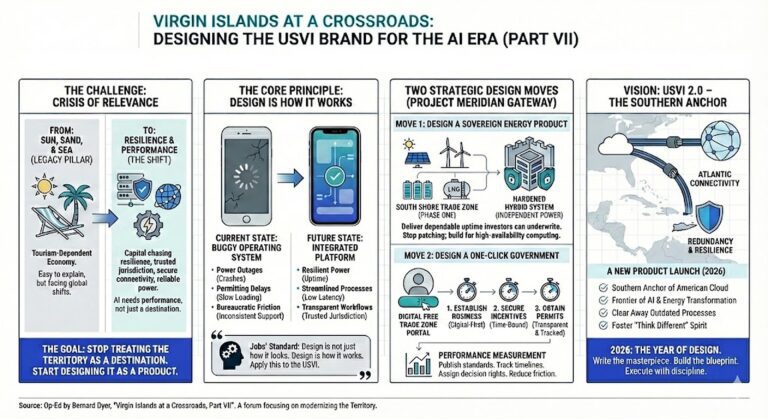
The United States Virgin Islands is not bankrupt. But we are facing a crisis of relevance.
For decades, our product was easy to explain: sun, sand, and sea. Tourism will remain a pillar of our economy. But as we enter 2026, the global economy is shifting. The capital shaping the next decade is chasing resilience, trusted jurisdiction, secure connectivity, and reliable power. Artificial intelligence and continuity-grade digital operations are not looking for another destination to visit. They are looking for places that can perform.
If we want the USVI to win, we must apply that design mindset to ourselves. We must stop treating the Territory only as a destination and start designing it as a product: an integrated platform for investment, innovation, and national resilience.
Design is How it Works
If the USVI were an app on your phone, would you keep using it? Or would you delete it because it crashes too often (power outages), loads too slowly (permitting delays), and offers inconsistent support (bureaucratic friction)?
Investors evaluate jurisdictions like operating systems. Our hardware is strong: geography at an Atlantic crossroads, under the U.S. flag and U.S. dollar, with an enforceable rule of law.
Software is where we must improve. A grid that fluctuates is not a nuisance. It is a defect that breaks uptime assumptions. A permitting process that takes years is not “thorough.” It is latency that kills deals. When workflows are opaque, capital goes elsewhere.
Reinvention means debugging our operating system with discipline. We cannot call ourselves a Digital Harbor if the lights flicker. We cannot invite the world’s most advanced companies to our shores if we force them to navigate processes that feel stuck in the past.
Think Different Governance
Jobs launched “Think Different” to celebrate builders, people willing to challenge assumptions and create new realities. The USVI needs that spirit as a governing philosophy.
We cannot compete with Florida or Texas on scale, or with larger neighbors on low-cost labor. So we must compete on differentiation. Our differentiation is real: outside the continental U.S. congestion zone, yet inside the U.S. legal and currency zone; Caribbean by culture, yet constitutional by law. That combination can be a premium advantage in the AI era, but only if we match it with execution.
Two design moves matter most.
First, design a sovereign energy product. We must stop pretending we can patch our way into the AI economy with a grid that was never built for high-availability computing. The digital economy routes around instability. In the USVI Economic Development Authority’s South Shore Trade Zone, we should build a dedicated, independent power system as a Phase One deliverable under Project Meridian Gateway. A hardened hybrid system anchored by solar, wind, storage, and an LNG bridge can deliver dependable uptime that investors can underwrite from day one.
Second, design a one-click government. Modern platforms win because they reduce friction. In a Digital Free Trade Zone, the pathway to establishing a business, securing incentives, obtaining permits, and reaching groundbreaking milestones should be digital-first, time-bound, and transparent. Publish service standards. Track timelines. Assign decision rights. Measure performance. If it takes months to navigate basic approvals, the design has failed.
The Virgin Islands Needs a Reality Distortion Field
Steve Jobs was famous for his ability to make people believe the future was inevitable. The Virgin Islands needs our own version of that force: vision, paired with execution.
The USVI can be the southern anchor of the American cloud. Redundancy in St. Croix should be framed as resilience in an era of cyber threats, climate shocks, and geopolitical uncertainty. And the diaspora should see coming home not as a step backward, but as a chance to build at the frontier of AI, energy transformation, and Atlantic connectivity.
A New Product Launch: USVI 2.0
Project Meridian Gateway is the engineering roadmap: cables, data centers, and power. But engineering without identity is just concrete and wire. This year, 2026, should be treated as a product launch.
The old version depended heavily on the seasonal winds of tourism. The new version must be powered by the constant current of the digital economy. That requires clearing away outdated processes, slow decision cycles, inefficient monopolies, and the “it can’t be done” mindset that kills opportunity before it arrives.
The world is searching for the next innovation hub built on a trusted jurisdiction, resilient infrastructure, and strategic geography. We do not need to wait for someone else to design it. It is time we design it ourselves.
2026: The Year of Design
Last year, this column asked hard questions about where we are. In 2026, Virgin Islands at a Crossroads is focused on where we are headed. Over the next 12 months, we will build a blueprint, defining the pillars of Project Meridian Gateway and translating them into measurable actions with clear owners and firm deadlines.
We are at a crossroads. One path leads back to comfortable stagnation. The other leads to a North Star: a Virgin Islands that commands respect not only for its beaches, but for its brilliance.
The script is blank. The pen is in our hand. Let us write a masterpiece.
Read the first six parts of the series here:
Op-ed: Virgin Islands at a Crossroads: Act Now or Miss the Next Global Economic Wave
Op-ed: Virgin Islands at a Crossroads, Part II: Anchoring the AI Economy at the Digital Gateway of the Americas
Op-ed: Virgin Islands at a Crossroads, Part III: Building the Workforce of the AI and Diversified Clean Energy Economy
Op-Ed: Virgin Islands at a Crossroads, Part IV: Powering the Future — Transforming the Virgin Islands’ Energy Landscape
Op-Ed: Virgin Islands at a Crossroads, Part V: The Superpower of the U.S. Virgin Islands and Why Our Strategic Location Matters Today
Op-Ed: Virgin Islands at a Crossroads, Part VI: Project Meridian Gateway: Building America’s Digital Harbor in the United States Virgin Islands
— Bernard Dyer is a veteran technologist and co-host of WSTX AM 970’s Community Digest radio program. He writes the Virgin Islands at a Crossroads series to challenge the status quo and design a sovereign, modern future for the next generation.
Editor’s Note: Opinion articles do not represent the views of the Virgin Islands Source newsroom and are the sole expressed opinion of the writer. Submissions can be made to visource@gmail.com.