The US Virgin Islands Chess Federation is proud to announce its delegation to the 46th FIDE Chess Olympiad, to be held September 15–27, in the historic Silk Road city of Samarkand, Uzbekistan.(Submitted photo)
The Olympiad will bring together more than 200 national teams for two weeks of elite competition, cultural exchange, and global celebration of chess.
Samarkand, known as one of the major corridors through which early chess spread westwards, will host players in the state-of-the-art Silk Road Complex and EXPO Center, with full accommodations provided by the organizers for all official team members.
USVI Delegation
The US Virgin Islands will field both an Open Team and a Women’s Team, each consisting of five players and a team captain, as confirmed in the federation’s official notice to players.
Open Team
• FM William Van Rensselaer
• Naitik Jhanwar
• Patrick Miller
• Darryl Allen
• Marco Emile
• Captain: Sinclair Wilkinson
Women’s Team
• Dejw Wrensford
• Anne Kershaw
• Lois Williams
• Kalima Williams
• Dru Ubben
• Captain: John Dempsey
Gail Widmer will serve as Head of Delegation, coordinating all logistics with the Olympiad Organizing Committee.
An Historic Opportunity
The 2026 Olympiad promises to be one of the most significant chess events ever held in Central Asia. As noted in the invitation, “chess unites people regardless of nationality, language, or cultural boundaries” and the event will “serve to further strengthen cooperation and mutual understanding between nations.”
USVICF President Sinclair Wilkinson expressed pride in the teams: “Our players have worked hard to earn their place on the world stage. Representing the Virgin Islands at the Olympiad is both an honor and a responsibility, and we look forward to showcasing our talent in Samarkand.”
AARP Virgin Islands, alongside top government officials and community leaders, has issued a unified call to action in observance of Elder Abuse Awareness Month this June, highlighting the urgent need to protect older adults andvulnerable residents across the territory.Troy A. De Chabert-Schuster, State Director, AARP Virgin Islands (Submitted photo)
In a joint statement, AARP Virgin Islands joined the Office of the Lieutenant Governor, the Office of the Attorney General, the Department of Human Services, the Disability Rights Center of the Virgin Islands, and community partners to reaffirm their shared commitment to preventing elder abuse in all its forms.
Elder abuse can include physical harm, emotional mistreatment, neglect, financial exploitation, and other forms of harm that threaten the safety, dignity, and independence of older adults. The statement emphasizes that many cases go unreported due to fear, isolation, or lack of awareness.
With the Territory’s older adult population continuing to grow and national estimates showing that one in ten older adults experience some form of abuse, leaders stress that a strong, coordinated response is essential.
The joint effort outlines key priorities for 2026, including:
Strengthening enforcement and penalties for abuse and financial exploitation
Expanding reporting systems and requirements
Improving coordination across agencies
Increasing public awareness, prevention programs, and community education
“Elder abuse is often hidden, but its impact is devastating,” said Troy A. De ChabertSchuster, State Director of AARP Virgin Islands. “This joint commitment sends a clear message: in the Virgin Islands, we will not look away. We are coming together across agencies and communities to protect our older residents, raise awareness, and ensure
that every person can age with dignity, respect, and security.”
“These efforts reflect our shared commitment to building a system of protection that is proactive, responsive, and centered on dignity and safety for every Virgin Islander,” the statement notes.
Leaders are also encouraging residents to stay informed, speak up, and support efforts to prevent abuse, reinforcing that safeguarding older adults is a collective responsibility across the community.Signatories to the Joint Statement
The joint statement was signed by the following leaders:
Troy A. De Chabert-Schuster, State Director, AARP Virgin Islands
Tregenza A. Roach, Esq., Lieutenant Governor, U.S. Virgin Islands
Gordon C. Rhea, Esq., Attorney General, U.S. Virgin Islands
Averil E. George, Commissioner, Department of Human Services
Angus Drigo, Executive Director, Disability Rights Center of the Virgin Islands
Keisha L. Richards, Chief Executive Director, St. Thomas Federal Credit Union
The Department of Public Works advises the community of a temporary road closure on Melvin Evans Highway between the Sunny Isle and Home Depot intersections to allow for median maintenance.
The westbound lane will be closed tomorrow, Wednesday, June 3, followed by the eastbound lane on Thursday, June 4. Closures will be in effect from 9 a.m. to 12 p.m. on both days.
Motorists are urged to use alternate routes and follow posted detours during this time.
The Department of Public Works appreciates the community’s patience and cooperation as it works to improve road conditions throughout the territory.
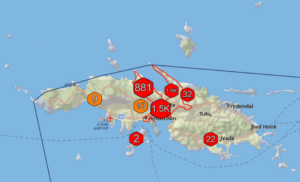
All feeders were restored as of approximately 11:59 PM. We appreciate your patience and support throughout this event. If you are experiencing an isolated outage, please report it at https://www.viwapa.vi/customer-service/report-outage-or-problem or call 340-774-3552 (Option 4). Our Dispatch team monitors outage reports 24/7.
Gov. Albert Bryan Jr. has submitted the final executive budget of his administration, proposing a roughly $1.63 billion Fiscal Year 2027 spending plan built around investments in housing, infrastructure, recreation, and long-term economic growth.
The proposal, submitted Friday to the 36th Legislature, includes a $958.2 million General Fund budget and comes under the theme, “Investing Today for the Communities of Tomorrow: Infrastructure, Recreation and Housing.” While the General Fund represents the locally funded core of government operations, the broader $1.63 billion budget includes additional governmental funds and revenue sources supporting agencies and programs across the territory.
The proposed budget supports 6,570 full-time government positions and directs the largest share of spending toward general government functions, which account for approximately $979.8 million. Education remains one of the largest spending categories at $229.1 million, while Public Housing and Welfare would receive $200.2 million. Together, those two areas account for more than $429 million in proposed spending. Public safety is budgeted at $84.6 million, Health and Human Services at $71.3 million, transportation and facilities at $63.6 million, and culture and recreation at $9.9 million.
At the center of the administration’s proposal is an expectation that government revenues will continue to grow. The budget projects General Fund revenues of $958.2 million in FY2027, compared with a revised FY2026 estimate of approximately $848.8 million. Total gross revenues are projected to reach nearly $1.04 billion, up from about $930.8 million in the current fiscal year.
Several major revenue categories are expected to increase. Gross receipts tax collections are projected to rise from approximately $230.4 million this year to nearly $245 million in FY2027. Real property tax revenues are forecast to increase from $55 million to $56.2 million, while trade and excise taxes are expected to grow from $37.7 million to $43 million. Hotel and non-room taxes, a key tourism-related revenue source, are projected to increase from $64.4 million to $68.6 million.
Income taxes continue to represent the government’s largest revenue source. Individual income tax collections are projected at approximately $428 million, while corporate income taxes are forecast at $72.4 million. Combined income tax revenues are expected to total roughly $465.4 million in FY2027.
The budget also anticipates a substantial increase in revenues associated with ongoing mitigation and recovery activities. Those revenues, which include withholding taxes, gross receipts taxes, excise taxes, and related contributions tied to recovery and mitigation work, are projected at approximately $111.5 million in FY2027, compared with about $33.2 million in the revised FY2026 estimate.
In a statement accompanying the budget submission, Bryan said the proposal reflects both the progress made during his administration and the territory’s continued economic momentum.
“As we submit the final Executive Budget of the Bryan-Roach Administration, we do so with confidence in the progress we have made and with a clear vision for the work still ahead,” Bryan said. “This budget extends a legacy of responsible fiscal management, accurate revenue forecasting, smarter government operations and the continued reduction of longstanding government debt. It is a financial plan rooted in discipline, but it is also a roadmap for people, progress and sustainability.”
Bryan also pointed to continued growth in tourism, housing development, private investment, and recovery-related construction as factors supporting the administration’s revenue projections.
“In plain language, the Virgin Islands economy is growing,” the governor said. “Our tourism product is expanding, private investment is increasing, recovery work is moving forward and our budget reflects a territory preparing for the future instead of merely reacting to the present.”
The administration is also proposing a $5 million contribution to the Budget Stabilization Fund, often referred to as the territory’s Rainy-Day Fund, while budgeting approximately $60.9 million for debt service payments. At the same time, some revenue sources are projected to decline. Transfers from the Insurance Guaranty Fund, for example, are expected to fall from $20 million in FY2026 to $10 million in FY2027, while total transfers into the General Fund are projected at $23.5 million, down from $33.6 million in the current fiscal year.
The proposal now moves to the Legislature, where senators will spend the coming months reviewing agency budgets, revenue assumptions, staffing levels, and spending priorities during annual budget hearings. Lawmakers may amend, reduce, or add items before adopting a final budget ahead of the start of the new fiscal year on Oct. 1.
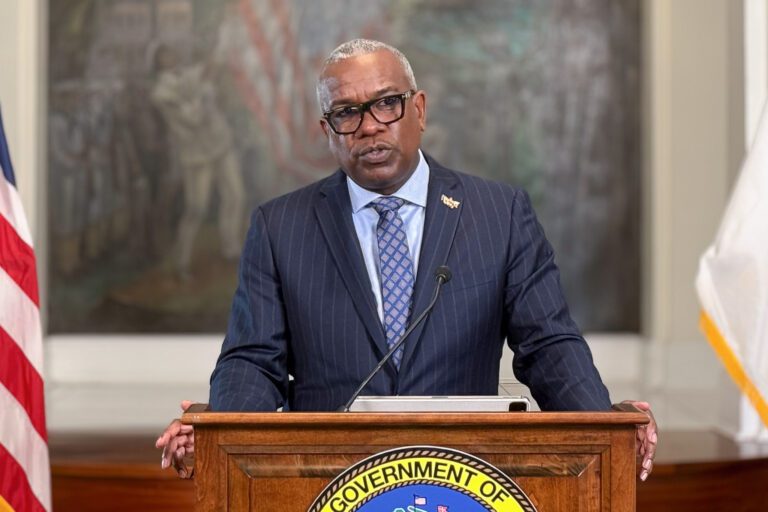
Lt. Gov. Tregenza Roach announced new direct flights to St. Croix from the New York City area and a potential $400 million resort and marina on Water Island. The widespread St. Thomas-St. John power outage continued. (Screenshot of V.I. Government House livestream)
Lt. Gov. Tregenza Roach delivered news Monday that, on almost any other day, might have been met with applause. But even new direct flights to St. Croix and a potential $400 million luxury resort — with a public land clawback – on Water Island couldn’t outshine the districtwide power outage darkening St. Thomas and St. John since Saturday.
The contrast between infrastructure demands and efforts to pull in tourists had been cast into even starker relief Sunday. Enormous LED-lit banners at New York City’s Citi Field flashed advertisements for the Virgin Islands precisely as mainland newspapers published an Associated Press article about the blackout.
Gov. Albert Bryan Jr. was at the game, photographed in a private suite with ice cream served in a miniature Mets helmet cup.
Roach downplayed the disparity at the press conference Monday afternoon, saying the Virgin Islands had capacity to both manage its internal infrastructure needs and launch large-scale advertising efforts to draw the tourists vital to the territory’s economy.
Roach likened the Virgin Islands’ predicament to working on a moving train, with many parts in motion, all needing attention.
“I know people are frustrated. I am frustrated as well. When the power goes off, it is not a small inconvenience,” Roach said. “Our residents have every right to expect better. Reliable power is not a luxury. It is a basic necessity and every outage reminds us how much work remains to be done to strengthen the system and restore confidence.”
Roach disagreed with calls for the territory to petition Washington for help. Locally, Sen. Ray Fonseca asked legislators to pass a resolution urging Bryan to reach out for federal help and Sen. Kenneth Gittens called for a forensic audit of the Water and Power Authority. Congressional Delegate Stacey Plaskett’s gubernatorial campaign issued a statement urging Bryan to request a state of emergency declaration.
Roach, however, said Virgin Islanders were capable of taking care of the WAPA problems.
“I do not agree with the call for federal intervention,” he said.
Bryan was in New York to speak at a Caribbean Tourism Organization conference, getting face time with other tourism deciders, Roach said.
“This is one of the region’s premier tourism gatherings, bringing together Caribbean leaders, tourism ministers and commissioners, and industry executives to discuss the future of Caribbean tourism, airlift, investment, culture, resilience, and regional competitiveness,” he said.
Similar efforts led to Roach’s first big announcement, he said: new direct United Airlines flights between Newark and St. Croix set to start Oct. 31.
The weekly 126-passenger flights were a “major milestone for St. Croix,” Tourism Commissioner Jennifer Matarangas-King said in a written statement earlier Monday. “As someone born and raised on St. Croix, I know firsthand how transformative direct connectivity to the New York market can be for our community, our businesses and our tourism economy,” Matarangas-King said.
Roach said it was a step toward achieving the island’s economic potential, one that required marketing St. Croix in a distinct and different fashion than St. Thomas and St. John.
“Economic development on St. Croix must have its own character and not simply follow the plan we’ve had for the St. Thomas-St. John District,” he said. “This island has a story worth telling and an experience worth sharing with the world.”
Would-be investors have presented the 36th Legislature with a proposal for a branded luxury resort on Water Island, another island with a story.
Coral Gables, Florida-based Bluewater Global Advisors — not Hermon Wouk — put a proposal before the Legislature to consider an 88-room hotel, restaurants, spa, marina, and up to 100 private residences, Roach said. Once operational, the hotel would likely produce up to $5 million annually in occupancy tax revenue.
“The project is more than a resort. It is a development that combines tourism, infrastructure, employee housing, and much needed community investment,” he said.
Roach said the project required at least $300 million to get going but would likely climb closer to $400 million. He said it “speaks to progress, investment, and long-term economic growth.”
The 100% self-sustaining project would create roughly 200 construction jobs and 300 permanent jobs, he said. It would add roads, drainage, utilities, and marine facilities.
“That means new revenue, new jobs, new infrastructure, and new economic activity without placing a new tax burden on Virgin Islanders,” Roach said.
The project would not impede public access to the Honeymoon Beach, popular with readers of Wouk’s book Don’t Stop the Carnival as a place to see the, perhaps mythological, green flash at sundown.
The beach and the tract of land directly above it would be removed from the existing land lease and returned to the government of the Virgin Islands.
“This is the type of private investment the Virgin Islands should be competing for: a project that creates jobs, expands our tourism product, strengthens infrastructure, protects public access, and generates long-term revenue for the government of the Virgin Islands,” Roach said. “Projects of this scale do not come around every day.”
Roach said it was up to the legislature to conduct their due diligence on the project. He was not aware of a potential timeline, he said.
The United States Virgin Islands will proudly host the 3rd Annual National Organization of Black Law Enforcement Executives (NOBLE) International Training Summit, scheduled for June 3–5, 2026, at the Westin Beach Resort &Spa at Frenchman’s Reef in St. Thomas.
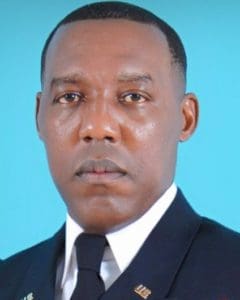
Virgin Islands Police Commissioner Mario M. Brooks (file photo)
As NOBLE celebrates its historic 50th Anniversary, this year’s international summit will be held under the theme: “Justice Without Borders: Global Practices Protecting the Vulnerable”
The summit is expected to bring together law enforcement executives, policymakers, government officials, academic institutions, nonprofit organizations, community leaders, and public safety professionals from across the United States, the Caribbean, and the global diaspora to engage in meaningful dialogue surrounding public safety, leadership, justice reform, international collaboration, and the protection of vulnerable communities.
Hosted in collaboration with the Virgin Islands Police Department (VIPD) and the Virgin Islands Peace Officer Standards and Training (POST) Council, the conference will highlight the U.S. Virgin Islands as a growing center for international public safety leadership and professional development.
Commissioner Mario M. Brooks expressed his enthusiasm for the territory being selected to host the prestigious event.
“The Virgin Islands Police Department is honored to welcome the 3rd Annual NOBLE International Training Summit to the US Virgin Islands. We extend our sincere gratitude to NOBLE for the tremendous work and continued support they provide throughout the Caribbean region in advancing law enforcement professionalism, leadership, training, and community partnerships. This summit represents another important opportunity to strengthen collaboration, share knowledge, and further our collective commitment to public safety and service excellence especially to all of us here in the Caribbean region.”
The multi-day summit will feature specialized law enforcement training sessions, international panel discussions, leadership development opportunities, networking forums, and collaborative initiatives focused on strengthening public safety partnerships and advancing global best practices.
Officials say the summit represents a significant opportunity to strengthen partnerships between regional and international law enforcement agencies while also showcasing the culture, hospitality, and strategic importance of the U.S. Virgin Islands.
NOBLE, founded in 1976, is one of the nation’s leading organizations dedicated to justice, equity, leadership, and excellence in law enforcement. The organization continues to advocate for progressive policing practices and stronger community partnerships worldwide.
For conference updates, registration information, and additional details, please visit: www.nobleinternationalaffairs.com
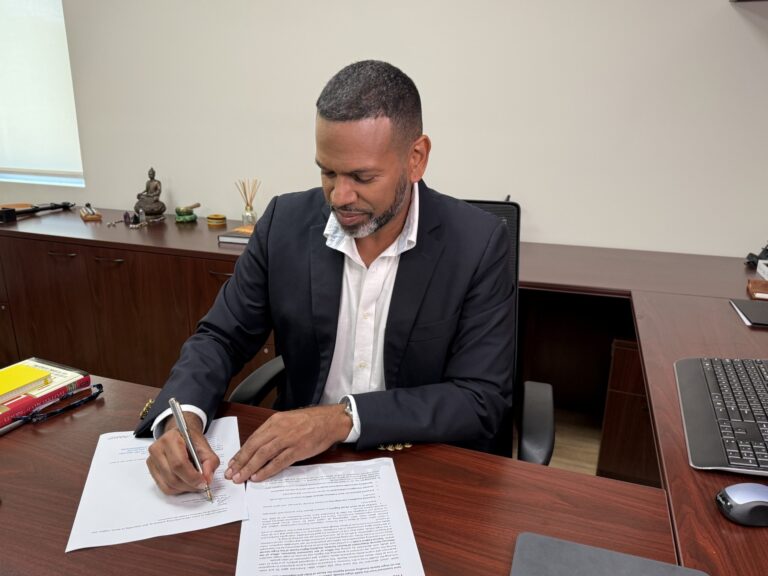
The University of the Virgin Islands today expressed sincere gratitude to the 36th Legislature of the Virgin Islands following the approval of $2.3 million in funding for the Virgin Islands Higher Education Scholarship Program, commonly known as the Free Tuition Program, through Bill No. 36-0296. The funding will support eligible students attending UVI for the Spring 2026, Summer 2026, and Fall 2026 semesters.
The funding approval marks an important step in ensuring continued access to higher education for Virgin Islands students and reinforces the Territory’s investment in opportunities, workforce development, and economic advancement.
“On behalf of the University of the Virgin Islands, I extend heartfelt gratitude to Sen. Novelle Francis and Sen. Kurt Vialet for working closely together to advance this important funding for Virgin Islands students,” said Dr. Safiya George, President of UVI. “I also thank Sen. Kenneth Gittens, bill co-sponsor, and all members of the 36th Legislature of the Virgin Islands for recognizing the importance of investing in the educational future of our students.”
Dr. George also expressed appreciation to Gov. Albert Bryan Jr., Lt. Gov. Tregenza Roach, and Office of Management and Budget Director Julio Rhymer for their continued support of the program and commitment to expanding educational access throughout the Territory.
“This funding will enable Virgin Islands students to continue pursuing their bachelor’s degrees at UVI, advance social mobility and contribute meaningfully to the Virgin Islands economy and workforce,” Dr. George said.
The Virgin Islands Higher Education Scholarship Program has played a significant role in expanding access to higher education for Virgin Islands residents. Originally established through legislation introduced by Lt. Gov. Roach while serving as a senator in the 32nd Legislature, the program was later expanded through legislation sponsored by Sen. Samuel Carrión through Act 8814 (formerly Bill No. 34-0236) to include part-time and online students. The measure broadened eligibility to support working adults, caregivers, single parents, and other nontraditional learners by requiring only six credit hours for participation.
During Academic Year 2025–2026, the program supported hundreds of students across the Territory. In Fall 2025, the Free Tuition Program served 404 students, including 338 full-time students and 66 part-time students. In Spring 2026, the program supported 405 students, including 332 full-time students and 73 part-time students.
The University notes that the legislation now awaits the signature of Gov. Bryan to become law, a step anticipated to proceed without concern.
“Thank you to our students and families for your patience and perseverance,” Dr. George added. “We remain committed to ensuring that higher education remains accessible and affordable for Virgin Islanders and look forward to welcoming the next generation of students to UVI.”
WAPA personnel continue repairing generation units and restoring service as additional capacity comes online at the Randolph Harley Power Plant. Fully restored feeders include: 5A, 9B, 7E, and 8B. Partial restoration has been achieved on Feeders 8A, 10B, 6B, and 7A. Restoration efforts remain ongoing as plant personnel work to safely return additional customers to service.
The Plaskett-Potter campaign is calling for urgent, decisive action in response to the devastating power outage that has left the residents of St. Thomas and St. John without electricity for more than 48 hours. This crisis is not an isolated incident; it is the latest chapter in a long, painful story of energy mismanagement that the people of the Virgin Islands can no longer afford to accept.
The V.I. Water and Power Authority’s online outage map showed thousands of St. Thomas customers had no power on Monday afternoon. (Photo courtesy WAPA)
Since coming to office, Congresswoman Plaskett has led federal efforts to support affordable reliable energy for the Virgin Islands. In 2017, she brought members of Congress to the Virgin Islands for oversight hearings after Hurricanes Irma and Maria, driving federal transparency measures across HUD, FEMA, and OMB during disaster recovery. In 2019, she called for a state of emergency for energy in the Virgin Islands and gave detailed reasons and outcomes in a public letter. Plaskett co-led in Congress the Expediting Disaster Recovery Act in 2023 to streamline oversight and reduce barriers to accountability, and in 2024 personally secured the visit of the U.S. Energy Secretary to assess WAPA’s reliability failures.
Most recently, after multiple days of power loss to St John, Congresswoman Plaskett again sent a letter to Governor Bryan asking that he request a federal state of emergency and gave potential outcomes for having that federal declaration.
This past March, Senate President Milton Potter took decisive action for Virgin Islanders suffering under WAPA’s relentless blackouts. He introduced landmark legislation to compensate residents for losses, including spoilt food and appliances destroyed by repeated power outage periods.
“It is unconscionable that this has become the norm and that we believe its unfixable,” said Congresswoman Stacey E. Plaskett. “Families are sitting in the dark, seniors and disabled residents are at risk, food is spoiling, businesses are shutting down, and people are getting no real answers. The frustration you all feel – we feel. While I can bring resources and make recommendations, only the local executive team has the power to execute those resources.”
“The time for half-measures and excuses is over,” said Senate President Milton E. Potter. “Our people are suffering. We have real solutions, and we are ready to implement them from day one, but the crisis in front of us right now demands action today, not tomorrow.”
The Plaskett-Potter campaign is calling on current leadership to act immediately, demanding the following actions without delay:
Transparency for the People
Virgin Islanders deserve to know what is happening and why. WAPA and the government must immediately end information blackouts and communicate regularly and clearly with the public so that families, businesses, and caregivers can plan and prepare.
Declare a State of Emergency on Energy and Request a Federal Disaster Declaration
This will unlock access to federal resources, technical expertise, and an expedited permitting process to bring temporary generation assistance to both St. Thomas and St. John.
Immediate Focus on Transmission and Distribution (T&D) System Maintenance
The federal government has tools available right now. The U.S. Department of Energy’s Section 202(c) emergency powers have been used to provide vegetation management for transmission corridors in Puerto Rico. The same approach must be applied here.
Additionally, battery systems can be procured under FEMA’s prudent replacement authority (428) or added under FEMA 406 mitigation, where project worksheets already exist for substations.
Increase Funding for the Local ECAP Program
The Energy Crisis Assistance Program, which provides critical support to elderly and disabled residents, has been capped at just $500,000 since 2011; a figure that is wholly inadequate given today’s costs and needs. That funding must be increased immediately to protect our most vulnerable neighbors.
Immediately Roll Out the Virgin Islands Resiliency Gateway
This program, designed specifically to support medically vulnerable residents by providing portable battery systems capable of powering essential appliances and medical equipment during outages, must be deployed now. People’s lives depend on it.
The Plaskett-Potter campaign urges all Virgin Islanders to visit plaskettpotter.com. This crisis demands accountability, urgency, and leadership, and the evidence of our ability to deliver all three is clear. We are the only gubernatorial campaign with a public platform, and we intend to be the administration that finally gets it done.






 The funding approval marks an important step in ensuring continued access to higher education for Virgin Islands students and reinforces the Territory’s investment in opportunities, workforce development, and economic advancement.
“On behalf of the University of the Virgin Islands, I extend heartfelt gratitude to Sen. Novelle Francis and Sen. Kurt Vialet for working closely together to advance this important funding for Virgin Islands students,” said Dr. Safiya George, President of UVI. “I also thank Sen. Kenneth Gittens, bill co-sponsor, and all members of the 36th Legislature of the Virgin Islands for recognizing the importance of investing in the educational future of our students.”
Dr. George also expressed appreciation to Gov. Albert Bryan Jr., Lt. Gov. Tregenza Roach, and Office of Management and Budget Director Julio Rhymer for their continued support of the program and commitment to expanding educational access throughout the Territory.
“This funding will enable Virgin Islands students to continue pursuing their bachelor’s degrees at UVI, advance social mobility and contribute meaningfully to the Virgin Islands economy and workforce,” Dr. George said.
The Virgin Islands Higher Education Scholarship Program has played a significant role in expanding access to higher education for Virgin Islands residents. Originally established through legislation introduced by Lt. Gov. Roach while serving as a senator in the 32nd Legislature, the program was later expanded through legislation sponsored by Sen. Samuel Carrión through Act 8814 (formerly Bill No. 34-0236) to include part-time and online students. The measure broadened eligibility to support working adults, caregivers, single parents, and other nontraditional learners by requiring only six credit hours for participation.
During Academic Year 2025–2026, the program supported hundreds of students across the Territory. In Fall 2025, the Free Tuition Program served 404 students, including 338 full-time students and 66 part-time students. In Spring 2026, the program supported 405 students, including 332 full-time students and 73 part-time students.
The University notes that the legislation now awaits the signature of Gov. Bryan to become law, a step anticipated to proceed without concern.
“Thank you to our students and families for your patience and perseverance,” Dr. George added. “We remain committed to ensuring that higher education remains accessible and affordable for Virgin Islanders and look forward to welcoming the next generation of students to UVI.”
The funding approval marks an important step in ensuring continued access to higher education for Virgin Islands students and reinforces the Territory’s investment in opportunities, workforce development, and economic advancement.
“On behalf of the University of the Virgin Islands, I extend heartfelt gratitude to Sen. Novelle Francis and Sen. Kurt Vialet for working closely together to advance this important funding for Virgin Islands students,” said Dr. Safiya George, President of UVI. “I also thank Sen. Kenneth Gittens, bill co-sponsor, and all members of the 36th Legislature of the Virgin Islands for recognizing the importance of investing in the educational future of our students.”
Dr. George also expressed appreciation to Gov. Albert Bryan Jr., Lt. Gov. Tregenza Roach, and Office of Management and Budget Director Julio Rhymer for their continued support of the program and commitment to expanding educational access throughout the Territory.
“This funding will enable Virgin Islands students to continue pursuing their bachelor’s degrees at UVI, advance social mobility and contribute meaningfully to the Virgin Islands economy and workforce,” Dr. George said.
The Virgin Islands Higher Education Scholarship Program has played a significant role in expanding access to higher education for Virgin Islands residents. Originally established through legislation introduced by Lt. Gov. Roach while serving as a senator in the 32nd Legislature, the program was later expanded through legislation sponsored by Sen. Samuel Carrión through Act 8814 (formerly Bill No. 34-0236) to include part-time and online students. The measure broadened eligibility to support working adults, caregivers, single parents, and other nontraditional learners by requiring only six credit hours for participation.
During Academic Year 2025–2026, the program supported hundreds of students across the Territory. In Fall 2025, the Free Tuition Program served 404 students, including 338 full-time students and 66 part-time students. In Spring 2026, the program supported 405 students, including 332 full-time students and 73 part-time students.
The University notes that the legislation now awaits the signature of Gov. Bryan to become law, a step anticipated to proceed without concern.
“Thank you to our students and families for your patience and perseverance,” Dr. George added. “We remain committed to ensuring that higher education remains accessible and affordable for Virgin Islanders and look forward to welcoming the next generation of students to UVI.”