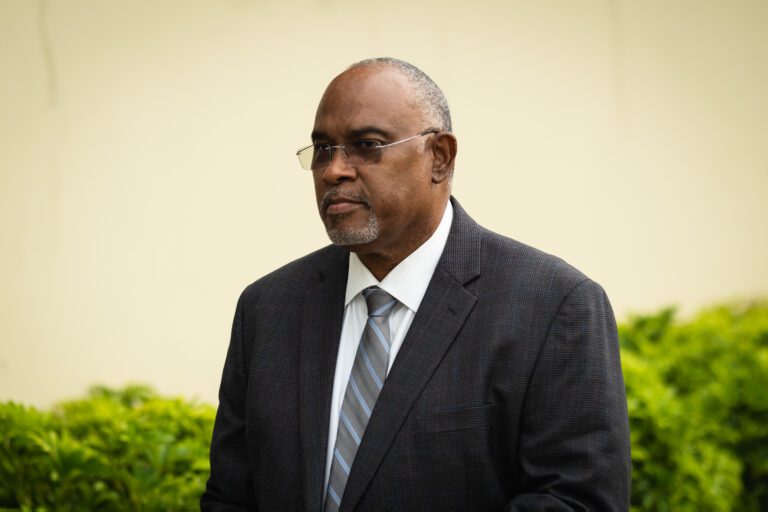
Former Police Commissioner Ray Martinez was sentenced Tuesday to 10 years in federal prison following his conviction on corruption-related charges tied to a bribery and fraud scheme involving government contracts. (Source photo by Kit MacAvoy)
A federal judge Tuesday sentenced former V.I. Police Commissioner Ray Martinez to 120 months in prison for his part in a kickback scheme involving a convicted felon-turned cybersecurity contractor, federal assistance funds and an attempted cover-up.
Tuesday’s hearing at the federal courthouse on St. Thomas was the first of three high-profile sentencings slated for this week. A sentencing hearing for Martinez’s codefendant, former V.I. Management and Budget Director Jenifer O’Neal, is scheduled for Thursday. David Whitaker, the contractor who became an informant and cooperating witness against multiple high-ranking government officials and who later pleaded guilty to wire fraud and bribery, is set to be sentenced Wednesday.
A jury in December found Martinez and O’Neal guilty of honest services wire fraud, bribery concerning federally funded programs and money laundering conspiracy after prosecutors showed how Whitaker traded expensive gifts so that Martinez would approve invoices for work performed by Whitaker’s company, Mon Ethos Pro Support. After helping Whitaker secure a nearly $1.5 million VIPD contract funded through the federal American Rescue Plan Act, the trio contrived to inflate invoices and use the proceeds to fund Martinez and O’Neal’s respective side businesses, Don Felito’s Cookshop and Java Grande.
The 10-year sentence handed down by U.S. District Court Judge Mark Kearney Tuesday was longer than the 60-72 months sought by Martinez and his attorneys but well below the 292-365-month range outlined by federal sentencing guidelines. Alexandre Dempsey, a trial attorney for the U.S. Justice Department’s Public Integrity Section, said Tuesday that 292 months — more than 24 years — was the ceiling for the government’s recommendation but that an “extreme period of incarceration” was warranted.
“He wanted a golden parachute,” Dempsey said, adding that Martinez tried to protect the restaurant by transferring his ownership interest to family members shortly after his conviction. “He tried to steal this money or keep it from going back to the people of the Virgin Islands.”
Multiple people who spoke on Martinez’s behalf Tuesday described a dedicated law enforcement officer, community leader and role model who made the mistake of keeping bad company. Martinez’s wife, V.I. Police Lieutenant Diana Martinez, withdrew her character testimony after Kearney said he was concerned about the restaurant transfer and a lack of transparency about the family’s finances. Martinez himself addressed the court for 45 minutes, during which he asked for leniency and apologized directly to his supporters, his former VIPD colleagues and his family. He lamented that his actions cast law enforcement in a bad light and talked about the family milestones he’ll miss while incarcerated. Upon his release, he told Kearney that he wishes to work with the American Civil Liberties Union and do outreach work.
Kearney said Martinez’s history of public service, age, documented health issues and low likelihood of recidivism factored into his decision to grant the defendant’s request for a shorter sentence than the one outlined by federal guidelines. However, he said, recorded conversations played for jurors at trial clearly demonstrated that Martinez was aware of the scheme’s criminal nature. That awareness extended to Martinez’s attempts to obstruct justice in ways that “only a police commissioner would know,” Kearney said.
Martinez’s incarceration will be followed by three years of supervised release. He was also ordered to forfeit $127,000 — the approximate value of the gifts he received from Whitaker — and pay more than $77,000 in restitution as well as a $5,000 fine and $900 special assessment fee.
The U.S. Virgin Islands has made progress in several key measures affecting children and families over the past five years, but significant challenges remain in education, economic opportunity, and housing, according to new KIDS COUNT data released Tuesday.
The findings come as the Annie E. Casey Foundation released its 2026 KIDS COUNT Data Book, a national report examining child well-being across the United States. While the territory is not included in the report’s state rankings because the U.S. Census Bureau’s American Community Survey is not conducted in the Virgin Islands, local data compiled by St. Croix Foundation’s KIDS COUNT USVI initiative paints a picture of both progress and persistent concerns.
Among the report’s bright spots, the territory’s unemployment rate declined from 6% in 2019 to 4% in 2024. Public school graduation rates also rose sharply, increasing from 70.9% to 81% during the same period.
Student performance in English Language Arts showed improvement as well, with the percentage of students reaching proficiency climbing to its highest level since the 2020-21 school year.
Those gains, however, were accompanied by troubling trends.
Math proficiency declined compared to 2020-21 levels, and 546 students dropped out of the public school system between the 2020-21 and 2023-24 school years. Annual dropout rates during that period ranged from 2.2% to 4%, according to KIDS COUNT USVI data.
Economic indicators also revealed ongoing disparities. While unemployment fell, average hourly wages in the territory remained 24% below the national U.S. average.
Health data showed continued population declines reflected in lower fertility rates and fewer live births in 2023. The Virgin Islands Department of Health also reported that 5.3% of babies born that year had a low birth weight.
In the area of family and community well-being, the report found that the number of households with children living in public housing increased despite an overall decline in the territory’s child population — a trend that suggests a growing share of children are living in economically disadvantaged housing situations.
The report’s release also renewed attention to longstanding concerns about data collection in the territory.
In a statement accompanying the release, St. Croix Foundation noted that the Virgin Islands continues to be excluded from some major national data sets and faces challenges related to delayed reporting, outdated tracking systems, and limited coordination among agencies responsible for collecting and sharing information.
“Behind every number in this report is a child who is either hungry or fed, housed or homeless, progressing academically or falling behind. No state is consistently getting this right,” Annie E. Casey Foundation President and CEO Lisa M. Lawson said in a statement. “The Data Book challenges us to follow the evidence and do what delivers results.”
This year marks the first time the national KIDS COUNT Data Book includes a comprehensive score for each state rather than relying solely on rankings. The new scoring system evaluates 16 indicators across four categories — economic well-being, education, health, and family and community factors — over a five-year period from 2019 through 2024.
To supplement the national report, St. Croix Foundation annually publishes territory-specific KIDS COUNT USVI reports. In 2024, the organization launched the territory’s first interactive KIDS COUNT USVI Data Dashboard, providing public access to local child well-being indicators.
The 2026 national KIDS COUNT Data Book is available through the Annie E. Casey Foundation, while Virgin Islands-specific reports and data can be accessed through St. Croix Foundation’s KIDS COUNT USVI program.
Public Services Commission Chair David Hughes raised concerns Tuesday about the performance and reliability of Wartsila generators installed as part of WAPA’s power generation modernization efforts in the St. Thomas-St. John District.. (Photo courtesy WAPA)
The four new generators at the heart of the St. Thomas-St. John district electrical grid aren’t just cutting-edge technology, they’re unique experiments that the long-troubled Water and Power Authority might have been better served avoiding, the Public Services Commission chair said Tuesday.
Commission Chair David Hughes called out the generators during the commission’s monthly meeting after Sen. Carla Joseph asked if there were similar generators in Trinidad and Tobago, which also uses Wartsila generators.
“These were, to answer your question, to my knowledge, the only three engines that Wärtsila has ever produced like that, and they were somewhat experimental. And they are clearly not working out very well. And they have not sold another engine of this type to anybody since. They were probably an ill-advised purchase by WAPA,” Hughes said. There is no one running this engine anywhere that I am aware of because they have not sold a single other one to a sole entity.”
A Wartsila-driven power plant in Tobago runs on hybrid liquefied natural gas and diesel, different from St. Thomas’ Randolph Harley Power Plant.
Wartsila, the Finland-based manufacturer of the generators, touted the generators as leaps forward after signing a contract with the Virgin Islands in 2020. The engines can run on diesel or propane, giving the territory options when fuel supplies fluctuate.
“In addition to being Wärtsilä’s first engine/hybrid power plant sale, this will also be the first installation utilising the Wärtsilä 32LG engine – a flexible, multi-fuel engine capable of operating with hydrocarbons in the range from propane to LFO, or carbon number C3 to C20 – a landmark in the company’s development of engine solutions,” the company wrote on its website.
Six years later, after a lengthy installation and testing phase, the engines have struggled to run on liquefied propane. The generators were taken offline in 2025 after a massive failure. Similar breakdowns resulted in a more-than-48-hour complete districtwide power outage in May. This week, a transmission failure on Wartsila 3 has also led to rotating outages on St. Thomas-St. John, though WAPA Chief Executive Officer Karl Knight said that crews have been on the ground troubleshooting.
WAPA officials have — for years and again Tuesday — said the idea behind the dual diesel-and-LPG-fuel systems gave the utility a nimbleness it didn’t previously have.
Outside consultants from Cartersville, Georgia-based J. A. Wright and Associates, wanted to look at the contracts WAPA had signed with Wärtsilä to ensure testing requirements and warranties against defects were in place. The PSC did not have the funds to pay the consultants to do a deep dive into the paperwork, however, commission members said.
Tuesday, Knight assured the commission testing and warranty provisions were in place. In fact, crews from the utility were in Wisconsin in late May to observe testing of emergency generation equipment bound for St. John, a WAPA spokesperson said.
The commission voted to keep the LEAC electrical rate at 22.2226 cents per kilowatt hour through Sept. 30.
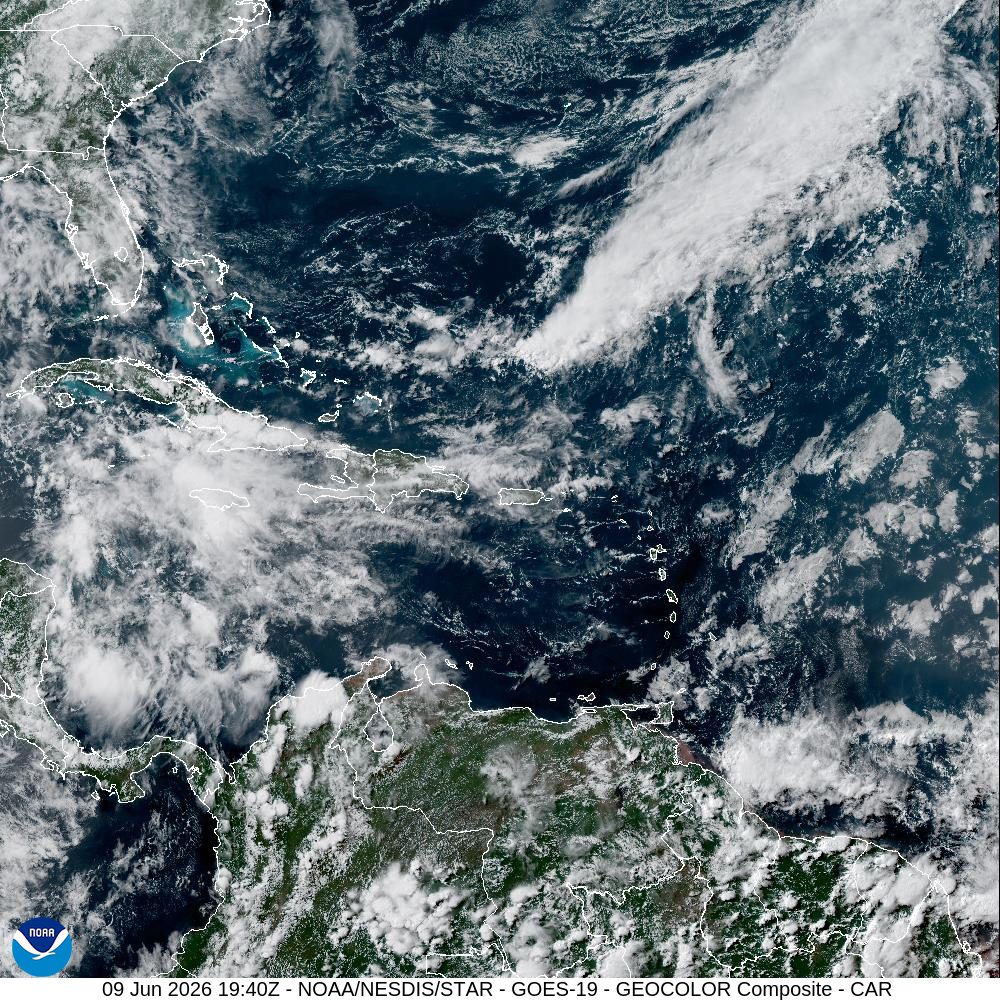
Visible satellite imagery at 3:40 p.m. on Tuesday shows clouds and areas of moisture stretching across the northeastern Caribbean on Tuesday. (Photo courtesy NOAA)
The Atlantic hurricane season began on June 1, and the Atlantic basin remains quiet, while the Eastern Pacific is already active. However, forecasters are closely watching part of the Gulf for possible tropical development later this month, although dry air and wind shear continue to limit most tropical activity.
First Tropical Outlook of the Season
This is the first Virgin Islands Source Tropical Outlook of the 2026 Atlantic hurricane season. The outlook is part of a semi-regular Source weather update intended to keep readers informed about tropical activity across the Atlantic basin, the Caribbean, and nearby regions during hurricane season.
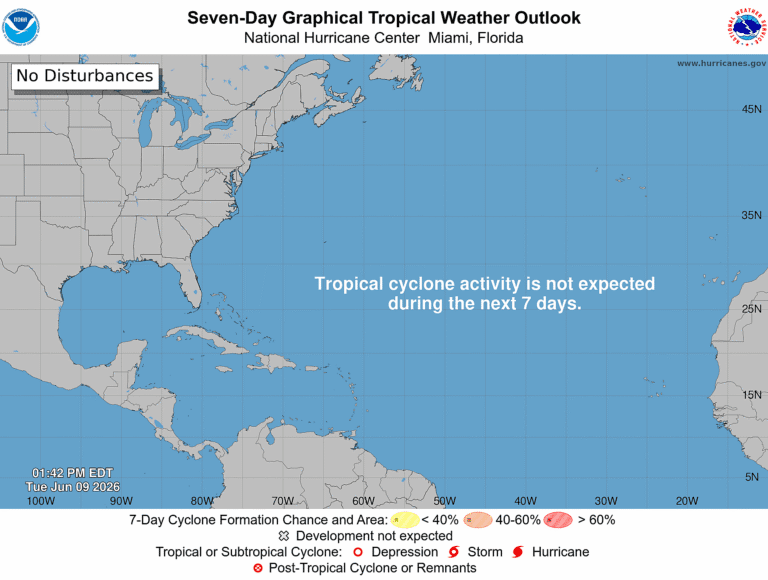
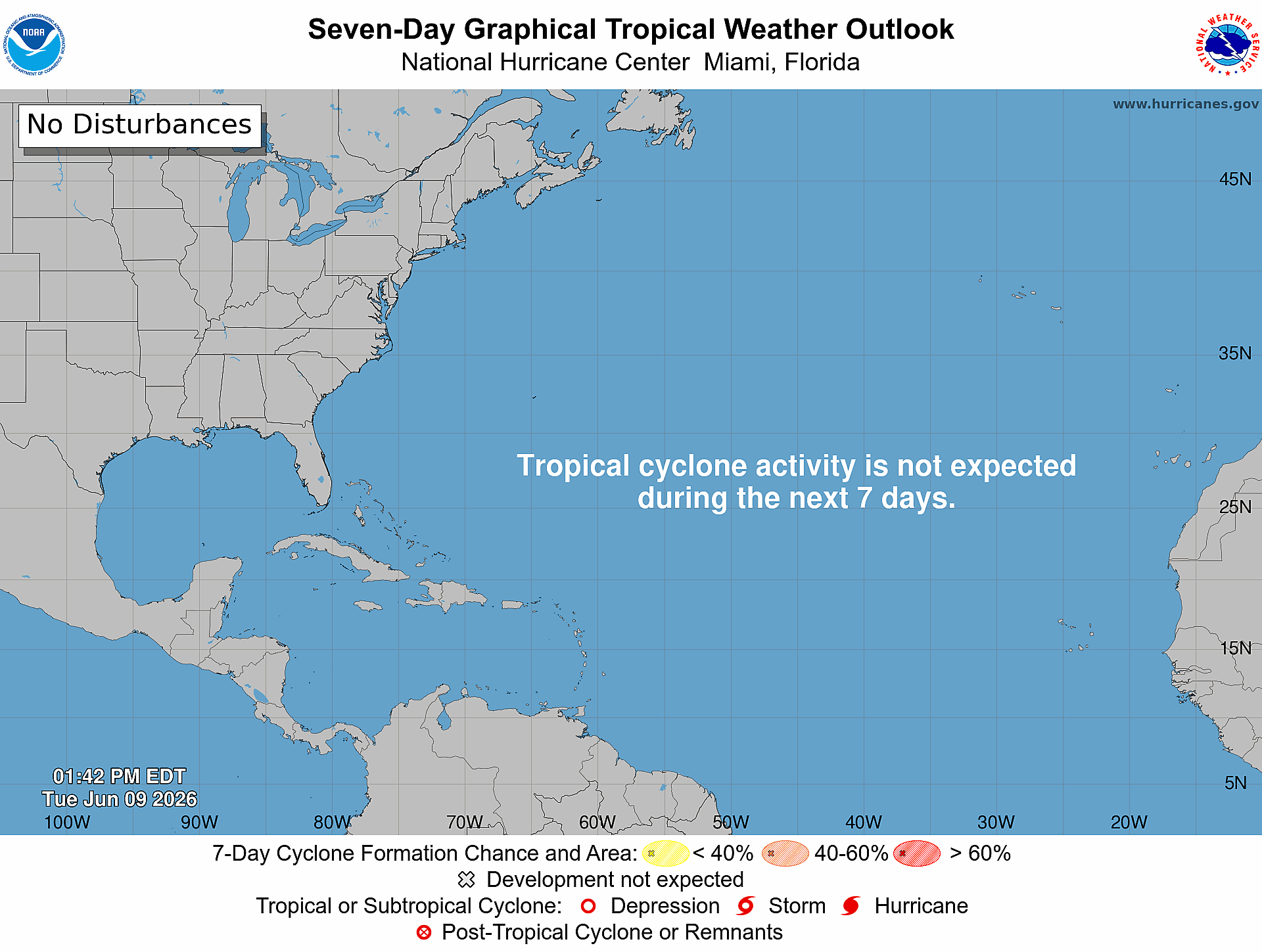
As of Tuesday, the National Hurricane Center said tropical cyclone formation is not expected across the North Atlantic, Caribbean Sea, or Gulf during the next seven days. However, the NHC’s Tropical Weather Discussion noted several tropical waves moving westward across the Atlantic and Caribbean, although none of those waves is expected to develop into a tropical system at this time.
As of Tuesday, the National Hurricane Center does not expect cyclonic development across the Atlantic basin in the next seven days. (Photo courtesy NHC)Low Chance of Development in the Gulf Later in June
While the Atlantic remains quiet overall, the Gulf will be one area to monitor in the coming days.
“A trough or weak low-pressure center may emerge from the Yucatán Peninsula into the Bay of Campeche, on Thursday through Friday night accompanied by numerous showers and thunderstorms, along with fresh to strong winds and building seas,” according to the NHC.
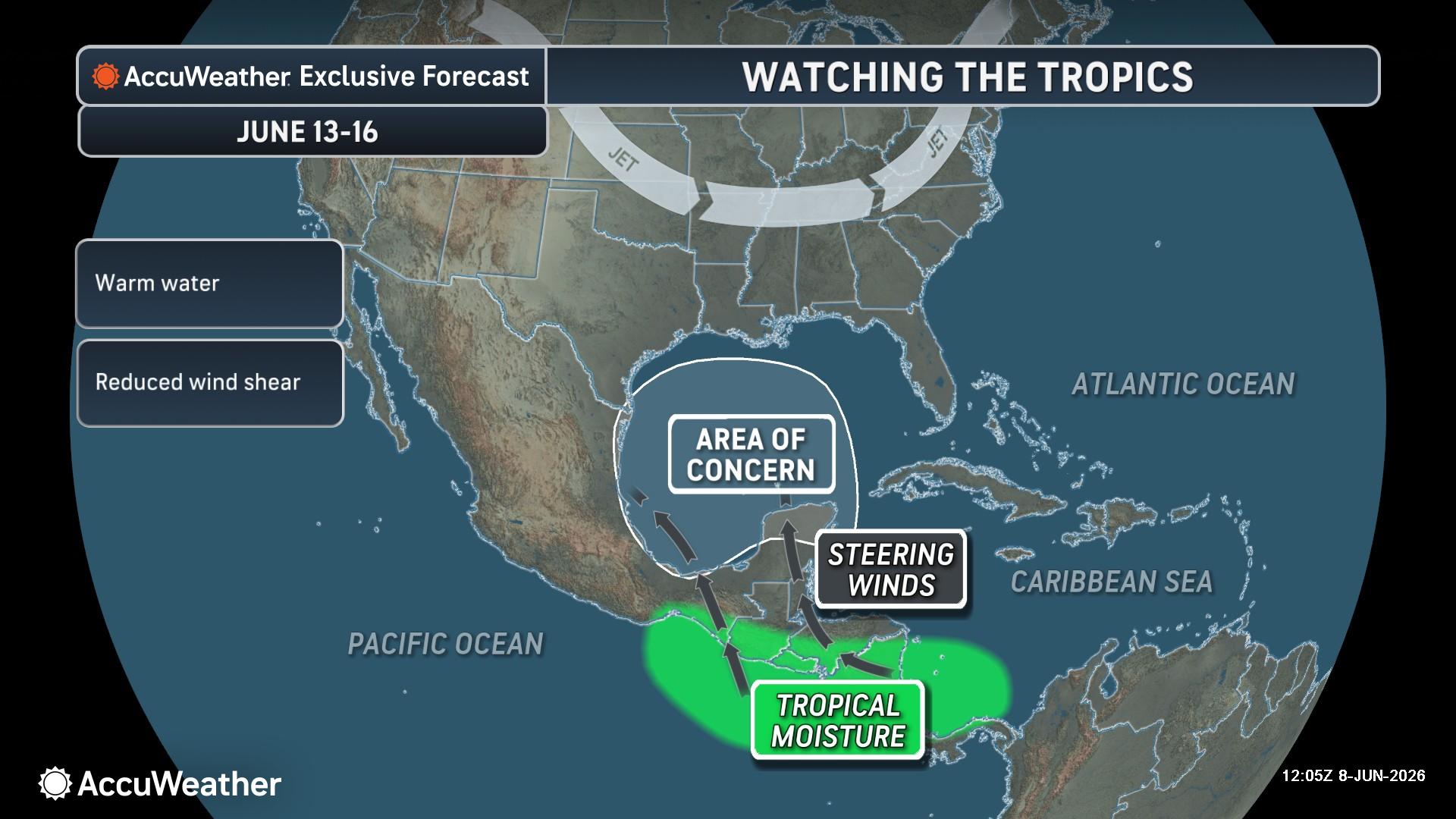
AccuWeather has noted that the Gulf could experience possible cyclonic development later in June, although the chances are relatively low. (Photo courtesy AccuWeather)
Alex DaSilva, lead hurricane expert at AccuWeather, told the Source that the Gulf will be one area to watch, although any development chances remain low.
“We are currently watching the Gulf for possible development toward the middle of the month,” DaSilva said. “Some moisture may come over from a tropical rainstorm that we are tracking in the Pacific. Any development chances are low, but we need to watch this area closely. After that, there doesn’t look to be anything in the near term. Most of the tropical waves this year have been choked out by dry air and wind shear,” he continued.
Eastern Pacific Already Active
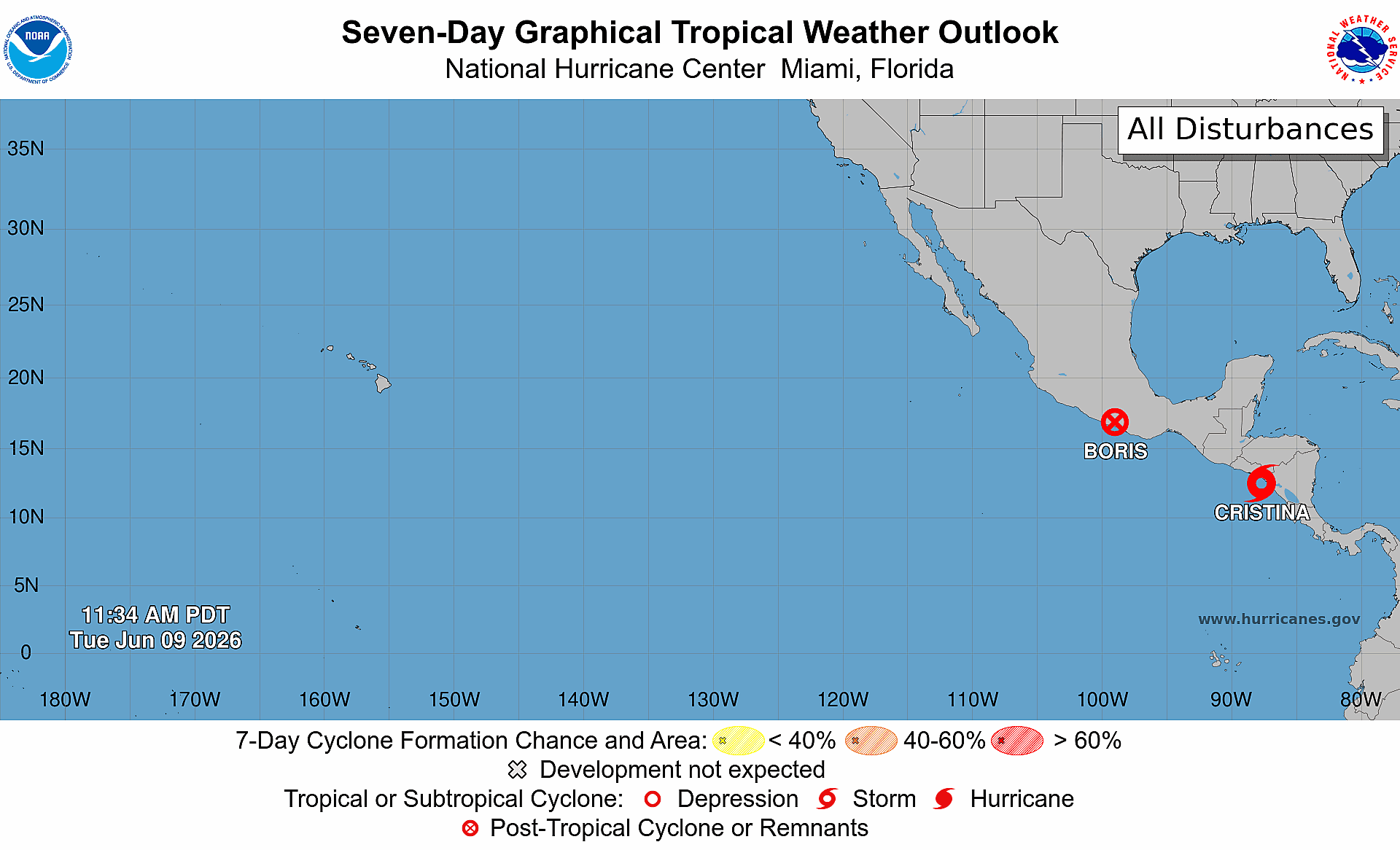
The Eastern Pacific basin, meanwhile, has been active, with three named systems having developed already. Tropical Storm Amanda developed earlier in June. As of Tuesday, the NHC was issuing advisories on Post-Tropical Cyclone Boris, located just inland over southern Mexico and Tropical Storm Cristina, located near the northwestern coast of Nicaragua. No additional tropical cyclone formation is expected in the Eastern Pacific during the next seven days.
The NHC has reported that the Eastern Pacific basin is already active with tropical systems. (Photo courtesy NHC)
DaSilva said the early activity is not unexpected, although the basin is running ahead of schedule climatologically.
“The average second-named storm in the Eastern Pacific is June 24, so we are ahead of schedule. This is not surprising as we have been forecasting an active Pacific season with early season development. Sometimes, if there are a lot of storms in the Eastern Pacific, it can help to increase wind shear in the Atlantic,” DaSilva noted.
Although additional tropical activity is not expected in the Eastern Pacific during the next seven days, there are signs that the basin will continue to produce storms.
According to the latest Global Tropics Hazards Outlook from the Climate Prediction Center, a weekly report released every Tuesday by the National Oceanic and Atmospheric Administration, the Pacific will have elevated chances of tropical development during the middle to latter half of June. The Atlantic basin is anticipated to stay quiet.
The longer-range forecast also indicated that Puerto Rico and the U.S. Virgin Islands could see drought conditions persist or worsen.
A Potentially Below-Average Atlantic Hurricane Season
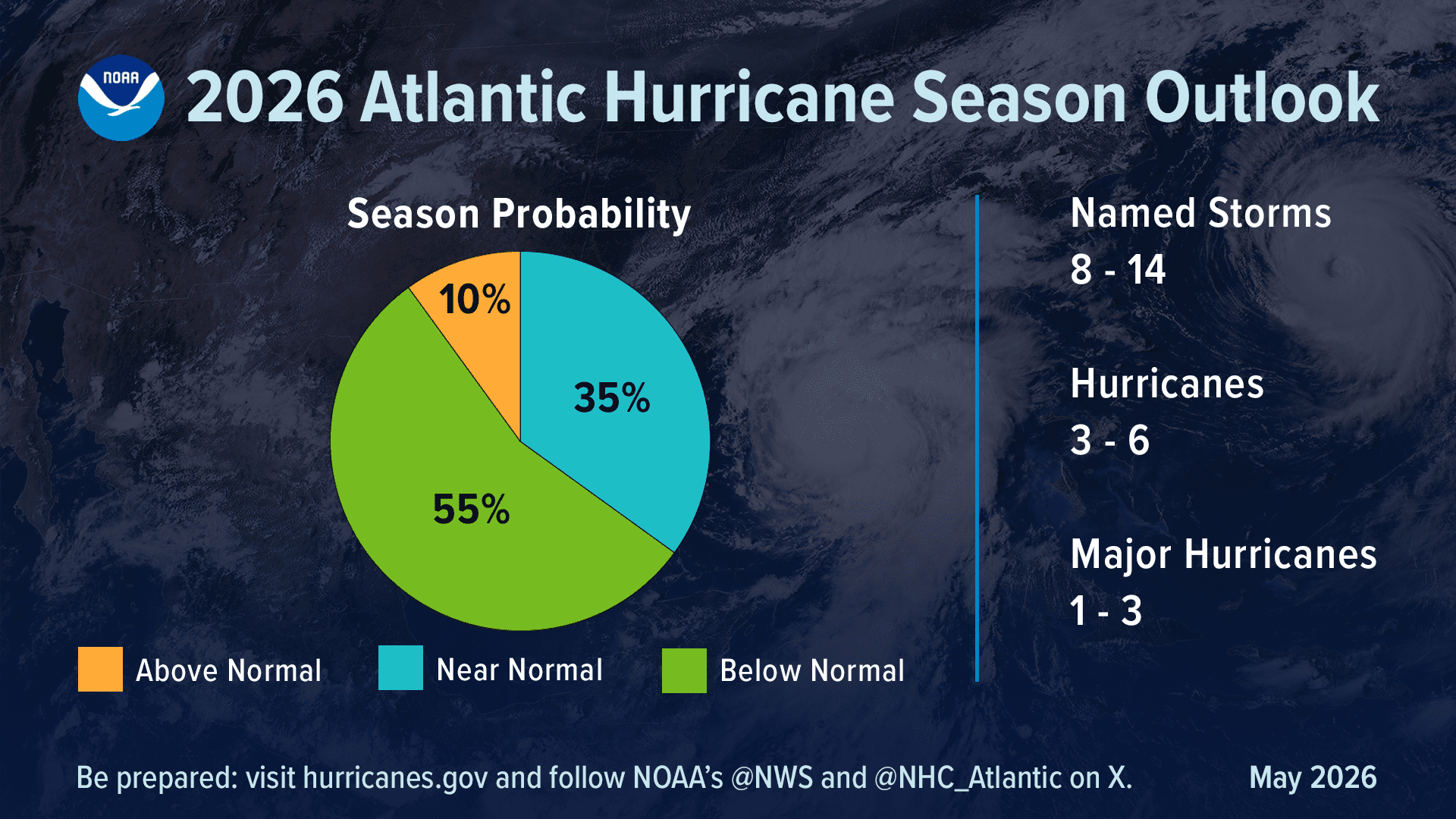
As the Source previously reported, the NOAA expects a below-normal season in the Atlantic, due in large part to El Niño, which involves a warming of the equatorial Pacific Ocean. El Niño usually helps to increase wind shear – a change in wind direction and velocity with height in the atmosphere – in the Atlantic Ocean.
NOAA’s NHC has predicted a below-average 2026 Atlantic hurricane season, although the agency warns that individuals should not let their guard down. (Photo courtesy NOAA)
The increase in wind shear from El Niño helps to disrupt storms and prevent hurricane formation and intensification. This is the opposite of a La Niña cycle, when the ocean waters across the equatorial Pacific cool significantly. During La Niña, wind shear typically decreases in the Atlantic, and a reduction in wind shear can favor cyclone development.
Nevertheless, while El Niño can help to increase wind shear in the Atlantic basin, it tends to decrease across the Eastern and Central Pacific basins, typically helping to create conditions that are more conducive to cyclonic development.
Importantly, wind shear is only one component of hurricane development, and residents and visitors should remain prepared across the Atlantic and Caribbean despite the possibility of a below-average season. It only takes one storm to cause massive devastation.
Local Weather: Heat, Dust and Some Rain Chances
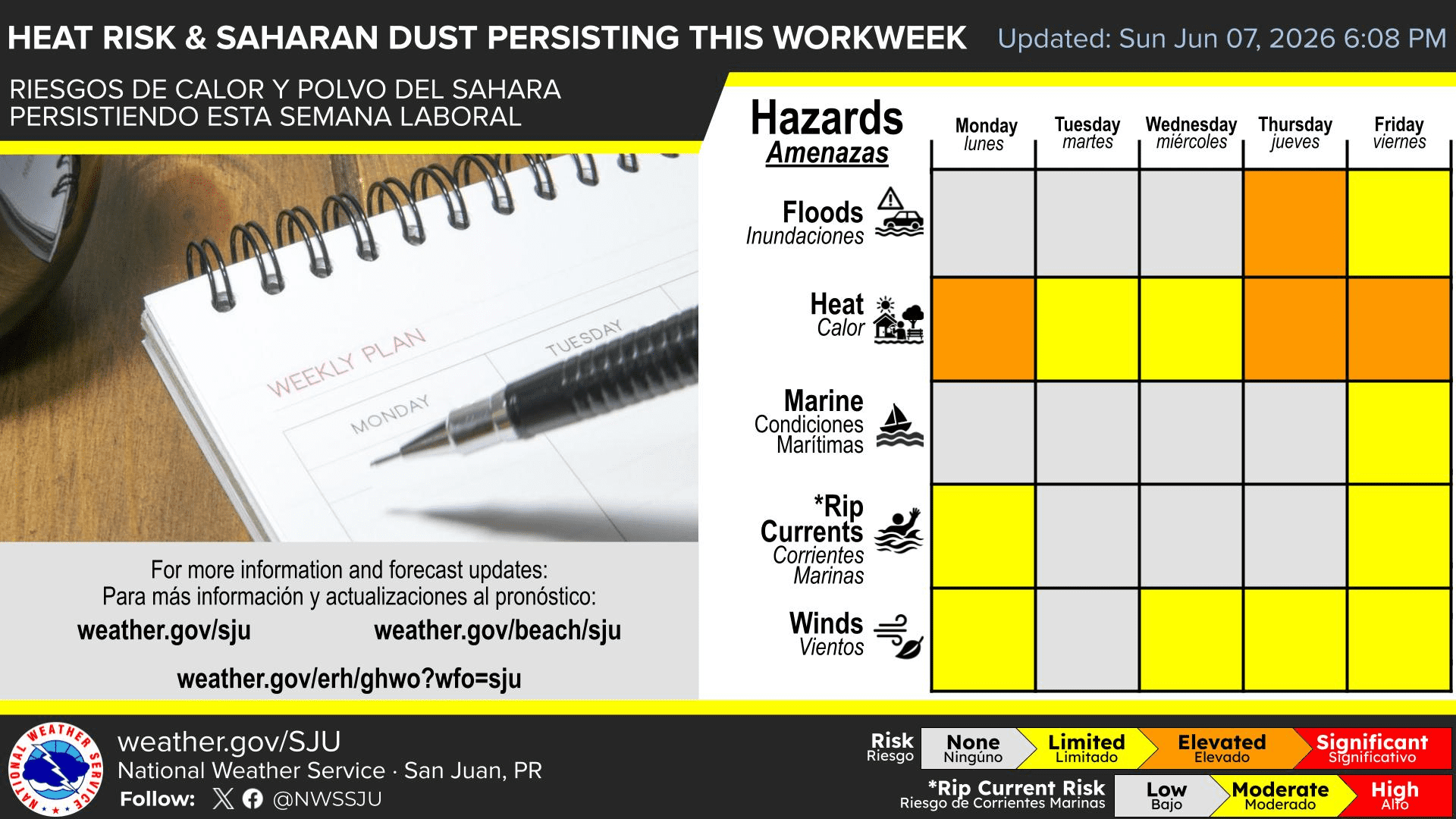
Across Puerto Rico and the U.S. Virgin Islands, the main local concerns this week include dangerous heat, traces of Saharan dust, and a possible increase in shower and thunderstorm activity later in the week, as well as gusty winds. The National Weather Service in San Juan, Puerto Rico, explained the local conditions in its Area Forecast Discussion on Tuesday.
A National Weather Service graphic highlights the main weather hazards expected this week. (Photo courtesy NWS)
“Dangerous heat will continue through at least midweek,” the NWS said. “Heat indexes will exceed 100°F, especially across urban, coastal, and lower-elevation areas of Puerto Rico and the U.S. Virgin Islands.”
The NWS issued heat advisories across the region on Monday and Tuesday, and additional alerts may be issued later in the week. Residents and visitors across both U.S. territories are encouraged to stay as cool as possible to avoid heat-related illnesses.
“A wetter and more unstable weather pattern is expected on Wednesday and especially Thursday, as a tropical wave interacts with an approaching upper-level trough, increasing the coverage of showers and thunderstorms across the region. The greatest risk of flooding will occur on Thursday,” the NWS stated.
The NWS also noted that minor concentrations of Saharan dust will be prevalent in the atmosphere, causing a hazy sky.
Finally, marine conditions around the islands are expected to remain somewhat choppy at times, and a moderate risk of rip currents is forecast from Thursday through early next week, particularly along east- and north-facing beaches in Puerto Rico and the U.S. Virgin Islands.
Forecast Updates
Information regarding the weather across the USVI, including marine forecasts, is available from the NWS and NOAA. The latest tropical forecasts can be viewed on the official website of the NHC.
The local forecast is regularly updated on the Source Weather Page, and a weekly video forecast is available. Additionally, residents and visitors can view weather alerts and disaster preparedness information from the Virgin Islands Territorial Emergency Management Agency
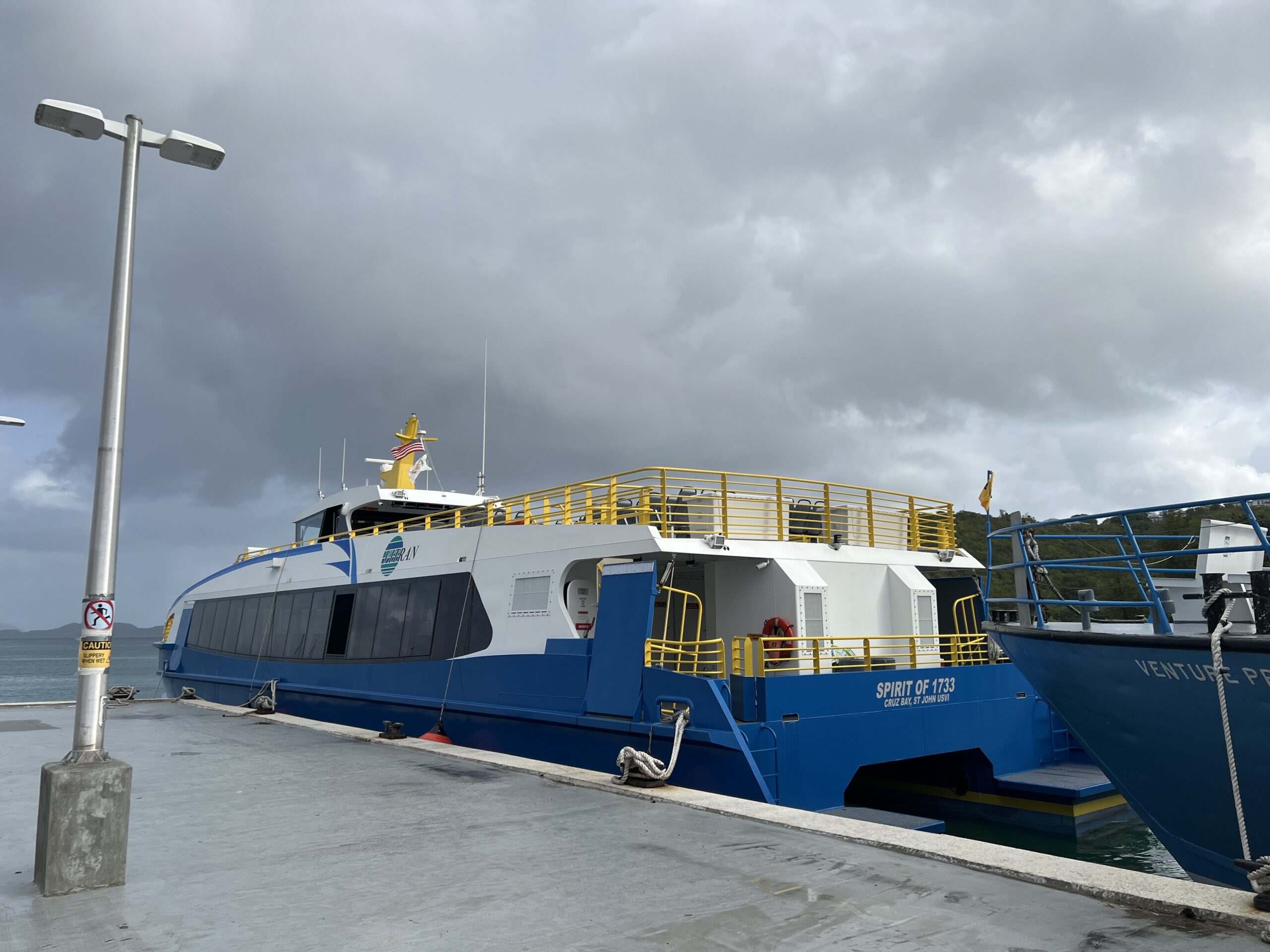
The territory’s ferry operators asked for 75 cents more per ticket to cover fuel cost increases. They got 66 cents. (Source photo by Amy H. Roberts)
Virgin Islands ferries between St. Thomas and St. John will be allowed to charge $0.66 more per ticket for the next three months to help alleviate costs from the spike in fuel prices, the Public Services Commission voted Tuesday.
The industry had asked for a $0.75 increase in May but the commission, which also oversees rates for the territory’s utilities, briefly considered $0.60 or $0.65 before settling on $0.66. The commission voted to have the increase end after 90 days.
There was some question about how the ferry companies — Varlack Ventures and Transportation Services — arrived at $0.66 but no question about the staggering increase in fuel prices. The ferry companies were paying as much as $7.68 per gallon, officials said.
The fuel relief came as the commission sought to assess and rearrange how the ferries charged passengers. A report drafted in late April suggested the industry may be making more money than allowed. Virgin Islands law allows the companies between 8% and 10% profit, according to the report. On $85 million revenue annually, the companies were collecting $7 million too much, the report said.
Commission chair David Hughes suggested the fuel surcharge could be taken from that $7 million rather than passed on to customers. A sticking point, however, was that the report and its findings had not been officially recognized or accepted by the commission. An attorney for the ferry industry had lodged a last-minute list of objections to the report that the commission did not address Tuesday because commissioners had not been able to read it on short notice.
Ferry operators have long rankled at regulation, a situation not alleviated by the commission’s inquiry into how the operations collect and spend their money. Most recently, the commission sought, and failed, to audit fuel consumption per route, per day, per year in an effort to pinpoint precisely how much money the companies needed to turn a profit between 8% and 10%.
“We have not accomplished the goal of the audit, which was to understand the fuel consumption of the three boats,” Hughes lamented. “We have data integrity issues and this is a big number that needs to be checked.”
The commission was also considering changing how the ferries charged — not just ticket price, but who paid what. There were six classes of ferry rider, Hughes said, each paying a different rate: children, students, senior citizens, adult residents, adult nonresidents, and bulk ticket buyers.
Hughes suggested, once the commission better knew the ferries’ finances, tickets could be made free-for-all children and seniors, and possibly even all local adults as well.
“It’s an opportunity to do something special for the Virgin Islands residents,” he said.
If all Virgin Islanders rode for free, all visitors would have to pay around $11 to cover the lost revenue, he said.
Sen. Carla Joseph, an ex-oficio commissioner, acknowledged she didn’t know how much it cost to put baggage on the ferry, then suggested the rate be raised from $4 to $6, or even $10.
The Virgin Islands Police Department, the Virgin Islands National Park, and St. John Rescue responded to reports of a lifeless woman in the waters of Salt Pond, St. John on Thursday — five days ago. Unlike almost every other such death, none of those emergency responders will say what happened.
Friends of the woman said her name was Julia and that she had worked as a bartender at Coral Bay’s Surf Club Cantina for eight months. They were reluctant to say more.
Police said she was 41 years old and that an autopsy had been completed Saturday.
People at St. John Rescue, an all-volunteer organization, did not respond to questions about the death at first and then said they were unable to answer, referring inquiries to the National Park.
The Virgin Islands National Park sent the Source the following statement Tuesday evening: “On June 4, Virgin Islands National Park rangers responded alongside St. John Rescue and the Virgin Islands Police Department to an incident at Salt Pond Beach. The incident remains under investigation, and no additional information is available at this time. Salt Pond Beach remains open, and visitors are encouraged to remain vigilant in and around the water, be aware of boat traffic and wildlife, and follow all posted safety guidance.”
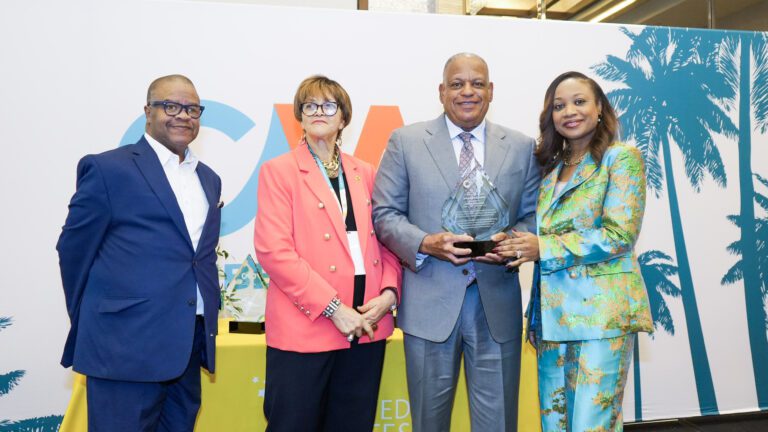
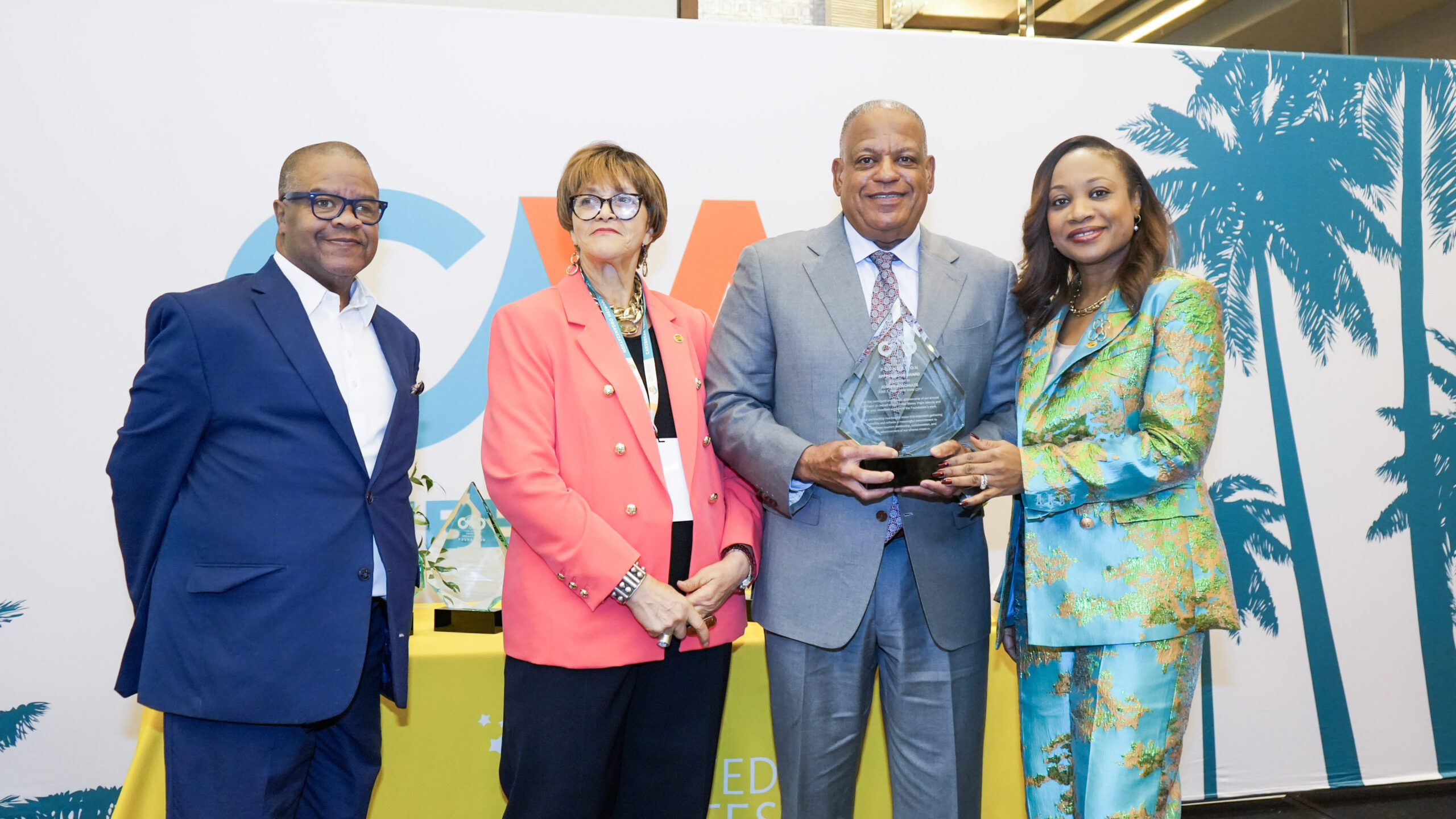
Caribbean Tourism Organization Foundation officials present an Appreciation Award to West Indian Company Limited President and CEO Joseph Boschulte during the organization’s annual awards luncheon held as part of Caribbean Week in New York City. The award recognized Boschulte’s contributions to Caribbean tourism and leadership within the U.S. Virgin Islands tourism industry. (Photo courtesy Tourism Department)
The Caribbean Tourism Organization Foundation honored West Indian Company Limited President and CEO Joseph Boschulte with an Appreciation Award during its annual awards luncheon held at Caribbean Week in New York City, a press release announced.
The award recognizes Boschulte’s contributions to Caribbean tourism and his leadership in advancing the U.S. Virgin Islands tourism industry throughout his career, according to the press release.
Caribbean Week is the region’s annual tourism event, bringing together government officials, industry leaders, media representatives and tourism stakeholders from across the Caribbean, the press release stated.
Before returning to WICO, Boschulte served as commissioner of the Virgin Islands Tourism Department, where he oversaw tourism initiatives that included expanded airlift, marketing campaigns and increased visitor arrivals, the release stated.
Boschulte accepted the award on behalf of tourism professionals and community members throughout the territory, the release stated.
“I am deeply honored to receive this recognition from the CTO Foundation,” Boschulte said. “This award reflects the dedication of the countless individuals across our tourism industry who create exceptional experiences for our visitors every day. I am proud to accept it on behalf of our entire U.S. Virgin Islands tourism community.”
According to the release, the award also recognizes the work of public- and private-sector partners who contribute to the visitor experience and support economic activity throughout the territory.
IN THE SUPERIOR COURT OF THE VIRGIN ISLANDS
DIVISION OF ST. CROIX
IN THE MATTER OF THE ESTATE OF
FRANK BROWN, JR
DECEASED.
SX-2026-PB-00051
NOTICE TO CREDITORS
NOTICE is hereby given that a Petition for Settlement without Administration Pursuant to Title 15, V.I.C. § 191 has been submitted to the Superior Court of the Virgin Islands for settlement of the Estate of Frank Brown Jr. All persons having claims against the estate are to present them to the Petitioner verified by affidavit, and persons indebted to the estate to make payment promptly to:
Rutha M.W. Brown
c/o Grey Law, PC
1131 King Street, Suite 301
Christiansted, U.S. Virgin Islands 00820
Tel: (340) 773-3660
Dated: June 9, 2026
/s/ Samuel T. Grey
Samuel T. Grey, Esq.
Attorney for the Petitioner
Shawn E. Leass was born on Feb. 19, 1964, in Findlay, Ohio, to Janice E. Leass and Ralph F. Leass. He was the youngest of his family. He loved deeply and was deeply loved by all who had the privilege of knowing him and being in his presence. Shawn and his sister spent their childhood summers at Findlay’s Riverside park and pool, as they always had season tickets to spend the summers there. Shawn was an excellent swimmer and developed quite a love for aqua activities then.
Shawn Leass
He received his education through Elida High School, in Lima, OH, and graduated from their automotive-mechanic program, in 1982. Upon graduation, Shawn enjoyed repairing race cars and racing them on speedway tracks. He thoroughly enjoyed traveling abroad. Along with some of his friends, Shawn discovered much adventure and opportunity in the Caribbean. He decided to move to St. Thomas, USVI, in the ‘90’s. It was there that he found self-employment as a scuba diver — maintaining boats and yachts, with much enthusiasm and provision for his livelihood. His favorite hobbies were to attend Rock and Roll concerts in the states, and perform as a bass guitar player for various pubs at ‘open mic nights.’ He had quite a collection of guitar picks from numerous concerts he had attended.
The St. Thomas community continues to mourn the loss of their beloved island musician, Shawn, as he was such a good friend to countless people. They have expressed both their surprise and sorrow at his untimely passing, resulting from an unexpected, tragic boating accident on the last night of St. Thomas’ annual ‘carnival,’ on Saturday evening, May 2, 2026.
He leaves behind a lifetime of memories to his mother, Jan E. Wooldridge, sister, Tracy M. Carr, brother-in–law, Cliff W. Carr and niece, Caralyn I. Dolney, and a host of loving uncles, aunts, cousins, and good friends.
A ‘Celebration of Life’ service is being planned to be held on Shawn’s birthday, Friday, Feb. 19, 2027, at Dan Hurley Home for Funerals and Cremation Centers, (340) 774-1464, at a time yet to be determined.
Funeral arrangements are under the care of Dan Hurley Home for Funerals and Cremation Centers of St. Thomas, St. John, and St. Croix. For online condolences or to share a special memory, visit www.hurleydavisfuneralhome.com
“For God so loved the world that He gave His one and only Son, That whoever believes in Him shall not perish but have eternal life.”John 3:16. (NIV)
In Economic Well-Being, the unemployment rate dropped from 6% to 4%, although average hourly wages remained 24% lower than the national U.S. average.
Public school graduation rates have increased significantly, from 70.9% to 81%, and there was an encouraging increase in student ELA scores, resulting in the highest percentage of proficient students for tested grade levels since SY 2020-21. In math, however, the overall scores and percentage of students proficient were lower than in SY 2020-21.
546 students have dropped out of the public school system between the 2020-21 school year and the 2023-24 school year, resulting in dropout rates between 2.2 and 4 percent per year for those school years.
In Health, the Virgin Islands Department of Health (VIDOH) reported that, in 2023, the fertility rate had decreased, and the overall number of live births continued to decrease along with the overall USVI population. Also in 2023, the VIDOH reported the percentage of babies born at low birthweight to be 5.3%.
In Family and Community, the number of households with children living in public housing increased, despite the overall decline in the number of children, signaling a higher percentage of children in economically disadvantaged housing.
In its 37th year of publication, the KIDS COUNT Data Book provides reliable statewide numbers to help leaders see where progress is being made, where greater support is needed, and which strategies are making a difference.
“Behind every number in this report is a child who is either hungry or fed, housed or homeless, progressing academically or falling behind. No state is consistently getting this right,” said Lisa M. Lawson, President and CEO of the Annie E. Casey Foundation. “The Data Book challenges us to follow the evidence and do what delivers results.” By offering a local road map, the Data Book equips policymakers, advocates, and communities with the information they need to make decisions that help children and young people thrive.
The 2026 national KIDS COUNT® Data Book can be accessed at www.aecf.org/databook. Virgin Islands KIDS COUNT publications and the Data Dashboard can be found by visiting St. Croix Foundation’s website at www.stxfoundation.org/kids-count-usvi/.
For more information about KIDS COUNT USVI, contact St. Croix Foundation at 340-773-9898 or kidscountusvi@stxfoundation.org.