Ana Elsa Osorio Benitez, of C’sted, St. Croix, passed away on Sunday, May 3, 2026. She was 89 years old.
Ana Elsa Osorio Benitez
She is preceded in death by her mother, Maria Christina Benitez; father, Sotero Osorio; grandparents, Julia Ayala Rosa and Anastacio Benitez; sister, Lydia Osorio; brothers, Julio Ramon Osorio, Victor Manuel Osorio, and Angel Ramon Osorio; nieces, Sandra, Sonia, Gladys, and Judy; nephew, Luis Angel Osorio; aunts, Juanita “Jenny”, Benita, Isidra “Chira”, and Selina; uncles, Ernesto, Richard, and Saturino; cousins, Luz “Cookie” Serrano (Best Friend), Elsie Ortiz, Luz “Lucy” Calderon, Milagros “Millie” Cepeda, and Carlos “Charlie” Calderon.
She is survived by her son, Angel “Rafie” Rodriquez; daughter-in-law, Maria Morales; sister-in-law, Josefina Serrano Osorio; sisters, Ana Ilda Osorio, and Juana Maria Osorio; brother, Angel Iran Osorio; nieces, Maria Christina, Luisa, Ruth, Chrissy, Mercedes, and Punchy; nephews, Milton, Richie, and Willie; great niece, Krizia; great-nephews, Omar, Carlito, Max, Xavier, Chris, Daniel, William, Eddie, and Orlando; special friends, Chikita, Carpio, James, Dinorah, Wanda, Biboy, Eulogio, Rosa Frias, and Maria Lourdes Santiago; cousins & other relatives, Maggie, Alba, Juliana, Nerieda, Sally, Gigi, Ramon, Lizza “Nicky”, Cherise “Shanty”, Carla Calderon, Marie Elsie Calderon, Carlos Calderon, III, Carlos “Landy” Calderon, Sr., Evalise Calderon, Carlos “Orlandito” Calderon, Ernst “Cuso” Schuster, Jr. (Elaine “Pinky” Schuster), Eusebio “Chebby” Cepeda, Orlando “Bundy” Ortiz, and Florencio “Cito” Ortiz (Franchesca “Frannie” Ortiz); other cousins, relatives and friends too numerous to mention.
Memorial service will be held on Saturday, June 20th at the James Memorial Funeral Home Chapel, located at 6AA Estate La Grande Princess, Christiansted St. Croix, USVI at 10:00 am.
Cremation arrangements are entrusted to Schuster’s Crematorium, LLC.
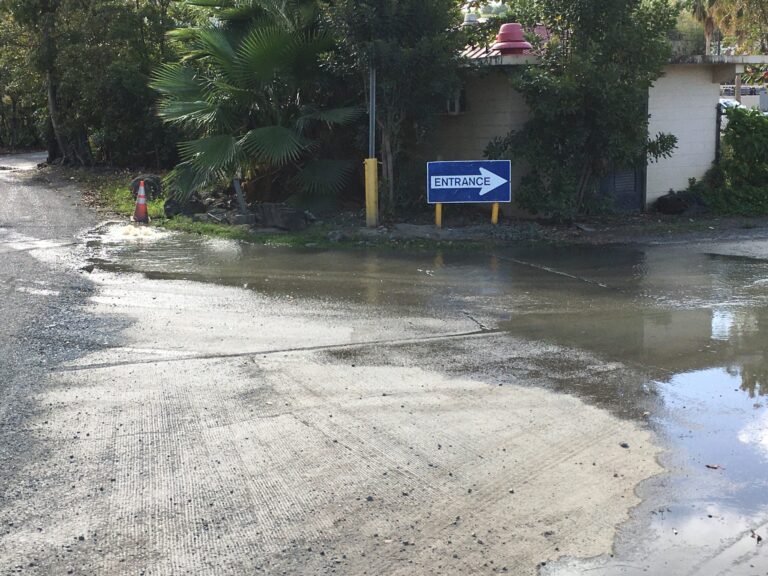
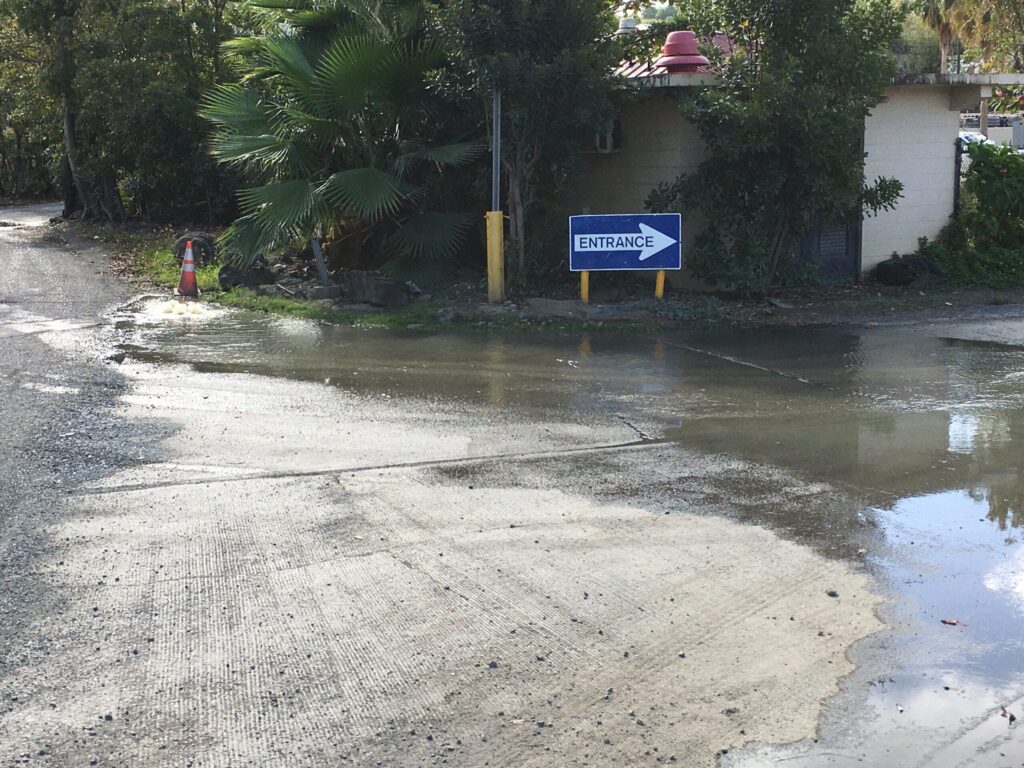
Monday and Tuesday from 10 p.m. to 6 a.m. the Department of Public Works conducts road repairs along a portion of Benburin “Benny” Stephens Drive in the Bovoni area of St. Thomas.
DPW contractor – Grace Civil LLC — has previously completed several segments of the Bovoni roadway and will return to the area adjacent to the Puma Gas Station to complete the remaining section of the project. To minimize disruptions for motorists and residents, construction activities will take place overnight from 10:00 p.m. to 6:00 a.m. each day.
Motorists should expect delays, exercise caution, obey all traffic control devices, and follow directions from flaggers and construction personnel. Residents and commuters are encouraged to plan accordingly and allow additional travel time.
(Submitted photo)
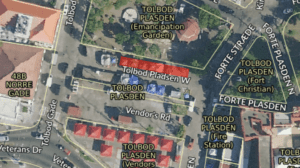
Also, Monday through Wednesday, from 8 a.m. to 6 p.m. the Post Office Beautification Project in the Historic Downtown Charlotte Amalie could slow traffic.
DPW contractor — Island Designs LLC. — will mobilize on-site beginning with a temporary refrigerated container that will be stored on the eastern side of Emancipation Garden for the delivery and offloading of project materials. The refrigerated container is expected to remain on-site through Wednesday. Landscaping activities will take place from 8 a.m. to 6 p.m., and the project is scheduled to be completed by August 2026.
The Post Office Beautification Project is part of the Department’s ongoing efforts to enhance the appearance of public spaces and create a more welcoming and aesthetically pleasing environment for residents and visitors.
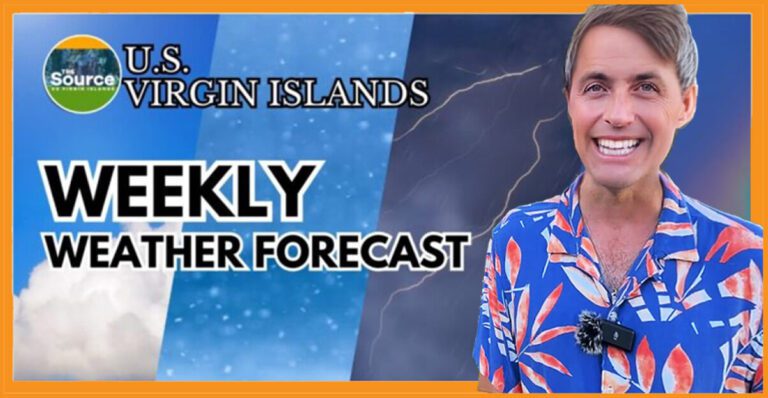
Check out our weekly weather forecast with Jesse Daley, covering Sunday, June 7, through Saturday, June 13.
Please stay safe and follow the Source for more weather updates!
An ad hoc group of creditors in Brett “Mac” McClafferty’s bankruptcy proceedings is seeking a 60-day extension to file a “nondischargeability action” against him because he continues to evade requests for information and acts with “utter disregard for his duties as a chapter 13 debtor and general disrespect for the bankruptcy process,” according to a motion filed Thursday in U.S. Bankruptcy Court in Delaware.
The group — called the “McClafferty Victims” in their filings and “Voluntary Lenders” by McClafferty — comprises some 17 individuals or closely held micro businesses that gave him money on behalf of his now defunct Mac Private Equity for investment purposes. In return, he gave them a promissory note to repay the money, according to court documents. Each of them has a lawsuit pending against McClafferty, and two have been awarded judgments in Virgin Islands courts, one for $45,000 and another for $110,000, the motion states.
Their claims are subject to exception from discharge, it says, adding that none of them possesses great wealth and they “have all suffered financial harm at the hands of Mr. McClafferty’s fraudulent schemes.”
Mac Private Equity — which was 100 percent owned by McClafferty, who is also co-owner of St. Thomas Social, a restaurant and bar in Yacht Haven Grande on St. Thomas — filed for relief under Chapter 7 of the Bankruptcy Code on March 4, 2025. On Nov. 7, McClafferty filed for relief under Chapter 13, which his creditors allege was to avoid further collections processes in the Virgin Islands.
After William F. Jaworski Jr., the Chapter 13 trustee, filed an amended motion March 17 to dismiss the case because McClafferty’s debts “in excess of $3,618,000” significantly exceed the thresholds set forth under section 13079(c) of the Bankruptcy Code, the Mac Private Equity creditors filed a motion to convert the case to Chapter 7, rather than dismiss it.
According to Jaworski’s amended motion, McClafferty’s conduct, “characterized by the failure to list all assets, concealment of income, the maintenance of a lavish lifestyle, and the funding of personal political ambitions while in bankruptcy falls far short of the ‘honest debtor’ standard. Such conduct warrants immediate dismissal.”
Jaworski noted that McClafferty did not accurately disclose his continuing stream of income from Social Hospitality Group, which owns St. Thomas Social, “has engaged in significant post-petition discretionary spending that is neither reasonable nor necessary for his support or maintenance,” and according to the Delaware Department of Justice, his proposed plan cannot be confirmed because he failed to file state tax returns for 2021 through 2024.
According to their motion, despite “diligent effort and investigation, the McClafferty Victims have been unable to find any evidence that Mr. McClafferty filed personal income tax returns for 2021–2024 in any jurisdiction.”
Meanwhile, George L. Miller, the trustee in the Chapter 7 petition for Mac Private Equity, filed a status report in March claiming McClafferty “was not able to adequately answer questions of the Trustee, counsel or creditors” at a meeting in October or in subsequent meetings. Miller reported that as far as he can tell, “None of the records obtained to date demonstrate anything other than Mr. McClafferty using corporate funds for personal expenses.”
McClafferty, who is running for delegate to Congress while also facing felony bank fraud charges in V.I. Superior Court on St. Thomas, with a current jury selection date of Nov. 3 — the same day as the General Election in which he is a candidate — has denied wrongdoing and has objected to Jaworski’s motions to dismiss the Chapter 13 petition.
He states, among other things, that none of the victims’ claims has been liquidated in the courts of the Virgin Islands and he intends to file objections to each of them. Regarding the proof of claim of $3,168,000, McClafferty said that because it and the alleged victims’ claims are “disputed, unliquidated, and based upon unajudicated allegations of liability, and because no court has determined that the Debtor is personally liable for any of these obligations, these claims cannot properly be counted toward the Debtor’s eligibility limits under 11 U.S.C. § 109(e) at this time.”
He was more blunt in his summation in a Facebook post in April. “We had no obligation to ‘invest’ anything lol. That’s the part you’re missing,” he posted on What’s Going on St. Thomas about the Mac Private Equity case. “Not a single one of our lending agreements obligated us to ‘invest’ anything. MPE was a startup PE [Private Equity] firm operating on a burn rate. It collapsed before it could take off. It’s a shame — but that’s life on the Serengeti; you win some, ya lose some,” he said, concluding the post with a shrug emoji.
In their motion for an order to convert the case to Chapter 7, his alleged victims claim that McClafferty has treated them and his other creditors “atrociously before and during this Case. He has lied under oath, used the territorial and federal courts of the Virgin Islands — and now the United States Bankruptcy Court for the District of Delaware — to play games, delay and hinder the McClafferty Victims’ recoveries.”
According to that motion, his outright disregard for his duties as a bankruptcy debtor “can only be seen as willful and malicious,” having stymied a meeting between himself and the creditors, known as a 341 meeting, and timed “to avoid further collections processes in the Virgin Islands.”
In their filing Thursday, they said nothing has changed since their first motion to extend and that since their last contact with Jaworski on May 28, McClafferty still has not provided his tax returns and “clearly has no intent to comply with the requirements of being a chapter 13 debtor.”
It would be a pointless and expensive waste of time for them to fight for a court order to force production of required information, they said, because he “will predictably ignore” it, then they will come back to the Court with more motions seeking sanctions and another order, “which Mr. McClafferty will predictably ignore.”
Judge Brendan Linehan Shannon, who is presiding over both the Chapter 13 and Chapter 7 cases, had not ruled on the creditors’ motion as of Saturday.
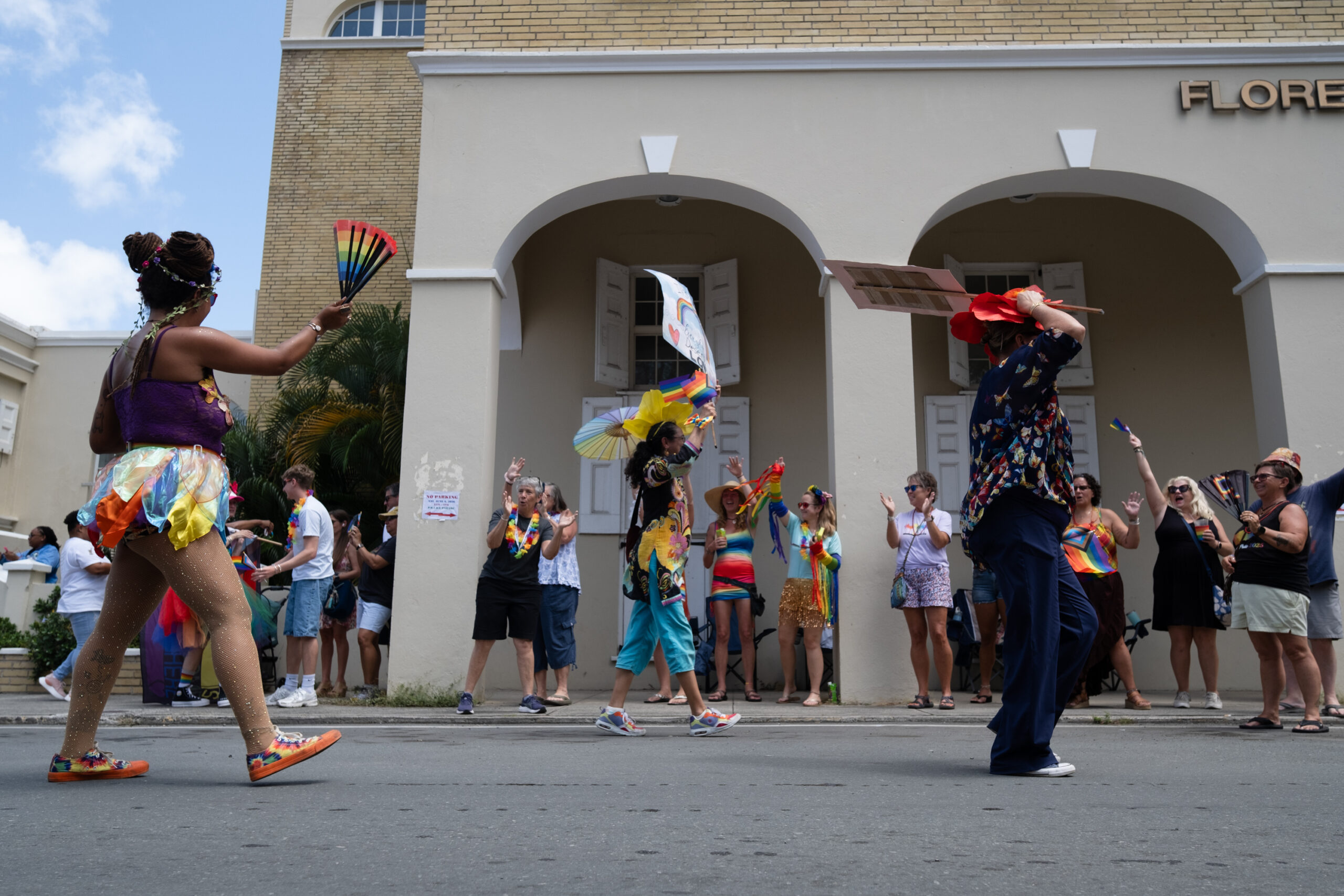
A Pride flag flies over King Street during the seventh annual St. Croix Pride parade Saturday in Christiansted. (Source photo by Kit MacAvoy)
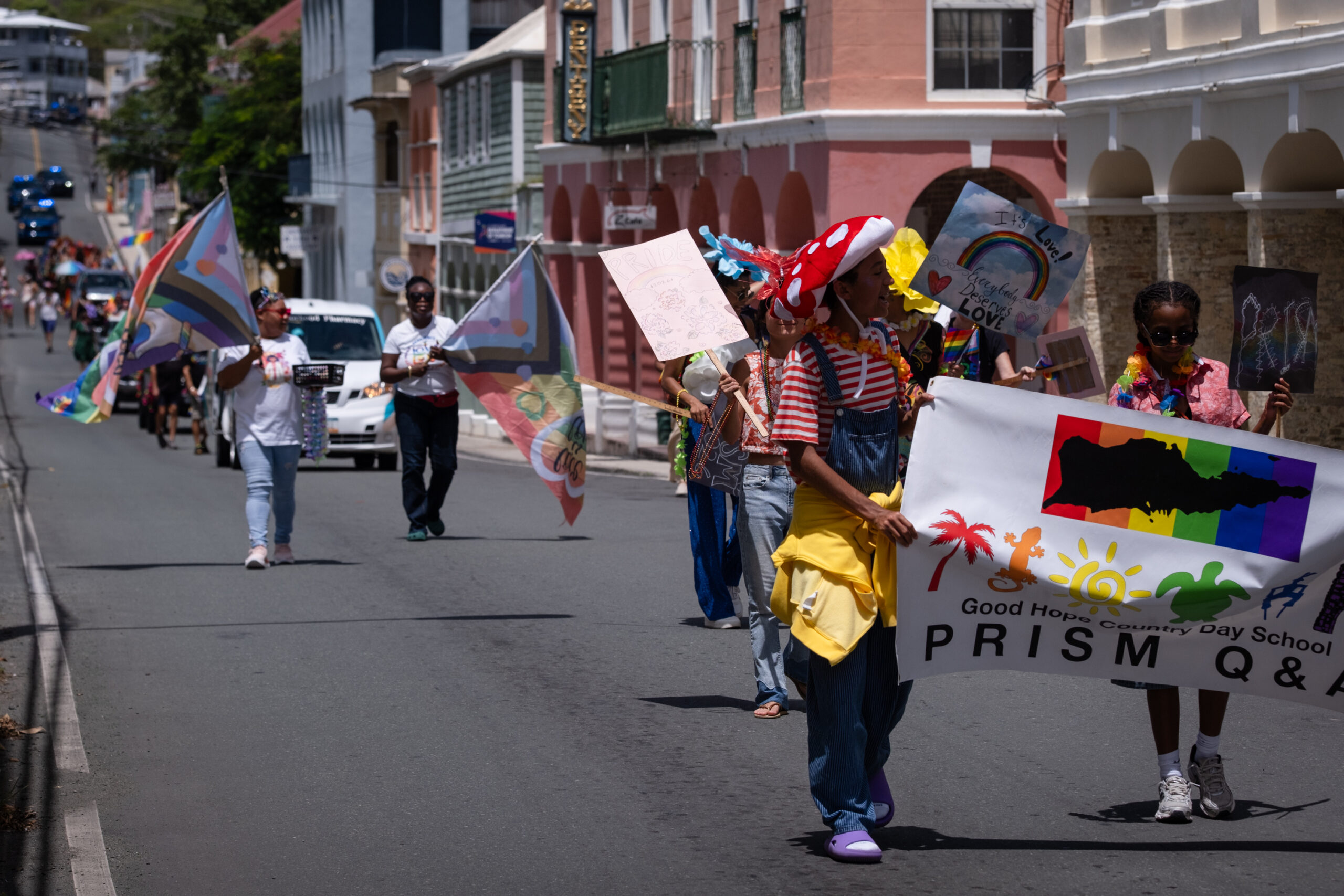
For the seventh year, St. Croix’s small but mighty Pride parade brought the community’s LGBTQIA community and allies together for a celebration of love and solidarity in Christiansted.
The seventh annual St. Croix Pride parade heads up King Street Saturday morning in Christiansted. (Source photo by Kit MacAvoy)
The parade made its way up King Street at around 11 a.m. with a colorful column that included Cruzan Cowgirls on horseback as well as groups from Good Hope Country Day School, businesses like Umami Sushi, and CMCArts. Umami’s Heather Reedy, who was born and raised on the island, said that she was proud to attend Saturday’s parade with her coworkers.
Heather Reedy represents St. Croix sushi staple Umami during the 2026 Pride parade Saturday morning in Christiansted. (Source photo by Kit MacAvoy)
“We always put a little flag up for June and everything, but this is something that’s really true to all of our hearts — whether you’re part of the community or not,” she said. “We all support the community.”
Shawna Richards watches the 2026 St. Croix Pride parade while holding a sign she made for the island’s first Pride parade in 2018. (Source photo by Kit MacAvoy)
St. Croix’s first Pride parade, which swept through Frederiksted in 2018, was marred somewhat by expressions of intolerance on social media and during the parade itself. On Saturday, attendees credited the V.I. Police Department for their support in ensuring a safe, welcoming event.
“I’m just happy that it’s a safe space to do it in,” Reedy said. “And I wish it would grow even more.”
The 2026 St. Croix Pride parade makes its way past the Florence Augusta Williams Public Library Saturday morning in Christiansted. (Source photo by Kit MacAvoy)
While Saturday’s parade was smaller than in previous years, St. Croix Pride president Imani Evans said a core group of attendees and supporters always turn out and have a good time.
“One of the big things right now is we’re always looking for more board members and more volunteers,” she said, adding that events are volunteer-based. “So we’re always looking for people who want to come and be a part of it.”
From left, the St. Croix Animal Welfare Center’s Sharyn Pittman introduces Coconut to parade-goers during the seventh annual St. Croix Pride parade Saturday morning in Christiansted. (Source photo by Kit MacAvoy)
Pride Month started early on the Big Island. On May 28, CMCArts hosted an opening reception for “Conversations on Pride,” an exhibition celebrating freedom of expression and the territory’s LGBTQIA community. That was followed by an inaugural Pride rave party at Shupe’s on the Boardwalk on May 30 and bingo at Sion Farm Distillery on June 2. On Wednesday, Common Cents Pub hosted “Rainbow Karaoke.”
Evans said upcoming events include a “Flower Power” brunch at Sion Farm Distillery from 10 a.m.-2 p.m. Sunday, a movie night at Blues Backyard BBQ from 6-10 p.m. Thursday, a “Rainbow Recharge” day at Island Movement on June 13, and a bar crawl from 1-8 p.m. on June 14 in Frederiksted. St. Croix Pride is planning to put a bow on the month of celebration with a closing beach party and drag show at Sandcastle on the Beach on June 20.
On Friday, the Virgin Islands Board of Elections was forced to suspend its review of candidate appeals and qualification challenges after losing its quorum, delaying decisions on several matters involving candidates seeking office in the 2026 election cycle.
During the meeting, board members reviewed appeals and eligibility issues involving candidates for various offices, including delegate to Congress, governor and the Legislature. Discussions centered on whether certain candidates met statutory filing requirements and whether those challenging disqualification decisions should be granted hearings before the board.
The continued review of candidate appeals comes just days after the Board of Elections voted to maintain a single ballot for federal and territorial contests in the 2026 election cycle. That meeting was also marked by discussions over candidate eligibility, residency requirements, ballot access and election procedures, underscoring the growing number of election-related challenges facing officials ahead of the November election.
Those issues remained at the forefront as board members reviewed appeals and correspondence from candidates seeking offices. Members debated statutory filing requirements, notification procedures and whether candidates challenging disqualification decisions should be granted hearings before the board prior to any final determination.
One of the appeals discussed involved Delegate to Congress candidate James Weber, whose nomination papers were disqualified after election officials determined they had not been filed in accordance with statutory requirements. Supervisor of Elections Caroline Fawkes told the board that Virgin Islands law requires nomination papers to be filed with the Supervisor of Elections in the district where the candidate resides. Some members agreed the law was clear, while others questioned whether candidates should be given additional opportunities to correct filing issues or present their cases before the board.
Board member Harriet Mercer argued that candidates requesting hearings before the board should be given the opportunity to appear in person before a quorum of members prior to any final determination being made. Mercer cited Weber’s appeal letter, which requested “a hearing in person of the quorum of the members of the Board of Elections.”
Before the board could conclude its review of the pending appeals, however, members were informed that a quorum was no longer present.
“We don’t have a quorum, so we cannot proceed,” Chair Raymond Williams announced, bringing the proceedings to a halt.
The board subsequently recessed the meeting and agreed to reconvene on Monday at 10 a.m. to continue reviewing unresolved candidate matters. Because of the loss of quorum, no final action was taken on several appeals and qualification challenges that remained before the board.
The delayed decisions come as election officials continue preparations for the 2026 election cycle and work through a growing number of candidate disputes, procedural questions and election-related challenges ahead of the upcoming election.
Wastewater has bubbled from St. John manholes for years, as shown in this 2024 photo. (Source file photo)
As St. Thomas and St. John recover from last weekend’s blackout, work crews across the territory were scrambling to avert another infrastructure disaster. The Virgin Islands’ sewer pipes are in dire condition, officials said Friday.
Many of the pipes and other critical sewer system equipment were long past their replacement date and deteriorating fast, officials at the Virgin Islands Waste Management Authority said. But there was good news.
VIWMA crews hoped to have St. John’s Power Boyd Pump Station issues resolved by Saturday, potentially ending unsanitary conditions in Estate Chocolate Hole. The station has had problems going back at least a decade.
Next on the list would be the long-troubled Cancryn area of St. Thomas, which could be free of unpleasant odors by the end of the weekend, VIWMA said in a written statement.
“Once completed, these repairs are expected to significantly improve system performance and alleviate unpleasant odors, wastewater backups, and other nuisances that have affected surrounding neighborhoods and businesses. This work represents a crucial step toward improving service reliability and quality of life for residents in the affected areas,” the statement said.
While the sight and smell of sewage bubbling up from manholes may be troubling, it’s actually by design.
Pedrito Francois, who was instrumental in concocting the sewer systems throughout the territory in 1972, told the Source in 2004 that he wanted failures to be evident. Repairs wouldn’t be made unless everyone knew the system had failed, he said.
Nearly 55 years after Francois designed the sewage systems, its working parts are collapsing, VIWMA officials said.
“Our sewer collection system has exceeded its intended service life in many locations, resulting in sudden line failures, collapses, and blockages that require immediate attention,” the officials said. “Crews continue to be deployed daily, prioritizing repairs that pose the greatest risk to public health, safety, and the environment. With multiple issues occurring simultaneously, resources are being strategically allocated to ensure that the most critical situations are addressed first.”
Long-term plans for fixing the problem were already in motion, according to the statement.
“Contracts are in place for a comprehensive, territory-wide replacement of aging sewer infrastructure. This major investment will begin in the coming months and represents a permanent, forward-looking solution to the very problems we are confronting today,” the authority said.
VIWMA officials warned in April, however, that large-scale, territory-wide repairs could take many years and require federal assistance.
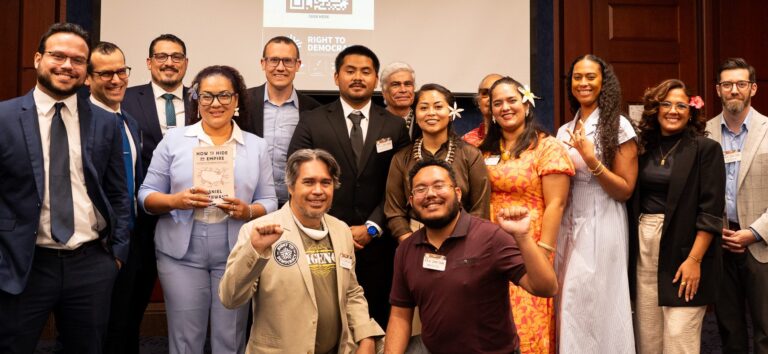
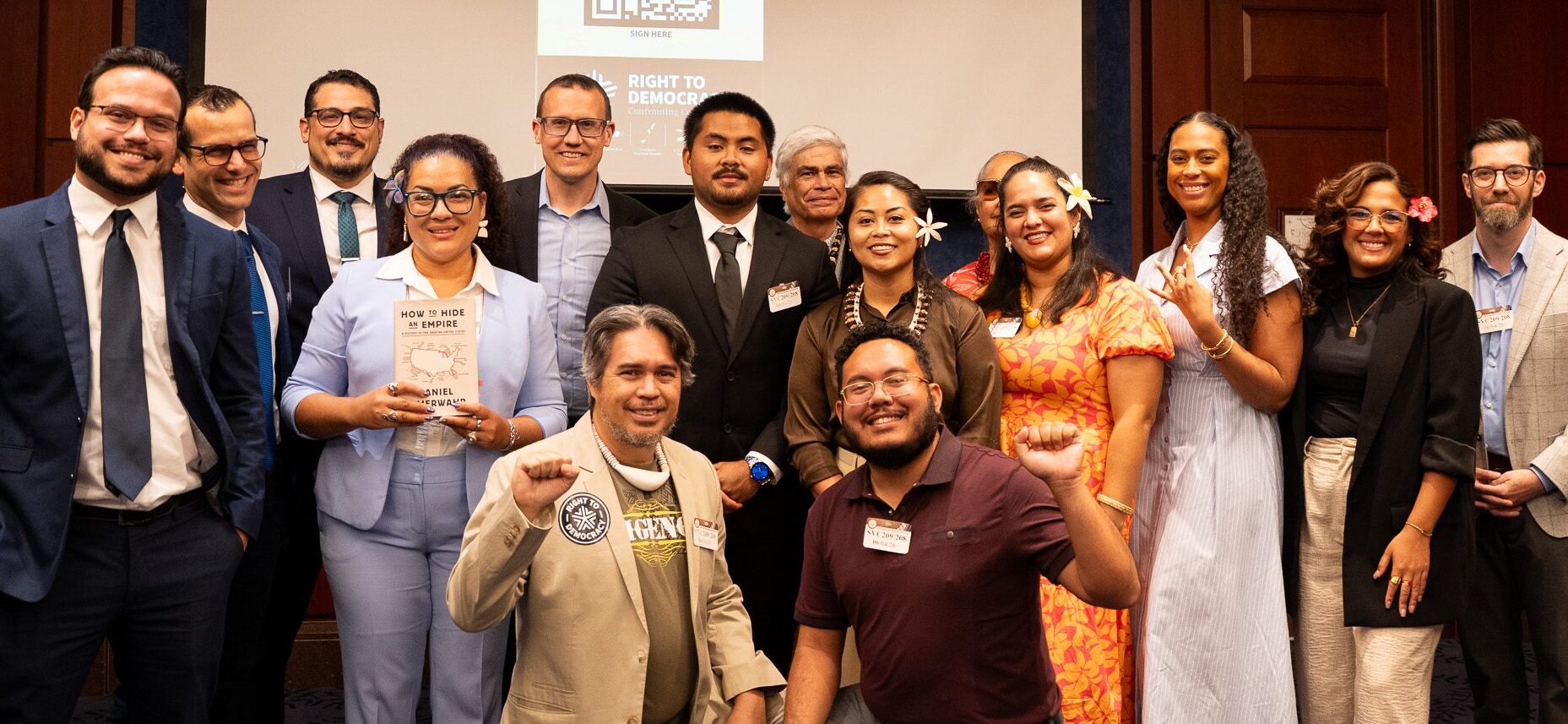
A bipartisan group of lawmakers and territorial advocates gathered in Washington, D.C., Thursday to brief congressional staff and other policy leaders on what “consent of the governed” means for people in U.S. territories. Third from right is Imani Daniel, executive director, VIISION and delegate to the Virgin Island’s Sixth Constitutional Convention. Delegate to Congress Stacey Plaskett appeared via video. (Image courtesy Right to Democracy)
As the United States prepares to mark its 250th birthday, Right to Democracy and a bipartisan group of lawmakers and territorial advocates, including from the Virgin Islands, gathered in Washington Thursday to brief congressional staff and other policy leaders on what “consent of the governed” means for people in U.S. territories.
While the Declaration of Independence says that governments derive their power from the consent of the governed, 3.6 million Americans living in U.S. territories are still waiting for that promise to reach them, noted Neil Weare, co-director of Right to Democracy, a nonprofit project that works to advance territory rights.
Thursday’s briefing, What Does “Consent of the Governed” Mean in U.S. Territories?, was organized in coordination with the Congressional Hispanic Caucus, Congressional Asian Pacific American Caucus and held at the U.S. Senate. Congressman Pablo José Hernández (D-PR) spoke, with Congresswomen Stacey Plaskett (D-VI), Kimberly King-Hinds (R-NMI), and Nydia Velázquez (D-NY) participating via video recording, according to a press release.
The briefing provided members of Congress and their staff with historical background on the current relationship between U.S. territories and the United States through the lens of the Declaration of Independence and the Insular Cases — a century-old legal framework rooted in racial and colonial prejudice — that continues to deny democracy, equity, and self-determination to residents of U.S. territories.
The session “made clear that the question of ‘consent of the governed’ in U.S. territories is not a relic of the past — it is a present reality that affects 3.6 million people every single day. Hearing directly from community leaders across the territories about how unilateral federal decisions shape their lives, their economies, and their environment made one thing undeniable: this undemocratic framework is unsustainable, and the federal government can no longer look away,” said Dr. Adi Martínez-Román, co-director of Right to Democracy. “The U.S. must fulfill its duties under federal and international law and provide the territories with a pathway to self-determination.”
“Two-hundred-and-fifty years ago, the United States rejected colonial rule through the Declaration of Independence, but for 125 years, the Insular Cases have allowed Congress to govern territories without full constitutional rights or self-determination,” added Weare. “It is time for the federal government to recognize colonial rule cannot be squared with the principle of the consent of the governed.”
“Regardless of what your view is on the status of the territories and what their final status should be, we should all be united and we should all present a united front to address the current challenges, and current obstacles, and current inequalities, and current injustices. We should take advantage of the 250th anniversary of the United States to educate the people of the United States about these lingering inequalities and challenges and to work toward solving them once and for all,” said Hernández, who is co-chair of the Territories and Commonwealths Caucus.
“As this nation confronts growing threats to our multiracial democracy, the territories are not a footnote. We are a warning and a road map. We’re living proof of what happens when consent of the governed is made conditional, when constitutional protections are treated as negotiable, when second-class citizenship is sewn into law and dressed up as precedent,” Plaskett said in a video statement. “True democracy and colonialism cannot coexist — not even when that colonialism wears the American flag.”
King-Hinds shared in a video statement that “no American community should be too small or too remote to have its voice respected. As we approach America’s 250th anniversary, we should recommit ourselves to ensuring that the principles of the Declaration of Independence apply equally to all Americans, including those living in the territories.”
“For more than three decades advocating for the people of Puerto Rico and our diaspora, I have said it plainly: the idea that the United States can hold colonies and claim plenary power over millions of people is far too reminiscent of King George III,” said Velázquez in a video statement.
“We cannot let this anniversary pass without using it. It is a real chance to focus on what we have in common and how we move forward together: the people of the territories, our diaspora communities, and our allies in Congress and across the states. And we have to act with the urgency this moment demands. Our Founding Fathers rose to the challenge in front of them; it is on us to rise to ours,” she said.
The briefing also featured testimony from Right to Democracy’s Environment and Democracy Fellows, who shared how federal decisions made without their input impact their communities on a day-to-day basis: María Hernandez, co-director of the Micronesia Climate Change Alliance (Guam); Andra Samoa, community leader and Director of Pacific Global Citizens (American Samoa); Nayda Bobonis, director of Strategic Relations and Advocacy at FURIA Inc. (Puerto Rico); Zeno De Leon Guerrero, board member of the Micronesian Climate Change Alliance (Northern Mariana Island), Imani Daniel, executive director, VIISION and delegate to the Virgin Island’s Sixth Constitutional Convention, and Dr. Sabrina Suluai Mahuka, executive director of Finafinau (American Samoa).
New York Times bestselling author Daniel Immerwahr, author of “How to Hide an Empire,” also presented and highlighted how the failure to recognize the significance of people in U.S. territories is not just a matter of history, but an issue that has ongoing consequences today as the White House considers territorial expansion to places like Greenland.
“People can support democracy, equity, and self-determination in U.S. territories by signing our Declaration to End Colonial Rule in U.S. Territories, which was created alongside Right to Democracy’s Cross-Territorial Coalition,” said Martínez-Román. The declaration is available here.
UNIVERSITY OF THE VIRGIN ISLANDS
REQUEST FOR PROPOSALS (RFP)
RFP TX2026-010
Financial Advisory Services
Higher Education Financing & Bond Issuance
Issue Date: 6/5/2026
Proposal Due Date: 7/1/2026
INTRODUCTION
The University of the Virgin Islands (UVI and/or University) is requesting proposals from qualified firms to provide Financial Advisory Services related to capital financing, debt structuring, and bond issuance for institutional capital projects, public-private partnerships, strategic initiatives and project financing.
The selected firm will serve as the University’s Independent Higher Education Financial Advisor and will provide strategic guidance related to financing options, debt management, bond issuance, commercial bank financing, federal funding and capital funding strategies.
UVI seeks a firm with extensive experience advising higher education institutions, particularly Historically Black Colleges and Universities (HBCUs) and institutions participating in federal financing programs such as the HBCU Capital Financing Program and inclusive of the tax-exempt for working capital and capital projects.
The University of the Virgin Islands works closely with the Government of the Virgin Islands and the Virgin Islands Public Finance Authority.
BACKGROUND
The University of the Virgin Islands is a public institution serving the U.S. Virgin Islands with campuses located on:
St. Thomas – Orville E. Kean Campus
St. Croix – Albert A. Sheen Campus
Online classes are also offered in various subjects.
The University continues to advance major capital investments including academic facilities, housing, research infrastructure, and student support facilities.
To support these initiatives, the University seeks financial advisory expertise to assist in evaluating and structuring financing mechanisms including but not limited to:
Revenue bonds
Public financing programs
Federal financing programs
Commercial bank financing
Capital financing through public/private partnerships
Debt restructuring or refinancing opportunities
SCOPE OF SERVICES
The selected firm will provide independent financial advisory services, which may include but are not limited to the following:
3.1 Strategic Financial Advisory
Advise the University on capital financing strategies
Working capital needs
Evaluate financing alternatives and funding structures
Develop financing models and projections
Assess debt capacity and credit considerations
3.2 Bond Issuance Advisory
Assist the University with planning and execution of bond transactions including:
Revenue bonds
Tax-exempt or taxable bonds
Refinancing or refunding bonds
Other capital market instruments
Services may include:
Structuring and sizing recommendations, timing strategy, and market execution assistance
Underwriter selection process support, trust agents and placement agents
Evaluation of financing alternatives (tax-exempt vs taxable, bank loans)
Credit rating agency strategy, if warranted
Advisory for periodic reviews monthly/quarterly reporting and project-specific
Regulatory and disclosure guidance relevant to the University
Preparing financial projections
Coordinating with underwriters, bond counsel, and rating agencies
Supporting preparation of offering documents
3.3 HBCU Capital Financing Program Support
Provide advisory services related to:
Participation in the HBCU Capital Financing Program
Federal loan program compliance
Financial modeling and structuring for program participation
3.4 Debt Management & Financial Planning
Review and analyze the University’s existing debt portfolio
Provide recommendations for refinancing or restructuring where beneficial
Develop long-term debt management strategies
3.5 Commercial Bank Support
Provide guidance on prospective financing options
Structure the support needed to address working capital needs and interim financing on capital projects
3.6 Capital Project Financial Modeling
Assist the University with financial feasibility analyses for major projects, including:
Student housing
Academic buildings
Infrastructure improvements
Public-private partnership opportunities
3.7 Transaction Support
Assist the University during financing transactions including:
Coordination with legal counsel, underwriters, and financial institutions
Rating agencies
Preparation of financial documentation
Presentations to governing bodies
Support during closing and issuance processes
CONTRACT TERM
The University anticipates awarding a contract for a period of three (3) years, with the option to renew for additional terms based on satisfactory performance and institutional need.
Services will be provided on an as-needed basis during the contract period.
PROPOSAL REQUIREMENTS
Proposals should include the following information:
5.1 Firm Qualifications
Firm overview and history
Experience providing financial advisory services to higher education institutions
Experience in providing financial advisory services to higher education institutions that are not rated by any of the rating agencies
Experience with HBCU institutions
Experience with rating agencies
Experience with bond issuances, commercial bank financing and capital financing
5.2 Relevant Experience
Provide descriptions of at least three (3) similar and recent engagements, including:
Institution name
Type of financing
Total financing amount
Services provided
Year completed
5.3 Proposed Team
Identify the key personnel assigned to this engagement, including:
Lead Financial Advisor(s)
Supporting analysts
Relevant experience and qualifications
5.4 Proposed Approach
Describe the firm’s methodology for providing financial advisory services to higher education institutions.
5.5 Fee Structure
Provide a clear description of the proposed fee structure, which may include:
Fixed advisory fees
Transaction-based fees
Hourly rates
Retainer arrangements
The University prefers transparent fee structures with no conflicts of interest.
5.6 References
Provide three (3) client references from higher education institutions.
EVALUATION CRITERIA
Proposals will be evaluated based on the following criteria:
Criteria
Weight
Firm Experience & Qualifications
30%
Relevant Higher Education Financing Experience
25%
Proposed Approach & Methodology
20%
Team Qualifications
15%
Cost / Fee Structure
10%
The University may request interviews or additional information from selected firms.
SUBMISSION INSTRUCTIONS
Proposals must be submitted electronically to:
Procurement Office
University of the Virgin Islands
bids@uvi.edu
Subject Line: RFP TX2026-010Financial Advisory ServicesHigher Education Financing & Bond Issuance
Proposals must be received 7/1/2026 2 PM ASTLate submissions may not be considered.
QUESTIONS
Questions regarding this RFP must be submitted in writing to:
Taylor Gilmore, Procurement Director
University of the Virgin Islands
bids@uvi.edu
Responses to questions may be issued in the form of an Addendum.
GENERAL TERMS AND CONDITIONS
The selected firm must comply with all applicable University policies and procurement requirements.
The University reserves the right to:
Reject any or all proposals
Waive minor informalities in proposals
Request additional information from proposers
Negotiate contract terms with the selected firm
All services will be subject to the University’s standard contractual requirements including insurance, indemnification, and compliance provisions.
CONFLICT OF INTEREST
Proposers must disclose any potential conflicts of interest related to underwriting, financial services, or advisory services that could impact their ability to serve as an independent financial advisor to the University.
UNIVERSITY COMPLIANCE REQUIREMENTS
Insert this section near the end of the RFP (typically under General Terms and Conditions).
University Compliance Requirements
The selected proposer will be required to enter into a formal agreement with the University of the Virgin Islands (UVI) and must comply with all applicable University contractual requirements.
The resulting contract shall incorporate the University’s standard contractual provisions, including but not limited to:
Insurance requirements
Indemnification and hold harmless provisions
Non-collusion certification
Conflict of interest disclosure
Equal opportunity and non-discrimination requirements
Compliance with applicable federal, territorial, and University policies
Independent contractor status
Data confidentiality and records retention
Audit and access to records
Submission of a proposal constitutes acknowledgment that the proposer is willing to comply with these requirements.
The University reserves the right to require the selected proposer to execute the University’s standard contract terms and conditions prior to commencement of services.
ATTACHMENT A
Price Proposal Form
Financial Advisory Services
Proposers must complete this pricing sheet and include it with their proposal submission. All pricing must be inclusive of all costs associated with providing the services described in this RFP, unless otherwise noted.
Advisory Fee Structure
Service
Proposed Fee
Basis (Fixed / Hourly / Transaction-Based)
Annual Retainer (if applicable)
$
Hourly Rate – Senior Advisor
$
Hourly Rate – Associate / Analyst
$
Financial Modeling / Analysis
$
Capital Financing Advisory
$
Bond Transaction Advisory Fees
If applicable, provide fees related to bond issuance or financing transactions.
Financing Type
Proposed Fee Structure
Bond Issuance Advisory
Bond Refunding / Refinancing
Debt Restructuring
Public-Private Partnership Financing
Proposers should clearly describe whether fees are:
☐ Fixed Fee
☐ Percentage of Transaction
☐ Hourly Not-to-Exceed
☐ Other (Explain)
Explanation:
Additional Expenses
Identify any additional reimbursable expenses.
Expense Type
Cost
Travel
Document Preparation
Other (Specify)
All reimbursable expenses must be approved in advance by the University.
Certification
The proposer certifies that the pricing provided herein is valid for a minimum of ninety (90) days from the proposal submission deadline.
Firm Name: _______________________________
Authorized Representative: _______________________________
Title: _______________________________
Signature: _______________________________
Date: _______________________________
UNIVERSITY OF THE VIRGIN ISLANDS
REQUEST FOR PROPOSALS (RFP)
RFP TX2026-011
INSURANCE BROKERAGE SERVICES
Issue Date: 6/5/2026
Proposal Due Date: 7/1/2026
INTRODUCTION
The University of the Virgin Islands (UVI) invites qualified firms to submit proposals to provide comprehensive insurance brokerage and risk management advisory services for the University. The selected broker will act as the University’s insurance advisor and representative in the insurance marketplace, assisting with establishing insured amounts, policy placement, risk evaluation, claims advisory, and strategic insurance program development.
The University seeks a broker with extensive experience serving higher education institutions or large public sector organizations, capable of advising on complex insurance programs and operating in geographically dispersed locations.
UNIVERSITY BACKGROUND
The University of the Virgin Islands is a public historically black university (HBCU) with campuses located on St. Croix (Albert A. Sheen Campus) and St. Thomas (Orville E. Kean Campus).
UVI operates a wide range of academic, research, housing, and public service facilities including:
Academic buildings
Student housing
Research laboratories
Agricultural facilities
Marine and environmental research programs
Athletic facilities
Administrative offices
The University maintains multiple insurance policies to protect its assets, operations, employees, students, and visitors.
OBJECTIVE
The objective of this RFP is to select a qualified Insurance Broker of Record to:
Provide professional brokerage services
Market insurance programs competitively
Identify competitive insurance markets
Advise on risk management strategies
Assist with claims coordination
Ensure adequate coverage at competitive pricing
SCOPE OF SERVICES
The selected broker will provide services including, but not limited to:
4.1 Insurance Program Review
Evaluate the University’s current insurance program and exposure
Review existing policies, endorsements, limits, deductibles, and coverage gaps
Recommend improvements to coverage structure and limits
4.2 Insurance Market Placement
Market insurance policies to qualified carriers and markets
Obtain competitive proposals from reputable insurers
Present coverage options and pricing comparisons
Assist in negotiating favorable terms and conditions
4.3 Coverage Types
The broker must be capable of placing and managing policies including but not limited to:
Property Insurance
General Liability
Automobile Liability
Professional Liability
Cyber Liability
Directors & Officers Liability
Employment Practices Liability
Builder’s Risk
Environmental Liability
Excess/Umbrella Liability
4.4 Risk Management Advisory
Provide advisory services related to:
Enterprise risk management
Risk mitigation measures and strategies
Contractual risk transfer
Insurance requirements for vendors and contractors
Safety and loss prevention programs
4.5 Claims Support
Assist the University in reporting and managing claims
Coordinate with insurers during the claims process
Provide claims tracking and status reporting
Advocate for the University in claim resolution
4.6 Annual Insurance Renewal
Conduct annual renewal marketing
Provide renewal strategy recommendations
Deliver renewal reports summarizing coverage and pricing options
4.7 Reporting
Provide regular reporting including:
Insurance program summaries
Market analysis
Claims activity reports
Risk exposure updates
CONTRACT TERM
The anticipated contract term will be:
Three (3) years, with the option for two (2) additional one-year renewals, subject to satisfactory performance and mutual agreement.
PROPOSAL REQUIREMENTS
Proposals must include the following information:
6.1 Firm Qualifications
Firm overview and history
Years of experience in insurance brokerage
Experience with universities or public institutions
Organizational structure and staffing
6.2 Relevant Experience
Provide at least three (3) references for clients of similar size or complexity.
Include:
Organization name
Contact person
Description of services provided
Length of engagement
6.3 Key Personnel
Provide resumes and roles for personnel assigned to the account.
6.4 Service Approach
Describe the firm’s approach to:
Insurance placement
Risk management advisory
Claims support
Renewal strategy
6.5 Compensation Structure
Proposers must disclose their compensation method, including:
Commission-based compensation
Fee-based compensation
Any other remuneration received from insurers
All compensation must be fully transparent.
EVALUATION CRITERIA
Proposals will be evaluated using the following criteria:
All questions regarding this RFP must be submitted in writing to:
Taylor Gilmore, Procurement Office
University of the Virgin Islands
Email: bids@uvi.edu
Responses to questions will be distributed to all known proposers.
GENERAL TERMS AND CONDITIONS
The selected firm will be required to comply with all applicable University policies and contractual provisions including:
Insurance requirements
Indemnification provisions
Compliance with applicable federal and territorial laws
Non-discrimination requirements
Conflict of interest disclosure
The University reserves the right to:
Reject any or all proposals
Request clarifications or additional information
Cancel the solicitation at any time
Negotiate with the selected proposer
LOCAL VENDOR PREFERENCE
Consistent with UVI procurement policies, preference may be given to qualified vendors located in the U.S. Virgin Islands, provided that pricing and qualifications are competitive.