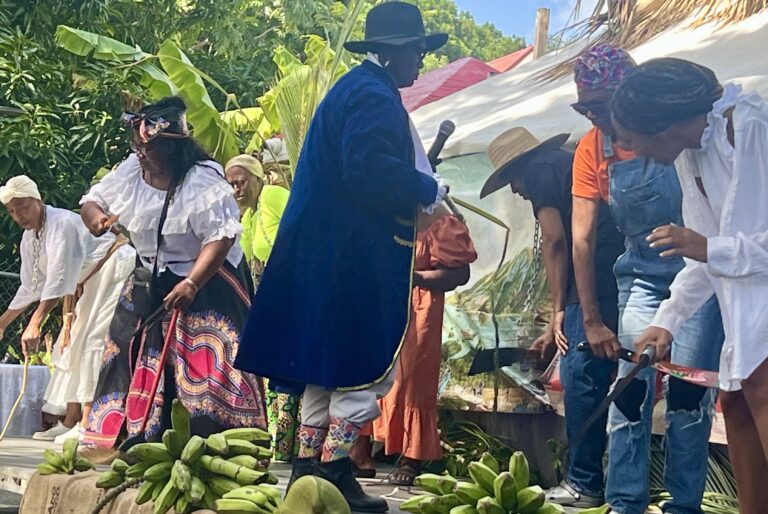
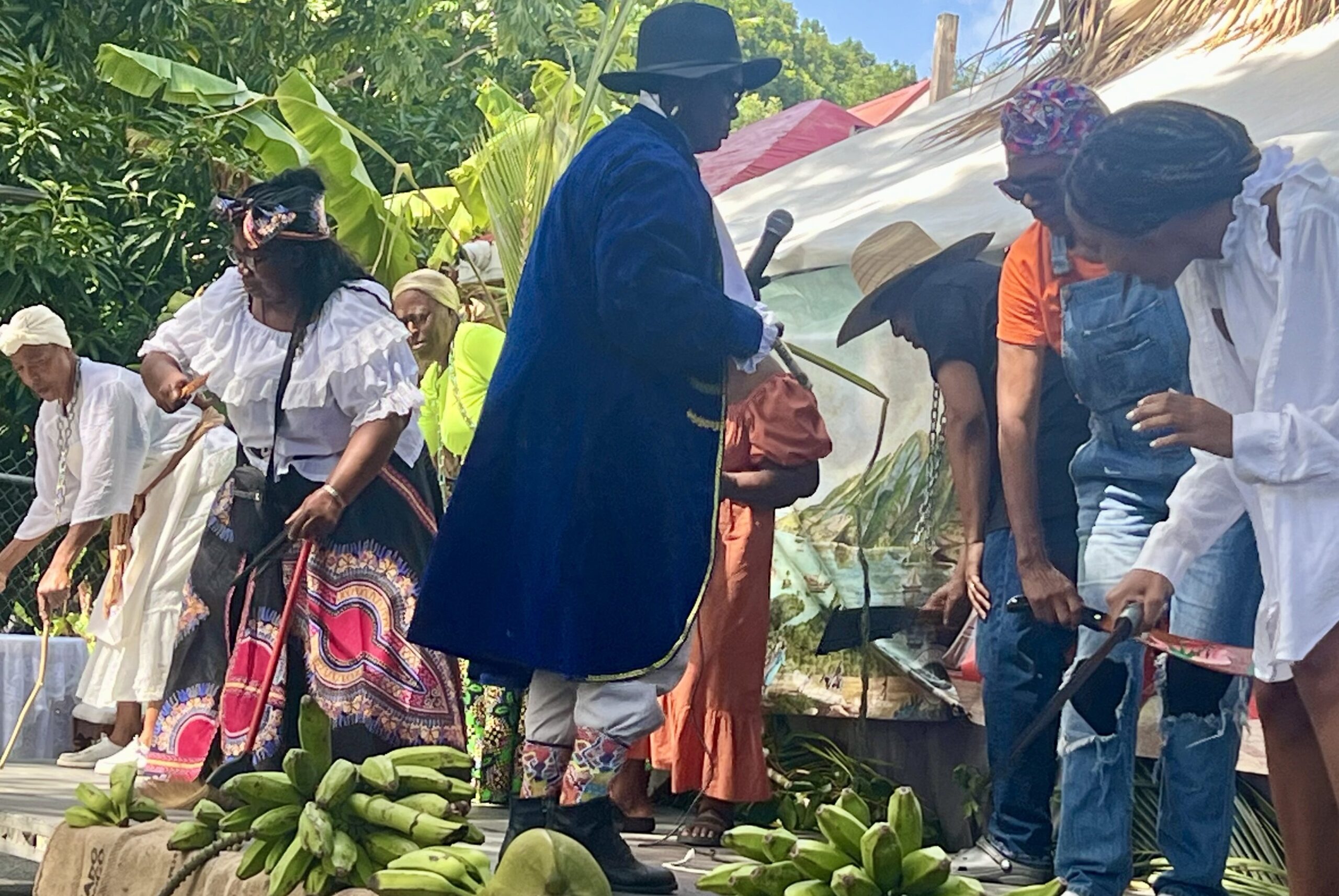
The St. John Drama Club presented the 10th performance of its annual Emancipation Day play Friday in Cruz Bay as part of the island’s annual Emancipation Day celebration.
This year, the club’s script writers added new elements to a narrative built over the years about events leading up to the July 3, 1848, Emancipation Proclamation by then-Danish Gov. Peter Von Scholten. The 2026 play featured expanded musical performances backed by locally known singer and master guitarist Haile Israel.
St. John Drama Club members depict scenes from plantation days in the Danish West Indies. (Source photo by Judi Shimel)
“The change in this year’s play is that we’re inclusive – St. Thomas, St. John, St. Croix,” said club member and co-playwright Myrna George.
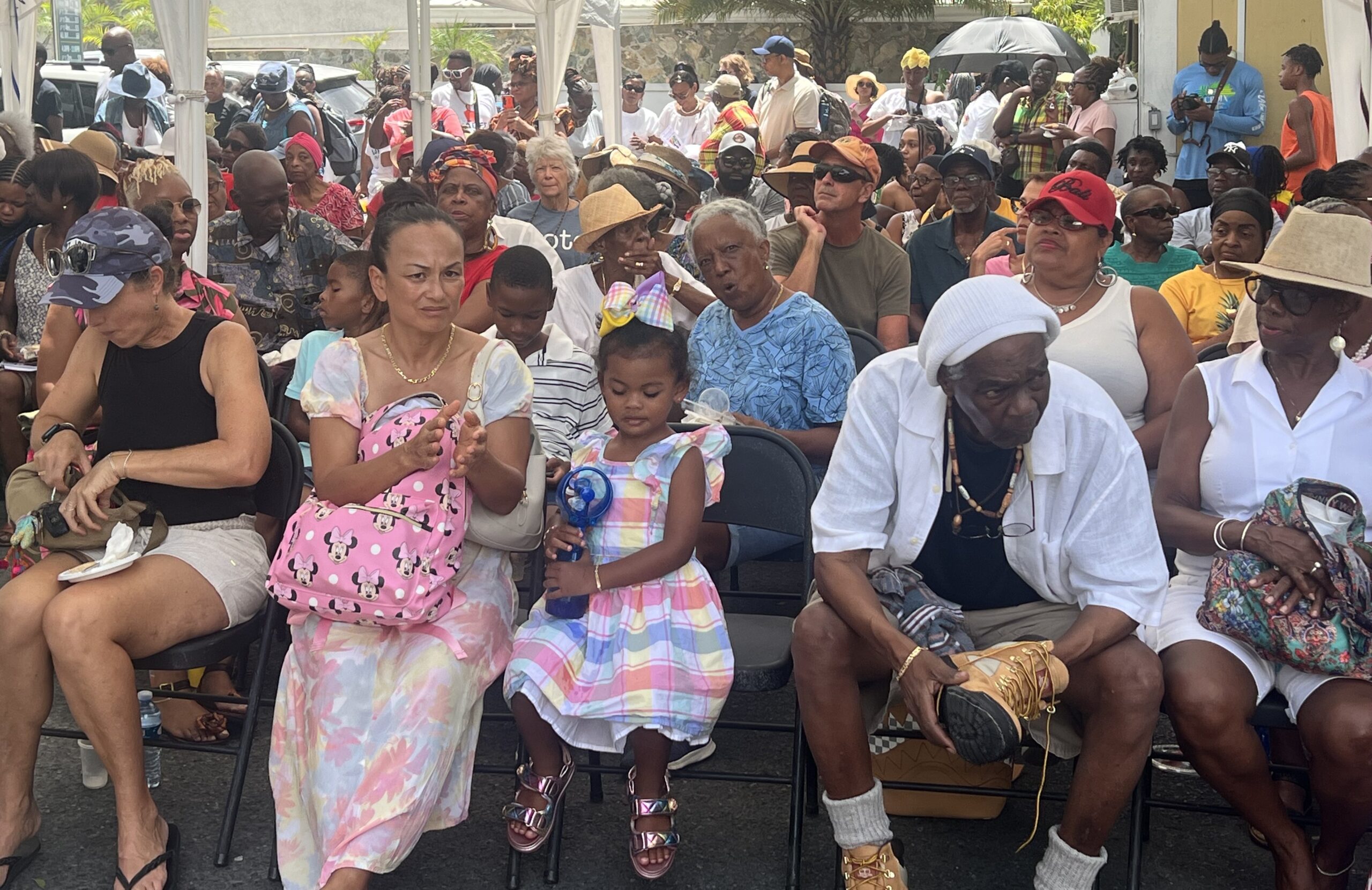
A bamboula troupe led the procession of actors from the gates of the Battery into the performance space around 2 p.m. Residents and visitors packed the seats; they were joined by elected leaders, culture bearers and Tourism Commissioner Jennifer Matarangas-King, who said, for her, it was a first-time viewing experience.
Educator, author and historian Gilbert Sprauve sat in attendance steps away from his childhood home in Cruz Bay. In the early days of the drama club, Sprauve helped with script production. Students from the St. John School of the Arts sang “Stand by Me,” a rhythm-and-blues tune made famous by Ben E. King in 1961. The V.I. For Life quadrille dancers and the drumming group Echo People helped make the Friday afternoon Emancipation Day celebration memorable for the audience.
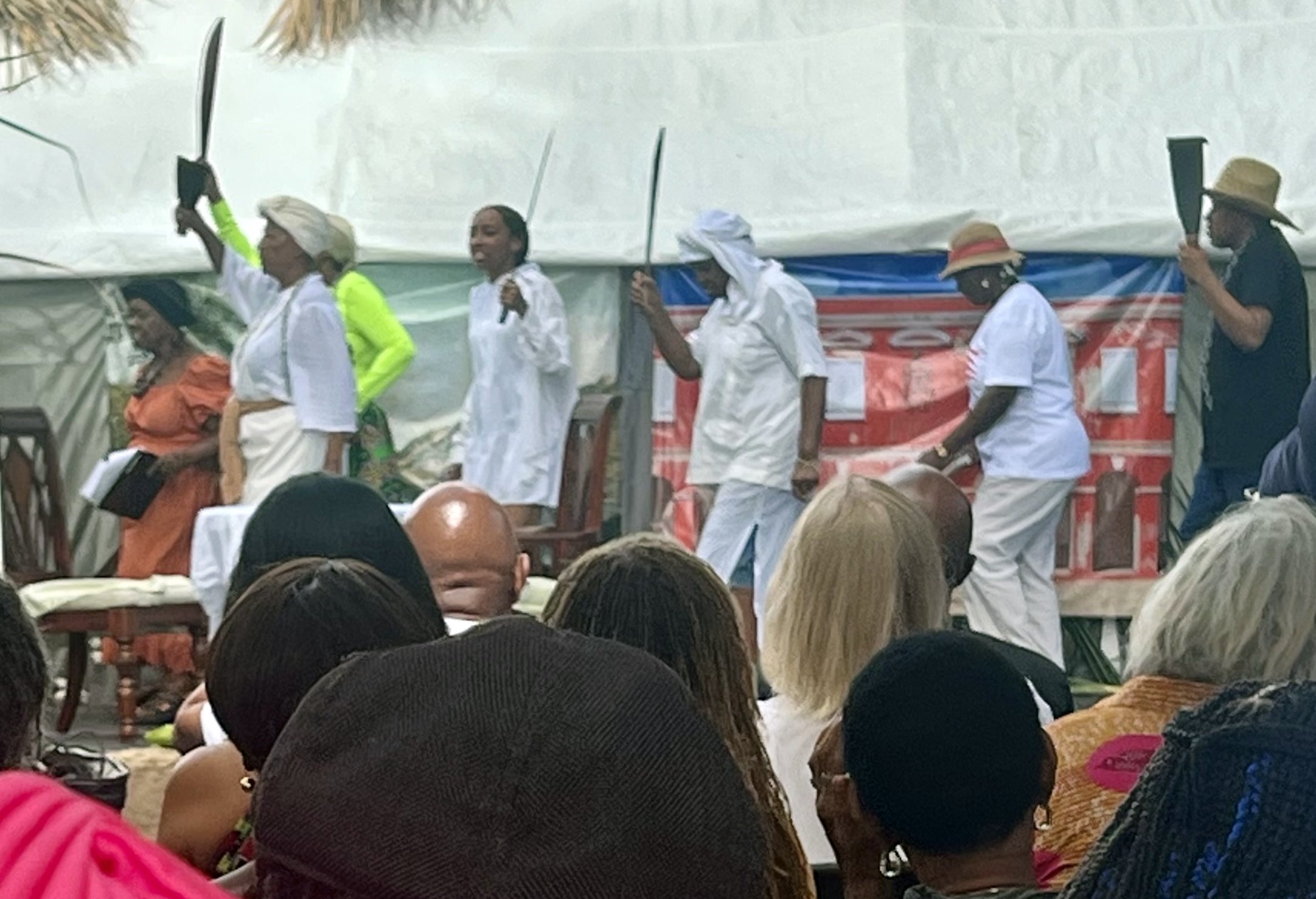
An audience watches Friday’s reenactment of the St. Croix slave uprising of 1848. (Source photo by Judi Shimel)
Division of Festivals Director Ian Turnbull made presentations to supermarket managers at Starfish Market and Lt. Gov Tregenza Roach for their support of St. John’s Emancipation Day commemoration.
As he has in speeches delivered at the annual Celebration Food Fair and at the opening of Celebration Village, Roach pointed to the events of July 3, 1848 — V.I. Emancipation — and July 4, 1776 — U.S. Independence Day — as vital elements of the St. John fete.
The U.S. Virgin Islands celebrated success in softball and volleyball this week, capturing a regional softball championship and earning a division title at the 2026 AAU National Volleyball Championships.
The U.S. Virgin Islands won the Caribbean Region championship at the 2026 Nike RBI Softball Regional Championships 18U, defeating teams from the Dominican Republic and Puerto Rico while finishing 5-0.
Amanda Thompson led the pitching staff, throwing 12 innings without allowing an earned run for a 0.00 ERA.
The offense was equally impressive, with six batters finishing the tournament with batting averages of .500 or better.
The U.S. Virgin Islands 18U softball team won the 2026 Nike RBI Softball Regional Championships with a 5-0 record, defeating teams from Puerto Rico and the Dominican Republic. (Submitted photo)
“The team did an amazing job in the regionals,” coach Richard Clendinen said. “They played well defensively. Pitching was amazing, and the bats were alive this weekend. We plan to carry these same tools to the World Series.”
With the regional title, the 18U team secured a berth in the 2026 Nike RBI Softball World Championships, scheduled for Aug. 9-13 in Vero Beach, Florida.
The championship roster includes Amanda Thompson, Alahya Jackson, Mekaela Richardson, Jaimia Cochrane, Jelissa Cochrane, Rashani Sackey, Kleniya Titus, Nia Byron, Brielle Creque, Love Moise-Creque, Adrianna Gomez, Erin Suggs, Alina Muhammad, Isaella Virut, Keira Frazier and Ryann Giddins.
The coaching staff includes manager Elroy Hill and coaches Innocencia Bermudez, Brock Creque and Richard Clendinen.
Meanwhile, several Virgin Islands volleyball teams wrapped up competition at the 2026 AAU National Volleyball Championships.
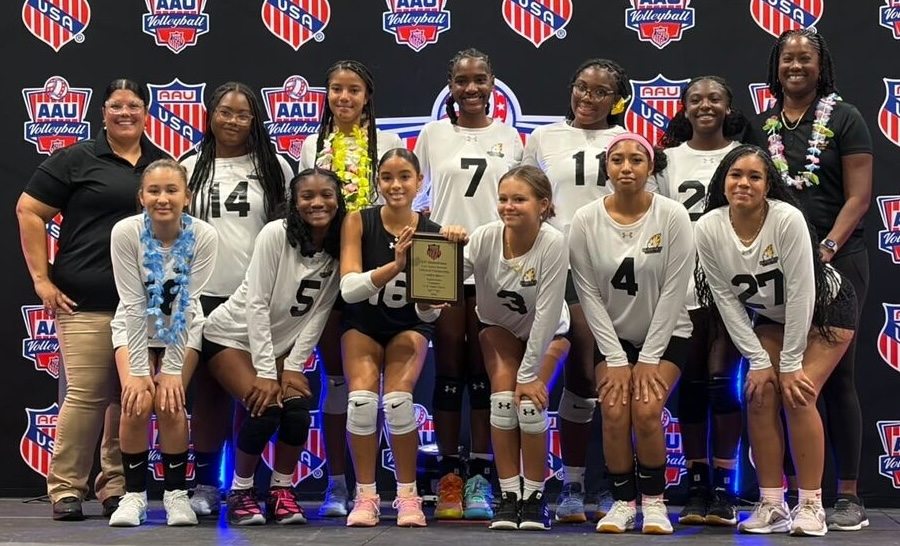
Island Heat 15-1 celebrates its Aquamarine Division championship at the 2026 AAU National Volleyball Championships. Front row, from left, are Ahreyann Belardo, Aah’Men Belardo, Makayla Malcolm, Fiona Gilbert, Anastacia Guadalupe and J’Malia James. Back row are assistant coach Jenna Castro, Keleah Sheppard, Nielalist Ilarraza, J’Nique Richardson, Kaylie Berkitt and head coach Elisa Languedoc. (Submitted photo)
Island Heat 15-1 closed out Wave Four by winning two matches on the final day to capture the Aquamarine Division championship. After advancing to the single-elimination placement bracket, Island Heat defeated CMass Edge 15 Blue 20-25, 25-20, 15-8 for the title.
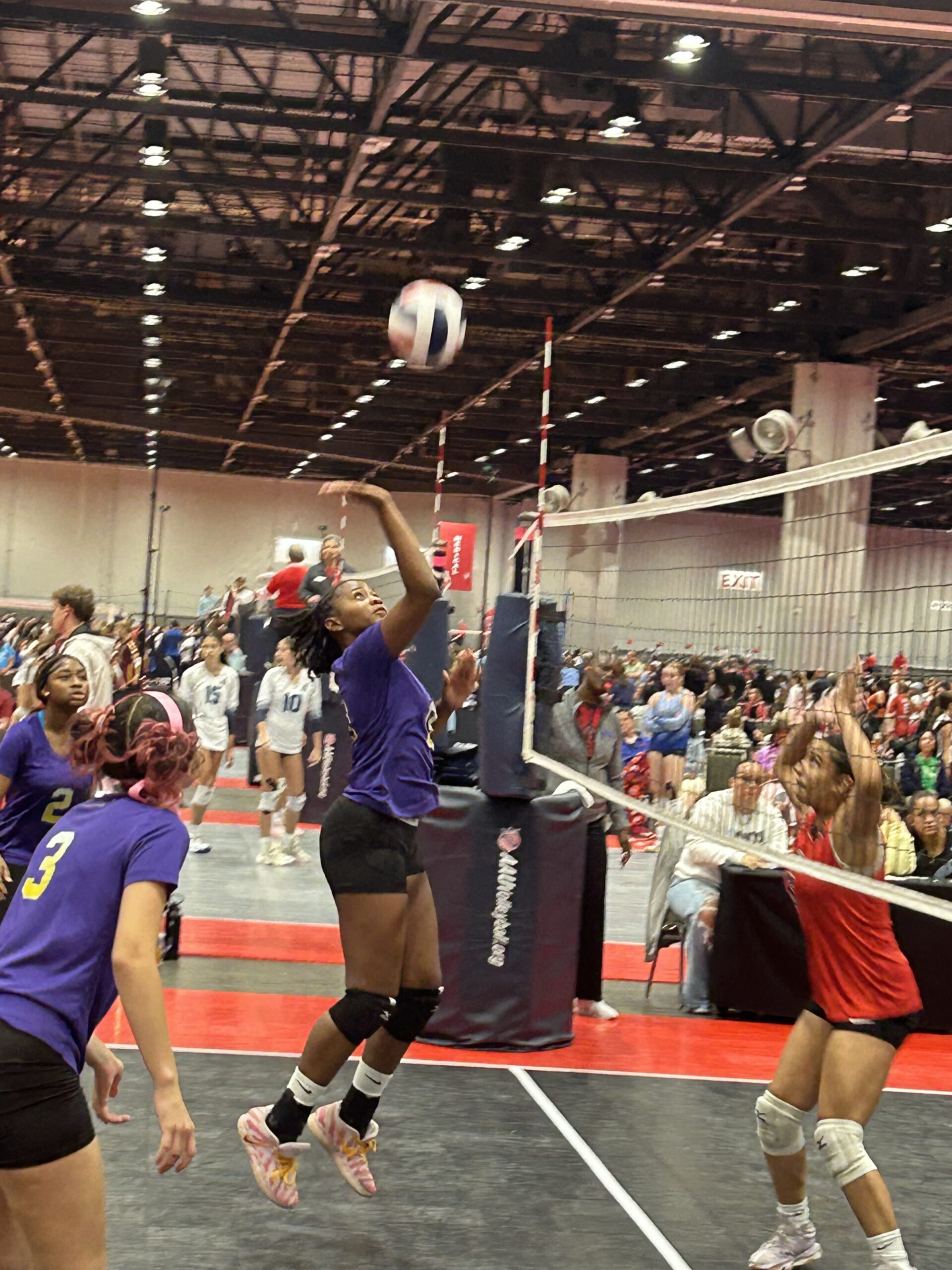
Morgan Richardson of Island Mixx 15-1 attacks the ball during competition at the 2026 AAU National Volleyball Championships. (Source photo by Mark Daniel)
Island Heat 16-1 entered the final day after winning all three of its matches on Day 3 to earn a berth in the Topaz Division. The team was eliminated by Ellevate Academy 16U, falling 25-18, 25-16.
Island Mixx also fielded two teams during Wave Four.
Island Mixx 16-1 compiled a 5-1 record through the first two days and entered Day 3 with an opportunity to qualify for the Gold Bracket in the 16U Spirit Division. The team won one of its three matches on the final day before advancing to Ruby Division A, where it fell to FAV 16 Phoenix 25-26, 23-25, 15-7. Island Mixx finished tied for 41st out of 159 teams in its division.
Island Mixx 15-1 concluded tournament play in Amethyst Division A against Unified 15-3. The Mixx held a 24-21 lead in the opening set before dropping it 27-25. They rebounded with a 25-10 victory in the second set but were unable to overcome unforced errors in the deciding set, falling 15-9.
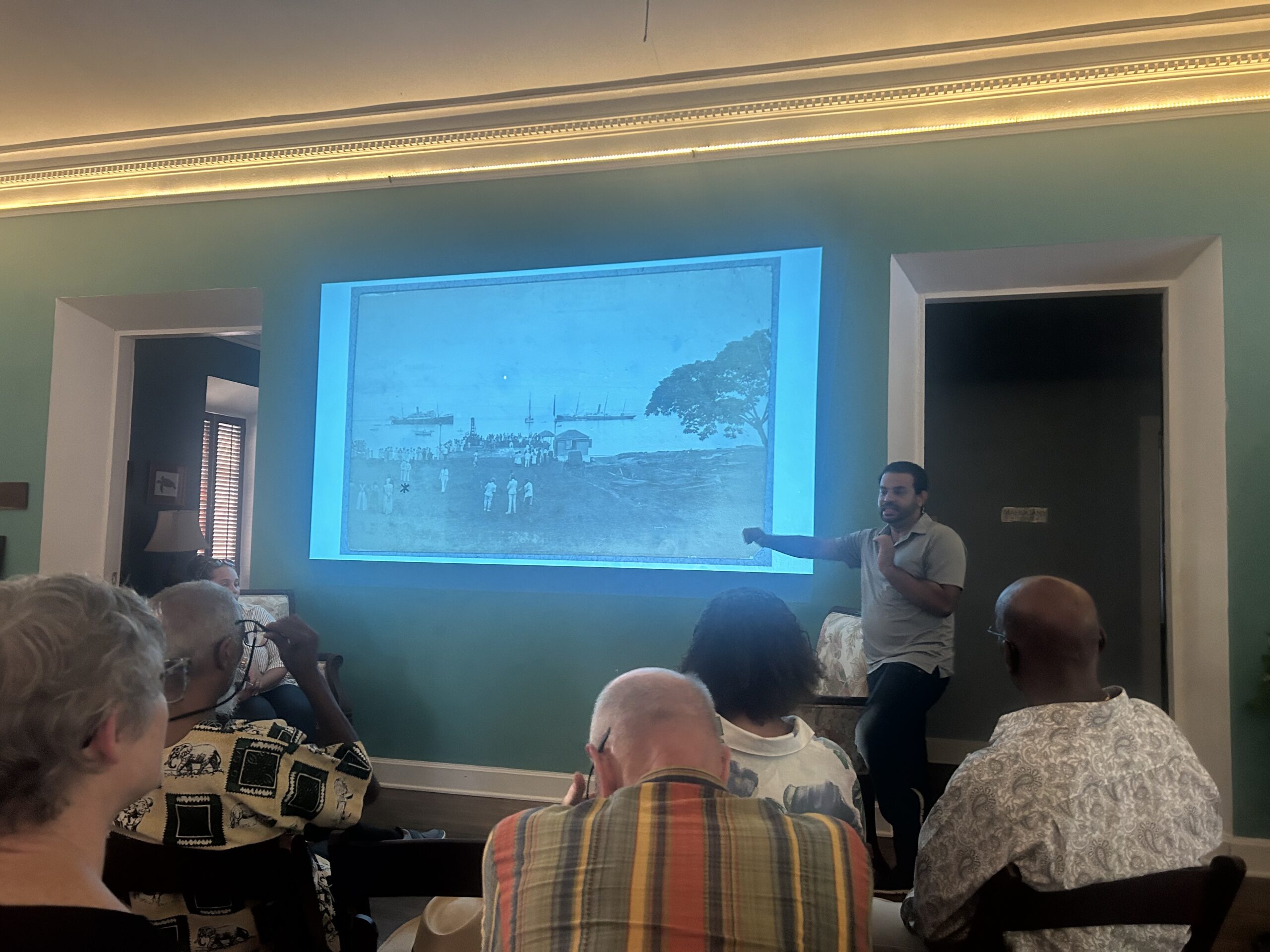
David Berg presents “Unfinished Histories: An Archival Unveiling,” highlighting the work of Find Your Archives a Home, or FYAH, the nonprofit he co-founded with Juliana Berry to preserve and share Virgin Islands archival materials. (Source photo by Joshua G Canning)
Caribbean-born photographer, archivist and cultural documentarian David A. Berg and archivist and researcher Juliana Berry presented “Unfinished Histories: An Archival Unveiling” at an intimate gathering in the great house at Feather Leaf Inn on Wednesday night. The presentation was one in a series of Emancipation Week events titled “Ancestral Memory: Caribbean Futures,” organized by the Virgin Islands Division of Libraries, Archives and Museums.
Berg and Berry are co-founders of Find Your Archives a Home, or FYAH, a nonprofit organization dedicated to locating, preserving and sharing archives focused on the Virgin Islands.
Their presentation, “Unfinished Histories,” delves into archives of 19th-century stereographic imagery to piece together and reclaim a visual and historical narrative they say was effectively erased by Danish colonialism. The two will take this research to the national stage at the 3D-Con event in Albuquerque, New Mexico, later this summer, but offered a preview in the Virgin Islands first.
“History is often written by those who hold the pen,” Berg and Berry said, “but curated by those who hold the archives.”
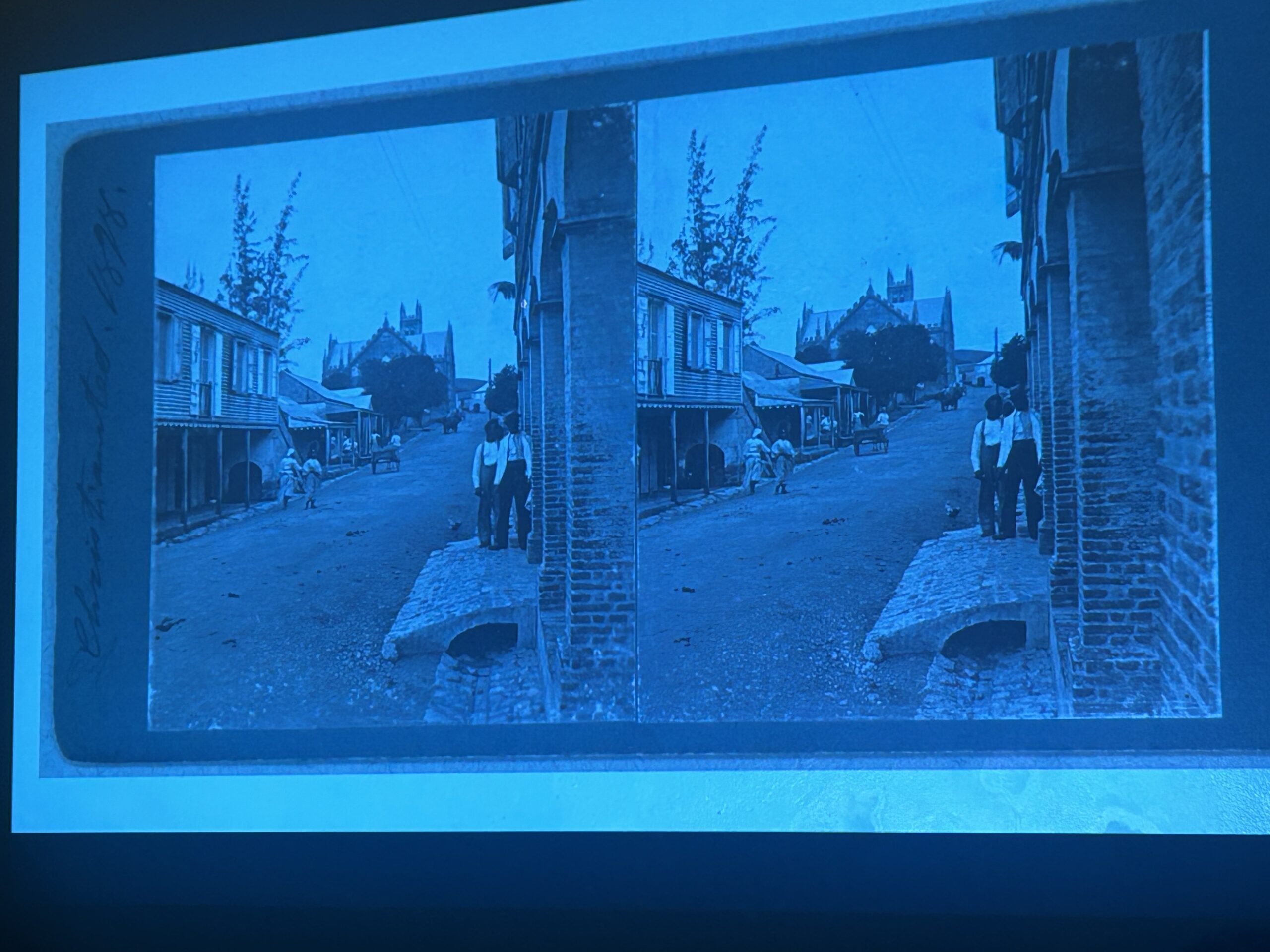
A historical stereographic image was among the archival photographs presented during “Unfinished Histories: An Archival Unveiling.” Berg and Juliana Berry use images like this to help restore the Virgin Islands’ historical record. (Source photo by Joshua G Canning)
When Denmark sold the Virgin Islands to the United States in 1917, they said, a vast portion of the islands’ historical records was transported to Copenhagen. Berg and Berry describe their project as one that “seeks to reactivate these archival materials for contemporary audiences by connecting photographic practices with current conversations surrounding preservation, accessibility and visual culture.”
They are working to reclaim that lost memory and reverse cultural erasure by collecting, assembling and curating archival materials from Denmark and collections in the United States.
They said they are committed to accomplishing that through “physical engagement, digital repossession, and critical reinterpretation, transforming historical records into tools for community knowledge and cultural continuity.” Their work also seeks to move archival practice “beyond colonial frameworks” while fostering “community-centered spaces that prioritize restoration, agency, and the preservation of collective memory for present and future generations.”
During the presentation, Berg and Berry shared and interpreted historical stereographic images they collected while visiting the West Indies Photo Archives at the National Museum of Denmark, where most historical records and photographs from 1672 to 1917 are housed.
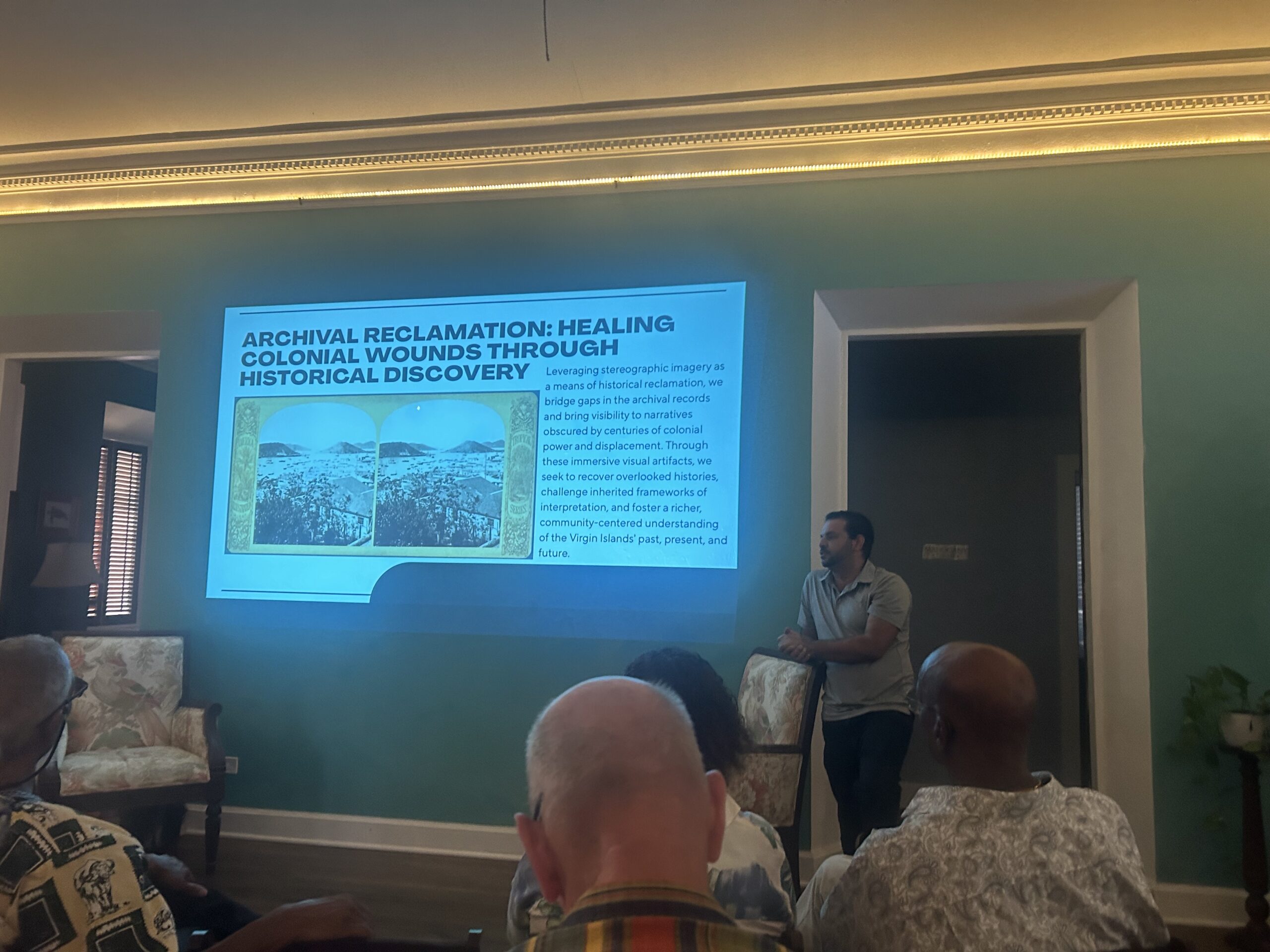
David Berg discusses the role archives play in preserving and reclaiming Virgin Islands history during “Unfinished Histories: An Archival Unveiling” at Feather Leaf Inn on Wednesday. David Berg and Juliana Berry say, “History is often written by those who hold the pen, but curated by those who hold the archives.” (Source photo by Joshua G Canning)
They also shared images from the Schomburg Center for Research in Black Culture’s Photos and Prints Division in New York and the Royal Library’s West Indian Photo Archives. Berg provided audience members with guidance on navigating metadata issues and locating archives and images cataloged in Danish.
Stereographic photography is a technique that creates the illusion of three-dimensional depth by capturing two images of the same subject from slightly different horizontal angles, approximately 2.5 inches apart, or about the average distance between human eyes.
Berg and Berry use stereographic imagery as a means of historical reclamation, working to “bridge gaps in the archival records and bring visibility to narratives obscured by centuries of colonial power and displacement.”
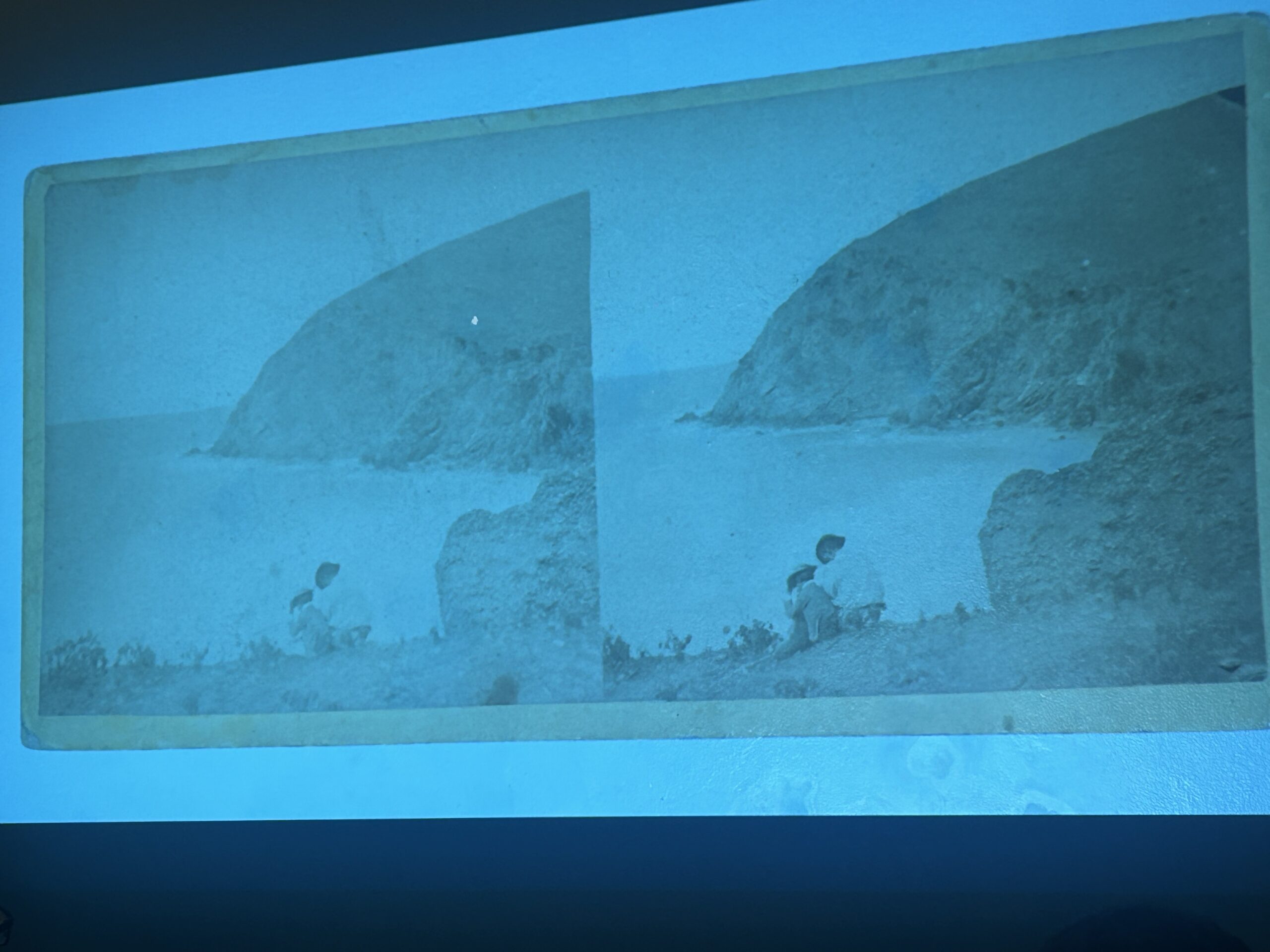
A 19th-century stereographic image believed to have been taken near Hamm’s Bluff on St. Croix was among the archival photographs featured during “Unfinished Histories: An Archival Unveiling.” David Berg and Juliana Berry used images like this to explore how historical records can help reclaim the Virgin Islands’ visual and cultural history. (Source photo by Joshua G Canning)
Through these visual artifacts, they seek “to recover overlooked histories, challenge inherited frameworks of interpretation, and foster a richer, community-centered understanding of the Virgin Islands’ past, present and future.”
In addition to co-founding FYAH with Berry, Berg is the founder of Blackwood Imaging, a fine-art photography and cinematic branding studio on St. Croix.
A ninth-generation Crucian photographer and digital archivist, Berg uses photography to preserve Caribbean history. A press release for his appearance in Fort Frederik Museum’s “Lunchtime with the Artist” series states: “Berg’s photography serves as a powerful tool for cultural preservation, capturing the essence of Caribbean life and history. His dual role as artist and archivist reflects a deep commitment to reclaiming and honoring Virgin Islands heritage from a distinctly local perspective.”
The title of Berg and Berry’s presentation, “Unfinished Histories,” references the academic book “Unfinished Histories: Art, Memory, and the Visual Politics of Nordic Colonialism.”
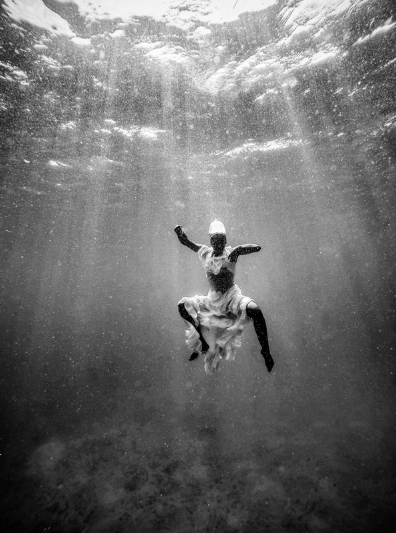
David Berg’s photograph was selected for the cover of the academic book “Unfinished Histories: Art, Memory, and the Visual Politics of Nordic Colonialism.” Berg contributed historical interpretation and rare archival photographs to the Yale University Press publication. (Photo courtesy David Berg/Blackwood Imaging)
Berg contributed historical interpretation and rare archival photographs to the project, including an image selected for the book’s cover. Published by Yale University Press, the book explores how art and visual culture help explain the complex and often overlooked history of Nordic colonialism.
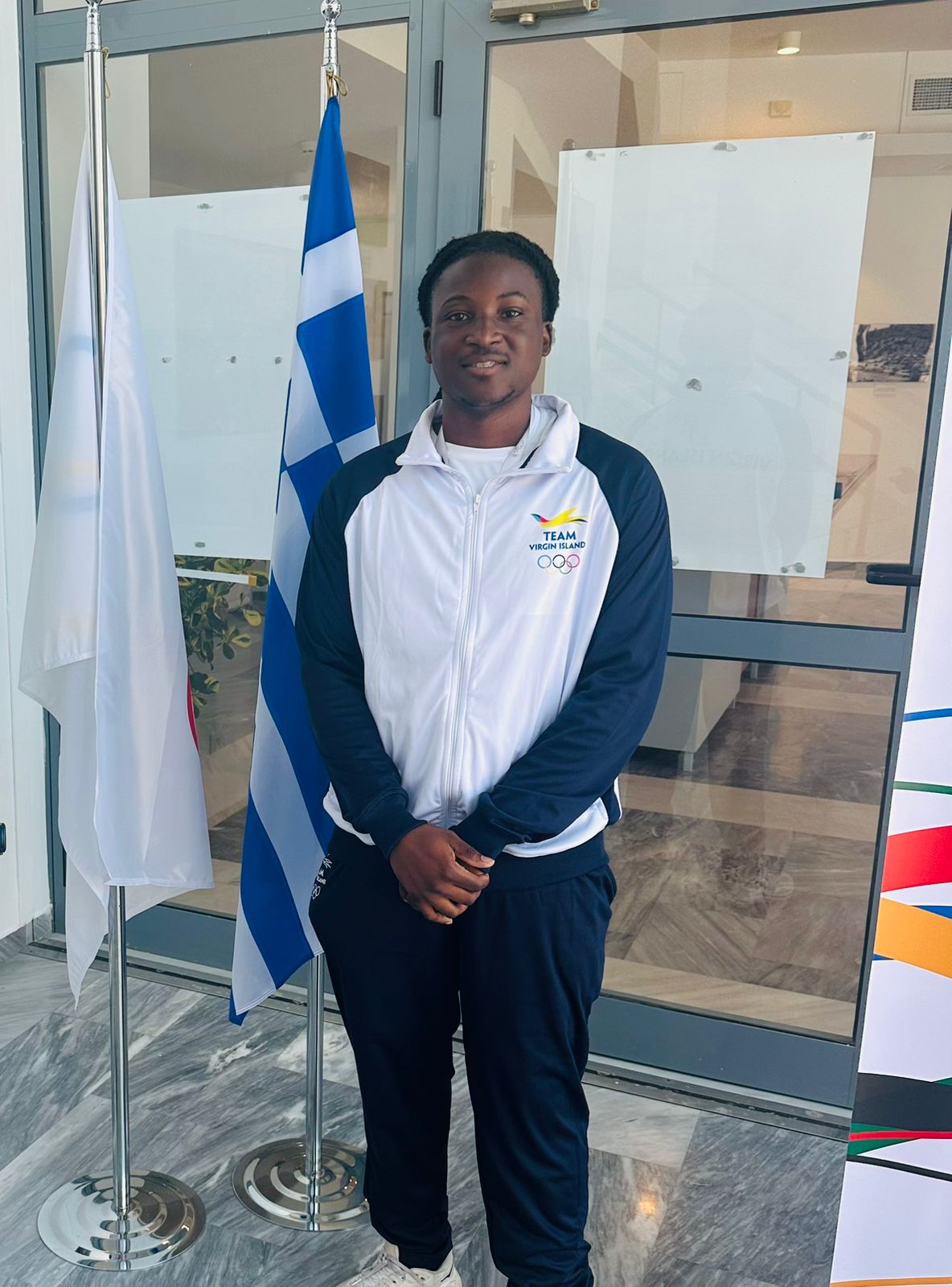
The Virgin Islands Education Department’s Eugene Farrell represented the U.S. Virgin Islands at the 66th International Session for Young Olympic Ambassadors in Ancient Olympia, Greece, after being selected by the Virgin Islands Olympic Committee, a press release announced.
Eugene Farrell represented the U.S. Virgin Islands at the 66th International Session for Young Olympic Ambassadors in Ancient Olympia, Greece, after being selected by the Virgin Islands Olympic Committee. (Photo courtesy VIDE)
Farrell, a program assistant with VIDE’s Division of Sports & Athletics, participated in the June 6-18 program alongside emerging leaders from around the world to study the principles of Olympism and ethical leadership in sports, according to the press release.
“This experience reinforced my belief that education extends beyond the classroom. As a representative of the Virgin Islands Department of Education’s Division of Sports & Athletics, I look forward to applying what I learned to help develop student-athletes through leadership, character, and the Olympic values, inspiring them to succeed both in school and in life,” Farrell said.
According to the release, this year’s session focused on inclusion, integrity and responsibility for athletes while exploring topics including safeguarding athletes, equity, ethical leadership and the values of the Olympic Movement.
VIDE Commissioner Dionne Wells-Hedrington said Farrell’s selection reflects the department’s commitment to developing leaders through sports and education.
“His participation reflected our department’s commitment to developing leaders who understand the transformative power of sports and education. We were proud to see him represent the U.S. Virgin Islands on this international stage, and we look forward to the positive impact his experience will have on our student-athletes and school communities,” Wells-Hedrington said.
Farrell’s participation supports the department’s efforts to promote leadership, sportsmanship and lifelong learning among student-athletes throughout the territory, the release stated.
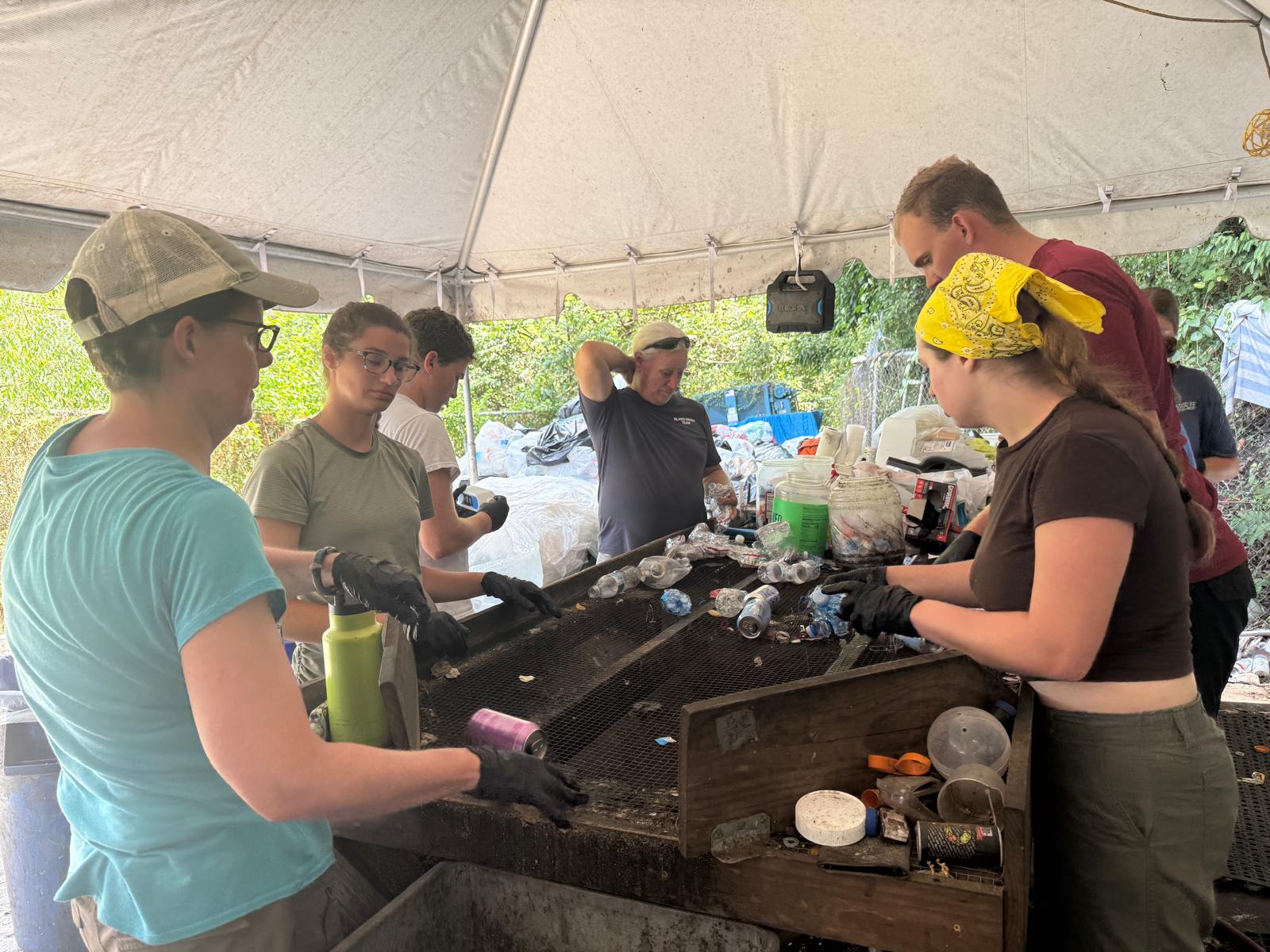
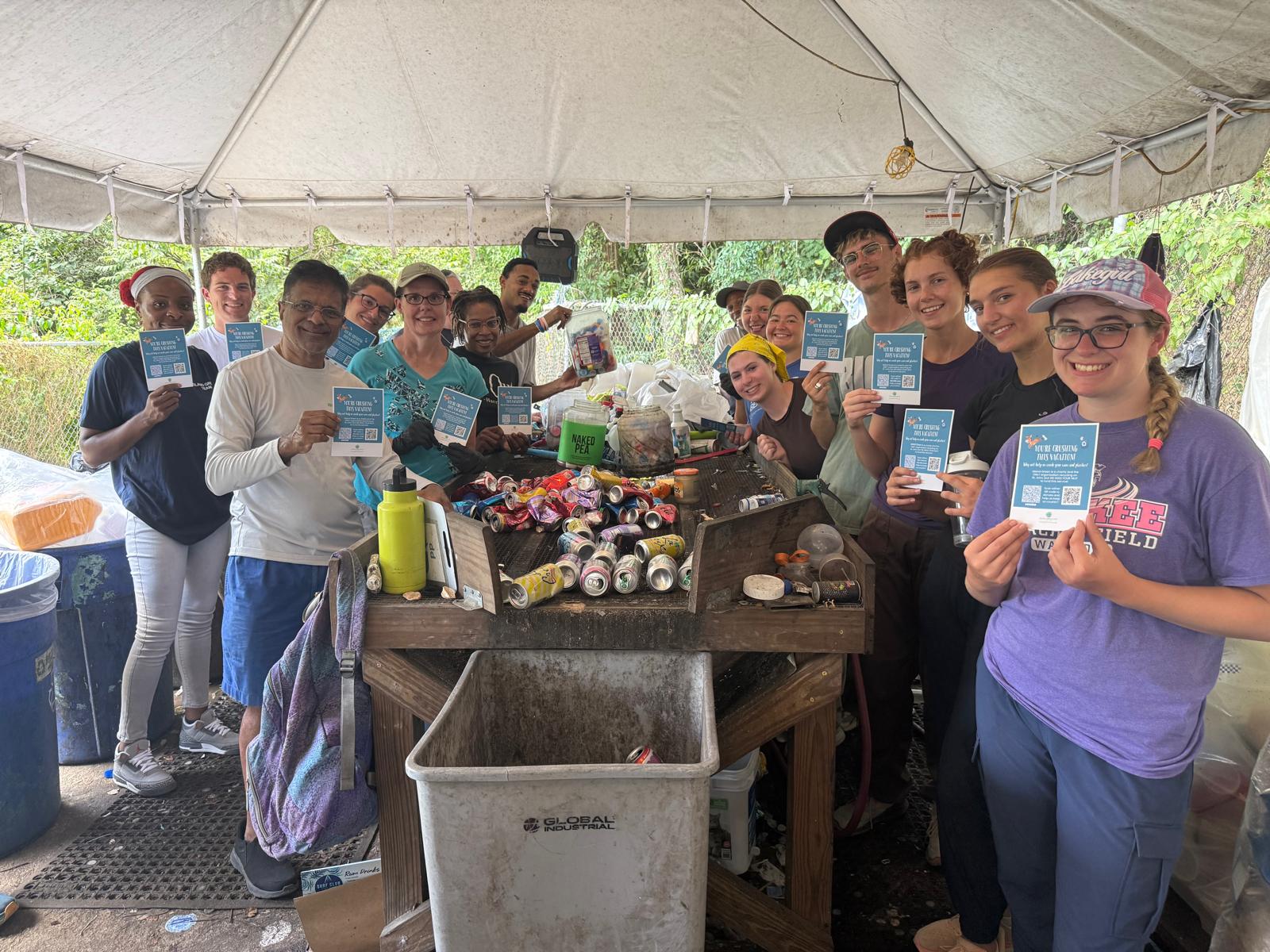
Iowa State students and organizers sorting recyclables at Island Green (Photo courtesy Island Green Living)
A group of approximately 10 Iowa State University students volunteering in the U.S. Virgin Islands spent Tuesday and Wednesday helping sort recyclables and prepare materials for shipment at Island Green Living’s Recycling Center at the ReSource Depot on St. John, the organization announced in a press release.
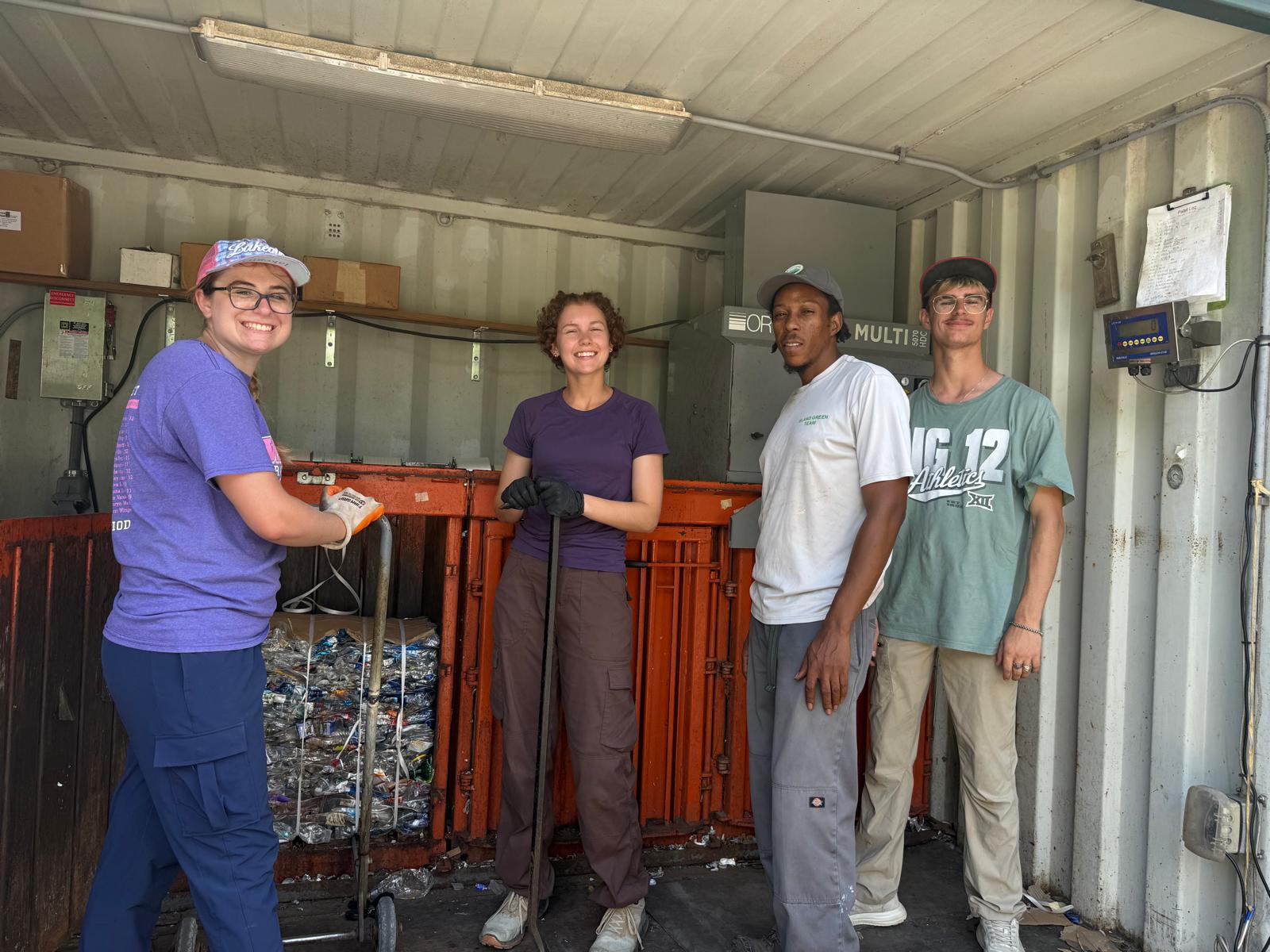
The students, accompanied by CALS Study Abroad Director Jodi Cornell and Associate Professor Julie Blanchong, assisted Island Green Living staff with processing aluminum and No. 1, 2 and 5 plastics collected through the nonprofit’s recycling program, according to the press release.
“Having the students from Iowa State here really exemplifies how community, when we get together and we work together, can conquer issues,” Interim CEO and Vice President Dawn Henry said in the release. “Island Green is leading the effort in the territory to source separate to keep resources from filling our landfill, and we encourage Virgin Islands to not only help by volunteering with us, but also by asking Waste Management to step up efforts by source separating on a municipal basis. The Waste Management Authority’s role is essential to the territory’s success.”
Island Green President Harith Wickrema said volunteers and donors are essential to the organization’s recycling program.
“Island Green values our volunteers and donors greatly in ensuring our recycling program continues. We truly could not operate without them and we thank the Iowa State students as well as Jodi and Julie,” Wickrema said. “We have still not received our full 2024 allocation from the Legislature and were not included in the 2025 budget, so although we are performing a municipal service by collecting and recycling hundreds of thousands of aluminum cans and ocean-bound plastic containers per year, we do so almost exclusively through donations and volunteers.”
Iowa State students and organizers with Island Green team (Photo courtesy Island Green Living)
Blanchong said the experience gave students an opportunity to contribute while visiting the territory.
“The organization makes a huge difference. It’s nice to see local people working, caring for the island, caring for the territory, and it is nice that when visitors come, they do their fair share to keep this island beautiful,” she said.
Cornell also thanked the organization for welcoming the group.
“We thank you for the opportunity for our students, for all of us, to learn and do something productive while we are here,” Cornell said.
Island Green Recycling Manager Akeino Williams with Iowa State students helping to process recyclables (Photo courtesy Island Green Living)
According to the release, Island Green Living has recycled more than 5.2 million aluminum cans and more than 167,000 pounds of ocean-bound plastics since the program began. The nonprofit also encouraged residents and visitors to volunteer, even for an hour or two, and emphasized reducing consumption of single-use plastics as the first step toward sustainable waste management.
The organization accepts rinsed No. 1, 2 and 5 plastics and aluminum cans at collection sites in Cruz Bay, Gifft Hill and Coral Bay, as well as at its ReSource Depot behind the Virgin Islands Territorial Emergency Management Agency on Gifft Hill Road, the release stated.
Island Green Living’s ReSource Depot thrift shop has diverted more than 1 million pounds of building materials, household goods, clothing and other items from local landfills. The nonprofit has also supported environmental initiatives including restrictions on plastic bags, plastic straws and toxic sunscreen, as well as food security and environmental education programs, the release stated.
A St. Croix-based beverage company has secured a $1.3 million strategic investment through a joint venture that will help expand its products across the Caribbean and into international markets, a press release announced.
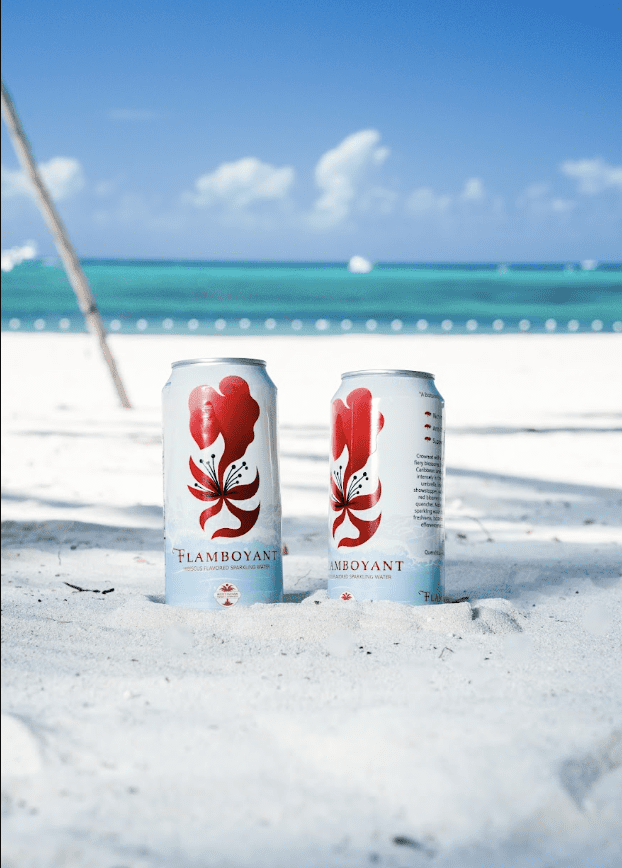
Flamboyant Water recently secured a $1.3 million strategic investment through a joint venture with Top Dog Cocktails, marking the St. Croix-based company’s first external capital raise since its founding in 2024. (Photo courtesy Flamboyant Water)
Flamboyant Water announced Tuesday that the investment comes through a partnership with U.S. ready-to-drink cocktail producer Top Dog Cocktails. Company officials said the funding will support expanded distribution, new product development and long-term manufacturing initiatives throughout the region.
The investment marks Flamboyant’s first external capital raise since the company was founded by Modern Caribbean LLC in 2024, according to the press release.
Headquartered on St. Croix, Flamboyant plans to broaden distribution throughout the Caribbean, with initial target markets including the U.S. Virgin Islands, Dominica, the Dominican Republic, Anguilla, St. Barths, St. Kitts and Nevis, Sint Maarten, Saint Martin, Cabo Verde and other Caribbean destinations, the press release stated.
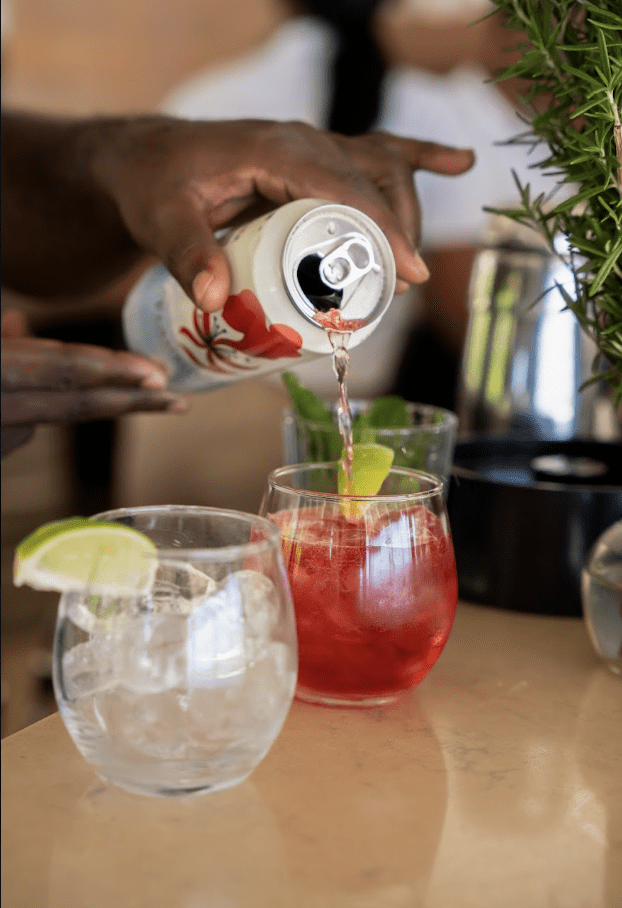
The company also plans to launch Flamboyant Reserve, a line of Caribbean-inspired rum-based ready-to-drink beverages. The first collection will include four flavors: Hummingbird, Island Garden, Island Spice and Island Citrus, the release stated.
According to the release, the beverages will contain fewer than 90 calories per can with 4.5% alcohol by volume and are expected to debut in fall 2026 in select Caribbean markets, Florida and Pennsylvania.
Flamboyant Water plans to expand distribution throughout the Caribbean and international markets while introducing a new line of Caribbean-inspired ready-to-drink beverages later this year. (Photo courtesy Flamboyant Water)
“The Caribbean already welcomes more than 30 million visitors every year,” founder Michael Pemberton, managing partner of Modern Caribbean LLC, said in the release. “Our strategy is simple: allow millions of travelers to discover Caribbean-inspired products at their point of experience and continue seeking out those products after they return home. As we expand distribution, we are equally focused on building manufacturing infrastructure in the region that enables Caribbean brands to create, produce, and export world-class products to consumers around the world.”
The company is also evaluating manufacturing opportunities in the Caribbean and is in discussions with the Government of Dominica, Invest Dominica Authority and the Dominica Water and Sewerage Company regarding a potential beverage manufacturing and export facility. According to the release, the proposed facility would support bottled water, premium beverages, private-label production and regional distribution, the release stated.
Top Dog Cocktails founder Ken Smukler said the partnership combines Flamboyant’s regional distribution strategy with his company’s product development experience, the release stated.
“Flamboyant represents an exciting opportunity to help build a globally scalable consumer brand inspired by Caribbean culture,” Smukler said in the release. “We believe the Caribbean’s tourism economy and growing consumer market create tremendous long-term potential across multiple beverage categories.”
The companies expect to begin rolling out the Flamboyant Reserve portfolio this fall while pursuing additional hospitality, tourism, retail and distribution partnerships throughout the Caribbean, according to the release.
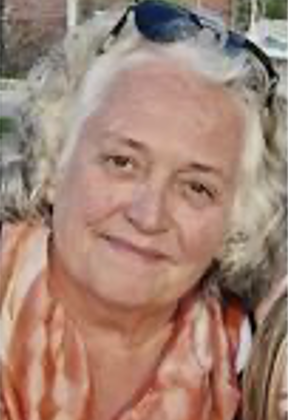
Deborah “Debbie” J. Ledansky (Submitted photo)
Deborah “Debbie” J. Ledansky
(October 2, 1950 – May 23, 2026)
Deborah “Debbie” J. Ledansky, 75, of Kenosha, Wisconsin, passed away peacefully, after a gallant battle with cancer, Saturday, May 23, 2026 at the Hospice Alliance Hospice House.
She was born on Oct. 2, 1950 to the late Joseph S. and Margaret (Wanenko) Ledanski in Kenosha. She was educated in the schools of Kenosha and graduated from Tremper High School. Debbie graduated from UW Madison with her BA in Education.
Debbie was a true educator that taught children in Australia, Guatemala, Columbia, Germany, and St. John, USVI, where she settled and taught for many years.
She traveled the globe, toured every continent except Antarctica. She maintained friendships around the world, especially her circle of friends in the Virgin Islands.
Debbie enjoyed swimming in the ocean, art, walks along the beach, and loved dogs and animals of all kinds.
Debbie is survived by her brother Joseph (Carleen) Ledanski, her nieces Sonya (Peter) Hyde, Sarah (Roland) Johnson and Stephanie Ledanski, her great nieces and nephew Rose, Ruth, and Rimona Johnson and Ione, Davin, and Zasha Hyde, and many cousins and friends all over the world.
She is preceded in death by her parents and one sister, Nancy (Ledansky).
There will be no funeral as per her request. The immediate family plans a celebration of Life at a later time. We are sure there will be lots of cackling and storytelling.
In lieu of flowers, memorials would be appreciated to St. John Schools of Arts, https://www.stjohnschoolofthearts.org/donate.
The family wants to send a special thank you to Dr Knight and his staff, and to the wonderful staff at Hospice House where they treated her so kindly and with such respect.
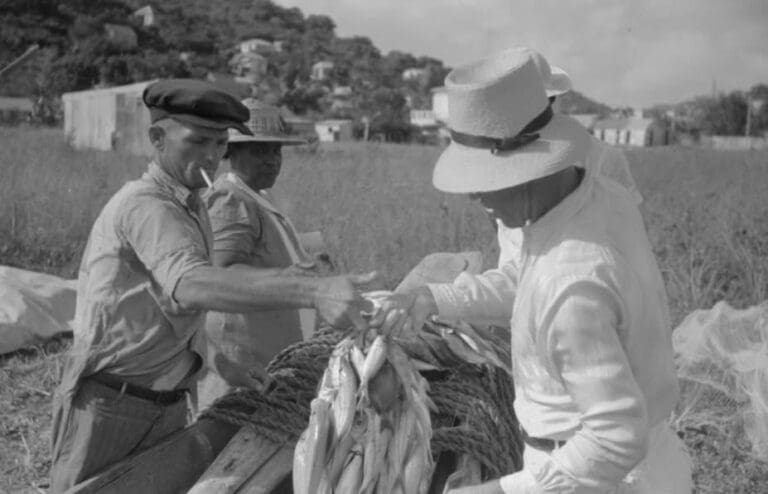
Commissioner Jean-Pierre L. Oriol of the Department of Planning and Natural Resources advises all licensed commercial fishers in the U.S. Virgin Islands that the annual commercial fisher registration period will take place in July 2026.
The Division of Fish and Wildlife, in partnership with the Division of Environmental Enforcement, will conduct in-person registration sessions in both districts to assist commercial fishers with renewing their registrations and submitting required documentation.
REGISTRATION SCHEDULE
ST. CROIX
ST. THOMAS–ST. JOHN
July 13–17, 2026
July 20–24, 2026
Division of Environmental Enforcement
DPNR Main Office
Anna’s Hope, St. Croix
2nd Floor Conf. Room, VIYA Building, Tutu
To complete the registration process, commercial fishers must bring:
• A completed and signed renewal form
• A current business license
• Any outstanding Commercial Catch Reports
DPNR encourages all licensed commercial fishers to attend during the designated registration period to ensure their records are current and their licenses remain in good standing.
For additional information or assistance, please contact the Division of Fish and Wildlife:
Email: DFWelectronic@usiv.onmicrosoft.com
St. Croix: (340) 773-1082
St. Thomas: (340) 774-3320, Ext. 5206
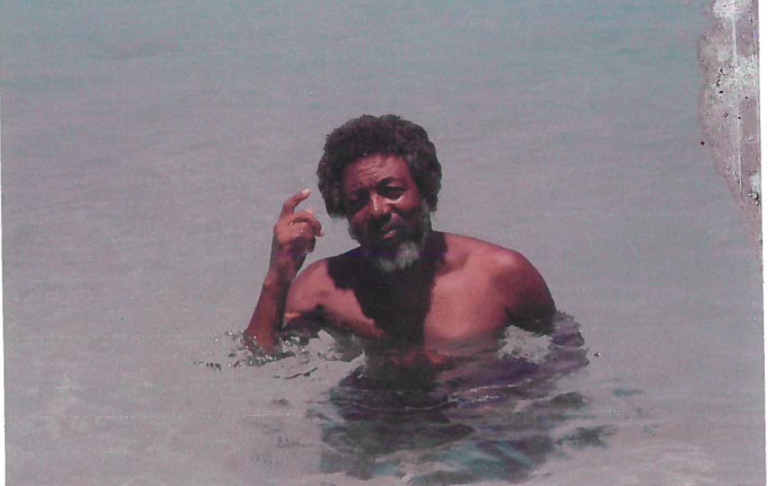
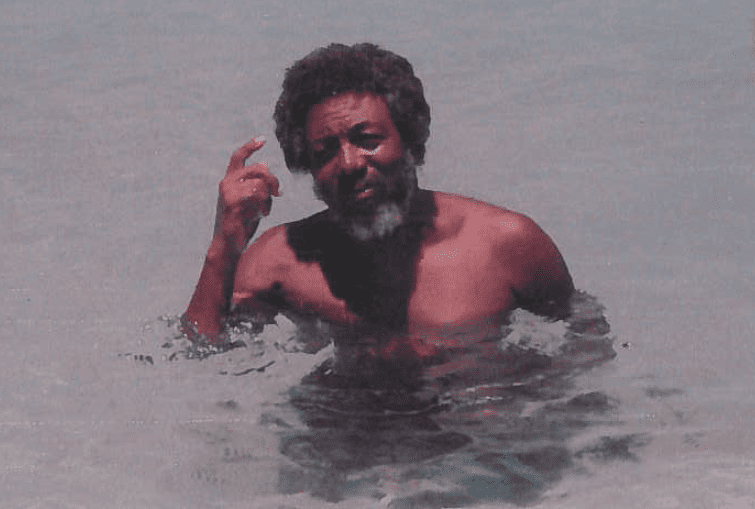
Editor’s Note: Each year on Emancipation Day the Source reprints this column, which first appeared in 2017.Victor Antonius “Tutsie” Edwards, who on Emancipation Day in 1985 swam across the treacherous Pillsbury Sound from St. Thomas to St. John to celebrate his freedom from drugs and alcohol and to raise funds for the Shaky Acres recovery program he helped found. (Submitted photo)Victor Edwards and Scott Fagan have been friends for more years than either one can count. Upon learning of Fagan’s submission of the story of Edwards’ daring Emancipation Day feat in 1985, he laughed, “Oh, Scott does that every year.” Fagan, who has teetered on the edge of world fame for much of his life,spent many years on St. Thomas.Arecent release of “Surrender to the Sun” speaks volumes of his love for the Virgin Islands. Since that fateful day in 1985, Edwards hasbeen a leader in teaching Virgin Islands children to swim.
In 1985 Shaky Acres — the recovery program that Tuts and I had started in 1981 — was going along fairly well but was in need of a fundraiser or two. Tuts heard, along with everyone else, of a proposed St. John swim.
Everybody heard of it because it was considered impossible by most folks, and suicidally dangerous by local folks who knew that there were sharks — starvin’ hungry sharks — out there the size of the battleship “Bismarck.”
The UDT (the Frogmen, the Navy Seals, the toughest hombres on or under the sea), while training for many years on St. Thomas, had given up on swimming to St. John because it was simply too crazy and dangerous a deed.
The well-intentioned local legislator who had proposed “the swim” was unaware of the deep and dark difficulties inherent in the “big fun fundraiser.”
When Tutsie was a young boy, riding back across Sir Francis Drake’s Passage coming home with his mother from a harvest festival in Cane Garden Bay in Tortola, he looked out from the deck of “The Joan Of Arc” or “The Bomba Charger” at Pillsbury Sound, the five-mile stretch of wild water that separates St. Thomas and St. John, and said to her, “I cou’ swim ‘crass dat yu kno.”
His usually gentle and loving mother, scared to death by what she was hearing, tried to discourage this crazy idea once and for all by replying, “Man hush up yu schupid mout, why yu like tu talk such schupid craziness?” Tuts didn’t see any reason to discuss it any further, but, he says, the conviction that he could do it was locked in his mind forever after.
It was July 3, 1985, Emancipation Day in the U.S. Virgin Islands — the day in 1848 on which it became official that enslaved people in the Danish West Indies had won their freedom and were now and forevermore free. Freedom was a long time coming for the children of Africa in the Danish West Indies, and very hard-won, as was Tut’s own personal freedom from drugs and alcohol.
There were 48 entrants altogether, most of them young white kids from the hot-shot St. Croix Dolphins Swim Team. They came prepared and ready to succeed, with sleek buoyant body suits, well-fitted goggles, and the best fins that money could buy.
A number of the St. Thomas swimmers were runners down from the states, budding triathletes; an elderly white gent determined to show his wife he still “had it”; and half a handful of locals with a mismatched assortment of masks and fins.
Tuts, on the other hand, was wearing one pair of big and baggy boxer trunks, y nada mas.
As the other swimmers did warmups and calisthenics on the sand at Vessup Bay in Red Hook, a tough old Tortola sailor pulled Tuts aside and said, “Buaayyy yu, yu crazy buaay? Yuh following de damn schupid white people dem? Yuh don kno de real name fo Red Hook is Shak Waff? Buaayy!! Shak ow de biggah den uh submarine! Yu is a Black man gon follow dem schupidy white people? Buaayy wha rang wid yuh, yuh crazy o something?”
Tuts concedes that the strongly delivered warning did cause him much concern, but that he had already told everybody over and again that he was going to do it, told them in the strongest terms, in the face of the harshest ridicule. It was common knowledge that no (sane) Black person from the islands could ever, should ever and would ever attempt to make that swim. Therefore, as his sanity was in question, it was also a crucial moment for recovery in the islands.
At this moment he was demonstrating clearly (to local folks) that local people who went to fellowship meetings “wid de crazy white people dem” were demonstrably nuts (just like they thought) and for him to chicken out before he even hit the water would have sealed it once and for all. Tuts has since confessed that on that particular morning he had decided that he would rather be eaten alive than quit.
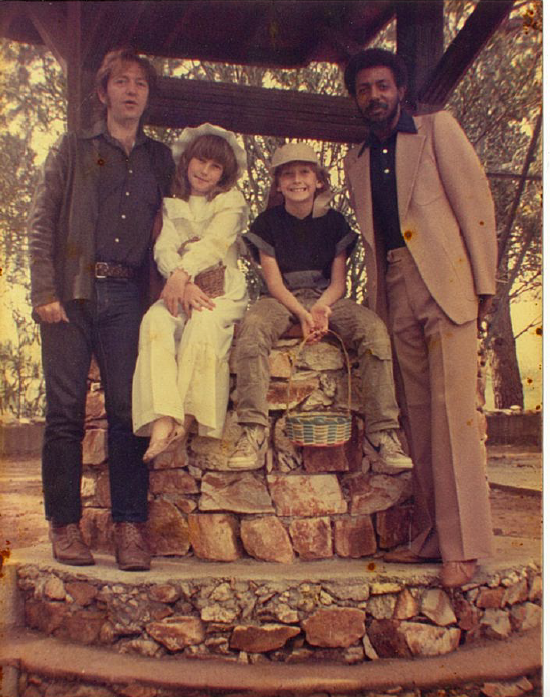
Victor “Tutsie” Edwards, right, with the author Scott Fagan and children Ielia and Archie, on Easter Sunday. (Submitted photo)
Once the old Tortola man realized that he was not talking to a sensible gentleman, he began to encourage him with information about what to expect in terms of currents and where to find what he called “soft spots” in the sea. He stated flatly that “yuh can’t swim directly east ta St. John, yuh have tu swim for Lovango (a small cay west-northwest of St. John) and as yuh hold Lovango as your goal, the current will be sweepin’ yuh south, look sharp! Buaay, dat is de onliest way to get dare.”
As the swim began, the fast and the fancy took off due east for Cruz Bay and before you knew it, half of them had been swept away and were heading backwards around Cabrita Point toward Big and Little St. James, then out over the Anegada Trough — part of the deepest trench in the Atlantic Ocean — on the bottom of which the scariest bug-eyed things on Earth, with jumping, wiggling electro “bait worms” dangling in front of foot-long razor teeth, swim around four miles down, snapping steel-trap jaws, and saying fish prayers, to get their dribbly lips around something, anything, soaked and slathered in coconut oil, or greasy mango-scented suntan lotion. From there, it’s south and west for St Croix, Puerto Rico, Santo Domingo, Haiti, The Caymans, the Isle of Pines, Cuba, and New Orleans. Of course, by the time they got to New Orleans there would be nothing left of them but a Speedo tag and whatever plastics they’d swallowed along the way.
Needless to say, an armada of rescue boats started pulling people in over the gunnels, like langustas on parade on a fish pot Saturday night.
Tuts was heading for Lovango.
Shortly after the fast and the fancy fiasco, the old white gent’s wife, standing in his rescue boat, started screaming hysterically, “A shark! A shark! Oh my God, I see a shark! Pull my husband out, pull my husband out, pull him out right now! Oh my GOD! Pull my husband out right now!”
Tuts says the poor old gent was utterly dejected as they pulled him up, his bathing suit drooping below his pale old, pink old, shiny old hiney.
Next went the dapper, sharply outfitted “high color” attorney from the states, who had looked most disdainfully upon our man’s baggy boxers and bony bare feet but was now being dragged, thoroughly defeated, flat on his back from the sea to flat on his back on the bottom of the heaving boat.
The boats were heaving now because the seas were heaving now they were coming into “The Big Blue” — a section of the sound a mile or more wide, in which, or perhaps I ought to say through which, big serioso, fast-moving, megalo mountains of big blue heavy water waves — waves of the sort that make you say “good lord,” or “mama mia,” or “holy freakin’ Toledo,” when you first see them even though you, if you have good sense, are looking at them from your perch on the deck of a big passenger ferry, 10 or 15 feet above the water line.
If you are in the water “down in the hollow” splashing along on your belly and craning your neck up trying to see the top of the wave, you will probably say a lot more than “good lord,” and if you are Tutsie and your rescue boat is manned by one “Fisherman John,” a continental dipso juicehead that you recently helped to drag off the junk heap of life, but now haven’t seen for over half an hour, most of it will not be printable in a general audience “memwah” such as this one. But you can believe me when I say, you have probably never heard anything like it.
Eventually, Tuts discovered that if he swam like crazy, faster and faster, as he got closer and closer to the top and he could then flip over to his back at just the last second, the wave would crest and the curl would break over his shoulders. He could “hang there” for seconds, perhaps one or two of the longest this side of eternity, and contemplate his mounting misery and helplessness before having to roll over and slide headfirst down, down, down, ah down, down, down, ah down, down, down, down, knowing that something is surely waiting in the “trough” to open its porky yaw and scrape the heck out of your back, belly and sides as it swallows you whole.
As I may have mentioned casually a short while ago, this section of the sound was just a splash over a mile or more wide. Can you guess how many times your whole life can flash before your eyes before you get completely bored with it?
What you don’t get bored with is the fact that you cannot see either island or, for that matter, anything at all when you are down in the valley, nothing but deep, dark blue. So, the desperate hope that you might be able to see something, anything, hinting at where you are (is it Puerto Rico? Is it Berlin?) at the top of the next wave is a powerful draw and can keep you going for many a repetition.
One time he did see something recognizable back on St. Thomas. It was the two super poles that mark the spot where the undersea cable goes down beneath the sea. Way down to the bottom that is the bottom way, way down in the pitch-black darkness beneath his own bottom. Better to see nothing, he thought, than things as scary as that.
Pretty soon his primary concern had shifted from monstroso seas to waves slapping him in the face — slap, slap, slap, slap — and he realized that he was in a different kind of swim now. The big blue was behind him, and he was battling offshore currents, lucky he had gone for Lovango because now, in spite of his forward motion, he was being swept sideways, southward toward Steven Cay, a small flat island outside of the bay of Cruz Bay.
Tuts knew that if he allowed himself to be swept southward beyond Steven Cay, he would be out in the Anegada Trough, and then as likely as not his rescuers would be the Venezuelan navy. He determined that he had to get to and make it through the spiffy currents around Steven Cay.
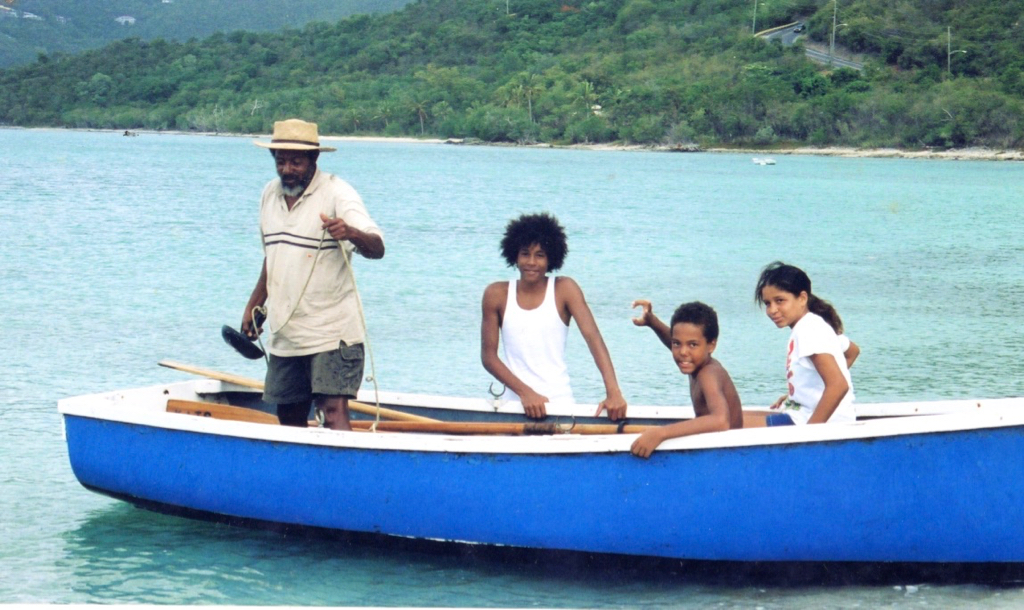
Victor Edwards demonstrates boating skills at John Brewer’s Bay in 2006 or thereabouts. Since his swim in 1985, Edwards has been a leader in teaching Virgin Islands children to swim. (Photo provided by V. Edwards)
If the current was running in his favor, it could be a breeze. He was exhausted, but just on the inside of Steven Cay was the outer entrance to Cruz Bay. He was almost, almost there.
Alas, the current was not in his favor (unless he wanted to turn around and “go with the flow” back to the “Cabrita express” and the aforementioned many points beyond), and this part of the swim took everything but the very best of him. The very best of him was all that kept him kicking; the current was so strong that the surface water was rippling backwards in protest. That’s when the “water under water” is moving too fast for the water “on the water” to keep up, so the surface ripples backwards in tiny little cascades of confusion, all of which seemed to be going right up his nose, and down his throat.
They say that the children of Africa can’t swim. My friend Tutsie has proved time and again that that is a racist lie, or put another way, demonstrably untrue. Although it is true that Tutsie’s mother, Miss Meu, born in Dominica, was one-half Carib. And although the present effort of the Carib/Arawak Federation is to dispel the myth that they say King Charles of Spain used to promulgate and excuse the genocide of the indigenous peoples of the Caribbean, specifically, that the Caribs were so wild and savage that they ate people, there is no question that the Caribs were and are among the toughest of the toughest human beings that have ever lived. So, our man, three-quarters African, one-quarter Carib (with a smitter-smatter of French and British, both in the African part of the pie) is lying all but dead in the water, having just burst through the impassable current hole at Steven’s Rock.
Tuts, aka “El Toro,” aka “Peperino,” aka “Skarpy,” aka “The Rabbi” (that’s another story), aka a hundred other desperado descriptors, was ready to give it up. If only he had the strength to raise his arm to signal surrender or the voice to beg to be dragged out of the sea, he would have done so. But just then the cheerful voice of Fisherman John came sing-songing across the water: “Make it look pretty Tuts! Make it look pretty! We’re almost there, man! Make it look pretty!”
Some day I’ll build a statue at Cabrita Point to Victor Antonius “Tutsie” “El Toro” Edwards, one portraying a skinny little mahogany- or brass-hued dude in baggy boxers, tilting forward on one leg, the other angled up and out behind, with hands clasped (as in prayer) just above his head, poised to dive into history.
Tuts became that day the first native Virgin Islander to EVER, in all time, swim from St. Thomas to St. John.
It wasn’t pretty as he crawled and dragged himself ashore (water streaming from every orifice), and it wasn’t pretty as he collapsed on the sand, unable to stand for a full three minutes. But in his defense, he was 40 freakin’ years old and working with a body that had been ravaged by drugs and alcohol.
The kids on the Dolphin Swim Team have much to be proud of. They did in their wetsuits, fins and organized swim formations what the rough and tough UDT had given up on: they made the swim.
I know that wherever these kids are in the world, and wherever they will go, they will always remember that “once upon a time, when we were kids in the islands, my friends and me did the impossible together.” They will also remember with awe and admiration “that skinny little fellow in the baggy boxer trunks” that did it alone and barefooted, and then passed on the champagne and praise, because “that’s not why he was there.”
Tutsie made the swim because it was Emancipation Day, and he wanted to demonstrate and celebrate freedom. He wanted to demonstrate freedom from fear of the sea and the ignorant idea that “Black people can’t swim.” He wanted to demonstrate that “recovery is macho” and that Black people now need to be emancipated from the chemical slavery that is alcoholism and addiction, and because even though she was long gone, he wanted his mother to know that he could do what he said he could do, and now it was time to go home.
And oh yeah, let’s not forget, he did it for Shaky Acres.
A federal judge scheduled jury selection in the trial of Davidson and Sasha Charlemagne for early November. (Shutterstock image)
The trial of Davidson and Sasha Charlemagne, originally scheduled to begin later this month, was pushed back by four months this week because the government’s prosecutor is on bereavement leave.
The Charlemagnes were arrested in June 2024 and charged with federal crimes related to their alleged mismanagement of lumber earmarked for disaster recovery projects under a U.S. Department of Housing and Urban Development-funded contract. They were initially charged with government program fraud, wire fraud and money laundering conspiracy. Months later, prosecutors tacked on charges of making false claims upon the government and alleged that Sasha Charlemagne submitted timesheets claiming she worked eight-hour days managing the lumber — which was stored rent-free for years at the Alexander Henderson Elementary School on St. Croix — despite the fact that she wasn’t even in the territory at the time.
The V.I. Housing Finance Authority awarded the original lumber management contract to Island Services Group, whose principals Morris Anselmi and Kimberly McCollum were themselves indicted on a charge of pocketing half a million dollars in federal Paycheck Protection Program funds in March 2024. The work was then subcontracted out to the Charlemagnes’ company, D&S Trucking.
The case against the Charlemagnes has moved at a snail’s pace since their arrest because Anselmi, a key witness, has been hospitalized out of the territory. An April 2025 deposition halted abruptly amid questions about Anselmi’s immunity from prosecution in the woodpile case. In April 2026, he and McCollum signed pretrial diversion agreements and cleared the way forward for his deposition and for the Charlemagnes’ trial.
The most recent setback came last week, when Assistant U.S. Attorney Denise George told the court that the recent and unexpected death of her father “required substantial attention during what would have been the critical period for pretrial preparation.”
“The Government does not have fully prepared cocounsel available to step in,” according to the government’s motion to continue, which added that Cherrisse Amaro — who was among prosecutors in the case against former V.I. Police Commissioner Ray Martinez and former Management and Budget Director Jenifer O’Neal — “recently departed the Office.”
After a status conference Tuesday, U.S. District Judge Mark Kearney set jury selection for Nov. 2 and opening statements in the Charlemagnes’ trial for the following day.
Former V.I. Housing Finance Authority executive Darin Richardson, who awarded the woodpile contract and who had a business relationship with Anselmi, was arrested at the same time as the Charlemagnes. While their trial languished amid procedural questions and delays, he was tried and found guilty in March 2025 of lying to a federal agent, criminal conflict of interest, bank fraud, money laundering and making false statements on a loan application. Kearney sentenced Richardson to three years in prison in March.
On Tuesday, the U.S. Third Circuit Court of Appeals granted Richardson’s release from custody pending appeal.





 The Division of Fish and Wildlife, in partnership with the Division of Environmental Enforcement, will conduct in-person registration sessions in both districts to assist commercial fishers with renewing their registrations and submitting required documentation.
REGISTRATION SCHEDULE
ST. CROIX
ST. THOMAS–ST. JOHN
July 13–17, 2026
July 20–24, 2026
Division of Environmental Enforcement
DPNR Main Office
Anna’s Hope, St. Croix
2nd Floor Conf. Room, VIYA Building, Tutu
To complete the registration process, commercial fishers must bring:
• A completed and signed renewal form
• A current business license
• Any outstanding Commercial Catch Reports
DPNR encourages all licensed commercial fishers to attend during the designated registration period to ensure their records are current and their licenses remain in good standing.
For additional information or assistance, please contact the Division of Fish and Wildlife:
Email: DFWelectronic@usiv.onmicrosoft.com
St. Croix: (340) 773-1082
St. Thomas: (340) 774-3320, Ext. 5206
The Division of Fish and Wildlife, in partnership with the Division of Environmental Enforcement, will conduct in-person registration sessions in both districts to assist commercial fishers with renewing their registrations and submitting required documentation.
REGISTRATION SCHEDULE
ST. CROIX
ST. THOMAS–ST. JOHN
July 13–17, 2026
July 20–24, 2026
Division of Environmental Enforcement
DPNR Main Office
Anna’s Hope, St. Croix
2nd Floor Conf. Room, VIYA Building, Tutu
To complete the registration process, commercial fishers must bring:
• A completed and signed renewal form
• A current business license
• Any outstanding Commercial Catch Reports
DPNR encourages all licensed commercial fishers to attend during the designated registration period to ensure their records are current and their licenses remain in good standing.
For additional information or assistance, please contact the Division of Fish and Wildlife:
Email: DFWelectronic@usiv.onmicrosoft.com
St. Croix: (340) 773-1082
St. Thomas: (340) 774-3320, Ext. 5206