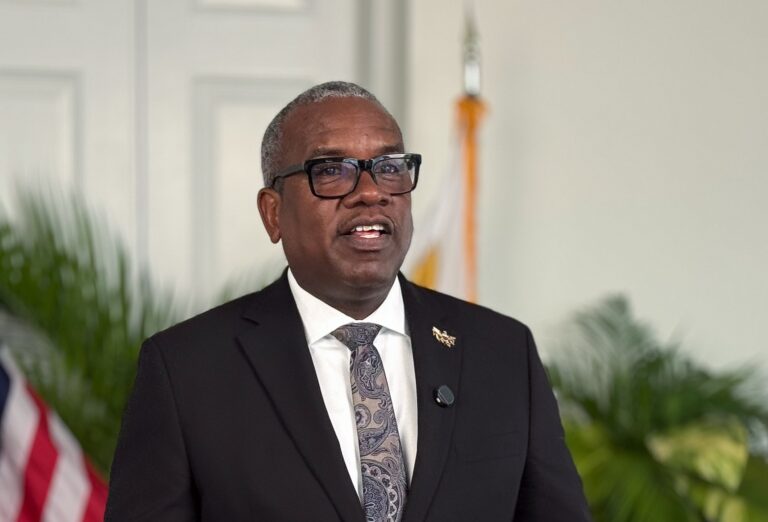
Gov. Albert Bryan Jr. called on Virgin Islanders to submit documentation of fees incurred since the Trump administration’s elimination of the “de minimis” exemption in a bid to sway White House officials to re-exempt the territory. (Photo courtesy Government House)
Government House is asking Virgin Islanders and local businesses to share their stories of increased costs following the Trump administration’s elimination of the “de minimis” exemption for packages from outside the U.S. Customs Zone worth less than $800.
“This is not just for us …. Every territory is really paying this de minimis tax now,” Gov. Albert Bryan Jr. said Monday on the heels of multiple meetings with administration officials in Washington, D.C. “So we think we got it across, but we want to do a little extra. We want to show them in dollars and cents what it means to you, the people of the Virgin Islands.”
Bryan said residents and businesses can share their stories and pictures of postal fees to postalfees@go.vi.gov.
“We want to know how it’s affecting you, and we want to prove our case to the White House to get the president to get this turned over,” Bryan said. “So if you’re on a household budget and you have to squeeze to make it, if you’re in a business and it cuts into your profit margin, I’m sure that the president does not want to do harm to Americans, and he will understand us getting this done.”
In an executive order signed by President Donald Trump last year, the White House characterized the de miminis exemption as a “catastrophic loophole used to, among other things, evade tariffs and funnel deadly synthetic opioids as well as other unsafe or below-market products that harm American workers and businesses into the United States.”
The move was condemned by representatives, including Congressional Delegate Stacey Plaskett, who said in September that it placed yet another burden on territorial residents.
“I have said, for more than 10 years, that the Virgin Islands should determine if being outside of the Customs Zone has the same benefit that it did over 100 years ago to our territory and residents,” she stated. “If not, the governor of the Virgin Islands as the individual with the authority to enter into arrangements of this nature with the federal government should request such change which would then require the executive branch authorization.”
Government House spokesperson Richard Motta Jr. swiftly refuted the notion that the territory’s exclusion was a local decision.
“It never was,” he said in September. “It was established by Congress in the Tariff Act of 1930, which means only Congress has the authority to change that status — not Governor Bryan and not the President of the United States — and that has been the case since the United States Virgin Islands was acquired by the United States in 1917.”
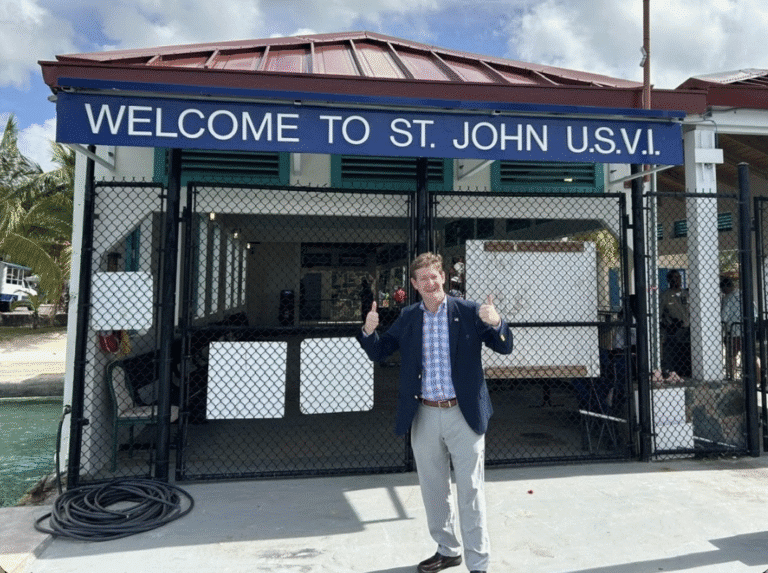
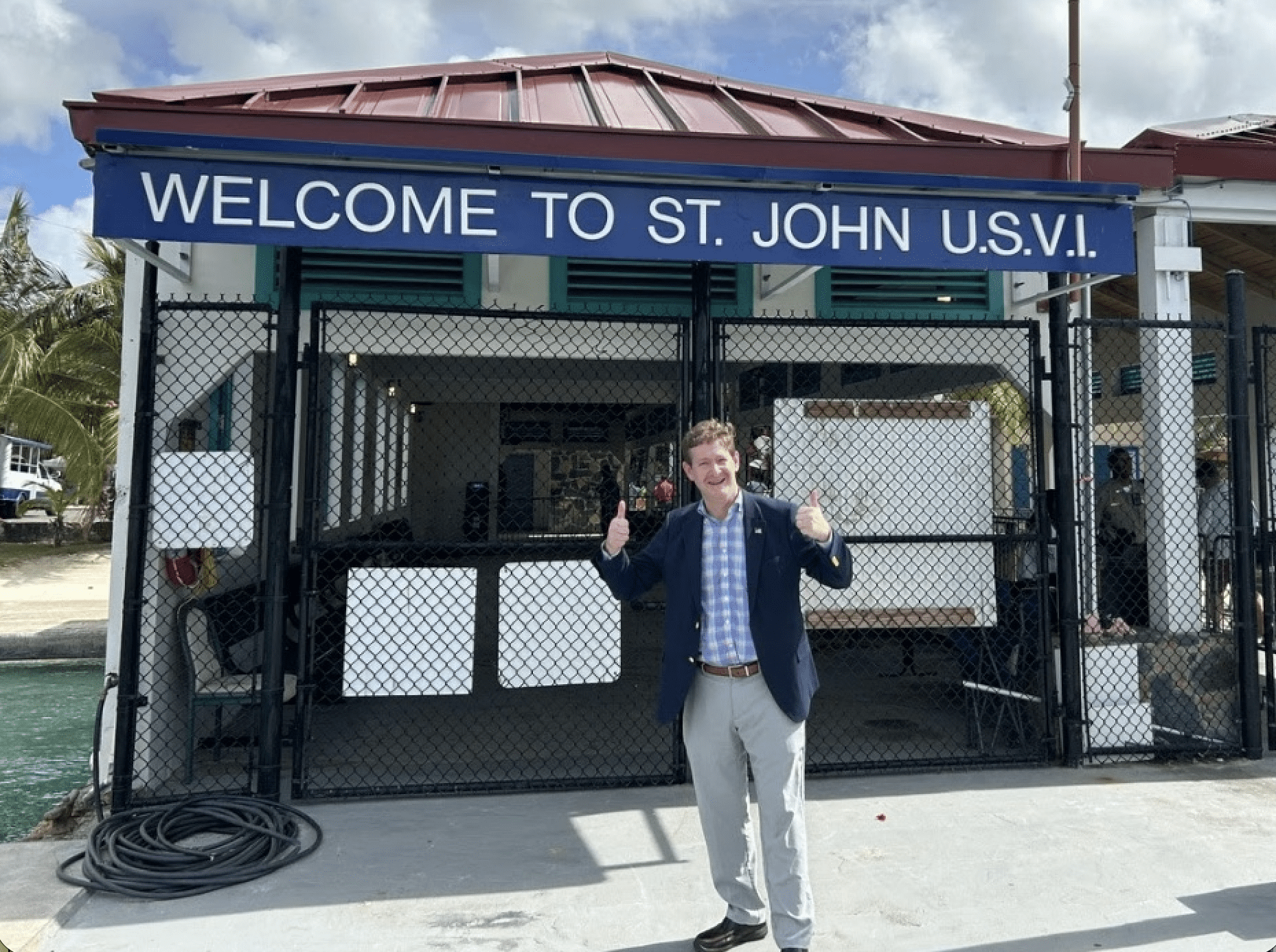
Matt Coleman was the first Regional Administrator of the Small Business Administration to visit St. John in three decades, according to federal officials. (Photo courtesy U.S. Small Business Administration)
Federal Small Business Administration officials met with Virgin Islanders in February, acknowledging shipping and receiving frustrations, promising diligence on new BVI charter boat fees, and, according to a statement from the agency released Monday, taking jabs at former President Joe Biden.
Matt Coleman, administrator of the U.S. Small Business Administration’s Atlantic Region, visited businesses on all three islands, from the Little Olive Food Truck to the Port Hamilton oil refinery, which under federal rules qualifies as a small business, according to the statement.
One of those businesses was Gold Coast Yachts, boatbuilders on St. Croix since 1986. President and cofounder Richard Difede said he was impressed someone in Coleman’s position would pay attention to the Virgin Islands, but noted the visit came during a particularly cold winter on the mainland.
Difede, the SBA’s 2018 Virgin Islands Entrepreneur of the Year, had bolstered his business and employees during the COVID-19 pandemic by using Paycheck Protection Program loans, something Coleman knew all about as the public face of the program in the Atlantic Region for the first Trump administration.
Difede said he told Coleman about the problems caused by new Customs regulations — where tax is owed on almost everything shipped into the Virgin Islands — as well as the general state of uncertainty’s effect on his business.
With orders placed around two years before expected delivery, Gold Coast’s yacht building requires careful planning with buyers and suppliers, he said.
“The suppliers can’t give me a price anymore. I don’t have a clue,” Difede said. “The uncertainty right now is massive, and that’s not good for the economy or any sector within the economy. So, you know, the status quo can always be improved. Confusion is not the way to improve it.”
Coleman, a President Donald Trump appointee, assured Difede and others that the federal government was working “tirelessly” to resolve one of the biggest hits to the USVI economy in recent memory, the BVI’s fee hike on charter boats. The Trump administration had sent a formal diplomatic complaint to BVI officials about their 2025 Commercial Recreational Vessel Licensing Act, he said.
The charter vessel industry and related businesses employ approximately 25% of the USVI’s private employees, Coleman said. The SBA, the Departments of State, Commerce, and Homeland Security, the Office of the U.S. Trade Representative, as well as local maritime advocates, were all working to protect the territory’s vital charter boat industry, he said.
Congress has also been alerted to the “economic inequities caused to U.S. Virgin Islands small businesses by the BVI amendments,” Coleman said in a press release.
“The sharp rise in license fees to utilize these shared waters is not consistent with the historically collaborative and close relationship between the USVI and BVI,” he wrote.
Coleman’s visit to the territory came with trademark Donald Trump-style bombastic language and shots at his predecessor, Biden.
In 2023 and 2024, the SBA broke records for backing loans in the territory, benefiting 18 businesses in 2023 and 22 in 2024, ensuring $9.8 million in small business loans that year.
Coleman said that the number more than doubled in 2025, but did not provide details on how many businesses benefited.
“The almost 200% increase in SBA loans in the USVI compared to the last year of the Biden Administration — in 2024, the SBA approved just $9.8 million in the territory, but one year later, that number jumped to $20.6 million — is a record high,” Coleman wrote. “Lending gains continued even after the Trump SBA reduced its workforce by 43% earlier last year and implemented stricter underwriting standards in response to heightened $400 million in defaults and delinquencies from the Biden Administration due to their mismanagement and lax underwriting standards.”
Officials from the Virgin Islands Small Business Development Center, which promotes weekly events to aid small business owners, did not immediately reply to several requests for information.
Coleman also touted the Trump administration’s dramatic reversal of federal regulatory oversight. He met with Port Hamilton refinery officials, including Vice President and refinery manager Fermin Rodriguez, who helped lead the refinery’s response to EPA environmental remediation. An early version of the SBA’s press release on Coleman’s visit erroneously said the refinery had secured new federal contracts. It has not, officials said.
“Thanks to the Trump economic agenda – including tax cuts, deregulation, and fair trade – job creators are spring-loaded for another historic year in 2026,” he said. “After four tough years, 2025 marked Main Street’s comeback — from USVI to the mainland — because President Trump knows that small business is big business for America. It’s why the Trump SBA prioritized capital access, deregulation, and Made in the USA – and helped generate all-time records for small business formation, confidence, and capital delivery.”
Coleman singled out Mutiny Distiller’s use of breadfruit for their vodka making, reducing reliance on imported ingredients.
At Gold Coast Yachts, Difede took a more measured view of both the deregulation and the made-in-America push.
“Things were more stable under previous administrations but that doesn’t necessarily mean they were stable. There were certainly issues,” he said.
The idea that businesses will pass along savings to their customers in the form of lower prices is a fantasy, he said. Regulations can be cumbersome and sometimes hold a business back but are also necessary for the health of the community.
“Ultimately, my business is secondary to the health of the people of the territory and the environment of the people in the territory,” he said. “Trump’s wiping out all these regulatory things for air and water and my food. I hate that.”
Upcoming Virgin Islands Small Business Development Center events include tips on securing an SBA loan, a primer on USVI economics and cash flow, a deep dive on the territory’s Economic Development Bank and State Small Business Credit Initiative, a talk on disaster preparedness and business resiliency, a guide to writing a successful business plan, and more.
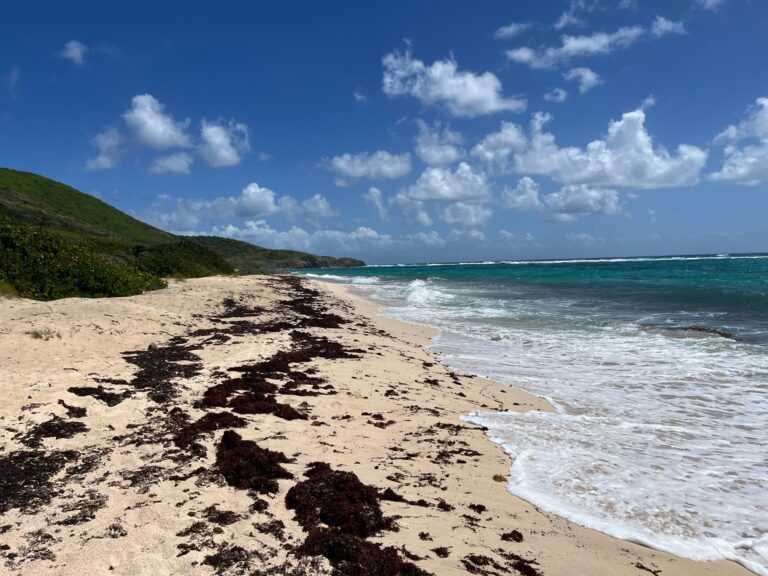
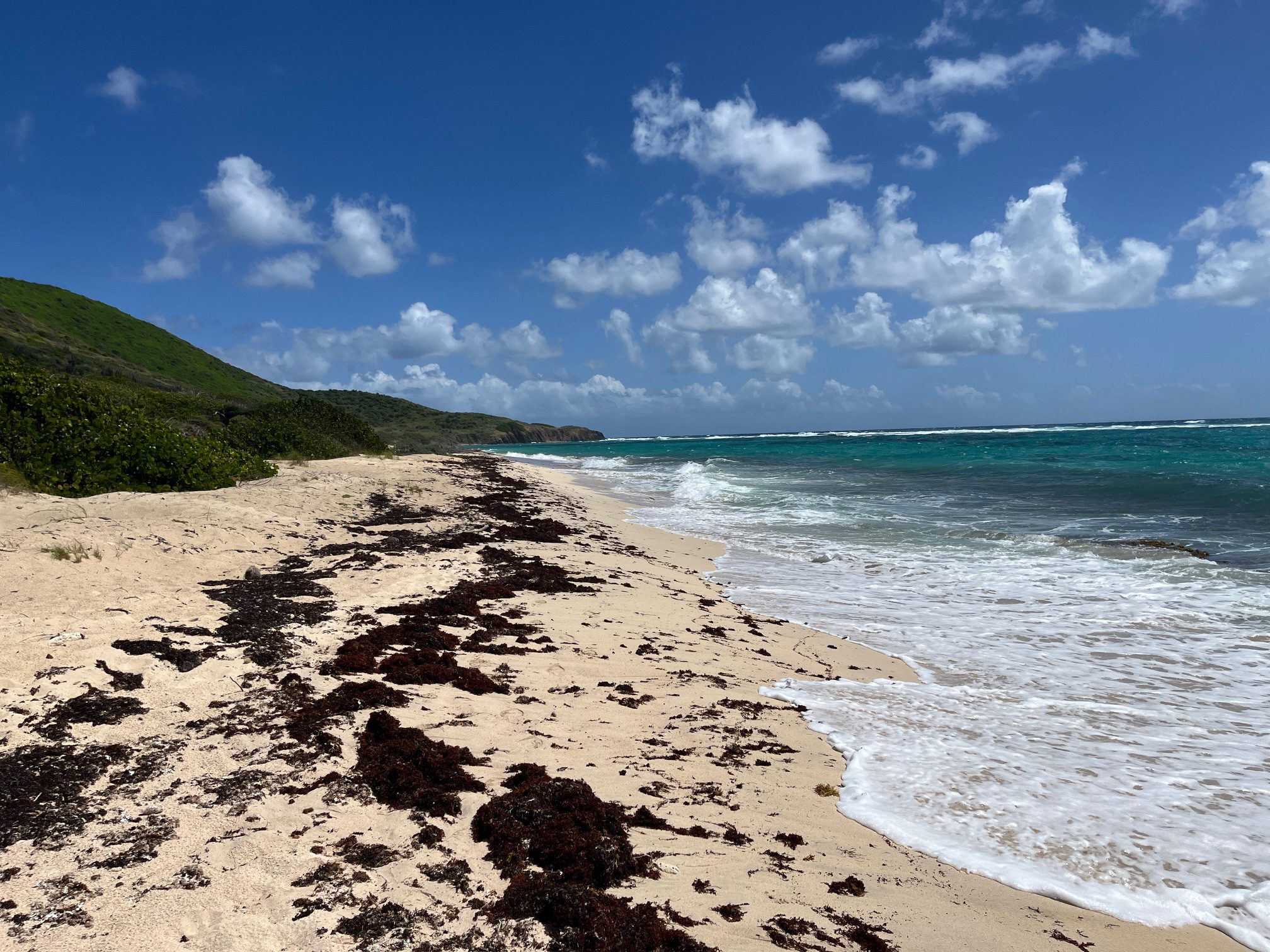
Patches of sargassum were visible along the shoreline on the east end of St. Croix on March 1. (Source photo by Jesse Daley)
Sargassum levels across the Atlantic and Caribbean remained above normal in February, and researchers say the region remains on track for another major sargassum year in 2026. A new outlook from the University of South Florida’s Optical Oceanography Lab found continued growth with further increases expected.
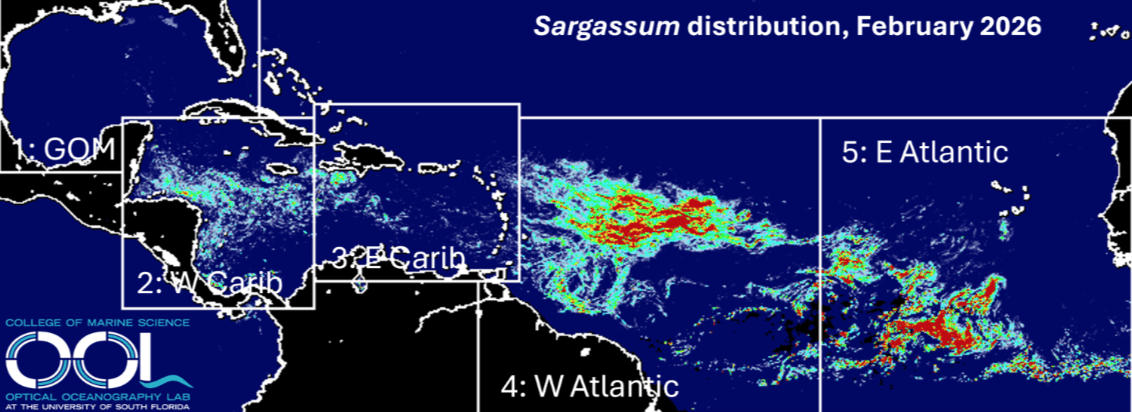
The OOL at USF monitors the presence of sargassum across the Atlantic, Caribbean, and Gulf regions using satellite imagery. The group’s February 2026 outlook, released Feb. 28, found that overall amounts continued to increase across much of the Atlantic and Caribbean region. With the exception of the eastern Atlantic, USF noted that February sargassum totals were at record highs for the month compared with historical observations.
“As predicted in January 2026, sargassum in most regions continued to grow, including the western Caribbean, western Atlantic, and eastern Atlantic,” USF explained. “In the Gulf and eastern Caribbean, total sargassum amount remained stable. Except for the eastern Atlantic region, every other region continued to see record high sargassum amount for the month of February. The distribution map continued to show three separated large masses in the eastern Atlantic, western Atlantic, and the western Caribbean, respectively,” USF said.
Beaching Events Across the Region
The February outlook indicated that seaweed beaching events likely occurred along parts of the western Caribbean, including areas of Belize, Honduras, and Mexico’s Caribbean coast. Islands across the Lesser Antilles, including the U.S. Virgin Islands, may also have experienced increased accumulations, particularly along windward-facing shores, where prevailing trade winds push floating mats toward land.
A satellite-based map of sargassum observed in February. Darker red areas indicate higher concentrations. The University of South Florida’s Optical Oceanography Lab reported an increase in the seaweed across the Atlantic and Caribbean. (Photo courtesy University of South Florida Optical Oceanography Lab)
These offshore accumulations serve as source regions that can be transported toward coastlines by currents and seasonal wind patterns in the months ahead.
While the USF outlook does not provide beach-specific forecasts, the U.S. Virgin Islands typically begin seeing increased sargassum arrivals in late spring and summer as seasonal currents transport floating mats into the northeastern Caribbean. However, beaching events and larger inundations can vary widely from one shoreline to another depending on wind direction, wave exposure, and local coastal features.
In order to help contain beaching events along the USVI, as reported in a previous Source interview with Amy Dempsey, a marine biologist and founder of the consulting firm Bioimpact, Inc., officials in the territory have begun using floating barriers to divert incoming mats of sargassum before they reach the shoreline. The booms have shown promise in keeping beaches clearer, but they require constant upkeep due to strong currents and storm damage and must be removed ahead of approaching cyclones.
Sargassum ExplainedAnother Source article included information about sargassum through an interview with Yuyuan Xie, Ph.D., a research scientist at USF. Xie is involved with the university’s OOL.
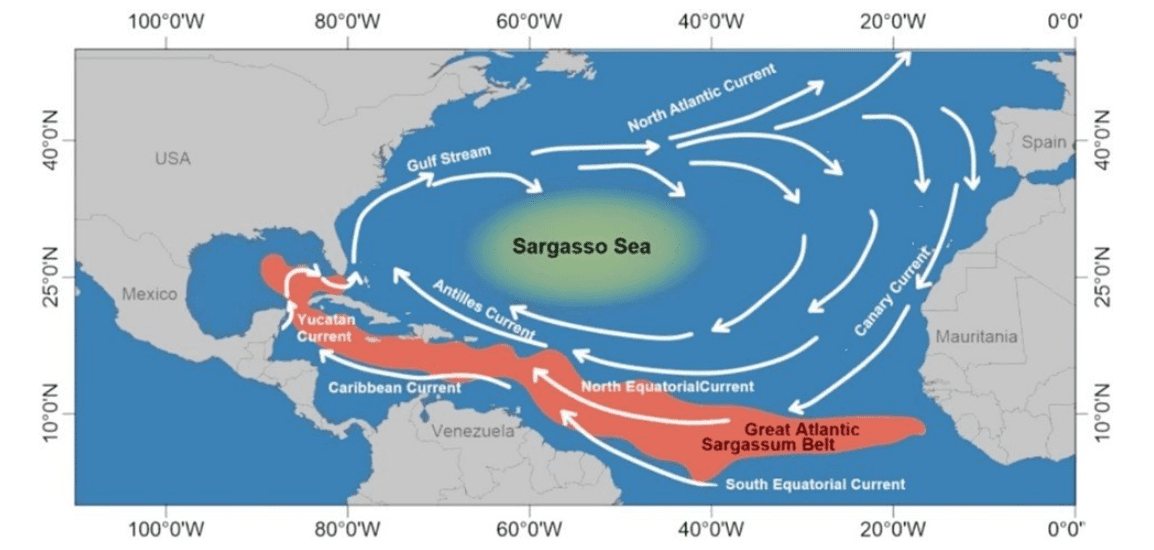
“Pelagic sargassum seaweed is a brown macroalgae floating on the ocean surface,” Xie said. “It was first reported in the 15th century by Christopher Columbus, and a regional sea in the North Atlantic Ocean, the Sargasso Sea, was named after this plant. Sargassum serves as a habitat for many marine animals, such as turtles, fish, shrimp, crabs, and so on. These macroalgae can grow to a length of several meters and form floating mats on the ocean surface,” Xie continued.
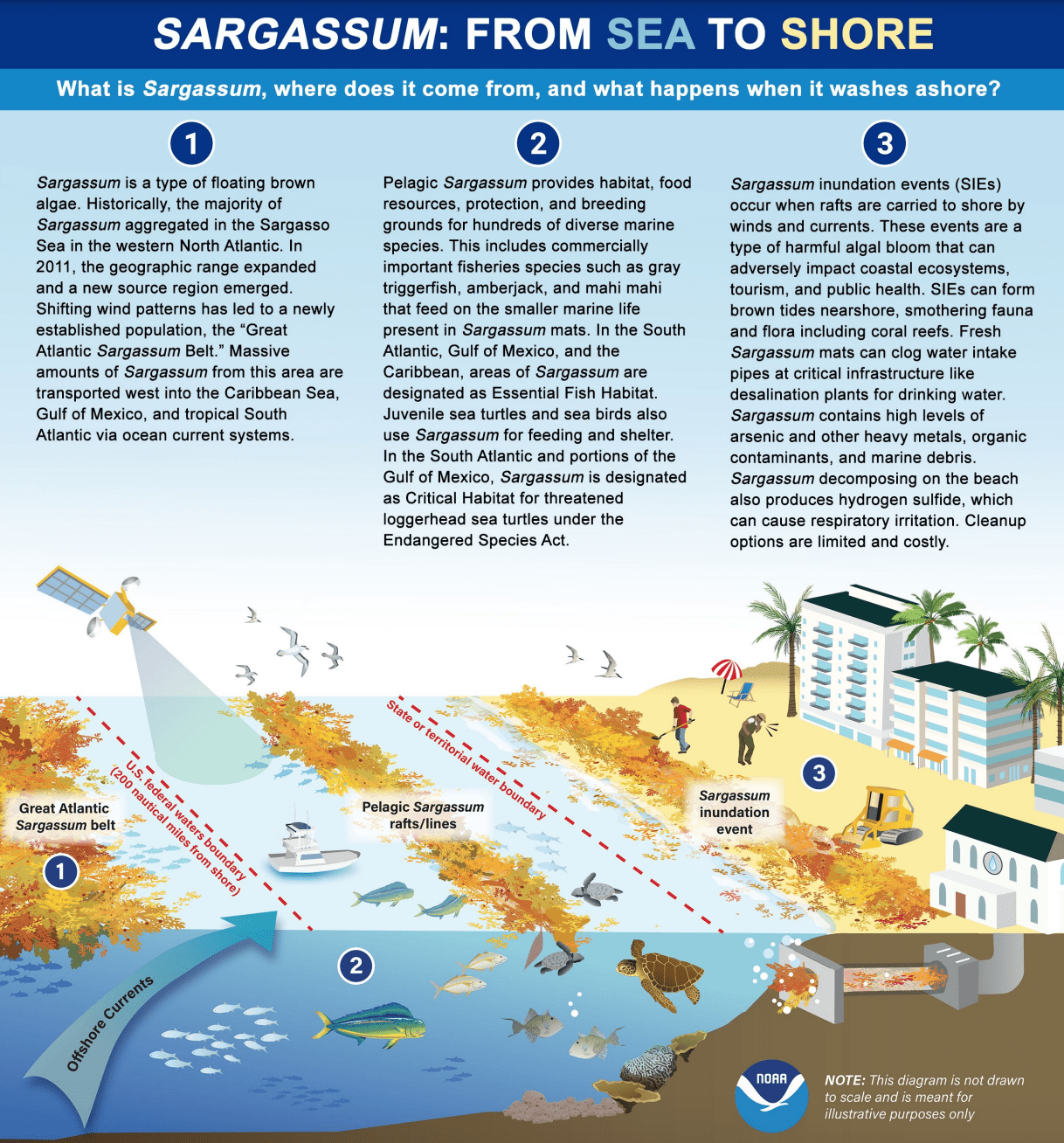
NOAA explanation about sargassum and inundation events. (Photo courtesy NOAA)Health Impacts
Sargassum has positive and negative benefits for the environment. In most cases, moderate amounts on beaches do not pose a significant risk to people, but there are important exceptions.
“Most of the time, moderate amounts on beaches would not represent a risk factor for humans. However, there are exceptions,” cautioned Xie. “After a couple of days onshore, sargassum starts to decompose and release noxious and stinking gases such as ammonia and hydrogen sulfide. The bad smell can cause respiratory problems. There are reports that in some of the Caribbean Islands, the hospitalization rate has gone up during the sargassum season,” he said.
“Sargassum can be both good and bad for the environment. In the ocean it is a critical habitat for many animals, so they should like to see increased sargassum. Sargassum on beaches can also stabilize sand dunes, thus helping to avoid beach erosion. But too much of a good thing can also make it bad. Excessive amounts of sargassum can also cause environmental and economic problems,” Xie added.
“There is no scientific consensus on exactly what caused the sargassum increases in the past decade in the Atlantic Ocean, but climate change may be part of the reason, as it affects precipitation, ocean circulation, and dust events, among other factors. This is still a research topic,” according to Xie. The current predictions for a busy year of sargassum are based on statistical models rather than the exact causes of why the amount of seaweed is expected to increase.
Sargassum Outlook: Additional Increases Expected
Sargassum amounts are expected to increase across most regions in the coming months, according to USF.
Illustration depicting the distribution of floating sargassum in the Atlantic Ocean, including the Sargasso Sea and the Great Atlantic Sargassum Belt, which spans from the west coast of Africa across the tropical Atlantic to the Caribbean and Gulf region. (Photo courtesy United States Environmental Protection Agency)
“Sargassum amount in most regions is set to increase in the coming month,” USF predicted. “The western Caribbean and the windward side of the Lesser Antilles will continue to see beaching events. Sargassum amount in the Gulf will remain low.
“Because of the continuous growth from November to February and the record high sargassum amount in most regions, 2026 is set to be another major sargassum year, including sargassum amounts exceeding 75% of the historical values,” USF added.
Follow Sargassum Updates and the Weather ForecastIndividuals can follow the progression of the current sargassum mats and stay up to date each month on where seaweed may be headed.
Finally, in addition to tracking sargassum conditions, residents and visitors across the U.S. Virgin Islands are encouraged to continue monitoring the local weather forecast.
Weather information is available from the National Weather Service and the National Oceanic and Atmospheric Administration. The local weather forecast for the U.S. Virgin Islands is regularly updated on the Source Weather Page, and individuals can also find weather alerts and preparedness information from the Virgin Islands Territorial Emergency Management Agency.
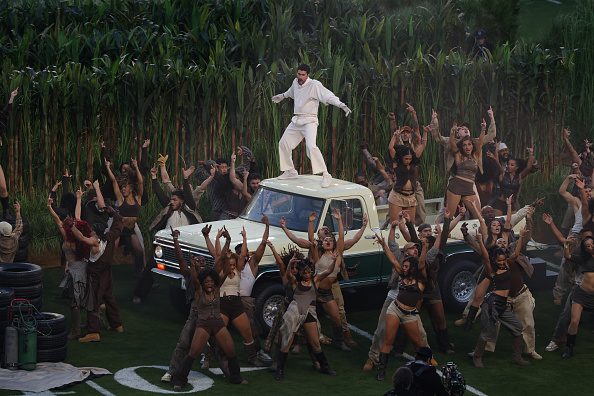
Bad Bunny performs the halftime show during the Seattle Seahawks versus the New England Patriots Super Bowl LX game on Feb. 8 at Levi’s Stadium in Santa Clara, California. (Photo by Matthew Huang/Icon Sportswire via Getty Images)
Editor’s Note: This is the second article of a three-part series. A Spanish version follows below.
The Benito Bowl, also known as Super Bowl LX, began with a young man in a sugarcane field, with a big smile on his face, saying, “Qué rico es ser Latino.” How good or nice, or delicious, or precious it is to be Latino (the word “rico” is fluid in this sense and very much depends on context).
Latino, in this case, as in most cases, is used to include all people born in the Americas or of American ancestry who speak Spanish, but also those who don’t speak the language but feel they are Latinos culturally, or genetically. Like the word “rico,” “Latino” has a fluid definition.
The term is particularly useful for business, demographics, statistics, marketing, and is good for politicians and other public figures, whether used to unite or divide.
In the case of the show’s opening statement, “Latino” was obviously used to unite.
But the halftime show, more than representing the Latino world, was staged to represent Bad Bunny’s homeland, Puerto Rico, and by extension the Greater Caribbean Region, because the two are inseparable (even so, Benito was able to honor and recognize every Latino, and every non-Spanish speaking American during his brilliant grand finale).
The show opens with what seems like an endless sugarcane field (cañaveral) where workers, cutlass in hand, are taking care of business. More than the rest of the American continent, it is the Caribbean that, since the XV century, has had the strongest and most painful relationship with the plant.
Just like canoes linked our islands during the previous 4,000 years, once sugarcane arrived, it became the reason many islanders travelled from island to island.
The sugar trade was the epicenter of the forced migration of citizens from Africa to our islands, the crop that maintained armies and empires, the monoculture that, up to the XX century, destroyed the agricultural self-reliance many of our islands had, and turned them into nations that despite fertile soil and year-round growing season, are incapable of feeding its people without importing food.
Sugarcane workers mixed our blood, our music, our language, our food, our games. It transformed us into human mosaics, composed of multi-continent, trans-insular DNA which we distilled and aged into our own unique blends: Caribbean people, Caribbean culture.
That is why you can travel from one end of this stunningly beautiful part of the world to the other, and regardless of the language differences we all feel very much at home.
Those cane fields, for better or for worse, are part of us. They are the sugar in our morning coffee or tea, in our desserts and candies, and they are also the rum we drink, an integral part of Caribbean economy and a welcomed guest to many celebrations.
The sugarcane and cane cutters were only one segment of Bad Bunny’s (Caribbean) multi-stage extravaganza.
The scene changes to a closer shot of some of the cane cutters and we finally see the artist, Benito Antonio Martinez Ocasio, who proceeds to sing as he walks past people busy doing their thing.
A young man is selling coconut water, next we see men playing dominoes. Pay attention to the faces, the clothing, the bottle on the table. Bad Bunny playfully shows a players which piece to play next.
This is followed in order of appearance by a nail salon, construction workers using cinder blocks to probably build a house, a “piragüero,” the snow cone cart so ubiquitous in our islands and called “granizado” in Cuba, “frio-fio” in the Dominican Republic, “fraco” in the US Virgin Islands, etc. Bad Bunny then passes a street food vendor and walks under two sparring boxers.
In a mere 1 minute 47 seconds, the artist had established the geographical/cultural environment where the show is taking place. Not the Puerto Rico or the Caribbean that visitors may see, but the one we locals know and recognize.
Bad Bunny was doing what many other artists have done before, creating a narrative arc to take the performance from A to B to C smoothly. This narrative structure often contains a story. But most times the stories are allegorical, filled with symbolic gestures and props, and so loosely tied together that many times we don’t see them.
In the case of the Benito Bowl, never has a halftime show been so explicitly told as a story, with a specific geographical region as the setting, or one that has exposed more of the star’s personal life, while at the same time intentionally not being so much about him.
History, family, love, injustice and uncertainty, were all part of the performance. It spoke about the past, the present, and a call for a better tomorrow.
The story was told in ways that never took away the joy and the fun of watching the show.
Those for whom it was intended got it, while the rest danced to the irresistible beat of reggaeton, Latin trap, bachata, salsa, dem bow, and other Caribbean rhythms.
Every part of the show can be explained as a segment of this multi-act play containing layers upon layers of meaning. It was intentional, it was well done.
There was messaging in everything, whether when the artist falls through the roof of the concrete house representative of so many houses in Puerto Rico and the Caribbean (Poorly built? Effect of hurricanes?), or having dancers perform in simple, comfortable, mostly brown, beige and white costumes that enhanced and complimented skin tones and bodies instead of dazzling, or impressing, those color schemes spelled tropical heat which does not require the bright colors associated with beaches and tourists. The earthy tones reminded us more of mountains, earth, rocks and rivers than cities, sands or sea. During another dance scene, we see all combinations of couples; everything is allowed here, something he later stresses when he says, “dance without fear, love without fear.” The message is tied to the main theme of the show, as we learn at the end. That scene takes place deep in the pastizal, in the bushes, is private, perhaps clandestine, and most definitely far from hotels and resorts.
In his songs “El Apagón” (The Blackout) and “Lo que le pasó a Hawaii” (What Happened to Hawaii), this second song performed by Ricky Martin, Benito protests injustice and socio-political crises. Even though Puerto Rican specific, the arguments and the roots of the problems can be easily extrapolated to many Caribbean nations and territories.
Was it political? Yes, but not in the way many expected. Benito is a Caribbean man after all, and so he used one of the many ways in which we can criticize and not offend. What we witnessed is an adaptation for the Super Bowl halftime show of our very own carnival narrative style.
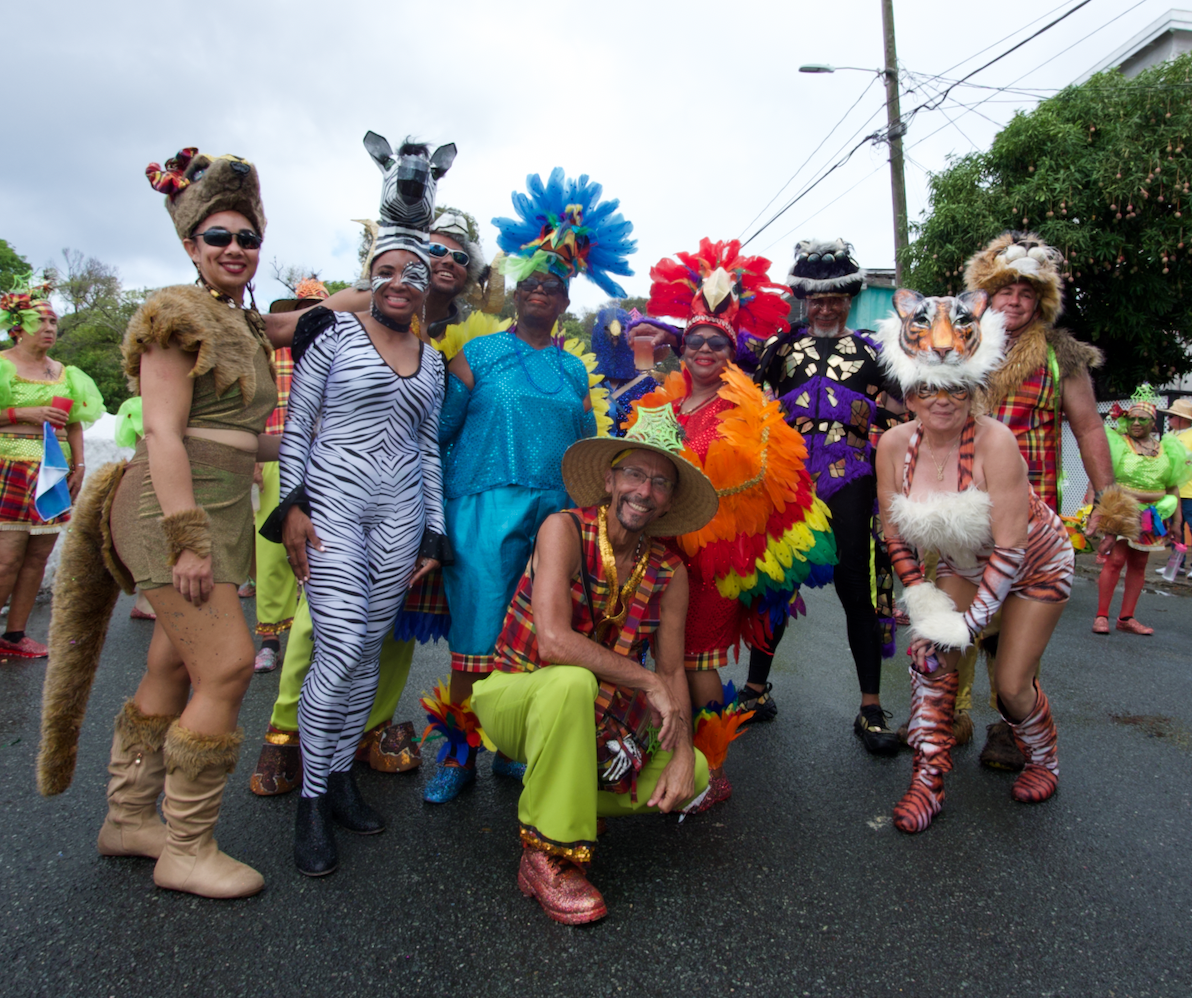
During carnival, costumes and lyrics can be plain fun, but in the hands of a clever creator, they can also sting those who deserve it, and make the rest of the audience laugh in complicity, and also think. Artists and revelers can speak about or enact ills and wrongdoings in the community or country while singing or parading down a street.
Storytelling at Carnival. “Broo ‘Nansi and Hummingbird” staged and performed by the Gypsy Troupe, St. Thomas Carnival, 2025. (Photo courtesy Mario Picayo)
Many artists before Benito have been much more explicitly political during the Super Bowl halftime shows. Watch Eminem (2022), Beyoncé (“Formation” 2016), and, in particular, Kendrick Lamar (2025) for three recent examples, but none of them did it as Bad Bunny. He brought his personal and public worlds to the stage, including special people in his life so that they could share the moment, be at the party and tell the story with him. He brought the islands to the Super Bowl and he left the stage parade style: colors flying, people running and jumping. Pure Caribbean fete.
Carnival and storytelling are good words to speak about the roots and the structure of the show, but there are two other words that keep coming to my mind after seeing that halftime performance many times. They might sound contradictory to some readers, considering all the whining, twerking, perreo, and grinding. Those words are classy and respectful. Respect is a word that I used in the previous article as well because it is one aspect of the production that should be emphasized and praised.
There was a level of tension and negative expectations before the show that the actual performance completely deflated.
It was manufactured by people who profit from clicks and from performing for the cameras. People in the business of scaring, insulting and dividing. Experts in the use of what is called “rage bait.”
Benito gave us, and them, a halftime show that reflected the absolute opposite. It was a unifying embrace: “We are all Americans,” “as long as we are alive we should love as much as we can,” “God Bless America,” and “the only thing stronger that hate is love”.
He did the show his followers expected, and convinced doubters and naysayers of what his millions of fans already knew: Bad Bunny is a top-notch entertainer.
Benito did not fall for the bait, either. He did not use sarcasms or cynicism, or explicitly, in language or image, create anything that could be considered controversial or divisive. As host of this gigantic celebration, Benito Antonio also had the good taste and courtesy to dress to the T in his Sunday best, white suit, tie, and all.
The artist broke barriers and told the world the story he wanted to tell about everything that he loves, especially his matria, his motherland, Borikén, Puerto Rico.
He did it with class, he did it with joy and he did it with tremendous respect for every viewer of Super Bowl LX.
¡Te la comiste Benito!— Mario Picayo is a Caribbean cultural activist, writer and publisher. He is chief editor of the publishing houses Little Bell Caribbean and Guaní Press. Born in Cuba, he lived many of his formative years in Puerto Rico, and later in the U.S. Virgin Islands. For close to four decades he has resided between the U.S. Virgin Islands and New York. Previously, and also parallel, to his publishing career he has worked as photographer specialized in documenting cultural celebrations, like carnival, and similar joyful, musical, community-unifying events from Trinidad to the Bahamas.Editor’s Note: Opinion articles do not represent the views of the Virgin Islands Source newsroom and are the sole expressed opinion of the writer. Submissions can be made to visource@gmail.com.
Related Link:
Op-Ed: Bad Bunny’s Super Bowl Halftime Show, Part One: Singing in Puerto Rican, Speaking Caribbean
****
El Benito Bowl, también conocido como Super Bowl LX, comenzó con un joven en un cañaveral, con una gran sonrisa en el rostro diciendo “Qué rico es ser latino”.
Latino, en este caso, como en la mayoría de los casos, se usa para incluir a todas las personas nacidas en América o de ascendencia americana que hablan español, pero también a quienes no hablan el idioma pero se sienten latinos culturalmente o genéticamente.
El término es particularmente útil para los negocios, la demografía, las estadísticas, el marketing y es bueno para los políticos y otras figuras públicas, ya sea para unir o dividir.
En el caso de la declaración inicial del programa, “latino” obviamente se usó para unir.
Pero el espectáculo de medio tiempo, más que representar al mundo latino, representa a la patria de Bad Bunny, Puerto Rico, y por extensión a la Región del Gran Caribe, porque ambos son inseparables (aun así, Benito logró honrar y reconocer a cada latino y a cada americano no hispanohablante durante su brillante Gran Final).
El espectáculo comienza con lo que parece un interminable cañaveral donde los trabajadores, machete en mano, trabajan. Más que el resto del continente americano, es el Caribe el que, desde el siglo XV, ha tenido la relación más fuerte y dolorosa con esta planta.
Si las canoas unieron a nuestras islas durante 4000 años, con la llegada de la caña de azúcar, esta se convirtió en la razón por la que muchos isleños viajaban de isla en isla.
El comercio del azúcar fue el epicentro de la migración forzada de ciudadanos de África a nuestras islas, el cultivo que sustentaba ejércitos e imperios, el monocultivo que hasta el siglo XX destruyó la autosuficiencia agrícola de muchas de nuestras islas, convirtiéndolas en naciones con suelo fértil y una temporada de cultivo durante todo el año, pero incapaces de alimentar a su gente sin tener que importar alimentos.
Los trabajadores de la caña de azúcar mezclaron nuestra sangre, nuestra música, nuestros idiomas, nuestra gastronomía, nuestros juegos. Nos transformaron en mosaicos humanos, compuestos de ADN multicontinental y transinsular, que destilamos y añejamos creando mezclas únicas: gente caribeña, cultura caribeña.
Por eso se puede viajar de un extremo a otro de esta hermosa región del mundo, y más allá de las diferencias lingüísticas, todos nos sentimos como en casa.
Esos cañaverales, para bien o para mal, son parte de nosotros. Son el azúcar de nuestro café o té mañanero, de nuestros postres y dulces, y también el ron que bebemos, parte integral de la economía caribeña y un invitado bienvenido en muchas celebraciones.
Pero el cañaveral fue solo una parte del espectáculo caribeño multiescénico de Bad Bunny.
De ahí, la escena cambia a una toma más cercana de algunos de los cortadores de caña y finalmente vemos al artista, Benito Antonio Martínez Ocasio, quien procede a cantar mientras camina pasando junto a gente ocupada en diferentes labores.
Un joven vende agua de coco; hombres juegan dominó. Préstenle atención a las caras, la ropa, la botella sobre la mesa. Bad Bunny, juguetonamente, le muestra a un jugador qué ficha jugar.
A esto le siguen, en orden de aparición, un salón de manicura, “trabajadoras de la construcción” usando bloques de cemento para probablemente construir una casa, un piragüero, el carrito de raspados tan común en nuestras islas y llamado granizado en Cuba, frío-frio en la República Dominicana, Freico en las Islas Vírgenes de los EEUU., etc. Bad Bunny luego pasa junto a un vendedor ambulante de comida y pasa por debajo de dos boxeadores.
En tan solo 1 minuto y 47 segundos, el artista ha establecido el entorno geográfico y cultural donde se desarrollará el espectáculo. No el Puerto Rico o el Caribe que los turistas visitan, sino el que los del patio conocemos y reconocemos.
Bad Bunny hizo lo que muchos otros artistas han hecho antes: crear un arco narrativo para llevar su show de A a B y de B a C con fluidez. Esta estructura narrativa, necesaria en muchos espectáculos complejos, a menudo contiene una historia. Pero la mayoría de las veces las historias son alegóricas tenuemente entrelazadas y de tramas difíciles de seguir.
En el caso del Benito Bowl, nunca antes se había narrado un espectáculo de medio tiempo de forma tan explícita, con una región geográfica específica como escenario, ni uno que expusiera más detalles de la vida personal de la estrella del show, pero que, al mismo tiempo, no se centrara en ella o él.
La historia y el presente de Puerto Rico, la familia, el amor, la injusticia y la incertidumbre formaron parte de la actuación. Habló del pasado, el presente e hizo un llamado a un futuro mejor.
Parte de los que vieron el espectáculo lo entendieron en todas sus dimensiones, y el resto lo gozó bailando al ritmo irresistible del reggaetón, el trap latino, la bachata, la salsa, el Dem Bow y otros ritmos caribeños.
Y es que cada parte del espectáculo fue un segmento de esta obra en varios actos, con múltiples capas de significado. Fue intencional; estuvo bien hecho.
Había un mensaje en todo, como cuando el artista cae por el techo de la casa de concreto, representativa de tantas casas en Puerto Rico y el Caribe (¿mal construida? ¿efecto de huracanes?), o en la decisión de que los los bailarines usaran vestuarios sencillos y cómodos, mayormente marrones, beige y blancos, que realzan y que complementan sus cuerpos y sus tonos de piel en lugar de deslumbrar o impresionar.
Esas paletas de colores evocaban un calor tropical que no requiere los colores brillantes asociados con las playas y los turistas. Los tonos terrosos nos recordaban más a las montañas, la tierra, las rocas y los ríos que a las ciudades, la arena o el mar.
Este no es el Puerto Rico costeño, siempre a la venta y siempre necesitado de protección.
Durante otra escena de baile, vemos todas las combinaciones de parejas posibles; aquí todo está permitido, algo que luego enfatiza el artista cuando dice «Baila sin miedo, ama sin miedo»; el mensaje está ligado al tema principal del espectáculo, como descubrimos al final. Esa escena transcurre en lo más remoto del pastizal o matorral, entre los arbustos, en un ambiente privado, quizás clandestino, y definitivamente lejos de hoteles y resorts.
En sus canciones «El Apagón» y «Lo que le pasó a Hawái», esta última interpretada por Ricky Martin, Benito protesta contra la injusticia y la crisis sociopolítica. Aunque son específicos de Puerto Rico, los argumentos y las raíces de los problemas se pueden extrapolar fácilmente a muchas naciones y territorios del Caribe.
¿Fue político el espectáculo? Sí, pero no de la forma que muchos esperaban. Benito es caribeño, después de todo, y por eso usó una de las muchas maneras en que podemos criticar sin ofender. Lo que presenciamos es una adaptación para el Espectáculo de Medio Tiempo del Super Bowl de nuestro estilo narrativo carnavalesco.
Durante el carnaval, los disfraces y las letras de las canciones pueden ser simplemente divertidos, pero en manos de un creador ingenioso también pueden herir a quienes se lo merecen y a la vez hacer reír al resto del público, cómplice de lo que está sucediendo. Artistas y creadores de comparsas y disfraces pueden hablar o representar males y quejas de sus comunidades o países mientras cantan o desfilan por la calle.
Narración de cuento en el carnaval, Broo ‘Nansy y Colibrí, puesta en escena e interpretación de los Gypsies, carnaval de St. Thomas, 2025. (Photo courtesy Mario Picayo)
Muchos artistas antes de Benito se han mostrado mucho más abiertamente políticos durante los espectáculos de medio tiempo del Super Bowl. Vean a Eminem (2022), Beyoncé (“Formation”, 2016) y, en particular, Kendrick Lamar (2025) como tres ejemplos recientes, pero ninguno de ellos lo hizo como Bad Bunny. Él trajo su mundo personal y público al escenario, incluyendo a personas especiales de su vida para que pudieran compartir el momento, estar en la fiesta y narrar la historia con él.
Trajo las islas al Super Bowl y salió del escenario, como en desfile, con banderas de colores ondeando y con los participantes en el show corriendo, saltando y cantando. Pura fiesta caribeña.
Carnaval y cuentista son buenas palabras para describir las raíces y la estructura del espectáculo, pero hay otras dos palabras que me siguen viniendo a la mente después de ver esa actuación de medio tiempo muchas veces. Podrían sonar contradictorias para algunos lectores, considerando el perreo y demás bailes urbanos, ofensivos para algunos, que vimos. Pero las palabras que me vienen a la mente son clase y respeto.
Respeto es una palabra que también usé en el artículo anterior porque es un aspecto de la producción que debe destacarse y elogiarse.
Había un nivel de tensión y expectativas negativas antes del espectáculo, que la actuación en sí desinfló por completo.
Esa atmósfera nociva fue creada por gente que lucra a través de las redes sociales y actuando para las cámaras. Gente que se dedica a asustar, insultar y dividir. Expertos en el uso de lo que se llama “carnada de ira”.
Bad Bunny nos ofreció, y a ellos también, un espectáculo de medio tiempo que reflejó todo lo contrario. Fue un abrazo unificador: Todos somos americanos, mientras uno esté vivo, uno debe amar lo más que pueda, Dios bendiga a América y, lo único mas poderoso que el odio es el amor.
Ofreció el espectáculo que sus seguidores esperaban y convenció a escépticos y detractores de lo que sus millones de fans ya sabían: Bad Bunny es un artista de primera.
Benito tampoco mordió el anzuelo ni la carnada. En ningún momento durante el show utilizó sarcasmos ni cinismo ni creó explícitamente, en lenguaje o imagen, nada que pudiera considerarse controversial o divisivo.
Como anfitrión de esta gigantesca celebración, Benito Antonio también tuvo el buen gusto y la cortesía de vestirse impecablemente con su mejor traje de domingo, blanco, con corbata y todo.
El artista rompió barreras y le contó al mundo la historia que quería contar, acerca de lo que ama, especialmente su patria, Borikén, Puerto Rico. Lo hizo con clase, con alegría y sobre todo con respeto hacia cada espectador del Super Bowl LX
¡Te la comiste, Benito!
— Mario Picayo. Activista cultural caribeño, escritor y editor. Es director de las editoriales Little Bell Caribbean y Guaní Press. Nacido en Cuba, vivió gran parte de sus años formativos en Puerto Rico y en las Islas Vírgenes de los EEUU. Durante casi cuatro décadas ha residido entre las Islas Vírgenes y Nueva York. Anteriormente, y en paralelo a su carrera editorial, ha trabajado como fotógrafo especializado en documentar fiestas tradicionales de un lado al otro del Caribe insular. Estas incluyen carnavales, fiestas patronales y otras celebraciones comunitarias honrando la musica, las artes y las tradiciones de sus pueblos.
A man was arrested Friday, Feb. 27after telling officers he was carrying a firearm without a license during a traffic stop on Veterans Drive, the Virgin Islands Police Department reported.
Members of the Special Operations Bureau were patrolling near Vendors Plaza at about 9:51 a.m. Feb. 27 when they observed a vehicle without a license plate affixed to the front, according to the police report.
Officers initiated a traffic stop and detected a strong odor of marijuana coming from the vehicle. The driver and passenger, identified as Jalanie Daniel, were asked to exit the vehicle and complied. Officers advised both individuals that the vehicle would be searched for illegal contraband and that they would be patted down for officer safety, the police report stated.
Before the pat-down, Daniel informed officers that he was in possession of a firearm and did not have a license to carry it, the report stated.
Daniel was arrested and charged with unlawful possession of a firearm and unlawful possession of ammunition. Bail was set at $60,000, the report stated.
Police arrested a 31-year-old man following a reported robbery early Monday at La Terreza Bar & Restaurant in Estate Castle Coakley on St. Croix, the Virgin Islands Police Department reported.
At about 1:47 a.m. Monday, the 911 Emergency Call Center received several reports of a robbery at the business, according to the police report.
Responding officers made contact with the victim, who reported she had been robbed. Detectives assigned to the case met with the victim, who identified Jeffry Escanio as the suspect. She told police Escanio grabbed a gold chain from her neck and began to strangle her, restricting her airway. The victim sustained injuries during the encounter. Witnesses corroborated the victim’s account, the police report stated.
Police made contact with Escanio, who was advised of his Miranda rights and declined to provide a statement, the report stated.
Escanio was arrested and charged with robbery in the first degree and assault first. Bail was set at $75,000. He was unable to post bail and was transported to the John Bell Adult Correctional Facility pending an advice of rights hearing scheduled for Tuesday, the report stated.
It is with heavy hearts that the beloved partner and family of Bernard Ulysses “The Blade” Prince announce his passing on Feb. 14, 2026, at his residence.
Bernard Ulysses Prince
Bernard was a significantly loved partner of Barbara Holder, son, brother, uncle, adopted father, grandfather, and great-grandfather. He will be greatly missed by his loving family and friends. He worked at Zinke Smith Concrete Plant, now known as Heavy Materials, for close to 40 years as the Batch Plant Manager.
He leaves behind cherished memories that will live on in the hearts of Barbara Holder (loving partner of 30 years); Sister: Sonia Prince; Brother: Wayne Prince (Cheryl); Brother-in-Law, Louis Vialet; Nephews: Kenneth Vialet (Tracey), Craig Vialet, Allen Vialet; Nieces: Donna Rojas Thompson (John), Keshia Prince Anderson (Troy), Kishma Prince (Jerry Wilson); Great Great Nephews: Kameron Miller and Nathaniel Isaac; Great Nieces: Juanita Mitcham, Asia Anderson, Amber Vial et; Great Great Nephews: Kameron Miller and Nathaniel Isaac; Great Great Nieces: Rhythm Green and Mylah Green; Adopted Children: Mario Lanclos (Ann Marie), Calvert White, Chanda Russell (Ashley), Ivan Foy; Adopted Grandchildren: Justice Lanclos, Zahnae’ Laplace James, Lanclos, Sky Lanclos, Mario Lanclos, III, Calaen White, Caleb White, Cassidy White, Te’Moy Singletary, Cheynne Greaves, Paris Jones; Adopted Great Grandchildren: Ivy Singletary, Yolani Singletary; Adopted Nieces and Nephews: Angela, Amy, Alex, Alva, and Wrigbie Archibald, Jr.; Special Friends: Danny Abendego, Calvin Charleswell, Elroy Donovan, Kevin Fenner, Elroy “Fever” Fleming, Reynald Frazer, Jerome “Peewee” Gerald Louie Harrigan, Adelia (Queenie) Henneman, Peter Jeremy, Sherman Letang, Jennifer Lettsome, Wayne Moorehead, Ashley Ritter, Glen Shillingford, Rudolph Smith, Viola Smith and a host of other family members and friends too numerous to mention.
Viewing and tributes will be held on Saturday, March 7, at the Lutheran Church of the Reformation, Annas Retreat, St. Thomas, U.S. Virgin Islands, from 10 a.m.-11 a.m.,with services following immediately. Interment will be private. Funeral arrangements are under the care of Dan Hurley Homes for Funerals and Cremation Centers of St. Thomas, St. John, and St. Croix. For online condolences or to share a special memory, visit www.hurleydavisfuneralhome.com
Ms. Holder has asked that, in lieu of flowers, donations be sent to the Heart and Lung of SRMC using the QR code below, or to SRMC -Administration, 9048 Sugar Estate, St.Thomas, VI 00802. Please be sure to type Heart & Lung in memory of Bernard Prince.
Shevon Krystal Johnson, aka Big Von, of St. Croix, passed away on Feb. 2. She was 41 years old.
Shevon Krystal Johnson
She is survived by her special companion, Rondall Knight, Jr.; mother, Juanita Eastman Joseph; father, The Honorable Senator Franklin D. Johnson; daughters, Rashae Knight, Rashai Knight; grandmother, Elenor Sealey; great uncle, Ronald Allick; sisters, Shamika Johnson, Tia Richards, Thandie “Mandy” Masilela; brother, Dimitri Joseph; niece, Zariah Jones; nephew, Malcolm Woodard; aunt, Mabeline Marshall, Isabel Lopez, Edna Abramson, Tricia Johnson, Alice Payne Roach, Theresa Hendrickson-Thomas, Delores English Edwards, Christie, Mercedes, Annette and Denise Eastman, Myrna Payne; uncles, Larry Johnson, Kervin Johnson, Thomas Johnson, Antonio Sealey, Maxwell McIntosh, Wayne Payne, Beresford Edwards, Kingsley Roberts, Christopher Eastman, Lyndon Eastman, Clive Eastman, Glen Eastman, Joseph Eastman, Larry Joshua, Eustace Roach, Trevor Bowers, Melvin Boodie; great aunts, Bernice Allick, Gisbatine Houston, Majorie Peterson, Holly Eastman, Glenda Eastman, Judith Eastman, Anna Johannes; godparent, Dawn Bruce, Rita Dawson, Delores Edwards, Arlene Griffin, Alyssa Newton, Marion Simmonds, Sheryl Watkin and Danny Watkins Sr., Rudy Ross; godchildren, Akaizah Smith, Azinirah Libert; special friends, Latina Graham, Nadia Thomson; precious friends and other relatives too numerous to mention.
Funeral service will be held on March 13 at St. Patrick Catholic Church. Viewing begins at 9 a.m., with service at 10 a.m. Interment will be held at Frederiksted Cemetery.
Funeral arrangements are entrusted to James Memorial Funeral Home, Inc.
They built it in heat and in rain. They built it in classrooms and clinics, in construction sites and small shops, in churches and on fishing boats. They survived storms that tore off roofs and recessions that tore at dignity. They raised children who stayed and children who left. They kept culture alive when it would have been easier to let it bend.
Now we have to ask ourselves something that is uncomfortable but necessary.
Are they aging with dignity in the Virgin Islands, or are they simply aging and hoping nothing goes wrong?
The numbers already tell a story we can no longer ignore. According to the 2020 Census, more than 21 percent of the population of the Virgin Islands is 65 years or older. Our median age is 45.9, which means we are not a particularly young territory anymore. At the same time, more than two in five households consist of a single person living alone. That combination should make all of us pause. Aging plus isolation is where vulnerability lives. That is where a fall becomes a crisis. That is where medication mistakes go unnoticed. That is where loneliness turns into quiet decline.
Within the last five years, the Legislature enacted a senior registry focused on disaster preparedness for older adults and individuals with disabilities who live alone. It was a necessary step. Hurricanes taught us hard lessons about who is left behind when systems fail. But disaster season is not the only season that threatens our elders. A registry that activates when a storm is approaching does not address what happens on an ordinary Tuesday afternoon when someone cannot get to dialysis, or on a Thursday night when dementia makes a home unsafe.
The Department of Human Services has publicly acknowledged that the territory faces a worsening long-term care crisis. There are not enough nursing home beds. There are not enough assisted living options. There are not enough adult day care slots. As a result, some elders who have nowhere appropriate to go become boarders in our hospitals. That is not sustainable for the health care system, and it is not dignified for the individual. Others are placed off island at significant cost, separating them from their families, their church communities, and the familiar rhythms of home.
We must also be honest about safety. Recent legislative efforts strengthened protections for older and dependent adults, including the creation of an elder abuse registry. That is progress. But laws on paper do not automatically translate into protection in practice. Elder abuse thrives in silence and in isolation. When seniors live alone, when caregivers are overwhelmed, when families are stretched thin, vulnerability increases.
Too many families in the Virgin Islands are forced into impossible choices. They keep an aging parent at home alone and pray nothing happens. They sacrifice income and mental health to become full time caregivers with little support. Or they send their loved one off island because there is no viable local alternative. None of those options reflect the dignity our elders deserve.
This is not about luxury. It is about infrastructure. If more than one fifth of our population is 65 or older, then aging is not a niche issue. It is central to our social and economic future. An aging population without adequate support places strain on hospitals, on families, on social services, and on the economy as a whole. But an aging population supported by thoughtful planning can remain active, engaged, and woven into community life.
We cannot continue to treat senior care as an afterthought or a line item that is adjusted only in crisis. If we say we value culture, then we must value the people who carried it. If we say we respect our history, then we must respect those who lived it.
Solutions
First, the existing senior registry should be expanded beyond disaster response into a year round voluntary support system. A protected database coordinated through Senior Citizen Affairs and partner agencies could include emergency contacts, mobility limitations, medical vulnerabilities, and caregiving arrangements. The purpose would not be surveillance, but support. Regular wellness checks, especially for those living alone, could prevent small issues from becoming emergencies.
Second, the territory should commission and publish a comprehensive senior needs assessment every two years. We need clear data island by island on housing needs, dementia prevalence, caregiver capacity, transportation gaps, and waitlists for services. Policy decisions and budget allocations should be tied to measurable need rather than anecdote.
Third, we must treat hospital boarding of seniors as a system failure to be reduced with urgency. Elders who no longer require acute medical care but have nowhere appropriate to be discharged should not linger in hospital beds. The territory should establish a target for reducing such cases and align funding and planning accordingly.
Fourth, the Virgin Islands needs a true senior living ecosystem that includes independent senior housing, assisted living, memory care, and respite services. This can be achieved through a public private partnership model that sets clear standards for affordability, staffing, and quality of care. Government can contribute land leases or incentives, but accountability and oversight must be built into the structure. Every major island district should have access to such options so that families are not forced to choose between separation and stagnation.
Fifth, adult day care and caregiver support programs must be expanded and treated as economic policy. When caregivers can work while their loved ones are safely engaged during the day, families remain financially stable and elders remain socially connected. Caregiver training and mental health support should be incorporated into these programs to prevent burnout.
Sixth, elder abuse prevention must move beyond statute into active public education. Training for mandated reporters, simple reporting pathways, and community awareness campaigns are essential. Protection cannot rely solely on victims to speak up. It must be built into the fabric of the community.
Finally, senior centers across the territory should evolve into hubs for comprehensive support. Beyond recreational programming, they can provide benefits navigation, health screenings, technology assistance for telehealth, and regular outreach to those who stop showing up. A senior who disappears from community life should trigger concern, not silence.
The measure of a society is not found in its slogans or in its campaign seasons. It is found in how it treats those who can no longer fight for themselves. Our elders are not a burden. They are living testimony. They are repositories of memory, resilience, and faith.
Every one of us is either caring for an elder, becoming one, or mourning one. Aging with dignity in the Virgin Islands should not depend on luck, family wealth, or proximity to services. It should be a given. And if we are honest, building that system now is not just about them. It is about the future version of ourselves.
Editor’s Note: Opinion articles do not represent the views of the Virgin Islands Source newsroom and are the sole expressed opinion of the writer. Submissions can be made to visource@gmail.com.
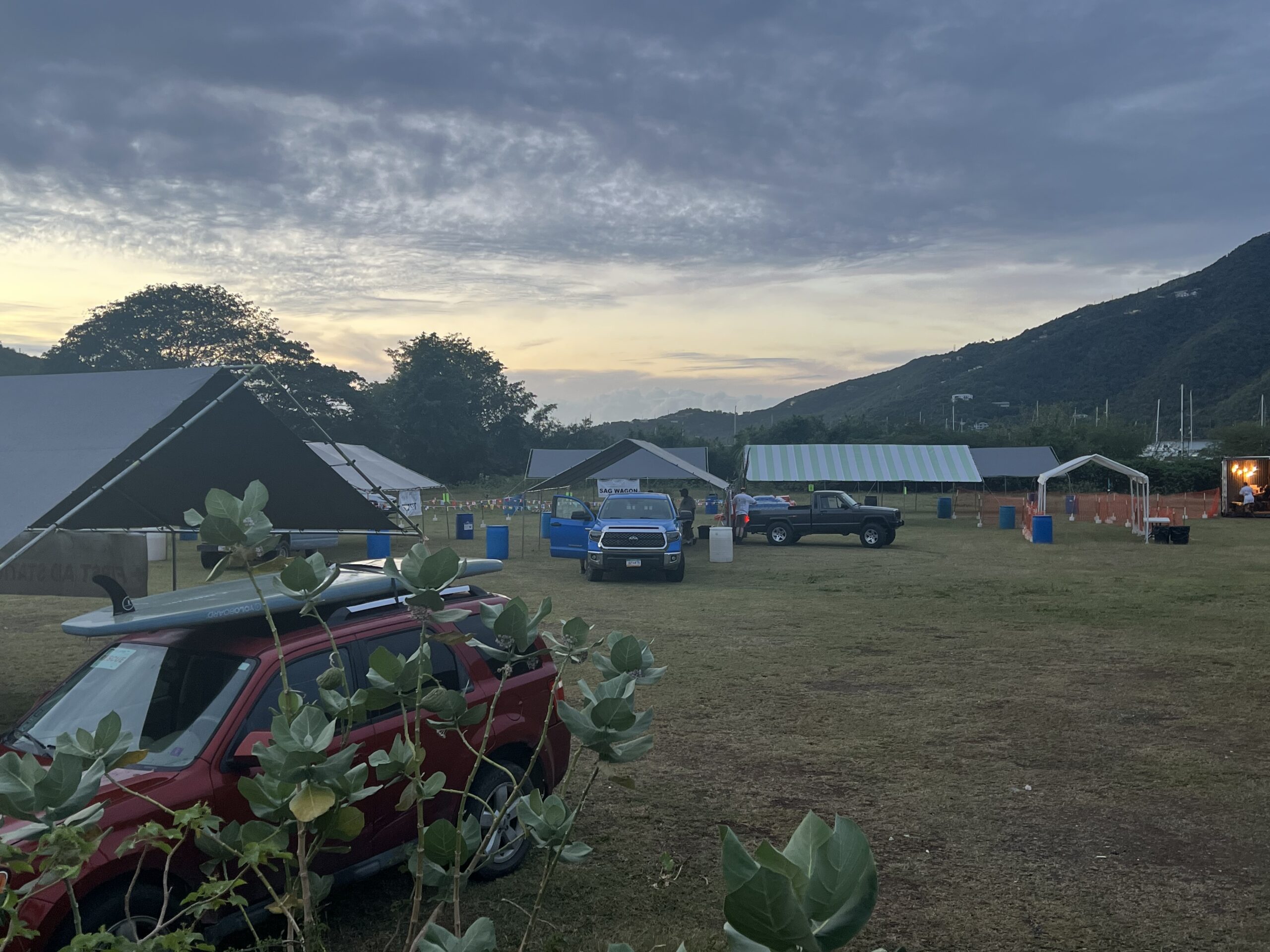
At daybreak on the last day of February, activity stirs along the road from Cruz Bay to Coral Bay. It’s the day of the 27th 8 Tuff Miles race.
Day breaks on a busy scene. (Source photo by Judi Shimel)
Moments from then, the race begins.
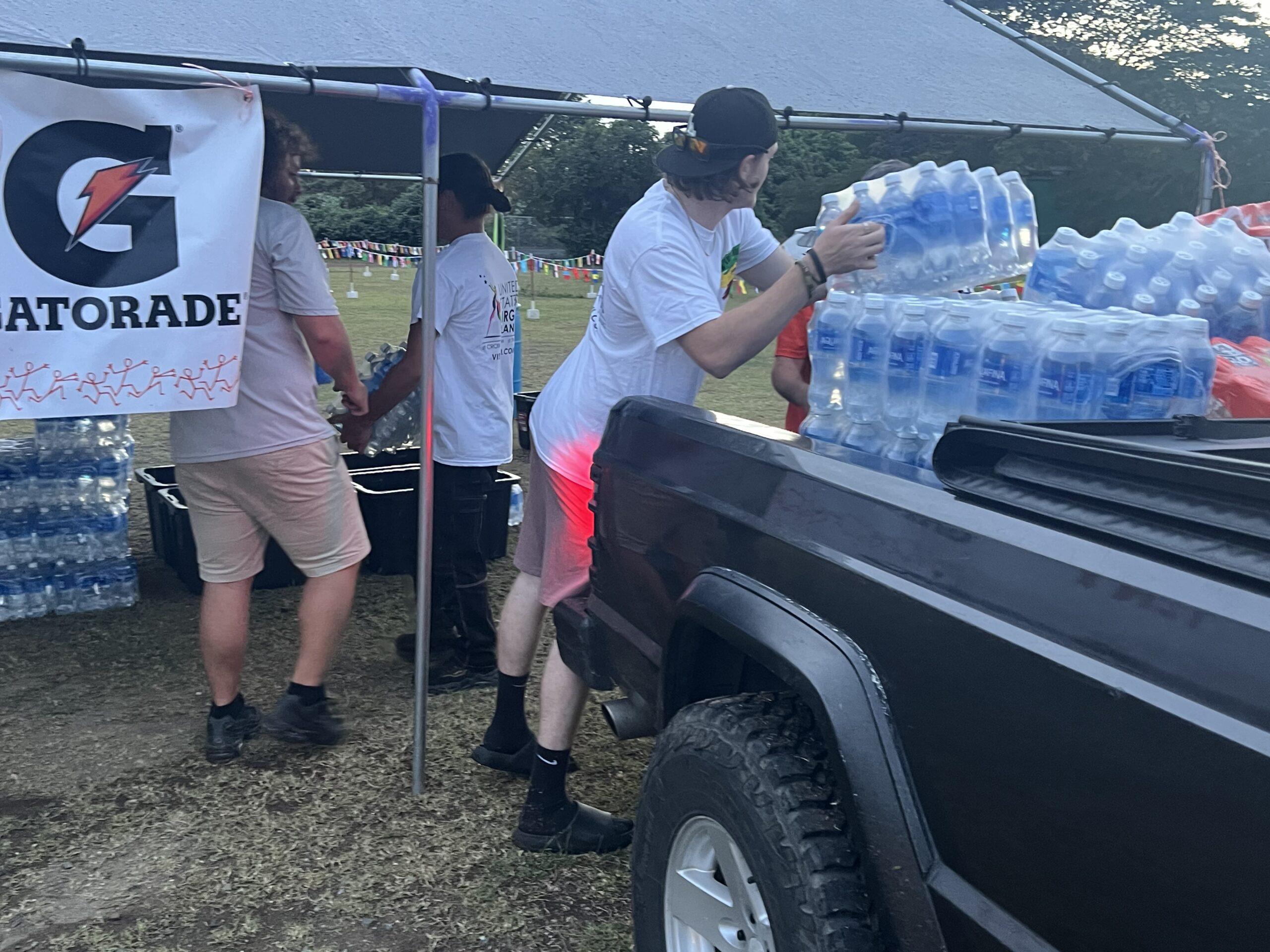
At the finish point, cases of water shift hand-to-hand from the back of a pickup truck.
Offloading essentials. (Source photo by Judi Shimel)
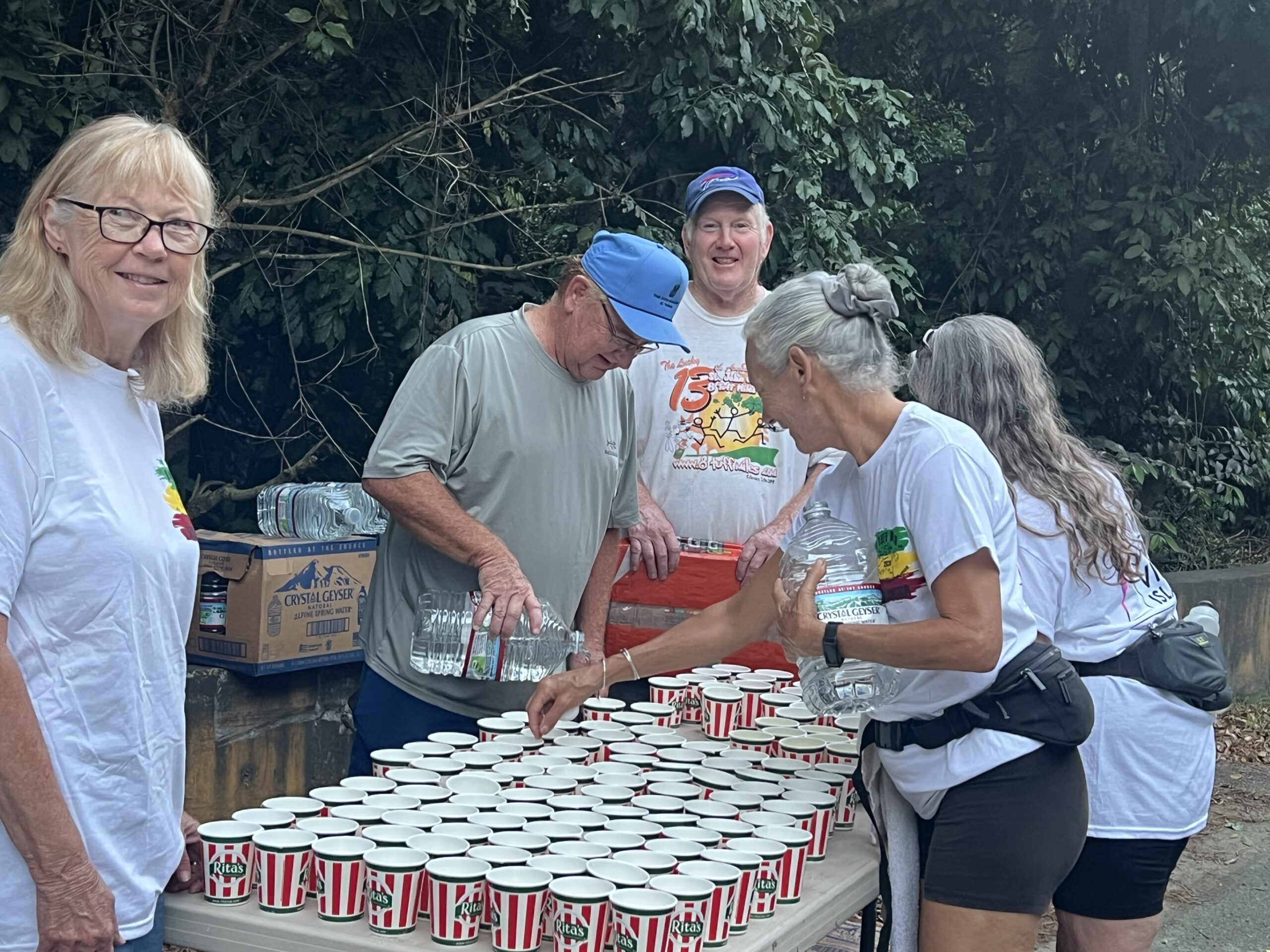
Water for hydration, joint health, and cramp relief. Volunteers set up tables to accommodate those along Centerline Road. Near the Catherineberg turnoff, Jeanette and Bruce Beckwith join members of Fish Bay Walkers as they prepare for duty.
Fish Bay Walkers supporting runners. (Source photo by Judi Shimel)
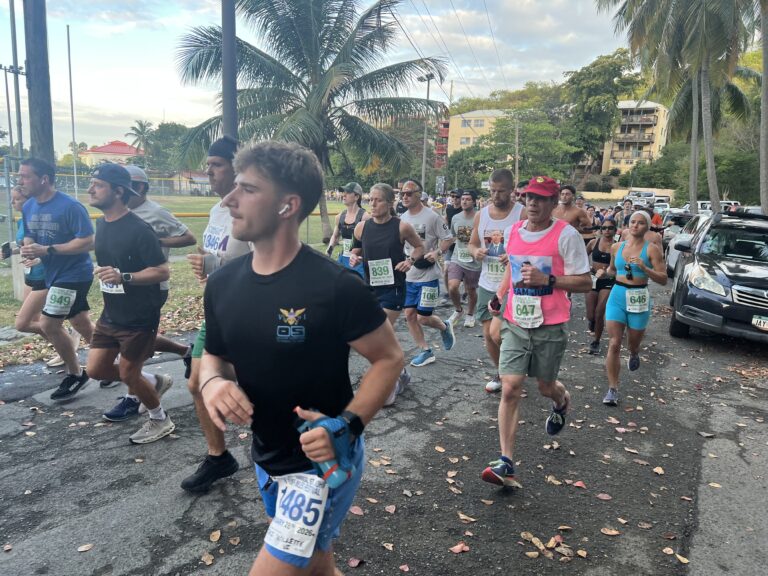
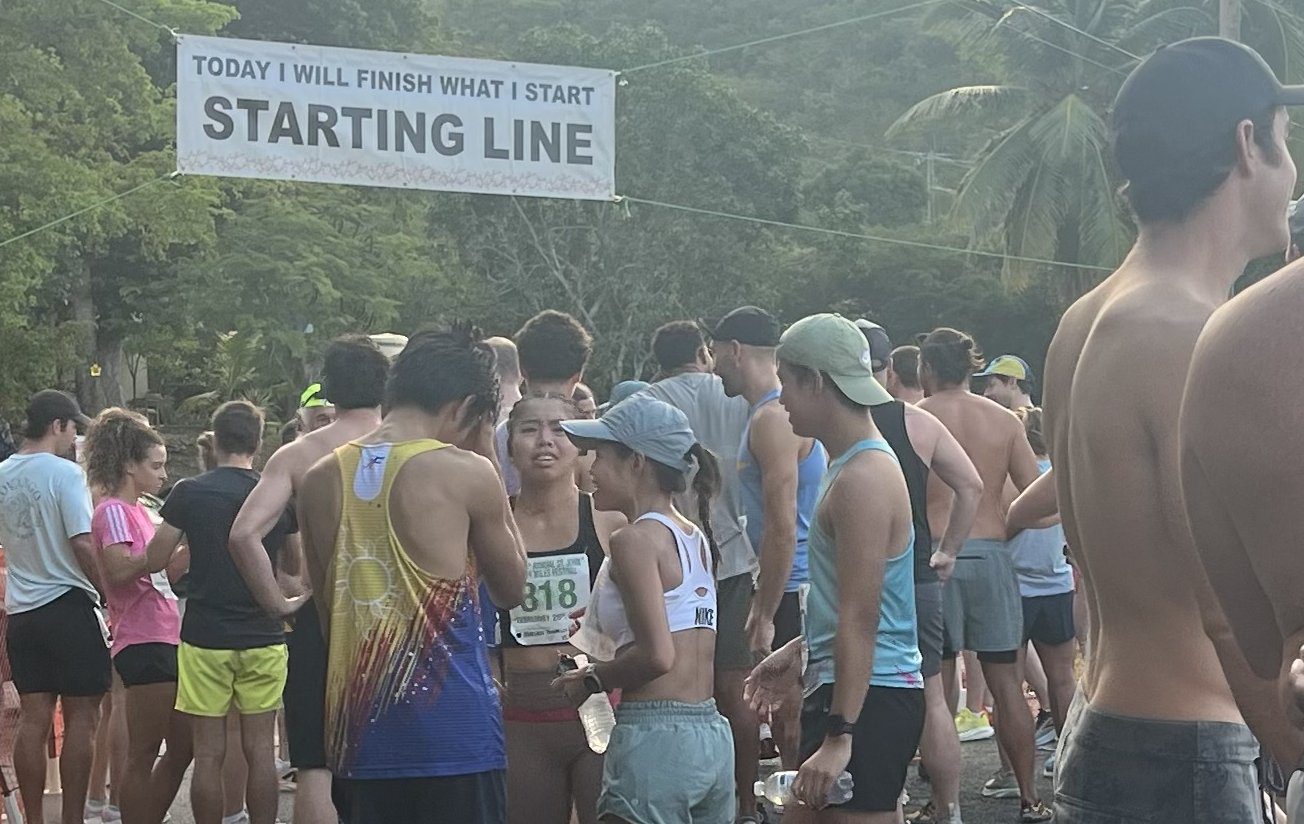
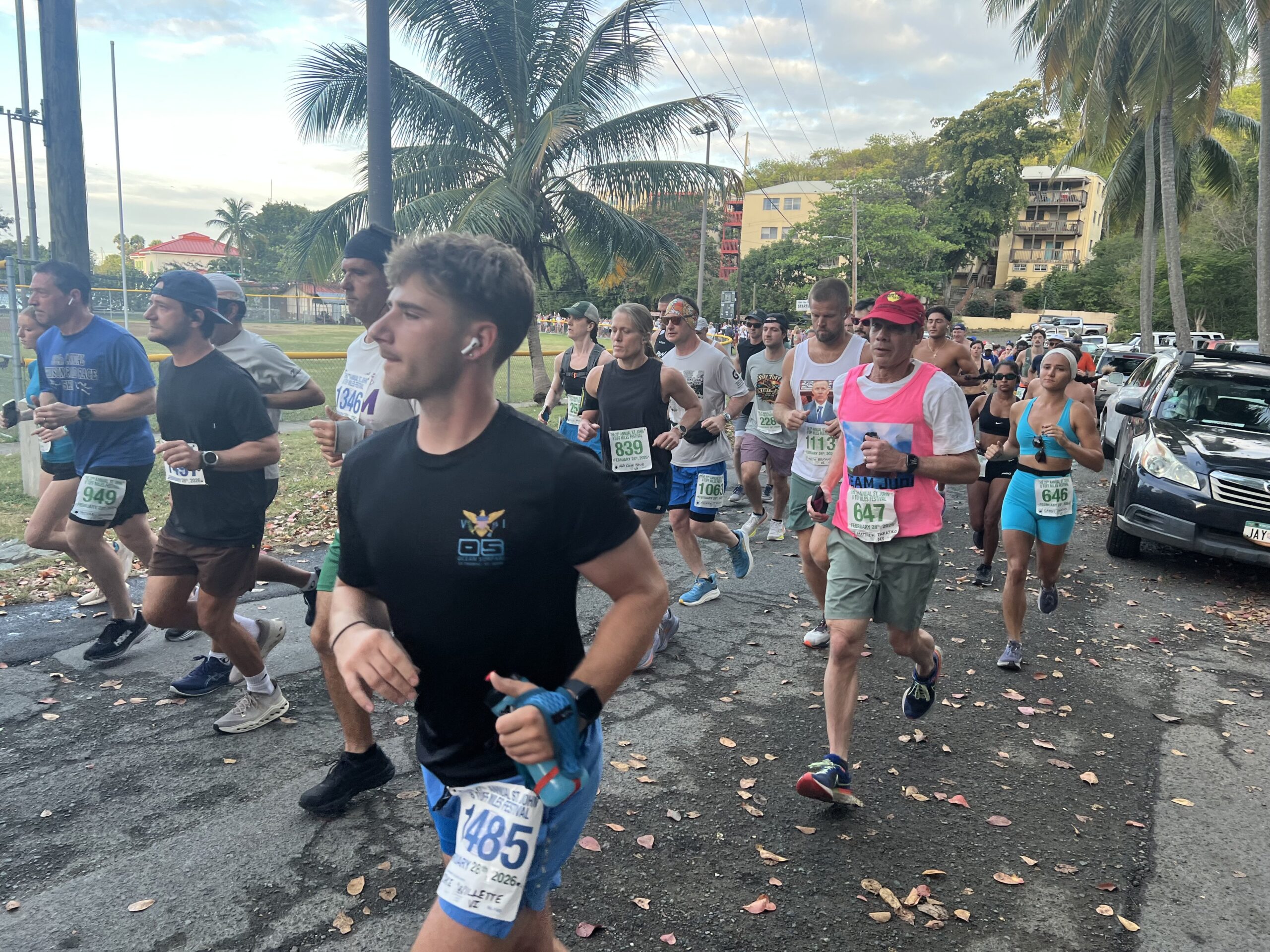
The time is 6:43 am — in less than half an hour, 1,500 registered runners and walkers would take off from the road behind the National Park Ballfield.
A sign and a pledge to go the distance. (Source photo by Judi Shimel)
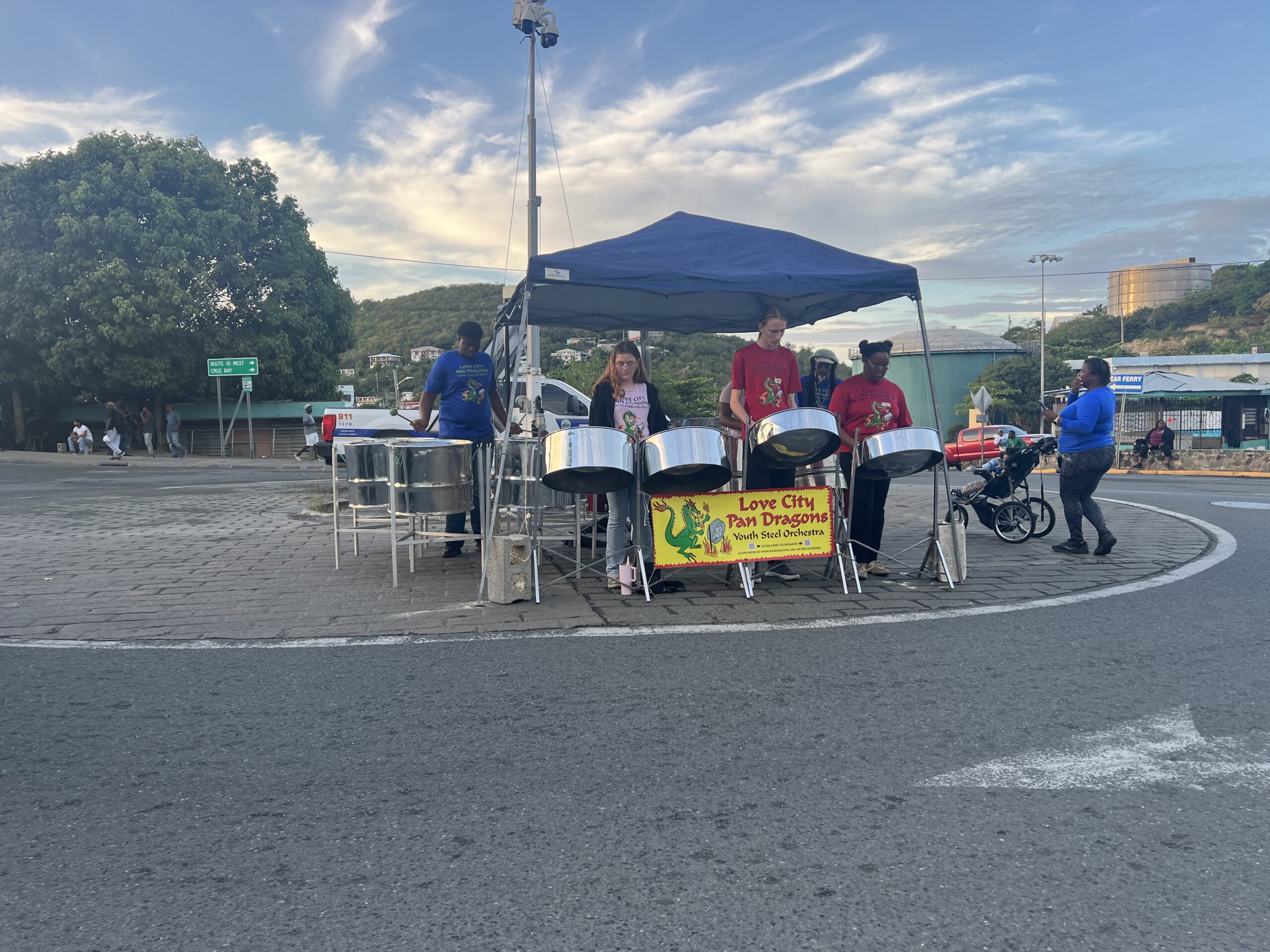
Within a few yards, they quickly hit the steep slope to the Veteran’s Circle where the Love City Pan Dragons waited to greet them.
Pan Dragons prepare. (Source photo by Judi Shimel)
Then it was up, up, up the road all the way to Coral Bay. A group made up of the top 100 finishers of the 2025 race led the charge with an eager set of challengers hot on their heels, given some lag time at the starting line.
“Up de Road!”(Source photo by Judi Shimel))
Along the way, some of those in the lead pack would lose their place among the first 100 finishers to their competitors.
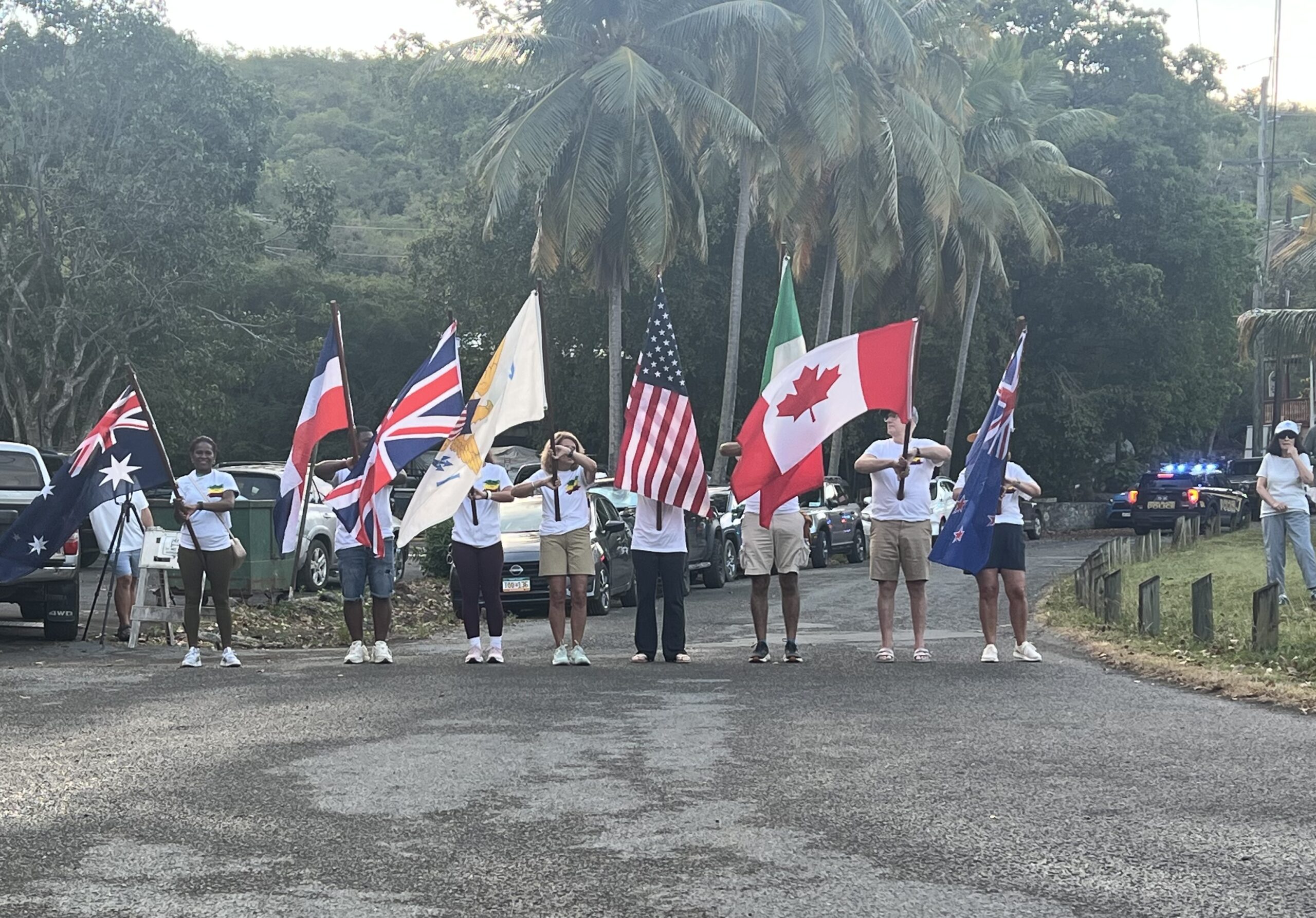
But before it all began, a moment to honor the nations represented by runners taking part in the race.
Flags to honor and to represent. (Source photo by Judi Shimel)
First across the finish line for the men’s division was Matias Porporato with a time of 51 minutes, 54 seconds; Elise Yoshioka clinched it in the women’s division in 58 minutes, 26 seconds.