Attorney General Praises Firearms Overhaul as Critics Urge Governor’s Veto

0
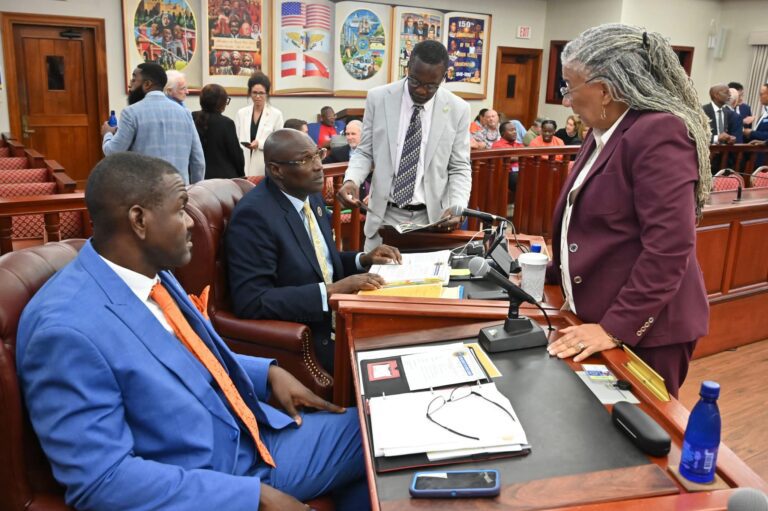
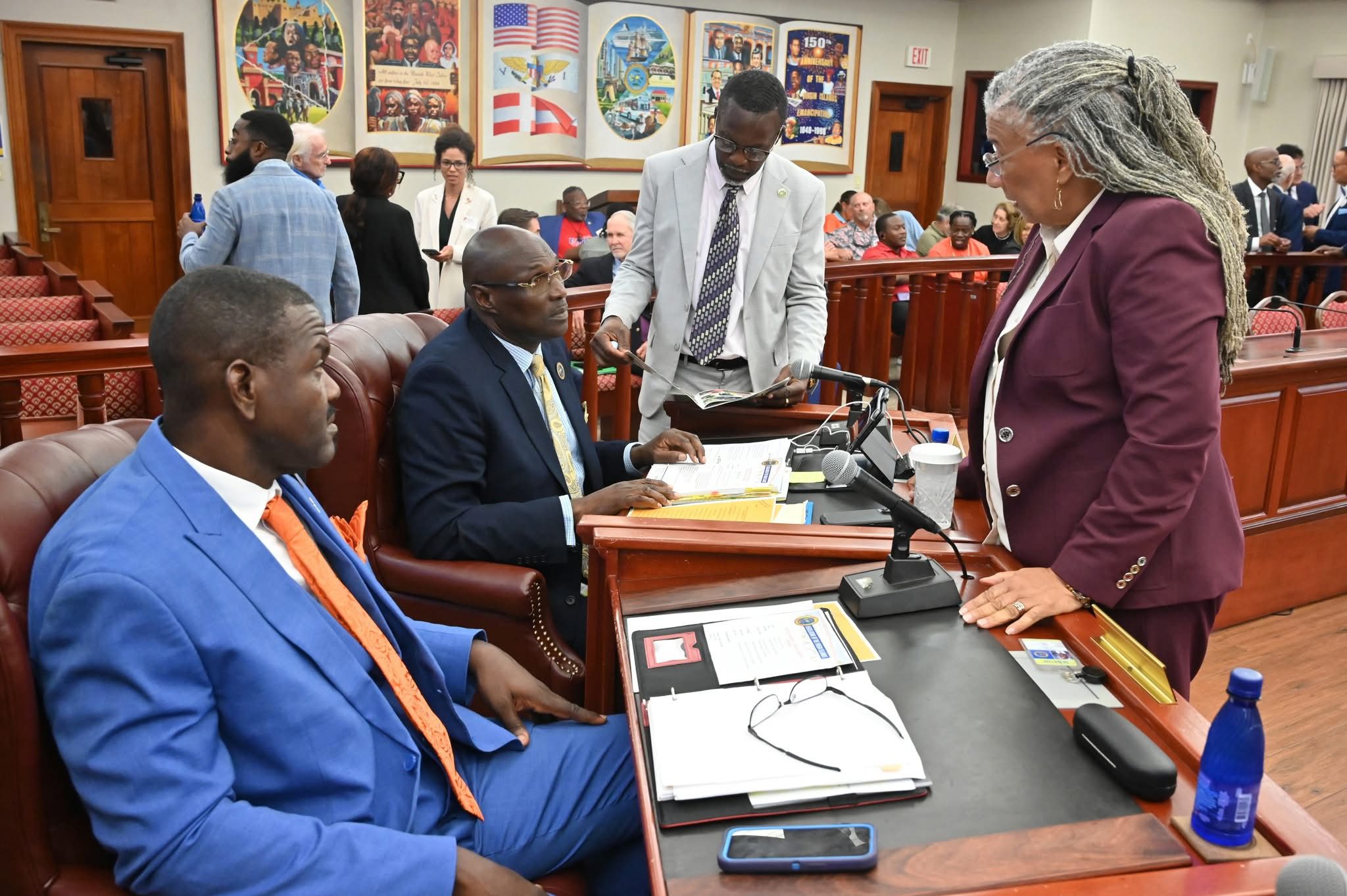
Senators discuss Bill No. 36-0144, the proposed Second Amendment Rights and Public Safety Act, on Friday. The measure, sponsored by Sen. Clifford Joseph, was approved and sent to Gov. Albert Bryan Jr. for consideration. (Photo courtesy of the VI Legislature)

Attorney General Gordon Rhea on Sunday praised lawmakers for approving a sweeping overhaul of the territory’s firearms laws, describing the measure as a long-overdue modernization effort that balances constitutional rights with public safety.

In a statement issued following Friday’s legislative vote, Rhea thanked senators for passing the “2026 Second Amendment Rights and Public Safety Act,” legislation developed by the Department of Justice in collaboration with Gov. Albert Bryan Jr.’s office, the Virgin Islands Police Department, and members of the Legislature.

“The new firearms law significantly improves how we regulate the possession and carrying of firearms and brings our laws into conformity with recent U.S. Supreme Court decisions while keeping faith with our obligation to protect the territory’s citizens,” Rhea said.

The measure, approved by the 36th Legislature on Friday as Bill No. 36-0144, would replace the territory’s long-standing discretionary permitting system with a “shall-issue” framework requiring the Virgin Islands Police Department to issue licenses to applicants who meet objective eligibility standards established by law.

Supporters have argued the overhaul is necessary to comply with recent court rulings, including the U.S. Supreme Court’s decision in New York State Rifle & Pistol Association v. Bruen, which struck down laws requiring applicants to demonstrate a special need to carry a firearm. The legislation also comes as the Virgin Islands faces a federal lawsuit challenging portions of its existing firearms permitting system.

Under the bill, residents who meet eligibility requirements — including not being convicted violent felons, fugitives from justice, subjects of domestic violence protective orders, or individuals adjudicated as dangerous to themselves or others — would be entitled to obtain firearm licenses and permits. The measure also establishes deadlines requiring VIPD to act on completed license applications within 45 days and firearm registrations within 30 days.

The legislation would also expand where licensed residents may legally carry handguns while maintaining prohibitions in designated “sensitive places” such as schools, government buildings, hospitals, and certain public gatherings.

At the same time, lawmakers retained and expanded a number of restrictions aimed at public safety. The bill prohibits automatic weapons, ghost guns, explosive devices, short-barreled rifles and shotguns, firearm conversion devices, suppressors, and .50-caliber rifles, while limiting most magazines to 15 rounds. Certain existing magazine owners would be grandfathered under the legislation.

Rhea said the measure provides “critical safeguards” for residents and visitors while ensuring the territory’s firearms laws remain constitutionally sound.

“It strikes the balance our community deserves: full respect for the constitutional rights of law-abiding citizens paired with meaningful regulations that allow our law enforcement officers to do their job and keep us safe,” he said.

Rhea also emphasized that the legislation keeps firearms out of the hands of convicted violent felons, fugitives from justice, individuals subject to domestic violence protection orders, and those who have been determined to be a danger to themselves or others. He further highlighted provisions restricting firearms in sensitive locations and prohibiting untraceable “ghost guns,” large-capacity magazines, and devices designed to convert firearms to fully automatic weapons.

Law enforcement officials made similar arguments during Friday’s Committee of the Whole hearing.

Assistant Attorney General Sean Bailey told lawmakers the territory’s existing law gives the police commissioner broad discretion to require applicants to demonstrate a “special need” to carry a firearm, a standard courts have increasingly found unconstitutional following the Bruen decision.

Assistant Police Commissioner Sean Santos described the legislation as a “balanced, comprehensive approach” that provides clearer guidance for officers while preserving lawful gun ownership.

The bill, however, drew significant criticism from gun-rights advocates and some lawmakers, who argued that many of its practical burdens fall on law-abiding gun owners rather than criminals.

Virgin Islands Safe Gun Owners founder Kosei Ohno testified that the legislation would require additional fees, training, and interactions with government agencies for residents attempting to comply with the law while doing little to address illegal firearms.

Local firearms dealer Ehren Henderson raised concerns about the bill’s restrictions on sensitive places, magazine capacity limits, and suppressor bans, arguing that lawful gun owners could face criminal liability during routine activities such as dropping children off at school or responding to medical emergencies.

Sens. Alma Francis Heyliger and Carla Joseph voted against the measure, expressing concerns that portions of the bill could unnecessarily criminalize otherwise law-abiding citizens. Several senators who ultimately supported the legislation acknowledged reservations about specific provisions, including restrictions on suppressors, magazine limits, and certain mental-health provisions, but concluded that the measure represented an improvement over existing law and a necessary response to ongoing litigation.

Opposition to the legislation has continued since its passage.

In an opinion piece released Monday, Ohno urged Gov. Albert Bryan Jr. to veto the measure, arguing that lawmakers approved a sweeping rewrite of the territory’s firearms laws without providing the public adequate opportunity to review the final language. He contended that residents were “asked to testify on a bill they were not allowed to see” and described the process as lacking transparency.

Ohno also argued that the legislation imposes additional costs, training requirements, and regulatory burdens on law-abiding gun owners while doing little to deter criminals who obtain firearms illegally. He criticized the bill’s expanded list of sensitive places, restrictions on suppressors and magazine capacity, and provisions requiring citizens to seek judicial relief if permitting deadlines are missed.

Calling for the governor to veto the legislation, Ohno urged lawmakers to revisit an alternative proposal advanced by his organization, arguing that constitutional rights and public safety can coexist without what he described as “rushed votes” and “unconstitutional shortcuts.”

Despite the debate, a majority of lawmakers concluded the legislation was necessary to modernize the territory’s firearms laws and respond to evolving constitutional standards while preserving tools for law enforcement and public safety.

The bill has been transmitted to Gov. Bryan for consideration. As of Monday, Government House had not publicly announced whether the governor intends to sign the measure into law.

Rhea also thanked DOJ Assistant Attorney General Sean Bailey and St. Thomas Criminal Division Chief Timothy Perry for their work on the legislation, calling their contributions invaluable to the effort.
Op-Ed: Losing Our Youth Cannot Become the Norm in the Virgin Islands

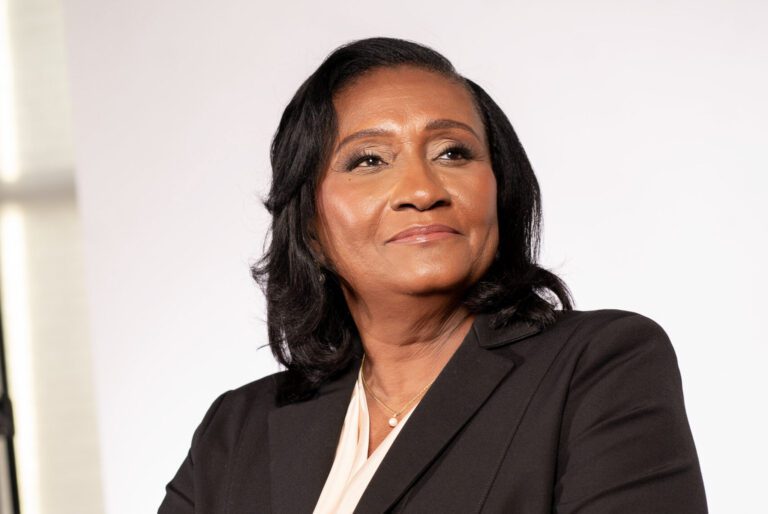
Donna Frett-Gregory (Submitted photo)
“Blessed are those who mourn, for they shall be comforted.” – Matthew 5:4 This is the verse Charlotte Amalie High School chose to honor and mourn the life of Tre’Vante Etienne. Fifteen years old. A son. A brother. A friend. A Virgin Islands child with a future that should still be ahead of him. Rodney and I are heartbroken for Tre’Vante’s parents, loved ones, classmates, teachers, and everyone carrying unimaginable grief today. There are no words that make this easier. But there is one thing I know. This is not normal. And we cannot allow ourselves to treat it as normal. When I heard the news of Tre’Vante’s murder, it brought back feelings I know too well. Today marks three years since my nephew lost his life to senseless violence. Years earlier, gun violence claimed the lives of my cousin and my uncle, a police officer. I know the horror of receiving that phone call. I know what it means for a family’s life to split into “before” and “after.” Rodney and I both grew up in neighborhoods where too many young people were exposed to violence early. We both raised sons in the Virgin Islands. We both know what it feels like to pray your children make it home safely. And like so many parents and grandparents across these islands, I have asked myself over and over: How many losses will it take before we decide enough is enough? This moment calls us to do more than grieve. It calls for action. According to KIDS COUNT USVI, homicide was the leading cause of death among young people ages 16–24 in 2023, accounting for 61% of deaths in that age group. On the mainland, homicide was the third leading cause of death for that same age group at 13.8%. This is more than a problem in the Virgin Islands, it is a crisis. And crises like this demand more than isolated solutions. They require us to be strategic. That is why public safety must be bigger than policing and rooted in a comprehensive approach built on three commitments. First, prevention and early intervention. Our children deserve safe places to belong, year-round opportunities to grow, and strong support systems that help them reach their full potential. That means reopening community centers across the territory and activating year-round youth programs, mentorship, career training, and internships, and increasing access to mental and behavioral health support within our schools. That also means re-launching VIVIS, the Virgin Islands Virtual Integrated System, a data-informed student support system designed to help schools identify academic, behavioral, and emotional needs earlier and connect students to resources faster. Second, protection and accountability. Our children deserve communities that are safe and adults who act when harm is done. This means building a territory-wide proactive crime prevention strategy. It also means equipping law enforcement with smarter, data-driven tools like real-time crime tracking, ensuring those who inflict harm are quickly identified and face swift accountability. Third, rehabilitation. Our children deserve to grow up in communities that break cycles of violence instead of repeating them. That means expanding workforce training and educational opportunities in our correctional system, strengthening rehabilitation and mental health services for adults, and creating real pathways for successful reentry so fewer families experience loss again. In order to protect our children, we must do all three. No child should grow up believing violence is normal, feeling forgotten, or wondering whether they will make it home. They deserve a community where every adult understands that every child belongs to all of us. Where we intervene, mentor, and speak up. Today, there is a family grieving. There is an empty seat. There are classmates trying to understand something no child should have to understand. We owe Tre’Vante more than our sadness. We owe him action. We have work to do.

Op-Ed: The Virgin Islands’ Place in America’s Freedom Story—And Why It Matters Now

Moleto A. Smith, Jr.
The 250th anniversary of the American story is approaching and an important question emerges: who is represented in the history we honor—and who is overlooked? The popular American story of Emancipation is often told through a lens rooted in the legacy of the American Revolution and extending from the 1863 Emancipation Proclamation to Juneteenth. That narrative presents freedom as the gradual fulfillment of ideals first declared in 1776. From the beginning, though, the nation’s founding was marked by contradiction: a revolution for liberty that allowed slavery to endure. This familiar story bypasses a distinct legacy of self-liberation that unfolded nearly two decades earlier on our own Caribbean shores. On July 3, 1848, thousands of enslaved Crucians refused to wait for distant authorities to decide their fate. Organized by Moses Gottlieb, known as “General Buddhoe,” more than 9,000 laborers marched on Fort Frederik, demanding immediate freedom. Their disciplined and unified action forced Governor-General Peter von Scholten to declare universal emancipation. It remains one of the clearest examples in the Caribbean of enslaved African descendants collectively seizing their own liberty. Juxtapose this legacy to the American Revolution, where ideals of freedom coexisted with the continued enslavement of African descendants. During the war, both British and American forces used the promise of liberty as a strategic tool. Lord Dunmore’s 1775 proclamation offered freedom to enslaved people who fled to British lines, prompting thousands to take that path. At the same time, Black soldiers served in the Continental Army, including in units like the 1st Rhode Island Regiment. For African Americans, freedom during the Revolution was uncertain and conditional—shaped by war, allegiance, and shifting policy. Liberty, under these conditions was often tied to the outcome of imperial conflict. On St. Croix, by contrast, it was demanded directly—asserted at the gates of colonial authority. Despite these different paths, the aftermath of emancipation followed a similar pattern. In the Danish West Indies, freedom did not dismantle the plantation system. The Labor Act of 1849 imposed strict controls on wages, contracts, and mobility, binding newly freed people to plantation labor under coercive conditions. Resistance continued, culminating in the 1878 Fireburn, when women like Queen Mary Thomas led a mass uprising against the system that had replaced slavery. On the mainland, the end of slavery in 1865 brought a similar struggle. Reconstruction briefly expanded rights, but those gains were eroded by Jim Crow laws and sharecropping, systems designed to preserve economic control and racial hierarchy. Across both contexts, emancipation marked a beginning—not the fulfillment—of freedom. Today, this dual history is reflected in two distinct commemorations: Juneteenth (June 19th), nationally, and Emancipation Day (July 3rd) in the Virgin Islands. Both recognize the end of slavery, yet they tell different stories—one of delayed federal enforcement, the other of collective self-liberation. As the country marks its 250th anniversary, rooted in the American Revolution, it is important to expand the boundaries of national memory. The story of American independence is incomplete if it overlooks the experiences of those in the territories. So, where do we go from here? To truly honor the dual legacies of 1776 and 1848, our national narrative must evolve from passive acknowledgment. We must bridge the gap between mainland and territorial history by ensuring that the stories of General Buddhoe, the 1st Rhode Island Regiment, and the Queens of the Fireburn are part of the national dialogue and are essential chapters in the broader American struggle for freedom. This history also requires that we deal with present-day issues. For more than a century, the Insular Cases have upheld a framework in which millions of Americans who reside in U.S. territories lack full constitutional protections and voting representation. These decisions continue to shape our reality today. By comparing the pension files of Black Patriots with the names inscribed in the Book of Negroes and the handbills of Fort Frederik, a broader, more complete history of American agency comes to light. It is a history that proves freedom was both negotiated in the trenches of the American republic and demanded at the gates of Caribbean forts. As the country looks ahead to its next 250 years, bringing together these distinct legacies is how we truly forge a more comprehensive future. Moleto A. Smith Jr. is a respected Virgin Islands leader, community advocate, and policy strategist based in St. Thomas, U.S. Virgin Islands. His work frequently centers on optimizing systems to drive results, ensure community transparency, and preserve the vital cultural legacy of the Territory. The views expressed are his own.

Henry Osorio Navarro Dies at 68

0
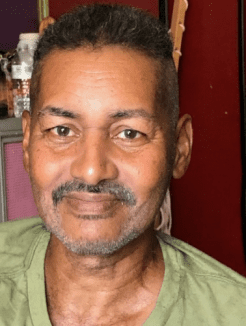
It is with profound sadness and heartfelt remembrance that we announce the passing of Henry Osorio Navarro, who entered eternal rest on June 8, 2026, at the age of 68.
Henry Osorio Navarro
Henry was a devoted husband, loving father, cherished grandfather and great-grandfather, beloved son, brother, and friend whose kindness, wisdom, and unwavering love touched the lives of everyone fortunate enough to know him. Born on Dec. 13, 1957, Henry lived a life centered on faith, family, and compassion. He was known for his generous spirit, warm smile, and the countless memories he created with those he loved. His strength, guidance, and unconditional love will remain a lasting legacy carried on by the many lives he influenced. Henry was preceded in death by his father, Julio Osorio Torres. He leaves to cherish his memory his beloved wife, Carmen M. Falcon Reyes; his loving mother, Dominga Osorio Navarro; his daughters, Zenovia Rios, Halina Cetnarowski-Colon, Jessica Flores Cosby, Yanira Olivo, and Jessenia Barranco; and his sons-in-law, Gabriel Almenas, Leon Cosby III, and Robert Beamon. Henry was a proud and loving grandfather to Marcel Rios, René Rios, Igor Rios, Alexander Almenas, Charlotte Almenas, Bjorn Almenas, Amaralyss Negron, Brianalyss Negron, Omarion Negron, Tyler Morales, Jariel Dewberry, Lela Olivo, Jasmine Yesu, Nick Yesu, Jaila Heathman, Jalene Heathman, Janae Heathman, Chris Cosby, Carlos Cosby, and Ciara Cosby-Harris (Shaq). He was also blessed with five great-grandchildren, Dionni Yesu, Massai Dewberry, Alexander Morales and Senethia and Sariah Harris, who brought immense joy and pride to his life. He is further survived by his sisters, Ana A. Saldana, Sandra Maldonado, Zoila Osorio, Natividad Osorio, and Maria Osorio; and his brothers, Jose A. Osorio, Julio Osorio Jr., and Reynaldo Osorio; and his best friend Alexander “Gizmo” Williams. Although our hearts are heavy with sorrow, we find comfort in the precious memories, enduring love, and invaluable lessons Henry leaves behind. His presence will be deeply missed, but his spirit will live on forever in the hearts of his family, friends, and all who had the privilege of knowing him. Forever loved, forever remembered, and forever missed.

Weekly Weather Forecast With Jesse Daley

0
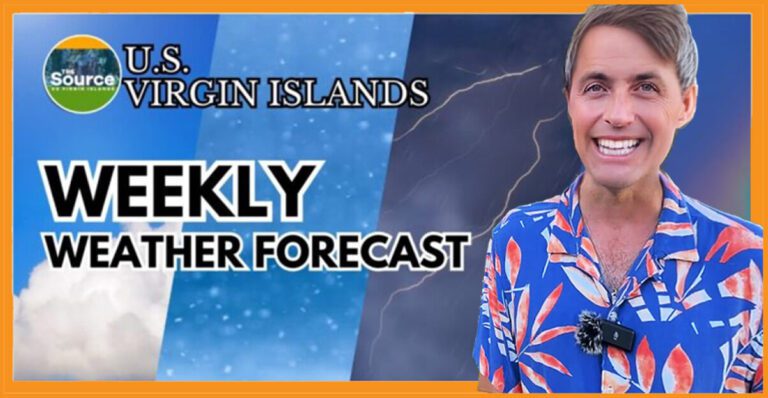
Check out our weekly weather forecast with Jesse Daley, covering Sunday, June 14, through Saturday, June 20. Please stay safe and follow the Source for more weather updates!

Editorial: Leadership Isn’t the Same Thing as an Investigation

0
The Virgin Islands Police Department has said little publicly about the killing of Tre’Vante Etienne. That is not necessarily a criticism. Our detectives have a responsibility to protect the integrity of a case, follow the evidence where it leads, and avoid saying anything that could jeopardize a future prosecution. Those are responsibilities we should all want them to take seriously. But while investigations require silence, leadership often requires something else. At the center of this tragedy is a family mourning the loss of a son. Tre’Vante’s family is grieving, as are his friends, classmates, teammates, teachers, neighbors, and a community trying to make sense of a loss that has left far more questions than answers. The investigation will hopefully confirm what happened and determine who is responsible, and those answers matter. But they are not the only questions being asked. Parents are wondering how to help their children process what happened. Young people are trying to understand a tragedy that has shaken their sense of normalcy. Families are asking what support exists for those most affected and who is bringing those conversations together. Saturday night, Gov. Albert Bryan Jr. called on the community, government included, to come together and create safe spaces for young people. The question now is what that means in practice. Who is responsible for convening schools, coaches, counselors, churches, youth organizations, parents, and community leaders? Who is coordinating the support that young people and families may need in the days and weeks ahead? These questions are not answered by an arrest, nor do they require details from an active investigation. They require leadership. To its credit, the Department of Health quickly announced behavioral health support for those affected by Tre’Vante’s death, recognizing that violence leaves behind more than an investigation. It leaves behind grief, trauma, fear, and confusion. There should be room for more of those conversations, more resources that support emotional health and healing, and more discussion about what support looks like in practice. Because leadership, particularly in moments like this, is not only about solving a crime. It is about standing before a grieving community and making clear that our young people matter enough to deserve a coordinated response. The investigation may tell us what happened. Leadership should help us decide what happens next. And as that conversation unfolds, remembering the young life at the center of this should also be a priority. Tre’Vante was a son, a brother, a friend, a teammate, a classmate, and a young man known and loved by many people in this community. Let’s rally around his family and hold them up in our thoughts, prayers, and actions. Those with information about what happened, please report it by calling the Criminal Investigation Bureau at 340-774-2211, extensions 5555 or 5556, or Crime Stoppers V.I. at 800-222-8477. Publisher’s Note: As with all signed editorials, the views expressed here are those of the author and do not necessarily reflect the opinions of the Source’s staff, contributors, or affiliated organizations.

DOH Offers Mental Health Support as Community Mourns Teen Killed in Friday Shooting

0
As police continue investigating the fatal shooting of 15-year-old Tre’Vante Etienne, Health officials are urging Virgin Islanders to focus on another reality unfolding across the territory: the emotional toll the tragedy is taking on students, families, friends, and the wider community. On Saturday, the Virgin Islands Department of Health announced that behavioral health services are available for anyone struggling in the aftermath of Friday’s shooting, which claimed the life of the Charlotte Amalie High School student and left classmates, relatives, and community members grappling with grief and unanswered questions. “This is a profoundly difficult time for our community,” Health Commissioner Justa Encarnacion said in a statement. “Our hearts are with Tre’Vante’s family, friends, classmates, and all those who loved and cared for him.” Residents seeking assistance may contact the St. Thomas Behavioral Health Clinic at 340-774-6380, St. John Behavioral Health Services at 340-776-6400, or the St. Croix Behavioral Health Clinic at 340-773-1311. Individuals experiencing emotional distress or a mental health crisis may also call or text 988 for free and confidential support 24 hours a day, seven days a week. The department’s response comes as investigators continue to piece together what happened Friday afternoon in the Savan neighborhood and basketball court where witnesses have said Etienne was reportedly playing baseball with his friends. While various accounts of the incident have circulated on social media and within the community, including claims that the shooting stemmed from an attempted robbery and reports that a suspect has been taken into custody, none have been confirmed by the Virgin Islands Police Department. Officials have said instead that the investigation remains in its early stages and have cautioned against releasing details that could compromise the case. What is known is that Etienne’s death has reverberated far beyond the scene of the shooting. Encarnacion said the loss of a child to gun violence affects not only a family, but an entire community. The Department of Health’s Behavioral Health Division is offering counseling referrals, emotional support, and information about available mental health services to residents affected by the tragedy. Deputy Commissioner for Behavioral Health Renan Steele noted that exposure to violence can trigger a range of emotional responses, including grief, fear, anxiety, anger, confusion, and helplessness, particularly among young people. “Following a traumatic event, it is normal to experience a wide range of emotions,” Steele said. “However, if feelings of sadness, anxiety, fear, or distress persist or begin to interfere with daily functioning, seeking professional support can be an important step toward healing.” Health officials encouraged parents and caregivers to check in with children and teenagers in the days ahead, noting that young people may respond to trauma through changes in behavior, difficulty concentrating, anxiety, withdrawal from friends and activities, or trouble sleeping. For many residents, the tragedy has become a difficult conversation taking place around dinner tables, in group chats, at churches, and among students processing the loss of a classmate and friend. “In times of tragedy, the greatest strength of our community is our ability to come together,” said Dr. Gesil Ramos, director of the Behavioral Health Division. “I encourage all of us to intentionally reach out to our young people, listen without judgment, and remind them that they are valued, supported, and never alone.” Meanwhile, police continue to investigate the circumstances surrounding Etienne’s death. Anyone with information is urged to contact the Virgin Islands Police Department.

Energy Office Completes First Solar Day-Care Project, Seeks Bids for Five More Sites

0
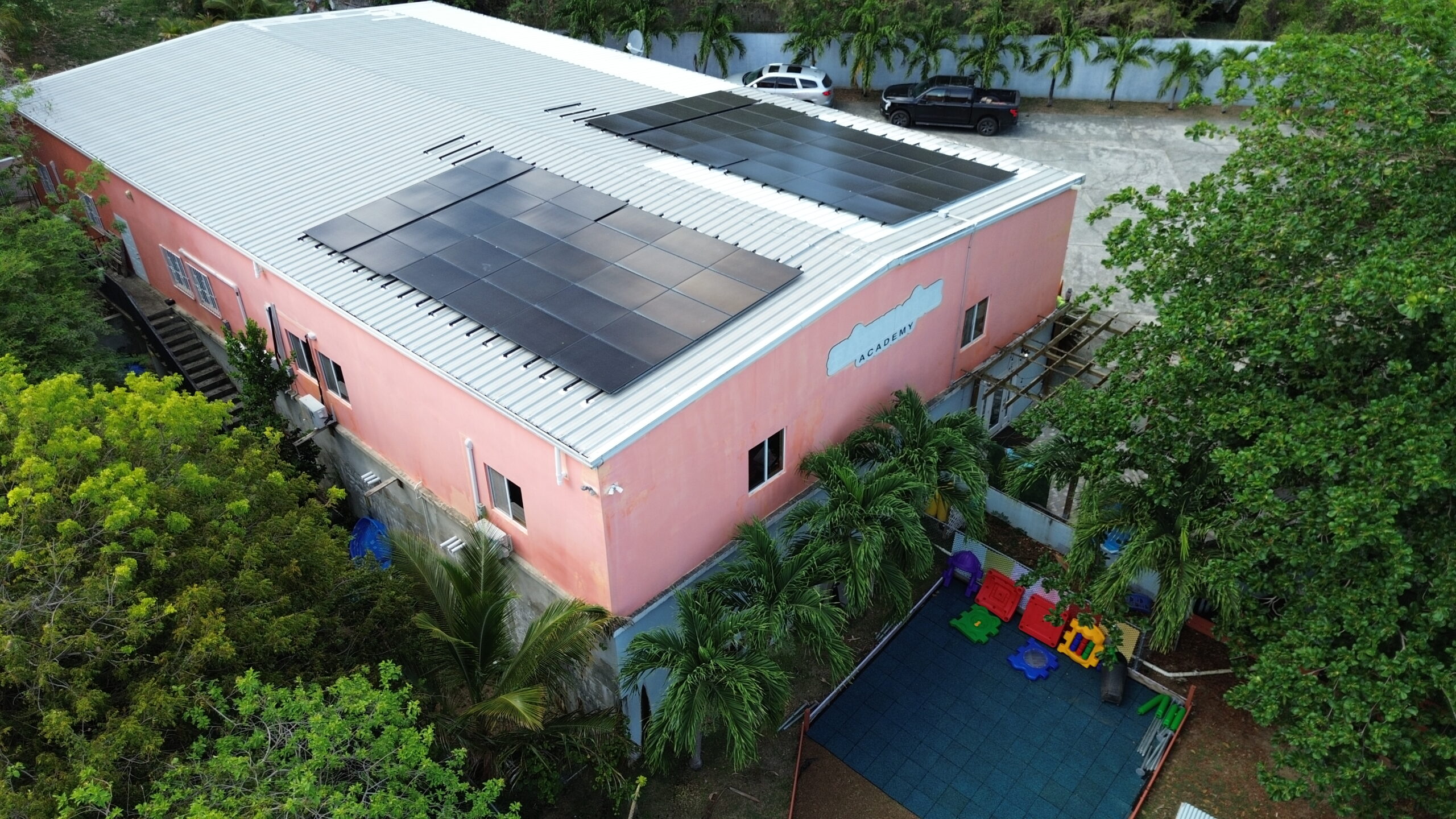
The Virgin Islands Energy Office has completed its first Community Electrical Innovation-funded solar and battery microgrid project at a St. Croix day-care center and has issued a request for proposals for five additional projects across the territory, a press release announced. The completed installation is at Happy Faces II on St. Croix. The system, installed and commissioned by ProSolar Caribbean in May, includes 9.9 kilowatts of solar photovoltaic generation and 40.5 kilowatt-hours of battery energy storage. According to the Energy Office, the project is designed to reduce electricity costs while allowing the facility to continue operating during power outages.
Happy Faces II on St. Croix is the first site completed under the Virgin Islands Energy Office’s Community Electrical Innovation Program, which supports resilient energy infrastructure at community facilities. (Submitted photo)
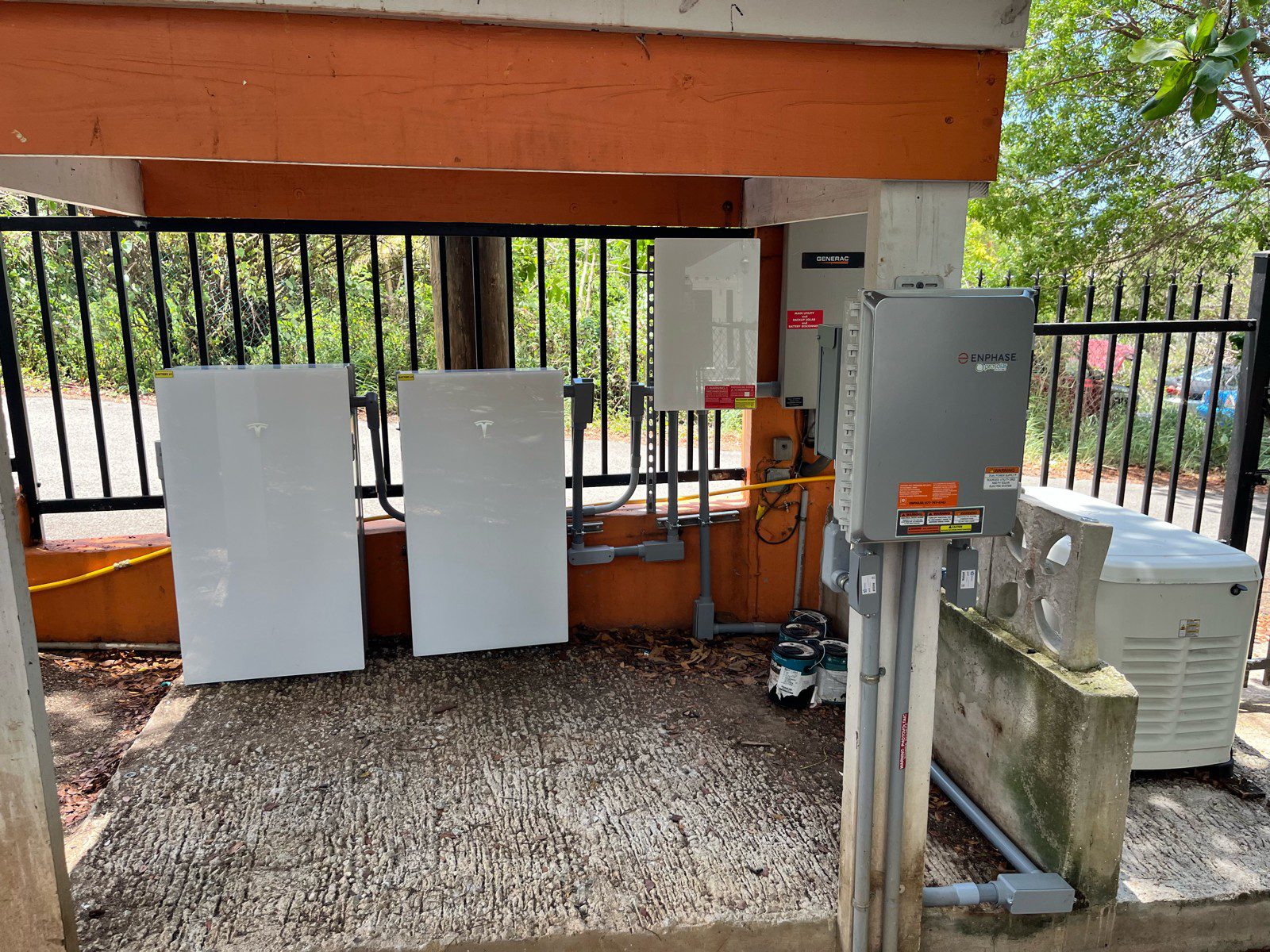
The battery system includes three Tesla Powerwall 3 units that have been enrolled in the Energy Office’s Virtual Power Plant program, which is intended to support future grid services through distributed energy storage, according to the press release. At the same time, the Energy Office released a request for proposals for solar and battery microgrids at five additional day-care and Head Start facilities on St. Thomas, St. John and St. Croix. Collectively, the projects call for 149 kilowatts of solar generation and 600 kilowatt-hours of battery storage, the press release stated.
A battery-backed renewable energy system recently commissioned at Happy Faces II on St. Croix is designed to help maintain operations during power outages while reducing energy costs. (Submitted photo)
The proposed sites are DHS Sugar Estate Head Start on St. Thomas, DHS Cruz Bay Head Start on St. John, DHS Anna’s Hope Head Start on St. Croix, DoReMi Daycare on St. Croix and Tenacious Toddlers Learning Center on St. Croix, the release stated. The Community Electrical Innovation program is funded through the Virgin Islands Housing Finance Authority using U.S. Department of Housing and Urban Development Community Development Block Grant-Disaster Recovery E-Grid funds. According to the release, the program supports the development of solar and battery storage systems at community facilities and nonprofit organizations in underserved areas, the release stated. Last year, the Energy Office identified 29 critical facilities across the territory for potential participation in the program and is now moving into the implementation phase, according to the release.

What Is Wind Shear, and Why Does It Matter During Hurricane Season?

0
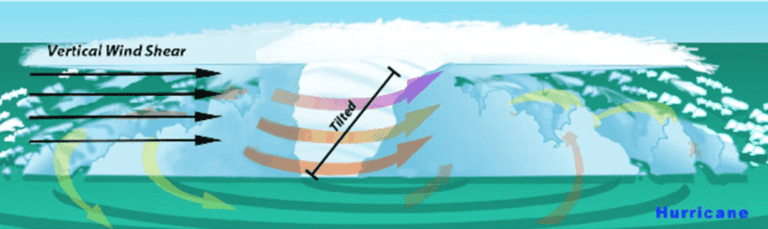
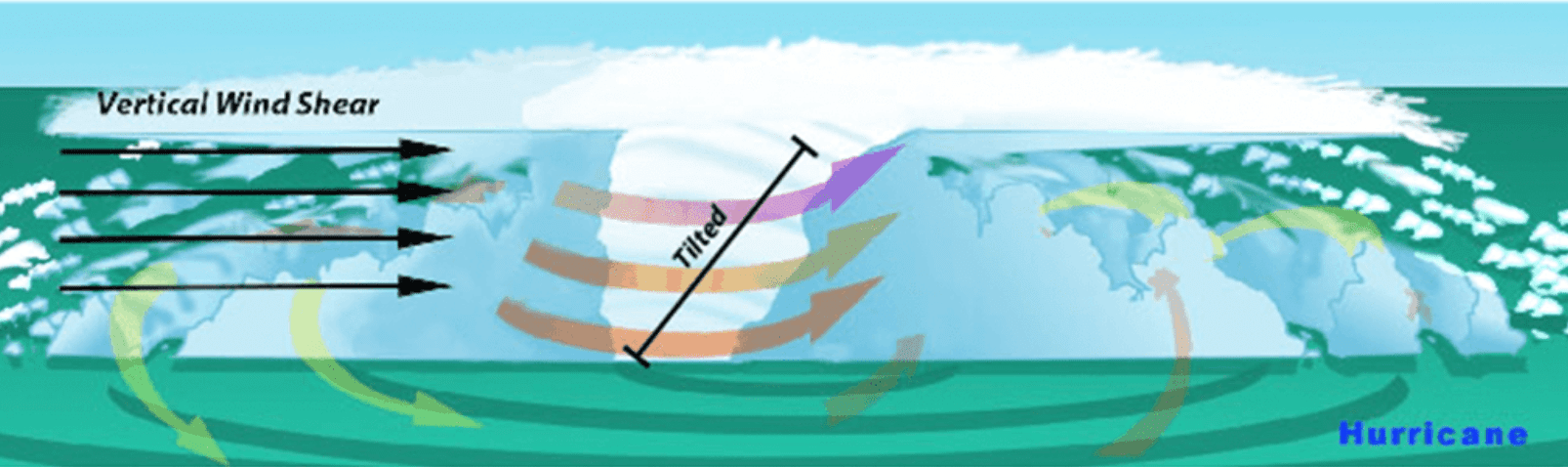
NOAA graphic showing how vertical wind shear can tilt a hurricane’s structure, disrupting the flow of heat and moisture needed for the storm to strengthen. (Photo courtesy NOAA)
Wind shear is a weather term often used during hurricane season, but it can sometimes sound like technical jargon. For residents in the U.S. Virgin Islands and across the Caribbean, understanding what wind shear means can help explain why some tropical waves struggle to develop, while others can organize when conditions are favorable.
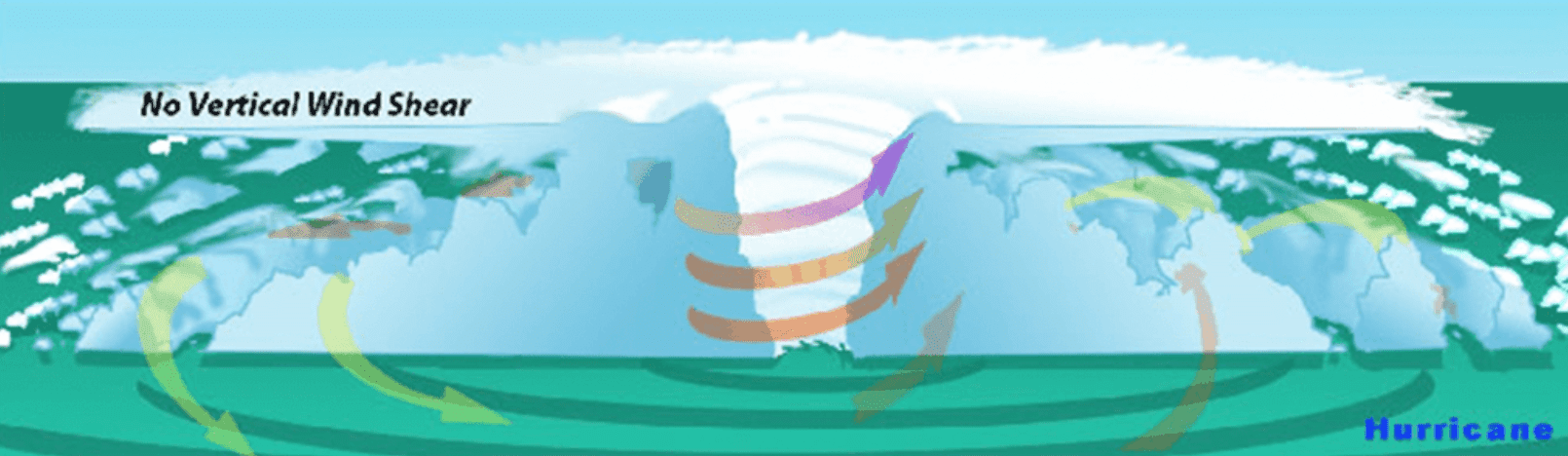
A graphic from NOAA showing how a hurricane can remain vertically aligned when there is little to no vertical wind shear. (Photo courtesy NOAA)
Understanding Wind Shear In simple terms, wind shear refers to a change in wind speed or direction with height in the atmosphere. During hurricane season, meteorologists talk about vertical wind shear, or how winds change from the lower part of the atmosphere to the upper levels. “Wind shear is the variation of the wind’s speed or direction over a short distance within the atmosphere,” according to information from the National Oceanic and Atmospheric Administration’s Atlantic Oceanographic and Meteorological Laboratory. “For tropical cyclones, wind shear is important primarily in the vertical direction, as these storms occupy a large vertical slice of the atmosphere from sea level to the top of the troposphere, which extends up to about 40,000 feet altitude in the tropics in summer,” NOAA said. How Wind Shear Can Disrupt Tropical Systems NOAA explained in further detail how wind shear can affect tropical storms and hurricanes: “Tropical weather systems are vulnerable to changes in the broader atmosphere surrounding them, often influenced by large features such as areas of high and low pressure and fronts. If there’s too much wind, these weather systems have trouble organizing and developing into a tropical cyclone. As a tropical system forms, heavy thunderstorms build near the center. Given the right environment, these systems can eventually begin turning counter-clockwise, or cyclonically, in the northern hemisphere. With little to no wind shear, the turning within the tropical system is uniform and the storm becomes vertically aligned, helping to keep it intact and likely strengthening.”
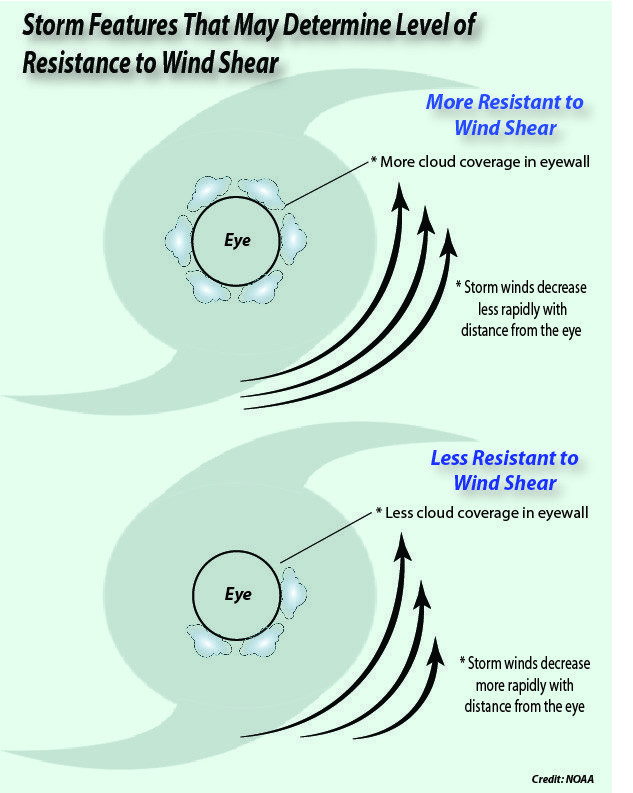
NOAA graphic showing storm features that may make a hurricane more or less resistant to the disruptive effects of wind shear. (Photo courtesy NOAA)
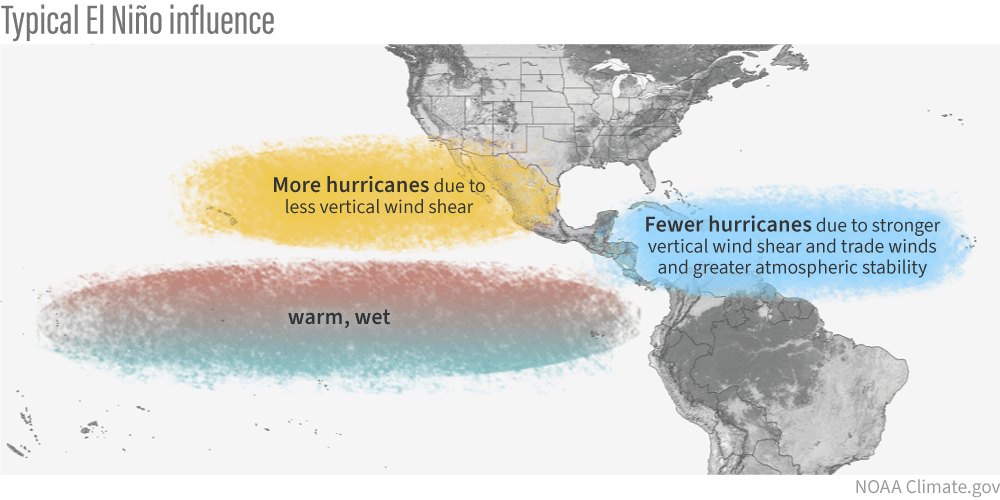
“The most favorable condition for tropical cyclone development is the absence of wind shear. When wind shear is present, however, a storm’s core structure becomes vertically tilted in relationship to the wind shear, disrupting the flow of heat and moisture. Tropical cyclones are heat engines powered by the massive heat release associated with water vapor condensing into liquid water. Vertically-tilted systems are less efficient at drawing in warm and moist air from the surrounding ocean and will be less likely to develop and strengthen,” NOAA stated. The National Hurricane Center’s Mariner’s Tropical Cyclone Guide lists low vertical wind shear as one of the key ingredients for tropical cyclone development, describing it as, “Little change in wind speed or direction throughout the depth of the troposphere.” Notably, wind shear does not necessarily mean residents will feel stronger winds at the surface. Breezy conditions across the Virgin Islands are more often tied to trade winds, pressure patterns, passing tropical waves, or local weather features. The El Niño Connection The latest El Niño update adds a timely reason to explain wind shear this season. The NOAA’s Climate Prediction Center issued an El Niño Advisory on Thursday, June 11, stating that El Niño conditions are now occurring. “El Niño conditions are present and expected to strengthen into the Northern Hemisphere winter 2026-2027,” the CPC said. The CPC noted that above-average sea surface temperatures have developed across the central and eastern equatorial Pacific Ocean, and that there is a 63% chance of a very strong El Niño during the November-January period. That matters for hurricane season, because El Niño often increases wind shear across parts of the Atlantic basin, including the Caribbean, while reducing wind shear in parts of the Pacific. NOAA/AOML explains that during El Niño, changes in the jet stream can lead to decreased wind shear in the Pacific and increased wind shear across much of the Caribbean and Atlantic. A Weather Expert’s Perspective The Source contacted Alex DaSilva, AccuWeather’s lead hurricane expert, to obtain additional information about wind shear, and why it is expected to play a major role this season.
A graphic showing typical El Niño influences, including increased vertical wind shear across parts of the Atlantic basin and reduced wind shear in the eastern Pacific. (Photo courtesy NOAA)
“El Niño typically leads to fewer storms in the Atlantic, because it increases wind shear, creating hostile upper-level winds that disrupt tropical development,” DaSilva said. “That tends to keep storm numbers lower overall, with more frequent periods of wind shear across the Atlantic basin. It’s the opposite in the Pacific. During El Niño years, there is generally less wind shear, which allows for more active hurricane seasons there,” DaSilva explained. “Overall, during this hurricane season, wind shear is expected to be higher across the Atlantic, which should limit development for much of the season. However, it will not be constant. There will still be periods of lower wind shear, and those are the windows when powerful storms can form, especially with very warm ocean temperatures. The stronger El Niño becomes, the lower the total number of storms is likely to be. If we reach a ‘Super El Niño,’ storm totals would likely fall toward the lower end of the forecast range,” DaSilva said. That combination of higher wind shear overall and very warm ocean water in parts of the basin, is one reason forecasters continue to stress preparedness. “I am still concerned about the risks this season. Ocean temperatures are expected to be extremely warm, and ocean heat content will be very high. Any storm that finds a pocket of lower wind shear could rapidly intensify. That’s the risk this year. People may see a season with fewer storms and assume there is little to worry about. But that can actually make it more dangerous, because people may let their guard down,” DaSilva cautioned. Wind Shear Does Not Eliminate Development Risk Indeed, wind shear also is not the only factor that determines whether a tropical system develops. Warm ocean water, ocean heat content, moisture, dry air, Saharan dust, tropical waves and steering patterns are all examples of components that can contribute to the development of a storm. As the Source reported recently, the Atlantic basin remains relatively quiet overall, although there is a slight chance for development in the Gulf region.
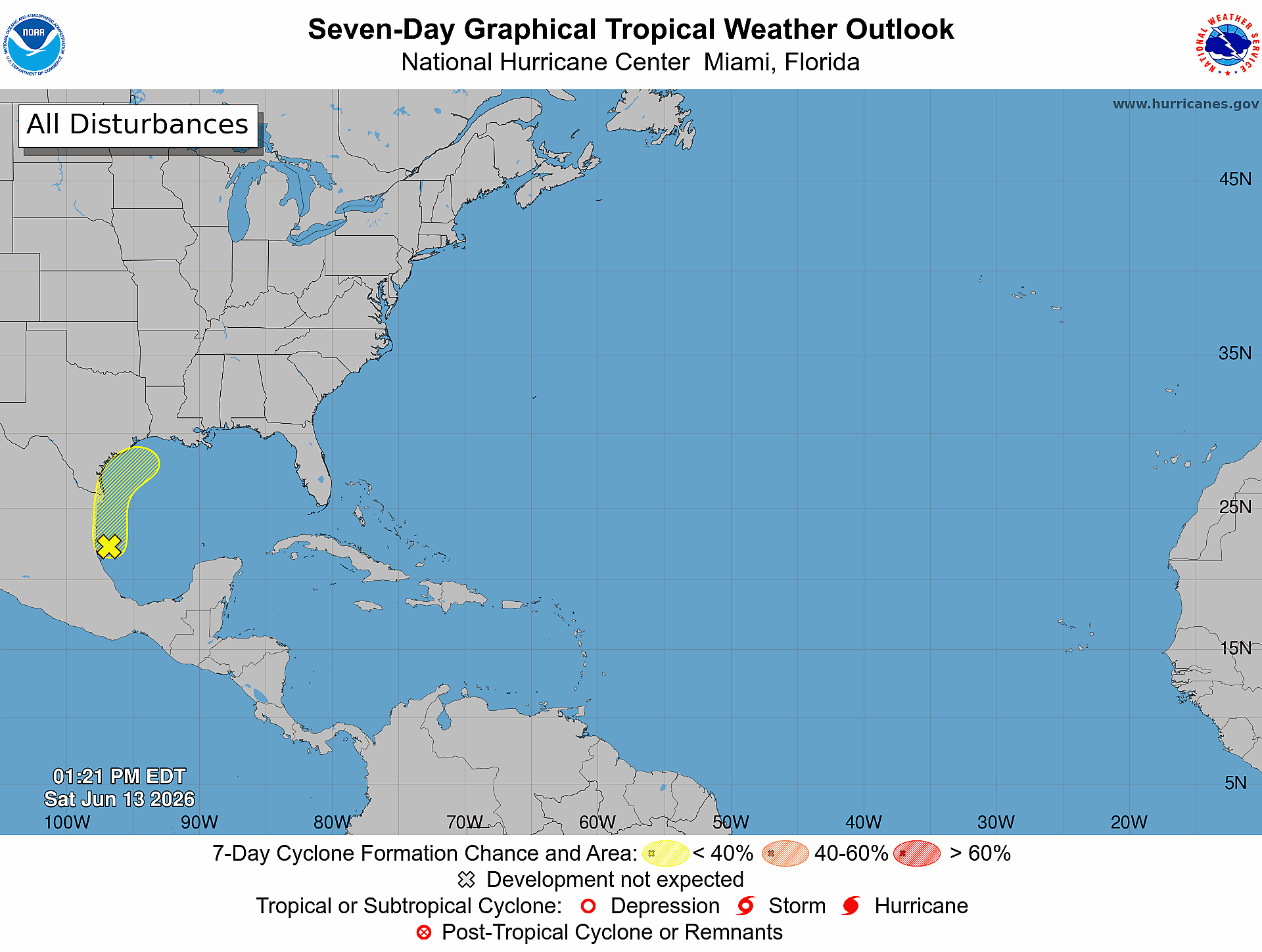
A NHC seven-day outlook released on Saturday afternoon indicates a slight possibility for tropical development near the Gulf region. (Photo courtesy NHC)
As of Saturday afternoon, the NHC said a broad area of low pressure just offshore of eastern Mexico was producing disorganized showers and thunderstorms in the southwestern Gulf. Significant development is not expected before the system moves inland over eastern Mexico by early Sunday. The NHC gave the system a low, 10% chance of formation through 48 hours and a low, 20% chance through seven days. The NHC added that the system could re-emerge over the northwestern Gulf on Tuesday or Wednesday while interacting with a frontal boundary, although conditions there are expected to be only slightly conducive for development. In the eastern Pacific, the NHC is monitoring a trough of low pressure located southwest of the Baja California Peninsula. Significant development is not expected, and the system has a low, 10% chance of formation through 48 hours and seven days. Tropical cyclone formation is not expected in the central North Pacific during the next seven days. Still, the Pacific has already shown early-season activity, and NOAA’s CPC has indicated that conditions may become highly favorable for additional East Pacific tropical cyclone development later in June. Forecast Updates DaSilva said that Caribbean residents and visitors should remain aware as the season progresses.
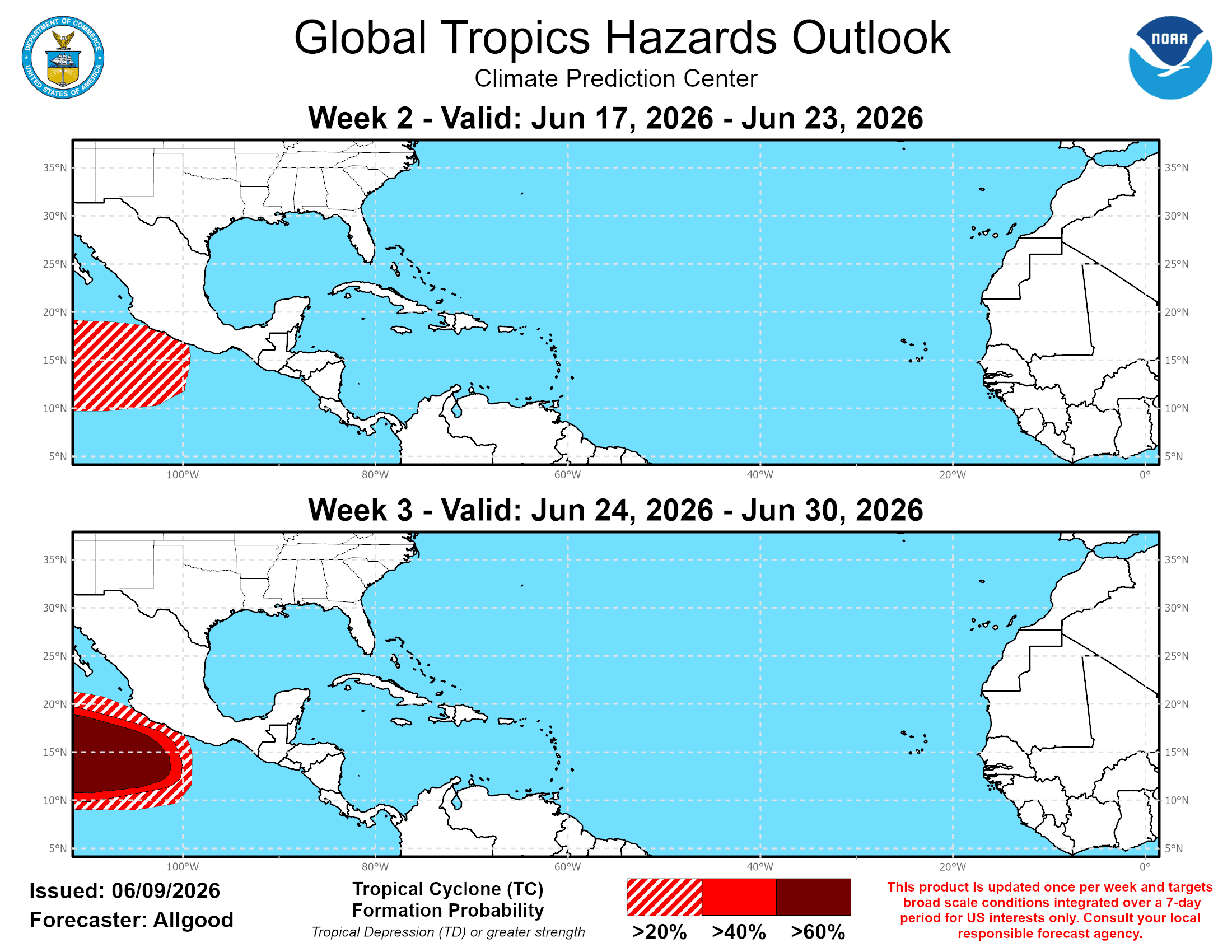
NOAA Climate Prediction Center Global Tropics Hazards Outlook issued June 9, showing potential tropical cyclone development areas in the eastern Pacific for late June. (Photo courtesy NOAA Climate Prediction Center)
“For the Caribbean, especially the eastern Caribbean, the higher risk typically comes later, usually starting in July and increasing into August. Early in the season, it is more common to see tropical waves that have not fully developed yet. If El Niño becomes very strong, especially a super El Niño, wind shear would likely be stronger during the second half of the hurricane season,” DaSilva noted. Information regarding the weather across the USVI, including marine forecasts, is available from the NWS and NOAA.  The latest tropical forecasts can be viewed on the official website of the NHC. The local forecast is regularly updated on the Source Weather Page, and a weekly video forecast is available. Additionally, residents and visitors can view weather alerts and disaster preparedness information from the Virgin Islands Territorial Emergency Management Agency

Arrest Made in Sexual Assault Investigation

An arrest warrant was obtained on June 8, in connection to a report made in March of inappropriate touching. On June 12, Rafea Abdallah Hassan, 30, was arrested by members of the Criminal Investigation Bureau without incident, reported the Virgin Islands Police Department.  According to a police report, on March 29, a woman presented at the Wilbur H. Francis Command Police Station and reported being inappropriately touched by a man while at work. Following an investigation, the suspect was identified as Hassan. He was booked, processed, and posted bail in the amount of $500. Hassan was released pending an advice of rights hearing on Monday, June 15, at the Superior Court.