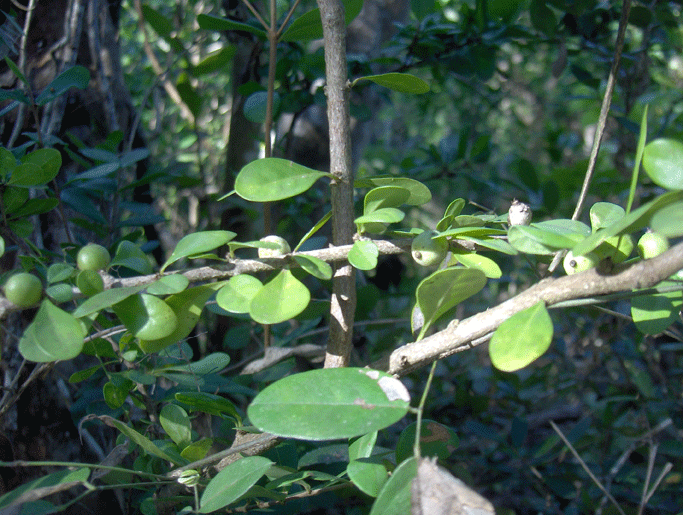
A native Randia aculeata shrub, once commonly used as a traditional Virgin Islands Christmas tree, grows in the hillsides where families once searched for the perfect holiday branch. (Photo from Wikipedia)
In the Virgin Islands, the Christmas season, or “Christmastime,” is not preparation for a single day, but instead a monthlong series of cultural events and traditional practices inclusive of African, European, and Caribbean influences.
While the overarching spirit of generosity, goodwill, and family remains, the specific customs, from the trees we decorate to the ways we communicate, have shifted over the decades, reflecting a Virgin Islands identity that continues to evolve.
While people living closer to the North Pole observe annual Christmas celebrations centered around the snowy cold of the winter season, here in the Virgin Islands, a year-round backdrop of warm sunny days, green rolling hills, and perfect beach weather is enjoyed. Christmastime is one of the longest seasons celebrated in the Caribbean region, traditionally stretching from Dec. 15- Jan. 6, Three Kings Day. However, with the annual St. Croix Crucian Christmas Festival aligning with the traditional Christmas holiday, the island of St. Croix begins its celebrations much earlier, involving horse races, Calypso concerts, parades, tramps, and other cultural events.
In recent decades, Virgin Islanders have shifted to adorning their homes with imported Evergreen Trees; however, in the early and mid-20th century, it was common to use the native “Randia Aculeata” shrub. Families would set off into the dense bush on the hillside to chop down the perfect tree; it would be used later that evening to decorate with bright-colored ornaments and candles. This practice highlighted a time when Virgin Islanders enjoyed a closer relationship to their environments, sourcing their needs from the natural world around them.
Another important fixture of a Virgin Islands Christmas is the traditional cuisine. Christmas menus were and still are defined by specific dishes, including kallaloo, fungi, sweet bread, ham, goat water, and black cake. Additionally, holiday drinks like guavavberry rum and sorrel are also important holiday staples. Similar to decades prior, today Virgin Islanders still source many of the ingredients for these cultural dishes and drinks from the land, when possible.
The melodious sound of Christmas in the Virgin Islands can be attributed to the “Scratch Band,” whose sound is often a blend of traditional Quelbe, Calypso, and Fungi music. At one point, many of these bands were comprised of handmade instruments created from everyday household items, including pans and kerosene tins. Today, popular Quelbe bands like Stanley and the Ten Sleepless Knights have become a quintessential part of the Virgin Islands Christmas experience, leading numerous tramps and featuring a catalog of popular Christmas music infused with Caribbean flavor, as well as self-written songs. This strong musical tradition was often paired with masquerading, in which groups like the Zulus, Devils, Wild Indians, and Pirates danced through the streets. These figures represent historical archetypes, engaged in performances intended to convey powerful stories.
Decades ago, before the digital age brought us high-speed internet and cellphones, Christmas cards held great importance for Virgin Islanders. These cards offered an opportunity to connect with friends and family who no longer resided in the territory, as well as loved ones who lived locally, but whose paths you never regularly crossed. The physical card, once a tangible symbol of connection across distance, has now been transformed into an instant text, social media post, or email.
While Christmas in the Virgin Islands looks different from decades prior, key cultural elements remain strongly rooted in annual customs. This reflection reminds us that culture is not static, but instead, is a living, breathing thing that requires participation, engagement, and space for continual evolution.
The third quarter defined all four games played on the opening day of the 2025 Paradise Jam Women’s Tournament at the University of the Virgin Islands Elridge Blake Sports and Fitness Center.
Harbor Division TournamentGAME 1 – Tulane University 64 – Elon University 61
The University of Elon Phoenix’s Tyana Walker hit all three of her first-half shots from beyond the arc, giving her team an eight-point advantage at intermission. In the third, she only took one shot, allowing the Green Wave of Tulane University to change the tide, outscoring the Phoenix 29-9 in the third quarter. Elon found themselves down eight points going into the final frame before Walker went back to work. She nailed three more shots from a distance, giving the Phoenix a 61-60 lead with about two minutes to go in the game. The Wave flooded their attention to Walker, who missed her final four shots from the field. Tulane held on for the 64-61 win. Mecailin Marshall was the Wave’s top scorer with 17 points. Walker led all scorers with 22 for Elon.
GAME 2 – Boise State University 65 – University of North Dakota 45
The University of North Dakota Fighting Hawks played the Broncos of Boise State University well in the first half. The Fighting Hawks shot 52.2% from the field and only trailed by 4 points at the end of the second period. North Dakota left their shooting touch in the locker room in the second half, only making three shots for the entire half, including missing all 12 of their three-point shots. Tatum Thompson and Dani Bayes led the offensive charge for the Broncos with 16 and 15 points, respectively. Mackenzie Hughes scored 15 points for North Dakota.
Boise State’s Tatum Thompson #0, white jersey, shots in Paradise Jam game against the University of North Dakota. (Source photo by Mark J Daniel)Island Division TournamentGAME 3 – BYU 64 – Virginia Tech University 60
Virginia Tech University was in front of Brigham Young University (BYU) after the first twenty minutes of play. However, over the next 10 minutes of the game, the Hokies of Virginia Tech managed only 11 points. The Cougars took full advantage, shooting 47% in the third quarter, affording them a 43-38 advantage going into the final period. BYU never relinquished the lead, winning the game by the score of 64-61. Sydney Benally of BYU and Carleigh Wenzel of Virginia Tech were the game’s top scorers, each recording 18 points.
Virginia Tech players received instruction during timeout in their Paradise Jam game against BYU. (Source photo by Mark J Daniel)GAME 4 – Vanderbilt University 88 – Oregon State University – 65
Vanderbilt’s Mikayla Blakes put on a show, dropping 35 points in the Commodores’ blowout victory over the Beavers of Oregon State University. The Commodores held a 13-point advantage after the first 10 minutes of play. The Beavers responded by outscoring Vanderbilt in the second, trailing by five going into halftime. The Commodores installed a full-court press in the third, forcing 11 turnovers and stretching the lead to 26 points by the end of the frame. Vanderbilt cruised to the 88 – 66 victory. Blakes ended with 35 points and four assists. Justine Pissott made five three-point shots for Vandy, finishing with 17 points. Jenna Villa and Ally Schimel both scored 15 for the Beavers.
Vanderbilt #1, Makayla Blakes scores one of her 35 points in the Commodores win over Oregon State in 2026 Paradise Jam. (Source photo by Mark J Daniel)The tournament continues on Friday:Harbor Division
Elon University vs. University of North Dakota – 1:30 p.m.
Tulane University vs Boise State University – 4 p.m.
Reef Division
Miami (OH) vs Washington State – 6:30 p.m.
Marist University vs LSU – 9 p.m.
Two men were injured in a shooting late Thursday near the Pueblo supermarket in Golden Rock, St. Croix, the V.I. Police Department announced.
An officer reported shots fired on Northside Road at about 11:40 p.m. When officers arrived, they found a vehicle with two men who had multiple gunshot wounds, police said.
Both victims were taken by ambulance to the Juan F. Luis Hospital. Police said one man had a non-life-threatening injury. The other was listed in critical but stable condition and was being prepared for air transport.
The Criminal Investigation Bureau is investigating. Anyone with information is urged to contact 911, the Criminal Investigation Bureau at 340-778-2211, or Crime Stoppers VI at 800-222-8477 (TIPS).
Impacting Your World Christian Ministries served Thanksgiving meals to more than 100 people this week at Bethlehem House, Ebeneezer Garden, and nearby homeless communities, providing food, prayer, and fellowship to residents in need.
Students from SPARKS — Students Promoting Awareness, Responsibility, Knowledge and Service — joined the effort, and organizers thanked Catholic Charities for supporting meal service at Bethlehem House.
“This outreach reflects our ongoing mission to support shelters, outdoor communities, and vulnerable individuals through consistent service and outreach,” Pastor McDonald said.
Bethlehem House Manager Silla Erilis said the Thanksgiving meal offered more than nourishment. “Feeding these families today is about more than a meal; it’s about hope and showing that someone cares.”
The group said additional initiatives are planned to continue assisting people experiencing homelessness.
For more information, contact Impacting Your World at 340-642-5598 or 340-715-2482.
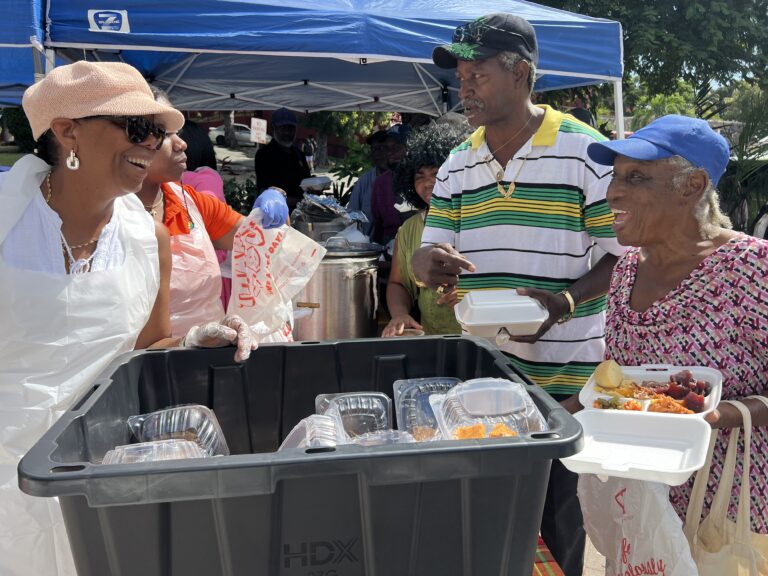
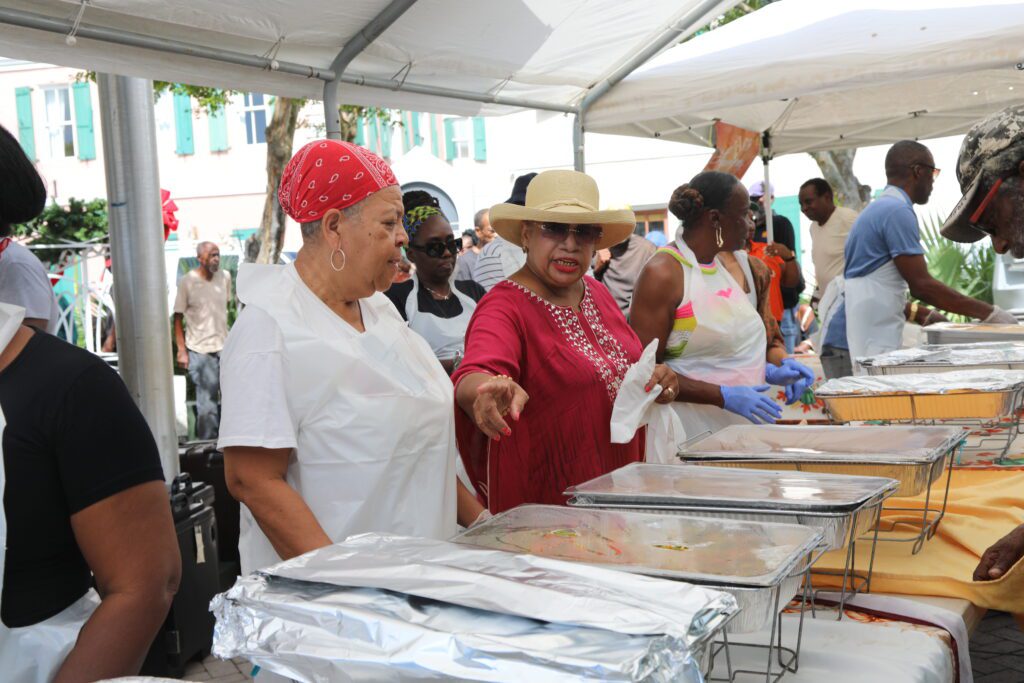
Francine Penn-Scipio (middle) works with volunteers to set up on Thursday. (Source photo by Ananta Pancham)
Emancipation Garden was already busy by midmorning Thursday, but as the sun climbed higher, the familiar rhythm of the Penn-Scipio Thanksgiving Luncheon took hold. Volunteers in aprons moved between tables, pots and warmers were lifted into place, and longtime supporters greeted one another with the ease of family. Nearly 30 years in, the event has become a touchstone of the holiday on St. Thomas — but this year, the atmosphere carried a different weight.
Organized by Francine Penn-Scipio, the luncheon has always been about feeding the community in body and spirit. But with SNAP benefit reductions, rising grocery prices, and a surge in similar holiday events across the island, Penn-Scipio wondered whether attendance — or support — might shift. It didn’t.
“The need is there,” she said plainly, stepping away from the serving line for a brief moment. “I was a little concerned because so many people are doing it, and I thought maybe the turnout would be less. But it doesn’t seem that way. People like to come here. I’m happy for them, and I try to make them happy as long as I can.”
Even more striking: at a time when many households are stretched thin, donors reached deeper.
“In times like these, you think people might give less,” Penn-Scipio said. “But nobody who always gave said no. Some gave a little more. Others gave what they could. I’m grateful for my people.”
Her son, Kellen Phillips, echoed the surprise. “Even with the cost of living going up, people donated more,” he said. “I think the community recognizes it’s not about them — it’s about what you can do for others.”
This year, Phillips estimated that roughly 400 meals were prepared, with 27 to 30 volunteers and close to 20 donors, from individuals who contributed a can of vegetables to those who offered checks of $500 or more.
The tradition began decades ago with Penn-Scipio’s late husband, Clarence Scipio, whose vision of fellowship and faith shaped the earliest gatherings. Over the years, it has grown with the support of longtime sponsors such as CC1, the Barbel family, Caribbean Foods, and I. Levin — names that have stood behind the luncheon even as it outgrew church halls and small kitchens and found its home in Emancipation Garden.
But at the heart of the effort is a single donor who helped make the event possible for decades: the late Leo Barbel, who once told Penn-Scipio, “This is a ministry you’re doing.” Before his passing, he promised that support would continue — a promise kept faithfully by his niece, who still delivers a check every year.
“He told me, ‘When I’m gone, they’re going to carry on,’” Penn-Scipio said. “And they have.”
Other supporters, including Hugo Hodge Jr., CC1, Caribbean Foods, and I. Levin, along with a growing roster of individual donors, continue to show up in ways large and small. “Some people give soup, some give a check, some do vegetables — whatever they can, they do,” she added.
The volunteers are just as varied. Newcomer Lindsay Shauss, development director at VI Help at the St. Thomas East End Medical Center, joined Thursday for the first time after being invited by Diane Morales — Penn-Scipio’s daughter. “I’ve lived on island for two years,” Shauss said. “It felt good to give back today, to be part of something bigger.”
Meanwhile, longtime volunteer and Charlotte Amalie High School counselor Lorna Daniel has spent a decade helping at the luncheon, originally invited by her former seventh-grade student, Penn-Scipio’s granddaughter, hospitality teacher Alliyah Dessout. “The joy on people’s faces keeps me coming back,” Daniel said. “You see them, and you just want to keep showing up.”
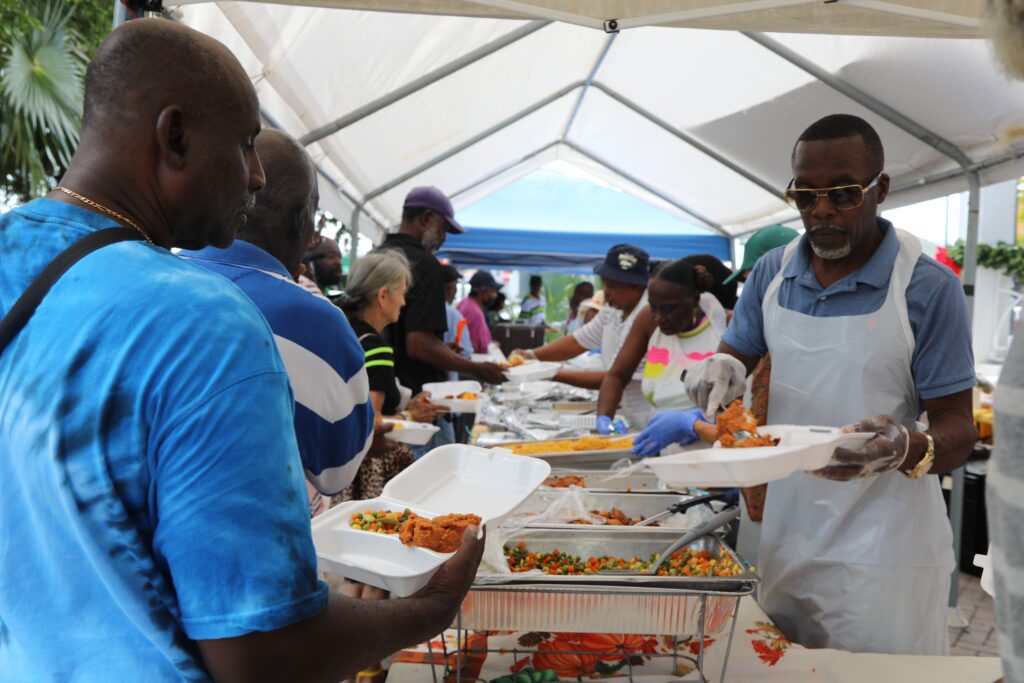
As he does most years, Sen. Marvin Blyden headed up the serving line, greeting guests with veggies and stuffing. (Source photo by Ananta Pancham)
This year’s menu, as always, blended tradition and comfort: turkey, chicken, ham, baked dishes, saltfish and soups prepared by close friends and supporters. Penn-Scipio used to cook much of the food herself, but as the luncheon grew, she turned to trusted hands to help with the volume — “once in a while, I still make my stuffing,” she said with a smile, “but not this year.”
The operation moved in four steady shifts, serving walk-ups, seniors, and those who passed through between other holiday gatherings. And as always, the luncheon fed those who needed the warmth of community just as much as the meal itself.
“We live a life of service and gratitude,” Phillips said. “A lot of people don’t have family anymore. They don’t cook because they’ve lost loved ones. Here, they can come get a meal, laugh with us, even cry with us if they need to. That’s okay. We’re here.”
As in years past, the luncheon drew cruise visitors, local families, and the seniors from Ebenezer Gardens, whom Penn-Scipio makes sure can get there safely. And even with the backdrop of rising costs and deeper need this year, the spirit of the event held steady: a table open to all.
As the line thinned and the volunteers gathered for their final tasks, Penn-Scipio looked out over the garden where she has spent so many Thanksgiving mornings.
“I’m grateful,” she said. “Grateful that people still come, grateful that people still give, and grateful that we can keep doing this.”
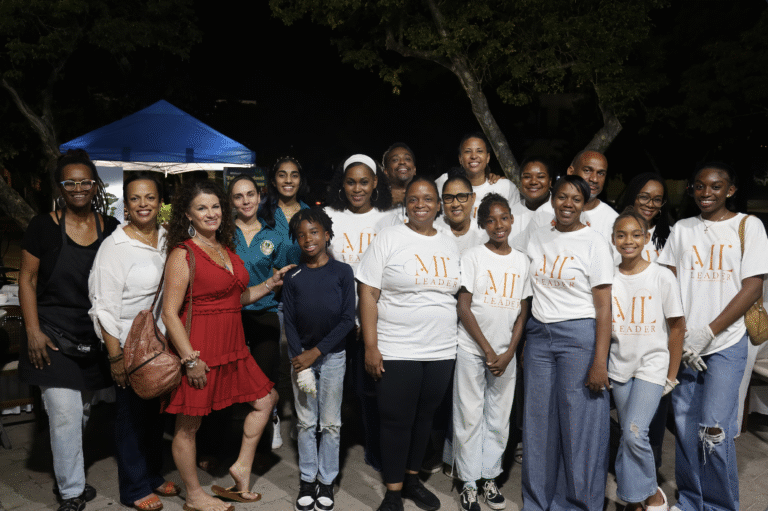
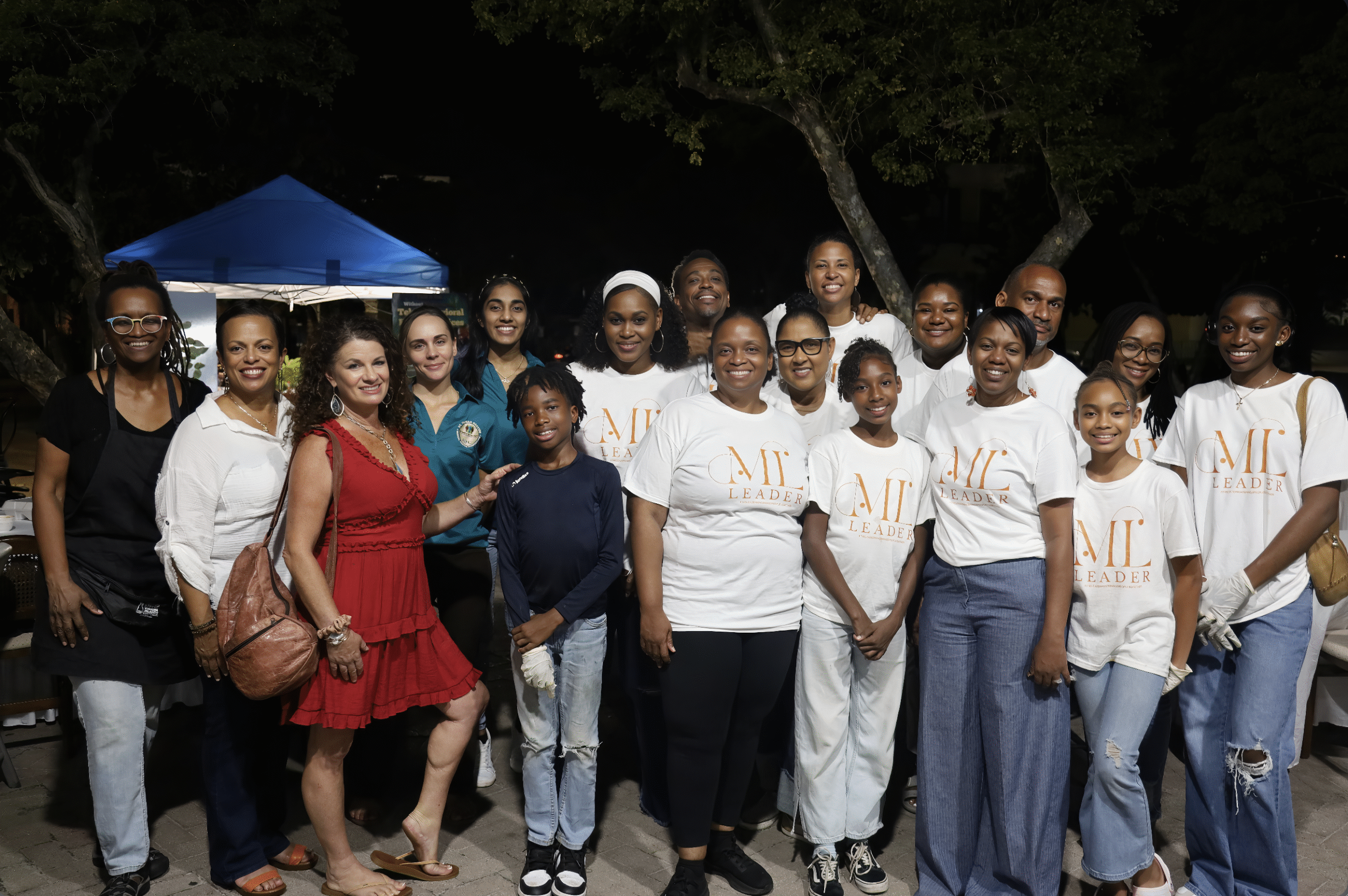
Community volunteers and attendees gather at Emancipation Garden on Wednesday night for the inaugural Thanksgiving Community Dinner hosted by May Leader and Friends. (Photo courtesy Creative Marketing Center)
What started as a simple idea — a shared meal in the heart of town — unfolded Wednesday night into something far larger, as nearly 200 Virgin Islanders gathered at Emancipation Garden for the inaugural Thanksgiving Community Dinner hosted by May Leader and Friends.
For three hours, the park became a shared table, a crossroads of stories, and a rare moment where neighbors from every corner of St. Thomas came together with no agenda beyond food, fellowship, and gratitude.
The evening began quietly, with prayers and reflections from community voices who set a tone of warmth and welcome. Those early moments felt like the start of something intimate, but as the crowd grew — elders arriving with friends, young families settling onto benches, familiar faces from nonprofits and local agencies mingling with those who simply needed a hot meal — the heart of the gathering revealed itself.
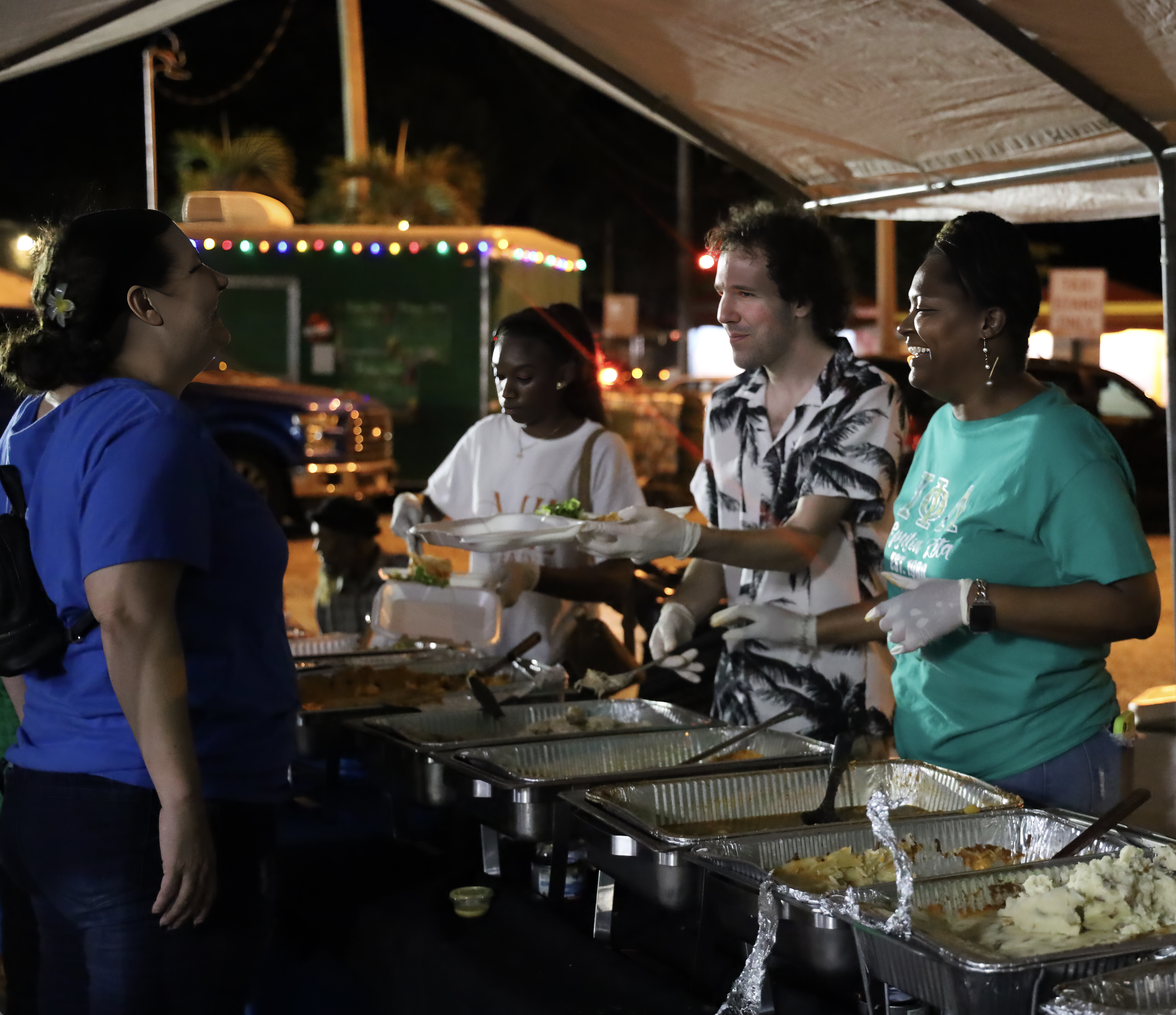
Local chefs, meanwhile, took the lead on the feast: Chef Benji of Blue 11 and Indigo 4, 11-year-old Chef Alexandre of the BVI, and Barefoot Buddha’s Chef Cory. Together, they shaped a menu that pulled from both tradition and place — Thanksgiving staples layered with Caribbean flavors that felt rooted in home. By the time the trays came out and the serving line opened, the atmosphere had shifted entirely. Long conversations formed in the line, laughter carried from table to table, and the park filled with the smell of herbs, roasted vegetables, and every imaginable dessert. Truckloads of donated food and beverages ensured that no one went without; each person left with a full plate and a sense of satisfaction that went well beyond the meal.
Volunteers serve hot meals to guests during the Thanksgiving Community Dinner at Emancipation Garden on Wednesday night. (Photo courtesy Creative Marketing Center)
Music from The Eljhaie Braithwaite Project & Friends threaded through the night — jazz that softened the edges of the park and turned it into something that felt like a neighborhood block party. Between songs, vendors and local organizations moved through the crowd, sharing resources, checking in, and reconnecting.
It was during those moments that May Leader, founder of May’s Kitchen, felt the heart of the gathering most clearly.
“I felt so happy and grateful looking around and seeing our entire community represented,” Leader said. “People experiencing homelessness shared a meal with government officials, and everyone belonged. That’s rare — and exactly what this gathering was created for.”
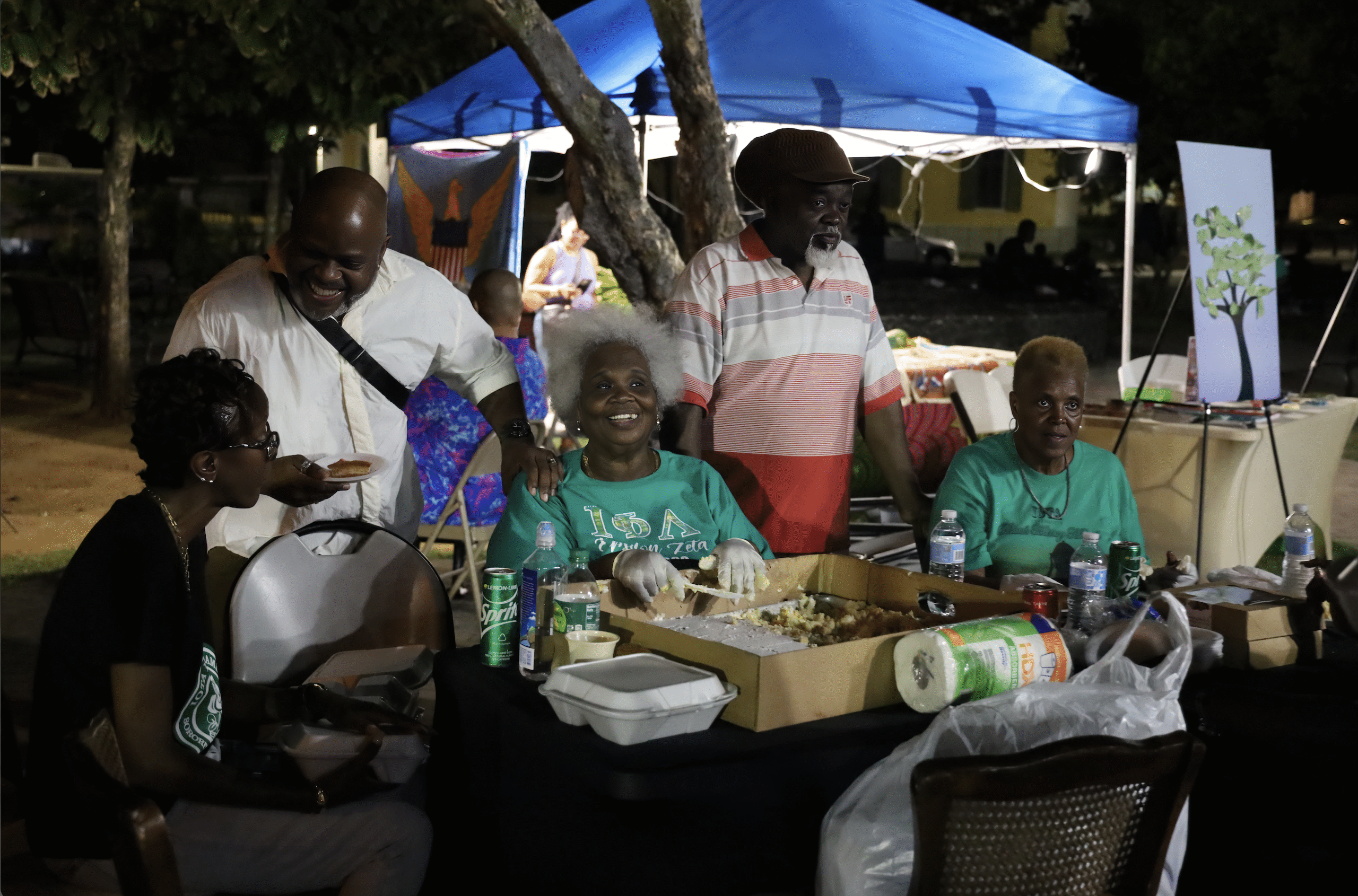
Members of the Epsilon Zeta chapter of Iota Phi Lambda Sorority, Inc. share food and fellowship during Wednesday’s Thanksgiving Community Dinner at Emancipation Garden. (Photo courtesy Creative Marketing Center)
The gratitude extended to the volunteers, whose work before, during, and long after the event made the gathering possible. “This wasn’t just about my vision for the community,” Leader said. “It showed the love and care we all have for one another. Without my amazing team, there is no way I could have accomplished this.” She also acknowledged WSTA, DJ Robbie, Lawrence Boschulte, 90.9FM, and AllAhWeTV for amplifying the effort and bringing people to the park who otherwise might never have heard about it.
The inaugural dinner drew support from Race Track, the Epsilon Zeta chapter of Iota Phi Lambda Sorority, Inc., Laurie’s Legacy, and dozens of other individuals and organizations who contributed food, services, and hands-on help. For more, visit mayleadervi.org.
Abijah Antonio Javois was supposed to surrender to Florida police Nov. 11. (shutterstock image)
Federal officials at Cyril E. King airport spotted a St. Croix man wanted for attempted murder in Florida Monday.
Abijah Antonio Javois, 21, allegedly shot at people sitting in a car in Orange County, Florida, on Nov. 10, according to the sheriff’s department. A warrant was issued three days later.
Port Authority officials arrested Javois around 4:30 p.m. and were holding him before potential extradition to Florida, where he is facing attempted murder, aggravated battery with a firearm, and shooting into an occupied vehicle charges.
After an initial arrest Nov. 10, Javois was supposed to surrender to police the next day, according to court records.
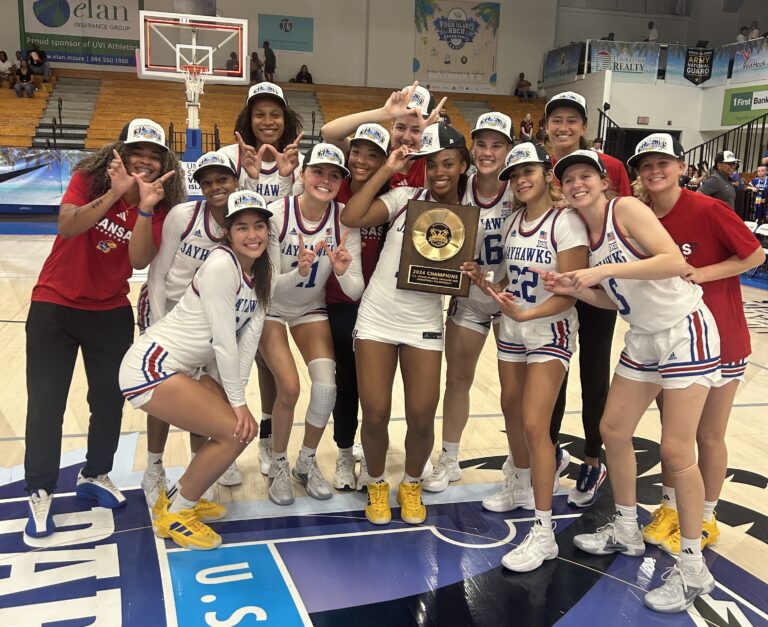
Florida State: Winner of the Paradise Jam 2024 Reef Division. (Source photo by Mark J Daniel)
The Women’s Divisions of the 2026 Basketball Travelers will tip off Thursday, with four games at the University of the Virgin Islands Elridge Blake Sports and Fitness Center. The women’s tournament has expanded to twelve teams competing in three divisions. Each team will play two matches over the three-day event.
Here is a snapshot of all twelve participating teams.
Harbor Division
The Elon University Phoenix is coming off an average 2024-2025 campaign, having won just as many games as they lost, 15. The Phoenix competes in the Coastal Athletic Association and their head coach is Charlotte Smith. Key players to watch are sophomore forward LaNae Corbett, graduate student forward Quinzia Fullmore, and freshman Ashanti Fox.
The Tulane University Green Wave is coming into this tournament with a 2-3 record early in the 2025-2026 season. This team, based in New Orleans, Louisiana, plays in the American Athletic Conference. Ashley Langford is entering her second year as head coach and is looking to improve on last year’s 17-13 season. Kanjia Daniel, Amira Mabry, and Kendell Sneed will be the key players for the Green Wave.
The University of North Dakota Fighting Hawks have not found their stride this young season, nursing a 1-5 record. The Summit League team is coming off a 12-19 2024-2025 season. Coach Dennis Hutter, entering his first full season, is looking to find a way to help this Fighting Hawks soar. He has experienced players to get the job done in the senior center, Walker Demers, graduate student forward, Ava Miller, and graduate student Mackenzie Hughes.
The Boise State University Broncos are the favorite in this division, led by seasoned head coach Gordy Presnell, who has over 20 years of experience. Three key players, all going into their senior year of school, Tatum Thompson, Natalie Pasco, and Dani Bayes, will look to improve on their 5-1 2025-2026 record.
Harbor Division Schedule – Thursday
Elon vs Tulane – 1:30 p.m.
North Dakota vs. Boise State – 4 p.m.
Island Division
The Brigham Young University Cougars play in the Big 12 Conference. This Utah team has played six games this year and has won all six games. The Cougars are seeking to continue their winning ways behind sophomore Guard, Delaney Gibb, freshman forward, Olivia Hamlin, and senior forward, Lara Rohkohi. Head Coach Lee Cummard is seeking to improve on their sub-500 record from last season.
The Hokies of Virginia Tech University have also found much success early in this season, boasting a 5-1 record. This ACC team out of Blacksburg, Virginia, is poised to give the Broncos their first loss of the season. Head Coach Megan Duffy will look to junior guard Carleigh Wanzel and senior forward Kilah Freelon to provide the leadership needed to be successful in this event.
The Oregon State Beavers are hoping to do much better than their male counterparts, who played three games in the men’s 2025 Paradise Jam and lost all of them. Head Coach Scott Rueck will utilize Tiara Bolden, Lara Alonzo-Basurto, Jenna Villa, and Kennedie Shuler to help his team build on its impressive 5-1 start to the season.
The Vanderbilt University Commodores from Nashville, Tennessee, have been perfect this season, sporting a 6-0 record. Mikayla Blakes, Sacha Washington, and Aubrey Galvan have provided leadership on the court. Head Coach Shea Ralph has provided solid leadership. Vanderbilt competes in the tough SEC Conference.
Island Division Schedule – Thursday
BYU vs Virginia Tech – 6:30 p.m.
Oregon State vs Vanderbilt – 9 p.m.
Kansas University: Winner of Paradise Jam 2024 Island Division. (Source photo by Mark J Daniel)Reef Division
The Red Hawks of Miami of Ohio University from Oxford, Ohio, come to the Paradise Jam with a 4-2 record. Glenn Box took his team to the Women’s National Invitational Tournament last year. The Red Hawks would like to get the NCAA Women’s Tournament this year. The players to watch for are Amber Scalia, Amber Tretter, and Tamar Singer.
Washington State University is off to a slow start with a 0-6 record thus far this year. The Cougars lost in the second round of the WNIT tournament last year and are working hard to get into the win column for the 2025-2026 season. Kamie Ethridge is the head coach of the Cougars. Eleonora Villa, Malia Ruud, and Charlotte Abraham are the players of interest on this Washington State roster.
Marist University Red Foxes compete in the MAAC Conference. Their record is 2-4 coming into this event. Freshman guard Justine Henry, junior forward Karly Fischer, and sophomore guard Danielle Williamssen control the action on the court. Erin Doughty leads the Foxes from the sidelines.
Flauj’ae Johnson, senior guard from Louisiana State University, is on St. Thomas. Johnson is one of the most popular collegiate female athletes in the NCAA. MiLaysia Fulwiley, Mikayalh Williams, and Zakiyah Johnson have helped LSU remain undefeated for the 2025-2026 season. Head Coach Kim Mulkey has her team focused and ready to make another run to the women’s final four. The Tigers play in the SEC Conference.
Reef Division Schedule – Friday
Miami vs Washington State – 6:30 p.m.
Marist vs LSU – 9 p.m.
In his biweekly column, Langley Shazor speaks to issues important to men within the territory.
From the time boys become men, there is an invisible clock that starts ticking. It counts down to the moment when value will be measured not by character or conviction, but by what sits in a bank account. The message is clear: a man without money is a man without meaning. The myth is reinforced in every culture, every generation, and every space where success is confused with self-worth. We praise the provider but rarely question the price he pays to be seen as one.
This belief that a man’s worth is tied to his wallet has shaped more lives than we realize. It is why some men live in quiet frustration, chasing achievements that bring no peace. It is why others fear love, fearing that affection is just charity in disguise. And it is why, even when some men earn more than they imagined possible, they still wake up feeling like they are falling behind. When worth becomes currency, no amount ever feels like enough.
There is a difference between providing and proving. Providing is a calling; proving is a cage. Many men confuse the two because we were raised to believe that our ability to provide was the ultimate test of manhood. We watched our fathers and uncles equate exhaustion with honor. We saw them wear struggle like a medal, never knowing that survival had become their only language. They built worlds on tired backs and proud silence, but rarely did anyone ask if they were happy. The next generation inherited that blueprint without realizing it was never meant to last forever.
Money, by itself, is not the villain. The problem is the weight we give it. Financial stability matters. It brings security, opportunity, and freedom. But when a man begins to see his income as proof of his identity, he lives in a constant state of performance. Every raise becomes validation. Every setback feels like shame. When we see worth as something to be earned instead of something we already possess, we begin to live like tenants in our own lives, constantly trying to make rent on respect.
The world often rewards performance more than purpose, and men get caught in that current. We hustle harder, sleep less, and convince ourselves that the grind is noble. But what happens when the job ends, when the company downsizes, or when the dream does not unfold the way we planned? Too often, men fall into quiet crisis, unsure who they are without the role or title that once defined them. We confuse our contribution with our existence. We begin to believe that if we are not producing, we are not valuable. That is not just a myth; it is a wound.
We need to separate achievement from identity. A man’s work is an extension of his purpose, but it is not the proof of his personhood. Purpose comes from within; it is the compass that directs the work, not the work itself. When a man learns that truth, he can build and lead without fear that a bad month, a missed opportunity, or a slow season makes him less of a man.
The myth of the money-defined man has also distorted relationships. Too many men equate love with transaction. They believe presence can be replaced with provision, that gifts can stand in for attention, and that as long as the bills are paid, the home should feel whole. But homes are not healed by income; they are built by intention. Families want stability, yes, but they also want connection. Children remember laughter more than they remember labels. Partners remember kindness more than they remember purchases. When we reduce our worth to what we can buy, we forget that what truly sustains the people we love is not what we give them, but how we show up.
Men also need to understand that financial power without emotional maturity creates imbalance. Money can buy comfort, but it cannot buy peace. It can earn admiration, but not respect. It can open doors, but it cannot keep relationships from falling apart once you walk through them. Too many men chase wealth, hoping it will silence insecurity, but all it does is amplify it. When your sense of self depends on what you can accumulate, your confidence becomes conditional.
We live in a world that praises the provider but rarely celebrates the nurturer. It’s time to expand that definition. A man who listens, teaches, protects, encourages, and uplifts is providing. A man who gives time, patience, and presence is providing. A man who loves without condition and leads with humility is providing. Those forms of provision leave a legacy no economy can measure.
The truth is, a man’s worth is proven through intention. It is in how he treats people when no one is watching. It is in how he honors commitments when applause fades. It is in the consistency of his word, the courage to keep showing up, and the wisdom to know that his presence carries more power than his possessions ever could.
We need men who understand that provision is more than payment, it is participation. It is showing up for the people you love, not just showing off for them. It is leading your home with care and not control. It is choosing generosity without needing recognition.
When we release the pressure to prove, we make room to live. We stop performing and start being. We find peace in purpose instead of panic in production. The world does not need men who can simply earn; it needs men who can endure with grace, give with heart, and love without condition.
A man’s worth is not what he earns. It is what he builds, within himself, within his home, and within his community. Money comes and goes, but integrity endures.
When men finally learn to measure themselves by the strength of their spirit instead of the size of their wallet, the world will see a different kind of wealth. One that cannot be counted, only felt.
Editor’s Note: Opinion articles do not represent the views of the Virgin Islands Source newsroom and are the sole expressed opinion of the writer. Submissions can be made to visource@gmail.com.
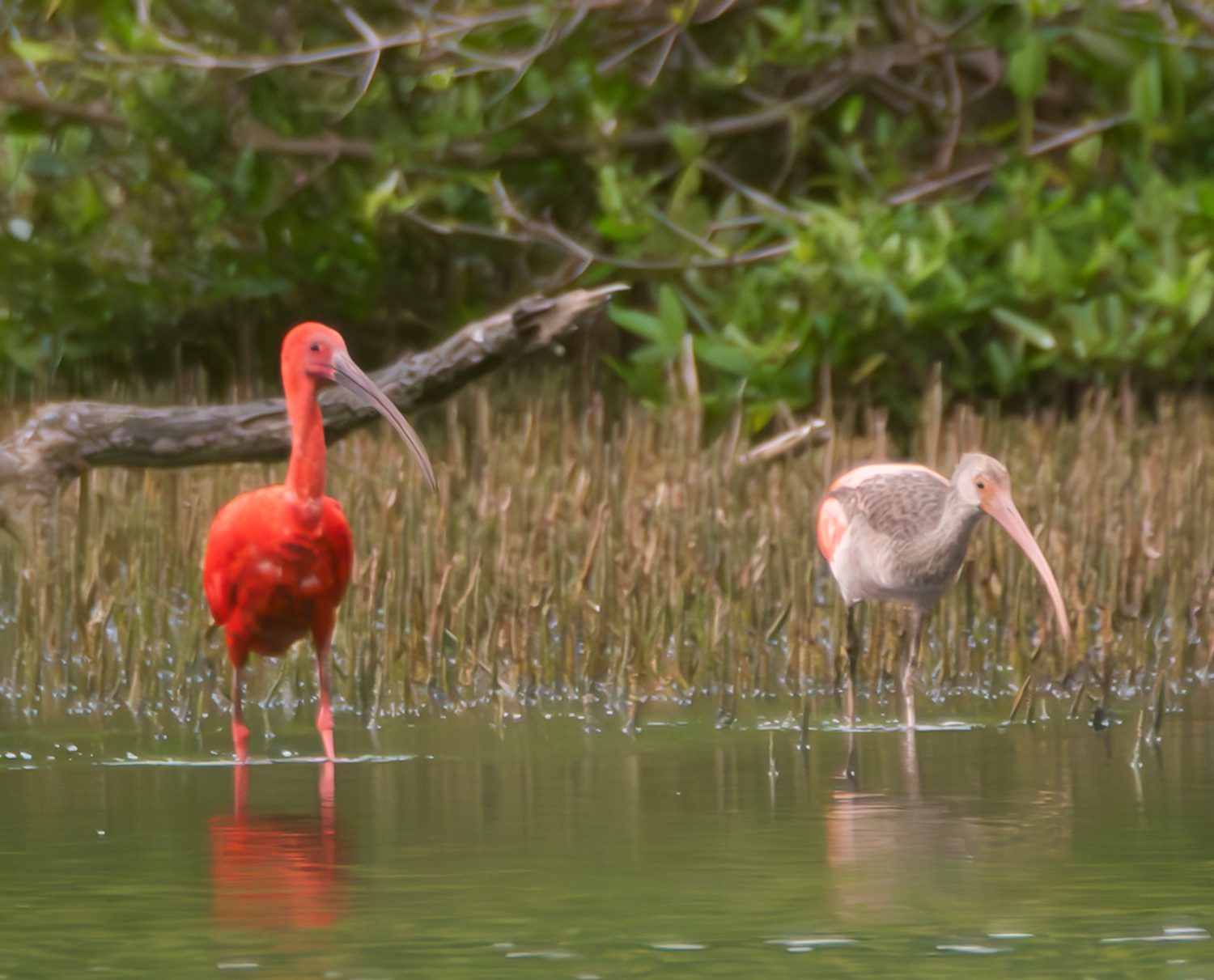
Scarlet ibis parents watch over their growing youngster. (Photo Gail Karlsson)
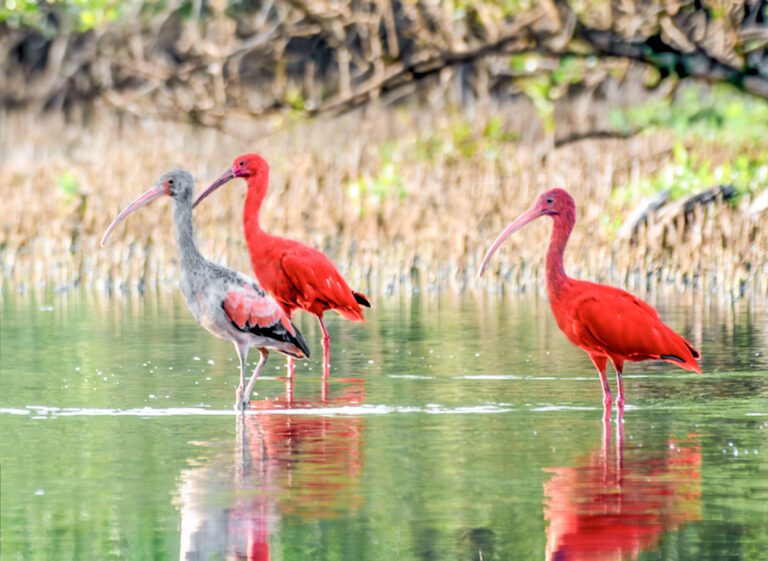
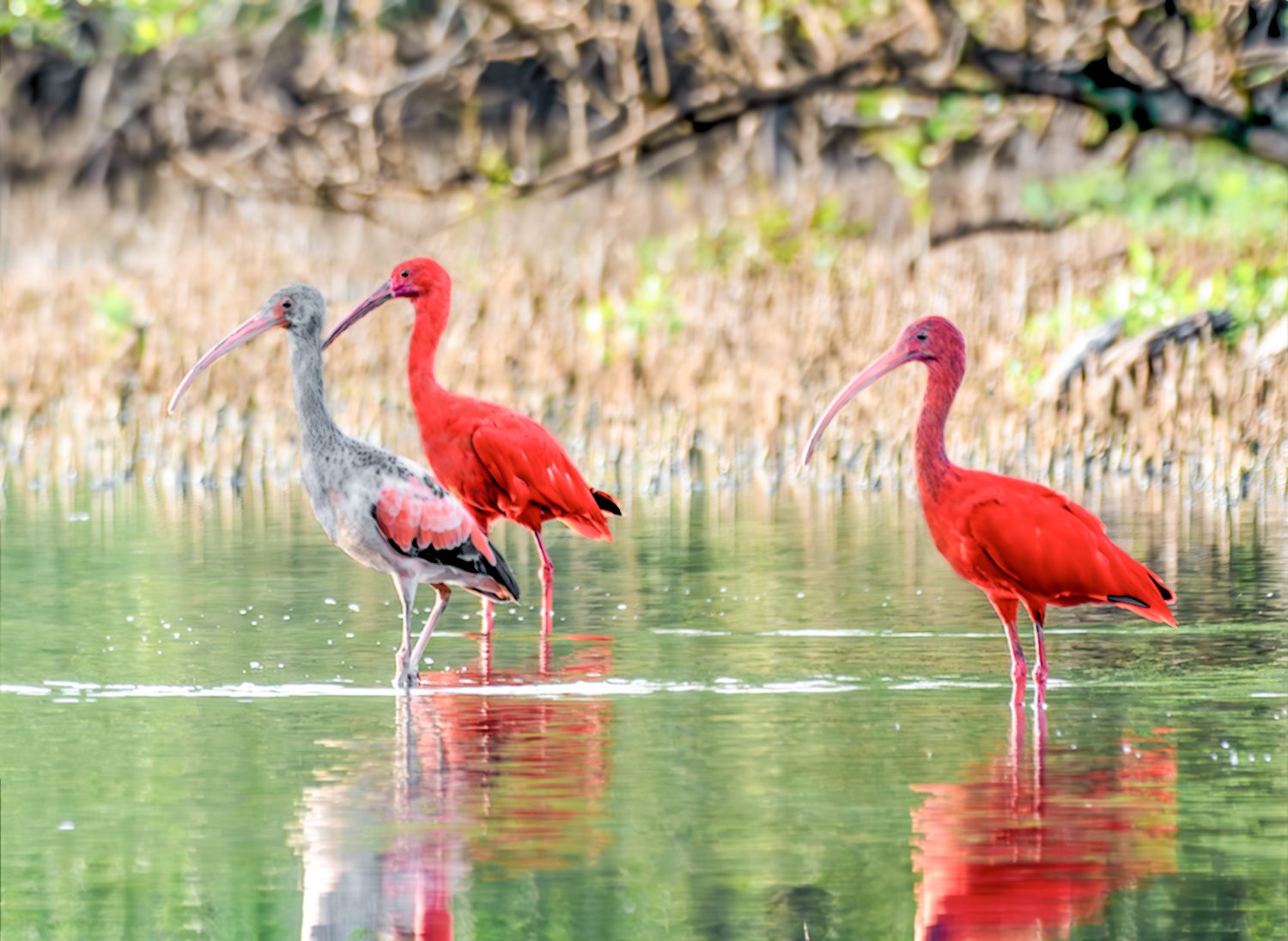
There’s a juvenile scarlet ibis that was born here! Now almost as big as its parents.
And there may be more wandering around. My neighbors recently saw three babies in the pond with the parents. But I have only seen one young one since I returned a few weeks ago. Maybe the others got mature enough to go off exploring on their own.
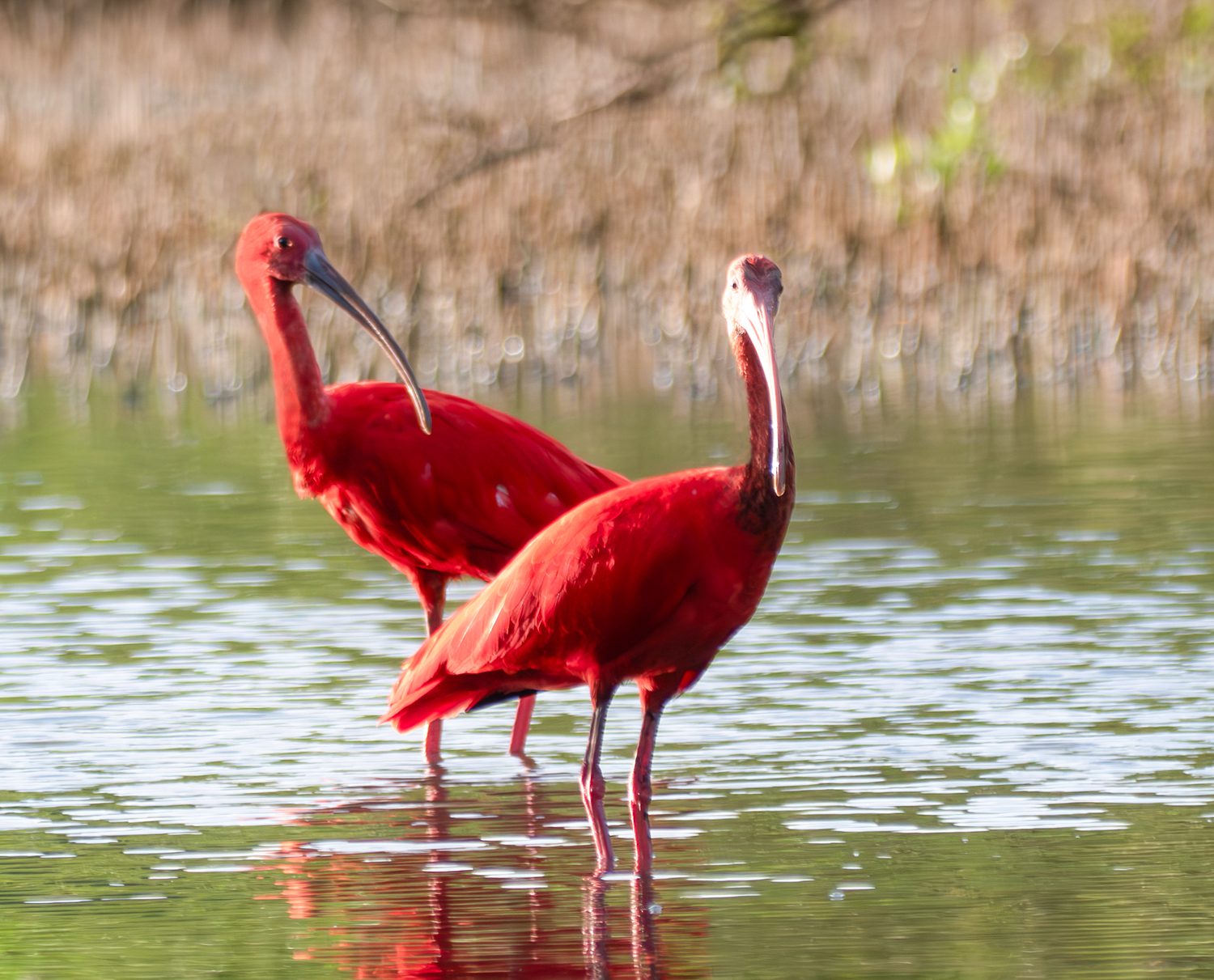
What a thrill to see these birds up close. For six seasons my husband and I watched the one lonely ibis in Fish Bay, hoping that an appropriate mate would come. Based on previous photographs, I think the bird on the left is the resident male. His feathers are now looking a bit uneven in color, but that is probably due to molting, which usually happens after breeding season.
How wonderful to have a mating pair of scarlet ibises on St. John. (Photo Gail Karlsson)
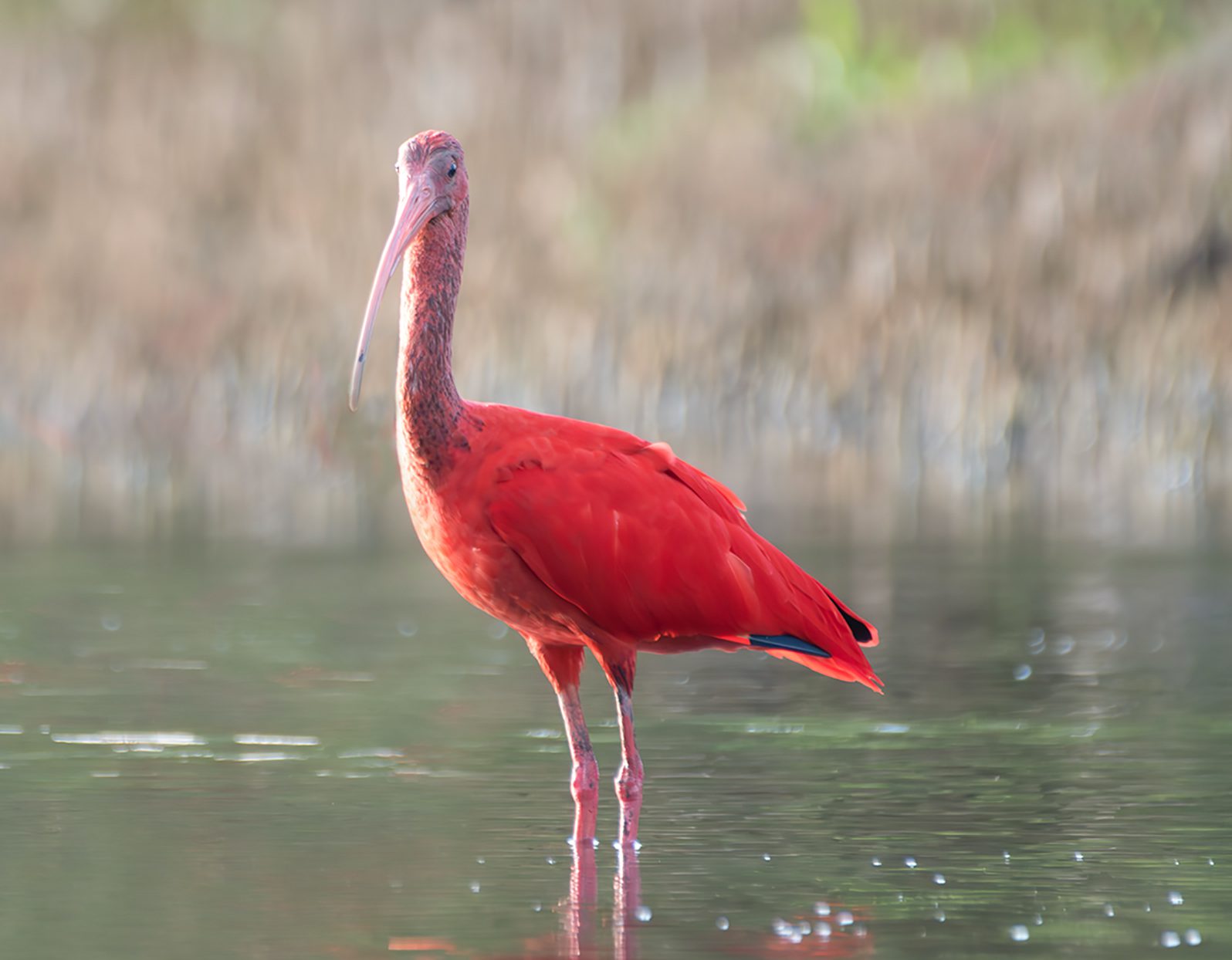
I think the newcomer is the female, and a younger bird because of her not-fully-developed purplish neck feathers. The male and female adults have similarly colored feathers, but they don’t reach their full adult plumage for a few years. Their color comes from carotenoid pigments contained in the food they consume, including small crabs, shrimps and other invertebrates, as well as some types of seeds and insects. They use their long bills, which have sensitive tips, to probe in the mud for food.
The new ibis has lighter colored neck feathers. (Photo Gail Karlsson)
I heard reports of other ibises coming over to Fish Bay the summer before this. (They have all probably come from the flock introduced by Richard Branson on Necker Island in the British Virgin Islands.) However, there was only one ibis in the pond when we returned last fall. And the resident ibis continued to consort with a snowy egret, which had become a faithful companion, year after year.
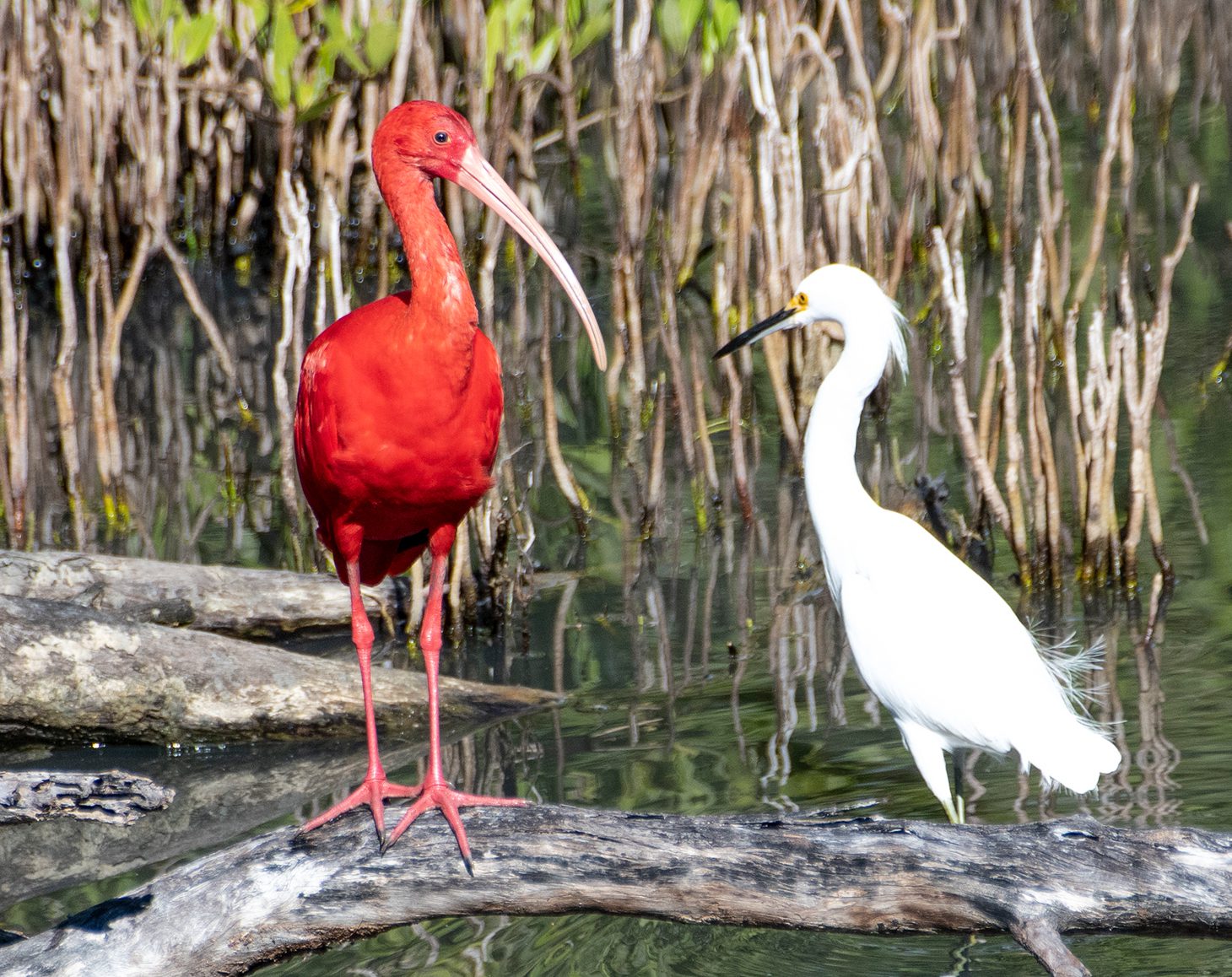
The resident scarlet ibis has had a long-term relationship with a snowy egret. (Photo Gail Karlsson)
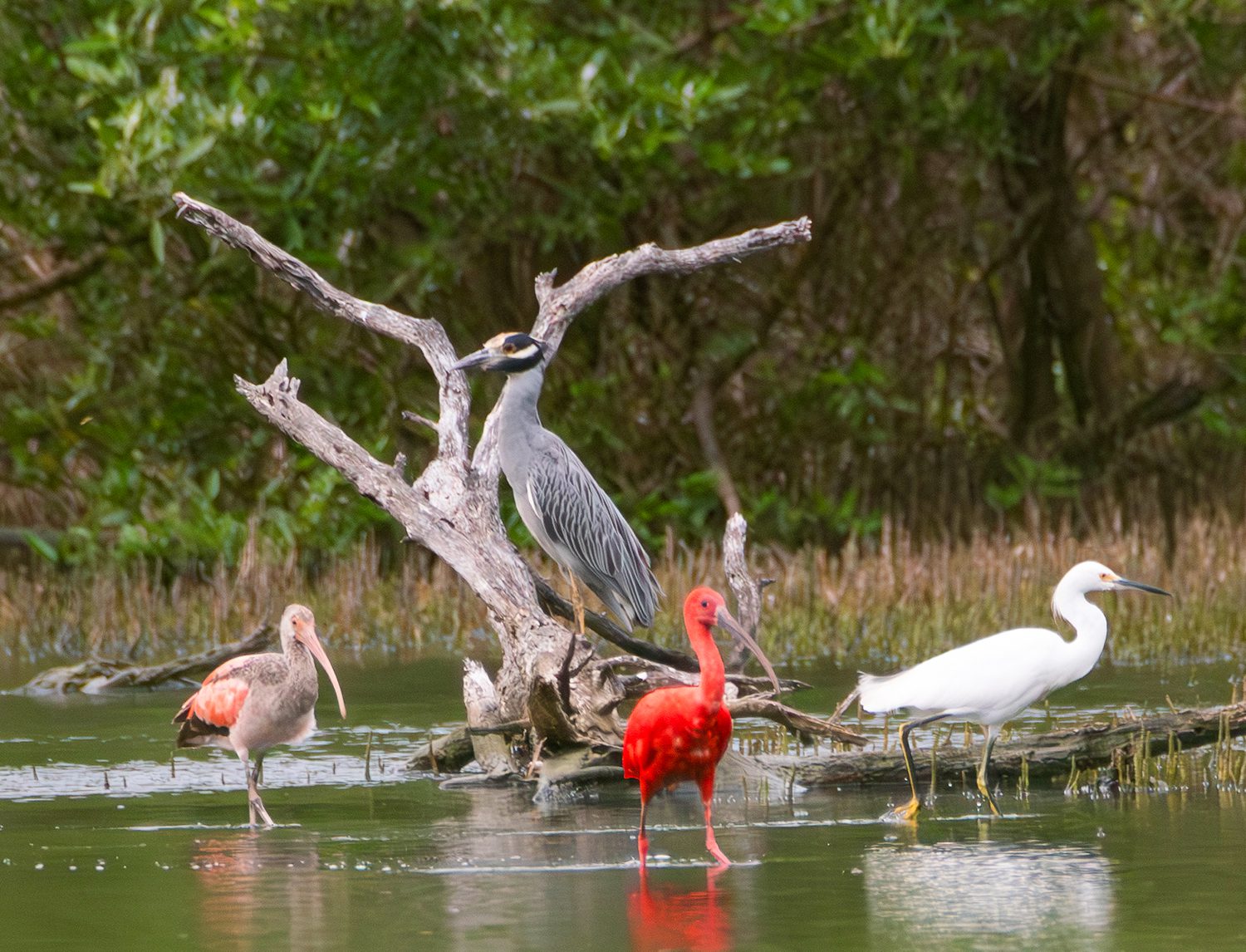
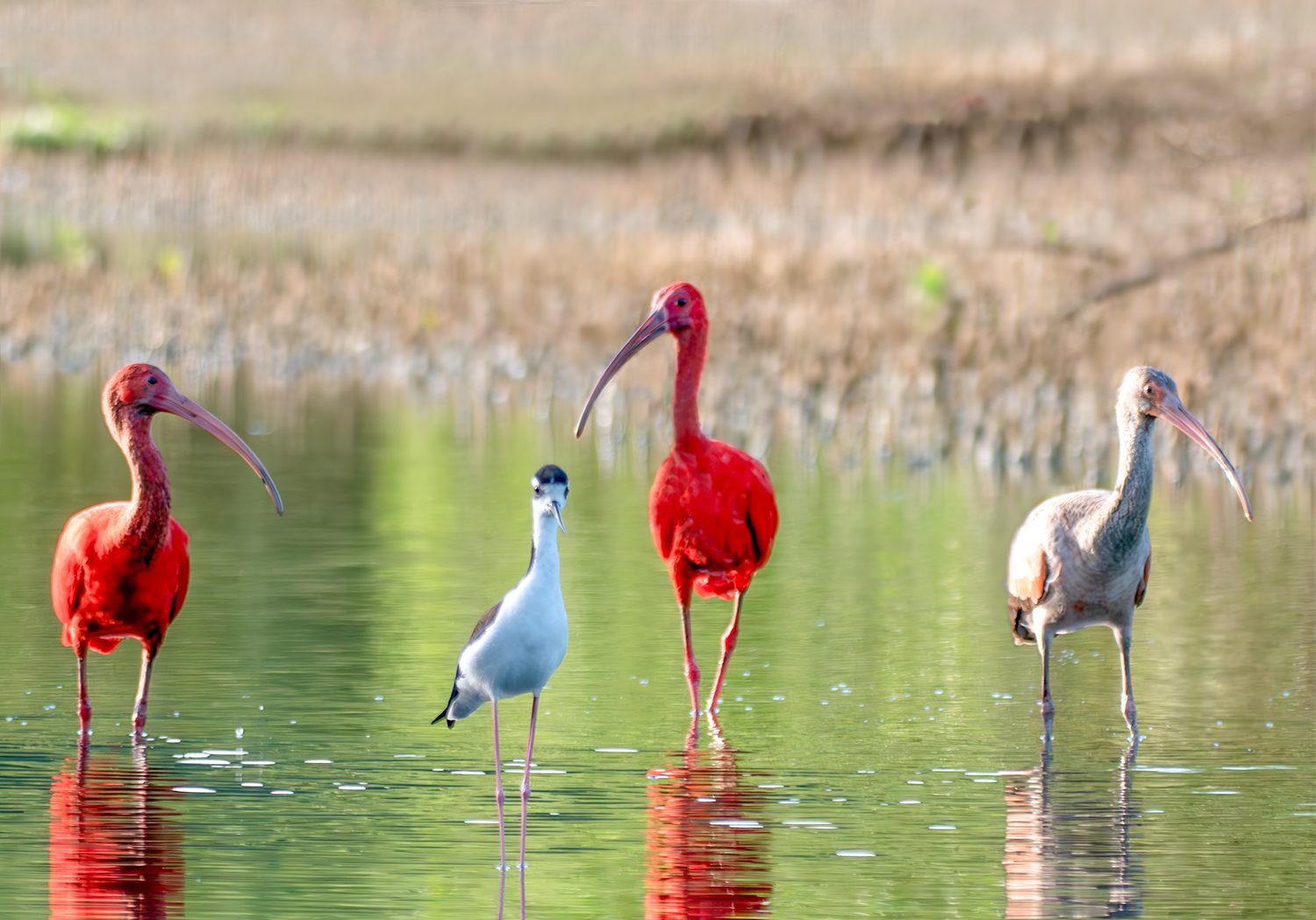
Interestingly, the snowy egret is still there, now apparently as a family friend. And sometimes a very large yellow-crowned night heron also seems to be standing guard.
These birds look like a group of superheroes of the wetlands. (Photo Gail Karlsson)
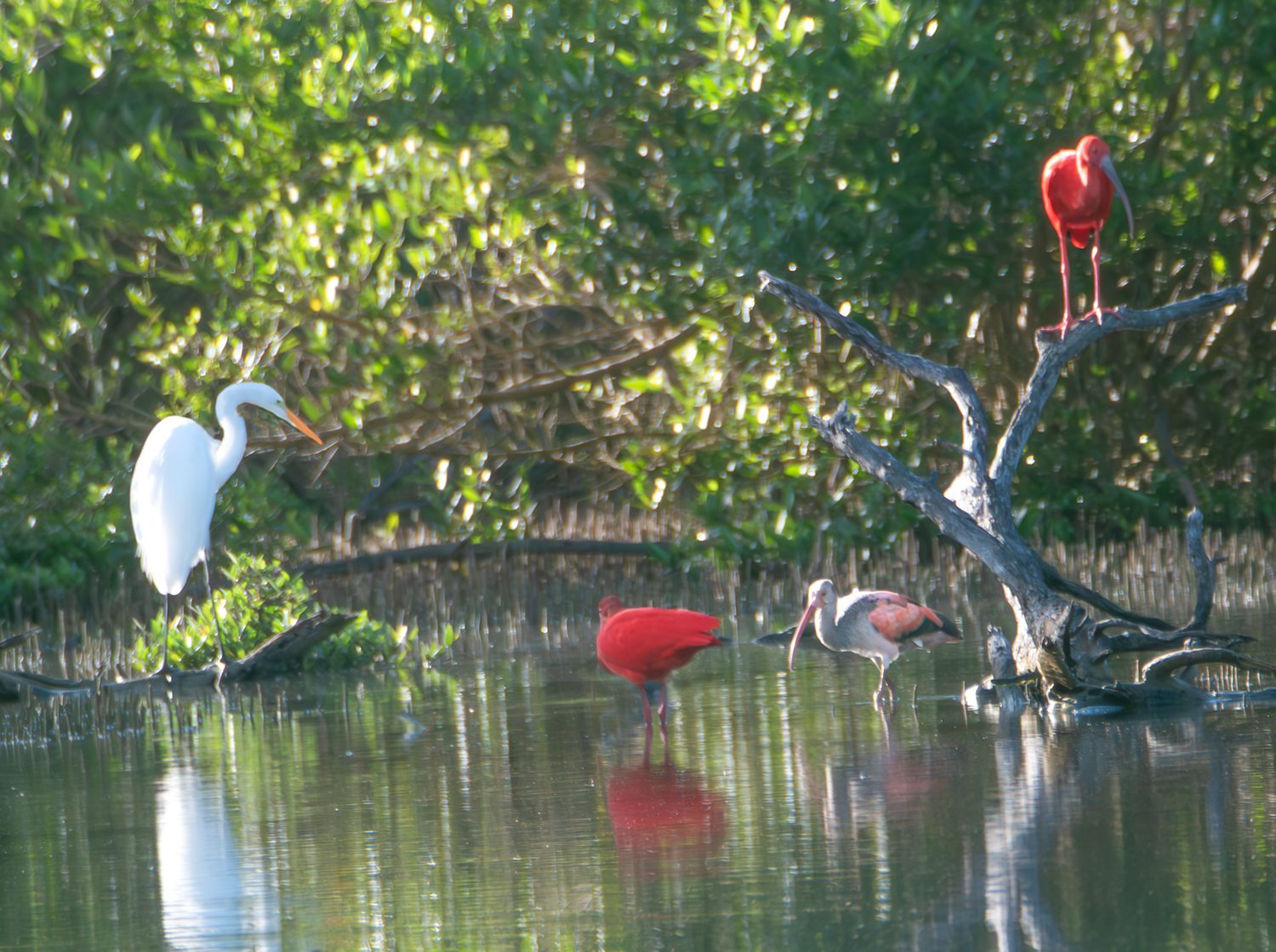
A great egret has also taken an interest in the youngster.
The great egret is much bigger than the snowy egret, and has a yellow bill. (Photo Gail Karlsson)
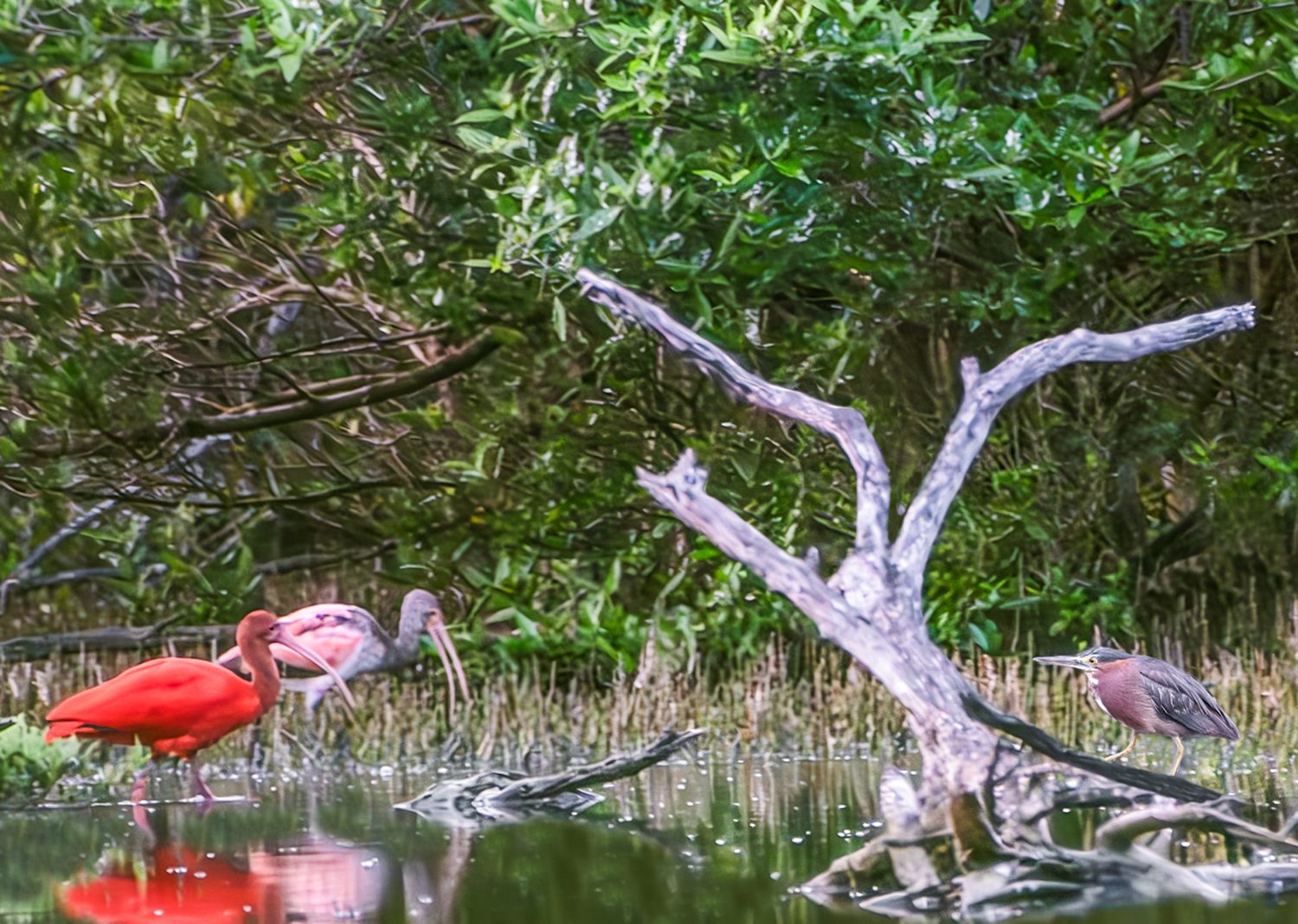
As well as a green heron that monitors all the activity on the pond.
Whenever I approach the pond a green heron starts making its warning clucking sounds. (Photo Gail Karlsson)
And a black-necked stilt insisted on being included in a family portrait.
At first I thought this stilt was another baby ibis. (Photo Gail Karlsson)
The trees along the road have grown up so much it is hard to see into the pond now. The birds tend to stay far back in a corner by the big tree stump. To get a view of them my husband and I had to crawl down off the side of the road and creep along through the bushes into the mangroves along the edge of the pond. Lots of rain has made the ground soft and muddy, and to my dismay, one morning I ended up sliding down into the slimy mud on my butt. Fortunately I was able to keep my telephoto lens safe, and later went back with dry pants.
We have mostly seen the ibises between 6:30 and 8:00 am. After that they usually disappear into the bush or fly off. However, there are many other birds using the pond throughout the day. Besides the ibises, egrets, stilts and green herons, we also saw little blue herons, lesser yellowlegs, spotted sandpipers and clapper rails.
Fish Bay pond birds clockwise from top left: little blue heron, lesser yellowlegs, clapper rail, spotted sandpiper (Photo Gail Karlsson)
We recently learned that the Fish Bay conservation land, which includes this pond, has been bought by the V.I. government with a grant from the National Oceanic and Atmospheric Administration (NOAA). It is to be held as a nature preserve by the V.I. Department of Planning and Natural Resources in a new Division of Territorial Parks and Protected Areas. The ownership of this area was in limbo for a number of years during which the land has been mostly untouched, except by the hurricanes.
It will be wonderful for this new nature preserve status to ensure long-term protection for all the wild birds and other creatures living in the wetlands here. It would also be good to provide a low impact viewing space that will allow people to observe what’s going on in the pond without disturbing the wildlife. The platform on St. John at Frank Bay built by the V.I. Audubon Society could be a good model.
The wetlands currently offer safe nesting spaces for a variety of birds. I was interested to see that both the scarlet ibis parents seemed to be taking care of the young one. I read that because of their long bills the newborn babies need help holding their heads up to get fed, so the feeding process requires two parents.
Ibises mostly probe in the mud for small crustaceans and insects. (Photo Gail Karlsson)
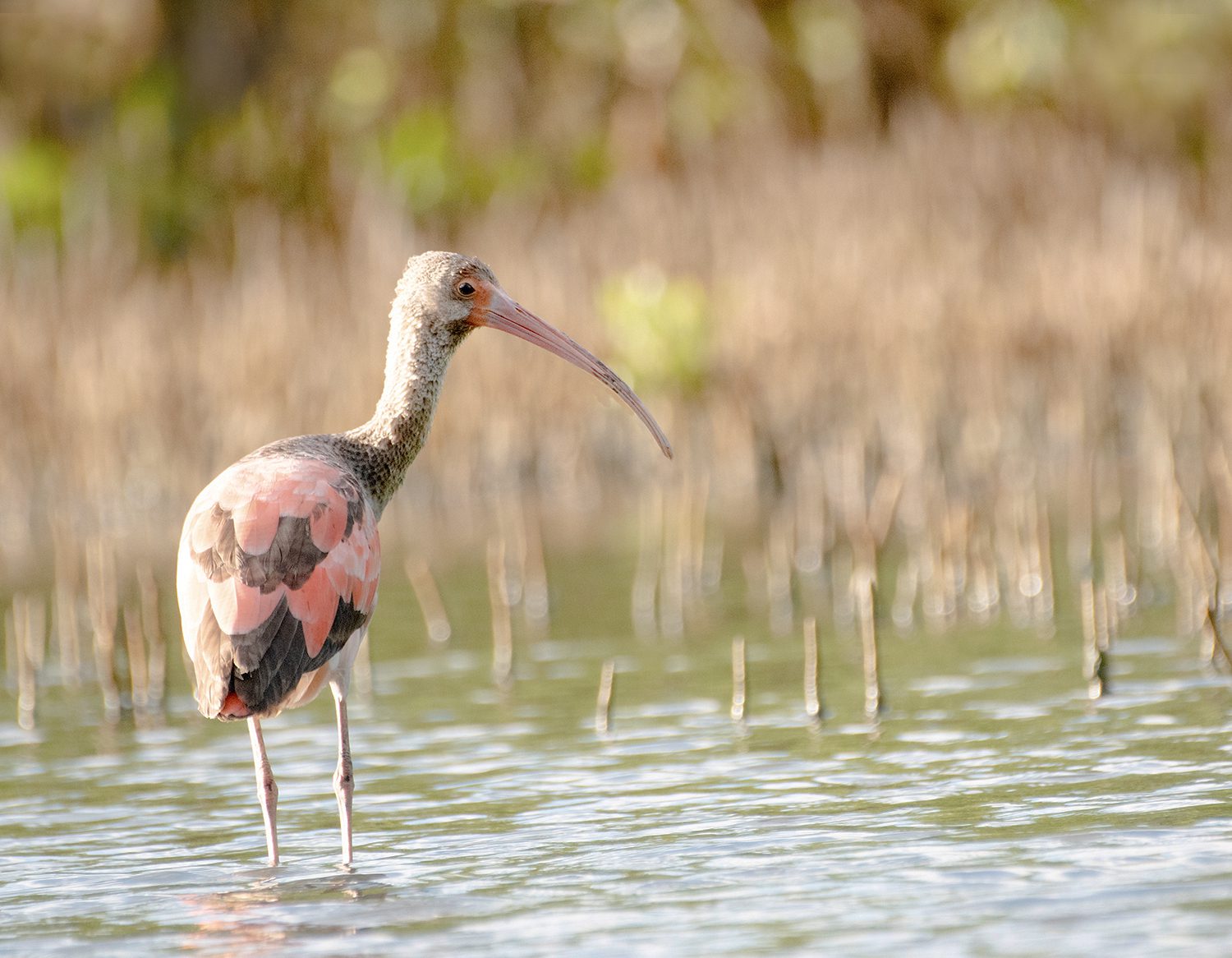
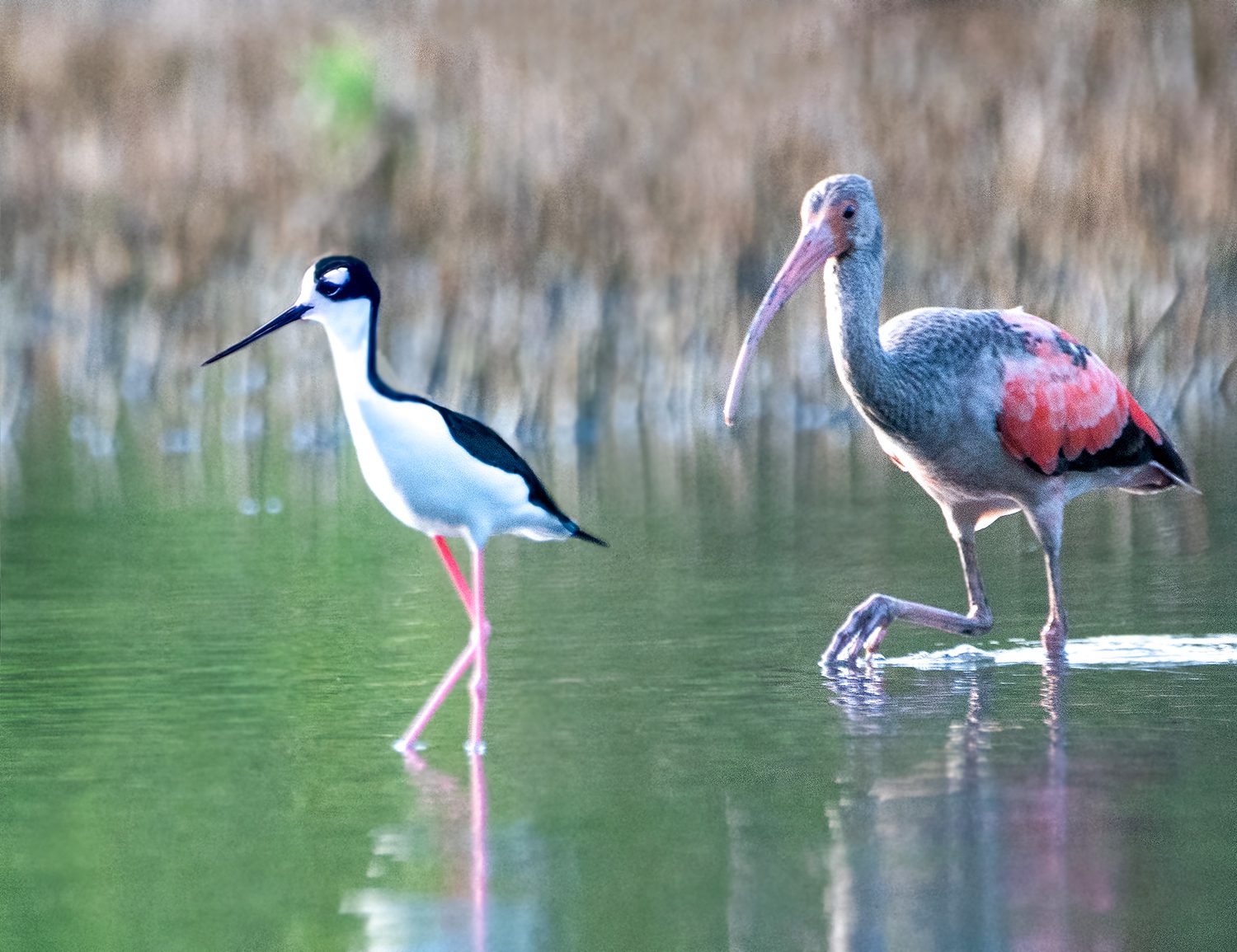
The baby scarlet ibises are grey. Then they soon start growing pink wing feathers, along with black feathers for their wing tips. My husband refers to this one as ‘splotchy’.
The young ibis looks like a made-up character from a Dr. Seuss children’s book. (Photo Gail Karlsson)
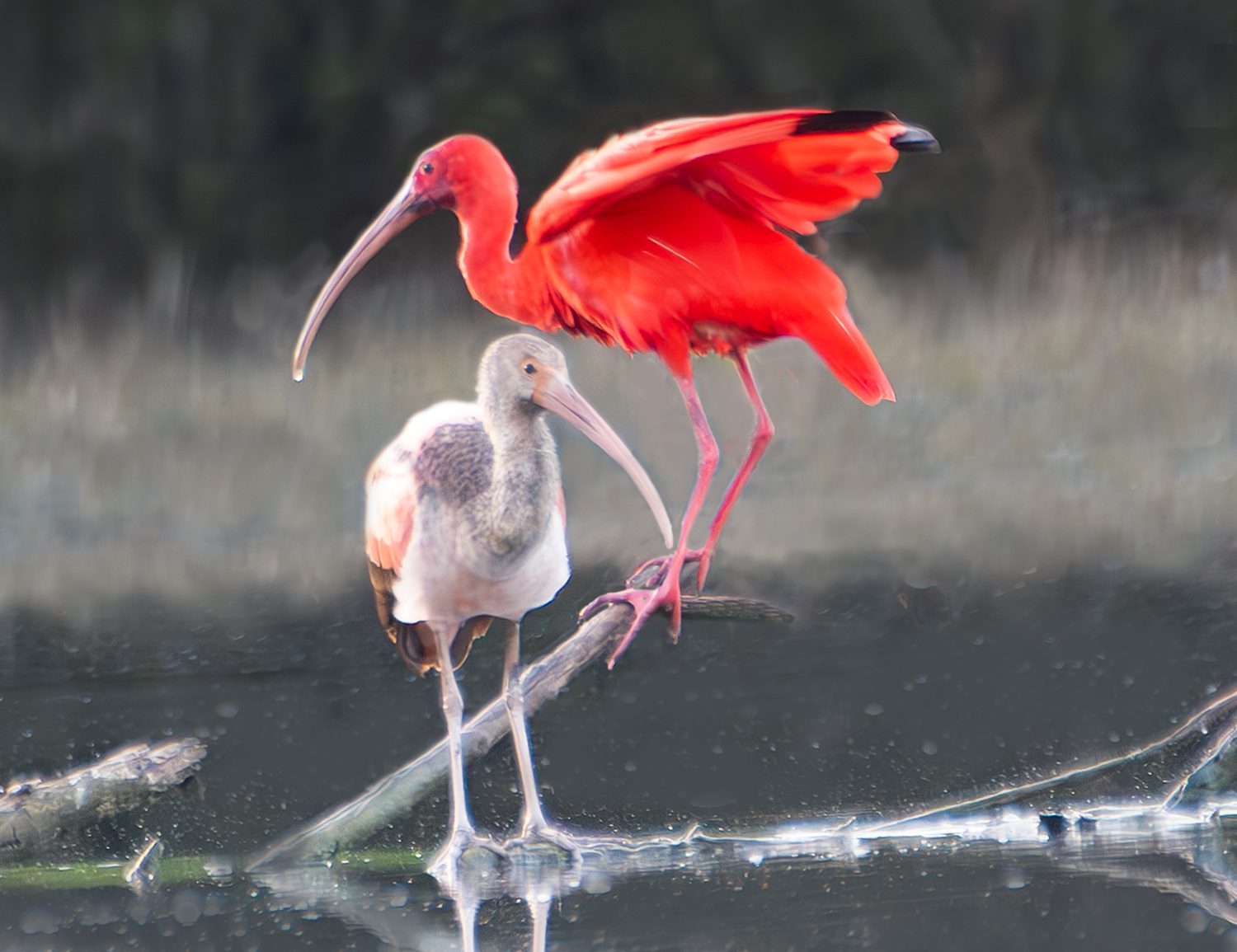
I do wish I knew for sure what happened to the other ibis youngsters. Possibly they wandered off after they got old enough to find their parents becoming overbearing.
It seems that a scarlet ibis can sometimes be a ‘helicopter’ parent. (Photo Gail Karlsson)
The young ibis occasionally keeps company with a chatty black-necked stilt instead of the parents.
Black-necked stilts are smaller than ibises but stand tall on their long pink legs. (Photo Gail Karlsson)
One day the scarlet ibis youngster may fly off to pursue its own adventures. But for now it is a welcome addition to the Fish Bay neighborhood.
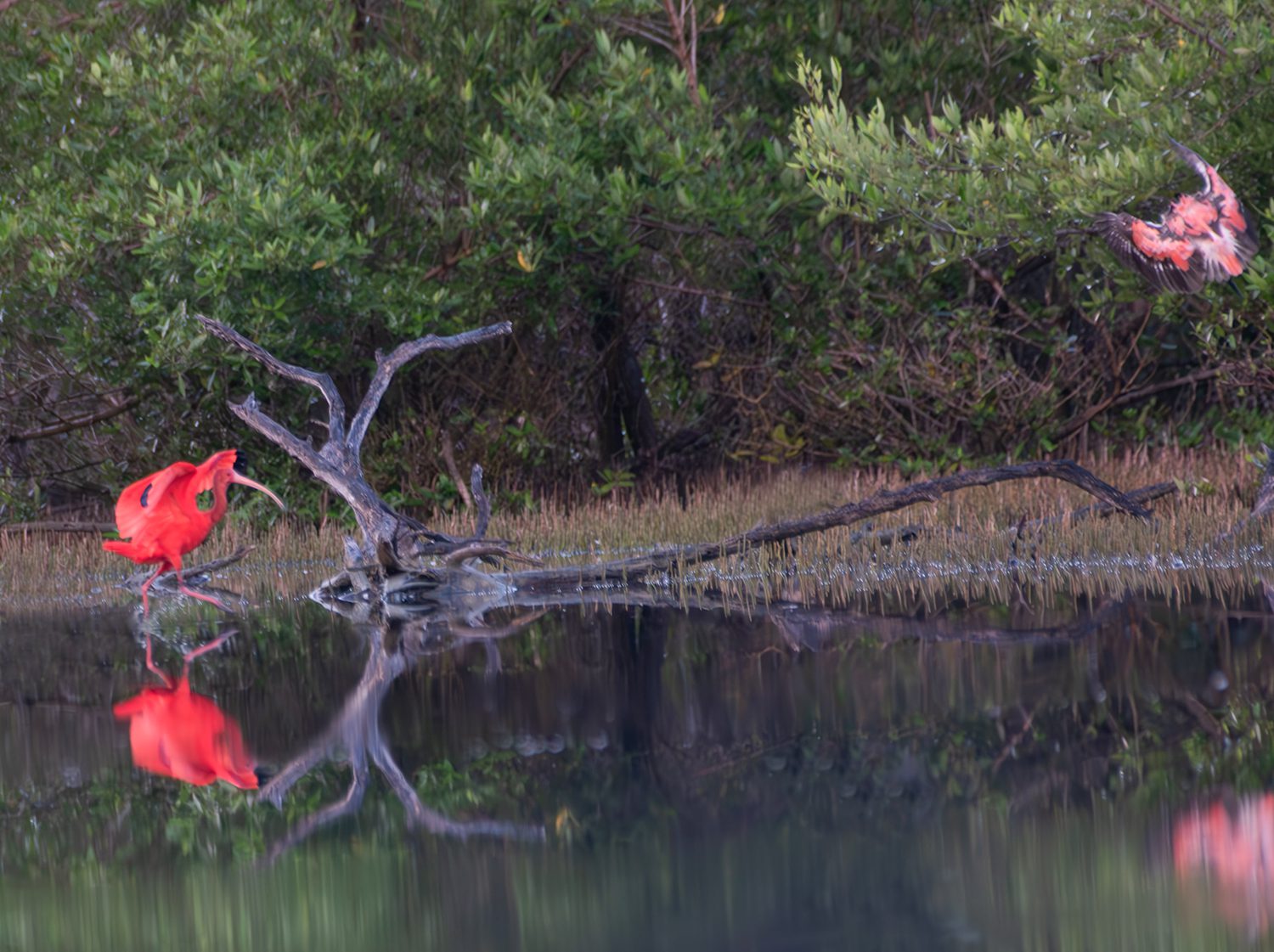
The young scarlet ibis looks more graceful in the air. (Photo Gail Karlsson)
Gail Karlsson is the author of a photo book Looking for Birds on St. John, as well as two other books about nature in the Virgin Islands – The Wild Life in an Island House, and Learning About Trees and Plants – A Project of the Unitarian Universalist Fellowship of St. John. A few years ago she also set up a web page fishbaywetlands.com. Follow her on Instagram @gailkarlsson and gvkarlsson.blogspot.com. More info at gailkarlsson.com.











 In his biweekly column, Langley Shazor speaks to issues important to men within the territory.
From the time boys become men, there is an invisible clock that starts ticking. It counts down to the moment when value will be measured not by character or conviction, but by what sits in a bank account. The message is clear: a man without money is a man without meaning. The myth is reinforced in every culture, every generation, and every space where success is confused with self-worth. We praise the provider but rarely question the price he pays to be seen as one.
This belief that a man’s worth is tied to his wallet has shaped more lives than we realize. It is why some men live in quiet frustration, chasing achievements that bring no peace. It is why others fear love, fearing that affection is just charity in disguise. And it is why, even when some men earn more than they imagined possible, they still wake up feeling like they are falling behind. When worth becomes currency, no amount ever feels like enough.
There is a difference between providing and proving. Providing is a calling; proving is a cage. Many men confuse the two because we were raised to believe that our ability to provide was the ultimate test of manhood. We watched our fathers and uncles equate exhaustion with honor. We saw them wear struggle like a medal, never knowing that survival had become their only language. They built worlds on tired backs and proud silence, but rarely did anyone ask if they were happy. The next generation inherited that blueprint without realizing it was never meant to last forever.
Money, by itself, is not the villain. The problem is the weight we give it. Financial stability matters. It brings security, opportunity, and freedom. But when a man begins to see his income as proof of his identity, he lives in a constant state of performance. Every raise becomes validation. Every setback feels like shame. When we see worth as something to be earned instead of something we already possess, we begin to live like tenants in our own lives, constantly trying to make rent on respect.
The world often rewards performance more than purpose, and men get caught in that current. We hustle harder, sleep less, and convince ourselves that the grind is noble. But what happens when the job ends, when the company downsizes, or when the dream does not unfold the way we planned? Too often, men fall into quiet crisis, unsure who they are without the role or title that once defined them. We confuse our contribution with our existence. We begin to believe that if we are not producing, we are not valuable. That is not just a myth; it is a wound.
We need to separate achievement from identity. A man’s work is an extension of his purpose, but it is not the proof of his personhood. Purpose comes from within; it is the compass that directs the work, not the work itself. When a man learns that truth, he can build and lead without fear that a bad month, a missed opportunity, or a slow season makes him less of a man.
The myth of the money-defined man has also distorted relationships. Too many men equate love with transaction. They believe presence can be replaced with provision, that gifts can stand in for attention, and that as long as the bills are paid, the home should feel whole. But homes are not healed by income; they are built by intention. Families want stability, yes, but they also want connection. Children remember laughter more than they remember labels. Partners remember kindness more than they remember purchases. When we reduce our worth to what we can buy, we forget that what truly sustains the people we love is not what we give them, but how we show up.
Men also need to understand that financial power without emotional maturity creates imbalance. Money can buy comfort, but it cannot buy peace. It can earn admiration, but not respect. It can open doors, but it cannot keep relationships from falling apart once you walk through them. Too many men chase wealth, hoping it will silence insecurity, but all it does is amplify it. When your sense of self depends on what you can accumulate, your confidence becomes conditional.
We live in a world that praises the provider but rarely celebrates the nurturer. It’s time to expand that definition. A man who listens, teaches, protects, encourages, and uplifts is providing. A man who gives time, patience, and presence is providing. A man who loves without condition and leads with humility is providing. Those forms of provision leave a legacy no economy can measure.
The truth is, a man’s worth is proven through intention. It is in how he treats people when no one is watching. It is in how he honors commitments when applause fades. It is in the consistency of his word, the courage to keep showing up, and the wisdom to know that his presence carries more power than his possessions ever could.
We need men who understand that provision is more than payment, it is participation. It is showing up for the people you love, not just showing off for them. It is leading your home with care and not control. It is choosing generosity without needing recognition.
When we release the pressure to prove, we make room to live. We stop performing and start being. We find peace in purpose instead of panic in production. The world does not need men who can simply earn; it needs men who can endure with grace, give with heart, and love without condition.
A man’s worth is not what he earns. It is what he builds, within himself, within his home, and within his community. Money comes and goes, but integrity endures.
When men finally learn to measure themselves by the strength of their spirit instead of the size of their wallet, the world will see a different kind of wealth. One that cannot be counted, only felt.
Editor’s Note: Opinion articles do not represent the views of the Virgin Islands Source newsroom and are the sole expressed opinion of the writer. Submissions can be made to visource@gmail.com.
In his biweekly column, Langley Shazor speaks to issues important to men within the territory.
From the time boys become men, there is an invisible clock that starts ticking. It counts down to the moment when value will be measured not by character or conviction, but by what sits in a bank account. The message is clear: a man without money is a man without meaning. The myth is reinforced in every culture, every generation, and every space where success is confused with self-worth. We praise the provider but rarely question the price he pays to be seen as one.
This belief that a man’s worth is tied to his wallet has shaped more lives than we realize. It is why some men live in quiet frustration, chasing achievements that bring no peace. It is why others fear love, fearing that affection is just charity in disguise. And it is why, even when some men earn more than they imagined possible, they still wake up feeling like they are falling behind. When worth becomes currency, no amount ever feels like enough.
There is a difference between providing and proving. Providing is a calling; proving is a cage. Many men confuse the two because we were raised to believe that our ability to provide was the ultimate test of manhood. We watched our fathers and uncles equate exhaustion with honor. We saw them wear struggle like a medal, never knowing that survival had become their only language. They built worlds on tired backs and proud silence, but rarely did anyone ask if they were happy. The next generation inherited that blueprint without realizing it was never meant to last forever.
Money, by itself, is not the villain. The problem is the weight we give it. Financial stability matters. It brings security, opportunity, and freedom. But when a man begins to see his income as proof of his identity, he lives in a constant state of performance. Every raise becomes validation. Every setback feels like shame. When we see worth as something to be earned instead of something we already possess, we begin to live like tenants in our own lives, constantly trying to make rent on respect.
The world often rewards performance more than purpose, and men get caught in that current. We hustle harder, sleep less, and convince ourselves that the grind is noble. But what happens when the job ends, when the company downsizes, or when the dream does not unfold the way we planned? Too often, men fall into quiet crisis, unsure who they are without the role or title that once defined them. We confuse our contribution with our existence. We begin to believe that if we are not producing, we are not valuable. That is not just a myth; it is a wound.
We need to separate achievement from identity. A man’s work is an extension of his purpose, but it is not the proof of his personhood. Purpose comes from within; it is the compass that directs the work, not the work itself. When a man learns that truth, he can build and lead without fear that a bad month, a missed opportunity, or a slow season makes him less of a man.
The myth of the money-defined man has also distorted relationships. Too many men equate love with transaction. They believe presence can be replaced with provision, that gifts can stand in for attention, and that as long as the bills are paid, the home should feel whole. But homes are not healed by income; they are built by intention. Families want stability, yes, but they also want connection. Children remember laughter more than they remember labels. Partners remember kindness more than they remember purchases. When we reduce our worth to what we can buy, we forget that what truly sustains the people we love is not what we give them, but how we show up.
Men also need to understand that financial power without emotional maturity creates imbalance. Money can buy comfort, but it cannot buy peace. It can earn admiration, but not respect. It can open doors, but it cannot keep relationships from falling apart once you walk through them. Too many men chase wealth, hoping it will silence insecurity, but all it does is amplify it. When your sense of self depends on what you can accumulate, your confidence becomes conditional.
We live in a world that praises the provider but rarely celebrates the nurturer. It’s time to expand that definition. A man who listens, teaches, protects, encourages, and uplifts is providing. A man who gives time, patience, and presence is providing. A man who loves without condition and leads with humility is providing. Those forms of provision leave a legacy no economy can measure.
The truth is, a man’s worth is proven through intention. It is in how he treats people when no one is watching. It is in how he honors commitments when applause fades. It is in the consistency of his word, the courage to keep showing up, and the wisdom to know that his presence carries more power than his possessions ever could.
We need men who understand that provision is more than payment, it is participation. It is showing up for the people you love, not just showing off for them. It is leading your home with care and not control. It is choosing generosity without needing recognition.
When we release the pressure to prove, we make room to live. We stop performing and start being. We find peace in purpose instead of panic in production. The world does not need men who can simply earn; it needs men who can endure with grace, give with heart, and love without condition.
A man’s worth is not what he earns. It is what he builds, within himself, within his home, and within his community. Money comes and goes, but integrity endures.
When men finally learn to measure themselves by the strength of their spirit instead of the size of their wallet, the world will see a different kind of wealth. One that cannot be counted, only felt.
Editor’s Note: Opinion articles do not represent the views of the Virgin Islands Source newsroom and are the sole expressed opinion of the writer. Submissions can be made to visource@gmail.com.