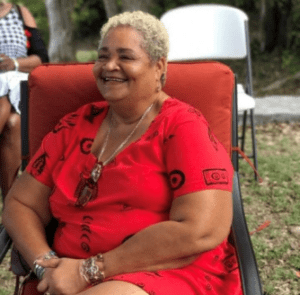
It is with deep regret, that the family announces the passing of Laynes Weekes on August 19, 2025. She was 82 years old.
Laynes Weekes
She was preceded in death by her parents Charlie Francis and Enid Thomas. Daughter, Beverly Thomas, sister Hazel Francis Harrigan and brothers Melrose and Leonard Francis.
She is survived by her husband, Perpaeter Weekes, daughters, Cheryl Weekes Mingo and Diana Weekes, son Chesney Thomas. Stepsons Charles, Lionel and Steven Weekes. Son-in-law Terrance Mingo. Grandchildren, Javonne Thomas, Teremun Mingo, Darnell and Darrell Luke, Chauncey and Chandler Thomas. Great grandchildren Jayce, James and Emilia-rose Thomas and Darrell Jr., Alannah and Aria Luke. Sisters Rosa Francis, Christalyn Ralph and Icelma Epps. Brother Gladwin Francis.Sister-in-laws Thelma Francis, Violet Francis and Elzena Molita Weekes Dasent. Brother-in-law Rolston Harrigan. Cousins Anna Samuel, Earl Attley, Judith Myers, Monica Joseph and Kandacie Emanuel. Nieces Brenda Christopher Osborne, Althea Francis, Kesana Francis, Patricia Francis Coates, Volda Francis Myers, Michelle Warner Knight, Darlien Harrigan, Roseline Ralph Mailandt, Rosemarie Ralph Wedderburn, Ingrid Francis Velez, Cynthia Francis, Francyne Francis Ridges, Dineasha Francis McQuilkin, Gladeasha Francis, Dine Potter, and Colette Weekes. Nephews Rohan Francis Sr., Everton Ralph Sr., Ulrick Ralph, Jahmal Gilead, Davin Harrigan, Cornell Hackett, Keithly Epps, Jr., Gelani Epps and Devon Francis. A host of great nieces and nephews and other relatives and friends too numerous to mention.
Relatives and friends are invited to attend the first viewing at Turnbull’s Funeral Home on Thursday, Sept. 25 from 4 p.m. to 6 p.m.
Second viewing and service will be held at First Pentecostal Church C-6 Estate Hoffman, St. Thomas, VI on Friday, Sept. 26 viewing from 9:00 am to 10:00 am service to follow at 10 a.m.
Interment will be at Smith Bay Eastern Cemetery. Tributes can be sent to tributesforlaynesweekes@gmail.com no later than Sept. 10. Professional service is entrusted by Turnbull’s Funeral Home.
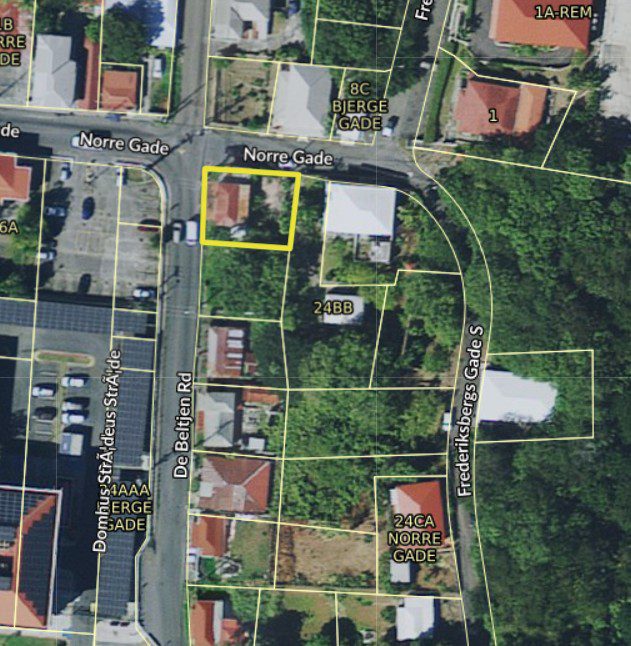
The Virgin Islands Waste Management Authority advises the community of a damaged sewer line located at 1026 Norre Gade, near the Old Wet Willy’s building.
A damaged sewer line located at 1026 Norre Gade, near the Old Wet Willy’s building.
VIWMA advises residents to avoid standing water in the affected areas.
We understand the inconvenience this may cause and rely on your cooperation as we work diligently to resolve the issue.
For updates or further assistance, please contact the Division of Wastewater at (340) 715-9151 or Communications Management at communications@viwma.org. Follow us on Facebook, Twitter, and LinkedIn.
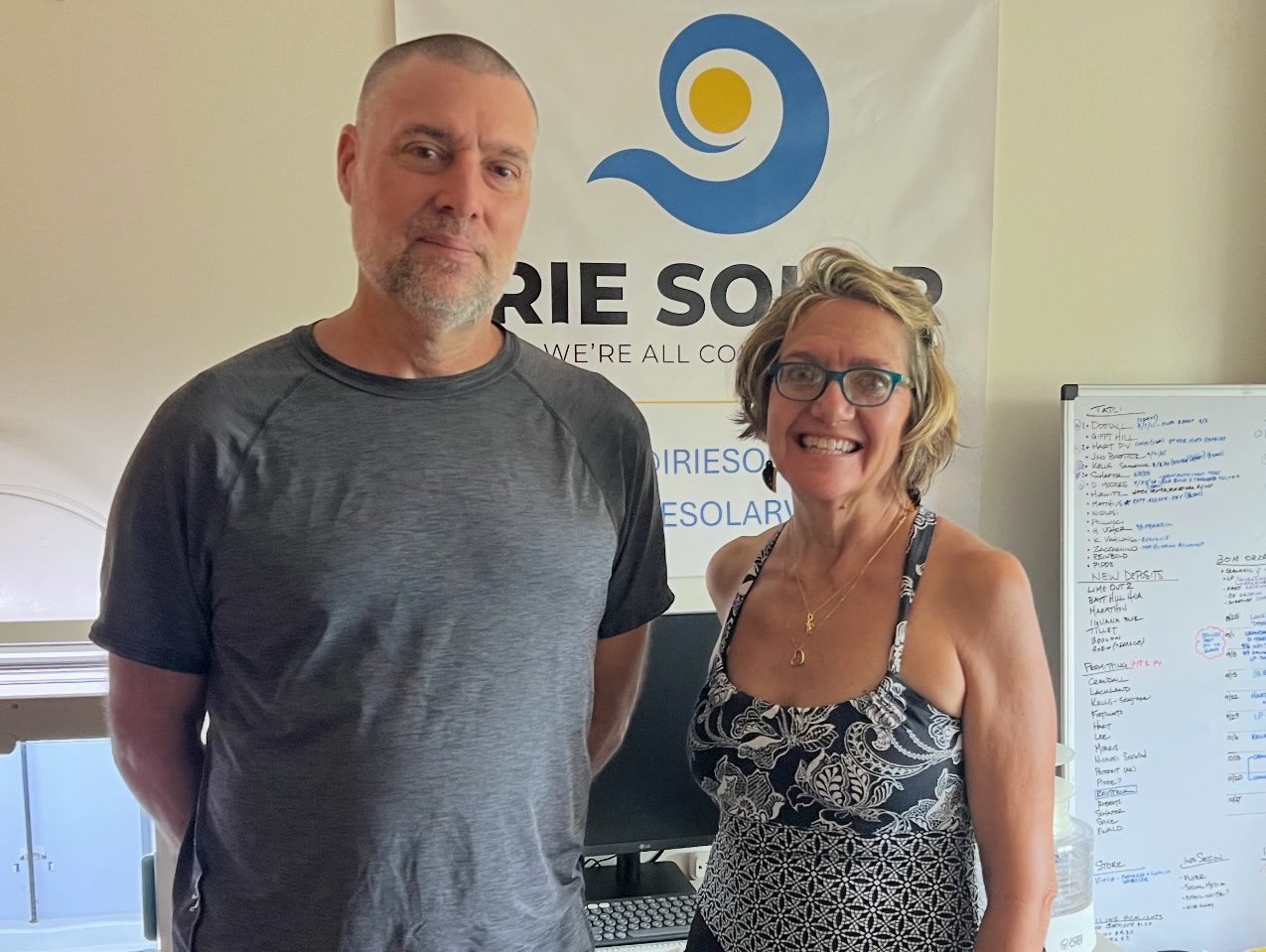
Rob Tutton, president of IRIE Solar VI, and Trista Sigler, the company’s office manager, are hosting an “Affordable Power Solutions” brunch at the Tap Room in Cruz Bay on Saturday at 10 a.m. (Source photo by Amy H. Roberts)
In honor of the eighth anniversary of Hurricane Irma, a St. John-based provider of portable power stations is offering community members an opportunity to buy back-up power systems at “rock-bottom” prices through noon on Monday, Sept. 8.
Rob Tutton, president of IRIE Solar VI, is inviting the public to learn about three featured portable power stations made by EcoFlow at a brunch on Saturday from 10 a.m. to noon at the Tap Room at Mongoose Junction in Cruz Bay.
At this “Affordable Power Solutions” event, Tutton will present the specifications and configurations of the three products that range in price and capability “so that people can make good decisions,” he said. “As a former government engineer, I don’t want to oversell anything. Each customer has their own needs. At the Tap Room, we’ll talk about how to choose it, and how to use it.”
With the lowest-priced product, the Delta 2 Max, customers can expect six hours of back-up power to run a refrigerator, two LED lights, and two fans before recharging. It sells for $1,069, including shipping. The most powerful product, the Delta Pro Ultra, costs $4,870.
The EcoFlow portable power stations can be charged by plugging them into WAPA power, a generator, a solar panel, or in some cases a car battery.
Rob Tutton displays a power system of his own design which can be customized to suit a home or business of any size. (Source photo by Amy H. Roberts)
IRIE (Island Renewable and Independent Energy) Solar offers a wide range of products, including one being patented by Tutton who designs solar batteries. He’s been at the forefront of developing solar products for home use and was one of the founders of Love City Community Network, a non-profit internet provider since Hurricane Irma hit in 2017.
For this event, IRIE Solar is selling the EcoFlow portable power stations at cost. “The intent is to crowdsource our first big buy,” said office manager Trista Sigler. “We’re donating time and space to help educate people and make this equipment affordable to everyone.”
Sigler said that Irie Solar can offer these low prices by ordering multiple units at one time, but there is a deadline: Monday, Sept. 8 at noon. “We’ve told the company that it’s for the resilience of the whole community,” she said. Customers can expect delivery of the portable power stations within six weeks “and possibly sooner.”
The EcoFlow portable power stations run on lithium ferro phosphate batteries, “which are taking over the industry,” Tutton said. “They’re not like the old lithium batteries that burst into flames. The units are safe and quiet. Unlike generators, you use these indoors. There’s no maintenance. You just have to keep them clean and protect them from corrosion.”
Those who attend the event can enter a free raffle for a discount on their order. For further information or to order online, go to https://www.iriesolarvi.com or call 340-209-2916.
Rayelle “Ray,” “Tae-Tae” Naidine Tutein
April 13, 1954 – August 27, 2025
As the sun descended into its slumber beneath the horizon on August 27, 2025, our beloved mermaid — Rayelle Naidine Tutein of #7 Old Hospital Ground, Christiansted — gracefully transitioned to the other side.
Rayelle Nadine Tutein
She was born on April 13, 1954, to Muriel Austin-Tutein (ah Hillsider) and Fritz Phillip Tutein “Pahwolf” (ah Gallowsbayrian). Along with her parents, awaiting Ray’s arrival by the seashore, were her beloved siblings Lloyd K. Austin, Phillip, and Preston Tutein.
Ray leaves behind her three sea urchins, raised with salt, sass, and plenty love — Akido Damani Walcott, Annelle Knight and Alea Navarro — who cared for her and carried her to the low tide on her final voyage.
She swam through life surrounded by the love of her Grand Reef: Anasia, Anthony, and the accountant of her sea chest, Amaud Encarnacion — each bringing color, wonder, and awe to the Sea. In Ray’s vibrant Grand Reef also rest her little clam shell: Rohit Goeptar Jr., her youngest grandchild, and Ariya Milan Joseph, her little sea pumpkin (great-grand).
Ray survived every storm with her red and white mangroves always standing guard at her shores — her older sisters, Lillian Jacobs and Sharon Elien-Tutein — and her soldier crab dem: Barbara Venetis, Lorraine Motta, Nancy Ayala, the Byron family, Donna Ventura Benjamin, Miguel Encarnacion and Cyntoine Francis-Schjang. Alongside them were two who stood especially close to Ray, her queen conch-niece and seahorse-nephew, Karisma and Kristepher Elien — who kept watch with devotion and love.
Also standing guard were her siblings Diane, John, Wayne, Fritz Jr., Audrey, William, Fitzroy, Adrian Tutein, Micheline Tutein-Baptiste, and Evelyn Wilkinson, together with their many queen conchs, seahorses, and seashells — her nieces, nephews, extended family, and countless friends too numerous to name in her vast, loving sea. All woven into her living reef, as she now rests in her seagrass bed in peace.
The family invites relatives and friends to gather in celebration at the Altona Lagoon Pavilion on Saturday, September 20, 2025, from 2 to 6 p.m., to share memories and say so long to our dearly departed and beloved mermaid, Rayelle “Ray,” “Tae-Tae” Naidine Tutein. Guests are invited to dress as vibrantly as the colors of the sunset at sea, in comfort, to honor her free and lively spirit.
The Virgin Islands Water and Power Authority advises customers on Feeder 8A and 8B of a scheduled electrical service interruption on Saturday, Sept. 6, from approximately 10 a.m. to 1 p.m.
Virgin Islands Water and Power Authority
The planned outage is necessary for Haugland VI to safely string new overhead lines onto newly installed composite poles on Mafolie Hill. These upgrades are part of WAPA’s ongoing efforts to strengthen the electrical grid and improve system reliability for the community.
Customers in the following areas will be impacted:
Agnes Fancy | Anna’s Fancy | Contant | Gotlieb’s Gas Station | Estate Ross | Garden Street | Hospital Ground | Knud Hansen Medical Arts Complex | Lytton’s Fancy Mahogany Estate | Nisky Center | Savan | Staabiland | Vester Gade | Sand Fill WSTA | Silver Dollar | Back Street | GERS Building | Harbor View | Saints Peter & Paul School |Subbase | Vitelco Building | Anna’s Retreat | Blackbeard’s Castle | Canaan | Taarneberg | Education Street | Hospital Ground | J. Antonio Jarvis School | Lionel Roberts | Louisenhoj | Mafolie | Magen’s Bay | Mahogany Run | Lovenlund | Peterborg | Polyberg | Ross | Taarneberg | Skyline Drive | St. Joseph & Rosendahl | St. Thomas Dairies | Wintberg | 7th Day Street | Coast Guard Building | Emancipation Gardens Park | Government Parking Lot | Legislature Building | Ron De Lugo Federal Building | Superior Court | Vendor’s Plaza | Veteran’s Drive | Fire Station
To stay updated on any changes to the scheduled outage, sign up for WAPA Alerts and receive notifications via text, voice, and email directly to your mobile device at https://member.everbridge.net/892807736728730/new.
WAPA thanks the public for their patience and understanding while this important maintenance is completed.
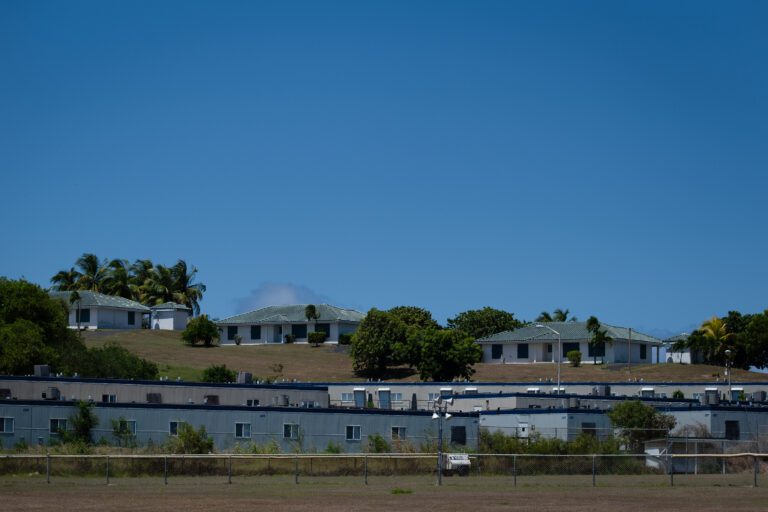
The Port Hamilton Refining and Transportation Village, also known as the “man camp,” appeared largely empty Thursday amid reports of a local deployment of U.S. Air Force personnel. (Source photo by Kit MacAvoy)
Amid reports that some military personnel deployed to the Caribbean will be quartered at the Port Hamilton Refining and Transportation Village as part of President Donald Trump’s escalation of drug interdiction efforts, Gov. Albert Bryan Jr. confirmed to the Source this week that the refinery operator is looking to the “man camp” as a revenue generator while it works toward restarting operations.
“Yes that’s what they are doing,” he said in a text message.
Bryan said his administration doesn’t have “any conversations with the feds on this topic,” but he said when asked that the housing option may be on the table for contractors brought in to work on the territory’s myriad disaster recovery projects. “Yes,” he said, the V.I. Disaster Recovery Office “is actively trying to facilitate arrangements for housing for contractors in both districts.”
The U.S. Defense Department did not respond to questions about the military deployment and Port Hamilton Refining and Transportation did not provide a statement on the billeting arrangement by Thursday evening. Bryan said Thursday morning that there was no new information about U.S. military presence on St. Croix after indicating to the Source last week that the detachment could include one to two hundred people.
The man camp was previously used to house personnel attached to President Joe Biden’s most recent visit to St. Croix in December. That stay was preceded by a viral video walk-through of the premises, which prompted widespread but unfounded speculation about an imminent restart of the refinery. Responding to questions from the Source, both the U.S. Environmental Protection Agency and the U.S. Justice Department stated at the time that the refinery hadn’t yet met the necessary prerequisites to resume operations.
More recently, federal regulators approved a second round of chemical removal from the property, and EPA officials emphasized during a July town hall meeting that the agency had not received a required 90-day notice of intent to restart. That meeting followed reports of staff downsizing in April, which prompted refinery operators to issue a statement acknowledging that Port Hamilton “is reevaluating its staffing needs as part of its long-standing efforts to ensure its operations are efficient and cost-effective.”
“This reevaluation could include temporary changes to human resources,” according to a brief statement PHRT issued. “At the same time, Port Hamilton continues to carefully monitor its idle refinery to ensure it is maintained in a safe and environmentally compliant manner, consistent with its regulatory obligations.”
The United States’ heightened military posture in the region follows Trump’s move to declare illegal drug cartels and transnational criminal organizations, like Tren de Aragua and MS-13, as foreign terrorist organizations almost immediately after resuming office in January. Multiple national media outlets reported in August that the U.S. military began deploying upward of 4,000 Marines and Navy personnel to Caribbean and Latin American waters in a show of force meant to curb drug-smuggling activity. On Tuesday, Trump announced that military forces had “shot out” a “drug-carrying boat” near Venezuela, allegedly operated by Tren de Aragua.
“And there’s more where that came from. We have a lot of drugs pouring into our country — coming in for a long time — and we just, these came out of Venezuela, and coming out very heavily from Venezuela,” he said Tuesday. “A lot of things are coming out of Venezuela. We took it out, and you’ll get to see that … after this meeting is over.”
A video of the airstrike, which the White House claimed killed 11 people, has since circulated widely online.
The deployment of military personnel to the U.S. Virgin Islands specifically came to light in a meeting of the V.I. Public Finance Authority two weeks ago, during which Bryan — who chairs the PFA board — noted Trump’s movement of warships into the region.
“And as a part of that, there’s also going to be soldiers deployed throughout the Caribbean — American soldiers — which is good for the economy,” he said at the time. “The drugs come through, they get lost, they get confiscated, people start speaking — that’s how the death starts. So this is going to stop some of that violence in our area, hopefully.”
Bryan reiterated his stance when a V.I. Consortium reporter asked him about U.S. military presence in the Caribbean during an Aug. 25 Government House press briefing.
“The natural flow of cocaine is to come through our shores, and along with the cocaine comes a lot of bad actors, murder and a lot of the things we don’t want, so I am for it. I understand we have some soldiers staying here in St. Croix as well, too, as part of that initiative. I welcome it,” Bryan said before acknowledging national concerns about Trump’s deployment of National Guard troops to Washington, D.C.
“But like I tell everybody: for years, every single year we go to D.C., we beg for more Border Patrol, we beg for more Coast Guard, we beg for more ICE agents, because we are a very porous border,” he said. “And when we shore up the one in St. John, St. Croix starts to become the conduit for cocaine … and guns and all kinds of other stuff. So I’m supportive of that. Plus, if you want to put two or three hundred soldiers here in St. Croix as part of that initiative, they gotta eat, drink and make merriment in our community. We are happy to have them. The safest I feel is when President Joe Biden comes down — we have 300 agents here. So more power to ‘em.”
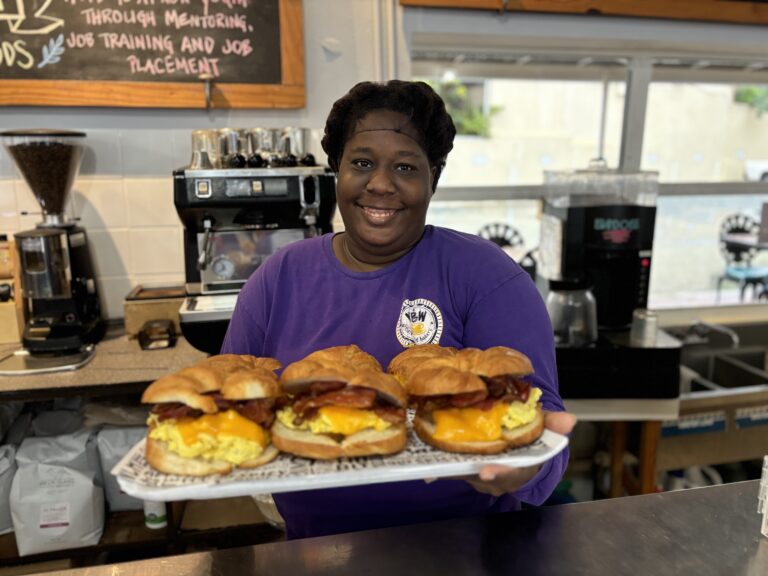
Hospitality and customer service training are part of the MBW Café experience. A student proudly presents a tray of fresh breakfast sandwiches. (Photo courtesy My Brother’s Workshop)
This Sunday, Hotel 1829 will host a special brunch in support of My Brother’s Workshop, a nonprofit that has been changing lives in the Virgin Islands since 2007. Guests will enjoy the hotel’s signature Sunday brunch while contributing to an organization that provides hope, healing, and purpose to at-risk youth across the territory.
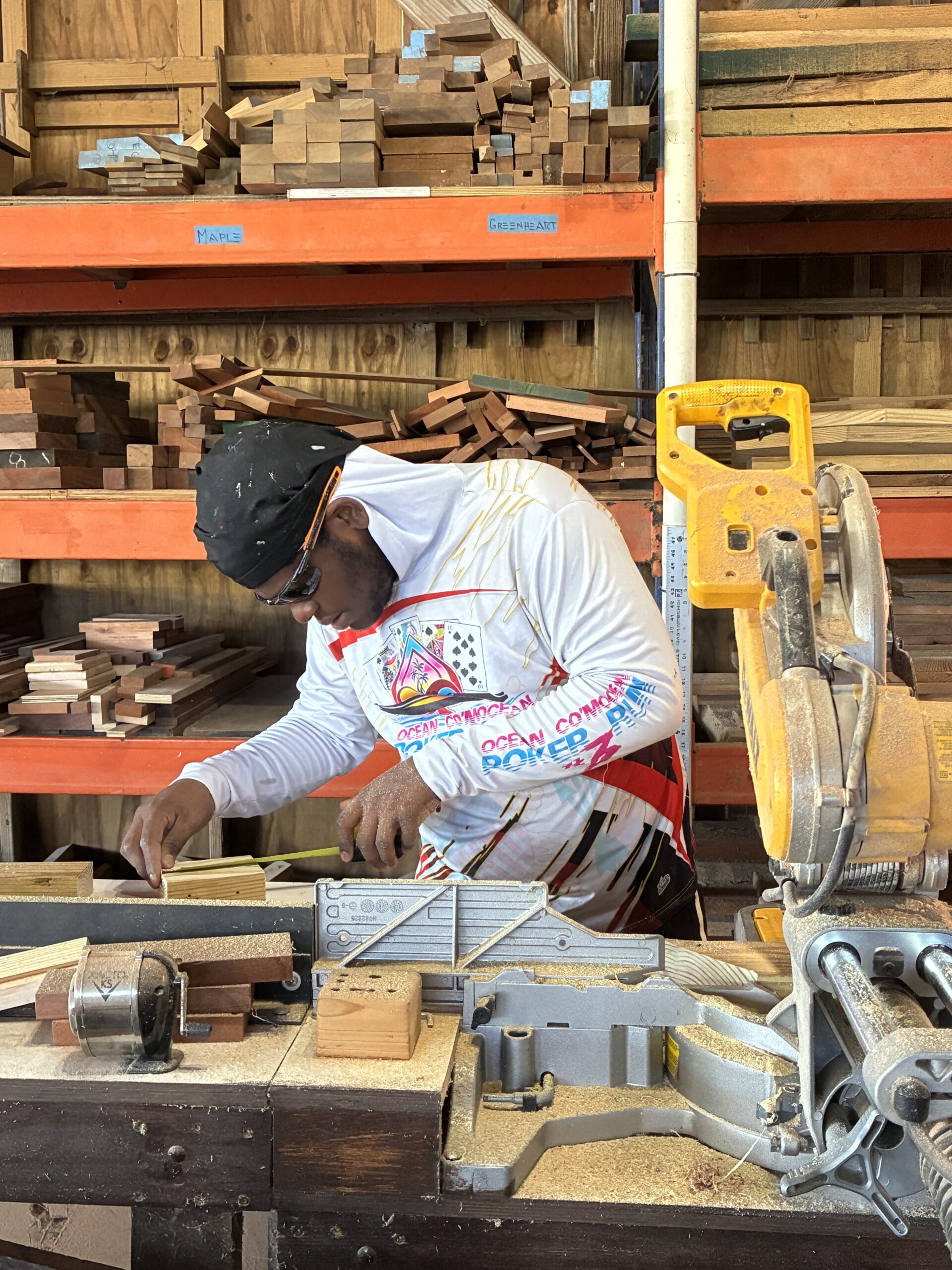
A participant carefully measures and prepares wood in the carpentry program, gaining skills that open the door to new opportunities. (Photo courtesy My Brother’s Workshop)
My Brother’s Workshop has served more than 1,600 young men and women, guiding them to discover their passions and build brighter futures. The organization takes a holistic approach that combines mentorship, education, counseling, on-the-job training, and job placement. Through its wide range of training programs, participants acquire skills in various fields, including culinary arts, customer service, retail, sewing, carpentry, construction, marine repair, welding, electrical work, plumbing, masonry, and more.
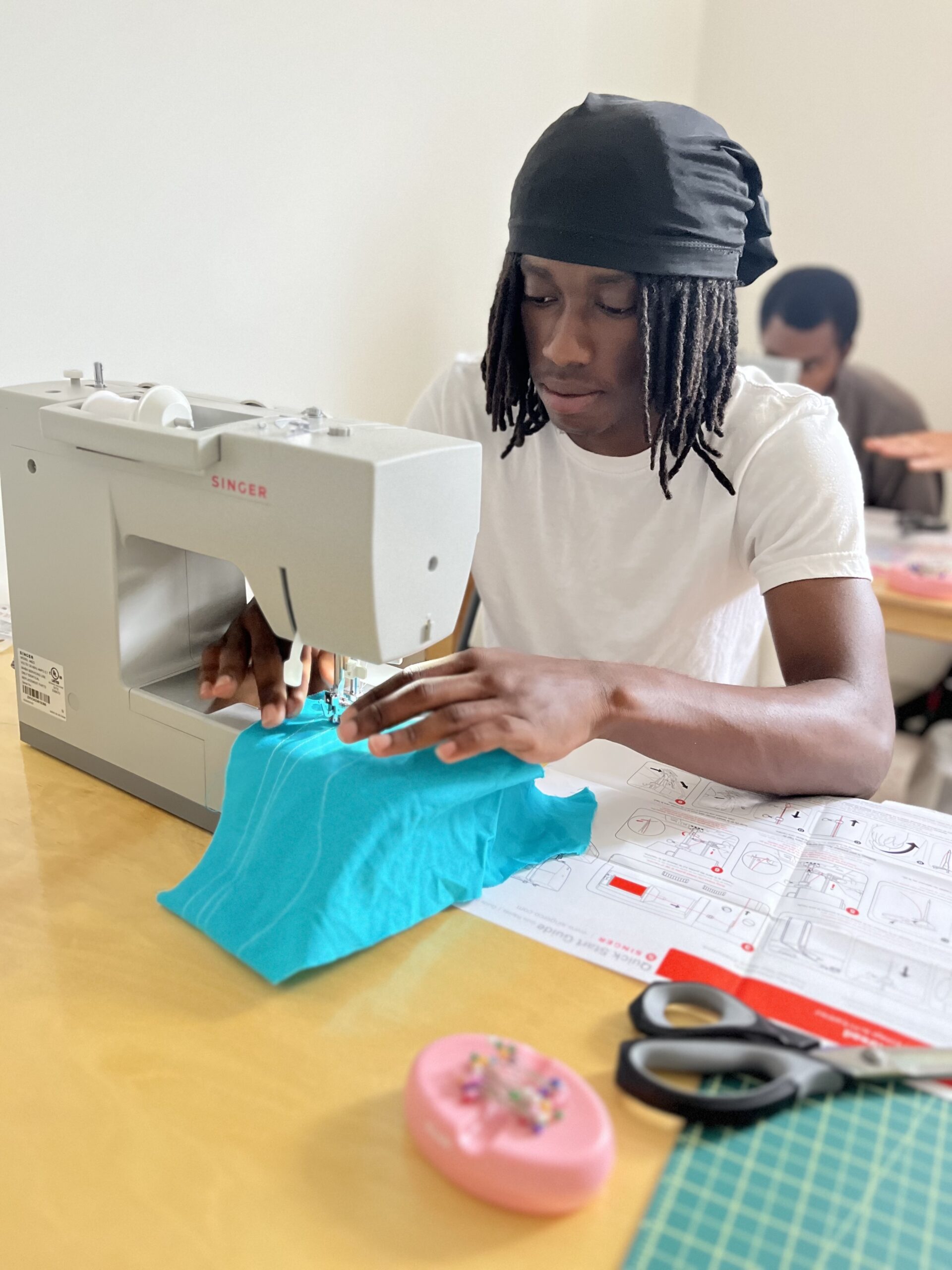
A student in the sewing program at My Brother’s Workshop learns the craft of garment-making while developing valuable job skills. (Photo courtesy My Brother’s Workshop)
A portion of the proceeds from Sunday brunch, along with all sales of a featured signature cocktail, will go directly to My Brother’s Workshop. Every donation supports these life-changing programs, ensuring that young people in the Virgin Islands have access to opportunities and support systems that help them thrive.
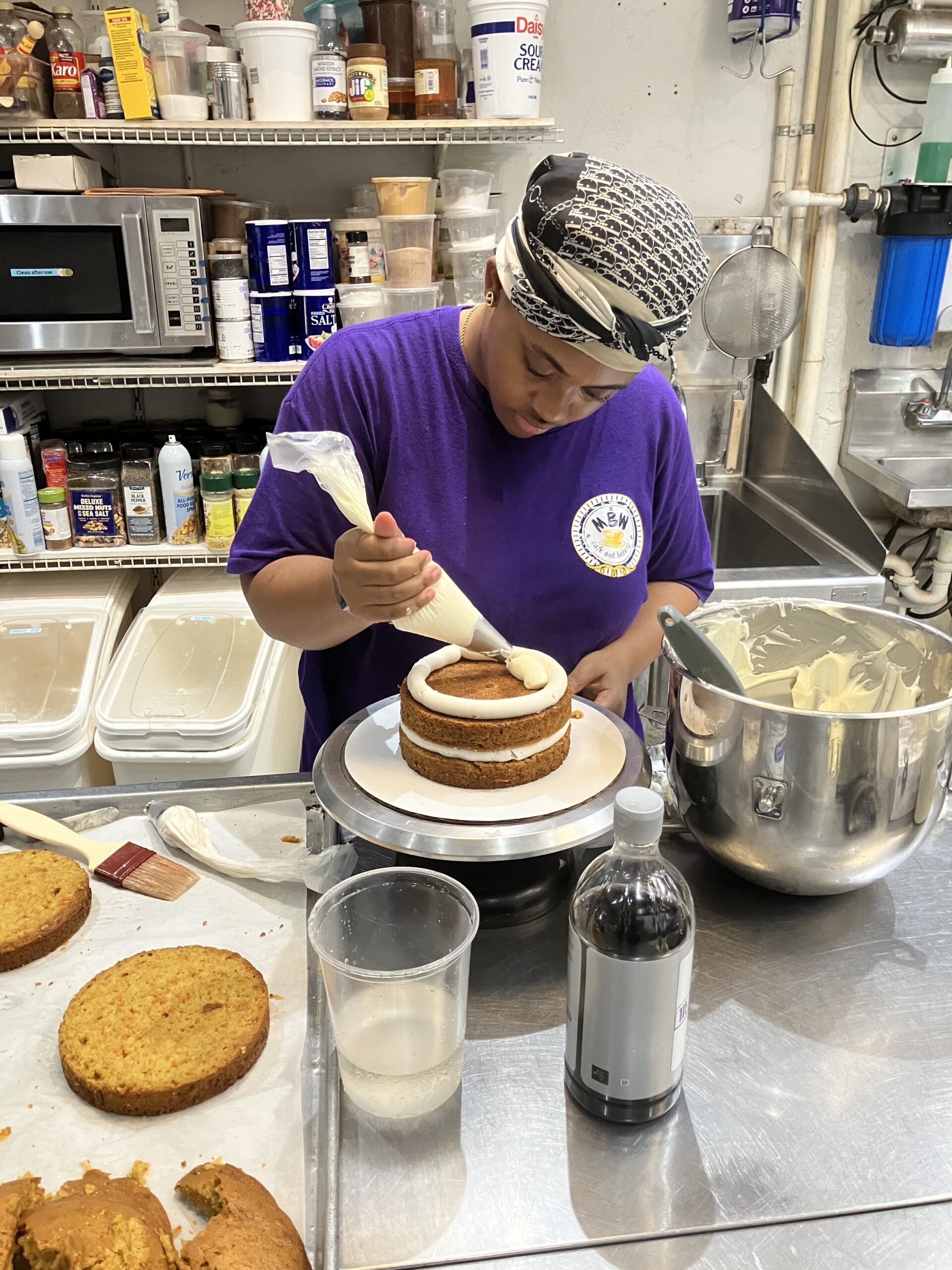
In the culinary arts program, hands-on training includes everything from baking to decorating. Here, a student carefully works on a layered cake. (Photo courtesy My Brother’s Workshop)
With brunch in high demand, reservations are strongly encouraged and can be made by calling or texting 833-843-1829. Those unable to attend can still make a difference by donating online at mybrothersworkshop.org or by connecting with the organization on Facebook and Instagram to learn more about how to give. Every contribution helps provide training, mentorship, and hope for the next generation.
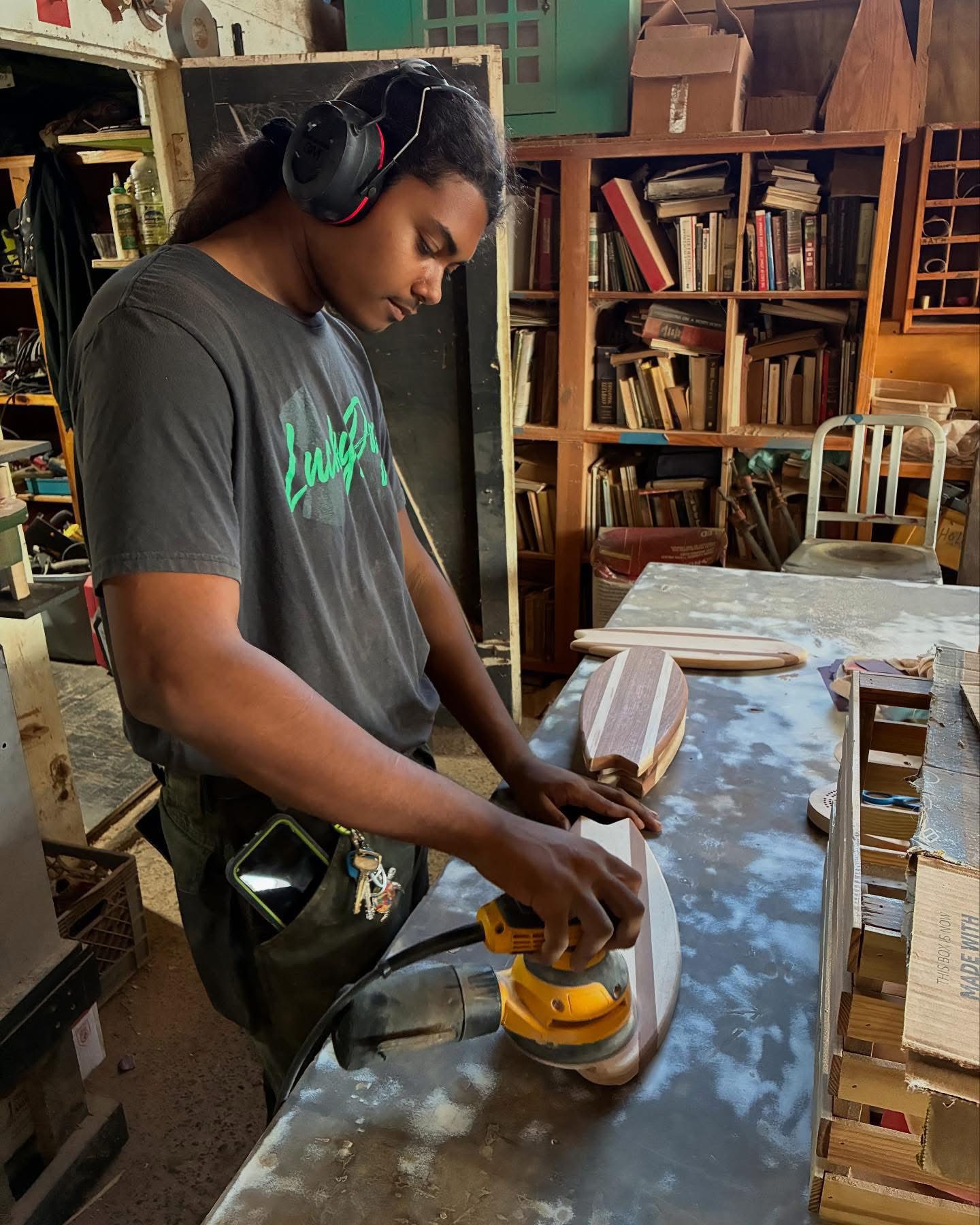
Training in the workshop emphasizes patience and precision, as students learn to shape and finish their projects by hand. (Photo courtesy My Brother’s Workshop)
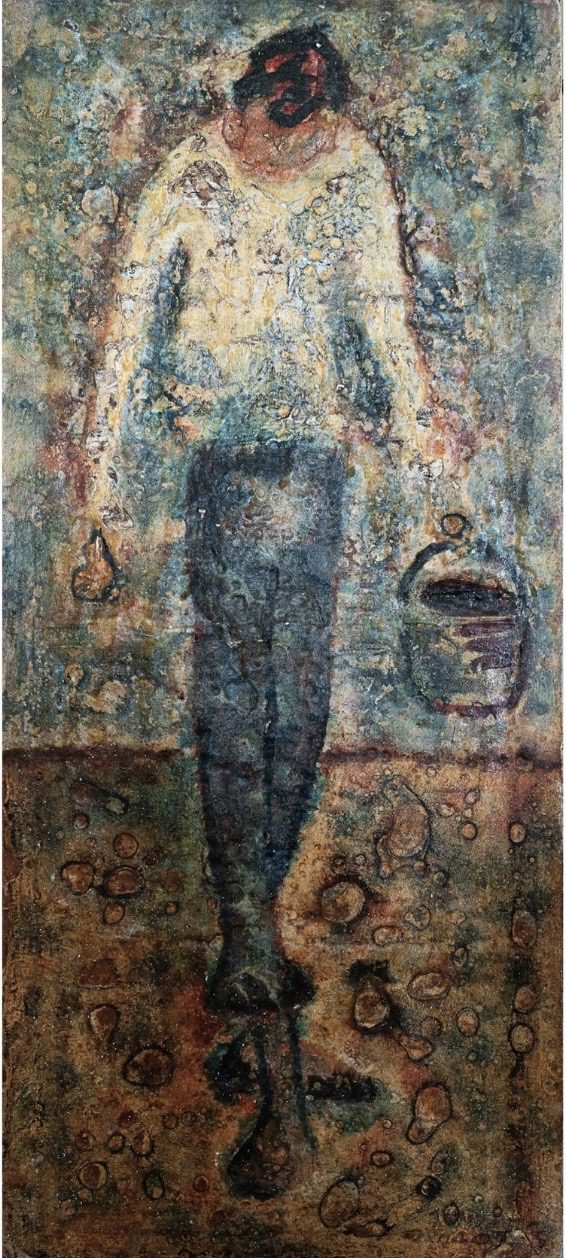
Wilfred Labiosa was a pioneering Nuyorican artist, educator and cultural visionary born in Harlem, NY (1937-2015) to Puerto Rican parents. His work and teaching left an indelible mark on Puerto Rican and Caribbean art history.
Self Portrait, 1962. Acrylic & oil on wood panel by Wilfred Labiosa (Photo courtesy CMCArts)
The Caribbean Museum Center for the Arts is honored to feature the wide range of art mediums of five decades of Labiosa’s career in the upstairs galleries. “Labiosa: A Retrospective” is a diverse exhibit with an opening reception on Saturday, from 4 p.m. to 7 p.m., which will also honor Virgin Islands Puerto Rican Friendship.
The artist Labiosa loved jazz and CMCArts is proud to honor him with a cadre of St. Croix’s finest jazz musicians: Marsvyn David, Elvis Pedro and Dimitri “Pikey” Copemann. Complimentary small bites will be served.
Tickets can be purchased at the CMCArts website for $10 per person and $5 for members. Tickets and memberships may also be purchased at the door.
The exhibition is organized by Galeria W. Labiosa, the Labiosa family and the artist’s son, Wilfred Labiosa. This showcase at CMCArts is the first venue in a worldwide tour. Labiosa will be in attendance for the reception to honor his father.
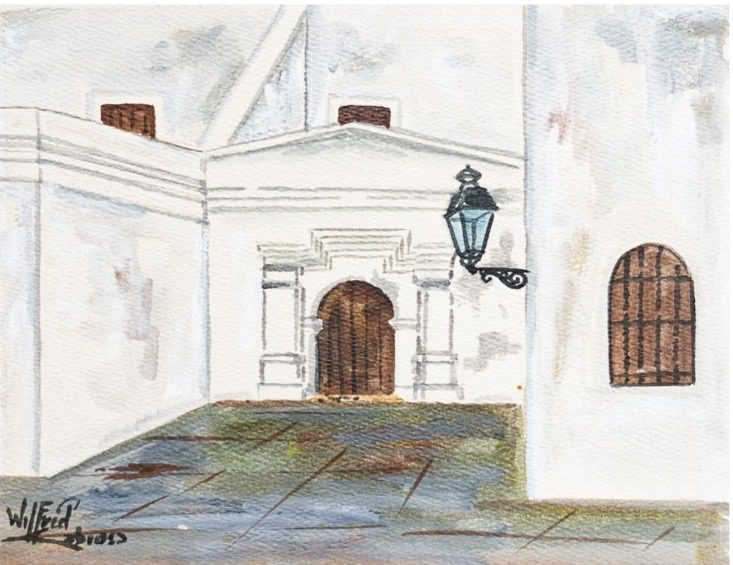
Entrada a iglesia de San Jose, n.d. Acrylic on paper by Wilfred Labiosa (Photo courtesy CMCArts)
“I think of CMCArts as my extended family, so it is important for the museum to be the first venue,” Labiosa shared with the Source. The exhibition will close Nov. 8 on St. Croix and will travel to Chicago, New York, Spain, San Juan and Japan, he said. “The exhibition will personally bring closure to my father’s passing and will honor his memory. Collectors love his art and this is a way for them to look at pieces they have never seen before. The family has gifted one piece to CMCArts for their Permanent Collection,” Labiosa said.
The artist Labiosa studied at the Fashion Institute of Technology and the School of American Arts in New York and the Inter American University in Puerto Rico. His wide range of mediums encompasses textiles, book covers, sculptures, paintings, animation and fine china.
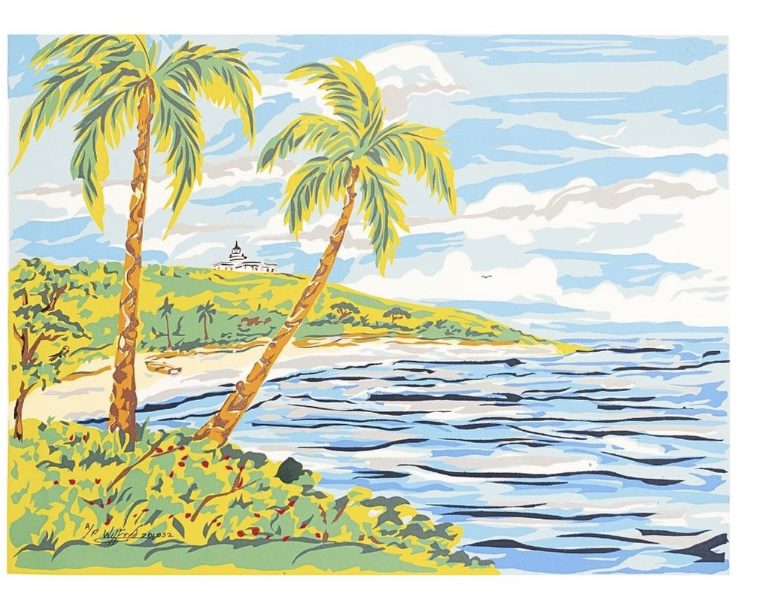
Faro en el Sur, 2004 Edition A/P silkscreen by Wilfred Labiosa (Photo courtesy CMCArts)
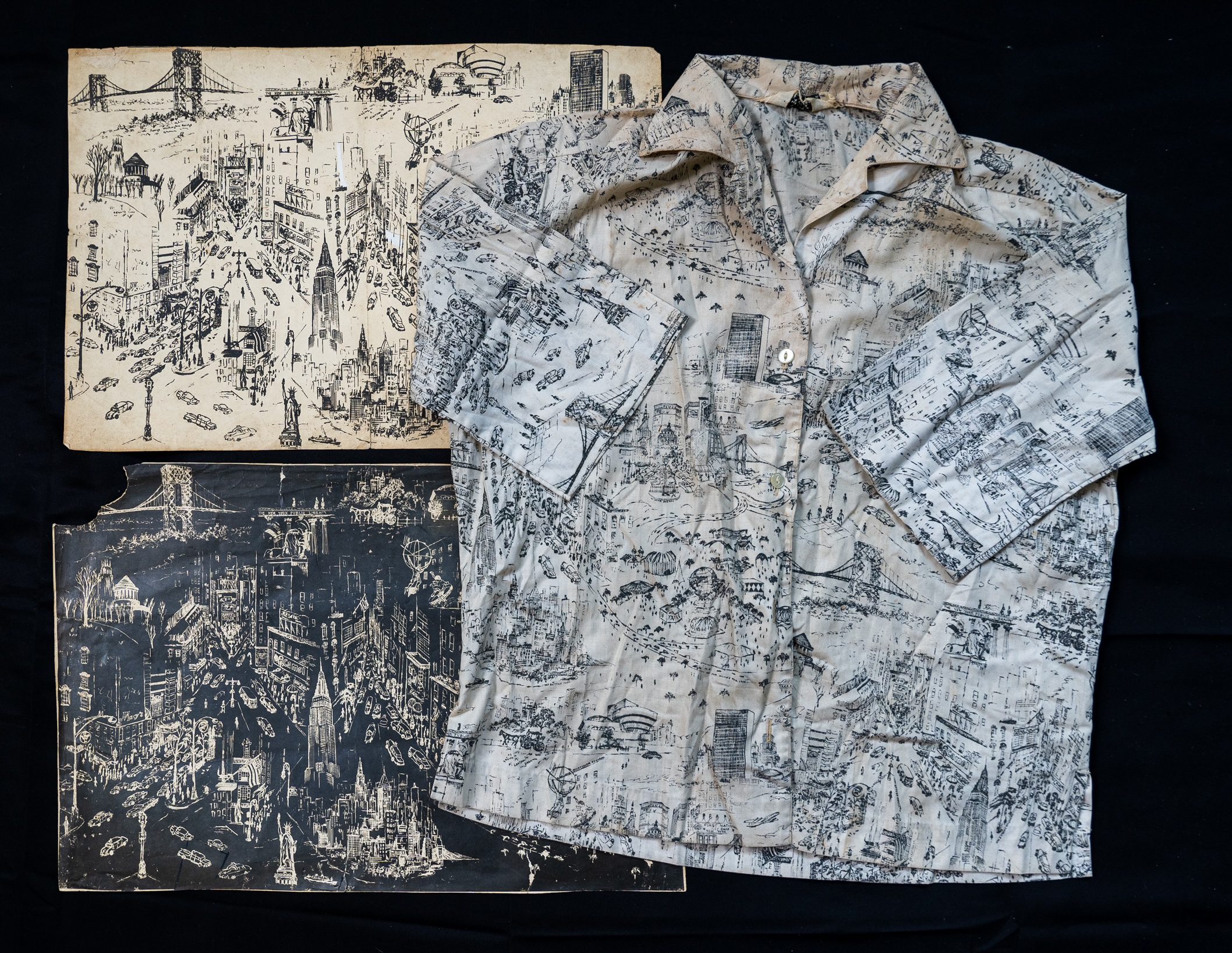
One special artpiece of the artist Labiosa is a shirt he was commissioned to create for the owner, at the time, of the Lord & Taylor department store in New York City. The original art was a mural by Labiosa for the NY Pavilion at the 1964 World’s Fair, which was ultimately created into the shirt. It depicts little vignettes of New York, including the Guggenheim Museum and many other icons.
World’s Fair Shirts, 1964 by Wilfred Labiosa (Photo courtesy CMCArts)
Labiosa vividly retells the story of his older sister, who was a bumblebee ballet dancer in the NY Pavilion at the time of the 1964 World’s Fair. She was just a toddler and he had not been born yet, he said with loving amusement.
The six upstairs galleries show Labiosa’s work divided into significant parts of his artistic life, CMCArts executive director Lisa Mordhorst shared. Some are dedicated to his life in New York and New England, specifically the Boston area. Mordhorst explained that some earlier pieces are of Old San Juan. She described the 1964 World’s Fair shirt as “magical.”
World’s Fair Shirt (detail), 1964 by Wilfred Labiosa (Photo courtesy CMCArts)
“His affection lies with Old San Juan, so most of his work and life is reflected in those images. I was especially moved by his images of El Yunque National Forest. There are many street scenes from Old San Juan,” Mordhorst delighted in sharing.
La Rogativa, 2005 Edition A/P silkscreen by Wilfred Labiosa (Photo courtesy CMCArts)
“Impulsivismo” [Impulsive] is a series of natural landscapes, abstracts and vibrant quick sketches that have evolved – like Fishes in the Night, Human Struggle and Bird Struggle, Mordhorst observed. “You can feel the emotion in the brushstrokes and the drawing strokes,” she noted. Some are almost impressionistic. “The impulsive part is that the artist allowed himself to be free,” Mordhorst interpreted.
“It is really an honor to be hosting the show and to be the first venue in this traveling retrospective. We are grateful for our friendship and connection with the artist’s son, Wilfred Labiosa, who has been involved with CMCArts almost eight years now, with his volunteerism as the board of directors treasurer. It’s an honor to tell the story of his father who was an incredibly dedicated artist and educator. He really spent a lot of time with underserved kids in areas that are underserved – making sure he shared the power of art with the world and with young people,” Mordhorst said.
A print catalog of Wilfred Labiosa’s work is available for purchase.
“Labiosa: A Retrospective” in the CMCArts Upstairs Galleries,
Sept. 6 – Nov. 8.
Museum Hours: Tuesday – Saturday, 9 a.m. to 4 p.m.
For more information:
cmcarts.org
Call: 340-772-2622
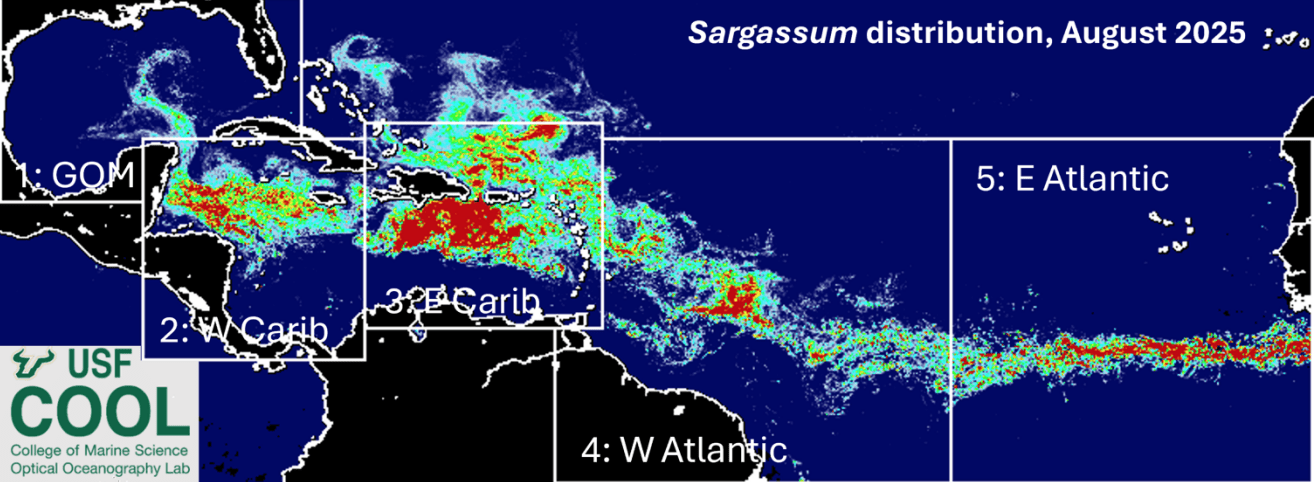
A map of sargassum observed via satellite in August. Darker red colors indicate more sargassum. (Photo courtesy USF Optical Oceanography Laboratory)
Sargassum levels across the Atlantic declined in August, but researchers say totals remain far above normal, leaving the U.S. Virgin Islands and the wider Caribbean at risk of inundations, according to a recent report from the University of South Florida’s Optical Oceanography Lab.
The OOL at USF uses satellite imagery to monitor the presence of sargassum across the Tropical Atlantic, Caribbean Sea, and the Gulf.
“As predicted in the sargassum bulletin in July 2025, total sargassum amounts in all but the eastern Atlantic region decreased in August,” according to an update from a sargassum outlook report released on Aug. 31 from the OOL at USF. “The most substantial decrease occurred in the Western Atlantic, from greater than 18 metric tons to six metric tons.”
“The decreases in the Gulf and Western Caribbean were minor because of the continuous influx arriving from the Eastern Caribbean. Some of the decreases in the Eastern Caribbean, and particularly to the north of the Eastern Caribbean, could be partially due to Hurricane Erin.
“Nevertheless, total sargassum amount in every region still exceeded the historical record for the month of August. Significant sargassum inundation events have continuously been reported around most Caribbean nations and islands, especially in the Mexican Caribbean,” the update explained.
Cyclones and the Displacement of Sargassum
The Source connected with Brian Barnes, Ph.D., an assistant research professor at USF, who provided additional information about the effects on sargassum due to tropical cyclones, including Hurricane Erin, which passed just north of the USVI in mid-August.
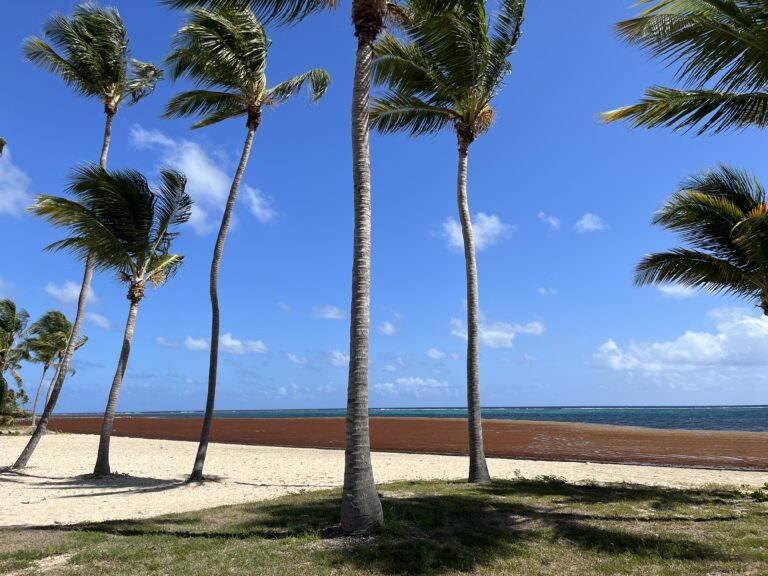
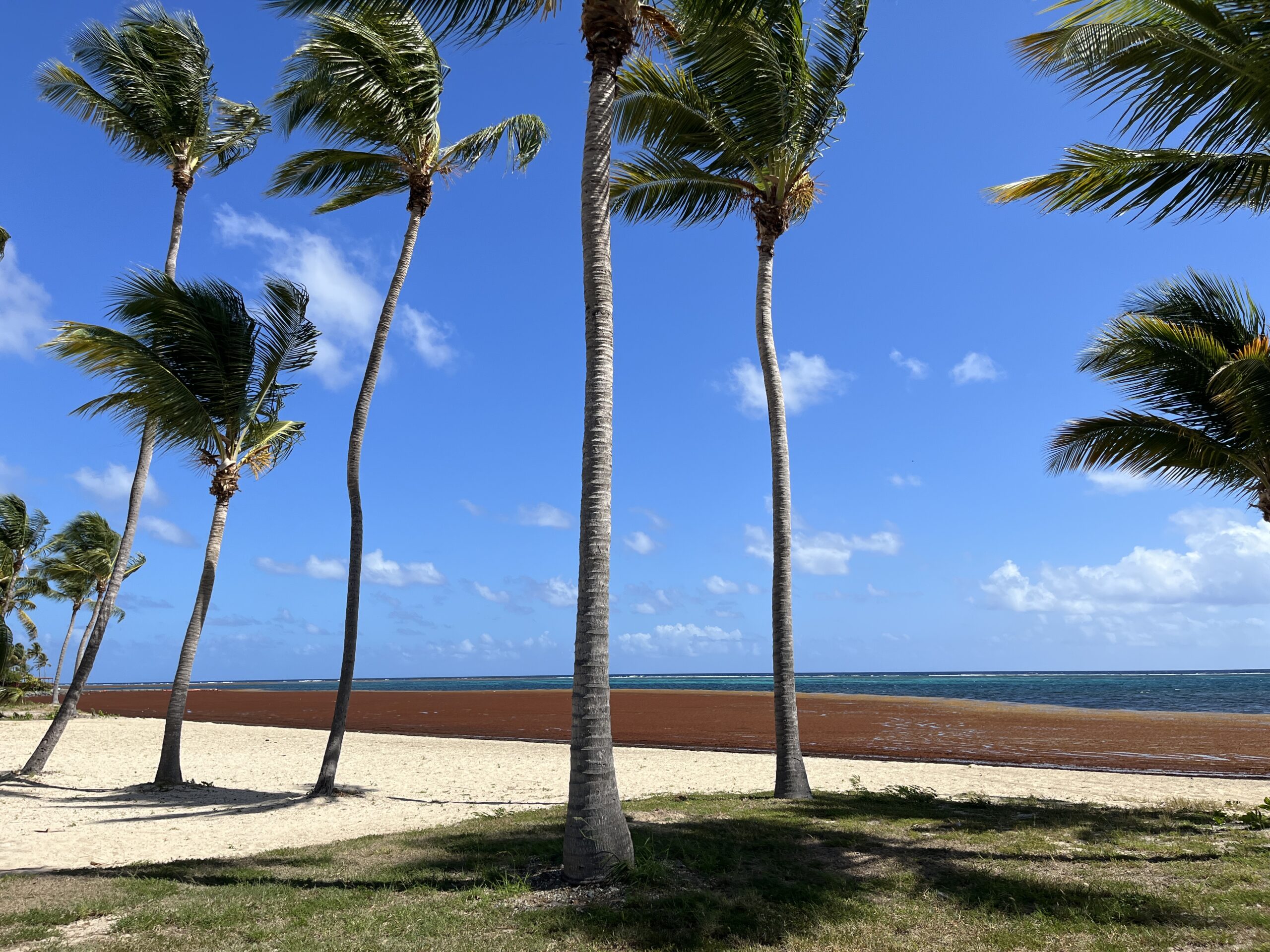
Sargassum observed on Aug. 14, along the Northside of St. Croix, prior to the passage of Hurricane Erin, which later tracked north of the USVI. (Photo by Jesse Daley)
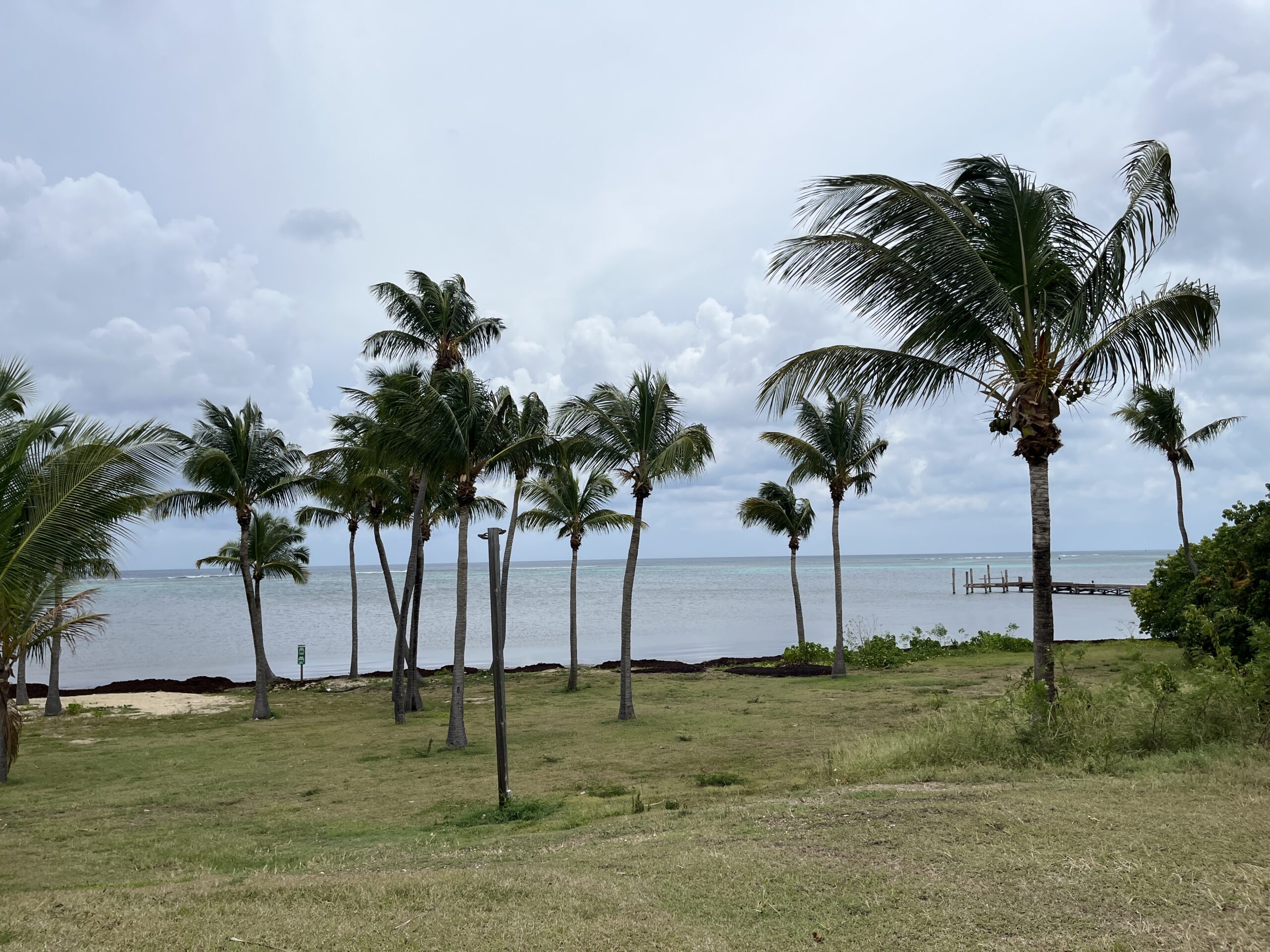
Several beaches that had been inundated with seaweed prior to Erin’s passage were largely free of sargassum once the storm moved away from the region.
“The impact of hurricanes on sargassum is not always straightforward,” Barnes said. “We’ve seen both increases and decreases in abundance following previous storms. On the one hand, storms can mix in deep water, which is rich in nutrients, while on the other hand, the strong winds may batter or physically submerge the sargassum, such that it sinks. For Hurricane Erin, there was a substantial biomass reduction in the cyclone’s wake,” he explained.
Inundations are Still Possible Across the USVIWhile a decrease in sargassum comes as good news, unfortunately, areas across the USVI and Puerto Rico will still likely experience inundations of the algae due to a large amount still in the ocean.
“As in previous years, the momentum of sargassum decline is likely to continue in the coming months, possibly reaching the annual minimum around October into November,” USF said. “However, because the absolute amount is still much higher than any previous August, sargassum inundation of variable degree will continue to occur in most of the Caribbean nations and islands. Still, whether a beach or small region receives large amount of sargassum depends on local factors that are difficult to predict, including winds and ocean currents,” USF added.
Sargassum observed on Aug. 17, along the Northside of St. Croix, following the passage of Hurricane Erin north of the USVI. Erin’s path across the Atlantic displaced seaweed throughout the region. (Photo by Jesse Daley)
“Despite overall declines, there’s still a lot of sargassum in the area, which means inundations are likely to continue in USVI,” Barnes said.
To deal with future accumulations of seaweed, local officials in the USVI have begun using floating barriers to divert incoming mats of sargassum before they reach the shoreline. However, while the booms have shown promise in keeping beaches clearer, they require constant upkeep due to strong currents and storm damage. The booms also need to be removed ahead of any possible approaching cyclones.
As was reported recently in a Source interview with Amy Dempsey, a marine biologist and environmental consultant and founder of the environmental consulting firm Bioimpact, Inc., additional booms are planned for the future.
While Dempsey confirmed that new deployments are being considered, funding remains a major hurdle. “The barriers are expensive, and unfortunately, someone has to be willing to put up the cost for the barriers, permitting, installation and monitoring.”
While most barrier deployments have been funded privately, Dempsey stressed the need for public investment and engagement, especially for protecting public beaches and nearshore habitats.
“We need to find funding sources so that public beaches and important resources can be protected,” Dempsey stated. “The public can advocate for financing through private funding to address this issue.”
Follow Sargassum Updates and the Weather Forecast
Individuals can follow the progression of the current mat of seaweed and stay up to date each month on where sargassum may be headed.
Finally, in addition to tracking the occurrence of sargassum, residents and visitors across the U.S. Virgin Islands are encouraged to continue monitoring the local weather forecast.
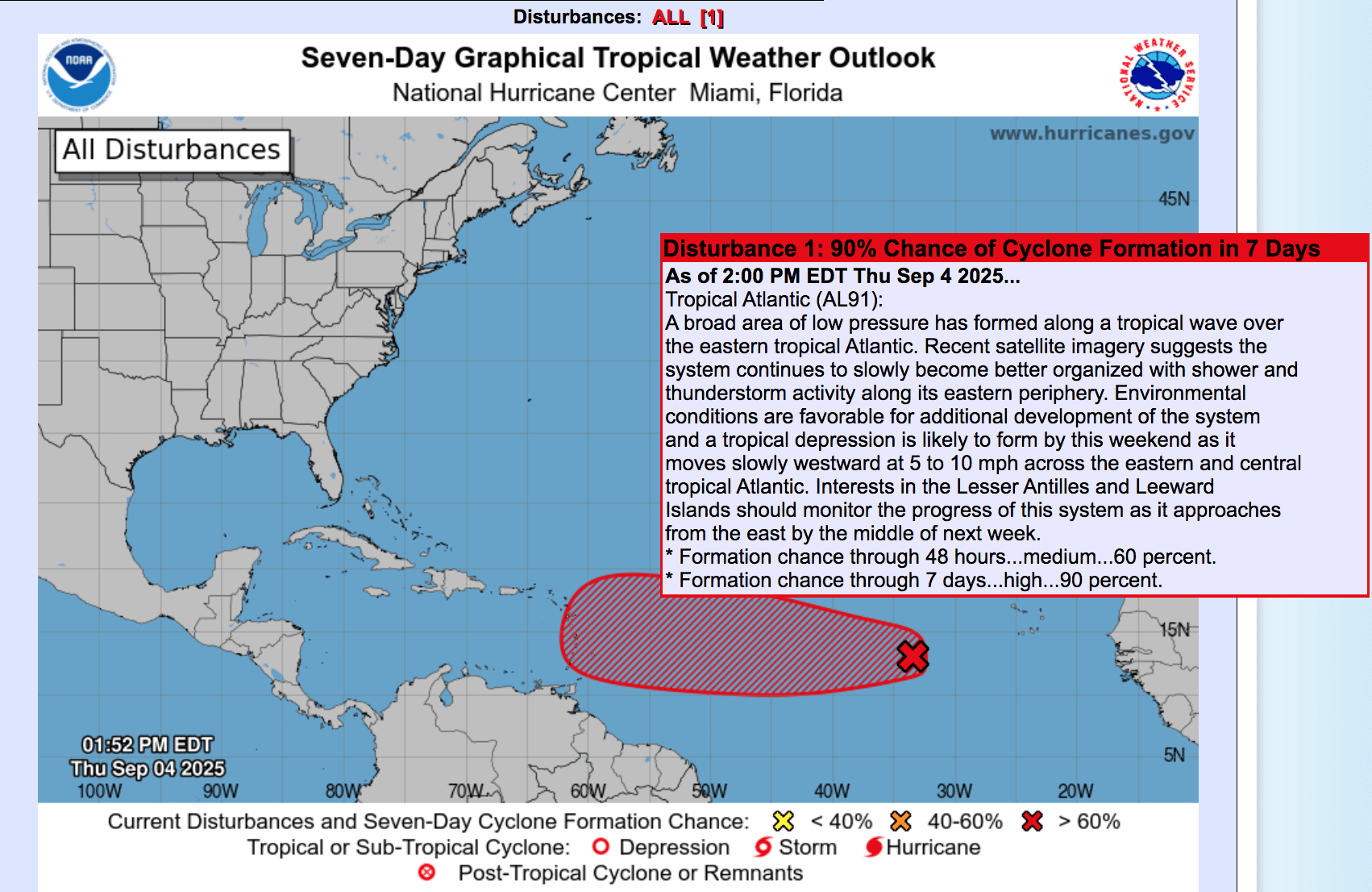
The National Hurricane Center is monitoring a tropical wave moving across the Atlantic Ocean with a high risk of development over the next seven days. The wave, currently designated as “Invest 91L,” is expected to intensify and could move close to the local region next week. Residents are urged to follow the forecast closely.
The NHC is monitoring Invest 91L in the eastern Atlantic, noting a high chance of development over the next seven days. Residents and visitors across the USVI are advised to monitor the system closely. (Photo courtesy of NHC)
Meanwhile, the National Weather Service in San Juan, Puerto Rico, has warned that very warm temperatures will persist across the area, and heat alerts may be issued. Showers and thunderstorms are also possible as a separate, smaller tropical wave moves through the area on Friday. Additionally, Saharan dust will be present in the atmosphere Friday, creating hazy skies and reducing air quality.
Weather information is available from the NWS, the NHC, and NOAA. The local weather forecast for the U.S. Virgin Islands is regularly updated on the Source Weather Page and VI Source YouTube Channel, and individuals can also find helpful weather information and alerts from the Virgin Islands Territorial Emergency Management Agency.
From left, Michele Matti, Lori Thompson, Simona Thomas, and Chris Borgesen address the support group Wednesday at Shore Prosthetics and Orthotics. (Source photo by Adisha Penn)
Shore Prosthetics and Orthotics in Tutu Park Mall hosted a support group for amputees Wednesday, hoping to connect individuals experiencing daily life with amputations and professionals who can lend support.
The intimate group event, open to those directly affected by limb loss, their families, friends, and health care professionals, provided an open space for individuals to share their experiences.
Chris Borgesen, vice president of operations at Shore Prosthetics, said the event was hosted to “get people to meet each other and learn to cope with limb loss.”
“In the Virgin Islands, sometimes it can be challenging,” Borgesen said, and added challenges can include “how the house is set up and how to do modifications.”
Lori Thompson, a psychologist at Insight Psychological Services, said her work includes talking to people after they have had an amputation. She addresses “the grieving process” and how one can cope with trying to navigate life after limb loss.
Thompson was accompanied by mental health professionals Simona Thomas and Michele Matti. She asked the group about things they have done to navigate daily life.
“I heal fast because I think positive[ly] that I want to heal,” said Henry. “I don’t give up … I never feel sorry for myself … I just continue being positive.”
“We need to have people who have successfully navigated the process,” said Thompson, after hearing Henry’s remarks. Thompson shared that sometimes individuals struggle to learn how to adjust to an amputation.
Windgrove Smithen, another attendee, shared that he lost his leg in 2021.
“‘Don’t worry about being an amputee, we’re going to get you walking,” Smithen recalled the team at Shore Prosthetics telling him. “And I appreciate that so much,” he added. “I’m grateful for you all.”
Even Theodore Nisbitt, an attendee who lost his limb doing forklift work at his job, was positive about his recovery and current lifestyle, sharing some of his experience with the group.
“When it happen[ed], it was a shock of course,” said Nisbitt, who added his daughter was “right around the corner” to be born. He shared that he did not remember feeling any pain when the accident occurred but, after surgery, that’s when the pain kicked in. “Therapy and stuff, I don’t think it’s easy for anybody. It’s just how you as a person take it. It’s not the end. I still have my health, I’m still alive,” said Nisbitt.
“You guys are tenacious,” said Thompson, after hearing the optimism from the group.
Smithen replied, “That happens when you’re not ashamed of the situation.”
Though all attendees spoke on the challenges of having amputations, most shared an extremely positive outlook on life after being amputated. However, some attendees shared their struggles, especially with being caretakers.
One attendee shared that she has a brother who had one of his legs amputated and spoke about the struggles of having to assist him, with one of her biggest challenges being the commute to him on St. John.
“Because he lives on St. John, I live here, throughout the time he was in and out of the hospital I was his constant support,” she said. She added, “It was kind of hard and kind of difficult for me. You just thought this would have been a quick process,” she said of the amputation, “and then here it is, I’m still here working with him.”
Thompson told the group that seeing a psychologist or psychiatrist helps individuals cope with adjustments to life after limb loss, signaling that the grieving process of losing a limb or being a caregiver can be daunting.
“Think on when you were a kid and you were on a bike or a skateboard and you fell down and you got cut,” said Thompson. “If you just put a bandage on top of it and pretend it doesn’t exist, what’s going to happen?” she asked. “It gets infected.”
Henry, who also shared her experience being a caregiver as well, referred to Psalms 121 as being “a helping psalms” for her while she recovered. She even recalled her doctor telling her, “I’ve never seen this before, you’re healing so fast,” the day after she lost her leg to diabetes. To her, the word diabetes means to “die-or-beat-it!”
Before the meeting ended, with some tears being shed, Borgesen said he sees patients who are either driven to live life and get back to normalcy after their amputations or those who stay complacent with their condition. He said the support group at Shore Prosthetics is meant to be a place where those who are managing well can inspire those who are having some difficulties managing.
For more information on Shore Prosthetics and Orthotics, go to www.shoreprosthetics.com or call 340-714-1009.