















Weekly Weather Forecast With Jesse Daley

0
Check out our weekly weather forecast with Jesse Daley, covering Sunday, July 27, through Saturday, Aug. 2. Our YouTube playlist is updated every week, AND check out Jesse’s daily weather updates here.

Tropical Waves to Bring Unsettled Weather to USVI, Puerto Rico

0
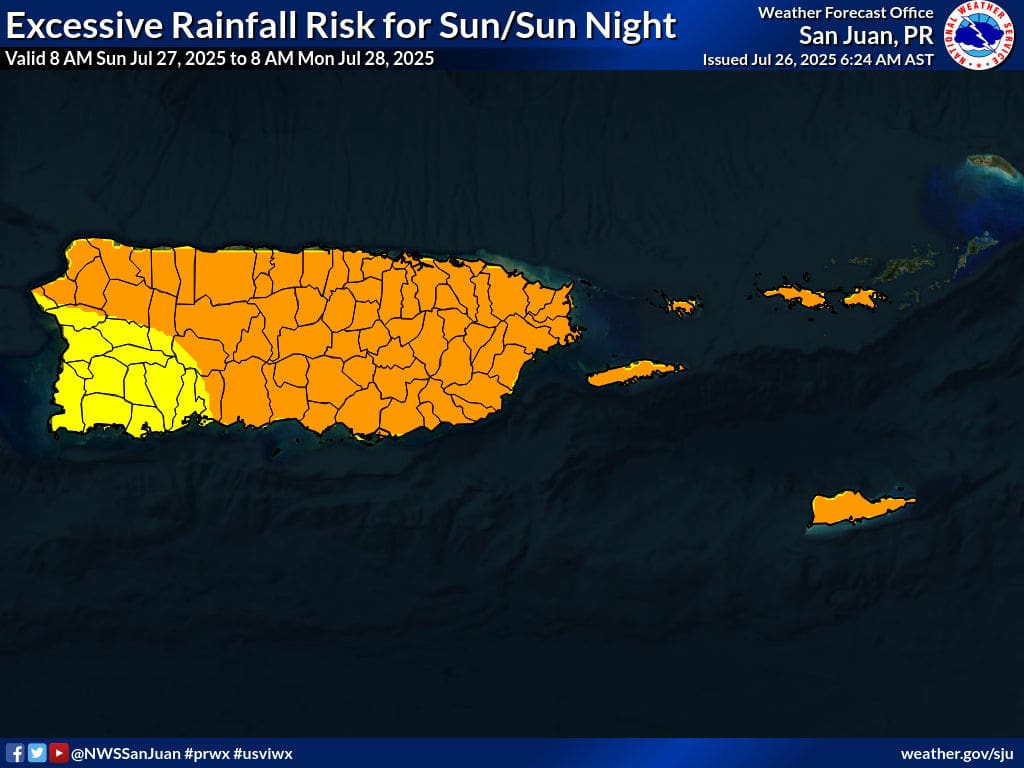
A graphical forecast for Sunday, July 27, indicates the potential for excessive rainfall across the USVI and Puerto Rico. Yellow indicates a limited excessive rain risk and orange designates an elevated excessive rainfall risk. (Photo courtesy NWS)

Two tropical waves approaching the eastern Caribbean are expected to bring periods of rainfall and thunderstorms to Puerto Rico and the U.S. Virgin Islands from Sunday through early next week, according to the National Weather Service in San Juan, Puerto Rico.

The NWS explained that the first of the two waves is anticipated to arrive across the local islands during the overnight hours of Saturday into Sunday.

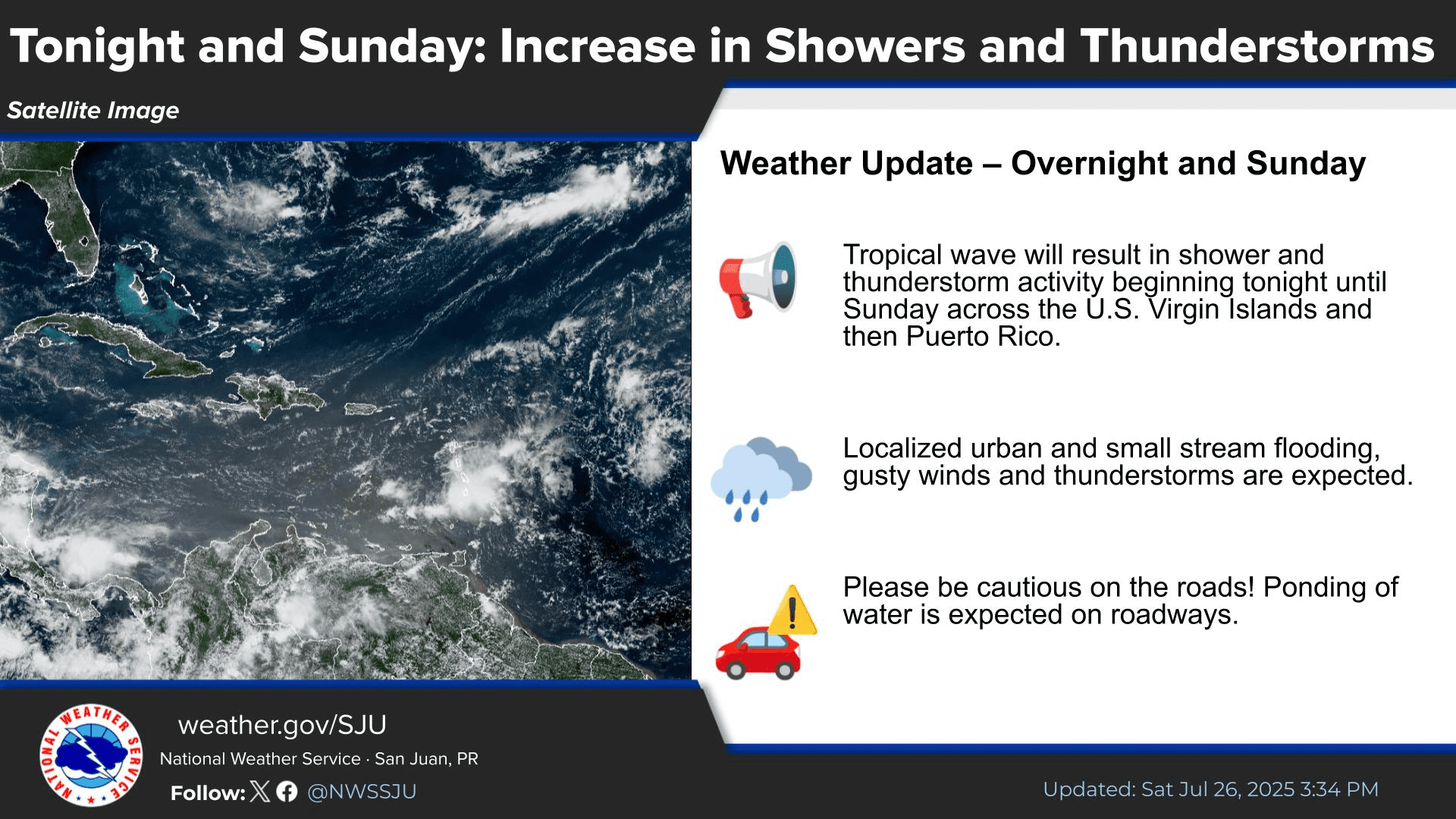
Graphic provided by the NWS describing weather impacts across the USVI and Puerto Rico between Saturday night and Sunday. (Photo courtesy NWS)

“An increased risk of urban and small stream flooding is expected across the local islands on Sunday and Monday as tropical waves move through the area,” the NWS explained in an update on Saturday morning.

“As the first wave progresses, periods of showers are expected to increase in the vicinity of the Virgin Islands overnight on Saturday, gradually moving into Puerto Rico during the morning and afternoon hours on Sunday,” the NWS said.

“Rainfall accumulations are expected to range from one to three inches, and some localized urban and small stream flooding can be anticipated, as well as gusty winds within the thunderstorms,” the NWS stated. “The areas with the highest risk of flooding are the east-southeast and the west-northwest.”

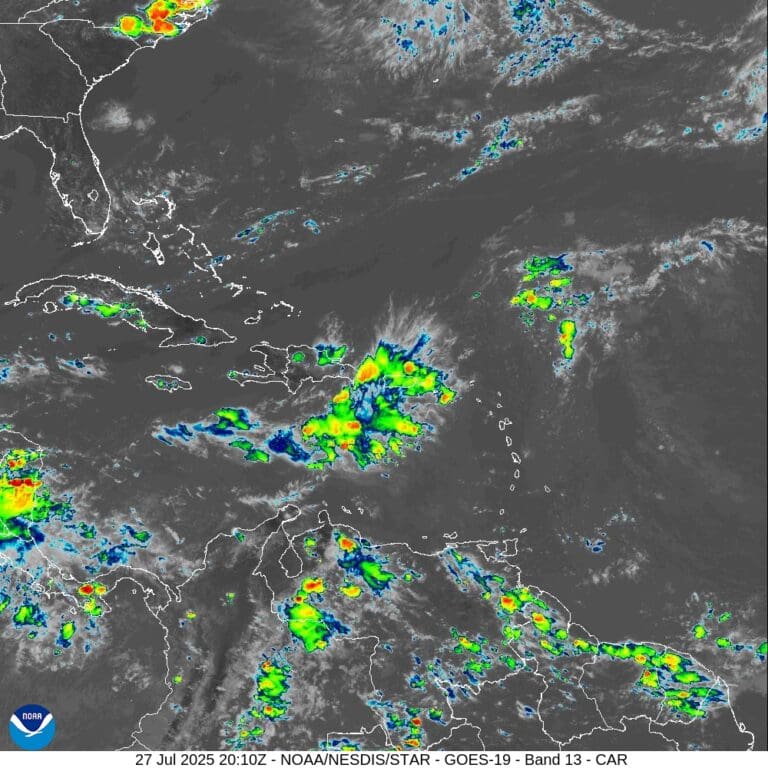
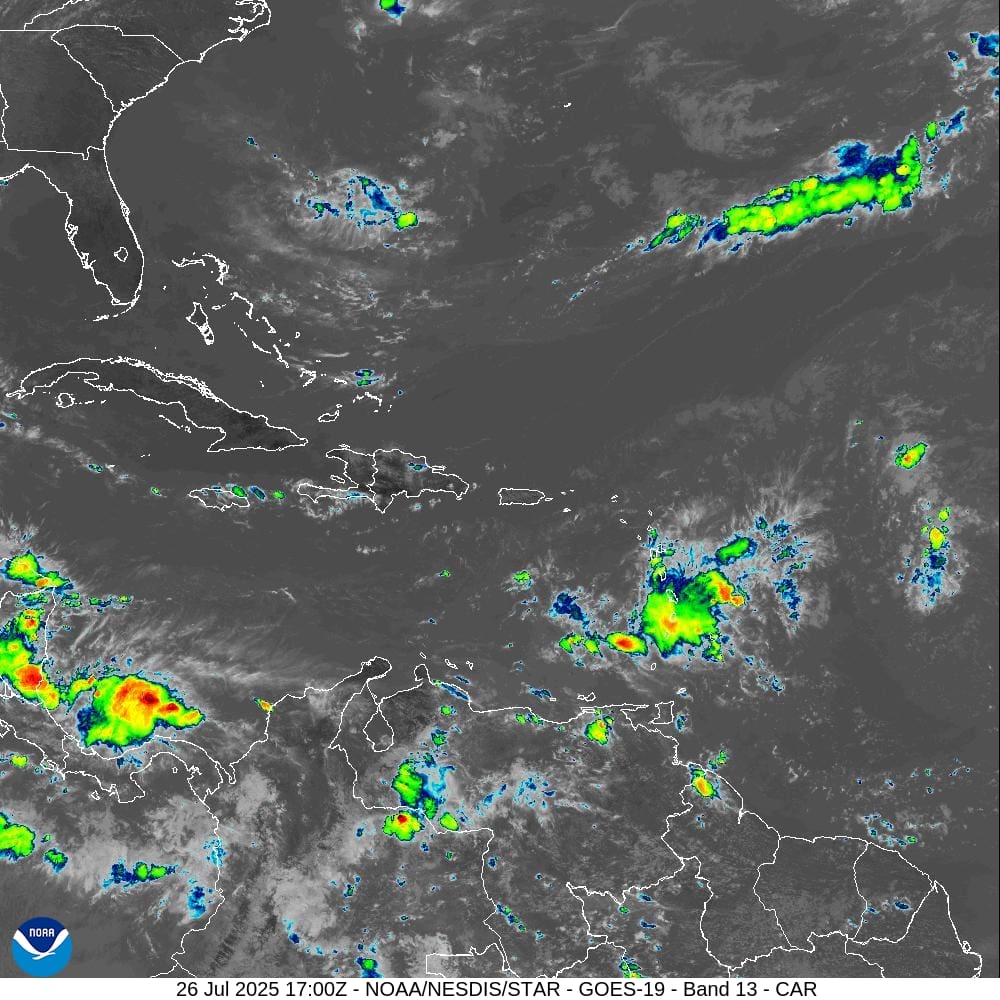
Infrared satellite imagery obtained at 1:00 p.m. AST on Saturday. The NWS expects a tropical wave to pass over the USVI and Puerto Rico this weekend, increasing the chance of rainfall and thunderstorms. A second tropical wave will arrive on Monday. (Photo courtesy NOAA)

The NWS update said that the second tropical wave will approach the area on Monday. “On Monday, yet another wave will move into the region,” the NWS said. “This wave does not look as concentrated as the wave on Sunday, but showers will still manage to reach portions of eastern Puerto Rico and the Virgin Islands through the day on Monday,” the NWS noted.

Warm Temperatures, Gusty Winds, and Choppy Seas

The NWS warned that warm temperatures, accompanied by a potentially high heat index, will affect the USVI and Puerto Rico over the next few days. Residents and visitors across the region are encouraged to remain hydrated and as cool as possible to prevent heat-related illnesses.

In addition to the tropical waves moving through the area, gusty easterly winds will continue. Boaters and swimmers are advised to exercise caution due to wind-driven choppy seas and the potential for rip currents.

“Beachgoers can expect a moderate risk of observing life-threatening rip currents along the exposed beaches in the northwest coast of Puerto Rico and Saint Croix,” the NWS predicted. “In contrast, elsewhere expect a low risk of rip currents. Regardless of the low risk, isolated stronger rip currents may occur, especially near piers, jetties, and channels.”

Tropical Outlook

Regarding the possibility of cyclonic development in the coming days, the National Hurricane Center has not flagged any areas of interest across the Atlantic Basin for the next seven days.

During a Saturday morning phone call with the Source, Mariangelis Marrero Colón, a meteorologist at the NWS in San Juan, Puerto Rico, explained that environmental conditions are not very conducive for cyclones to form at this time.

While several forecast models have hinted at a slight potential for a system to organize next week, Mariangelis Marrero Colón emphasized that the NWS in San Juan would be watching the tropics closely.

“The environment is hostile for storms to develop,” Marrero Colón stated. “That said, we will continue to monitor the NHC. However, as of Saturday morning, the NHC is not forecasting any potential for the development for the next seven days.”

Nevertheless, it is crucial to remember that the forecast can change very quickly. USVI residents and visitors are encouraged to continue to remain prepared.

In addition to obtaining weather information from the NWS, the NHC, and NOAA, the local weather forecast for the U.S. Virgin Islands is regularly updated on the Source Weather Page and VI Source YouTube Channel. Individuals can also find helpful weather information and alerts from the Virgin Islands Territorial Emergency Management Agency.

Summer Madness Hoops Classic Tips Off at MCM Center

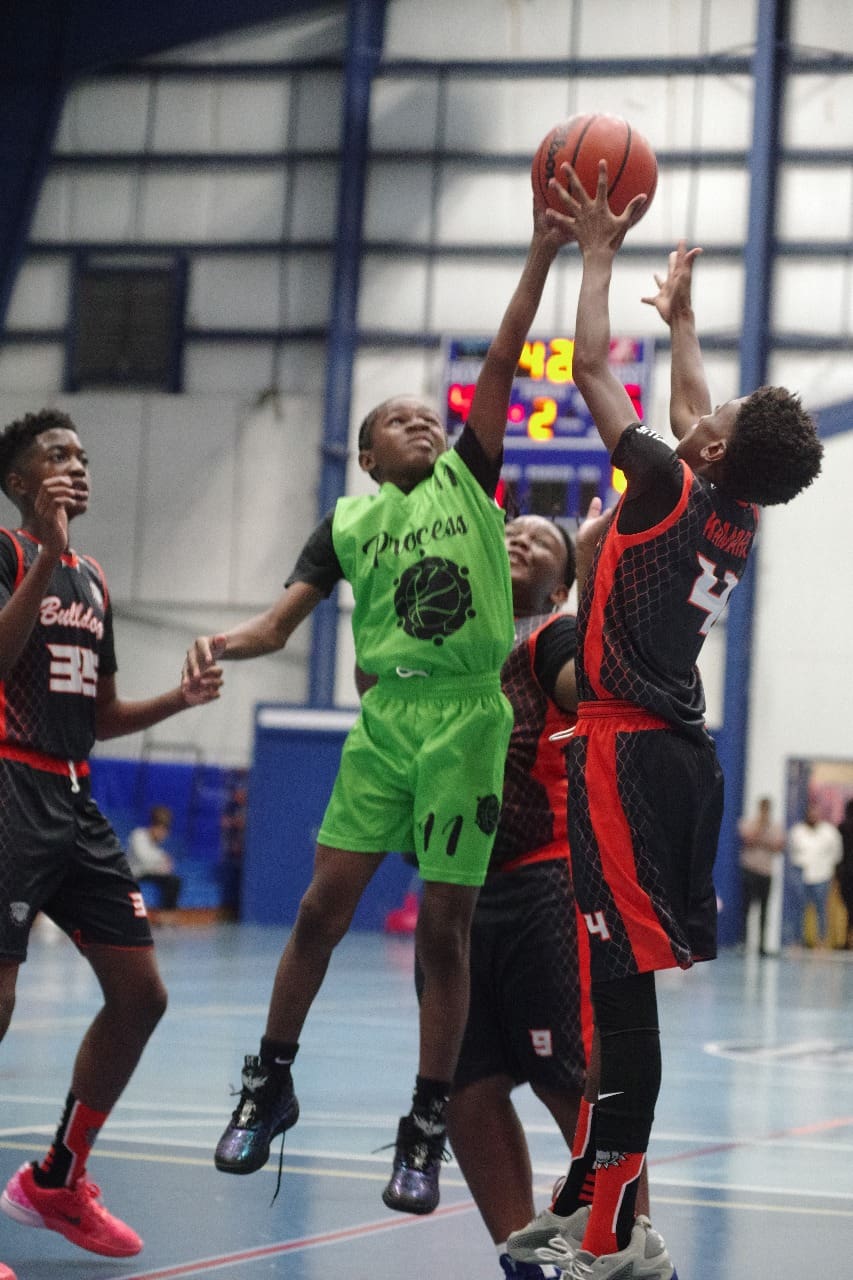
Player jumps for the rebound in the Process vs Bowie 11U Division game at the Summer Madness Hoops Classic. (Photo submitted by Lester Harvey)

The Summer Madness Hoops Classic tipped off Friday at the Mark C. Marin Center with a full slate of five games, launching a weekend of youth basketball competition. The opening game saw St. Croix Guidance take out the British Virgin Islands’ Out The Mud with a 36-12 victory in the 12U Division. Kirt Thomas led Guidance with nine points and seven steals. Kyle Gumbs Jr. was the game’s top scorer with 13 for Out The Mud.

Game two saw an 11U team from Bowie, Md., dropping 50 points. Their tower in the center, Ryan Tay, recorded 27 points, 13 boards, and four blocks. Kyle Gumbs and Makai Hodge combined to score 17 of The Process 12U team’s 28 points.

The Process, Makai Hodge, in a green uniform, drives to the basket in his team’s game against the 11U team from Bowie, Maryland. (Photo submitted by Lester Harvey)

St. Croix teams continued their winning ways in the third match-up of the day as Alliance 12U team slowed down St. Thomas’ Process 12U team, 25-19. Michael Phillips led Alliance’s balanced attack with eight points and eight rebounds. Phillips had four other teammates score at least two baskets. Makai Hodge contributed eight points for The Process.

Guidance 12U team found themselves on the court for the second time that evening, facing the 12U team from Bowie. The stateside program collected its second win of the day with a 33-19 victory. Sem Abel was the game’s top scorer with 15 points. Lamar Harris’s five points led Guidance.

Wisdom Raynor, Bowie 14U team, lays the ball up in their game against SVA. (Photo submitted by Lester Harvey)

Bowie’s 14U team made it a clean sweep for the team from Maryland as they defeated Sports Vision Academy (SVA) All Stars based in Tortola, 50-18.  Howard Hill came off the bench to pour in 14 points, secure six rebounds, and snatch four steals. Klan Stoutt dropped seven points for SVA.

Saturday’s results: Game 6 – 12U Division – Bowie 33 – Process 9 Game 7 – 14U Division – Process 34 – Guidance 23 Game 8 – 12U Division – Out the Mud 18 – Alliance 12 Game 9 – 11U Division – Guidance 21 – Process 17 Game 10 – 14U Division – Bowie 43 – Process 30 Game 11 – 14U Division – SVA 46 – Guidance 36 Game 12 – 12U Division – Guidance 30 – Process 11 Game 13 – 12U Division – Bowie 41 – Alliance 31 Game 14 – 11U Division – Bowie 30 – Guidance 10 Game 15 – 14U Division – Bowie 59 – Guidance 47 Game 16 – 12U Division – Bowie 44 – Out the Mud 25 Game 17 – 14U Division – Bowie 30 – Guidance 10 Game 18 – 12U Division – Guidance 26 – Alliance 19

The final day of SMHC is Sunday, July 27, at the MCM Center on Antilles School campus.  Admission is $15 for adults and $5 for children.

Schedule: Game 20 – 9:00 a.m. – The Process vs Guidance – 11U Division Game 21 – 10:00 a.m. – Bowie vs Guidance – 14U Division Game 22 – 11:00 a.m. – Out the Mud vs Guidance – 12U Division Game 23 – 12:00 p.m. – SVA vs Process – 14U Division Game 24 – 1:00 p.m. – Winner of game 20 vs Bowie – 11U championship game Game 25 – 2:00 p.m. – Winner of game 22 vs Bowie – 12U championship game Game 26 – 3:00 p.m. – Winner of game 21 vs Winner of Game 23 – 14U championship game Closing ceremonies – 4:00 p.m.

Education and Tutu Park Mall Stage Annual Back to School Community Connectivity Event

0
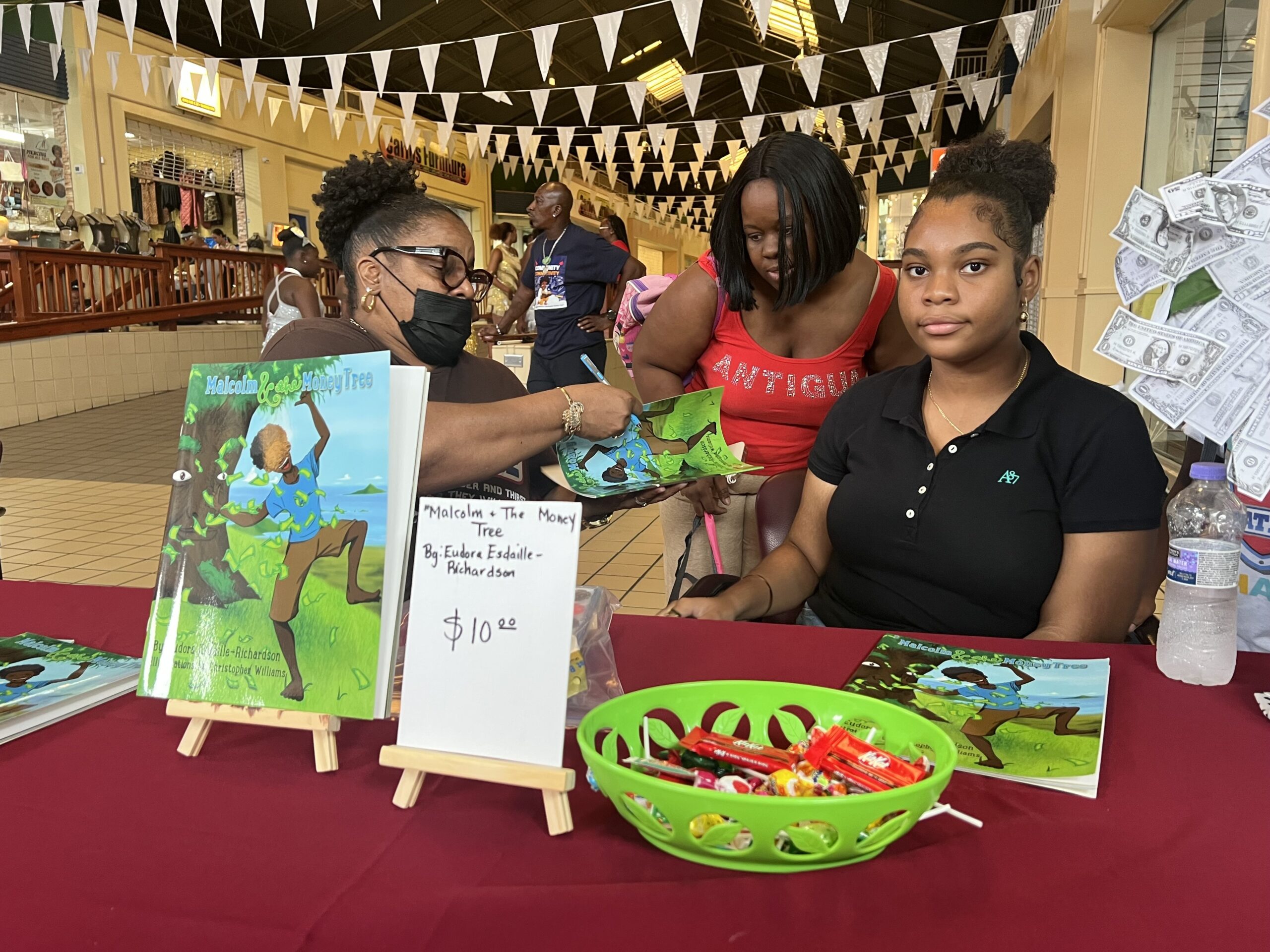
Author Eudora Esdaille-Richardson autographs a copy of her book, Malcolm & the Monkey Tree, as Marleta Richardson looks on. (Source photo by Judi Shimel)

As parents and guardians spent Saturday picking out clothes and supplies at Tutu Park Mall, the Department of Education greeted them with a back-to-school event at center court. Those who dropped by picked up free school supplies and useful information to help them and their children prepare for the 2025 fall semester.

Organizers said the annual event is intended in part to help offset the cost of getting students ready for returning to classrooms after the summer recess. More than a dozen displays ringed the area with children’s books by local authors, accessories for school uniforms, and tips on the proper use of child safety seats.

Performances by the St. Thomas Majorettes, Keon Harrigan, Sandra Anderson, and others drew spectators and gave shoppers a break from their weekend chores. Emcee Shayla Solomon introduced speakers and invited everyone to participate for raffle prizes.

Deejay Iggy supplied the tunes.

Assistant District Superintendent Symra Brown-Gumbs welcomes families at Tutu Park Mall on Saturday. (Source photo by Judi Shimel)

Assistant District Superintendent Symra Brown-Gumbs provided commentary on a school uniform fashion show staged with students dressed in appropriate — or not  — attire.

Solomon invited fathers to visit their children’s schools on the first day of classes. She also stressed the importance of regular attendance for all, including youngsters in kindergarten and the primary grades. “We are reminding parents that attendance matters,” she said.

Volunteers from the Disability Rights Center of the Virgin Islands answered questions about Individualized Education Programs. Advocate Shamni Cari said she came to the mall to serve as a resource. “If you’ve got some concerns, whether it’s an evaluation, whether it’s the IEP, whether it’s the follow-up with accommodations — we can provide that information,” Cari said.

Tutu Park Marketing Director Juan Christian said mall executives facilitate the annual back-to-school event as part of their community outreach. “We’re not just a shopping center, but we also have community interest at heart,” Christian said.

Saturday’s event was the first of two Community Connectivity programs being held this year under the theme “Igniting Innovation and Elevating Excellence.” St. Croix will present its Back-to-School Jamboree & Food Truck Festival at St. Croix Educational Complex High School on Aug. 9.

Honeymooner May Have Gotten False “Private Beach” Promise; That’s Nothing New

0
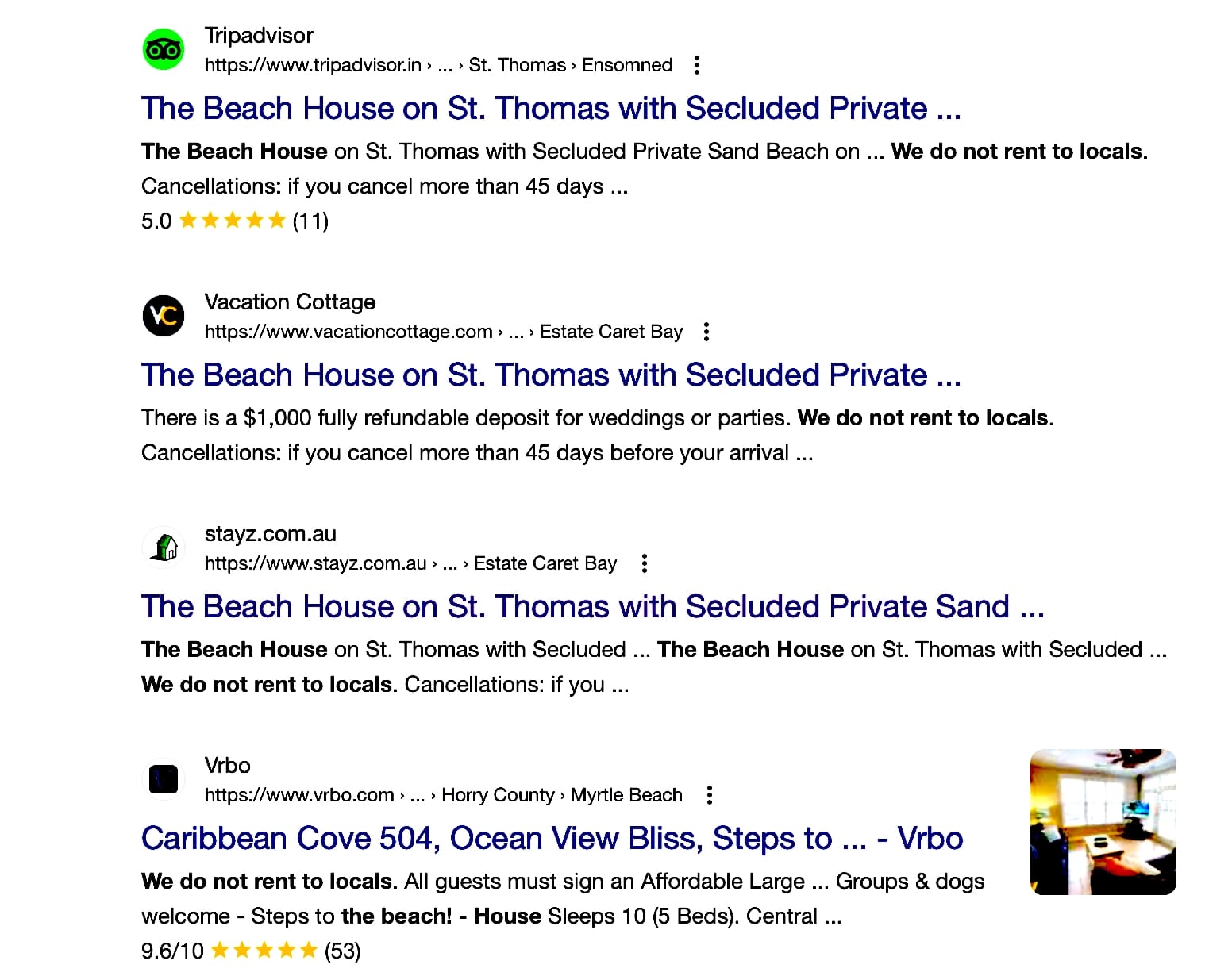
Advertisements for The Beach House falsely listed the property as having a private beach and being off limits to local Virgin Islanders. The listings were changed after a contentious interaction was caught on tape. (Screenshot from internet search)

The owner of a vacation villa advertising a private beach apologized Friday for a melee caught on videotape, where her tenant attempted to eject innocent beachgoers from “private property.” The villa owner also acknowledged discriminatory language on the property website — but had explanations for both offenses.

The video shows a woman in denim shorts and a Texas flag-themed bikini top exclaiming that the beach is private and the woman filming her needs to leave.

The person filming is heard explaining that all Virgin Islands beaches are public.

No maam, theyre not. You can go to a public beach at Magens Bay,” the woman says, hands on her hips, mirrored aviator sunglasses shining.

“Fifty years I’ve lived here,” the woman filming responds in a level tone.

“Congratulations. That’s great. This is private property,” the woman snaps, her voice starting to quiver.

Like many similar videos, the nearly one-minute clip ends with the complaining woman calling the police.

The video, shared widely on social media Wednesday, elicited hundreds of comments, many concerned about misinformation fed to some visitors by mainland landowners renting out Virgin Islands properties. All Virgin Islands beaches are public up to the high water mark.

The complaining woman had rented The Beach House, a secluded villa on remote Mail Beach, for her honeymoon, property owner Annette Elliot said Friday. Being one of St. Thomas’ lesser-known stretches of sand, tucked between Caret Bay and Neltjeberg Bay, an uninformed off-island visitor might be forgiven for assuming it was private — even if it hadn’t been expressly written in advertisements for the villa.

Elliot, who bought the property with her then-husband about a decade ago, said she was unsure why advertisements for The Beach House listed the beach as private. She suggested a previous owner may have written it. Copyright information lists it as being created in 2015 and updated in 2025.

Elliot did, however, accept responsibility for another statement about the villa that has caused outrage.

Listings for the eight-bedroom home on Airbnb, Vrbo, Tripadvisor, Travelocity, Vacation Cottage, and elsewhere included the sentence, “We do not rent to locals.”

The websites did not define who was considered a “local,” but the statement appeared to directly violate VI Code sections covering unlawful discriminatory practices.

The language has since been removed from individual websites, but search engines, which can be slow to adapt to webpage changes, still list The Beach House as having a private beach and unwilling to rent to “locals.”

Elliot, who lives in Virginia, said her ex-husband had added the no-locals clause after renting to Virgin Islanders who threw a raucous two-day party that attracted hundreds, damaged a cistern, disturbed neighbors, and left an ungodly mess. She said it wasn’t meant to discriminate against anyone and that she’d rented to locals for weddings and other events in recent years.

“I’m sorry that happened, and I don’t know why that happened,” Elliot said of the beach incident. “Everybody’s on a different page, and everybody’s all outraged because of our renter.”

She blamed the incident, in part, on nearby rental properties encouraging their visitors to traverse down to the beach either via a dangerous gut or by using her property’s stairs. She said the route passes by The Beach House’s kitchen window, a shower, and a closed gate.

“There’s a huge cliff and there’s the boulders,” Elliot said. “People walk down through the actual property, push through the gate, walk right down to the house, to the steps. You’re very obviously on a property. You can look and see it’s a kitchen.”

Elliot worried she may be held liable if someone got hurt attempting to reach the beach via her property.

“I don’t care if they’re on the beach, you know, but they can’t go through that gut,” she said. “They could really get hurt.”

The Beach House was not the first Virgin Islands property to falsely advertise a private beach. In 2019, the legislature heard testimony of myriad properties falsely claiming a private beach, leaving some vacationers vocally disappointed. A 2020 video appeared to show a woman attempting to deny beach access to several men, going so far as to claim they had threatened her life.

Debate about what the Virgin Islands Open Shoreline Act means is also nothing new.

Title 12, Chapter 10 of the VI Code reads: “No person, firm, corporation, association or other legal entity shall create, erect, maintain, or construct any obstruction, barrier, or restraint of any nature whatsoever upon, across or within the shorelines of the United States Virgin Islands as defined in this section, which would interfere with the right of the public individually and collectively, to use and enjoy any shoreline.”

Concerned citizens have written to the Source since at least 2003, worried that the letter of the law and common practice can be two different things.

In 2024, a group of St. Croix residents sued new property owners who had allegedly placed boulders at what they described as a traditional beach access point.

Until very recently, a St. John vacation rental advertised as having a private beach. The villa’s new owners removed the “private beach” language. Reached Saturday, the villa’s former owner said she meant the word private to mean rarely-visited and out of public view — not that it was private property.

Adding to potential confusion, former renters leaving reviews often boast of a villa’s “private beach” rather than a beach with privacy. The owners of Sand Dollar Estate list the beach in front of their Peterborg property as “secluded,” not private. Multiple reviewers online don’t bother with the distinction.

Bending or breaking rental housing rules is not new in the territory. Federal law protects renters who receive Section 8 housing assistance from discrimination, yet the practice is not uncommon, especially in privately listed homes.

A self-listed two-bedroom, one bathroom home for rent in Estate Catherine’s Rest recently advertised as not allowing Section 8 tenants, as did another in Mt. Pleasant. Professional realty organizations like Coldwell Banker and others have had listings barring Section 8 renters, perhaps by accident.

All professionally listed rental properties go through a central database meant to catch discrimination, but some slip by, realtors in the territory said.

Christine Belmonte, an agent with St. Thomas-based Real Solutions, said realtors were on the lookout for discriminatory listings.

“When we do see stuff like this, we report it,” Belmonte said.

Whether by accident, negligence, or subterfuge, not all property managers are particularly careful with their rental listings’ language. The manager of a St. John vacation rental advertising a “solar heated pool” some years ago was unaware that the statement implied solar panels electrically heated the pool. She meant the statement to mean the pool — like everything else in Earth’s solar system — was heated by the sun.

Kapok Seeds Float Off in Fluff Balls

Fuzzy fluff contains small kapok seeds. (Photo Gail Karlsson)

After witnessing the weeks-long spectacle of a kapok tree (Ceiba pentandra) attracting a mob of bats to pollinate its flowers (see my May 17, 2025, VI Source article if you missed it), I kept going back to see what would happen next.

After the bats come to eat the nectar inside the flowers, and consequently spread the pollen around to other flowers, the flowers fall off. Then the kapok tree’s seeds begin developing inside the cup-like structures where the ovaries are located.

The spaces left when the flowers fall are soon filled with developing seed pods. (Photo Gail Karlsson)

Since there are lots of flowers on the tree, and they aren’t all pollinated at once, some of the seed pods start growing sooner than others. At first, the pod is green and looks like a tiny zucchini. When it gets bigger, the pod turns brown and hard.

Successfully pollinated flowers go on to produce seed pods. (Photo Gail Karlsson)

I kept going back to see how the pods were developing but it was many weeks before I saw any of them opening up. Eventually they started cracking open lengthwise, and I could see rows forming inside that from a distance looked like kernels of corn growing on the cob.

The expanding fibers around the seeds push open the pods. (Photo Gail Karlsson)

After the pod’s hardened skin dropped off, you could see that the ‘kernels’ were actually soft. Soon wisps of the compressed fibers started getting loose as the wind caught them.

The fibers around the seeds keep expanding once they are free from the pod. (Photo Gail Karlsson)

For a while the tree looked like it was decorated with round puff balls. While many other types of trees get their seeds distributed by producing tasty fruits for birds and animals to eat and deliver to another spot that might be favorable for germination and growth, the kapok trees instead send their seeds floating off on fluffy parachutes.

The kapok tree doesn’t put energy into growing new leaves until the flowering and seed development process is over. (Photo Gail Karlsson)

As the fibers got fuzzier and kept expanding and getting looser, some of them kept their ‘kernel’ shape, just growing bigger and softer. Later, they lost it entirely and completely unraveled. Then you could see that there were small, dark seeds attached to the fibers. Because of these fibers, the tree is also sometimes called a ‘silk cotton’ tree.

A light, waxy layer on the kapok fluff makes it shiny and water repellent. (Photo Gail Karlsson)

For many years the kapok fibers were prized by people for use in life jackets and life preservers because they are very light and buoyant and do not absorb water. At the same time, the fluffy fibers trap air, so they retain heat and are useful for insulation and bedding. Over time, people started using synthetic substitutes, but there has been some interest in kapok again as a natural, non-allergenic fiber.

The primary purpose of the light-weight fluff, however, is to transport the little seeds through the air to a space far away from the mother tree where another such huge tree could possibly grow and thrive.

Unfortunately for many of the seeds, and the homeowners nearby, much of the fluff ends up just falling close to the tree, on top of other trees and bushes, or smothering the existing ground cover plants.

Globs of fallen fluff can end up covering the ground and other plants. (Photo Gail Karlsson)

I hope that some of the seeds do reach a good place for them to grow, so there can be more of these wonderful trees around to support local wildlife, and to delight human observers as well.

Gail Karlsson is the author of a photo book Looking for Birds on St. John, as well as two other books about nature in the Virgin Islands – The Wild Life in an Island House, and Learning About Trees and Plants – A Project of the Unitarian Universalist Fellowship of St. John.  gailkarlsson.com.  Follow her on Instagram @gailkarlsson and at gvkarlsson.blogspot.com.

Mental Health Awareness: Grief, Part 1

0
Grief is a life-long process. From my experience, it is one of pain, sorrow, and unexpected waves of emotion where I can cry like it just happened. Recently, I completed a training to become a Certified Grief Therapist. The training was very informative but left me in moments where I was very much reflective on how I’ve been handling my own grieving process. Back in December 2017, I lost my mother. Then in June 2018, I lost my dad, to what can only be described as a broken heart because of my mother’s passing. Six months and three days apart, is all the time I had in between losing them. To say it was difficult, is an understatement. You could never prepare for someone’s passing, whether they were sick or if it was a sudden death, the pain that comes along with the loss, is nothing that you can completely prepare for. The pain for me, was and still is unbelievably difficult. I literally try to be okay with them being gone: EVERY SINGLE DAY. I can remember at times when I was growing up, that there were times, when I heard my dad telling my mom about who should die first. I can chuckle at this now, but it was a strange conversation to hear. One day, I asked him why he tells her that. His reply was that if she died before him, he would not be able to take it. There are days when I can grieve for one and days when I grieve for the other. On those days when I grieve for the both of them at the same time: let’s just say that this is when GRIEF pronounces itself in OVERWHELMING ways, and it hits me with waves of different emotions.  On these days, I push through and find my peace by using a variety of coping mechanisms, and in reflecting on what I would describe as my parents being the best comedians. The memories of their joke telling (without even trying) makes me chuckle out of the blue and I find joy in knowing that I had the best of times with them. Remember that grief is a natural feeling and to feel how you feel when you feel it. Let the waves of emotions wash over you and always remember that you’re not alone. Grief is a part of our mental health. Grief will touch every one of us, at some moment in time. Grief should not be ignored, and at times it needs to be addressed with the help of a mental health professional. Please remember that there is no shame in grieving and no shame in seeking help.  Natalie J. Lewis is a marriage and family therapist licensed in the U.S. Virgin Islands, Florida, Georgia and Virginia. She is a proud graduate of St. Croix Central High School (“The Classic Class”- Go Caribs) and Nova Southeastern University (Go Sharks).

Op-Ed: Creating a Mentally Healthy Community

0
On July 17, I had the privilege of presenting at the Government of the Virgin Islands Health and Wellness Expo. The energy observed as the event affirmed what I have long hoped for and now believe: Our community is ready to talk about mental health. Conversation alone is not enough, we must act.  
Sheena M. Walker
Mental health is not only a personal issue but a public health priority. According to the Caribbean Public Health Agency, one in four adults across the Caribbean live with a diagnosable mental health condition; yet more than 70% go untreated. These statistics are alarming in that they reflect not only data, but our family members, neighbors, students, coworkers and maybe even ourselves.  In the Virgin Islands, we are not immune.  We continue to navigate the aftermath of hurricanes, economic uncertainty, systemic inequities and collective trauma. Repeated exposure to these unfavorable circumstances increases our risk for mental health challenges.   During my talk, I emphasized that shame produces trauma. As author bell hooks wrote, “when you feel like you can’t tell your story…that creates a wound.” Many people in our community carry those wounds, deepened by stigma and a deep-seeded mistrust in healthcare systems.  We are too often told that seeking help is a weakness, or that prayer alone will suffice.  While faith, family and community are vital to healing, especially within our community, we should not discount the value of our mental health providers who provide culturally-informed mental health care.    This is not a suggestion to discard our cultural traditions, but a call to integrate them. We can blend the wisdom of our elders, the strengths of our family and community bonds, and the resilience of our ancestors with contemporary tools like therapy, journaling and mindfulness. Mental health must be decolonized, re-established and reclaimed in ways that honor and serve who we are.   Improving mental health in the Virgin Islands requires more than treatment and access to care, it demands prevention, education, and long-term support throughout the lifespan.  In schools, we can teach emotional intelligence and nonviolent communication to help children mange stress early. For those living with chronic mental illness, we need long-term care programs, adolescent behavioral supports, and independent living services that promote dignity and recovery.  Parents, seniors, and new mothers also need accessible spaces, like day treatment programs and family support groups, for connection, education and healing.   But this responsibility does not fall solely on government agencies, it belongs to all of us.  As individuals, we can normalize open conversations about mental health in our homes.  As educators, we can foster classrooms that support emotional expression. As healthcare providers, we must deliver care that honors cultural identity and historical context. And as policymakers, we must fund and prioritize mental wellness not as an afterthought, but as a cornerstone of community well-being. Mental wellness is not a luxury but a human right. It is time that we move beyond stigma and create lasting pathways to healing. Together, we can build a stronger, healthier Virgin Islands.  

Update: White, Hendricks Guilty of Wire Fraud, Bribery

0

Friday, July 25 | 6 p.m.

A jury of their peers found Calvert White, the former Sports, Parks and Recreation commissioner, and Benjamin Hendricks, a business owner, guilty of committing honest services wire fraud and federal program-related bribery Friday afternoon at the federal courthouse on St. Thomas. No sentencing date was set.

The charges against White and Hendricks stemmed from a federal investigation into a kickback scheme by which White — with Hendricks as a go-between — tried to solicit a $16,000 bribe in exchange for steering a federally-funded contract to install security cameras to Mon Ethos Pro Support, a surveillance company formerly owned by the federal government’s cooperating witness in the case.

Devin Kowalski, special agent in charge of the Federal Bureau of Investigation’s San Juan office, told the Source that Friday’s verdict was “a testament to the community’s impatience with corruption.”

“Twelve people agreed today that this was an unacceptable situation for the community, and they convicted” the defendants, Kowalski said. “And I’m proud of that fact. I’m proud of the agents and the professional staff of the FBI that worked tirelessly on this case.”

Kowalski credited the work of the U.S. Attorneys Office, the Justice Department, and the V.I. Inspector General’s Office in bringing about Friday’s verdict, which he said took many years.

“We don’t build a case overnight that’s going to produce that outcome,” he said. “So the community needs to trust — and I recognize that there’s a trust deficit — the community needs to trust the FBI is working to make sure all the T’s are crossed and the I’s are dotted to deliver the United States Attorney’s Office a solid case for them to prosecute and achieve the outcome that we earned today.”

Kowalski urged U.S. Virgin Islanders who have allegations of federal crimes, including public corruption, to contact the FBI by calling 800-CALL-FBI or visiting tips.fbi.gov.

Over the course of its deliberations, which began early Thursday afternoon, the jury asked U.S. District Judge Mark Kearney three questions. One of which was a request to receive instructions again. Later, they asked for a more precise definition of “interstate commerce,” which Kearney explained — by federal law — includes territories, properties and the District of Columbia. The jury later asked whether it was common knowledge that wire transactions, by definition, include text messages, phone calls and emails.

After thanking and dismissing the jury, Kearney denied the government’s motion to detain White and Hendricks ahead of sentencing, which their respective attorneys — Clive Rivers and Darren John-Baptiste — called “ridiculous” and “not a reasonable request” given that neither defendant was accused or convicted of a violent crime. While they await sentencing, White and Hendricks will have to maintain weekly, in-person check-ins with a probation officer and will not be allowed to leave the St. Thomas-St. John district. They will not be required to wear electronic monitors.

The exact sentences will ultimately depend on the judge, who will consider the findings of a presentence report, the recommendations of prosecutors and the defendants, and federal sentencing guidelines.

According to the U.S. Code, honest services fraud occurs when public officials “deprive another of the intangible right of honest services” by misusing their positions for personal gain, typically in the form of a bribe or kickback. The crime carries a maximum penalty of 20 years in prison. Bribery concerning federally-funded programs carries a maximum penalty of 10 years in prison if it involves at least $5,000 — the exact amount that the government’s cooperating witness, David Whitaker, wired to Hendricks on Jan. 3, 2024, according to evidence shown at trial.

That evidence also included multiple recordings of in-person meetings, phone calls and text exchanges between Whitaker, White and Hendricks during which the trio discussed how to make Whitaker’s contract bid more attractive to a V.I. Property and Procurement Department evaluation committee.

Whitaker, who himself pleaded guilty to two counts of wire fraud and one count of bribery in connection with another federal investigation into public corruption, took the witness stand Tuesday and Wednesday and testified that Hendricks told him White wanted $16,000 — or one percent of the value of the surveillance camera contract at the time — in exchange for his help. In one recording played for jurors, Whitaker could be heard asking White to “just let me know how you want me to get you the sixteen we talked about.”

“Yeah, no it can’t be a check or nothing like that,” White replied.

Whitaker ended up wiring $5,000 to Hendricks, according to testimony and bank records shown at trial, and the same amount was deposited into one of White’s bank accounts 90 days later. The contract would later be awarded to Whitaker’s company for $1.43 million, though it was never executed.

Friday, July 25 | 3:30 p.m.

A federal jury Friday afternoon convicted former Sports, Parks and Recreation Commissioner Calvert White and local contractor Benjamin Hendricks on charges of honest-services wire fraud and bribery tied to a $1.6 million government contract to install surveillance equipment at DSPR facilities across the territory. Prosecutors said White accepted a $16,000 kickback in exchange for steering the federally funded deal to Mon Ethos Pro Support, a company owned by cooperating witness David Whitaker. Hendricks acted as the middleman.

The case hinged on a series of recordings, messages, and financial records presented over the course of the trial. Jurors began deliberations Thursday afternoon and returned the verdict Friday around 2:15 p.m. after asking the court for clarification on whether text messages and emails sent via servers outside the territory constituted wire transmissions under federal law. The judge confirmed they did.

Sentencing dates have not yet been announced, both White and Hendricks were allowed to remain free pending sentencing. This story will be updated.
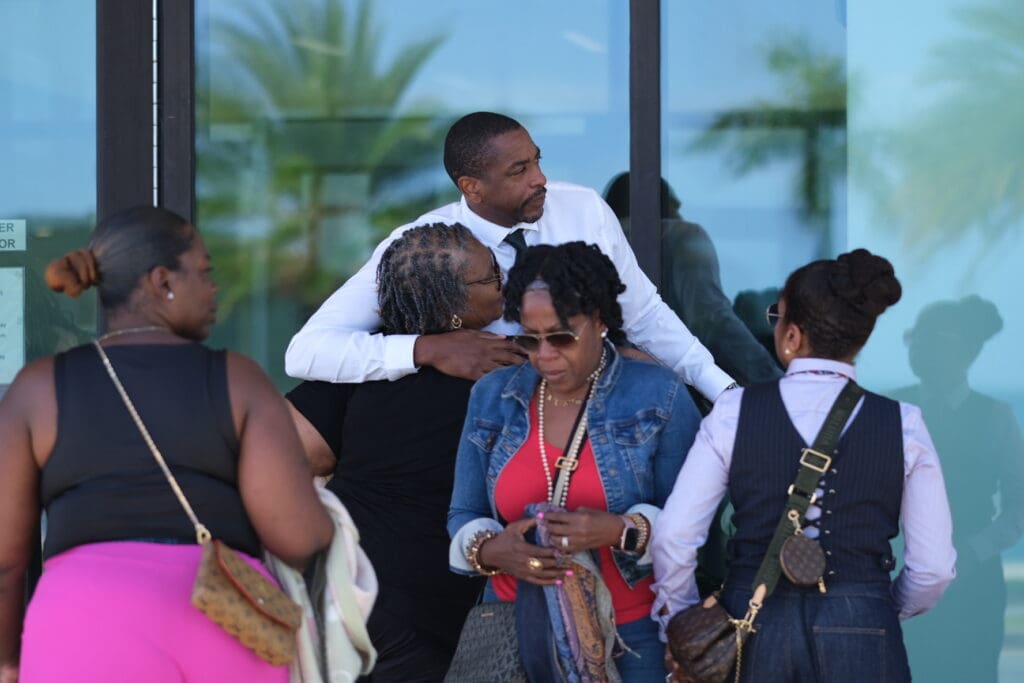
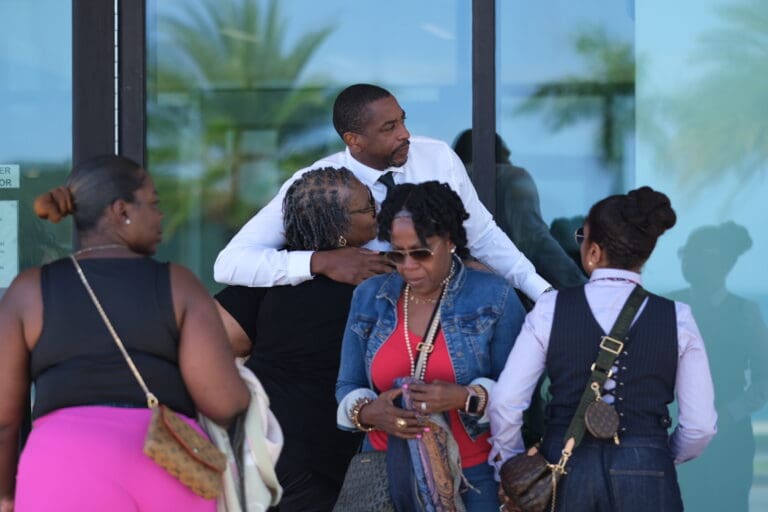
Family and friends convened a prayer circle as jurors continued deliberations Friday (Source photo by Kit MacAvoy)

LGO Seeks $7.74M Budget Boost To Tackle Staffing Gaps and Sustain Strong Revenue Growth

Lieutenant Governor’s Office Actiing Chief of Staff Nadja Harrigan testies at the Senate Budget, Appropriations and Finance Committee hearing Friday. (Photo courtesy V.I. Legislature)
The Lieutenant Governor’s Office is seeking a $7.74 million budget for fiscal year 2026— a 7.74% increase over last year — to fund at least 91 positions and continue its role as one of the territory’s top revenue generators. 

Senators highlighted the office’s financial impact, noting that it collected $124.3 million in fiscal year 2024 and is projected to bring in $132.6 million for 2026. The proposed budget increase aims to support ongoing operations, salary increases, and critical infrastructure projects, while the office continues to face challenges in filling 29 specialized vacancies. 

The Lieutenant Governor’s Office stands out as the second largest revenue-generating agency in the Virgin Islands government, In fiscal year 2024, the office collected over $124 million, and as of June 2025, it had already brought in more than $76 million, with projections reaching $132.6 million for fiscal year 2026 — a 5.45% increase in collections.

This strong performance drew praise from lawmakers, including Sen. Hubert Frederick. “Normally, my approach would be to focus on costs,” Frederick said, “but I’m not going to do that today because you’re generating revenues. You’re doing what we want most — not all — of our agencies to do: bring in money to help ease the financial burden on our community.”

According to Nadja Harrigan, acting chief of staff of The Lieutenant Governor’s Office “Despite challenges during the fiscal year, the very dedicated, experienced, qualified and competent staff across all of LG’s various divisions continue to perform their duties and responsibilities effectively and efficiently and have had several noteworthy accomplishments.”

The Recorder of Deeds and the Division of Corporations and Trademarks focused on expanding online services and improving customer access. These enhancements contributed to significant revenue growth, as more residents and businesses were able to efficiently access essential government services. “It’s very profitable, we have a lot of customers actually using the service, and so we have collected a lot of money,” said Erica Dover, recorder of deeds, who also noted that the division is on track to exceed its $5 million projection from registration fees, filing fees, and franchise taxes.

The Division of Business and Financial Management is responsible for managing the office’s budget, payroll, and financial operations, and the division not only implemented salary increases for unionized employees — addressing long-standing compensation issues — but also oversaw major repairs and office relocations. 

The Division of Banking, Insurance, and Financial Regulation collected more than $34 million and made significant strides in modernization by launching new digital platforms., The Division is also experiencing a backlog in reviewing financial statements and conducting examinations due to insufficient staffing. There are four key examiner positions vacant (one on St. Croix, three on St. Thomas), some for as long as two to three years. The main challenge in filling these roles is the inability to offer competitive salaries compared to other agencies.  

The Division of Geospatial Information Systems secured $4.6 million in federal funding for street addressing and infrastructure mapping projects. The division recently completed the Saint John SAI project, making it the first island in the Caribbean with a complete urban grid, officials said. The office is also expanding the street addressing initiative and partnering with other agencies to manage critical infrastructure data and implement the “Call Before You Dig” legislation. Upcoming plans include finishing the final phase of the street addressing project, advancing the benchmark network control project, and updating GIS data for all utilities agencies to enhance GPS capabilities.  

“The collection and provision of access to geospatial data used by public and private entities that provide emergency navigational and other essential services is one of the essential services provided by LG divisions. These capabilities have positioned the Office of the Lieutenant Governor as the Caribbean regional leader in the field of GIS in government infrastructure,” said Harrigan. 

Finally, The Division of Real Property Tax reported collecting over $62 million in fiscal year 2024, surpassing projections. The division expanded installment plan options for property owners, making it easier for residents to manage their tax obligations. Efforts to streamline property tax collection from timeshare units in the Virgin Islands remain stalled, despite a law passed over five years ago aimed at simplifying the process and boosting revenue. 

The legislation allows the Lieutenant Governor’s Office to send a single bill to each timeshare association, which would then collect from individual owners. But legal ambiguities and administrative delays have hindered full implementation.

“Part of the confusion is that a timeshare is really not real property,” said Tax Assessor Laurence Romney. “Once we clarify that, we should only need to send one bill per association.”

Senators voiced frustration over the lack of progress. “We passed this legislation five or six years ago,” said one Sen. Kurt Vialet. “And we could never reach a conclusion in getting anything done … This entity does well and I commend all of the workers, but some of these decisions are questionable.”

Additionally, leadership advocated for legislative changes to increase or remove the $500,000 cap on the tax assessor revolving fund, aiming to provide greater flexibility and resources for property tax administration.

The Virgin Islands has over 60,000 property parcels, yet in the most recent reporting period, only 883 properties were inspected — a fraction of the total inventory. This gap is not due to a lack of will, but a lack of personnel. As Romney explained, “We are short staffed, and that contributes to that so we were without basically any appraisals for a little while. We have three, and in the short time that they have been here, they made an impact in assessing properties.” 

Romney further emphasized the scale of the need: “We need about 20 [appraisers] to do what we need to do. Because when we get into full gear to do the mass appraisal and so on, we need that kind of counting among our appraisers to be able to cover the properties that need to be covered.” 

The consequences are significant. Properties that are not regularly assessed may be undervalued, leading to lost tax revenue. The outstanding amount of property tax owed in the Virgin Islands is approximately $100 million, with some of that debt dating back as far as the 1970s, according to officials. To address these challenges, the LGO is leveraging technology — implementing online payment systems and automating assessment processes to reduce delinquencies and streamline operations. 

To close the gap, the LGO has conducted a staffing analysis and is seeking additional funding to hire and train more appraisers. As Romney put it, “We shouldn’t even think of that as an expense. We should think of that as an investment, because as we are able to appraise the properties that exist with the improvements, then there is more money for the tax collector to collect to take care of our needs in the government.”