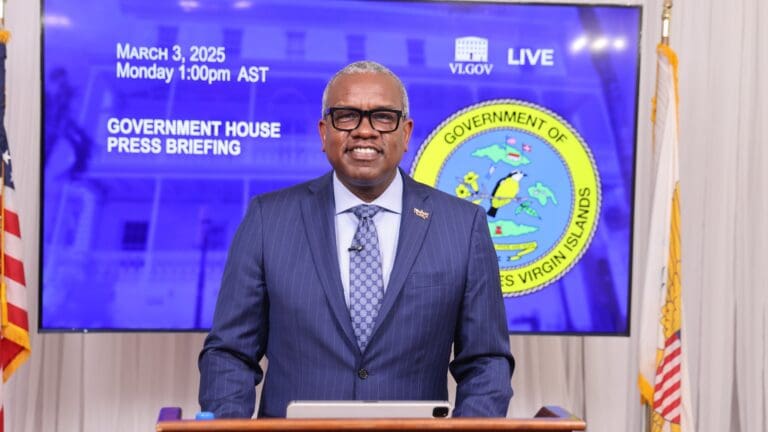
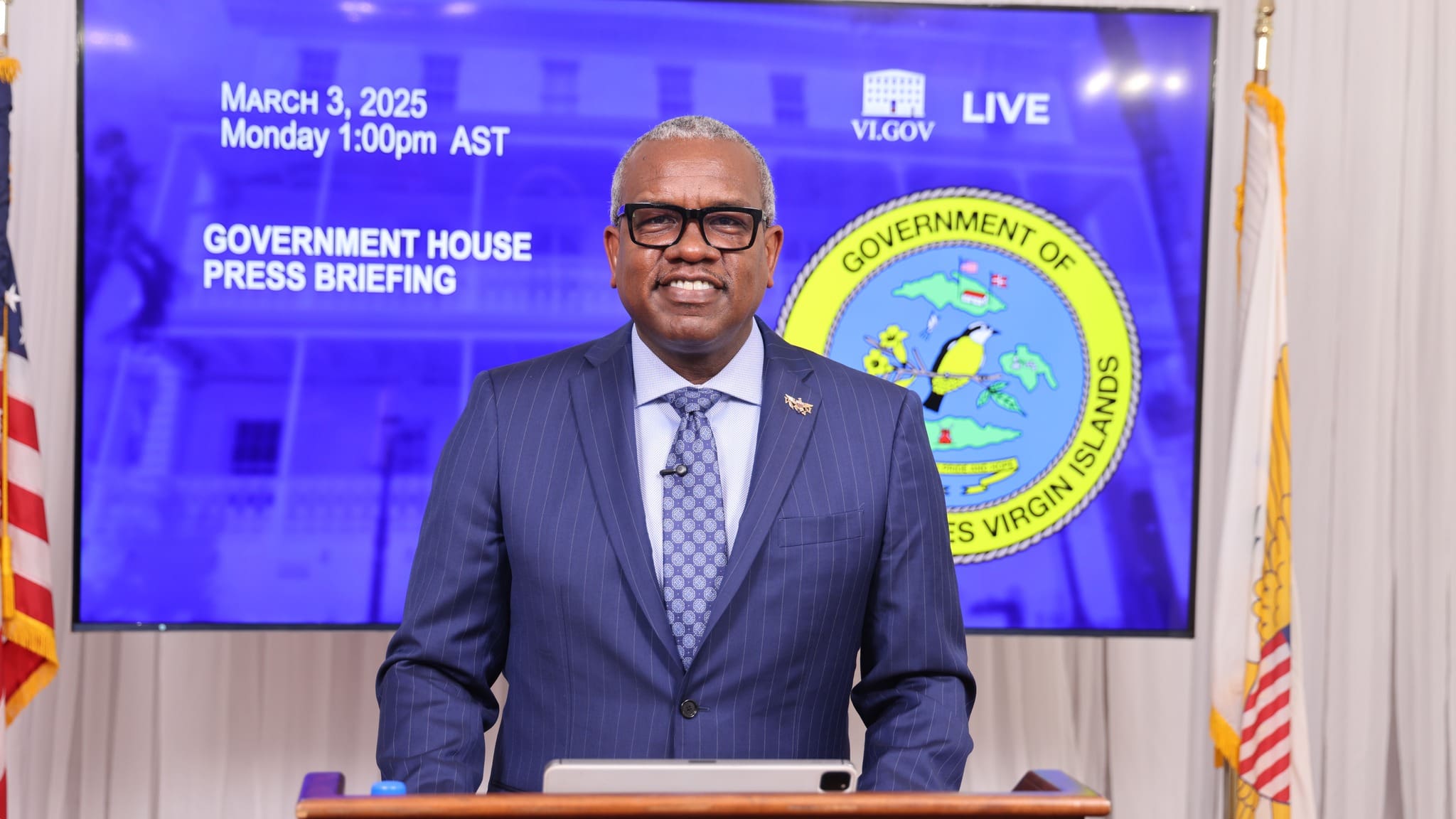
Gov. Albert Bryan Jr. addressed the public Monday from Government House on St. Croix. (Photo courtesy Government House Facebook page)
Gov. Albert Bryan Jr. returned to a Government House podium Monday following a trip to Washington, D.C., where he discussed his administration’s federal policy goals and partnerships, including a restart to the refinery and the re-extension of the rum cover-over rate.
Reporters who attended Monday’s briefing virtually were unable to ask questions due to a technical issue with the administration’s call-in system, but in a phone call with the Source afterward Bryan said he was confident that the Trump administration’s attempted freeze has not impacted the territory’s billions of dollars in federal disaster recovery or federal grants and funds.
“I’m pretty committed, and part of that confidence really is, it’s $23 billion,” Bryan said. “It’ll take us way past the Trump administration to expend those funds. And [the U.S. Housing and Urban Development Department ] — we got an extension on the [disaster recovery] funds in December, so they extended until 2029.”
Bryan said the Trump administration made clear its intention to divest from offshore wind energy before noting that funds earmarked for the territory have “escalators” to compensate for expected inflation.
“So I mean, I got two more years of Trump, and … we — the nation has four more years of him,” he said. “So I think … we’ll be able to weather this.”
During the briefing, Bryan announced that — after pursuing legal action — the Virgin Islands government will take back control of the Randall “Doc” James Race Track on St. Croix from developer VIGL operations.
“This is an important step,” he said. “It gives us the ability to explore solutions that will bring horse racing back to the big island of St. Croix in a way that is sustainable and beneficial for our community.”
Bryan has long expressed vexation with VIGL over a perceived lack of progress on the race track, lambasting the developer during his 2024 State of the Territory Address and announcing legal action against them during his 2025 State of the Territory Address.
Bryan also took time to address rising tensions between the territory and the British Virgin Islands following his suggestion that the U.S. Virgin Islands should levy tariffs against its neighboring territory. That suggestion was made in response to a measure under consideration in the BVI that would substantially increase fees for yacht charters — a move local charter boat operators fiercely decried. In a press conference Friday, BVI Premier Natalio Wheatley said the neighboring territory won’t be bullied by “Trump-style tariffs.”
On Monday, Bryan said he will be meeting with Wheatley on Friday to have “an open and candid conversation about proposed increases” on U.S. Virgin Islands charter boat operations.
“Let me be clear: my intent, yesterday and today and always, has been to find an amicable solution — one that is fair and equitable to both of our economic interests,” he said. “I do not engage in diplomacy through headlines, but we have had this conversation over and over again with the BVI. Up to last year, we met, we decided that things would change. A year has gone by — no change.”
Chaired by Senate President Milton Potter, Monday’s Committee of the Whole hearing was meant to delve into factors impacting the territory’s high cost of living. (Photo courtesy of the Virgin Islands Legislature)
A marathon hearing Monday before the Senate’s Committee of the Whole laid bare the complex and interwoven factors driving the territory’s sharply rising cost of living, underscoring the urgent need for comprehensive solutions. Testimonies from government officials, academics, and business leaders, coupled with pointed questions from senators, painted a stark picture of the economic pressures impacting every facet of life in the USVI.
Licensing and Consumer Affairs Commissioner H. Nathalie Hodge directly addressed the territory’s heavy reliance on imported goods. “This is further compounded by limited wholesale competition, resulting in higher retail markups and reduced consumer choice,” she warned, highlighting the impact of high shipping costs, import duties, and freight surcharges on everyday prices. Adding significantly to the burden are the high costs of utilities, particularly from the Virgin Islands Water and Power Authority, which, as Hodge noted, “significantly impacts businesses’ operational costs and are ultimately passed onto consumers.” This already challenging situation is exacerbated by global inflation, ongoing supply chain disruptions, and volatile fuel prices.
The DLCA, Hodge explained, is actively implementing several strategies to address these concerns. These include a monthly “Shopping Basket” report providing real-time price comparisons, rigorous enforcement of consumer protection laws, initiatives to diversify the local economy and foster local food production, and a comprehensive cost-of-living study currently underway. The agency recommended the creation of a Consumer Price Monitoring Dashboard and the implementation of policies designed to both boost market competition and support local production. However, Hodge emphasized the need for a collaborative approach, declaring that “tackling this issue requires a collaborative effort involving all levels of government and every individual consumer.”
Sen. Alma Francis Heyliger’s response underscored the critical need to reduce reliance on imports and invest in local agriculture, although she acknowledged the substantial challenge of incentivizing such investment among residents.
Adding further dimension to the discussion, University of the Virgin Islands Economics Professor Mark Wenner identified key drivers of the high cost of living, including the territory’s geographic isolation and the resulting high shipping costs; the small market size which restricts competition; high utility costs, particularly for electricity; housing market pressures stemming from limited land and high demand; the territory’s tax structure; and the lack of economic diversification.
Wenner’s testimony highlighted the serious economic and social consequences of this imbalance, warning that “When this latter type of imbalance exists and persists for a long time, it generates social and economic tensions. Namely, it undermines economic competitiveness and growth.”
Echoing sentiments from Sen. Kurt Vialet about the volatility of the territory’s power grid and infrastructure being a main theme throughout the testimonies, Wenner directly advocated for significant policy changes, including the elimination or privatization of WAPA, describing it as a major impediment to economic progress. He also spoke about promoting renewable energy sources, bolstering local agriculture, and revising the territory’s tax structure while cautioning against overly generous tax incentives, citing the example of Puerto Rico, where such policies have shown a poor return on investment. Wenner emphasized that, unlike Hawaii, which faces a similar high cost of living, the USVI lacks the mitigating factor of higher average incomes. The concentration of market power, Wenner noted, “tends to result in limited or no price competition and downwardly sticky prices.”
Senate President Milton Potter reinforced the urgent need for a thorough cost-benefit analysis of tax incentives, advocating for a reevaluation of the territory’s high tax abatement policies. He also expressed concern over the lack of an updated cost-of-living study, with the last one dating back to 2015, highlighting the impediment this poses to effective policymaking.
V.I. Economic Development Authority Chief Executive Officer Wayne Biggs Jr. corroborated many of the concerns raised, highlighting the significant impact of imports and high shipping costs on consumer goods pricing.
“Imports can affect consumer goods pricing by directly influencing the cost of goods brought into a country,” Biggs stated, pointing to the added expense of tariffs and duties, as well as fluctuations in fuel prices. He further emphasized the impact of the limited market size, high cost of electricity, and the inherent challenges posed by the territory’s gross receipts tax structure, which often gets passed directly to consumers.
While acknowledging many challenges, Biggs defended the current tax incentive programs, attributing their success to attracting businesses and generating jobs in the territory. Sen. Novelle Francis echoed the concerns raised earlier by Potter, advocating for a more in-depth analysis of the territory’s economic circumstances. He also highlighted the decrease in government employment and the territory’s overall population and suggested exploring public-private partnerships as a potential pathway to improvement. The significant influx of federal funds into the territory and the lack of a commensurate improvement in the cost of living was also a significant area of concern, Francis said.
The perspective of small business owners was represented by Scott Barber of Universal Business Supplies, who detailed the substantial impact of high costs across all aspects of business operations. High rents and land costs, high utility costs, high fuel costs, high import and tax costs, skilled labor shortages, the high cost of living, high insurance premiums (especially given the risk of hurricanes), the limited market size, increased competition for employees from government hiring, and the disruption caused by the lengthy Main Street and Waterfront projects on St. Thomas all severely impacted the ability of small businesses to not only thrive, but to simply survive, he said.
Barber emphasized that small businesses are the “lifeblood” of the Virgin Islands community, and urged collaborative efforts between the government and the business sector to create solutions that foster economic sustainability. He specifically called for the government to improve its timely payment practices for businesses, while also suggesting the possibility of extending business license renewal periods.
Adding to the discussion, the Virgin Islands Energy Office Director, Kyle Fleming, highlighted the significant challenges inherent in generating electricity on a remote island and outlined a plan to lower energy costs. He advocated for a transition toward renewable energy sources. Fleming highlighted the potential benefits of a Virtual Power Plant, citing a study that projected that this initiative could save WAPA “$22.5 million annually.” He stressed the importance of legislative support to encourage the adoption of home battery systems, crucial for the successful implementation of a VPP.
Meanwhile, V.I. Housing Finance Authority Strategic Advisor Rick Grant addressed the territory’s housing affordability crisis, citing dramatic increases in construction costs and property prices, exacerbated by the lingering effects of Hurricanes Irma and Maria. “This escalation in expenses has made it increasingly challenging to build homes that are affordable,” Grant stated. VIHFA, he said, is pursuing a multipronged strategy involving increased funding, advocacy for legislative changes, collaboration with developers on innovative housing projects, exploration of alternative building methods, and the administration of emergency assistance programs.
The Committee of the Whole picks up again Tuesday with additional testimony.
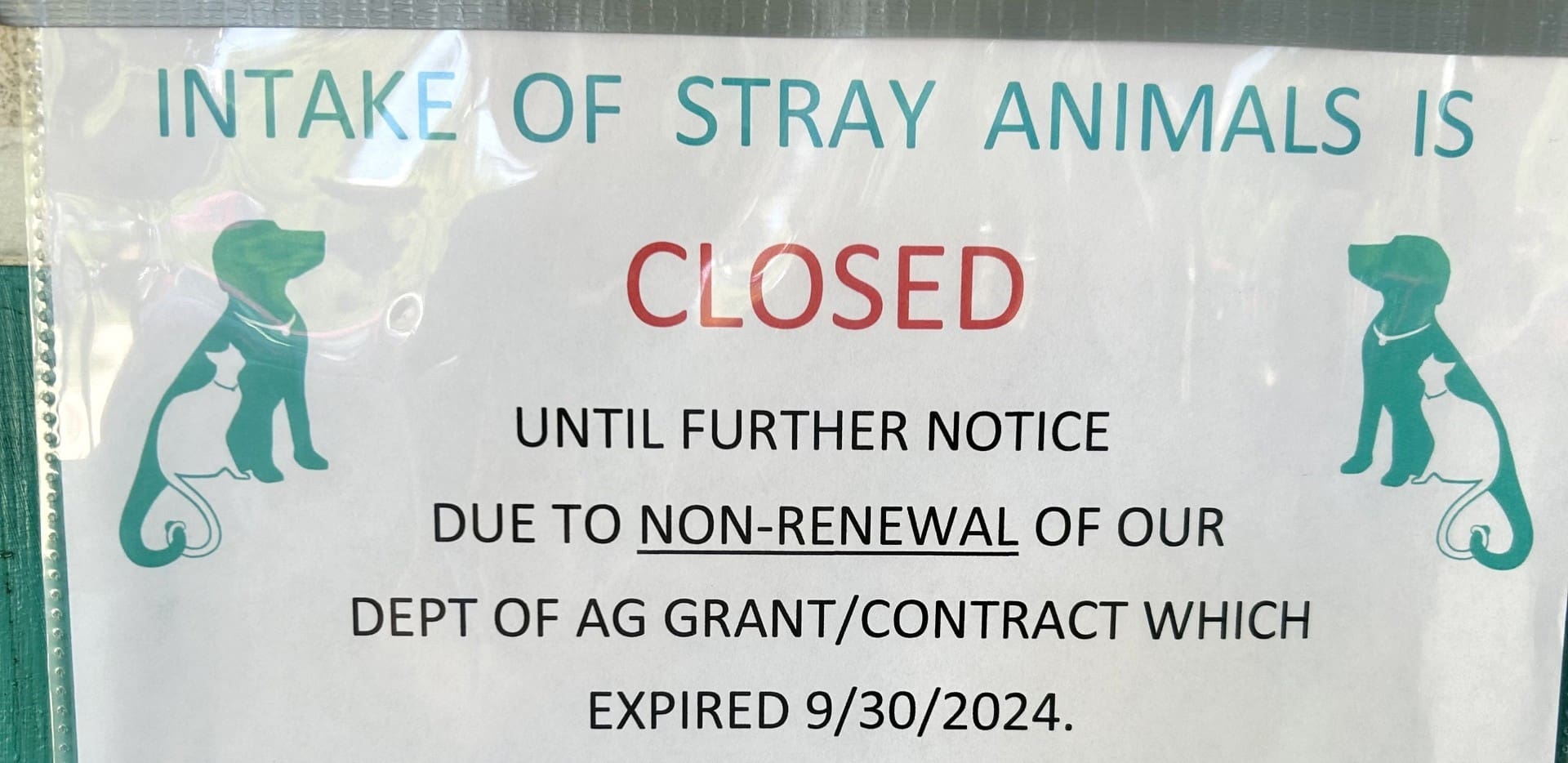
The St. Croix Animal Welfare Center posted a sign on its door in October after a long-standing contract with the Virgin Islands government lapsed, forcing the center to cut critical services. (Photo from SCAWC Facebook page)
Territory animal shelters sounded the alarm yet again Monday.
The St. Croix Animal Welfare Center said in a statement that neither they nor the St. Thomas Humane Society, the Animal Care Center of St. John, Ruff Start, or R.E.A.L. Cruzan Cats have received the promised funding from the Virgin Islands government.
“Animal shelters across the territory are in danger of closing their doors,” according to the statement.
For years, the government has relied on the shelters to perform critical services typically done by municipal animal control departments. Monday’s call to action came months after SCAWC announced that it would have to suspend its open intake and its spay and neuter programs because the government hadn’t renewed a long-standing contract with the shelter that expired Sept. 30.
“Within weeks, the USVI Government ‘awarded’ SCAWC with a $175,000 grant for general operations and a $50,000 grant for a spay/neuter program on October 22, 2024,” according to Monday’s press release from the center. “Sadly, those funds were never received.”
SCAWC Public Relations and Marketing Director Becca Hughson told the Source Monday that the first grant has historically been received in four installments, and the center has yet to receive the first two. The $50,000 spay and neuter funding was received biannually, and the center did not receive its first installment on Jan. 1.
“And also … the funding that the government is supposed to give to St. Thomas and St. John — you know, we have our clinic, we have other means, we have a really solid foundation for fundraising. But for St. Thomas and St. John, their government funding basically carries them through the year,” she said. “It pays for their staff. Without their government funding, they have very little chance of staying open. So … we’re limping along — and we’re barely making payroll. I can’t even imagine how difficult it is on St. Thomas and St. John.”
According to SCAWC, the center attempted to reach the V.I. Agriculture Department — which oversees their grant funding — multiple times over several months. The center’s executive director eventually visited the department on Feb. 24. Hughson said they learned that their contract had never been executed and that their point person at the department was no longer employed there.
“And none of the other shelters have heard from that contact either, so we don’t know what happened to them,” she said. “But I know we didn’t get the idea that she had necessarily [been] replaced with anyone, and … we’re not even sure if anyone has even checked her emails.”
Hughson said the center can’t sustain an open-door shelter without the funds, forcing them to take in animals on a case-by-case basis.
“And when it boils down to it — and we hate to have to do this — but we have to determine whether or not that animal is adoptable. If we don’t think it can be adoptable, then we simply can’t even take it,” she said. The center used to take animals in regardless of whether they were sick or aggressive.
“But really … it sucks. It’s just like, is this animal adoptable, yes or no? If it’s adoptable, then yes — if we have space. If we don’t have space, then no,” she said.
Asked about the shelters’ funding Monday, Gov. Albert Bryan Jr. said he’d look into the issue.
“I don’t think that’s a matter of money,” he said. “That’s just a matter of — we don’t have a contract, and contracts take forever. Because the last time that came up, that was the problem. They didn’t have a contract. It wasn’t that we didn’t have the money.”
(Submitted photo)
On January 28, 2025, the People of the Virgin Islands established a fourth, temporary branch of government — the 6th Constitutional Convention. The 6th Constitutional Convention is now exploring and exercising its duties to present to the People of the Virgin Islands a written framework of government that is drafted locally as opposed to being drafted by misinformed and innately disinterested, faraway parties.
With that, automatically adopting the Revised Organic Act of 1954 (ROA) as the Constitution of the Virgin Islands defeats the purpose of mobilizing the energy and resources necessary to convene a constitutional convention. The most particular reason for this futility is the fact that the ROA was not written by the People of the Virgin Islands; it was written by the United States Congress during a period when the People of the Virgin Islands did not even have a democratically elected representative in Congress.
This means that the language and framework within, and of, the ROA inherently delegates, or rather abdicates, constituent power to the United States Congress. I am of the opinion that we must establish, exercise, and maintain constituent power locally.
For instance, if we adopt the ROA as our constitution and are then asked, “Who drafted the Constitution of the Virgin Islands?” Our only truthful answer would be “the United States Congress.” However, we should be able to say, “The People of the Virgin Islands!” And within our future historical narrative(s) of this time and the past, we should be able to identify individuals and groups who advocated for particularly local and unique rights and protections.
There is significance to this idea, as the supremacy of a law is inextricably tied to the supremacy of the drafters of the law. If we follow through with adopting the ROA as our constitution, we would be affirming the supremacy of the United States Congress and that the will of Congress is supreme to the will of Virgin Islanders. I am completely and firmly of the idea that constituent power — power that is supreme to the powers provided for in a constitution of a government — must rest with the people to be governed, not a distant and disinterested polity.
Obviously, if the People are happy and content with the current framework of government established within the ROA, then there is no action to be taken. However, if we are unhappy and discontent with our current framework of government, then we should treat this moment in our people’s history as extraordinary; and we should be thoughtfully deliberative and thorough in designing a new and sensibly constituted form of government.
Furthermore, the issue and question of status is critically important and necessary in our consideration of designing our own framework of government. The reason is because constituent power actually and technically rests with the US Congress because our ability to even consider constituting our own framework of government came about from an Act of Congress in the form of Public Law 94-584. In avoiding the philosophical question of “legislating constituent power,” let’s accept and explore this political reality. The fact that our ability to consider constituting our own framework of government was born from an act of Congress means that Congress could also take that ability away! This technically means that constituent power rests with Congress, but obviously, Congress is not “the People of the Virgin Islands.” As a result, we have to grapple with the idea that we are indeed colonial subjects of the United States government as we pursue the drafting and ratification of a local constitution.
If we ratified our own constitution under our current status, we would need to, as a requirement of Public Law 94-584, recognize the “sovereignty” and “supremacy” of the United States Constitution. The most glaring issue with that sort of recognition in our current context is the fact that we are an “unincorporated” colony of the US. This means the privileges and protections of the US Constitution pertain to us only in part, not in totality. How can we recognize the sovereignty and supremacy of a document in whole when it only matters to us in part? It would make for a fractured, impracticable, and anomalous framework of governing.
So, to effectively assert and actualize our constituent power (our power to exercise self- determination), we have to ask, determine, and decide, “Who are the People?” Adopting the ROA as our constitution would be a step in the wrong direction. Furthermore, we need to ensure this 6th Constitutional Convention serves more purpose than simply rectifying the failures of the 5th.
—Malachi Thomas is a community advocate, public servant, and a 2014 graduate of Oberlin College.
Editor’s Note: Opinion articles do not represent the views of the Virgin Islands Source newsroom and are the sole expressed opinion of the writer. Submissions can be made to visource@gmail.com.
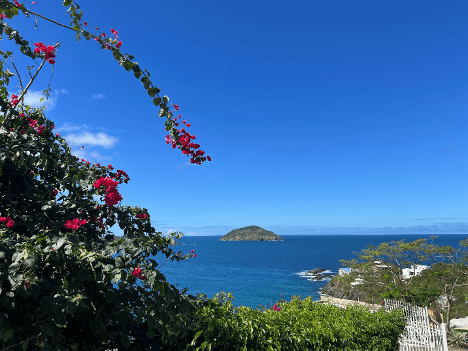
A photo of Outer Brass Cay on St. Thomas, USVI, taken on Jan. 22, indicates lush and drought-free conditions across the region. (Photo courtesy NIDIS/Drought Report)
Recent rainfall across the region has resulted in the U.S. Virgin Islands and Puerto Rico remaining free of drought. While some relatively dry conditions have been observed, both U.S. territories are expected to stay drought-free through Spring.
“As the northeastern Caribbean dry season progresses, strong trade winds have increased the frequency of rain showers across eastern and northern Puerto Rico and the U.S. Virgin Islands, keeping the soils wet and water storage sufficient, [however,] rainfall activity was limited for the southern and western portions of Puerto Rico,” according to information contained in an update released on Feb. 27 from the National Integrated Drought Information System, the National Oceanic and Atmospheric Administration, and numerous partners, including the U.S. Department of Agriculture and the University of the Virgin Islands. (A complete list of individuals who contributed to the report is listed at the bottom of the report.)
The drought update explained that Puerto Rico and the USVI have remained free of drought since early 2024. Even with the dry season underway and with several areas starting to experience some dryness, including the southern and western areas of Puerto Rico, rainfall has been plentiful across both U.S. territories overall:
“Puerto Rico and the U.S. Virgin Islands have been drought free since late April 2024 and late February 2024, respectively.”
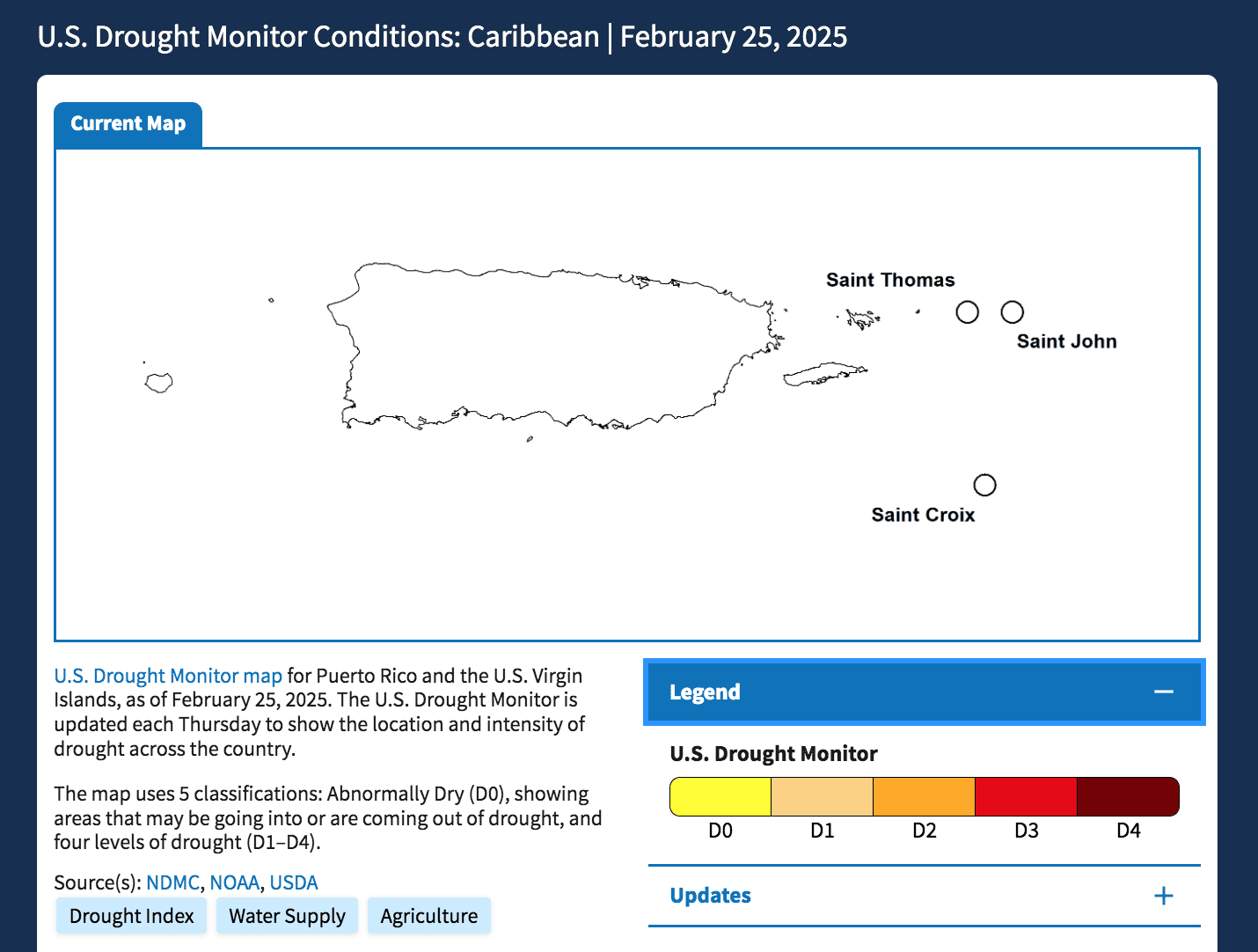
A graphic showing the current drought status across USVI and Puerto Rico. Both U.S. territories remain free of drought. (Photo courtesy NIDIS/Drought Report)
The report continued, “In Puerto Rico, above-normal rainfall has been observed for most of the east, eastern interior, and northeast sections. However, rainfall deficits are beginning to increase in the southern plains and, more noticeably, in the northwest. While most streams are running near normal, water is being depleted from the wells in southern Puerto Rico and from Guajataca Dam in the northwest. Additionally, concerns for fire ignition and spreading are increasing in these areas, which have drier soils. Nevertheless, Abnormally Dry (D0) conditions have not developed yet, as this dryness is considered typical for the early months of the year. In areas where soils are dry, vegetation is showing signs of stress.”
The drought report also stated, “Rainfall amounts are in the normal range, based on data collected from the Community Collaborative Rain, Hail, and Snow Network. [These amounts are] keeping the soils wet and the vegetation healthy. In the U.S. Virgin Islands, recent intermittent rains have improved groundwater levels on St. Thomas and St. Croix. St John has had a small loss of groundwater in the last month but overall is still quite wet,” according to the drought report.
Benefits and Challenges for Farmers
The report noted that farmers and agriculturalists across both U.S. territories have experienced some benefits from recent rain, including the production of bananas and grass growth. The update indicated that rivers across Puerto Rico have recently been at primarily normal levels.
However, several challenges have also been reported because of rainfall, such as fungi and bacteria growth on crops. Furthermore, difficulties have been described across areas now beginning to have drier conditions, such as the southern portion of Puerto Rico, which has been experiencing an increased risk of wildfires.
“Frequent showers led to wet soils across most of the eastern and north-central portions of Puerto Rico,” the report said. “However, these rains were not as common in the northwest and the southern hills of south-central Puerto Rico, where both satellite-derived products and observations from farmers and spotters show dry soils, [and] in areas where soils are dry, vegetation is showing signs of stress,” the report continued.
Across the U.S. Virgin Islands, a similar situation of benefits as well as challenges was reported by agriculturalists across St. Thomas, St. John, and St. Croix:
“St. Thomas: Farmers reported full ponds due to recent storms, and the rain has helped vegetation. Livestock and poultry farmers have access to feed. Guinea grass is drying up due to high winds. Increased rains and saturated soils are resulting in landslides and significant road erosion,” according to the report.
“St. John: Row and specialty crop farmers report heavy and intermittent rain. Some soils are showing signs of distress due to general moisture losses from heat and windy conditions. In January, many focused on clean-up because their farms were submerged underwater during the storms. Some farmers are working on planting microgreens, fruit trees, and quick crops to keep production up and are also rotating crops to prepare for hotter summer months,” the report indicated.
“St. Croix: Many farmers are reporting intermittent rains and showers, which are leading to the loss of soil from erosion. Livestock farmers experiencing high winds are working to plan for feed shortages, which will occur later in the year due to a lack of grass during the hotter months,” the report explained.
Drought is Not Expected in the Coming Months
Although several regions have faced drier weather, the NIDIS does not expect drought conditions to develop over the next few months. However, some locations may be categorized as “Abnormally Dry” soon.
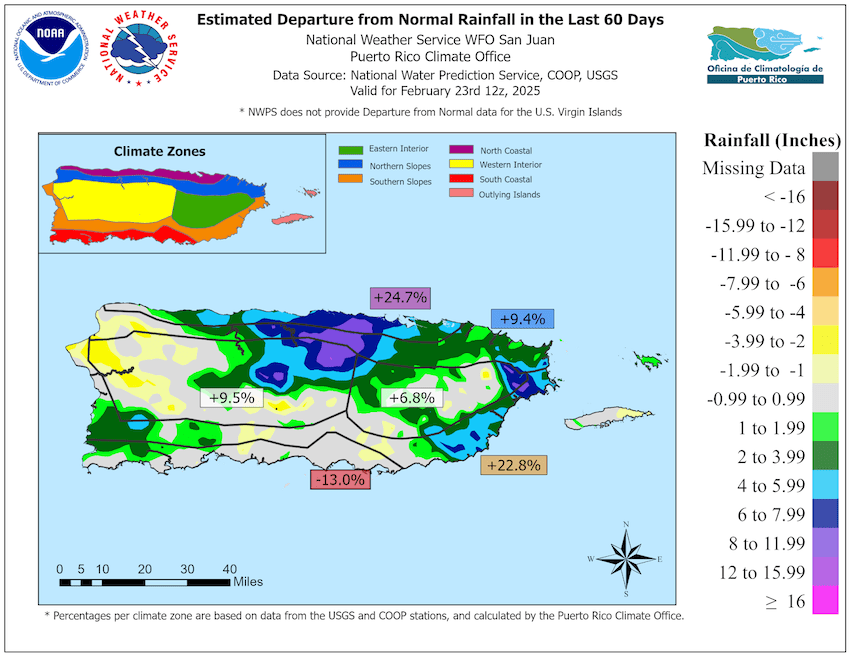
An image indicating rainfall deviation from normal across Puerto Rico. While a USVI map is unavailable, both U.S. territories have received near-normal amounts of rainfall with only a few areas experiencing relatively drier conditions. (Photo courtesy NWS San Juan, Puerto Rico, and NIDIS/Drought Report)
“The North American Multi-Model Ensemble [forecast model system] for spring (March [through] May 2025) indicates a 40 to 50 percent chance of observing slightly wetter-than-normal conditions for portions of Puerto Rico, with near-normal conditions forecast for the Virgin Islands,” the update stated. “Additionally, there is a greater than 70 percent chance that temperatures will remain above normal through the spring season,” the update added.
“[Still,] no drought is expected to develop over the next three months in Puerto Rico or the U.S. Virgin Islands, according to the NOAA Climate Prediction Center’s current Seasonal Drought Outlook,” the report assured. “However, Abnormally Dry (D0) conditions may appear across the southern plains and northwestern Puerto Rico in light of increasing summer temperatures as we transition between seasons.”
Stay Informed About the Weather
The report concluded with information regarding computer forecast models that expect rainfall to be slightly above or near normal levels through May. Warm temperatures are also forecast to affect the local islands over the coming months.
Residents and agriculturalists can stay updated on the latest drought information on the NIDIS website. Additionally, the local weather forecast for the U.S. Virgin Islands is regularly updated on the Source Weather Page and VI Source YouTube Channel.
Individuals can also find helpful weather information and alerts from the National Weather Service and the Virgin Islands Territorial Emergency Management Agency.
A new shade structure and playground will be unveiled at Ezra Fredericks Ballpark during a ribbon-cutting ceremony on Saturday, March 15, from 12:30 p.m. to 2 p.m., marking a milestone in the park’s revitalization.
Sponsored by AARP Virgin Islands and VI Wise, the additions were made possible through a partnership between the Virgin Islands Department of Sports, Parks and Recreation and the Virgin Islands Surfing Federation to enhance the park as a multi-use recreational space for the community, according to the press release.
The project is part of an ongoing effort to transform the ballpark into a hub for families, athletes, and individuals of all ages. In addition to the shade structure and playground, future improvements will include a Skate & Bike Park, basketball court upgrades, and the preservation of field space for continued recreational use, the press release stated.
The event will feature remarks from AARP Virgin Islands State Director Troy De Chabert-Schuster and other community leaders. Attendees will have the opportunity to explore the new facilities, learn more about upcoming enhancements, and enjoy light refreshments. The revitalization effort emphasizes sustainability, incorporating recycled and upcycled materials to reduce environmental impact while improving public amenities, the release stated.
“We are thrilled to unveil these new facilities that will provide a safe and enjoyable environment for our community to come together, play, and stay active,” said Acting Commissioner of Sports, Parks and Recreation Vince Roberts. “This is just the first of many improvements to come, and we’re excited to continue working together to create a park that truly serves the diverse needs of St. Thomas residents.”
AARP’s contribution was made through its annual Community Challenge Grant, which supports projects that create more livable communities. De Chabert-Schuster highlighted the initiative’s impact, stating, “AARP is proud to support initiatives that create inclusive spaces for people of all ages. The shade structure will provide comfort and relief for older people and their families who want to enjoy outdoor activities, and we’re happy to see this project come to life. It’s a fantastic example of public and private partners coming together for the benefit of the entire community.”
Applications for the 2025 Community Challenge Grant are due March 5, the release stated.
The ribbon-cutting ceremony is open to the public, and residents are encouraged to attend and celebrate the latest improvements to the park, it said.
Jahkeem Perez, 24, appeared in Virgin Islands Superior Court on Feb. 27 for an advice of rights hearing after his arrest on firearm-related charges. Perez faces counts of carrying a firearm openly or concealed, possession or sale of ammunition, and alteration of identifying marks on a weapon, Attorney General Gordon C. Rhea announced.
A judge set Perez’s bail at $50,000, requiring a $5,000 payment for release, and ordered him to house arrest with a curfew and a third-party custodian, according to the press release.
According to the probable cause fact sheet, the charges stem from a Feb. 26 incident when an off-duty Virgin Islands Police Department officer observed a man sitting under a tree in the Matthew Charles area with a handgun fitted with an extended magazine. The officer reported that the man placed the firearm into a dark-colored backpack and handed it to another male, who then placed the bag on the front seat of an unregistered white Honda Accord before driving toward Profit Hill.
VIPD officers located and stopped the Honda Accord. The driver, later identified as Perez, was the sole occupant. Officers observed the backpack on the front seat, ordered Perez out of the vehicle, and conducted a search. Inside the backpack, officers found a Smith & Wesson revolver, a Glock 19, multiple magazines, two plastic bags containing 46 grams of marijuana, and $570 in cash.
When asked whether he had ever held a firearm license in the Virgin Islands, Perez answered, “No.” He was then taken into custody.
The off-duty officer also reported that the first male had discarded another handgun into nearby bushes before leaving the area. Officers recovered a black handgun with an extended magazine but were unable to locate the second suspect.
During the hearing, V.I. Justice Department Criminal Chief Amie Simpson argued that the altered firearms, lack of license plates, and suspected efforts to transport weapons posed a significant public safety risk. The DOJ, in collaboration with VIPD, continues to investigate the case and potential additional suspects.
It is with profound sorrow that we announce the passing of Alphonso Edmond Farrell, who transitioned peacefully from this life on February 24, 2025, at the age of 84. Born on September 13, 1940, Alphonso was a cherished father, grandfather, brother, uncle, and friend. His legacy of love, kindness, and generosity will forever remain in the hearts of all who knew him.
Alphonso Edmond Farrell
Alphonso was preceded in death by his beloved parents, Lueille Walters-Pemberton and Harold Farrell. He leaves behind his daughters, Yasmin and Kristin Farrell, as well as his adopted son, Thaddeus Steven. His grandchildren, Jaden Farrell-Baxter, Kylee Saint Fort, Karissa Saint Fort, and Kayson Saint Fort, were the light of his life and brought him immense joy.
Alphonso is survived by his siblings: his brothers Hugh Walters (Nevis) and James Bernard Walters (New York); his sisters Olinder Levine and Rosalyn Pemberton (Nevis); and numerous nieces and nephews, including Theodora, Sherry Dionne, Sharima, Julie, Natasha, Brenda, Judy, Nicholette, Okima, Anastasia, Dinelle, Tichina, Patricia, Diane, Jodilee, Tamara, and Laurencia; and nephews Ricky, Frankie, Stanley, Dinsdale, Trevor, Steve, Cecil Jr., Clive, Rhanji, Adriel, Chaim, Dishawn, Glenroy, Samuel Jr., T-Sean, Shakim and Melvin.
He is also survived by his aunts Ursula Arthurton (Nevis), Pearly Rhymer, Shirley Browne (Nevis), Phyllis Payne (Antigua), Alton Maynard (Nevis), Wilbert “Bracket” Walters (England); his cousins Sylvia Charles, Sonia Maynard-Liburd, Ortis, Elsa Walters, Mavis Halliday, and Stafford Liburd (St. Kitts); as well as his in-laws, Gelo Saint Fort (son-in-law), Doreen Walters, Mavis Walters (sisters-in-law, Nevis), Cecil Levine (brother-in-law), and many more extended family and friends.
Alphonso was blessed with an extensive network of friends, among them his special companions Daniel (Starman), Denise, Osborne, Cathy, Meser, Wilson, and his sister Martha Mills, along with countless others who held him dear.
Alphonso’s life was a testament to his unwavering strength, boundless generosity, and deep love for his family and friends. He touched the lives of many with his wisdom, his infectious smile, and his willingness to lend a hand to anyone in need. His devotion to his family was unparalleled, and he leaves behind a legacy that will live on through the many lives he impacted.
A Celebration of Life:
First Viewing: March 13, from 3 p.m. to 5 p.m. at Divine Funeral Chapel
Funeral Service: March 14 with a viewing at 10 a.m. followed by a service at 11 a.m. at United Pentecostal 2-H Paradise
Interment: Alphonso will be laid to rest at Kingshill Cemetery.
As we say goodbye to Alphonso, we take comfort in knowing his spirit will live on in our hearts forever. His family extends their gratitude for the outpouring of love, support, and condolences during this difficult time.
Rest in peace, Alphonso. You will be dearly missed.
Lorraine Cartier, age 65, was affectionately known as Debbie/Debbito. She transitioned into eternal life on Feb. 14, 2025.
She is remembered by her companion, Almeric “Dee-Dow” Messer; stepfather, John French; children, Charles Thomas, Sherisma, Rasheem & Cynthia Skeet, Rakim and Kidejah Messer; grandchildren, Chaleah, Chabarri & Chamal Thomas, Mackeel, Amani & Maurice Liburd, Zyaire Skeet, Sekani and Ariel Brown III, Ke’Zayrah, Keyanna, Ra’Naisa and Rakim Messer, Jr., Taliem Petersen; great-grandchildren, Ma’Kayla, Ma’Kajah, Mackeem, Zahkarii, Zahmani, Za’Niah Liburd, K’Noah Skeet, Nature Thomas; adopted children, Jozette & Rudy Walker, Eliston Hughes, Chenelle & Jashseen Simmonds; siblings, Dian, Shermaine & Winston Cartier Jr., Joanna French, Bridgette & Vera Fredericks, Lornette Caines, Jerome Seeley; (18) Nephews and Nieces; (39) great nephews and nieces; aunts, Rita Brunstorff, Erna Beckles, Clari Holmes; uncle,Aubrey Bronstorff, Rueben Lang, Michael Cartier; daughter-in-law, Grisel Rosado; son-in-law, Dwight Parris; brother-in-law, Avid Huggins; sister-in-law, Reba Cartier; nieces-in-law, J’Nae Torres-Lang, Glenda Ayala; god-mother,Edna O’Reily; god-children, Clevon “Freddy” Edney, Jeniquah Yarwood, Oriana O’Reily; special cousins, Helen & Shirley Sealey, Oshana & Othni Edney, Robert Epps, Gary Browne, Donna Hendricks, Doris & Raheem Sutton, Patricia Frorup, Lynda Holmes, Steve Brown, Millicent Miller, Diana Kelly, Suenic Goodridge, Delroy Richards Jr., Dwight Cartier, Denise Cartier, Roy Beckles, Rudolph Meyers, Janice Richards, Shermaine Peters, Lorraine Sobratti, Angelita Gautier, Laurel Lawrence, Sandra McFarlane-Harris, Cabrielle Regis, Wilma Abramson; close friends, Frankie King, Geneveva “Beba” Diaz, Ellie Parris, Denise Hicks, Ralph Murray, Negra & Glenda Felix, Melissa Hughes, Arnold Jarvis, Bernadette Orr, Julia Francis, Hanife James, Marc “Wamba” Perinon, Gloria Jeffery, Isaiah & Jennifer Thomas, Jacque Thomas-Eastman, Reginald Donovan, Bernard “Winky” Caines, Warren Christian, David Bermudez, Letticia Barnes, Maurice Liburd, Thelma Jacobs; other friends and family to include members of, the Brunstorff, Cartier, Phaire, Petersen, Walcott, Henry, Beckles, Gautier, Hansen, Graham, Lawrence, Wilson, & Miller Families, Thyra Thompson & Family, Eugenie Samuel & Family, Elroy Gerard, Aisha Perinon, Delores Bess & Iris Canton, Hendricks Family, Bermudez Family, Messer Family, Skeet Family, Liburd Family, RDC and JFK Family; other family and friends too numerous to mention.
Funeral service will be held on Saturday, March 8, at James Memorial Funeral Home. Viewing at 9 a.m, with service at 10 a.m. Interment will be held at the Kingshill Cemetery. The family respectfully request that those in attendance wear festive colors.
Professional services are entrusted to James Memorial Funeral Home, Inc.
The Virgin Islands Department of Education’s St. Croix District Division of Student Services announces the enrollment period for Granny Pre-School and Kindergarten students for the 2025-2026 school year. Registration will take place on Monday, March 17 from 8:30 a.m. to 12 p.m. at the Division of Student Services Office, located at the Theodora Dunbavin (Alternative Education) Campus, 4053 La Grande Princess, Christiansted, VI 00820 (across from the Honda Dealership).Parents and guardians are encouraged to take advantage of this opportunity to secure placement for their children.
For more information, please contact the Division of Student Services at (340) 773-1095 ext. 7600 or email student.services@stx.k12.vi.