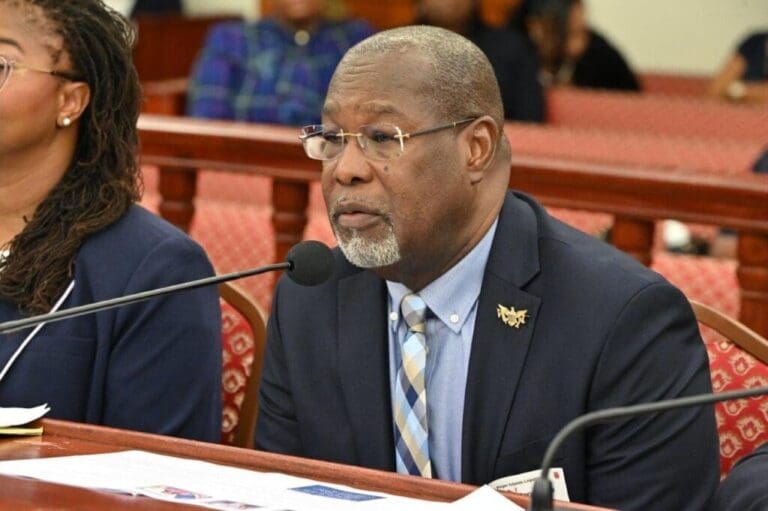
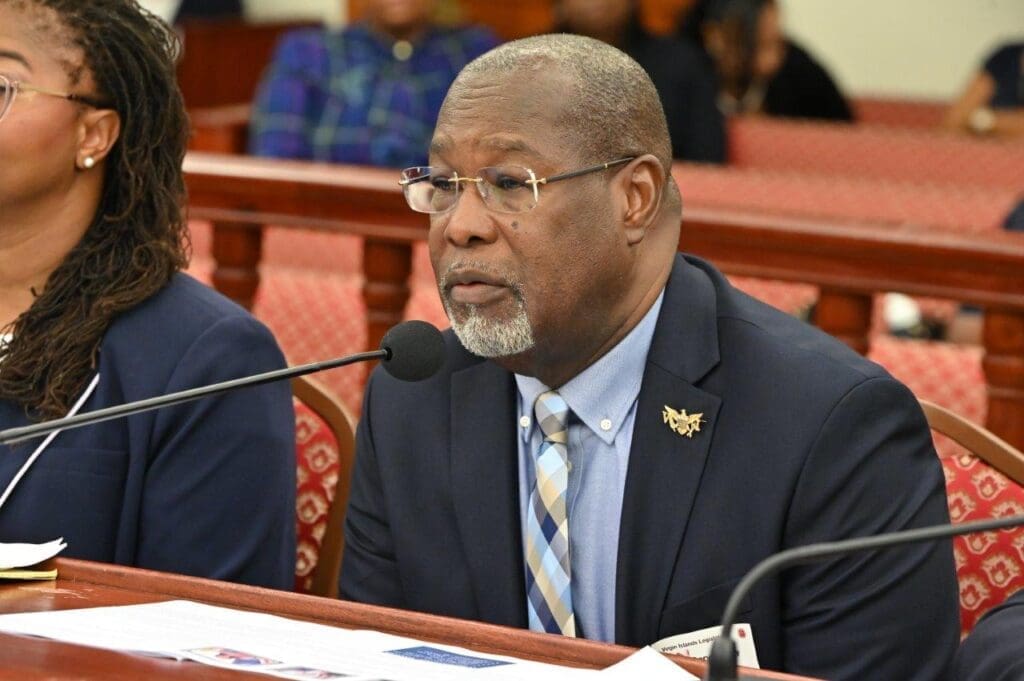
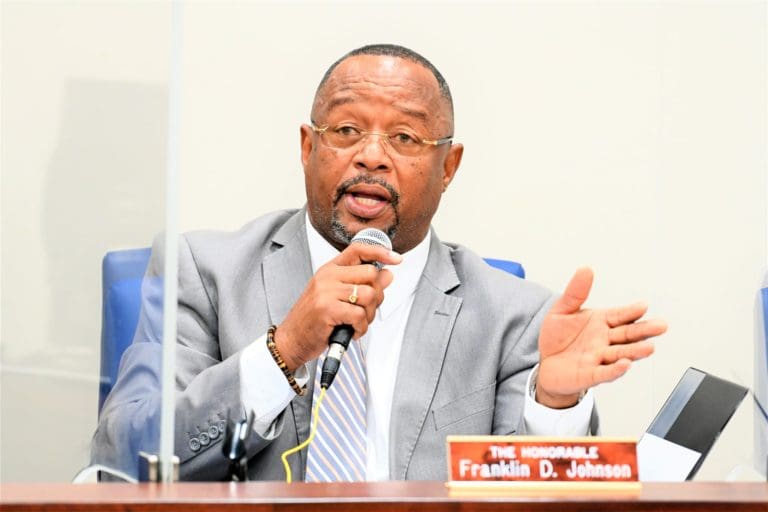
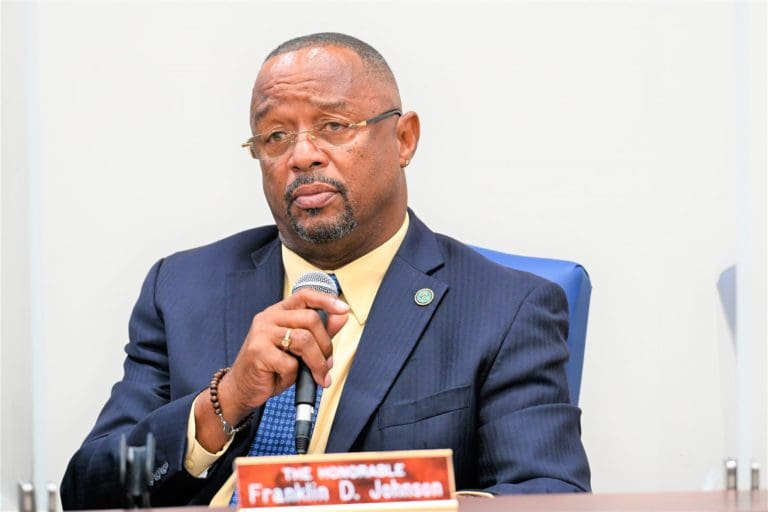
On Tuesday, Senator Franklin D. Johnson toured the ongoing reconstruction of the Arthur Richards School in preparation for the Department of Education and Bureau of School Construction and Maintenance hearing scheduled for Wednesday, Feb. 5. Accompanied by representatives from the contractor, MCN, Senator Johnson assessed the progress of this long-awaited project. MCN project manager indicated the school should be completed by school year 2026.
“It is a relief to finally see movement on this project,” said Senator Johnson. “However, I am deeply disturbed by the substantial change orders that have significantly increased costs to almost double the original estimate. These escalations raise serious questions about fiscal oversight and their impact on the recovery budget.”
The Arthur Richards School reconstruction is a crucial project aimed at providing modern, resilient infrastructure for students and educators. Delays and cost adjustments have caused frustration within the community, prompting Senator Johnson to emphasize the need for strict oversight, accountability and transparency.
Wednesday’s hearing will delve into key updates on the Department of Education’s financial management, including imprest funds and grants, as well as student test scores for the 2023-2024 academic year and strategies to address learning loss.
The Bureau of School Construction and Maintenance will report on all school recovery rebuilding efforts, anticipated project timelines, electrical upgrades, AC installations, summer maintenance, and the school-based work order process.
Senator Johnson remains committed to responsible spending of the people’s money and ensuring that students and educators have access to safe, high-quality learning environments, which improves learning.
For more information, please contact the Office of Senator Franklin D. Johnson.
Senator Franklin D. Johnson, a proud alumnus of the Job Corps program and a senator from the St. Croix District, addressed students at the St. Croix Educational Complex High School today, sharing his personal journey andemphasizing the transformative opportunities the program provides for young individuals seeking to enhance their education and career prospects.
Speaking to an intimate audience of students and prospective Job Corps members, Senator Johnson recounted his own experience in the program and how it played a crucial role in shaping his career and leadership path. “Job Corps was a steppingstone for me,” he stated. “It equipped me with the skills, discipline, and confidence to succeed in life, and I want every student here to know that the same opportunities are available to them.”
Job Corps, a federal program under the U.S. Department of Labor, provides free education and vocational training to young men and women seeking to develop their skills and secure meaningful employment. The program offers career pathways in various industries, including healthcare, construction, hospitality, and technology, preparing participants for long-term success in the workforce. Additionally, Job Corps offers students who do not have the means to attend college or a trade school an opportunity to receive training and certification in various professions for free.
Senator Johnson, who attended Union County Vocational School through Job Corps, obtained his certification and became a certified welder, among other professions. He emphasized the importance of skill-based education and how it can provide a stable and gives you an education but also the confidence and ability to build a successful future,” he said.
During his address, Senator Johnson highlighted the importance of workforce readiness and how the Job Corps program aligns with the economic needs of the community. “By investing in vocational training and education, we are empowering our youth to become self-sufficient and contribute meaningfully to society, especially now that we are rebuilding our community from the ravishes of the storms of 2017” he said. “This program doesn’t just teach job skills; it builds character, resilience, and a pathway to success.”
The students engaged enthusiastically, asking questions about different career tracks within Job Corps and seeking advice on how to maximize their potential. Several students expressed interest in joining the program, inspired by Senator Johnson’s story and the realworld opportunities it provides.
Senator Johnson also urged local leaders and businesses to support Job Corps graduates by offering internships, apprenticeships, and job opportunities. “It’s a collective effort,” he noted. “When we support programs like Job Corps, we are investing in our community’s future.”
The event concluded with a call to action for students to explore the Job Corps program and take charge of their futures. Senator Johnson’s speech resonated with many, leaving a lasting impact on those in attendance.
For more information about the Job Corps program and how to apply, visit http://www.jobcorp.org or call 340-777-9892 in St. Thomas or 340-773-1001 in St. Croix
Senator Bolques and his team recently met with representatives from the U.S. Small Business Administration (SBA) to discuss programs and resources available to small businesses in the territory. The meeting provided an in-depth overview of SBA initiatives, including access to capital, federal contracting assistance, technical support, and disaster recovery programs.
The SBA reported an annual average of 17-20 guaranteed loans issued in the territory, totaling approximately $10 million, with a recent peak of 22 loans worth $9 million. The discussion also highlighted the Thrive program, designed to help businesses grow, and the SBA’s lender match program, which connects entrepreneurs with approved financial institutions.
Senator Bolques emphasized the need for streamlined local government processes to facilitate SBA lending and enhance small business opportunities. The conversation also touched on the SBA’s role in providing technical assistance through the Small Business Development Center (SBDC) and SCORE, which offer business planning and mentorship. (SCORE is a nonprofit organization and a resource partner of the U.S. Small Business Administration (SBA) that provides free mentoring, business education, and support to entrepreneurs and small business owners.)
“The SBA is an essential partner in fostering economic development and business success in the U.S. Virgin Islands,” said Senator Bolques. “We will continue working to ensure that local businesses can fully utilize these resources, including increasing awareness of funding opportunities, training programs, and federal contracting advantages.”
Additionally, the SBA addressed disaster recovery loans and clarified support options for businesses impacted by emergencies. While SBA assistance for nonprofits is limited due to Congressional regulations, the agency is committed to allowing anyone interested to attend training and informational webinars to help organizations navigate alternative resources.
As a follow-up to the meeting, Senator Bolques’ office will collaborate with the SBA to: Share upcoming SBA webinar topics and training programs with local businesses.
Identify and recommend eligible businesses in the territory for the SBA’s Thrive program.
The Senator’s office encourages small business owners and entrepreneurs to take advantage of these SBA programs and resources. For more information, visit SBA.gov or contact the Small Business Development Center for personalized guidance.
Homes crowd a hillside in Port-au-Prince, Haiti. (Shutterstock photo)
In her biweekly column, “State of the Territory,” former Sen. Janelle K. Sarauw delves deeper into issues of concern for V.I. residents.
America often prides itself as the land of opportunity, yet its history tells a different, more uncomfortable story – especially when it comes to Haiti and immigrants of color. The narrative of migration is far from simple, and to understand the current crisis of Haitian migration, we must confront America’s role in destabilizing Haiti and the glaring racial disparities in how immigrants are treated.
A History of Exploitation and Destabilization
America’s interference in Haiti spans over a century, beginning with the U.S. occupation from 1915 to 1934. Ostensibly, this invasion was to “protect American interests” and prevent European influence, but in reality, it was a calculated effort to control Haiti’s resources and finances. The U.S. took over Haiti’s national bank, prioritized foreign debt repayment over domestic development, and reinstated forced labor systems that exploited Haitian citizens to build infrastructure under brutal conditions.
The rewriting of Haiti’s constitution in 1918 allowed American companies to purchase Haitian land, displacing countless farmers. By the end of the occupation, Haiti was left with weakened sovereignty, devastated infrastructure, and deep resentment toward the U.S.
Even after the occupation ended, U.S. policies continued to harm Haiti. Support for brutal dictators like François “Papa Doc” Duvalier and Jean-Claude “Baby Doc” Duvalier in the name of Cold War politics perpetuated repression and economic inequality. Trade policies and neoliberal reforms, such as flooding Haitian markets with subsidized American rice, obliterated local agriculture and created economic dependency.
Let’s not forget the aftermath of the 2010 earthquake. While billions in aid were pledged, foreign NGOs and contractors managed much of the reconstruction, sidelining local Haitians. The result? Foreign corporations profited, while Haiti saw minimal sustainable development.
And still, America wonders why Haitians are seeking refuge on U.S. shores. It is not a mystery – it is a reckoning with the consequences of over a century of exploitation, destabilization, and disregard for Haitian sovereignty.
Immigration: A Story of Racial Disparities
Let’s talk about immigration. When white Europeans arrived at Ellis Island – 12 million of them from Eastern and Southern Europe – only 2% were turned back.
Compare that to the treatment of immigrants of color, especially those from Haiti, Latin America, and Africa. Instead of “welcome to America,” they are met with walls, cages, deportations, and mass protests demanding they “go home.” It is impossible to ignore the disparity: Ukrainians fleeing war are warmly welcomed, while Haitians fleeing equally dire circumstances are met with hostility and racial profiling.
This echoes America’s selective compassion in other areas. During the so-called “war on drugs,” millions of Black and Latino men were jailed for minor drug offenses. Now, with the opioid epidemic disproportionately affecting white Americans, the federal government has responded with compassion, funding, and rehabilitation programs. If race is not at the heart of these differences, then we are willfully blind.
The Root of Migration
Immigration does not occur in a vacuum. People flee when their countries are in chaos. And more often than not, that chaos is fueled by foreign interference, particularly from the U.S. Haiti is a prime example. American policies uprooted its economy, undermined its democracy, and supported oppressive regimes. Now, when Haitians seek safety and opportunity in the U.S., they are demonized.
If America truly wants to address immigration, it must start by addressing its foreign policy. Stop destabilizing developing nations. Stop exploiting their resources. Stop creating the very conditions that drive mass migration.
Conclusion: Confronting Uncomfortable Truths
Haitian migration – and immigration broadly – cannot be reduced to simplistic solutions like “follow the process” or “go home.” To tackle this issue, we must confront America’s uncomfortable history of destabilization, economic exploitation, and racial bias. Haitians, like all immigrants, deserve more than shallow opinions or cruel policies. They deserve justice, acknowledgment of history, and equitable treatment.
America’s history on foreign policy and immigration is far from perfect, but if we fail to learn from it, we will perpetuate the same cycles of harm and inequality. It is time to move beyond the shallow narratives and reckon with the deeper truths – however uncomfortable they may be.
Editor’s Note: Opinion articles do not represent the views of the Virgin Islands Source newsroom and are the sole expressed opinion of the writer. Submissions can be made to visource@gmail.com.
Labor Department Commissioner Gary Molloy testified at a 2024 budget hearing. (Photo courtesy V.I. Legislature)
The unemployment rate in the U.S. Virgin Islands, at 3.2 percent, is relatively low, but it rose slightly last year.
Two hundred seventy-seven residents are now collecting benefits. They have no reason to be concerned about the chaos in Washington, D.C. The Trust Fund from which those residents receive payment is funded through the unemployment tax rate placed on employers.
With the Trust Fund now at $25 million, the employer contribution rate, according to a Virgin Islands Labor Department press release, is dropping this year to 4.06 percent from 4.11 percent in 2024. Commissioner Gary Molloy said in an email to the Source that only if the trust went broke would it be forced to borrow from the federal government.
He added that employment had dropped slightly from 2023 to 2024, a 1.1 percent decline. The approximate 400 job losses were primarily in the finance and government sectors.
In its effort to keep the Trust Fund healthy, according to the email from Molloy, the Labor Department has taken significant steps to manage the unemployment system. He wrote that the department repaid $20 million of its $87.5 million Title XII loan at the end of last year, reducing the balance to $59.7 million.
According to the press release, the department anticipates further rate decreases in 2026 as the repayment of advances continues to reduce financial pressures on the fund. Additionally, absent any major economic disruptions, employers can expect continued improvements in the rate structure.
What a person receives as an unemployment benefit is determined by average wages in the territory and what the person received when employed. The average weekly wage in the territory is now over one thousand dollars.
The department plans to introduce an Employer Tax Portal next month to make it easier for employers to make their contributions.
The site will allow employer account management and wage reporting online, as well as electronic tax payments and compliance tracking.
The Labor Department has several divisions besides the one handling unemployment benefits:
Bureau of Labor Statistics – tracks employment trends and labor market data.
Workforce Development Unit – provides job training, apprenticeships, and employment support.
Labor Relations – ensures compliance with labor laws and employer-employee relations.
Occupational Safety and Health – regulates workplace safety and health conditions.
Workers’ Compensation Administration – manages and pays claims for work-related injuries.
Hearing and Appeals – handles unemployment benefits and labor case disputes.
Business and Administration – provide operational support and technology services.
According to Molloy’s email, the department focuses on several areas. They include:
Fixing WAPA: Training a workforce skilled in energy sector jobs.
Improving Roadways: Supporting construction and public works employment.
Solving Children and Family Issues: Expanding youth employment and apprenticeship programs.
Reducing Inflation: Helping workers secure stable and well-paid jobs.
Rebuilding the USVI: Strengthening labor force participation in recovery efforts.
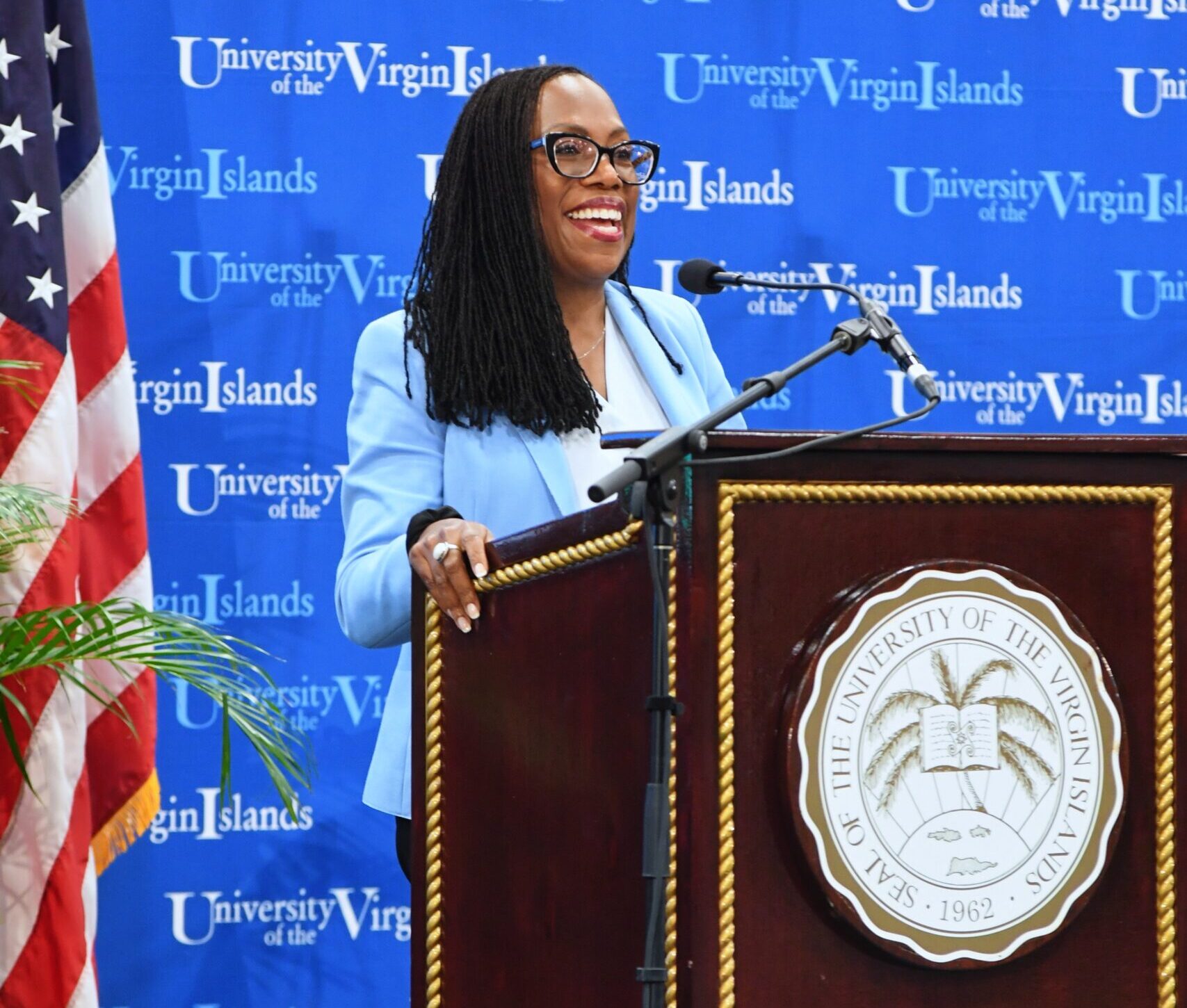
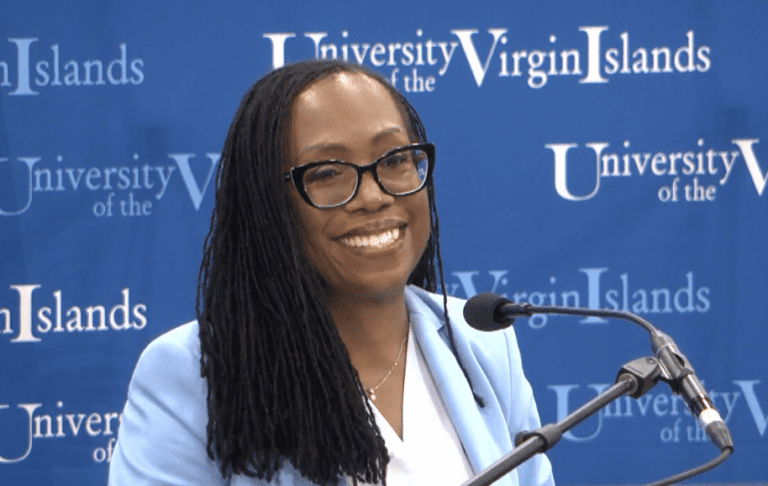
The newest justice to join the U.S. Supreme Court — Ketanji Brown Jackson – speaking Friday on the UVI St. Thomas campus. (Photo courtesy UVI)
On her second stop in the Virgin Islands, the newest Supreme Court justice shared the keys to achievement with people who gathered to meet her. Justice Ketanji Brown Jackson met with judges, the higher education community and invited guests for a candid conversation.
Despite Friday’s demanding schedule, Jackson said she enjoyed the enthusiasm that greeted her at every stop. The new justice — the first former public defender appointed to the high court — is the first African American woman to join the Supreme Court. “This first Black woman is very, very grateful to have this chance,” she said. “My family has gone from segregation to the Supreme Court in one generation.”
Those were among the remarks heard by those attending the District Court-sponsored forum held at the Westin Resort at Frenchman’s Reef. About 350 people filled the seats in the hotel ballroom.
Over the course of 90 minutes, that audience heard District Court Judge Wilma Lewis pose questions to Jackson about her life, her background, and how she navigated a career path that led to her judicial perch.
“Justice Jackson is a trailblazer,” said Chief District Judge Robert Molloy in his welcoming remarks. “Her words not only carry the weight of wisdom but perseverance, integrity, and a deep commitment to justice,” he said.
In her conversation with Lewis, Jackson said she decided to become a judge as a child after reading about federal Judge Constance Baker Motley in a magazine. When she learned about Supreme Court Justice Sandra Day O’Connor becoming the first woman to serve on the U.S. high court, Jackson said she put the two role models together and thought there was — for her — a path to the Supreme Court.
Lewis asked the justice how she dealt with discrimination. “You have to develop a clear sense of who you are and where you are going to not be distracted by those sorts of things,” she said.
Earlier that day, on the University of the Virgin Islands St. Thomas campus, Jackson addressed leaders of the Student Government Association at a convocation event. Her appearance there set her among a series of distinguished speakers, including fellow Supreme Court Justice Sonia Sotomayor, former U.S. Attorney General Loretta Lynch, and Georgia Sen. Raphael Warnock.
“Your journey, Justice Jackson, embodies the very principals we hold dear; your journey is proof that education is the gateway to transformation,” said St. Thomas Association President Zeidan Bass.
At that event, Jackson said she was surprised by the number of students who approached her, asking for advice to help navigate their futures. The justice offered three suggestions: work hard at anything they aspired to do, hold an unshakable belief that anything is possible, and never underestimate the power of kindness.
Communication skills are key, she said, urging students to develop top-notch written and spoken abilities. And drawing on a story from her own experience, Jackson pointed to the value of discernment — learning when and how to speak up and when to resist the urge to speak.
As she wrapped up her remarks, UVI President Safiyah George and board of trustees Chair Henry Smock presented the justice with an honorary doctorate degree in a brief formal ceremony. Student leaders took a moment to reflect on what they had heard.
“For me, her remarks stood out about humility; it’s good to remain humble about everything you go through, and that’s one of the principles that I live by,” said Bass.
For St. Croix Student Government Association’s Brianna Thomas, Jackson’s word of the day was kindness. “I think we live in a very harsh world and kindness is rare to find, unfortunately. It’s one thing that I’m reminded of and through my mother that being kind never hurt anybody,” Thomas said.
Check out our weekly weather forecast with Jesse Daley, covering Sunday, Feb. 9, through Saturday, Feb. 15. Our YouTube playlist is updated every week, AND check out Jesse’s daily weather updates here.
An earthquake centered near Honduras has triggered a Tsunami Advisory across the Virgin Islands and Puerto Rico. (Photo courtesy U.S. Tsunami Warning System)
A powerful earthquake struck north of Honduras on Saturday evening, briefly prompting a Tsunami Advisory for areas including the Virgin Islands and Puerto Rico, according to the U.S. Tsunami Warning System, part of the National Oceanic and Atmospheric Administration (NOAA) and the National Weather Service (NWS).
Based on the initial information after the earthquake, a tsunami advisory was issued for areas across the Virgin Islands and Puerto Rico, in expectation of the possibility of powerful waves generated by the temblor. However, the advisory was canceled for the Virgin Islands and Puerto Rico shortly thereafter.
“A Tsunami Advisory is issued when a tsunami with the potential to generate strong currents or waves dangerous to those in or very near the water is imminent, expected, or occurring,” according to the U.S. Tsunami Warning System website. “The threat may continue for several hours after initial arrival, but significant inundation is not expected for areas under an advisory,” the website said. (During a Tsunami Advisory, NOAA advises individuals to “stay out of the water, and away from beaches and waterways.”)
Earthquake and Tsunami Information
Tsunami alert information. (Photo courtesy NOAA)
A previous Source article shared information about the threats to both U.S. territories caused by earthquakes and tsunamis, noting that the islands are positioned in an active seismic zone:
“During an earthquake, it is critical for people to ‘Drop, Cover, and Hold On’ to protect themselves,” said Elizabeth Vanacore, PhD, a seismologist and a researcher at the Puerto Rico Seismic Network (PRSN).
“If you are driving your car [during a] small [seismic] event, you might not perceive the earthquake,” she explained. “However, if there is a larger event, recommended actions become situational. For instance, if you are in a safe area without electric poles or trees, then you should come to a stop, pull the handbrake, and protect your head with your arms,” Vanacore cautioned.
Vanacore encouraged the public to get involved in drills and exercises that are intended to familiarize residents and visitors across the region to be ready in the event of an earthquake or a tsunami.
“Understanding the hazards due to earthquakes and tsunamis in the region is constantly improving thanks to efforts of scientists and emergency managers both in the USVI and Puerto Rico,” Vanacore declared. “Relationships across the islands are critical to our continued resilience, [and] while earthquakes and tsunamis cannot be predicted, we can all prepare for them,” she noted.
“[Preparing for quakes] includes participating in activities like [the Great] ShakeOut and Caribe Wave, as well as taking ownership of your own preparedness at home. The PRSN and the Virgin Islands Territorial Emergency Management Agency (VITEMA) have information available to learn about earthquakes and tsunamis, and most importantly, how to prepare for them,” she recommended.
U.S. Supreme Court Justice Ketanji Brown Jackson during remarks. (Source photo by Jonelle-Alexis Jackson)
The University of the Virgin Islands (UVI) hosted its 2025 student convocation on Friday, featuring the Honorable Ketanji Brown Jackson, associate justice of the United States Supreme Court, as the keynote speaker and honorary degree recipient. Jackson delivered a powerful and personal address, encouraging students to embrace hard work, kindness, and courage as they navigate their personal, academic, and professional journeys.
The convocation, held at UVI’s Elridge W. Blake Sports and Fitness Center, was a landmark event for the university community. Pamela Moolenaar-Wirsiy, UVI’s vice president for Student Success & Innovation, served as Master of Ceremony, setting the tone for an afternoon of celebration and inspiration. The UVI Jazz Ensemble, under the direction of Dion Parson, chair of the performing & music arts department, delivered captivating musical selections that added a dynamic and uplifting element to the convocation ceremony. Their performance showcased the depth of musical talent at UVI, blending rhythmic sophistication with a rich, soulful sound that resonated throughout the venue.
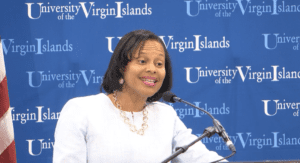
UVI President Safiya George (Source photo by Jonelle-Alexis Jackson)
UVI President Safiya George officially welcomed Jackson, describing her as a trailblazer whose career exemplifies perseverance and justice. Zeidan Bass, student government association president for the Orville E. Kean Campus, and Henry C. Smock, chairman of the UVI Board of Trustees, also delivered remarks, reinforcing UVI’s commitment to academic excellence and leadership development.
Jackson, the first Black woman to serve on the U.S. Supreme Court, expressed her deep appreciation for the opportunity to engage with students, particularly at Historically Black Colleges and Universities (HBCUs). She shared that her parents and brother are proud HBCU graduates, giving her a special connection to institutions like UVI.
Reflecting on her experiences during her recent book tour, Jackson noted that many young people asked her for advice on achieving success. She responded with three key lessons:
UVI President Safiya George and U.S. Supreme Court Justice Ketanji Brown Jackson (Source photo by Jonelle-Alexis Jackson)Hard Work Leads to Extraordinary Success
Jackson emphasized that diligence and determination are the keys to achieving greatness. She recalled how, as a child, she watched her father study law while raising a family, teaching her that perseverance is essential. Quoting Henry Wadsworth Longfellow, she reminded students:
“The heights by great men reached and kept, were not attained by sudden flight, but they, while their companions slept, were toiling upward through the night.”
Kindness is a Powerful Tool for Success
Sharing a childhood memory, Jackson recounted how she once mocked a misspelled note, only to later realize it was written by her grandmother, who had been denied a formal education due to segregation. The moment taught her that privilege should never lead to arrogance and that treating others with respect and kindness can open doors in life that academic achievements alone cannot.
Courage and Conviction are Essential
Jackson recalled her time as vice chair of the U.S. Sentencing Commission, where she advocated for fair sentencing reforms despite political risks. Though she feared the consequences of speaking out, she ultimately chose to stand by her principles, a decision that helped pave the way for her judicial career. She urged students to trust their values, believe in their abilities, and boldly pursue justice—even when the path seems uncertain.
UVI President Safiya George, U.S. Supreme Court Justice Ketanji Brown Jackson, and UVI Board Chairman Henry C. Smock, Esq. (Source photo by Jonelle-Alexis Jackson)
Following her address, UVI conferred an honorary degree upon Jackson, recognizing her contributions to law, leadership, and social justice. The award was presented by UVI Smock and George. The convocation concluded with remarks from Briahna Thomas, President of the Student Government Association for the Albert A. Sheen Campus, and a final message from George, who praised Jackson for her inspiring words and lifelong commitment to justice. A special acknowledgment was extended to the District Court of the Virgin Islands, including Chief Judge Robert A. Molloy and District Judge Wilma A. Lewis, for their role in facilitating her visit to the territory.
Jackson’s presence and words left an indelible impact on UVI students and faculty, reinforcing the university’s commitment to excellence, leadership, and social responsibility. Under George’s leadership, UVI continues to empower students to become global change-makers, ensuring that education serves as a bridge to opportunity and justice. As the 2025 student convocation came to a close, students and faculty alike departed with a renewed sense of purpose, inspired by Jackson’s message that with hard work, kindness, and courage, anything is possible.
Ribbons adorn the sign proclaiming UVI’s Orville Edward Kean St. Thomas campus. (Source photo by Judi Shimel)
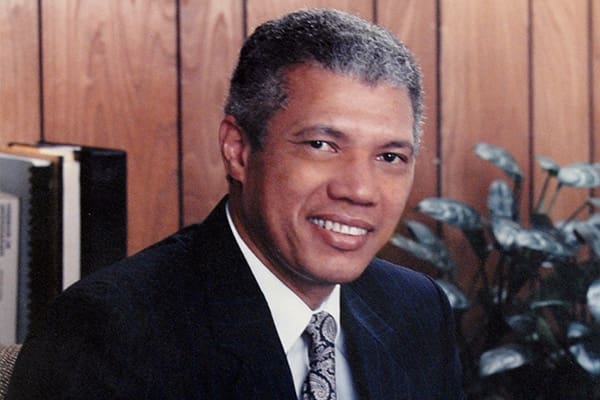
Friends and associates of the late UVI President Orville Kean bade him a warm farewell from the University of the Virgin Islands St. Thomas Campus on Saturday. There, about 400 people settled into seats and bleachers at the Elridge W. Blake Sports and Fitness Center to remember him.
Kean — the school’s third university president — died Jan. 19 on St. Thomas at the age of 86. He was remembered on Saturday as a “deeply respected and loved” educator committed to the advancement of knowledge, promotion of progress, and dedication to his Virgin Islands home.
The service was a celebration of a life lived to the fullest to the very end. Catherine Kean — his daughter — told the story of his passing in a way that conveyed her father’s spirit.
“The morning dad passed…he looked at me squarely and asked…’Am I dying now?’…I said ‘yes, daddy…it’s today…'”
“We used to play a game…I would say not today and not tomorrow…We both knew what I meant…He said…’I thought I had until June.’”
The sports and fitness center offered a homey setting for Kean’s memorial, with a wreath and his giant portrait smiling at those seated in the rows of chairs facing the stage and a cluster of banquet tables arranged towards the back where a repast would be served later.
Musicians and vocalists assembled in a corner at the front of the stage, delivering spirited performances of jazz and gospel selections, including an arrangement of “Spain” by Chick Corea.
Portrait of Kean smiles from the stage at Blake Fitness Center. (Source photo by Judi Shimel)
Virgin Islands songbird Lorna Freeman sang “Bridge over Troubled Waters;” Louis Taylor and Friends joined jazz drummer Dion Parson with a version of “My Funny Valentine.”
St. Thomas jazz man Taylor took the microphone upon the last note, saying it was one of Kean’s favorite tunes; it was played at his last birthday party and he asked that it be played again when his time was done.
“There will be no funeral dirges for Dr. Kean,” said Mistress of Ceremonies Joanne Moorehead, but there was poetry and tributes from longtime friends Malcolm Kirwan, Roy Watlington, and Gilbert Sprauve as well as from UVI President Safiyah George and President Emerita LaVerne Ragster.
George recalled her predecessor as an extraordinary leader and her personal mentor. “Today and in the days to come, when we think of Dr. Kean with sadness, we will be reminded that he brought joy to this university and that his spirit and contributions will always be remembered.”






 America often prides itself as the land of opportunity, yet its history tells a different, more uncomfortable story – especially when it comes to Haiti and immigrants of color. The narrative of migration is far from simple, and to understand the current crisis of Haitian migration, we must confront America’s role in destabilizing Haiti and the glaring racial disparities in how immigrants are treated.