


Consider the Source with Adisha Penn

Remembering Pamela Richards: A Legacy of Service and Dedication
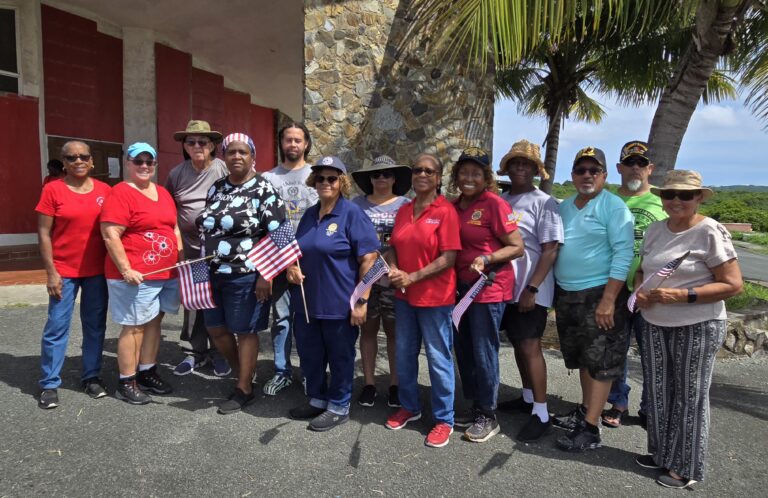
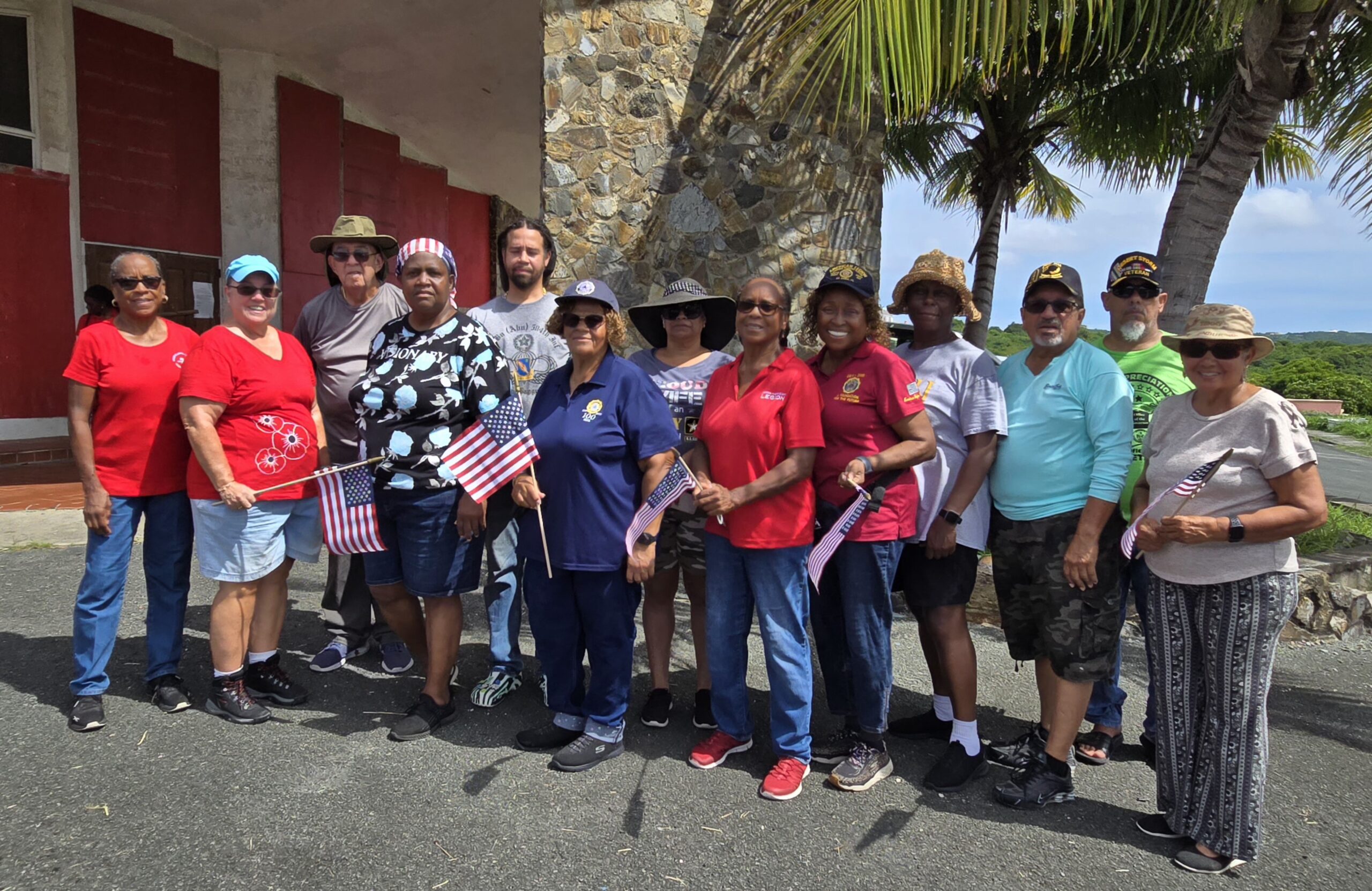
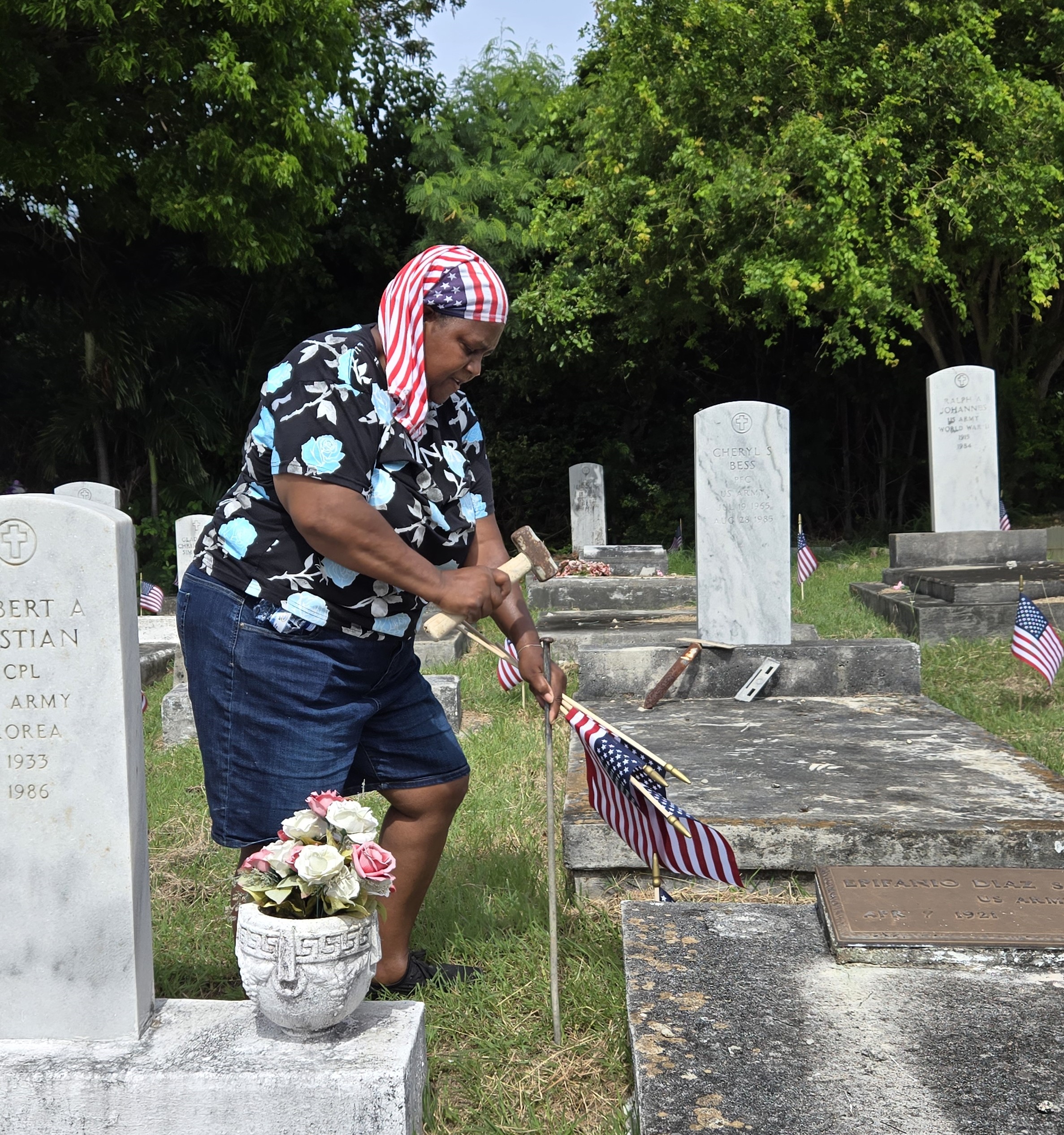
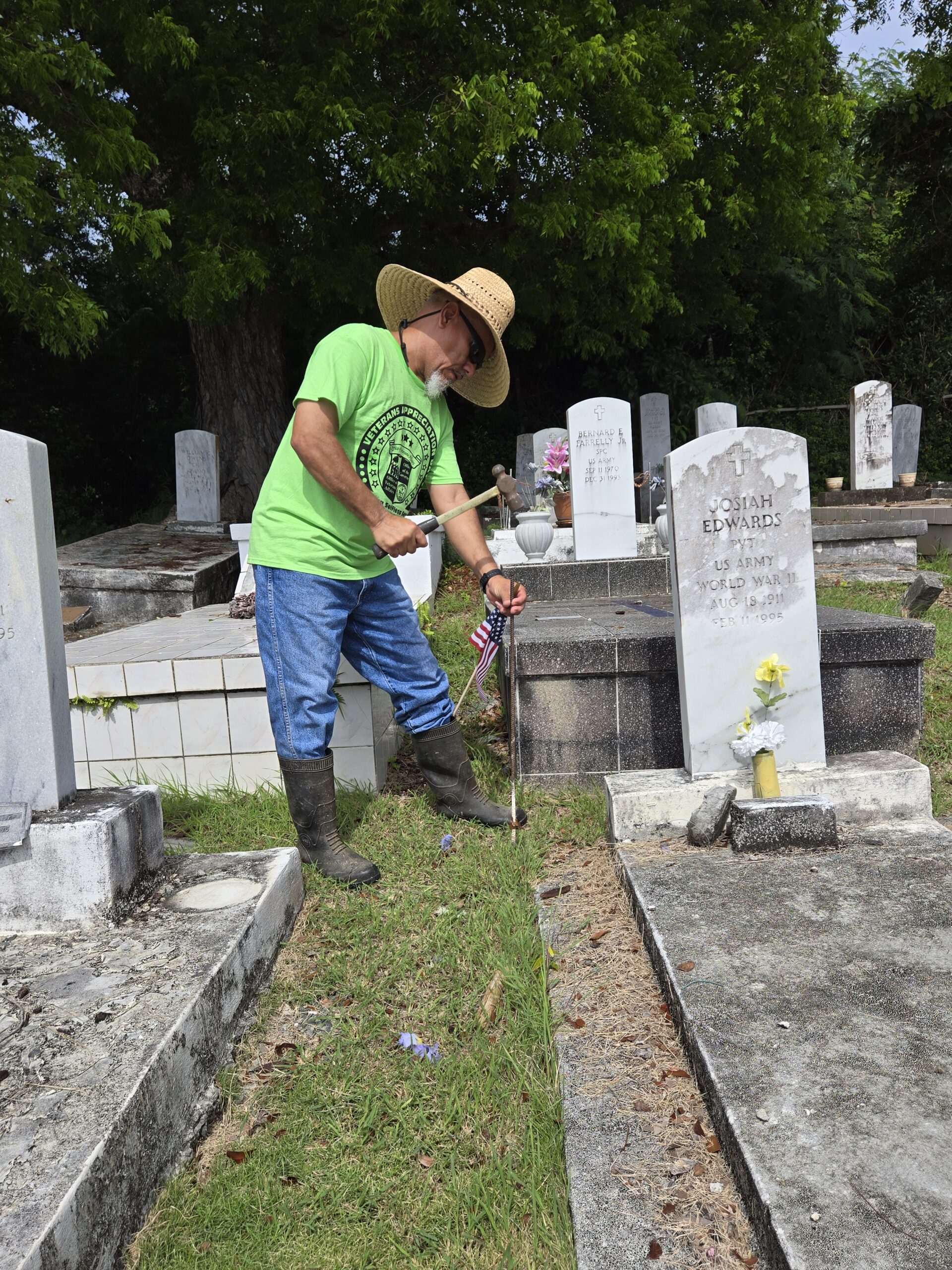
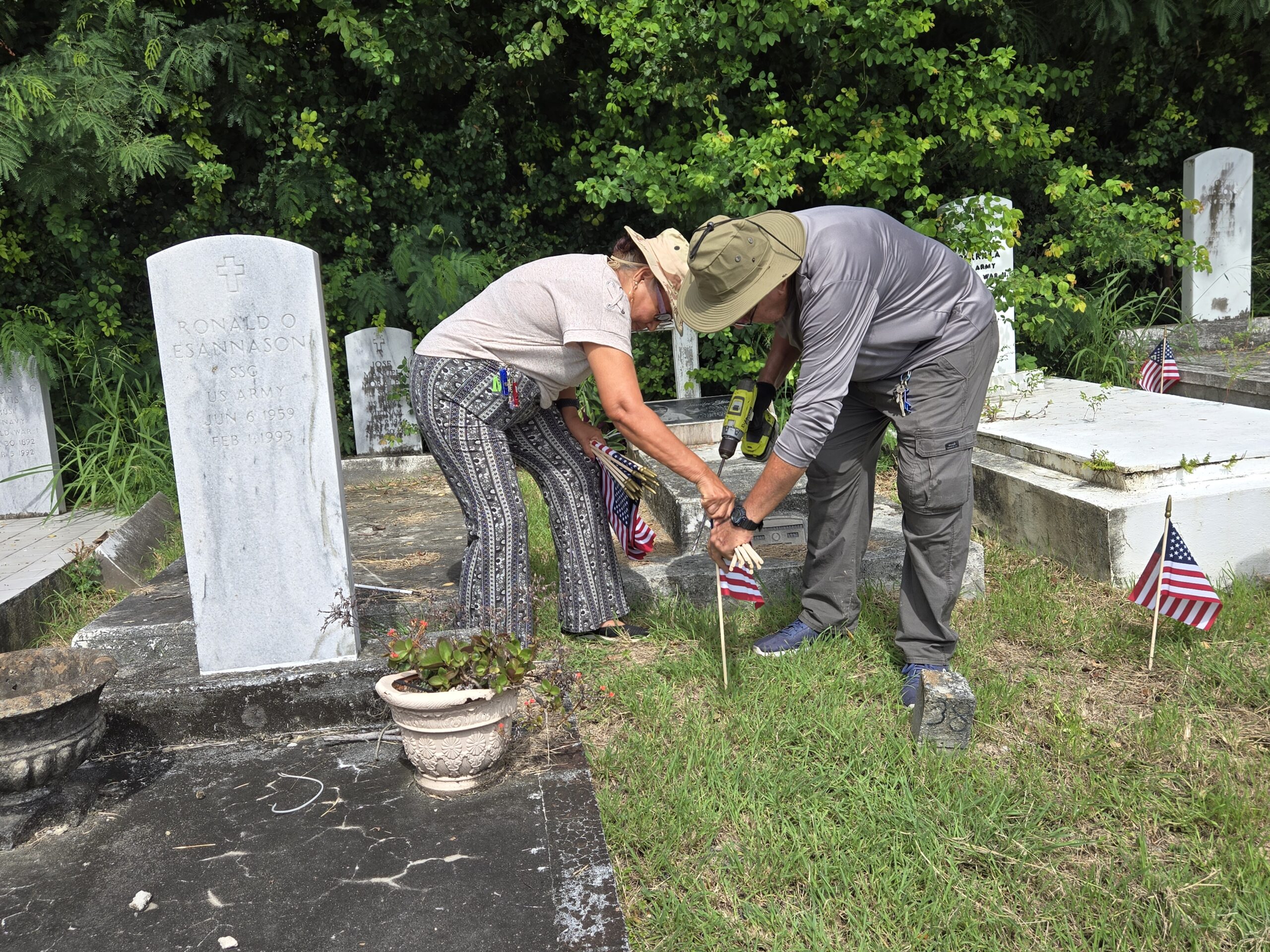
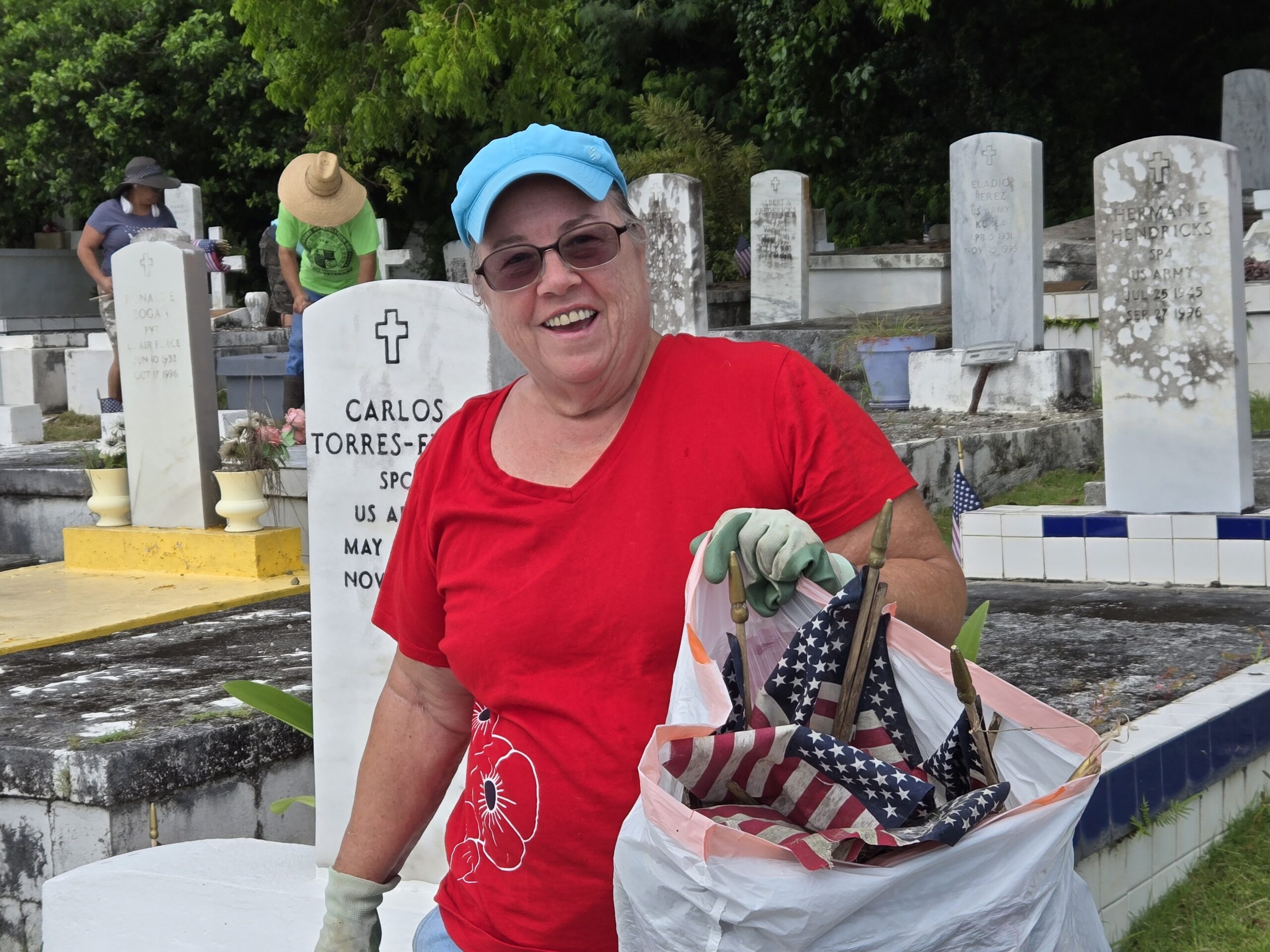
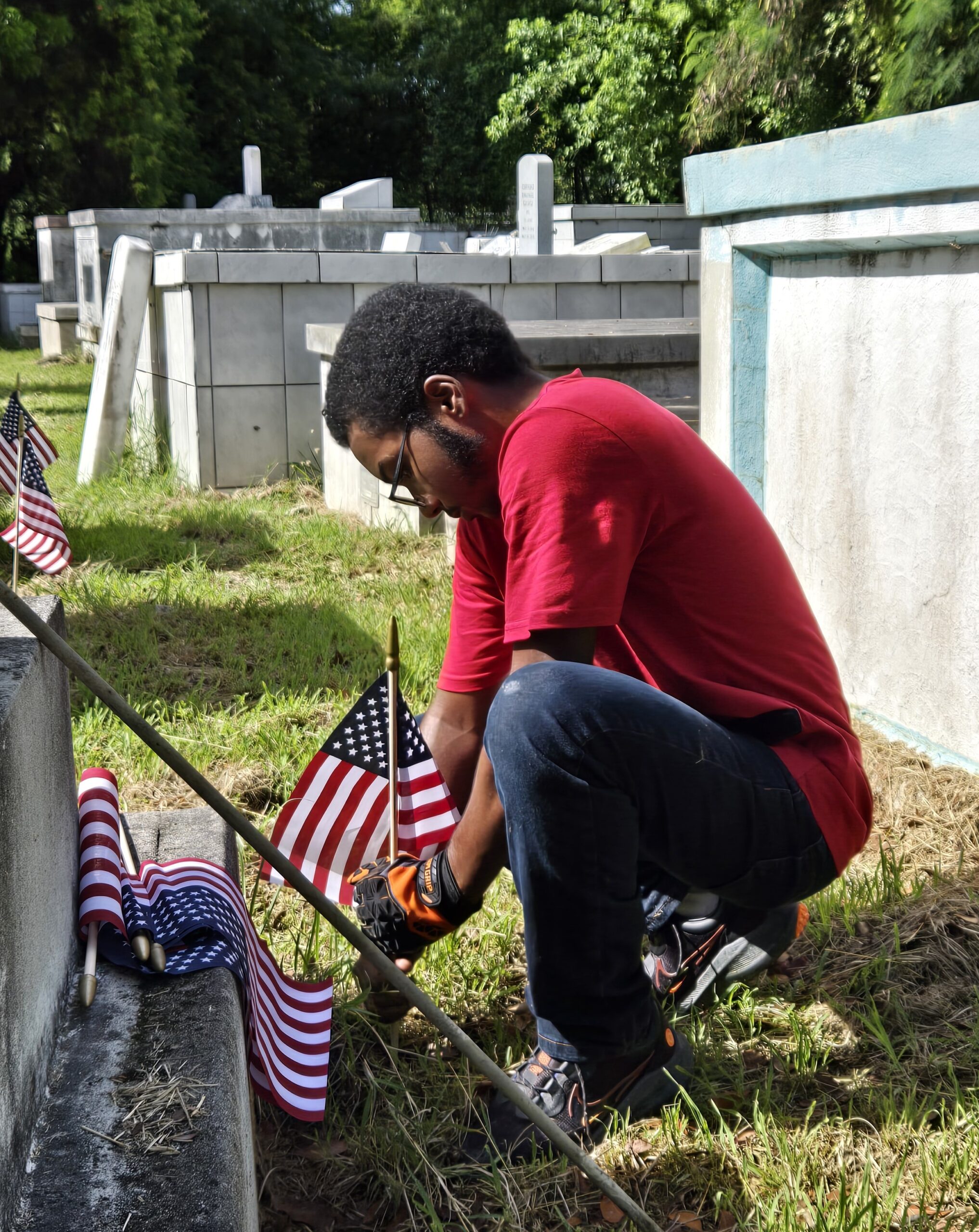
Photo Focus: In Preparation for a Day of Remembrance the Changing of the Flags a Memorial Day Tribute
Senate Bill Aims to Clean Up Guardianship Issues

Southern SARE Sowing the Seeds of Sustainable Agriculture


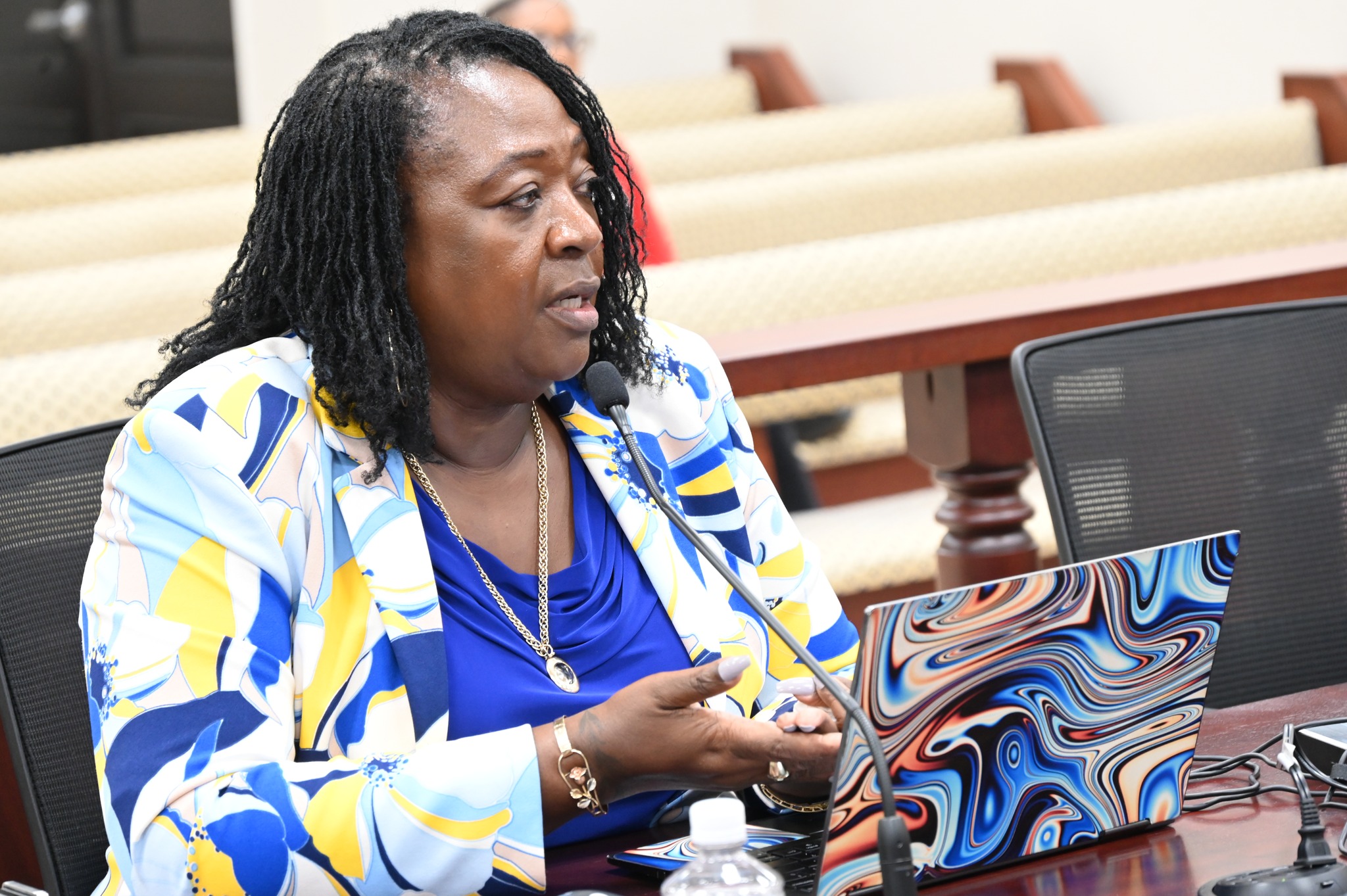
Southern Sustainable Agriculture Research and Education, or SSARE, has been sowing seeds for sustainable agriculture in the U.S. Virgin Islands. DaraMonifah Cooper, Southern SARE communication specialist, said that over the past few weeks, a team of representatives has visited farmers on St. Croix, St. Thomas, and St. John.
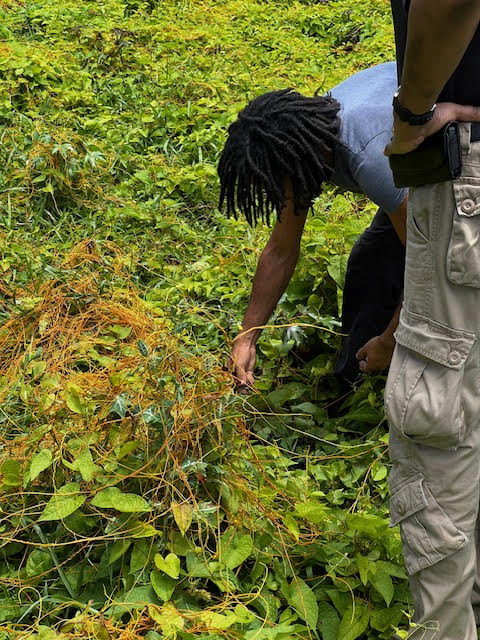
The representatives conducted farm tours individually and in groups. They also met with staff, faculty, and students at the University of the Virgin Islands, representatives from different agriculture-related agencies, and representatives from the agriculture business center.
Cooper said the mission of these meetings served different purposes; however, the real topic was the funding of the program for research and education as well as professional development, travel scholarships, and event sponsorships pertaining to sustainable agriculture. The team met with different stakeholder groups, exchanging insights on their activities, needs, and challenges, and in return, SARE shared its program solutions and suggested other programs that might be helpful.
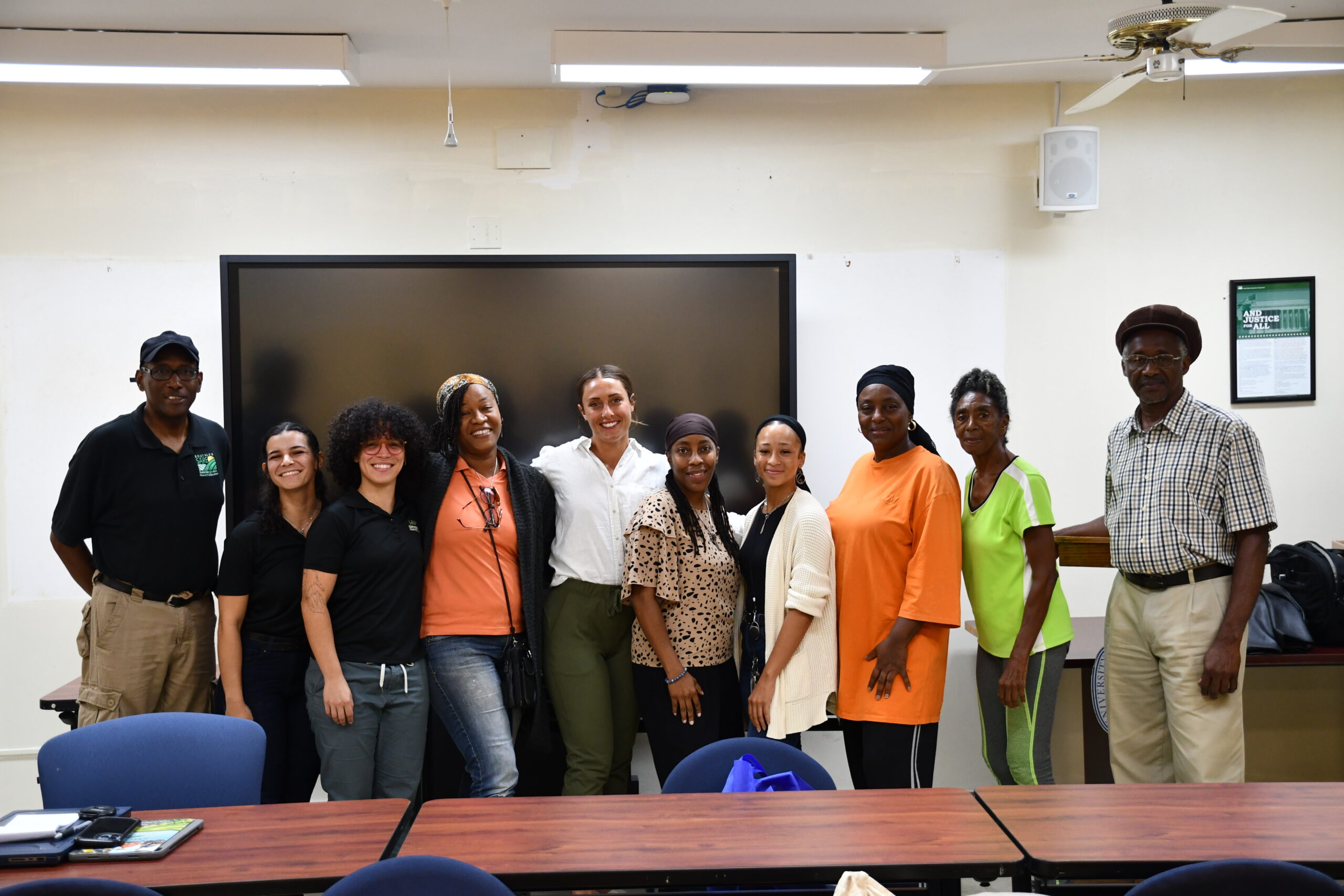
“Visiting small farms on the Virgin Islands has shown me the resilience and dedication of local communities in their pursuit of sustainable agriculture and food sovereignty. By partnering together and sharing simple technologies, we can enhance production through soil conservation and improve food security through post-harvest education. True progress comes from mutual respect and working hand-in-hand with those who know the land best,” said Gabriella Soto-Velez, sustainable agriculture specialist at the National Center of Appropriate Technology.
Cooper said that the most recent outreach received an excellent reception and great cooperation from the farmers. “To give an idea of what comes next, within the next weeks, SSARE will compile and analyze all of the data collected to develop a strategic funding plan for the territory based on what we learned from the farmers as well as those supporting them within the government,” she said.
“This plan will contain an overview of the opportunities and challenges facing agriculture in the Virgin Islands, identification of key stakeholders and the development of a contact list, and an analysis of the grant opportunities that could fund potential projects on the islands and go through a matching process. The plan also involved an analysis of the gaps that could prevent successful access to grant opportunities and the development of a plan to remove them. Last, SSARE will develop a timeline to apply for identified grants and a goal for the total dollars that could realistically be brought into the Virgin Islands,” said Brennan Washington, Southern SARE Southeastern Outreach coordinator who lead all of the meetings along with Cooper, who coordinated them.
Sustainable Agriculture Research and Education has provided over $1 million in total funding and 25 grant projects since 1988. Grants range from $3,000 to $400,000. Some are competitive grants, and others are not.
“We are not replicating any services that already exist. We are working together with the Department of Agriculture, the School of Agriculture, and the University of the Virgin Islands,” said Cooper.
“A lot of times these external agencies come in and basically replicate services we offer here. This is something we strategically did not do because we met first with Commissioner Petersen from the Department of Agriculture and asked him what he thought the areas that needed support were,” she said.
Cooper said that SSARE continues to look forward to working closely with the Agriculture Department and Cooperative Extension Service to elevate USVI agriculture and help keep them informed of their progress.
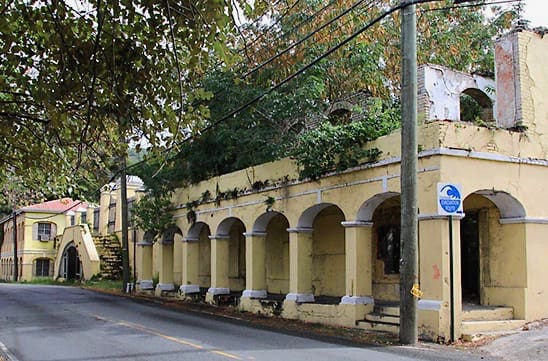
Cooper said that the team will be following up with fisheries and those who were not able to attend. If you are interested in learning more about SSARE and were not able to attend their outreach, contact communication specialist DaraMonifah Cooper at dcooper@sare.org or visit www.southern.sare.org.Mellon Foundation, NEH and Others Fund Grants for VI Architecture Center
Weekly Weather Forecast with Jesse Daley

Senate Moves to Raise Pay for Jury Duty, Extend Firearm Licenses
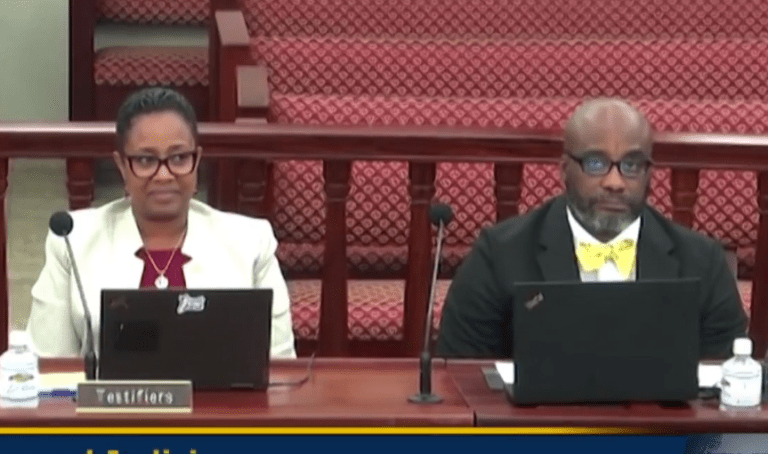
On Friday, the Committee on Rules and Judiciary forwarded to the full Senate a bill extending firearm licenses from three to five years, as well as a bill raising the pay for residents serving on juries. However, a bill to confer peace officer status on enforcement officers employed by the Government Employees’ Retirement System did not receive favorable treatment.
Sen. Novelle Francis said he had reservations about conferring peace officer status for GERS officers because the status would go everywhere with the officers. He said it would set a precedent, and what would stop employees at Sunshine Mall or Sunny Isles from getting peace officer status?
Sen. Kenneth Gittens opposed non-government officers getting peace officer status and asked why some employees could not be trained as armed security. Gittens and Francis have both worked as police officers.
Sen. Marise James, who also voted against a favorable recommendation, said she relied on her colleagues’ expertise.
Sen. Milton Potter introduced the measure to extend the period for a firearms license and an amendment requiring a firearms safety course for each renewal.
Sen. Angel Bolques said he supported the extension because it would reduce administrative paperwork.
Regina deChabert Petersen, administrator of courts of the judicial branch, said, “Inadequate compensation for juror service is a real concern for the effective and timely administration of justice.”
She added that the local judiciary now pays $40 for a full day of service, $20 for a half day of service, and $5 per day to defray the cost of transportation.
The fees were set in 1976.
Sen. Franklin Johnson said the cost of living in the Virgin Islands has risen “drastically” since the fees were set.
The proposed bill states, “Jurors impaneled for trial shall receive $80 per day for their service and $40 for any half-day. Jurors who participated in the jury selection process but were not chosen to serve on the jury shall receive $20 per day for their service and $10 for any half-day of service.”
Petersen added, “These amounts, while an improvement over the fees currently in place, may also become insufficient due to inflation and changes to the cost of living.”
She suggested that the new figures be set as the floor (no less than) and that the judiciary have the power to raise them when appropriate.
Ian Clement, deputy attorney general, who, like Petersen, testified in support of the bill Friday, said the bill needed an amendment showing who would pay the additional costs and where the funds would come from.
The bill would also increase “the fee from $4 to $80 for a witness to attend a proceeding in court before an administrative judge, or before any person authorized to take his deposition.”
St. John Celebrates the New VINP Facility at Lind Point
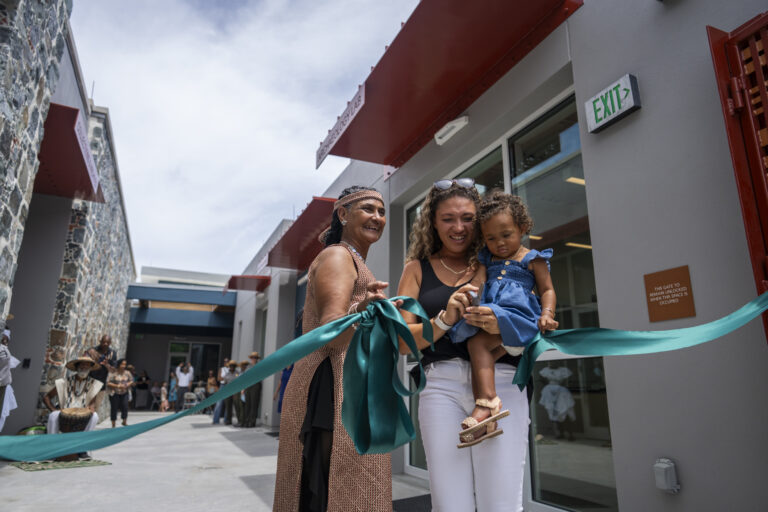
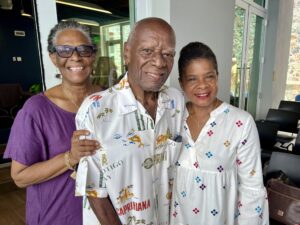
There were smiles all around, and even a few tears, as officials from the National Park Service hosted the grand opening of the Resource Management, Science and Collection Center on St. John Saturday morning.
Residents and visitors, as well as current and former Virgin Islands National Park employees, rode shuttle buses from the NPS Visitor Center in Cruz Bay up the steep hill to Lind Point to tour the new complex.
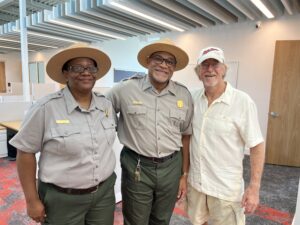
All were eager to see the new facilities that include offices for the Division of Resource Management, a conference/classroom space, a lab for processing archaeological artifacts, a secure area for archives, a dive locker, and housing for park employees and visiting researchers.


They were greeted by the Love City Pan Dragons Youth Steel Orchestra, a troupe of dancing moko jumbies led by Yisrael Petersen, and later by bamboula dancer Raven Phillips and drummer Delroy “Ital” Anthony.

Following the blowing of the conch shell, and an invocation by the Rev. Anthony Abraham of Our Lady of Mt. Carmel Catholic Church, VINP Superintendent Penny Del Bene welcomed everyone to come and enjoy the facilities and introduced the speakers.
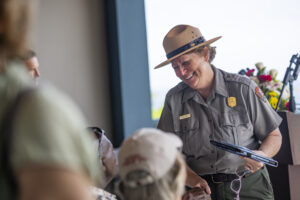
Mark Foust, Southeast Regional Director of the NPS, said he first set eyes on St. John after the hurricanes of 2017. “I’ll never forget the pain, or the heart and resilience of the people. There’s something special about the islands,” he said. “The path between the NPS and the people of St. John has not always been smooth or easy, and there’s no point in pretending it isn’t that way, but it takes grit and heart to bring this project to fruition.”
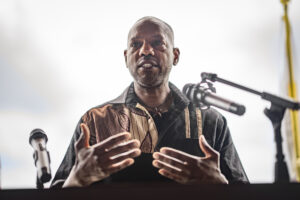
The keynote speaker was Nigel Fields who served as superintendent of the VINP for five years including the project’s early planning stages after the hurricanes, through the groundbreaking in 2022, until July 2023 when the walls, roofs, and windows were all in place.
Fields, who now works for the EPA, asked the audience to consider the amount of faith it takes to make changes and move forward on big projects.
He said that the Resource Management, Science and Collection Center (known as the RMS) replaced the old Biosphere Reserve Center — small wooden structures built in the same location in the early 1980s as the environmental movement was gaining momentum.
“We had to take the old Biosphere model and move it to address the climate change reality we’re all facing now,” Fields said.
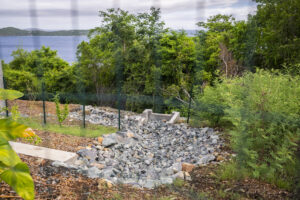
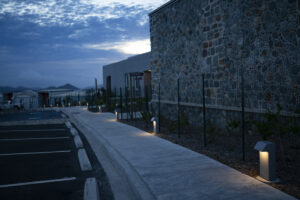
The ecological design features of the RMS include solar panels, bio swales and retention areas to control storm water runoff, dark sky lighting, and enough concrete to withstand winds exceeding 220 mph.
“We’ve learned a lot in the past 40 years,” Fields continued, as people have thought more about communication between citizens and the environment. Unique spaces like the Virgin Islands National Park “should not be put on a shelf,” he said. “We have a special opportunity to open up these landscapes.”
Fields said that in the “old days,” artifacts were commonly removed from the sites in which they were found and stored elsewhere in an effort to preserve and protect them. Now the model calls for preserving artifacts in their context so that people who can interpret them can pass on their value to new generations.

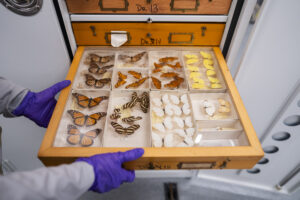
The new collections center at the RMS can accommodate 165,000 archaeological objects and 245,000 individual pieces in the archives.
“We’ve made a $30 million investment to keep these treasures here,” Fields said, “for our young people to learn about sustainability and their own culture.”
Chief Ranger Ludric Smith followed up Fields’ speech by telling the audience that the project almost came to a halt twice.
The first time was when the plan was first proposed and then rejected by higher officials (under the previous federal administration). Local and regional officials then went back and worked with the Denver Service Center — the Park Service’s central location for planning and design — to revise the plan.
Then after the COVID pandemic hit, construction costs skyrocketed, and the plan had to be modified again.
Ultimately, the project’s costs came in about one million dollars more than was predicted in 2023 and about five months after the originally scheduled date.
Eric Cusin, an executive with J. Benton Construction, LLC, — the company that oversaw the RMS’ construction — said workers on the site racked up more than 200,000 hours on the job.
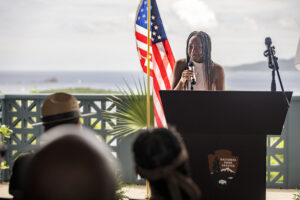
Some audience members became misty-eyed as Jordyn Powell, representing the “future stewards” of the park, recalled stories about her great-grand-uncle Noble Samuel, who served as a park ranger, senator, island administrator, and superintendent of the park in Christiansted. “He took Lady Bird Johnson snorkeling. It was in the January 1968 issue of National Geographic,” she said.
Powell said that the park’s mission is to maintain the “delicate balance to sustain our environment” as well as the “flavors and traditions” that are passed down for generations, so that her children can enjoy “watching the waterfalls at Reef Bay” and “speaking our dialect.”
Throughout the program, speakers checked the microphone and spoke of their hopes that the power would stay on. (St. John experienced multiple power failures during the previous week.) The new facility has solar panels “all over the roofs,” according to Cusin, but lacks back-up batteries in the event that WAPA goes down.
The solar panels provide power while the WAPA system is functioning, said Scott Simmons, the deputy superintendent for the VINP. But back-up batteries will cost an additional $250,000, and the funding is not available at this time.
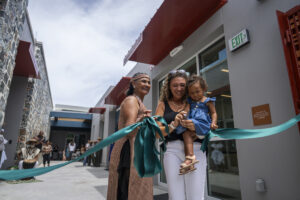
In addition to the speakers, Taino Kasike Maekiaphan Phillips participated in the ribbon cutting and Pastor Reginald Joseph gave the closing prayer.
Photo Focus: Christiansted Bypass Named in Aloy “Wenty’ Nielsen’s Honor
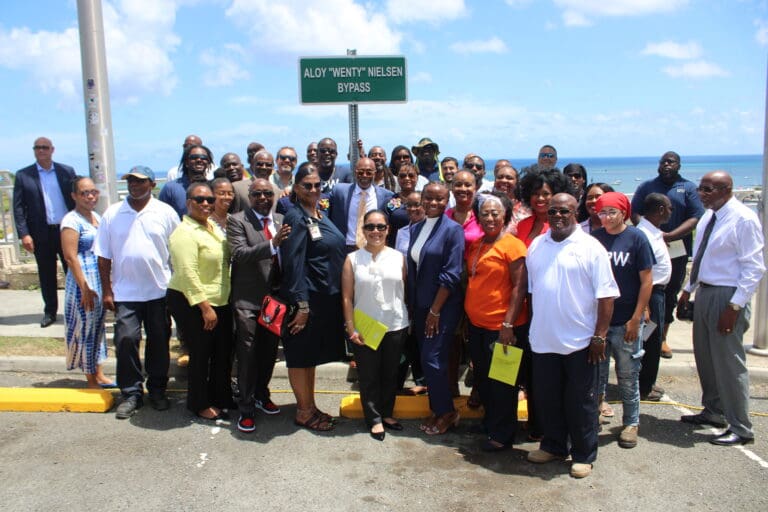
Aloy “Wenty’ Nielsen, a Public Works Department employee for over 30 years, was honored during National Public Works Week.
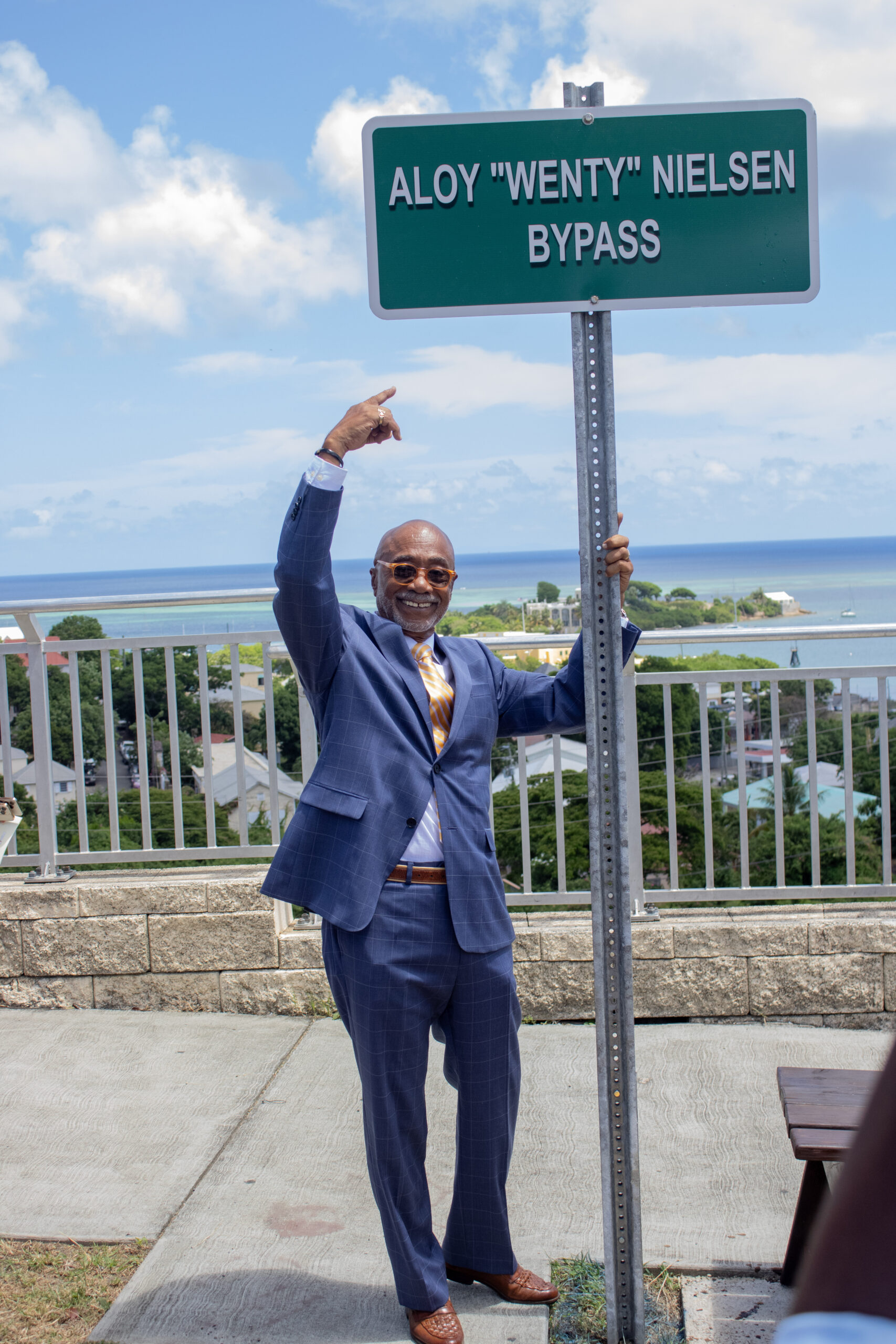
Nielsen dedicated his life to serving the Virgin Islands community, and his hard work was celebrated with the renaming of the Christiansted Bypass in his honor, according to the press release.
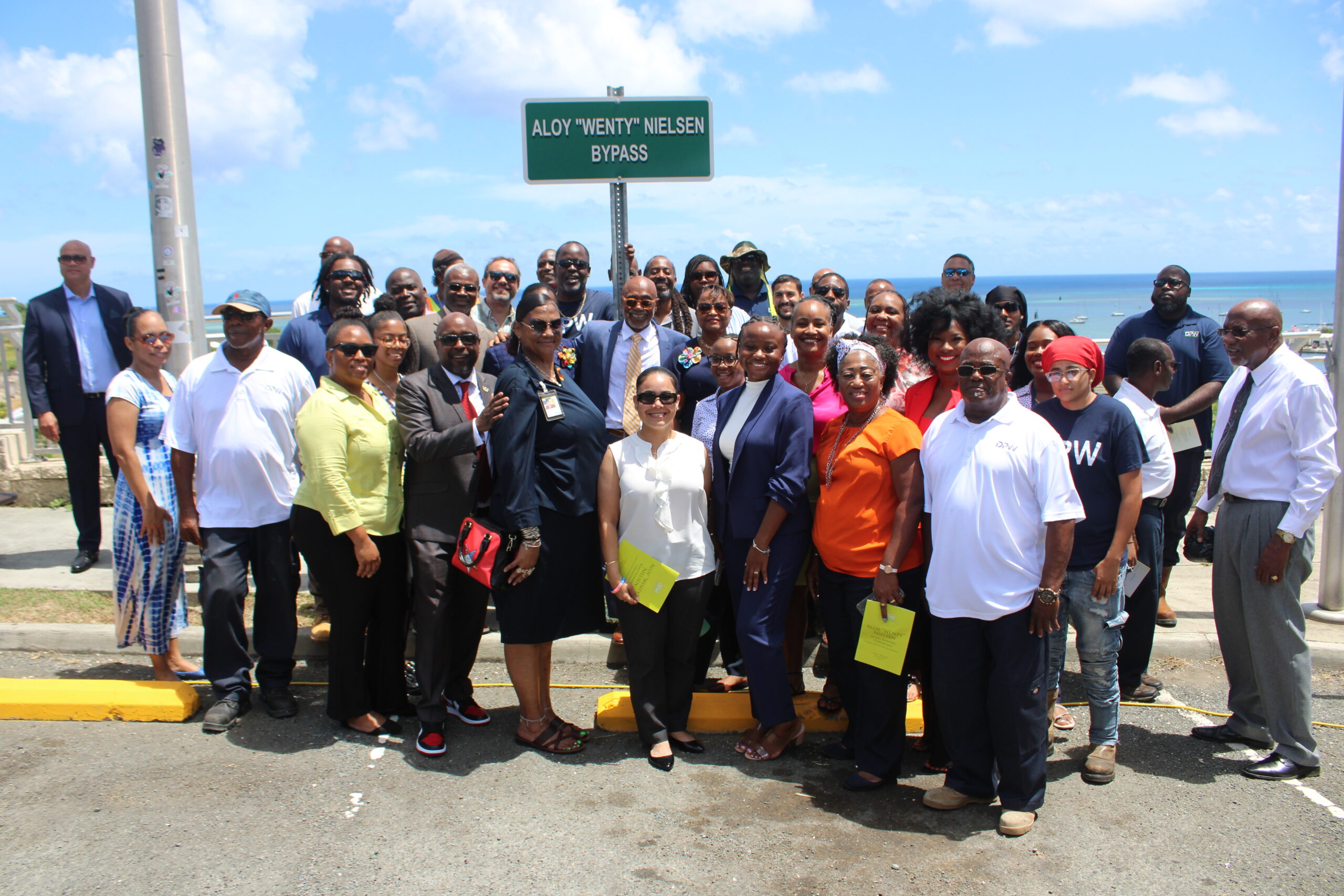
Along with the 1.2-mile roadway, Nielsen was responsible for notable projects such as the Millennial Monument at Point Udall, the roundabout on St. John, and the Long Bay revitalization on St. Thomas, the press release stated.