 Hundreds of Crucians flocked to Sunny Isles Mall Thursday to mark the opening of hurricane season with a little straight talk about preparedness as the V.I. Territorial Emergency Management Authority held its first All-Hazard Preparedness Expo.
The Expo will be repeated Friday at the Tutu Park Mall on St. Thomas.
Thursday’s event was held in conjunction with the official opening of the hurricane season, but VITEMA Director Elton Lewis said the emphasis is on all kinds of disasters. The purpose, he said, was to provide islanders with the tools to become prepared no matter what Mother Nature, man or fate throws at them.
"We really need to get the information out to the general population so they can be self-reliant and don’t have to rely on government," he said.

Tables lined the Sunny Isles Amphitheater; among those taking part were the Department of Human Services, which oversees the shelters; the V.I. Water and Power Authority; the V.I. Police Department; the American Red Cross; Search and Rescue; the V.I. National Guard; the National Oceanic and Atmospheric Administration; the Department of Planning and Natural Resources; and Innovative among others.
VITEMA’s display was the most popular, judging by the line that formed at the very beginning of the Expo and continued throughout the evening. VITEMA was signing up residents to receive the VI Alert, an electronic message that notifies subscribers to upcoming dangers and other emergency news. The agency was also giving large green bags that can be used to store emergency equipment in one place.
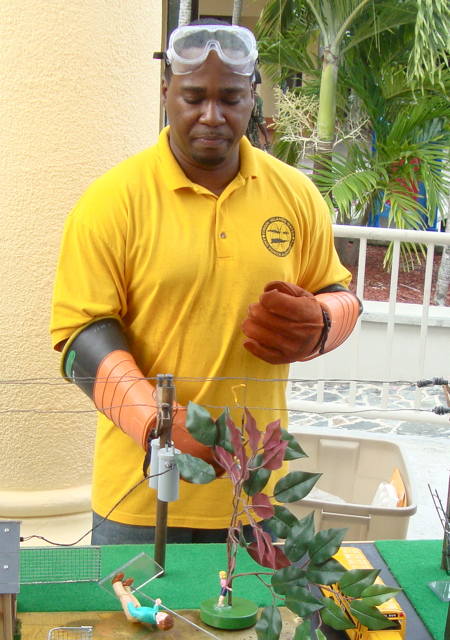
But audience members, especially kids, seemed to love the WAPA booth best of all. Electrical engineer Arthur Burton, heavily swathed in protective gear, was demonstrating the hazards of "Power Town," a display that included a house, power lines, kids, and vehicles.
To show why people should never touch a downed line, he brought one of the model power lines in contact with the model tree that a child figure was climbing. When he threw the power switch, a small bolt of electricity arced between the line and the tree. If it were a real situation, the child in the tree could have been killed—as could the child contacting the line (with sparks shooting from its feet), or the kids on the school bus he dropped a line over.
"You can’t tell by looking at it whether a line is live or not," he said.
At the Disability Rights Center’s table, Zulma Turner explained that seniors and people with disabilities have to do all the same planning and preparing that others do, plus a whole lot more.
Because so many of this group depend on others for transportation and other needs, she said, it’s important that they make plans long before a hurricane or tsunami or other disaster strikes. They need to arrange transportation to a shelter, keep all their prescriptions filled and have extra medication available if a disaster causes a long-term problem for medical supplies.
The Division of Occupational Safety and Health was on hand with tips for job safety during natural disasters, and the St. Croix Rescue Squad was passing out information on its Community Emergency Response Team (CERT) training, which prepares the territory’s teens to be ready to lend a hand when disasters occur. Young people who wish to take the three-month course can get further information by calling 773-2244.
And Innovative, better known for cable TV and phone service than disaster planning, was lending a hand as well. Their high-speed internet data cards were connecting the computers VITEMA used for VI Alert registration. During an emergency, being able to communicate throughout the territory and with the outside world can be a matter of life and death.