



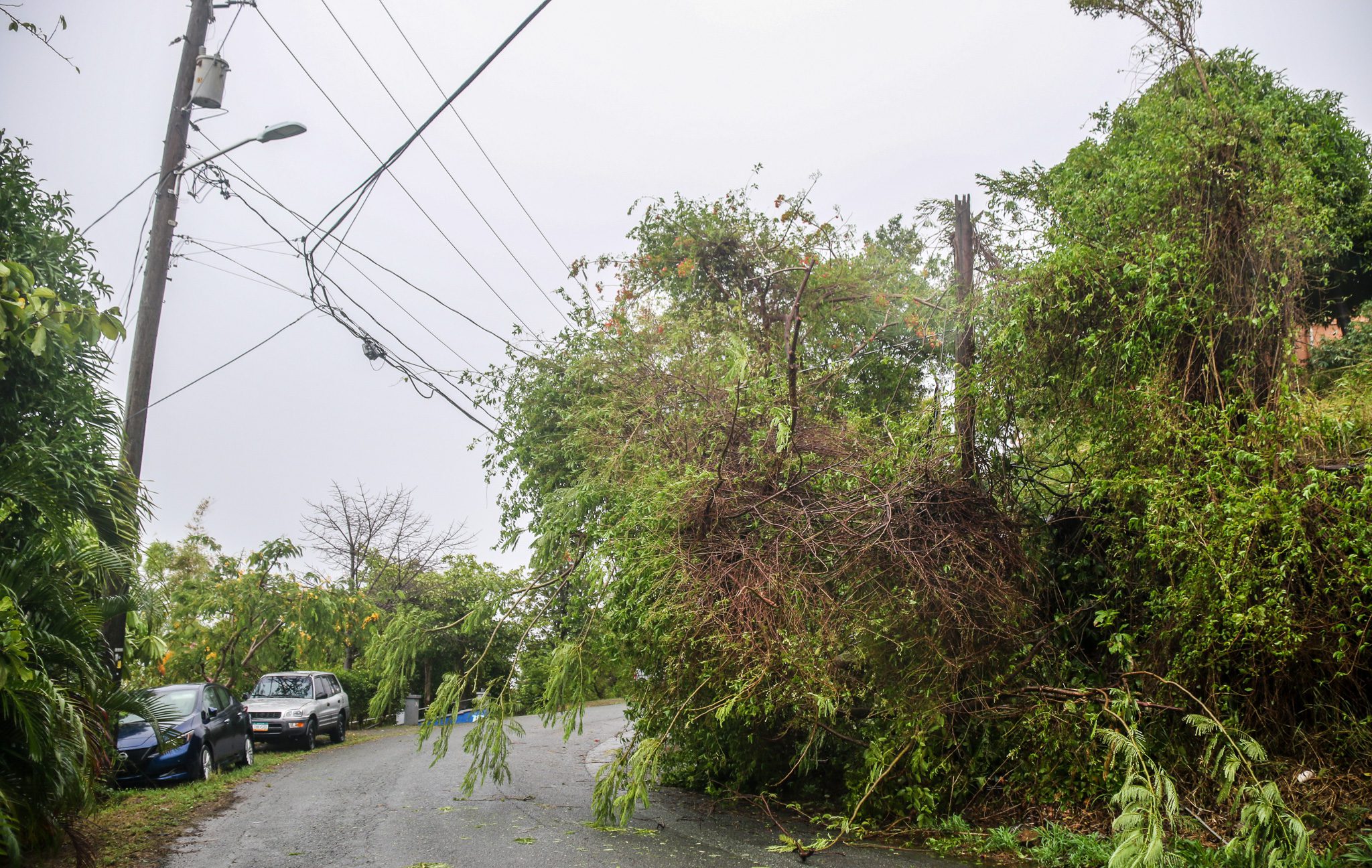
Heading into Monday, the Virgin Islands Water and Power Authority was nearing full restoration after Hurricane Erin’s outer bands knocked out electricity to tens of thousands across the territory. The storm passed the USVI at Category 5 strength without making landfall, but driving rain, high winds, and fallen vegetation left widespread outages in its wake.
By Saturday morning, an estimated 14,000 customers in the St. Thomas–St. John district were still without power, with fewer than 4,000 remaining impacted on St. Croix — numbers that significantly exceeded earlier, more modest estimates. Restoration efforts, however, were slow to gain momentum amid hazardous conditions and pressing infrastructure failures.
A critical transmission line that feeds eastern St. Thomas failed Friday afternoon under storm strain, prompting crews to prioritize stabilizing it — work that was essential before any feeder-by-feeder restoration could resume. “Repairs are not fully completed long‑term, but the line is back up now,” said WAPA Communications Director Shanell Petersen in a call with the Source late Sunday afternoon, underscoring that while the line was made operational again, a lasting solution remains in progress. This temporary repair is separate from an ongoing FEMA‑funded Feeder 13 upgrade, part of WAPA’s broader infrastructure hardening strategy.
With conditions improving, crews resumed restoration Saturday, though vegetation continued to pose problems. Fallen and wind-swept branches triggered lingering outages even on otherwise intact feeders. As Petersen explained, “Even as the majority of customers on a particular feeder have been restored, there might still be a few who remain without power,” as even minor contact was enough to trip service.

By Saturday afternoon, partial progress was evident: St. John saw its first sections of power restored, while on St. Croix, crews managed to bring the number of customers without electricity down to fewer than 4,000, largely through reenergizing Feeder 7B and beginning work on Feeder 6A.
Restoration on St. Thomas remained hampered into Saturday evening by ongoing rotating outages. Reports from WAPA cited feeder schedules — with power cycling on Feeder 7B, Feeder 9C and part of 10B, Feeder 7C, and Feeder 9E — as teams secured lines amid challenging conditions.
Meanwhile, rainfall totals confirmed the severity of the storm’s outer bands: about 1 inch on St. Croix, approximately 4 inches on St. Thomas, and up to 6 inches on St. John.
By late Sunday, isolated outages continued to be addressed in neighborhoods across the territory, with WAPA urging residents to report local outages to help crews prioritize dispatch. “Vegetation management continues to pose significant challenges, as anticipated with a storm of this strength,” WAPA stated in a release, naming priority areas like Caret Bay, Contant, and Plantation Manor on St. Thomas, as well as Enighed Hill and Cruz Bay on St. John.
In Erin’s aftermath, WAPA officials stressed that the storm underscored the need to keep strengthening both the grid and the workforce that maintains it. Petersen said the authority deployed all of its restoration crews across both districts once conditions allowed, noting that on St. Croix, cooler weather allowed linemen to work longer hours, while on St. Thomas, extreme heat forced more rotations.
Even with the full force of its workforce in the field, she added, restoration would have been faster with additional resources and personnel. That’s why WAPA has been “aggressively pursuing additional linemen,” reaching out at regional gatherings such as the Caribbean Lineman’s Rodeo and promoting local apprenticeship and internship programs to build capacity at home. Those efforts, she explained, are key to shortening restoration times when widespread outages strike.
At the same time, long-term infrastructure projects are moving ahead. FEMA-backed work to overhaul Feeder 13 — a critical transmission corridor separate from the eastern St. Thomas line that failed during Erin — is underway, part of a larger plan to harden the grid against future storms. Vegetation management will also remain a priority, with Petersen acknowledging that additional resources would allow for more aggressive trimming before winds bring branches down on lines.
Despite the challenges, Petersen said Erin showed clear signs of progress. “We were in a much better place than we were last year,” she said, recalling how long it took to bring the system back after Tropical Storm Ernesto in 2024. By early Monday, she said, all feeders were expected to be back on, with the remaining outages limited to isolated pockets scattered across neighborhoods.