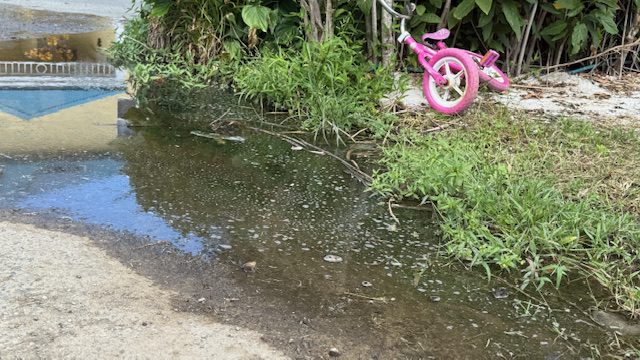
It’s pretty easy to guess what the residents of the Calabash Boom housing community on St. John want for the holidays: toilets that flush.
Residents of the affordable housing community located 2.5 miles south of Coral Bay (along the road to Salt Pond) have been without gray water in their toilets since Dec. 11, according to Mary Andrews, a 15-year resident.
The apartments at Calabash Boom are now owned by Jackson Development Company, LLC, which acquired the property about a year ago. JDC also bought several other affordable housing developments including Bellevue Village on Gifft Hill on St. John and Lovenlund on St. Thomas.
The townhouses on the Calabash Boom property are owned individually, but residents share infrastructure with the tenants of the eight apartment buildings.
Andrews said she made multiple attempts to reach officials at Jackson Development by phone and email, but her messages were not returned. Residents received letters on Dec. 16 stating that the pump at the gray-water treatment plant had failed, and a new one had been ordered.
The Source also tried to reach officials at Jackson Development Company starting on Dec. 15. On Monday, Dec. 22, an employee who answered the phone at the company’s office said, “A pump is to blame for (the breakdown) of the gray water circulation. A new one is on order and should arrive momentarily.” He identified himself only by his first name and said he is not an official spokesperson for the company.
The Calabash Boom housing community, which includes 24 townhouses and 48 apartments, has its own sewage treatment facility because there are no municipal systems for producing potable water or treating sewage beyond the town of Cruz Bay, roughly 10 miles away.
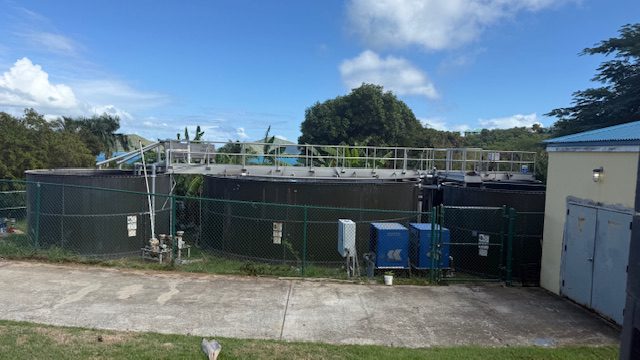
The on-premises facility filters whatever is flushed down the toilets and cleans the effluent to the point where it is considered “gray water” — safe enough to be recycled to use in toilets or to water plants. Potable water for showers and cooking is trucked in for tenants in the apartments while townhouse owners rely on rainwater stored in their cisterns.
Since Dec. 11, residents in the townhouses and the apartments have been filling jugs with water from their sinks and pouring it into their toilets. “I’m here by myself at the townhouse, filling my toilet tank with gallon jugs from the tap,” said one resident, a retired teacher. “I tried rigging up a hose, but it didn’t work. At times the floor becomes wet from the transfer. That’s a real danger for me, because I don’t want to take a fall.”
At age 84, Andrews also lives alone and said she has trouble lifting and carrying the gallons of water. She wonders how some of her neighbors cope, especially those in multi-generational households with many family members sharing one bathroom.
This is not the first time that the gray water system at Calabash Boom has failed. According to Andrews, starting July 4 there was no water in the toilets for 12 days until repairs were made to underground pipes.
“When the septic system goes back on after being off, the gray water isn’t filtered properly. It goes in the toilets, and it’s nasty,” said the retired teacher.
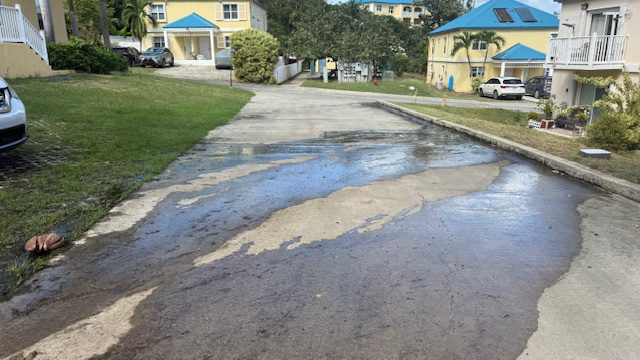
She said smelly effluent is now leaking from pipes, running down the roadways and pooling in places like the basketball courts and areas where children play.
After agreeing to take photographs and video clips for this story, the retired teacher said, “Now that I’ve walked around, I’m really upset with this situation. I’m thinking of the health hazard to residents, pets and wildlife in the area … there are donkeys, chickens, birds, tortoises, iguanas. When the septic reaches Coral Harbor and Johnson Bay, all marine life is affected by this sewage leak. It’s not just a pump issue.”
Calabash Boom residents say maintenance has often been a problem at the housing community. Since the development was built, there have been at least three management companies. “The first one wasn’t good. The next one was horrible. And the third tried, but there still was nothing going on,” said the retired teacher.
Jackson Development Company bought the property in the last year as a way to address maintenance concerns and allow tenants to purchase their units. Calabash Boom was built by Reliance Housing Foundation, the nonprofit affordable housing developer where Robert “Bob” Jackson was the CEO.
“These properties were originally built with federal Low Income Housing Tax Credit (LIHTC) funding allocated by the Virgin Islands Housing Finance Authority,” Jackson explained to the Source last January. Clifford Graham, one of Jackson’s current partners at Jackson Development Company, was the executive director at VIHFA when these properties were built. (VIHFA was instrumental in the financing of the recent sales of the properties.)
“An important part of the original development plan was to provide for the conversion to affordable homeownership after the initial 15-year rental period required under the tax credit program,” Jackson said. “I left employment at Reliance in 2013, and they closed their doors in 2015. Likewise, Cliff left VIHFA in 2011. However, we both have felt an obligation to fulfill the original promise to convert these properties to affordable homeownership.”
In many ways, Calabash Boom is a successful affordable housing community, many residents say. “It’s a great community,” said the retired teacher, “and a nice neighborhood. I’ve enjoyed it, but not with these health hazards.”