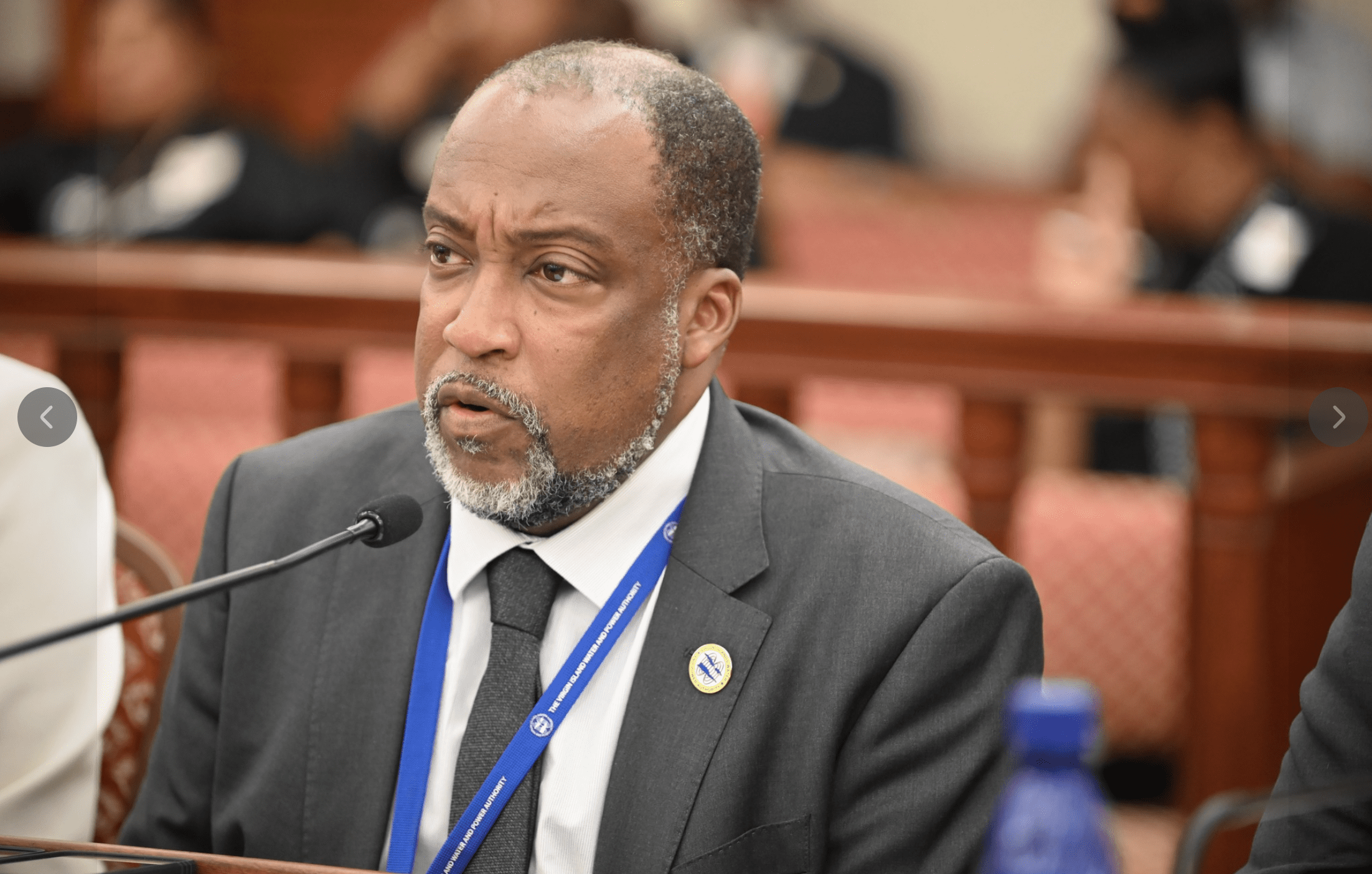
The Virgin Islands Water and Power Authority was called before lawmakers Thursday as residents on St. Thomas and St. John continue to grapple with weeks of rolling blackouts that left homes in the dark, spoiled food in refrigerators and shuttered small businesses across the district.
Meeting as a Committee of the Whole, the 36th Legislature spent hours pressing WAPA officials, federal recovery partners and regulators for a clear accounting of what went wrong, why the grid remains so fragile and when reliable service will return. Senators called for a straightforward timeline of recent outages, an honest assessment of aging generators such as Unit 15 at the Randolph Harley Power Plant on St. Thomas, and answers about how a deliberately severed submarine cable was able to trigger an island-wide outage on St. John.
Senators also pushed the utility to move beyond technical explanations and address deeper, long-standing issues, including deferred maintenance, reliance on obsolete equipment, delays in renewable energy projects and the lack of any plan to compensate customers for losses. Lawmakers noted that despite years of legislative support and federal funding, residents continue to face some of the highest electricity rates in the United States alongside unreliable service.
Karl Knight, executive director of WAPA, told senators the crisis was not caused by a single malfunction but by “multiple compounding failures.” He said February thunderstorms brought lightning, high winds and vegetation into power lines on St. Thomas, blowing fuses and breaking insulators. As crews worked through those problems, an underground section of Feeder 13 on the Charlotte Amalie waterfront failed, forcing load onto Feeder 12 and triggering rolling outages of up to five megawatts to prevent a system collapse.

On St. John, Knight said, a transmission line between Red Hook and Cruz Bay tripped and plunged the island into a blackout. Subsequent testing showed the submarine cable had been “deliberately cut with a mechanical device,” not damaged by an electrical fault. WAPA temporarily revived an older, retired cable and spliced sections of both lines to restore service.
The most severe blow came March 19, when Unit 15, a turbine commissioned in 1980, at the Randolph Harley Power Plant suffered an electrical fault and tripped offline, destabilizing the system and triggering a district-wide outage. The failure led to nearly three weeks of rotational blackouts until another large generator, Unit 27, was repaired and returned to service.
“Our system is operating with aging infrastructure, limited redundancy and very little margin for error,” Knight said. “This was not neglect; this was a system under pressure responding to multiple compounding failures.”
Knight told lawmakers the authority is pursuing a three‑tiered plan to stabilize the grid in the short term while larger projects move forward.
In the next six months, WAPA expects to complete a FEMA‑funded bypass for Feeder 13 on St. Thomas and install emergency standby generation on St. John, where a vendor has been selected. Temporary repairs to damaged submarine and distribution lines are also planned, though some work remains unfunded.
Over the following six to 24 months, the plan relies heavily on federally supported projects, including temporary generation at the Randolph Harley Power Plant and new solar and battery storage installations on St. Thomas and St. John. Longer‑term efforts, expected to take several years, include replacing aging generators such as Units 14 and 15, rebuilding key transmission feeders and developing microgrids to allow parts of the territory to maintain power during major outages. “We are not standing still,” Knight said. “The authority has a clear path forward that will provide tangible improvements to our delivery of reliable service.”
Public Services Commission Executive Director Sandra Satori said the outages were “entirely foreseeable and preventable,” pointing to a management audit and integrated resource plan completed nearly a decade ago that warned WAPA to modernize its generation fleet and expand renewables or risk reliability problems.
She said only portions of that road map were implemented, leaving the territory dependent on aging and obsolete units such as Units 15 and 23 and with insufficient backup capacity when multiple failures occurred at once.
“WAPA needs to become an asset to the Virgin Islands, providing reliable and affordable power,” Satori testified, urging lawmakers to require a detailed “recovery and stabilization plan” with enforceable benchmarks and oversight. Without it, she warned, the territory could “find ourselves back in this place” even after new FEMA-funded projects come online.
Senators echoed that frustration, saying residents have heard similar assurances for years without seeing lasting improvements. “What we have been doing for decades is not working, and it’s destroying the fabric of this territory,” Sen. Alma Francis Heyliger said. “It’s disrupting the everyday lives of the people of this territory … we need to actually start having serious conversations about how we’re going to get this fixed, because the constant talking, talking, talking is not working.”
One issue senators repeatedly raised was how the deliberate cut to the St. John submarine cable was handled and whether federal law enforcement was properly engaged. Several members pressed Knight to clarify whether the FBI had been notified, questioning why the incident was initially treated as a local police and fusion-center matter after an entire island lost power. Knight later told the committee that the Virgin Islands fusion center director had referred the case to the FBI, and added that WAPA has taken steps to secure the site.
Lawmakers were also sharply critical that St. John remained vulnerable nearly seven years after a 2019 proposal to install standby generators and battery storage was shelved. Senators said the decision left the island dependent on a single critical transmission link and highlighted a broader pattern in which planned upgrades and funded projects have not translated into the redundancy needed to protect residents when major lines or generation units fail.
Several senators focused on the human toll of the outages, recounting calls from constituents who lost televisions and refrigerators to power surges, small businesses forced to close during peak hours and elderly residents left without air conditioning or running water. Sen. Avery Lewis urged WAPA to halt disconnections while service remains unstable and to prioritize payment plans.
By the end of the day‑long hearing, senators said they were not convinced WAPA can avoid another crisis without clearer timelines and stronger oversight. Several senators said their anger was not only about broken equipment but about a lack of trust and oversight after years of similar hearings. They complained that WAPA still has no clear, written road map with deadlines that lawmakers and regulators can enforce.
PSC officials urged the Legislature to give the commission “full support and backing” to enforce its orders, while WAPA’s board chair, Maurice Muia, called for a standing “transformational leadership” committee that would bring lawmakers, regulators and utility executives into the same room to monitor progress.
Knight acknowledged that the system remains “on borrowed time” until new generation and grid projects come online, and said he does not want to ask residents to pay more. Instead, he told senators, WAPA must cut operating expenses to fit within existing rates — a path he described as difficult to walk without compromising service. “We will probably slip off the path every now and again, like we just did,” he said, “but I see a very positive future ahead.”
Editor’s Note: For an in-depth look at the history of WAPA’s issues, check out this series published by the Source in 2019.