



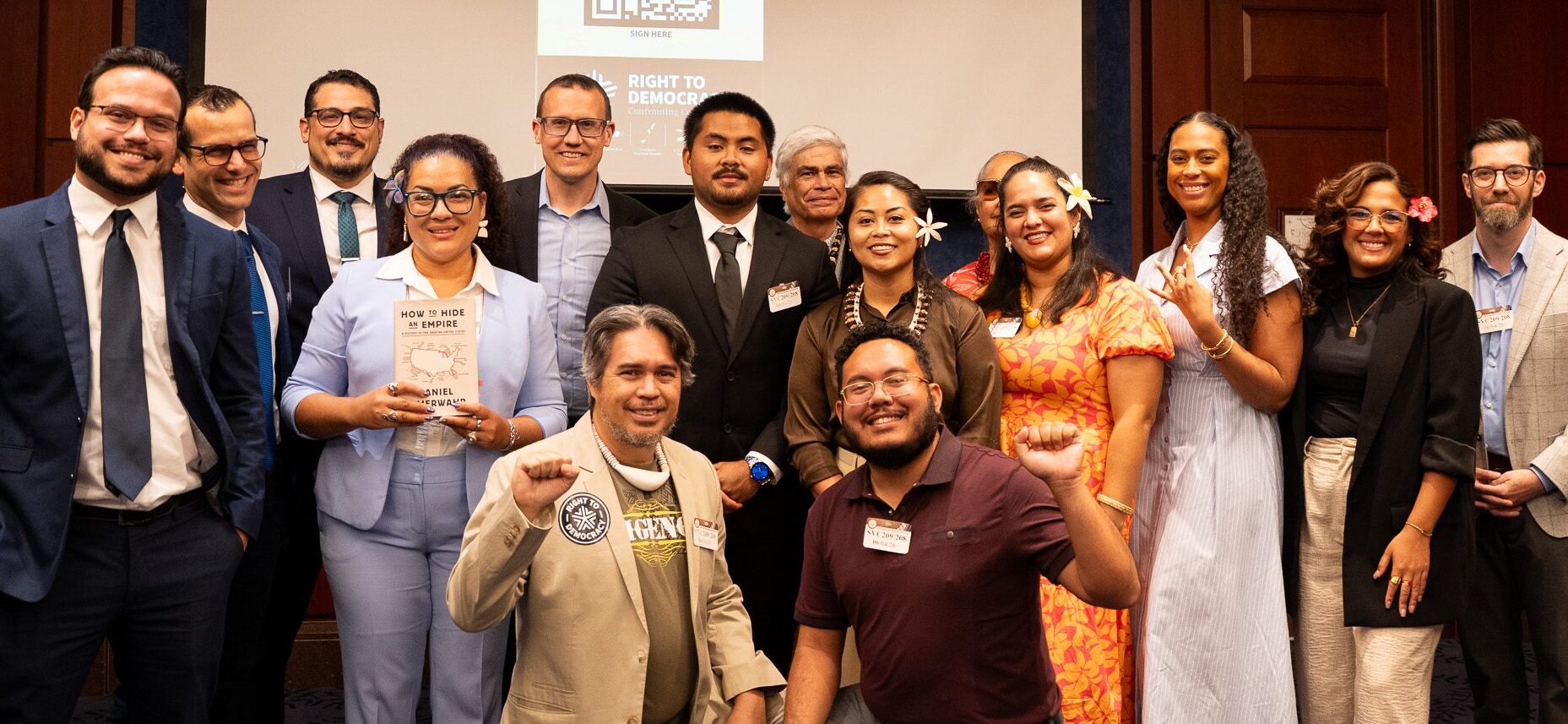
As the United States prepares to mark its 250th birthday, Right to Democracy and a bipartisan group of lawmakers and territorial advocates, including from the Virgin Islands, gathered in Washington Thursday to brief congressional staff and other policy leaders on what “consent of the governed” means for people in U.S. territories.
While the Declaration of Independence says that governments derive their power from the consent of the governed, 3.6 million Americans living in U.S. territories are still waiting for that promise to reach them, noted Neil Weare, co-director of Right to Democracy, a nonprofit project that works to advance territory rights.
Thursday’s briefing, What Does “Consent of the Governed” Mean in U.S. Territories?, was organized in coordination with the Congressional Hispanic Caucus, Congressional Asian Pacific American Caucus and held at the U.S. Senate. Congressman Pablo José Hernández (D-PR) spoke, with Congresswomen Stacey Plaskett (D-VI), Kimberly King-Hinds (R-NMI), and Nydia Velázquez (D-NY) participating via video recording, according to a press release.
The briefing provided members of Congress and their staff with historical background on the current relationship between U.S. territories and the United States through the lens of the Declaration of Independence and the Insular Cases — a century-old legal framework rooted in racial and colonial prejudice — that continues to deny democracy, equity, and self-determination to residents of U.S. territories.

The session “made clear that the question of ‘consent of the governed’ in U.S. territories is not a relic of the past — it is a present reality that affects 3.6 million people every single day. Hearing directly from community leaders across the territories about how unilateral federal decisions shape their lives, their economies, and their environment made one thing undeniable: this undemocratic framework is unsustainable, and the federal government can no longer look away,” said Dr. Adi Martínez-Román, co-director of Right to Democracy. “The U.S. must fulfill its duties under federal and international law and provide the territories with a pathway to self-determination.”
“Two-hundred-and-fifty years ago, the United States rejected colonial rule through the Declaration of Independence, but for 125 years, the Insular Cases have allowed Congress to govern territories without full constitutional rights or self-determination,” added Weare. “It is time for the federal government to recognize colonial rule cannot be squared with the principle of the consent of the governed.”
“Regardless of what your view is on the status of the territories and what their final status should be, we should all be united and we should all present a united front to address the current challenges, and current obstacles, and current inequalities, and current injustices. We should take advantage of the 250th anniversary of the United States to educate the people of the United States about these lingering inequalities and challenges and to work toward solving them once and for all,” said Hernández, who is co-chair of the Territories and Commonwealths Caucus.
“As this nation confronts growing threats to our multiracial democracy, the territories are not a footnote. We are a warning and a road map. We’re living proof of what happens when consent of the governed is made conditional, when constitutional protections are treated as negotiable, when second-class citizenship is sewn into law and dressed up as precedent,” Plaskett said in a video statement. “True democracy and colonialism cannot coexist — not even when that colonialism wears the American flag.”
King-Hinds shared in a video statement that “no American community should be too small or too remote to have its voice respected. As we approach America’s 250th anniversary, we should recommit ourselves to ensuring that the principles of the Declaration of Independence apply equally to all Americans, including those living in the territories.”
“For more than three decades advocating for the people of Puerto Rico and our diaspora, I have said it plainly: the idea that the United States can hold colonies and claim plenary power over millions of people is far too reminiscent of King George III,” said Velázquez in a video statement.
“We cannot let this anniversary pass without using it. It is a real chance to focus on what we have in common and how we move forward together: the people of the territories, our diaspora communities, and our allies in Congress and across the states. And we have to act with the urgency this moment demands. Our Founding Fathers rose to the challenge in front of them; it is on us to rise to ours,” she said.
The briefing also featured testimony from Right to Democracy’s Environment and Democracy Fellows, who shared how federal decisions made without their input impact their communities on a day-to-day basis: María Hernandez, co-director of the Micronesia Climate Change Alliance (Guam); Andra Samoa, community leader and Director of Pacific Global Citizens (American Samoa); Nayda Bobonis, director of Strategic Relations and Advocacy at FURIA Inc. (Puerto Rico); Zeno De Leon Guerrero, board member of the Micronesian Climate Change Alliance (Northern Mariana Island), Imani Daniel, executive director, VIISION and delegate to the Virgin Island’s Sixth Constitutional Convention, and Dr. Sabrina Suluai Mahuka, executive director of Finafinau (American Samoa).
New York Times bestselling author Daniel Immerwahr, author of “How to Hide an Empire,” also presented and highlighted how the failure to recognize the significance of people in U.S. territories is not just a matter of history, but an issue that has ongoing consequences today as the White House considers territorial expansion to places like Greenland.
“People can support democracy, equity, and self-determination in U.S. territories by signing our Declaration to End Colonial Rule in U.S. Territories, which was created alongside Right to Democracy’s Cross-Territorial Coalition,” said Martínez-Román. The declaration is available here.