Legislation defining government employee ethics and conflict-of-interest violations was not spurred by recent federal investigations of public officials, one of the bills’ author said Friday.
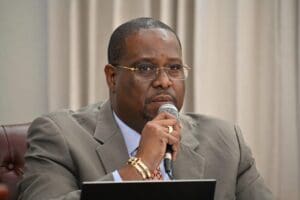
Sen. Kenneth Gittens said bills creating and funding a Virgin Islands Commission on Ethics had been drafted well before the revelation that the Federal Bureau of Investigations was studying the actions of officials at several V.I. government agencies.
“This bill has been in works for quite some time, way before what has taken place right about now,” he said. “What I’ve said is, the Virgin Islands has seen its fair share of some of these things but I didn’t associate it with what has taken place.”
Among other things, the bill would establish a time frame where a former government employee could not go to work for a contractor specializing in their area of the V.I. government. For example, under the proposed law, a Water and Power Authority employee could not quit and then directly go to work for a WAPA fuel or equipment supplier.

“It would affect government employees having direct involvement with the private sector and then going directly to work for them,” Gittens said. “For a period of one year after a public employee’s employment with the Government of the Virgin Islands, the former employee may not have any involvement either directly or indirectly with any negotiations or discussions of contracts or any other matter in which the public employee was previously involved in.”
The law, co-sponsored by Sen. Franklin Johnson and Sen. Marvin Blyden, would not regulate the behavior of a contractor to the government, however. Only government employees would be beholden to the proposed law, not employees of private enterprises, he said.
Other potential ethical lapses not specifically spelled out would go before the ethics commission, which would decide whether the action was a violation — and if so whether it was a civil matter or a potentially criminal one that needed to be referred to the attorney general, Gittens said.
Nepotism hires, abuse of influence, and other grey-area behavior would be investigated and ruled on. If found to have violated ethical behavior, the government employee would be able to appeal if the commission granted it.
There are provisions in the bill to discourage frivolous accusations. If the commission finds a complaint to be without merit, the person complained about may be able to seek damages for harm to reputation and attorney’s fees.
The office of the Attorney General, the Office of the Territorial Public Defender, the League of Women Voters, the Inspector General’s office, and others discussed revisions to the legislation Wednesday, a process that continued as the bill was held in the Committee on Rules and Judiciary.
Gov. Albert Bryan Jr. said in June that he intended to speak with Gittens about the legislation after the arrests of Education’s Director of Maintenance Davidson Charlemagne, 50, and his wife, Sasha Charlemagne, 44, and the indictment of former Virgin Islands Housing Finance Authority Chief Operating Officer Darin Richardson, 56. Days later, investigations into employees of the Office of Management and Budget, the Virgin Islands Police Department, and the Sports, Parks, and Recreation Department were made public.
While versions of the ethics bill have been discussed for decades, critics say the legislation would only add slow, costly bureaucracy while not addressing the underlying problem: lack of enforcement of existing laws.
The Senate sent a bill to Bryan late Wednesday night that would make lying to the Legislature punishable by a fine. Currently, it is illegal to lie while under oath at the Senate, but there is no penalty.
The bill was meant to add teeth in attempts to stop obstruction of the legislative process, Gittens said.
“The integrity of legislative proceedings is foundational to democratic governance,” he said. “It’s there to deter and penalize those who would knowingly deceive the Legislature by making false statements.”
It was not clear when Bryan would sign or veto the perjury bill.