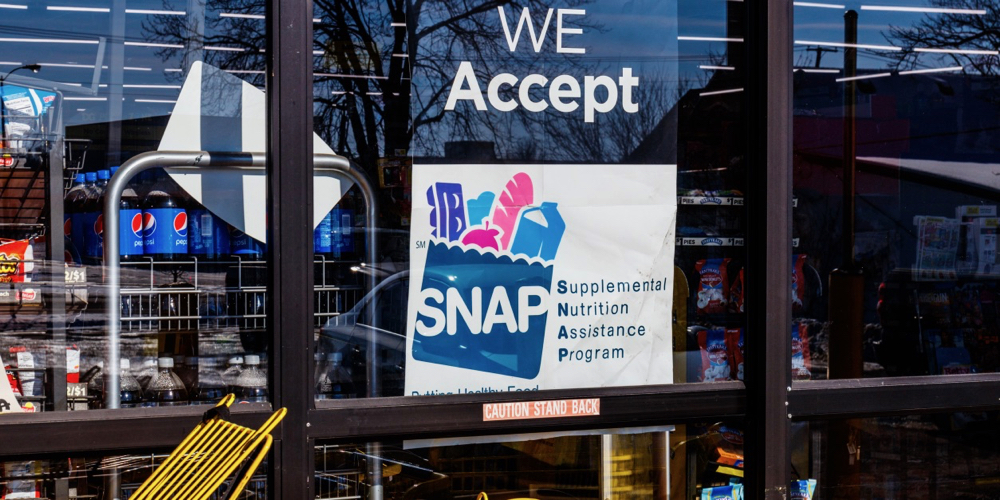
Gridlock in Washington, D.C. has paused the SNAP food assistance program that roughly 24,000 Virgin Islanders depend on, officials said Thursday.
The Virgin Islands Human Services Department issued an alert Thursday morning that all Supplemental Nutrition Assistance Program benefits for November would be disrupted as a result of the ongoing federal government shutdown.
“Due to the lapse in federal appropriations, the U.S. Department of Agriculture’s Food and Nutrition Service has indicated that there will be insufficient funds to issue November SNAP benefits to households nationwide, including those in the U.S. Virgin Islands,” wrote Human Services spokesperson Ryan Nugent. “Consequently, FNS has directed all states and territories to pause the transmission of November SNAP benefit files to Electronic Benefit Transfer vendors. This means that the usual process of loading November SNAP benefits to EBT cards has been temporarily stopped, and households in the territory will not receive SNAP benefits until federal funding is restored.”
Gov. Albert Bryan Jr. had warned the disruption was coming in a media briefing Wednesday, saying an official announcement from Human Services would come later that day.

“This government shutdown that we’re going through is really getting tenuous and the longer it goes on, the more problems it creates,” Bryan said. “The food stamp payments, the debit card payments, will be impacted.”
Bryan urged leaders in Washington to put the welfare of the American people above political divisions. He also urged Virgin Islanders on SNAP benefits to be careful with their money.
Human Services’s 9 a.m. announcement urged all SNAP recipients to do the same, saying to take immediate action, plan ahead, carefully budget, and conserve their current benefits “to navigate this period of uncertainty.”
By being proactive, households can better manage essential needs and reduce the potential impact of delayed November benefits, the statement said.
“We empathize with our clients as we recognize the stress and hardship this situation may cause, and we will continue to monitor the situation and work with our federal partners and lawmakers to advocate for a swift resolution,” the release said.
Meanwhile, Nugent told the Source Thursday that it would take about $5 million to cover November SNAP benefits for Virgin Islands residents. He said the department is exploring every possible option, while noting that similar concerns are being raised in states across the country.
The U.S. Department of Agriculture has directed all states and territories to pause transmitting benefit files to EBT vendors until appropriations are restored, effectively freezing SNAP benefits for November. In Minnesota, local agencies have been told to stop approving new applications, while New York State has said it will maintain October benefits as usual but cannot yet guarantee November payments. Some states, including New Mexico, have discussed or approved temporary measures to protect food assistance, though national advocacy groups such as FRAC warn that if states advance their own funds during a federal lapse, there is no guarantee of reimbursement once Congress resolves the shutdown.
When asked whether the Virgin Islands government is considering similar action, Senate Finance Committee Chair Novelle Francis said, “Yes, we are currently having conversations and looking at the availability of funding to support DHS in this matter. A more formal response would be forthcoming after consultation with the executive branch,” which would determine, among other things, what funding source any appropriation would come from.
Senate President Milton E. Potter echoed those concerns Friday, acknowledging the hardship the shutdown poses for Virgin Islanders — particularly those reliant on programs like SNAP — and announcing immediate legislative steps to address it.
In response to Human Services’s alert, Potter said he has submitted two bill draft requests — Amendment No. 36-593 and Bill Draft Request No. 25-0884 — to provide emergency financial relief that would allow food assistance and other critical social services to continue uninterrupted throughout the duration of the shutdown.
He added that the Committee of the Whole will convene on Oct. 29 to hear from the government’s financial team about the projected fiscal impact, followed by a full Senate session on Oct. 30 to vote on legislation authorizing the use of local funds, including the Rainy Day Fund, to temporarily cover November benefits. “If there was ever a time to use our Rainy Day Fund, it is now,” Potter said. “Our citizens need immediate help, and it is both our elected and moral duty to act decisively to ensure that no family goes hungry and no child is left without support.”
Meanwhile, in Washington, several members of Congress are calling for stronger protections for SNAP recipients. Some Democrats have introduced legislation such as the Closing the Meal Gap Act of 2025, which would boost benefits by updating outdated formulas used to determine monthly allotments and expand eligibility for low-income families. Though there is not yet a coordinated bipartisan agreement, pressure is mounting across party lines to restore funding to safety-net programs impacted by the shutdown.
Nugent said the department continues to work directly with recipients and community partners. “We have to maximize the work we put in at every level,” he said, adding that hunger, poverty, rising costs, and economic uncertainty disproportionately affect vulnerable populations like senior citizens, families with children, and individuals with disabilities.
Other territorial agencies are also closely monitoring the ripple effects of the shutdown. Education Commissioner Dionne Wells-Hedrington said her department acted early to safeguard core services, shifting federally funded personnel off grants when it became clear that the change in federal administration could delay funding approvals. “When we saw that things were being pulled back, we made an executive decision to protect our programs,” she said, explaining that special education services, in particular, were prioritized to ensure that no interruption in support would affect students if budget cuts were imposed.
To date, the Education Department has not experienced delays in its federally funded programs. “We’ve received our grants and have been able to encumber the funds without issue,” Wells-Hedrington confirmed. However, she noted that the department is closely monitoring its ability to complete federal drawdowns — the process by which agencies request access to grant funds — and that if the shutdown continues into another month, it could begin to pose problems for those approvals.
Many of the affected projects are funded through the American Rescue Plan, which requires federal authorization before the territory can access those dollars. “Before we can touch the federal funds, we need approval from the U.S. Department of Education,” she said. “We spend locally, through our line of credit, to ensure goods and services for schools, construction work, library resources, and other supplemental items continue, then are reimbursed for those expenses through the federal department.”
The federal government shuts down when lawmakers cannot agree to fund operations. The House of Representatives, the U.S. Senate, and the executive branch — which can veto spending plans — must all align on budget priorities. The current shutdown began Oct. 1. Most shutdowns last four or five days; the longest, lasting 35 days, occurred in 2018 when President Donald Trump sought $5.7 billion to heavily fortify the border with Mexico.
In May, many SNAP recipients told the Source they were having trouble recertifying for benefits under new federal rules that require people in need of food assistance to submit personal information more often than during the COVID-19 pandemic.
Unlike SNAP, the Women, Infants, and Children Program continues to provide services during the shutdown, the Health Department announced Thursday.
While many federal agencies have paused operations, the WIC program in the Virgin Islands continues to provide critical nutrition benefits and support to families, Health Commissioner Justa Encarnacion said in a written statement.
“The Virgin Islands WIC Program has begun receiving its portion of USDA funding to ensure that families continue to have access to nutritious foods and essential support,” Encarnacion said. “We encourage all participants to keep their appointments and use their benefits as usual.”
All food benefits are being distributed without interruption, and program staff across the territory remain on duty to assist clients, she said.
WIC clinics across the St. Croix and St. Thomas-St. John districts are open for regular business hours, said V.I. WIC Director Lorna Concepcion.
“Our staff remain available to provide nutrition and breastfeeding support, and we continue to encourage mothers to breastfeed their infants,” Concepcion said.