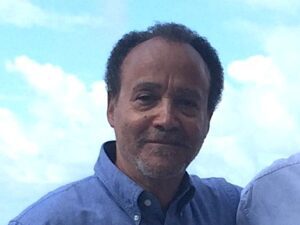
It is with great sadness that the family of William Charles “Kelly” Evans regrets to announce his passing and going home to glory on Nov. 2, 2025 at the age of 74. Kelly was a loving husband, caring father, and loyal friend to all who knew him.
William Charles “Kelly” Evans
He was preceded in death by his loving wife, Patricia A. Evans, father Gov. Melvin H. Evans, mother Phyllis Evans, brother Melvin H. Evans Jr., sister-in-law Terri Evans, and nephew Dustin Smith. He is survived by his loving daughter Melina Sophinos; son-in-law Nick Sophinos; grandchildren Talia Sophinos and Evan Sophinos; brothers Robert Evans and Cornelius Evans; and sisters-in-law Maresa Fanelli, Beth Evans, Kaye Harrington Evans, Chris Hogan, and Jennifer Blefko. He is further survived by nieces Rochelle Walker, Alexandrya Black, Rebekah Solomons, Brittany Smith, Kayla Blefko, and Leah Blefko; and nephews Robert “Bobby” Evans, Jordan Evans, Graham Smith, Logan Smith, and Ryan Blefko.
A joint Celebration of Life gathering for Kelly and Pat will be held in April for family and friends. The family is asking that any memories or pictures that would like to be shared please be sent to KellyandPatEvans@gmail.com or direct messaged to @KellyandPatEvans on Facebook or Instagram.
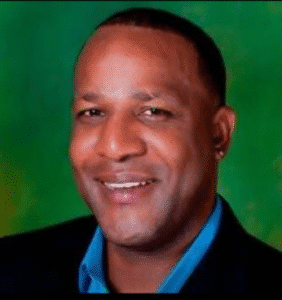
It is with profound sorrow that the family announces the passing of Michael J. Springer, who was born on Sept. 7, 1975, and transitioned from this life on Dec. 13, 2025. Michael was a devoted husband, loving father, cherished grandfather, and a friend to many. His strength, warmth, and unwavering love for his family will forever be remembered.
Michael J. Springer
Michael leaves to mourn his beloved wife, Jenna Boland-Springer; his daughter, Brooklyn H. Springer; and his sons, Nicholas Springer, Michael J. Springer, Micah Springer, and Brandon Springer. He was a proud grandfather to Autumn Springer and June Springer, who brought him immense joy.
He is also survived by his brothers, Judah Maccabaeus and Domingo Martinez; his sisters, Faye F. Martinez and Michelle M. Springer-Vasquez; and his aunts, Jackie Springer and Vera Springer. Michael will be fondly remembered by his nieces, Chenay L. Harvey, Inieka Nimchan, Renesha Martinez, and Starte Martinez; and his nephews, William S. Harvey III, Maurice Harvey, Jahmoy R. Williams, Shaquille Springer, Hakeem Springer, Shamoy Martinez, Kwanza Martinez, Rueben Martinez, Malik Martinez, and Daniel Martinez.
He is further survived by his cousins, Stephanie Robles, Monique Christian Creque, John Christian Jr., and Angel Christian; his in-laws, Danase Boland and Ruth Dubois; along with special friends and extended family members too numerous to mention.
Michael was preceded in death by his loving mother, Hellen Chinnery Martinez Springer; his father, Michael Springer; his grandparents, Mary Springer, Armonde Springer, Rosalia Chinnery, and Willie Light Chinnery; and his uncles, Peter Beguesse, Arthur Beguesse, Noel Greenidge, and Keith Springer.
Michael’s life was one filled with love, resilience, and deep connections. Though he has departed this earthly life, his legacy will continue to live on in the hearts of all who knew and loved him. A Public Memorial in his honor will be announced shortly.
The Virgin Islands Children’s Museum has received a $30,000 donation from One Communications, providing additional financial support as the non-profit organization works to sustain its community and educational programs amid ongoing funding challenges.
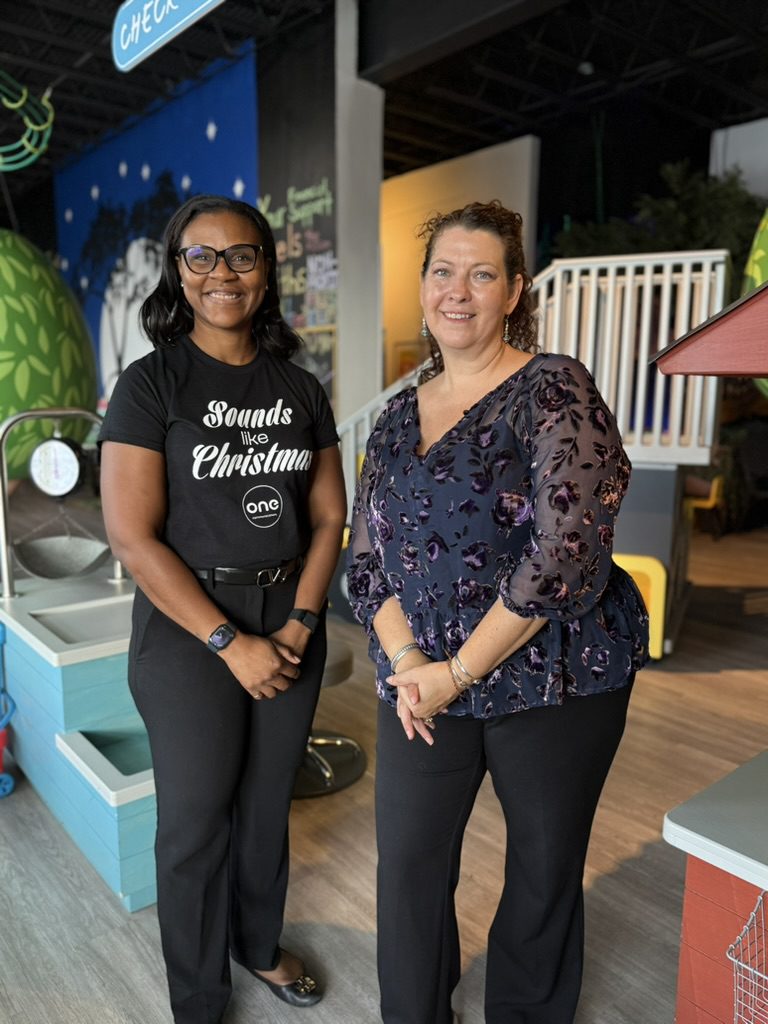
Siobhan James-Alexander, CEO of One Communications VI, with Virgin Islands Children’s Museum CEO Amber McCammon during a recent visit to the museum.
Recently, as volunteers moved between stacks of wrapped gifts and made final preparations for the 6th Annual Liston Davis Christmas Children’s Parade, an Office of Gun Violence Prevention event which benefits the Virgin Islands Children’s Museum this year, an unexpected moment quietly unfolded inside the Museum’s space.
Surrounded by volunteers, staff, and the hum of holiday activity, representatives of One Communications presented the Virgin Islands Children’s Museum with a donation of $25,000, in addition to the $5,000 donated earlier this month.
The donation came after an unusual WhatsApp message to One Communications, an informal but honest appeal from the Museum seeking support to keep its programs alive during a particularly difficult period.
“It’s incredible to see the work the Children’s Museum does to support education, connection, and opportunity for young people in the Virgin Islands,” said Siobhan James-Alexander, CEO of One Communications Virgin Islands. “Many of our employees are parents, and we see the impact of this space every day. We wanted to help make the holidays a little brighter while supporting the important work happening here year-round.” James-Alexander noted that the donation aligns directly with One Communications’ CSR pillars, which focus on community development, education and youth empowerment, and meaningful partnerships that create lasting impact.
The Museum’s leadership expressed gratitude for the timely support, noting that the donation will help stabilize operations and strengthen programming for the coming year, ensuring that children across the Virgin Islands continue to have access to hands-on learning and cultural experiences.
“We were genuinely surprised,” said Amber McCammon, Chief Executive Officer of the Virgin Islands Children’s Museum. “After receiving the initial support, we did not expect One Communications to return with an additional contribution. That second check arrived at a moment when we were focused on delivering our holiday programming while managing very real operational challenges. It helps us stabilize our operations, support our staff who are from the community, and continue offering programs that many families rely on throughout the year.”
Recognizing the impact of the museum’s work, One Communications is encouraging broader engagement from the private sector. “Community institutions like the Virgin Islands Children’s Museum play an important role in shaping how children learn, explore, and connect,” said Siobhan James-Alexander. “They also support families, educators, and working parents across the Territory.”
We encourage corporate VI and the wider community to take a closer look at the work being done at the Museum and consider how they can support its sustainability. Investment in spaces like this is about strengthening the environment in which our children grow and our communities thrive.”
Donations to the VICM can be mailed to P.O. Box 304457, St Thomas, VI 00803, or made online at: https://www.paypal.com/donate/?hosted_button_id=ZSMA5AC4MTPF8.
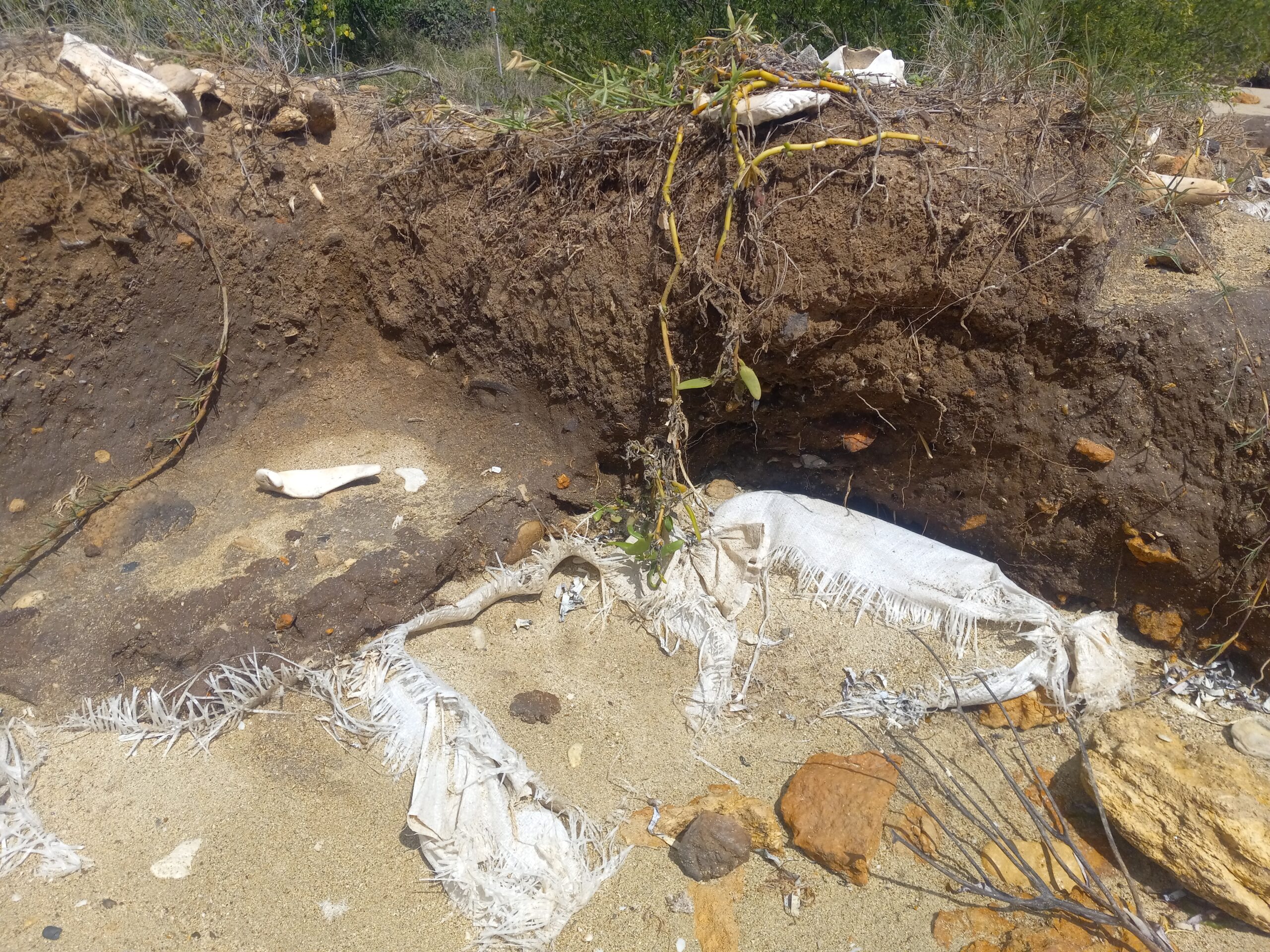
The Aklis site, a significant pre-Columbian archaeological site within Sandy Point National Wildlife Refuge of Concordia Bay Beach.This site has shell middens and burials showcasing early indigenous people. It is listed in the National Register of Historic Places. The site has been eroding due to the dredging of the Krause Lagoon a half century ago and the impact of climate change on the coastal shore of the refuge. Sandbags are put at the site to protect it. However, the site is still being washed away by the ocean waves. It is against the federal and local law to dig at the site. (Photo by Olasee Davis)
The other day, I got a call from Dr. Elizabethada A. Wright, a professor of English, Linguistics and Writing Studies at the University of Minnesota. She wanted to interview me on sacred places of the Virgin Islands. The interview took place at my office at UVI, where we discussed sacred places of the Virgin Islands. She was overwhelmed with so much information that I gave her, despite my tight schedule. She and her son took lots of notes as well as rare information about historic documents that I shared with them on the cultural, historical, and archaeological history of these islands.
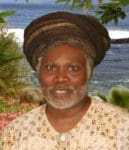
Olasee Davis, Ph.D. (Submitted photo)
The interview was very powerful, touching, enlightening, and spiritually moving as I discussed with them sacred places of our islands, and the greatness of our ancestors. Believe me, she was excited, thrilled, and fascinated with the history of the Virgin Islands, especially Maroon Country, the colonial gravesites, and pre-Columbian sites of people that lived on these islands for a millennium or centuries ago. She wrote me back and said, “Hello Dr. Davis, I would like to thank you so much for taking the time on Wednesday to share a tiny bit of your vast knowledge with me. I apologize for not writing to thank you earlier, but I have been traveling around St. Croix following up on so many of the sites that you told me about.”
She further stated in her notice to me, “I did venture a bit into Maroon Ridge, but not as far as I would have liked. The Baobab trees have fascinated me. One narrative I learned after talking with you was that of Queen Mary, after whom the highway is named. Do you know, by any chance, where she is buried on the island? Or if anyone knows? I will be in touch with you again — and I hope to talk with you soon.”
With the discussion I had with Dr. Wright and her son about sacred places in the Virgin Islands, I reflected on a previous article I wrote about not only the scared burial of Queen Mary but also Queen Susannah “Bottom Belly,” Queen Mathilda and George Washington, an enslaved person buried in Maroon Country. I was inspired by her to write a brief history on gravesites and the importance of them to our history. Believe me, one of our most sacred places in Virgin Islands history is our gravesites, particularly slaves, and pre-Columbian sites. Gravesites give us an understanding of our past history, as painful as it might be, and how slaves and indigenous people buried their dead, rituals they had, funeral ceremonies at gravesites, traditional African burial, and so on. Our major historic cemeteries are in the towns of the Virgin Islands.
However, many people don’t realize that plantations or estates in the Virgin Islands have their own burial grounds. Most of these gravesites today are covered with forests, shrubs, or bushes. There are laws that protect historic gravesites in the Virgin Islands. That law is known as the Antiquities and Cultural Properties Act, which protects historic gravesites whether they are on public or private land. The law also includes the protection of pre-Columbian sites. In other words, Native Americans, or indigenous people historic sites. The law also includes Jewish historic gravesites or any graves that are considered historic in the Virgin Islands.
This slave gravesite is at Big Fountain, or Estate Fountain (now Carambola Golf Course) on St. Croix. The Doward family on St. Croix are descendants of this slave gravesite. (Photo by Jerry Doward)
In fact, historic gravesites are considered a National Historic Site of the United States and the Virgin Islands. For example, the St. John’s Episcopal Church in Christiansted graveyard has been on a National Register of Historic Places since 2019. Reimert Haagensen, a Danish planter who lived on St. Croix during the 1740s and 1750s, mentioned in his notes about slaves’ burial. When a slave got very old, Haagensen stated, they were employed by taking care of small matters. When he became useless, according to Haagensen, the slave was provided with food until his death. That same day or evening when the slave died, Haagensen noted, “his body is placed in a hole in the field without a casket, without ceremony or any other observance.”
Haagensen did mention in his notes that there were some slaves, due to their service in the planter house or their knowledge of some trades, who were buried in a board coffin. Slaves would ask their planters for permissions to dance and honor their dead. “When this takes place, they jump around in their crazy ways and sing, in addition to beating their fingers on a skin they have made into a drum; this is their best of a funeral,” noted Haagensen.
During the colonial period of the Danish West Indies, calabash fruit (Crescentia cujete) was made into a handmade instrument played at funerals. (Photo by Olasee Davis)
C.G.A. Oldendorp, a Moravian missionary who visited the Danish West Indies in 1767 and lived there until 1768, mentioned in detail how slaves buried their dead. However, I wouldn’t be able to describe in detail what he said due to the limits of space in this article. He did mention that there were designated places on the estates for slaves’ burial, some of them not buried far from their houses. He also mentioned that many slaves followed the coffin with singing and dancing, accompanied by the sounds of drums, calabashes, and other handmade instruments.
Lieutenant Brady, who was an officer in the British Navy visited St. Croix in the 1820s, also described what he saw of slaves’ burial. Brady mentioned before the slave was laid to rest in the ground, that in the evening family and friends assembled in the house. “The first watch was passed in praying and singing psalms, under the direction of a helper of the Moravian church, of which the deceased had been a member…” noted Brady. At midnight, Brady said, which is customary time among slaves, “free slave”, etc., the interment service for the funeral took place with praying and singing, which were repeated at the gravesite and in the house after which the supper (dinner) was partaken of. At about two o’ clock in the morning people dispersed to their own homes.
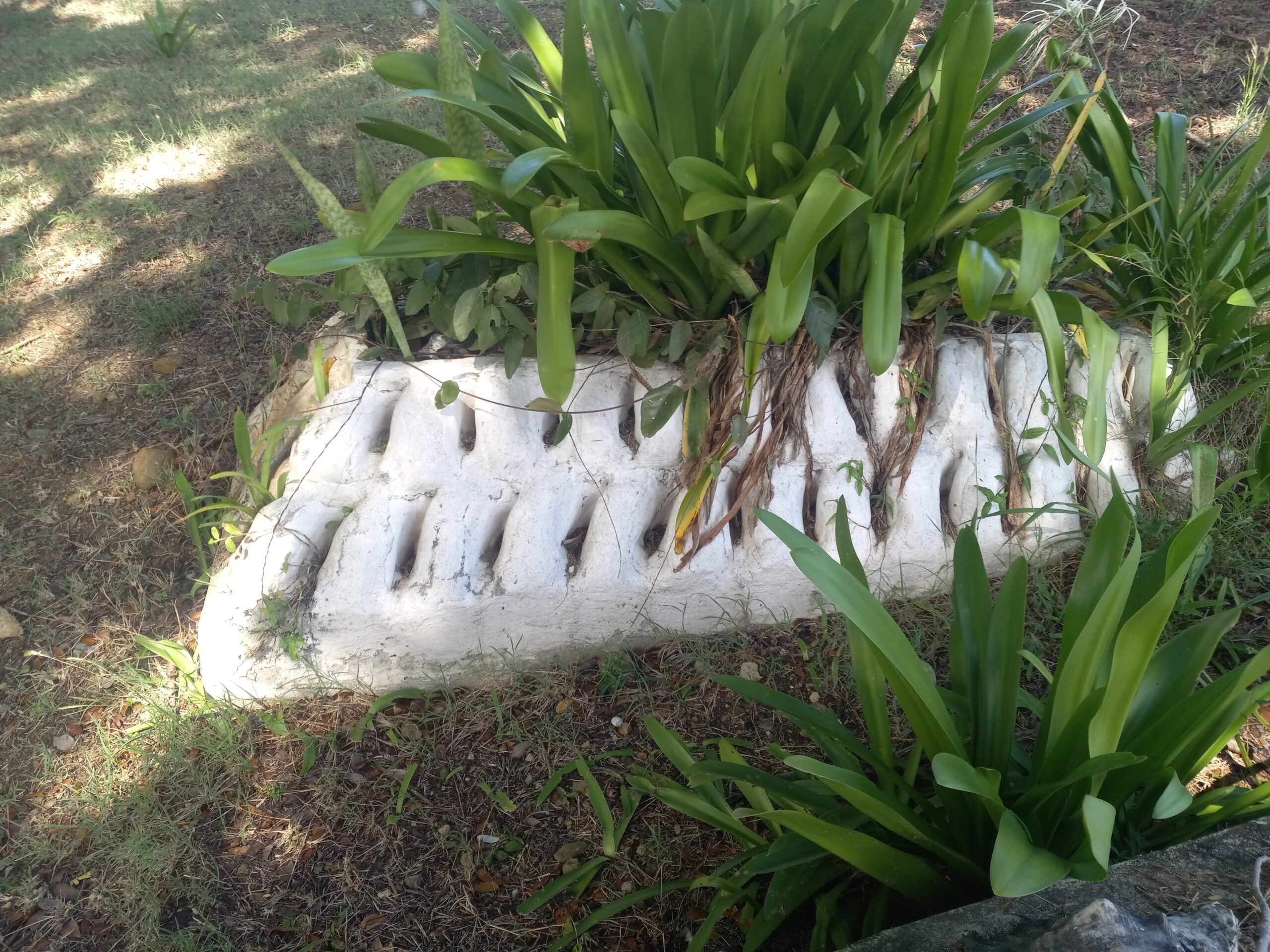
A slave grave decorated with conch shells and spider lily plants at Friedensfeld “Field of Peace” Midlands Moravian Church. Dedicated in 1852, the wood church replaced the original structure built 1810-1819. (Photo by Olasee Davis)
Family and friends of the deceased were expected to contribute to the supper, items such as pork, fowls, and so forth, according to their means. The tombs of Moravian slaves are whitewashed every Easter. Those slaves’ tombs of other religious persuasions were washed sometime during the year. In the Danish West Indies, slaves were allowed to be buried in the church’s yard, and some of their gravesites were decorated with conch shells, Danish bricks, stones, or just put in a hole in the ground.
A few years ago, I assisted Kallista Karastamatis, a graduate student from Texas State University, in her anthropological research project on colonial gravesites on St. Croix. The title of her research paper was “Analyzing Demographic Differences in Danish Colonial Period Burial Practices in Frederiksted Public Cemetery & Annaly Cemetery, St. Croix US Virgin Islands.” Her research shed light on colonial practices of burying the dead when the islands were Danish.
Believe me, talking about slaves’ burial is a deep spiritual history of our ancestors. You can’t help yourself but cry for those who made the ultimate sacrifice for our freedom.
— Olasee Davis is a bush professor who lectures and writes about the culture, history, ecology and environment of the Virgin Islands when he is not leading hiking tours of the wild places and spaces of St. Croix and beyond.Editor’s Note: Opinion articles do not represent the views of the Virgin Islands Source newsroom and are the sole expressed opinion of the writer. Submissions can be made to visource@gmail.com.
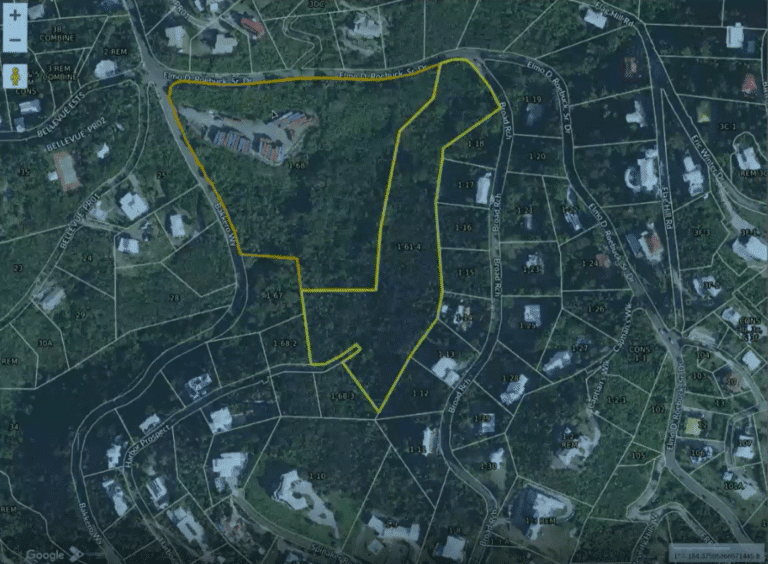
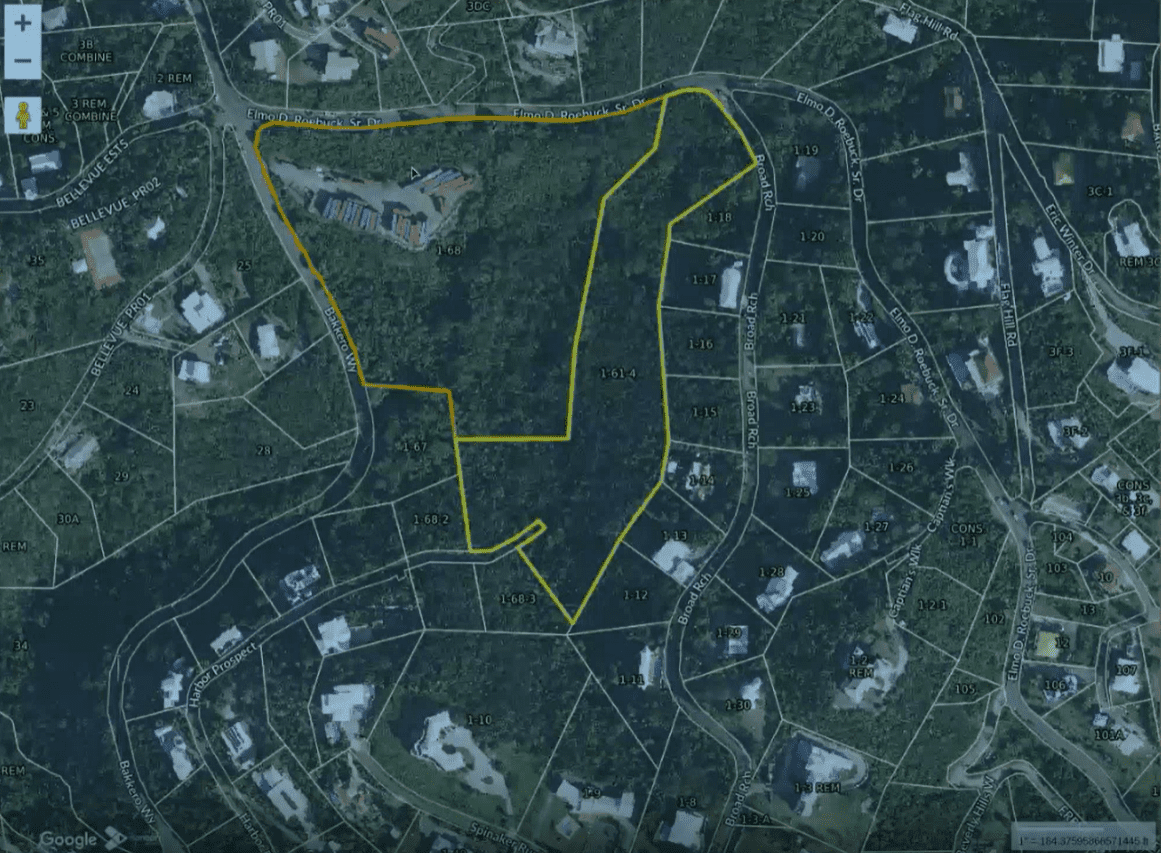
Aerial view of the proposed Estate Bakkero site, with parcel boundaries outlined. (Screenshot from Teams meeting)
A developer’s bid to rezone land above the Westin Beach Resort & Spa at Frenchman’s Reef in Estate Bakkero on St. Thomas for dense workforce housing drew sharp opposition Monday during a public hearing, with neighbors warning the project would permanently alter a quiet residential area already strained by hotel traffic.
Sweetgrass Valley Properties LLC is asking the V.I. Department of Planning and Natural Resources to change several parcels from R‑1, low‑density residential, to R‑3, a medium‑density zone that allows multifamily and taller buildings. The company’s initial plan is a dorm‑style compound to house hundreds of off‑island workers for federally funded disaster‑recovery projects.
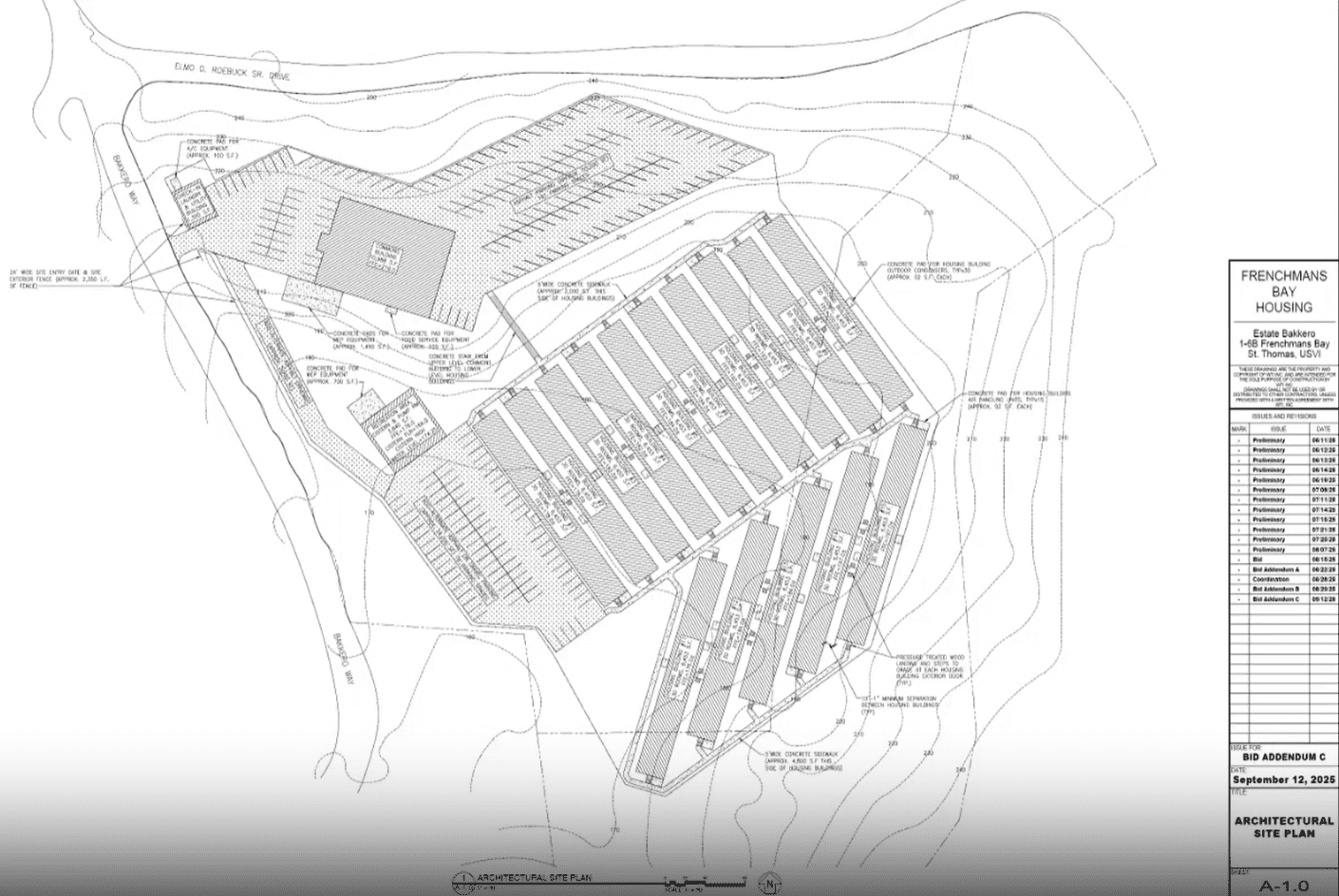
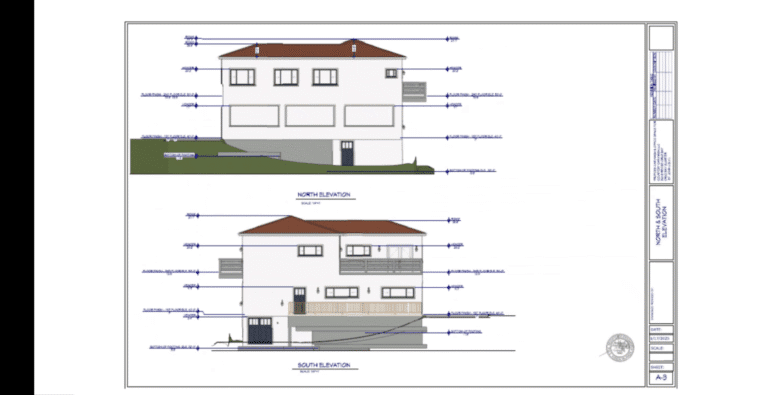
Rendering of the proposed workforce housing development in Estate Bakkero. (Screenshot from Teams meeting)
The proposal centers on Parcel 1‑68 and a portion of 1‑61‑4 on the hillside above the resort. Site plans show 15 modular housing buildings with about 30 single‑occupancy rooms each, space for roughly 450 workers, along with a commons building that would house a kitchen, game and fitness rooms, laundry facilities and support space, plus a small pump building over a cistern. The applicant lists parking at about 257 spaces.
Project representative Mirella Cornelius said the territory cannot meet its disaster‑recovery obligations without dedicated worker housing. “Without sufficient housing capacity, contractors will be unable to staff projects adequately,” she said. “If we fail to provide appropriate housing through necessary rezoning, we risk losing this critical funding.”
Todd Donahue, owner of Sweetgrass Valley Properties, framed the project as part of the wider recovery effort. He said “they need 3,500 people from off island for both St Thomas and St Croix” to work on government projects and noted that “St Croix has a lot more flat land, a lot more land. St Thomas is very limited.” He told residents and DPNR that his company is “trying to be a help with what’s coming and trying to get this done in a timely manner for the betterment of the island.”
Government staff raised technical red flags without outright opposing the project. Floodplain manager Ellerton Maynard noted that the property “is not located within the floodplain” but said it still “poses some storm water issues,” warning that “unregulated storm water becomes flood waters.” Pointing to “a tremendous drop off” south of the site and “the very dense green area to the bottom of the structures” where the gut runs, he questioned whether the applicant’s proposed erosion controls would be sufficient.
“Silt fence is not really going to be appropriate,” Maynard said, urging the use of bush berms and best‑management practices from the Virgin Islands stormwater handbook.
Rukia Andrews of the Division of Fish and Wildlife said a check of the federal IPaC system indicated “possible V.I. tree boa presence” and a sensitive St. Thomas plant in the area. She told the applicant that “with the V.I. tree boa … we do have protocols that need to be followed before any heavy machinery and things can be enacted on the site,” and said she would rerun the site through the system and, if needed, send those protocols through DPNR staff.
The strongest objections came from nearby homeowners, who said the proposed density and use are incompatible with an R‑1 neighborhood that already handles heavy resort and beach traffic. Several described the neighborhood as a quiet, family-oriented area.
“We strongly oppose … requesting a rezoning from R‑1 to R‑3 for the stated purpose of developing workforce housing,” said Kurell Sheridan. “I do not support placing a large-scale workforce housing camp, a trailer camp, into a family-oriented, low-density residential neighborhood.” In a written comment, Matthew Rafa called the plan “very concerning and very upsetting,” adding that the area “is a very quiet and family neighborhood, not a location to install a man camp.”
Neighbors said hotel-related cars and taxis already frequently clog the narrow road, block driveways, and even impede mail delivery. Some have posted their own “no parking” and towing signs to keep access clear. One homeowner said that with roughly 450 workers on site, “buses will be running perhaps 24 hours a day,” adding to traffic and noise. Residents argued that hundreds of workers, along with service vehicles and company shuttles, would overwhelm the neighborhood, particularly in a hillside community they described as “not walkable” and without public transit.
Linda Solberg said stormwater from the slope already “dumps … onto my property.” She warned that the site’s steep topography, additional hard surfaces and buildings, and on-site amenities such as a large dining hall and bar could worsen runoff as well as noise and light pollution.
Several speakers highlighted the long-term consequences of changing the zoning to R‑3. Donahue told DPNR that Sweetgrass’s “long-term goal would be to make mid-income housing for the hotel staff as well as other…condos that are affordable” once the current wave of government construction is complete. Sheridan said, “Once the scale is broken, it cannot be restored,” arguing that R‑3 would allow much taller and denser condo development even if the temporary modular units are eventually removed. Solberg added, “This is our only chance … to address these concerns” before any rezoning becomes permanent.
Sheridan also questioned why DPNR is considering the request when the territory’s recently adopted Comprehensive Land and Water Use Plan designates the Tutu Park area as “an appropriate and thoughtful use for workforce and other housing,” not Bakkero. She called the proposal part of “cumulative rezoning” in the neighborhood, undertaken without a clear, long-range vision for Estate Bakkero and without DPNR “standing up” for its own plan.
The public comment period remains open until Friday, Jan. 9, 2026. Written comments can be emailed to Territorial Planner Leia Laplace at leia.laplace@dpnr.vi.gov. All testimony, including letters read into the record Monday, will be included in DPNR’s recommendation report.
Under Title 29 of the Virgin Islands Code, planning technician Gail Pagan explained, DPNR has 30 days after the hearing to prepare a written recommendation report for the commissioner. The report can recommend approval, denial, or modification of the rezoning request. Once the commissioner signs it, the report goes to the Legislature, which must hold a committee-of-the-whole hearing where DPNR reads its findings into the record before senators vote on any zoning bill.
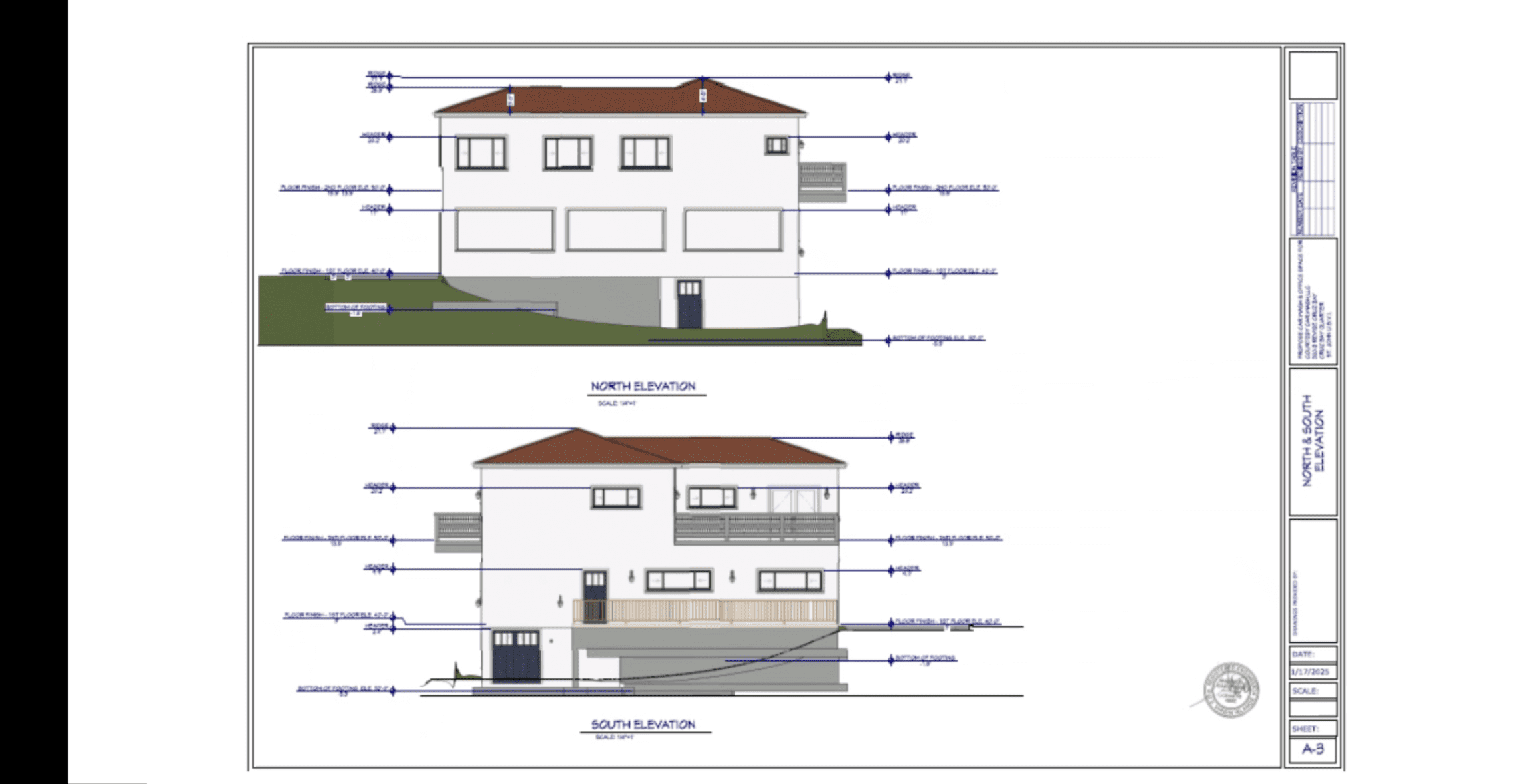
An architect’s drawing shows the design of the car wash building. (Image from an online DPNR meeting held Dec. 30, 2025)
The public has until Jan. 11, 2026, to send in comments regarding a proposal for a zoning variance that would allow a local Cruz Bay business to construct a car wash.
The Department of Planning and Natural Resources held an online meeting Tuesday morning to hear testimony from Greg and Josephine Edward, owners of Courtesy Car Wash, LLC. The Edwards secured a lease from the Property and Procurement Department in 2022 for the .07-acre site, which is located across the road from their car rental business, Courtesy Car & Jeep Rental.
The property — Plot No. 300-B Revised Cruz Bay Town — is owned by the government of the Virgin Islands and is zoned as Public, but the Edwards must obtain a variance to operate a car wash business.
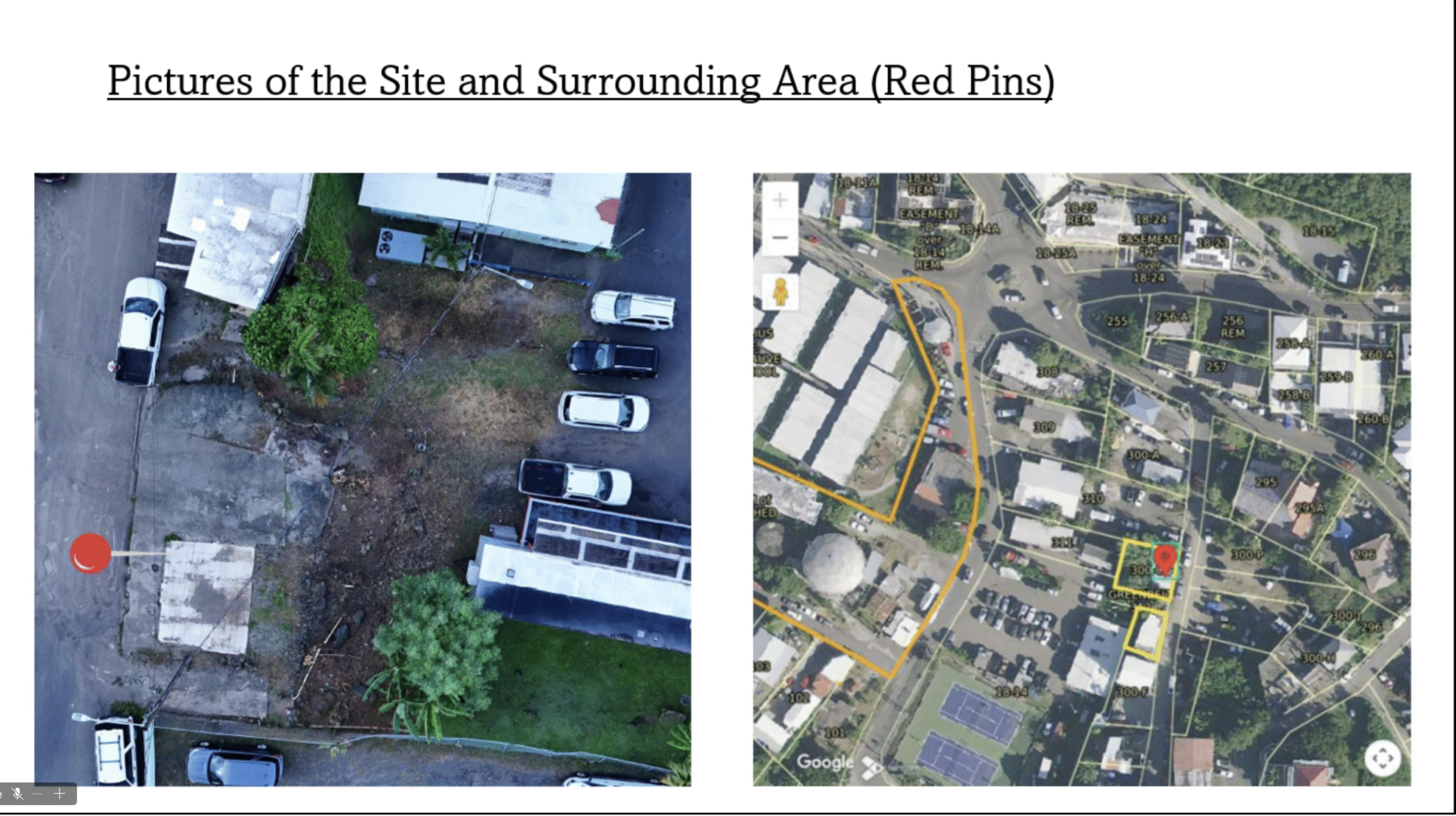
A screenshot from Map Geo shows the location of the proposed site for a car wash in Cruz Bay. (Screenshot from Map Geo)
The site, comprising less than 3,000 square feet, has no structures on it now other than a concrete slab, the remnants of a restaurant once known as Etta’s that closed years ago.
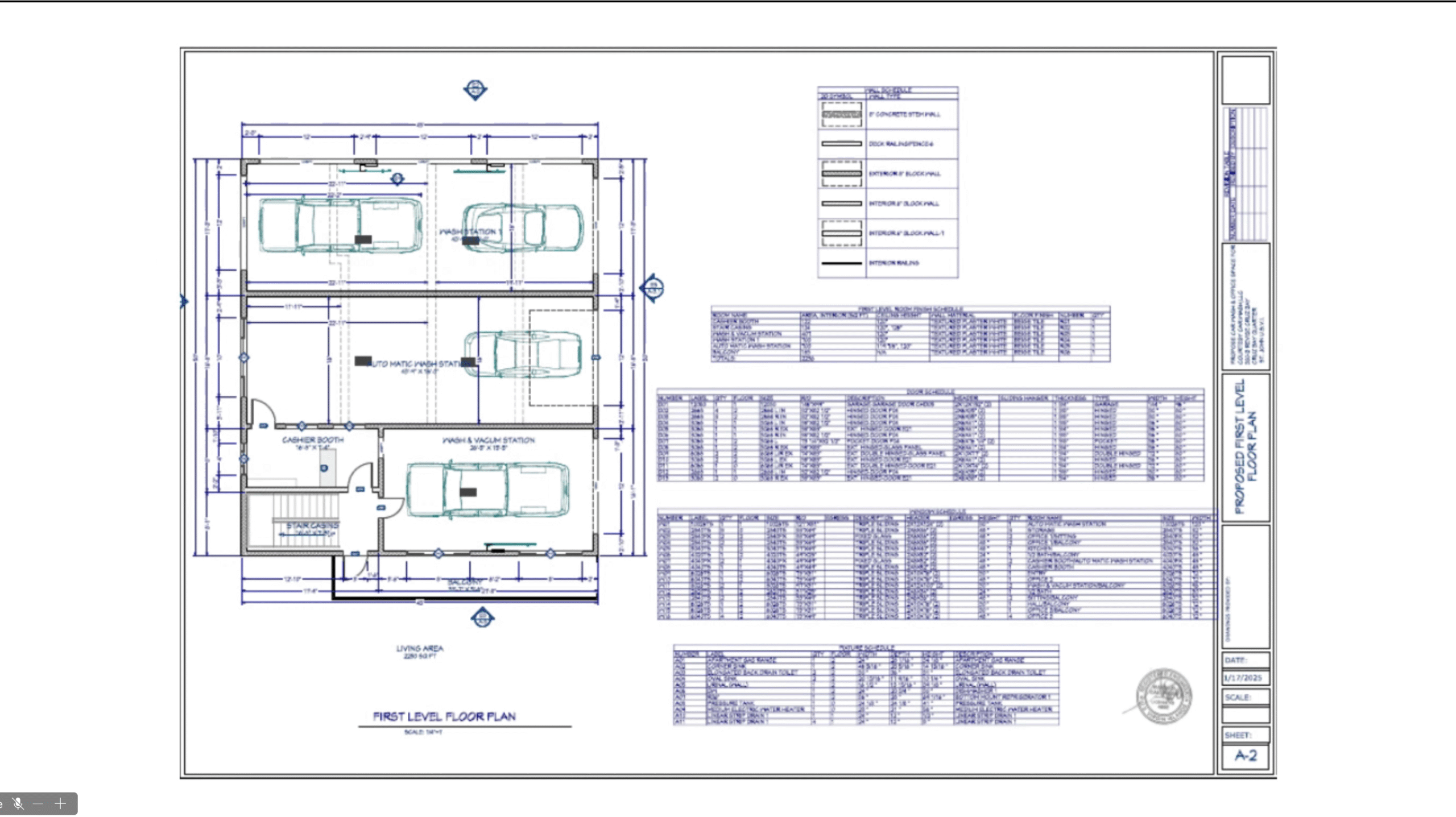
If the variance is granted, the Edwards plan to demolish the concrete slab and construct a two-story building with a basement. The first story will include three stations for power washing cars, plus an additional station for hand washing.
A drawing shows the plan for the first level of the car wash. (Image from an online DPNR meeting held Dec. 30, 2025)
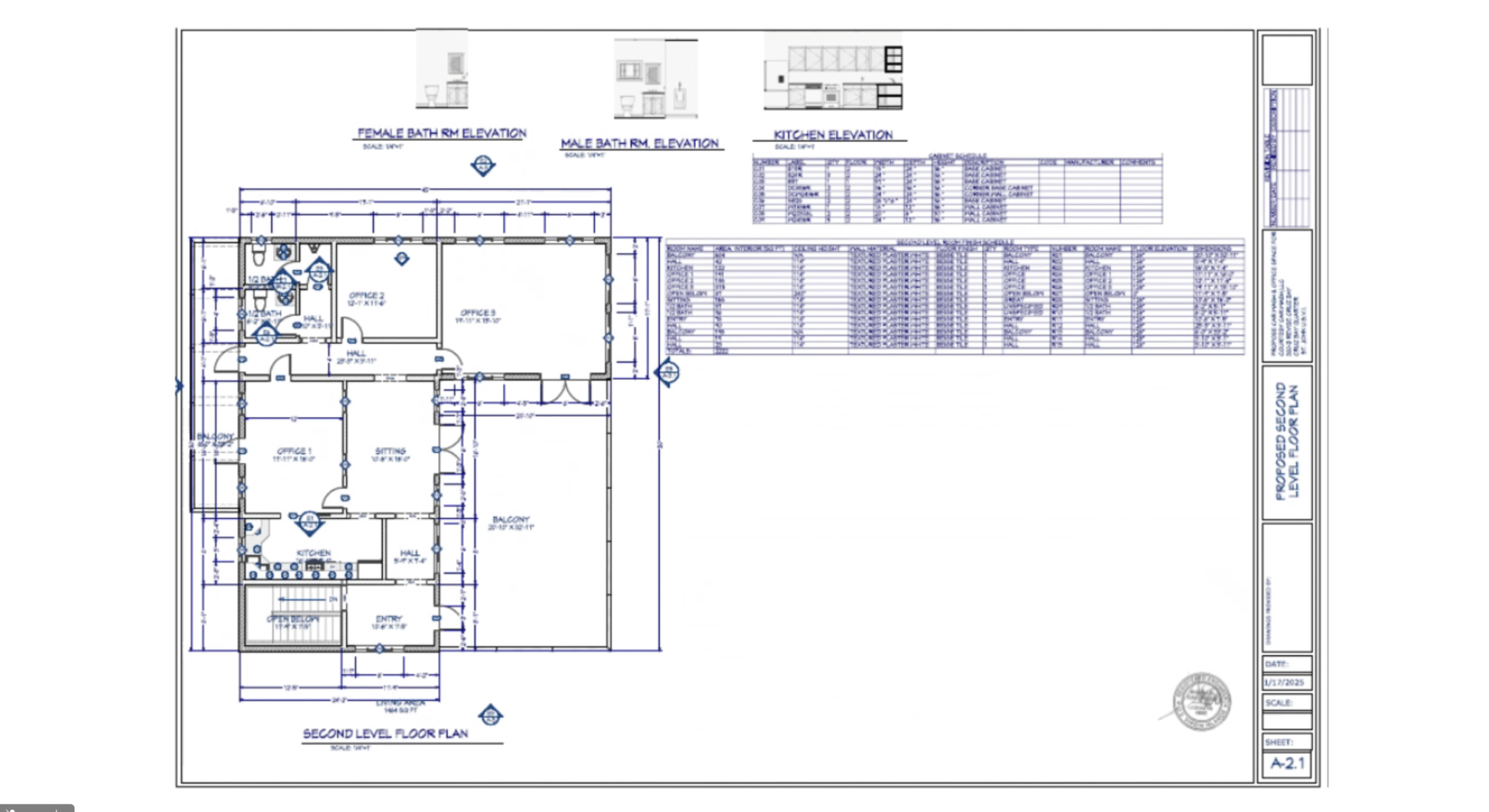
The second story will include three offices, a waiting area, a small kitchen, and a balcony. Josephine Edward said the offices would be used solely by the business. Parking for staff would be available across the road at the car rental site.
A drawing shows the floor plan for the second floor of the car wash structure. (Image from an online DPNR meeting held Dec. 30, 2025)
Plans call for installation of a video surveillance system, solar lighting, a standby generator, water drainage system, fencing and landscaping.
Once the permits are in place, Edward said she expects construction to take about a year and a half. The 30-year lease specifies a monthly rent of $2,000 with options to extend up to 20 additional years. The rent can be reassessed every five years.
Edward said she hopes to provide a service that is not currently available on St. John. She said rates for interior and exterior cleaning will be competitive with prices on St. Thomas.
The property is located adjacent to the northeast corner of the BMV parking lot, but access to it is from the road that leads to the parking area for St. Ursula’s Episcopal Church.
Aerial photos show details of the formerly developed site proposed for a car wash. (Image from an online DPNR meeting held Dec. 30, 2025)
The previously developed site allows the owners to connect to municipal water, electric and sewage systems. When questioned by DPNR officials, Josephine Edward stated she expects the hours of operation to be 6 a.m. to 5:30 p.m. for power washing and as late as 10 p.m. for handwashing.
At the online meeting, Alecia Wells, representing St. Ursula’s Church, said she had concerns that noise from the car wash could disturb worshippers at the church’s Sunday services.
“I’m a big Sunday person myself,” said Edward. “We will try to get top-of-the-line machines that operate quietly. We will be respectful,” she said.
Anyone who wishes to comment on the proposed zoning variance CCZP0104-25 may send comments by Jan. 11 to leia.laplace@dpnr.vi.gov.
Once the comment period ends, DPNR staff have 30 days to make a recommendation to approve, deny or amend the zoning request. The final recommendation is signed by the DPNR commissioner and sent to the Senate’s Committee of the Whole for a hearing. It is then scheduled for a vote by the Senate.
Applications are open for RapierMed’s Blake and Karen Space Camp Scholarship, which will send eligible U.S. Virgin Islands high school students to Space Camp in Huntsville, Alabama, in 2026. (Shutterstock image)
RapierMed has announced the second year of the Blake and Karen Space Camp Scholarship, a STEM-focused opportunity that will send U.S. Virgin Islands high school students to Space Camp in 2026.
Now in its second year, the scholarship covers the cost of attending Space Camp in 2026 and will be awarded to three or more students with a grade-point average of 3.2 or higher who demonstrate an interest in science, technology, engineering and mathematics.
The 2025 scholarship recipients are Naitik Jhanwar of All Saints Cathedral School; Tiera J’Nai Polanco and Colum Morgan of St. Croix Educational Complex High School; Sumyah Mark of Charlotte Amalie High School; Seamus Henry O’Donnell and Anais Craig of Gifft Hill School; and Kali Calhoun of Ivanna Eudora Kean High School.
Space Camp is held at the U.S. Space & Rocket Center in Huntsville, Alabama. The program immerses participants in an environment focused on space, aviation and defense, featuring hands-on exhibits and realistic mission simulations designed to foster creativity, teamwork, leadership and decision-making skills.
For more than 32 years, Space Camp has inspired more than 700,000 participants from all 50 states, U.S. territories and more than 150 countries. Modeled after NASA astronaut training, the program serves as a gateway to exploration, innovation and leadership.
“NASA Space Camp offers Virgin Islands youth a unique, once-in-a-lifetime opportunity to engage in hands-on, immersive learning in a field that becomes increasingly vital with each advancement in space exploration,” said Robert Goldsmith, vice president of RapierMed. “RapierMed is proud to support this initiative, opening doors for the territory’s brightest minds. We encourage all high school students across the Virgin Islands to apply.”
Applications are now open and will be administered through the Community Foundation of the Virgin Islands. Students are encouraged to apply by Feb. 20, 2026.
RapierMed said the Blake and Karen Space Camp Scholarship reflects the company’s continued commitment to creating opportunities that inspire curiosity, innovation and excellence among the youth of the Virgin Islands, while supporting education and helping shape the future of the community.
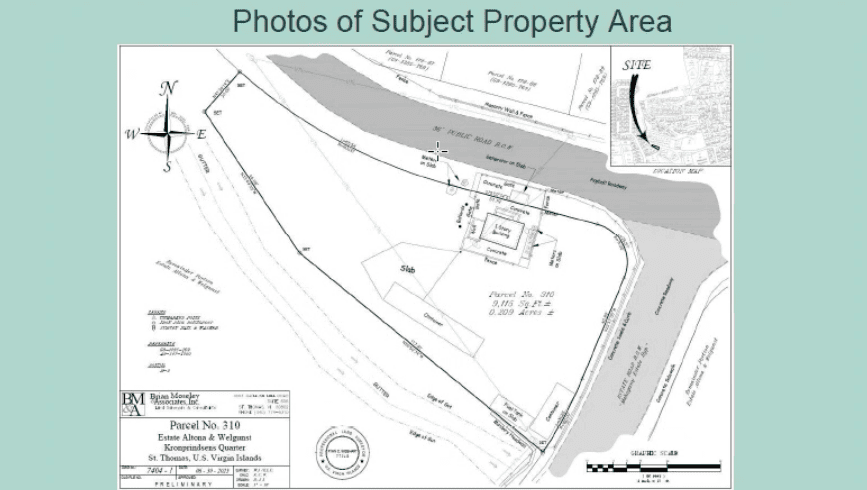
A slide from a presentation by Assistant Commissioner Vincent Richards of the Property and Procurement Department, Tuesday’s meeting, shows Parcel No. 310, the lot under consideration for rezoning. (Screenshot from Teams meeting)
A proposal to rezone a small residential parcel in Estate Altona & Welgunst on St. Thomas to allow a local family-owned auto repair shop to relocate there drew opposition from residents during a public hearing Tuesday.
The Property and Procurement Department is seeking to rezone Parcel No. 310, a roughly 9,115-square-foot lot, from R-3 residential medium density to B-3 business scattered so that Leaders Auto Repair can relocate from its current location at 1662 Kronprindsens Gade and construct a small garage and vehicle storage area.
Department officials said the request is intended to support a local business while cleaning up a government-owned lot that has long been used for informal storage. But residents who live next to and across from the site argued the parcel sits in a flood-prone area that drains into a nearby gut, warning that an auto repair operation there would increase the risk of oil, antifreeze and other contaminants washing into their neighborhood and local waterway.
Assistant Commissioner Vincent Richards of Property and Procurement said the government and Leaders Auto Repair are negotiating a lease of at least 10 years, possibly extending to 20 years with renewal options. Rent would be reduced during construction and rise to more than $1,000 per month once operations begin.
Richards described the parcel as underutilized and currently used for informal storage, derelict vehicles and old equipment.
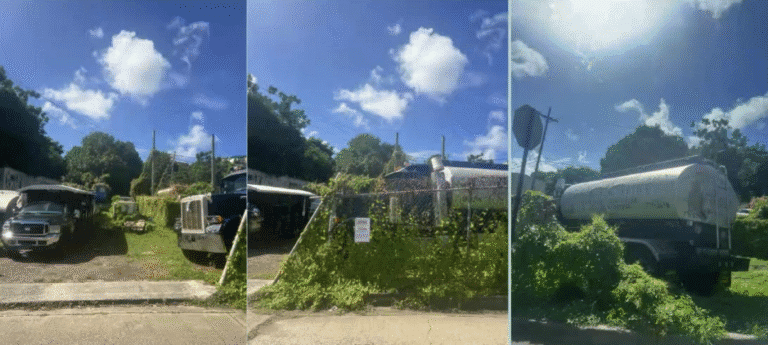
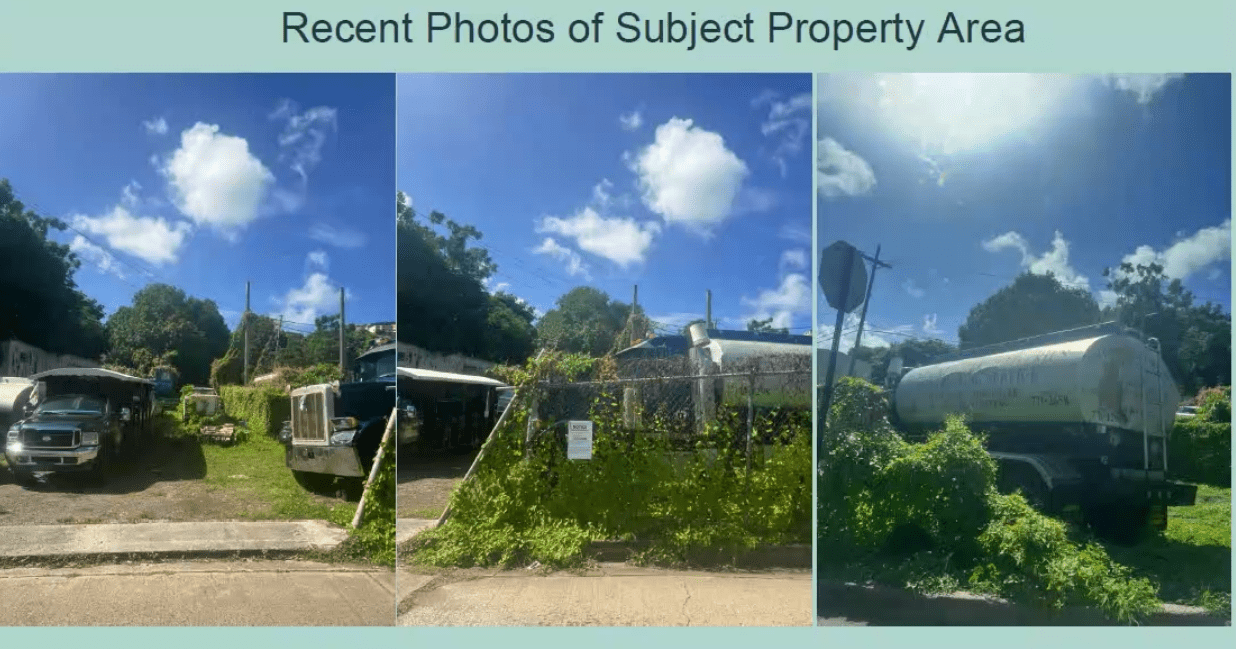
Recent photos of the subject property, shown during a presentation by Assistant Commissioner Vincent Richards of the Property and Procurement Department, depict what he described as “abandoned equipment” and vehicles currently being stored on the site. (Screenshot from Teams meeting)
“The proposed development will remediate the current conditions and replace it with a single facility and parts storage, thereby improving both functionally and visually the appearance of the subject property,” Richards said. “This rezoning request presents an opportunity to remediate a neglected parcel, support responsible and small business activity and remain compatible with the surrounding neighborhood.”
The proposal calls for a single building constructed in one phase, with an estimated three- to nine-month timeline from permitting to occupancy. The shop would operate from 8 a.m. to 6 p.m., Monday through Saturday, with at least two employees on site. Richards said the site could accommodate about 10 to 12 vehicles and that all vehicles would be stored on the property behind privacy fencing.
“All owner and client vehicles will be required to be parked and stored on the subject property only,” Richards said.
Richards said environmental reviews found no flood-prone location, no endangered species and no known cultural or historic resources on the parcel. He said the lot was carved out of a larger government property to avoid a nearby gut and that the business would be required to connect to public sewer and potable water and properly store and dispose of automotive fluids. Lease provisions would allow termination for noncompliance, he said.
Residents, many of whom said they have lived in Estate Altona & Welgunst for 30 years or more, challenged claims that Parcel 310 is not flood-prone.
“Anyone who’s lived there for any amount of time, and I’ve been there 60 years, can tell you that is an active flood zone,” said Karen Johnson Hassan. “Anything in that gut goes right through into the Frenchtown gut area there by McDonald’s and right out into the waterway. It’s unacceptable what you guys are planning or trying to do. The people that live there are older. They’ve lived there for decades.”
Neighbor Kenja Baptist said that lenders have already judged the area a flood risk. “This is a copy of my flood insurance,” she told officials. “It was a requirement with our mortgage because we are in a flood zone. So what he [Richards] said, that’s not correct.”
For many residents, flooding was only part of the concern. They said that once an auto repair shop is in place, spills and improper disposal are inevitable, regardless of safeguards promised in a lease.
“I haven’t heard yet any mitigation process to stop the oil, the antifreeze and the transmission fluid going into the gut, which would eventually end up in the seawater,” said Augustine Ayala, who owns a nearby home. “I am totally against it. There is no way that you can make any guarantees, especially when it comes to oil transmission fluid and antifreeze. Antifreeze is not just a common element that goes into the ground and doesn’t do any impact.”
Others pointed to what they described as a pattern of lax enforcement, noting that derelict cars and boats have remained for years in and around the same area.
A petition submitted by residents cited public health research on living near environmental hazards and urged planners to err on the side of protecting the neighborhood.
“The study concluded that the evidence at this time is sufficient to justify the application of the precautionary principle … Enough evidence of potential harm being done exists to justify taking steps to rectify the problem and to protect the public from potentially harmful exposures,” the petition stated.
Others raised concerns about traffic on a narrow road, declining property values and the long-term impact on the neighborhood. One resident suggested the parcel could instead be developed as a children’s park.
Residents also cited a long history of dumping, derelict vehicles and abandoned boats on the property, arguing that government agencies had failed to maintain or clear the site.
Testimony also touched on Discount Trucking, a water‑truck business that operated for decades on the site under the late James Bryant. After Richards said his department had no record of a lease and described the past water‑truck operation as using the lot without a formal agreement with the government, resident Linda Carrijo said he had run his business there for nearly 30 years, delivering water and doing work for public agencies, and would never have squatted on government land.
“I’m getting emotional because Mr. Bryant died almost three years ago,” she said. “I don’t understand how all of a sudden a lease disappears, and we’re talking as though this man was running a business for almost 30 years … and he didn’t have a lease. I’m not going to allow someone to defame Mr. Bryant’s character and make it seem like he was running an illegitimate business, squatting on government property.”
Richards later apologized and said his department would use this information and search its files, and those of other agencies, for any past lease. “It’s definitely not the intention to sully anybody’s name or their memory,” he said. “Now that we have that information, we could dig into it a little bit more, take a second look, and I’ll be happy to change the record.”
Environmental officials also flagged potential issues. Rukia Andrews of the Division of Fish and Wildlife said mapping tools indicated possible presence of the Virgin Islands tree boa and identified a riverine feature near the site.
“If the rezoning does pass, we’d have to send you our protocols and things … before you can do any heavy machinery or building in the area,” Andrews said.
Mary Stiehler of the Environmental Protection Division confirmed the presence of a gut and vegetated area west and southwest of the parcel and questioned how runoff and hazardous materials would be managed, particularly given nearby water infrastructure.
May Leader, co-owner of Leaders Auto Repair, said the business has operated on St. Thomas since about 2010 at 1662 Kronprindsens Gade, near the Board of Education offices, without complaints.
“We’ve been in business for 15 years … and we never had any complaints,” she said. “We use the best compatible tools that are out there available. We do our research. We do everything that needs to be done to the proper standard.”
“We take pride in teaching not just our children, but youth in the community, and we follow proper standards for handling oil and other materials. I’m just trying to make sure you understand that some of us can do it the right way. By any means, we’re not trying to harm anyone,” Leader added.
A slide from the presentation instructed residents to submit additional public comments by email before Sunday, Jan. 11, 2026. (Screenshot from Teams meeting)
The hearing was chaired by DPNR planning technician Gail Pagan, who said written public comments will be accepted until Sunday, Jan. 11, 2026. Residents wishing to submit comments can email leia.laplace@dpnr.gov.vi before that date.
“This is an open process,” Richards said. “I just want you to understand that your opinion is greatly and deeply respected and I appreciate it.”
Community members will gather at Franklin Powell Park in Cruz Bay for St. JanCo.’ s first-ever Guavaberry Contest, celebrating a cherished Virgin Islands tradition of homemade guavaberry rum and liqueurs. (Source photo by Sian Cobb)
St. JanCo. will present its first-ever Guavaberry Contest at Franklin Powell Park in Cruz Bay, St. John, on Sunday. The event, running from 5:30 p.m. into the evening, promises an evening steeped in cultural heritage, local talent, and festive celebration.
More than just a competition, the event is a heartfelt initiative to preserve a cherished custom. After listening to St. John elders engage in a lively debate about who makes the best guavaberry on the island, St. JanCo.’ s President and cofounder, Hadiya Sewer, suggested hosting the contest to honor the territory’s culinary heritage — and, of course, to settle any debates.
“Some elders in our community thought it would be a great idea because the tradition of making guavaberry rum has slowly been lost over time. This contest is intended to help preserve and celebrate that tradition,” explained Jovanna Laurencin, executive director of St. JanCo.
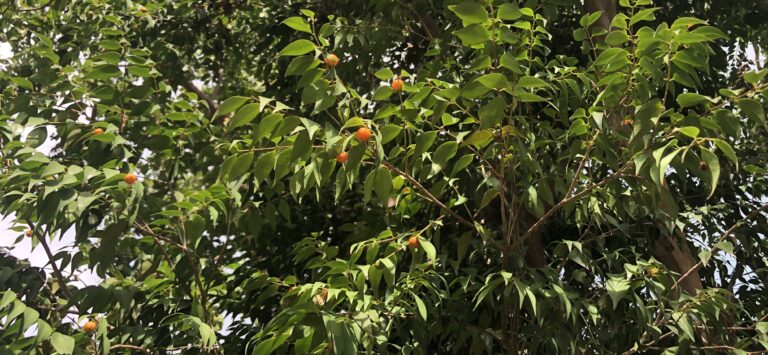
The contest will spotlight guavaberry rums and liqueurs, beverages deeply connected to Virgin Islands history and holiday celebrations. “Guavaberry rum is a long-standing Virgin Islands tradition, typically made during this time of year, and is synonymous with Christmas and community gatherings,” said Laurencin.
“Guavaberry rum making is such a beautiful, slow, and often intergenerational practice,” Sewer added. “In some families, new batches are made using a small amount of liquor left at the bottom of an older jimmy john. In this way, guavaberry making carries forward the flavor, history, and care of previous generations of Virgin Islanders.”
Contestants’ homemade creations will be evaluated by a guest judge with a distinguished palate. “The judge, Juncinto Durant, brings years of experience as a culinary connoisseur, combined with hands-on family training and mentorship from an industry professional with extensive distillery experience and international exposure to flavor pairing,” Laurencin explained.
Beyond the competition, attendees can enjoy a full community festival atmosphere. The evening will feature live musical performances by Quelbe Resurrection and Icon Sounds. A selection of local foods, snacks, and crafts will be available, and a cash bar will be on site. “These elements are key to the experience. We strive to educate locals, residents, and visitors about our homegrown traditions and culture,” said Laurencin.
Two trophies will be awarded: one for People’s Choice and one for the Judges’ Best Choice.
For St. JanCo., the event reflects its core mission. “This event provides a meaningful opportunity for cultural education and for experiencing a tradition that has long been passed down by elders in our community,” Laurencin said. Sewer noted that guavaberry making highlights Virgin Islands foodways and ecologies. “We cultivate the trees and harvest the fruit to craft the liqueur. In a territory that imports more than 95 percent of its food, celebrating guavaberry making reflects St. JanCo.’ s commitment to land stewardship, cultural heritage preservation, and echoing the Virgin Islands Good Food Coalition’s call for food security, local farming, and the use of locally grown food in our dining.”
Parking will be available at Slim Man’s Parking Lot and the nearby gravel lot. Contest sign-up and additional information are available by emailing info@stjanco.org. Those interested in participating, vending, or volunteering for this or future events are encouraged to reach out via email or through St. JanCo.’ s Facebook and Instagram pages.
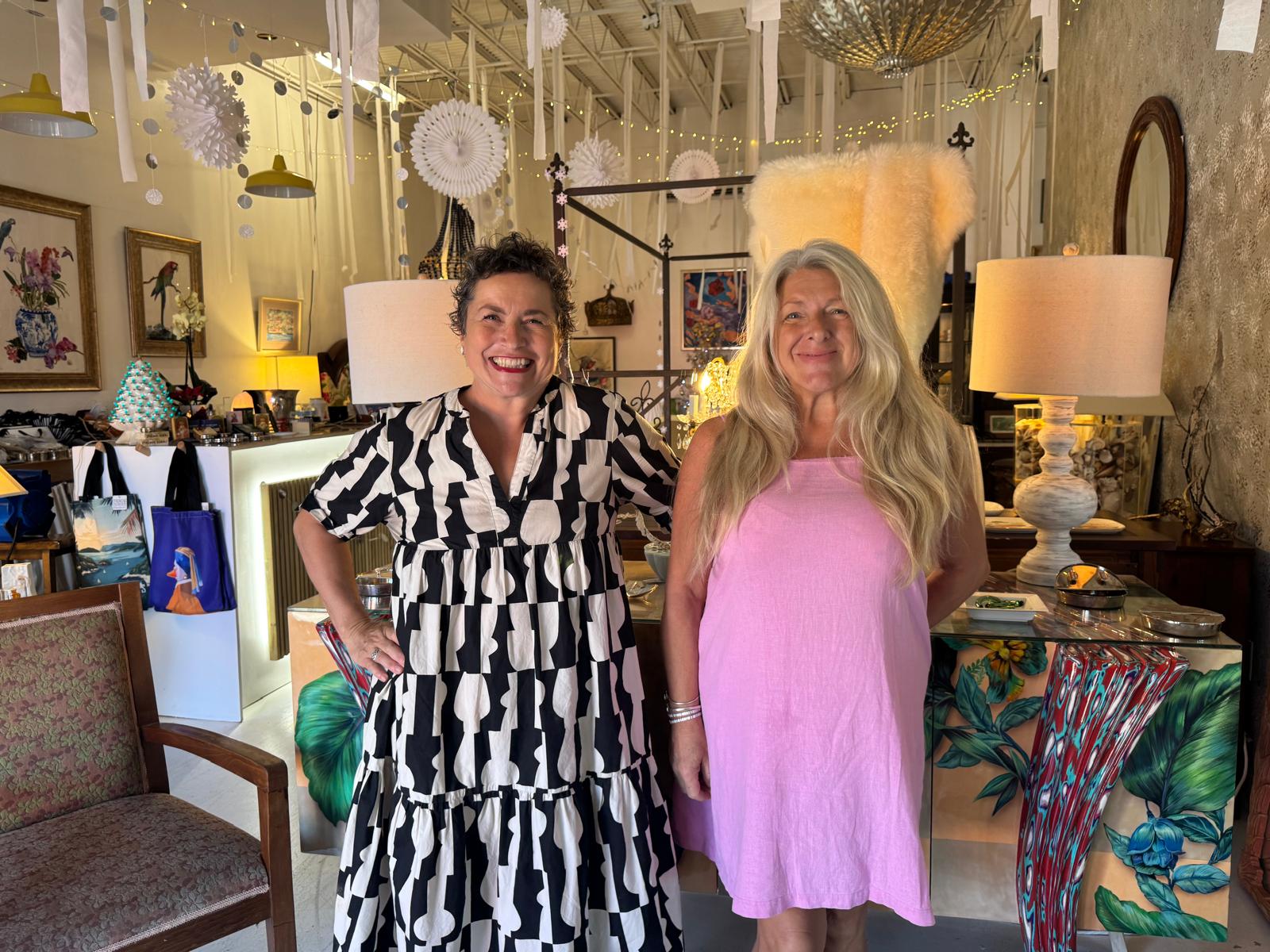
Diane Ormrod and Dorothee Walliser, owners of French and Scouser. (Source photo by Adisha Penn)
Two best friends, Diane Ormrod and Dorothee Walliser, opened “French and Scouser,” a furniture and design store on St. Thomas that resells home goods and provides interior design services.
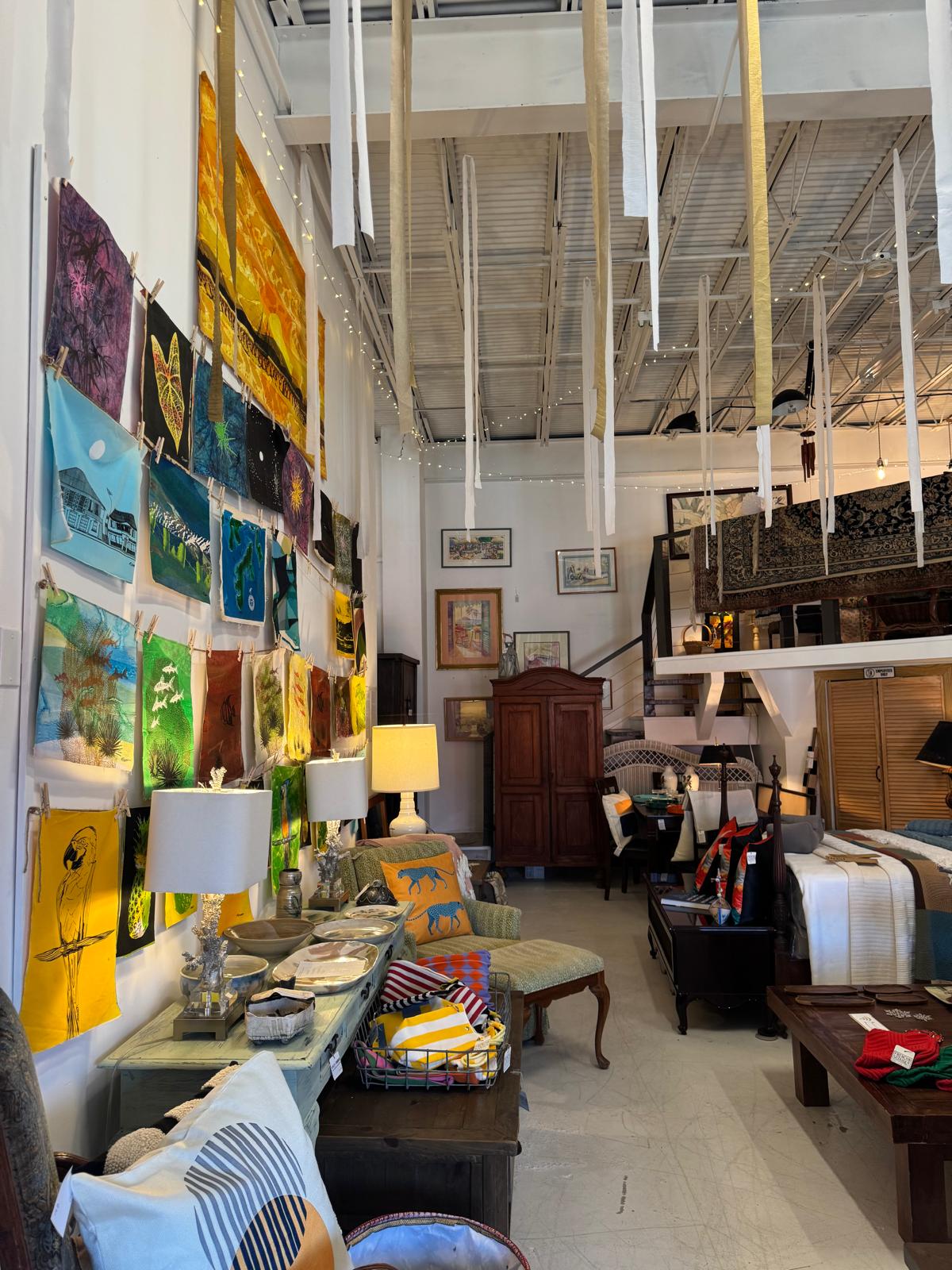
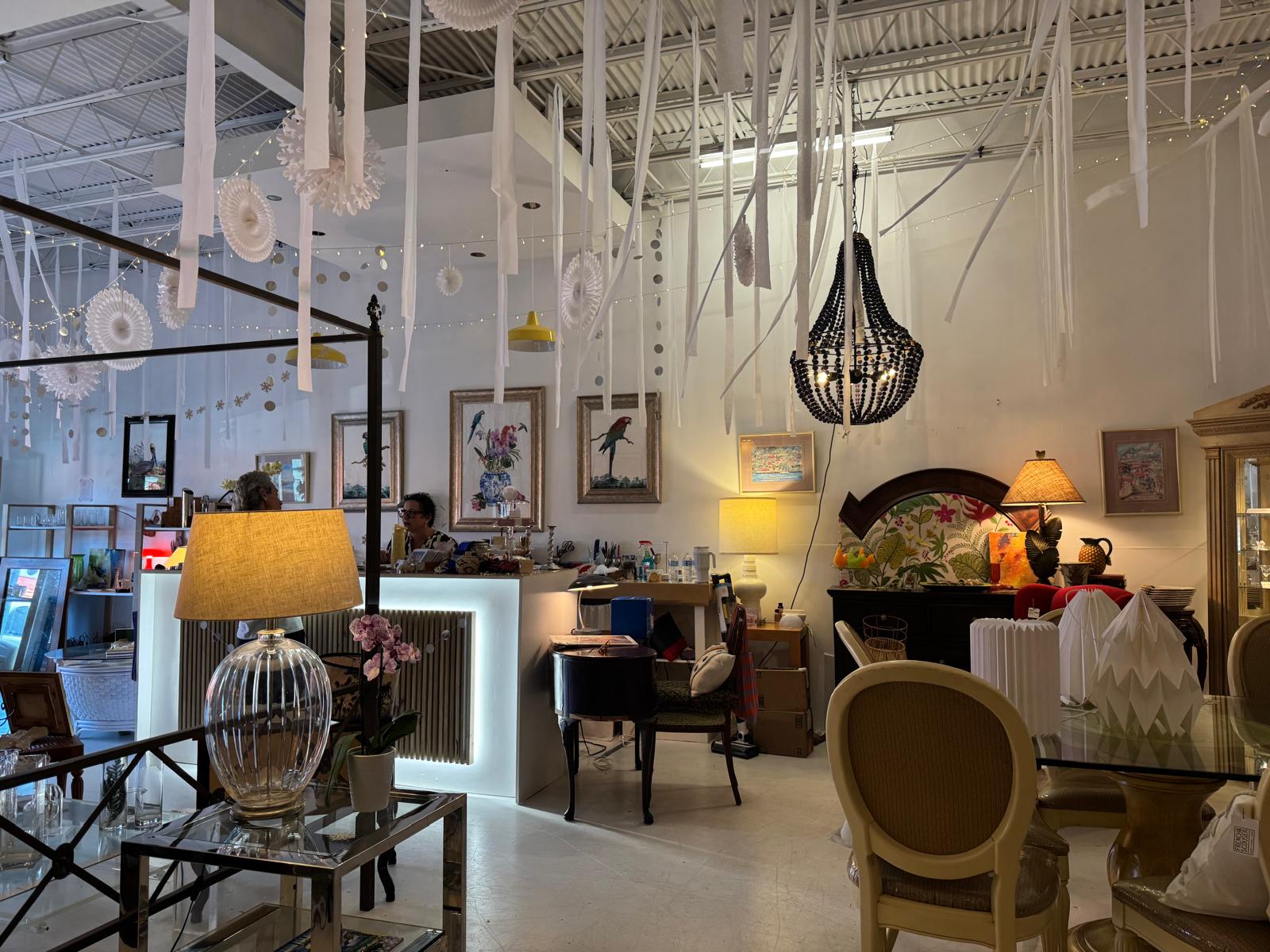
Located at Prime Storage, behind the Roy L. Schneider Hospital, the store has a modern aesthetic created by the used and new products being sold. Opened in July, the store has been buzzing with individuals interested in purchasing secondhand or repurposed products.
“It’s mainly consignment, but we also have new home goods and accessories,” said Ormrod. “We don’t sell appliances.”
Photos and other furnishings for sale at French and Scouser on St. Thomas. (Source photo by Adisha Penn)
According to Ormrod, the duo has been in business since 2012. They originally had a business in New York that served as a boutique hotel and retail space where they sold vintage goods. Items in the rooms at the hotel were available to be sold to guests.
“Dorothee and I are best friends, we’re like sister friends, and we’ve been in business together a long time. And I just love coming here and wanted to find a way to stay here. It was kind of like a place where we would come and every year we would come and say, ‘Well, how can we stay a little longer, how do we live here,’” Omrod explained.
“We’ve been friends for 23 years,” added Walliser.
Diane Ormrod and Dorothee Walliser, owners of French and Scouser, greet a customer. (Source photo by Adisha Penn)
They met through their careers in publishing and have been inseparable since.
“I lost my job because my company was purchased, and I just decided I really didn’t want to go back into the grind of the corporate life. And she was also doing freelance,” said Walliser.
After Ormrod purchased a home in upstate New York, Walliser said she attended estate sales and auctions with her while she furnished her home.
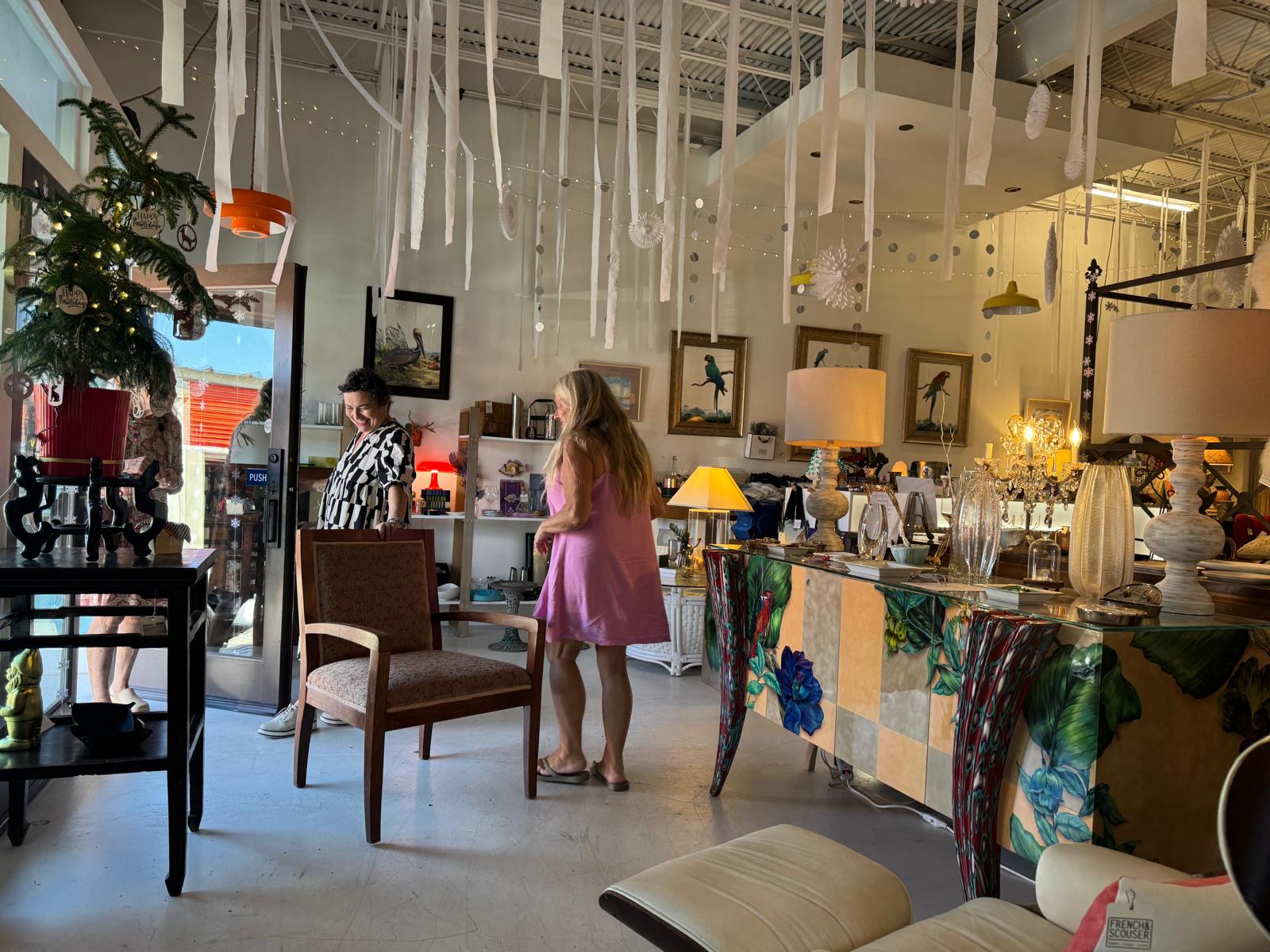
Diane Ormrod, co-owner of French and Scousser, talks to a customer at her store. (Source photo by Adisha Penn)
“All of a sudden, we realized, ‘Oh my god, these things are going for so low, and they’re so beautiful, maybe we can do something,’ and that’s how it started. It was completely organic,” said Walliser.
She said they started selling items online and everything grew from there.
Once they decided to move to St. Thomas, “In 2020, I felt like a lot of stuff was expensive,” said Ormrod, and added that there was also not a huge selection of items to source on island. “We wanted to have something where we could present beautiful things to people at a pretty reasonable price, and also keep things out of that big massive landfill that we got here.”
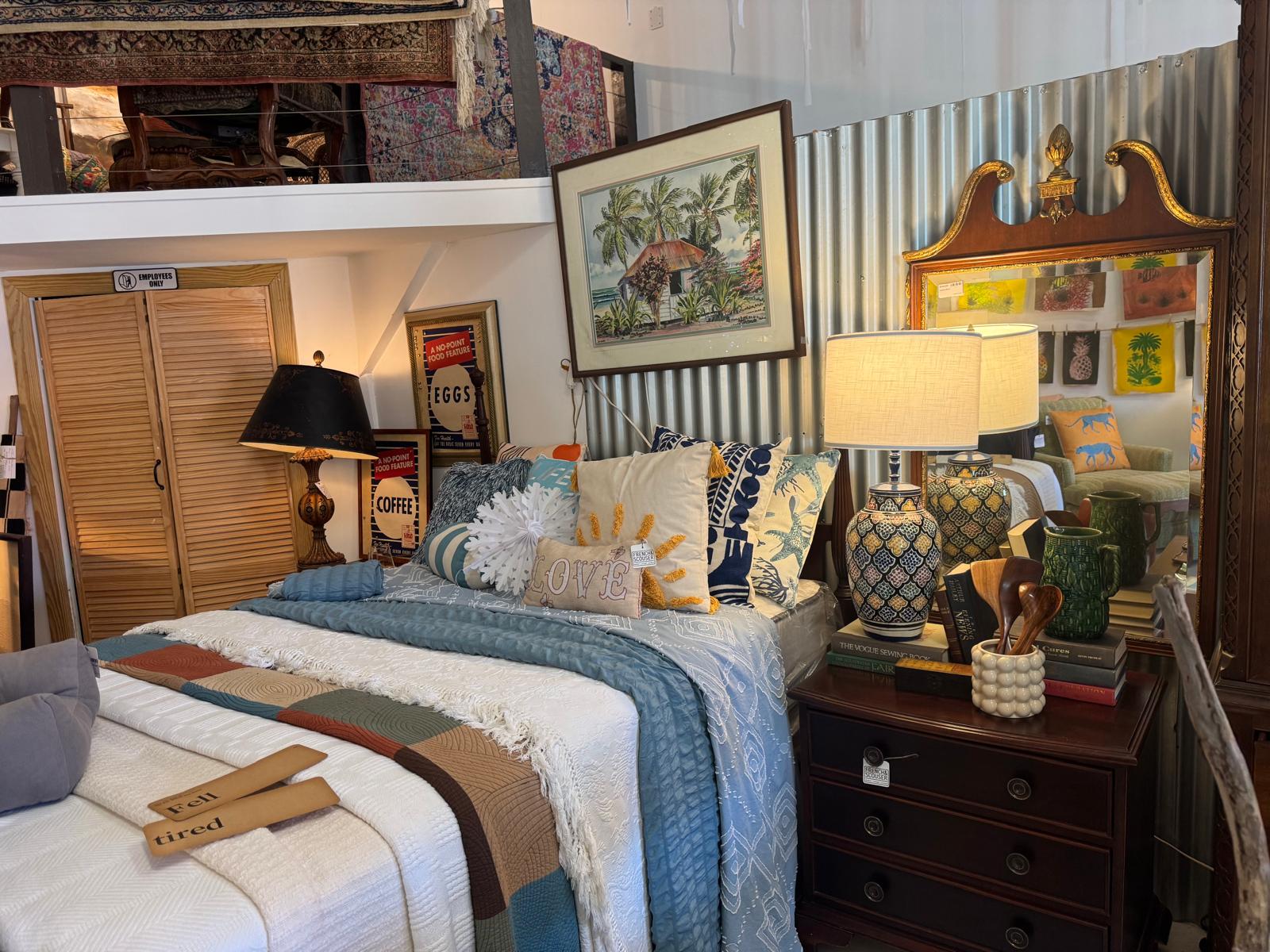
A bed, lamp, pillows, and other furniture for sale at French and Scouser. (Source photo by Adisha Penn)
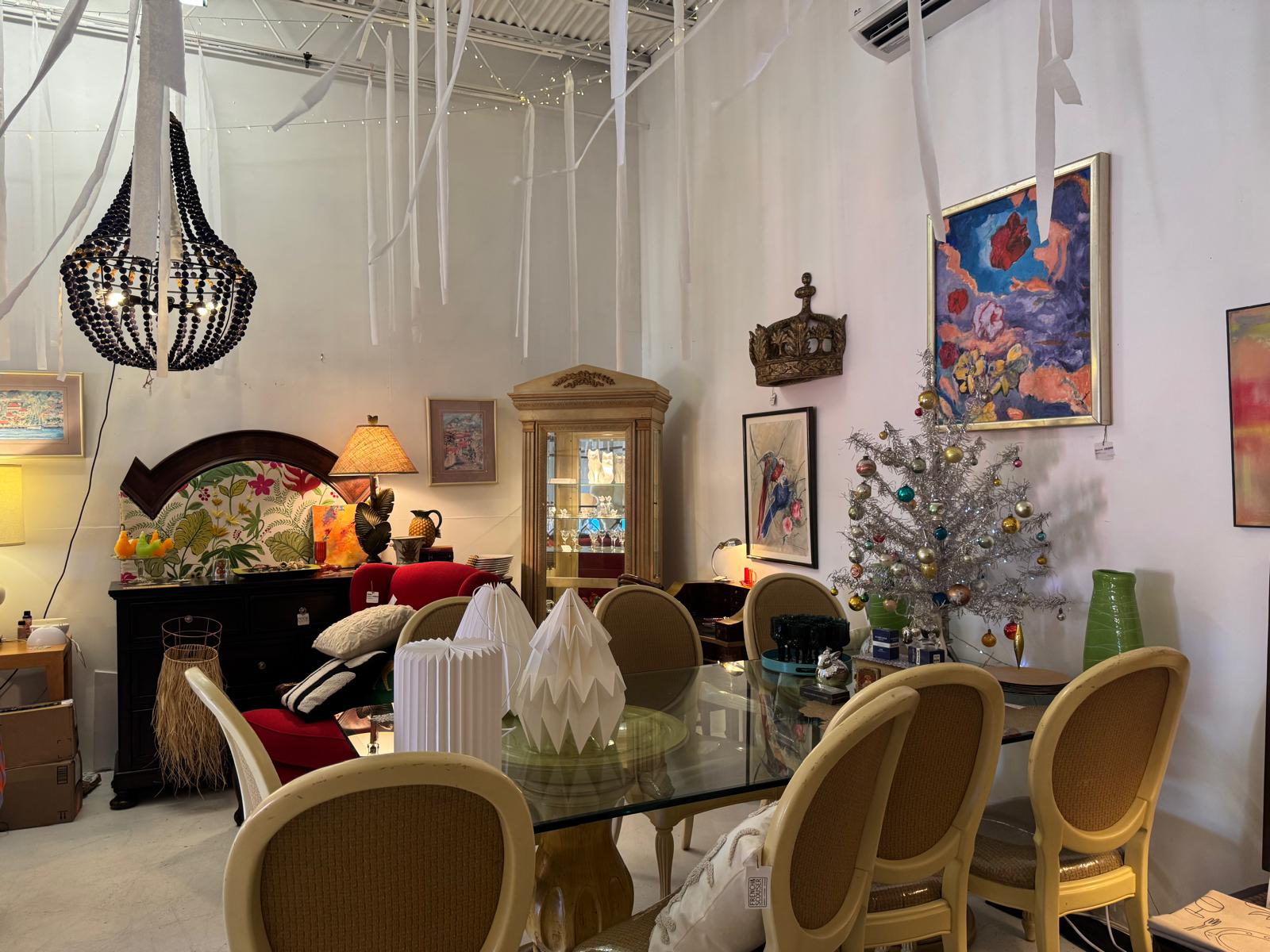
Items like dressers, desks, side tables, lamps, chairs, and glasses fill the store’s space. Ormrod said she encourages her customers not to simply discard personal items they no longer want because, “Maybe it’s something that might be considered old to you, but to someone else it’s beautiful.”
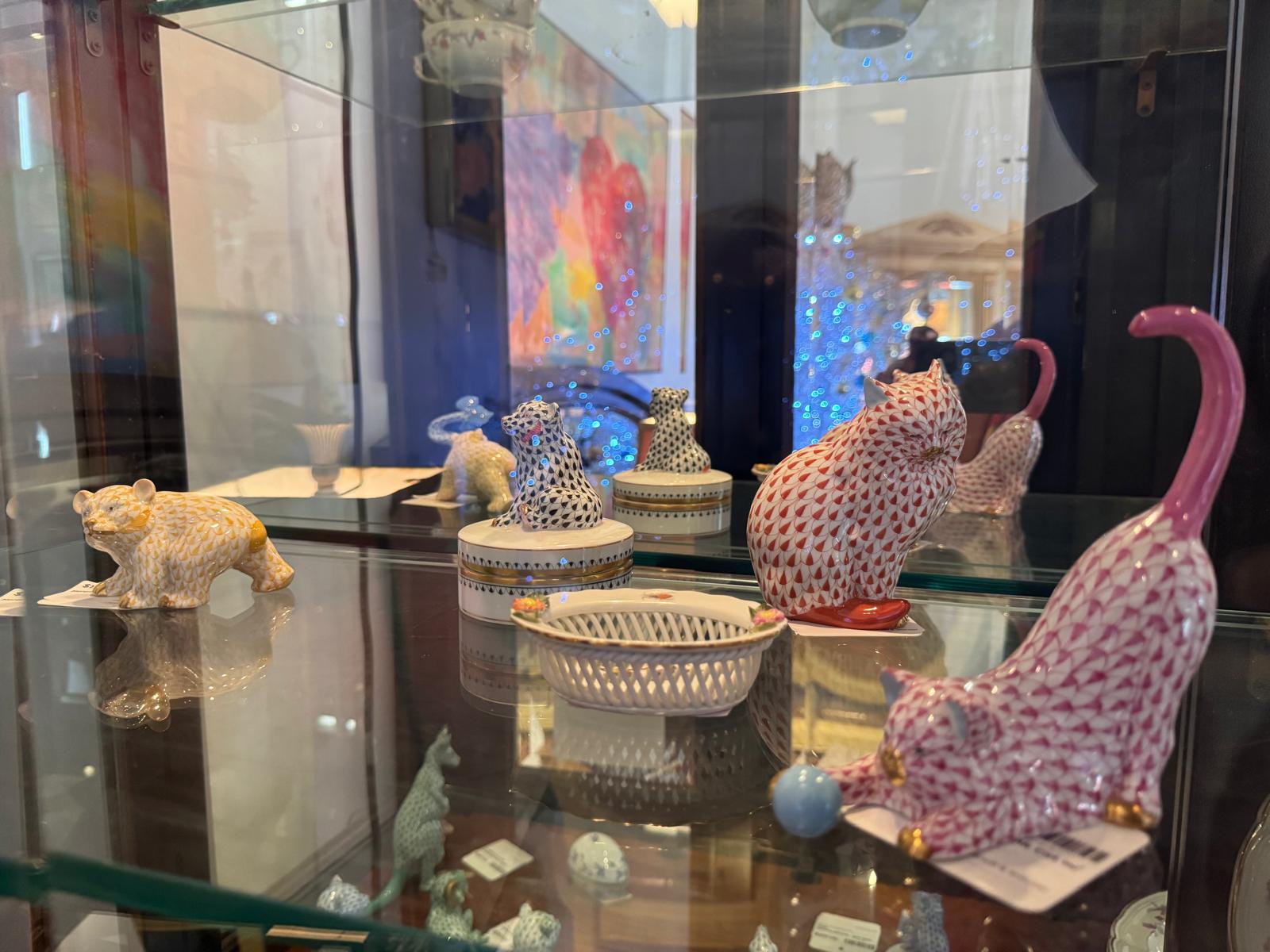
Animal figurines inside a glass case are on display to be sold at French and Scouser. (Source photo by Adisha Penn)
Of the business, “We had no idea that all of a sudden, as soon as we told people, it was like the flood gates opened,” said Ormrod, who added the pair were not sure how they would be received in the community. “It’s been amazing.”
When asked how they came up with their unique name, they informed that it’s related to their hometowns.
A table, chair, and other furniture for sale at French and Scouser. (Source photo by Adisha Penn)
“French because Dorothee is from Paris, and Scouser is me. I’m from Liverpool, and anyone from Liverpool is called a Scouser,” Ormrod said jokingly, who added that the name is also coined from the creators of Absolutely Fabulous and French and Saunders.
Visitors to the store can oftentimes be greeted by Ormrod’s Chihuahua. Hours of operation are 10 a.m. to 5 p.m., Tuesday to Saturday. For more information, call 340-220-2407.