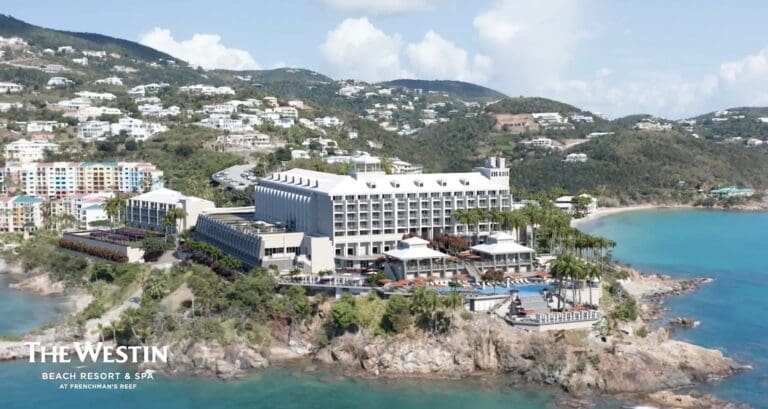
The Bryan administration has submitted legislation to the 36th Legislature that would allow a wholly owned subsidiary of the Virgin Islands Public Finance Authority to issue tax-exempt bonds for hotel development projects, beginning with the Westin Frenchman’s Reef Resort and Spa on St. Thomas.
The measure amends the Hotel Development Act to expand the financing tools available to developers and lower borrowing costs, while the administration maintains that the government of the Virgin Islands would not take on debt, guarantee the bonds, or operate the hotel.
Gov. Albert Bryan Jr. said in an exchange with the Source Wednesday that the proposal was initiated by the ownership group of Frenchman’s Reef following the completion of major reconstruction and redevelopment work at the property. The current owner of the Frenchman’s Reef property is an affiliate of Fortress Investment Group, a global private investment firm that acquired the resort from DiamondRock in 2021 and financed its redevelopment following Hurricanes Irma and Maria.
The amendment would allow the owner to refinance its private construction debt at tax-exempt interest rates.
“This was actually a request from the investors, and we thought it was a great opportunity,” Bryan said, adding that the financing mechanism is standard in the hospitality finance industry. He emphasized that “the bonds are the developer’s responsibility” and that there is no pledge of government revenues or assets.
A press release issued Wednesday stated that the refinancing would be structured through a Public Finance Authority subsidiary and compared the arrangement to industrial development bonds commonly issued in other jurisdictions. The administration said the approach reduces private borrowing costs, accelerates tourism investment, and does not create taxpayer liability.
In a transmittal letter delivered Oct. 22 to Senate President Milton Potter, Bryan wrote that the tax-exempt financing would replace the developer’s current private financing structure, and that the public benefit comes at the end of the repayment period. “The benefit for Fortress is that the tax-exempt bonds would replace the corporate debt and equity on the Frenchman’s Reef property,” the letter states. “The direct benefit for the Government is that upon the final redemption of the bonds, in 30 years or so, the Frenchman’s Reef property would revert to government ownership.”
Bryan said the proposal aligns with a model already used across the territory, where major hotels operate under long-term leases on government-owned land. He cited Emerald Beach, the former Beachcomber Hotel, Hotel on the Cay, and portions of Yacht Haven as examples. During his term, the administration executed a new long-term lease for Hotel on the Cay, is preparing to rebid the Beachcomber site, and noted that the Emerald Beach lease will expire soon.
“The concept of leasing government land for developments that revert back to the government is not new,” Bryan said. “What’s new is using this financing structure to acquire the asset at the end.”
The governor also noted that the Frenchman’s Reef proposal would not result in public operation of the hotel and would not alter its current hotel management contract. Davidson Hospitality would continue managing the property.
The proposal now moves to the 36th Legislature, where lawmakers are expected to review the financing structure, the scope of the amendment to the Hotel Development Act, and the conditions surrounding eventual public ownership of the property. No hearing date has yet been set.
U.S. Justice Department attorneys are unable to work on federally mandated oversight of the V.I. Police Department because of the ongoing shutdown of the federal government. (Shutterstock image)
A report from U.S. Justice Department attorneys overseeing the V.I. Police Department’s compliance with a 16-year-old federal consent decree will be delayed because of the ongoing shutdown of the federal government.
The department’s Civil Rights Division wrote U.S. District Court Chief Judge Robert Molloy last week to request a stay, saying that they would not be able to file this month’s report because attorneys had been furloughed while Democrats and Republicans in Congress continued to spar over a federal appropriations bill. Molloy granted the request Wednesday but said the parties are still required to attend an evidentiary hearing in December, barring a subsequent order to continue.
Molloy told police officials, Justice Department attorneys, and a court-appointed monitor during the last evidentiary hearing in September that local law enforcement was on the “right track” and “right path” to complying with the consent decree, which was entered in 2009 following allegations that VIPD officers habitually deprived Virgin Islanders of their constitutional rights. That recent hearing covered reporting periods up to May 31. Since then, officers on St. Croix and St. Thomas have shot and killed at least two men: Alejandro Torres III, 48, on July 17 and Tyler Simpson, 36, on St. Thomas.
The Source has repeatedly sought information about those killings. Earlier this month, VIPD finally provided a copy of its body-worn camera policy, which states that public records requests for bodycam footage “shall be accepted and processed, in accordance with the provisions of federal and territorial law and forwarded to the Project Administrator.’ Further, “Public and Media request [sic] will be forwarded to the Public Information Officer.”
Another section states that body-worn camera footage “for release pursuant to a public records request or as authorized by the Commissioner or designee, shall be redacted, as required by law and Department procedures, prior to release.”
The Source responded by again requesting footage recorded by officers involved in the shootings of Torres and Simpson but has not received a response.
Though U.S. Justice Department attorneys were unable to submit a report this month, attorneys for the V.I. Justice Department submitted their own status report on behalf of the VIPD. According to Assistant Attorney General Ariel Smith, the department has one Force Review Board report awaiting Commissioner Mario Brooks’s review and signature, and investigative reports into two “Level 1” use of force incidents have been sent to supervisors for review before being forwarded to the board.
The only explicit acknowledgment of the summer’s killings was a statement that “VIPD is currently providing training (i.e., building entry) to their officers based on the body-worn camera reviews of officers of the most recent Officer-Involved Shooting Incidents,” according to the report.
Members of the public have until Nov. 7 to send their comments to the Department of Planning and Natural Resources concerning the rezoning of nearly three acres of property in Estate Susannaberg from low-density residential to commercial.
The site is located along Centerline Road across from St. John Concrete and just east of Heading East restaurant.
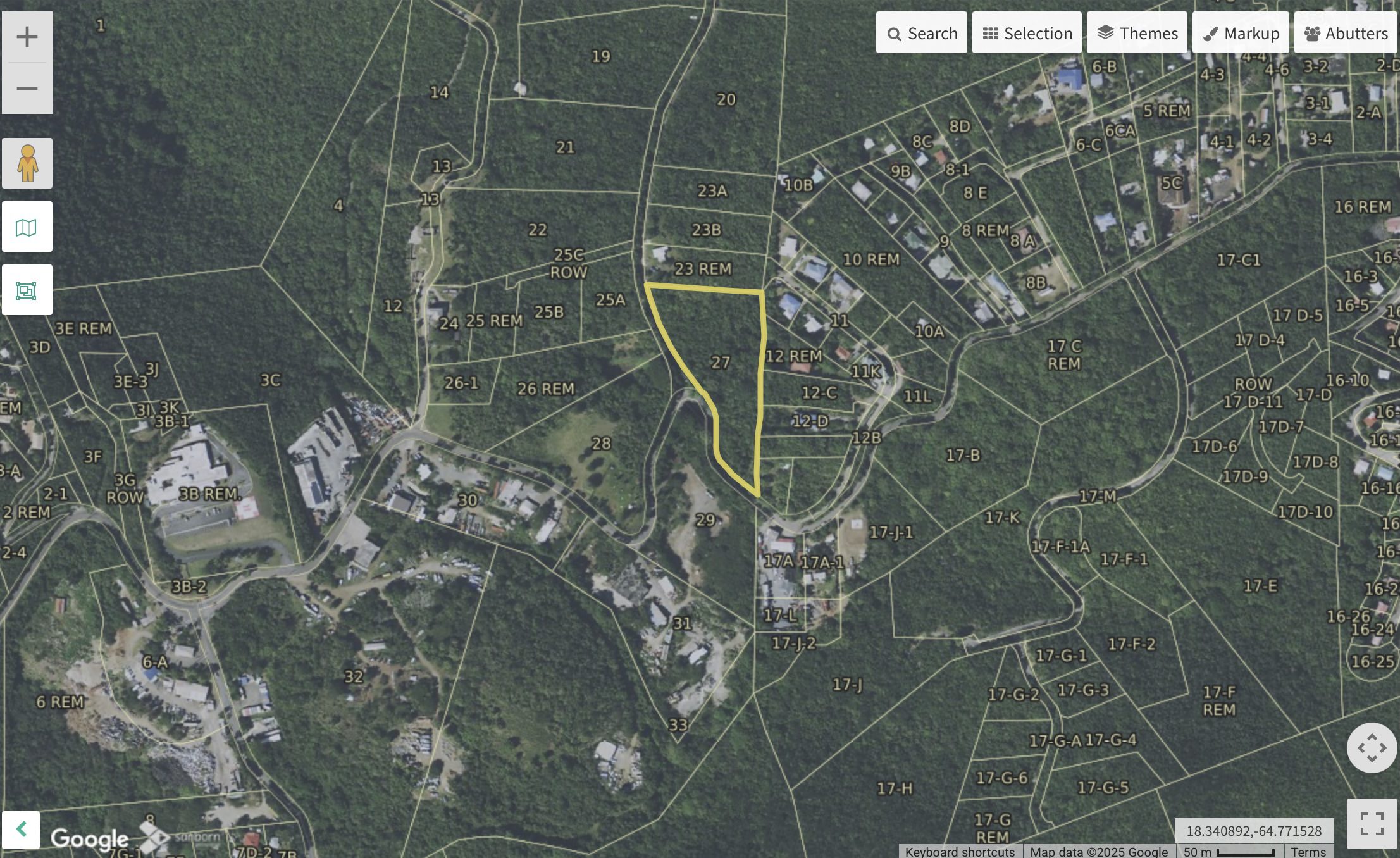
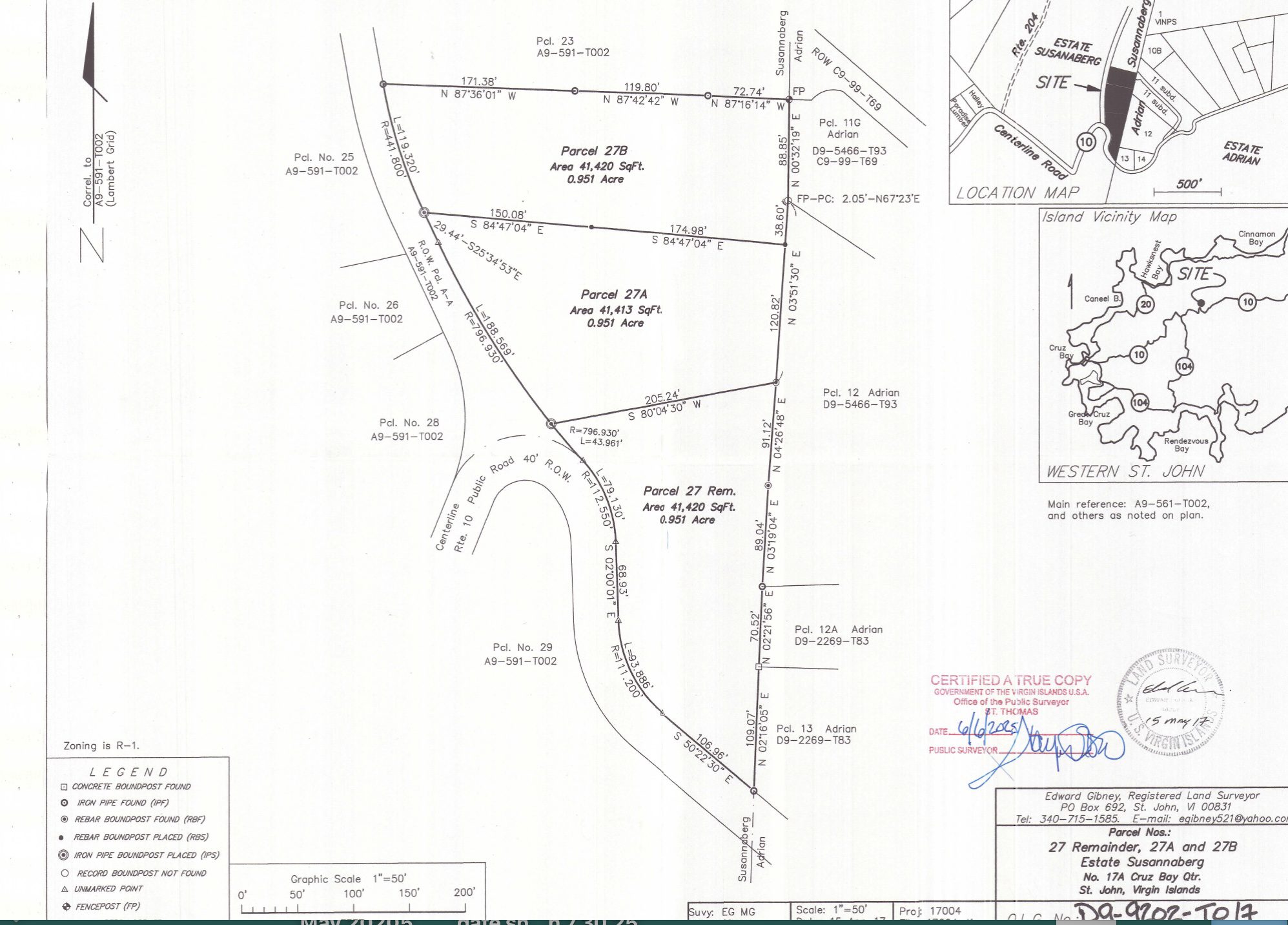
At a DPNR zoning meeting held online on Wednesday morning, consultant Brian Turnbull presented two applications concerning Parcel 27 Estate Susannaberg, which appears on the Map Geo site as one 2.9-acre residential property. Parcel 27 has been subdivided into three separate parcels, although it was not made clear in the meeting when this took place.
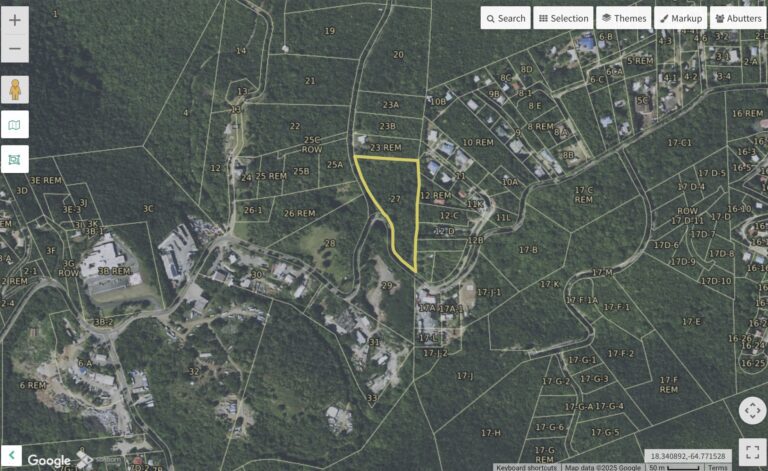
The outline on this image from Map Geo shows the boundaries of Parcel No. 27 which has been subdivided. The owners of the subdivided properties are now applying to rezone their parcels from low-density residential use to commercial use. (Image from Map Geo)
The Jesse Lee Richards Irrevocable Trust now owns one of the parcels that was subdivided. Parcel No. 27 B Estate Susannaberg (appearing on the shaded map as light pink) is a .95-acre site which is jointly owned by Richards’ three children. Under R-1 (low-density residential) zoning, the site cannot be subdivided among the three children because R-1 zoning requires a minimum of one-half acre.
Turnbull said his clients decided their best option is to use the property for nonresidential purposes. There is a shortage of land on St. John available for commercial uses, and the area is already transitioning into a semi-industrial, mixed-use neighborhood, he added.
An updated zoning map shows the subdivision of Parcel No. 27 Susannaberg. (Image from DPNR zoning meeting held Oct. 29, 2025)
If the rezoning request is approved, the owners of Parcel No. 27 B intend to build a two-story warehouselike structure where tenants could store merchandise or open small businesses.
Turnbull also presented an application on behalf of the Jacqueline L. Jacobs Living Trust to convert Parcel Nos. 27A and 27 Remainder Estate Susannaberg from R-1 to Commercial zoning. (These two parcels totaling 1.9 acres appear as dark pink on the shaded map.)
This map shows the ownership of subdivision of parcel No. 27 Estate Susannaberg. The part in dark pink is the property owned by the Jacqueline L. Jacobs Living Trust. Parcel 27 B, immediately to the north (in light pink), belongs to the Jesse Lee Richards Irrevocable Trust. (Image from DPNR zoning meeting held Oct. 29, 2025)
Earlier this year, Jacobs had agreed to a request from a nearby construction business to store two trailers on her property. She applied for an earth change permit, which she received, but she didn’t realize that “zoning laws did not allow operation of a business at that site,” Turnbull continued. He advised her last summer to “cease any work on her property,” adding she has no plans to build any structures until rezoning takes place.
Turnbull said both applicants for zoning changes would agree to extend the setbacks for development on their properties to mitigate the impact of development.
But three property owners whose sites adjoin Parcel 27 spoke against the rezoning at the meeting.
Shikima Jones-Sprauve said she didn’t want to stop property owners from developing their land, but once a property is rezoned, the intended use can change. “We’ve already seen how land that was supposed to be a pineapple patch became a bar and grill,” she said. The commercial zoning category includes many uses, she continued. “What’s to say that our peace will not be disturbed?”
Turnbull responded, “That is a legitimate concern. I have no guarantees, to be honest with you.”
Another neighbor, Nika Gumbs, said her peace was already being disturbed. “Every morning there is noise, and it’s consistent throughout the day. I don’t know what they’re doing, but this ‘cease and desist’ did not make (activity) stop. There’s something still going on.”
Gumbs said she also had concerns about the construction of a warehouse on Parcel No. 27 B because storage units require safety lights and motion detectors. “We have all kinds of animals who go through that area. Lights will be going on and off all night shining onto our property.”
Turnbull said he would consider all of the concerns and reduce the negative impact in the design process. “I see many places where residential and commercial can coexist.”
Gary Pearson, another neighbor, didn’t see it that way. “The neighborhood is residential, and I want to see it remain that way,” he said.
The application number for the Richards property is CCZPoo88-25. The application number for the Jacobs property is CCZPoo89-25. The public can send in their comments about these two applications to leia.laplace@dpnr.vi.gov. DPNR staff have 30 days from the hearing date to make their recommendation to approve, modify, or deny the applications.
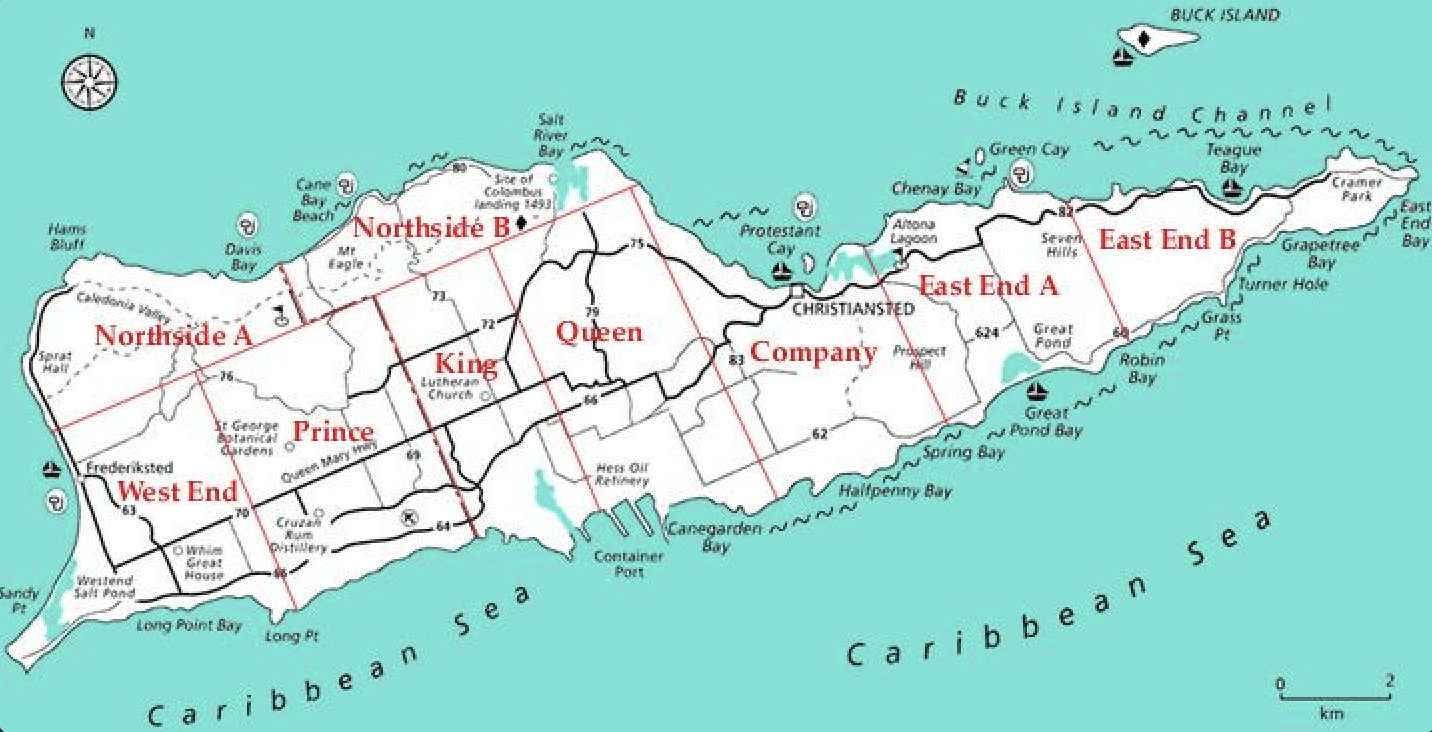
Map of St. Croix showing the island’s nine quarters, including Queen Quarter (center), where a proposed rezoning request seeks to develop affordable housing in Estate Morningstar. (Photo from www.livingonstcroix.com)
The Department of Planning and Natural Resources’ Division of Comprehensive and Coastal Zone Planning held a virtual public hearing Tuesday to consider a request to rezone property in Estate Morningstar, Queen Quarter, St. Croix, from R-1 (Residential-Low Density) to R-3 (Residential-Medium Density) to allow for the development of affordable housing units.
On behalf of the applicant, Roy Sheridan, local registered architect and planner Brian Turnbull presented the proposal. Turnbull explained that Sheridan purchased the 14.2-acre property 28 years ago and that it has remained largely unchanged since.
“Over the years, the property has remained vacant, almost in the condition he purchased it,” Turnbull said. He added that as demand for housing increases, Sheridan has been approached by community members to create affordable housing.
“The surrounding parcels, most of them, not all of them, were developed under their current R-1 classification,” Turnbull said. “For the most part, you have single or two-family dwellings on half-acre lots. But that doesn’t mean the character of the neighborhood has to stay that way for eternity.”
Turnbull argued that introducing a development with higher density would not automatically devalue surrounding properties. Instead, he said, careful planning and compliance with existing building and environmental standards would ensure that the project enhances the area.
“Bringing something new or different in this modern age of technology doesn’t have to be a negative to that character,” he said. “This sense of devaluing property, I don’t want to call it a misnomer, but perception doesn’t always match reality.”
Turnbull noted that access to the property would not interfere with existing roads or neighborhoods, as it is separated from nearby parcels by clear boundaries. “Accessing this property will not be through any existing surrounding neighborhood,” he said. “There’s a road separating us from some of the R-1 lots, and there are hard property lines with no roads running through our property.”
He also committed to transparency and compliance as the project progresses, saying he will amend the application if new information arises from the Historic Preservation Office regarding any cultural or archaeological resources on the land. “To the extent within our ability, we will do everything in our power to conform to all zoning, building, and environmental codes, regulations, and standards currently applicable,” he said.
The hearing was chaired by Planning Technician Keshoi Samuel, with Territorial Planner Leia LaPlace in attendance. Samuel reminded participants that public comments will be accepted until Nov. 7, after which the department will finalize its recommendation to the commissioner. That recommendation could include approval, modification, or denial of the rezoning request.
The National Hurricane Center is tracking Hurricane Melissa, which struck Jamaica at Category 5 strength Tuesday before making landfall in Eastern Cuba. As of Wednesday, Melissa was moving northeast, delivering dangerous winds, flooding rains, and storm surge to Cuba, Haiti, and the Bahamas as it heads toward Bermuda.
Hurricane Melissa
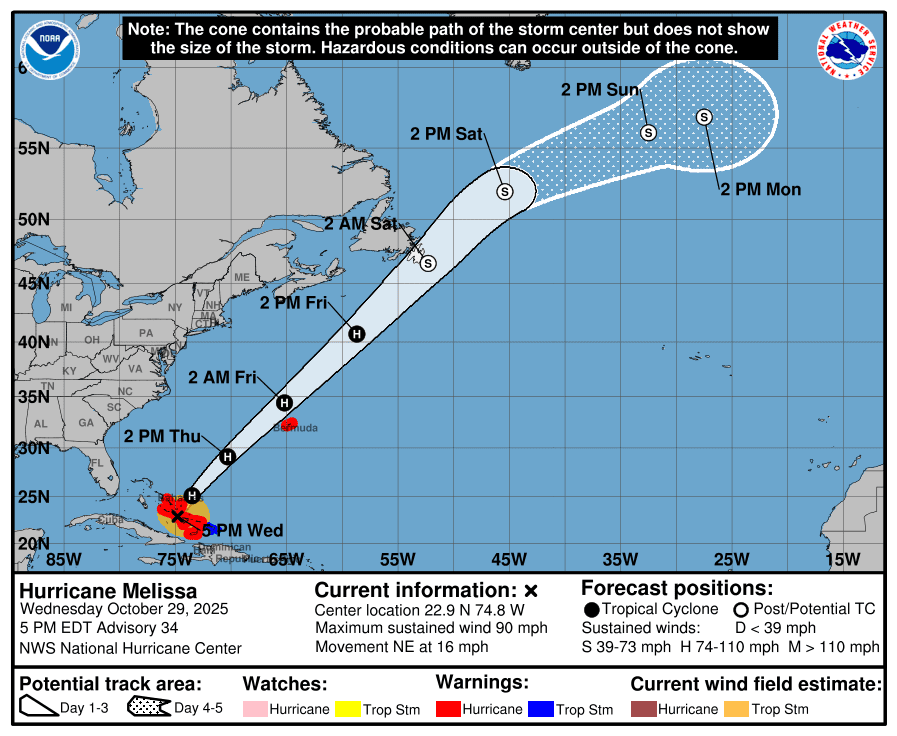
Hurricane Melissa made landfall along the southwestern coastline of Jamaica Tuesday as an extremely dangerous Category 5 storm, causing widespread impacts across the island. The hurricane then made a second landfall along Eastern Cuba early Wednesday morning at Category 3 strength. Haiti and the Dominican Republic have also experienced severe flooding and wind damage from Melissa. By Wednesday afternoon, the storm was crossing the Southeastern Bahamas as a Category 2 hurricane and tracking northeast toward Bermuda.
On Wednesday, the NHC was monitoring Hurricane Melissa as the storm moves northeast after causing major devastation across portions of the Western Caribbean. (Photo courtesy NHC)
“At 5:00 p.m. AST, the center of Hurricane Melissa was located near latitude 22.9 North, longitude 74.8 West,” according to an afternoon update from the NHC. “Melissa is moving toward the northeast near 16 mph. An accelerating northeastward motion is expected during the next few days. On the forecast track, the core of Melissa is expected to move across the southeastern or central Bahamas Wednesday evening and is forecast to pass near or to the west of Bermuda late Thursday and Thursday night. Maximum sustained winds are near 90 mph with higher gusts. Some restrengthening is possible on Wednesday into Thursday, with weakening beginning thereafter,” the NHC said.
“Hurricane-force winds extend outward up to 60 miles from the center and tropical-storm-force winds extend outward up to 185 miles. The estimated minimum central pressure is 974 millibars,” the NHC continued.
Tropical alerts are in effect for the following areas:
“A Hurricane Warning is in effect for the southeastern and central Bahamas and Bermuda. A Tropical Storm Warning is in effect for the Turks and Caicos Islands,” the NHC noted.
After passing near Bermuda, Melissa is forecast to accelerate northeastward and transition into an extratropical cyclone. Forecasters say portions of Atlantic Canada and eventually parts of Europe could feel the storm’s effects late this week into the weekend.
A Record-Breaking StormAs the Source reported on Monday, Hurricane Melissa underwent “extreme rapid intensification,” resulting in the explosive cyclone. Extreme rapid intensification occurs when a cyclone experiences “an increase in maximum sustained winds of at least 50 kt., about 58 mph, in a 24-hour period,” according to ClimateCentral.org. This is an even faster rate of strengthening than “rapid intensification,” which the NHC defines as “an increase in the maximum sustained winds of a tropical cyclone of at least 30 kt., about 34 mph, in a 24-hour period.”
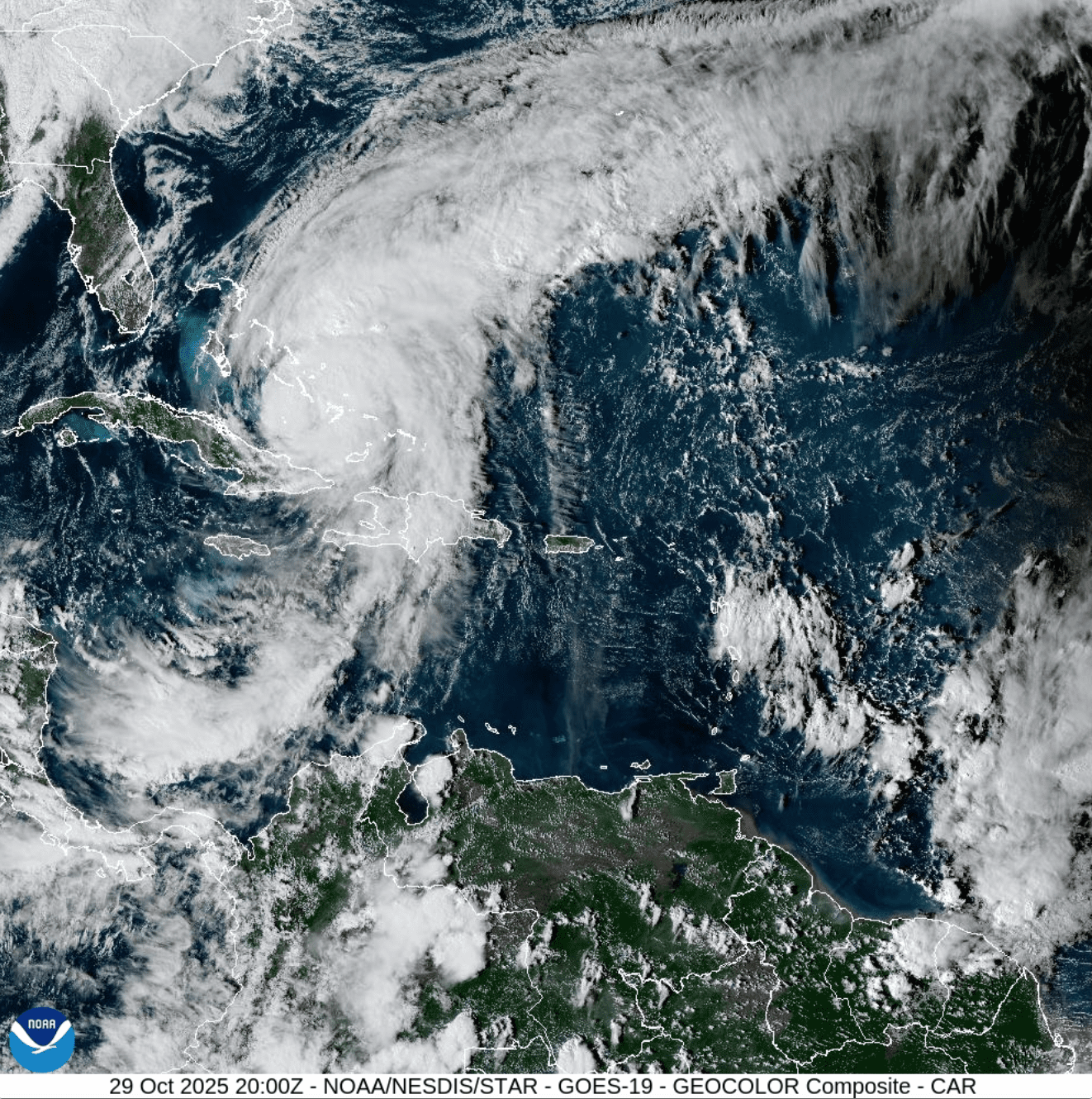
Visible satellite imagery obtained at 4:00 p.m. AST on Tuesday shows Hurricane Melissa moving across the Bahamas and in the direction of Bermuda. (Photo courtesy NOAA)Hurricane Melissa ranks among the most powerful cyclones ever recorded in the Atlantic basin and is the third storm of the 2025 season to reach Category 5 strength. Tragically, the hurricane has caused casualties across parts of the Caribbean as it unleashed devastating winds and flooding.
“Melissa intensified into a Category 5 hurricane Monday, becoming the third storm of the year to be classified at the top of the Saffir-Simpson Hurricane Wind Scale, joining Hurricanes Erin and Humberto,” according to AccuWeather. “The system then went on to become the strongest of the three with maximum sustained winds peaking at 185 mph Tuesday morning,” AccuWeather said.
“Another key measure of a hurricane’s intensity is the central pressure, or the atmospheric pressure at the core of the eye. On Tuesday morning, Melissa’s pressure dropped to 26.34 inches of mercury (892 millibars), making it the third most intense Caribbean hurricane ever observed. Melissa is also the second strongest hurricane in terms of pressure anywhere across the Atlantic during October, behind Hurricane Wilma (26.05 inches of mercury, 882 mb),” according to AccuWeather.
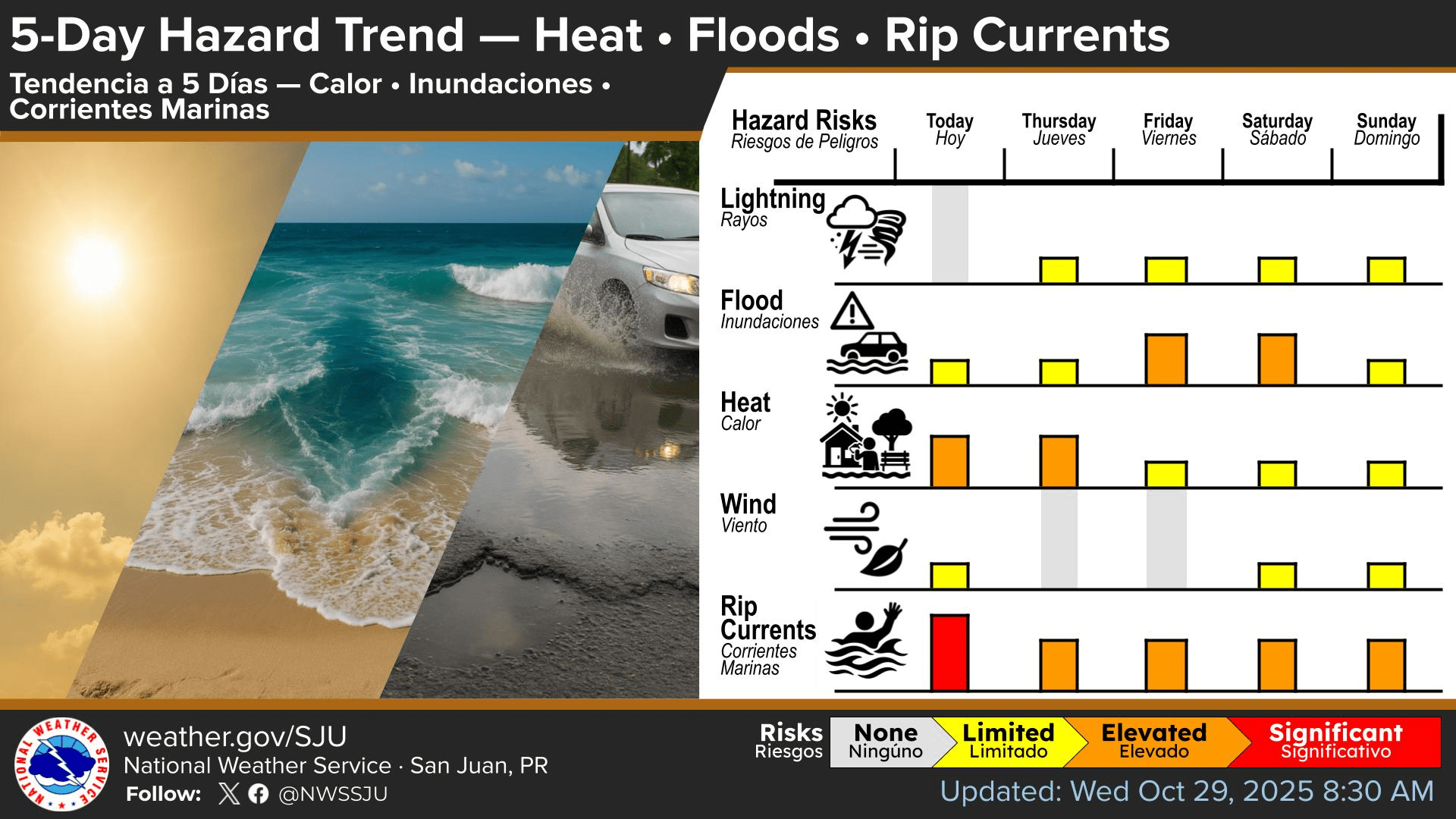
Local Weather UpdatesThe National Weather Service in San Juan, Puerto Rico, noted that weather across the U.S. Virgin Islands and Puerto Rico will continue to be indirectly influenced by distant Hurricane Melissa, but this influence will decrease as the storm moves northeast. While no direct impacts are expected, showers and isolated thunderstorms may occur from lingering tropical moisture. A nearby area of high pressure should help limit widespread precipitation through the end of the week.
A graphic from the National Weather Service in San Juan, Puerto Rico, showing weather-related threats across the local islands in the coming days. (Photo courtesy NWS)
In the coming days, a tropical wave is forecast to pass near the Virgin Islands and Puerto Rico over the weekend, bringing an increased chance of showers and thunderstorms.
“The region will continue under a southeasterly wind flow as Melissa moves from the western Caribbean into the western Atlantic through at least Thursday,” the NWS said on Wednesday. “Afterward, a frontal boundary will approach the region from the west, interacting with a surface high pressure anchored across the central Atlantic around Friday, promoting the return of a moderate to locally fresh easterly wind flow,” the NWS explained.
“The greatest chance of rainfall arrives Saturday, as a tropical wave moves through, increasing the potential of moderate to heavy showers and isolated thunderstorms for the region,” the NWS added.
Hazardous marine conditions with an elevated risk of rip currents are also expected as swells generated by Hurricane Melissa reach the local islands. Additionally, warm air temperatures will continue to affect the region, which may prompt additional heat alerts.
Looking Ahead: NOAA Global Tropics Hazards Outlook
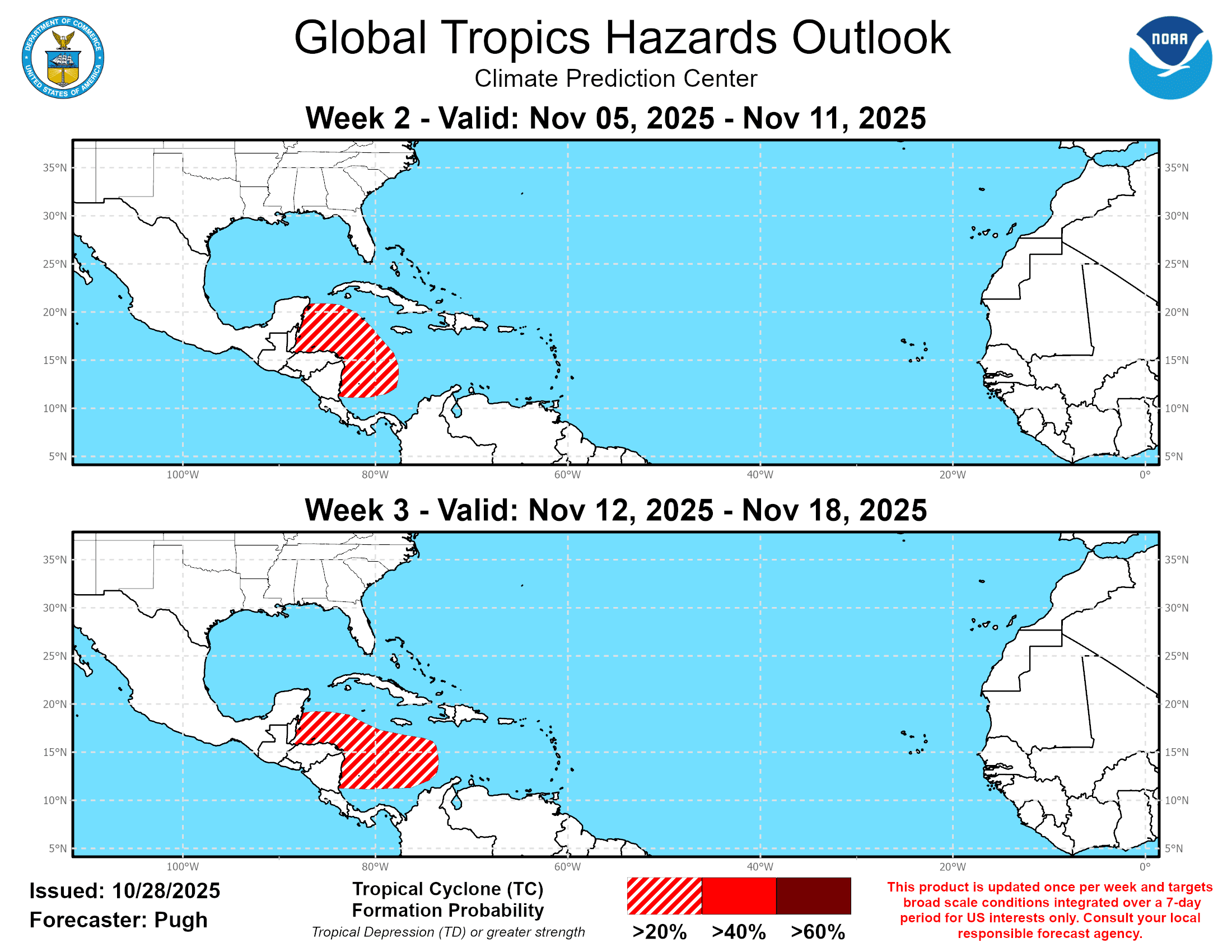
A Global Tropics Hazards Outlook was released Tuesday by NOAA’s Climate Prediction Center, and the forecast tool provides insight into potential activity across tropical basins up to three weeks in advance.
NOAA’s Climate Prediction Center released its weekly Global Tropics Hazards Outlook on Tuesday. NOAA predicts that tropical development could occur across portions of the Atlantic basin near the western Caribbean and the Gulf in the coming weeks. (Photo courtesy NOAA)
NOAA predicts that tropical development could occur across portions of the Atlantic basin near the western Caribbean and the Gulf during the “Week Two” outlook period, which runs from Nov. 5 until Nov. 11 and during the “Week Three” period, from Nov. 12 until Nov. 18.
While tropical activity is not expected to develop near the USVI in the near term, it is important to remember that this forecast is not guaranteed, and development may still happen as the forecast can change. Additionally, a recent Tropical Outlook from the Source noted that the emergence of a La Niña weather pattern could influence storm activity for the rest of the hurricane season, which ends on Nov. 30.
During a La Niña cycle, the ocean waters across the equatorial Pacific Ocean cool significantly, affecting global weather. During La Niña, wind shear— a change in wind direction and velocity with height in the atmosphere — also typically decreases in the Atlantic Ocean. A reduction in wind shear can favor cyclone development. This pattern is the opposite of El Niño, a warming of the equatorial Pacific, which usually increases wind shear in the Atlantic Ocean, helping to rip apart storms and prevent hurricane formation and intensification.
Staying Informed
USVI residents and visitors are encouraged to continue to remain prepared. Weather information is available from the NWS, the NHC, and NOAA.
The local weather forecast for the U.S. Virgin Islands is also regularly updated on the Source Weather Page and VI Source YouTube Channel. Additionally, A weekly Tropical Outlook article from the Source will be published throughout hurricane season to provide in-depth updates.
Residents and visitors can find additional weather alerts and preparedness information from the Virgin Islands Territorial Emergency Management Agency.
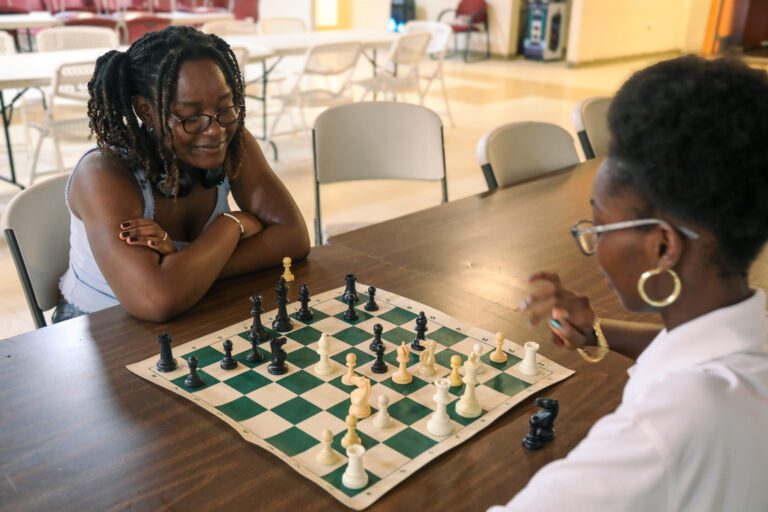
Standout players Asia Watson-Francis and Nyeema Henderson, both juniors at Charlotte Amalie High School, battle it out during a Sunday afternoon practice. (Source photo by Amara Stokes Gilbert)
Every Sunday at 3 p.m., the auditorium of Lockhart K-8 School fills with an unlikely sound: silence. Not the empty silence of an abandoned building, but the concentrated quiet of 25 to 30 young minds locked in battle, their fingers hovering over chess pieces as they calculate their next moves. For decades, volunteer coaches at the St. Thomas-St. John Youth Scholastic Chess Club, have been building critical thinkers, confident competitors, and ambassadors for the Virgin Islands.
The club’s roots run deep in the community. Coaches Brandon Rhymer and Sinclair Wilkinson have led the program for decades, creating a completely volunteer-driven youth organization. Their impact spans generations as their protégés now train current students. Wilkinson mentored Coach William van Renselaer, now an international chess master. Rhymer trained Coach Marco Emile, who has become one of the program’s most dedicated volunteers.
“Mr. Rhymer and Mr. Wilkinson do this without any payment,” Emile reflected during a Sunday afternoon practice. “I’m inspired by them. They had a great effect on me and my life, and I would like to have that effect on others. They sacrifice a lot without getting anything in return. Coaching chess is my way of giving back.”
This generational thread — students becoming coaches, giving back what was freely given to them — creates a family atmosphere that transcends the typical student-teacher dynamic. Five adults regularly volunteer their Sunday afternoons, teaching opening strategies and endgame techniques, but more importantly, teaching young people that their community believes in them enough to invest time without expectation of return.
Charlotte Amalie High School teacher Shamang Straun understands the club’s power better than most. She started as just another parent, dropping off her six-year-old son Ger’lanni for Sunday chess. A decade later, he is sixteen and still playing, and Straun is the club’s vice president and secretary.
“It keeps students out of trouble and gives them a positive outlet,” Straun explained. “As a teacher, I see the way the players grow as critical thinkers. They perform better in school when they have this to do.”
Her observation isn’t just maternal pride — it’s backed by what she sees week after week. Students like Dejw Wrensford and Leah Williams, who placed first in their divisions at the club’s most recent tournament, have doubled down on improving their focus and problem-solving skills.
At only 11 years old, Wrensford has her sights set on international competition. “My goal is to compete in the next Chess Olympiad,” she said with a smile. “So right now I’m focused on competing in as many tournaments as possible to help me reach that goal.”
Fifteen-year-old Williams, who made a strong showing in last year’s Chess Olympiad in Budapest, Hungary, added, “I just like beating people — especially boys,” with a laugh.
For parents in the Virgin Islands, the club offers something precious: a safe, constructive place for their children to spend time — free of charge. The chess club has provided consistent programming for decades, assuring families that every Sunday at 3, their children will be challenged, supported, and kept engaged in something meaningful.
This March, the club faces its biggest logistical challenge yet: sending 22 students and four coaches to Chicago for a national tournament.
The day before competition begins, students will explore Chicago’s capital landmarks to learn the history of the area and experience a major mainland city.
Ivanna Eudora Kean High School senior, Diego Emile, spent his Sunday session refining techniques for the team’s national competition in Chicago next March. (Source photo by Amara Stokes Gilbert)
The experience comes with a price tag of more than $1,000 per student for airfare, lodging, meals, and tournament fees. For families with multiple children in the program, that cost can be prohibitive. The club aims to alleviate as much financial strain as possible, tirelessly fundraising to ensure that no talented student misses the opportunity.
“We want every child who’s put in the work to have the chance to compete,” said club president Sinclair Wilkinson. When these students reach Chicago, they’re representing the Virgin Islands. They need to know their community is behind them.”
On Saturday, from 11 a.m. to 3 p.m., the club will hold a fundraising event at Tutu Park Mall. They’re not selling anything except a simple proposition: invest in these young people, and they’ll make the Virgin Islands proud.
How to Support the St. Thomas-St. John Youth Scholastic Chess Club:
Fundraiser: Saturday, Nov. 15, 11 a.m. – 3 p.m. at Tutu Park Mall
Weekly Meetings: Sundays at 3 p.m., Lockhart K-8 School
Donate via PayPal: STT STJ Youth Scholastic Chess Club
The club welcomes donations of any size to help send 22 students and four coaches to Chicago this March. Every contribution helps ensure that financial barriers don’t keep talented young players from representing the Virgin Islands on a national stage.
The Democratic Party of the Virgin Islands (DPVI) recently ratified its 2026 Primary Election and Certification Plan during the Territorial Committee’s meeting held at the Virgin Islands Port Authority Video Conference Rooms on St. Thomas and St. Croix. This landmark action establishes clear standards of fairness, transparency, integrity, and neutrality in the Party’s election process while fully implementing the Jan. 10, 2024 federal ruling by Chief Judge Robert Molloy in Republican Party of the Virgin Islands v. Election System of the Virgin Islands, which affirmed that the certification of political party candidates is an internal Party function protected by the First Amendment.
Democratic Party of the Virgin Islands
“This Plan is a declaration of the Party’s constitutional authority and our commitment to fair, transparent, and disciplined certification,” said Carol M. Burke, State Chairwoman. “It ensures that every Democrat who seeks the privilege of appearing on our ballot does so through the will of our members—under procedures that guarantee integrity, accountability, and equality of access.”
Governor Bryan Voices Support for the Plan
Governor Albert Bryan Jr., who attended the meeting and expressed his full support, commended the DPVI for taking a decisive step toward strengthening democracy in the Virgin Islands.
“This plan represents responsible governance and political maturity,” said Governor Bryan.
“By establishing transparent standards and reaffirming the Party’s constitutional authority, the Democratic Party of the Virgin Islands is ensuring that democracy here in our territory remains strong, fair, and inclusive. I applaud Chairwoman Burke and the entire Territorial Committee for leading this effort with clarity and conviction.”
Core Standards of the Election Plan
• Party Autonomy: DPVI retains full authority to determine which individuals may be certified to appear as Democratic candidates—a right protected under the First Amendment and reaffirmed by Judge Molloy’s 2024 ruling.
• Transparency: All certification procedures, forms, and candidate requirements will be publicly available to ensure accountability and trust in the process.
• Fair Access: All Democrats in good standing have equal opportunity to seek nomination under uniform rules and impartial review.
• Integrity and Neutrality: All members serving on certification, oversight, or judicial committees must remain impartial; violations of neutrality are subject to disciplinary action.
• Ethical Conduct: Candidates and Party officers must uphold civility, honesty, and respect, avoiding any misuse of Party resources or misinformation.
• Unified Messaging: Only certified Democratic candidates will represent the Party on the ballot, and the Party will present a unified message promoting fairness and democracy throughout the 2026 election cycle.
The Plan also codifies a detailed candidate eligibility and endorsement system, defines the ministerial role of the Election System of the Virgin Islands (ESVI), and establishes a dispute resolution process handled exclusively within DPVI through its Judicial Council and the Courts.
Developed collaboratively by the Election Oversight Committee, Primary Election Ad Hoc Committee, and Executive Committee, the Plan was introduced to Party leadership on Oct. 24, 2025, and unanimously ratified by the full Territorial Committee the following day.
During the meeting, reports were also presented by Dr. Kyza A. Callwood, Treasurer; Riise E. S. Richards and Dr. Gary Molloy, National Committee Members; and District (STT) Barbara A. Petersen. Territorial Committee members also heard remarks from Delegate to Congress Stacey Plaskett’s representative, Nellie Varlack, and from Senators Marvin Blyden, Angel Bolques, Carla Joseph, Ray Fonseca, Marise James, and Avery Lewis. Senate President Milton Potter was excused.
Chairwoman Burke concluded, “With the adoption of this plan, the Democratic Party of the Virgin Islands affirms its commitment to internal democracy, candidate integrity, and compliance with both territorial and federal standards. We are ready to lead by example in the 2026 election cycle and beyond.”
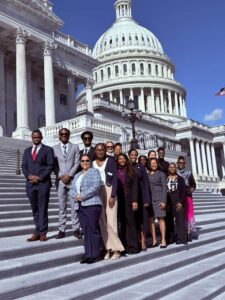
A delegation of University of the Virgin Islands students, led by President Dr. Safiya George, senior faculty and administrative leaders, traveled to Washington, D.C. last week, to participate in the inaugural UVI Day on Capitol Hill—a strategic initiative that advances one of the core goals of UVI’s GRAND Momentum Strategic Plan to create more experiential learning and leadership development opportunities for students. Designed as an immersive learning experience, the initiative offered students an unparalleled opportunity to engage directly with members of Congress and their staff, observe the federal legislative process, deepen their understanding of civic engagement and strengthen their advocacy skills for UVI on a national stage.
The UVI Delegation with Basil Ottley (Submitted photo)
As the only Historically Black College and University and land-grant institution located outside the continental United States, UVI students emphasized how the University’s distinctive geographic and cultural context broadens national dialogues on higher education, while also drawing attention to the unique challenges that accompany this position.
Students also used the opportunity to discuss how shifts in national policies are shaping their educational experiences and UVI’s broader mission. They recognized the University’s ongoing success in strengthening academic programs and expanding research capacity, while also offering thoughtful insights into the impact of reduced higher education and research funding, the challenges faced by international students from neighboring Caribbean islands, and the unique barriers confronting the territory.
Developed in partnership with Congresswoman Stacey E. Plaskett, the initiative provided students with first-hand exposure to national leadership, policymaking and career pathways in public service. “UVI Day on Capitol Hill” marks the beginning of what the University hopes will become an annual initiative to prepare the next generation of Virgin Islands leaders through immersive learning experiences in the nation’s capital. Eleven students from the College of Liberal Arts and Social Sciences participated in the trip, including undergraduate, graduate and doctoral students from both campuses and UVI Online.
“Despite the uncertainty created by the current government shutdown, it was a pleasure to welcome President Dr. Safiya George, students, and faculty from the University of the Virgin Islands to our nation’s capital, and it served as a powerful reminder of why representation matters at every level of government—especially during times like these,” said Congresswoman Stacey E. Plaskett. “These bright, engaged students deserve representation. As the future leaders of the Virgin Islands, they must see themselves in Congress and recognize their power to shape policies that impact our community. As the only HBCU and land-grant institution outside the continental United States, UVI holds a vital position in our nation’s higher education landscape. I am committed to ensuring our students have equal access to experiential learning, leadership development, and career opportunities as their mainland peers. This partnership reflects my office’s ongoing commitment to investing in our young people and ensuring the Virgin Islands has a meaningful voice at the table shaping our Territory’s future,” Plaskett continued.
“This visit represents the kind of global exposure and experiential learning that define a UVI education,” said President George. “Our students are gaining real-world understanding of how government works, how advocacy shapes policy and how their voices can make a difference on issues that matter to the Virgin Islands and beyond. We are sincerely grateful to Congresswoman Plaskett and her team for their partnership and for providing our students with such an extraordinary opportunity to engage directly with national leaders.”
During the visit, students toured the U.S. Capitol led by Congresswoman Plaskett and her staff, learning firsthand how laws are passed while seated in the Senate Chamber. They also met with U.S. Senator Reverend Raphael Warnock and attended briefings with staffers from the offices of U.S. Senator Bill Cassidy, U.S. Congressman Robert C. “Bobby” Scott, and U.S. Congresswoman Alma Adams, who support committees including the Senate Committee on Health, Education, Labor and Pensions and the House Committee on Education and the Workforce. Discussions centered on higher education funding, workforce development, career pathways, and the federal role in supporting the Virgin Islands. Amid a government shutdown, students gained a rare, real-time perspective on how federal operations are affected, deepening their understanding of the complexities and resilience of the legislative process.
Students also participated in a networking luncheon with Victor Santos of the Thurgood Marshall College Fund and members of Congresswoman Plaskett’s team, where they learned about national advocacy efforts on behalf of HBCUs, the congressional office’s work representing the U.S. Virgin Islands, stages of the legislative process, and pathways for student engagement through internships. The visit also included a meeting with Basil Ottley, Associate Director for Policy for the USVI at the U.S. Department of the Interior’s Office of Insular Affairs, for an in-depth discussion on federal-territorial relations.
The itinerary included visits to The Washington Center, a UVI partner institution that offers internships and leadership development programs in D.C., and the McCain Institute for International Leadership with Arizona State University, where students discussed ethics, democracy and global leadership. Another trip highlight was a visit to Amazon Web Services Skills Center in Arlington, Virginia, where students explored AI and machine learning technology and learned about careers in the field.
Students described the trip as inspirational. Jason Haynes, a student in the PhD program, said, “Our visit to D.C. was more than a trip. It was a transformative experience that ignited a sense of unity and purpose among us as emerging leaders of the Virgin Islands.”
UVI senior and Criminal Justice major, Samber Challenger added, “This has been a trip full of learning opportunities and exciting moments. Sitting on the House Floor and learning the intimate details of how the process works was a once in a lifetime opportunity. I am truly amazed, edified, and grateful!”
The UVI Delegation on Capitol Hill (Submitted photo)
Darin Connor, a Psychology and Political Science major, reflected, “It was absolutely breathtaking to be able to sit and speak with political giants who are the movers and shakers of the world we wish to see.”
Supporting the delegation’s success was Dr. Una Dyer, vice president for Strategic Affairs, who led coordination with Congressional leaders and partner organizations to design the visit’s impactful agenda, Ms. Jessica LaPlace, who directed on-site logistics and support, and two faculty members, Dr. Kula Francis, associate professor of Political Science and Dr. Molly Perry, associate professor of History and Geography, who ensured that students benefited from expert guidance that connected classroom learning to real-world policy discussions.
“Our students represented the very best of our mission at UVI ‘to educate and empower the US Virgin Islands, the Caribbean and the world through an environment that promotes creativity, innovation and excellence,’” said Perry. “These students represent an emerging generation of leadership who will continue this important advocacy as they launch their careers.”
While in D.C., students engaged with Adrianne Todman, former Deputy Secretary of Housing and Urban Development, on leadership and public service, and participated in cultural excursions to the city’s national monuments and museums that reinforced lessons on democracy and civic identity.
For more information about UVI’s academic programs and experiential learning opportunities, visit www.uvi.edu.
Too often, conversations about youth violence focus on punishment. We ask, What did they do? instead of What happened to them—and what can we do to stop it from happening again? But youth violence doesn’t just “happen.” It follows patterns. It reflects underlying emotional distress and unmet needs. And it’s deeply influenced by poverty, family instability, under-resourced schools, community disinvestment, and a lack of accessible mental health care.
In the U.S. Virgin Islands, where the effects of colonialism, natural disasters, and economic hardship intersect, the urgency of addressing youth violence cannot be overstated. Our young people are not disposable. They are navigating environments shaped by trauma and inequity—and too often, they’re doing it without the supports they need.
In response, a public health framework offers a more effective way forward. It helps us move from reaction to prevention. It recognizes that safety isn’t just the absence of violence—it’s the presence of connection, stability, and opportunity. And it calls for coordinated action at three levels: primary, secondary, and tertiary prevention.
Primary Prevention: Building Strong Foundations
Primary prevention is about stopping violence before it starts. In the Virgin Islands, that means investing in the early building blocks of well-being. We need to expand access to high-quality early childhood education across all islands, with trauma-informed support built in from the start. We need to strengthen parenting programs that support caregivers with resources, coaching, and connection—not judgment.
Safe community spaces also matter. Whether it’s after-school programs, sports leagues, arts initiatives, or well-lit parks with trusted adults nearby, young people need places to belong. The more access they have to positive outlets and mentorship, the less likely they are to turn to violence. We also need to address structural poverty—because no amount of positive messaging can undo the stress of an empty fridge or an overcrowded, unstable home. As reported in the 2023 KIDS COUNT USVI Data Book (https://stxfoundation.info/2023KIDSCOUNTUSVIDataBook), 40% of non-incarcerated youth who committed a juvenile offense were residents of public housing.
Secondary Prevention: Reaching Youth at the Crossroads
Some youth are already at risk—struggling in school, exposed to violence, or disconnected from caring adults. For them, secondary prevention means creating off-ramps before harm occurs. These off-ramps have to exist in every space young people move through—classrooms, after-school programs, and community centers—so that support is accessible wherever risk shows up.
In schools, that means behavioral health services that prioritize understanding and early intervention over punishment, with more trained specialists in St. Croix, St. Thomas, and St. John who can recognize trauma and help students regulate before crises escalate. In the community, it means mentorship programs, job training, and conflict resolution workshops that give teenagers the tools to manage anger, navigate relationships, and imagine a future beyond violence. The free, online KIDS COUNT USVI Data Dashboard (https://www.stxfoundation.org/kids-count-dashboard/) tracks enrollment programs from the VI Department of Labor, as well as enrollment for mentorship programs via My Brother’s Workshop.
A young person who has these opportunities is less likely to pick up a weapon—and more likely to pick up a paycheck or a college application. But to make this real, we must fund such programs sustainably, not as short-term grants or pilot projects.
Tertiary Prevention: Healing and Rebuilding
For youth who have already been involved in violence—whether as victims, perpetrators, or both—we need to respond with healing, not just punishment.
Restorative justice programs, both in schools and in the community, can offer a way to repair harm and rebuild trust. Trauma-informed therapy must be available without long waitlists or stigma. And for those exiting juvenile detention or prison, reentry support should include education, employment, housing, and mental health services.
Too often, we expect young people to “do better” without giving them the tools to actually change. But the truth is, when we provide consistent support and second chances, transformation is possible.
The Path Forward
Addressing youth violence in the Virgin Islands isn’t just a matter of criminal justice—it’s a matter of community health. If we want long-term safety, we must be willing to invest in long-term healing. That means shifting our mindset from blame to belonging, from punishment to prevention.
To strengthen prevention at every level, we need tools that help us understand the root causes of youth vulnerability and measure where supports are most urgently needed. The St. Croix Foundation’s KIDS COUNT USVI Data Dashboard is one such tool. Designed with accessibility and equity in mind, the dashboard brings together territory-wide and island-specific indicators related to juvenile justice involvement, foster care rates, youth disconnection, educational outcomes, and causes of death among young people aged 16 to 24. By disaggregating data by age, district, and risk status—including Persons In Need of Supervision (PINS)—the dashboard allows policymakers, nonprofit leaders, educators, and funders to target their interventions more strategically, identify geographic or demographic disparities, and evaluate trends over time. Within a public health framework, this data is invaluable: it enables primary prevention by showing where early childhood and family supports are lacking; supports secondary prevention by identifying risk factors like school disengagement or behavioral health crises; and informs tertiary prevention by highlighting systemic gaps in reentry or rehabilitation services. In short, the dashboard helps us move beyond anecdotes and assumptions, grounding our response to youth violence in real-time, actionable information.
Tools such as these can open the door to new opportunities. For example, the KIDS COUNT USVI Data Dashboard Community Bright Spots section tracks four years of enrollment data across a range of organizations. By reviewing these figures, community stakeholders can identify service gaps and co-design programming or even new organizations to meet needs —such as transportation, supplemental meals, and snacks—while also leveraging the charts and graphs to strengthen grant proposals. The dashboard will also be useful for monitoring enrollment trends moving forward, helping organizations to coordinate logistics across the public and nonprofit sectors more effectively.
It’s not too late to build a future where every young person on our islands feels safe, seen, and supported. But we have to act—together, strategically, and with the urgency this crisis demands. We invite our community to join us at the launch of the 2025 KIDS COUNT USVI Data Book in November, where the numbers will inspire us to take informed, compassionate action—because understanding the root causes of youth violence is the first step toward building a safer, more supportive future for all our children.
Editor’s Note: Opinion articles do not represent the views of the Virgin Islands Source newsroom and are the sole expressed opinion of the writer. Submissions can be made to visource@gmail.com.
Senator Kurt A. Vialet is urging local grocers, distributors, and wholesalers to keep food prices steady as the territory faces the combined impact of the ongoing federal government shutdown and the reduction in Supplemental Nutrition Assistance Program benefits.
Sen.Kurt Vialet. (File photo)
“With so many Virgin Islanders already struggling to stretch every dollar, now is not the time for unnecessary markups or price increases,” said Senator Vialet. “We must work together to ensure that our most vulnerableresidents, especially seniors, families, and children, can continue to access affordable, nutritious food.”
According to the Virgin Islands Department of Human Services, November SNAP benefits in the U.S. Virgin Islands have been paused due to the federal funding lapse. Approximately 24,000 households in the Territory currently rely on SNAP benefits to purchase groceries and maintain food security. Furthermore, the Food Research & Action Center warns that a prolonged shutdown could lead to delayed or interrupted benefits across states and territories. While the Government of the Virgin Islands has indicated that local reserves can sustain SNAP benefits into early 2026, if necessary, this measure is only temporary and highlights the seriousness ofthe current situation.
Senator Vialet emphasized that the current situation could significantly strain household budgets and increase food insecurity across the islands. He is calling on the Department of Licensing and Consumer Affairs to closelymonitor food prices and take swift action against any price gouging or exploitative practices.
Senator Vialet is urging the community to come together.
“If there are any supermarkets, stores, restaurants, churches, organizations with food pantries, or individuals willing to support food drives, now is the time to step forward,” Vialet stated.
He added that his office is ready to help connect resources where needed and encourage residents to share information about available food banks, distribution events, or community programs that can assist families during this difficult period.
“I understand the pressures businesses face, from shipping costs to supply chain issues, but compassion must come before profit,” Vialet said. “This is not just about economics; it’s about humanity. Let’s come together as one Virgin Islands family and make sure every person has a meal on their table.”