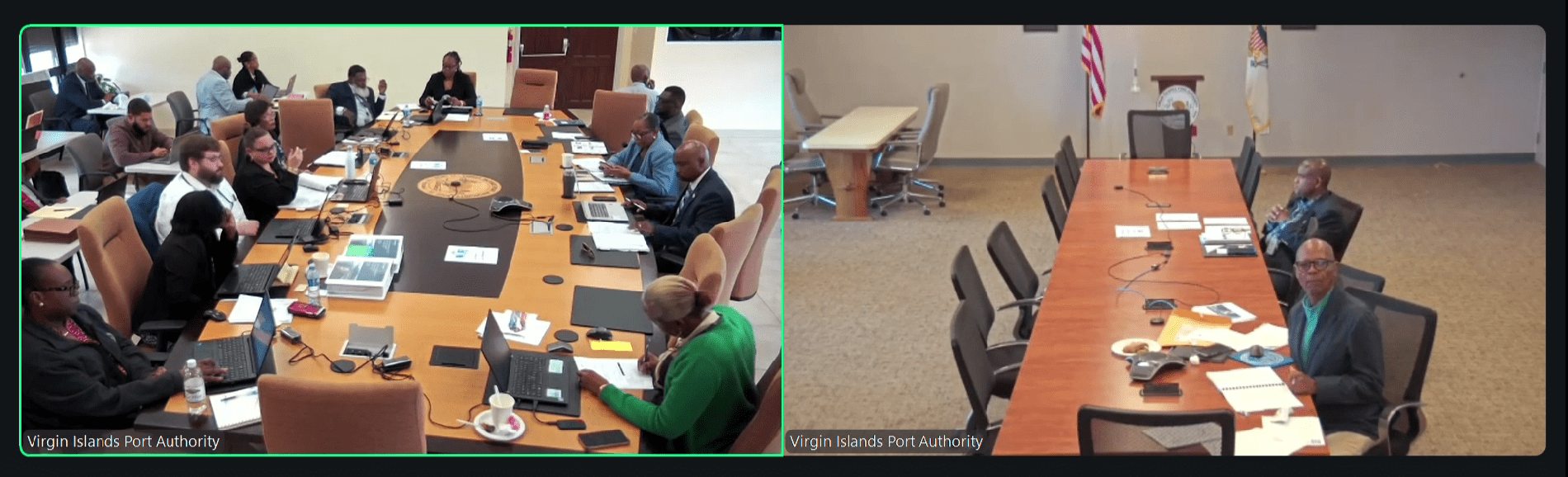
The Virgin Islands Port Authority Board during its monthly board meeting. (Zoom meeting screenshot)
The Virgin Islands Port Authority Board met on Wednesday and ratified agreements related to the Randall “Doc” James Racetrack, extended the P3 Initiative Transition Agreement with Sky City VI, Inc., authorized a new diesel fuel supply contract for the St. Thomas-St. John district, approved a $44,000 change order for emergency operations and approved multiple property leases in the district.
The board ratified two previous poll votes. The first approved an agreement allowing the government of the Virgin Islands to use the Randall “Doc” James Racetrack property near the Henry E. Rohlsen Airport, and the second extended the P3 Initiative Transition Agreement with Sky City VI, Inc. through Dec. 31. Board member Celestino White Sr. questioned the nature of the ratification voting process, and said that members should not be tied into the finality of a poll vote occurring prior to a board meeting when limited information surrounding the matter is available.
“Poll vote, once taken, cannot be changed at [a] subsequent hearing. I say that to say that in reviewing the information from legal counsel,” said White. “Poll vote I thought was a preliminary thing, and more information is submitted, and you make a final decision. But it seems like you locked in it [a poll vote] with whatever little information you may have at the time, or how much information you have,” White said.
“In regards to the ratification process, once the deadline for the matter that has gone to poll, let’s say for reconsideration has passed, that being said, the ratification process happens at the next board meeting. So that’s what it means that members cannot change their votes during the ratification process,” responded general counsel Catherine Hendry, referencing Robert’s Rules of Order. “You would keep that same vote if the deadline has not passed,” she added, and said that “When it comes to this matter and the processes, once the motion for ratification has happened, they can look at other motions.”
Board members Willard John, Derek Gabriel, and Kevin Rodriguez approved the matter, while Jennifer Matarangas-King and White abstained.
Under the Property Committee, the board unanimously approved a new lease agreement with J. Benton Construction, LLC for warehouse space at the Gordon A. Finch Molasses Pier terminal in St. Croix. The two-year lease, with renewal options, will be used for storage of construction materials and operational equipment. The agreement includes annual rent and maintenance fees totaling $39,780, with 5% increases during renewal periods.
The board also unanimously approved an expanded lease with A&R Warehouse & Storage, LLC for an additional 17,000 square feet at Lindbergh Bay (Bourne Field) on St. Thomas. The space will be used for storage of goods, building materials, heavy equipment, and office operations under a lease running through 2032, with periodic rent increases.
Under the Projects and Operations Committee, the board authorized a contract with Right on Time Trucking to supply and deliver diesel fuel to VIPA facilities in the St. Thomas-St. John district through September 2028, with renewal options based on performance.
Additionally, the board unanimously approved Change Order No. 2 for the CEKA Air Alliance Interior Build-out project, authorizing up to $44,000 for Energy Efficient Builders, LLC to install and commission a trailer-mounted generator supporting VIPA’s temporary Aircraft Rescue and Fire Fighting station at the Cyril E. King Airport’s Air Alliance Building.
Relating to projects, after the executive director’s report, Gabriel asked, “Is the resurfacing project still expected to be completed by the end of the year,” regarding the King airport.
Preston Beyer, engineering director, responded that the “contractual period runs until February of 2027.” He added, “But the intent is that it will still be completed within the period of performance.”
The board also accepted the minutes from its March 18 meeting and approved reordering future agendas so action items are addressed before reports.
Board members Gordon Rhea and Leona Smith were absent. No further reports were given or an executive session held.
A St. Thomas man was arrested Wednesday in connection with the recovery of a stolen vehicle that had been tracked through a GPS system, the V.I. Police Department reported.
VIPD said utility company personnel reported on April 30 that one of their vehicles had been moved from where it had been parked. Authorities said the company was alerted through the vehicle’s GPS system.
Police said the GPS later showed the vehicle stationary in the Nadir Hill area around 12:30 a.m. April 30, where it was recovered.
According to the police report, investigators identified Burton Fahie as the suspect during the investigation. Police said Fahie was apprehended Wednesday in the area of First Bank on Veterans Drive and transported to the Criminal Investigation Bureau.
Fahie was charged with unauthorized use of a vehicle, possession of stolen property and damage to vehicle. Bail was set at $27,500. Unable to post bail, Fahie was turned over to the Bureau of Corrections pending an advice of rights hearing, police said.
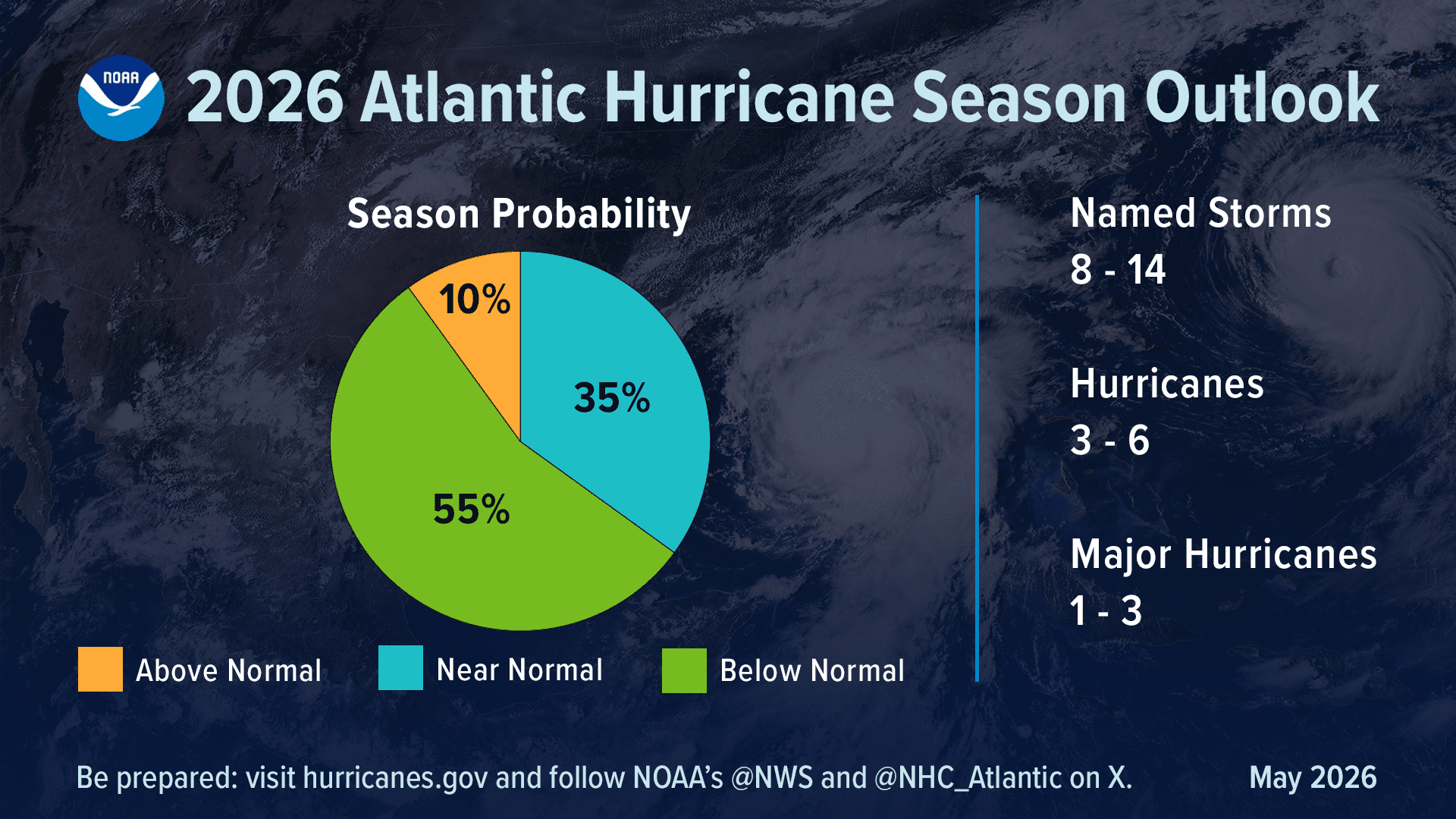
NOAA is forecasting a below-normal 2026 Atlantic Hurricane Season. (Photo courtesy NOAA)
The National Oceanic and Atmospheric Administration is forecasting a below-normal 2026 Atlantic hurricane season, citing the likely development of El Niño, which can help to suppress tropical activity across the Atlantic basin. Still, officials warned that residents should not let a potentially quieter seasonal outlook change how they prepare.
NOAA Releases 2026 OutlookNOAA announced its 2026 Atlantic hurricane season outlook Thursday morning during a news conference held at NOAA’s Aircraft Operations Center in Lakeland, Florida, home to the agency’s Hurricane Hunter aircraft. The Source attended the briefing virtually, which included officials from agencies such as NOAA, the National Weather Service and the Federal Emergency Management Agency.
“NOAA’s outlook for the 2026 Atlantic hurricane season, which runs June 1 to Nov. 30, predicts a 35% chance of a near-normal season, a 10% chance of an above-normal season, and a 55% chance of a below-normal season,” according to a press release from NOAA on Thursday.
“The agency is forecasting a total of 8-14 named storms, with winds of 39 mph or higher,” the press release said. “Of those, 3-6 are forecast to become hurricanes with winds of 74 mph or higher, including 1-3 major hurricanes category 3, 4 or 5 with winds of 111 mph or higher. NOAA has a 70% confidence in these ranges,” NOAA reported.
“An average season has 14 named storms with seven hurricanes, including three major hurricanes,” the release added.
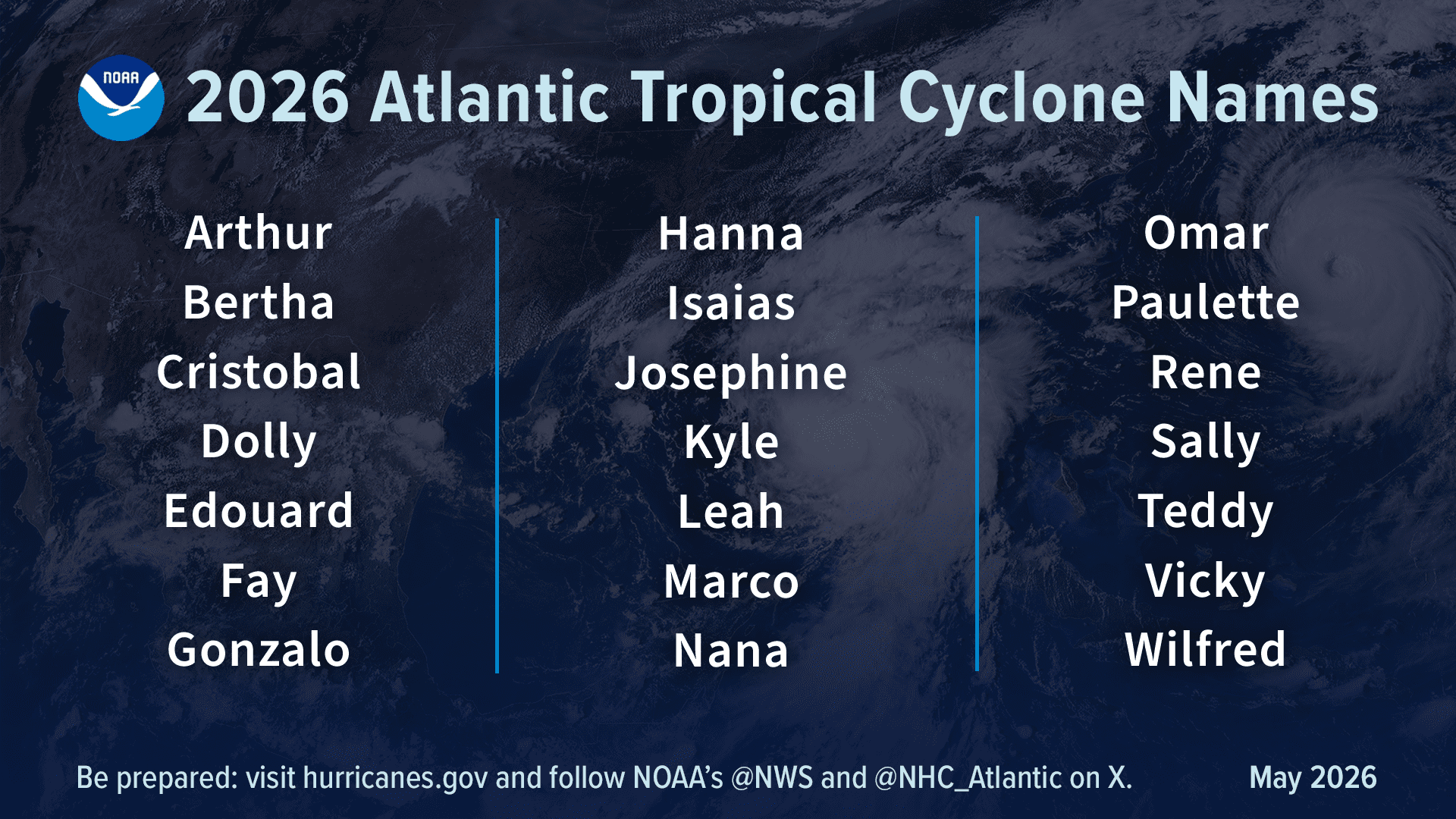
NOAA released the list of names for the 2026 Atlantic tropical cyclone season, which begins June 1 and continues through Nov. 30. (Photo courtesy NOAA)
Under Secretary of Commerce for Oceans and Atmosphere and NOAA Administrator Neil Jacobs, Ph.D., spoke at the event and noted the importance of hurricane season preparation, even during a potentially less-active year.
“Even though we’re expecting a below-average season in the Atlantic, it’s very important to understand that it only takes one storm,” said Jacobs. “We have had Category 5 hurricanes make landfall in the past during below-average seasons,” he warned.
Notably, Jacobs added that the eastern and central Pacific hurricane seasons are anticipated to be above normal in terms of tropical activity.
El Niño Expected to Limit Atlantic Cyclones
NOAA officials said a developing El Niño pattern is one of the primary factors behind the below-normal Atlantic forecast. During the briefing, Jacobs said there is a 98% chance of El Niño conditions occurring later this season and an 80% chance that the El Niño will become moderate to strong.
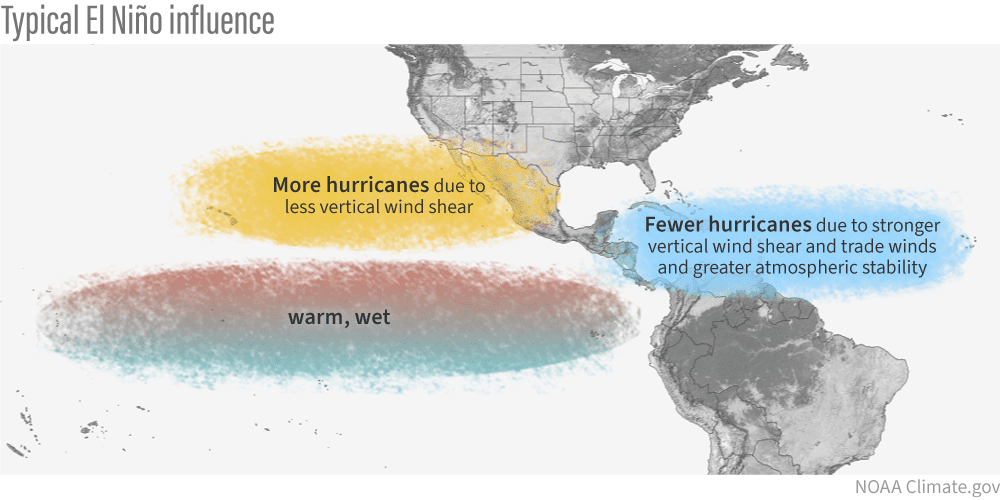
A NOAA Climate.gov graphic explains the typical influence of El Niño, which can increase wind shear across the Atlantic and limit hurricane development while favoring more tropical activity in the Pacific. (Photo courtesy NOAA)According to the National Oceanic and Atmospheric Administration, “Scientists call the two opposing climate patterns of El Niño and La Niña the ‛El Niño-Southern Oscillation’ (ENSO) cycle. El Niño and La Niña can both have global impacts on weather, wildfires, ecosystems, and economies.” An ENSO-neutral phase typically occurs between phases of a La Niña or an El Niño event.
El Niño, which involves a warming of the equatorial Pacific Ocean, usually helps to increase wind shear — a change in wind direction and velocity with height in the atmosphere. In the Atlantic Ocean, the increase in wind shear from El Niño helps to rip apart storms and prevent hurricane formation and intensification. This is the opposite of a La Niña cycle, when the ocean waters across the equatorial Pacific cool significantly. During La Niña, wind shear typically decreases in the Atlantic, and a reduction in wind shear can favor cyclone development.
Officials Urge Early Preparation
Despite the below-normal Atlantic outlook, nothing with the weather is guaranteed. Ken Graham, director of the NWS, repeatedly stressed that seasonal predictions should not be treated as a reason to delay preparations.
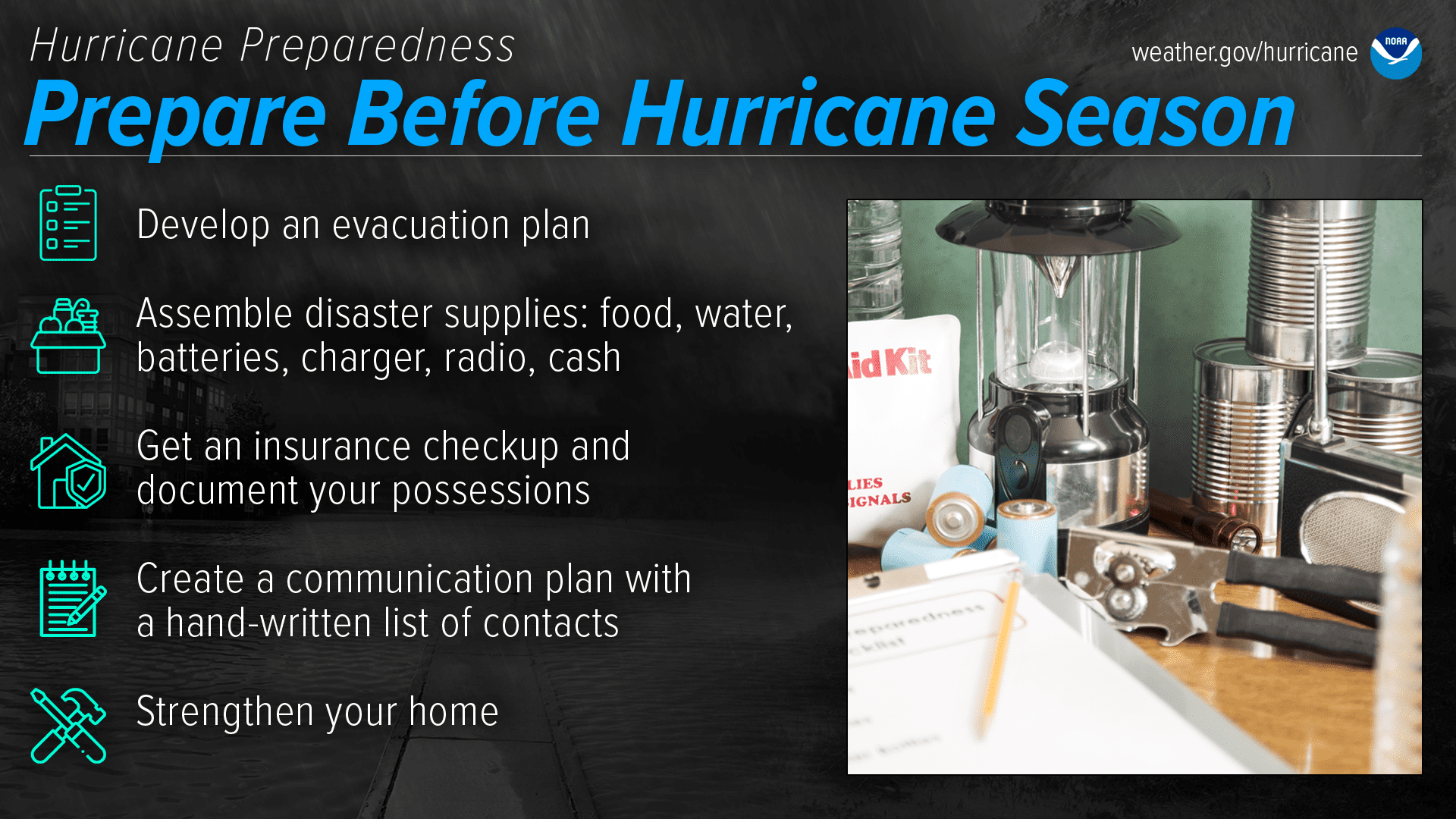
NOAA encourages residents to prepare before hurricane season by developing an evacuation plan, assembling disaster supplies, reviewing insurance coverage, creating a communication plan, and strengthening homes. (Photo courtesy NOAA)
“Don’t let words like ‘below-average’ change the way you’re prepared,” Graham said. “The actions that you take today get you ready for the hurricane season.”
Graham also warned that rapidly intensifying storms can leave residents with far less time than they might expect. He noted that some of the strongest landfalling U.S. hurricanes were tropical storms only days before impact, underscoring the importance of preparing before a storm is approaching.
“There’s no such thing as ‘just’ a Tropical Storm, ‘just’ a Category 1, or ‘just’ a Cat 2,” Graham said, noting that residents should focus on a storm’s impacts, including flooding, storm surge, tornadoes, damaging winds, high surf and rip currents, rather than only its category.
He encouraged the public to stock up before a storm threatens, noting that now is the time to purchase nonperishable food, water, medicine, batteries and other supplies.
Graham also emphasized that access to medication, dialysis and other medical needs may be disrupted for a week or longer after a storm. He urged residents to prepare for extended power outages, include pets in emergency plans, and check on family members and neighbors who may need assistance.
New Forecasting Tools and Hurricane Technology
The briefing also highlighted technology NOAA uses to forecast tropical systems, including Hurricane Hunter aircraft, satellites, new forecasting products and tools, including artificial intelligence-based forecast models, and unmanned drones and ocean gliders.
Additionally, as the Source previously reported, the NHC is updating its forecast cone graphics this year.
“In 2026, the forecast cone will now include tropical storm and hurricane watches and warnings for inland areas. The additional information follows a successful experimental phase last year, which demonstrated that the improved forecast cone enabled inland communities to better understand and prepare for the danger posed by tropical cyclone winds,” according to NOAA.
NOAA explained that the new operational cone will now include all land-based tropical storm and hurricane watches and warnings in effect for the continental United States, Hawaii, Puerto Rico, and the U.S. Virgin Islands. The updated graphic will also use one shade for the full five-day cone and include a legend symbol for places where a hurricane watch and tropical storm warning are both in effect.
Dangers Continue After a Storm
FEMA officials also stressed that residents should listen to local authorities before, during, and after a storm. Disaster response begins locally, officials said, and residents should heed guidance from emergency managers in their own communities, including the Virgin Islands Territorial Emergency Management Agency.
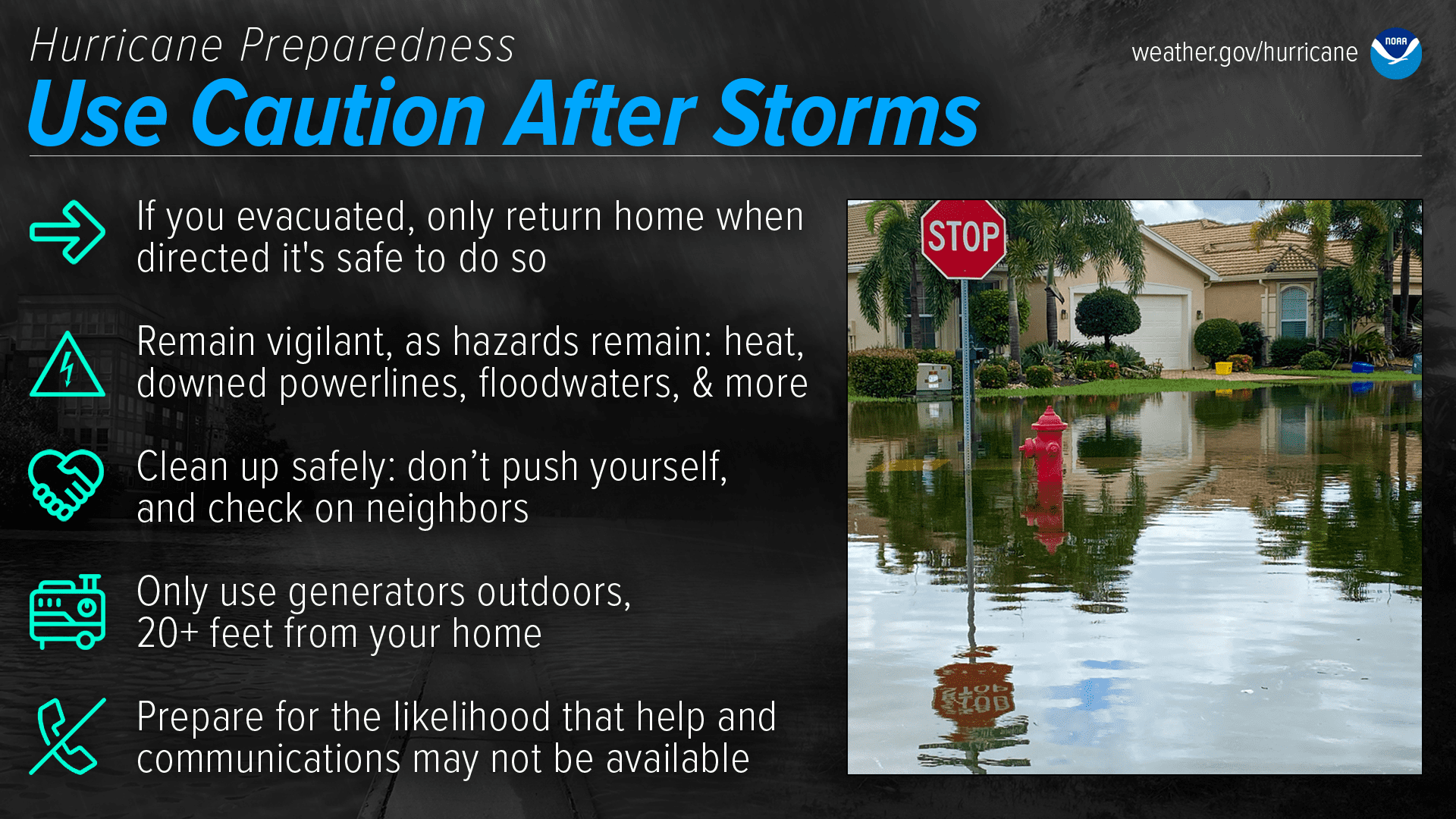
NOAA urges residents to use caution after storms, when hazards can include flooding, downed power lines, heat, communication outages, and unsafe generator use. (Photo courtesy NOAA)
Officials cautioned that the danger does not end once a storm passes. Downed power lines, contaminated water, gas leaks, displaced wildlife, unsafe roads, chain saw injuries, and improper generator use can all create serious risks after a tropical system.
Graham specifically warned about generator safety, urging residents to operate generators outdoors and away from windows to prevent carbon monoxide poisoning.
FEMA officials also encouraged residents to think beyond their own households by checking on elderly relatives, neighbors and others in the community who may need assistance.
Tropical Weather Updates
Although the Atlantic remains quiet for now, there are some subtle hints of possible early-season tropical activity to monitor near the southeastern U.S. coast. A FOX Weather article reported that meteorologists are watching for possible tropical activity during the first two weeks of June, though forecasters stressed that it remains uncertain whether anything will form. If development does occur, “heavy rain will be the largest threat,” according to the article.
Additionally, the Climate Prediction Center’s Global Tropics Hazards Outlook has highlighted an area in the Pacific for possible cyclonic development during the first week of June.
However, no tropical cyclones are expected in the Atlantic basin in the next seven days as of Thursday afternoon, according to the NHC.
For local residents across the U.S. Virgin Islands, the message from NOAA, the NWS, and FEMA was clear: a below-normal forecast does not mean there is no risk. It only takes one storm to make a season dangerous, and individuals across the islands are encouraged to begin preparing now.
Information regarding the weather across the USVI, including marine forecasts, is available from the NWS and NOAA.
The local forecast is regularly updated on the Source Weather Page, and a weekly video forecast is available. Additionally, residents and visitors can view weather alerts and disaster preparedness information from VITEMA.
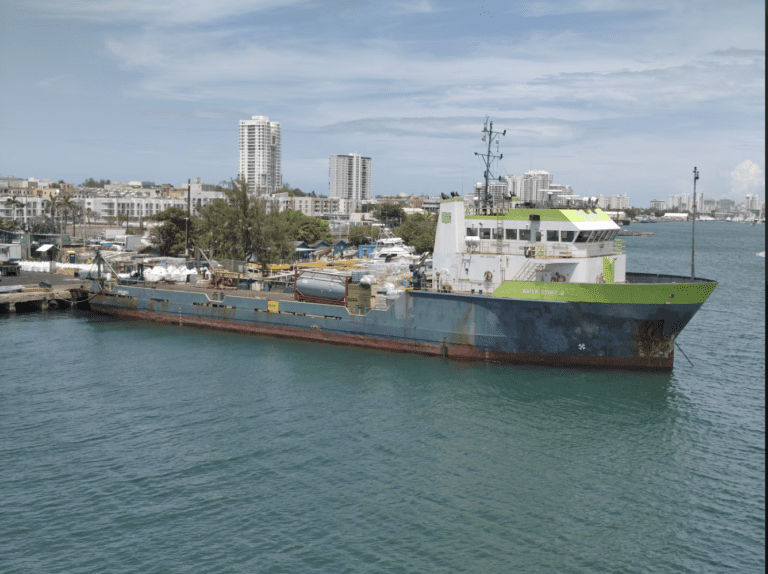
Photos released by the Coast Guard show the Water Spirit 2 stern-first against a wharf with two chains from its bow extending into the channel. (Photo courtesy U.S. Coast Guard)
The U.S. Coast Guard in Puerto Rico will allow the return of two cargo ships barred from San Juan for allegedly blocking a vital shipping lane if they come up with a better mooring plan, Gov. Albert Bryan Jr. said Thursday.
The 210-foot-long, 46-foot-wide Water Spirit 2, and the 205-foot-long, 46-foot-wide Admiral Pride were both warned and then fined by the Coast Guard after they partially obstructed the narrow San Antonio Channel within the San Juan Harbor on May 1, officials said last week.
The ships started using a different wharf after their regular docking area was moved, Bryan said.
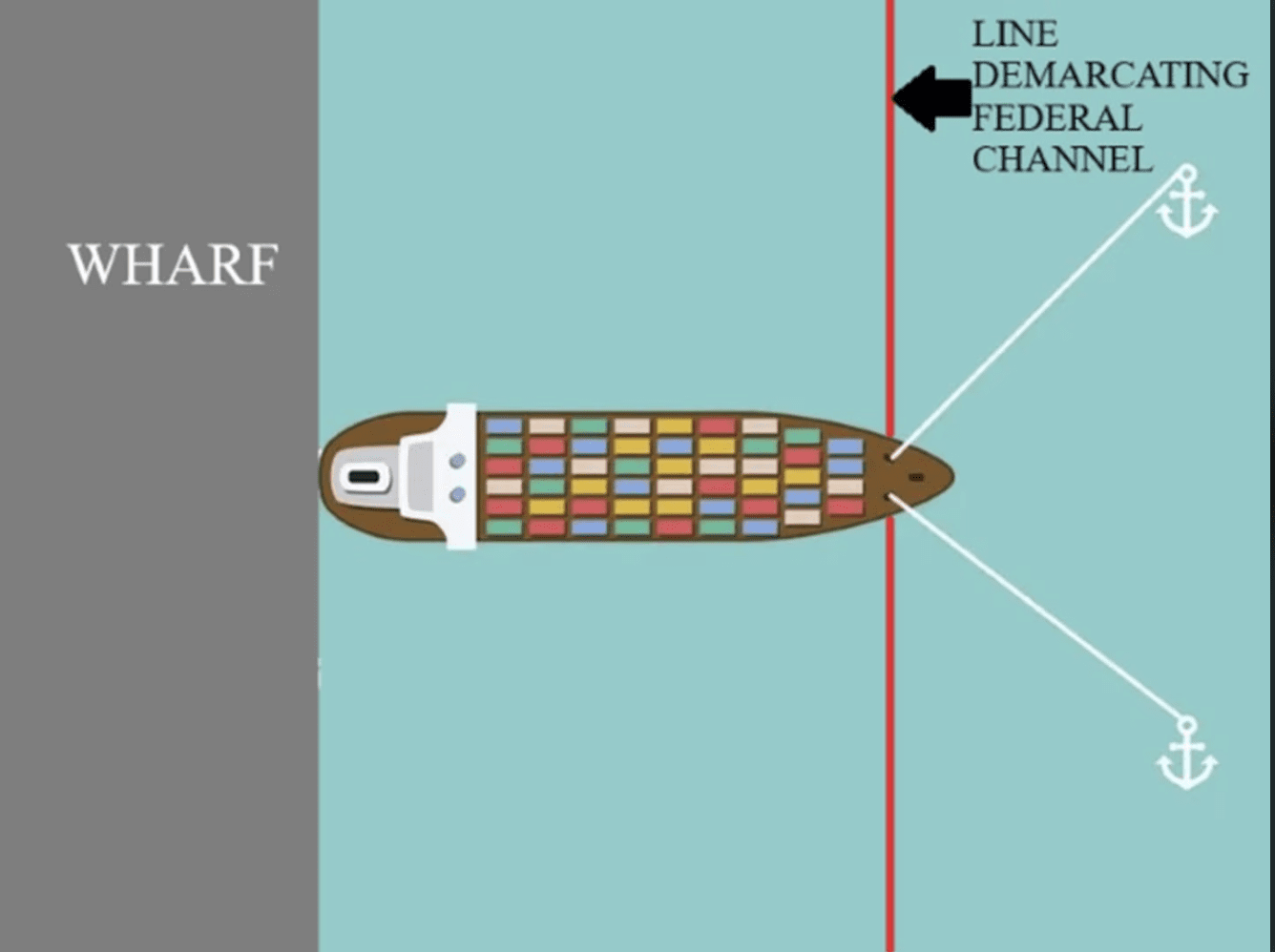
Photos released by the Coast Guard appear to show the Water Spirit 2 stern-first against a wharf with two chains from its bow extending into the channel.
“The issue at hand is strictly related to the location being used for loading and off-loading operations following changes at the marina facility,” Bryan said in a written statement.
The two vessels serviced the U.S. and British Virgin Islands regularly, hauling everything from cars to frozen food between St. Croix, St. Thomas, St. John, Tortola, and San Juan.
A diagram released by the Coast Guard shows the Water Spirit 2 stern-first against a wharf with two chains from its bow extending into the channel. (Photo courtesy U.S. Coast Guard)
Both shipping companies were in the process of retaining a marine surveyor to conduct necessary assessments and provide the documentation required by the Coast Guard, Bryan said.
“Once the survey is completed and accepted by the Coast Guard, the vessels should be able to resume shipments and regular service to Puerto Rico,” he said. “There are a number of possible options available, and we remain committed to working with all parties involved to ensure continued marine transportation and commerce between the Virgin Islands and Puerto Rico.”
Government House announced the Coast Guard meeting Monday, saying Bryan had hoped to secure an arrangement where the ships could continue to dock in San Juan while a permanent solution was found. Such a variance agreement did not appear to have been reached, according to Government House, but Bryan said if an agreement isn’t reached soon, the Virgin Islands government would step in to help.
“ … the Government of the Virgin Islands will work collaboratively with the vessel operators, the Puerto Rico Ports Authority, and the United States Coast Guard to identify an alternative suitable docking location,” a statement from Government House said.
The University of the Virgin Islands’ 13D Innovation Center will host a Virgin Islands Good Food meeting on May 28, focused on improving market access and expanding opportunities for local farmers in the territory. (Submitted photo)=
On Thursday, May 28, Virgin Islands Good Food will host an interest meeting at the University of the Virgin Islands 13D Innovation Center Main Room from 5 to 7:30 p.m. The gathering is designed to bring local farmers, buyers, and support organizations together for a direct conversation about market access opportunities for V.I. farmers.
Attendees will learn about VIGF’s “Scaling Good” project and participate in a discussion exploring fruit market access and opportunities in St. Thomas. Refreshments will be served, and an RSVP is appreciated.
According to Jamal Pennick, the VIGF Chief Operations Officer and Program Lead, there is no single barrier preventing local VI farmers from getting their produce into schools, restaurants, and grocery stores. Instead, a layered set of compounding challenges exists. He explains that the most stubborn structural issue is price disparity. “Locally grown fruits and vegetables, often raised using more natural and organic methods, cannot compete with imported prices sourced from regions where labor costs are significantly lower. When shoppers see imported tomatoes at a fraction of the price of locally grown options, the economics become difficult for local farmers,” Pennick said.
“And the real irony is that the consumer is often trading quality and traceability for that lower price; they have no way of knowing that pesticides were used on those imported products, or how they were processed to maximize size and yield,” Pennick said.
Another key issue is that the consumer has come to expect produce that is impeccable, when locally grown, organic produce often has blemishes and small imperfections. “There’s often a real disconnect between what a buyer considers acceptable product and what a farmer considers a fair delivery. Without common grading standards and training, those conversations can turn into lost contracts,” Pennick said.
Cash flow presents a third obstacle, particularly in farm-to-school programs. “Payment may flow from the federal government to the VI government before reaching the farmer, creating a pipeline that can take longer than many small farmers can financially sustain, particularly if they don’t have other revenue streams carrying them in the meantime,” says Pennick.
VIGF is working on two parallel avenues through its “Scaling Good” project, both aimed at giving local farmers sustainable, real-world markets.
The first avenue is institutional procurement. The organization is providing technical assistance, guidance, and coordination resources to help small farmers and cooperatives to develop a strategy to supply the VI government, specifically for Farm to School breakfast and lunch programs. “We’re providing technical assistance, guidance, and coordination resources to help small farmers and cooperatives develop a strategy to supply the VI government. The goal is a Fall 2026 demonstration with the VI Department of Education that proves the model works,” Pennick said.
The second avenue is a direct-to-consumer access system where customers can browse available products from local farmers, purchase electronically via card or digital payment apps, and either pick up directly from the farm or have items delivered. “Think of it as a DoorDash for local produce: a small delivery fee, a driver who picks up from the farmer, and fresh VI-grown food at your door,” Pennick said. He acknowledges that this vision is ambitious, with real technological, logistical, and operational challenges, but it represents the ideal goal for reducing friction between local farmers and everyday customers.
“The path forward for VI farmers isn’t about any one grower becoming a large-scale operation overnight. It’s about building an ecosystem where farmers, producers, buyers, and support organizations work together, where the system is designed to absorb the natural variations of small-scale agriculture and turn it into consistent, marketable output. That’s the model we are building toward,” Pennick said.
To RSVP for this upcoming information session, visit https://bit.ly/GoodFood2026STT, or call 340-643-2298 or 860-922-2194.
Cory Magras, a longtime chef and hospitality professional, is preparing to open a new restaurant this summer at the former French Quarter Bistro location in Frenchtown, called Sambucas.
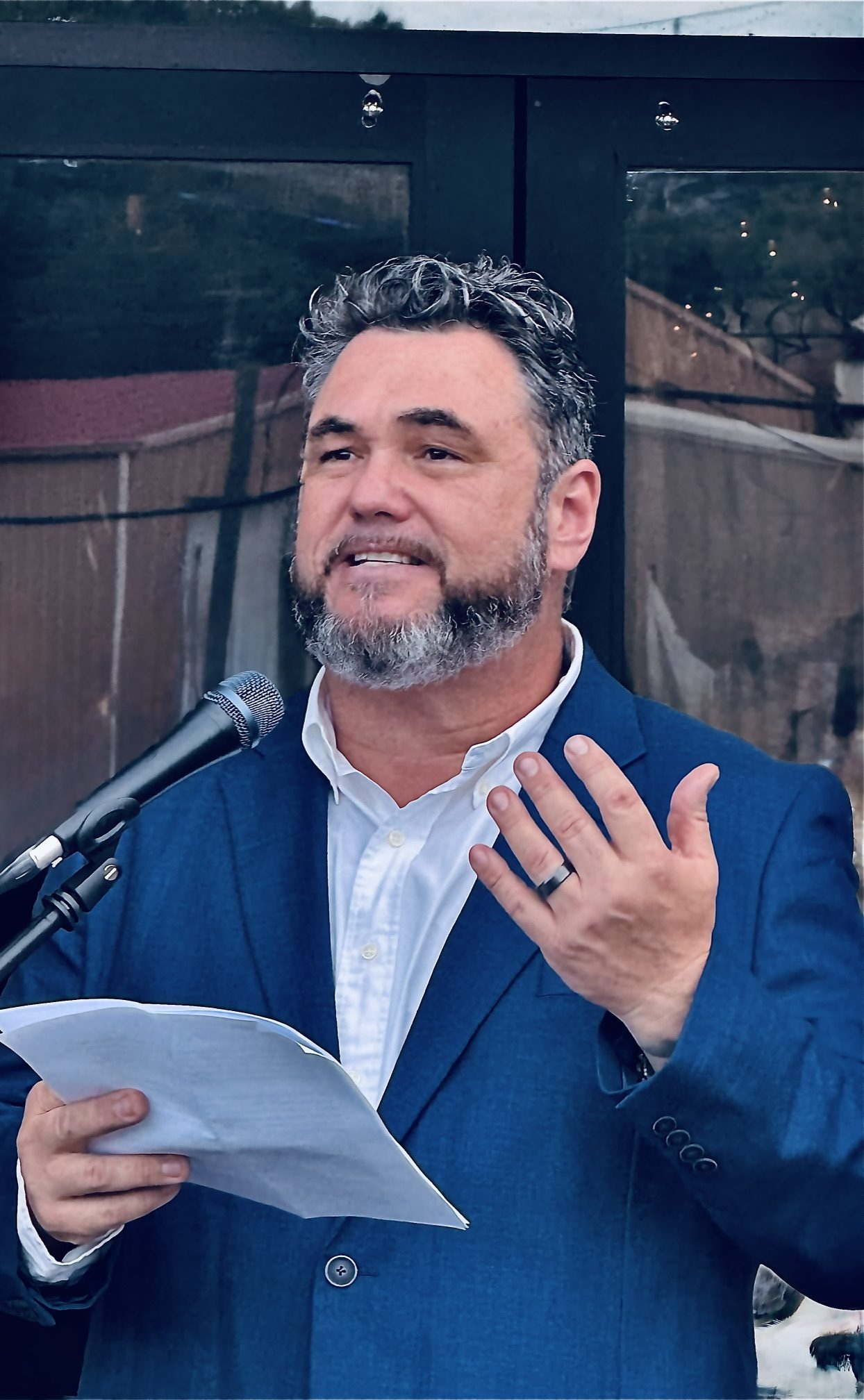
Cory Magras gives eloquent speech at the annual Bastille Day celebration in Frenchtown a few years ago. (Photo courtesy Cory Magras)
While the space currently operates under the previous owner’s menu, Magras has been methodically preparing for a full transformation. Deep cleaning, painting, equipment upgrades, and logistical planning have occupied the weeks following the finalized sale.
Sambucas, lovingly named after his family’s furry friend, will feature a Mediterranean-Italian focused menu, but Magras notes that this foundation opens the door to cuisines from the South of France, Spain, Greece, North Africa, and the Middle East. Over the coming weeks, he will sample different specials and new concept items to work out kitchen logistics like storage and service flow. Sambucas will participate in the annual Frenchtown Father’s Day Celebration, followed by a tentative grand opening in July, which also coincides with his mother’s 75th birthday. “It’s very exciting,” Magras said.
Sambuca, the Magras family pet, stands ready for a picture. (Photo courtesy Cory Magras)
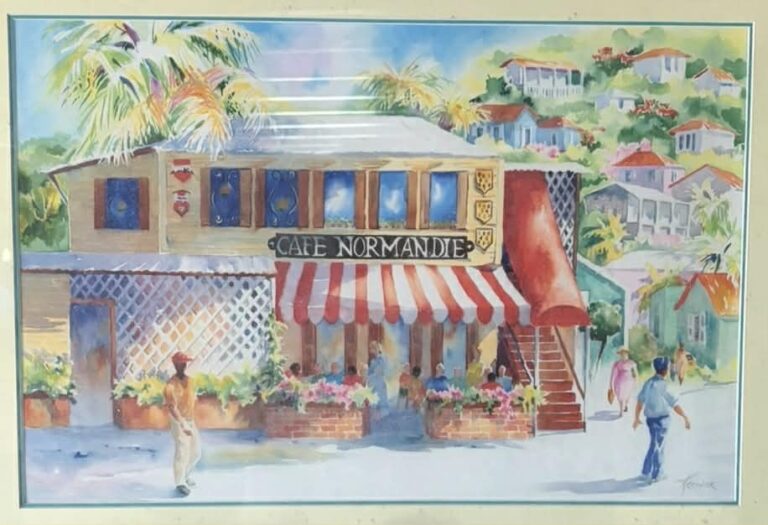
For Magras, this specific building carries deep personal history. He grew up around the former Cafe Normandie, a legendary Frenchtown establishment that occupied the same site. As a boy playing at the nearby baseball field, he recalls being more focused on the taxi vans bringing patrons to the restaurant than on the game itself. “I can vividly remember the scents that was foreign to me then, but now is completely normal daily. It’s the aroma of shrimp scampi, by the way,” Magras said.
The connection runs even deeper. An old photograph of the building from 1941 shows a staircase and balcony that have since been hidden by renovations. The same staircase now leads to Magras’ office. He imagines his father and others leaning on that balcony decades ago, discussing local events or politics with a cold drink in hand. “The simple answer is yes. Yes, I did select this restaurant for a specific reason. But that reason is only part one of the ambition that has been sparked. To make my father proud,” Magras said.
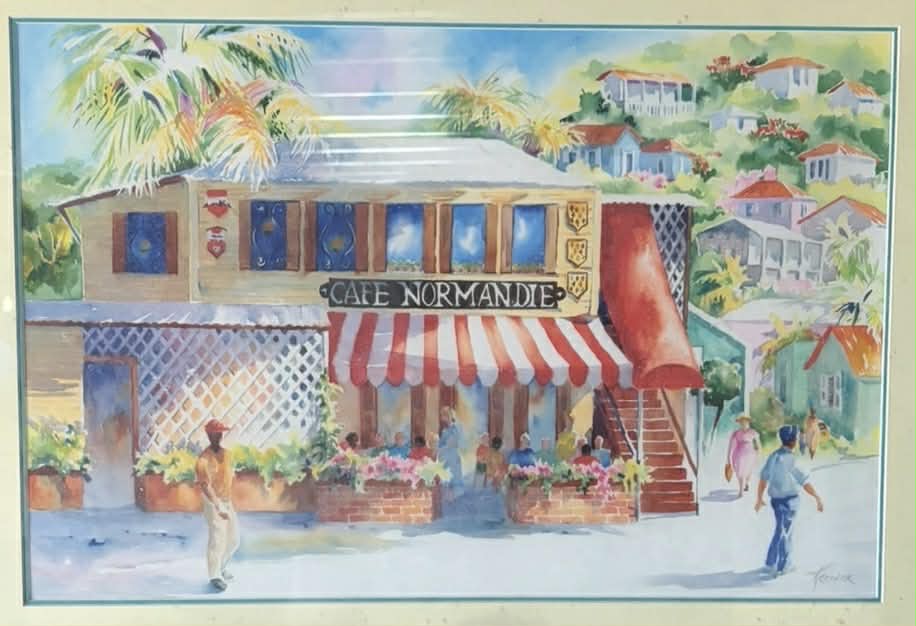
A colorful artwork of Cafe Normandie depicts the bustling streets of Frenchtown as people walk by the building. (Photo courtesy Cory Magras)
Sambucas will offer more than a standard dinner service. Magras has been granted a nightclub license for the location, though his vision is more refined. He plans to offer late-night food options for those in the culinary industry who often finish work with few places to gather. Additional plans include expanding hours to feature brunch, local lunch, a refined dinner menu, speakeasy-style offerings, craft cocktails, and a deeper wine list.
Magras emphasizes that his progress would not have been possible without the support of his family. “My amazingly supportive friends and family, my mom, my wife, my two daughters keeps me focused, motivated, calm, down to earth, and persistent,” Magras said.
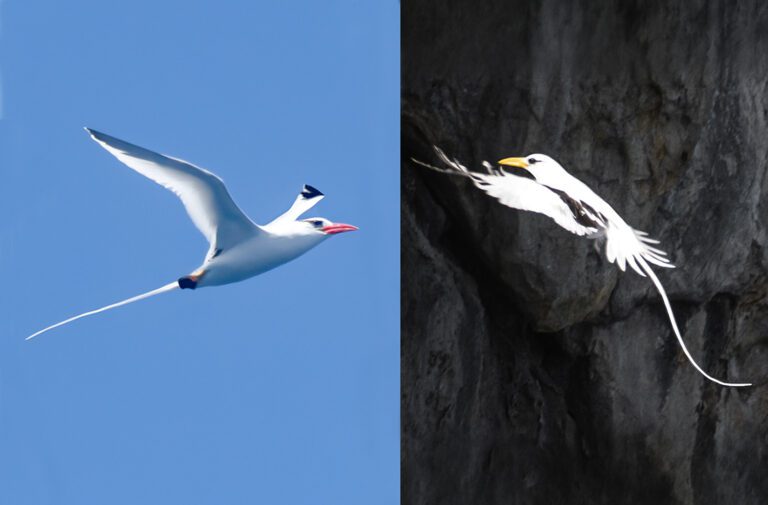
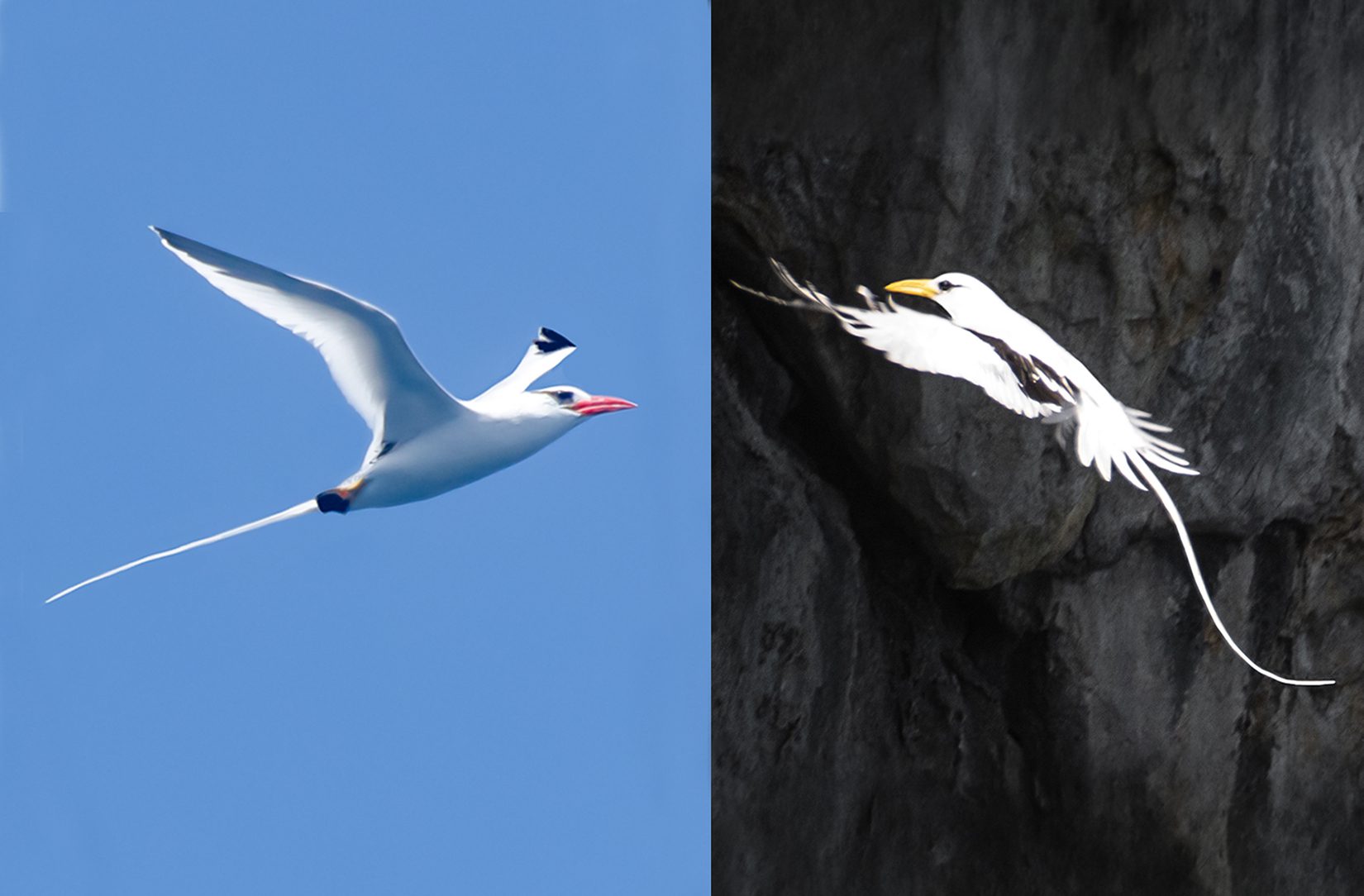
Red-billed Tropicbird (left) and White-tailed Tropicbird (right). (Photo Gail Karlsson)
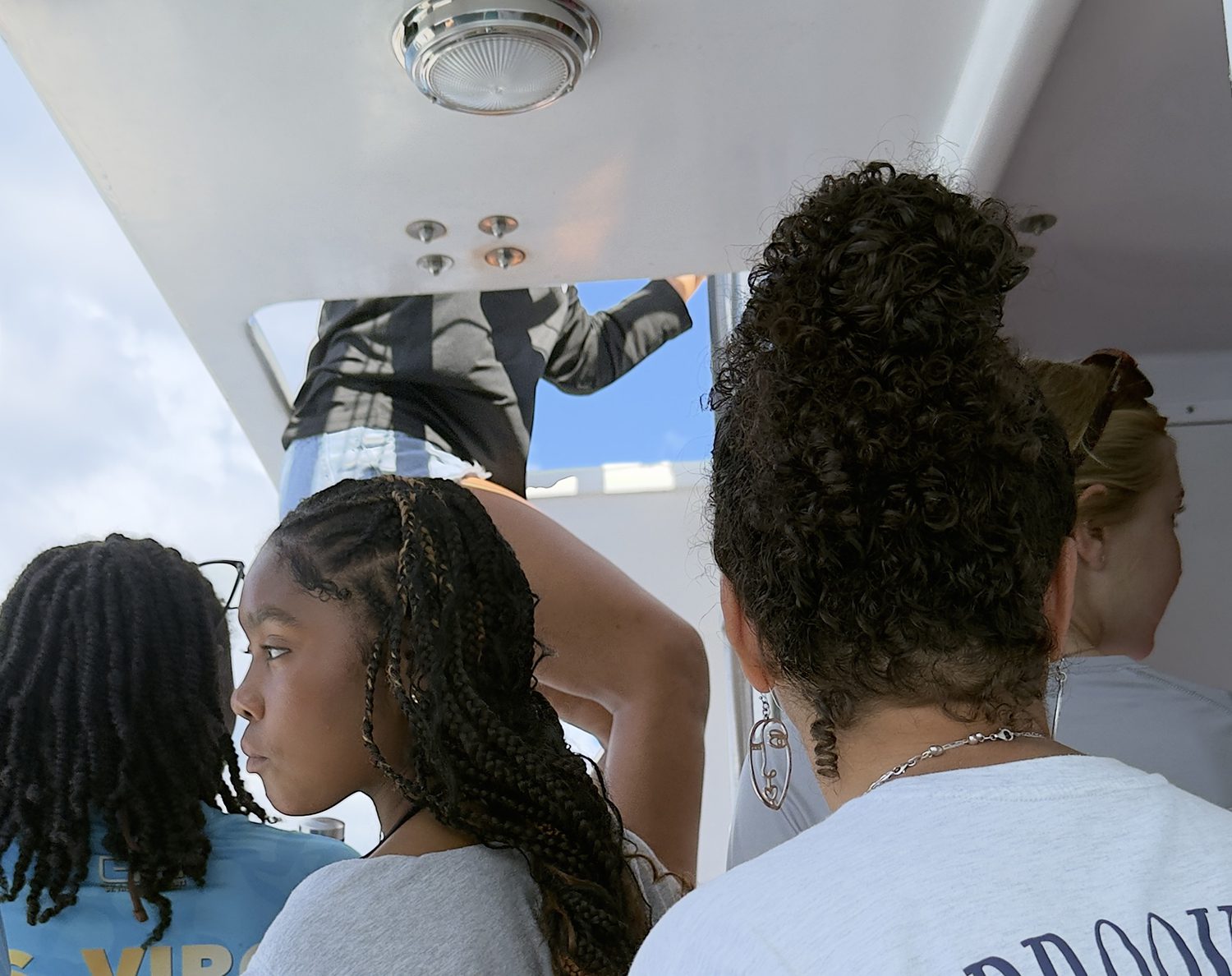
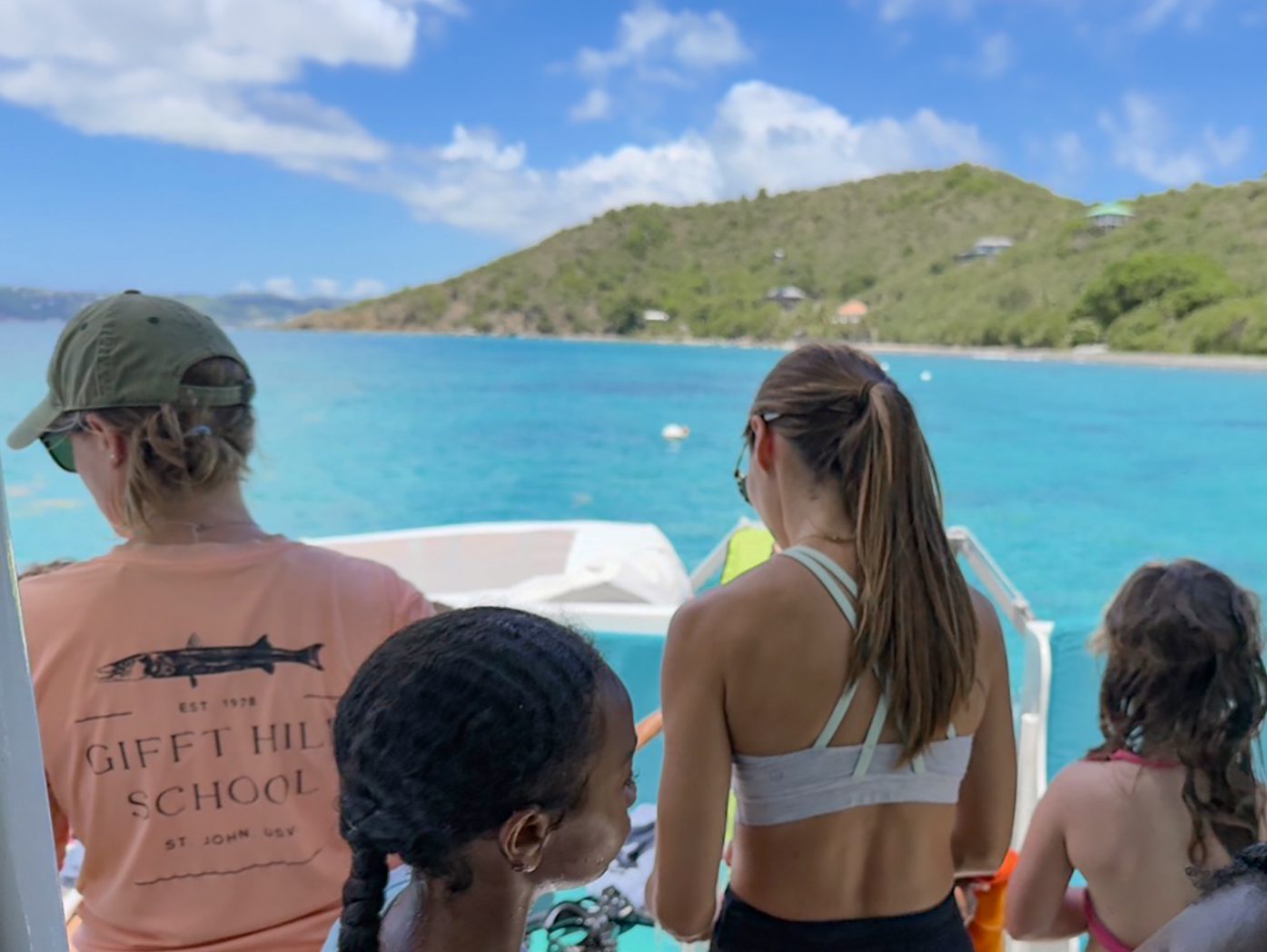
Students from Gifft Hill School’s third and ninth grades recently went out on a boat to look for nesting seabirds on some of the small islands north of St. John. The trip was sponsored by the V. I. Audubon Society as part of a bird study program designed to help build awareness about the wide variety of birds in the Virgin Islands, and the importance of protecting them.
Students climbed to the upper level of the boat to scan for birds. (Photo Gail Karlsson)
At this time of year, many different seabirds come from around the Caribbean to the small offshore islands in this area so they can mate and nest in secluded spaces.
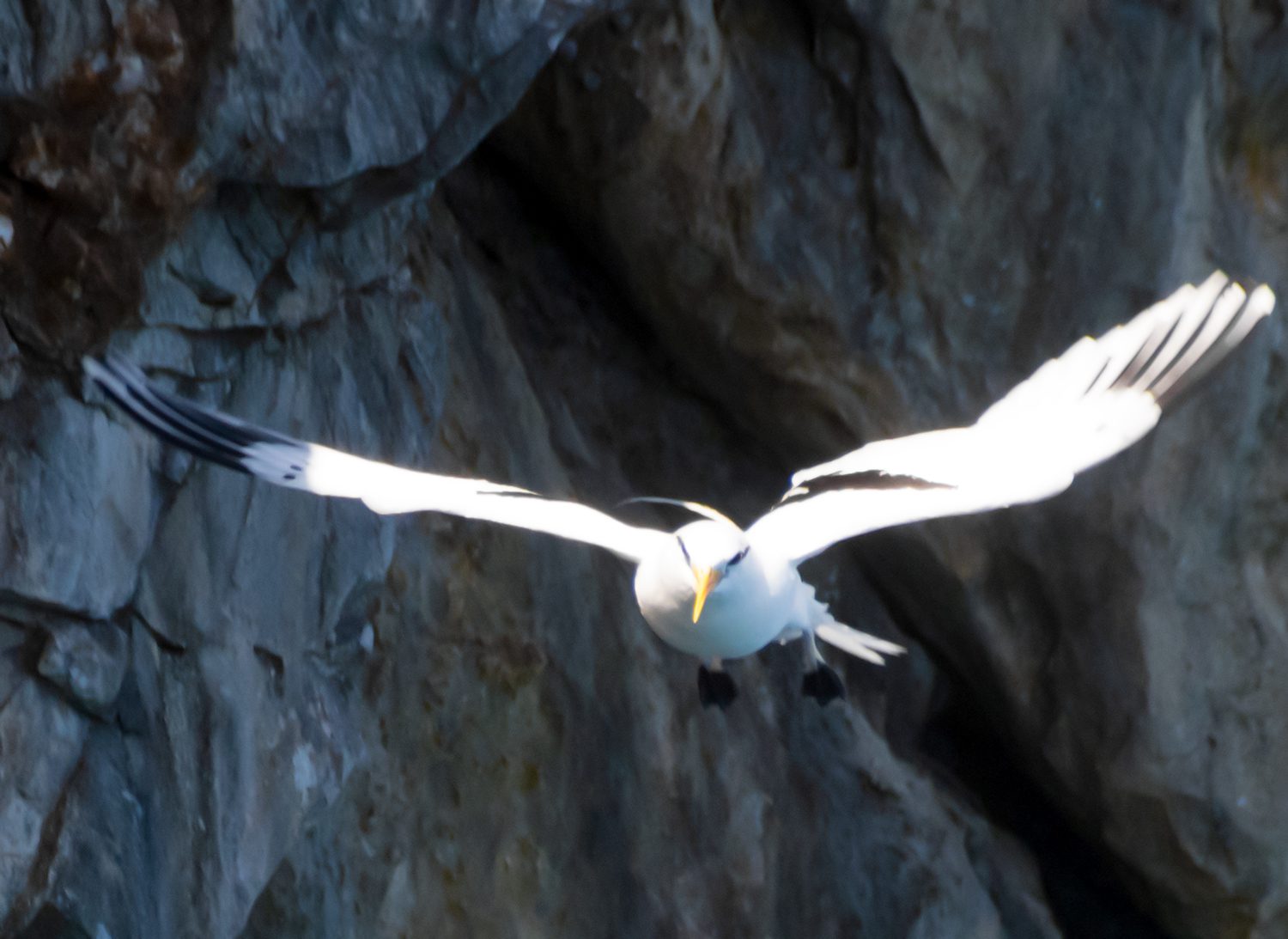
Heading northeast out of Cruz Bay, the students, and accompanying teachers and Audubon Society members, were quickly rewarded with views of a group of about ten White-billed Tropicbirds flying back and forth from nests on the cliffs at Congo Cay. There were also a few of the somewhat larger Red-billed Tropicbirds (17-20 inches compared to 14-15 inches for white-tailed ones).
A White-tailed Tropicbird flew out near a cliff on the north side of Congo Cay. (Photo Gail Karlsson)
Tropicbirds are pelagic, which means they spend most of their time flying around over open water. The tropicbirds stay in warmer ocean areas, catching fish far from land, then resting on the surface of the water. They are usually alone or in pairs, not large flocks.
Sometimes sailors will see tropicbirds hovering over boats, maybe watching for fish that rise to the surface due to boat-related activity. They are rarely seen by people on land, though, and sometimes seem mythical to non-sailors.
However, since tropicbirds can’t nest out on the surface of the sea, they seek out isolated rocky cliffs when it is time to breed. They come together in small groups to find mates and make their nests, and then they are more easily visible. However, you generally still need a boat to go see them.
Tropicbird nesting is not limited to a specific month, but usually takes place at times when there are plenty of small fish available in the water nearby. I saw some nesting near Congo in December, and now others nesting in May.
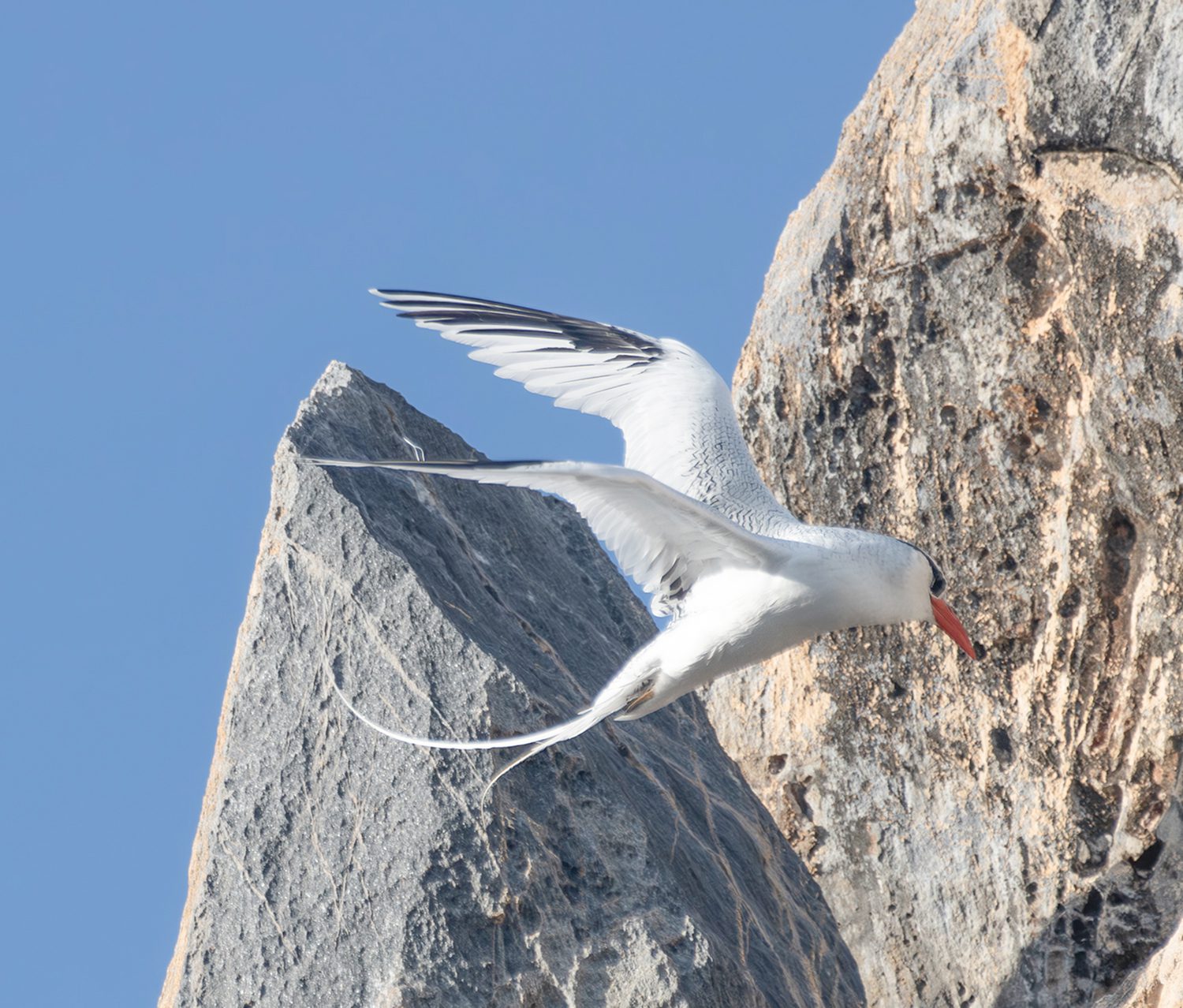
A Red-billed Tropicbird approached its rocky nest. (Photo Gail Karlsson)
The tropicbirds’ long, white ribbon-like tails, or streamers, are lovely and most distinctive. Yet they don’t seem very practical. It turns out that, like many impressive bird traits, they are primarily designed to attract a mate. During courtship, the tropicbirds engage in aerial courtship displays, circling around each other and alluringly swinging their tails from side to side.
After the courtship and mating period, they find a spot on a rocky ledge, or in a crevice, for a minimalist nest. Invasive, non-native rats are now living on many of the offshore cays, and they will eat unprotected eggs, so the seabirds are now facing new dangers. The steepest, slippery cliff faces may be the safest.
There is usually only one tropicbird egg, and it is incubated mostly by the female. She sits with it for about six weeks while the male brings her food. When the chick hatches, both parents bring food for it as it grows. Then after about three months the chick is ready to leave the nest and start its pelagic, ocean wandering life.
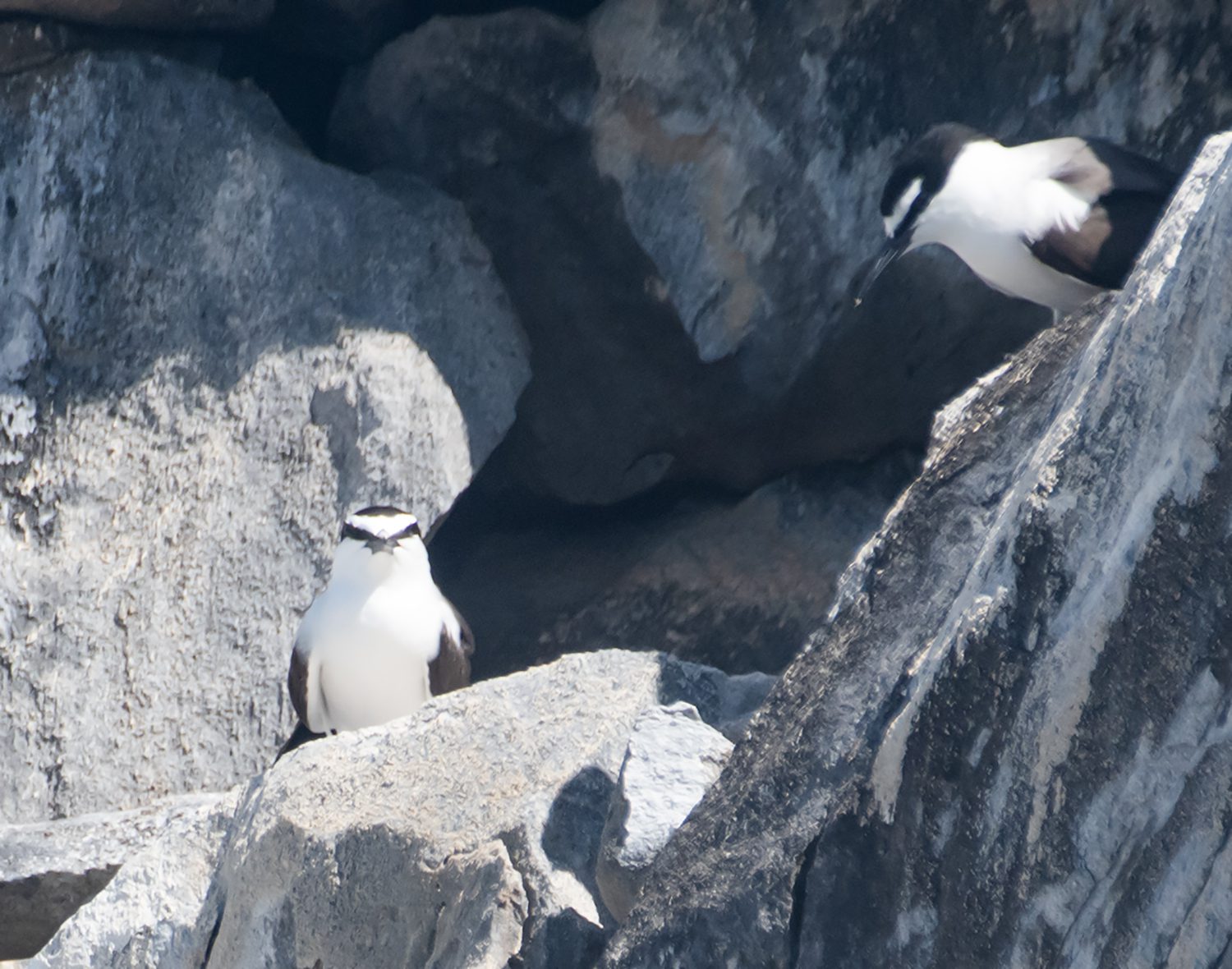
Nearby, on the imposing cliffs of Carvel (or Carval) Rock, about 20 pairs of smaller Bridled Terns were nesting. These birds get their name from the dark lines reaching from their mouths to the backs of their heads, like a bridle used to control a riding horse. These terns are also pelagic and widespread in warm ocean waters. They tend to stay somewhat closer to shore than tropicbirds, though, and like to find something floating to sit on, like mats of the sargassum seaweed, rather than settling down right on top of the water.
A pair of Bridled Terns watched over their nesting site. (Photo Gail Karlsson)
The bridled terns have longish forked tails, and their courtship involves some high flight displays, but their moves are not as dramatic as the tropicbirds. A male will fly by offering a fish to entice the females, and there is also a ground-level dance involving bowing and strutting.
The female will produce only one egg, and place it on or under a ledge, without building a substantial nest. Both parents will guard the egg, and then feed and protect the chick from predators, which seems like a strategy that increases the likelihood of its survival.
A Bridled Tern flew up to warn us against getting too close. (Photo Gail Karlsson)
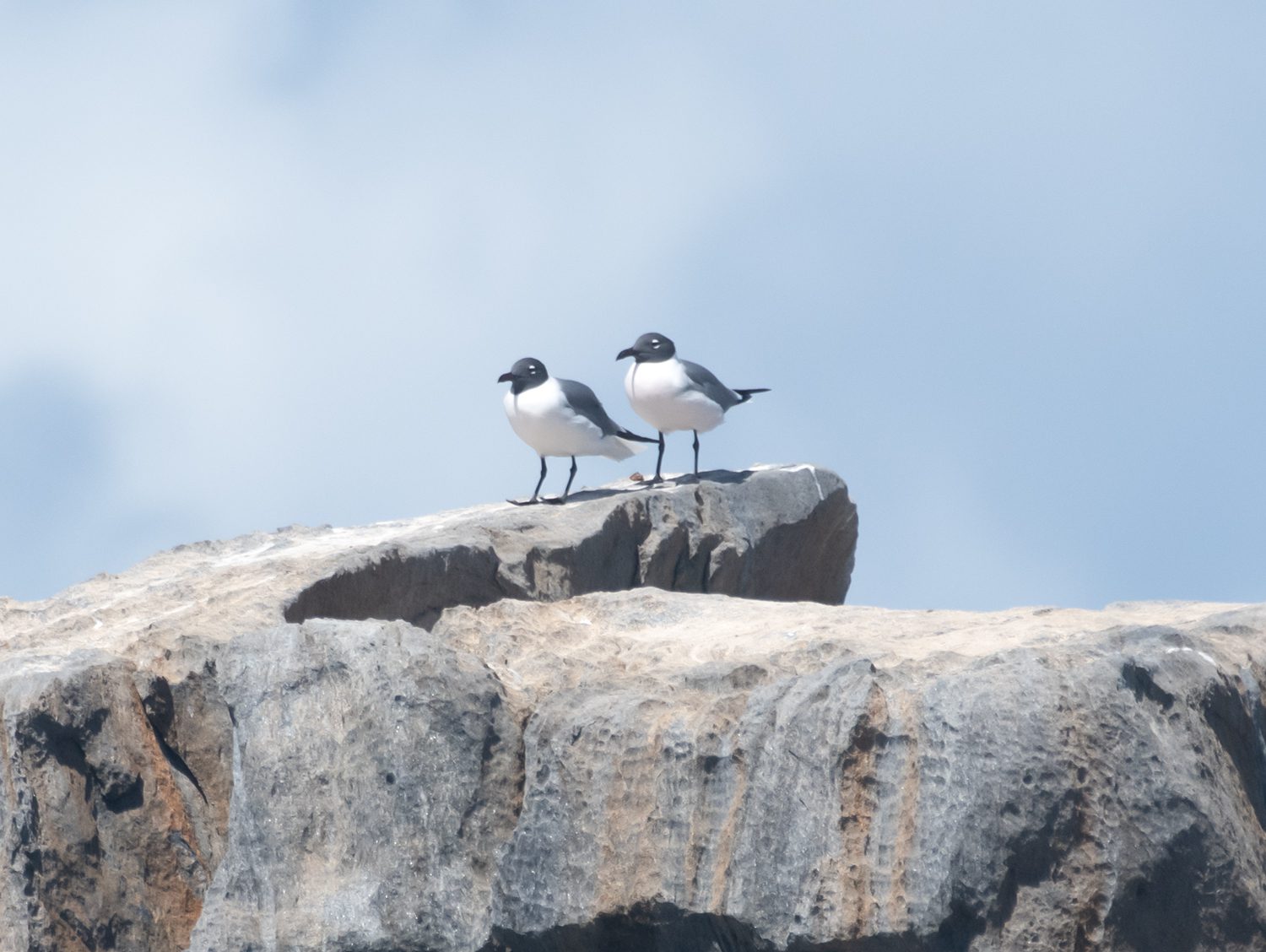
Laughing Gulls also come to some of the offshore islands in the Virgin Islands to nest during the summer, but they are not welcome near the terns. Gulls will eat the terns’ eggs or chicks if they get a chance, and will also chase adult terns and try to grab fish out of their mouths. The gulls also frequently gather in groups along the beaches, and will eagerly steal food from people as well.
Laughing Gulls came by to survey the scene at Carvel Rock. (Photo Gail Karlsson)
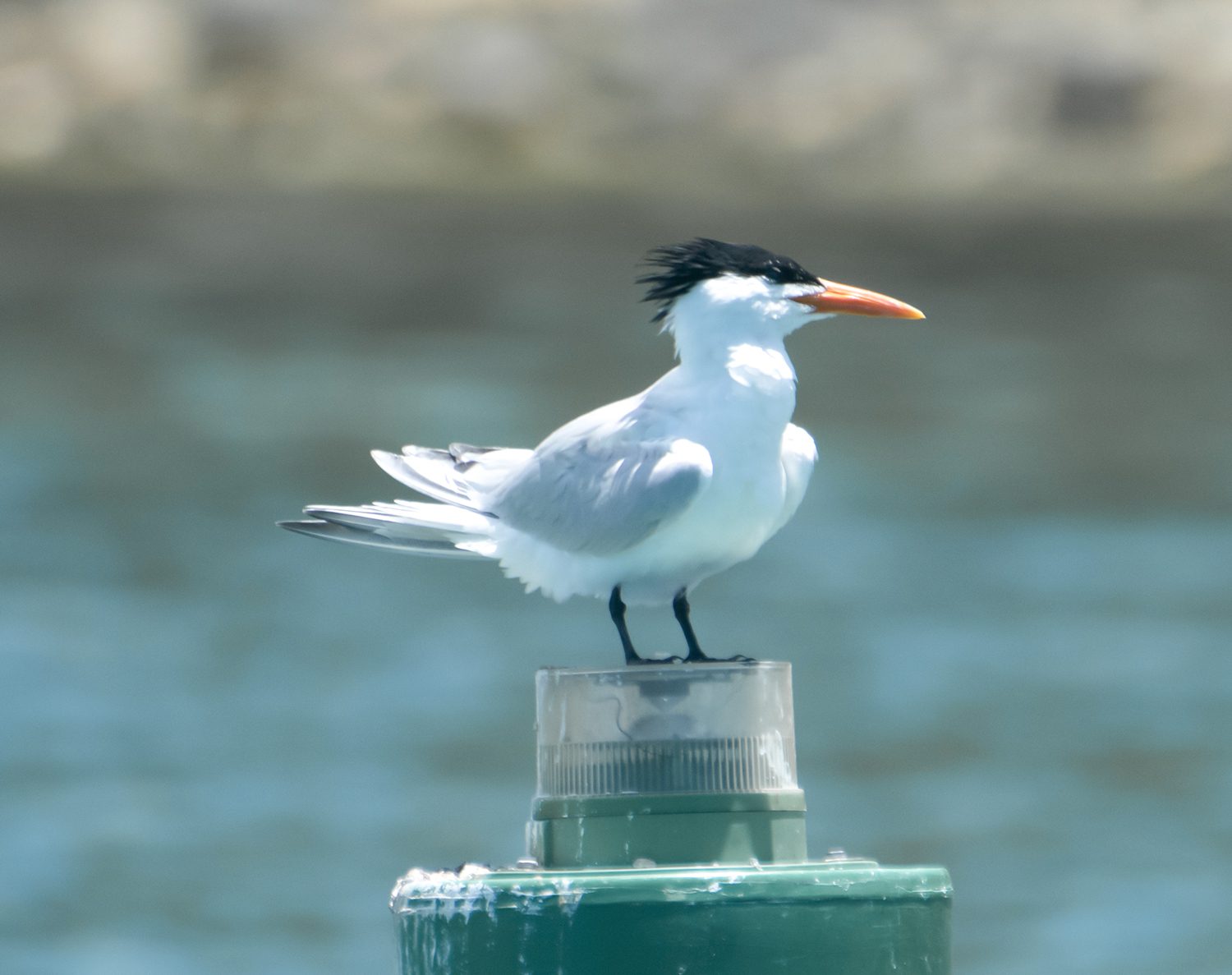
Royal Terns will also steal fish from other, smaller terns. They are more commonly visible from land as they like to sit on buoys in the harbor. They have black caps when breeding, and there are a few of them that nest in this area.
Royal Terns stand on buoys to scan for fish. (Photo Gail Karlsson)
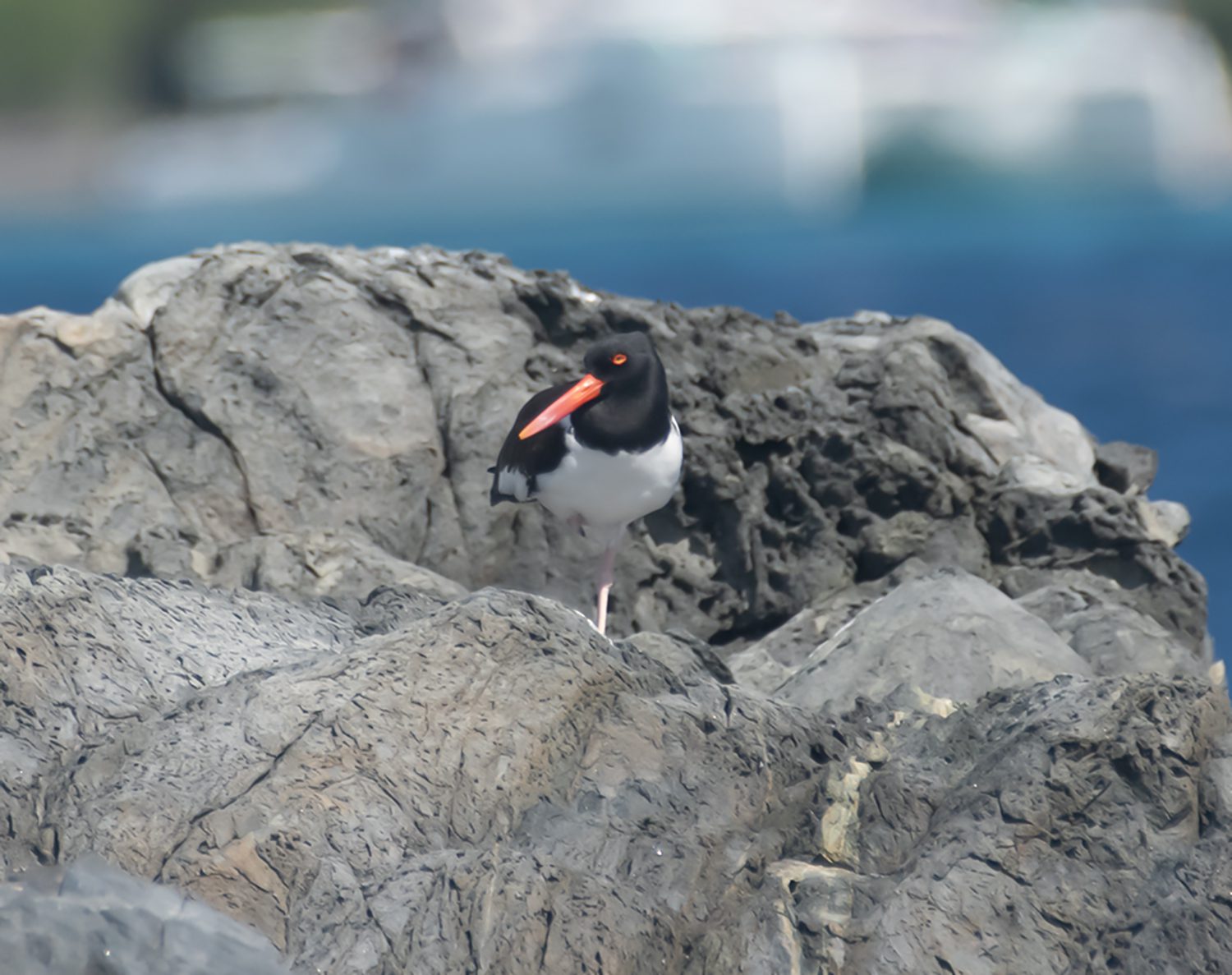
From the boat, we also saw a couple of Oystercatchers on Rata Cay between St. John and Lovango. Oystercatchers have long, carrot-like bills that give them a cartoonish appearance. They actually stay through the year in some areas in the Virgin Islands, and are almost always seen in pairs. They nest on beaches in remote parts of the larger islands, as well as on small cays close to shore. The parents will take turns sitting on the nest and bringing food, which often includes local whelks that they break open with their strong bills.
A bright-billed Oystercatcher warily watched our boat go by. (Photo Gail Karlsson)
The students on the trip learned about the importance of preserving isolated offshore spaces for birds so they can continue to nest and reproduce, and be as free as possible from invasive predators and human disturbance. Because seabirds are not just fun to watch. Their widespread migrations, fishing, and nesting activities are critical for maintaining the health of our interconnected oceans, islands and sky.
At the end of the trip, the students also got to jump in the water off Lovango Cay to cool off and also take a look under the water with snorkels. A pretty great day.
Students had a chance to swim and snorkel near Lovango Cay. (Photo Gail Karlsson)
Gail Karlsson is the author of a photo book Looking for Birds on St. John, as well as two other books about nature in the Virgin Islands –The Wild Life in an Island House, and Learning About Trees and Plants – A Project of the Unitarian Universalist Fellowship of St. John. Follow her on Instagram @gailkarlsson and gvkarlsson.blogspot.com. More info at gailkarlsson.com
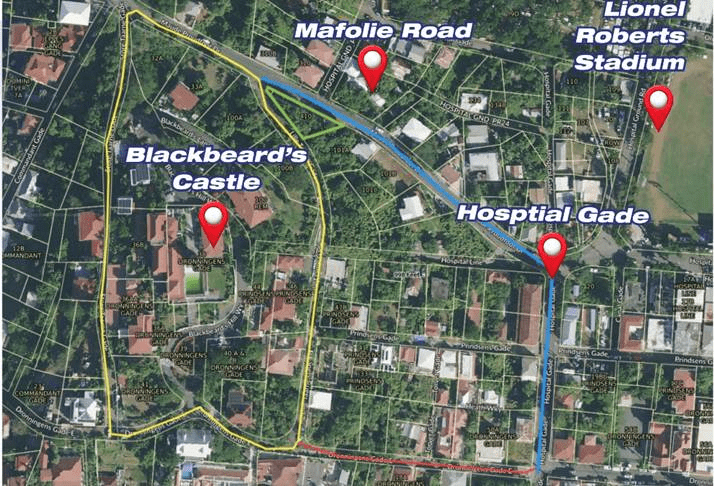
The Virgin Islands Water and Power Authority is advising the public of the upcoming Blackbeard Hill Waterline Rehabilitation Project, which will improve and modernize water infrastructure in the Blackbeard Hill community on St. Thomas.
The Water and Power Authority will work on water lines in the Blackbeard Hill area.
Funded by the U.S. Environmental Protection Agency through the Department of Planning and Natural Resources, construction is scheduled to begin on June 1.
The project includes a comprehensive waterline main replacement featuring approximately 2,800 linear feet of new water pipeline, along with upgraded valves and fire hydrants. The work also includes construction of a new pump station to improve system pressure and operational performance. Existing waterlines within the project area will be properly decommissioned, and all affected roadways, paved surfaces, and landscaped areas will be restored upon completion.
Island Roads Corporation has been selected to execute the project on behalf of WAPA. Initial activities will include mobilization, material delivery and staging, and work area preparation ahead of construction. Work will then proceed in phases throughout the Blackbeard Hill community to minimize disruption.
Upon completion, the project will improve water distribution reliability, stabilize system pressure and flow, reduce long-term operational and maintenance costs, and strengthen overall system performance. These upgrades will provide a more resilient and efficient potable water system for Blackbeard Hill residents and businesses.
To support construction activities, traffic management measures will be implemented, and motorists should expect intermittent and phased impacts within the project corridor. Appropriate detour signage will be posted to ensure safe and efficient movement through active work zones. Customers may experience temporary water service interruptions during construction and will receive advance notice through WAPA Alerts.
WAPA thanks the community for its cooperation and support as the Authority continues to advance critical infrastructure improvements across the territory.
The Virgin Islands Water and Power Authority Communication’s department is committed to reaching, informing, and connecting with the youngest members of the community to the eldest, through meaningful, transparent and effective communication.
IN THE SUPERIOR COURT OF THE VIRGIN ISLANDS
DIVISION OF ST. THOMAS & ST. JOHN
IRMA D. PEETS, Plaintiff, vs.INGRID SMITH, LANVILLE QUEELEY, BRIAN PEETS, SHAWNA DEFOUR (F/K/A SHAWNA PEETS), NADIA PEETS, AND PATRICIA PEETS, AND ALL PERSONS CLAIMING AN INTEREST IN PARCEL 394-109 ESTATE ANNA’S RETREAT (TUTU), NO. 1 QUARTER., ST. THOMAS, U.S. VIRGIN ISLANDS, Defendants.
Civil No. ST-2025-CV-00163ACTION TO QUIET TITLE AND FOR ADVERSE POSSESSION
To: Ingrid Smith
840 N. Sherman Circle
#G-201
Miramar, FL 33025
Within the time limited by law (see note on the next page) you are hereby required to appear before this Court and to answer to a Complaint filed against you in this action. In case of your failure to appear or answer, judgment by default will be taken against you as demanded in the Complaint for damages.
Witness my hand and the seal of this Court on this 19th day of May, 2026.
____________________________________
TAMARA CHARLES
Clerk of the Court
By: _________________________________
Deputy Clerk
BARNES, D’AMOUR & VOGEL
P.O. Box 10829
St. Thomas, VI 00801
Tel: (340) 774-8188 / Fax: 776-8664
/s/Gaylin Vogel
Gaylin Vogel, Esq.; VI Bar No. 1077
gvogel@usvilawfirm.comAttorneys for Plaintiff
NOTE: The Defendant, if served personally, is required to file his/her answer or other defense with the Clerk of the Court, and to serve a copy thereof upon the Plaintiff’s attorney within twenty (20) days after service of this summons, excluding the date of service. If served by publication or by personal service outside of the jurisdiction, the Defendant is required to file his/her answer or other defense with the Clerk of this Court, and to serve a copy thereof upon the attorney for the Plaintiffs within thirty (30) days after the completion of the period of publication or personal service outside of the jurisdiction.
IN THE SUPERIOR COURT OF THE VIRGIN ISLANDS
DIVISION OF ST. THOMAS & ST. JOHN
IRMA D. PEETS, Plaintiff, vs.INGRID SMITH, LANVILLE QUEELEY, BRIAN PEETS, SHAWNA DEFOUR (F/K/A SHAWNA PEETS), NADIA PEETS, AND PATRICIA PEETS, AND ALL PERSONS CLAIMING AN INTEREST IN PARCEL 394-109 ESTATE ANNA’S RETREAT (TUTU), NO. 1 QUARTER., ST. THOMAS, U.S. VIRGIN ISLANDS, Defendants.
Civil No. ST-2025-CV-00163ACTION TO QUIET TITLE AND FOR ADVERSE POSSESSION
To: Lanville Queeley
840 N. Sherman Circle
#G-201
Miramar, FL 33025
Within the time limited by law (see note on the next page) you are hereby required to appear before this Court and to answer to a Complaint filed against you in this action. In case of your failure to appear or answer, judgment by default will be taken against you as demanded in the Complaint for damages.
Witness my hand and the seal of this Court on this 19th day of May, 2026.
TAMARA CHARLES
Clerk of the Court
By: _________________________________
Deputy Clerk
BARNES, D’AMOUR & VOGEL
P.O. Box 10829
St. Thomas, VI 00801
Tel: (340) 774-8188 / Fax: 776-8664
/s/Gaylin Vogel
Gaylin Vogel, Esq.; VI Bar No. 1077
gvogel@usvilawfirm.comAttorneys for Plaintiff
NOTE: The Defendant, if served personally, is required to file his/her answer or other defense with the Clerk of the Court, and to serve a copy thereof upon the Plaintiff’s attorney within twenty (20) days after service of this summons, excluding the date of service. If served by publication or by personal service outside of the jurisdiction, the Defendant is required to file his/her answer or other defense with the Clerk of this Court, and to serve a copy thereof upon the attorney for the Plaintiffs within thirty (30) days after the completion of the period of publication or personal service outside of the jurisdiction.