Since taking office the Bryan‐Roach Administration has expanded the number of electric vehicles in public service from six, to over 70 through the Government Operations Fleet Efficiency & Electrification Transition (GOFLEET) Initiative.
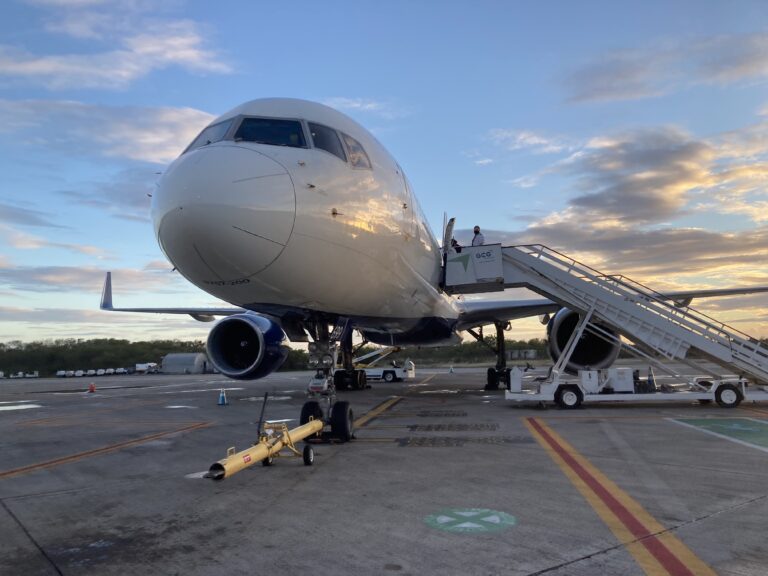
An NYPD electric vehicle similar to five all-electric vehicles bound for VIPD. (Photo by VIEO Director Kyle Fleming)
The Virgin Islands Energy Office made history this September when it coordinated the first‐ever locally sourced bulk procurement of electric vehicles for the Government of the Virgin Islands. All in all, the GVI through Metro Motors VI will purchase 18 EVs. This order includes five all‐electric, police‐upfitted cruisers like the NYPD vehicle pictured above, that will be deployed across the territory as well as eight additional Ford F‐150 Lightnings to strengthen the government fleet’s resilience and reduce operating costs.
As federal consumer support for electric vehicle purchases winds down this month with the sunsetting of Internal Revenue Service tax credits, Virgin Islands Energy Office Director Kyle Fleming reassures the public of the continuity of the Electric Mobility (EM) rebate program. EM is a VIEO program that offers Virgin Islands residents rebates of up to $5,000 for the purchase of a qualifying new or used electric vehicle, or up to $500 towards the purchase of an eligible electric bike.
IRS credits worth up to $7,500 for qualifying new electric vehicles, (EV) and as much as $4,000 for used EVs will expire after Sept. 30th due to provisions included in the One Big Beautiful Bill signed into law by President Donald Trump. These tax credits, like EM, are designed to help consumers bridge the price gap between traditional internal combustion engine (ICE) vehicles and EVs all while helping to reduce the amount of pollutants generated by vehicular traffic.
When EVs first made their commercial debut they were a lot more expensive than the alternative, with an average retail price as much as 50% higher than an ICE equivalent according to data compiled by automotive industry analyst JATO. The price gap between the powertrains has fallen precipitously in the intervening years, with data from 2024 showing that a new EV is likely to cost only 15% more than the retail price of a comparable new ICE vehicle. While on the aftermarket, used EVs are often selling for less than comparable gasoline models.
“Affordability, not luxury, is what defines EV adoption in the Virgin Islands,” Director Fleming said.
Since launching in 2024 VIEO has issued more than 45 EM rebates totalling in excess of $200,000. Cost data collected by VIEO shows that Virgin Islanders taking advantage of the rebate are making good use of the aftermarket, and are on average purchasing near new – 6,100 miles or less ‐ EVs for a pre‐rebate price of $32,500. The most popular manufacturers to date are Tesla and Nissan, together representing more than half of all rebated vehicles. A majority of EM rebates have been issued for used EVs, and nearly 90% have gone to vehicles purchased in the states and shipped into the territory by private individuals. To increase the options available to consumers and reduce the burdens inherent in bespoke vehicle importation, VIEO recently executed a subgrant agreement with Metro Motors VI that will make new EVs available for purchase on St. Thomas and St. Croix. The agency is also in the midst of coordinating with local used‐car dealers so more electric vehicles are available locally for residents to test drive and purchase.
Easing the price of purchase is just one prong of VIEO’s strategy to make EVs a sensible option in the territory. In 2024 VIEO began constructing public charging infrastructure in the territory, and before the end of the year completed the installation of eight Level II chargers on St. Croix. Since going live the chargers have been utilized more than 650 times, and displaced nearly 3,000 gallons of gasoline.
Infrastructure work remains ongoing, with the development of a resilient solar powered and battery coupled
Level III DC fast charger slated to be constructed at the University of the Virgin Island’s Albert Sheen Campus. And on St. Thomas, VIEO is currently finalizing the installation of eight chargers, and another four on St. John, all of which are going through utility hook up and final commissioning by the manufacturer.
“We are pairing consumer incentives with tangible commercial fleet leadership,” Fleming added. “By electrifying government operations, especially our most heavily utilized vehicles within the VIPD, we are cutting costs for taxpayers and showcasing reliable, modern transportation solutions that work for island conditions.”
To learn about EM program guidelines, apply, or delve deeper into other efforts currently underway by the Administration of Governor Albert Bryan Jr. to increase energy efficiency and resilience in the territory, please visit VIEO at energy.vi.gov for more information.
When the Bryan administration began, there were 6 Electric vehicles in the GVI fleet. The Launch of the
GOFLEET has seen exponential growth by adding over 70 electric vehicles to GVI fleet. This has been realized through historic funding in the form of over $4 million in federal funding to electrifying fleets.
Gov. Albert Bryan Jr. confirmed Tuesday night that he has signed the fiscal year 2026 budget bills into law, a move that, among other things, clears the final hurdle for the long-awaited $35,000 minimum salary increase for government workers. With his signature, months of debate over how to fund the raise have shifted to the practical task of implementation.
The administration will now begin preparing to make the adjustments, though officials said that amended Notices of Personnel Action must still be processed by the Division of Personnel before the higher paychecks reach employees. The last day of fiscal year 2025 was Sept. 30.
Sen. Kurt Vialet, who shepherded the increase through the Legislature, urged agencies not to drag their feet on that step. “Our employees cannot afford unnecessary delays,” Vialet said in a release Monday. “The Legislature acted to bring relief through this salary adjustment, and it is now the responsibility of agencies to ensure that the data is provided to Personnel so the increases are reflected for the fiscal year. This is about planning, accountability, and making good on our commitment to our workforce.”
The raise stems from Bill No. 36-0053, sponsored by Vialet and enacted in May over the governor’s veto. It lifts the minimum salary for full-time government employees from $27,040 to $35,000 beginning Oct. 1. Budget testimony revealed that the largest gaps were among custodial workers and other frontline staff, while many agencies already had employees earning closer to the new threshold.
Bryan initially vetoed the measure this spring, calling it “reckless” and warning that the price tag could approach $40 million annually once payroll and fringe benefits were included. Senators countered that the impact would be far less. Their veto override cemented the increase into law, but left the summer budget hearings consumed with the question of how to pay for it.
That answer came during the September markup, when Finance, Budget, and Appropriations Chair Sen. Novelle Francis said the actual cost, after consultation with the Office of Management and Budget and the Division of Personnel, is closer to $4.6 million — about $3.5 million for salaries and $1.1 million for fringe benefits. Francis explained that many employees already earned just under the $35,000 floor, and that the shortfall was concentrated in areas such as Sports, Parks and Recreation. Lawmakers ultimately redirected vacancy savings from more than 800 unfilled positions across government to bridge the gap.
The full Senate approved the budget bills on Sept. 15, appropriating a little more $1 billion – including General Fund, reimbursements, federal funds, and transfers – for FY 2026. For Vialet, the next step is ensuring that implementation keeps pace with legislative intent.
“Delays at the agency level translate directly into delays for employees,” he said in his release. “Submitting the information on time guarantees a smooth transition and prevents the kind of bureaucratic setbacks that undermine confidence.”
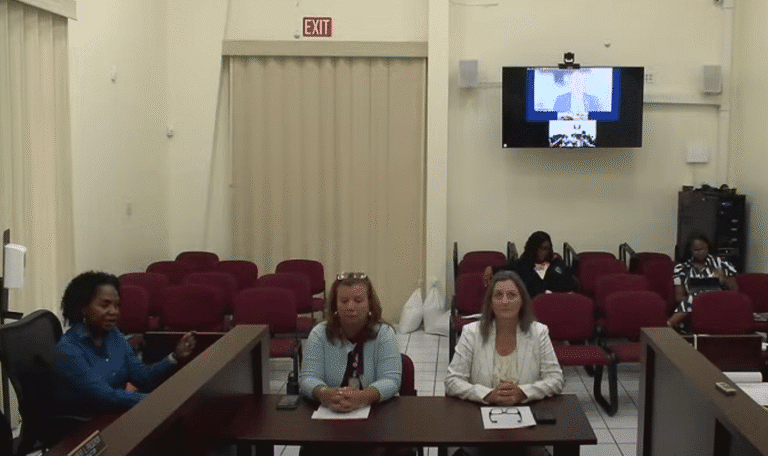
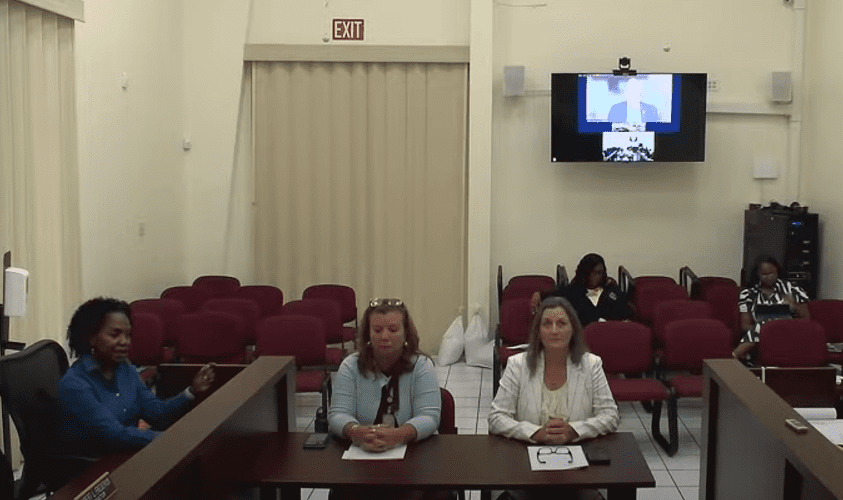
WAPA general counsel Dionne Sinclair, left, contract manager Nicole Aubain, center, and Chief Financial Officer Lorraine Kelly, right, appear before the V.I. Public Services Commission on Tuesday in a meeting broadcast over Zoom. (Screenshot from Zoom meeting)
The V.I. Water and Power Authority faced tough questions and criticism from the Public Services Commission Tuesday over its second attempt at securing a long-term fuel since parting ways with Vitol.
WAPA’s governing board narrowly and controversially approved a contract with Puerto Rico-based Empire Gas in July after respondents to an initial request for proposals issued in April failed to meet the utility’s criteria. The board voted to rescind the contract in August while authorizing WAPA Chief Executive Karl Knight to find a short-term supplier, which ended up being Empire Gas. The utility issued a second RFP on Sept. 8. WAPA’s contract manager, Nicole Aubain, told commissioners Tuesday that the utility directly solicited 36 companies. Approximately 10 vendors participated in a prebid meeting on Sept. 19 and finished proposals will be received by Oct. 24.
Responding to questions from PSC Vice Chair David Hughes, Aubain said she didn’t feel that there were any “major changes” to the second RFP but noted that it was advertised more widely. Hughes noted that vendors who responded the first time “took great exception” to an item requiring local storage of liquefied petroleum gas.
“They thought it indicated a substantial misunderstanding — by WAPA — on how fuel moves and the necessity for local storage, as opposed to just a responsiveness, for instance, in the face of like a hurricane or something,” he said. Aubain said the provision carried over to the more recent request for proposals.
“So you didn’t listen to the vendors that said that that was completely unnecessary — and that was exclusionary to all but one party,” Hughes said. “You kept that local storage requirement in the document.”
The utility’s general counsel, Dionne Sinclair, said the provision wasn’t a mandatory requirement. After Hughes acknowledged that it was unusual for the commission to receive direct inquiries about procurement procedures and noted the volume of feedback the PSC received from vendors frustrated with WAPA’s lack of communication last time around, Sinclair said the utility had done a “deep dive” on concerns raised during the previous procurement.
“And we — in order to safeguard, I think, the integrity of the present process — we copied much of what the federal component asked for, even though the language was previously in the prior RFP,” she said. “We tightened it up in this RFP to make it clear that any communications, and requests for influence, any solicitations that are outside the contract manager and the contract department will result in disqualification.”
“How convenient for you,” Hughes said dryly before the two began briefly talking past one another. “So this is exactly why we have a docket open on this: because of the concerns that were expressed to your regulator and to your board, frankly, that weren’t addressed by the process.”
Hughes later noted vendors’ concerns that fuel volumes described by the RFP “didn’t actually reflect either the current consumption of the utility, nor its projected — did you guys tighten up the actual volumes that you were asking people to bid on this time? Or did we just … stay with the same numbers?”
Sinclair said those numbers “reflect the average of our usage.”
“I think they were not, but I’m not in a position to demonstrate otherwise today. They were well in excess,” Hughes said. “And the situation is quite fluid, as you know, in the Virgin Islands, because we’re bringing substantial components of solar, which are reducing our energy requirements to fossil fuels by about 30 percent on each island. I’m just curious if we reflected the — at least the future potential for — those reductions in this new RFP, or we’re asking people to bid the old … consumption rates.”
Aubain said the utility’s procurement process involves project managers and departments outlining their specific needs and that “most of it is negotiable.”
“When it comes to RFP, it’s a negotiable thing,” she said. “Just like Attorney Sinclair expressed to you when you talked about the storage — all of those are suggestions and what we need, and we’re hoping that we’re going to get the best results back.”
Hughes said he understood how proposals work but he knew the authority “is well aware of the effects to its future consumption” as it replaces old generators with more efficient units and ramps up its development of solar power and battery backups.
“I just find it interesting that you would publish an RFP that makes no attempt to quantify that for the vendors that you’re asking to enter into long-term contracts,” he said. “I understand it’s all negotiable, but when you say something is negotiable, what you’re really saying is: anybody who asks that question, you’ll answer it or enter into a discussion with — but if you have the engineering knowledge, why aren’t you just putting that in the document?”
Sinclair said the RFP was for a two-year contract and based on a two-year usage forecast from WAPA personnel. Hughes maintained that fuel consumption is slated to decrease in that period and said he was simply echoing vendors’ concerns.
“I just find that amazing,” he said. “That we go through a process that — by the director’s admission — failed, and we wouldn’t actually make any changes to that. That makes no sense.”
Sinclair later asserted that the first solicitation failed largely because vendors were unable to meet WAPA’s price.
“For the price point that was being demanded, it would not have availed itself to anything that would have benefited the authority — and certainly would not have benefited the people of the Virgin Islands,” she said. “Because of that, and pursuant to our whole procurement process, we closed out that procurement. We went to direct solicitations and were able, from that process, to get a viable option.”
Sinclair said a number of spurned vendors then voiced concerns to regulators and legislators, which she believed “impeded the integrity of the process.”
“And it’s something that you couldn’t do under federal procurement, just to be clear,” she added. “So in this process, we are tightening that. Undue influence will not be considered or weighed, and it will be a straightforward, transparent procurement.”
The National Hurricane Center is monitoring hurricanes Imelda and Humberto in the Atlantic basin. While the storms are not expected to impact the U.S. Virgin Islands directly, rough surf and rip currents are possible, and forecasters say the Atlantic will remain active with chances for additional development in October.
Hurricanes Imelda and Humberto
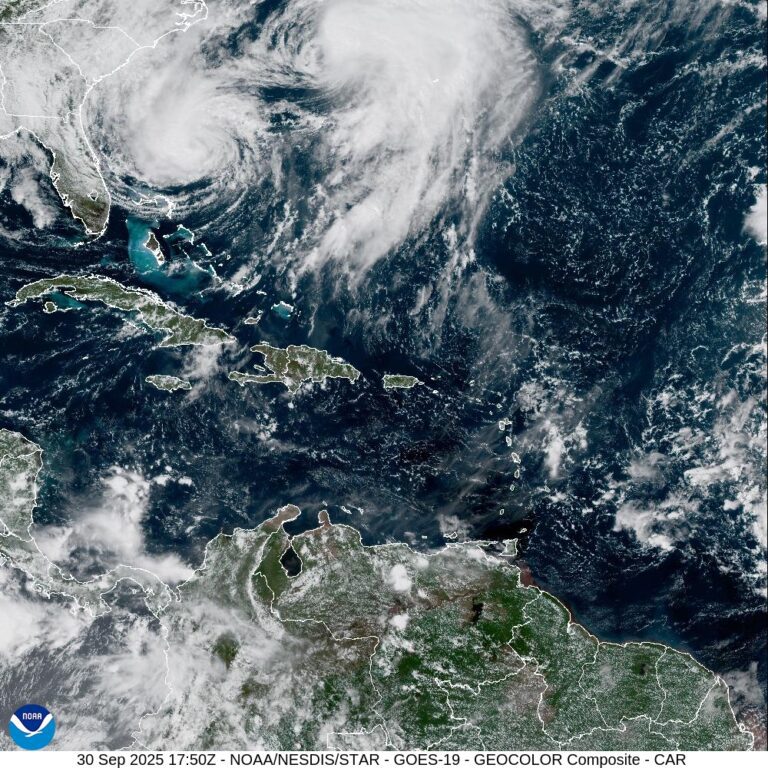
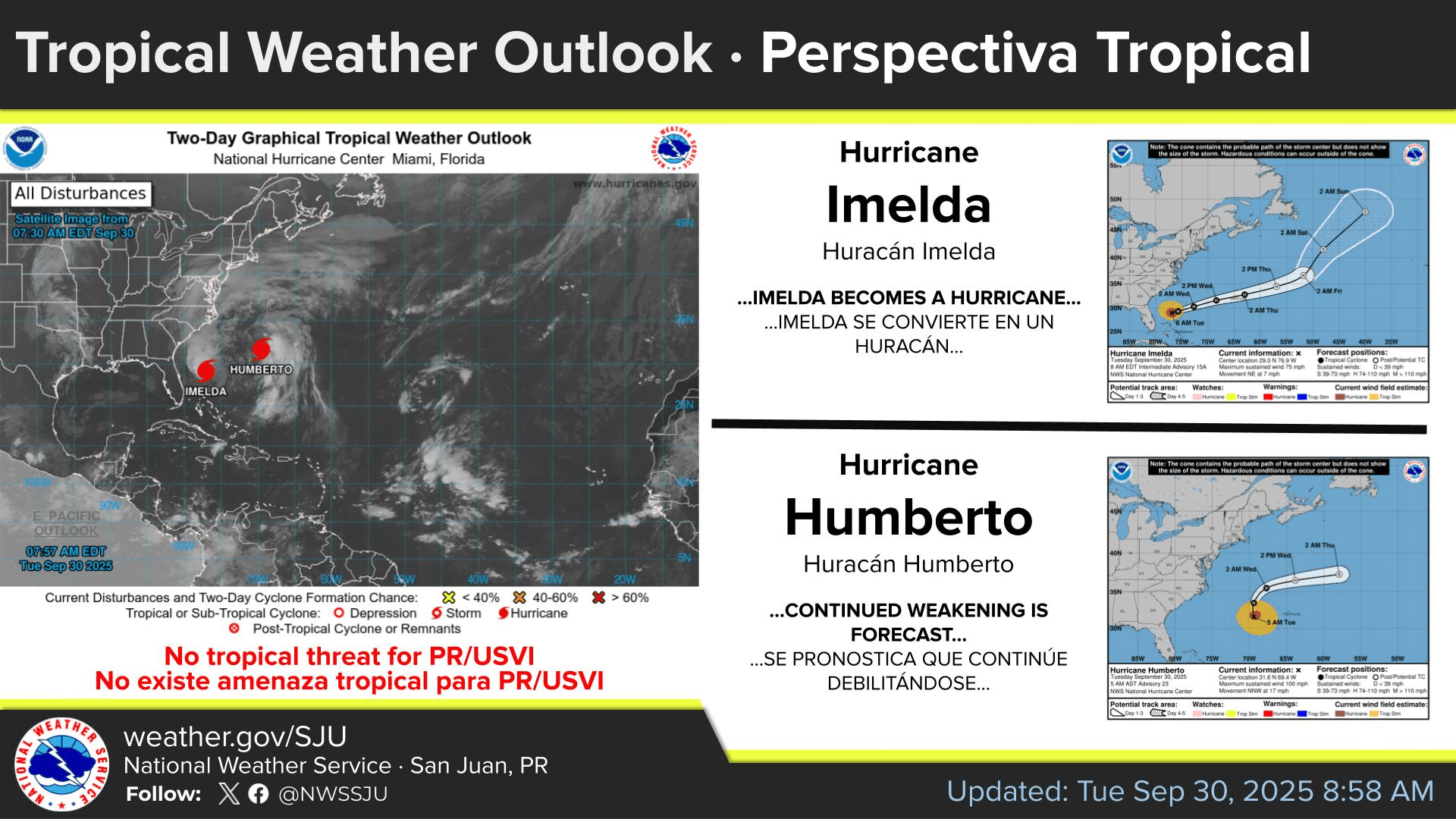
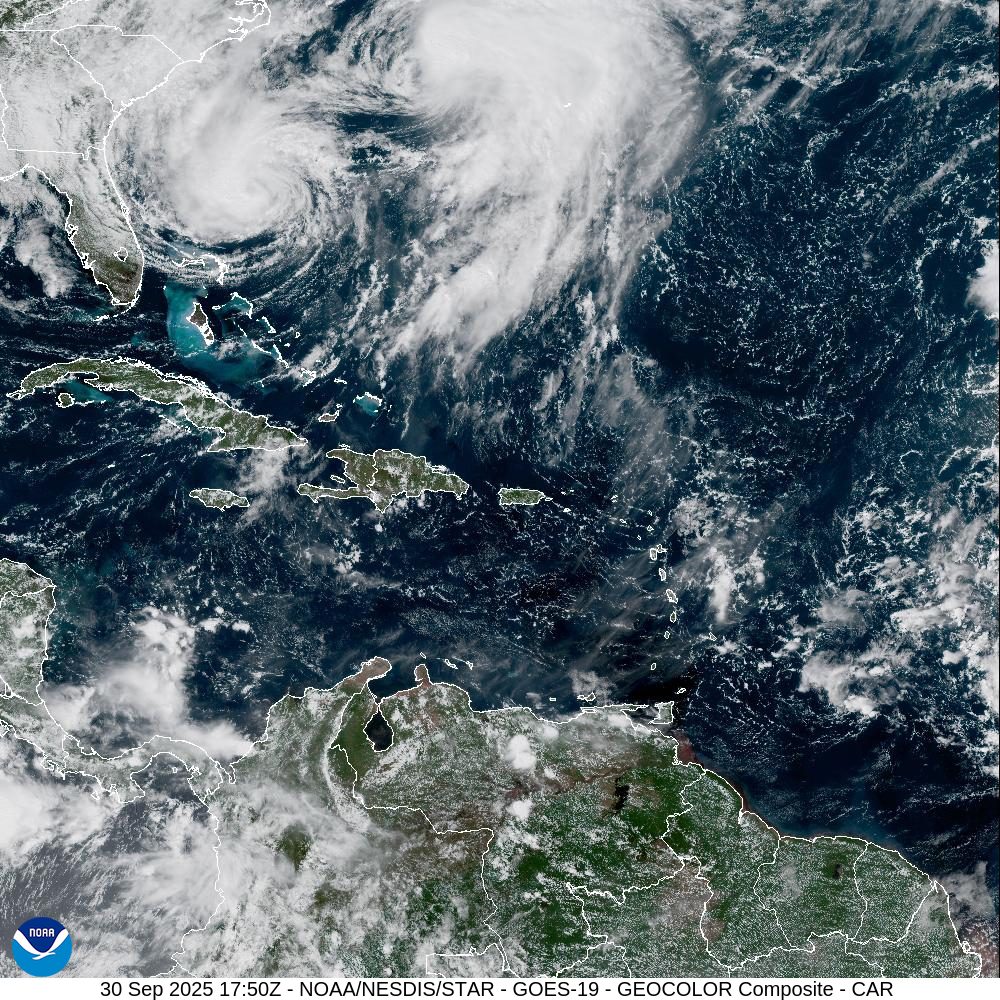
As of Tuesday afternoon, hurricanes Imelda and Humberto remained active in the Atlantic, several hundred miles apart. Imelda, a Category 1 hurricane near the Bahamas, is forecast to pass near or directly over Bermuda on Wednesday, where a hurricane warning is in effect. Humberto, also a Category 1 hurricane, was located farther north, west of Bermuda. Areas across the Bahamas, Bermuda, and portions of the southeastern U.S. are expected to continue experiencing impacts from the storms, including rainfall and gusty winds.
On Tuesday, the NHC was monitoring hurricanes Imelda and Humberto in the Atlantic. While neither storm will directly affect the USVI and Puerto Rico, the storms are expected to generate choppy seas around the local islands. (Photo courtesy NHC and NWS)
Neither system poses a direct threat to the U.S. Virgin Islands or Puerto Rico. However, swells generated by the storms will produce choppy seas across much of the Atlantic basin, and marine conditions will be rough across the local region.
Imelda, which initially was designated Invest 94L as it passed across the USVI and Puerto Rico last week, brought wind and rainfall to areas of the Bahamas over the weekend. As of Tuesday evening, the cyclone was packing winds of approximately 90 mph and is forecast to continue strengthening as it travels toward Bermuda.
Official Forecasts from the National Hurricane Center
“At 5:00 p.m. EDT, the center of Hurricane Imelda was located near latitude 29.4 North, longitude 75.5 West. Imelda is moving toward the east-northeast near 12 mph,” the NHC said. “A generally east-northeastward motion at a faster forward speed is expected over the next couple of days. On the forecast track, the center of the hurricane will approach Bermuda Wednesday afternoon. Maximum sustained winds are near 85 mph with higher gusts. Some additional strengthening is forecast during the next day or so.”
Visible satellite imagery obtained at 1:50 p.m. on Tuesday shows Hurricanes Imelda and Humberto north of the U.S. Virgin Islands and Puerto Rico. (Photo courtesy NOAA)
The NHC also noted that Hurricane Humberto is forecast to remain over open water and will gradually lose strength as it passes west of Bermuda.
At 5:00 p.m. AST, the center of Hurricane Humberto was located near latitude 34.0 North, longitude 69.5 West. Humberto is moving toward the north near 17 mph. A turn to the northeast is expected later today, followed by a faster east-northeast motion on Wednesday and Thursday. On the forecast track, the center of Humberto will pass west of and then north of Bermuda today and Wednesday. Maximum sustained winds are near 80 mph with higher gusts. Continued weakening is forecast and Humberto is expected to become a strong extratropical system on Wednesday,” according to the NHC.
Some wind and rain impacts are still expected across Bermuda, and the storm will continue to generate choppy seas throughout much of the Atlantic basin.
“Swells from Humberto are likely to cause dangerous surf and life-threatening rip current conditions, affecting beaches of the northern Caribbean, Bahamas, Bermuda, and much of the east coast of the United States over the next several days,” the NHC said.
Local Impacts for the Virgin Islands and Puerto Rico
On Tuesday afternoon, the Source spoke with Manuel Ramos-Rodriguez, a meteorologist at the National Weather Service in San Juan, Puerto Rico, about the two hurricanes positioned north of the U.S. Virgin Islands and Puerto Rico. Ramos said that while neither storm is expected to directly impact the islands, both Imelda and Humberto are forecast to generate rough seas and an elevated risk of rip currents later this week. Marine alerts may be issued as conditions develop.
“A large, long-period northerly swell arriving by late Thursday night will promote hazardous marine and beach conditions across the islands, persisting through at least Sunday or early next week,” the NWS warned. A period of a swell indicates the time between breaking waves.
Hurricane Expert Insight
The Source also reached out to Alex DaSilva, AccuWeather’s lead hurricane expert, to learn more about Imelda and Humberto, as well as any potential tropical weather threats in the coming days.
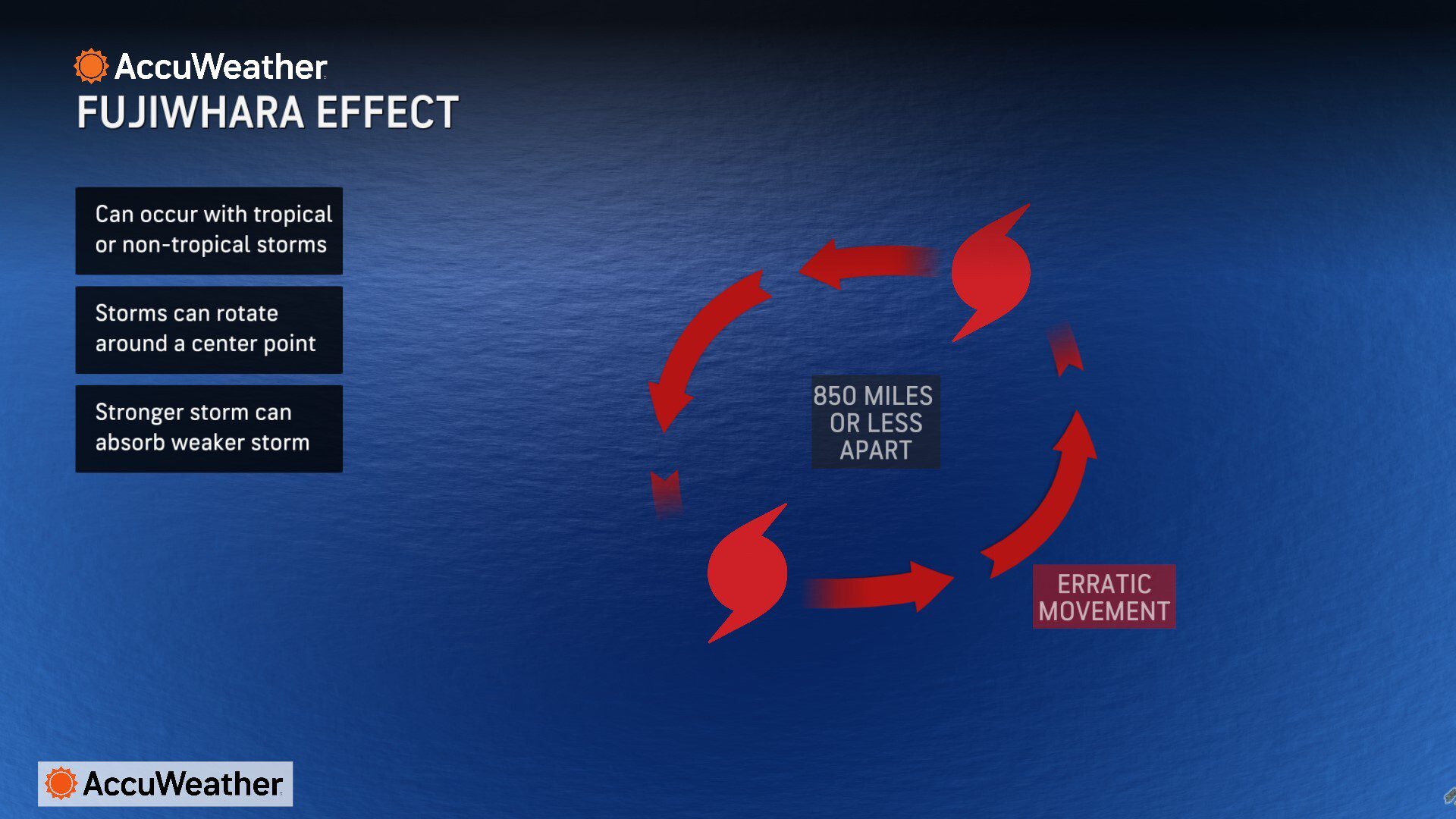
DaSilva explained that hurricanes Imelda and Humberto have been interacting in a relatively rare fashion, known as the “Fujiwara Effect,” named after a Japanese meteorologist, which occurs when nearby storms influence each other’s movement.
The National Oceanic and Atmospheric Administration explained the following information about the Fujiwara Effect phenomenon:
“When two hurricanes spinning in the same direction pass close enough to each other, they begin an intense dance around their common center. If one hurricane is a lot stronger than the other, the smaller one will orbit it and eventually come crashing into its vortex to be absorbed. Two storms closer in strength can gravitate towards each other until they reach a common point and merge, or merely spin each other around for a while before shooting off on their own paths. In rare occasions, the effect is additive when the hurricanes come together, resulting in one larger storm instead of two smaller ones.”
In a separate interview in LiveScience, DaSilva explained that “the influence from the much stronger and larger Humberto will tug at Imelda and help pull the storm away from the U.S. and out to sea.”
“The Fujiwara Effect is occurring right now, as Imelda and Humberto are about 500 miles apart, well within the 850-mile threshold for this to happen,” DaSilva told the Source on Tuesday. “It’s quite rare for this to occur in the Atlantic basin and is more common in the Western Pacific, where there are more space and more storms in an average year. The last notable Fujiwara Effect in the Atlantic I can recall was in 2016 with hurricanes Matthew and Nicole.”
A graphic explaining the Fujiwara Effect, a phenomenon currently occurring due to the proximity between Hurricanes Imelda and Humberto. (Photo courtesy AccuWeather)
“These interactions can make forecasting much more challenging, because storm tracks become more erratic. We know storms rotate counterclockwise around each other, but they can wobble and shift in unpredictable ways, which can cause model uncertainty,” DaSilva added.
While the Fujiwara Effect has influenced Imelda’s trajectory, forecasters had not anticipated the two storms merging. However, a merger remains possible as Imelda intensifies and Humberto weakens.
Possible Cyclonic Development in October
The Atlantic hurricane season lasts for approximately two more months, officially ending on November 30. DaSilva noted that there is still plenty of time for tropical development to occur, including the potential for systems to organize and possibly affect the local islands, especially through the middle of October.
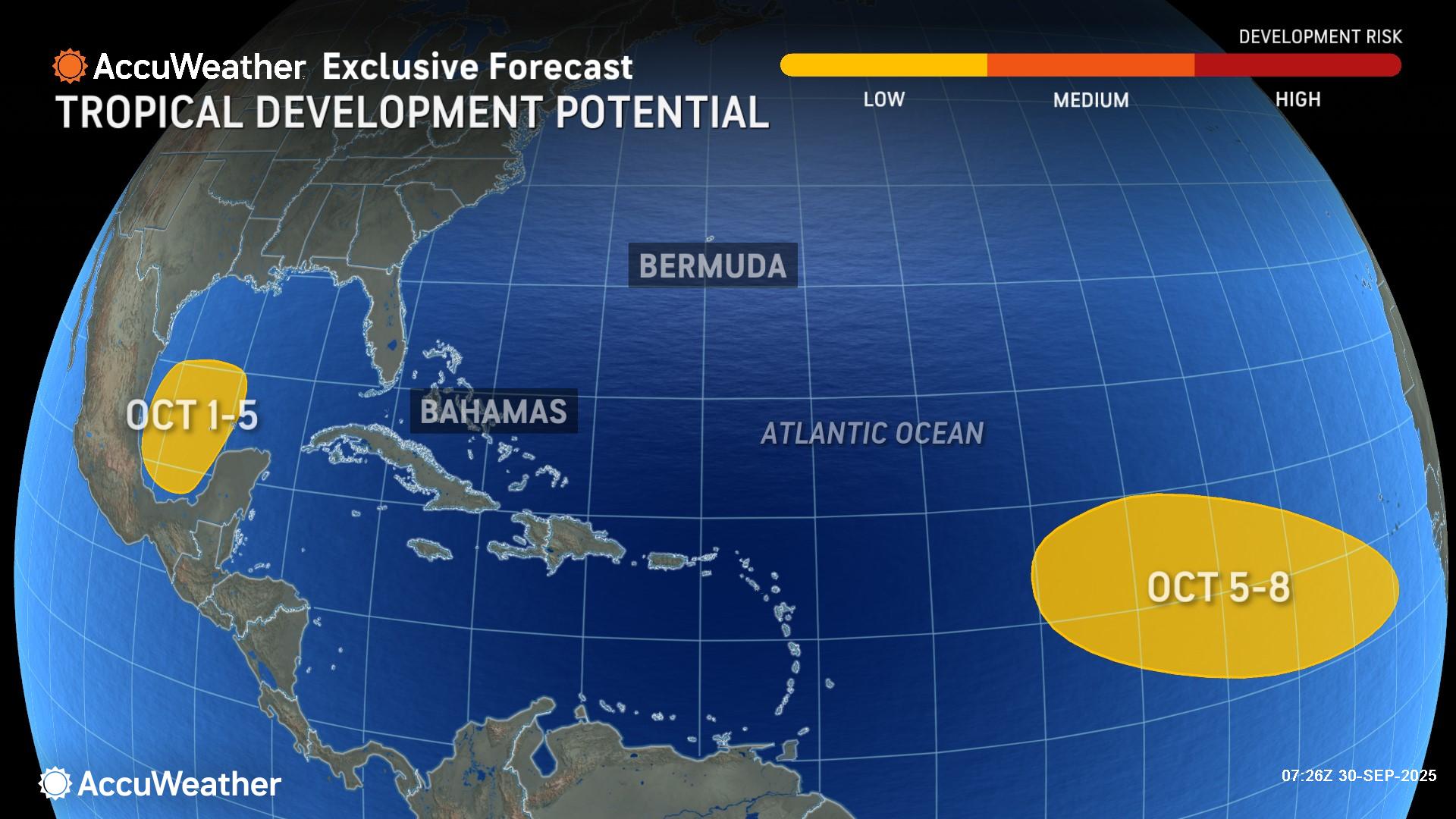
AccuWeather meteorologists have highlighted two areas of possible development during the first week of October, including a tropical wave expected to emerge off the west coast of Africa in the coming days. (Photo courtesy AccuWeather)
Notably, he advised individuals across the Caribbean to keep an eye on a tropical wave that is forecast to emerge off Africa this week for possible organization.
“We’re still in the tropical wave season, which usually continues through mid-October,” DaSilva said. “AccuWeather meteorologists are watching a tropical wave expected to move off Africa in the next couple of days, and some models are hinting at development. However, overall, the chance looks low because of wind shear ahead of it, and if it does develop, it wouldn’t be until after Oct. 8. Therefore, any potential impact to the U.S. Virgin Islands would be at least 10 days away. It’s still very far out, but it’s worth monitoring,” he emphasized.
“After mid-October, the number of tropical waves coming off Africa drops off significantly, and climatology tells us it becomes much harder for storms to develop in the eastern Caribbean,” DaSilva stated. “That said, we have seen storms as late as November, and with waters still quite warm this year, we can’t say the chance is zero. While the odds of impact to the Virgin Islands are lower after October 15, we still need to keep watch through the end of the season.”
A Potentially Busy Second Half of the Season
DaSilva reported that forecasters are still expecting a potentially active period of tropical activity through the remainder of the season. He also shared an update on the current conditions of the El Niño-Southern Oscillation, which can affect cyclonic development across the Atlantic.
“We still anticipate a busy second half of the season, and we’re seeing signs that the atmosphere is starting to behave like a La Niña as waters in the eastern Pacific cool,” DaSilva confirmed.
“That tends to reduce wind shear and can allow for more storm development late in the season. Last year, this type of weather pattern led to a very active October and November, and while I don’t think it will be quite as busy this year, we could still see some significant storms. I’m especially concerned about the Western Caribbean and the Gulf, where waters remain largely untouched. Those areas could support explosive development if the right conditions come together,” he concluded.
NOAA Global Tropics Hazards Outlook
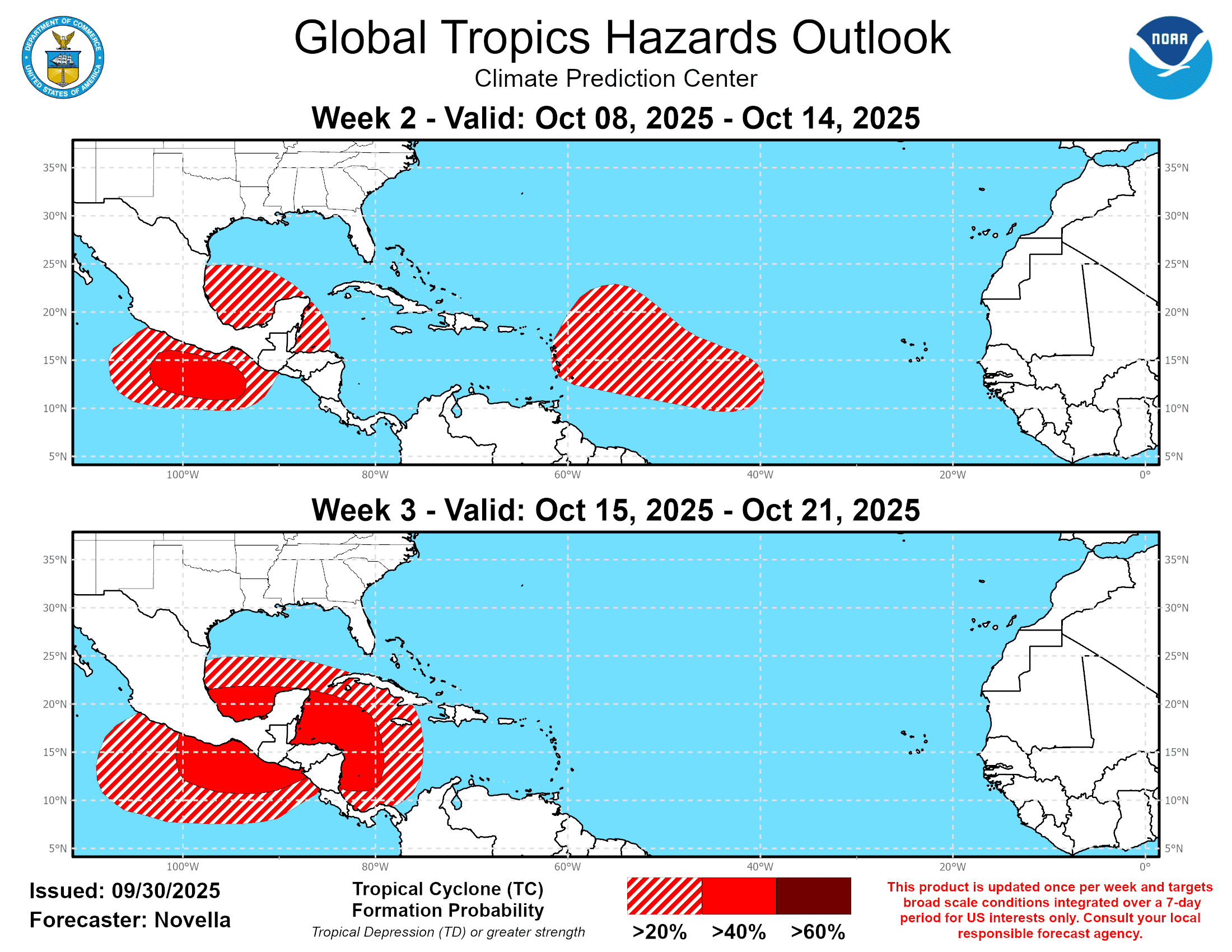
According to a Global Tropics Hazards Outlook released Tuesday, there will continue to be an elevated chance of cyclonic development across portions of the Atlantic basin in the coming weeks. The forecast tool, which is issued every Tuesday by NOAA’s Climate Prediction Center, provides insight into potential activity across tropical basins up to three weeks in advance.
NOAA’s Climate Prediction Center released its weekly Global Tropics Hazards Outlook on Tuesday, Sept. 30. NOAA highlighted areas across the Atlantic basin and Eastern Pacific basin as having increased chances for tropical activity in October. (Photo courtesy NOAA)
In its latest update, NOAA said that areas across a portion of the Main Development Region of the Atlantic basin – the zone between the west coast of Africa and the Caribbean – may experience a 20-40% chance of tropical development during the “Week Two” outlook period, which runs from Oct. 8 until Oct. 14. Development is not forecast across the Main Development Region in the “Week Three” outlook, running from Oct. 15 through Oct. 21.
However, according to the forecast, areas across the Western Caribbean Sea and the Gulf are likely to see an elevated chance of tropical cyclogenesis at times in October.
Additionally, the Eastern Pacific basin, which remains active, is also expected to experience an increased risk for cyclonic development in the coming weeks.
Local Weather Information and Staying Informed
Finally, the NWS has reminded residents and visitors of ongoing weather-related threats for Puerto Rico and the USVI, including the possibility of showers and thunderstorms, as well as very warm temperatures, which could prompt heat alerts across the region.
Additionally, marine conditions will be hazardous due to nearby tropical systems, and marine alerts may be issued in the coming days.
The forecast can change very quickly, and USVI residents and visitors are encouraged to continue to remain prepared. Weather information is available from the NWS, the NHC, and NOAA.
The local weather forecast for the U.S. Virgin Islands is also regularly updated on the Source Weather Page and VI Source YouTube Channel. Additionally, A weekly Tropical Outlook article from the Source will be published throughout hurricane season to provide in-depth updates.
Residents and visitors can find additional weather alerts and preparedness information from the Virgin Islands Territorial Emergency Management Agency.
Police arrested 52-year-old Shelva Smith Sunday on St. Coix after an investigation revealed she caused second-degree burns to a juvenile by holding the child’s hand over a hot stove, the Virgin Islands Police Department reported.
At about 4:28 p.m., the 911 Emergency Call Center received a report of a child with burns to the right hand. A detective from the Criminal Investigation Bureau was assigned to the case and determined that Smith was responsible for the injuries, according to the police report.
Smith was at the Wilbur Francis Command Police Station when she gave a statement. She was then arrested on a charge of child abuse, booked and transported to the John Bell Correctional Facility after bail was set at $60,000. She remains in custody pending her advice of rights hearing, the police report stated.
Police arrested 23-year-old Dekyle Fessale on Sept. 25 after a reported disturbance in Smith Bay, St. Thomas, involving a gun and a knife, the Virgin Islands Police Department reported.
At about 6:12 a.m., officers were dispatched after a man reported that he had been threatened. The victim told police he was in a verbal altercation with his girlfriend’s son, Fessale, when Fessale allegedly brandished a gun. The victim said Fessale later returned with a knife and charged at him, the police report stated.
After interviewing the victim, officers arrested Fessale on charges of third-degree assault, brandishing a dangerous weapon and disturbance of the peace. Bail was set at $25,000, the report stated.
The case remains under investigation. Police ask anyone with information to contact 911, the Criminal Investigation Bureau at 340-774-2211, or the Office of the Police Chief.
Police arrested 37-year-old Jeuris Zabala-Ramirez early Monday on St. Croix in connection with a stabbing that left a man hospitalized with serious injuries, the Virgin Islands Police Department reported.
At about 2:48 a.m., officers were dispatched to the Juan F. Luis Hospital emergency room after a man arrived in a private vehicle with a stab wound to his arm. The victim was admitted for treatment, police said.
Detectives from the Criminal Investigation Bureau identified Zabala-Ramirez as the suspect. He was arrested at his home, advised of his rights and admitted to assaulting the victim, the police report said.
Zabala-Ramirez faces charges of first-degree assault, third-degree assault and use of a dangerous weapon during a crime of violence. He was booked and held on $100,000 bail. Unable to post bond, he was remanded to the John A. Bell Golden Grove Adult Correctional Facility pending his advice of rights hearing, the report said.
St. Thomian All-Star Aliyah Boston and teammates Bree Hall, Aerial Powers, and Shey Peddy can hardly contain their excitement during the Indiana Fever’s dominant playoff performance. (Photo courtesy Indiana Fever)
The Indiana Fever refused to let their season end Sunday, delivering a 90-83 victory over the second-seeded Las Vegas Aces at Gainbridge Fieldhouse to force a decisive Game 5 in their WNBA semifinal series.
All-Star center-forward Aliyah Boston posted the best postseason performance of her career with 24 points, 14 rebounds, five assists, two steals and two blocks, while Kelsey Mitchell added 25 points in the must-win game. The sixth-seeded Fever, who rallied from consecutive losses to even the series at 2-2, will face the Aces Tuesday night at Michelob Ultra Arena in Las Vegas at 9:30 p.m. ET.
For Cleone Boston, watching her daughter rise to the occasion has been nothing short of surreal. “This story is being written by God,” Cleone Boston said in an exclusive interview following the game. “Nobody expected them. Who would’ve even prepared to play against the Fever?”
She referenced the biblical story of Gideon’s 300, where a vastly outnumbered army achieved victory through faith and belief. It’s a theme that has resonated throughout the Fever locker room and extends far beyond the basketball court, according to Aliyah’s mother.
“When you believe, it doesn’t matter who else doesn’t believe,” she said. “And that goes beyond sports.”
Before the game, Boston’s father Algernon Boston sent a text to his daughter with simple instructions: “Leave it all out on the floor.” She delivered exactly that, playing with aggression and poise while anchoring both ends of the court.
For Cleone Boston, watching her daughter’s growth has been as rewarding as the victories themselves. The journey from a nine-year-old playing with boys on the Zero Tolerance team on St. Thomas to a WNBA All-Star has exceeded even their most optimistic projections.
“All we were looking for was a scholarship,” she said, recalling when she and her husband sent Aliyah and her sister Alexis to a three-week basketball camp in Milton, Massachusetts, when they were 10 and 12 years old. “We told them at ages nine and 11 that they weren’t paying for college. That was as far as we’d thought about it.”
But as Aliyah’s talent became undeniable, the vision expanded. Once she reached college at South Carolina, where she won an NCAA championship among several other national accolades, the WNBA dream crystallized. She decided she wanted to be the best and set her sights on being the number one draft pick, a goal she achieved in 2023.
This postseason has accelerated her development as a leader. Cleone Boston has noticed her daughter’s increased maturity in handling the mental challenges that come with playoff basketball.
“She analyzes everything,” Cleone Boston said. “She’s taking it in stride a lot more this year than before. She’s getting better at compartmentalizing.”
No matter how dominant a performance, Boston still spends her free moments post-game dissecting missed opportunities. But this year, she’s learning to process and move forward.
“She’s staying very levelheaded, very motivated. She’s learning to leave things when it’s time to leave them,” Cleone Boston said of her daughter, who opted to film a podcast episode the night before Game 5 instead of rewatching film.
Boston’s mindset heading into the series-deciding game reflects the same confidence that carried the Fever through Sunday’s elimination game. “I know nobody expects us to be here,” Aliyah said, “But now that we’re here, we need to just win!”
Taking Game 1 of the series gave Indiana the cushion of knowing they had multiple chances. When they dropped Games 2 and 3, facing elimination on their home court, they responded with their best performance of the series.
“It’s very motivating and encouraging to watch,” Cleone Boston said. “They don’t give up, no matter what people say. They’re choosing to believe that anything is possible despite what it looks like.”
The support from back home on St. Thomas has been overwhelming. Cleone Boston checks her phone after games to find 40-plus text messages from friends on island watching one of their own compete on a national stage.
“For anybody back home watching, I hope they’re encouraging their children to watch,” she said. “Make sure they see that coming from a 32-square-mile island doesn’t limit you. You win or lose in your mind before any place else.”
Tune in on ESPN2 to find out whether Aliyah Boston and the Fever will advance to the WNBA Finals.
The U.S. Virgin Islands delegation, led by Commissioner Nominee Jennifer Matarangas-King of the Tourism Department, highlighted the territory’s expanding air service and strategic growth during Routes World in Hong Kong, a press release announced.
Throughout the weeklong event, the delegation held talks with major airlines including Delta, JetBlue, Porter and Volaris, as well as Scandinavian Airlines and the Denver International Airport Authority, with discussions centered on boosting connectivity — particularly for St. Croix — and strengthening existing routes, according to the press release.
Matarangas-King said the positive feedback reinforced the territory’s position as a growing force in the aviation sector. “The Department of Tourism’s participation at Routes World 2025 showcased not only the territory’s strategic prowess, but also its inherent growth potential,” she said. “Airline and industry partners from across the globe are seeing the U.S. Virgin Islands as a preeminent destination, drawn by its rich cultural heritage, pristine natural beauty, and robust infrastructure that supports both leisure and business travel.”
Former Commissioner Joseph Boschulte, who joined a keynote panel alongside representatives from Orlando Airport and Barcelona Tourism, emphasized the USVI’s record-breaking arrivals and reduced seasonality. “The growth in arrivals into both St. Croix and St. Thomas continues to trend upward with the retention of more year-round service,” Boschulte said. “Sustained support from our airline partners combined with continued strategic marketing efforts emphasize the promising outlook for tourism in the U.S. Virgin Islands.”
That growth is expected to accelerate during the winter 2025–26 season. St. Croix is projected to see a 16% increase in seats from the continental U.S., with American Airlines leading a 29% jump, including a new Saturday service from Chicago beginning Dec. 6. JetBlue will add 52% more seats into the market, the press release stated.
St. Thomas will also post record gains with a nine percent year-over-year increase in overall capacity, highlighted by Delta’s 33% boost into the market, American’s 15% increase, and United’s 14% rise. New service will include Southwest flights to Baltimore and Orlando, Delta service to Boston, Contour to Dominica, and Cape Air to St. Barth, the release stated.
The additional service represents the territory’s strongest winter airlift to date, with new gateways from Boston, Chicago, Miami, Charlotte and Washington, D.C. As the season approaches, the Department of Tourism said it remains committed to sustaining momentum and deepening partnerships that keep the U.S. Virgin Islands among the Caribbean’s fastest-growing destinations for air service, it stated.
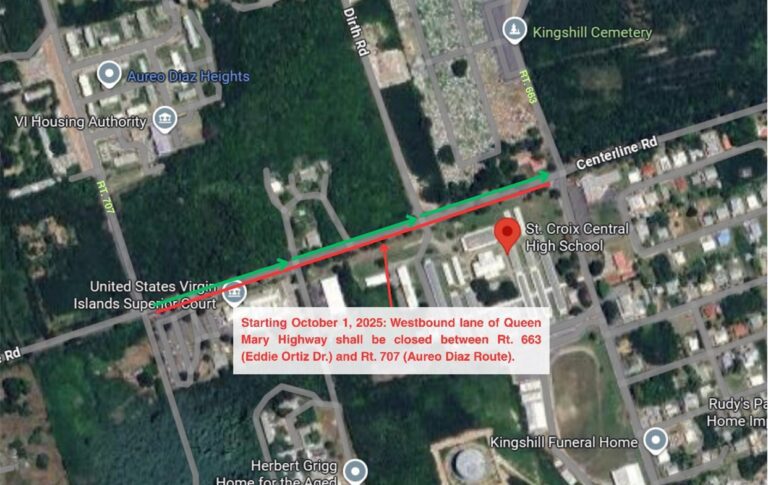
The Virgin Islands Water and Power Authority advises motorists that beginning Wednesday, Oct. 1, at 9 a.m., the westbound lane of Queen Mary Highway/Centerline Road, from the traffic light at Route 663 (Eddie Ortiz Drive near Central High School) to the intersection of Route 707 (Aureo Diaz Heights), will be closed to traffic.
(Water and Power Authority)
The closure is necessary to allow WAPA’s contractor, J. Benton Construction, to trench across the roadway and install an electrical duct bank as part of the Queen Mary Highway Electrical Undergrounding Project.
Access to the Superior Court, Curriculum Education Center, Herbert Grigg Home for the Aged, and Head Start facilities will be available from the west, at the intersection of Route 707 (Aureo Diaz Route) and Route 70 (Queen Mary Highway/Centerline Rd).
WAPA encourages drivers to plan alternate routes to avoid delays. Motorists are reminded to observe posted speed limits and follow the instructions of flaggers directing traffic safely through the construction area.
We appreciate the community’s patience and cooperation as we continue our efforts to improve the reliability and safety of electrical service.