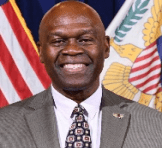
Issues of violent crimes, especially those involving guns, domestic violence and sexual and physical assault continue as popular talking points throughout the Territory.Moleto A. Smith Jr., director of the U. S. Virgin Islands Law Enforcement Planning Commission
From a public policy perspective, these types of violent offenses traumatically impact the community’s perception of safety and its confidence in the justice system.
On one hand, national and local indicators of crime trends reveal that violent crimes are decreasing. For example, the 2023 Crime in the Nation Statistics, released by the Federal Bureau of Investigation (FBI) on September 23, 2024, indicates nationally violent crimes decreased by about 3.0% in 2023 compared to 2022 estimates, with the largest decreases in the following areas:
Murder and non-negligent manslaughter (– 11.6%)
Rape (– 9.4%)
Aggravated assault (– 2.8%)
Robbery (– 0.3%)
Similarly, according to the “Criminal Victimization, 2023”, published by the United States Department of Justice (USDOJ) Bureau of Justice Statistics:
In 2023, there were 22.5 violent victimizations per 1,000 persons age 12 or older in the United States, which was similar to the 2022 rate.
The rate of violent victimization excluding simple assault for males decreased from 9.5 per 1,000 persons in 2022 to 6.9 per 1,000 in 2023.
Robbery victimizations reported to the police indicate a decrease in percentage during 2023 (42%) than in 2022 (64%).
Locally, data from the Virgin Islands Police Department (VIPD) show percentage decreases in reported cases of Rape (-31%) and Burglary (-14%), and percentage increases in reported cases of Felony Assault (+28%), Robbery (+20) and Homicide (+19%) during Calendar Year (CY) 2024 compared to CY 2023.
On the other hand, while the official records may show downward trends, unofficially the community’s perception of safety may more likely be shaped by the interpersonal relations that persons may have, either directly or indirectly, with victims of violent crimes, including victims of crimes that may go unreported, underreported or unresolved through the justice system. These data are often reported to community-based organizations that aids crime victims.
Victim assistance providers funded by the U.S. Virgin Islands Law Enforcement Planning Commissioner (LEPC), reported that between October 12, 2017 and January 3, 2023:
15,000 individuals received services, of which 9,151 were new individuals
6,600 individuals for Domestic and/or Family Violence
1,100 individuals for Adult Physical Abuse
1,000 individuals for Adult Sexual Assault
400 individuals for Child Sexual Assault
800 individuals as Survivors of Homicide Victims
Additionally, a high number of persons received trauma-related support services for their exposure to these crimes: Counselling and crisis intervention – 13,000 persons; emotional and safety support – 6,300 persons.
So, what is trauma? The American Psychological Association (APA) defines trauma as any disturbing experience that results in significant fear, helplessness, dissociation, confusion, or other disruptive feelings intense enough to have a long-lasting negative effect on a person’s attitudes, behavior, and other aspects of functioning. Traumatic events are typically significant ones, such as violence, sexual and physical assault, or accidents that often challenge an individual’s view of the world as being safe, just and predictable. The trauma from being a victim of a violent crime, including Post Traumatic Stress Disorder (PTSD), secondary and vicarious trauma, and collective trauma, is known to negatively influence a person’s perception of being safe in the community.
What is vicarious or secondary trauma? Vicarious or secondary trauma, according to the American Counselling Association (ACA), is the emotional residue of being exposed to traumatic stories and experiences of other people through work, witnessing fear, pain, and terror that others have experienced. This type of trauma may significantly impact a small community, like the Virgin Islands. Impacts may include heightened stress and disruption to community dynamics affecting the overall well-being of community members, as well as the overall perception of community safety.
What is collective trauma? The American Medical Association (AMA) refers to collective trauma as traumatic events that affect an entire group or society and/or sever ties that bind community members to each other, such as safety, trust, connection and meaning. Instances of collective trauma encompass natural disasters, terrorist acts and shootings.
The trauma from violent crimes may be compounded by the collective trauma associated with the exposure to two (2) Category 5 hurricanes (Irma and Maria, September 2017) within two (2) weeks, and the COVID-19 Global Pandemic (March 2020 – May 2023) that the community continues to experience. A March 2022 research study published in the European Journal of Psychotraumatology provides informative key takeaways that may be applicable to the situation in the Territory. The study establishes that the combination of one or more natural disasters with COVID-19 trauma increases the prevalence and severity of the following conditions:
Likely Generalized Anxiety Disorder (GAD) and the severity of anxiety symptoms in residents. (GAD is a mental health condition characterized by excessive worry and fear about everyday issues.)
Likely Major Depressive Disorder (MDD) and the severity of depression symptoms in residents. (MDD is a mental health condition that causes a persistently low or depressed mood and a loss of interest in activities that once brought joy.)
Likely Post Traumatic Stress Disorder (PTSD) and the severity of PTSD symptoms in residents. (PTSD is a mental health condition that can develop after witnessing a traumatic event, such as a natural disaster, serious accident or violence. Symptoms include flashbacks, nightmares, severe anxiety and uncontrollable thoughts about the event.)
Low resilience symptoms in residents.
Where we go from here: Considerations for reshaping public policy on community safety
For many community members, including victims of violent crimes and their families, the perception of community safety and the status of public policy on community safety are misaligned. The following trauma-related factors should be considered in Virgin Islands public policy on community safety:
(1)Collective trauma must be considered as a foundational factor in reshaping public policy. The cascade effect of traumatic events over the past eight (8) years, coupled with a community perception of safety strongly influenced by the interpersonal relations that community and family members have with violent crime victims, especially victims of crimes that may go unreported, underreported or unresolved, are important factors that cannot be ignored.
(2)There is a well-established link between trauma and criminal behavior. Therefore, trauma-informed interventions to crime prevention, offender rehabilitation, community involvement and education, to include mental health support and education, are necessary factors in addressing the root causes of criminal behavior. These factors must be considered in reshaping public policy.
(3)Law enforcement workforce training in key aspects of trauma-informed policing should be considered in reshaping public policy. Law enforcement interventions, including data-driven and technology-driven initiatives to reduce incidents of violent crimes and increase the likelihood of apprehending perpetrators, should be complemented by a law enforcement workforce that is well trained in key aspects of trauma-informed policing as a proven approach that improves interactions with violent crime victims, develops community trust and fosters greater confidence in reporting incidents.
(4)Allocating the necessary financial and other resources to support successful cross-agency collaborations across the justice system must be considered as required in reshaping public policy. On-going cross-agency collaborations across the Virgin Islands justice system should incorporate trauma as planning and implementation principles and align necessary resources, accordingly.
The negative impact of trauma, whether direct, vicarious, secondary, collective or otherwise, on violent crimes in the Territory is real. It extends across the justice system and influences perpetrators, victims, service providers, law enforcement personnel and others who interact with, work in or are involved with the justice system. It also plays an unspoken, oftentimes invisible, role in shaping the community’s perception of safety and its trust and confidence in the
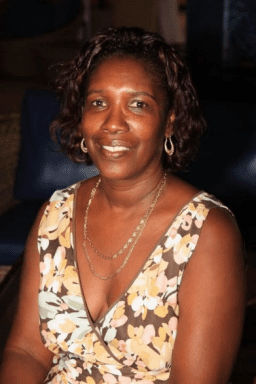
Valerie L. Williams a.k.a. “Vally” of St. Croix U.S.V.I. transitioned into eternal life on July 28, 2025.She was 66 years old.Valerie L. Williams
She was preceded in death by her son, Franklin Johnson Jr.; Father, Federico M. Williams; Sister, Dale Goodwin; Brother, Federico Williams Jr.; Aunt, Silva Gibbs; Uncle, Sanford M. Ford.
She is survived by her Mother, Asta Williams; Daughters, Nyra Rodgers and Nyisha Francis; Sons, Akil Thomas, Saeed Payne, Nybo Rodgers; Grandchildren, Eryn Rodgers, Avin Wells, Amir Wells, Astanna Payne and Kijahni Thomas; Sister, Rosalyn Williams; Brothers, Craig Williams Sr. and Elston Williams; Nieces, Kamirah and Sapphira Hendricks, Utashe Spencer, JKiwa and Jsshra Goodwin, Jawana Goodwin-Page, Ellisha and Addisha Williams, Nasha Williams; Nephews, Jeffrey Petersen, Jade Goodwin, Joshua Spencer, Jnuru Goodwin, Hapma Williams, Symandi Horsford, Craig Williams Jr., Nasheem Williams, JKendai Goodwin, Tyrone Baxter, Jabari Goodwin; Aunts, Linda McIntosh, Eunice Edwards, Marlene Hanley; Uncles, Winston Williams Sr., Warren Williams, Eugene Hanley, Leroy Hanley; Daughter-In-Law, Sharon Payne; Sister-In-Law, Stephanie “Piedy” Williams; Godparents, Claude and Pauline Richards, Neville and Mary Lee, Norman Richards, Eileen Martin; Godchildren, Chenelle Hendricks, Okeya Milligan, Lychelle Lynch, Eljo Brooks, Rasheed Milligan, Kamilya Barnes, Rayanna Rawlins. Other relatives and friends too numerous to mention.
Funeral service will be held on Wednesday, Aug. 27 at St. Paul’s Episcopal Church, Frederiksted St. Croix U.S.V.I. Tributes will begin at 9 a.m. with service at 10 a.m. Interment will follow at Frederiksted Cemetery.
Professional services are entrusted to James Memorial Funeral Home, Inc.
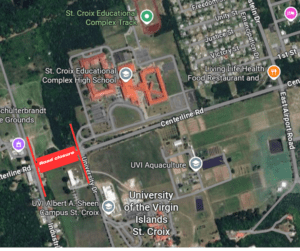
The Virgin Islands Water and Power Authority notifies the public that traffic adjustments along Queen Mary Highway/Centerline Road will extend through mid-September due to the complex installation work required as part of the Electrical Underground Project by J. Benton Construction.
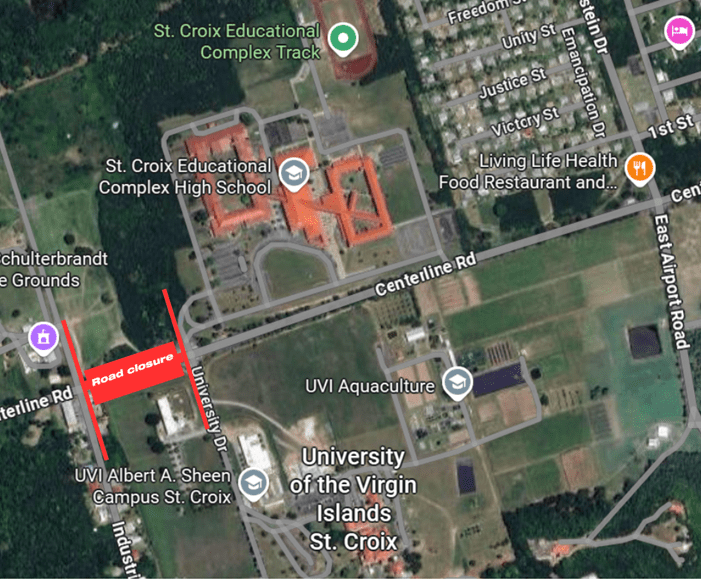
Map of the Queen Mary Highway:Centerline Rd. section that closed on August 14, 2025, and is expected to reopen in mid-September.
The affected segment of Queen Mary Highway/Centerline Road stretches from the University of the Virgin Islands (UVI)/St. Croix Educational Complex High School (SCECHS)/Career and Technical Education Center (CTEC) traffic light to Industrial Road/Upper Love Road. The road closure in both directions will remain in effect until the current phase is completed.
As part of these changes, westbound traffic entering Queen Mary Highway at the Castle Burke traffic light/East Airport Road will continue to be limited to accessing UVI, CTEC, and the St. Croix Educational Complex.
All traffic changes will be clearly marked to help drivers navigate the area safely.
WAPA encourages residents to stay informed by signing up for WAPA Alerts, which provide real-time notifications on this project and other important announcements. Registration is available at: https://member.everbridge.net/index/892807736728730#/signup.
The Authority thanks the community for its continued patience and cooperation as we work to build a more resilient electrical infrastructure.
The Virgin Islands Water and Power Authority Communication’s department is committed to reaching, informing, and connecting with the youngest members of the community to the eldest, through meaningful, transparent and effective communication.
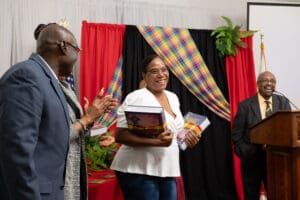
The deadline to submit your pre-order for copies of the Virgin Islands Civics textbook has been extended to Aug. 31. Don’t miss this opportunity. The Virgin Islands Civics textbook is designed to empower students not only to learn about civics but to live it, equipping them to become active, informed citizens of the U.S. Virgin Islands.
Jamila Russell holds two copies of the U.S. Virgin Islands edition of the Social Studies Civics textbook during an unveiling ceremony on Saturday at Government House on St. Croix. (Source photo by Kit MacAvoy)
Interested parties may submit their pre-order using the following form: https://bit.ly/43QJedY.
Please note that all payments and delivery arrangements will be coordinated directly with the printer. For more information, contact the Virgin Islands Department of Education State Office of Instructional Development at (340) 773-1095, ext. 7086.
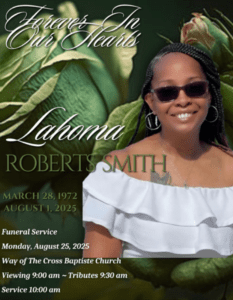
Forever in our hearts.Lahoma Roberts Smith
Lahoma Roberts Smith, of Eliza’s Retreat, passed away on August 1. She was 53 years old. Her service will be held at the Way of the Cross Baptist Church on August 25. The viewing will begin at 9 am, tributes at 9:30 am, and the service will start at 10 am.
Interment will be held at Kingshill Cemetery.
Professional services entrusted to James Memorial Funeral Home.
Friends and relatives are advised of the passing of Simeon “Sancoch” Thomas, 62, of St. Thomas, U.S. Virgin Islands who passed away Thursday, July 10, 2025.
Simeon Thomas
Sisters Juliana “Julie” Baron (Sister) Severina “Pitty” Thomas (Sister) Delphina “Miss Thomas” Thomas (Sister) Virgin “Babygirl” Thomas-Blanc (Sister) Brothers Matthew “Blackpatch” Thomas (Brother) Jerrild “Jahboy” Thomas (Brother) Nieces Kelsha Baron Tasha Baron-Smith Donna Xavier Lisa Benika Katriana Nickez Nephews Barrington Baron Jelani Thomas Jevon Thomas Jahriel Thomas Joniah Henson Erie Jonah Andy Alain Sammy Nickel Nicky Grand Neice and Nephews Too many to mention (20+)
The funeral will be held Friday, Aug. 22. Viewing will begin at 9 a.m. Service starts at 10 a.m. at Turnbull Funeral Home.
Internment: Private.
Professional service entrusted by Turnbull’s Funeral Home and Crematory Services.
The lawyer for former OMB Director Jennifer O’Neal said he may file a motion for severance prior to jury selection on Dec. 3 (Source file photo)
During a Monday hearing in a pending federal bribery case, a lawyer representing former director of the Office of Management and Budget Jenifer O’Neal said he might ask the court to separate his client from her codefendant, former Police Commissioner Ray Martinez.
With four months to go to the start of a scheduled trial, a U.S. Magistrate Judge Alan Teague called on the prosecutor and defense attorneys to report Monday on their pretrial preparations.
O’Neal, along with Martinez, is accused of accepting unauthorized payments from a vendor providing cybersecurity services to government agencies, including the Virgin Islands Police Department. Jury selection for a trial where they are expected to appear as co-defendants is scheduled to begin Dec. 3.
Parties in the case appeared by way of livestream video in an open courtroom at the Ron deLugo Federal Building. Teague said he expected the trial to take about two-and-a-half weeks and that it was important for the legal teams to complete the discovery process on time. During discovery, the defense and the prosecution exchange evidence produced over the course of building their respective cases.
Attorney Dale Lionel Smith raised the prospect of filing a motion for severance as Monday’s hearing was drawing to an end. O’Neal’s lawyer raised concerns about information in the prosecutor’s possession that may prove favorable for Martinez. Specifically, Smith suggested the former police commissioner may have given a proffer statement to officials at the U.S. Attorney’s Office.
A proffer statement is one in which a defendant demonstrates knowledge about an alleged criminal activity; in some cases such a statement may help the individual gain a more favorable legal stance. It could also help the government challenge or refute statements made by other witnesses at trial.
Federal trial attorney Alexandre Dempsey did not dispute Smith’s claim about a proffer interview involving Martinez, and said the government had turned over all the required material. But he refuted a suggestion that prosecutors were withholding material that should have been turned over.
“The court does not require that handwritten notes are subject to discovery,” Dempsey said, adding that no such notes existed.
The magistrate commended the legal teams for working together cooperatively. At the same time, Teague raised concerns over how long it was taking to produce exchangeable documents containing statements by Martinez from a computer hard drive where they are stored.
“Why is it that it took a month for your office to get the documents into a readily accessible format?” Teague asked.
Martinez’s lawyer assured the court that he would return to the office within the next few days and personally supervise the production of documents.
Lawyers for both O’Neal and Martinez said they were doing their best to review large amounts of evidence as part of their trial preparations. “We are on our way to being prepared, judge. We have no choice but to be prepared for December 3,” Smith said.
Teague concluded the hearing by saying he did not expect lawyers to be ready by August for a December trial, but it was his duty to check on their progress.
If needed, he said, he would schedule another status hearing on Aug. 29. If not needed, he said, the next pretrial hearing would take place in October.
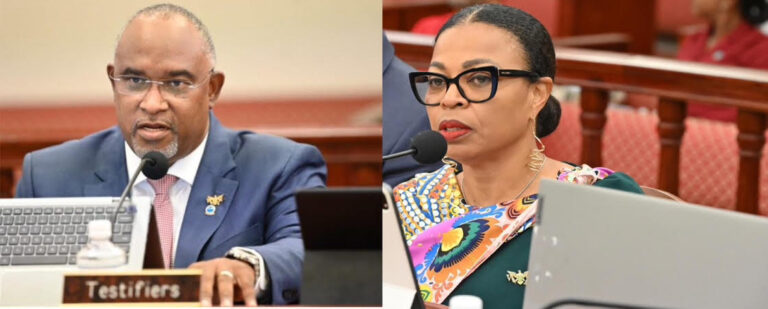
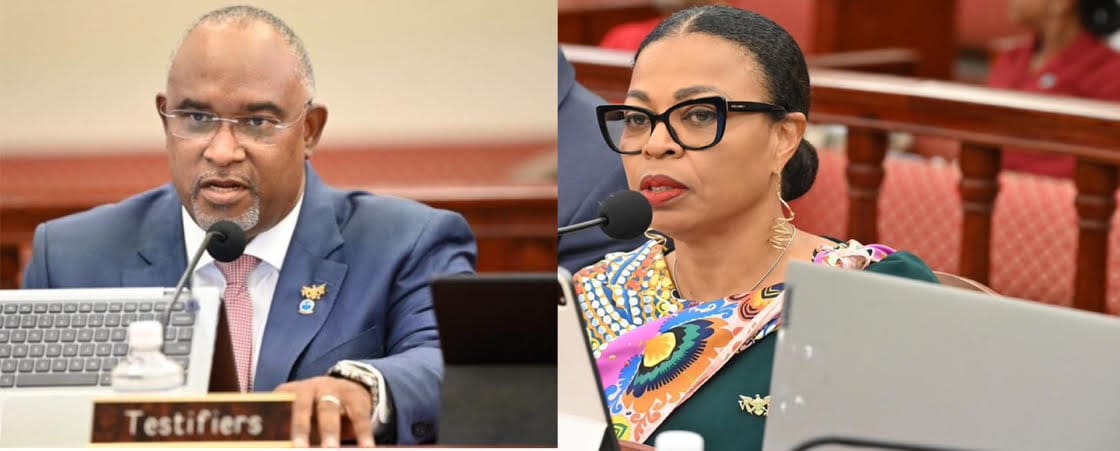
Broken sewage lines, sargassum piling on shoreline, a taxi industry running without enforcement officers and a cruise company struggling to keep pace with larger ships and rival ports: those were the realities laid out before senators Monday as the Senate Budget, Appropriations and Finance Committee weighed fiscal year 2026 budget requests from four key agencies.
From the Inspector General’s Office to the Magens Bay Authority, the Taxicab Commission, and West Indian Company Limited, the stories differed but the takeaway was the same: each faces a fight to keep essential pieces of the territory running.
Inspector General’s OfficeInspector General Delia Thomas urges lawmakers to maintain her office’s $2.9 million budget. (Photo courtesy Legislature of the Virgin Islands)
Inspector General Delia Thomas asked lawmakers to maintain her office’s $2.9 million budget — unchanged from last year — to support 20 filled positions and two vacancies. Most of the request, $2.38 million, is tied up in salaries and benefits, underscoring that the office is driven almost entirely by its people rather than large capital needs.
Thomas stressed that, despite its size, the office has delivered results. In the past year, it released an audit of the Education Initiative Fund that led to a revision of the governing law, ensuring schools receive fairer distribution of resources. It also completed an inspection of the Agriculture Revolving Fund that revealed more than $4 million in missed opportunities for the Department of Agriculture, a finding that spurred further scrutiny of funding practices. In addition, the office provided investigative support that resulted in the successful prosecution of a government employee. Eleven more assignments are in progress, ranging from audits of the Taxicab Commission to a slate of reviews into the Water and Power Authority’s billing, collections, contracting, and employee loan payments.
But Thomas did not downplay the strain on her staff. “We had hoped to complete more assignments, but we were unable to do so,” she told senators, explaining that many delays come from agencies withholding or slow-walking records, forcing auditors to juggle multiple projects at once. The pressure is compounded by unexpected costs: last October, a broken sewage line and failed air-conditioning unit at the St. Thomas office set the agency back $71,600 — nearly its entire $80,000 maintenance budget in the first month of the fiscal year.
Even with ongoing training — auditors attended national fraud conferences and performance audit workshops to stay current — the workload is relentless. Asked what keeps her up at night, Thomas was candid: it is “frustrating when we could not get information, as well as people not understanding what our office does.”
Magens Bay AuthorityMagens Bay Authority General Manager Monique Simon outlines the authority’s fiscal year 2026 request and the rising costs of maintaining the territory’s most visited beach. (Photo courtesy Legislature of the Virgin Islands)
For Magens Bay Authority General Manager Monique Simon, the request was $3.65 million — funding needed to operate not only Magens Bay Beach, but also Smith Bay Park and Drake’s Seat. The authority employs 53 staff members, 16 full-time and 37 part-time, but eight critical positions remain vacant, including three lifeguards and two security guards. Simon stressed that those front line roles are essential to keeping the parks safe and welcoming for the thousands of visitors they receive each week.
She described the mission of the authority as one rooted in preservation and access. Since its establishment in 1946 through a donation from philanthropist Arthur Fairchild, the parks have been held in trust for public use. That legacy, she said, drives efforts not only to maintain facilities but also to educate residents and visitors about the island’s natural resources.
The challenges, however, are daunting. “Nature itself is a constant adversary,” Simon explained, listing invasive plants, flooding, hurricanes, and especially the sargassum that regularly piles along the shoreline. Human behavior compounds the strain, with abandoned pets, loud music, glass bottles, and illegal vending all testing the authority’s small team. Facility concerns — from long entrance lines to aging restrooms — add another layer of pressure. Asked what keeps her up at night, Simon didn’t hesitate: “the sargassum.”
Despite those obstacles, Simon pointed to progress. ADA-accessible ramps have been installed at multiple bathhouses, additional picnic benches procured, and new water wheelchairs added for visitors with mobility needs. Lifeguard training has expanded, with Red Cross certification programs supplemented by responder safety courses. Events like the annual “King of the Wing” competition drew thousands to the park, raising money for local nonprofits while showcasing Magens Bay as a gathering place for the wider community.
Looking to the year ahead, the authority’s capital projects include a full reconstruction of Bath House #1 — still bearing damage from the 2017 hurricanes — as well as renovations of Shed #1 and the pedestrian bridge, and a septic system upgrade at Bath House #2. Simon said those improvements go hand in hand with long-term preservation goals: restoring the arboretum, refurbishing trails, and expanding school partnerships for tours and environmental education. “Our efforts are focused on providing exceptional recreational experiences, while preserving our natural assets,” she told senators.
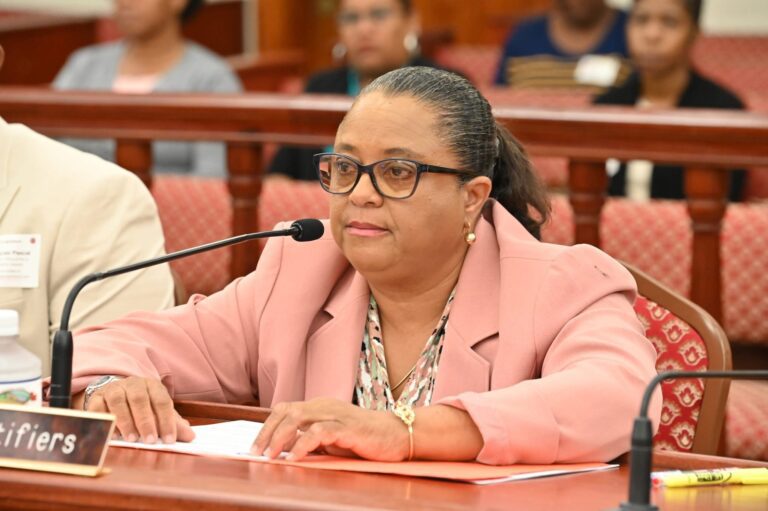
Taxicab CommissionVirgin Islands Taxicab Commission Acting Executive Director Melissa Smith speaks about staffing shortages, the absence of enforcement officers, and the need to modernize outdated systems. (Photo courtesy Legislature of the Virgin Islands)
If Magens Bay is fighting nature, the Virgin Islands Taxicab Commission is fighting for survival. Acting Executive Director Melissa Smith told senators the agency is running on fumes, with just two employees left to serve the entire territory. “Our regulatory arm of enforcement is nonexistent,” she admitted, explaining that all enforcement officers have either retired or resigned.
The commission’s current appropriation stands at $556,043 — $395,603 from the Taxi Revolving Fund and $160,440 from the Tourism Revolving Fund. But Smith said that figure is far from sufficient. “The resource minimum projection is set at 1.5 million dollars,” she testified, pointing out that proper staffing, enforcement visibility on ship days, and a functioning administrative backbone cannot be maintained on the present budget.
Technology is another sticking point. The agency continues to rely on manual, paper-based systems that delay licensing, records processing, and revenue collection. “Computer systems and equipment are outdated,” Smith said, adding that a digital overhaul — including the ability to share real-time data with the Bureau of Motor Vehicles and the Police Department — would cost between $200,000 and $400,000. Without it, she warned, illegal taxi operators will continue to proliferate, undermining legitimate businesses and putting public safety at risk.
Even with its skeletal staff, the commission has managed to process 2,739 transactions this year, including licenses, medallion transfers, lease agreements, and operator badges. Smith praised her two remaining staff members, saying they had kept the agency running against the odds. The commission has also launched a training program in partnership with UVI CELL, with 84 participants in the first cohort and a second group scheduled for later this year.
Smith framed the commission’s needs as a matter of economic and public safety. “With this funding, we will strengthen regulatory oversight, improve service standards, and ensure that our taxi industry continues to serve both residents and visitors with integrity and efficiency,” she said.
West Indian Company LimitedCharlene Turnbull, Interim President and CEO of the West Indian Company Limited, testifies during Monday’s budget hearing before the Senate Finance Committee. (Photo courtesy Legislature of the Virgin Islands)
Interim CEO Charlene Turnbull outlined both the promise and the pressure facing the West Indian Company Limited. For FY 2026, the company is requesting $10.3 million in appropriations, anchored by projected revenues of $9.7 million from cruise passenger wharfage fees and land rentals. WICO currently employs 33 staff with four vacancies yet to be filled, she said, while carrying the weight of long-term debt service and insurance costs.
On the surface, the outlook appears strong. Turnbull told lawmakers that cruise traffic is rebounding, with passenger arrivals expected to grow by 20 percent — between 1.1 and 1.2 million visitors — and ship calls rising from 281 to 362, a 29% jump. That growth is projected to bring an additional $1.6 million in passenger revenues, lifting total passenger-based income to roughly $9.6 million compared with this year.
But behind those figures lies a tightening squeeze. Personnel expenses remain WICO’s largest cost, while property insurance — accounting for nearly 80% of the company’s total insurance outlays — continues to climb. Debt service alone stands at $3.3 million annually, eating into the flexibility needed for capital projects. Turnbull pointed to the long-discussed Water Pipeline Project, designed to allow ships to receive water along the full dock, as a top infrastructure priority. She also emphasized the need to position WICO competitively by pursuing foreign and boutique cruise markets that can fill berths during off-peak days.
Her warning was clear: success is not guaranteed. “With these emerging threats on the horizon, we must pivot and pivot fast,” Turnbull said. Senators, including Chair Novelle E. Francis Jr., pressed back, expressing frustration over the lack of current-year detail and sharper forward projections.
Committee members present included Francis, along with Sens. Dwayne M. DeGraff, Ray Fonseca, Hubert L. Frederick, Carla J. Joseph, and Kurt A. Vialet.
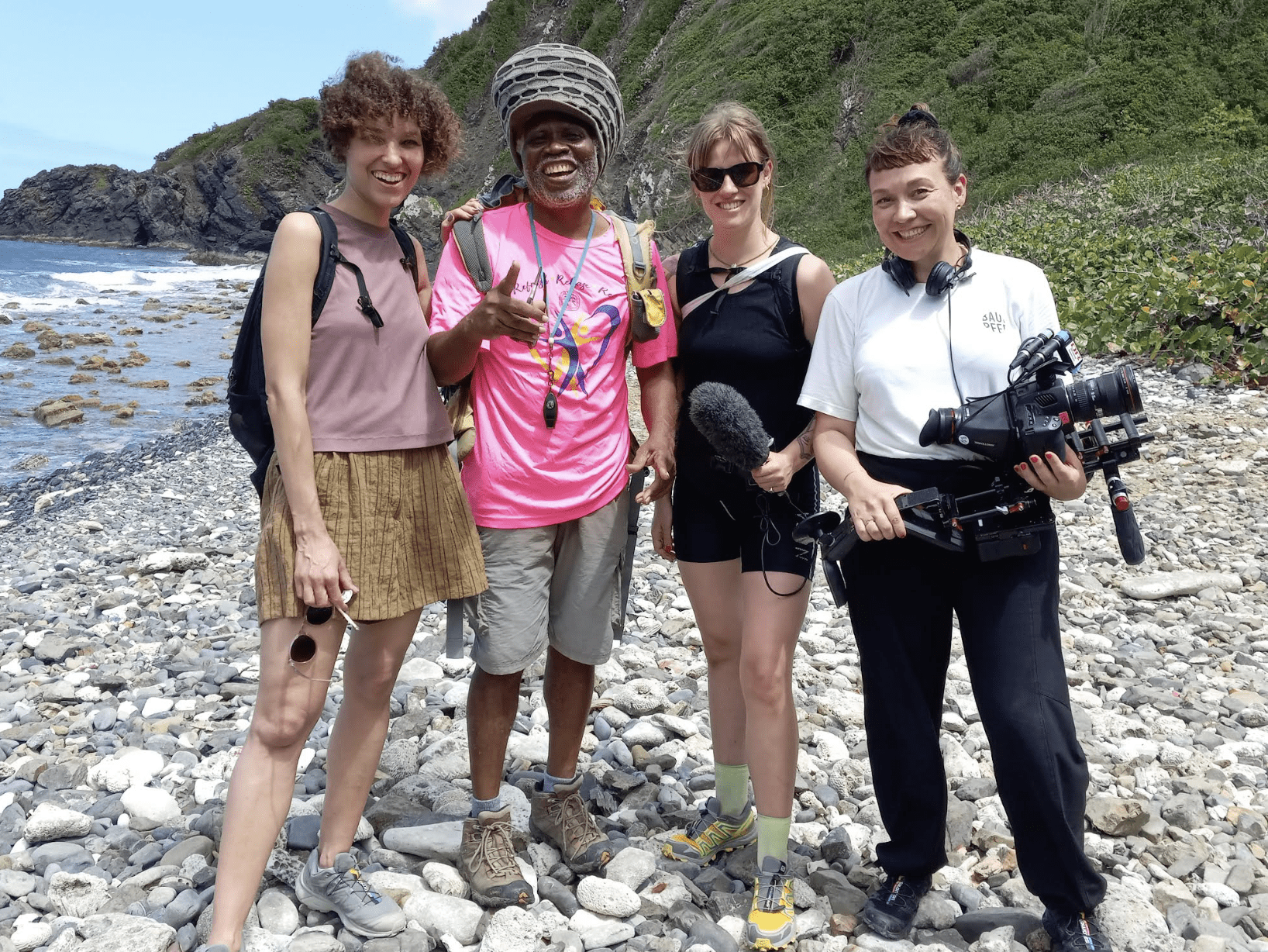
Nola, from left, Olasee, Anne and Michelle. These are the three journalists from Denmark that he worked with on the project to save Maroon Country. They are standing at Wills Bay, one of the many bays in Maroon Country on the Great Northwest of St. Croix. (Photo by Lisa Doward)
Editor’s Note — It’s official: Professor Olasee Davis’s decades-long effort to preserve Maroon Country on St. Croix as part of the U.S. Virgin Islands’ Territorial Parks system is now a reality following the purchase of some 2,386 acres of undeveloped forested and coastal land that was under threat of development. The area is so named for the thousands of enslaved laborers from Africa who sought self-liberation by fleeing plantation life and seeking refuge in the remote, inaccessible areas that the Maroon Sanctuary Territorial Park will now protect. Government House confirmed Monday that an official announcement will come later this week.
Last spring Anne Fisker Hansen, a Danish journalist who I worked with on a project called “Slave life in the Danish West Indies,” said to me, “Olasee, 2024 would be your year.” I looked at her and blushed, thinking nothing of it. Nevertheless, the “Slave life” project also included Maroon Country on the Northwest A Quarter of St. Croix. I was told by Nola Grace Garrdmand, Hansen, and Michelle, all three who are journalists from Denmark, that I have had followers for years in their home country, by reading my online articles, research, and the social and political stand I have taken to preserve the Great Northwest of St. Croix.
Olasee Davis (Submitted photo)
They even mentioned that I have a fanfare club in Denmark rooting for me to protect the Northwest as a territorial park. I was taken aback by their comments because I see myself as an ordinary person who tries to make a difference in my community and the world. The three journalists are part of the Danish National Broadcasting Corporation, which was working on a large historical drama documentary about Denmark’s participation in the transatlantic slave trade and about the life of enslaved Africans and slave owners in the former Danish West Indies colony.
The Danish journalists believe the story should not be told merely from the perspective of the slave traders and slave owners. Their aim is to tell the story from the perspective of the enslaved laborers as well. They believe this part of history has often been neglected in Western historical traditions. The series was broadcast in the spring of this year and was filmed in the Virgin Islands, Ghana, and Denmark.
For 42 years, I have been fighting socially and politically to preserve the Northwest of St. Croix to become a park whether managed by a nonprofit organization, locally or the federal government. As a native conservationist, I wanted to see the Northwest of St. Croix be preserved as a park indefinitely, for the people of the Virgin Islands and our nation. I realized that to protect the area, it takes the power of the pen. That means protesting by writing articles about Maroon Country and conducting scientific research to get support not just locally, but also nationally, and internationally.
There has been countless scientific research conducted in Maroon Country by botanists, anthropologists, historians, foresters, ethnobotanists, archaeologists, and so many other research managers. To make the Northwest known to the Virgin Islands community, I have taken literally thousands upon thousands of people, especially our schoolchildren, there for more than 42 years! People nationally, and internationally, are drawn to learn about the natural, cultural, and marine resources of the area.
A map shows Maroon Country land that will be preserved as part of the Territorial Parks system. Olasee Davis has championed the cause for decades, and writes about when he learned that the acquisition was successful. “The government officials went a step further and said, ‘you can’t die now’ and advised me not to tell anyone about the news until the federal government announced that more than 2,000 acres of the Great Northwest on St. Croix will be protected as part of the Virgin Islands Territorial Park along with lands on St. Thomas and St. John.” (Photo by Trust for Public Land and DPNR, Division of Territorial Parks & Protected Areas)
The Danish National Broadcasting Corporation that I mentioned earlier is one of many companies I worked with over the years, including our own PBS television station, in educating the world public that the Great Northwest is significant to human history. Also, I have been interviewed by countless magazines over the years locally, nationally, and internationally such as Virgin Islands Pride, National Geographic, Caribbean Travel & Life, Gardenia Fiori, Orti E. Giardini, Islands Destination and Dreams, and American Legacy, just to mention a few, in promoting Maroon Country preservation.
Believe me, I take every opportunity I get to educate the public to protect the Northwest and Northeast central areas of St. Croix, hoping someone will hear my cry in the wilderness of this spiritual, ecological, and sacred landscape of the highlands region of St. Croix. Over the years, community organizations have held conferences, workshops, tours, and utilized other means to promote the protection of Maroon Country.
At the end of the day, however, I often stand alone in fighting to preserve a land where slave gravesites still exist, virgin forests abound, caves beckon, clouds touch the mountaintops during heavy rainfall with flowing streams, tide pools that take your breath away with their geological moon-like rock formations, wildlife that brings the forest alive with the sounds of native and exotic creatures, and the waves of the ocean hit against the rough coastline of a paradise — all of it just waiting on the Northwest of St. Croix to be preserved.
In this journey to preserve part of Virgin Islands heritage, I have fasted many times, cried at times, become depressed at times, and prayed all the time to balance my physical, mental, and spiritual life. Believe me, I had sleepless night at times, worried at times, and wondered if God would ever answer my prayers from a sinner, and one who is imperfect in so many ways. However, when I thought of the heroic spirit of enslaved Africans in the Great Northwest of St. Croix who affirmed freedom and human dignity by flight, struggle, and the creation of temporary refugee communities in the hills, cliffs, forests, and mountains, I became hopeful for the preservation of Maroon Country.
Hope and faith springs eternal. I received an email message from one of my former University of the Virgin Islands students, Caroline Adams Fawkes. She invited me to her pre-commencement breakfast at UVI’s St. Croix campus. She was about to receive an honorary doctorate degree, for which I remain so proud of her. At the same time, I had a very important meeting with government officials in my office. Believe it or not, it was the same day and time of Caroline’s event.
Earlier on, I was told by the government officials by email messages that they had good news for me. At that moment, I knew I couldn’t attend Caroline pre-commencement event. Knowing Caroline, I knew she would understand my dilemma. The government officials went a step further and said, “You can’t die now” and advised me not to tell anyone about the good news until the federal government announced that over 2,000 acres of the Great Northwest on St. Croix will be protected as part of the Virgin Islands Territorial Park along with lands in St. Thomas and St. John!
My heart jumped for joy. This is history. Can you believe it? It is the first time in Virgin Islands history where land of such large acreage on St. Croix will be set aside as a territorial park for the people. I’ve often said to family and friends that whenever the Northwest is protected, I can die in peace. I knew then in my heart that God answered my prayers.
It was the efforts of Melissa Hill, project manager of the Trust for Public Land in Florida, Sarah Haynes and Bruce Wilson, the Trust for Virgin Islands Lands, Kitty Edwards, director of the V.I. Territorial Parks under the Department of Planning and Natural Resources, Gerard Frandelle, executive director of Crucian Heritage and Nature Tourism, Celeste Jarvis, director of Nature Conservancy, and others including colleagues from UVI, Toni Thomas and myself who submitted a grant proposal to NOAA for land acquisition of Maroon Country on St. Croix. We were awarded the funds. Anne was right: 2024 was the year of Maroon Country preservation on St. Croix.
— Olasee Davis is a bush professor who lectures and writes about the culture, history, ecology and environment of the Virgin Islands when he is not leading hiking tours of the wild places and spaces of St. Croix and beyond.
Following are links to previous editorials by Olasee Davis, advocating for Maroon Country to be included as part of the Territorial Parks system:
Chief District Judge Robert Molloy has ruled that the death penalty is off the table in the murder case of Richardson Dangleben Jr.
The order issued Monday ends months of wrangling over whether the Justice Department, which filed notice in February 2024 that it would not seek capital punishment, could suddenly reverse that decision more than a year later, after proceedings were well underway.
Molloy foreshadowed his decision in a May opinion denying the DOJ’s motion for a 120-day stay in the case after U.S. Attorney General Pam Bondi issued a Feb. 5 memorandum reviving the death penalty and lifting the moratorium on federal executions. That followed a Jan. 20 executive order by President Donald Trump to review all decisions to not seek such punishment in eligible cases charged during the Biden Administration.
The judge said then that not only had the deadline long passed for the government to declare it would seek the death penalty, but doing so now would clearly disadvantage Dangleben, who faces first-degree murder, assault and gun charges in the July 4, 2023, shooting death of V.I. Police Detective Delberth Phipps Jr. on St. Thomas.
Dangleben has pleaded not guilty and is set to go to trial Oct. 6, likely on St. Croix after both the defense and prosecution indicated in a stipulation filed July 31 that they are in agreement on Public Defender Matthew Campbell’s request for a change of venue due to publicity surrounding the case.
Campbell has strongly opposed the DOJ’s efforts to pursue the death penalty, writing in a brief in March that reversing course more than a year into proceedings had effectively pulled the rug out from under his client “based on a whim.”
Moreover, had he known the government would do so, Dangleben would never have requested a continuance when he was set to go to trial last October and the matter would now be moot, Campbell said.
Molloy also noted in his May opinion that because Dangleben had been proceeding according to the “no-seek” decision, he had been without a learned counsel — an attorney expert in death penalty cases — for more than a year, complicating his trial preparation and his preparation for re-review by the Capital Review Committee.
In June, Campbell filed a motion to strike the government’s notice of intent to seek the death penalty, followed by another in August asking Molloy to decide the matter without oral argument and based on the briefs already filed in the case, given the looming trial date.
Molloy granted the motion Monday in his two-page order, writing in a footnote that “the Court will issue a memorandum opinion outlining its reasons at a later date.”
The judge ordered the government’s notice of intent stricken from the record and said its February 2024 notice that it would “proceed with either a non-capital trial or plea agreement in this matter” would be the controlling document in the case.
“Thus, this case will proceed as a non-death penalty case,” Molloy wrote.