The Virgin Islands Cycling Federation will host the Triple Bypass Road Race this Sunday, Aug. 24 at 7 a.m., starting near the former Milgie’s Convenience store in Sally’s Fancy, on St Croix’s south side.
Virgin Islands Cycling Federation competitors (VI Source file photo)
The race course will include a 15-mile lap, including a climb over the Christiansted Bypass, and will offer three distances: Elite – 45 miles, Expert – 30 miles and Sport/Masters/Women/Juniors – 15 miles.
Race-day registration will be open from 6am to 6:45am. Entry fee: $10 for VICF members, $15 for General. For more information, please contact 340-643-5050.
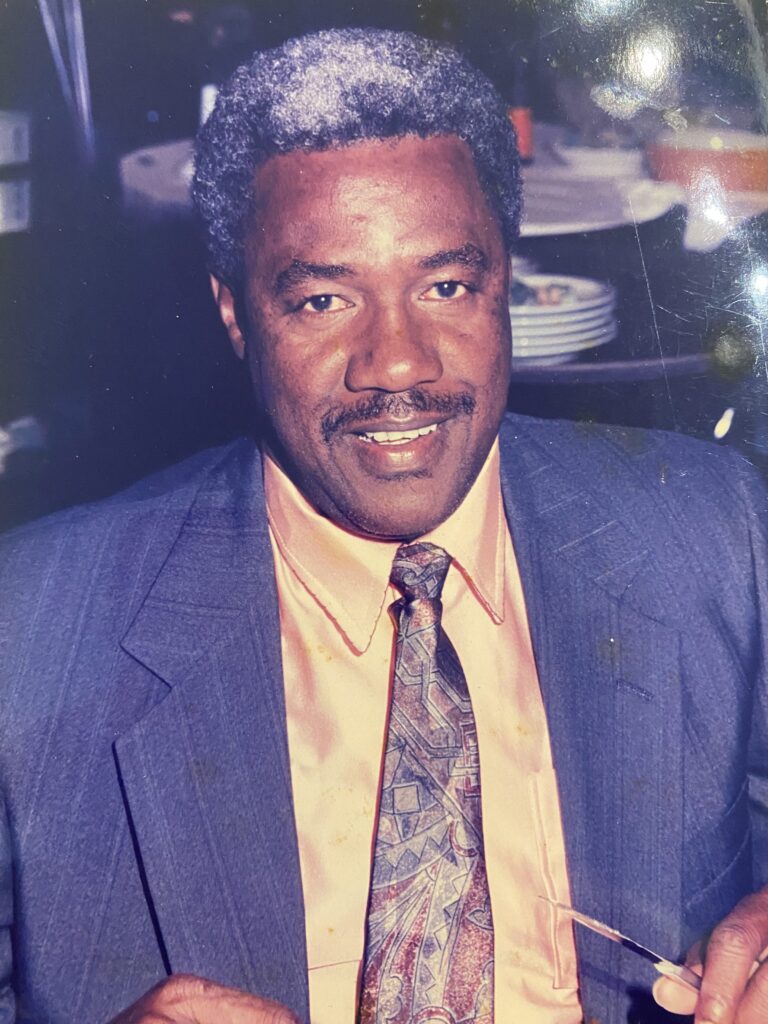
Courtney Woods Sr.
It is with great sadness that we announce the passing of Courtney Woods Sr., of St. Croix, who died on Aug. 3, 2025. Funeral will be on Friday, Aug. 22 at St. Paul’s Episcopal Church with viewing at 9 a.m. Service to follow at 10 a.m.
The U.S. Virgin Islands Department of Tourism is launching a recruitment drive for local hospitality greeters and entertainers who will welcome visitors at the territory’s airports and cruise ports. The initiative seeks energetic, personable Virgin Islanders who can share the islands’ culture, provide helpful information, and ensure every guest receives a warm introduction to the territory.
A moko jumbie greets guests. (Source photo by Diana Dias)
Department of Tourism Commissioner Nominee Jennifer Matarangas-King highlighted the importance of these roles in delivering an exceptional visitor experience. “Our people are the heart of the U.S. Virgin Islands, and this is an opportunity to showcase that warmth, pride, and hospitality to every guest who steps onto our shores,” she said. “From the very first smile to the moment they begin exploring, these ambassadors will help shape memories that last a lifetime.”
Applicants must be at least 18 years old, have knowledge of the territory, and a passion for hospitality. A flexible schedule, valid business license, and proof of full vaccination are required. Bilingual proficiency in English and Spanish is preferred.
Where to Apply:
Applications are available at the following Department of Tourism offices:
St. Croix: 321 King Street, Frederiksted
St. John: 6A Cruz Bay
St. Thomas: 2318 Kronprindsens Gade
For additional information, contact Director of Administration and Management Jamila Miller Christopher at 340-774-8784 or jmiller@usvitourism.vi.
For more information about the U.S. Virgin Islands, please visit https://www.visitusvi.com/.
A 43-year-old man turned himself in to police Sunday after a woman was shot multiple times Saturday night in Frederiksted. (Shutterstock)
A man turned himself in Sunday after a shooting the day before sent a woman to Luis Hospital for emergency surgery, prompting a brief manhunt by the V.I. Police Department. Kenny Rogers, 43, was charged with first-degree attempted murder, first-degree assault and firearms-related crimes.
According to documents filed in V.I. Superior Court, the 911 Emergency Call Center’s ShotSpotter system detected seven gunshots fired late Saturday night on East Street in Frederiksted. Police arrived to find a woman lying on the ground with several gunshot wounds on her back. She was taken to Luis Hospital by ambulance.
An officer spoke with the victim’s brother, who said he heard the woman tell Rogers “that she no longer wanted to be in a relationship with him,” according to the probable cause fact sheet filed in court. The witness said the two argued before Rogers pulled out a gun and shot at them. The woman later also identified Rogers as the shooter.
Police were unable to find Rogers at his New Works home, even after they obtained a search warrant and a tactical unit breached the door. They then issued a wanted poster for Rogers, who surrendered himself later at the Wilbur H. Francis Command. Rogers also surrendered two licensed firearms and declined to give a statement.
Rogers’s bail was set at $100,000 and he was remanded to the John A. Bell Adult Correctional Facility pending an advice of rights hearing scheduled for Monday morning.
The Virgin Islands Water and Power Authority advises the community that restoration efforts are steadily progressing following the impacts of Hurricane Erin.
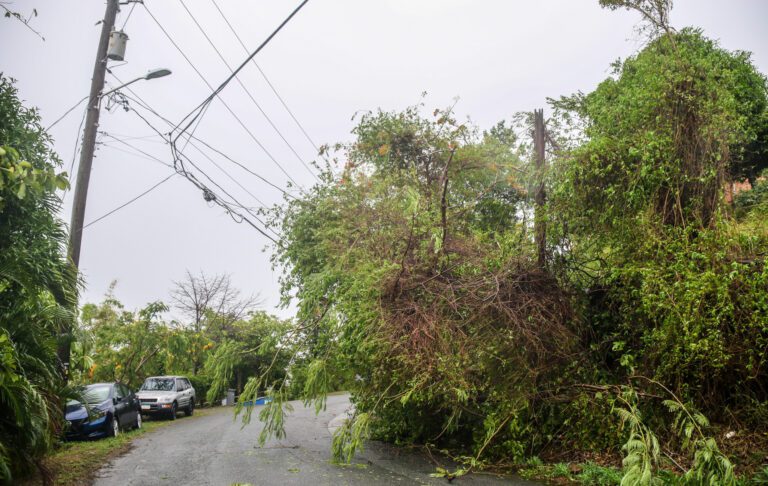
Downed trees, like the one impacting St. Thomas’ Feeder 6A Sunday, were among the biggest obstacles for WAPA crews working to restore power after Hurricane Erin. (Photo by Ananta Pancham)
In the St. Thomas/St. John district, the Authority began with approximately 21,000 customers without power. Within 24 hours, fewer than 2,000 customers remain out. A small portion of customers on Feeder 7B are still without service, and crews continue to address several isolated outages across St. Thomas. Restoration was initially delayed to allow for necessary repairs to the transmission line, while St. John has been fully restored.
On St. Croix, crews have also made significant progress, reducing the number of customers without service to fewer than 300, down from over 4,000 earlier today. The Authority’s goal is to restore all customers today, as crews continue to work safely and efficiently across the Territory.
As territory-wide restoration continues, customers may experience power restoration with temporary interruptions as the grid stabilizes. If you are still experiencing an outage, please report through the appropriate channels, so crews can be dispatched effectively. Outages may be reported online at https://www.viwapa.vi/customer-service/report-outage-or-problem or by phone at 340-773-2250 or 340-774-5225 – Option 4. For real-time updates, customers may also visit the outage viewer at http://outageviewer.viwapa.vi:7575/.
WAPA thanks the community for their patience and support for the line crews as they continue to work diligently and safely.
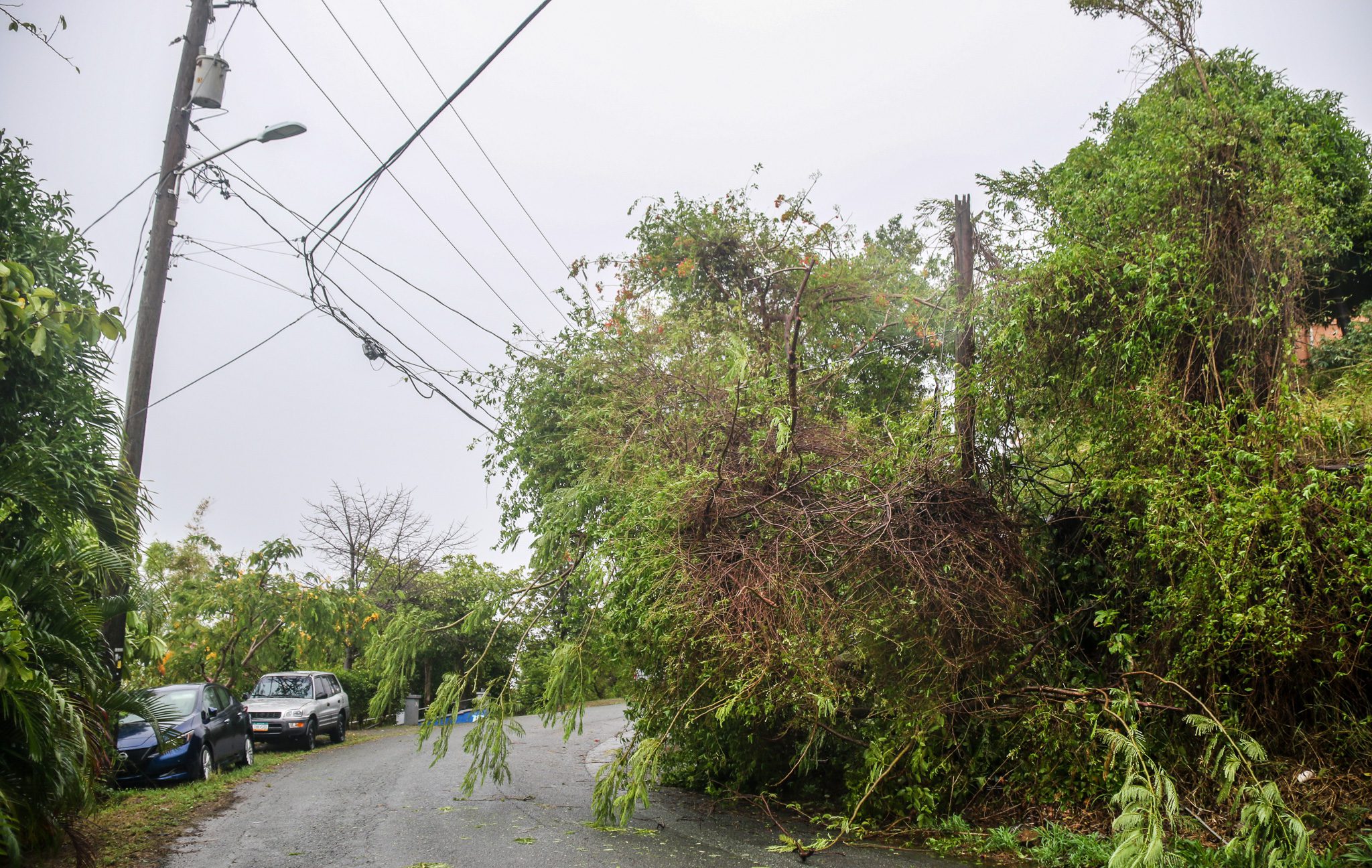
Downed trees, like the one impacting St. Thomas’ Feeder 6A Sunday, were among the biggest obstacles for WAPA crews working to restore power after Hurricane Erin. (Photo by Remington Gardner)
Heading into Monday, the Virgin Islands Water and Power Authority was nearing full restoration after Hurricane Erin’s outer bands knocked out electricity to tens of thousands across the territory. The storm passed the USVI at Category 5 strength without making landfall, but driving rain, high winds, and fallen vegetation left widespread outages in its wake.
By Saturday morning, an estimated 14,000 customers in the St. Thomas–St. John district were still without power, with fewer than 4,000 remaining impacted on St. Croix — numbers that significantly exceeded earlier, more modest estimates.Restoration efforts, however, were slow to gain momentum amid hazardous conditions and pressing infrastructure failures.
A critical transmission line that feeds eastern St. Thomas failed Friday afternoon under storm strain, prompting crews to prioritize stabilizing it — work that was essential before any feeder-by-feeder restoration could resume. “Repairs are not fully completed long‑term, but the line is back up now,” said WAPA Communications Director Shanell Petersen in a call with the Source late Sunday afternoon, underscoring that while the line was made operational again, a lasting solution remains in progress. This temporary repair is separate from an ongoing FEMA‑funded Feeder 13 upgrade, part of WAPA’s broader infrastructure hardening strategy.
With conditions improving, crews resumed restoration Saturday, though vegetation continued to pose problems. Fallen and wind-swept branches triggered lingering outages even on otherwise intact feeders. As Petersen explained, “Even as the majority of customers on a particular feeder have been restored, there might still be a few who remain without power,” as even minor contact was enough to trip service.
By Saturday afternoon, partial progress was evident: St. John saw its first sections of power restored, while on St. Croix, crews managed to bring the number of customers without electricity down to fewer than 4,000, largely through reenergizing Feeder 7B and beginning work on Feeder 6A.
Restoration on St. Thomas remained hampered into Saturday evening by ongoing rotating outages. Reports from WAPA cited feeder schedules — with power cycling on Feeder 7B, Feeder 9C and part of 10B, Feeder 7C, and Feeder 9E — as teams secured lines amid challenging conditions.
Meanwhile, rainfall totals confirmed the severity of the storm’s outer bands: about 1 inch on St. Croix, approximately 4 inches on St. Thomas, and up to 6 inches on St. John.
By late Sunday, isolated outages continued to be addressed in neighborhoods across the territory, with WAPA urging residents to report local outages to help crews prioritize dispatch. “Vegetation management continues to pose significant challenges, as anticipated with a storm of this strength,” WAPA stated in a release, naming priority areas like Caret Bay, Contant, and Plantation Manor on St. Thomas, as well as Enighed Hill and Cruz Bay on St. John.
In Erin’s aftermath, WAPA officials stressed that the storm underscored the need to keep strengthening both the grid and the workforce that maintains it. Petersen said the authority deployed all of its restoration crews across both districts once conditions allowed, noting that on St. Croix, cooler weather allowed linemen to work longer hours, while on St. Thomas, extreme heat forced more rotations.
Even with the full force of its workforce in the field, she added, restoration would have been faster with additional resources and personnel. That’s why WAPA has been “aggressively pursuing additional linemen,” reaching out at regional gatherings such as the Caribbean Lineman’s Rodeo and promoting local apprenticeship and internship programs to build capacity at home. Those efforts, she explained, are key to shortening restoration times when widespread outages strike.
At the same time, long-term infrastructure projects are moving ahead. FEMA-backed work to overhaul Feeder 13 — a critical transmission corridor separate from the eastern St. Thomas line that failed during Erin — is underway, part of a larger plan to harden the grid against future storms. Vegetation management will also remain a priority, with Petersen acknowledging that additional resources would allow for more aggressive trimming before winds bring branches down on lines.
Despite the challenges, Petersen said Erin showed clear signs of progress. “We were in a much better place than we were last year,” she said, recalling how long it took to bring the system back after Tropical Storm Ernesto in 2024. By early Monday, she said, all feeders were expected to be back on, with the remaining outages limited to isolated pockets scattered across neighborhoods.
Hurricane Erin moved farther north into the Atlantic Sunday after brushing past the U.S. Virgin Islands and Puerto Rico with gusty winds, rain and rough surf. Several severe weather alerts remain in effect through Monday as outer rainbands continue to impact the region.
Hurricane Erin underwent extreme rapid intensification over the weekend, strengthening from a Category 1 storm Friday morning to a Category 5 hurricane in just 24 hours. By Sunday afternoon, the system had weakened to a Category 3, but forecasters say it is expected to re-intensify and grow in size as it approaches the Turks and Caicos and the Bahamas.
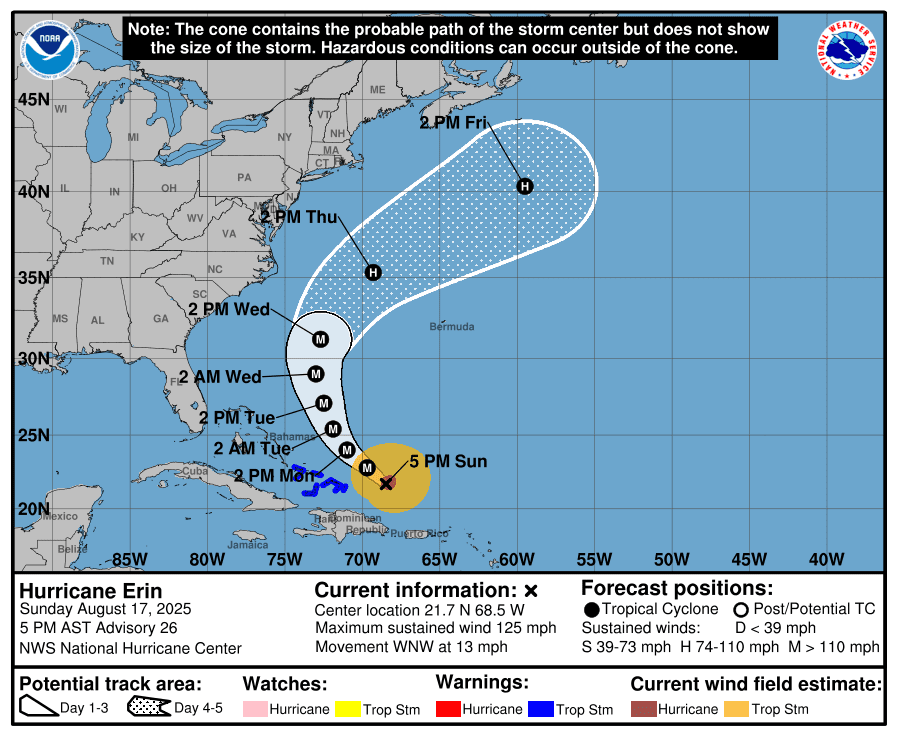
Track of Hurricane Erin
As of the 5 p.m. Sunday update from the NHC, Hurricane Erin was located about 275 miles northwest of San Juan, Puerto Rico, moving west-northwest with maximum sustained winds of 125 mph. The storm’s minimum central pressure was measured at 946 millibars.
Hurricane Erin’s projected storm track as of 5 p.m. on Sunday. The storm continues to move away from the USVI and Puerto Rico. (Photo courtesy NHC)
“At 5:00 p.m. AST, the center of Hurricane Erin was located near latitude 21.7 North, longitude 68.5 West. Erin is moving toward the west-northwest near 13 mph. This general motion is expected today, followed by a gradual turn to the northwest and north on Monday and Tuesday. On the forecast track, the core of Erin is expected to pass to the east and northeast of the Turks and Caicos Islands and the southeastern Bahamas tonight and Monday,” the NWS said.
“Maximum sustained winds are near 125 mph with higher gusts. Erin is a Category 3 hurricane on the Saffir-Simpson Hurricane Wind Scale. Some increase in size and strength is forecast during the next 48 hours. Erin is likely to remain a dangerous major hurricane through the middle of this week,” according to the NWS.
Impacts Across USVI
The core of Hurricane Erin passed just north of the U.S. Virgin Islands Saturday as a major hurricane. While the center remained north of the local islands, the storm tracked slightly farther south and west than earlier forecasts had predicted. Erin moved close enough to bring tropical-storm-force wind gusts at times and heavy rainfall to areas across the region.
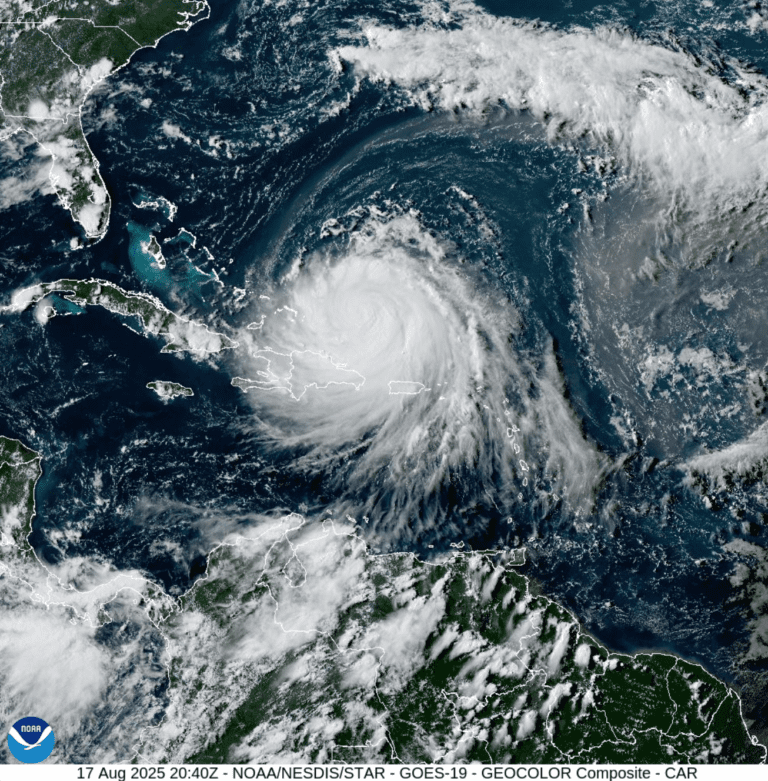
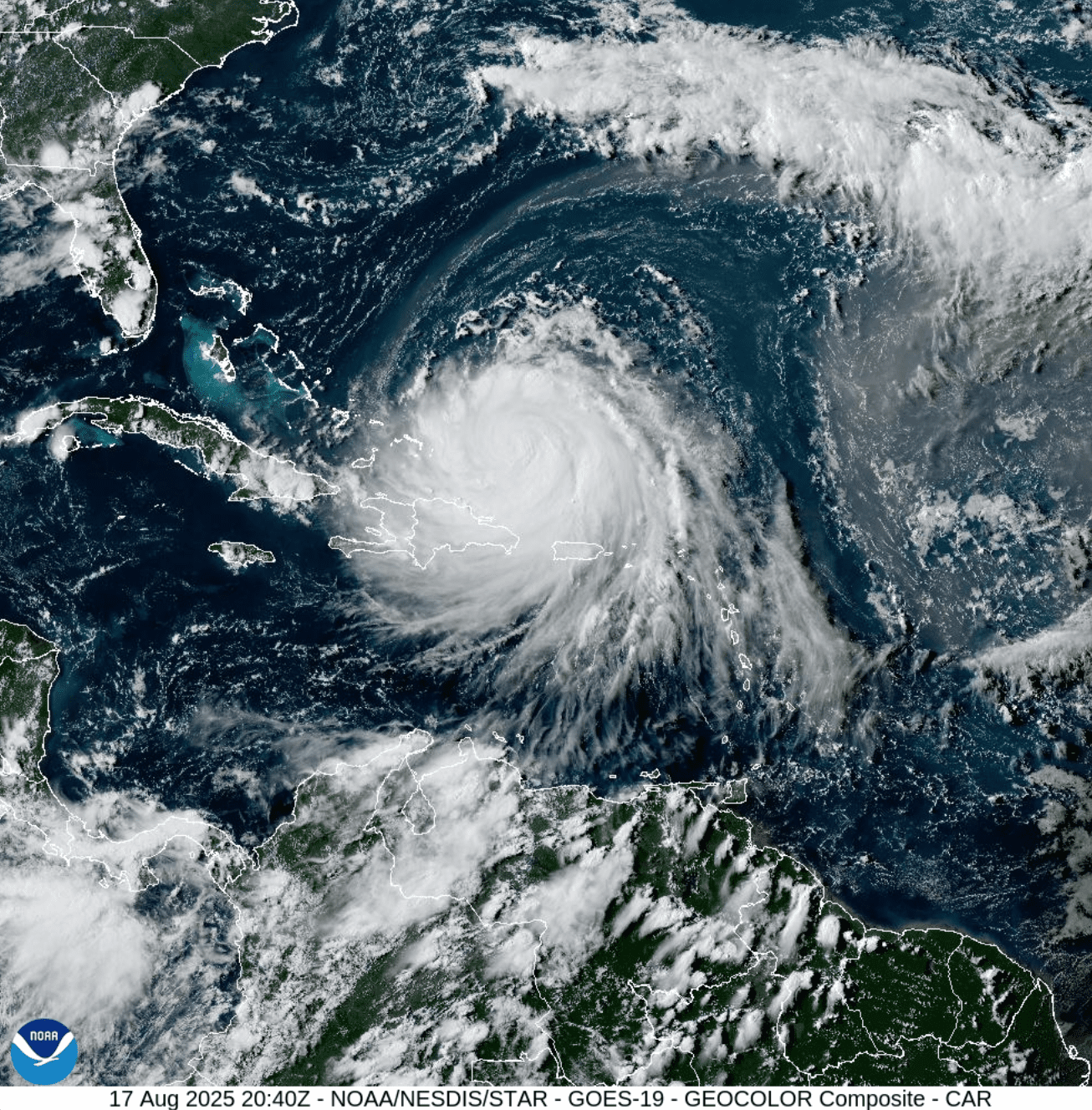
Visible satellite imagery obtained at 4:40 p.m. on Sunday as the system continued to move west-northwest and away from the USVI and Puerto Rico. (Photo courtesy NOAA)
Multiple weather alerts were issued, including Flash Flood Warnings for St. Thomas, St. John and St. Croix. A Tropical Storm Warning was issued for the Atlantic waters north of Puerto Rico and the USVI, from 10 nautical miles offshore to 19.5 degrees north latitude. The warning expired at 5 p.m. Sunday.
Other severe weather alerts included a Flood Watch, High Surf Advisory, High Rip Current Risk and Small Craft Advisory for both Puerto Rico and the U.S. Virgin Islands. These alerts will remain in effect until Monday.
On Sunday, the Source spoke with Daryl Jaschen, director of the Virgin Islands Territorial Emergency Management Agency, about storm-related impacts in the U.S. Virgin Islands following preliminary assessments across the territory.
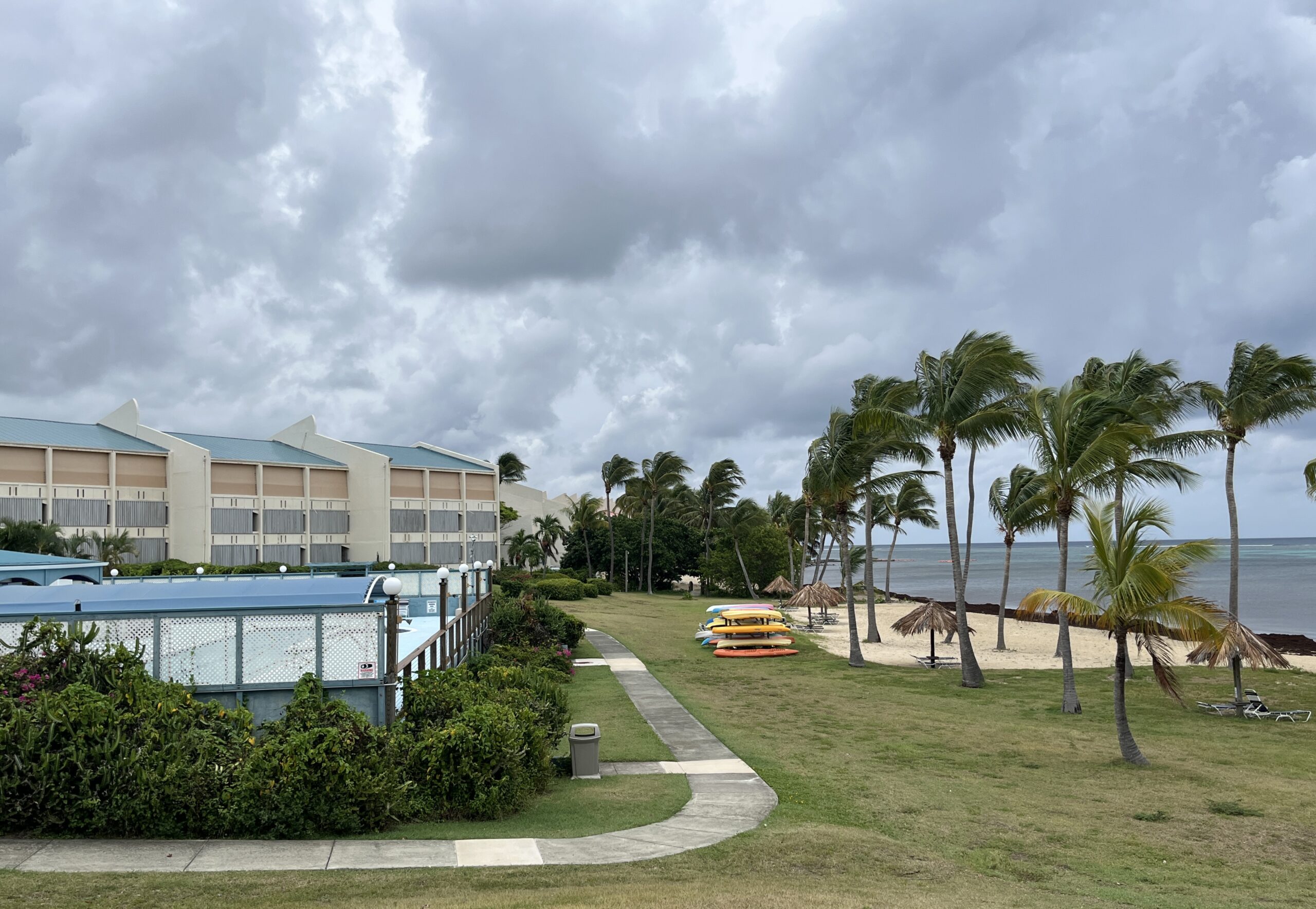
Storm shutters remained closed on the Northside of St. Croix on Sunday as gusty winds continued to affect the island. (Source photo by Jesse Daley)
Jaschen said that as of Sunday afternoon, power outages were ongoing on St. Thomas, St. John and St. Croix, with St. Thomas experiencing the most widespread disruptions. However, officials with the Virgin Islands Water and Power Authority were confident that most feeders would be restored Sunday night.
A palm tree on St. Thomas swayed as the winds picked up Saturday when Hurricane Erin passed by the U.S. Virgin Islands. (Source photo by Michele L Weichman)
Across the islands, fallen branches were reported, but few trees were downed.
Jaschen also reported that several boats had sunk across the territory. According to information posted online, an iconic pirate ship docked in Charlotte Amalie Harbor was among the ships that sank during the storm.
Wind and Rainfall Details
Speaking to the gusty conditions, Jaschen said tropical storm-force winds extended about 160 miles from the center of Hurricane Erin. However, the strongest winds were concentrated in the storm’s northeastern quadrant and farther away from the U.S. Virgin Islands.
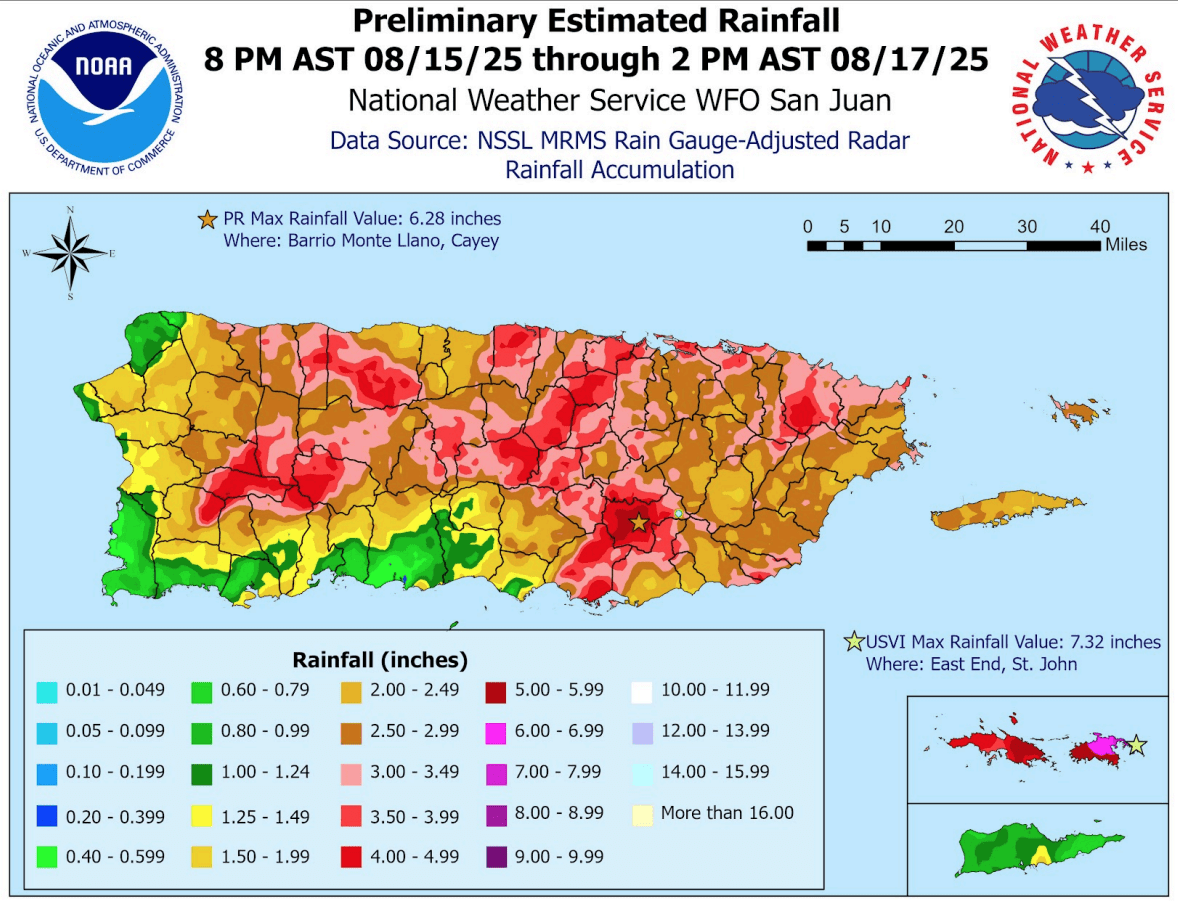
Preliminary rainfall estimates associated with Hurricane Erin as of Sunday afternoon. (Photo courtesy NWS)
Still, Jaschen noted that multiple rainbands swept across the islands, and some produced gusts that reached tropical-storm strength.
Regarding rainfall totals, Jaschen explained that, according to the National Weather Service in San Juan, Puerto Rico, the British Virgin Islands received approximately 10 inches of rain, St. Thomas received about four inches, and St. John collected roughly six inches. St. Croix — located farther south of Erin’s core — received approximately one inch of rain.
The Source also connected with Rafe Boulon, a weather observer on St. John, who meticulously records rainfall data from his home at Trunk Bay. Boulon told the Source that he measured over four inches of rain as of Sunday afternoon.
“I recorded 4.43 inches of rain over the two days of the storm,” Boulon said.
Boulon also noted that the south side of St. John was more significantly affected than the northern-facing portions of the island.
“Winds were pretty light on the north side of St. John,” Boulon explained. “South-facing homes were hit harder with the stronger backside, south to southwest winds. We were very lucky that Erin passed far enough to our north that we were spared any significant damage,” Boulon said.
Jaschen said that as of Sunday evening, government offices and schools would be open on Monday. However, several schools may have a delayed start, and announcements would be provided if any changes are expected.
Finally, according to information available online, seaports in the USVI are open, and airports across the territory are operational. However, travelers are advised to check directly with their airlines for the latest updates on potential delays or cancellations.
National Weather Service Information
The NWS in San Juan reminded residents and visitors that the local islands may still receive some impacts over the next day or so as Erin pulls farther away from the USVI. The NWS shared the following information Saturday regarding continuing impacts from Erin.
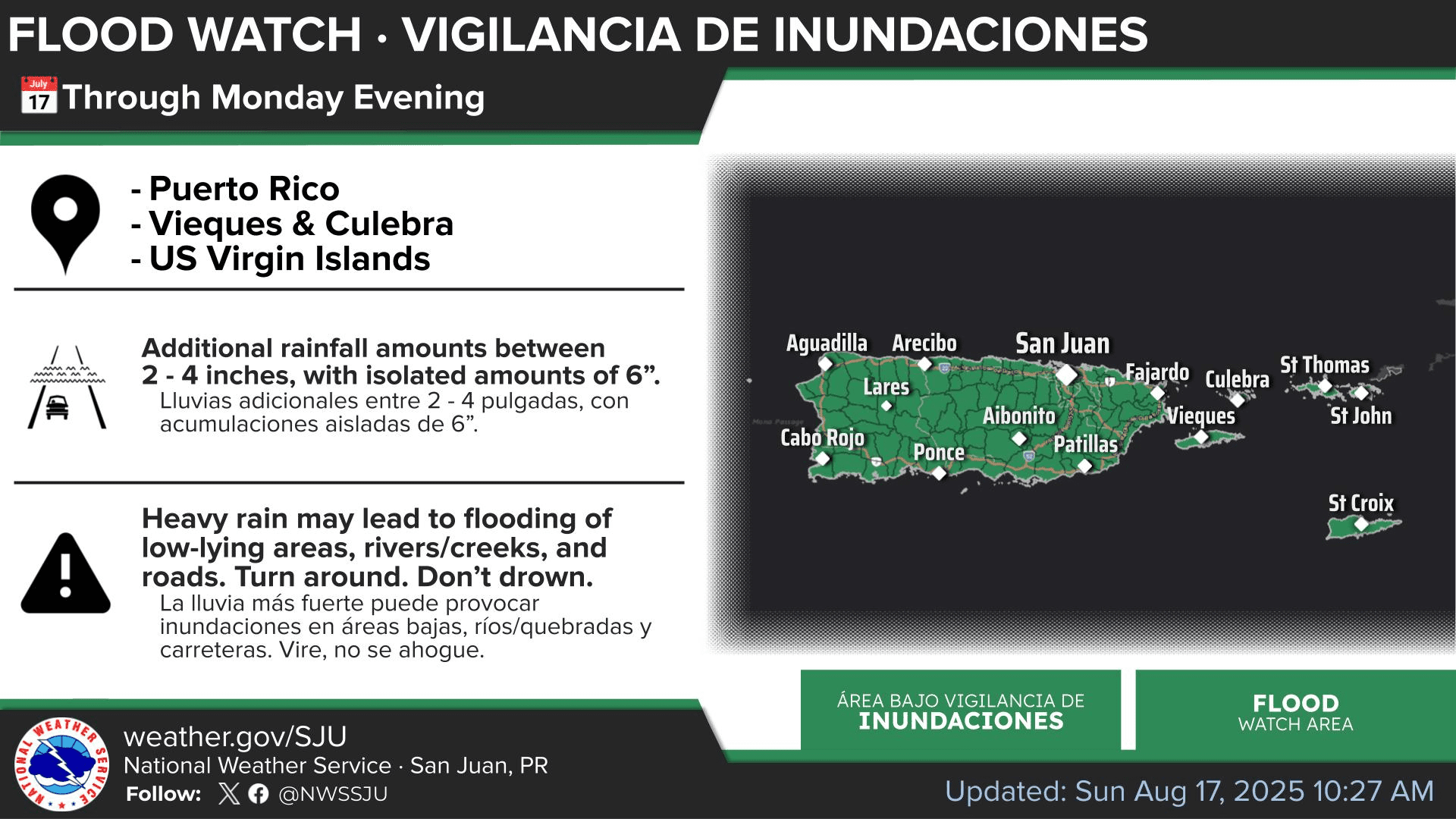
“Although the system continues its route to the Western Atlantic, associated feeder bands are expected to move over the U.S. Virgin Islands and eastern sections of Puerto Rico this evening and into the late-night hours,” the NWS said. “The strongest showers will continue to result in low-level flooding, including at low-lying river crossings and in small urban streams. Winds will become more southerly as the system moves north. Given the expected conditions, a Flash Flood Watch remains in effect until Monday evening,” the NWS explained.
A Flood Watch will remain in effect across the region until Monday. (Photo courtesy NWS)
The NWS added that weather conditions on Monday would likely be cloudy with additional rainfall, with a continued chance of flooding. Weather conditions are expected to improve on Tuesday, though very warm temperatures will affect the islands.
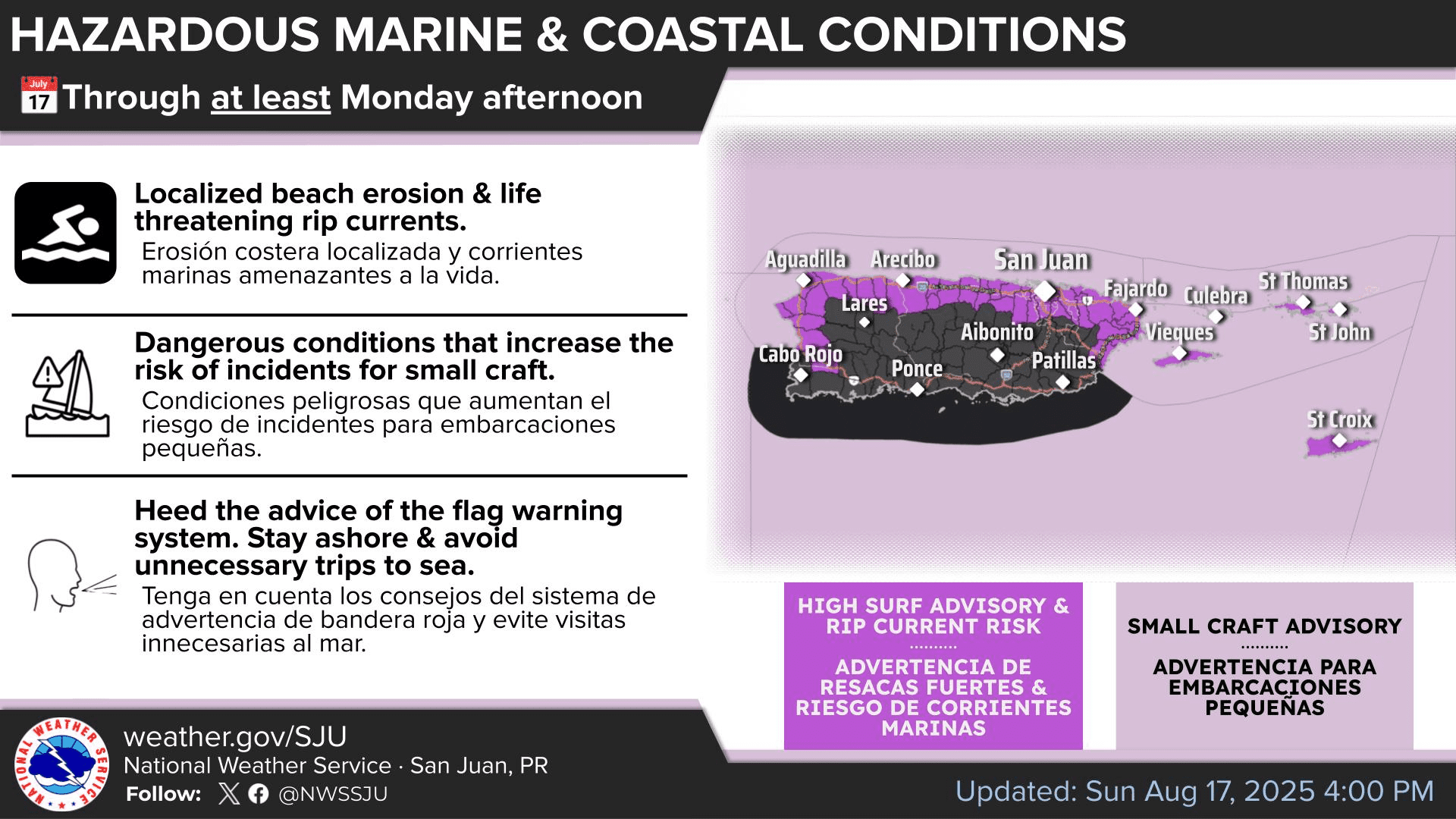
The NWS also urged caution regarding hazardous marine conditions, noting that seas will continue to be rough for the next few days, and there will continue to be an elevated risk of rip currents.
Marine conditions will remain hazardous across the USVI and Puerto Rico. (Photo courtesy NWS)Looking Ahead
In addition to tracking Hurricane Erin, the NHC was monitoring two other areas across the Atlantic basin on Sunday afternoon. One disturbance was located off the east coast of the U.S. mainland, while another tropical wave was moving across the central Atlantic.
Individuals in the USVI and Puerto Rico are encouraged to closely monitor the progress of the tropical wave in the central Atlantic for any potential future impacts.
As the climatological peak of the Atlantic hurricane season approaches, residents and visitors in the U.S. Virgin Islands are urged to remain prepared. Weather information is available from the NWS, the NHC, and NOAA.
The local weather forecast for the U.S. Virgin Islands is regularly updated on the Source Weather Page and VI Source YouTube Channel. A weekly Tropical Outlook article from the Source is also published throughout hurricane season to provide in-depth updates.
Finally, residents and visitors can find weather details and preparedness information from VITEMA.
In her biweekly column, “State of the Territory,” former Sen. Janelle K. Sarauw delves deeper into issues of concern for V.I. residents.
The conversation about health insurance in the Virgin Islands has taken a sharp and sobering turn. In a recent Committee of the Whole hearing on the Governor’s proposal to move government employees into a self-insurance model, the proposal itself was rejected for clear and practical reasons. Yet what came out of that hearing was far more disturbing. We learned that only eight percent of active government employees are considered healthy.
Eight percent. This is not just a statistic to be tucked away in a report. It is a mirror held up to the health of our community. It is a warning flare in the night, telling us that something is terribly wrong. Insurance premiums are rising, driven by large payouts and high claims, but the real story is not just about the numbers. It is about what is happening to our bodies, our homes, our workplaces, and our environment.
We have to ask ourselves why so many Virgin Islanders are unwell. We cannot fall into the trap of blaming this crisis entirely on individual choices. Yes, as a community we must confront poor eating habits and sedentary lifestyles, but that does not explain why such a staggering majority of our workforce is unhealthy. The truth is harder to face, but it is right in front of us.
Our environment is compromised, and it is compromising us. Many modular classrooms are filled with mold. Government buildings where people work every day are plagued by mold as well. Charlotte Amalie High School has dealt with asbestos contamination. Raw sewage flows openly through our streets. On St. Croix, a refinery sits on top of soil already poisoned by decades of industrial activity, while lead-contaminated water ran through the pipes in some communities. The Tutu area remains a designated Superfund site, a reminder of contamination that has never been fully remediated. The dumps across the territory burn constantly, sending plumes of smoke and toxins into the air, yet no one can say with certainty what exactly we are breathing.
Layered on top of these environmental hazards is a cost of living that leaves many working families in a constant state of financial stress. WAPA’s unreliability adds another daily strain. And for those already struggling with their health, these conditions are not just inconvenient, they are life-shortening. Chronic respiratory illnesses, cardiovascular disease, diabetes, cancers, and mental health struggles all thrive in an environment where stress is constant, the air and water are questionable, and access to preventive care is limited.
We cannot afford to ignore these connections. If we are serious about controlling insurance costs, we must be equally serious about addressing the root causes of illness. That begins with knowledge. We need a comprehensive public health study that examines every factor contributing to the sickness in our community. This study must look at environmental toxins, workplace hazards, access to healthy food, mental health stressors, and the cumulative effects of living under these conditions year after year.
The University of the Virgin Islands could lead this effort, partnering with national public health institutions. We can seek grant funding so that the cost does not burden the local government. But what matters most is that the research be independent, transparent, and driven by the goal of producing real, actionable recommendations to improve health outcomes for every Virgin Islander.
Without such an effort, we will remain locked in a cycle where the cost of healthcare rises, insurance premiums soar, and families face financial ruin when illness strikes. The toll is not just measured in dollars, but in years of life lost, in the quality of our children’s futures, and in the steady erosion of a community’s well-being.
The health of the Virgin Islands is a reflection of the health of its environment, its infrastructure, and its people. Right now, that reflection should trouble every single one of us. We can choose to look away and continue paying higher premiums while more of our neighbors get sick. Or we can decide, once and for all, to face the truth, demand answers, and fight for the right to live in a place where health is possible.
The question before us is simple: do we have the courage to find out why our people are so sick, and the will to do something about it? The time to answer that question is now.
Editor’s Note: Opinion articles do not represent the views of the Virgin Islands Source newsroom and are the sole expressed opinion of the writer. Submissions can be made to visource@gmail.com.
In his biweekly column, Langley Shazor speaks to issues important to men within the territory.
In the last column, I talked about self-awareness and the importance of moving from the window to the mirror. I shared how reading “Emotional Intelligence 2.0” reminded me that accountability starts with seeing yourself clearly, not the version you project or the one you have convinced others to believe, but the version that shows up in your patterns. But the next step is where most of us stumble, not in recognizing what we do, but in deciding what to do with that truth once we see it. This is where self-management comes in.
Self-management is not just about staying calm or avoiding conflict. It is about controlling your emotions, behaviors, and impulses in the moment. It is the pause between what happens and how you respond. It is the space where decisions are made, relationships are either strengthened or weakened, and your growth either shows up or disappears. It is where maturity gets tested. That pause is not easy. It is one thing to reflect after the damage is done. It is another thing entirely to stop yourself in the moment, to shut your mouth when your pride is screaming, to walk away when your anger wants to stay, or to sit quietly in discomfort when your ego wants to be loud. That pause is not weakness; it is strength under control. It is dignity in action.
There was a time when I believed being emotionally expressive was a sign of authenticity. I told myself that saying exactly what I felt in the moment was proof that I was honest, passionate, and real. But what I had to learn, through trial and error, is that there is a fine line between being honest and being emotionally reckless. Not every emotion needs a microphone. Not every trigger needs a response. Not every feeling is an invitation to act. Self-management is not about bottling your feelings or pretending they are not real. It is about acknowledging them without letting them lead you. It is about having the maturity to say, “I feel this, but I choose how I respond to it.”
And the truth is, many of us are still learning how to pause. We are quick to speak and slow to listen. Quick to react and slow to reflect. We say things out of frustration that we do not mean. We shut down when we should speak up, or we lash out and then blame the other person for the reaction we triggered. How many times have you said something in anger and then wished you could take it back? How many relationships have you strained, not because of what happened, but because of how you handled it? How many moments have you replayed in your mind, wishing you had taken just a few more seconds before you opened your mouth or sent that message?
Self-management is not something you master once and move on from. It is a skill you sharpen through discipline and practice. It is a decision you make again, and again, especially when your old patterns want to come back. When I started reading “Emotional Intelligence 2.0,” I began paying closer attention to how often I justified behavior based on what I was feeling. I started seeing how easy it was to make excuses for snappy tones, for avoidance, for overreactions, especially when I was tired or under pressure. But pressure does not excuse disrespect. Stress does not justify a lack of self-control. In fact, pressure is often the very thing that reveals where you are in your emotional growth. When you cannot manage yourself, it is not just a communication issue—it is a character issue.
It is easy to look at your environment or the people around you and say, “This is why I reacted like that.” It is harder to admit, “I chose that reaction.” The world is going to test your patience, your boundaries, your capacity. People will frustrate you. Situations will stretch you. And if you are not anchored in emotional discipline, you will find yourself constantly apologizing, constantly repeating cycles, and constantly blaming others for outcomes you created. I have seen brilliant people damage their influence because they could not manage themselves when it mattered most. I have watched leaders fall apart, not because of failure, but because of unregulated emotion. I have seen relationships crumble because someone refused to pause.
That pause is everything. It is the difference between a moment that hurts and a moment that heals. It is the difference between reacting and responding. And I am learning to value it more. I am learning to pause not just when I am angry, but also when I am afraid, when I am disappointed, when I am tempted to withdraw or dismiss something that actually matters. Self-management is not just about controlling your behavior, it is about protecting your integrity and preserving your relationships. Sometimes that means saying, “Let me take a moment before I speak so I do not do harm.” Other times it means saying, “I am upset, but I am choosing to listen anyway.” And often, it means choosing not to act at all, simply because you know the emotion is louder than your wisdom in that moment.
Self-management is hard work. It requires constant self-checks. It means noticing when your breathing changes, when your tone shifts, when your jaw tightens or your energy changes. It means slowing down long enough to ask, “What is really happening here?” It means choosing intention over instinct. And over time, that pause builds something in you. It builds restraint. It builds wisdom. It builds trust, not just with others, but with yourself. You begin to trust your own ability to stay rooted, to move with purpose, and to choose responses that reflect who you are; not just how you feel.
That is where real accountability shows up. It is not just about saying “I messed up.” It is about choosing not to mess up again in the same way. It is about making a different decision the next time the same emotion hits. That is the pause that builds you. That is the space where growth lives. And that is the work I am committed to.
Langley “Casual-Word” Shazor is a poet, author, publisher, entrepreneur, public speaking coach, podcast host, and pastor who is an advocate for youth and men. His goal is to enlighten, empower, and liberate those who are silenced, marginalized, and enslaved to self-destructive thoughts and behaviors. Visit thecasualword.com.
Editor’s Note: Opinion articles do not represent the views of the Virgin Islands Source newsroom and are the sole expressed opinion of the writer. Submissions can be made to visource@gmail.com.
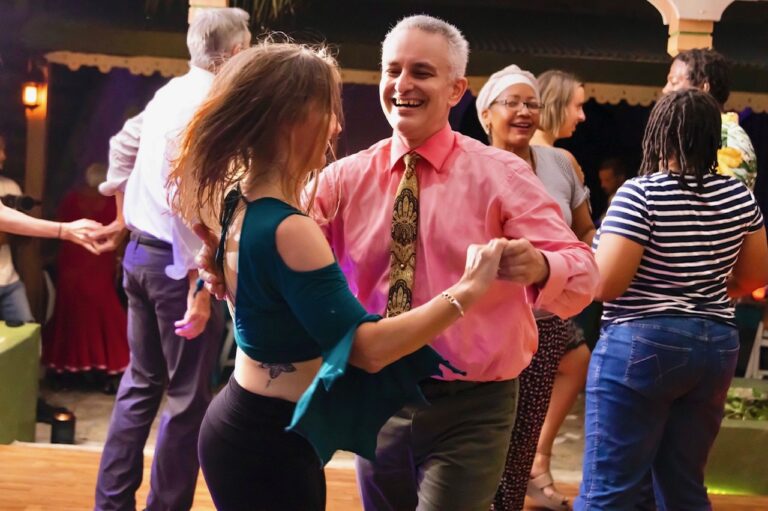
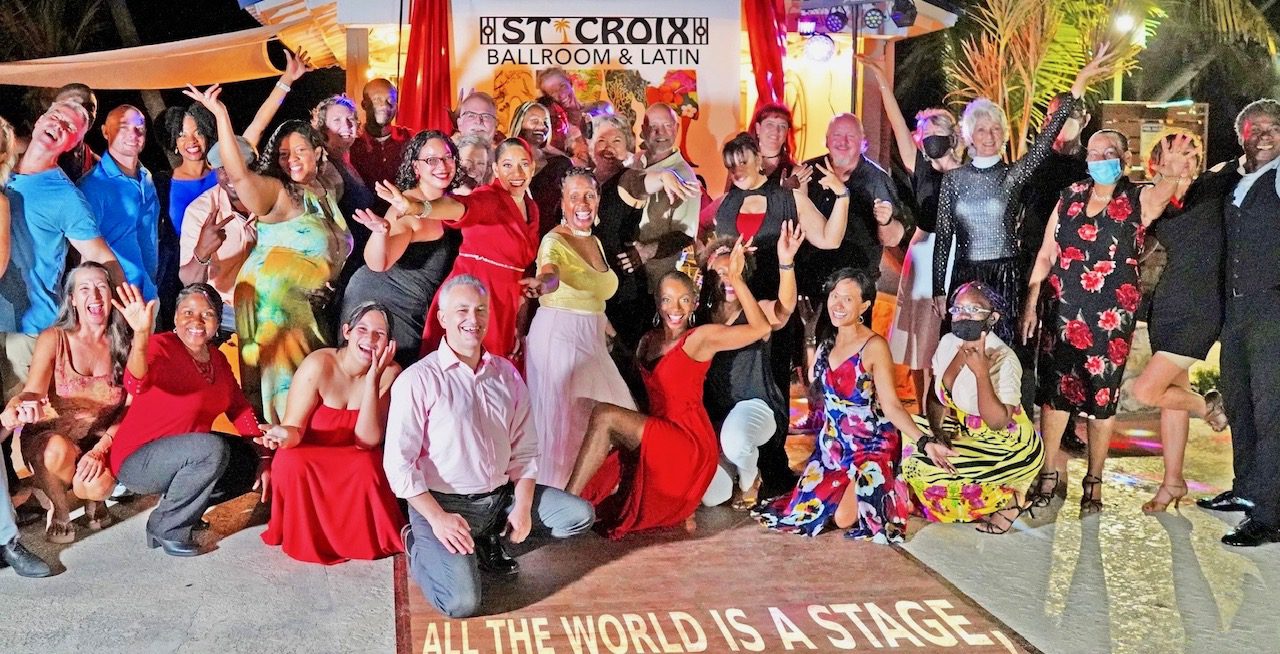
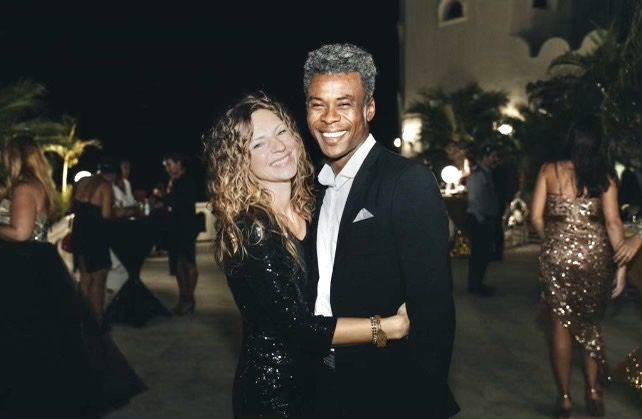
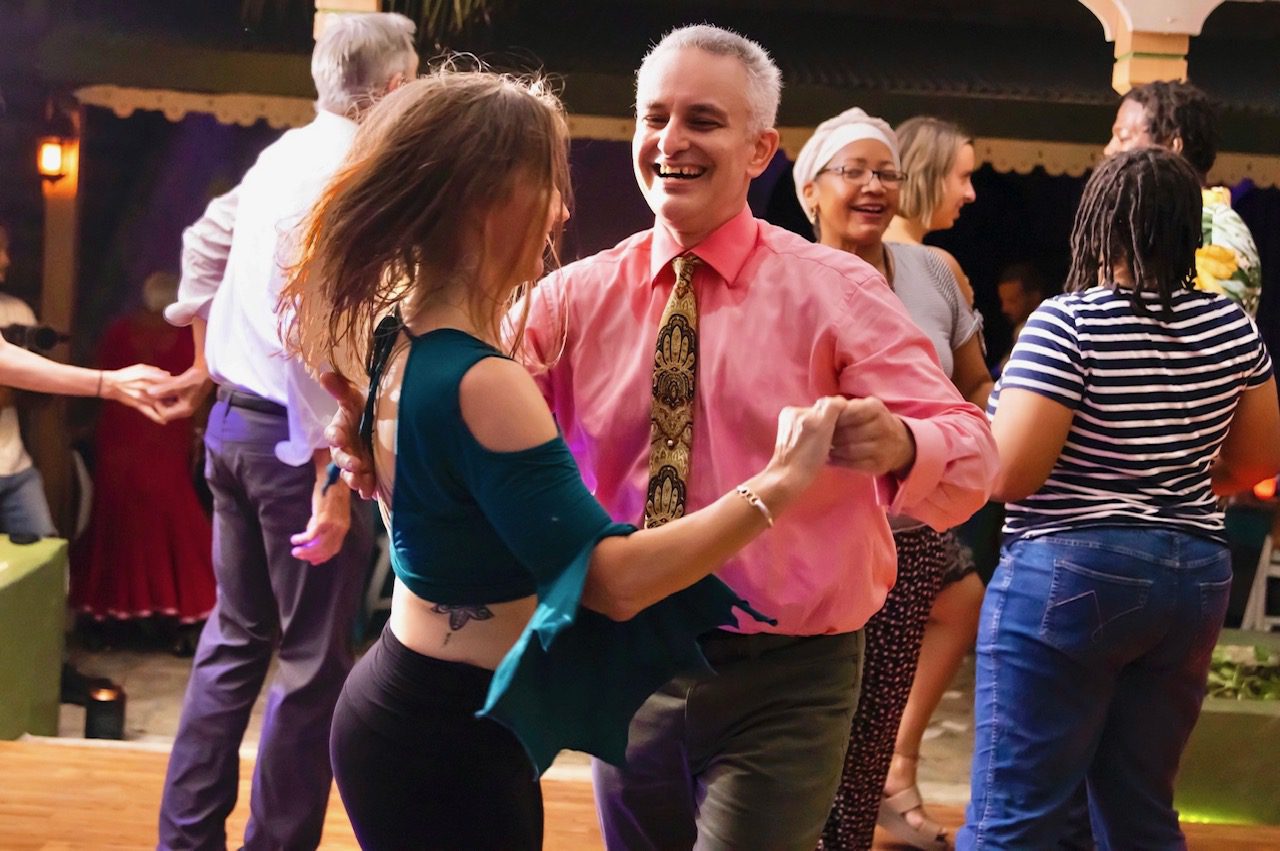
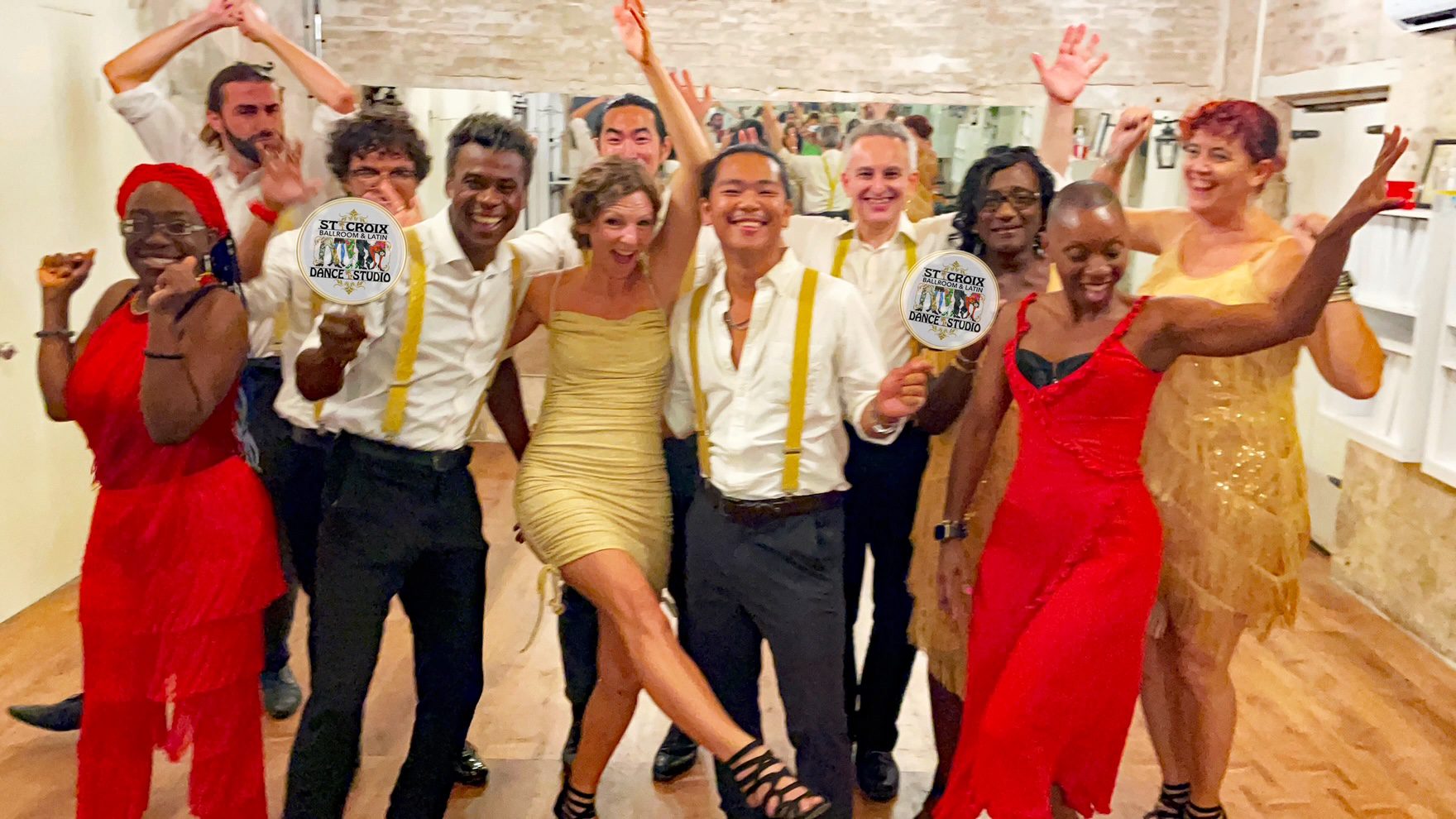
St. Croix Ballroom & Latin Students & Instructors (Photo courtesy St. Croix Ballroom & Latin)St. Croix Ballroom & Latin is alive and well and continues operating as a full-time dance studio in the courtyard at 55 Company Street in downtown Christiansted. The three components that have always been available are a dance studio providing lessons and classes; a dance community that embraces students, nonstudent social dancers, visitors and more; and the nightclub, Dazzled, that created a social dance environment.Co-owner Jennifer Hilaire spoke with the Source to explain the shift the studio has taken.Jennifer & Garincha Hilaire, St. Croix Ballroom & Latin Dance Studio owners. (Photo courtesy St. Croix Ballroom & Latin)“Since it is a small island, we were not able to sustain ‘Dazzled’ our nightclub, bar and restaurant. We closed that component as of December 2024. The shift is back towards a driven/roaming dance community that is able to meet at a variety of venues on the island. We will continue to stay updated on social dance events happening on the island and we encourage the community to join the public Facebook group, ‘Salsa STX.’ This group is open to everyone and serves as a platform where anyone can share information about dance events, upcoming parties and dance gatherings on the island,” she said. St. Croix Ballroom & Latin offers a free, private dance lesson to St. Croix residents. Interested parties are encouraged to contact the studio directly to schedule the complimentary lesson and learn more about the studio’s teaching style, lessons and class offerings.Instructor Serge Khlystov dances with a student. (Photo courtesy St. Croix Ballroom & Latin)“We are looking forward to welcoming many of our students back as season approaches,” Hilaire said.The 4th Anniversary Celebration for St. Croix Ballroom & Latin is set for Friday, Sept. 19, 7-10 p.m. at the Courtyard Studio, 55 Company Street, Christiansted. Free to the public. Social dancing and students’ spotlights.St. Croix Ballroom & Latin students & instructors get ready for a performance. (Photo courtesy St. Croix Ballroom & Latin)RSVP on the website.For more information:
stcroixballroomandlatin.comstcroixballroomandlatin@gmail.comFacebook: Salsa STXFollow us on Instagram.
Call or text: 340-642-2751














 In her biweekly column, “State of the Territory,” former Sen. Janelle K. Sarauw delves deeper into issues of concern for V.I. residents.

 In his biweekly column, Langley Shazor speaks to issues important to men within the territory.
In the last column, I talked about self-awareness and the importance of moving from the window to the mirror. I shared how reading “Emotional Intelligence 2.0” reminded me that accountability starts with seeing yourself clearly, not the version you project or the one you have convinced others to believe, but the version that shows up in your patterns. But the next step is where most of us stumble, not in recognizing what we do, but in deciding what to do with that truth once we see it. This is where self-management comes in.
Self-management is not just about staying calm or avoiding conflict. It is about controlling your emotions, behaviors, and impulses in the moment. It is the pause between what happens and how you respond. It is the space where decisions are made, relationships are either strengthened or weakened, and your growth either shows up or disappears. It is where maturity gets tested. That pause is not easy. It is one thing to reflect after the damage is done. It is another thing entirely to stop yourself in the moment, to shut your mouth when your pride is screaming, to walk away when your anger wants to stay, or to sit quietly in discomfort when your ego wants to be loud. That pause is not weakness; it is strength under control. It is dignity in action.
There was a time when I believed being emotionally expressive was a sign of authenticity. I told myself that saying exactly what I felt in the moment was proof that I was honest, passionate, and real. But what I had to learn, through trial and error, is that there is a fine line between being honest and being emotionally reckless. Not every emotion needs a microphone. Not every trigger needs a response. Not every feeling is an invitation to act. Self-management is not about bottling your feelings or pretending they are not real. It is about acknowledging them without letting them lead you. It is about having the maturity to say, “I feel this, but I choose how I respond to it.”
And the truth is, many of us are still learning how to pause. We are quick to speak and slow to listen. Quick to react and slow to reflect. We say things out of frustration that we do not mean. We shut down when we should speak up, or we lash out and then blame the other person for the reaction we triggered. How many times have you said something in anger and then wished you could take it back? How many relationships have you strained, not because of what happened, but because of how you handled it? How many moments have you replayed in your mind, wishing you had taken just a few more seconds before you opened your mouth or sent that message?
Self-management is not something you master once and move on from. It is a skill you sharpen through discipline and practice. It is a decision you make again, and again, especially when your old patterns want to come back. When I started reading “Emotional Intelligence 2.0,” I began paying closer attention to how often I justified behavior based on what I was feeling. I started seeing how easy it was to make excuses for snappy tones, for avoidance, for overreactions, especially when I was tired or under pressure. But pressure does not excuse disrespect. Stress does not justify a lack of self-control. In fact, pressure is often the very thing that reveals where you are in your emotional growth. When you cannot manage yourself, it is not just a communication issue—it is a character issue.
It is easy to look at your environment or the people around you and say, “This is why I reacted like that.” It is harder to admit, “I chose that reaction.” The world is going to test your patience, your boundaries, your capacity. People will frustrate you. Situations will stretch you. And if you are not anchored in emotional discipline, you will find yourself constantly apologizing, constantly repeating cycles, and constantly blaming others for outcomes you created. I have seen brilliant people damage their influence because they could not manage themselves when it mattered most. I have watched leaders fall apart, not because of failure, but because of unregulated emotion. I have seen relationships crumble because someone refused to pause.
That pause is everything. It is the difference between a moment that hurts and a moment that heals. It is the difference between reacting and responding. And I am learning to value it more. I am learning to pause not just when I am angry, but also when I am afraid, when I am disappointed, when I am tempted to withdraw or dismiss something that actually matters. Self-management is not just about controlling your behavior, it is about protecting your integrity and preserving your relationships. Sometimes that means saying, “Let me take a moment before I speak so I do not do harm.” Other times it means saying, “I am upset, but I am choosing to listen anyway.” And often, it means choosing not to act at all, simply because you know the emotion is louder than your wisdom in that moment.
Self-management is hard work. It requires constant self-checks. It means noticing when your breathing changes, when your tone shifts, when your jaw tightens or your energy changes. It means slowing down long enough to ask, “What is really happening here?” It means choosing intention over instinct. And over time, that pause builds something in you. It builds restraint. It builds wisdom. It builds trust, not just with others, but with yourself. You begin to trust your own ability to stay rooted, to move with purpose, and to choose responses that reflect who you are; not just how you feel.
That is where real accountability shows up. It is not just about saying “I messed up.” It is about choosing not to mess up again in the same way. It is about making a different decision the next time the same emotion hits. That is the pause that builds you. That is the space where growth lives. And that is the work I am committed to.
Langley “Casual-Word” Shazor is a poet, author, publisher, entrepreneur, public speaking coach, podcast host, and pastor who is an advocate for youth and men. His goal is to enlighten, empower, and liberate those who are silenced, marginalized, and enslaved to self-destructive thoughts and behaviors. Visit thecasualword.com.
In his biweekly column, Langley Shazor speaks to issues important to men within the territory.
In the last column, I talked about self-awareness and the importance of moving from the window to the mirror. I shared how reading “Emotional Intelligence 2.0” reminded me that accountability starts with seeing yourself clearly, not the version you project or the one you have convinced others to believe, but the version that shows up in your patterns. But the next step is where most of us stumble, not in recognizing what we do, but in deciding what to do with that truth once we see it. This is where self-management comes in.
Self-management is not just about staying calm or avoiding conflict. It is about controlling your emotions, behaviors, and impulses in the moment. It is the pause between what happens and how you respond. It is the space where decisions are made, relationships are either strengthened or weakened, and your growth either shows up or disappears. It is where maturity gets tested. That pause is not easy. It is one thing to reflect after the damage is done. It is another thing entirely to stop yourself in the moment, to shut your mouth when your pride is screaming, to walk away when your anger wants to stay, or to sit quietly in discomfort when your ego wants to be loud. That pause is not weakness; it is strength under control. It is dignity in action.
There was a time when I believed being emotionally expressive was a sign of authenticity. I told myself that saying exactly what I felt in the moment was proof that I was honest, passionate, and real. But what I had to learn, through trial and error, is that there is a fine line between being honest and being emotionally reckless. Not every emotion needs a microphone. Not every trigger needs a response. Not every feeling is an invitation to act. Self-management is not about bottling your feelings or pretending they are not real. It is about acknowledging them without letting them lead you. It is about having the maturity to say, “I feel this, but I choose how I respond to it.”
And the truth is, many of us are still learning how to pause. We are quick to speak and slow to listen. Quick to react and slow to reflect. We say things out of frustration that we do not mean. We shut down when we should speak up, or we lash out and then blame the other person for the reaction we triggered. How many times have you said something in anger and then wished you could take it back? How many relationships have you strained, not because of what happened, but because of how you handled it? How many moments have you replayed in your mind, wishing you had taken just a few more seconds before you opened your mouth or sent that message?
Self-management is not something you master once and move on from. It is a skill you sharpen through discipline and practice. It is a decision you make again, and again, especially when your old patterns want to come back. When I started reading “Emotional Intelligence 2.0,” I began paying closer attention to how often I justified behavior based on what I was feeling. I started seeing how easy it was to make excuses for snappy tones, for avoidance, for overreactions, especially when I was tired or under pressure. But pressure does not excuse disrespect. Stress does not justify a lack of self-control. In fact, pressure is often the very thing that reveals where you are in your emotional growth. When you cannot manage yourself, it is not just a communication issue—it is a character issue.
It is easy to look at your environment or the people around you and say, “This is why I reacted like that.” It is harder to admit, “I chose that reaction.” The world is going to test your patience, your boundaries, your capacity. People will frustrate you. Situations will stretch you. And if you are not anchored in emotional discipline, you will find yourself constantly apologizing, constantly repeating cycles, and constantly blaming others for outcomes you created. I have seen brilliant people damage their influence because they could not manage themselves when it mattered most. I have watched leaders fall apart, not because of failure, but because of unregulated emotion. I have seen relationships crumble because someone refused to pause.
That pause is everything. It is the difference between a moment that hurts and a moment that heals. It is the difference between reacting and responding. And I am learning to value it more. I am learning to pause not just when I am angry, but also when I am afraid, when I am disappointed, when I am tempted to withdraw or dismiss something that actually matters. Self-management is not just about controlling your behavior, it is about protecting your integrity and preserving your relationships. Sometimes that means saying, “Let me take a moment before I speak so I do not do harm.” Other times it means saying, “I am upset, but I am choosing to listen anyway.” And often, it means choosing not to act at all, simply because you know the emotion is louder than your wisdom in that moment.
Self-management is hard work. It requires constant self-checks. It means noticing when your breathing changes, when your tone shifts, when your jaw tightens or your energy changes. It means slowing down long enough to ask, “What is really happening here?” It means choosing intention over instinct. And over time, that pause builds something in you. It builds restraint. It builds wisdom. It builds trust, not just with others, but with yourself. You begin to trust your own ability to stay rooted, to move with purpose, and to choose responses that reflect who you are; not just how you feel.
That is where real accountability shows up. It is not just about saying “I messed up.” It is about choosing not to mess up again in the same way. It is about making a different decision the next time the same emotion hits. That is the pause that builds you. That is the space where growth lives. And that is the work I am committed to.
Langley “Casual-Word” Shazor is a poet, author, publisher, entrepreneur, public speaking coach, podcast host, and pastor who is an advocate for youth and men. His goal is to enlighten, empower, and liberate those who are silenced, marginalized, and enslaved to self-destructive thoughts and behaviors. Visit thecasualword.com.