Ocean Point Terminals today announced that it has awarded $15,000 in scholarships to eight noteworthy U.S. Virgin Islands students for the 2025-2026 school year. Ocean Point maintains a strong commitment to education, and this funding is allotted annually to support scholarship recipients in their pursuit of a degree at an accredited U.S. college or university, or technical/vocation college.
This year’s recipients include:
Sherisha Elizee, who will attend Oglethorpe University
Isabella Hahnfeld, who will attend the University of Maryland
Nathan Langley, who will attend New York University
Ellany Lopez, who will attend Georgia State University
Jordyn Powell, who will attend Princeton University
V’Mane Rochester, who will attend the University of the Virgin Islands
Tarique Turnbull, who will attend Tuskegee University
Vivia Webster, who will attend Tulane University
Ocean Point Terminals’ Chief Executive Officer Todd Dillabough was excited that the company could continue its commitment in support of this year’s recipients. “Education is one of the most powerful tools you can give someone, and we remain steadfast in our commitment to support the next generation,” stated Mr. Dillabough.
Every year Ocean Point provides over $200,000 in training and scholarships, part of which is provided to the University of the Virgin Islands to support its Process Technology degree program and the development of our local workforce.
Scholarship recipients are selected based on their scholastic record and financial need compared to other applicants, and those scholarships are provided for up to four years should the student maintain good academic standing. Since 2016, the Terminal has supported a total of 133 individual students in their pursuit of a quality post-secondary education. To date, the Company has awarded more than $1M for training and scholarships to local recipients across the territory
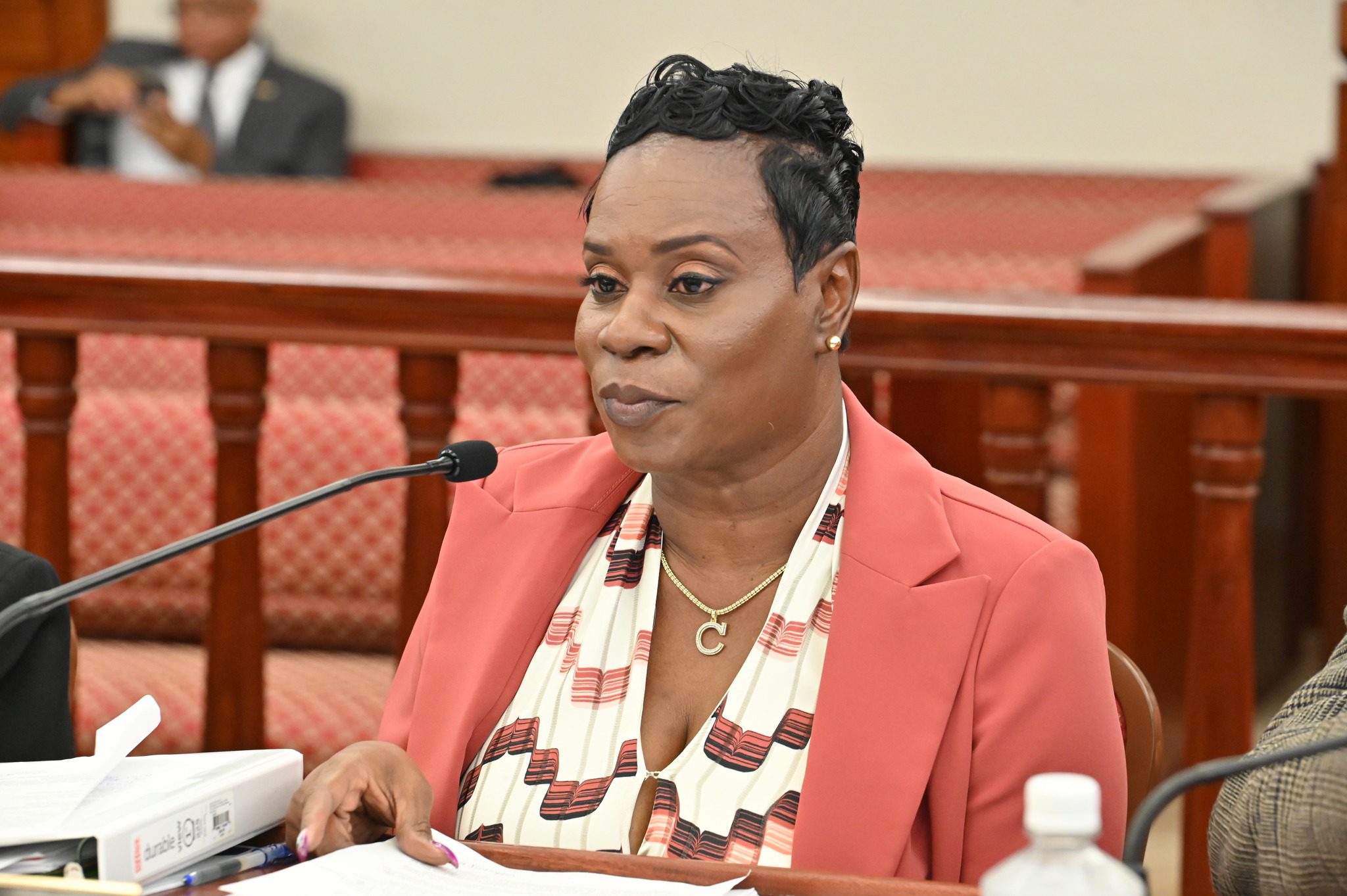
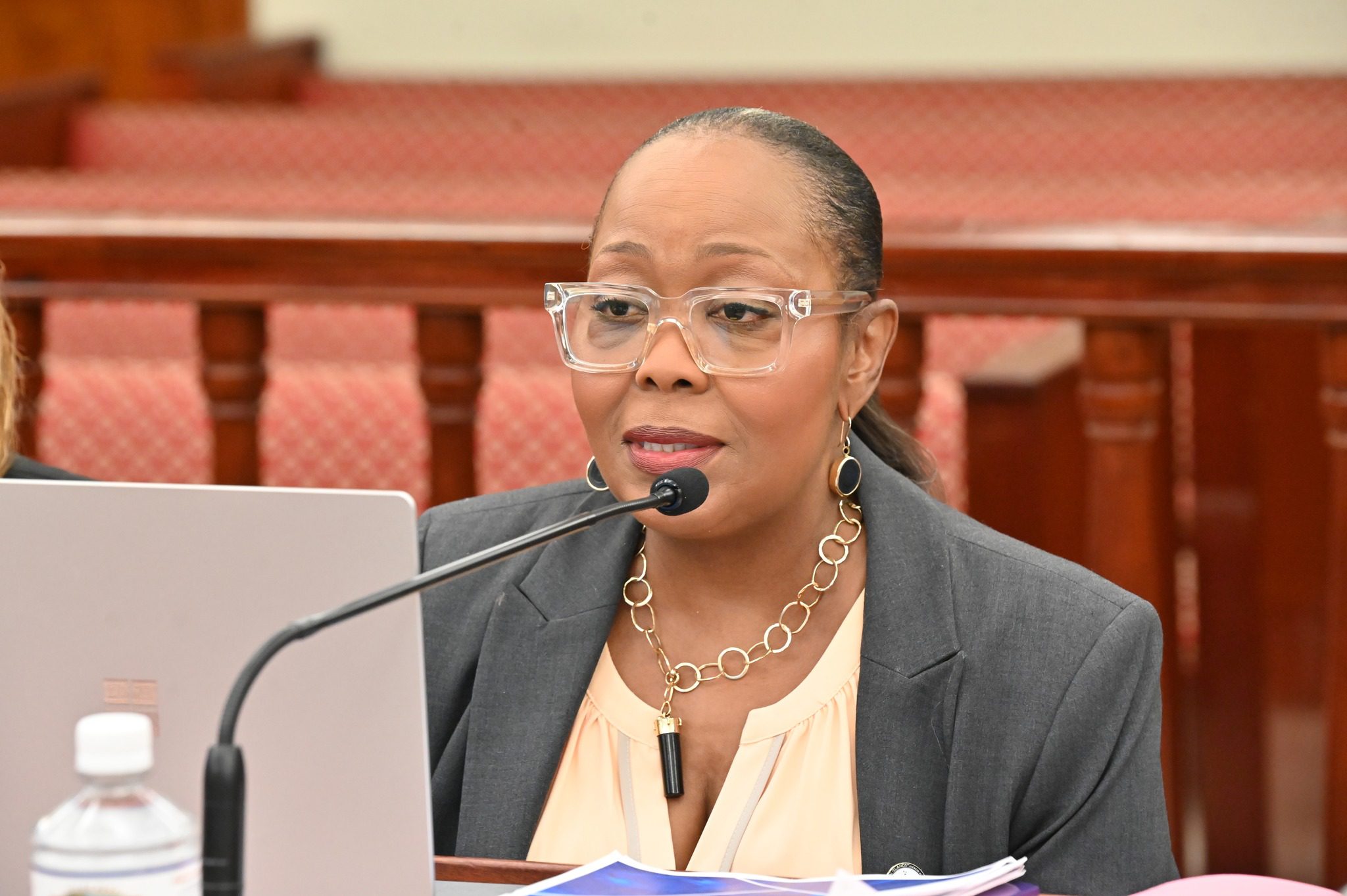
Charmaine Mayers, chief financial officer for the School Construction and Maintenance Bureau, testifies before the Senate Budget, Appropriations and Finance Committee Tuesday on St. Thomas. (Photo courtesy V.I. Legislature)
Leadership from the School Construction and Maintenance Bureau endured their first budget hearing before the Senate Finance Committee Tuesday, 10 months after taking over the responsibility of building and maintaining the territory’s public schools from the V.I. Education Department.
Lawmakers spent much of the hearing grilling testifiers over the high salaries attached to management positions and relatively low number of “boots on the ground” employees after Sen. Novelle Francis Jr., who chairs the committee, noted that the bureau appeared “top-heavy.”
“You are top-heavy,” Sen. Carla Joseph agreed. “You are top-heavy and you need to reconsider how you’re spending the government money and the taxpayers’ money.”
Joseph listed a series of high-paying but apparently vacant positions at the bureau before concluding with a listing for a chief engineer budgeted at $13,180. She asked if that number was correct. The bureau’s chief financial officer, Charmaine Mayers, said the list Joseph referenced was out-of-date and may have been presented to the V.I. Management and Budget Office when the bureau first came online.
“This is the information that was provided to our post auditor,” Joseph said. “I’m only reading from what our post auditor received from the executive branch, so if you want us to have discussions, let us have discussions on real and pertinent information that is validated.”
Mayers stressed that the information Joseph referenced didn’t come from her or BSCM.
“This list has been exhausted, because we don’t have any vacant positions outside of the procurement officer,” she said. “All of the positions currently filled.”
The chief engineer position Joseph referenced earlier, Mayers said, went to a former Education Department employee whose salary increased from $96,000 to $112,000. Under Act 8717, which established the bureau, maintenance and construction personnel previously employed by VIDE were transferred to BSCM. Joseph questioned why the employee needed a $16,000 raise to do the same job.
“I’m just trying to understand the justification for this extra pay,” she said. “You’re going into a bureau, you were doing this work before — why is it?”
Mayers said the position required more work, “so, more work, more pay.” Joseph seemed dissatisfied with the answer.
Senate Majority Leader Kurt Vialet said later that when it comes to school maintenance, “you need workers on the ground.”
“You don’t need a bunch of management positions. You need people in the school that are working on a regular day basis,” he said, declaring that he was dizzy from looking at the numbers. “You got six individuals making over a hundred thousand dollars and 25 making less than [$35,000]. And some of them, some of those individuals got raises — to transfer over from the one to the next, they got a raise. This whole thing is confusion, colleagues.”
In the relatively short time since its inception, the bureau has already weathered criticism from lawmakers and the public over school conditions — particularly in the run up to the 2025-2026 school year. Mayers said during her prepared testimony Tuesday that establishing a brand-new department while also working to fulfill its mandate “has presented both great challenges and important opportunities.”
Mayers led testimony in defense of a $4.76 million allotment from the government’s general fund to support operations in the coming fiscal year. Act 8717 also mandates annual $5 million appropriations from the government’s School Construction Capital Fund. This year, Mayers said the bureau is requesting closer to $5.75 million to cover routine maintenance at schools and other facilities in both districts.
A 36-year-old man was arrested Monday after police said he assaulted a woman during a domestic violence incident on St. Croix.
According to the Virgin Islands Police Department, detectives were called to the Ancilmo Marshall Command around 3 p.m., where an adult female reported that her boyfriend, Nelson Garcia Jr., had punched her and struck her in the head with a cell phone, causing visible injuries.
Garcia surrendered to police at the Wilbur H. Francis Command and was taken into custody. He is charged with second-degree assault and simple assault and battery. Under domestic violence law, no bail was set, according to the police report.
He was booked, transported to the John Bell Golden Grove Adult Correctional Facility, and remanded pending an advice of rights hearing, the police report stated.
V.I. Management and Budget Director Julio Rhymer Sr. led testimony on behalf of Gov. Albert Bryan Jr.’s financial team Tuesday on St. Thomas. (Photo courtesy V.I. Legislature)
The central government’s finance team appeared before the Senate Budget, Appropriations and Finance Committee Tuesday to present their final testimony on the territory’s $1.76 billion proposed budget.
The wrap-up meeting came after months of budget hearings during which individual department heads defended their budget requests for the upcoming fiscal year — or explained why their recommended allotments were insufficient — and several developments have reshaped the territory’s financial outlook since Gov. Albert Bryan Jr.’s financial team first presented the 2026 executive budget to the Legislature in June.
One seismic shift came in June when the Government Employees’ Retirement System moved forward with a planned 3% increase to employer contributions, effective Oct. 1. The GERS’ board approved the increase in September 2024 but later delayed implementation for nine months because the government’s precarious fiscal state at the time would have left it unable to meet its obligation to the system. That hasn’t changed, Management and Budget Director Julio Rhymer Sr. told lawmakers Tuesday.
When asked by Sen. Novelle Francis Jr. if the government could absorb the cost of the increase, Rhymer simply answered, “No.”
Francis asked if anyone from the executive branch had communicated that to GERS.
“The governor was expected to reach out to GERS and have the discussion,” Rhymer said.
“We’ll be doing the same as well,” Francis said.
Appearing before the Senate Finance Committee last week, GERS Administrator Angel Dawson said the increase was necessary even with the long-sought permanent extension to the rum cover-over rate — from $10.50 to $13.25 per proof gallon — which the territory secured in July after years of lobbying the federal government. The system relies on cover-over revenues via a funding note, and Dawson said there’s still a risk that payouts will be lower than anticipated because of lower demand for rum. He presented lawmakers with two scenarios last week: either employer contributions stay where they are and the system becomes insolvent from 2033-2039 — at which point it would need $290 million in government funds to pay benefits — or the increase is implemented, and the system would only be insolvent from 2036-2038. In the latter scenario, GERS would still need $89 million from the central government to pay benefits.
Dawson put the annual cost to the government at $13 million, but on Tuesday Rhymer said the estimated cost was “$4-5 million.”
Lawmakers and testifiers spent little time discussing the legislative mandate to increase salaries for the government’s lowest-paid employees to $35,000 per year. Senate Majority Leader Kurt Vialet introduced the bill in June amid an acrimonious back-and-forth between the Legislature and executive branch earlier this year over the implementation of raises for top government officials. Bryan decried the move, stating that it “will place a massive burden on our finances, and — perhaps most concerning — will undoubtedly add to the inflation woes Virgin Islanders are already facing, potentially negating the very increase it intends to provide.” Lawmakers later overrode his veto of the measure.
Vialet asked V.I. Personnel Division Director Cindy Richardson Tuesday if her department is ready to apply the raises.
“We’ll do what we have to do,” Richardson said. “I mean, once the agency puts them in, we’ll do what we have to do.”
Another of the summer’s more tense legislative sessions came in early August when lawmakers unanimously rejected a bill establishing a special committee to issue a request for proposal for self-funded health and dental insurance plans. The measure appeared to sidestep the Government Employees Services Commission Board, whose chair, Beverly Joseph, said the self-funded model offers more flexibility and cost control but exposes the government to risks in the absence of reserve funds, experienced third-party administrators and a reliable payment structure for high-cost claims.
Rhymer said during prepared testimony that the GESC Board will meet Thursday to make its final decision and that the board’s proposed option “would cost the government $10.4 million and introduce critical changes.” According to Rhymer, an employee’s premium for single coverage would increase by $12.13 and a family’s by $21.25.
“However, with this plan structure change, employees will see high deductibles with increases from $500 to $2,500 for individuals and from $1,000 to $5,000 for families,” he said. Rhymer said Health Reimbursement Accounts will also be introduced, and co-payments will increase. “Please note that members will only be able to access care within the Cigna Open Access Plus network and will no longer have the option to see out-of-network doctors.”
The hearing came one day after leadership from the West Indian Company vexed lawmakers by failing to disclose the financial data they needed for this year’s budget markup, leading Francis to call that hearing an “exercise in futility” before telling the agency to come back with the required information.
On Tuesday, Sen. Hubert Frederick noted to Nathan Simmonds, the V.I. Public Finance Authority’s director of finance administration, that WICO owes the government approximately $10 million in Payments in Lieu of Taxes.
“Is WICO a public corporation owned by the government of the Virgin Islands,” he asked, “or are they a private company?”
Simmonds said the PFA “believes that WICO is a public organization” and acknowledged that the authority owns a hundred percent of WICO’s shares.
“‘Nuff said,” Frederick replied. “We need to collect our PILOT from WICO, then. That’s it. If we own it, we need to collect every dime, and that money needs to go to the general treasury so we can pay our bills.”
The judge asked accused gunman Jahmar Lewis if he understood the potential penalty facing him if found guilty at trial. (Source photo by James Gardner)
The last defendant to face justice for the 2022 robbery and murder at a Havensight jewelry store changed his mind about accepting a plea deal. Through a filing by his lawyer in Superior Court Tuesday, accused gunman Jahmar Lewis said he’d rather take his chances at trial.
Lewis is one of three armed individuals accused of robbing Glitters Jewelry Store on Dec. 4, 2022, and shooting two people inside the store. One of the wounded victims — customer Gregoriana Julien — died from her injuries on Jan. 1, 2023.
A store security guard survived but was badly injured, according to authorities.
Three other people arrested and charged in connection with the case — Michiah Cozier, Akenda Weeks, and Junior Garcia — changed their pleas to guilty and are scheduled for sentencing on Oct. 16. In late July, it appeared the remaining defendant would also take steps to avoid a jury trial.
At an Aug. 8 hearing before Superior Court Judge Carol Thomas-Jacobs, defense attorney David Cattie said his client wanted more time before changing his not guilty plea. “ The Court heard from Defense counsel who stated we did have a signed plea in this case, but my client received some additional information which was filed under seal in this case; we are requesting additional time to consider that information along with the plea offer,” Cattie said.
At trial, Lewis faces 44 criminal counts, including first-degree murder, kidnapping, attempted murder, assault, robbery, grand larceny, conspiracy, and related illegal weapons charges. Thomas-Jacobs offered to reschedule the hearing to Aug. 22 and admonished Lewis to consider the penalty awaiting him if jurors find him guilty.
“You understand the penalty is way more than what this plea is?” the judge asked.
“Yes, your honor,” Lewis said.
But with Tuesday’s motion for withdrawal, it will be up to the judge as to what comes next. Jury selection on Sept. 22 at 9 a.m. is the most likely option, as mentioned at the August hearing.
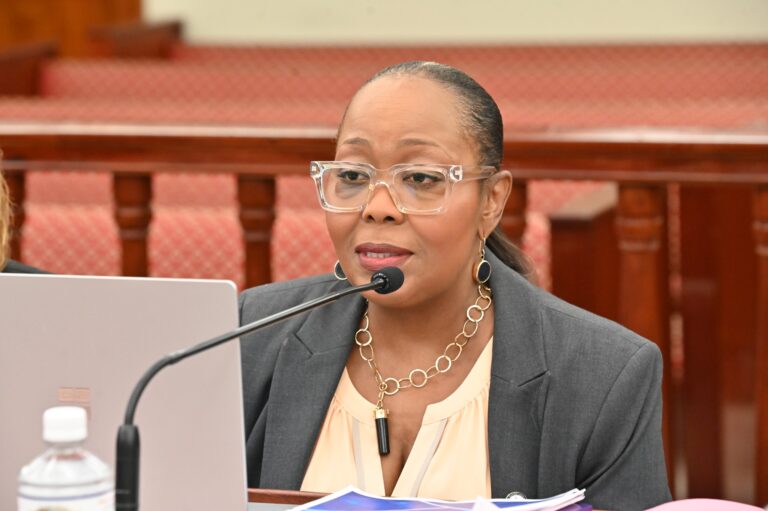
Commissioner nominee Jennifer Matarangas-King testifies in front of the Senate Budget, Appropriations and Finance Committee Tuesday. (Photo courtesy V.I. Legislature)
The Tourism Department asked senators Tuesday to approve a $39 million budget for fiscal year 2026, the same amount as last year, while facing questions about more than $1.3 million in unpaid vendor bills.
Commissioner nominee Jennifer Matarangas-King testified that as of July 18, the department had received $32.4 million in allotments for the current fiscal year but still owes about $1.3 million to local vendors. She said the outstanding payments cover sponsorships and festival-related services, some dating back to December 2024.
Assistant Commissioner Alani Henneman described the bills as a mix of community sponsorships and direct vendor payments. “All of the payments are local payments, senator. It’s just a variety of sponsorships. I would say maybe 10 to 50, maybe Festival-related, direct vendor payments,” Henneman explained. “The $1.3 [million] is a combination of some outstanding festival payments that were miscellaneous payments, but also some sponsorships that have to go through the Property and Procurement process.”
King told lawmakers the delays were caused by procurement hurdles and staff shortages, but said the department has recently begun working more closely with the Office of Management and Budget and the Finance Department to address those issues. “We have begun working very recently, meeting with the leadership for OMB and Finance, and it was an opportunity for them to tell some of their pain points in terms of what we need to do,” King said.
Senators pressed officials to act quickly to restore trust. “Department of Tourism has a bad reputation when it comes to paying people. We don’t want to tarnish it. It’s a bad reputation, so let’s fix it,” said Sen. Dwayne DeGraff.
Sen. Carla J. Joseph underscored the impact of delayed payments by sharing the story of one local vendor. “The vendor provided food, and they’re owed over $13,000,” Joseph said. “That’s a local person who went out on a limb, not once, but twice, for our Festival, and they have not received their payment. That’s tax monies you’re spending that is used by us to pay the outside vendors first, and we aren’t taking care of our people first. Charity begins at home. Make it a priority to take care of our people first, because it’s their tax money.”
Department leaders detailed how money was spent in fiscal year 2025. Personnel costs totaled nearly $3 million, with $1.26 million spent by July. Fringe benefits accounted for $573,121, while supplies and utilities cost $116,936 and $77,292, respectively. By far the largest category was “other services,” which consumed more than $32 million — a line item lawmakers questioned for its size and lack of clarity.
Officials said the broad category covers a wide range of initiatives, including advertising, festivals, strategic partnerships, public relations, and sales. “The recommendations of the budget will cover all operational costs for the department, salaries and fringe benefits, contracts, office expenses, offshore sales, film visitor experience and the Division of Festivals, sponsorships, collateral, social media, advertising and marketing,” said King.
The future of parade broadcasts by WTJX, the Virgin Islands’ public television station, is in question as lawmakers and Tourism officials grapple with funding shortfalls following the loss of federal support, as well as WTJX not being able to stream the St. John Parade, as reported on during their July 15 hearing.
For decades, WTJX has aired local parades at no cost to the Tourism Department or the Division of Festivals, providing a vital service to the community — especially elders who rely on television rather than online streaming. “Since forever, parades have been broadcasted by WTJX,” said Ian Turnbull, director for the Division of Festivals. “We have supported WTJX, I think, to the tune of about $71,000 over a couple years.”
This year, WTJX has requested additional support to continue its coverage, citing financial strain after federal funding cuts. “WTJX is even under more dire circumstances because of the federal government and the cuts,” said the commissioner. “Livestreaming is fine, but a lot of elders, especially, they’re not going to be streaming, they’re going to be watching it on TV, and they’ve been relying on that. So that’s something that we need to take a look at moving forward.”
Lawmakers echoed the need for action, with Sen. Kurt Vialet urging, “I just think we need to include this in the budget. We need to make it a line item and just move forward from there.” The committee Chair, Sen. Novelle Francis, added, “We just can’t lock out WTJX, who have traditionally done this. A lot of people are looking forward to being able to view the parades via WTJX, and were really denied that opportunity.”
Alongside questions about spending, staffing challenges remain a pressing issue. The department currently employs 29 people but has 11 vacancies and 10 new positions approved in the upcoming budget. Director of Administration and Management Jamila Miller said the agency has struggled to recruit for critical roles, such as the assistant director of Festivals, which has been vacant for more than a year. “We have received resumes for those positions, and the intent is to start scheduling interviews,” Miller told lawmakers.
Despite these challenges, Tourism indicators continue to climb. The Virgin Islands is on pace to surpass its 2024 record of nearly 1 million overnight guests. Seat capacity is projected to reach 706,689 in 2026, a 5% increase over 2024. The average daily hotel rate is $664, with more than 620 new hotel rooms added in St. Thomas and St. John.
“The United States Virgin Islands continues to solidify its place as a preeminent travel destination within the Caribbean and worldwide, supported by consistent arrival numbers and industry-leading marketing initiatives,” said King.
Marketing campaigns have also expanded the territory’s reach. The “A Vibe Like No Other” promotion brought 1,500 visitors to St. Croix, distributing $375,000 to local hotel partners. The number of businesses listed on VisitUSVI.com has grown to 700 from 200 last year, and a monthly newsletter now reaches more than 300,000 readers worldwide.
“The most recent Business Research and Economic Advisors study ranked St. Thomas second in average passenger spending among all Caribbean destinations. This continued growth reflects intentional strategy and consistent execution through a coordinated blend of public relations, advertising and digital engagement, the Department of Tourism strengthens the territories profile and sets the U.S. Virgin Islands apart from regional competitors,” said King
Models from the kids ROCK fashion show earlier in the year. (Photo courtesy JG Management USVI)
As JG Management USVI enters its 15th year, founder and owner Jason Gardener is preparing to welcome a new wave of talent interested in expanding their skills in modeling, acting, and the performing arts.
Over the years, Gardener has built a creative empire in the Virgin Islands, producing signature events such as kids ROCK Fashion Weekend, VI Model of the Year Competition, St. Croix STYLE Fashion Week, The JG Center of Excellence, STYLED by Jason Gardener, and the Mr. & Miss JG Management Pageant.
Reflecting on this milestone year, Gardener said that the upcoming season’s theme is “Elevation.” In March, the group will officially celebrate its 15th anniversary. “Reaching 15 years is amazing, and now I just want to keep growing and getting better. I want to elevate my skills in teaching, expect more from the talent, raise the bar with our productions, and create even greater opportunities,” Gardener explained.
Mt. Pleasant studios on St. Croix, located above Jane’s Bridal. Auditions are open to children, beginning at age 5, as well as to teens and young adults.
Auditions and registration for the 2025-2026 season begin this weekend at Mt. Pleasant studios on St. Croix, located above Jane’s Bridal. Auditions are open to children, beginning at age 5, as well as to teens and young adults. Sessions will be held on Saturday, Aug. 23, from 1 p.m. to 4 p.m.; Sunday, Aug. 24, from 1 p.m. to 4 p.m.; and Sunday, Aug. 31, from 1 p.m. to 3 p.m. The dress code is personal style, allowing participants to showcase their individuality. The new season officially begins on Sept. 2.
Model from JG Management. (Photo courtesy JG Management USVI)
JG Management’s training program is designed to prepare participants for success in both the fashion and entertainment industries. Training encompasses modeling and acting techniques, stage presence, public speaking, fashion styling, production insights, confidence-building, portfolio and resume development, as well as personal growth. In addition to weekly sessions, students will also participate in special workshops and fun outings.
Gardener said he is excited to welcome both returning and new talent this season, but he especially hopes to see more male participants. “Before the pandemic, we had a strong male presence with boys, teens, and young adults. I would love to see that return. There are many opportunities — whether for local commercials, castings, or even projects when we travel to New York — and we get frequent requests for male talent,” he said.
JG Management is seeking more male models this season. (Photo courtesy JG Management USVI)
Gardener is also the visionary behind the highly anticipated kids ROCK Fashion Weekend, which he launched in 2013 after moving back to St. Croix from New York. “When I started my training program, I wanted to put on the biggest fashion shows in the Virgin Islands. That’s how Kids ROCK came about. The name just popped into my head because, you know, kids rock,” Gardener recalled.
Now in its 13th year, kids ROCK has become a cornerstone of youth fashion in the Virgin Islands, along with VI Model of the Year Competition and St. Croix STYLE Fashion Week, giving young models an early platform to shine. As JG Management steps into its 15th year with the theme of Elevation, Gardener remains committed to guiding Virgin Islands talent toward growth, opportunity, and the global stage.
The United States Virgin Islands Soccer Federation is competing in the 2025 Caribbean Football Union U14 Girls Challenge Series in Port of Spain, Trinidad, from Aug. 15–25, 2025. The annual tournament showcases the Caribbean’s top under-14 soccer players, with boys’ and girls’ teams alternating each year in this international high-level competition.
This year’s event attracted 23 teams from throughout the Caribbean.
Tier I
Group A – Bermuda, Dominican Republic, Martinique, and Puerto Rico
Group B – Aruba, Jamaica, Trinidad and Tobago, and Trinidad and Tobago High Performance (replaced Haiti)
Tier II
Group A – Bonaire, Dominica, St. Kitts & Nevis, and United States Virgin Islands
Group B – Barbados, British Virgin Islands, French Guiana, Grenada, and Suriname
Group C – Anguilla, Antigua & Barbuda, Cayman Islands, Guyana, and Turks & Caicos Islands
The USVI girls got off to a fantastic start as they steamrolled St. Lucia 7 – 1 in the Ato Boldon Stadium. Kyla Groetzinger led the way with five goals. Olivia Ardion and Tyrah Perez also scored one goal each for the Virgin Islands.
USVI Kyla Groetzinger receives Player of the Match Award for scoring five goals in their 7 – 1 win over St. Lucia at 2025 Caribbean Football Union 14U Girls Challenge Series. (Submitted photo)
St. Kitts & Nevis was the second team to yield to the USVI offensive machine. This time it was Ardion who pasted the Virgin Islands offense with three goals. Juvanita Hursts added the final goal in the USVI’s 4 – 1 win.
USVI received a much-needed day off, but the break seemed to have an adverse effect on USVI girls as they were only able to score one point in their 1 – 1 draw against Bonaire. This set up a must-win game against undefeated Dominica. The game started well with Groetzinger scoring her seventh goal of the tournament, giving the VI a 1 – 0 lead. However, Dominica came back and scored four unanswered points on their way to a 4 – 1 victory. The win secured a spot in the knockout stage for Dominica.
USVI Olivia Ardion scores a hat trick in USVI’s 4 – 1 win over St. Kitts & Nevis at the 2025 Caribbean Football Union 14U Girls Challenge Series. (Submitted photo)
The USVI placed second in their pool and must now wait to see if they rank as the top second-place team. The highest-ranked second-place finisher will also advance to the final stage of the tournament.
Fly the Whale launches new daily service from St. Croix starting Sept. 15. (Photo courtesy Fly the Whale)
Fly the Whale will launch three new daily round-trip flights between Henry E. Rohlsen Airport on St. Croix and San Juan International Airport starting Sept. 15, the airline announced in a recent press release.
The service expands travel options for business, medical, and leisure passengers, with flights arriving and departing from the Jet Aviation FBO on the east side of San Juan International — about a seven-minute ride from the main terminal. A shuttle will be provided for passengers connecting at the terminal. Guests traveling from the terminal to Jet Aviation will need to arrange a taxi or Uber, according to the press release.
Fly the Whale President Shane Reynolds called the new service “a great opportunity for our valued guests to travel to San Juan for onward connections, business, medical care, and those seeking a getaway to the beautiful islands of Puerto Rico and St. Croix.”
The expansion builds on the airline’s growth in the region. Since launching service between St. Croix and St. Thomas in April 2023, Fly the Whale has carried tens of thousands of passengers. The new route extends the carrier’s customer-focused operations beyond the U.S. Virgin Islands to Puerto Rico, the press release stated.