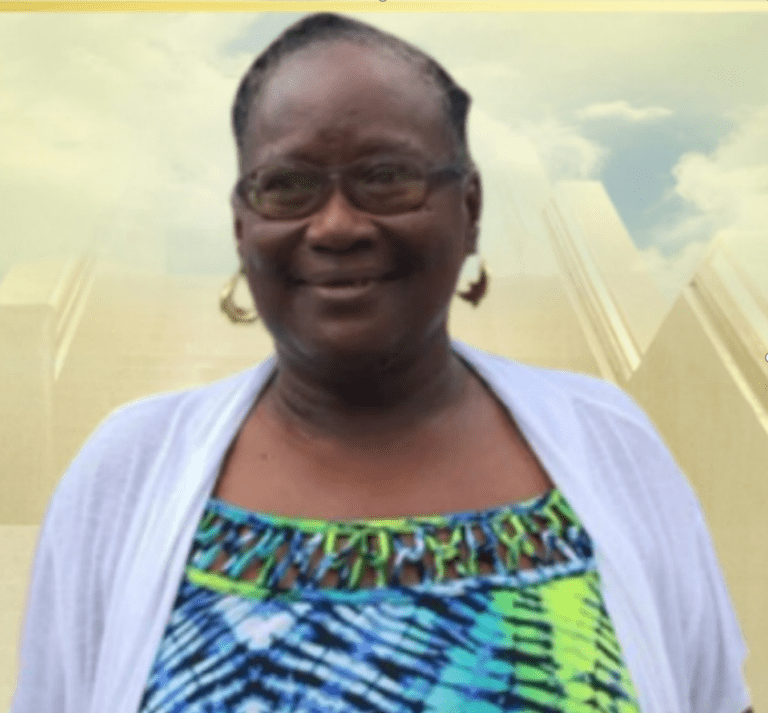
Alice Leona Shervington a.k.a. “Ms. Shervy” of Christiansted, St. Croix transitioned into eternal life on July 26, 2025. She was 68 years old.Alice Leona Shervington
She was preceded in death by her Mother, Inez A. Shervington; Father, Clarence Shervington Sr.; Brothers, Juniel Wilson, Clarence Shervington Jr.
She is survived by her daughter, Khaliah B. Parris; Sons, Kareem Abdul Isaroon, Osirus W. Lewis; Grandchildren, Spencer “Khaleem” Maxwell, M’Laizsa Isaroon, Nahtifa & Nahbrion Joseph, Nahajah & Prince “Khadeem” George, Nahlani & Khayan Goodwin, Orion Lewis; Great Grandchildren, JeLaia, NaJai & Myla (twins) and Sky George (ATL); Sisters, Laverne S.Penn, Jacqueline A. Shervington; Brothers, Keith Amaro (Cali), Kenneth Amaro (FL), Larry (NJ) and Earl Shervington, Attorney Dwayne Henry, Esq.; Nieces, Keema Penn, Shynylle (NJ), Sherna (NY), Shania (FL) & Inez Shervington Jr., Emily Coleman (LA), Felicia (FL), Meagan Awoyemi (LA), Courtney & Brianna Amaro; Nephews, Floyd Penn Jr. (MD), Larry Shervington Jr. (NJ), Kevin Wilson (GA); Great Nieces, Raynyse Nesbitt, K’Nira George, Nia Shervington, Sophia M.D. Awoyemi, Jordan & Brooklyn Harrison, Kyniah Florent, Ameerah Shervington, Milani A. Guadalupe; Great Nephews, Treyvon Shervington, Malcolm Harrison, Jah’Mari John, K’Mani George, Emmanual Laddler, Jeremiah Hagan, Michael Williams Jr., Michael Awoyemi; Uncle, Eardley Shervington (FL), Brother-In-Law, Floyd Penn Sr.; Sisters-In-Law, Roslyn Amaro (FL), Cheryl Shervington (NJ); Cousin and Other Relatives, Ira Phillips Jr., Edelta Phillips and Butchie Phillips. Other relatives and friends too numerous to mention.
Funeral service will be held on Thursday, Aug. 21 at St. John’s Episcopal Church, Christiansted, St. Croix. Viewing will begin at 9 a.m. with service at 10 a.m. Interment will follow at Christiansted Cemetery.
Professional services are entrusted to James Memorial Funeral Home, Inc.
WAPA contractor, J. Benton Construction, has reopened the Queen Mary Hwy/Centerline Rd from Castle Burke traffic light (East Airport Rd) to UVI/Complex High School traffic light.
Starting Thursday, Aug. 14, at 9 a.m., from UVI/Complex/CTEC traffic light to Industrial Rd/Upper Love Rd (near Spicy Grill), the road will be closed until Sunday, August 24.
Please note that westbound traffic at Castle Burke will only be able to access UVI, CTEC, and SCECHS. Thank you for your support and cooperation.
Rita Johnson, of Estate Strawberry, passed away on July 17. She was 75 years old.
Rita Johnson
She was preceded in death by her parents, Wilfrid A. James and Elaine V. Bølling Forbes; niece, Keisha James; nephew, Fernando Cabret III.
She is survived by her husband, Delzin “DJ Sox” Johnson; sons, Patrick Sweeney, Jr., Lamont Sweeney, Kareem Johnson; brothers, Floyd Henderson, Patrick James, Sr., Howard Forbes, Sr.; sisters, Aurelia Cepeda Estrill, Elaine James Springer, Verna Forbes Dowling, Evelle Forbes; step-mother, Dorene Hector James; step-siblings; Melvin, Marvin, and Helen Forbes, Monette Tracy; step-sons, Gladwin and Afori Johnson; step-daughter, Tamara Johnson; grandchildren, Daniella Sweeney-Yates, Lamont K. Sweeney, Jr., Christian, L’mya Sweeney, Mah’Lani Johnson and Leondre Santos, Dominique Tasker; great-grandchildren, Rowan Yates, Ezra Santos, Xiomara Santos; aunts, Dorothea Thomas Vivican, Myrtle Thomas Daniel, Genevieve Thomas; uncle, Roy Thomas; nieces, Corine James Jeffers, Antoinette James Alleyne, Beverly James, Desiree Ross, Wendye Ross-Rice, Monique Estrill, Darisse, Daynia Dowling, Kandace Copemann, Amira Forbes; nephews, Patrick James, Jr., De’Andre James, Jamil Springer, Howard Forbes, Jr., Anthonio Forbes, Jelani Copemann; daughters-in-law, Janet Sweeney, Evelyn Webster; grandson-in-law, Josh Yates; sisters-in-law, Ella Jean Forbes, Glassome James, Urylee and Yvone Burke; brother-in-law, Darwin Dowling; goddaughter, Delia Richardson; other precious relatives, The James Fam., The Bølling Fam., The Thomas Fam., The Johnson Fam., The Bough Fam., The Brady Fam., The Henry Fam., The Gibbs Fam., The Vivican Fam., The Daniel Fam., The Lenhardt Fam., The Andrews Fam., Therese Tasker, Nadine Davis Glasgow, Martiza Santos, Karimah Chinnery, Doreen Chesterfield, Edgar Ross; special friends, Floretta Begraff, Angie Bermudez, Alma Roberts, Suzette Rojas, Wilmot, Darren and Joanne Edwards, Christian, Debra Webster & Fam., Dinah O’Reilly, Rae Armstrong, Winona Hendricks, Betty Joseph, Curleen Rodgers, Rena Brodhurst and Fam., The Food Court breakfast crew, V.I. Lottery Office, Dept. of Human Services; special thanks to, Continuum Care in Atlanta, James Memorial Funeral Home, Inc., Rena Thomas and Yvette Browne.
Funeral service will be held on Aug. 19 at Holy Cross Catholic Church. Viewing will begin at 9 a.m., and the service will start at 10 a.m. Interment will follow at Christiansted Cemetery.
Professional services entrusted to James Memorial Funeral Home, Inc.
Ruth Christine Williams, of Estate Morningstar, passed away peacefully on July 26, at the age of 77.
Ruth Christine Williams
She was born in 1948 in St. Kitts to Ellen and Harold Maynard. Ruth immigrated to St. Croix in 1964, and on December 12, 1971, she married Sydney Williams. Ruth was cherished by all who knew her. With a tender heart and a generous spirit, she was a constant source of love, kindness, and unwavering devotion to her family and friends. Her warmth and compassion left a lasting impression on everyone she met.
She was preceded in death by her mother, Ellen Maynard, and father, Harold Maynard.
She is survived by her spouse, Sydney E Williams; sons, Marcus Williams, Mostin Williams, Michael Williams; grandchildren, Mateo Williams, Nathaniel Williams; siblings, Naomi Julien, Linkon Maynard, Claudette Walwyn, Ingrid Gilbert, Antonio Maynard, Cheryleann Pemberton, Harold Maynard Jr; nieces, Petra Holder, Tresca Liburd, Stacy Greer, Sophia Philip, Jinnelle Julien, Julia Julien, Alex Julien, Camelle Gilbert, Dr. Janielle Maynard, Lynicia Maynard, Dr. Odaelys Pollard, Odessa Walwyn, Tonisha Maynard, Jayanti Maynard, Esther Francis, Cynthia Francis, Lenore Josiah, Joya Williams, Veron Bussue, Julene Williams, Davia James; nephews, Maverick Liburd, Lawson Liburd, Travis Phillip, Calver Gilbert, Shaundi Gilbert, Konris Maynard, Gamaliel Brian Pemberton, Andwele Maynard, Oza Maynard, Halsted Francis, Roy Francis, Dr. Donnell Josiah, Lenard Josiah, Juan Williams, Jevon Williams, Joel Williams, Daviel James, Damian James, Davenee James; aunts, Hildred Lawrence, Wendy Lawrence, Joyce Daniel; uncles, Neil Claxton, Paul Maynard; daughters in-law, Dr. Kiticia Jules Williams, Lenay Brooks-Williams; brothers in-law, Peter Gilbert, Vincent Liburd, Lincoln Pemberton, Eucline Williams, Vernon Williams, Pastor Noel James, Lenny Josiah; sisters in-law, Verlyn Maynard, Arlyne James, Verna Williams, Claristine Francis, Varina Williams, Silvia Williams, Sonya Williams; special friends, Odette Rene, Lucia Frederick, Beata Manuel, Joan Brooks, Felix Frazier and others too many to include separately; cousin and other relatives, Wendy Lawrence and Family, in St Kitts, Neil Claxton and Family in St Croix, Joyce Daniel and family in Florida.
Funeral service will be held on Aug. 31 at Central Seventh Day Adventist Church. Viewing will begin at 9 a.m., and the service will start at 10 a.m. Interment will follow at Kingshill Cemetery.
Professional services entrusted to James Memorial Funeral Home, Inc.
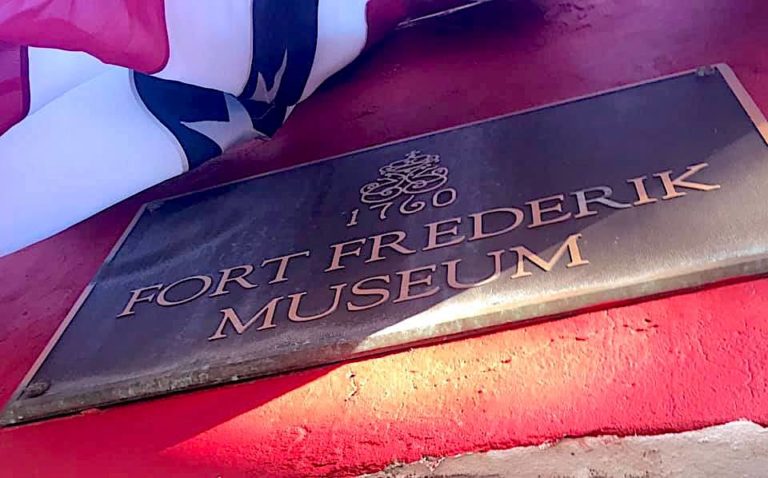
Commissioner Jean-Pierre L. Oriol of the Department of Planning and Natural Resources invites the public to attend the Division of Libraries, Archives and Museums’ ongoing artist talk series, “Lunchtime with the Artist,” beginning Tuesday, Aug. 19 from 1 p.m. to 2 p.m. at the Fort Frederik Museum.
Fort Frederik (Fort Frederik Museum photo)
This engaging series features artists whose work is part of DLAM’s annual Emancipation art exhibition, “Tides of Freedom: Histories of Resistance from the USVI to the USA.” The first presentation will spotlight mixed-media artist Victoria Rundberg-Rivera, a self-taught painter based in St. Croix whose work reflects a deep personalconnection to themes of freedom and resistance.
“Lunchtime with the Artist” will continue throughout the duration of the exhibition, which runs until late October. Each session will offer a unique opportunity to hear directly from participating artists about their creative process, inspirations, and how their work contributes to the broader narrative of emancipation in the Virgin Islands and beyond.
Admission is $5, with free entry for students under 18, who are especially encouraged to attend and engage in the dialogue.
For more information, please contact:
• Amy Parker DeSorbo, DLAM Director: amy.desorbo@dpnr.vi.gov
• Monica Marin, DLAM Chief Curator: monica.marin@dpnr.vi.gov
• Or call Fort Frederik Museum at 340-772-2021
Police were working Thursday to identify a body found wrapped in garbage bags in the Fortuna area of St. Thomas Wednesday afternoon.
The Virgin Islands Police Department received a report of the suspected human remains around 3:45 p.m. Wednesday, according to a police spokesperson. Officers searched the area and found the body. The gender and cause of death were not immediately clear. An autopsy is planned.
Police asked anyone with information about the corpse to contact the Major Crimes Unit at 340-774-2211, extensions 5554, 5555 or 5556 — or to call 911 or Crime Stoppers V.I. at 800-222-8477 (TIPS).
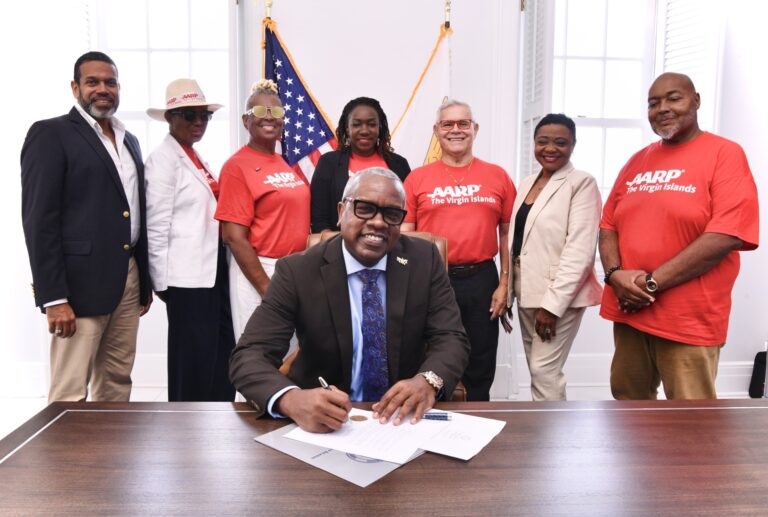
Governor Albert Bryan, Jr. has officially proclaimed August 14, 2025 as the ‘Social Security Day’ in the US Virgin Islands, recognizing the program’s enduring impact on the lives of Virgin Islanders and Americans nationwide.
Gov. Albert Bryan Jr. proclaims August 14, 2025 as “Social Security Day” in America’s Paradise. (Submitted photo)
Social Security helps older Americans stay out of poverty and live with dignity after a lifetime of hard work. Signed into law in 1935, the Social Security Act has provided a foundation of financial stability for retirees and individuals with disabilities, as well as surviving spouses and families for nine decades. Today, 22,254 Virgin Islanders rely on Social Security to help meet essential needs such as housing, food, and healthcare.
“Social Security has stood the test of time, offering dignity, independence, and peace of mind to generations,” said Pamela Toussaint, Associate State Director of Advocacy and Outreach for AARP Virgin Islands. “As we mark this historic milestone, we reaffirm our commitment to protecting and strengthening this vital program for the future.”
The program also plays a significant role in the US Virgin Islands’ economy, generating nearly $406.8 million annually in economic activity. Social Security beneficiaries spend this steady income on essentials, fueling local businesses, supporting jobs, and generating tax revenue through a powerful ripple effect.
With the proclamation, Governor Bryan encouraged all Virgin Islanders to reflect on the importance of Social Security and support efforts to ensure its continued strength for generations to come.
For more information on what AARP Virgin Islands is doing to celebration this historic landmark, go to: https://qr.aarp.org/SS90partiesUSVI
CAHS students gather under a shade tree outside the Ruth Thomas Auditorium Wednesday. (Source photo by Judi Shimel)
Public schools welcomed thousands of students and their parents on the first day of classes for the fall semester. For many — especially the children — it was a day of glad reunions with classmates and teachers and staffers. For school administrators, it was a day to manage a stream of visitors with questions on scheduling and class assignments.
Gov. Albert Bryan Jr. joined Education Department officials on a visit to greet the families showing up at one St. Thomas school Wednesday morning. At another school, Sen. Avery Lewis of the Senate Education Committee began a readiness tour of facilities that underwent inspection in late July/early August.
“I always love to see kids on the first day of school. It reminds me of the first day I took my kids to school,” the governor said. “And today, surprisingly, is pretty good. We don’t have as much crying, so that’s pretty good.”
Gov. Albert Bryan Jr. joins school officials at Joseph A. Gomez Elementary to welcome students on the first day of school. (Photos by Clara Freeman, Government House)
First day impressions shared by officials, administrators and parents varied. Some shared their thoughts with members of the press; others took to social media. Others simply thought out loud as they made their way through the day.
Lindon Poleon, a father of two Joseph Gomez Elementary School students, stood at a distance, watching his first-grader and one just starting kindergarten. Poleon said he was pleased with the way things were going. “I had a chance to meet the teachers; they were very nice,” he said.
A proud dad walks his little lions to class on the first day at Joseph A. Gomez Elementary School. (Photos by Clara Freeman, Government House)
Principals and assistant principals at three public schools spoke about new cellphone policies, new courses in development and how quickly students settled into their classrooms on day one. At Ivanna Eudora Kean High School, Principal Sally Petty spoke about an array of activities, including the garden club, the chess club, cheerleading, and the sewing club.
Kean High is also making progress in restoring the school’s fish farm with help from teachers in the science department, Petty said.
“We have athletics, we have the Honor Society; we have a book club, a reading club — so there’s a lot of things the students can get into besides academics after school,” the principal said.
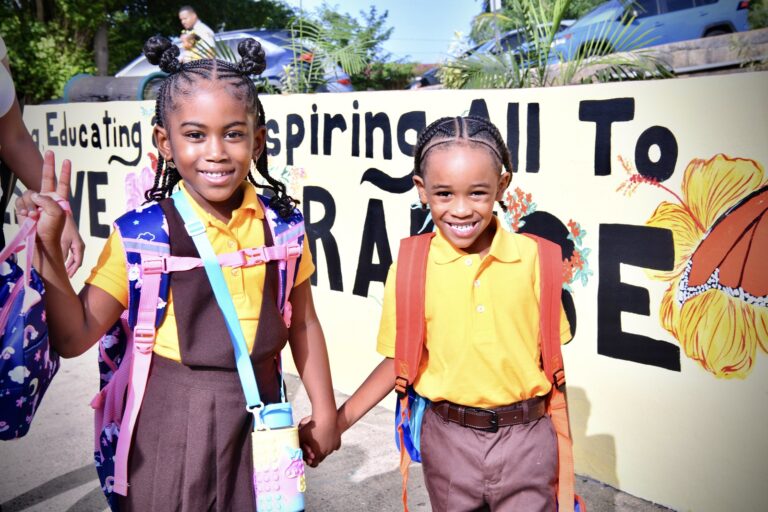
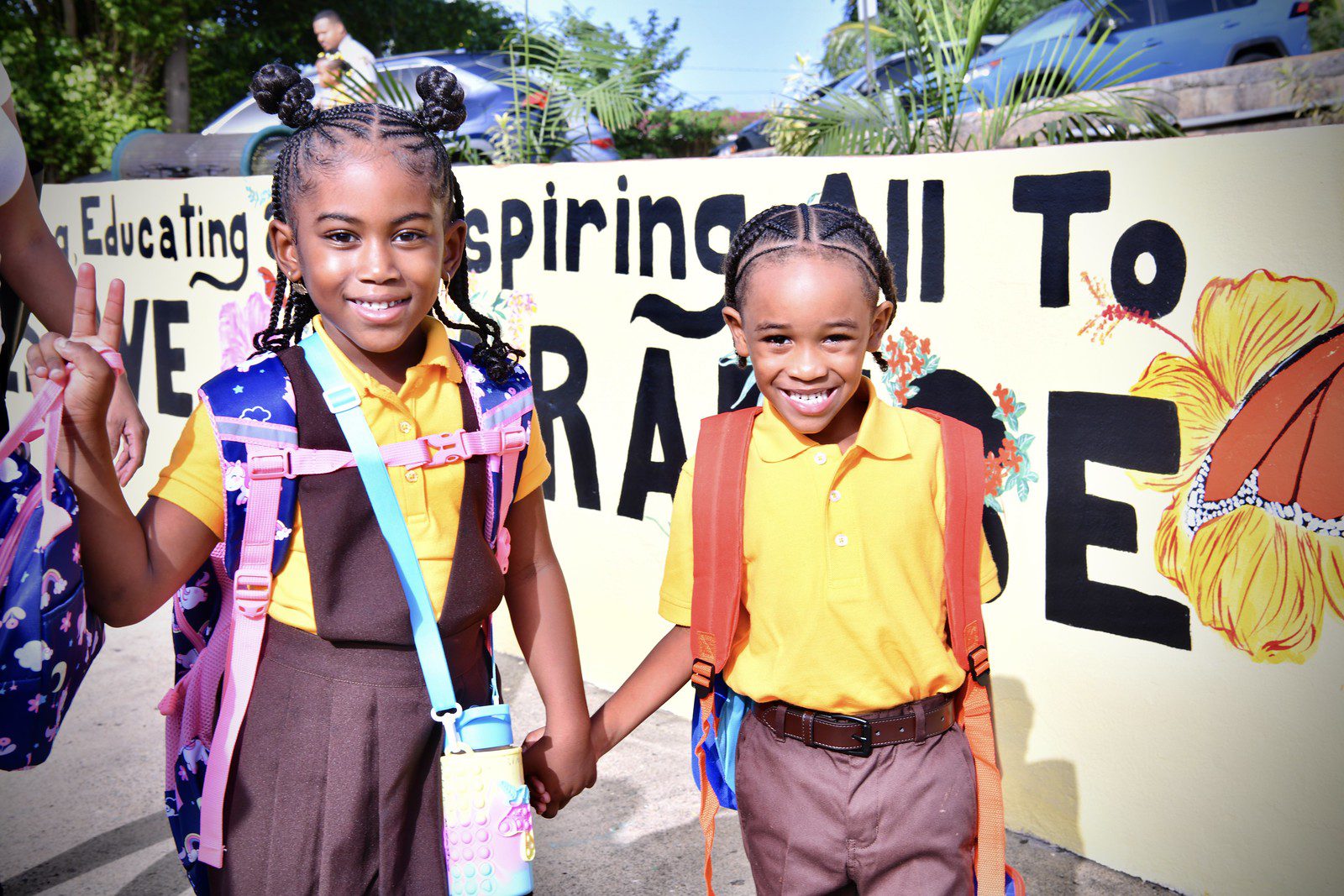
Smiling siblings hold hands as they head into their first day of school. (Photos by Clara Freeman, Government House)
Few were willing to discuss the problems they faced with equipment — or lack thereof —and maintenance issues on opening day. Charlotte Amalie High School Principal Njnanya Boyd turned away questions about having to manage school operations on an active construction site. Boyd also turned down a request from a visitor to view the on-campus Sprung shelter set up during hurricane reconstruction efforts, which is now reportedly being used as a cafeteria, gym and auditorium.
Students at CAHS bring questions to the principal’s office. (Source photo by Judi Shimel)
At last assessment by Education Committee inspectors, the CAHS shelter lacked air conditioning.
“It’s where we feed our children; it’s where we have study hall — it’s very important — but we have made the adjustments necessary in the absence of Sprung as far as the AC units,” Boyd said.
Students were instead assembled in the school gymnasium, several parents complained on social media. “First day of school at CAHS, and they’ve got a bunch of them just packed into the gym twiddling their thumbs. Not like we had all summer to address mold and air conditioning issues,” one parent said.
Parents and students queue up outside the principal’s office at Gomez Elementary School. (Source photo by Judi Shimel)
Air conditioning was also a topic among office workers at Yvonne Millner-Bowsky School in Mandahl. It also factored into the way officials at the Bertha C. Boschulte Middle School approached orientation this year.
The plan was to hold smaller group orientations to prevent large, uncomfortable gatherings.
“We did not have seventh- and eighth-grade orientation this year. We opted only to have sixth grade because they’re coming in new, and new seventh- and eighth graders coming into the school,” said acting BCB Principal Kifani Hendricks-Carey.
A list of attendance guidelines posted at the Bertha C. Boschulte Middle School. (Source photo by Judi Shimel)
Bryan acknowledged the ups and downs of getting schools in shape in 2025. Federal funding arrived slowly and came with new conditions attached. That, he said, led to a late start for contractors and maintenance crews.
“That delayed things, and then the schools are 50 years old; I was passing Ulla Muller (Elementary School) yesterday and realized I was sitting in a classroom at Ulla Muller 50 years ago, and the school wasn’t new then. So, we are really focused on getting the new schools up,” Bryan said.
I check in on the territory I was raised in nearly every week. Two recent editorials — one by former Sen. Janelle Sarauw and one by Dwight Cartier — confirmed something I’d already feared: much of what ails the Virgin Islands is still with us.
Albert Gibbs
As someone who lives in the Metro-DC area but is still very much a Virgin Islander at heart, I don’t romanticize home. I’m not urging people to return for the next fish fry. At my age, reliable healthcare is not optional: I’m diabetic and grateful I don’t need dialysis, but I need care I can count on. I can live without air conditioning; I cannot live without the ability to see at night, or to flush the toilet after I use it.
These are not petty complaints. They are the daily evidence of a system failing its people: unreliable water and power, crater-sized potholes that ruin cars and block emergency access, schools without up-to-date technology, and a health environment that lags behind what any community should expect. When people say “come home,” are they saying “come home to better healthcare, infrastructure, and a future our children can depend on?” Right now, the data and the lived experience do not support that promise.
I’m encouraged that new voices are stepping up. I spoke with Dwight Cartier recently and came away convinced he represents the kind of change we need: practical, people-focused, and willing to spotlight what we’ve overlooked. Small things matter — why don’t we mark the island’s heroes? St. Croix is the birthplace of an NBA Hall of Famer and of Henry Rohlsen, an original Tuskegee Airman. Other islands put cultural markers and pride on display; we should, too. Pride in our history and role models helps build civic confidence.
But pride alone won’t fix structural problems. Too often contracts, bids and fiduciary actions are decided by proximity and bloodlines, not competence. In a small community, family ties are natural — but they must not be a substitute for merit. Malfeasance and misfeasance are worse when the public stays silent because the person at fault is “one of ours.” We need transparent procurement, clear accountability, and an insistence on competence.
We cannot keep putting all our eggs in tourism’s basket. Tourism is vital, but it’s brittle: a global downturn, a storm, or a single company pulling back can devastate livelihoods overnight. St. Croix — and the Virgin Islands as a whole — must diversify with an industrial and agricultural strategy, plus blue economy and renewable energy manufacturing. We must find practical uses for the island’s waste stream: convert the dump into a source of clean energy, stop poisoning our land and water, and turn liabilities into jobs. Contaminated sites and a legacy refinery footprint are not abstract problems — they affect people’s health, contribute to high healthcare costs, and make doing business harder.
We face high living costs and high energy and healthcare bills. When electricity and medical care rank among the most expensive in the nation, families feel the squeeze in ways that statistical charts don’t fully capture. When a community’s health metrics are alarmingly low, there’s a reason: environmental contamination, limited local food production, and infrastructure gaps all play a role.
This is not a partisan screed. I have voted only four times in my life — for causes I believed would bring meaningful change. I voted for change then, and I believe we need a new infusion of leaders now. That includes people like Dwight Mike Cartier and leaders like former Sen. Janelle Sarauw, both of whom merit being known and evaluated by the public. Meet them. Question them. Learn from them. If we continue to re-elect the same people, with the same habits, the same committees that produce no results, nothing will change.
Elections are about evidence. Every time you can’t wash your clothes safely, when you can’t flush your toilet, when a neighbor’s yard is overrun by an invasive species because response is slow or absent — that’s evidence. Res ipsa loquitur: the facts speak for themselves. They tell us that business as usual is unacceptable.
If you’re a Virgin Islander, especially those living off-island: your perspective matters. If you’re at home: your vote and your voice matter. When candidates come to your neighborhood, take the time to meet them. Ask hard questions. Demand plans that go beyond slogans — plans for industry, for local food production, for transparent contracting, for converting waste into energy, and for healthcare that is accessible and affordable.
Change begins with attention, then accountability. Let the evidence guide our choices this election year.
— Albert Gibbs, Metro-DC
Editor’s Note: Opinion articles do not represent the views of the Virgin Islands Source newsroom and are the sole expressed opinion of the writer. Submissions can be made to visource@gmail.com.
The Horsford cousins arrive at Claude O. Markoe Elementary School on the first day of classes. (Source photo by Diana Dias)
St. Croix schools came alive Wednesday morning as faculty, staff, and students returned for the first day of classes, filling campuses with the familiar mix of anticipation, first-day jitters, and fresh starts.
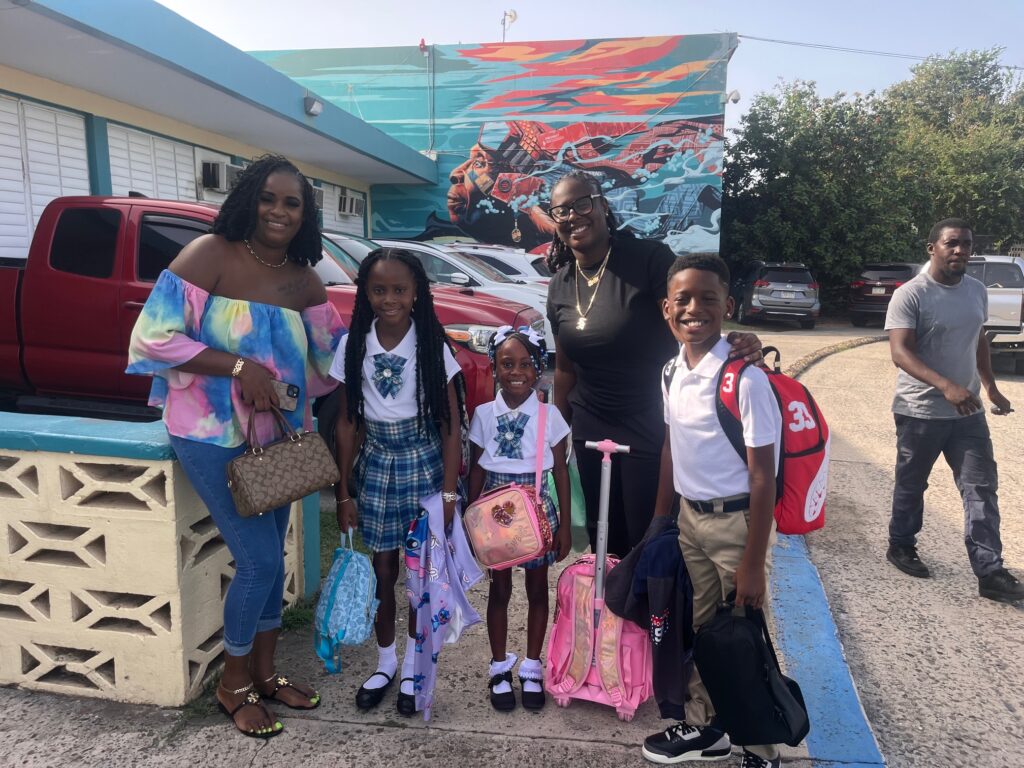
At Claude O. Markoe Elementary School, parents escorted their children through the gates, many carrying small bins packed with school supplies. One parent, Sash Ogarro, said she was eager to see the children return after the long summer break.
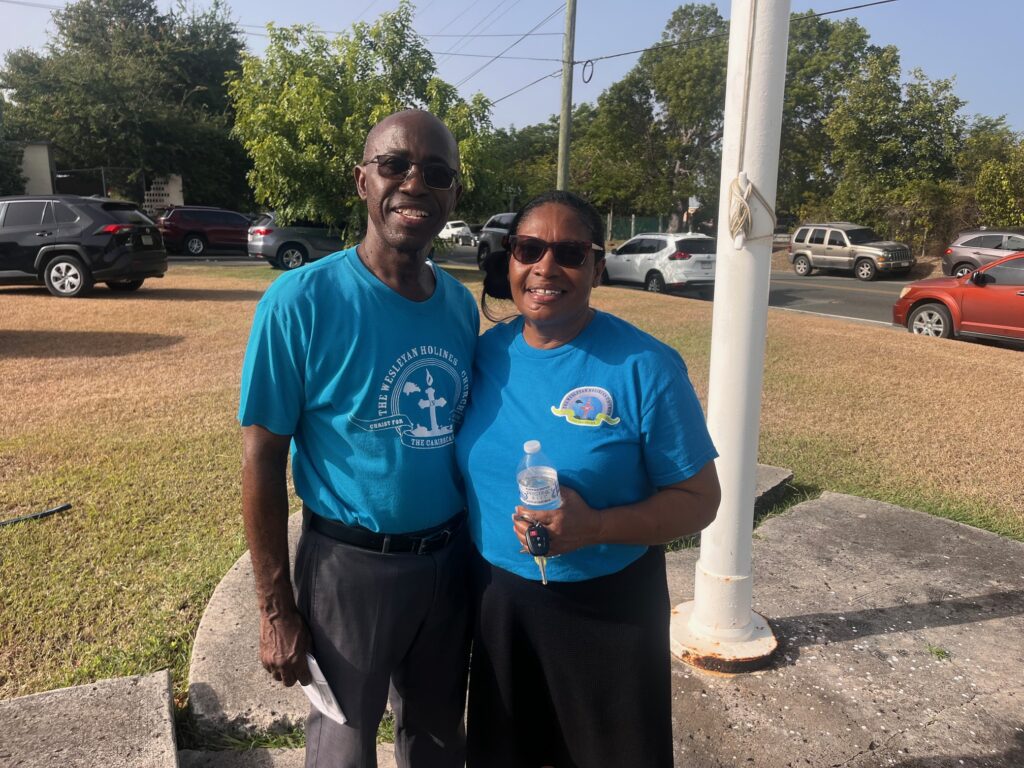
Reverend Lorenzo H. Davis and Buelle Davis of the Frederiksted Wesleyan Holiness Church, Inc. offer words of prayer to students and parents before they enter. “It takes a community,” said Davis. (Source photo by Diana Dias)
Just outside the school, Reverend Lorenzo H. Davis and his wife, Buelle Davis, from the Frederiksted Wesleyan Holiness Church, Inc., offered prayers for the students. “This is our first time here as a couple, but in the past, other churches have come to the schools to pray for the children,” Davis said. “It takes a village to raise a child, and that still stands. Part of the reason for the village is prayer, because prayer is important. It’s been important in our lives, and we believe it’s still important today. Even though there is a separation of church and state, we believe that prayer is important — it covers and gives you a different perspective on your day when you start with prayer.”
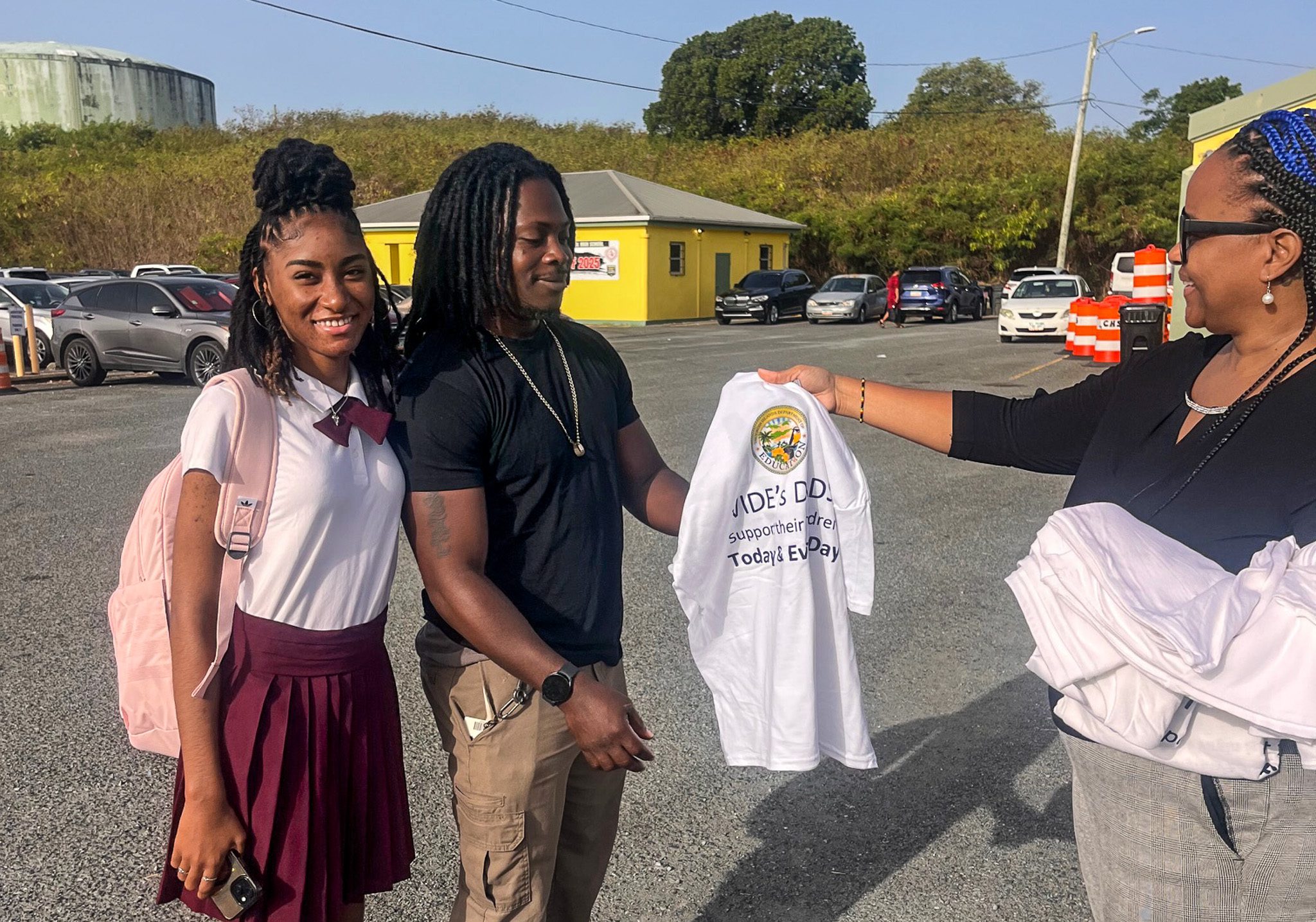
Photo 7 – Uncle Calvin Howard and niece Ani Velez enter St. Croix Central High School. Fathers who escorted students into school received shirts in appreciation. (Source photo by Diana Dias)
At St. Croix Central High School, Principal Chermaine Hobson-Johnson described the morning as “very cliché” but exciting.
“We are very happy to have them back,” she said. “We are also happy to have them so they can graduate and move on to begin their careers. That is the difference between high school and elementary — in high school, you are molding them to prepare for their careers and whatever else they have planned for their future. It’s a different energy at the high school level.”
Malia Knight, 7, raises her hand on the first day of third grade Wednesday at the Pearl B. Larsen PreK-8 School on St. Croix. (Photo by Kit MacAvoy)
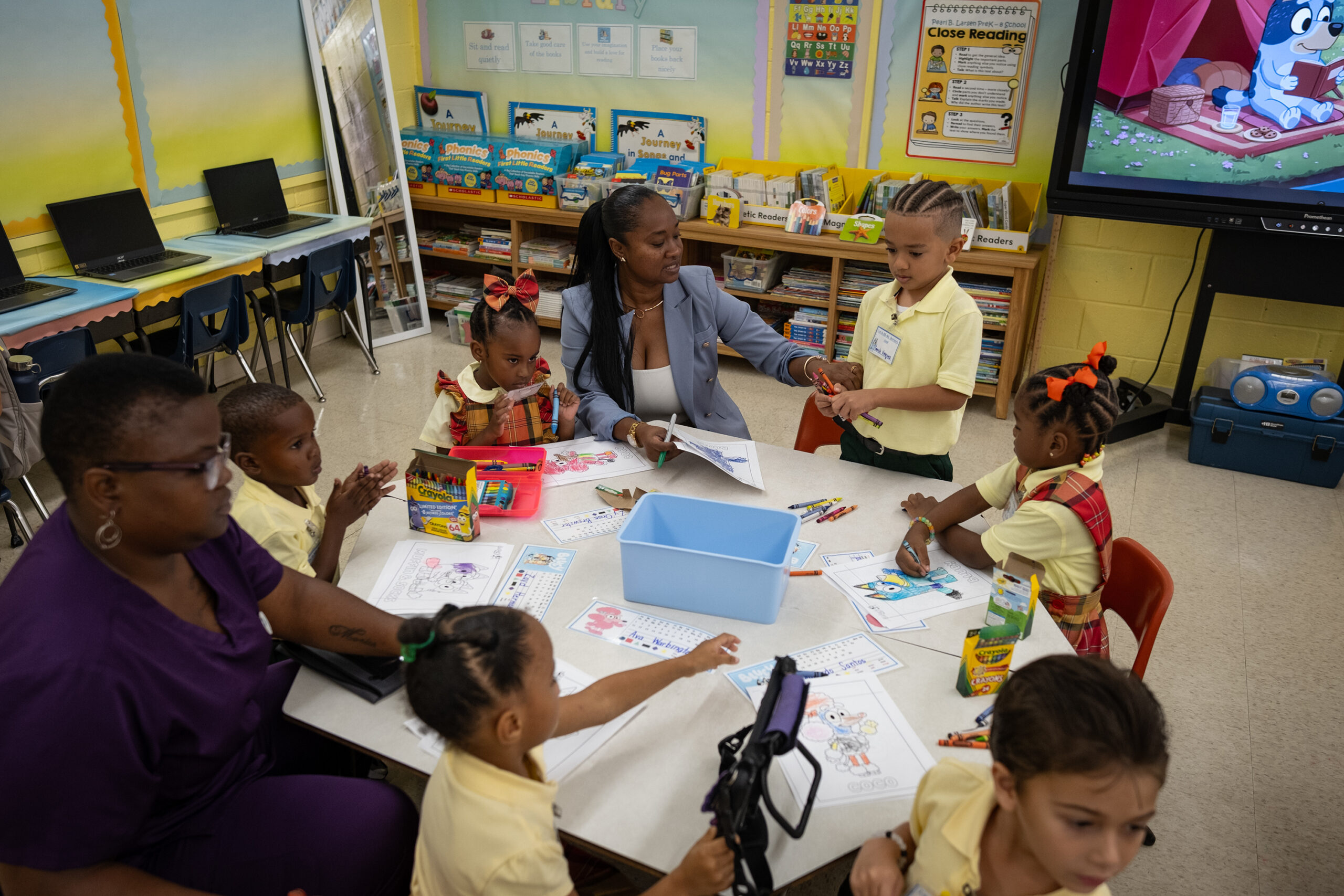
Across the island at the Pearl B. Larsen PreK-8 School, the territory’s youngest learners were settling in for a year of discovery. In Astral Battiste’s kindergarten class, a wall of Bluey decorations welcomed students. Battiste, voted the territory’s Teacher of the Year in 2024, marked her 20th year in the classroom by putting students to work right away on a coloring exercise. Next door, Janice Hendricks introduced her kindergarteners to the basics of pencil etiquette: writing is encouraged; poking is frowned upon.
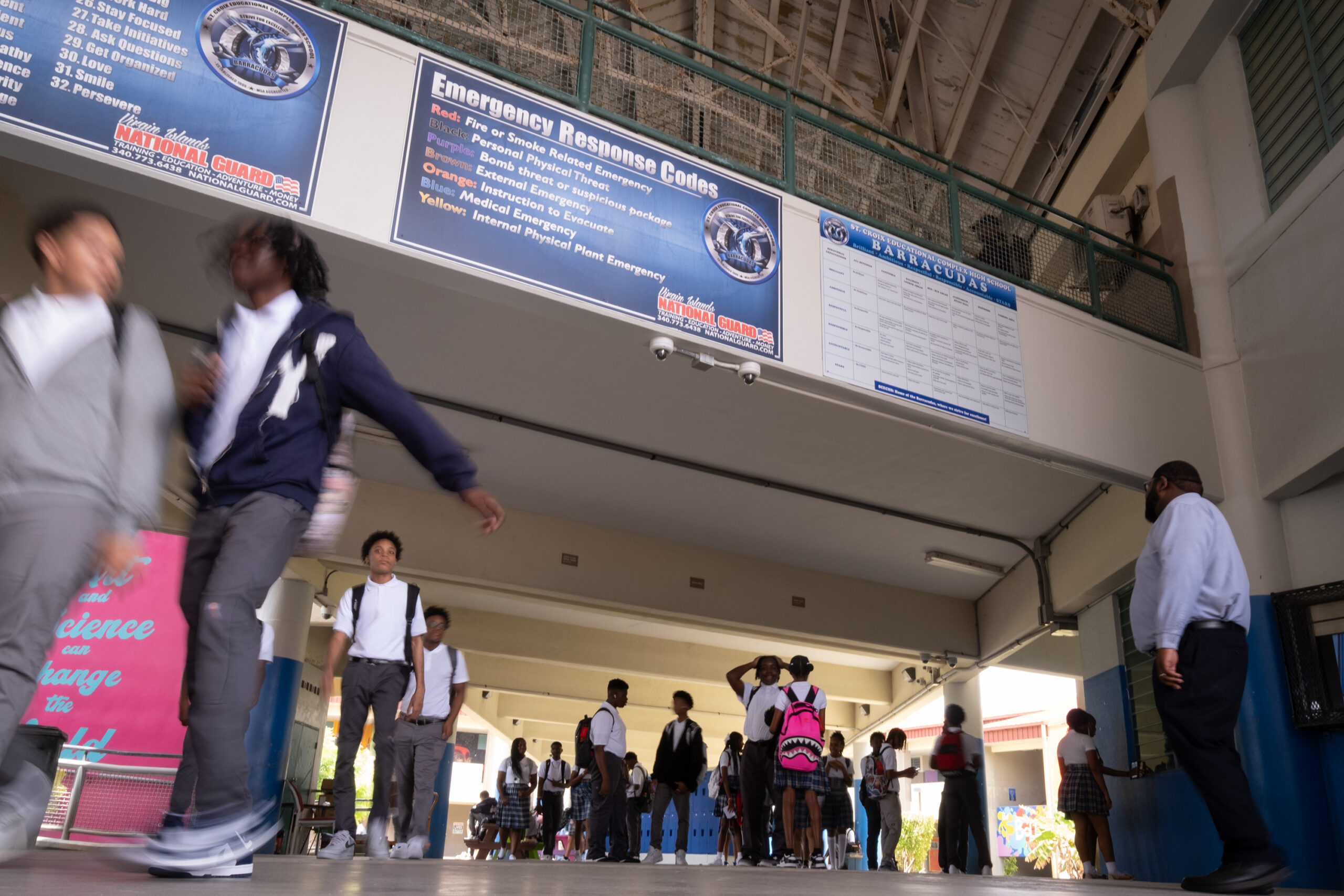
Barracudas fill the hallways and courtyards of the St. Croix Educational Complex Wednesday after the first day of classes concludes. (Photo by Kit MacAvoy)
At the St. Croix Educational Complex, the year began with the unveiling of a new “I ❤️ SCEC” sculpture. After the final bell rang shortly after 1 p.m., Assistant Principal Erick Willie said the day had gone smoothly.
For St. Croix Insular Superintendent Carla Bastian, the morning’s scenes reflected the heart of the district’s mission.
“The first day of school in the St. Croix District was filled with energy, anticipation, and the unmistakable joy that comes with new beginnings,” Bastian said. “From the buses rolling into school yards, parents walking their children to the gates, and classrooms, the district came alive with a new year of opportunities for excellence.”
Astral Battiste, center, begins her 20th year as a kindergarten teacher Wednesday at the Pearl B. Larsen PreK-8 School on St. Croix. (Photo by Kit MacAvoy)
She praised principals, teachers, and staff for setting a welcoming tone and acknowledged the district’s continued focus on high expectations, academic growth, and improved attendance.
“Despite the infrastructure challenges as we approached the new school year, and those that remain, I am proud of the collective effort from educators, families, and community partners who made this opening day a success,” she said. “The St. Croix District is committed to building on this strong start, ensuring that every day this school year is an opportunity for growth, achievement, and the celebration of our students’ potential.”