






Governor Bryan Calls Special Legislative Session to Advance Reforms in Fiscal Responsibility, Government Fairness, and Public Trust

Governor Albert Bryan Jr. has officially called the 36th Legislature of the Virgin Islands into Special Session for Thursday, July 31. The session will consider three critical legislative proposals aimed at restoring fiscal discipline, promoting fairness, and strengthening public confidence in government.
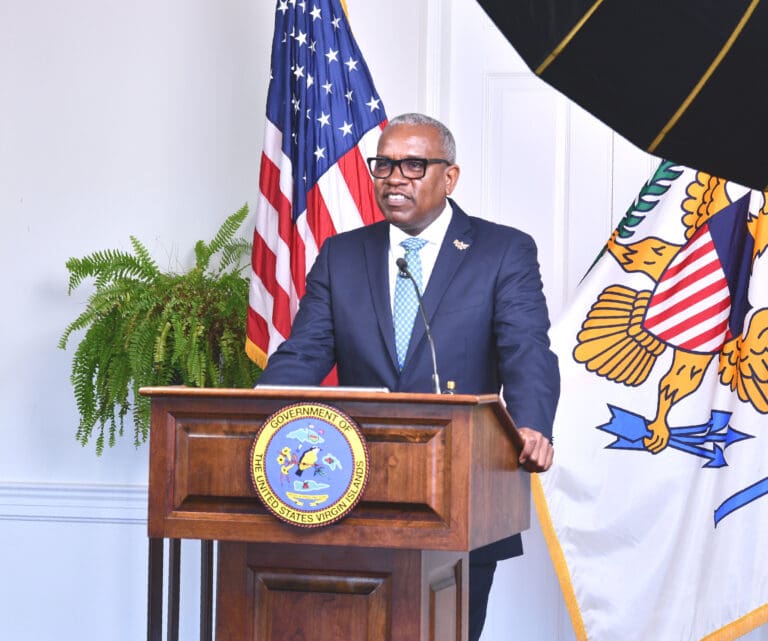
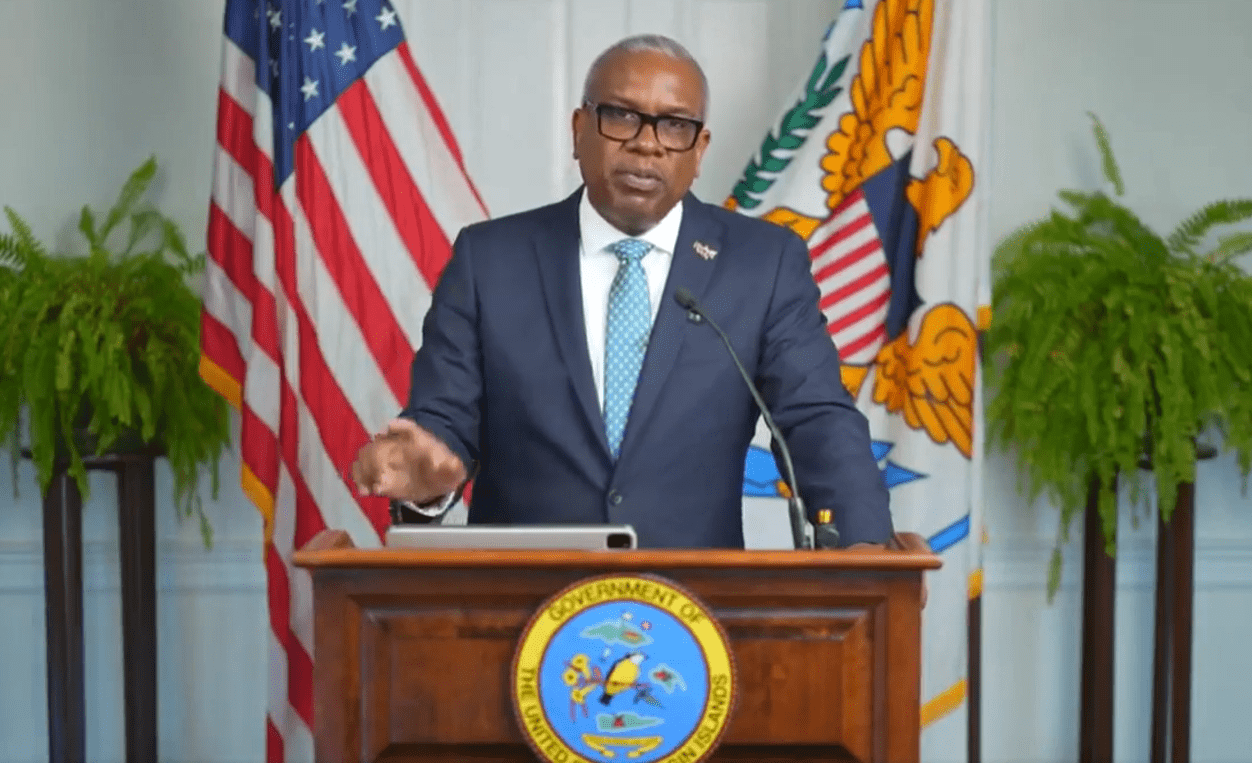
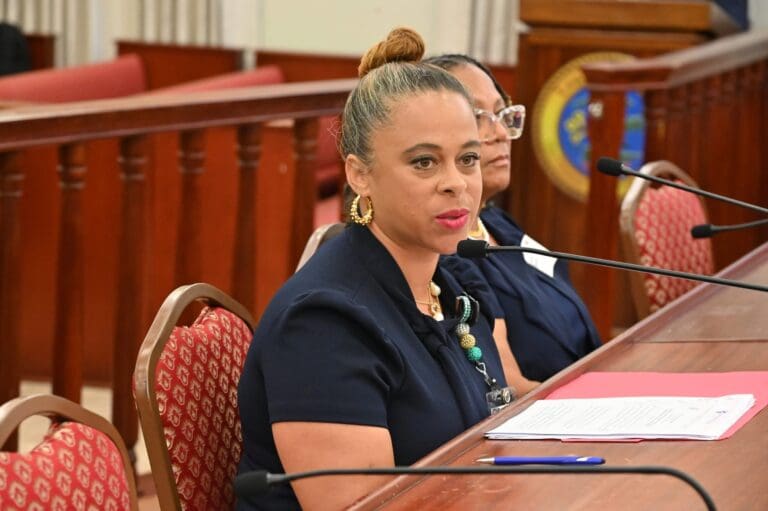
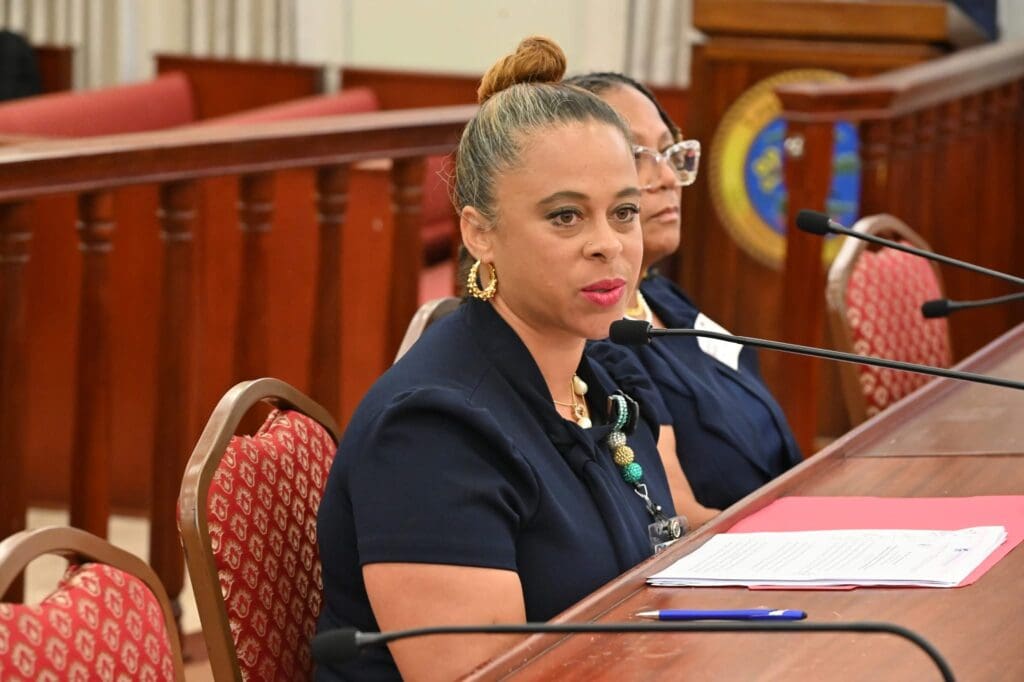
Governor Albert Bryan Jr. (Submitted photo)
Governor Bryan first announced his intent to convene a Special Session during his June 30 press briefing. Since then, Government House has received a significant number of messages from residents across the territory voicing strong support for the proposed reforms and calling for immediate action. “This is not a symbolic gesture. It is a serious call to action,” Governor Bryan said during his July 7 press briefing. “The people of the Virgin Islands expect leadership rooted in fairness, responsibility, and a commitment to sound policy. These proposals reflect that standard.” Governor Bryan has submitted three legislative proposals for consideration during the Special Session: 1. Request for Proposals for a Self-Funded Health and Dental Insurance Plan Notwithstanding any other law, this measure directs the Government Employees Service Commission to issue a request for proposals to explore a self-funded health and dental insurance model for government employees and retirees. The current fully funded plan has become financially unsustainable, with rising premiums placing an increasing burden on workers and retirees. “If we continue on the current path, we will see higher premiums, greater out-of-pocket costs, and possibly a reduction in benefits,” Governor Bryan said. “Taking this step allows us to evaluate a model that could reduce costs, improve transparency, and direct savings back into the healthcare system. We must act now to protect the financial well-being of our workforce and the long-term stability of our healthcare institutions.” 2. The Double Dipping Repeal Act of 2025 This bill eliminates the ability of incumbent legislators to receive both a government pension and a legislative salary at the same time. The Governor said this practice is fiscally irresponsible and undermines public trust in elected officials. “There is one Government of the Virgin Islands. The position of senator is not difficult to fill,” Bryan said. “This is about restoring parity and ensuring that those who serve do so under the same standards we expect of every other public servant. It is time to put an end to this.” 3. Repeal of the Leave of Absence Requirement for Government Employees Seeking Office The final proposal repeals the requirement that government employees take a leave of absence simply for declaring their candidacy for public office. Governor Bryan described the law as a barrier to public participation and outdated in both purpose and practice. “As a lifelong Democrat, I believe in access and participation,” he said. “This law discourages qualified people from entering public service. I want to thank Senator Marise James for introducing this measure in the past. Since raising this issue publicly, we have heard from many Virgin Islanders who agree that it is time to change the law. There is no reason to keep this on the books.” Governor Bryan said these reforms reflect his administration’s broader commitment to fiscal responsibility and public accountability. He emphasized that each proposal addresses longstanding issues that require thoughtful and decisive action. “These are not political proposals. They are practical steps that reflect the values of fairness, transparency, and responsibility,” Bryan said. “The people of this territory want leadership that puts good governance ahead of politics. That is what this Special Session is about.” The Governor has directed members of his administration to be available to provide testimony and answer questions on July 31. He encouraged members of the Legislature to approach the session with urgency and focus. “We owe it to the people we serve to lead with courage, with clarity, and with discipline,” Bryan said. “This is our opportunity to move the Virgin Islands forward. I stand ready to work with the Legislature to make that happen.”

Back To School Jamboree Saturday

0
The Virgin Islands Department of Education (VIDE) is excited to announce its Back-to-School Jamboree and Food Truck Festival, scheduled for Saturday, Aug. 9, at the St. Croix Educational Complex from 11 a.m. to 5 p.m. In full alignment with VIDE’s 2025–2026 school year theme, “Igniting Innovation and Elevating Excellence,” the event aims to foster community collaboration, parent partnerships, and school pride while providing families with essential resources to start the school year strong. The Jamboree will feature engaging activities for PreK–12th grade students and parents, music, games, community educational stations, and a variety of local food trucks. VIDE invites community partners, agencies, and organizations to participate by hosting educational stations where families can engage with the services and opportunities available in the community in an interactive way. The goal is to create a space where students, parents, and community partners can connect, receive hands-on support, and celebrate the start of a new school year. Community partners interested in participating are asked to scan the QR code or complete the registration form by July 14, 2025. For additional information or to confirm participation, please contact Dynel Lang, Director of Parental and Community Engagement & Positive School Climate at dynel.lang@vide.vi or 340-773-1095 ext. 7095 or Mrs. Jeselle Cruse-Peter, Elementary Programs Coordinator, at jeselle.cruse@vide.vi or (340) 514-5390. The Virgin Islands Department of Education looks forward to welcoming families and partners as it kicks off the 2025–2026 school year with a celebration that embodies the spirit of innovation, excellence, and community.

CFVI Chooses Kari Currence For 2025 Lawyers’ Scholarship

0
The Community Foundation of the Virgin Islands is pleased to announce Kari Currence as the recipient of the 2025 Lawyers’ Scholarship, which was established in 2022 by current St. Croix attorney Lisa Harris Moorhead and former St. Croix attorney Susan Bastress to support the next generation of Virgin Islands legal professionals.
Kari Currence is the 2025 Lawyers’ Scholarship recipient. (Submitted photo)
Currence, a graduate of Good Hope Country Day School, is currently pursuing her law degree at the Moritz College of Law at Ohio State University, where she is expected to graduate in 2026. Her academic journey includes undergraduate studies at both Columbia University and the University of the Virgin Islands. “I hope to return to the Virgin Islands to practice law,” Currence said. “My views on what exactly I might do change from time to time as my experiences broaden. However, I would like to obtain a clerkship with a local or district court judge and then enter either private practice or government service.” “We are delighted to award a scholarship to Kari as she pursues her J.D. degree and prepares to bring her talents back to the Virgin Islands,” said Moorhead. Noted Bastress, “Investing in future leaders like Kari is essential to the continued growth and vitality of our community.” The Lawyers’ Scholarship provides recipients with $5,000 per year, renewable annually for the duration of their studies, as long as they remain in good academic standing. This ongoing support reflects the scholarship’s commitment to helping students achieve their educational goals. Past Scholarship Recipients CFVI is proud to have supported a growing cohort of aspiring legal professionals from the Virgin Islands through the Lawyers’ Scholarship Fund: 2024 Recipients
  • Layalie Washshah, a St. Croix native and Good Hope Country Day graduate, is pursuing her J.D. at Loyola University Chicago School of Law, graduating in 2027.
  • Amisha Mirchandani, born on St. Thomas and a graduate of Antilles School, is studying at Villanova University Charles Widger School of Law, graduating in 2027.
2023 Recipients
  • Diamond Ash, a Charlotte Amalie High School alumna is pursuing her J.D. at William & Mary Law School, graduating in 2026.
  • Denisha Emmanuel, a graduate of St. Croix Educational Complex, is pursuing her J.D. at American University Washington College of Law, graduating in 2027.
“CFVI congratulates Kari and all previous recipients on their achievements,” said CFVI President Dee Baecher-Brown, “and we look forward to their future contributions to the Virgin Islands legal community.” Donations to The Lawyers’ Scholarship Fund can be made online at https://cfvi.co/LawyerScholarshipFund. Checks can be made out to “CFVI” with the memo “Lawyers’ Scholarship Fund” and mailed to CFVI at PO Box 380, St. Thomas, VI 00804. Credit card donations can be taken over the phone by calling CFVI at 340-774-6031.

Op-Ed: A Rare Sighting Brings Memories of the Golden Days of Waterfowl

Members of the St. Croix Hiking Association recently spotted a subspecies of the Common Moorhen like the one pictured here in a pond along the Estate Adventure Nature Trail. (Shutterstock image)

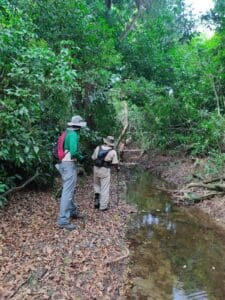
The other day I got a phone called from Cathy Prince, the President of the St. Croix hiking Association. She was giving me an update on the progress of the cleaning of Estate Adventure Nature Trail. Since last year’s rain, Adventure’s stream has been flowing. As the crew was cleaning along the banks of the streambed and trail paths, they came upon a duck in the middle of a natural freshwater pond setting on a nest.

Olasee Davis
Olasee Davis (Submitted photo)

“Oh my God!,” you thought you were watching a wildlife documentary on National Geographic. When I saw the duck for myself, I was dumbfounded. The duck paid us no attention and kept watching us as we stood from the shoreline of the pond taking photos with our android and smartphone cameras. Wildlife, especially birds, is a good indicator of a healthy environment. Historically, St. Croix was a wetter island with its flowing streams and freshwater ponds dotting the landscape of different forest ecosystems, marshlands, pastureland, and sugarcane plantations.

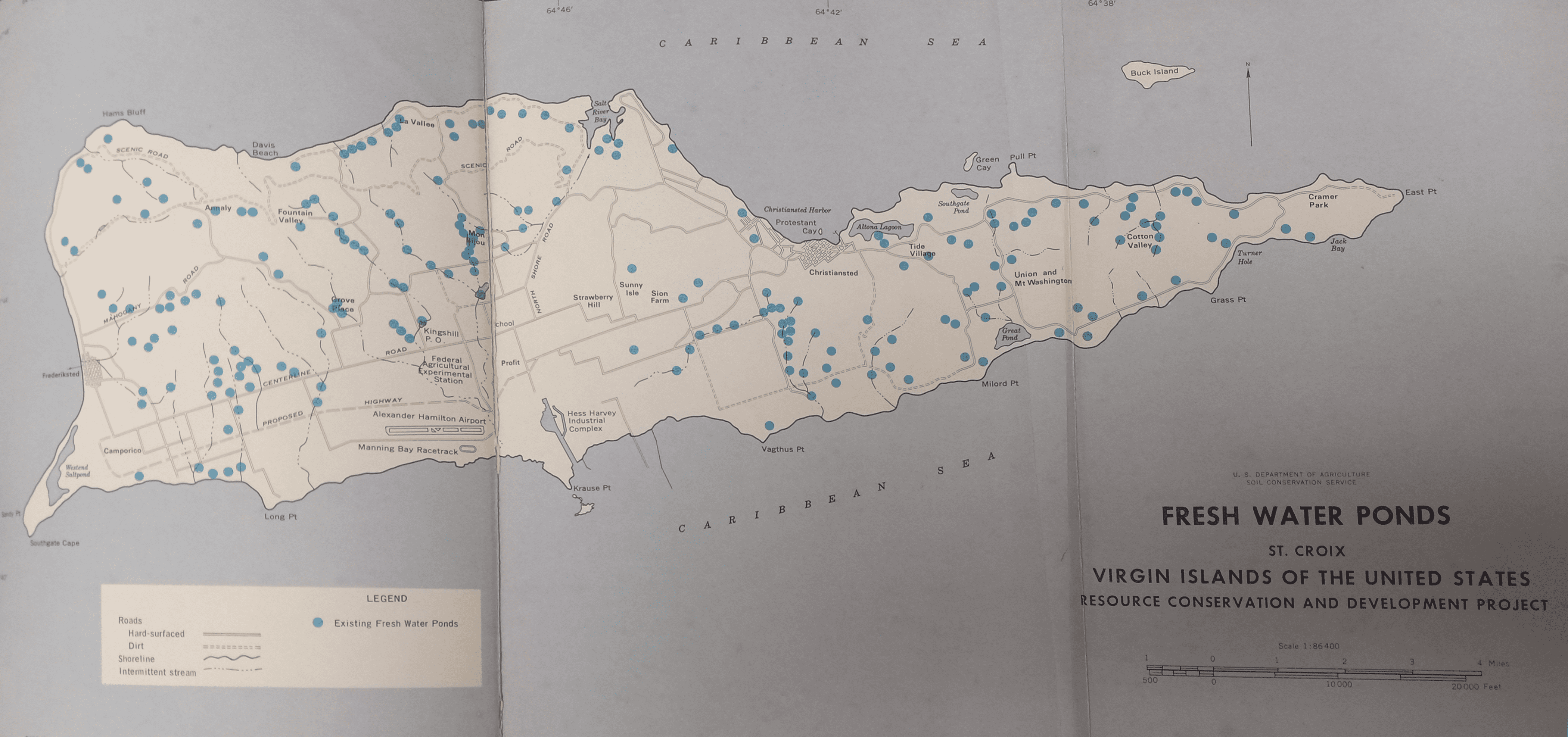
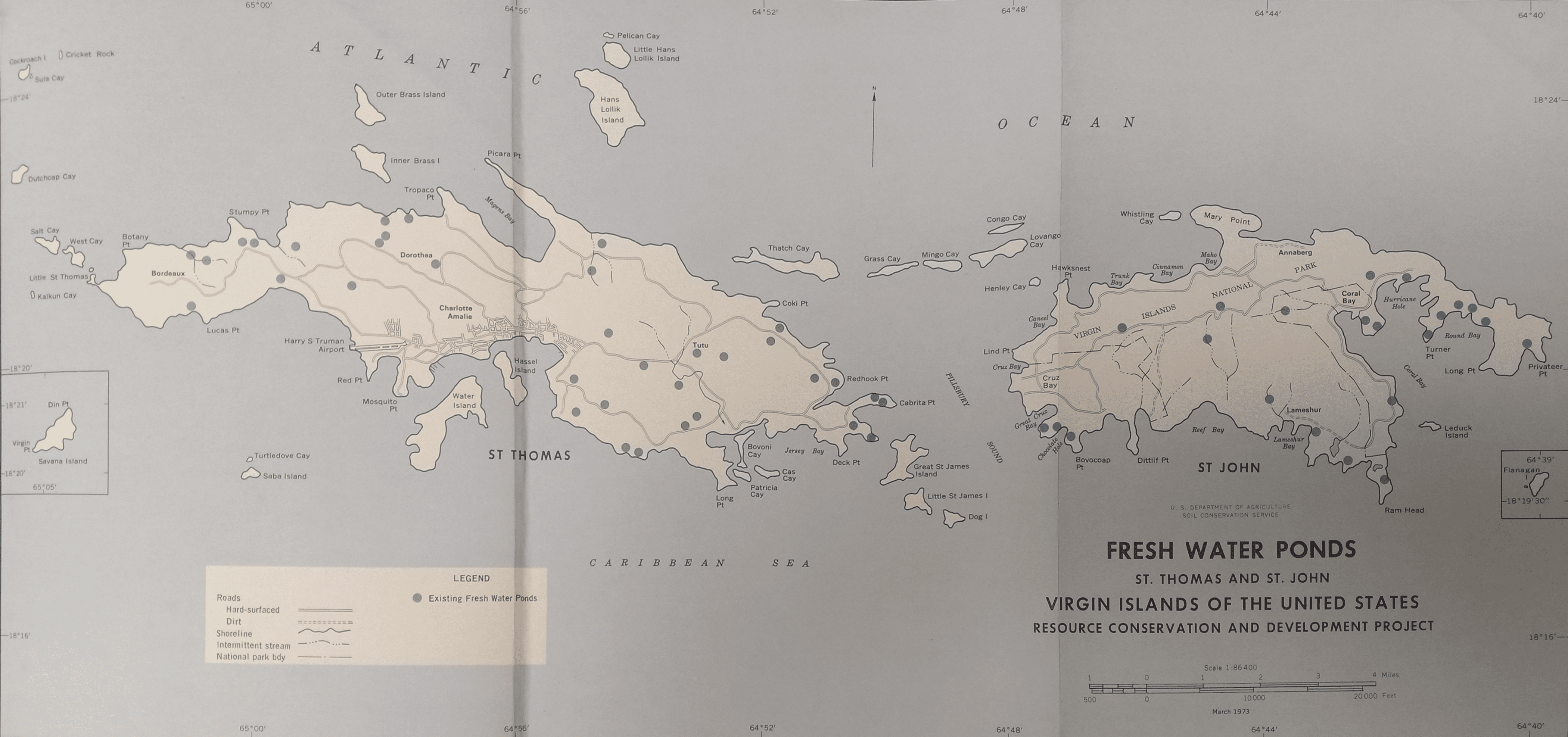
Although St. Croix was known historically for its sugar industry, it was also known for its wildlife and hunting season. In the early 1970s, there were more than 200 freshwater ponds on St. Croix. St. John and St. Thomas also had their fair share of freshwater ponds back in the day. The duck that we saw at Estate Adventure is locally known as “waterfowl” (Gallinula chloropus cerceris). It is a subspecies of the Common Moorhen, also known as the Common Gallinule. The term cerceris identifies a particular geographic variation of the bird, specifically found in the Caribbean region. This duck was once common but is now extremely rare on the islands.

The “waterfowl,” as we call it locally, has a blue and gray body with a white line on the side, and a bright red facial shield. It lives around well-vegetated marshland, ponds, and other wetlands of the islands. The local breeding ducks in the Virgin Islands consist of three species.

The Anas bahamensis, which is one of the native ducks, is known locally as “brass wing” or Bahamn pintail or sometimes referred as a white-cheeked pintail. It is still common, but not in great numbers as it used to be. It adapted well to freshwater ponds, saltwater ponds, lagoon and mangrove swamps. It was also found on many small offshore cays and inlets surrounding the Virgin Islands, particularly St. Thomas and St. John.

Henry and Rita, both members of the St. Croix Hiking Association, clean along the streambed of Estate Adventure Nature Trail. (Photo by Olasee Davis)

Our largest native ducks were the West Indian Whistling (Dendrocygna arboresa). It is very rare or just about disappeared or extinct from the Virgin Islands. However, two were sighted in October 2002 by Floyd E. Hayes at the Big Fountain Valley Estate freshwater pond, now known as Carambola Golf Course. This duck was commonly known as “Night duck” and “Whistler” during the Danish era and early American rule of the Virgin Islands.

In 1955, the late naturalist George A. Seaman mentioned in his wildlife report to then Gov. Archie Alexander about the Qxyura jamaicensis jamaicensis ducks, known locally as the Little “Diver.” When Seaman wrote this report, he said it was questionable if any are to be found on the islands of St. John and St. Thomas. In other words, these ducks were extremely rare in the wild. Seaman did mention, up until the 1950s and ‘60s, that the Little “Divers,” also known as Ruddy ducks, were occasionally sighted in farm ponds on St. Croix.

Nevertheless, in June 2002 and 2004, Ruddy ducks were sighted at the Estate Fredensborg freshwater pond in the central plain of St. Croix. The ducks were also spotted again in July at the Estate Granard freshwater pond on the south of St. Croix. During the winter months, particularly September through April, historically speaking, a number of migratory ducks appear in the Virgin Islands. One of the most common is the Blue-winged teal (Anas discors).

In the early 1970s there were more than 200 freshwater ponds on St. Croix. St. John and St. Thomas also had their fair share of freshwater ponds back in the day. Today, if you find five freshwater ponds on St. Croix and three each on St. John and St. Thomas, we are lucky. For this reason and others, we are much poorer in wildlife due to changes in the environment. Those changes are mainly due to human destruction of the fragile ecosystem of these islands. (Images courtesy Department of Conservation and Cultural Affairs circa 1973)
In the early 1970s there were more than 200 freshwater ponds on St. Croix, above. St. John and St. Thomas, below, also had their fair share of freshwater ponds back in the day. Today, if you find five freshwater ponds on St. Croix and three each on St. John and St. Thomas, we are lucky. For this reason and others, we are much poorer in wildlife due to changes in the environment. Those changes are mainly due to human destruction of the fragile ecosystem of these islands. (Images courtesy Department of Conservation and Cultural Affairs circa 1973)

Also, with this migration of ducks to the islands are Baldpates (Anas americana) and sometimes Pintail (Anas acuta) ducks. In his wildlife report, Seaman mentioned that Lesser scaups (Aythya affinis) were the second most abundant winter duck in the Virgin Islands. These ducks migrate from North America to as far south as Central America in the winter months. The Green-winged teal (Anas carolinensis), Mallard (Anas platyrhynchos), and Black-bellied tree ducks (Dendrocygna autumnalis) have been recorded from the Virgin Islands decades ago. Today these ducks probably no longer visit the islands due to lack of freshwater ponds and habitat destruction.

“I myself remember when both Slob and Clifton Hill had freshwater ponds and Rust-up-Twist was one of the richest and most extensive freshwater ponds on the island. This latter pond not alone supported gallinules, coots, grebes, and several species of ducks, but was a source of mudfish and eels,” noted George A. Seaman.

Historically, two coots were known from the Virgin Islands: (Fulica caribaea) and (Fulica americana americana). According to Seaman, the rapidly falling water table in the Virgin Islands resulted in the disappearance of many species of ducks that were once abundant on the islands. The only resident rails in the Virgin Islands that Seaman mentioned were (Rallus Longirostris caribaeus) and the Clapper Rail (Rallus crepitans).

These ducks were found in mangrove swamps like the Krause Lagoon, Mangrove Lagoon on St. Thomas, and other sustainable habitats. The Sora Rail (Porzana Carolina) was another winter resident waterfowl to the Virgin Islands. These waterfowl ducks were found in all Virgin Islands. Historians believe that the Moscovy (Cairina moschata) duck was once common on St. Croix. This duck is now extinct, but their bones appear in Indian kitchen middens of pre-Columbian times on St. Croix.

Nevertheless, the Virgin Islands today are much poorer in wildlife due to changes in the environment. However, most of the changes are mainly due to human destruction of the fragile ecosystem of these islands. We simply don’t care. So, when I saw the duck, it reminded me of the glorious days when these islands were a heaven for wildlife. Can you imagine the duck is so smart that it built its nest with sticks about 2 or 3 feet high above the water in the middle of the pond? One logical conclusion you might gather is that the mongoose wouldn’t be able to reach it eggs. Now, tell me, what an intelligent duck.

— Olasee Davis is a bush professor who lectures and writes about the culture, history, ecology and environment of the Virgin Islands when he is not leading hiking tours of the wild places and spaces of St. Croix and beyond.

Bryan Celebrates Permanent Rum Cover-Over Increase, Braces for Other Impacts of Federal Budget Bill

Gov. Albert Bryan Jr. addressed the impacts of the federal budget bill on the territory during a weekly briefing Monday at Government House on St. Thomas. (Screenshot from V.I. Government House livestream)

A permanent increase to one of the U.S. Virgin Islands’ critical revenue streams took center stage during Monday’s weekly briefing at Government House, though Gov. Albert Bryan Jr. acknowledged that federal spending cuts pose a number of challenges.

Teri Helenese, the territory’s director of State-Federal Relations and Government House’s representative in Washington, D.C., said that permanently increasing the rum cover-over rate to $13.25 per proof gallon means “we don’t have to keep going back to the Congress, begging for money that is ours.” Helenese repeatedly thanked U.S. Senate Finance Committee Chair Mike Crapo for adding the provision once the bill reached the Senate.

“This win, this legislative victory was hard-fought and many years in the making,” she said.

Excise tax collected on Virgin Islands-made rum exported to the continental United States is “covered over” to the territory, and the territory submits advance estimates of rum excise taxes to the U.S. Interior Department’s Insular Affairs Office each year. The rum cover-over rate was capped at $10.50 per proof gallon but extended — and retroactively applied — multiple times through federal legislation. For years, the U.S. Virgin Islands enjoyed a rate of $13.25 per proof gallon until the extension expired at the end of 2021.

Territory leaders have repeatedly expressed confidence in securing another extension, and the higher rate was assumed in 2022 when Bryan signed a securitization bill into law, refinancing the rum cover-over Matching Fund bonds to fund the Government Employees’ Retirement System — then on the brink of insolvency — for another 30 years.

GERS Administrator Angel Dawson said in a statement to the Source Monday that because the rate increase is not being applied retroactively, the system is owed $34 million from 2023 and $56.4 million from 2024.

“While the issue of permanency outweighs retroactivity when viewed over the course of decades, these are real dollars owed to the GERS,” he said. “We are presently having our actuarial firm complete an analysis of what the impact of both permanency of the $13.25 rum cover-over rate and the loss of retroactivity will be on the GERS. After these impacts are quantified, we can sit with the Governor and the Legislature to determine how the GERS Funding note and Indenture of Trust can be fulfilled,” he said.

The funding vehicle also assumes that consumers on the mainland will continue drinking rum, but the V.I. Public Finance Authority’s Nathan Simmonds, director of finance and administration, told the Senate Budget, Appropriations and Finance Committee last month that rum sales on the continent had been slow.

“Don’t worry, they gonna drink more rum when this ‘Big, Beautiful Bill’ hit the streets,” Bryan quipped during Monday’s briefing before adopting a more serious tone. “I think we’re gonna be all right. Spirits flow up and down. Tequila is really popular now, rum is trying to do something — Diageo is trying to do something — to make a comeback, flavored rums are actually selling pretty well, so I think we’ll be okay.”

“And you know,” he added, “we’re always hunting for a new rum company. We don’t talk about it, but we’ve been trying to do that for the last six and a half years too. That was one of my … proposed campaign solutions, so we’ve been trying to find another rum company, or two, to get it done.”

Though the U.S. Virgin Islands scored wins in the federal budget bill by securing the rum cover-over extension and a carveout for some beneficiaries of the territory’s economic development programs, cuts to programs like Medicaid and the Supplemental Nutrition Assistance Program are poised to have a massive impact on Virgin Islanders. Bryan said the government needs “to be a little bit more fiscally prudent” in light of “additional pressures.”

“One of the things that’s in there is double certification. So instead of certifying once a year now, for Medicaid, you’re going to have to certify twice a year, which is twice as much work,” he said. “And they’ve shifted the burden of that to the U.S. Virgin Islands. We don’t get that subsidy.”

The freeze on Section 8, he added, is definitely a threat.

“That is the most dire — could be a hit, but it’s not too hard. But there’s light at the end of the tunnel too. I think … no tax on tips and no tax on Social Security is awesome for our seniors,” he said.

Addressing the Legislature’s push to raise the minimum salary for government employees to $35,000 per year, Bryan claimed the raise could actually leave people and the territory worse off by shifting them “off of the federal payrolls and onto the Virgin Islands payroll.”

“They were probably getting three or four thousand a year in food stamps,” he said. “Now that food stamp goes away, and we the government are now paying the $4,000 in the form of salary, because they’re making too much to get food stamps. And that money is being taxed, so you’re actually probably making them poorer than they were before.”

Bryan said the wage increase forces the private sector to increase their own salaries, but it also pushes the cost of retaining government employees higher. Including fringe benefits, Bryan put the minimum cost of employing someone at $52,000 per year.

“What does that do? That pushes people off of federal programs, and then we end up paying for them instead of the federal government paying for them,” he said. “So you know, thank the Legislature in their brilliance, in making these moves.”

Bryan’s vexation with the Legislature was evident Monday, and he announced that a special session will convene on July 31 to consider: issuing a request for proposals for self-funded health and dental insurance plans for government employees; a bill prohibiting lawmakers from receiving a government salary and retirement annuity while accruing additional retirement benefits; and a measure eliminating the requirement that government employees take a six-month leave before running for office.

The briefing also included an update on the public-private partnership with Jackson Development Company to provide St. John and St. Thomas renters with a path to home ownership.

“For years, families on St. John have faced limited options and rising costs,” he said. “This project represents a real path to home ownership and a chance for residents to live and grow in the community they love.”

Clifford Graham, a partner at Jackson, noted that he was the V.I. Housing Finance Authority’s executive director when residences at Bellevue and Calabash Boom were built two decades ago. At the time, renters were told they could qualify to buy their homes if they paid their rent on time for 15 years. Robert Jackson, another partner, ran the now-defunct nonprofit that built the units. Graham said the units had completed their 15-year affordability period under the Low Income Housing Tax Credit program and that an additional 15-year local affordability period “can be relaxed if they’re converted to affordable home ownership.”

Two Hours’ Notice: Dialysis Crisis on St. Thomas Sparks Legislative Firestorm

SRMC CEO Tina Comissiong testifies before the Senate Health Committee on the hospital’s emergency response to the closure of Caribbean Kidney Center. (Photo courtesy V.I. Legislature)

In a territory where continuity of dialysis care has long been a critical concern — especially after the costly off-island transfers following hurricanes Irma and Maria — lawmakers on Monday confronted what many called an avoidable crisis: the abrupt closure of Caribbean Kidney Center’s St. Thomas facility with just two hours’ notice — leaving 32 patients scrambling for care, and Schneider Regional Medical Center left picking up the slack.

At the center of the controversy was Dr. Walter Gardiner, CKC’s longtime medical director, who told the Senate Committee on Health, Hospitals, and Human Services that the July 1 shutdown was a “painful but necessary” decision triggered by a wave of personal health emergencies among his key clinical staff. Three of CKC’s most critical personnel — two with relatives undergoing chemotherapy and one with a mother in the ICU — suddenly stepped away, leaving the facility unable to meet the federally required staff-to-patient ratio.

Faced with what he described as an urgent and unsafe situation, Gardiner said he made the decision alone to cease operations temporarily and notify the government and patients by email.

“If anything had gone wrong with the hemo patients, we would have been crucified,” Gardiner said. “I make no apologies for the decision. Yes, I apologize for the inconvenience, but not for protecting patients from harm.”

That comment sparked immediate backlash.

“You gave us two hours’ notice that you were closing a center where lives were on the line, and you sit here saying you make no apology?” Sen. Ray Fonseca fired back. “That pissed me off.”

Lawmakers said they were stunned by the lack of coordination and even more concerned by the financial backdrop. CKC, a private entity, had received more than $2.8 million in public funding through various appropriations over the years, including $75,000 under Act 8130, $700,000 under Act 8729, and another $2.1 million in emergency support. Yet, when pressed on what it would take to remain open or reestablish services, Gardiner offered no clear financial figure — only that staffing had become “untenable.”

“This testimony is lacking in detail,” Sen. Marvin Blyden added. “What exactly made the staffing situation so dire? And what would it cost to bring you back online?”

As lawmakers dug for answers, it was Schneider Regional Medical Center CEO Tina Comissiong who painted the clearest picture of the fallout. According to Comissiong, SRMC received an email from CKC at 3:47 p.m. on July 1 announcing that it would cease operations by 5 p.m. — just 73 minutes later. No formal clinical handoffs were made. No calls to nephrologists. Just a notice, followed by silence.

By the next morning, patients began arriving — many without complete records, prescriptions, or any indication of recent medical history.

“Our team of nephrologists started evaluating patients at 4:30 a.m.,” Comissiong testified. “The records we received were piecemeal. There was no doctor-to-doctor communication. No coordination with our case management or dialysis teams. We had to reassess and recertify every single patient to ensure they could be safely treated.”

SRMC’s ability to absorb the patients was made possible only by a 2024 expansion that added 12 new dialysis stations and the hospital’s annual stockpiling of hurricane supplies. But Comissiong made it clear that the system is straining. To keep the service running smoothly, SRMC now needs three more hemodialysis-trained nurses, at least five or six new technicians, and up front funding to contract them.

“We estimate a need of $300,000 to $500,000 right now just to stabilize operations,” she said. “Over the long term, with consistent volume, the service could become more financially viable, but we’d still need about $500,000 to $1 million annually to maintain it at full capacity.”

Despite these clear needs, SRMC has yet to receive the $1 million appropriation authorized under Act 8876 — legislation passed in 2024 specifically to support and expand dialysis services.

Sen. Milton Potter questioned the holdup. “Why hasn’t the money been disbursed?”

Comissiong responded that it was likely a matter of central government cash flow but reiterated the urgency: “Releasing those funds now would make a significant difference.”

Further complicating the situation is a lawsuit filed July 1 by Puerto Rico Hospital Supply, one of SRMC’s vendors, seeking more than $317,000 in unpaid invoices for dialysis-related equipment. The lawsuit, filed in Superior Court, alleges the hospital failed to pay for shipments made as far back as September 2024. Comissiong confirmed that the vendor is one of many included in the payment list tied to the $10 million in emergency appropriations passed earlier this year, of which SRMC has received $6.5 million and disbursed nearly $5 million to date.

“We expect to process the full list within 30 days of receipt,” Comissiong told senators.

Still, the concern wasn’t just about unpaid bills — it was about system capacity and the risk of future breakdowns.

Sen. Hubert Frederick stressed the need for redundancy. “If something catastrophic happens at the hospital, then what? Where do these patients go?” he asked. “We can’t afford to be caught off guard again.”

He added that SRMC’s use of emergency supplies to meet this unplanned surge created another layer of risk, especially heading into the height of hurricane season.

Meanwhile, Sen. Carla Joseph called for an Inspector General audit into how CKC used previous government allocations and whether proper oversight had been in place. “If CMS pays for dialysis, why are we scrambling for money to keep the service running?” she asked, echoing frustrations voiced by other members of the panel.

Though Gardiner insisted that no patients were in immediate danger and that CMS guidelines were followed in terms of discharging and transferring patients, SRMC’s Chief Nursing Officer, Delphine Olivacce, contradicted that account. In her testimony, she said many patients lacked key documentation, which required SRMC’s medical team to start from scratch.

“There’s a very specific CMS-prescribed protocol for safe discharges and facility handoffs,” Comissiong added. “That was not followed.”

Despite the chaos, senators praised SRMC staff for stepping up under pressure, but made clear that gaps in the system remain.

Despite the criticism leveled at CKC, several senators acknowledged the broader issues at play — including the need for stronger oversight, faster disbursement of critical funds, and a long-term plan to safeguard dialysis care in the territory. As of Monday, Schneider Regional continued to treat all 32 patients formerly under CKC’s care, with staffing reinforcements and supply orders pending.

The Health, Hospitals, and Human Services Committee said it will continue monitoring the situation as SRMC works to stabilize services and the future of CKC remains uncertain.


Contract for Knud Hansen OK’d by PFA

0
Adrienne Williams-Octalien, director of the Office of Disaster Recovery, discussed at the PFA Monday the status of recovery projects. (Source file photo)

The Public Finance Authority board of directors, chaired by Gov. Albert Bryan, on Monday, approved a $103 million contract with Suffolk Construction Company, Inc. to construct the St. Thomas Healthcare Bundle — a major milestone in the Rebuild USVI Initiative.

The project bundle includes the rebuilding of the Knud Hansen Tower and the Knud Hansen building, the demolition of the mental health building, renovations to the John S. Moorehead Municipal Complex and the construction of the new Queen Louise Home for the Aged. All are part of the Rebuild USVI Initiative.

Office of Disaster Recovery Director Adrienne Williams-Octalien stated that two bids were received and reviewed, with Suffolk being selected due to its relevant experience and comprehensive documentation. The construction is projected to take three years. She noted ODR has grouped projects into bundles — such as health care and education — to improve efficiency. In response to a question from Bryan, she said four bundles are now under contract.

The board also agreed to amend the contract for professional services the authority has with Resolution Economics, increasing the contract cost by $ 330,425.90, making the total contract cost $857,925.95. Nathan Simmonds, PFA director of administration, said the scope of the work being performed by the firm was much more than had been anticipated.

Fiscal Strategies has been working with the authority for two years and because of board approval, Monday will be working at least two more. Each year, it is paid $330,000. Its contract with PFA expired recently, and staff asked that it be renewed for another two years with another two-year option.

Bryan said the firm had been doing a lot of work for the government and it might be of assistance in resolving some of the debt issues facing semiautonomous agencies such as the Waste Management Authority.

Before the PFA board meeting, a meeting of the Matching Fund Special Purpose Securitization Corporation was held, also chaired by the governor.

The corporation approved the payment of $145,000 to the PFA in reimbursements.

Bryan mentioned that the rum coverall had been set permanently at $13.25, but the Virgin Islands lost $90 million during the three years it was collected at the $10.50 rate. He said efforts would be made to recoup that $90 million.

29th Mango Melee Promises Excitement for All at St. George Village Botanical Garden

0
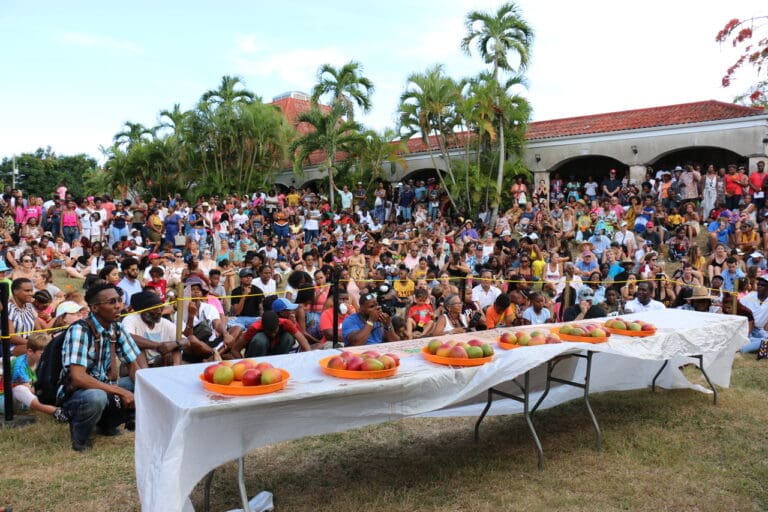
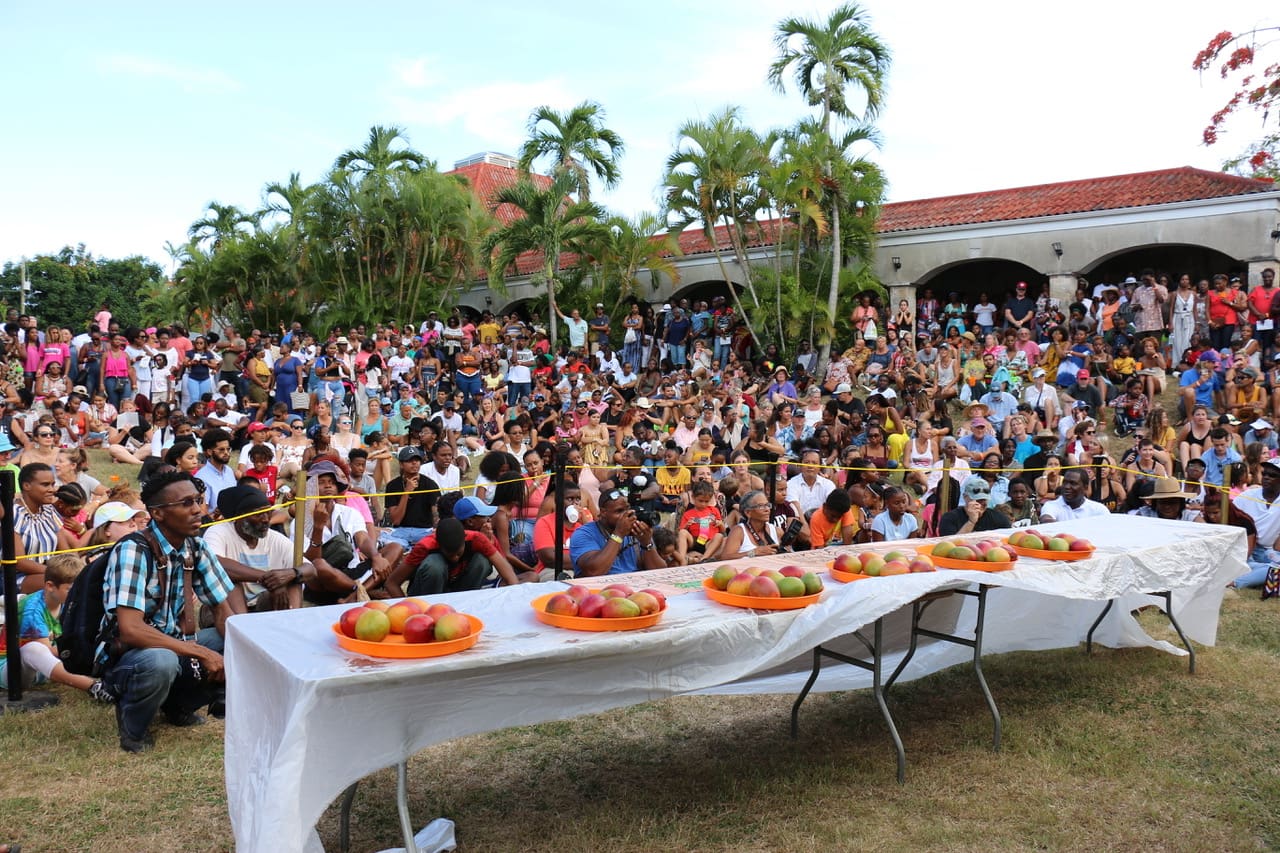
A large crowd gathers in anticipation of the Mango Eating Contest in 2024. (Source photo by Linda Morland)

The St. George Village Botanical Garden’s largest annual fundraiser, Mango Melee, returns this Sunday with food, crafts, contests, and family fun across the garden’s 16-acre grounds. Admission is $10 for adults, $5 for children ages 5 to 12, and free for children under 5. All proceeds support the garden’s operational costs.

More than 100 local craft and food vendors will be featured at this year’s event. Guests can enjoy handcrafted art, jewelry, clothing, and a wide variety of mango treats and local favorites. Vendor maps and lists will be available to help visitors find their favorite booths.

Parking and Transportation

Designated parking will be available across from the St. Croix Blue House and the nearby church for $5 per vehicle. Free air-conditioned passenger buses will shuttle guests from the parking area to the garden entrance from 10:30 a.m. to 5:30 p.m. Limited handicap parking will be located near the Bodine Center. Vehicles with a government-issued placard will be directed by security personnel to the appropriate location.

Event Highlights

  • Mango Eating Contests: Set for 4 p.m. on the Great Hall lawn. Prizes will be awarded to both adult and children’s winners.

  • Mango Tasting: A new blindfolded mango-tasting contest will allow guests to sample five varieties and vote for a crowd favorite.

Young contestants eat as quickly as they can as they compete in the Children’s Mango Eating Contest in 2018. (Source photo by Linda Morland)

Family Activities:

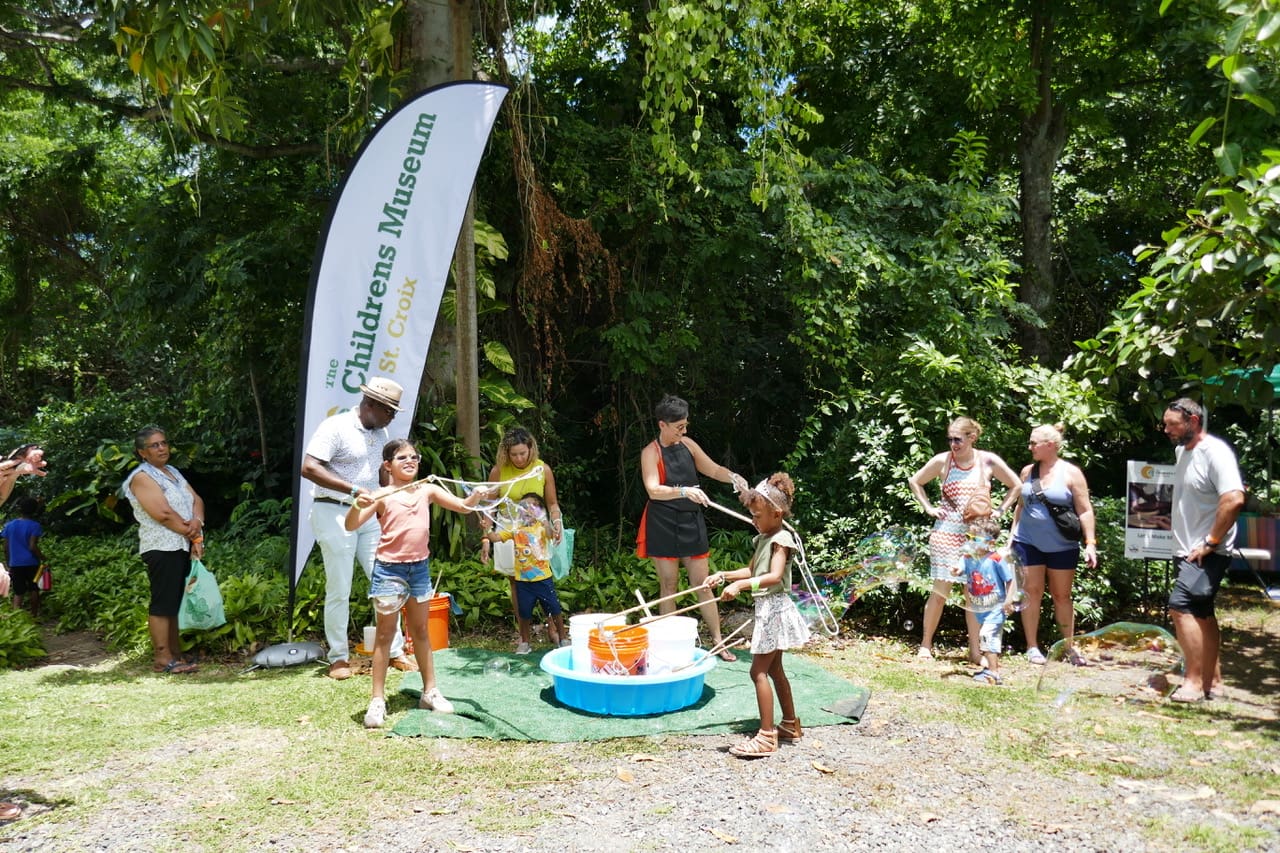
  • Virgin Islands Children’s Museum pop-up experience
  • Jungle James’ Petting Zoo
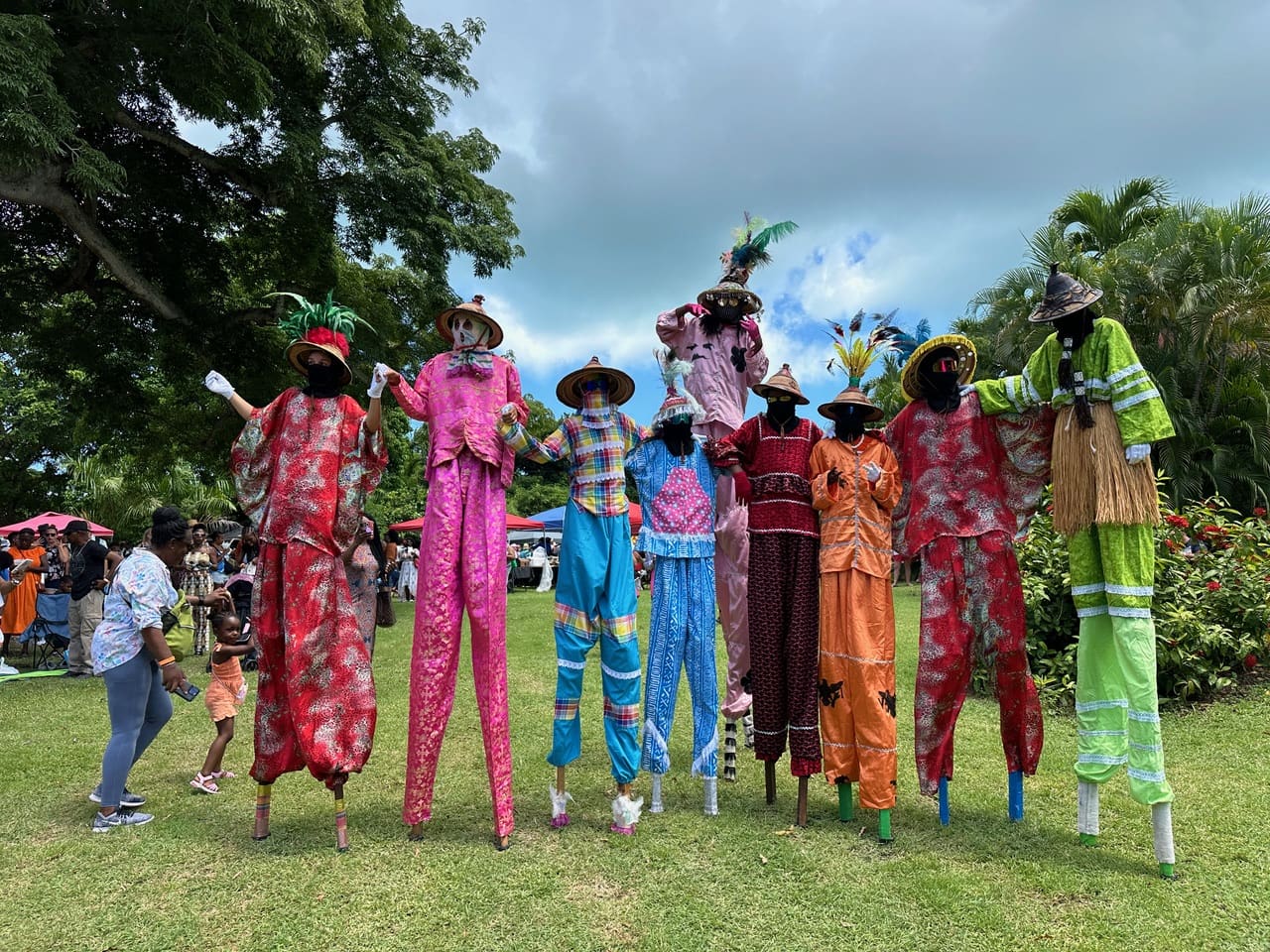
  • Guardians of Culture Moko Jumbies
  • Music in Motion Dance Performance
  • Steelpan performance by Kevin Williams Jr.
Guardians of Culture are a popular feature at Mango Melee shown in a photo from 2024. (Source photo by Linda Morland)

Food and Drink
Three bars sponsored by Cruzan Rum will be available:

  • In the Bodine Visitor Center

  • On the Great Hall lawn

  • Behind the Great Hall near the coral fountain

Check the event map for exact locations.

One of the long-time vendors, Cruzan Gold, is a popular booth at Mango Melee, pictured in 2019. (Source photo by Linda Morland)

Educational and Environmental Programs

  • Soil testing and mango grafting workshop by the Virgin Islands Department of Education

  • Coral reef restoration talks by local environmental nonprofits

  • Presentation by the St. Croix Environmental Association on the ecological role of bats

The Children’s Museum of St. Croix provides a range of activities for children attending Mango Melee. Making bubbles is enjoyed by several in 2024. (Source photo by Linda Morland)

Garden Extras

  • The Garden’s Nursery will be open during the event.

  • The St. Croix Orchid Society will offer a special orchid collection for sale.

  • Visit the Garden information table to enter a membership raffle. Prizes include a 2-night/3-day stay in a Deluxe Ocean Front Room at The Buccaneer Hotel (winner need not be present).

Multiple varieties of mangoes as well as local vegetables and other fruits on display in the Great Hall in 2019. (Source photo by Linda Morland)
Check the schedule for activities and entertainment.

Tickets are available in advance through Eventbrite or for purchase at the garden’s gift shop. Guests are encouraged to purchase early to skip the line on event day.

Celebrating 35 Years of the Americans with Disabilities Act

0
Representatives from nine government agencies and nonprofit organizations invite individuals with disabilities to join them in commemorating the 35th anniversary of the Americans with Disabilities Act (ADA) at two events that will feature workshops, guest speakers, valuable resources, and giveaways.  Attendees will enjoy a complimentary lunch and have the opportunity to connect with experts and peers. The theme is “ADA Anniversary #ADA35 – Celebrate. Learn. Share.” The celebrations will take place from 9 am to 3 pm on July 15, 2025, at the UVI Innovation Center in St. Thomas, and from 9 am to 3 pm on July 17, 2025, at the Governor’s Ballroom in St. Croix. They will also be available to watch online on Zoom.  The 35th Anniversary of the Americans with Disabilities Act Celebration is coordinated and sponsored by the following organizations: the Disability Rights Center of the Virgin Islands, the Northeast ADA Center, the USVI Office of the Territorial ADA Coordinator, the USVI Department of Human Services Vocational Rehabilitation Program, the University of the Virgin Islands, the Virgin Islands University Center for Excellence in Developmental Disabilities (VIUCEDD), the Virgin Islands Association for Independent Living, the Beyond Visions Foundation, and the Family Voices US Virgin Islands. Due to limited space, in-person attendance is by prior registration only. Interested participants must call Shammi Carr at (340) 772-1200 to reserve their seat. To view the celebrations on Zoom, please use the following links: bit.ly/ADA35STT for the St. Thomas event and bit.ly/ADA35stx for the St. Croix event.

Angel L. Ayala, Jr. Dies

0
It is with profound sadness that the family of Angel L. Ayala, Jr., aka “Busta”, announces his transition from this earthly realm on June 20, 2025. 
Angel L. Ayala, Jr.
He is survived by his wife, Kimberly Industrious-Ayala; son, Gianni Ayala; daughter, Elyse Ayala; brothers, Andrew Ayala, Michael Ledesma; brother-in-law, Julian Industrious, Jr.; sisters-in-law, D’Joi Francis-Ayala, Akeda Industrious; nieces, Anecia Ayala, Anissa Ayala, Keemora Industrious; nephews, Michael Deleo Ledesma, Julian Industrious III, Caleb Industrious; in-laws, Julian and Felice Industrious; aunts, Beryl Battiste, Delphine Lewis, Luella LaFranque, Louise Felix, Madeline Bloice (Leroy), Lillian Ishaan, Eugenie LaFranque-Christian. Cousins, Shauna Lynch, Lauren Andrew, Laurelie Bloice, Stephanie Richards, Elma “Lulu” Brunson, Rudolph “Rudy” Clarke, Beverly Hodge, Clarence “Junie” Clarke, Fern Clarke, Joycelyn “Erie” Petersen, Fayola Felix-Gunn (Derek), Vincent “Tito” Doward, Gwenette Harrigan (Louis), Gary Lewis, Michelle Ledee, Denise Battiste, Duran Fontaine, Juville Fontaine, Louis ”Nicky” Hughes, Lorne Hughes, Tracy Robinson, Riise LaFranque, Jeron Ishaan, Jeffery Ishaan, Leilani Ishaan, Jovanni Ishaan, Leona Wheatley, Doris Pickering; special friends, Romeo Leader, Olatungi “Tungi” Francis; and many other relatives and friends too numerous to mention. A celebration of life will be held on Friday, July 11 at Blyden Memorial Chapel. The viewing will be at 9 a.m. to 10 a.m. The service will follow at 10 a.m. Interment will be private.