From left, WAPA linemen Kymani Ross, Evanson Matthew, John Briscoe, and Troy Lake engage with STEM summer students, sharing insights about electricity delivery and careers in the electrical field. (Photo courtesy WAPA)
The Virgin Islands Water and Power Authority visited the St. Croix Educational Complex on Tuesday as part of the school’s STEM Summer Program, engaging middle school students in hands-on activities and career exploration designed to introduce them to essential roles in water and power delivery across the territory, the authority announced in a press release.
WAPA professionals from the Communications, Line, and Information Technology departments met with 23 students from grades 6 through 8, sharing personal career stories and highlighting the many disciplines involved in supporting critical infrastructure in the Virgin Islands, according to the press release.
Students were introduced to the territory’s power infrastructure — from how electricity is generated, including through increasing use of solar energy, to how it is transmitted and distributed. Lineworkers were spotlighted as key players in the process, responsible for maintaining and repairing the power lines and poles that connect homes and businesses to electricity. The session provided students with a deeper understanding of the technical, hazardous, and highly coordinated work required to keep the grid running, the press release stated.
In addition to energy systems, students explored the evolution of water infrastructure, tracing its development from early wooden pipes to modern PVC systems. The session challenged them to think critically about how future technologies might improve water delivery and sustainability, the release stated.
A highlight of the visit was the interactive “Leaky Pipe Water Challenge,” in which students were divided into teams to simulate repairing a damaged pipe. The exercise emphasized real-world problem-solving and reinforced skills in teamwork, communication, and critical thinking, while encouraging awareness of issues such as water loss, the release stated.
“We are proud to inspire the next generation of engineers, technicians, communicators, and IT professionals,” said Shanell Petersen, director of Communications at WAPA. “These students represent our future, and we are committed to providing them with opportunities to learn, explore, and envision themselves in careers that make a difference in our community and, potentially, the world.”
According to the authority, the summer camp visit is part of WAPA’s broader commitment to community engagement, education, and workforce development. By reaching students early, WAPA hopes to spark interest in STEM pathways and help build a knowledgeable, locally rooted workforce for the Virgin Islands.
At the halfway mark of 2025, the U.S. Virgin Islands Tourism Department is reporting strong performance across key sectors — including airlift, cruise arrivals, accommodations, cultural events, and global visibility — as the territory continues to establish itself as one of the Caribbean’s most dynamic destinations.
“We’ve reached the halfway point of 2025 with exceptional results that reflect the appeal and strength of the U.S. Virgin Islands,” said Joseph Boschulte, commissioner of Tourism. “This is a testament to the dedication of the Department of Tourism team and local stakeholders who together remain focused on sustainable growth, strategic partnerships, and cultural authenticity.”
Air service to the territory continues to expand, with daily nonstop flights now operating between Dallas and St. Thomas. Additional service from Chicago and Boston is scheduled to begin in December, while St. Croix will receive new nonstop flights from Chicago later this year. These developments follow a record year for air arrivals in 2024. While projections for 2025 show a slight decline from last year’s peak, numbers remain historically strong, according to the press release.
Cruise travel is also trending upward. St. Thomas and St. John are expected to receive nearly 1.5 million passengers across 414 ship calls — a 4% increase. On St. Croix, 86 ship calls are scheduled, bringing more than 208,000 passengers to the island as it continues to play a growing role in the territory’s cruise strategy, the press release stated.
Hotels and vacation rentals are showing healthy growth. Hotel occupancy is up 4.3%, and hotel tax collections through April 2025 have surpassed the same period in 2024 by 6.7% — a 41% jump over 2023. Short-term rental revenue is also climbing, tracking nearly 11% ahead of the prior fiscal year. The U.S. Virgin Islands now ranks third in the Caribbean for both average daily rate and revenue per available room, each exceeding the regional average by more than 30%, the release stated.
Major cultural celebrations continue to attract visitors. The 2025 Crucian Christmas Festival and St. Thomas Carnival generated more than $5.6 million in combined earned media value and drew thousands to experience the music, food, and pageantry of the islands. The upcoming St. John Celebration, scheduled for June 29 through July 4, is expected to further highlight the territory’s vibrant spirit, the release stated.
National marketing campaigns have helped keep the USVI top of mind for travelers. Partnerships with the LPGA, Chicago Cubs, New York Jets, Boston Red Sox, Klutch Sports Group, Fenway Sports Management, “Way Up with Angela Yee,” and iHeartRadio have expanded reach in key markets. The destination was also featured at the 2025 Dreamville Festival and is preparing for activations at events such as the Food & Wine Classic in Aspen, the LPGA FM Championship, Angela Yee Day, and One Musicfest, according to the release.
The meetings and incentives sector is also growing. More than 17 programs were booked during the 2023–2024 fiscal year, generating nearly 7,000 room nights, $2.7 million in room revenue, and over $330,000 in tax revenue. According to Cvent, St. Thomas now ranks as the fifth most preferred Caribbean destination for incentive travel, ahead of Puerto Rico and Jamaica, the release stated.
The territory’s tourism accolades continue to build. In 2025, Caribbean Journal named the U.S. Virgin Islands both Caribbean Yachting Destination of the Year and Event Destination of the Year. St. Croix was honored as Caribbean Culinary Destination of the Year, and local chef David “Benji” Benjamin received the title of Caribbean Chef of the Year. Globally, Tripadvisor ranked Trunk Bay and Magens Bay among the top ten beaches in the world in its Travelers’ Choice Best of the Best Awards, it said.
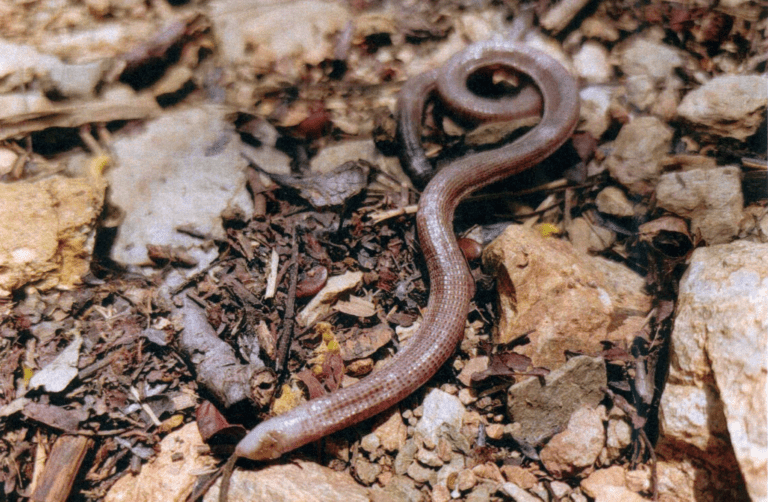
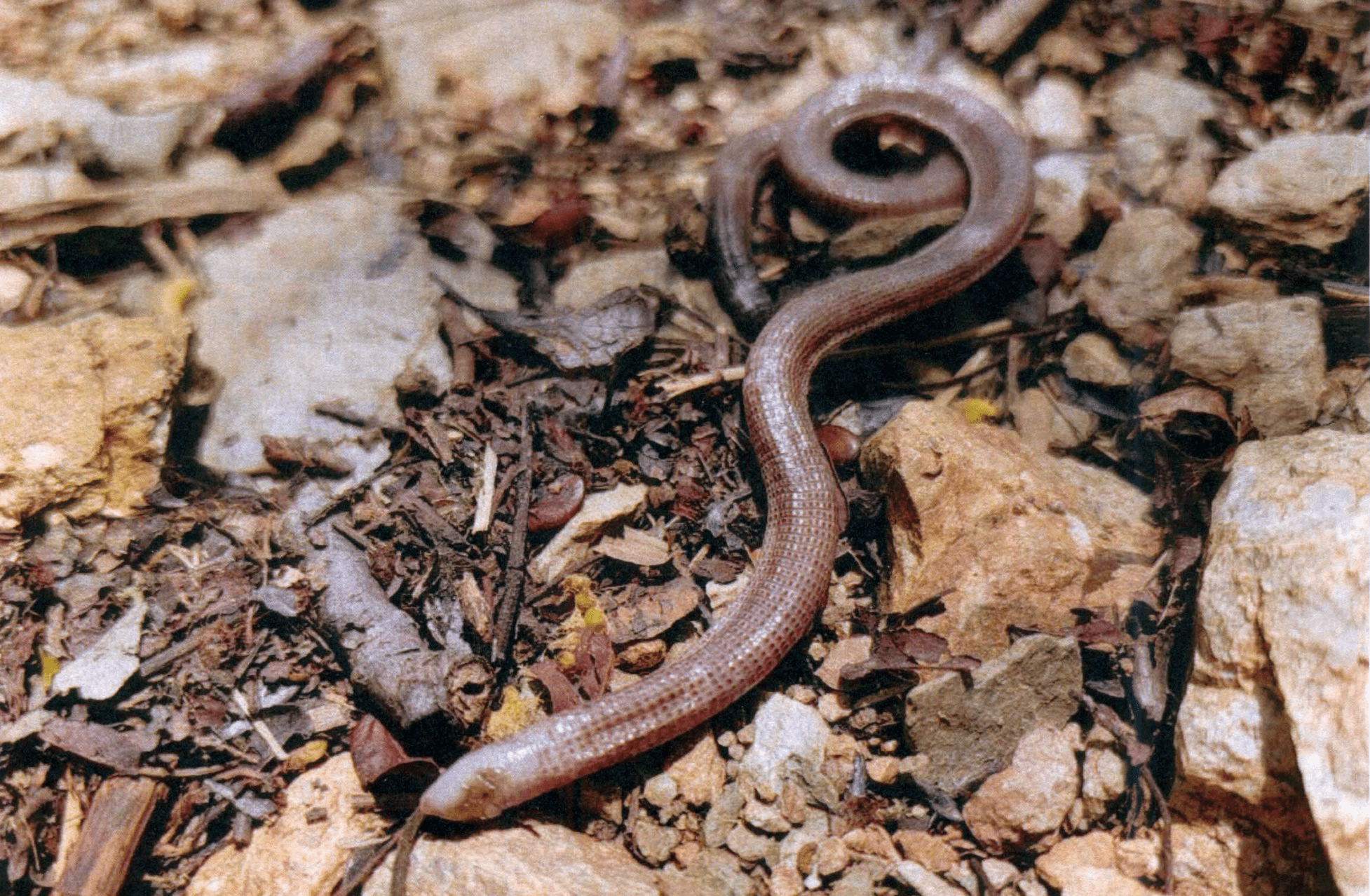
Brigitte Berry took this photo of a native reptile most people in the Virgin Islands never encounter or have heard of. It is a legless lizard, spotted during a hike on St. John. (Photo by Brigitte Berry)
The other day, I got an email message from a good friend of mine, Brigitte Berry, a rare native Virgin Islander who loves these islands’ wildlife and environment. She sent me a photo of a native reptile most people in the Virgin Islands never encounter or have heard of. It was a legless lizard (Amhisbaena fenestrata) looking more like the blind snake (Typhlops richardii). This legless creature is a burrower. It is only seen when digging into the ground, turning over stones or litter.
Olasee Davis (Submitted photo)
They are easily distinguished from Typhlops richardii, the blind snake, by their beige or pink color, and the rings of scales around their body. They are also called Virgin Islands worm lizard. According to biologists, their legs may have disappeared due to the subterranean environment they have lived in. Although they are less than 10 inches long and ¼ inch in diameter, they are voracious predators. Their bite can be painful, sometimes drawing blood or removing a piece of your skin if you handled them.
The generic name of Amphisbaena pretty much sums it up. It derives from the Greek words “bainin” meaning to go and “amphs” meaning “both ways.” In other words, the legless lizard has the ability to move forward and backward, both on the surface of the ground and in their burrows. The diet of the legless or worm lizard in general is composed of cockroaches, termites, ants, beetle larvae, and other sorts of body insects, depending on the species of Amphisbaena.
The legless worm lizard primarily is found in forest habitats, underground, but also may be seen on the surface of the ground, especially after heavy rainfalls. They are native to the Virgin Islands, Tortola, Great Camanoe, Virgin Gorda, Puerto Rico, Culebra, and Vieques. Nevertheless, I heard for donkey years that the small Indian mongoose (Herpestes edwardsii) was brought to the Virgin Islands to kill snakes. This also includes any reptile like the legless worm lizard. However, this is a myth.
In 1884, the mongoose was introduced to St. Croix to control the rats in the sugarcane fields not the snakes. Of course, the mongoose had a major impact on the wildlife population of the Virgin Islands, in particular birds, as well as the agricultural industry, specifically poultry farms. We have five native snake species in the Virgin Islands. This doesn’t include the invasive red tail Boa constrictor, which is a recently introduced species on St. Croix that is impacting our wildlife population and putting fear in people.
The blind snakes are generally known as worm snakes, or some people referred to them as garden snakes. These small snakes are about 5 to 10 inches overall. They burrow into the ground. They are gray or brown above and cream below in color. Their tongues are forked with a smooth scale around their bodies that allows them to travel through the soil. Believe me, they are good for your garden, loosening up the soil for plant growth.
They have reduced small dark spot eyes under the scales of their head. Their mouth is well behind and below the tip of the snout. Their bodies and tail are nearly cylindrical, ending the tail with a sharp point. These reptiles eat ants, termites, and other small insects. The blind snakes are native to Puerto Rico and the Virgin Islands, spending most of their lives underground. They are also found mostly in other tropical regions of the world.
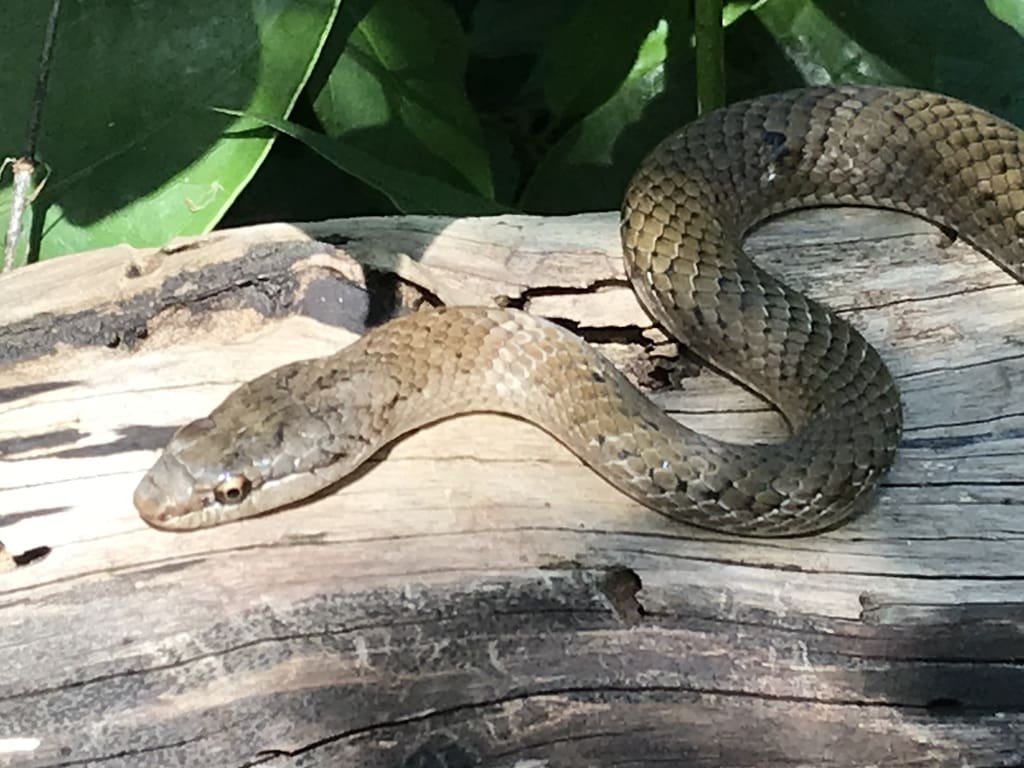
The Puerto Rican racer (Borikenophis portoricensis or Alsophis portoricensis) is another native species snake and endemic to Puerto Rico and the U.S. and British Virgin Islands. (Photo courtesy Wikipedia)
The Puerto Rican racer (Borikenophis portoricensis or Alsophis portoricensis) is another native species snake and endemic to Puerto Rico and the U.S. and British Virgin Islands. These snakes can grow to be 2½ to 3 feet long. Most Puerto Rican Racer snakes are gray, brown, or olive color above, while some have longitudinal stripes. However, the underside of the snake is white, sometimes with dark spots or stripes on the sides. Keep in mind, we don’t have any native or exotic snakes in the Virgin Islands that are poisonous.
The Puerto Rico racer snakes are believed to be rare or extinct on larger islands, but on small islands like Water Island, Hassel Island, Greater and Smaller St. James, and several other cays, inlets and small islands surrounding St. Thomas and St. John, these replies are moderately common. These snakes hunt in the daylight. They are very quick and usually bite if caught. The bites can bleed, but in humans its effect ranges from mild swelling to immobilization and to a severe numbness that may last up to a month. If they are cornered, they will raise their head and can flatten their neck like a cobra.
The primary food source for Puerto Rican racers are frogs and lizards, particularly Anoils species. They also are known to consume fish and freshwater crabs. These snakes are found in a variety of habitats, such as woodlands, rocky areas, coastal forests, and in forest leaf litter.
The Arrhyton exiguous is another native snake to Puerto Rico, St. Thomas, St. John, Culebra, Tortola, and Virgin Gorda. It is a small snake basically found around walls, in moist litter, under rocks, and in other similar places of habitat. These snakes are harmless. The upper parts of their bodies are brown with a darker stripe running down the side from behind their eye. Their bellies are light brown or white, with dark spots on either side of each ventral scute. These snakes can get over a foot long, while most of them range from 6 to 10 inches long. They eat small lizards, slugs, and insects.
Another snake, Alsophis portoricensis, is very rare. It is endemic to St. Croix. In 1972, Dr. Charles Leck found some eggs on the east end of St. Croix. Their habitat is xenic forest. This endemic snake of St. Croix is probably extinct and has not been recorded in over 100 years. Probable causes are the introduction of the mongoose and deforestation of its habitat. This snake was also recorded in 1898 on the island of Green Key off the northeast coast of St. Croix. It was known as St. Croix racer or St. Croix tree snake.
The Virgin Islands Tree Boa (Chilabothrus granti) is native to the British and U.S. Virgin Islands and Mona Island between the island of Puerto Rico and Hispaniola. It is an endangered species protected by federal and local laws. It is the largest native snake in the Virgin Islands at 3 or 4 feet long.
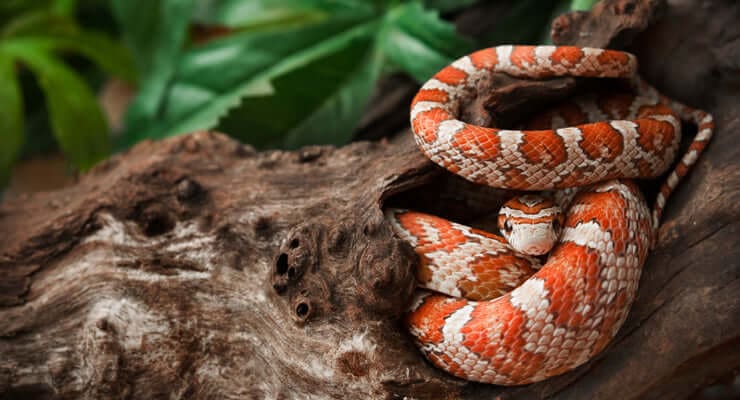
Another snake you should know is the Corn snake (Pantherophis guttatus). They are not native to the Virgin Islands, but they have been introduced here and to the wider Caribbean. (Photo by Luke Tansley)
Another snake you should know is the Corn snake (Pantherophis guttatus). They are not native to the Virgin Islands, but they have been introduced to the Caribbean including the Virgin Islands. These snakes are invasive species and native to the southeastern United States. The Corn snake is known to carry a parasite called Crytosporidium, which can infect domestic and native mammals, as well as humans causing diarrheal disease. I didn’t intend to talk aboutsnakes, but since the legless lizard looks like the blind snake, I say why not educate my beloved public about snakes in the Virgin Islands.
— Olasee Davis is a bush professor who lectures and writes about the culture, history, ecology and environment of the Virgin Islands when he is not leading hiking tours of the wild places and spaces of St. Croix and beyond.
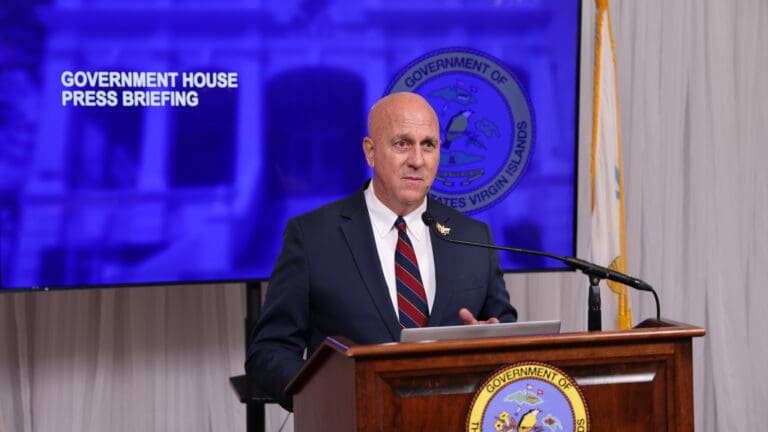
VITEMA Director Daryl Jaschen said during Monday’s Government House press briefing that a recent set of exercises showed that the territory is prepared for the next natural disaster (Photo courtesy of Government House)
As the 2025 Atlantic hurricane season gets underway, local and federal emergency officials say the Virgin Islands are “better prepared than ever,” as demonstrated during a recent two weeks of intensive disaster response drills that tested everything from shelter logistics to medical evacuations and fuel delivery.
The series of exercises, led by the Virgin Islands Territorial Emergency Management Agency, brought together the V.I. National Guard, FEMA, the U.S. Coast Guard, multiple government departments, and private-sector partners for a full-scale functional simulation. The scenario — built around a fictitious Category 3 storm named Hurricane Indigo —challenged agencies to respond to 150 mph winds, up to 10 inches of rain, and storm surge exceeding 10 feet.
“This wasn’t a tabletop exercise,” VITEMA Director Daryl Jaschen said at Monday’s Government House press briefing. “This was a real-time test of how the Virgin Islands would respond if a major hurricane were bearing down.”
The drills ran from June 3 through June 14, simulating a timeline from 120 hours before landfall to 30 hours after. Teams worked from Emergency Operations Centers across St. Croix, St. Thomas, and St. John, coordinating with FEMA Region 2 and military partners in San Antonio, Texas, where the Department of Defense held its annual Rehearsal of Concept for storm season.
Key Areas of Focus: Power, Healthcare, Debris Management
Jaschen outlined Monday several areas where the exercises revealed both strengths and ongoing challenges.
Among them: managing backup power at 151 government facilities across the territory. “We’re tracking generator needs and working with WAPA to prioritize restoration,” Jaschen said. “We don’t want to deploy equipment to buildings that will be back online quickly, or forget about sites that may be without power for much longer.”
Officials also refined evacuation and support plans for dialysis patients. In a real emergency, many would be moved to the new facility on St. Croix operated by the V.I. Healthcare Foundation. “The goal is to keep patients in the territory whenever possible, rather than evacuating them elsewhere,” Jaschen said.
Waste disposal was another major focus. The drills included identifying locations on each island for staging and final disposal of hurricane-related debris, including fallen trees and vegetative waste, in coordination with the Waste Management Authority.
Shelters and Medical Needs
Shelter planning was a central part of the simulation. The territory currently has:
St. Thomas: three shelters for 1,196 people (1 pet-friendly, two wheelchair-accessible)
St. Croix: two shelters for 621 people (both accessible; one pet-friendly)
St. John: two shelters for 207 people (both accessible; neither pet-friendly)
In addition, each district has one special medical needs shelter that can accommodate up to 13 individuals. Residents who require these must preregister with the Human Services Department to ensure transportation and placement.
Officials reviewed both pre- and post-storm shelter protocols, evacuation timelines, and communications procedures, including the need to act before tropical storm-force winds make movement unsafe. “We’re committed to ensuring no island is left without safe shelter,” Jaschen said.
Over the course of the two weeks, agencies also practiced establishing unified command, coordinating search and rescue operations, clearing critical roadways, deploying generators, and staging supplies and personnel.
Participants included the Public Works Department, Port Authority, WAPA, Fire and Emergency Medical Services, Police, Planning and Natural Resources, and Human Services. The goal, Jaschen said, was not just to test response, but to ensure synchronization between local, federal, and military assets.
Jaschen said the drills offered reassurance, but also a reminder: readiness is a shared responsibility. VITEMA continues to urge residents to sign up for Alert VI at www.vitema.vi.gov, make emergency plans, and register in advance for medical shelters if needed.
“Our mission is to protect life and property,” Jaschen said. “Capstone 2025 showed we’re not just prepared — we’re committed to doing whatever it takes to keep the Virgin Islands safe.”
A newly released School Management Accountability Report by the Virgin Islands Board of Education outlines persistent challenges in the territory’s public schools, ranging from leadership bottlenecks and overcrowded classrooms to chronically strained counseling services and lagging academic performance. The report includes detailed findings and recommendations, arriving just as Gov. Albert Bryan Jr. heads to Washington, D.C., to discuss education funding and oversight with federal officials.
Titled “Turning the Tide: Reclaiming the Promise in Public Education,” the report paints a stark picture of systemic issues: administrative delays impacting special education referrals, insufficient funding support, overloaded counselors managing caseloads far beyond recommended levels, and standardized test results showing nearly 72% of fourth-graders on St. Thomas-St. John and 59% on St. Croix scored below proficiency in English Language Arts. In math, more than 80% of eighth and 11th graders across both districts also failed to meet standards. Though science scores showed slight improvement — eighth-grade proficiency on St. Croix rose from 27.1% to 37% — the data underscores deep learning gaps.
Against this backdrop, Bryan headed to Washington, D.C. Monday, meeting with officials, including U.S. Secretary of Education Linda McMahon. A key agenda item: advocating for restoring direct control over federal education funds and ending reliance on the current third‑party fiduciary system enforced by the U.S. Education Department.
“We are in D.C. trying to save Education money and get out from under the third‑party fiduciary,” Bryan wrote to the Source in an update. “The national Education Department makes it hard to spend money timely.” He added that he would share “more details on the process, and next steps after the meeting,” once discussions conclude.
The third‑party fiduciary requirement dates back to 2002, when federal officials placed the territory under a compliance agreement due to fiscal mismanagement. Since 2006, and most recently through a contract executed in December 2020 with McConnell & Jones LLC, the U.S. Education Department has mandated that grant funds — such as IDEA Part B and other federal education awards — be managed through an independent agent to ensure compliance with fiscal controls.The additional layer of approval has long been a point of contention for local leaders who say it delays disbursements and stifles efficiency.
In a telegram to federal officials in 2023, Deputy Assistant Secretary Kerry Neal reaffirmed that the territory “must have a third‑party fiduciary agent … to administer all Department grant funds … to ensure fiscal accountability.”
Meanwhile, the Board of Education’s accountability report offers comprehensive recommendations aimed at building internal capacity at all levels. School leaders are urged to take stronger ownership, set clear academic and behavioral goals, and engage families and community stakeholders before the start of the school year. Counselors, who currently serve more than four times the recommended student-to-counselor ratio, should be supported with additional staffing, such as psychologists or social workers, and relieved of non-counseling duties. Academic interventions for struggling readers and mathematicians must start early, with targeted professional development, curricular alignment, and community-based support efforts.
Discipline and behavioral health systems are also flagged. The report highlights the underutilized role of deans of students and the lack of robust data tracking for mental health and disciplinary interventions. Recommendations include empowering these roles, expanding restorative justice practices, and enhancing mental health supports within schools.
Classroom environments, too, require attention. The report warns of overcrowded, poorly lit or noisy rooms reliant on passive teaching methods, calling instead for smaller class sizes — capped at 15 in early grades and 25 in secondary school – more critical thinking-based instruction, and greater consistency in teacher certification and professional support.
Despite its catalog of shortcomings, the report notes positive signs: access to Advanced Placement, Career and Technical Education, and extracurricular programs such as STEM fairs and moot court. However, it stresses these advantages remain uneven and must be more broadly supported and replicated.
The report was officially submitted on June 15, 2025, fulfilling the annual requirement under Virgin Islands law. It closes with a clear directive: systemic reform will require collaboration, not just accountability. “Schools must be equipped and led in a manner that promotes equity, meaningful instruction, and consistent accountability,” it states. The Board calls on the Education Department, the Legislature, educators, unions, and community partners to act together.
From a deadly shooting in a packed St. Thomas parking lot to a child found bound in the rain on St. Croix, a string of violent crimes played out across the Virgin Islands last week, with court filings laying out what unfolded — and what officers found when they arrived.
In one of the more high-profile cases, police responded around 1:37 p.m. Saturday to reports of gunfire at the Fort Mylner KFC parking lot on St. Thomas, where they found 29-year-old Everton Glenroy Ralph Jr. — also known as “Flint” — unresponsive in the driver’s seat of a red Acura SUV. He had sustained multiple gunshot wounds to the torso and chest.
While officers were processing the scene, 27-year-old Kemo Riley Jr. approached and identified himself as a friend of the victim. According to court documents, he told detectives he had just received a haircut from Ralph and, after hearing gunshots, walked over and looked through the windshield to find Ralph bleeding inside the vehicle.
But Riley’s actions quickly raised red flags. Surveillance footage showed him removing a gold chain and a black crossbody bag from the SUV before walking away. Officers later found both items in his possession; inside the bag was a Glock 9mm pistol with an extended magazine. Police also noted that Riley had blood on his hands and watched as he entered a nearby restaurant to wash them.
Riley was arrested and charged with possession of an unlicensed firearm and destruction of evidence. He was scheduled to appear in court for a preliminary hearing this week.
Two days earlier, police were called to Oswald Harris Court in connection with another homicide. According to court records, 28-year-old Shyiane Degallerie placed a 911 call around 2:49 a.m. Thursday, reporting that he had been in a car crash in the area. The dispatcher remained on the line and reported hearing an escalating argument laced with profanity, followed by multiple gunshots. The caller then went silent.
Degallerie was later found dead near Building 6 at Oswald Harris Court. His registered handgun was recovered at the scene. Surveillance footage reviewed by detectives showed a confrontation between two motorists, with one walking away and being chased by another man and a third person who had been sitting nearby.
On Saturday, police arrested 20-year-old Ajani Prentice in connection with the case. He was already in custody on another matter when detectives picked him up from the Red Hook dock. According to court documents, Prentice told officers he saw Degallerie chasing a relative with a gun and intervened. He has been charged with illegal possession of a firearm and is being held on $50,000 bail.
On St. Croix, a separate incident triggered concern after police responded to reports of a child being left outside in the rain at the Louis E. Brown Villas. Officers found a 12-year-old boy lying on a soaked mattress near Building 12. The child was completely nude, with one hand restrained to a column, according to court filings. Beside him were two bowls containing food and a roll of toilet paper.
Police knocked on the door of the apartment and spoke with 30-year-old Jessica Christian, who told them she had tied up her son because he had been defecating around the house and she could not control him. At one point, officers said Christian attempted to restrain him again. The boy and his 5-year-old sister were both removed from the home and placed in the custody of Human Services.
Christian was arrested and charged with child abuse, false imprisonment, and cruelty to an incompetent person. Her bail was set at $60,000.
All three cases are currently pending in Superior Court as investigations continue.
Although operations appeared to normalize by Monday afternoon, VIPD Communications Director Glen Dratte said Tuesday morning the department is still managing staffing challenges. While contingency measures remain in place, he acknowledged that adjustments are ongoing to ensure adequate patrol and emergency coverage across the territory.
Monday, June 16 | 6 p.m.
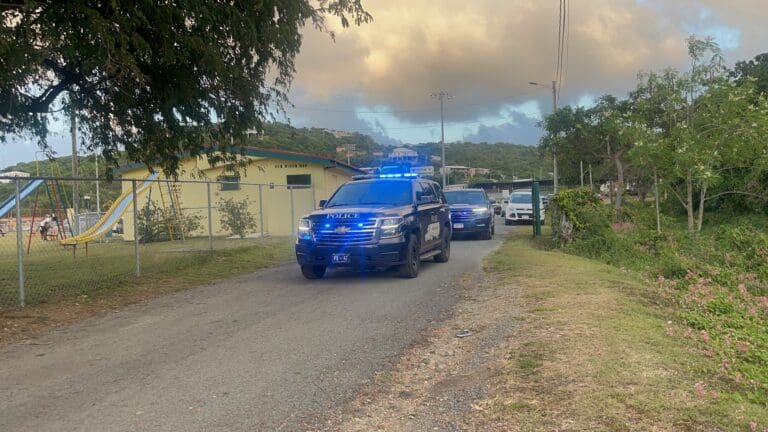
The Virgin Islands Police Department confirmed that several officers reported sick on St. Thomas-St. John on Sunday – Father’s Day – forcing a shift in staffing during an already challenging stretch for the department. With some officers also out on military leave, the shortfall came as VIPD continues to respond to a series of high-profile violent crimes that have stretched resources across the territory.
In the days leading up to the shortage, police had responded to a string of serious incidents. On Wednesday, June 12, 28-year-old Shyiane Degallerie was shot and killed at Oswald Harris Court following what investigators said was a confrontation that began with a hit-and-run crash. Just two days later, on Saturday, June 14, officers were called to the Fort Mylner KFC parking lot, where 29-year-old Everton G. Ralph Jr. was found dead in the driver’s seat of an Acura after multiple shots were fired. That killing marked the territory’s 18th homicide of the year. These cases — and other violent episodes in recent weeks — have placed sustained pressure on patrol and investigative units across both districts.
To maintain coverage, VIPD activated its contingency protocols Sunday, reassigning officers from nonessential divisions to critical patrol and emergency response duties. Although the sudden spike in sick calls prompted public speculation of a possible “Blue Flu” sick-out, VIPD Communications Director Glen Dratte confirmed that all officers had returned to duty by Monday and that operations had returned to normal. The department emphasized that public safety and community visibility remained intact throughout the temporary disruption.
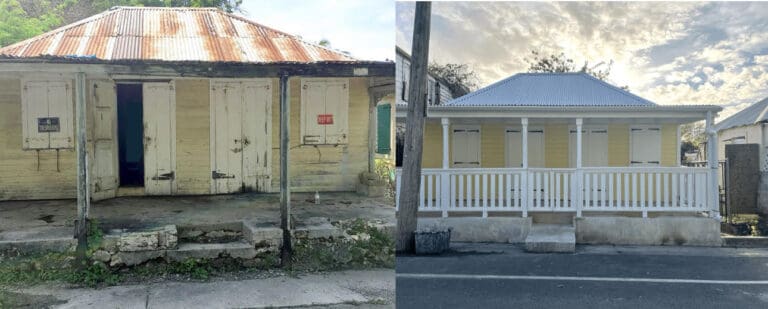
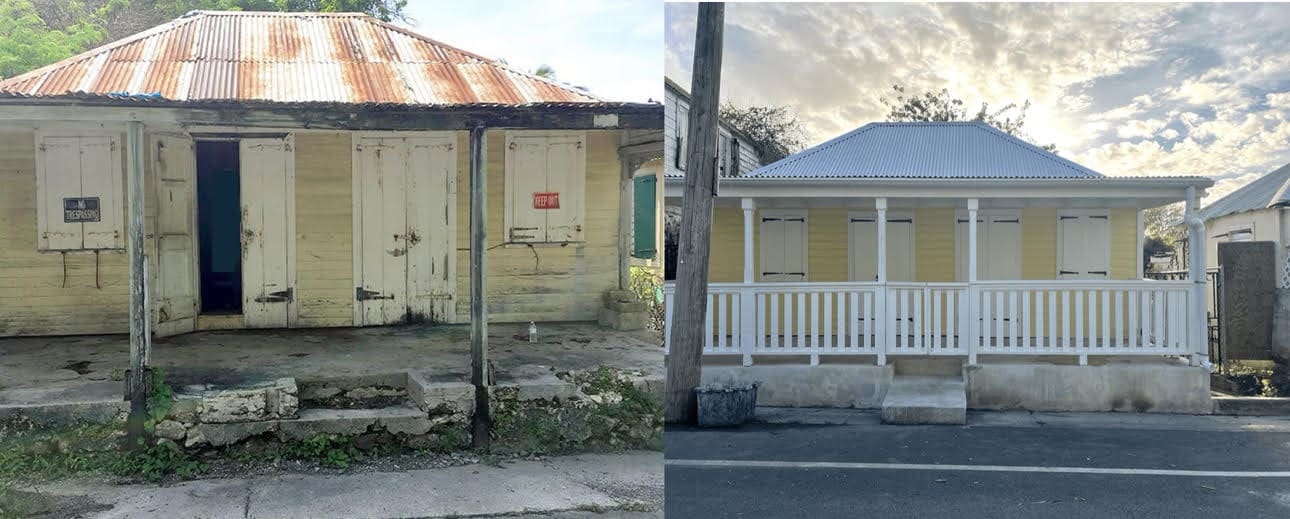
38 Hospital Street in Frederiksted, St. Croix, before and after repairs. (Photo courtesy CHANT)
Backed by a $10 million federal investment, the Virgin Islands Historic Building Recovery Program has already restored more than 45 hurricane-damaged historic buildings across the U.S. Virgin Islands, with dozens more projects in progress.
Following the widespread damage caused by hurricanes Irma and Maria, Congress and former President Biden appropriated $50 million through the Emergency Supplemental Historic Preservation Fund, which the National Park Service administers. The fund was created to support historic preservation efforts in FEMA-declared disaster zones.
Of the $50 million, just over $10 million was awarded to the Virgin Islands.
The VIHBRP is managed by the Department of Planning and Natural Resources’ State Historic Preservation Office. So far, the program has supported the rehabilitation of historic buildings all across the territory.
Traditionally, the Emergency Supplemental Historic Preservation Fund reimburses property owners after repairs are completed according to predetermined preservation standards. However, according to VISHPO Director and Deputy State Historic Preservation Officer Sean Krigger, most residents didn’t have the means to cover renovation costs while waiting for reimbursement.
“Most of the people that really got the major impacts — they just simply couldn’t afford to do the repairs on their own,” Krigger said. “We lobbied and worked with the National Park Service to get approval so that we could pay for repairs up front… once we achieved that approval, we were then able to make a positive impact in helping projects.”
After this adjustment, the $10 million awarded to the U.S. Virgin Islands from the fund was distributed into two government projects: the rehabilitation of Government House in Charlotte Amalie and the DPNR Submarine Base building, each receiving $1 million for rehabilitation. About $2 million supported staffing and administrative costs, and more than $7 million was directed toward historic building restoration and repair projects.
Projects have included roof and gutter repairs, structural reinforcements, historic shutter restorations, and repainting across many historic locations throughout Christiansted, Frederiksted, Cruz Bay, and Charlotte Amalie.
Krigger said the office hopes the program will result in lasting improvements throughout historic districts in the territory.
“What we are hoping to achieve with this project is that we will have a visual impact on our historic towns for improvements,” Krigger said. “We’re wanting to improve not just buildings, but streetscapes – bringing vitality back to our communities – and I’m happy to say that we’re getting that done.”
Krigger emphasized that the program’s success is due to collaboration between government agencies, contractors, and community partners.
“It’s a team effort,” Krigger said. “We are thankful for the support.”
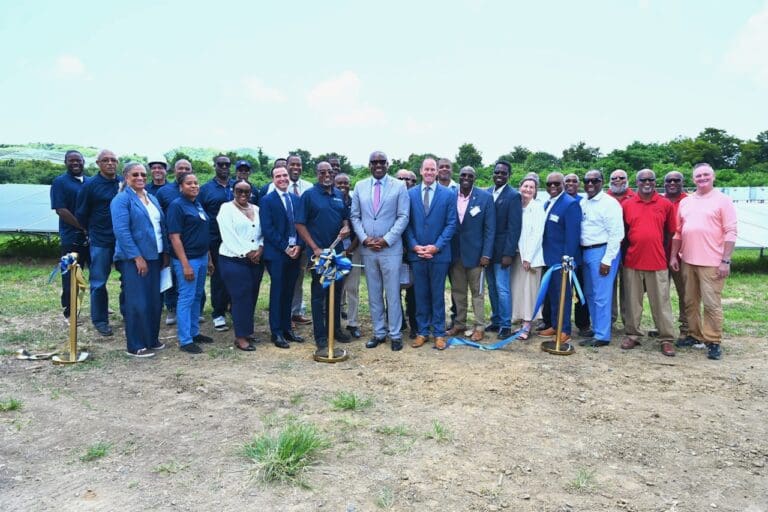
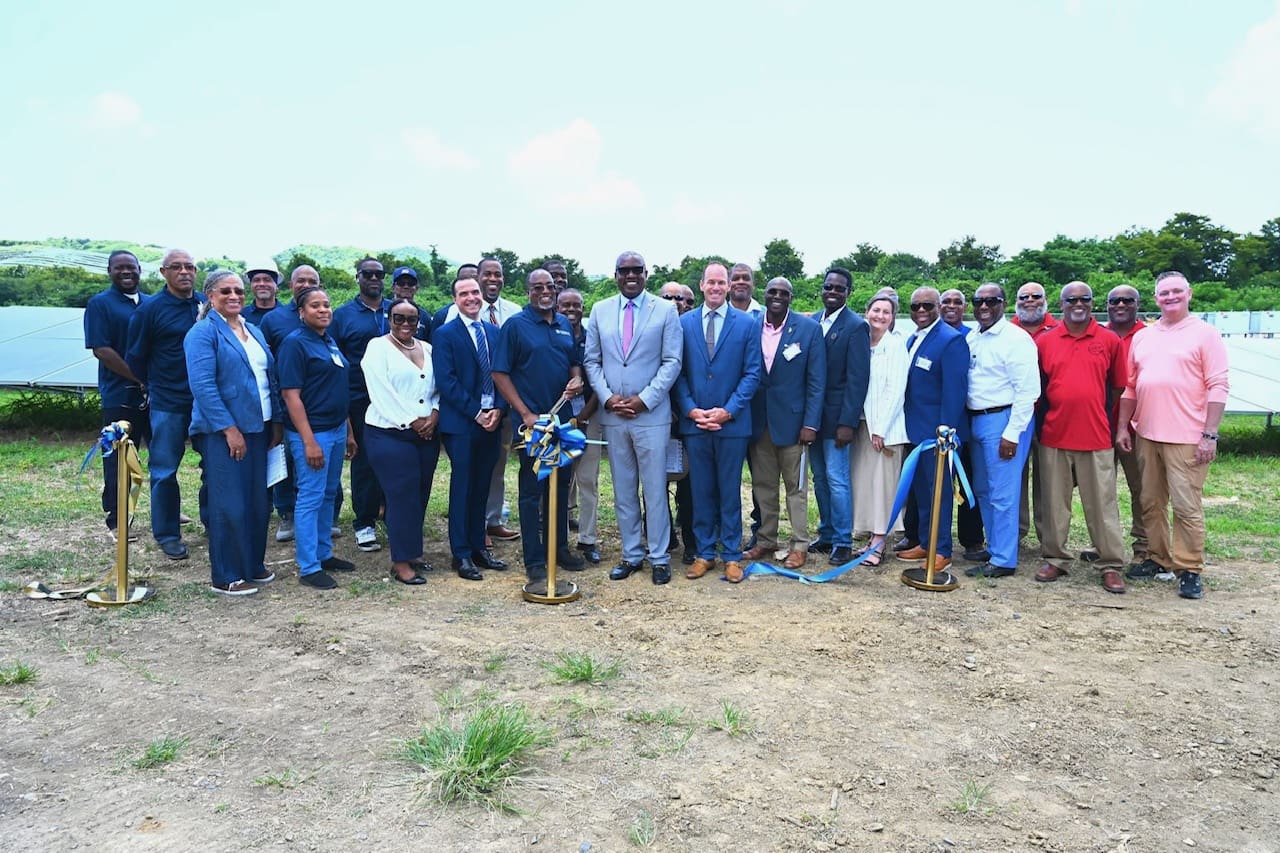
WAPA leadership and government officials mark a historic moment as they cut the ribbon at the Hogensborg Solar Farm, officially commissioning the largest utility-scale solar project in the U.S. Virgin Islands. (Photo courtesy WAPA)
The Virgin Islands Water and Power Authority has officially commissioned the Hogensborg Solar Farm on St. Croix, the largest utility-scale solar project in the U.S. Virgin Islands, marking a major milestone in the territory’s shift toward renewable energy, the authority announced in a press release.
During a ribbon-cutting ceremony held Friday, June 13, in Estate Hogensborg, WAPA leaders and local government officials celebrated the launch of the 48,210-panel facility, which can generate up to 22.4 megawatts of power. The solar farm features advanced battery storage systems, developed by Honeywell, designed to support the grid during outages and peak energy demand, according to the press release.
“This project is more than a milestone — it’s a movement,” said WAPA CEO Karl Knight. “Being able to rely more on indigenous sources of energy and less on costly imported fuels like diesel and propane marks a pivotal shift for WAPA and the Virgin Islands. This solar project demonstrates our dedication to building a cleaner, more reliable energy future — one that empowers our community and protects our environment for generations to come.”
The Hogensborg facility is the third solar installation on St. Croix and the fourth utility-scale renewable energy project WAPA has helped implement. It was developed by VIElectron and is owned by VIRAPC, the press release stated.
Gov. Albert Bryan Jr. called the commissioning “real progress” in the territory’s clean energy push.
“This project moves us closer to a future where we can depend less on expensive, imported fuel and more on clean, local energy,” he said. “It also reflects our larger effort to transform the Water and Power Authority into a more modern and sustainable utility.”
WAPA officials say the Hogensborg project supports the territory’s Vision 2040 goal of achieving 75% renewable energy and aligns with the authority’s broader microgrid development strategy to enhance grid resilience, the release stated.
Building on the momentum, WAPA has begun development of the Fortuna Solar Farm on St. Thomas. That project, expected to be completed by late 2026, will include 94,440 panels and a 25-megawatt battery storage system designed to stabilize power for the St. Thomas-St. John district, it said.
A recording of the ribbon-cutting ceremony is available here.
Antilles School’s Fishman Family Field comes to life at Soccer Fun Day with 8U, 9U, and 11U athletes from Lindbergh Bay Soccer Program, Massey Soccer Academy, New Vibes SC, and LRVI FC Castaways. (Source photo by Amara Stokes Gilbert)
Cheers, music, and the steady thump of soccer balls filled the air at Antilles School’s Fishman Family Field during the Sports, Parks and Recreation Department’s Soccer Fun Day.
Young athletes from Lindbergh Bay Soccer Program, Massey Soccer Academy, New Vibes SC, and LRVI FC Castaways brought their A-game across 8U, 9U, and 11U divisions, turning the sunny Saturday into a celebration of competition, community, and youth development.
From early morning warm-ups to the final whistle, the energy never dipped. The concession stand buzzed with activity, volunteers passed out water and snacks, and families packed the sidelines — laughing, shouting encouragement, and sharing in the joy of every goal and assist.
Massey Soccer Academy keeps the party going at youth Soccer Fun Day with music and concessions. (Source photo by Amara Stokes Gilbert)
Behind the scenes, it took a village to make the event happen. Parent volunteer, Kelli Webster, from the Lindbergh Bay program, credited the day’s success to the sacrifice and consistency of parents and coaches.
“It’s not easy,” Webster laughed. “But when you see how much these kids love the game, it makes all the effort worth it. Events like this show how far soccer has come in the Virgin Islands. Our kids are starting younger, getting that exposure, and building a real community around the sport.”
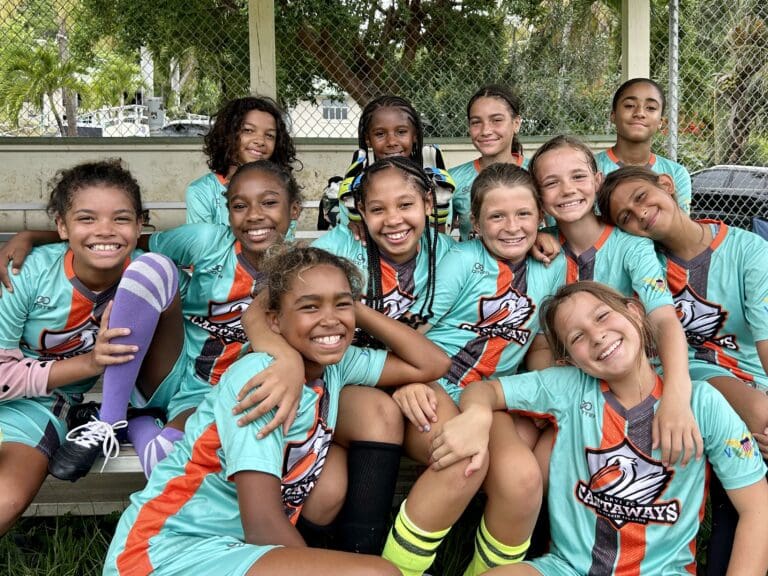
That sense of community echoed through the words of Castaways’ parent, Rocky Dell, who shows up weekend after weekend to watch his daughters play. “The kids keep me showing up. I love to see them overcome challenges and hit new milestones,” Dell said. “I hope they’re not just learning the game, but teamwork, sportsmanship, and making lifelong friends.”
“And the young ladies are for real out here!” he added with a smile. “Brilliant to watch. The beach is always gonna be there — but we’ve gotta get out on the field.”
LRVI FC Castaways 11U girls pose for a team photo after celebrating a big goal during Soccer Fun Day. (Source photo by Amara Stokes Gilbert)
Coach Dale Richards of Massey Soccer Academy emphasized how essential these match days are — not just for fun, but for player growth.
“It gives us a real look at how the kids are progressing,” Richards said. “They get to measure themselves, not just against teammates but players their age from other programs. We want to see them grow together, build chemistry. My hope is that we carry the USVI to the world one day.”
Achieving that dream starts with people like New Vibes SC standout Jordan Atemazem, who consistently volunteers his free time to show up for the next generation.
“I love the sport, and I love these kids. I want to be there to give them the guidance and support they need,” he shared. “It’s not just about playing soccer — it’s about learning how to understand each other and becoming a family.”
Lindbergh Bay Soccer Program and LRVI FC Castaways 8U boys face off in a friendly competition on Antilles School’s Fishman Family Field. (Source photo by Amara Stokes Gilbert)
At this Soccer Fun Day, that’s exactly what they did. They shared victories and shortcomings. They cheered each other on.
And they reminded everyone watching that the future of soccer in the Virgin Islands is bright — and already on the field.