

New EPA Region 2 Administrator is Mike Martucci
0
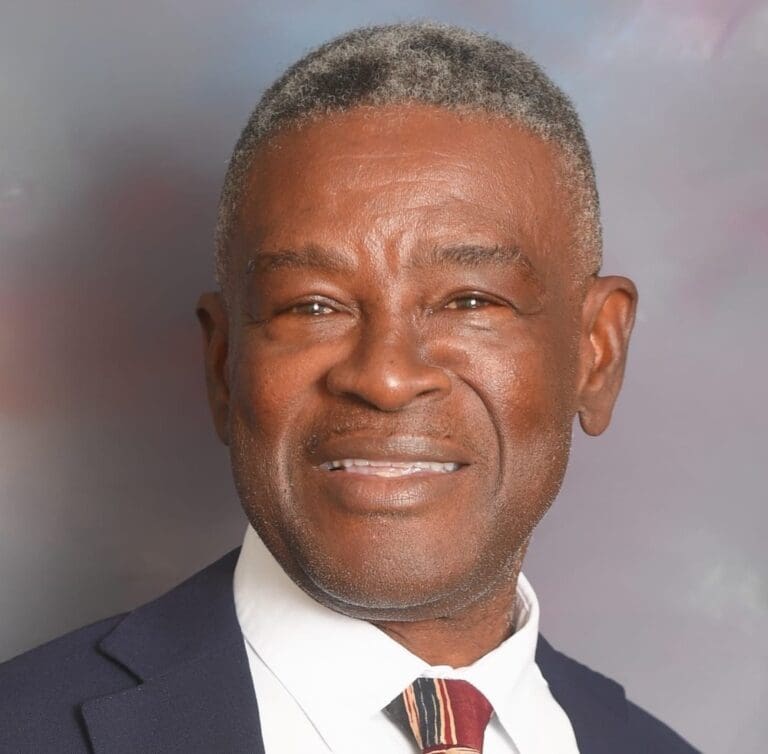
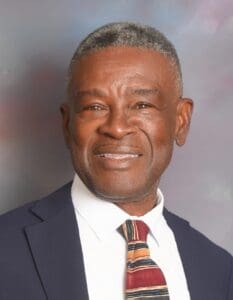
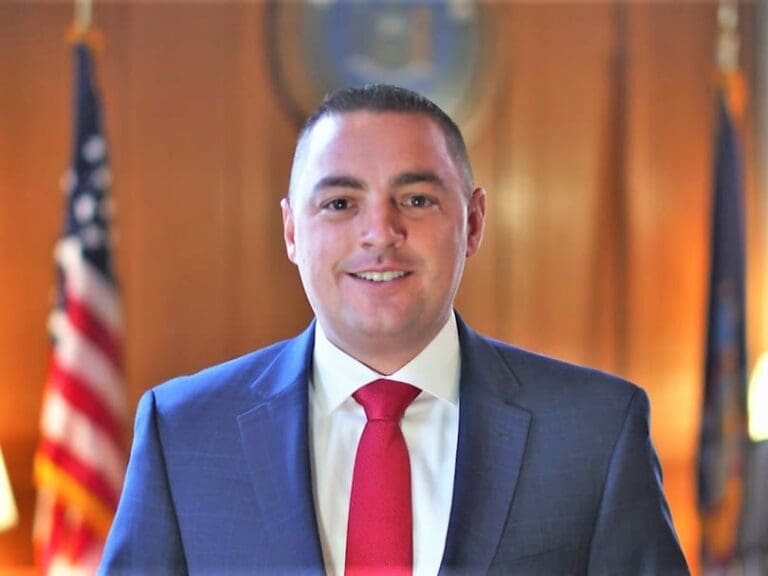
Thursday, U.S. Environmental Protection Agency Administrator Lee Zeldin announced that President Donald J. Trump has appointed Michael Martucci as the Regional Administrator for EPA Region 2. As Regional Administrator for EPA Region 2, Mike is overseeing the EPA’s work to carry out important priorities of the administration’s environmental agenda and protect the people of the region covering New Jersey, New York, Puerto Rico, the U.S. Virgin Islands and eight federally recognized Indian Nations. “As a businessman, state senator, and community leader, Mike Martucci has proven he is committed to service,” said EPA Administrator Lee Zeldin. “In the New York State Senate, he championed legislation aimed at improving our environment and advancing conservation. Mike brings a wealth of private and public sector experience and is exactly who we need leading Region 2. I am excited to have him aboard.” “I am honored to have been chosen for this role and just a few weeks into my job I am already impressed with the professionalism, thoughtfulness and dedication of the EPA’s regional workforce,” said Regional Administrator Martucci. “I am proud to lead this regional office to meet the important priorities of the Trump Administration, which include balanced environmental protection.” Mike Martucci is a former NY State Senator, and respected business owner and farmer from the Hudson Valley. During his time in the NY State Senate, Mike was a supporter of New York’s Environmental Bond Act and passed legislation related to open space protection and inland waterway designation throughout his district which included portions of Orange, Ulster, and Delaware Counties as well as all of Sullivan County. After college, Mike founded a school transportation company which grew from one bus that Mike drove to one of the largest in the country. The company now serves thousands of schoolchildren and their families in the Hudson Valley Region of New York. A family farmer, Mike is a steward of our environment and understands the importance of preserving open space for future generations. Mike is a lifelong resident of Orange County. He is a dedicated family man who believes in giving back to his community through volunteerism, teaching and philanthropy. He is a graduate of Marist College where he obtained a Master of Business Administration degree. Mike and his wife Erin are raising their three children in Orange County, NY. Mike is known as someone who works collaboratively with stakeholders to achieve goals.

Bike Racing Starts Feb. 16

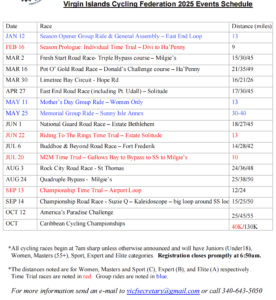
The Virgin Islands Cycling Federation will kick off its 2025 competitive season with a 9-mile time trial on Sunday, Feb. 16 at 7 a.m. The point-to-point course will begin at the Divi Hotel on St Croix’s east end and finish at the entrance pillars to Ha’Penny Beach.
In a time trial format, each rider is sent off at one-minute intervals, with the fastest rider starting in the ultimate position. In this format, also known as the Race Against the Clock, each cyclist will race alone as no drafting is permitted.
As in all VICF events, helmets must be worn. Time trial bicycles and road bicycles with aerobars will be permitted. There will be five racing categories: Elite, Expert, Sport, Masters (50+) and Juniors (under 18). Medals will be awarded to the top three finishers in each division.
Race-day registration will be open from 6am to 6:45am. $10 for VICF members, $15 for non members. For more information about cycling in the VI, please call 340-643-5050.

Free Online Workshop for Nonprofits

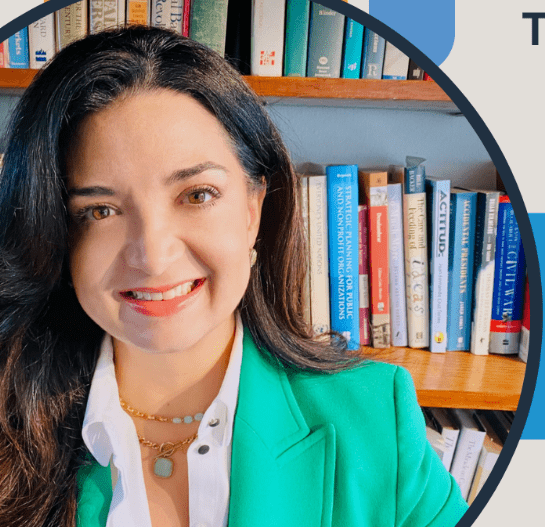
The Recovery Innovation Coordinator and Center of Excellence (RICCE), a program of the Democratic Training Institute, is partnering with the University of the Virgin Islands Center for Excellence in Leadership and Learning (UVI-CELL) to offer nonprofit professionals a free online workshop titled “Tools for Grant Award Implementation: Turning Awards into Achievements”. The workshop will take place on Thursday, Feb. 20, from 9 a.m. – 1 p.m. AST. This practical workshop, conducted in English, is designed for nonprofit organization professionals, including Executive Directors, Grant Managers, Program Managers, Financial Officers, and Compliance Officers, who are responsible for managing grant-funded programs. Participants have two flexible viewing options: they can join the online workshop from home or office, or, for those with limited internet access, attend the online viewing at one of the UVI campuses in St. Thomas, St. Croix, or St. John. Those attending UVI will have the benefit of enjoying refreshments and networking with nonprofit leaders and staff from UVI-CELL and RICCE from 8 a.m. – 8:45 a.m., before the workshop begins. The 3.5-hour workshop will equip nonprofits with practical tools and real-world insights to implement grant-funded projects effectively. Participants will gain a step-by-step roadmap to turn grants into impactful, sustainable outcomes. Led by Isabel C. Fernández, a Certified Grant Management Specialist with over $58 million in secured federal funds, the workshop leverages her expertise in grant writing, compliance, and fund administration across sectors. Workshop Details: Date: Feb. 20 Networking at UVI locations: 8 a.m. – 8:45 a.m. Workshop Viewing: 9 a.m. – 1 p.m. AST UVI Locations: St. Thomas (Orville E. Kean Campus) St. Croix (Albert A. Sheen Campus) St. John (St. John Academic Center) Register for UVI Location Viewing: https://buytickets.at/ifdricceprogram/1563366 Register for Online Viewing: https://buytickets.at/ifdricceprogram/1560022

Karl R. Percell, Esq. Dies at 66

0
With profound sorrow and a deep sense of loss, the family of Karl R. Percell, Esq., 66, announces his sudden passing on Sunday, January 26, 2025, on St. Thomas. 
Karl R. Percell, Esq.
Attorney Percell was a well-known and respected legal practitioner with more than forty years of experience in the public and private sectors of the U.S. Virgin Islands. He was renowned for his expertise in administrative and corporate law, real estate, probate, and wills, trusts and estate planning, and he was the president of Percell Legal Group, P.C. He shared his legal skills with his community by giving countless hours to LSSVI-Ebenezer Gardens Apartments (a non-profit independent living senior community where he chaired the board and sponsored the Christmas party); Legal Services of the Virgin Islands, Inc.; AARP Virgin Islands Chapter; the St. Thomas-St. John Friends of Denmark, Inc.; and the St. Thomas Committee of the Virgin Islands Coastal Zone Management Commission. He also knew how to enjoy himself. He partied with the Gypsy Carnival Troupe, travelled extensively with family and friends, and appreciated fine food and wine. He liked to laugh and had no qualms with being the brunt of the joke.  He was preceded in death by his parents, Alphonso (A/K/A Alfonso) and Eselyn (A/K/A Eseline) Elmira Percell, and special cousin, Milton A. “Bull” Frett. Attorney Percell is survived by his wife of more than 37 years and best friend, Carolyn P. Hermon-Percell; his three beloved children, Karl R. Percell, II, P.E., Tyler M. Percell, and Alexa J. Percell; and his absolute joy, his granddaughter, Kameryn G. Percell.  Other survivors include his siblings, Sandra, Rodney, Diana, Neal, and Jerry Percell; his in-laws, Kenneth and Alma Hermon, Beverly Hermon Wallace and Dave Wallace, Kenneth Jr. And Lisette Hermon, and Thelma (Rodney) Percell; and by other family members and special friends too numerous to mention.  The celebration of the life of Karl R. Percell, Esq. will be held on Friday, February 28, 2025, at the Lutheran Church of the Reformation, Anna’s Retreat, St. Thomas, U.S. Virgin Islands, beginning at 9:00 A.M. (there will be no viewing), with internment at Coki Point Cemetery.  Tributes may be sent to krptributes@gmail.com until February 24, 2025. The family requests that, in lieu of flowers, donations be made in memory of Karl R. Percell, Esq. to Ebenezer Gardens Apartments, C/O LSSVI, 516B Hospital Street, Frederiksted, St. Croix, VI 00840-3824 (or via www.lssvi.org/donate). Professional services have been entrusted to Turnbull’s Funeral Home.

Associate Supreme Court Justice Ketanji Brown Jackson Shares Life Lessons on St. Croix
0
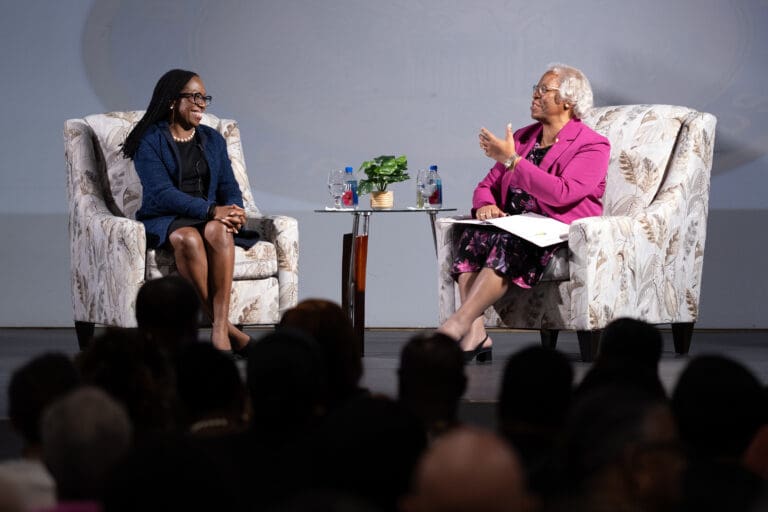
Justice Ketanji Brown Jackson steps onto the stage for a sit-down discussion with District Judge Wilma Lewis Thursday evening at the Sydney Lee Entertainment Center on St. Croix. (Source photo by Kit MacAvoy)

The Honorable Ketanji Brown Jackson visited St. Croix this week, where she spoke to students and — if U.S. District Judge Wilma Lewis is to be believed — danced the quadrille for the first time. Jackson sat down with Lewis for a discussion of her early life and career Thursday night at the Sydney Lee Entertainment Center.

Jackson was born in Washington, D.C., to parents who were both public schoolteachers. She grew up in Miami after her father moved the family there to study law at the University of Miami, and Jackson said some of her earliest memories were of sitting at the table with her father — him with law books, her with coloring books.

Justice Ketanji Brown Jackson and District Judge Wilma Lewis discuss Jackson’s path to becoming an Associate Justice of the U.S. Supreme Court Thursday on St. Croix. (Source photo by Kit MacAvoy)

Throughout the 90-minute discussion with Lewis, Jackson repeatedly cited the impact of her parents, who pushed her to participate in extracurricular activities like music lessons and swimming.

The latter led to what Jackson described as a formative experience.

During a pool party, a seven- or eight-year-old Jackson was floating in the pool and drifted away from the safety of the ledge. Then, she said, she began to sink. Fortunately, an adult jumped in and saved her. Though relieved to have been saved, Jackson told the crowd Thursday that she was angry at herself — she knew how to swim, so why had she panicked? She resolved that if she ever found herself in “the deep end” again, she wouldn’t lose her cool.

“I would swim,” she said.
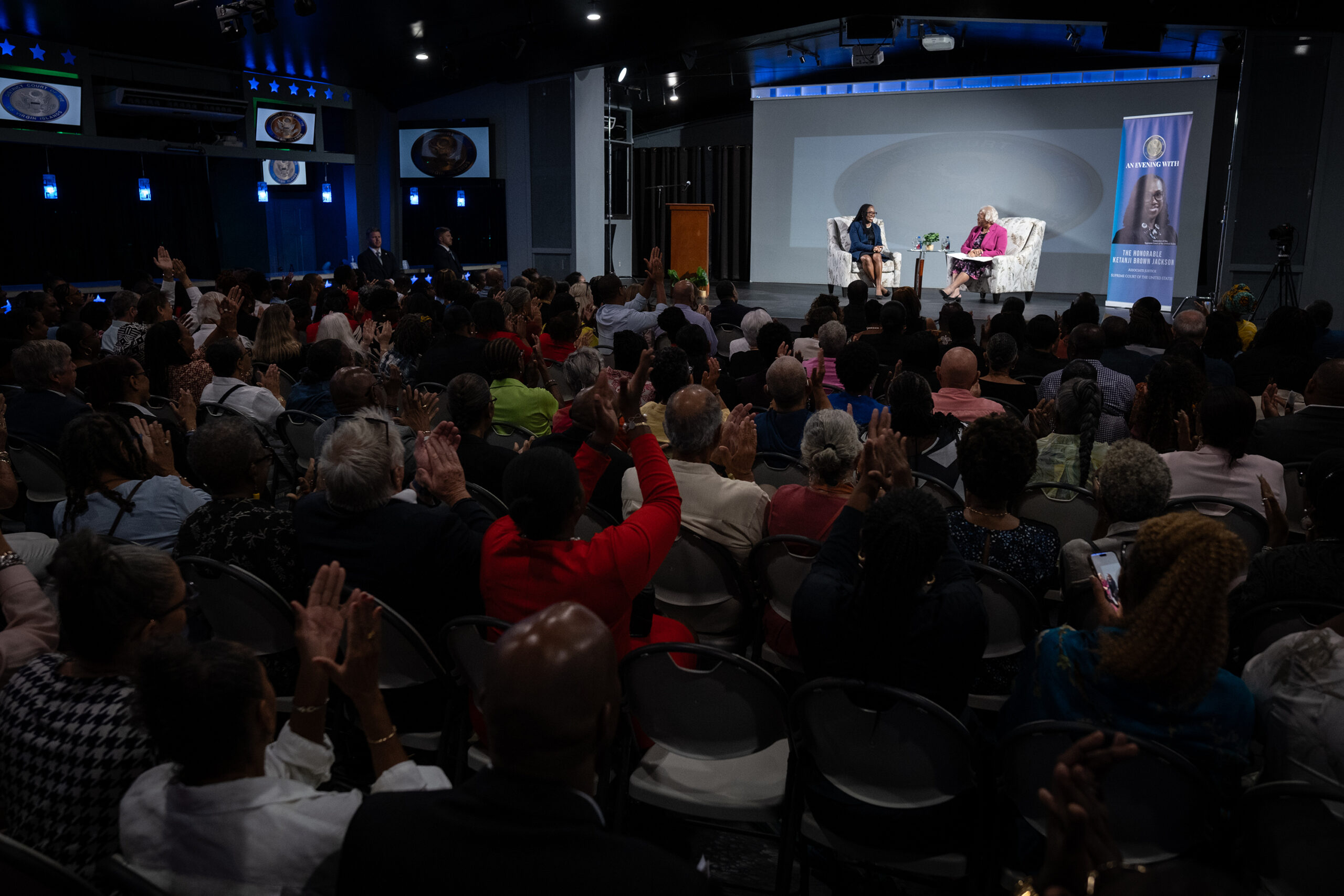
The crowd claps as Justice Ketanji Brown Jackson and District Judge Wilma Lewis take their seats Thursday night at the Sydney Lee Entertainment Center on St. Croix. (Source photo by Kit MacAvoy)

Though her interest in the law came early — thanks to her father — Jackson said she was inspired to pursue a judgeship while reading a Jet Magazine profile of pioneering civil rights attorney Constance Baker Motley, the first African American woman appointed to the federal judiciary.

Jackson later attended Radcliffe College, which fully merged with Harvard University in 1999, and graduated cum laude from Harvard Law School in 1996. After earning her J.D., she clerked for three judges: Judge Patti Saris of the U.S. District Court for the District of Massachusetts; Judge Bruce M. Selya of the U.S. Court of Appeals for the First Circuit; and Justice Stephen Breyer of the U.S. Supreme Court.

Following a stint in private practice, Jackson served as an attorney for the U.S. Sentencing Commission — an independent agency within the federal judicial branch responsible for promulgating sentencing guidelines — and spent two years as an assistant federal public defender in Washington D.C.

“And I noticed, when I was a public defender, how few of my clients actually understood the judicial process that was shaping their entire lives,” she said Thursday. Jackson said the experience informed her later work as judge for the U.S. District Court for the District of Columbia, where she said she took pains to make sure the people in her courtroom understood what was happening.

Jackson and Lewis went on to discuss the associate justice’s nomination to the U.S. Supreme Court — and the grueling confirmation process that followed. After a nerve-wracking vetting process, Jackson said she had all but convinced herself that someone else was getting the job. Then, one Thursday night, former President Joseph Biden called her on her cellphone. The White House released a recording of that call from Biden’s perspective.

“What you can’t know, or what you don’t know, is that I was like under my desk,” Jackson said, laughing.

An audience member holds a copy of Justice Ketanji Brown Jackson’s autobiography, “Lovely One,” before the Associate Justice of the U.S. Supreme Court speaks to St. Croix residents Thursday night at the Sydney Lee Entertainment Center. (Source photo by Kit MacAvoy)

Though she weathered scathing lines of questioning from Republic lawmakers during the ensuing confirmation hearings, Jackson said Thursday that her private meetings with lawmakers during the confirmation process were “to a person” lovely. When the hearings began, Jackson said she recalled thinking that lawmakers weren’t really talking to her — they were acting for their constituents.

“This is a performance, is what I’m thinking in my head. And that helped me to stay calm, to understand what everybody’s roles were,” she said.

Members of the crowd enthusiastically seize the opportunity to take pictures of Justice Ketanji Brown Jackson Thursday evening on St. Croix. (Source photo by Kit MacAvoy)

Jackson took her seat on the U.S. Supreme Court in June 2022. On Thursday, she said little about the court itself and less about the current climate in Washington, D.C., though she noted that there is an institutional focus on maintaining traditions of cordiality and collegiality. One way the justices do that, she said, is by having lunch breaks where they’re not allowed to talk about cases.

Jackson is slated to give a similar talk to St. Thomas residents on Friday.

Plaskett Warns of ‘Musk Meddling’ While Caribbean Charities Fear for Funding

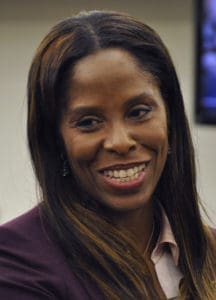
Delegate Stacey Plaskett is warning of “Musk meddling” while Caribbean charities fear for funding. (Source file photo)
Quasi-governmental employees combing through Americans’ private data could be mining tax records and other protected information for personal profit, Congressional Delegate Stacey Plaskett warned Thursday. All the while, a freeze on funding for global nonprofits has Caribbean charities gasping. In a Washington, D.C., press conference entitled “Taxpayer Privacy After Musk Meddling,” Plaskett and other members of the House Ways and Means Committee said billionaire Elon Musk’s apparently unchecked access to Americans’ tax, personal finance, veterans affairs, and health records, could constitute a massive data breach. President Donald Trump, who has long refused to release his own tax records, elevated Musk to manage the newly-created Department of Government Efficiency or DOGE, designating him a part-time special government employee. Plaskett and other House Democrats on the committee that oversees revenue, tax-writing, and trade said Musk and other nongovernment employees were running roughshod through Americans’ private information. Allowing Musk access was not the same as other elements of Trump’s highly unorthodox first weeks in office, Plaskett said. Trump’s threat of tariffs on some of America’s closest trade partners, talk of taking over Greenland, the Panama Canal, and the Gaza strip, and enthusiasm over undoing diversity, equity, inclusion, and accessibility measures struck some as chaotic. She said Musk’s actions were precise and planned: He may be harvesting the information to further enrich himself. “I know people are calling this chaos. This may be chaos to us but it’s not chaos to them. They know exactly what they are doing; they know exactly why they are doing it,” she said. “They are not just reading this information. They’re putting it in AI models, we’re finding out. They want to understand where the money is flowing. Why do they want to understand where the money is flowing?” Plaskett said. “Much of Elon Musk’s resources and his wealth is based on government contracts. $15 billion that we know of is, from one company that he owns, in government contracts.” Having access to private citizens’ financial information as well as the other vast amount of data collected by the federal government but not publicly disseminated would present an obvious conflict of interest for someone who benefited from government contracts, she said. Leaking or having unauthorized access to private tax information is a felony. “President Trump says that Elon Musk is going to self-report if he has a conflict of interest? What kind of nonsense is that? And it’s no mistake, and it’s no chaotic, kind-of discombobulated happenstance that one of the first things our president did was fire the inspectors general,” Plaskett said. “The watchers are gone. The watchers are not there to do the kind of independent oversight that Congress gave them authorization to do.” Another Trump order gave all federal employees an ominous option to take a buyout and resign or face future layoffs and furloughs. A federal judge temporarily halted the buyout plan Thursday but not before some 40,000 federal employees resigned, according to the White House. The shiver continued through the nonprofit world. Musk and others have worked to strip funding from international and domestic humanitarian programs, as well as uproot protections for vulnerable groups. On St. Croix, Lutheran Social Services CEO Junia John-Straker said her drawdown of federal funding took three or four days longer than usual. Her agency took a risk to pay its vendors on time, hoping the money to reimburse themselves would arrive. Lutheran Social Services depends on such vendors to house and feed elderly and disabled people in the territory and care for young children. Without the federal funds, that would not be possible, she said. “We were told it was under review, which had never been the case before,” John-Straker said. “We are concerned. Not necessarily for the job, per se, but to be able to pay our vendors, and pay our bills on a timely basis. Everybody should be concerned. We don’t know what’s going to happen.” Matters were decidedly less stable for foreign organizations that depend on funding the United States. President John F. Kennedy created the United States Agency for International Development in 1961 to “partner to end extreme poverty and promote resilient, democratic societies while advancing our security and prosperity,” according to the agency’s former website. Trump ordered a near complete freeze to USAID funds and Musk has said the program that seeks to spread values of democracy, cooperation, and global health should be shuttered. With an emphasis on so-called soft power, USAID programs range from fighting Ebola to studying the causes of and solutions to extreme poverty, advocating cultural diplomacy, health initiatives like disease control and clean water initiatives, and teacher and first responder trainings. USAID’s staff in Barbados, where many funds were administered, did not answer emailed requests for comment. They may have been packing. In 2023, USAID helped fund a partnership with U.S. forces and Grenada’s Royal Police Force to train 66 first responders in emergency preparedness, first aid, and more. The exact impact USAID had on the Caribbean region was not clear because, as of Wednesday, more than 10,000 USAID webpages went dark. The message on all www.usaid.gov pages now alerts all its global employees they are on administrative leave starting at 11:59 p.m. Friday. Unless designated “mission-critical” by 3 p.m. Thursday, all these people have been told to book flights back to the United States and prepare for their contracts to be terminated. “ … the Agency would arrange and pay for return travel to the United States within 30 days and provide for the termination of PSC and ISC contracts that are not determined to be essential,” the website reads. The curt message ends: “Thank you for your service.” The global nonprofit Caritas has been battling poverty and helping disaster recovery for more than 50 years. In the Caribbean and Latin America, Caritas Antilles works with people forcibly displaced from their homes, natural disaster and climate change preparedness, and more from Jamaica to Guyana. The Caritas Antilles Youth Emergency Action Committees, established in 2009, will be particularly hard hit, Caritas said in a statement sent to the Source Thursday. “What was once a thriving network of youth-led emergency preparedness, disaster risk reduction, and community resilience initiatives has now been thrown into uncertainty, leaving vulnerable populations at heightened risk and staff unemployment. From stalled critical mitigation projects to the paralysis of emergency response programs, the stop work order has not only hindered progress but has also reversed years of dedicated efforts in disaster preparedness,” the statement said. “This unforeseen directive has not only halted essential mitigation projects but has also disrupted ongoing preparedness initiatives, volunteer engagement, and collaborative partnerships with key community stakeholders,” the organization with offshoots in St. Lucia, Dominica, Guyana, and Jamaica said. “ … the furlough of 28 dedicated staff and the disengagement of volunteers – including 555 active and 349 supportive volunteers — undermining program momentum, team morale, the competitive nature of competent staff recruitment and the broader disaster preparedness landscape.” While exact figures were not available because the USAID site was down, other information via alternative federal websites gives a ballpark on what was spent in 2024. According to alternative federal websites, Haiti received $104.6 million in 2024. Columbia, $89.7 million. Dominican Republic, $49.5 million. Barbados, potentially for many Eastern Caribbean programs, $18.1 million and Jamaica, $13.67 million. How those funds were administered was not clear.

Territorial Hospital Board Approves Several Expenditures
0
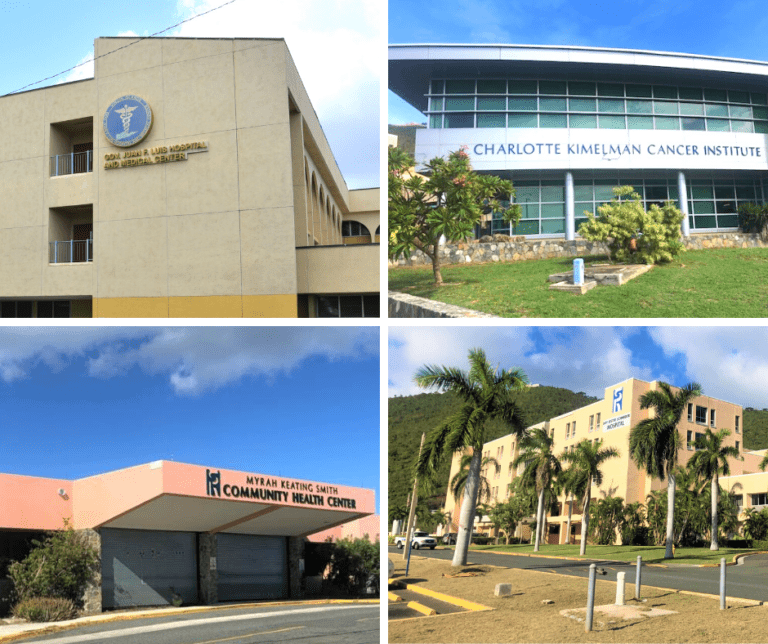
The V.I. Government Hospital and Health Facilities Corporation Territorial Board met for its monthly meeting Wednesday. (Submitted photo)
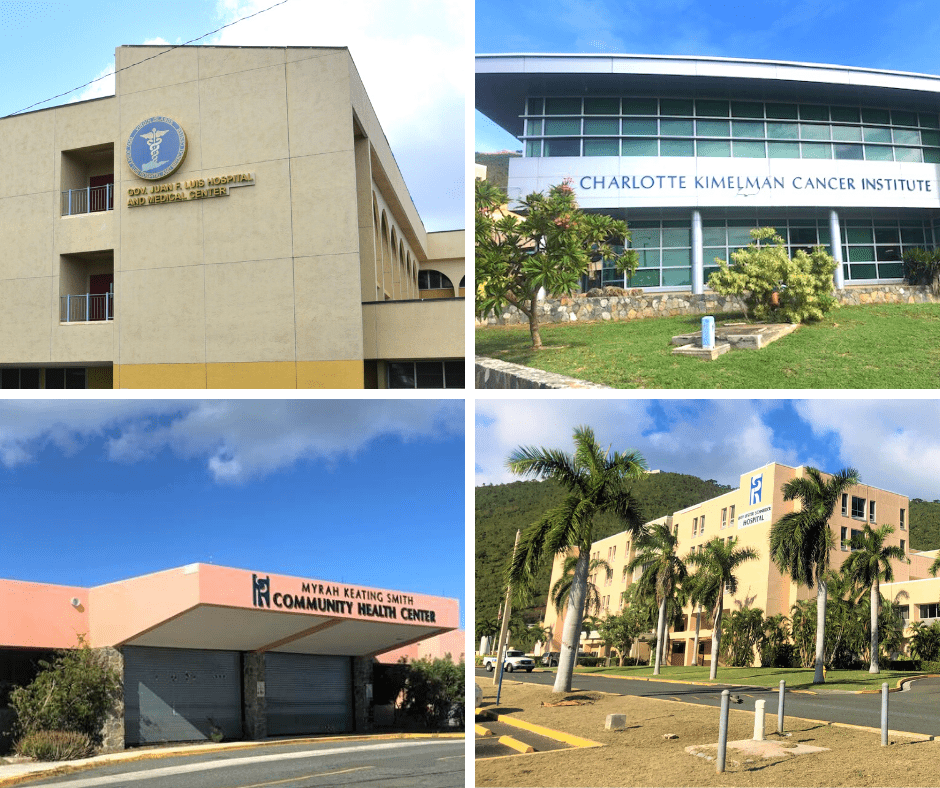
During a V.I. Government Hospital and Health Facilities Corporation Territorial Board meeting Wednesday, members approved several expenditures and extended contracts for medical staff at the Schneider Regional Medical Center. At the beginning of the meeting, Chair Christopher Finch introduced Darlene Baptiste, the new chief executive officer for the Juan F Luis Hospital and thanked Hazel Philbert for acting as the interim CEO for the last six months. Both women expressed appreciation for the support they received from the board and medical staff. Baptiste said she plans to spend the first 30 days “listening and building relationships” so that JFL can become a “beacon of health care.” Daryl Smalls, territorial executive director for the Territorial Hospital Redevelopment team, outlined the funds needed to extend the architectural engineering work contract with FLAD Architects to develop five acres of land adjoining JFL for parking, storage, and an administration building. The construction project was finally bid successfully after a third advertisement. Smalls said the project could now be completed by the end of the year. The estimated cost increase includes construction administration, travel, and per diem expenses not to exceed $2,427,402.24 in total. Another expenditure approved by the board was for JFL and the Biomedical Department to contract for preventive maintenance for hospital equipment for two years at $17,342.19 a month. Finally, the territorial board recommended aligning the procurement policy with the central government’s: One quote is needed for acquisitions valued up to $10,000; three quotations are necessary for acquisitions between $10,000.01 and $150,000, and for formal solicitation acquisitions over $150,000.01. The board voted unanimously in approval. Finch asked for a vote to change the board meeting dates for March 17 for the Finance Committee and March 19 for the full board to allow more time for the hospitals to close their books. The board agreed. The board also approved reappointing four physicians for three years at the SRMC. Board members attending the meeting were Finch, Justa Encarnacion, Julio Rhymer, Dr. Frank Odlum, Dr. Jerry Smith, Greta Hart-Hyndman, Faye John-Baptiste, Kevin McCurdy, and Dr. Albert Titus.

U.S. Territory Democrats Pushing for Voice on National Stage
0
“You’re not listening to us,” Democratic Party of the Virgin Islands State Chair Carol Burke said to Democratic National Committee leadership. (Logo of U.S. Territories Alliance)
Leaders of the Democratic Party of the Virgin Islands said Thursday they have a message for their mainland counterparts: Listen to us. Had the national party elevated concerns from the Virgin Islands and other territories, the 2024 national election results may have been different, said Carol Burke, the party’s state chair. “One of the problems that we have experienced in the last presidential elections is that the state parties were not given the leverage that they should have been given in terms of what the priorities should be for the campaign so we missed a lot of constituencies concerns because of that,” Burke said. “We want our voices at the national level to be heard.” Roughly 55 percent of 2024 presidential election voters who identified as Latin American cast their ballots for Democratic candidate Kamala Harris, according to The Associated Press. That was down from approximately 60 percent who had voted for Joe Biden in the previous election. Harris, who is Black, also did worse with Black voters than Biden, with 16 percent voting for Donald Trump. That’s double the 8 percent support Trump received from Black voters in 2020, according to the Pew Research Center. In 2019, the Democratic Party of the Virgin Islands teamed up with like-minded party officials in the other four U.S. territories and Washington D.C. to form the U.S. Territories Alliance, Burke said. Democrat branches in American Samoa, the District of Columbia, Guam, the Commonwealth of Puerto Rico, the Northern Mariana Islands, and the U.S. Virgin Islands wrote to the national party demanding long sought for funding. Unlike stateside counterparts, territorial Democrats don’t usually receive funding from the national party. For $20,000 a month, territorial state Democratic parties would be able to develop and train local leaders, implement grassroots and digital organizing strategies, and expand voter registration, education, and engagement among key demographics. The funds would also help include women, millennials, educators, health care professionals, veterans, farmers, fishermen, absentee voters in the diaspora, and Latino communities in their party’s efforts. Democrat leaders in the territories also hope the money will help support travel and accommodations and enable American Samoa’s delegation to fully participate in the Quadrennial Convention. “The Democratic Territories Alliance strongly asserts that this funding is not just a matter of party strategy — it is a moral imperative,” the alliance wrote in a press statement. “The territories have long suffered from systemic inequities rooted in the legacy of the Insular Cases, which unfairly established a colonial framework depriving territorial residents of equal political rights. While residents of the territories serve in the military, pay taxes, and contribute to the economic and cultural fabric of the United States, they remain disenfranchised in fundamental ways, including the inability to vote for president.” More recognition and funding would be a step toward integrating territorial Democrats priorities with the national party’s platform, Burke said. Although she described the situation as “a bone of contention,” Burke said overall she was optimistic and hopeful about new Democratic National Committee officers voted in on Feb. 1. Ken Martin was elected committee chairman. The U.S. Territories Alliance said Martin was a “champion for the territories” in a written statement. “His continued advocacy is crucial to ensuring that territorial Democrats receive the support they need to remain competitive and engaged in the national political landscape,” the statement said.

The Bee Project Invites the Public to Free Art Workshops on St. John Feb. 10 and 11
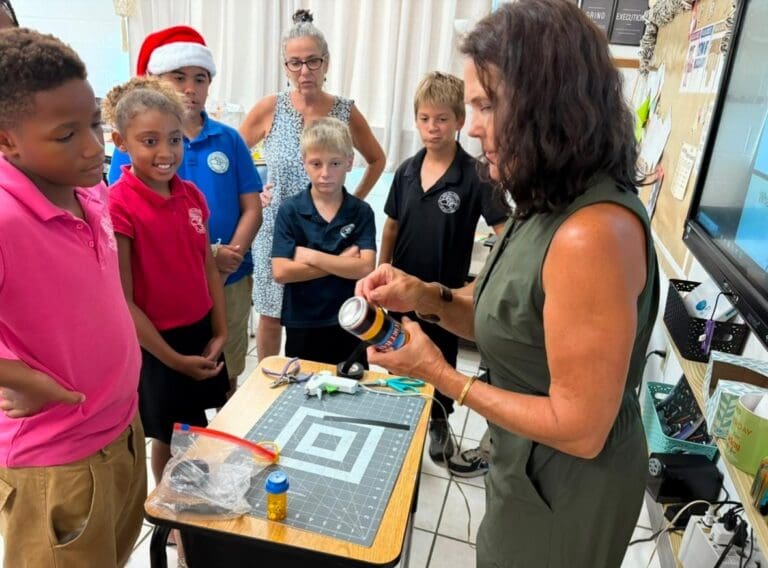
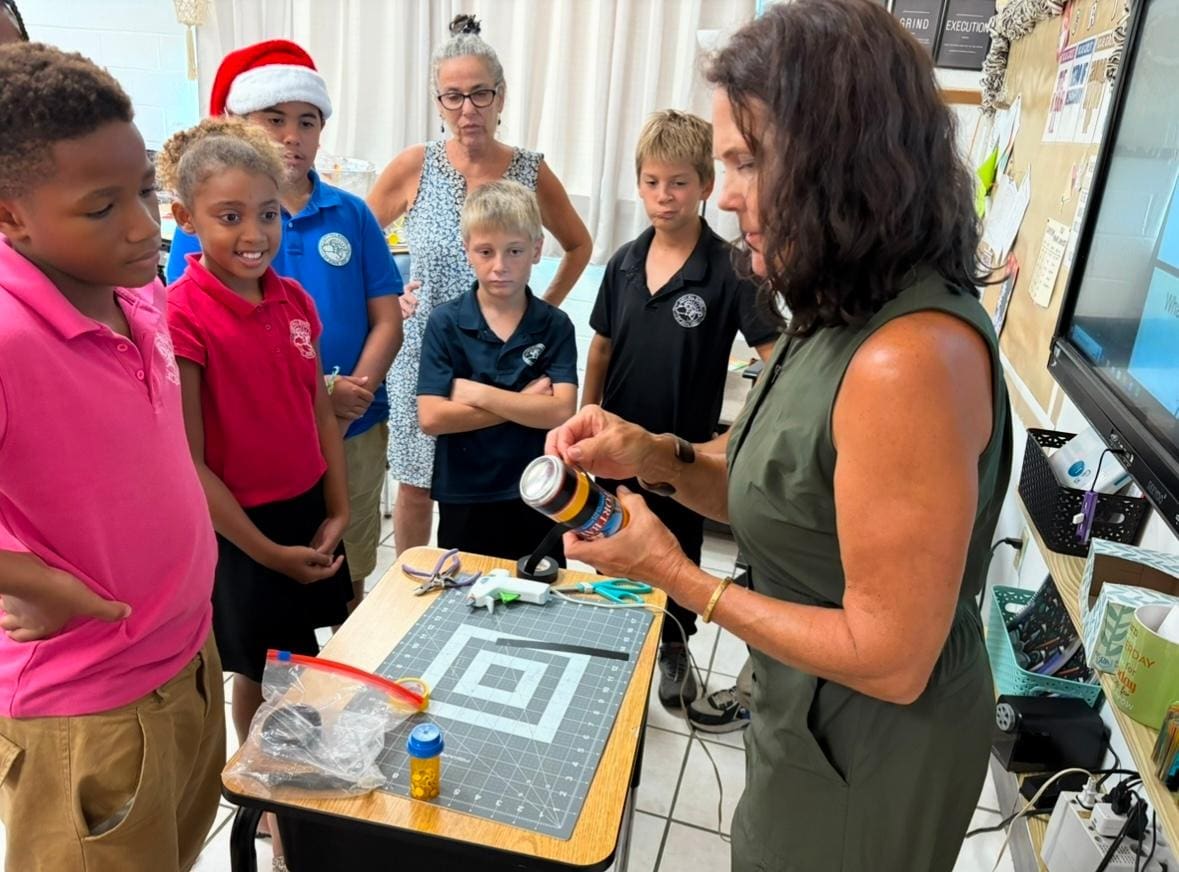
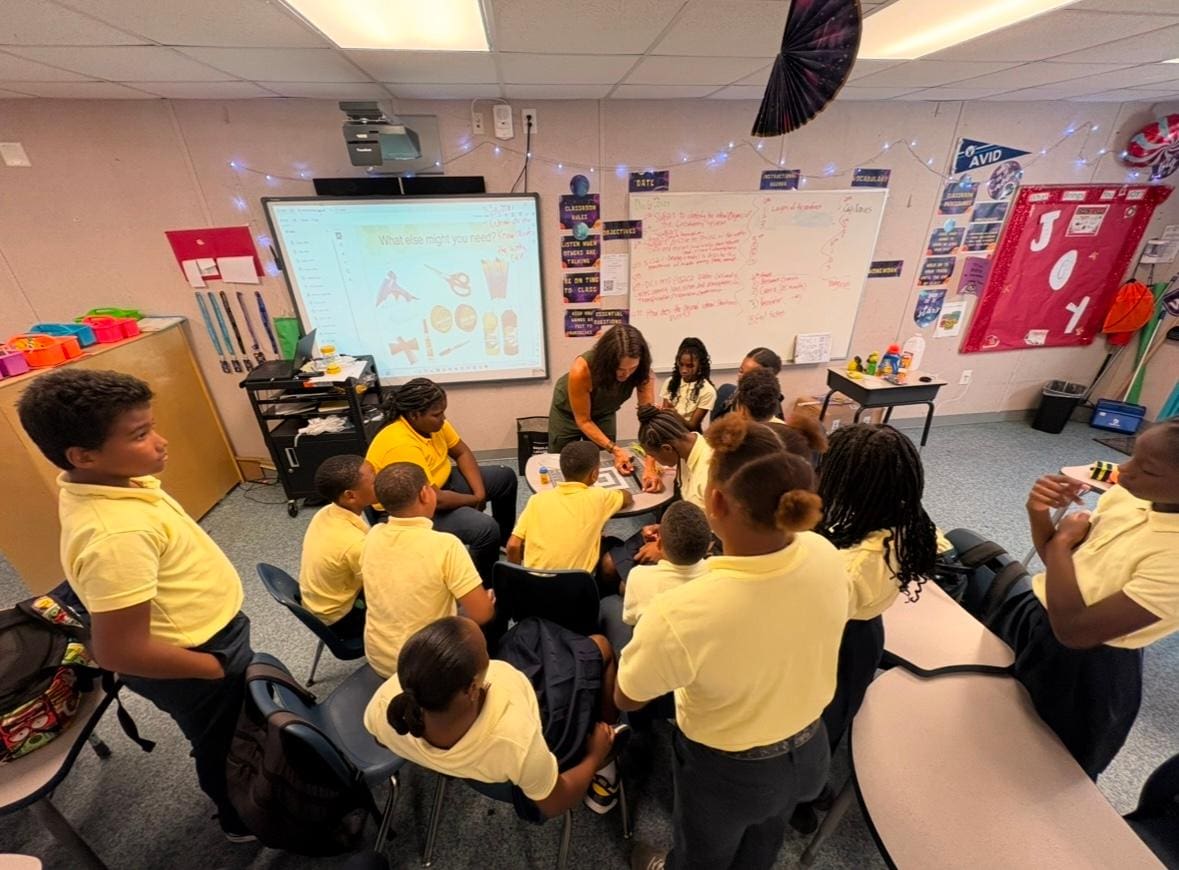
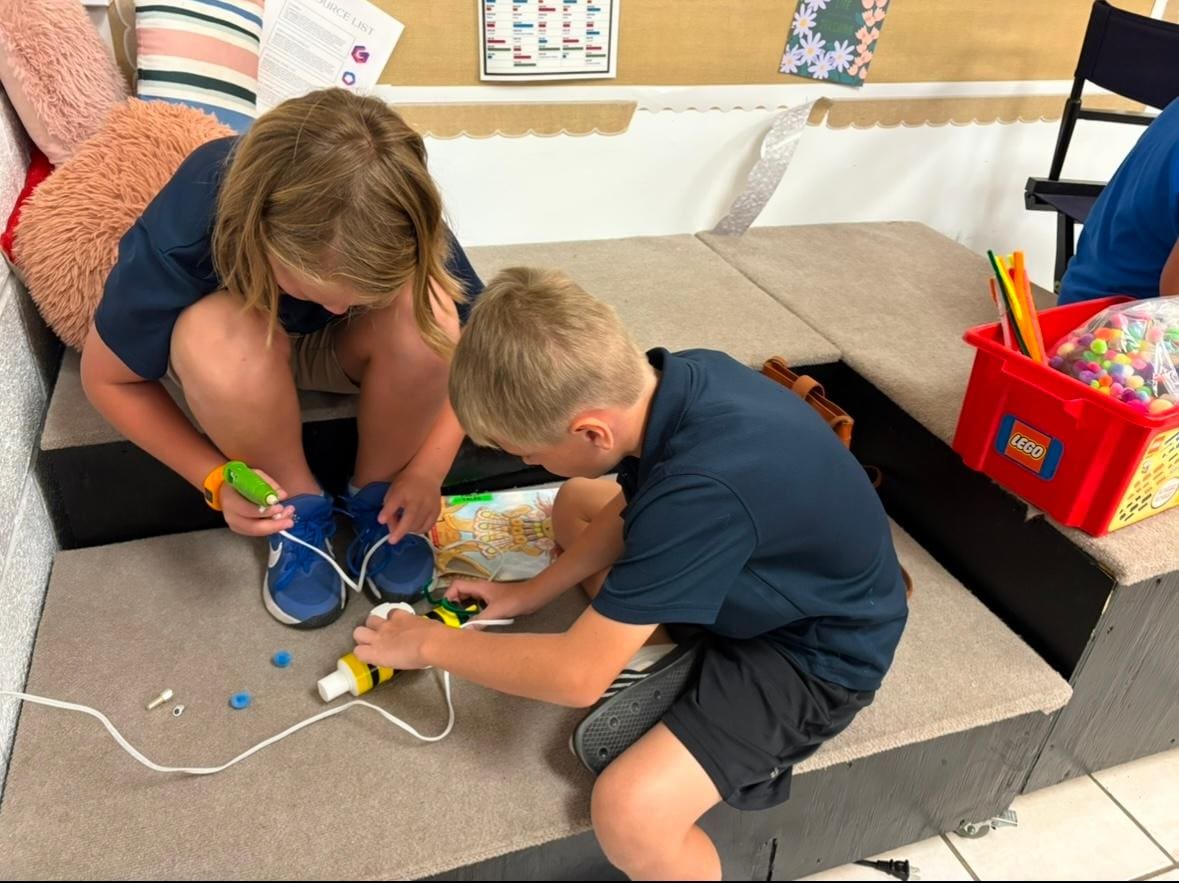
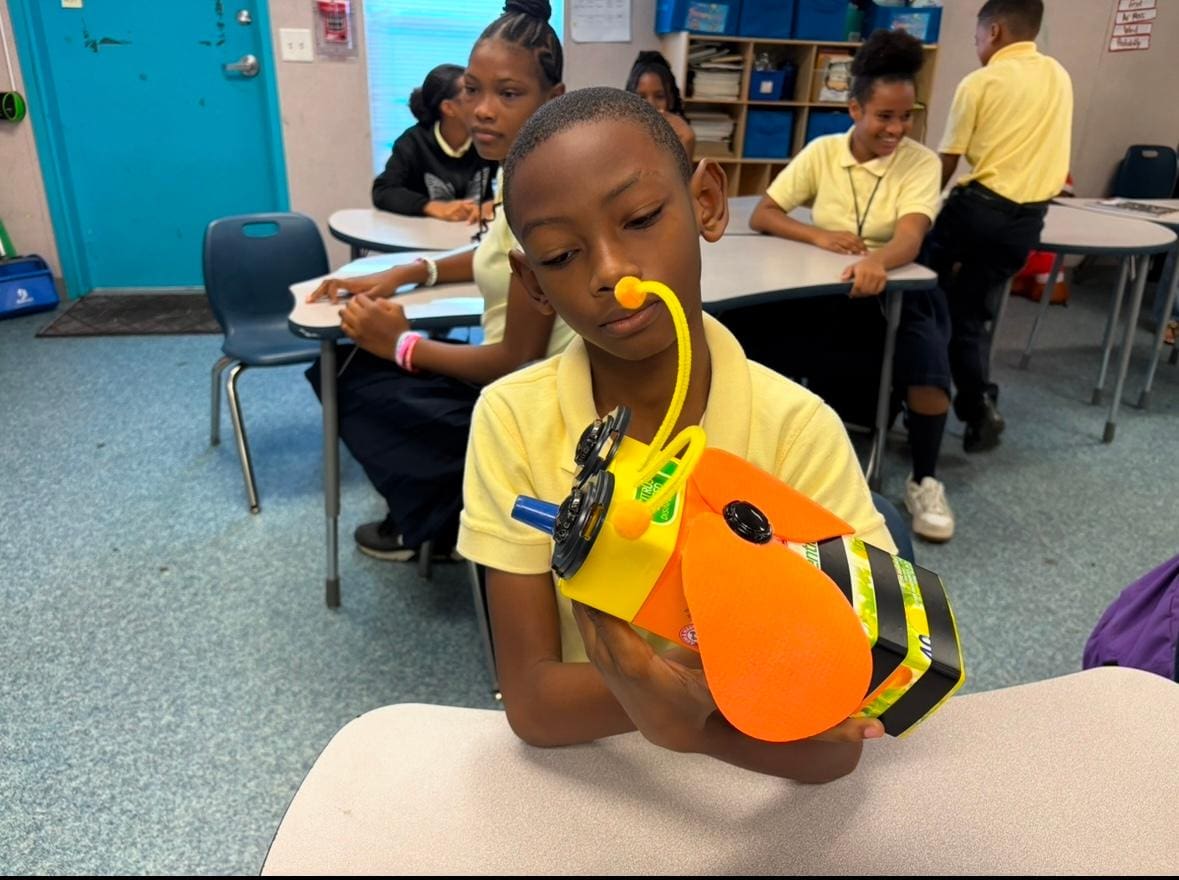
Elena Smyrniotis works with Gifft Hill School students. (Photo courtesy St. John School of the Arts)
Do you like to create things with your hands? Do you have concerns about the environment? Do you want to participate in a community arts project? A “yes” to one or more of these questions means you might like to join The Bee Project, a public art project created several years ago in Iowa that is spreading to locations throughout the United States, including the Virgin Islands. The Bee Project arrived in schools on St. John in December 2024, and it is continuing with community workshops that are free and open to the public on Monday, Feb. 10, from 7 to 8:45 p.m. and on Tuesday, Feb. 11, from 10 to 11:45 a.m.   The art workshops, suitable for all ages, will be held at the St. John School of the Arts in Cruz Bay. Materials will be supplied, and participants may bring their own.
Fifth graders at the Sprauve School get a lesson on bees from Elena Smyrniotis. (Photo courtesy St. John School of the Arts)
The project’s goal is to increase awareness of the vital role bees play in our environment as pollinators and learn what we can do to protect them. One way to do this is to engage community members in an art project to make bees out of recycled materials and then include them in a beehive structure placed in a public space. As part of the project, fifth graders in all three schools on St. John have been learning about bees — their various types, their anatomy, their social structure, their role as pollinators — as well as the threats to their survival.
Gifft Hill School students collaborate on making a bee. (Photo courtesy St. John School of the Arts)
“It aligns perfectly with the fifth-grade science curriculum,” said Jeune´ Provost, executive director of the St. John School of the Arts who was formerly a teacher and administrator. “There are nearly 20,000 known bee species in the world, and 4,000 of them are native to the United States. And all these bees have jobs as pollinators,” according to the United States Geological Survey. “Bees of all sorts pollinate approximately 75 percent of the fruits, nuts and vegetables grown in the United States, and one of every four bites of food people take is courtesy of bee pollination.”
Recyclable plastics are used to fabricate the bees for The Bee Project. (Photo courtesy St. John School of the Arts)
The St. John School of the Arts became involved when Elena Smyrniotis, the creator of the project, approached the school about hosting the project on St. John just as the school was looking to expand its Arts for Advocacy Program. Smyrniotis began working with children in 2021 in Iowa, the heartland of America’s crop production. As a multimedia artist and educator, she gained funding through the Grant Wood Art Colony sponsored by the University of Iowa and the U. of I. Office of Sustainability and the Environment, and the Office of Community Engagement. “Threats to both honeybees and wild bees are numerous,” according to Smyrniotis’ website. “For honeybees, pests and pathogens, such as mites and viruses, environmental stressors like pesticides or poor nutrition, and genetic limitations all contribute to varying degrees to what is popularly called ‘Colony Collapse Disorder.’ For wild bees, threats come from loss of habitat, reduction of floral resources, loss of nesting sites, and the use of chemicals.” The facts are distressing, but an art project is an uplifting way to get people involved with the cause. It allows everyone — children, adults, and seniors — to unleash their creativity while working alongside others to improve the welfare of the community.
A student at the Julius E. Sprauve School makes bees. (Photo courtesy St. John School of the Arts)
Provost said the project will continue throughout the year and include visits to schools by beekeepers and workshops at the senior centers on St. John. The St. John School of the Arts is looking for a welder to put together the hexagonal hive structure and an outdoor public location to present the project. For further information, contact the SJSA at 340- 779-4322.

Man Arrested Near St. Thomas School for Marijuana Possession, Distribution

0
Special Operations Bureau officers arrested a man Tuesday afternoon near a St. Thomas school after he was observed making multiple drug transactions, the Virgin Islands Police Department announced. At approximately 12:30 p.m., VIPD’s Intel Unit observed and recorded a man, later identified as Lewis Lebron, 49, conducting three separate hand-to-hand exchanges with unidentified individuals in the Altona & Welgunst area. Investigators also saw him rolling and smoking what appeared to be marijuana on three occasions, according to the police report. When officers made contact with Lebron, he was found in possession of several small plastic bags containing a green leafy substance that field-tested positive for marijuana. He also had cash in multiple denominations, the police report stated. Lebron was read his rights and arrested for possession with intent to distribute marijuana within 1,000 feet of a school. Unable to post $7,500 bail, he was remanded to the Bureau of Corrections pending his advice of rights hearing, the report stated.