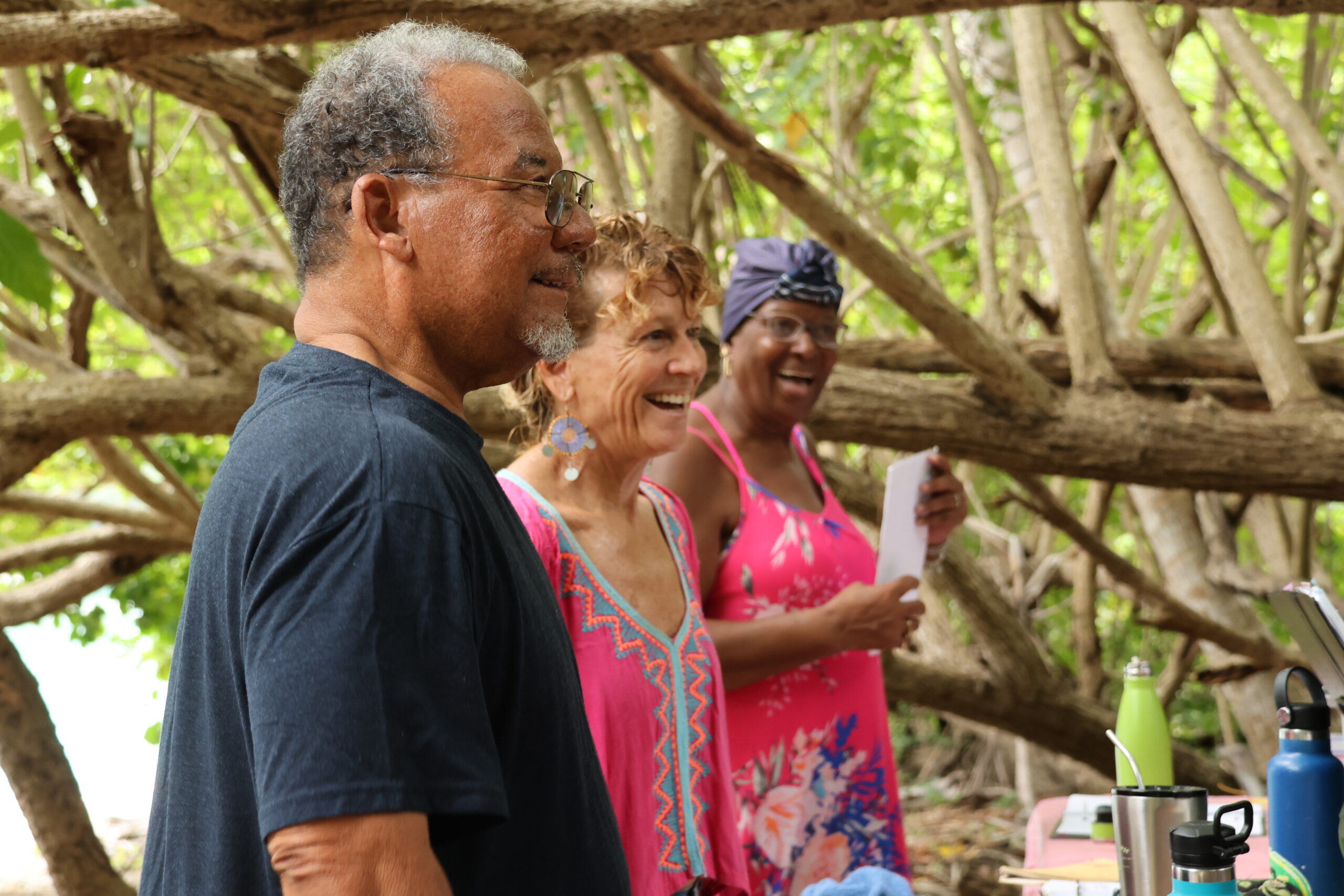
We are excited to share that after years of planning and hard work, the revitalization of Ezra Fredericks Ballpark is officially underway!
Virgin Islands Surfing Federation
Thanks to the incredible generosity of our supporters, we have successfully reached our Phase 1 fundraising goal. This achievement sets the stage for a transformation that will breathe new life into this important community space. Once Phase 1 is complete, Ezra Fredericks Ballpark will feature a Skate & Bike Park, a playground, basketball court, open field space, multiple shade structures, benches, shade trees, and much-needed infrastructure repairs.
Construction of the St. Thomas Skate & Bike Park kicked off in mid-January and is expected to conclude in May. Installation of the playground and dugout shade expansion will begin shortly with expected completion in March.
We are deeply grateful for our network of supporters—your knowledge, hard work, resources, and dedication have made this possible. As a free, public recreational space that will attract a wide range of users, we believe the revamped park will serve as a cornerstone for community-building and active, outdoor lifestyles.
Looking ahead, we’re already planning for Phase 2 and will keep you updated as it unfolds. Right now, Skate & Bike Park lighting and shade for the playground are top priorities. Stay tuned for more info on a ribbon cutting event for the shade structure’s completion co-hosted by AARP Virgin Islands, and beyond that, an all out festival for the Skate & Bike Park’s completion.
We would like to affirm our commitment to financial transparency by providing you with the attached Financial Statements. A detailed project budget is also available upon request.
Michelle Smith, a freshman at the University of Georgia, made an impressive start to her indoor track and field season at the Ted Nelson Invitational in College Station, Texas, on Jan. 25. Smith, hailing from the US Virgin Islands, showcased her exceptional talent and determination in her debut collegiate meet.
In the 400 meters, Smith won her heat with a remarkable time of 53.68 seconds. This performance not only highlighted her speed and endurance but also set the tone for what promises to be an exciting season ahead.
Smith’s contributions didn’t stop there. She ran the second leg of the 4×400 meters relay, delivering a blistering split of 52.44 seconds. Her efforts, combined with those of her teammates, led the University of Georgia to set a new meet record with a time of 3:30.39. This outstanding performance is now the third fastest in UGA history and currently stands as the leading time in the NCAA.
Smith’s achievements at the Ted Nelson Invitational underscore her potential to become a key player in collegiate track and field. Her early success is a testament to her hard work and the strong support system at the University of Georgia.
The Interscholastic Track and Field Series continues on St. Croix on Thursday, January30. Middle School and High School athletes will begin competing at 4 PM at the St. Croix Educational Track and Field Facility. The following day, Friday, Jan. 31, the Elementary School athletes will take to the track at the same time and location.
Malique Smith, a member of the Virgin Islands track and field team, delivered an outstanding performance at the 2025 RADD Sports College Invitational held on Jan. 24 in Gainesville, Florida. Competing in the 600 meters event, Smith secured first place with an impressive time of 1:19.40.
Smith’s remarkable run was just 0.7 seconds shy of the Virgin Islands record of 1:18.73, held by the renowned Tabarie Henry. This near-record-breaking performance highlights Smith’s exceptional talent and determination, setting a high bar for his future competitions.
The Interscholastic Track and Field Series will continue on St. Croix on Thursday, January 30. Middle school and high school athletes will kick off the competition at 4 p.m. at the St. Croix Educational Track and Field Facility. The excitement continues the next day, Friday, Jan. 31 when elementary school athletes take to the track at the same time and location.
Looking to secure a loan to help grow your business? Attend this webinar to learn more about the SBA Guarantee Program and how lenders use it to make loans. Become familiar with the 5 C’s of lending and get acquainted with resources to help you find lenders and put together an effective application.
Join SBA PR/USVI District Office, Senior Area Manager Wayne Huddleston, as he shares this information. There will be a question and answer segment.
Sign up at WWW.VISBDC.ORG
Federal agents conducted identification checks at some V.I. ports Sunday, sparking widespread concern and unconfirmed reports of raids at local resorts. While Gov. Albert Bryan Jr. acknowledged an increased federal presence and monitoring at the Red Hook Ferry Terminal on St. Thomas and the dock on St. John, he stated that federal agencies are not required to notify territorial authorities of such initiatives in advance.
Social media activity began early Sunday afternoon, with multiple posts warning of Immigration and Customs Enforcement (ICE) agents checking identification and detaining individuals aboard the St. Thomas-St. John ferries or at the docks. Some posts alleged ICE operations targeting resorts, but those claims remain unsubstantiated. Tourism Commissioner Joseph Boschulte and Lisa Hamilton, president of the U.S. Virgin Islands Hotel and Tourism Association, reported no knowledge of such actions.
Representatives from major resorts, including Bolongo Bay, The Westin, Emerald Beach, Margaritaville, and The Ritz-Carlton, confirmed that no federal agents had visited their properties Sunday. Hamilton emphasized the need to verify information before sharing it online, citing potential harm to the territory’s tourism sector from unsubstantiated claims.
Calls to the Virgin Islands Justice Department and the Virgin Islands Police Department also revealed that neither agency was informed of any federal operations. VIPD further confirmed that it had no involvement in the activities reported at the ports.
Details regarding the individuals reportedly detained remain unclear, and federal agencies have not released statements clarifying the scope or purpose of their actions, though several videos have been circulated by community members of agents at the docks and St. Thomas-St. John car barge.
The increased federal activity follows a recent executive order signed by President Donald Trump, titled “Protecting the American People Against Invasion.” The order, which expands federal authority for immigration enforcement, is primarily focused on border regions but applies to all U.S. territories, including the Virgin Islands.
This is a developing story. The Source will provide more details as they become available.
Acting Inspector General of the Social Security Administration Hannibal Ware. (Photo courtesy Hannibal Ware)
The Trump administration has dismissed several federal inspectors general in recent days, including Hannibal “Mike” Ware, the inspector general of the Small Business Administration (SBA). Ware, a Virgin Islander known for his high-profile investigations into fraud tied to federal COVID-19 relief programs, is pushing back against the decision, raising questions about its legality and implications for oversight.
The terminations, reportedly carried out via email from the White House Presidential Personnel Office, cited “changing priorities” but provided no further explanation. Critics argue the removals appear to violate the Inspector General Reform Act of 2008, which mandates a 30-day advance notification to Congress to safeguard the independence of these critical oversights.
Ware, who also serves as the chairperson of the Council of the Inspectors General on Integrity and Efficiency (CIGIE), responded promptly to his dismissal. In a letter to Sergio Gor, Director of the White House Office of Presidential Personnel, Ware challenged the legality of the action, stating, “At this point, we do not believe the actions taken are legally sufficient to dismiss Presidentially Appointed, Senate Confirmed Inspectors General.”
Ware’s tenure as SBA Inspector General was marked by ongoing oversight activities, including investigations into fraudulent activities related to the Paycheck Protection Program (PPP). Notably, his office was among those who led the investigation into David Whitaker, founder of Mon Ethos Pro Support, who pleaded guilty to wire fraud and bribery charges. Whitaker admitted to planting surveillance devices in Virgin Islands government offices and submitting fraudulent PPP loan applications, resulting in substantial financial losses.
In an interview with the Source last November, Ware said as the inspector general of the Small Business Administration (SBA) and acting inspector general for the Social Security Administration (SSA), he oversees billions in federal funds, ensuring these resources reach those for whom they’re intended. “My role is not about punishing my community — it’s about protecting it,” he emphasized.
His work at the SBA led to 1,536 indictments, 1,164 arrests, and 925 convictions related to SBA programs. The COVID-19 pandemic brought new challenges, with an estimated $200 billion, or 17 percent of SBA pandemic relief funds, potentially lost to fraud. “When people are stealing, they’re stealing from the people in our territory who need those funds,” Ware said last November.
The abrupt dismissal of Ware and other inspectors general has prompted national concern about the erosion of governmental checks and balances. Diana Shaw, former acting inspector general at the State Department, described the move as “the travesty we feared may be coming,” emphasizing the potential threat to the independence and objectivity of inspectors general, according to Politico.
The Inspector General Act of 1978, as amended by the Inspector General Reform Act of 2008, stipulates that the president must communicate the reasons for an inspector general’s removal to both houses of Congress 30 days prior to the action. This provision is designed to prevent undue political interference and maintain the independence of these oversight officials.
In her biweekly column, “State of the Territory,” former Sen. Janelle K. Sarauw delves deeper into issues of concern for V.I. residents.
For decades, Virgin Islanders have been wrestling with a profound question: How do we achieve true self-determination within the constraints of U.S. territorial governance? This question cuts to the core of our identity, our future, and our aspirations as a people. The struggle to draft a constitution — a document that reflects our cultural heritage, preserves ancestral land rights and adheres to U.S. constitutional principles—remains a challenge. At the heart of this dilemma lies a tension between our unique identity as Virgin Islanders and the federal oversight that limits our autonomy.
The Revised Organic Act: A Double-Edged Sword
The governance of the Virgin Islands is shaped by the Revised Organic Act of 1954, a federal law that serves as our de facto constitution. While the act granted us partial self-governance, it also cemented federal authority over critical aspects of our lives, from defense to foreign relations. We can elect our local leaders, but our laws remain subject to federal review and nullification. And, despite being U.S. citizens, we are excluded from voting representation in Congress and federal elections — a glaring inequity in a nation that prides itself on democracy.
The Revised Organic Act represents both progress and limitation. It was a step forward from colonial rule under Denmark, but it stopped short of full self-determination. It gave us a political identity within the U.S. system but left us politically disenfranchised. This duality defines our struggle: we are simultaneously autonomous and subordinate, empowered yet constrained.
Economic Dependencies and Sovereignty
One of the greatest obstacles to self-determination is our economic dependency. The Virgin Islands rely heavily on tourism and federal aid, tying our economic survival to external forces. This dependency limits our ability to craft policies that prioritize local needs over federal interests. It also perpetuates a cycle of reliance that undermines our quest for sovereignty. As scholars have noted, true self-governance requires not just political autonomy but economic independence — something we have yet to achieve.
The Elusive Constitution
Efforts to draft a constitution that balances local aspirations with federal requirements have repeatedly failed. The 5th Constitutional Convention in 2010 was a stark example. Its draft document sought to preserve ancestral land rights and cultural identity but faced federal objections over provisions deemed discriminatory or unconstitutional. The U.S. Department of Justice flagged issues with residency requirements and the management of territorial waters, highlighting the delicate line we must walk between preserving our heritage and complying with federal law.
At the heart of these debates is the question of identity. How do we protect the rights of ancestral Virgin Islanders without violating constitutional principles of equal protection? This tension has stalled progress, leaving us in a state of political limbo. Without an accepted constitution, we continue to operate under the Revised Organic Act — a framework that falls short of reflecting our unique cultural and historical context.
Lessons from the Caribbean
Our struggle for self-determination is not unique. Across the Caribbean, former colonies have grappled with similar challenges. The wave of decolonization in the mid-20th century saw nations like Jamaica and Trinidad and Tobago gain independence in 1962, followed by Barbados in 1966 and Guyana later that same year. The Bahamas joined the ranks of sovereign nations in 1973. Grenada declared independence in 1974, with Dominica achieving sovereignty in 1978 and Saint Lucia in 1979. That same year, Saint Vincent and the Grenadines also gained independence. The momentum continued into the 1980s, with Antigua and Barbuda becoming independent in 1981 and Saint Kitts and Nevis following in 1983.
These milestones underscored the potential for small island nations to assert their sovereignty and thrive on the global stage. For Virgin Islanders, these examples serve as a source of inspiration and a reminder of what is possible when a people come together with a shared vision for autonomy.
The Role of the United Nations
The United Nations has long recognized the Virgin Islands as a non-self-governing territory, advocating for our right to self-determination. In 1977, a U.N. mission confirmed that we remained under colonial rule despite partial self-governance. The U.N. has urged the U.S. to engage in open discussions about our political status, including options for independence, integration, or enhanced autonomy. Yet, these recommendations have largely gone unheeded, leaving our future in the hands of a federal government that prioritizes strategic interests over our democratic rights.
The Human Cost of Disenfranchisement
Beyond the legal and political complexities, disenfranchisement has a profound impact on our identity and culture. As Virgin Islanders, we navigate a hybridized cultural space shaped by the legacies of Danish and American rule. This dual identity can be both enriching and disorienting as we strive to preserve our unique heritage while integrating into the American political system.
The reflections of J. Antonio Jarvis, a prominent Virgin Islander historian, capture this tension. He warned of the risks of losing our cultural uniqueness in the pursuit of Americanization, cautioning against the imposition of external values that could erode our identity. His words remain a poignant reminder of the need to balance progress with preservation, modernity with tradition.
The Path Forward
The constitutional dilemma of the Virgin Islands is more than a legal issue — it is a reflection of who we are and who we aspire to be. Achieving self-determination will require bold leadership, collaborative effort, and a commitment to addressing the root causes of our disenfranchisement. It will require us to confront the challenges of economic dependency, federal oversight, and cultural preservation with courage and resolve.
As we navigate this journey, we must remember that our struggle is part of a broader global narrative. Around the world, former colonies have charted paths to sovereignty, overcoming immense challenges to assert their place in the global community. We can draw inspiration from their successes while crafting a path that reflects our unique history and aspirations.
The road ahead will not be easy, but it is a journey worth undertaking. For the Virgin Islands, self-determination is not just a goal — it is a necessity. It is the foundation upon which we can build a future that honors our past, empowers our present, and secures our place in the world.
Editor’s Note: Opinion articles do not represent the views of the Virgin Islands Source newsroom and are the sole expressed opinion of the writer. Submissions can be made to visource@gmail.com.
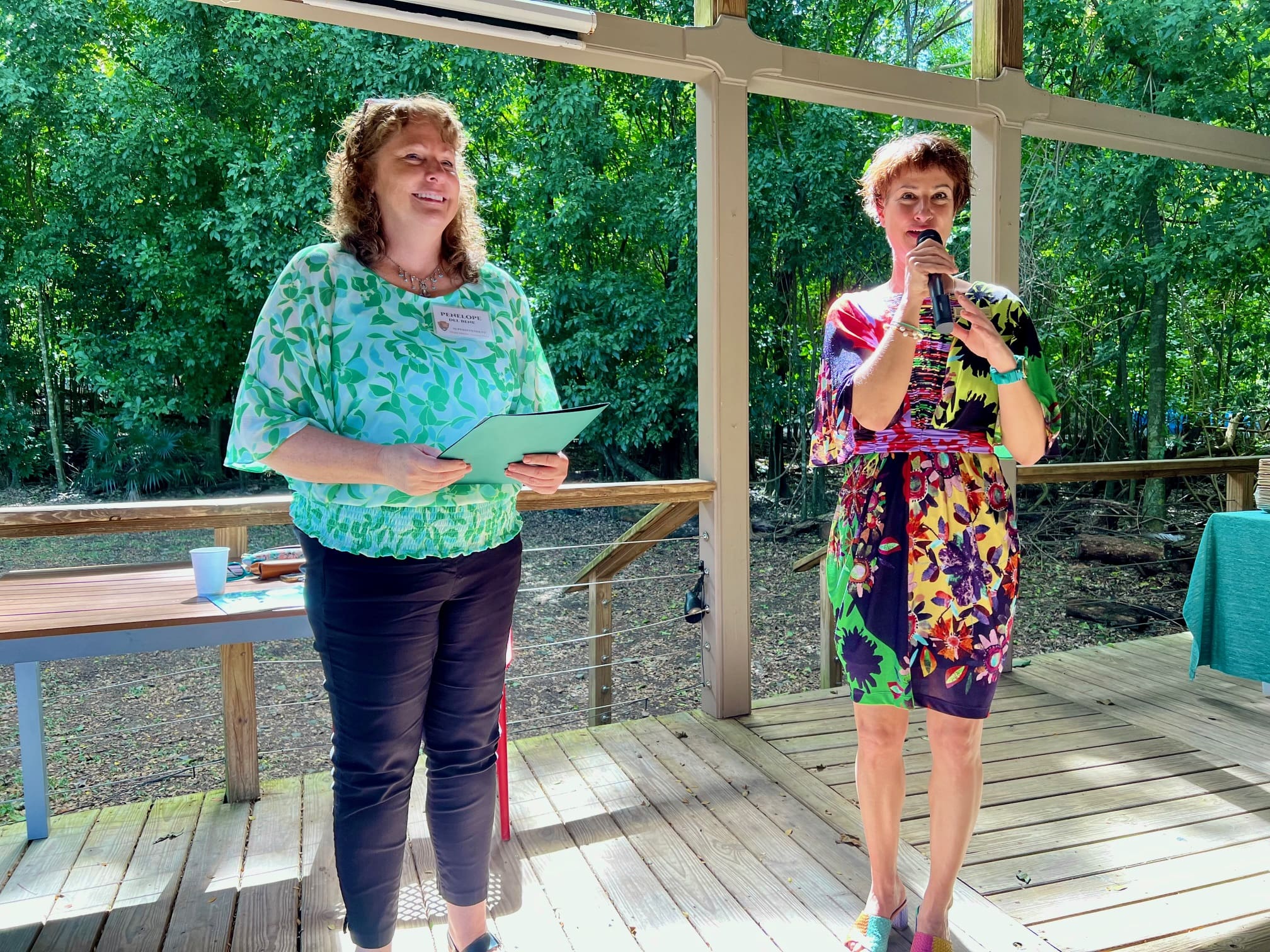
Tonia Lovejoy (right,) executive director of the Friends VINP, introduces Penny Del Bene, superintendent of the Virgin Islands National Park. (Source photo by Amy H. Roberts)
Thanks to funding from the Friends of the Virgin Islands National Park in 2024, 2,491 turtle hatchings on St. John made it to the sea safely.
Nearly a thousand students from 10 schools spent time in the park learning about history, culture and nature. Three hundred campers from seven camps attended swim lessons and educational sessions, and seven college students were given financial assistance.
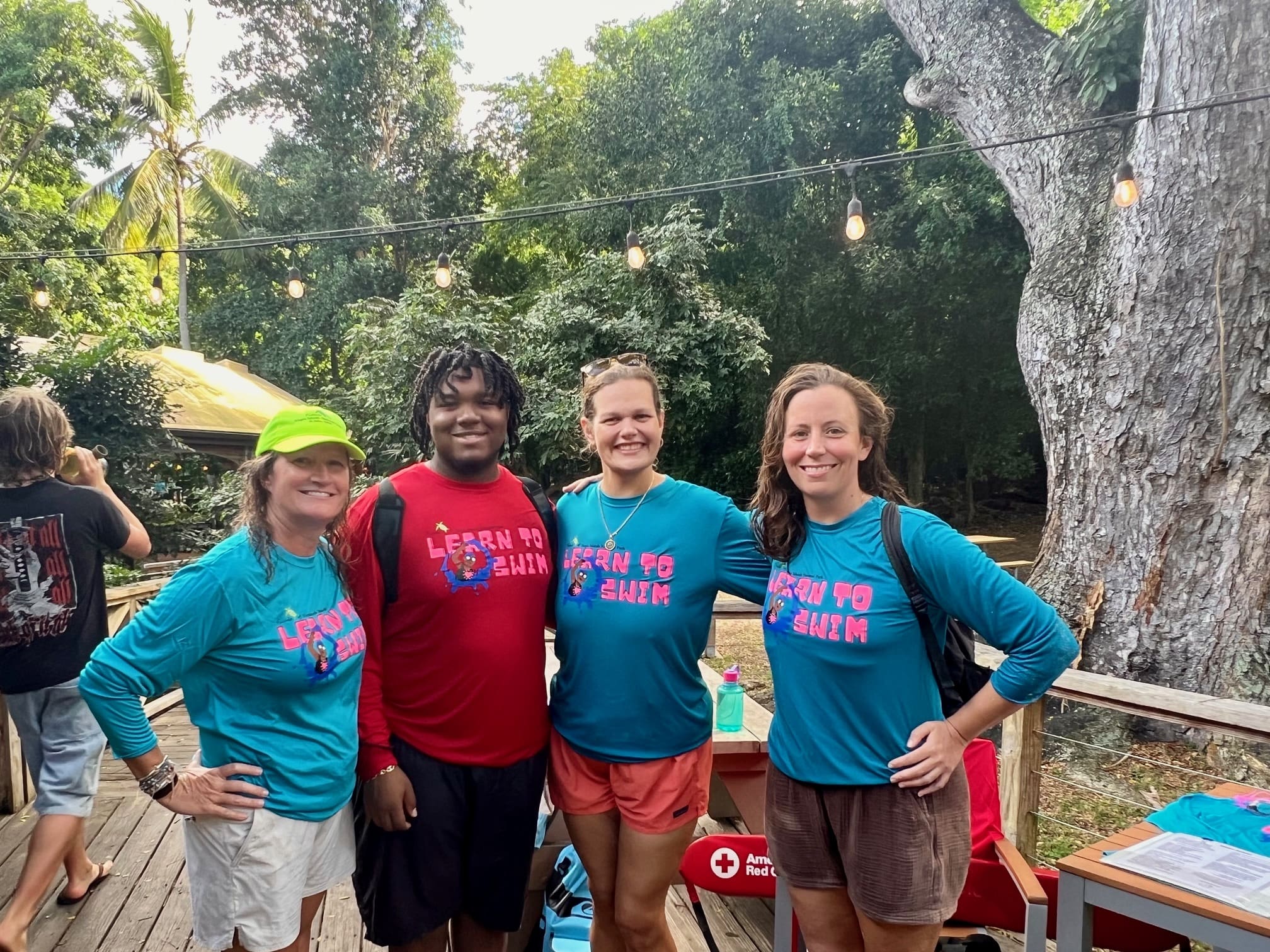
Fresh out of the water from Saturday swim classes, Noel Wrights, Maxim McMahon, Tara Murza and Diane Bower pose for a photo. The free Learn to Swim Program is held every Saturday at Cinnamon Bay from 9:30 to 11:30 a.m. and is open to children and adults. New learners are welcome to show up any Saturday. (Source photo by Amy H. Roberts)
These are some of the accomplishments outlined in the Friends VINP annual impact report for 2024, which was distributed at their annual meeting held at the Raintree Restaurant at Cinnamon Bay Saturday.
In all, the Friends VINP is managing 36 programs with a combined budget of more than a million dollars, according to Executive Director Tonia Lovejoy.
“We’re all here because every one of us has a special place in our hearts for this place,” Lovejoy said. She, as well as other speakers, avoided directly addressing the mounting environmental and political challenges to the Virgin Islands National Park and to the other 438 sites within the National Park Service system.
Instead, Lovejoy said she looks up to her role models, to the children in the community, and to her higher power to find hope.
“I look to hope,” she said. “Hope is not passive. It is active. It’s intentionally showing up to protect and preserve the things we love.”
Now in its 38th year, the Friends VINP has made a special effort to engage youth in supporting its mission. This past year it has established a Young Professional Board, and the keynote speaker at the meeting, Ki’Janne´ Alfred, is a member of that board.
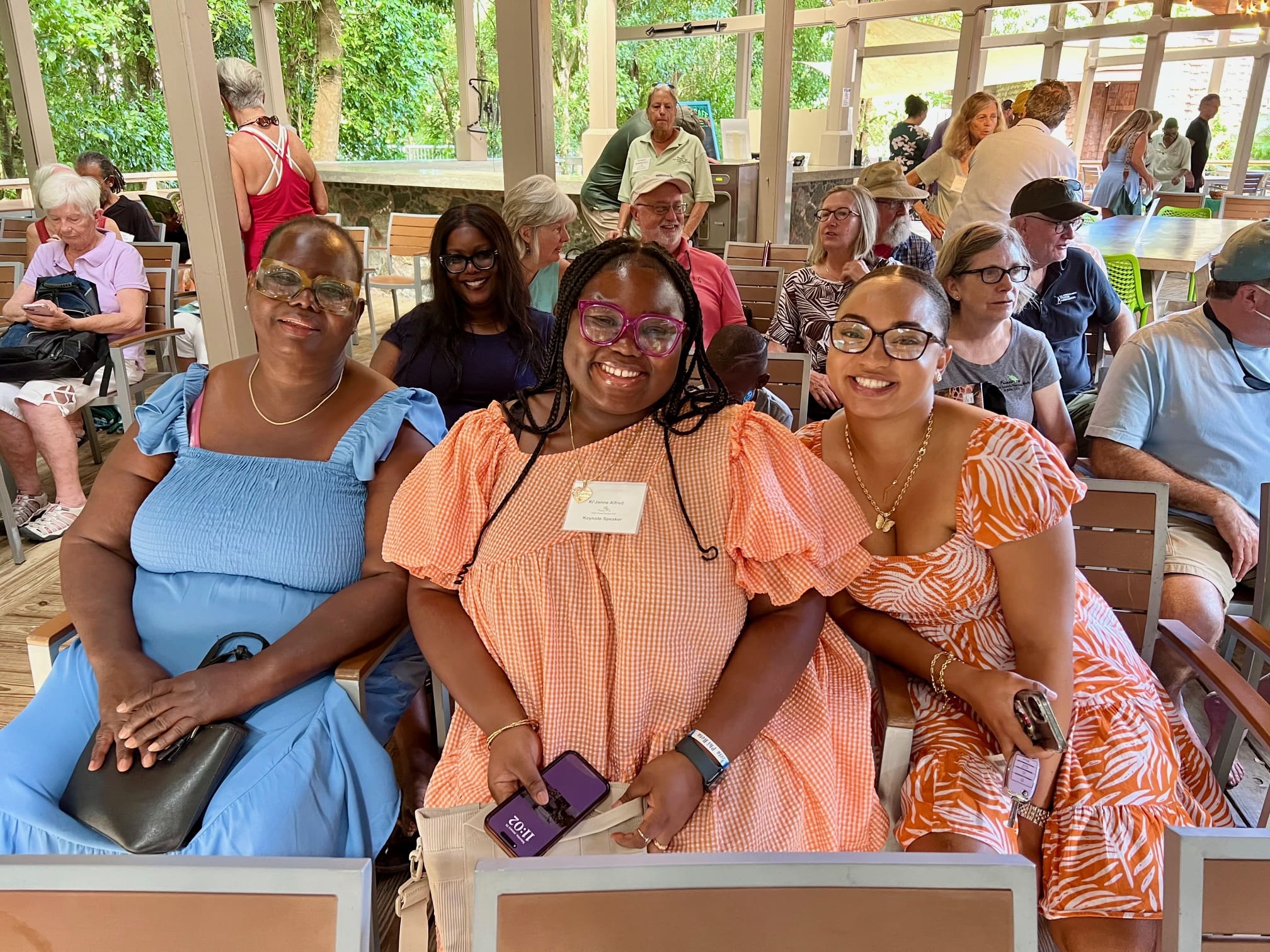
Keynote speaker Ki’Janne´ Alfred, center, is flanked by her mother Deverell Alfred (left) and friend Ajahni Jeffers, prior to the start of the annual Friends of the Virgin Islands National Park meeting. (Source photo by Amy H. Roberts)
Alfred was also the recipient last year of the Friends VINP Noble Samuel Scholarship and is the great-granddaughter of Julius E. Sprauve, who donated land to create the national park on St. John in 1956.
Alfred grew up participating in programs sponsored by the Friends, including working one summer on a trail crew. She said she looks forward to creating opportunities for school children to think of the park not only as a home and a place to cherish but as a place to develop “skills to connect to our land and heritage.” She received a standing ovation.
Friends VINP Board President Audrey Penn expressed her gratitude toward Adrian Davis and Andy Rutnik, two longtime board members who retired at the end of 2024.
Andy Rutnik and Adrian Davis are given flowers as a thank you upon their retirement from the board. (Source photo by Amy H. Roberts)
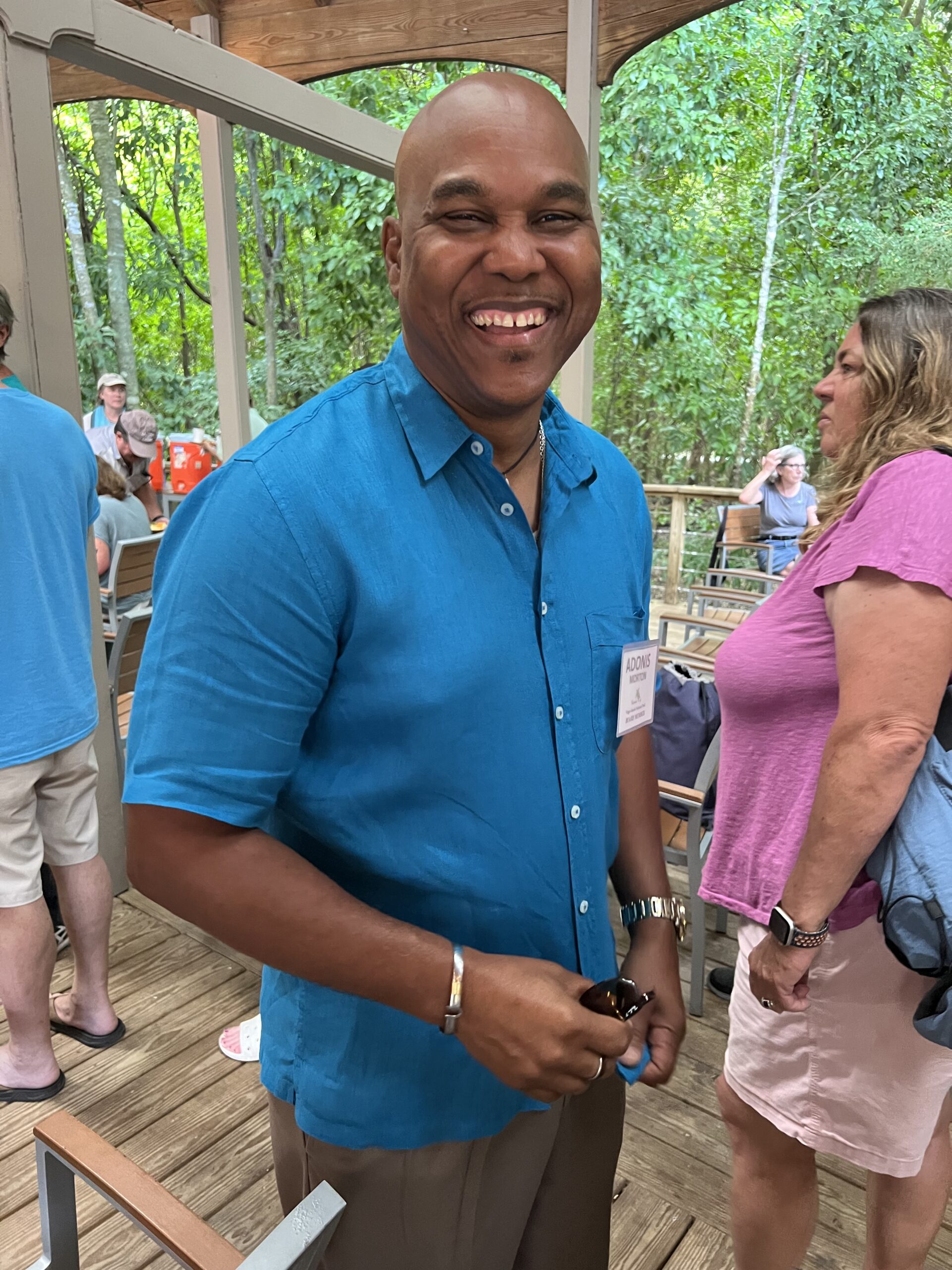
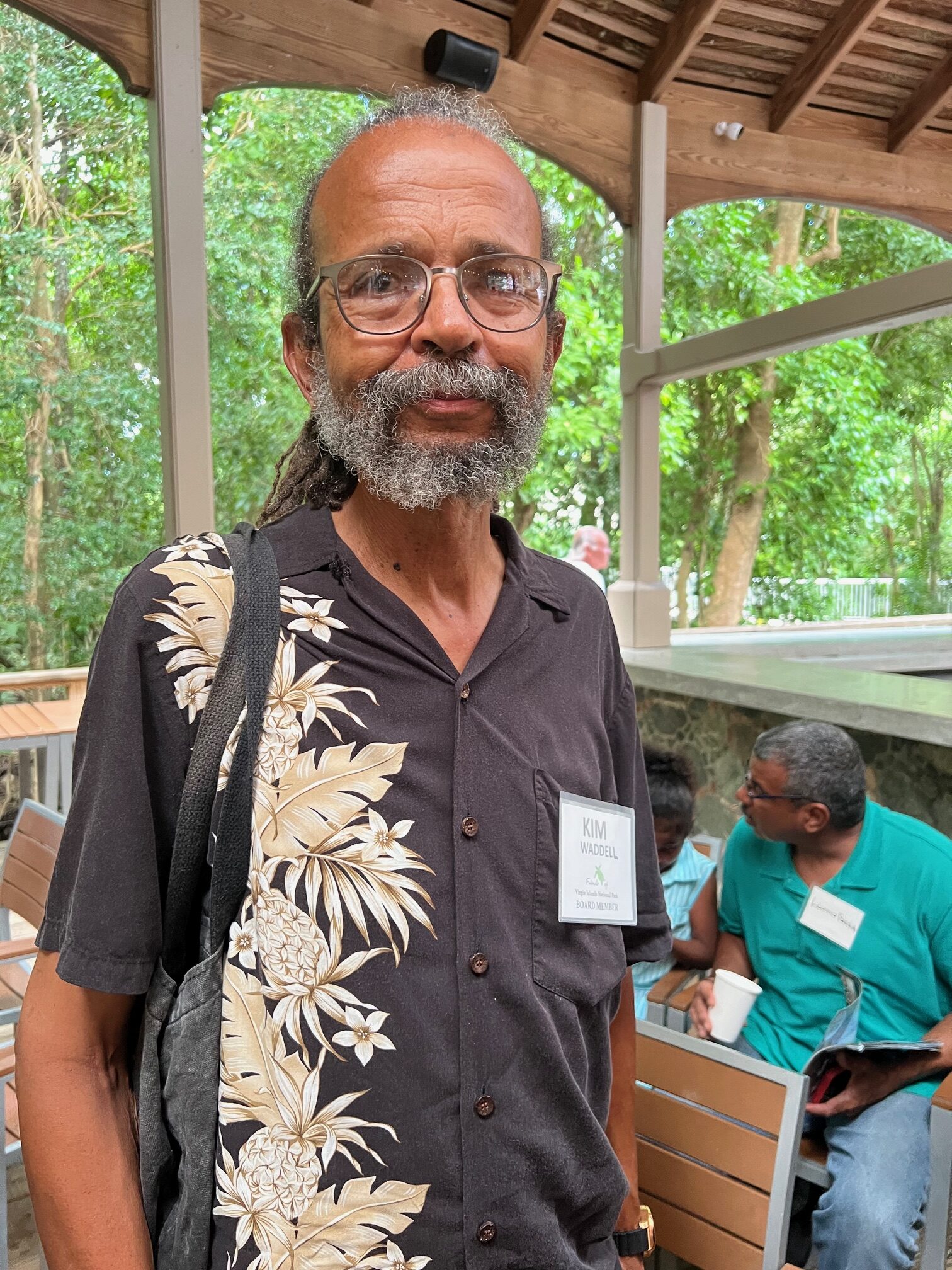
Penn also welcomed three new board members: Julice (Harley) Holder, chief of staff at the Virgin Islands Port Authority; Adonis Morton, a retired bank executive who now serves as general manager of Cinnamon Bay campground; and Kim Waddell, Ph.D., director of VI EPSCoR at the University of the Virgin Islands.
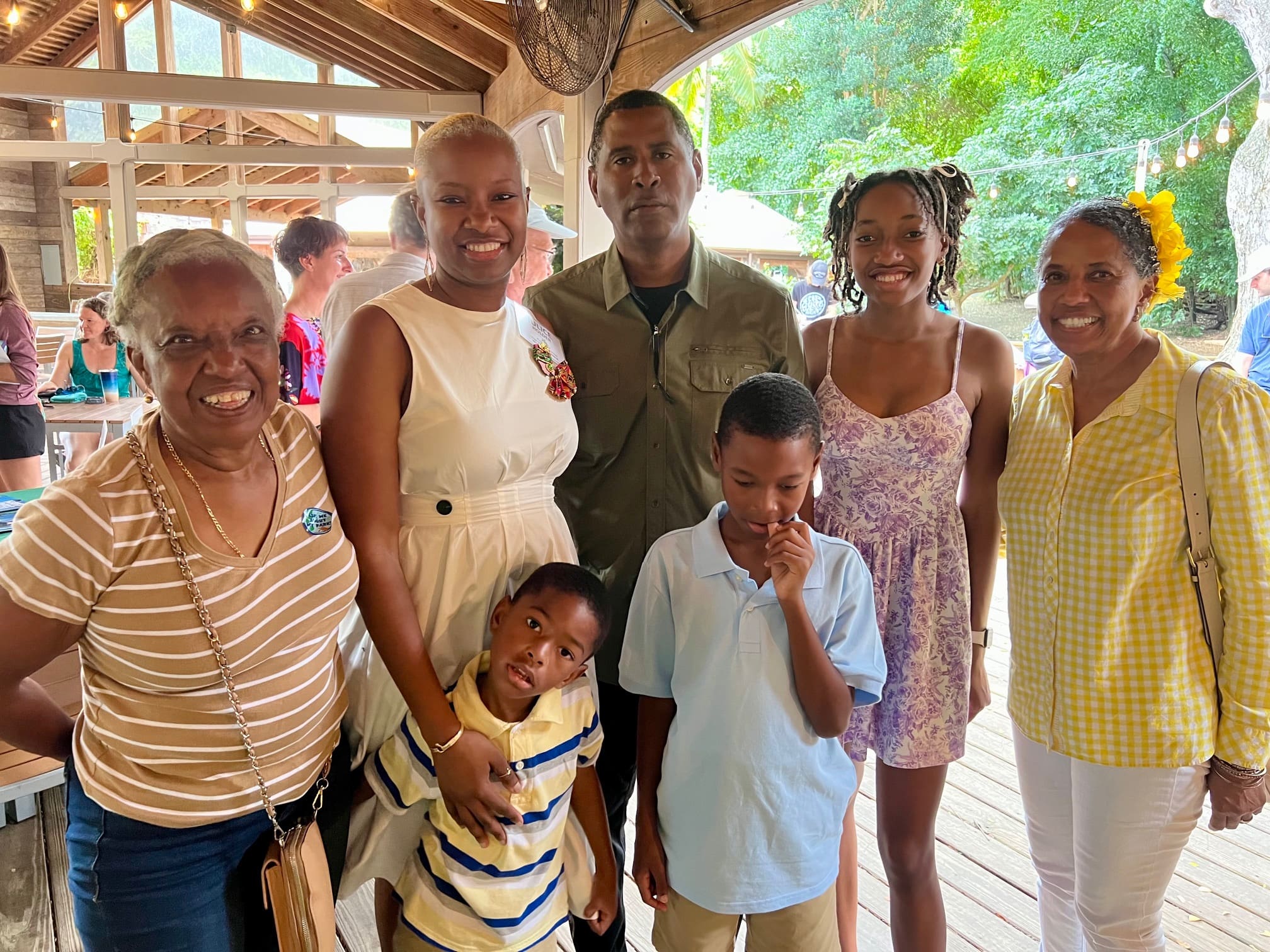
The family of Julice Holder showed up to celebrate her appointment to the board of the Friends VINP. Top row from left: Patrice Harley, Julice Holder, Melville Holder, Jordyn Holder, Jeannette Johnson. Bottom row: Jace Holder and Jackson Holder. (Source photo by Amy H. Roberts)New Friends VINP Board Member Adonis Morton serves as general manager of Cinnamon Bay Beach and Campground. (Source photo by Amy H. Roberts)Kim Waddell of UVI is one of the newly named board members of the Friends VINP. UVI partners with both the Friends and the VINP to conduct scientific research. (Source photo by Amy H. Roberts)
After making brief remarks about the park’s efforts to clean up contaminated sites at Caneel Bay and clear trails at Hassel Island on St. Thomas, VINP Superintendent Penny Del Bene opened the floor to questions.
One of the first questions from the audience concerned why the previous owner of the lease for the resort at Caneel Bay, CBI Acquisitions, has so far not been forced to pay for the cleanup at Caneel.
Del Bene declined to say more than, “It’s a very complicated question which our solicitors are working on.” Upon further questioning, she said that the selection of a new developer of the Caneel Bay property was in the Request for Qualifications stage.
Del Bene was also asked about efforts to recruit locals to fill positions within the park. She responded that the VINP does have authority to hire locally for positions up to GS-7 level. She spoke in favor of the Friends VINP’s efforts to establish a Junior Ranger Program, which will serve as a training ground and pipeline for local hiring. She noted that a recent executive order puts a 90-day hold on any federal hiring.
Asked about how other new executive orders might affect the Virgin Islands National Park, Del Bene responded, “It would be inappropriate for me to answer that.”
Del Bene did say that the park faces many challenges and issues, “and we are doing our best to be available to the public.” Although the monthly Wednesday evening public meetings are on hold until May, Del Bene said she has an open-door policy and invited anyone with a concern to set up an appointment with her by calling 340-776-6201.
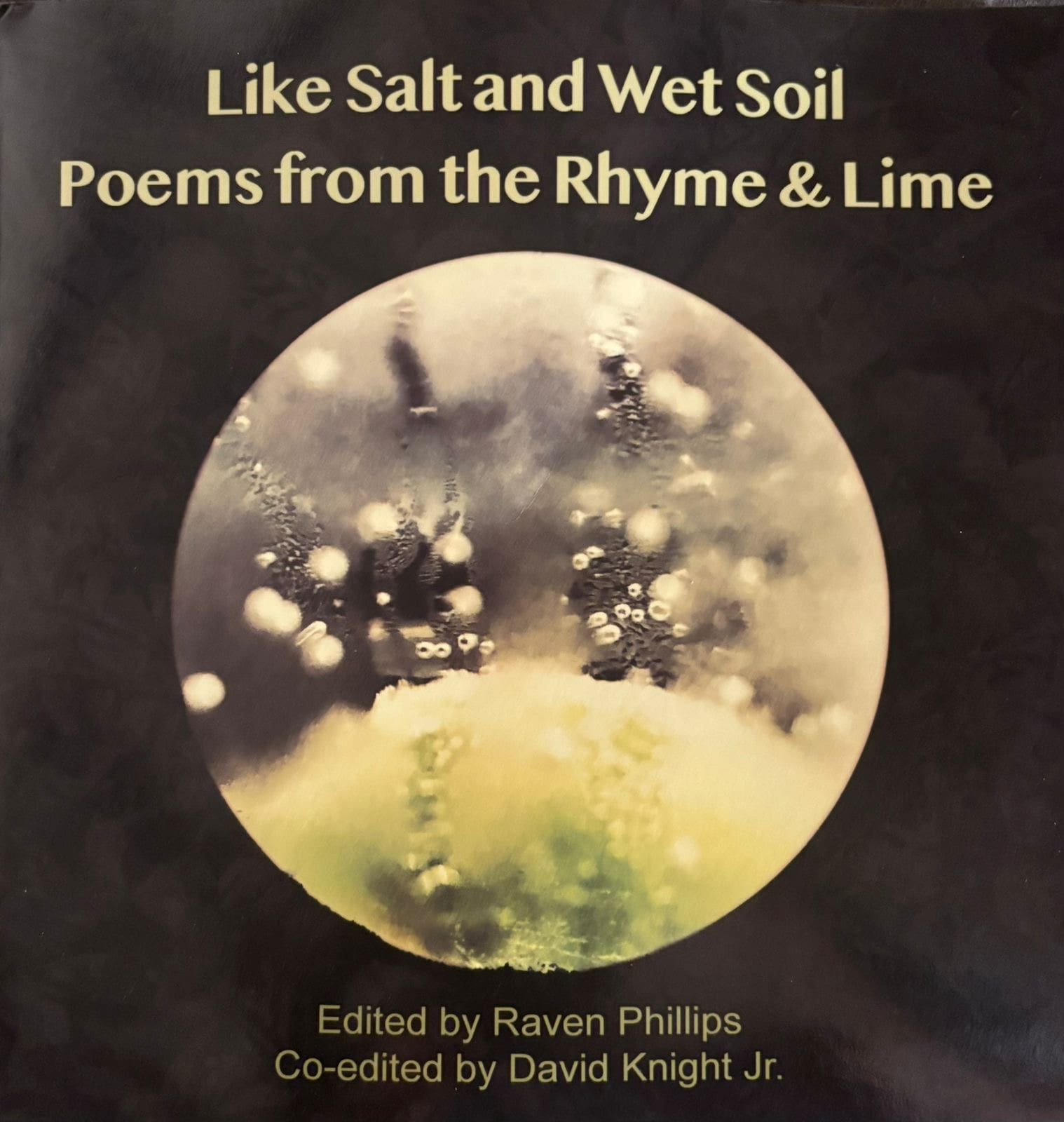
The Gri Gri Project and Bajo el Sol Gallery released their first-ever poetry anthology, “Like Salt and Wet Soil,” Saturday.
“Like Salt and Wet Soil,” poetry anthology features a variety of poetry written by Virgin Islanders and guests of the Virgin Islands. (Photo courtesy Raven Phillips)
This publication features an aggregate of original poems that have been featured at their monthly poetry readings coined with the name Rhyme and Lime hosted at Bajo el Sol Art Gallery in Cruz Bay, St. John.
The book was made in celebration of the fifth year of the event’s existence and features original poetry from poets who performed at the event between 2019 and 2023. Rhyme and Lime is a poetry event formed in 2019 by Virgin Islands’ poet Jamaica Hamilton alongside David Knight Jr. and Priscilla Hintz Rivera Knight.
Production of “Like Salt and Wet Soil” began in 2023. Editors Raven Phillips and David Knight Jr. worked together to curate a poetry anthology that would celebrate numerous Virgin Islands poets and guests of the Virgin Islands who had shared original work throughout the years. William “Bill” Stelzer was integral in designing the book for publication.
Phillips, the current host and organizer of Rhyme and Lime, began stewarding the event in 2021 when Hamilton relocated to the States. She noted that Thomas Lynch of the Lynch and Sons Fund for the Arts financially supported the anthology’s production.
“This process was beautiful in offering an invitation to connect with the poets who have participated in Rhyme and Lime over the years. It’s really the poets who have made this organization what it is. I offer a little scaffolding but the artists are the ones who have the courage to share their work in the space with their community. It is an act of community and communal love,” Phillips said.
Rhyme and Lime invites the public to attend their monthly gatherings, which typically takes place on the last Saturday of every month at 7 p.m. at the Bajo el Sol Art Gallery on St. John, where the poetry anthology can also be purchased. This event offers an opportunity for poets to share their work and poetry lovers to listen to various presentations, including spoken word and musical performances.
“Poetry and the humanities in general are so important, especially now during a time where these studies have been de-emphasized. The humanities make us well rounded people and opens the door to expression and art. This creative avenue is equally invaluable on an individual level and a collective level. Sharing stories, thoughts, and emotions with other people offers human to human connection across all lines,” Phillips said.
Some Recovery Choir members gather for rehearsal at Hawksnest Beach. (Photo by William Stelzer)
“What the World Needs Now Is Love, Sweet Love.”
That’s just one of the songs that will be featured in the St. John Recovery Choir’s spring concerts featuring Quelbe Resurrection, and anyone who wants to join is welcome.
Recovery Choir Director Kristen Carmichael-Bowers is sending out an invitation to community members to attend weekly rehearsals for the “One Love” concerts scheduled for April in Coral Bay and Cruz Bay. “It’s all about unity,” she said.
Rehearsals are held twice a week starting Feb. 4. Members can attend Tuesday evenings from 5:30 to 7 p.m. at the Gifft Hill School Upper Campus balcony, or they can come Saturday mornings from 9 to 10:30 a.m. to the picnic tables (to the far right) at Hawksnest Beach. Sectional rehearsals led by Christie on Zoom will be held on Thursdays.
“Sing St. John’s unity-themed ‘One Love’ event planned for Saturday, April 19 in Franklin Powell Park will be a celebration of our community’s cultural roots,” said Carmichael-Bowers. The program will be eclectic, and alongside other popular genres, “Quelbe, Reggae, Calypso, Negro Spiritual and Bamboula traditions will be highlighted in particular.”
Some of the performers expected to attend are the Senior Singalong Singers, Ocama Youth Choir, the Echo People, the Coziah Dancers and Voices of Love from St. Thomas. Quelbe Resurrection, one of St. John’s favorite bands, will top off the evening with music to dance to in the park.
“Singing together helps us to transcend our differences and experience the humanity that is within us all. It’s also a way for those of us who were not born here to learn about and honor Virgin Islands’ culture and its origins from ancestral Virgin Islanders,” said Carmichael-Bowers.
The Recovery Choir, Ocama Youth Choir and Quelbe Resurrection will also be performing in Coral Bay April 11 at Our Place.
This project is made possible in part through the Mid Atlantic Folk and Traditional Arts – Community Programs of Mid Atlantic Arts with support from the National Endowment for the Arts.
Sing St. John is jointly supported by a grant from VI Council on the Arts and the National Endowment for the Arts in Washington, DC, a federal agency.
Registration for the choir takes less than a minute. Go to Sing St. John’s website and be sure to click “submit” after completing the form. Members are kindly asked to pay a $50 fee, but that fee can be waived without question by selecting the waive-fee option.
For further information, please text, call, or WhatsApp Carmichael-Bowers at 802-380 0761.







 In her biweekly column, “State of the Territory,” former Sen. Janelle K. Sarauw delves deeper into issues of concern for V.I. residents.