Emilie Almestica of Wilkes, Antigua transitioned into eternal life on Jan. 16. She was 76 years old.
Emilie Almestica
She was preceded in death by her grandmother Millicent Mason; mother Sybil Daniels; father Johnny (John) Kirby; and brother Patrick Daniels.
She is survived by her husband Ramon Almestica Sr, sisters Daisylyn Hodge, Lynette (Florie) Otto; daughters Ginna Randolph, Tashira (Rashad) Almestica-Dostalie; sons Gary (Corona) Randolph, Teddy (Rolanda) Randolph, Keith (Chandra) Randolph, Treavor Randolph, Ramon Almestica Jr, Sergio Almestica. Grandchildren Termich (Travis) Cherry, Isaiah Randolph, Richard Bochamp, Teddy Ravae (Deanna) Randolph, Cherish Randolph, Azarah Almestica, Gabriel Dostalie, Jahsai Dostalie, Serenity Dostalie, Hezekiah Randolph, Jeka’meam Randolph, Allora Almestica, Isabella Almestica; great grandchildren Savior Randolph,Truth Harrison, Royalty Randolph, Logan Cherry, Levi Cherry, Isaiah Randolph Jr
Malachi Randolph, Kairo Randolph, Rhyan Randolph, Nico Randolph; god children Xiaxiang Washington, Sevon Washington, Kelia Bradshaw, Xiamara Gomez, and Ebbie Gomez.
Close family and friends, the Kirby family, the Almestica family, the Daniels family, Nicole Thomas Peters, Carmen Brown and family, Angela Burt-McIntosh and family, Diana Washington and family, Deborah Bailey, Hyacinth Bailey, Eunice Bailey, Denfield (Bampo) Jones, Dahila Green, Valarie Ponce, Natanya Ponce, Shamarra Ponce, Gerard and Nadine Glasgow, Gail (Gigi) Glasgow, Janet Jonas, Denise Jackson, Elba Proctor, Augusta Stevens, Esther Urgent, the Ricardo Richards school family, Alexander Henderson School family, Rueben Gomez and family, Vashti Harris, Yvonne Isles, Yvonne Auguste and family. As well as a host of other relatives and friends.
Friends and family viewing will be held on Thursday, Feb. 6 at Divine Funeral Services, 129 Peter’s Rest Christiansted between4 p.m. and 6 p.m.
Funeral Services will be held on Friday, Feb. 7 at St Joseph’s Catholic Church, 1 Mount Pleasant, Frederiksted, viewing at 10 a.m., service at 11 a.m.
Interment following service at the Kingshill Cemetery.
The family request that those in attendance wear shades of red.
The University of the Virgin Islands is proud to announce that the Honorable Ketanji Brown Jackson, associate justice of the U.S. Supreme Court, will be the featured speaker at a Student Convocation at 3 p.m. on Feb. 7, in the Elridge W. Blake Sports and Fitness Center on its Orville E. Kean Campus on St. Thomas and streamed live in a closed link to members of the UVI Community.
“We are honored to host the Honorable Justice Ketanji Brown Jackson at the University of the Virgin Islands in a historic event that is sure to inspire us all,” said UVI President Dr. Safiya George. “I am excited that our students will be able to hear first-hand from Justice Jackson, who has had an inspirational career, with many achievements, as she makes monumental legal decisions serving on the highest court in the land.”
Justice Jackson, born in Washington, D.C., has a distinguished background in law and public service. She grew up in Miami, Florida, where her parents were public school educators. Her academic journey began at Harvard University, where she enrolled in 1988 and graduated in 1992 with a Bachelor’s Degree in Government from Harvard-Radcliffe. She continued her education at Harvard Law School, earning her Juris Doctorate (J.D.) in 1996.
Following law school, Justice Jackson’s career has been marked by a commitment to both private practice and public service. She has held three federal clerkships, with Judge Patti B. Saris of the U.S. District Court for the District of Massachusetts, Judge Bruce M. Selya of the U.S. Court of Appeals for the First Circuit and Justice Stephen G. Breyer of the U. S. Supreme Court. Her public service includes two years with the United States Sentencing Commission from 2003 to 2005 and a role as a federal public defender from 2005 to 2007. In 2010, she returned to the U.S. Sentencing Commission as a commissioner. Justice Jackson served on the U.S. District Court for the District of Columbia from 2013 to 2021. She was also appointed to the Defender Services Committee of the Judicial Conference of the United States in 2017, and the Supreme Court Fellows Commission in 2019. In 2021, President Joe Biden appointed her to the U.S. Court of Appeals for the District of Columbia Circuit. On Feb. 25, 2022, President Biden announced he was nominating Jackson to fill the Supreme Court seat left open by the retirement of Justice Stephen Breyer. The U.S. Senate voted to confirm her on April 7, 2022.
Justice Jackson has the distinction of being the first Black woman to serve on the U.S. Supreme Court, the first federal public defender to sit on the Court and the first Justice since Thurgood Marshall to represent criminal defendants. She took the oath of office on June 30, 2022.
Justice Jackson is married to Dr. Patrick Jackson, and they are the proud parents of two daughters.
During the convocation, Justice Jackson will be awarded an honorary degree from UVI, recognizing her significant contributions to the legal field and her role as a trailblazer for women and people of color in the judiciary.
“We invite the University Community to attend this special event, which offers UVI students a unique opportunity to hear directly from one of the most influential and celebrated justices serving on the U.S. Supreme Court,” said Dr. George. “This event promises to be an inspiring occasion, highlighting Justice Jackson’s remarkable journey and her commitment to justice and equality.”
“The presence of Justice Ketanji Brown Jackson at this convocation is a profound moment for UVI and the Virgin Islands,” said Dr. Una Dyer, vice president of Strategic Affairs, who has been working closely with President George on managing the event’s logistics.
“Justice Jackson’s story will resonate deeply with our students, reminding them that excellence, perseverance and dedication can lead to extraordinary accomplishments.” UVI encourages all members of the University Community to participate in this historic event. Registration will be required for UVI students and employees to attend the event.
In 2017, the University had the distinction of hosting the Honorable Supreme Court Justice Sonia Sotomayer at a student convocation.
Margaret E. Miller, of Sion Hill, transitioned into eternal life on Jan. 18. She was 69 years old.
She is preceded in death her mother Violet Ramsey and father Frederick Ramsey.
She is survived by her spouse Aaron Buntin; daughter, Chamonie Miller, Andrea Miller; son, Andreas Miller Jr.; grandchildren, Rickisha & Ricardo Richards, Abassi Boston, Najee Miller, Juicy Miller, Shaniya Miller, Letecia Miller, Janiaha Warden, Jazarah Warden, Jahmario Warden, Jahmanie Morton, Jahmarley Warden; great-grandchildren, Ty’rese Williams, Dy’aire Wrensford, Chalia Boston; sister, Pamela Noorhaseen, Hyacinth Bradshaw, Pearline Weeks; brother, Samuel Dore; nieces, Maqueda Noorhasen, Pamela Noorhasen, Octavia Ramsey, Theresa Ponce, Althea Gumbs, Olivia Bradshaw, Marion Bradshaw, Shanika Weeks, Yvonne Weeks, Sharmika Weeks, Patricia & Diane Dore; nephews, Brian Noorhasen Jr., Joseph Ramsey, Leslie Bradshaw, Howard Douglas, Valentine Dore; daughter-in-law, Charice Miller; special friends, Aaron Buntin, Claron Buntin, Barbara Williams, Jola Warden, Murray Barrie, Jose Contreras, Suretha La’Shawn; other relatives and friends too numerous to mention.
Funeral service will be held on Jan. 29 at Bethel A.M.E. Church on #12 Queen Street, Christiansted. Viewing will begin at 9am with service at 10am. Interment will follow at Kingshill Cemetery.
Professional services are entrusted to James Memorial Funeral Home, Inc.
Coral Bay Community Council is excited to announce that from now until the end of the year, CBCC will be updating the 2015 Coral Bay Drinking Water and Wastewater Plans to continue to improve drinking water and wastewater systems for the Coral Bay community and beyond. Given the plans are almost 10 years old, and the community has experienced a higher-than-normal turnover of residents leaving the island due to the 2017 hurricanes, COVID-19 pandemic, increase in cost of living, and aging populations returning stateside, now is an opportune time to update them.
We will also continue to coordinate drinking water testing, host workshops for residents and professionals, and provide one-on-one consultation. To learn more about the project, please join CBCC for a project kick-off meeting on Friday, Feb. 7 at Our Place from 5:30 p.m. to 6:30 p.m.
“We strive to support a healthy and happy community by empowering them with the knowledge and tools to properly operate their systems as well as continue to look for new options and technologies that will make life easier and systems more resilient to our daily challenges and cost,” explains CBCC Environmental Projects Manager, Rachel McKinley.
Part of accomplishing a happy and healthy community is getting input from the community itself. Watershed Coordinator and project lead, Maya Craig says, “CBCC will be involving the Coral Bay community and folks across the USVI in this process. Throughout the year, there will be community meetings, workshops, surveys, and public commentary. Keep an eye out for CBCC outreach on our Facebook, Instagram, newsletters, and posted flyers.”
Updating the plans will include addressing findings from the past nine years of research on unsafe system practices such as discharging effluent water on top of soil, using improper amounts of bleach to purify drinking water, and limited system maintenance, while offering healthier, proven treatment alternatives. The plans and the research reports are available on our website at: https://coralbaycommunitycouncil.org/water-and-waste-water/drinking-water-wastewater-research-projects-reports-plans/
If you have any questions about your drinking water and wastewater systems, call us at 340-776-2099, email Water@CoralBayCommunityCouncil.org or stop by the CBCC office (in Coral Bay across from the fire station) for answers.
The Coral Bay Community Council is a local 501(c)(3) nonprofit organization established in 2003 by volunteer residents with the purpose of acting as a community advocate, government liaison, and trusted information and research source. As a watershed management association, CBCC works to protect the Coral Bay watershed, watersheds across the territory, and the people that live within them.
Coral Bay Community Council is an equal opportunity provider and employer.
This material is based upon work supported under a grant by the Rural Utilities Service, United States Department of Agriculture. Any opinions, findings, and conclusions or recommendations expressed in this material are solely the responsibility of the Coral Bay Community Council and do not necessarily represent the official views of the Rural Utilities Service.
The Virgin Islands Water and Power Authority is calling for community support to ensure the safety of its employees and contractors following recent threats against workers performing necessary duties.
The authority reported that Meter Reading and Meter Service employees have been targeted while on the job. In response, WAPA emphasized the essential role these workers play in delivering services and announced measures to protect their well-being. WAPA stated in a press release.
The authority is deeply concerned by the threats staff have faced. Their safety is a top priority, and WAPA asks the community to recognize their vital contributions, the release stated.
WAPA provided tips on identifying its field workers and ensuring smooth interactions.
Employees:
Operate official WAPA vehicles with marked license plates.
Wear WAPA-issued uniforms.
Announce their presence upon arrival at residences.
Display official WAPA identification.
Additionally, technicians from subcontractor Davey Resource Group (DRG), working on the Geographic Information Systems (GIS) Inventory project, may be seen using tablets, GPS devices, and other tools. DRG personnel can be identified by:
WAPA Contractor ID badges
Safety vests
A Letter of Authority available upon request.
Field activities occur seven days a week between 7 a.m. and 4 p.m. across the territory. WAPA urged the public to help create a safe environment for workers and prevent harassment.
“We ask that community members work with us to ensure that WAPA employees and contractors can complete their assigned work without fear of harassment or threats,” the release stated.
Two individuals implicated in a November 2024 shooting at Oswald Harris Court on St. Thomas are now in custody, the Virgin Islands Police Department announced.
Detectives from the Criminal Investigation Bureau arrested Azani Prentice, 18, and Tony Isaac, 19, on charges of attempted first-degree murder, first-degree assault, first-degree reckless endangerment, willful discharge of a firearm, possession of an unlicensed firearm, and conspiracy, according to the police report.
The arrests stem from a warrant issued by the Superior Court of the Virgin Islands, the police report stated.
According to police, Prentice, with Isaac’s assistance, was captured on video firing multiple shots at a male victim, who was seen fleeing the area on foot. The victim sustained several gunshot wounds during the incident, which occurred on Nov. 24, 2024. Bail for both suspects has been set at $500,000.
This case remains under active investigation. Authorities urge anyone with information about the shooting to contact the Criminal Investigation Bureau at 340-774-2211, the 911 Emergency Call Center, or submit an anonymous tip through Crime Stoppers V.I. at 1-800-222-8477. The VIPD emphasized that all tips will remain confidential.
The V.I. Water and Power Authority Governing Board convened Thursday to address water rehabilitation projects and other issues. Members of the public were able to attend via Zoom. (Screenshot from WAPA Governing Board Zoom meeting)
The V.I. Water and Power Authority Governing Board approved more changes to two water system rehabilitation projects on the west side of St. Croix during a meeting Thursday.
Board members approved a seven-month no-cost extension to the Hannah’s Rest water rehabilitation project, which began in March and was initially slated for completion by September 2024. According to a press release WAPA issued after Thursday’s meeting, the project’s delays were caused by disruptions in the global supply chain.
The board also approved a $1,617,536 expansion to the Campo Rico waterline rehabilitation project, expanding the scope of the project by extending the water distribution network and adding infrastructure like hydrants and service connections. The project’s completion date was set for February 2026.
The third item board members approved was a 10-month extension and $1,531,599 cost increase for completion of the utility’s inventory assessment.
Residents on St. Croix have long complained of discolored, foul-smelling water from the territory’s water system. Concerns about water quality and safety became more urgent in October 2023 when testing of the island’s water meters revealed staggeringly high levels of lead and copper at some locations, and Gov. Albert Bryan Jr. declared a state of emergency in response. Follow-up tests showed substantially lower levels of lead and copper, and the initial results were later attributed to faulty testing protocols.
WAPA Chief Executive Officer and Executive Director Karl Knight reiterated during a report to the board Thursday that the authority does not have a lead issue, and the utility has never used lead service lines or “anything that would contribute to an acute lead crisis, as we’ve seen in other parts of the country.”
“We do have an issue with brown water which is … caused by corrosion and ductile iron piping,” he said. “That ductile iron piping on St. Thomas, St. John and St. Croix has, in many instances, exceeded its useful life and the corrosion — when pipes get rusty, water that passes through those pipes becomes discolored.”
Those pipes are being replaced with PVC piping through the utility’s water rehabilitation projects, which Knight said should mitigate the issue.
Knight said the things that keep him up at night are “areas of potential, catastrophic failure,” including the Richmond Power Plant’s aging T3 transformer. The authority’s governing board unanimously approved a $1.52 million allotment for a new transformer during a meeting in December. Knight said Thursday that the authority is in the middle of procuring the new transformer and that, in the meantime, the utility’s new chief operating officer, Lemuel Lavinier, has a “workaround.”
WAPA officials held a ribbon-cutting ceremony last Friday to celebrate commissioning the four long-awaited — and long-delayed — Wärtsilä generators at Richmond. On Thursday, Knight said the WAPA personnel have “worked out most of the kinks, but they’re certainly already paying dividends.”
“We’re seeing the benefit financially of their performance, but also reliability-wise,” he said, noting that some people “wrinkled their brows” when he mentioned having shorter outages during last week’s ceremony. Knight said that with the new units, outages in the St. Thomas and St. John district are less frequent and, for the most part, shorter.
“And one of the reasons is because we now have standby generation. Some of our legacy units like Unit 23, Unit 27 — even, at times, Unit 15 — are actually being operated in standby mode,” he said. “Meaning, if something does go down, we are able to — as quick as we can start those engines — we’re able to pick back up those portions of the grid, which is a luxury that we haven’t really had in recent times.”
The board also discussed documentation of potential conflicts of interest among WAPA board members, executives and managers ahead of upcoming audits. Chief Financial Officer Lorraine Kelly said the process involves having each employee and board member document whether they have a conflict of interest regarding any transactions, contracts, procurements or purchase orders.
“And the intention is primarily one of antifraud, but also it’s just a good practice that we understand sometimes a spouse [or] a family member may own a business in which we have procurement efforts,” she said. “And it might just be helpful for us to know to make sure to recuse that person if there were any kind of discussions or negotiations regarding the topic.”
Corruption tends to diminish growth, waste taxpayers’ money, rob the public treasury, undermine public trust, and contribute to income inequality and poverty, when present in moderate or high levels. (Shutterstock image)
Recent revelations of public corruption in the U.S. Virgin Islands have shocked the community. Three cabinet members face charges of bribery, honest service wire fraud, contract manipulation, and money laundering — an unprecedented number for any administration. Public corruption in the V.I. has long been suspected, dating back to the 1960s, and it likely caused economic drag. Still, due to a lack of investigations, the actual economic costs have not been documented or estimated. This raises four critical questions:
What is public corruption?
When should we be concerned about it?
How did the Virgin Islands reach this state?
What actions can combat public corruption in the USVI?
Mark Wenner
Public corruption is defined as government officials using their powers illegitimately for personal gain. It can manifest as bribery, extortion, nepotism, cronyism, and embezzlement. The most prevalent form typically involves public officials accepting bribes in exchange for favorable decisions, licensing, contract awards, or hiring. More subtle forms may involve campaign contributions intended to influence the politician to implement policies favorable to the interest of donors at the expense of the common good.
Corruption impacts economic performance. It tends to diminish growth, waste taxpayers’ money, rob the public treasury, undermine public trust, and contribute to income inequality and poverty, when present in moderate or high levels. Societies plagued by high levels of corruption often experience poor economic outcomes, including lower GDP, less efficiency, and higher poverty levels while countries with low corruption levels, correlate with strong economic performance.
For example, the top five countries for human development (Iceland, Norway, Denmark, Switzerland, and Finland) also rank among the least corrupt, according to the 2022 Inequality-Adjusted Human Development Index (IHDI) and the 2022 Corruption Perceptions Index (CPI). The Virgin Islands, lacking a formal CPI score but exhibiting numerous scandals and public sector irregularities, could be approximated to fall in the range of 35-42 on this index, similar to the scores of the Dominican Republic, Trinidad and Tobago, and Guyana but far below Barbados, the highest-ranked Caribbean country with a score of 65 in 2022, a few points behind the United States.
The Virgin Islands’ tolerance for public corruption can be attributed to three main factors: political dominance by one party that has maintained a client-patronage system, a small, registered active voter base of 31,000 that seems to prioritize personal loyalty over good governance, and a judiciary that often imposes lenient sentences or dismisses corruption cases.
The political landscape has been shaped by the Democratic Party’s dominance, which has controlled the governorship for 38 of the past 63 years and consistently held a majority in the unicameral Legislature. Since the fusion of the Democratic/Unity parties and the creation of a political machine in the 1960s that dispensed government jobs, contracts, leases, and welfare benefits for votes, elected political leaders commonly use patronage and political budgeting. The government has been and continues to be the largest employer, currently accounting for 32 percent of the civilian workforce, and government spending drives the economy, accounting for 34 percent of the Gross Domestic Product in 2022. Since 2018, with massive allocations of federal assistance, the impetus to channel even more contracts to friends, inflate contracts, and spend money to curry favor with voters, especially in the run up to elections, has ramped up.
A small voter base intertwined by blood and social ties (attending the same high school, being members in the same churches and social organizations, having played team sports together as youths), complicates accountability because voters do not want to openly criticize a distant cousin, schoolmate, old teammate, godbrother, or in-law who happens to be an elected or senior government official, fostering a culture that prioritizes maintenance of reciprocal and loyal social bonds over good governance. Voters see having a friend or relative in a high government position as an asset who can grant a favor even though they may be unqualified, incompetent, or ethically challenged. Typical voters accept the patronage system and exchange their votes for the promise of maintaining their government jobs, getting a contract, or to receive handouts even though the quality of life is lowered by widespread mismanagement, waste, and corruption.
Lastly, few corruption cases have been prosecuted over the years, and the judiciary has shown a tendency to sentence those who have been tried leniently (90 days to 52 months) or dismiss cases altogether, sending a message of non-deterrence, that the probability of detection is low and punishment costs are low.
To effectively minimize and combat public corruption in the Virgin Islands, a multifaceted and coordinated approach is essential:
Make the political party system competitive. Reform the Democratic Party, revitalize other political parties, and attract candidates with integrity.
Create a professional civil service to ensure that appointments are merit-based, salaries are competitive, reduce patronage, and reduce the number of unclassified positions that serve at the governor’s pleasure.
Mandate yearly financial disclosures for elected officials to identify disproportionate wealth accumulation.
Publicly disclose travel authorizations and expenses to ensure transparency and discourage abuse of government expense accounts by high-ranking government officials.
Implement a strong Code of Ethics for public officials, enforced by a well-resourced Office of Ethics to investigate and sanction violations.
Ensure the independence of the Attorney General (AG) and Inspector General (IG) with dedicated budgets for effective operations and the election of the AG.
Transition to a secure electronic procurement system to eliminate favoritism and ensure transparency in bid evaluations. Accelerate the digitization and a movement toward e-government in general.
Instruct prosecutors and judges to pursue aggressive investigations and impose strict penalties to punish and deter corruption.
Inculcate values of integrity and honesty in schools, churches, and community organizations, emphasizing the importance of accountability and truthfulness in public discourse and conduct. Voters have to be critical, discerning, and civic minded, not voting for a politician because you know them or because they are a distant relative or in-law, but for a person with the best qualifications, the most experience and demonstrated integrity who will serve the common good. Voters have to hold politicians accountable, they cannot constantly reelect politicians who have demonstrated a lack of integrity and engaged in or tolerated corruption and malfeasance.
Globally, high levels of corruption have been shown to hinder economic development, lower allocative efficiency, and corrode public trust. It is an important policy issue and should be actively minimized. The abovementioned suggested actions aim to enhance transparency, integrity, and accountability and foster civic-mindedness to reduce corruption and promote better governance in the Virgin Islands. The continued tolerance for widespread public corruption and bad governance, contributes to poor public finances, brain drain, economic stagnation, and population decline.
— Mark Wenner is an assistant professor of economics at the University of the Virgin Islands who resides on St. Thomas.Editor’s Note: Opinion articles do not represent the views of the Virgin Islands Source newsroom and are the sole expressed opinion of the writer. Submissions can be made to visource@gmail.com.
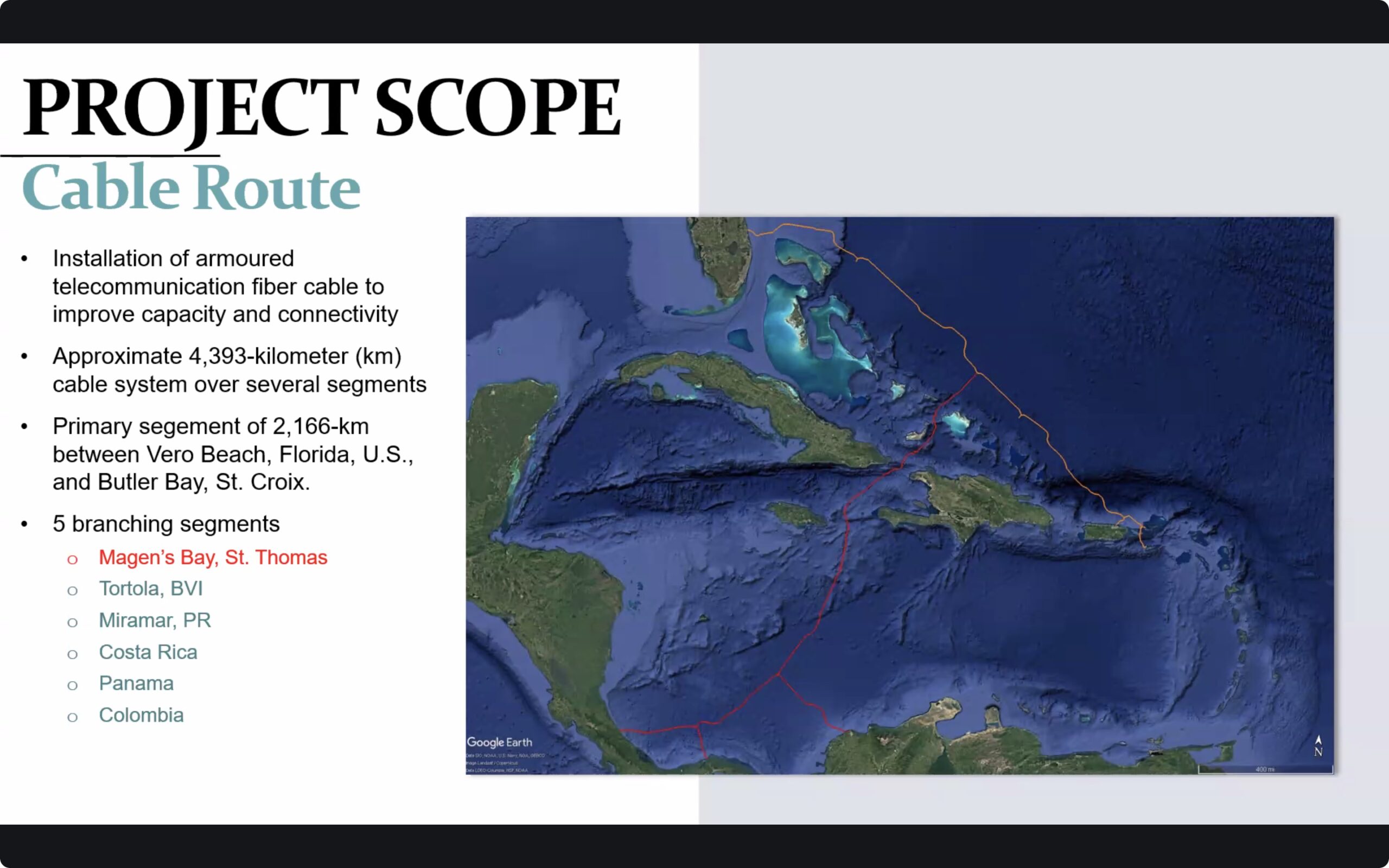
A planned 2,730-mile telecommunications cable will link Vero Beach, Florida to Butler Bay, St. Croix. (Screenshot from CZM Zoom meeting)
Land and water use officials approved a 14-mile stretch of fiber-optic line into Magens Bay Wednesday night, a tiny offshoot in the 2,730-mile telecommunications cable that is planned to link Vero Beach, Florida, to Butler Bay, St. Croix.
The Department of Planning and Natural Resources’ Coastal Zone Management Division approved the connection after assurances that the line would not damage undersea life or its habitat. The cable will enter a shoreline manhole and connect to an AT&T of the Virgin Islands distribution building through an existing conduit.
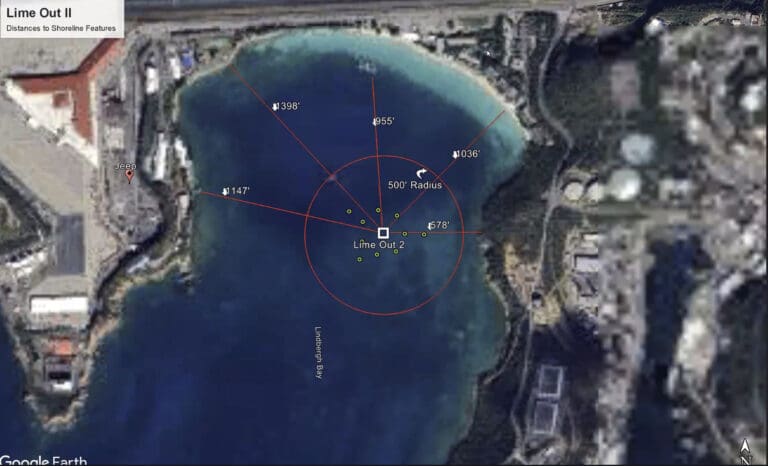
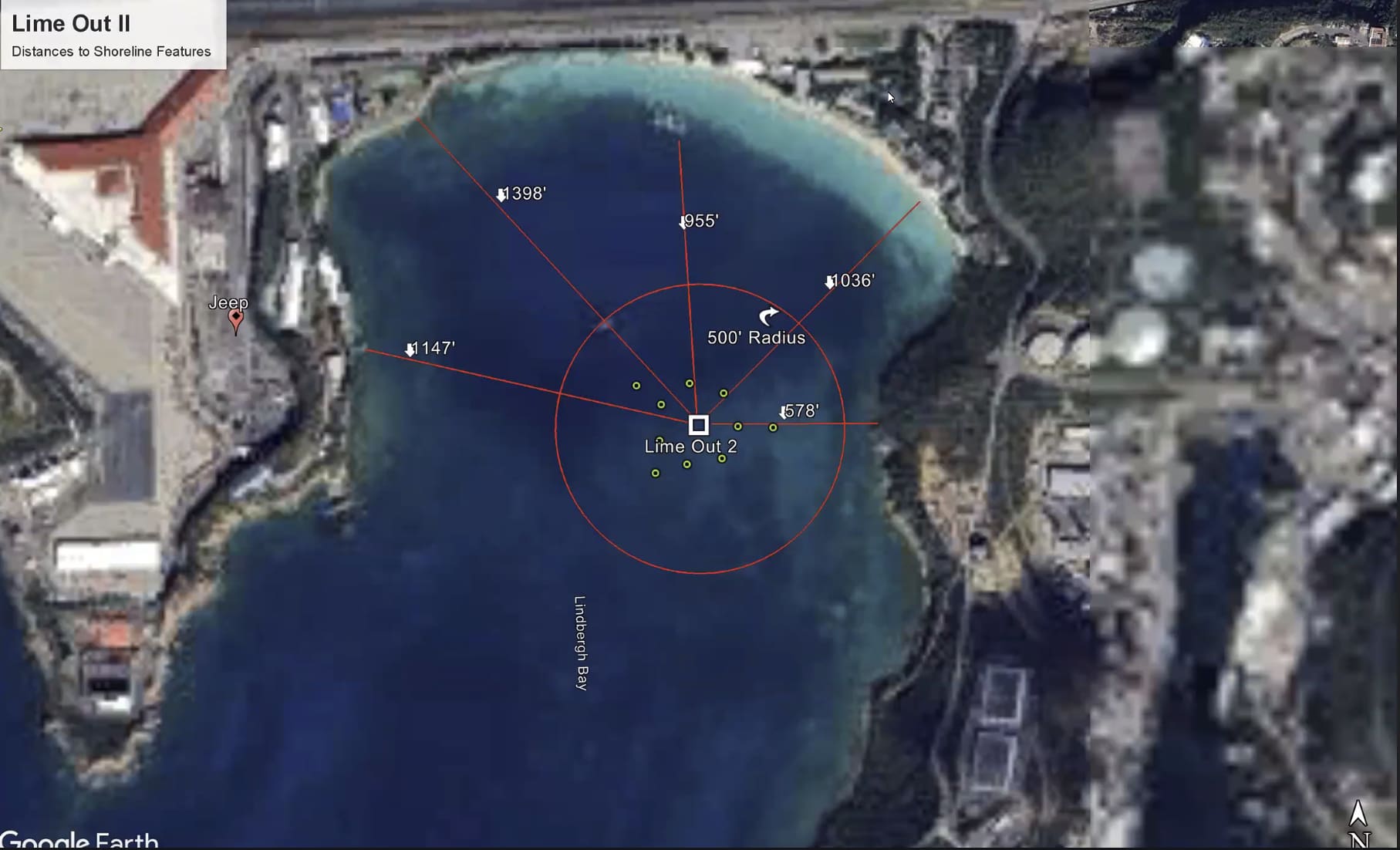
The marathon CZM meeting that lasted late into the night also saw approval of a second Lime Out floating restaurant — this one in St. Thomas’ Lindbergh Bay.
Lime Out II restaurant would float in St. Thomas’ Lindbergh Bay. (Screenshot from CZM Zoom meeting)
Like its Coral Bay predecessor, Lime Out II will offer to-go food and drinks for boaters moored in the area. Owners Richard Baranowski and Dane Tarr assured CZM officials the 53-foot long, 20-foot wide vessel would not have any means of propulsion and would not cook any food on-site using gasoline or any hydrocarbons. All meals would be prepared elsewhere and be served in biodegradable containers.
Affixed to the ocean floor with four helix-type anchors to minimize disturbance to the seabed, the floating restaurant would offer 10 moorings for patrons’ vessels under 65 feet in length. The location would be between roughly 578 feet and nearly 1,400 feet from shore. Seating would be at the bar or on several floating chairs tied to the barge.
“The spot that we’ve chosen is far enough away from the beach but also in a protected area so people can sit at the barside and sit on the floats,” Tarr said. “That spot is a happy medium where it’s out of the way but not too far from the beach.”
The restaurant would have no restroom facility for patrons and a single eight-gallon toilet for staff use.
CZM officials mandated noise from the restaurant would be limited to less than 90 decibels audible at 100 feet.
The meeting ended without a decision on a proposed correctional facility in Sub Base to alleviate overcrowded conditions at other jail facilities. The proposed Swan Annex Correctional Facility hit several snags in the approval process, including limited road access to and from the site and the need to evict a longtime tenant from a building on the site so it could be demolished.
The hotel being built on GERS property is 70 percent complete. (Photo from GERS administrator’s report)
How much rum tax is returned to the Virgin Islands is essential to the over 8,700 retirees receiving checks from the Government Employees’ Retirement System. However, Angel Dawson, the GERS administrator, told the board of trustees that it amounts to little more than a “statistical rounding error” to the U.S. Congress, and he noted that Congress is presently having trouble passing any tax legislation.
Board member and former Sen. Ronald Russell initiated the discussion by questioning whether the board should travel to Washington, D.C., to lobby for a rum tax return of $13.50 per proof gallon. The territory is only receiving $10.50 presently for every proof gallon. The federal Bipartisan Budget Act of 2018 set the per-gallon rate to $13.25 for five years following the back-to-back Category 5 hurricanes of September 2017, but that expired at the end of December 2021.
The GERS rescue plan lawmakers enacted in 2022 was based on getting the $13.25 per gallon.
Dawson reported that the Virgin Islands’ failure to get higher returns was not due to a lack of effort. He said Gov. Albert Bryan Jr., Delegate Stacey Plaskett, and the territory’s lobbying firm in Washington were all pushing for it.
Board Chair Dwane Callwood said he was against the idea of the whole board going to Washington, D.C.
Russell tried to unseat Callwood as board chair later in the meeting. Russell said it was time for someone from St. Croix to chair the board. However, when the votes were tallied, Callwood received four votes, and Russell received two. Trustee Leona Smith was elected vice chair.
Tahmin Clarke, who replaced Nellon Bowry and retired as a trustee at the end of 2024, attended his first meeting. Clarke had questions about how investment strategy has changed considering the changing administration in D.C. He was told the board was taking 10 percent of its equity vestments and placing them in bonds. The move should “reduce the volatility” of GERS’ investments. Last month, the trustees also moved some of GERS’ funds from big stock companies like Facebook, Microsoft, and Apple to smaller companies. In the treasurer’s report, Denise Jeremiah said in December 40 percent of the $26 million needed for disbursements was collected.
Dawson reported that the hotel being constructed on St. Thomas waterfront property owned by GERS was 70 percent completed and should be finished by May.
Board member Andre Dorsey questioned whether SkyCity VI Airport employees would be members of GERS. SkyCity is taking over the operation of the Cyril E. King Airport on St. Thomas and the Henry E. Rohlsen Airport on St. Croix. Callwood said GERS did not have any authority over a private company.