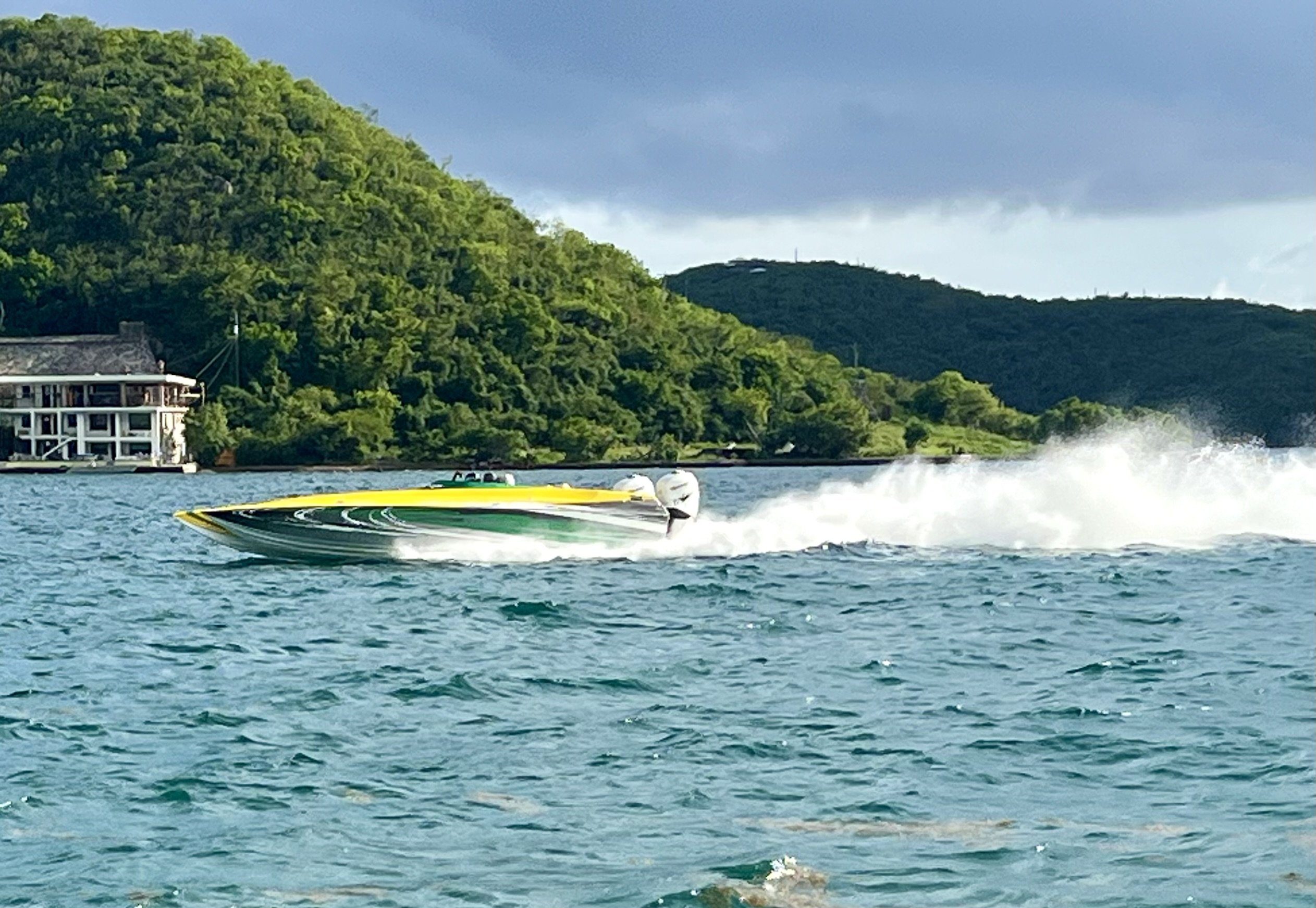
Hundreds of Virgin Islanders converged along the Charlotte Amalie Waterfront Sunday to enjoy boat racing and each other’s company. The annual Carnival Boat Races brought mariners and spectators together to watch vessels zip along the coastline.
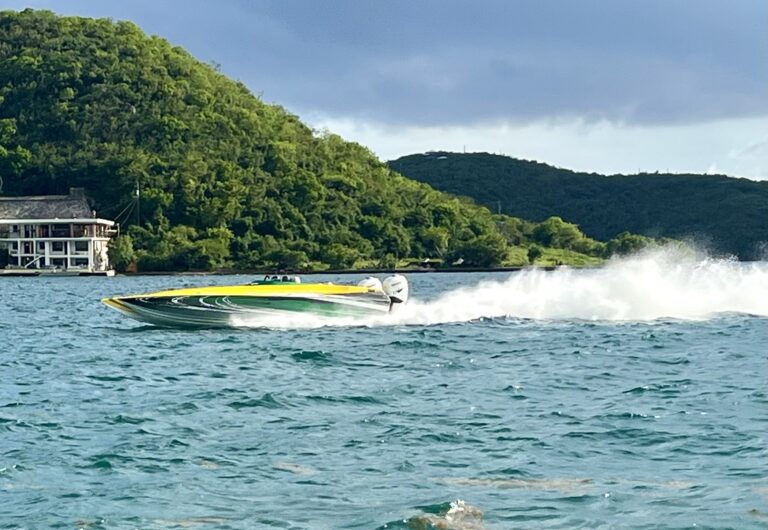
Powerboat throttles up for Sunday’s race. (Source photo by Judi Shimel)
Dozens of pleasurecraft rafted up from Vendor’s Plaza and westward, giving passengers a comfortable perch to view the action. Intermittent spurts of motorcycles sped along Veterans Drive throughout the afternoon.
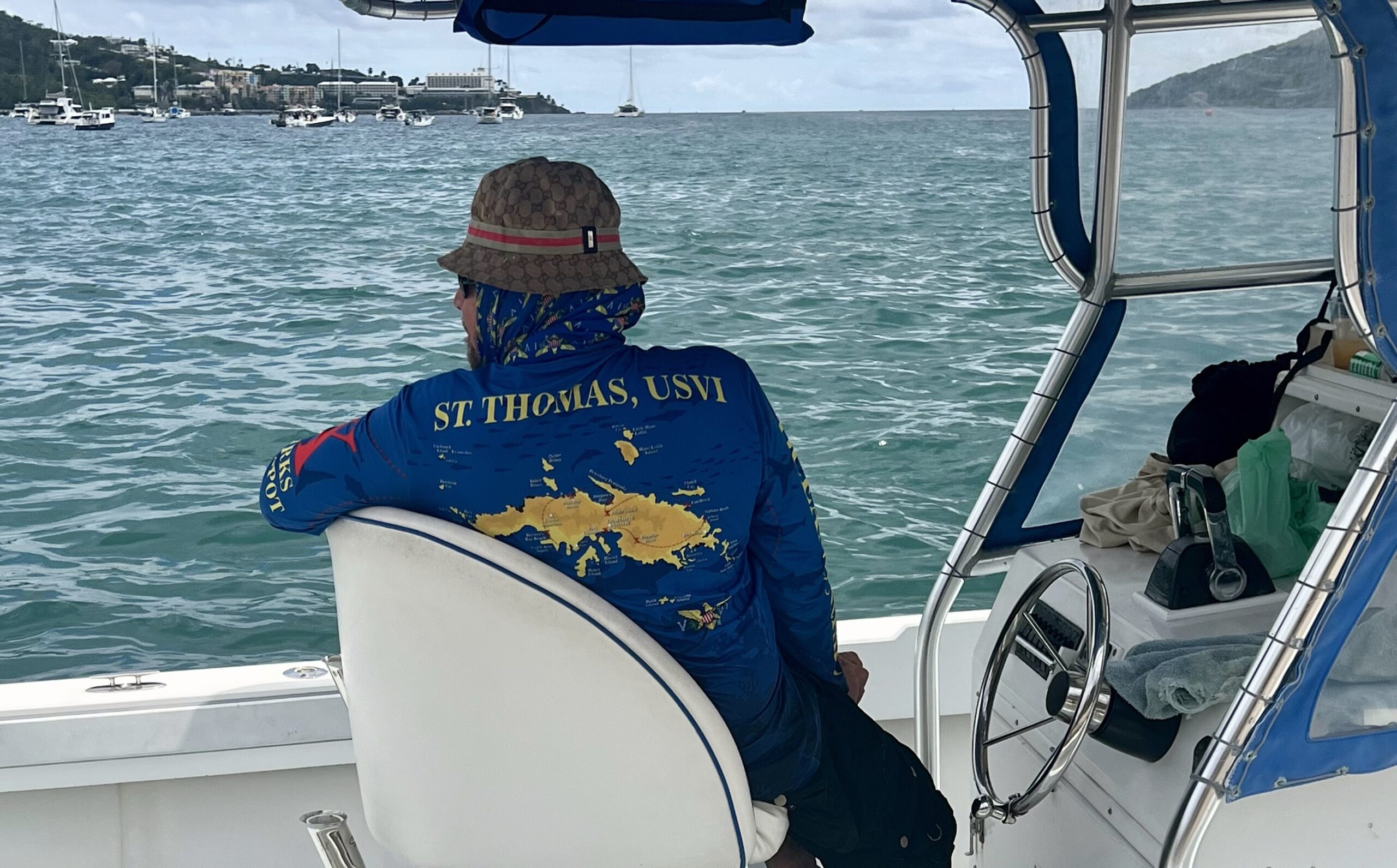
Fisherman Boogie displays his V.I. pride. (Source photo by Judi Shimel)
There were also those who chose to take it slow.
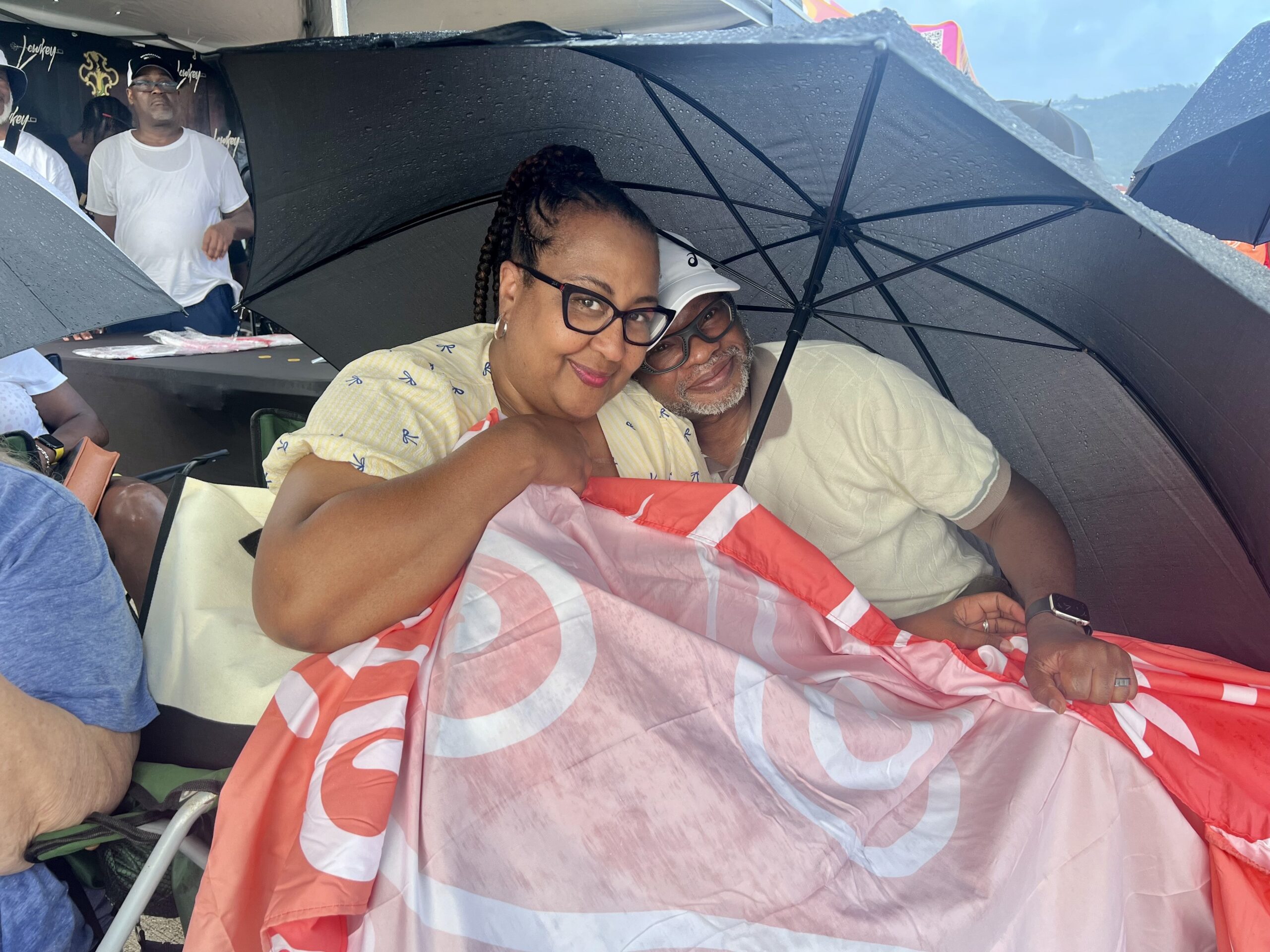
Belita and Rod Hart from Atlanta cuddle up against a sudden sprinkle. (Source photo by Judi Shimel)
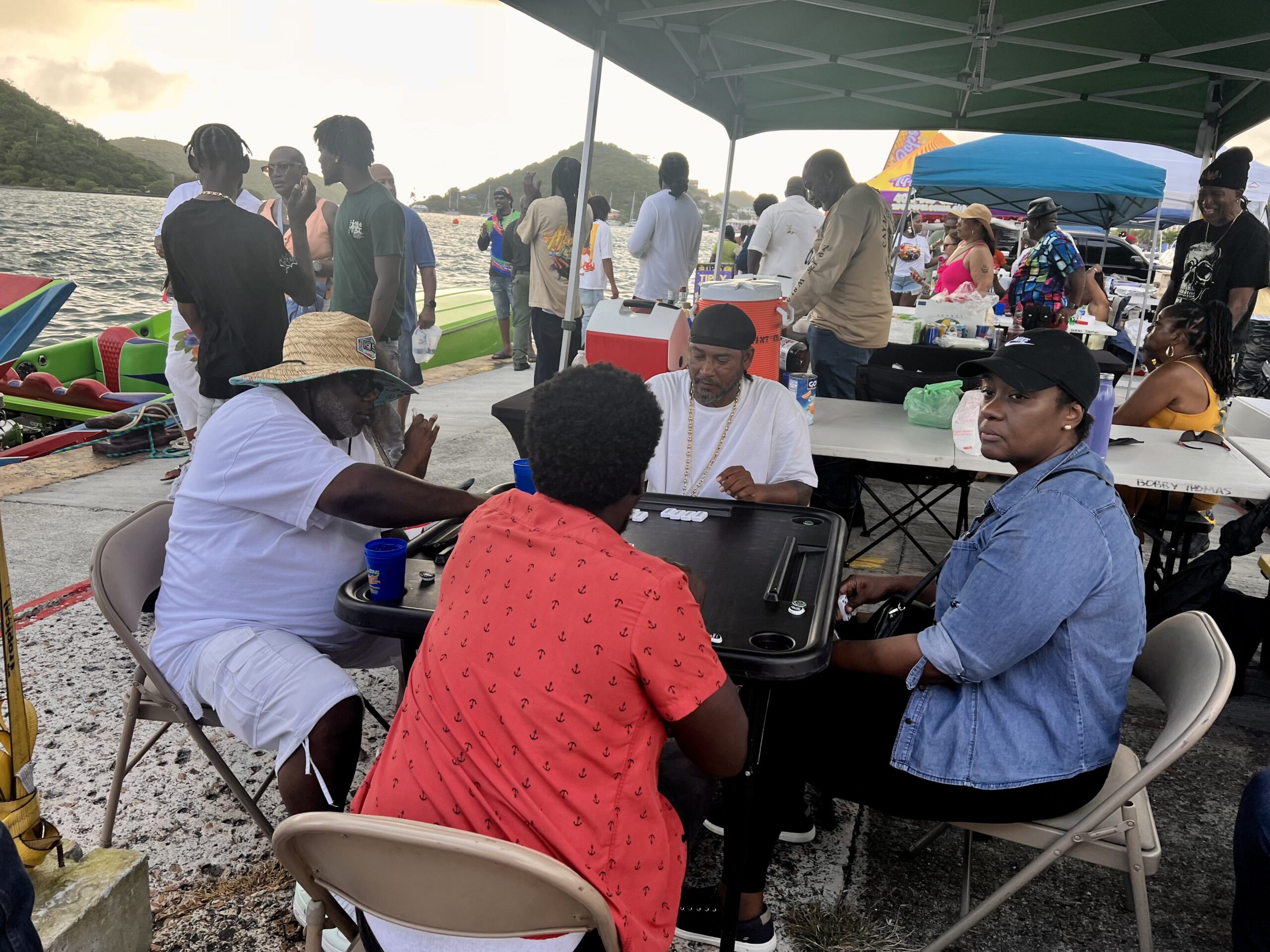
A card table and a pile of dominoes set the stage for some friendly competition.
Sunday dominoes under shade by the sea (Source photo by Judi Shimel)
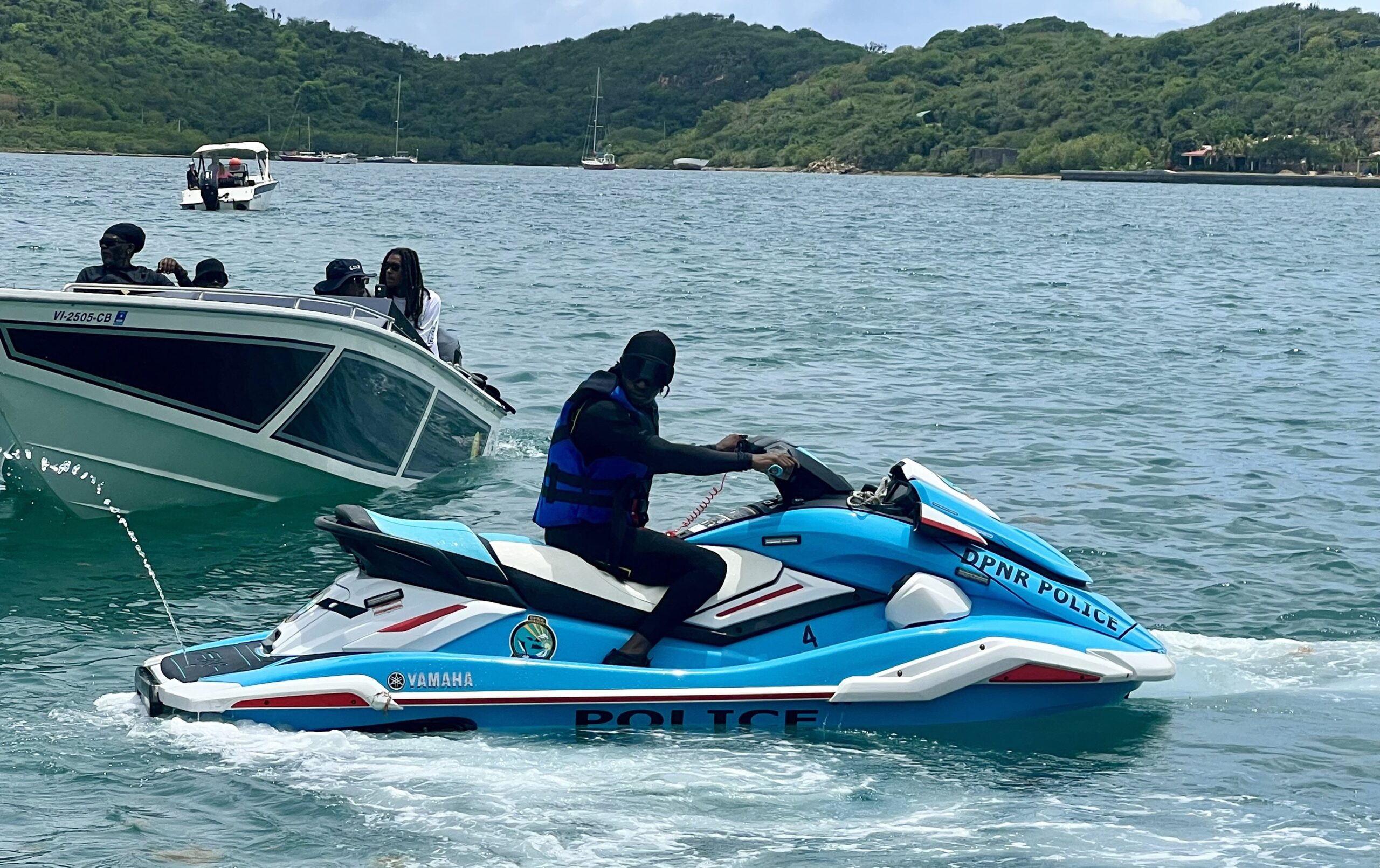
Live bands and deejays kept the mood upbeat while race announcer Elroy Donovan Jr. called the start for each racing class: Zap Cats, 12-16 ft. speedboats; 21- to 22-footers; 24-ft V-Hulls; 27-to 30-ft. V-Hulls; Offshore Class and Unlimited Class racers — all under the watch of VI Police and DPNR Enforcement units.
DPNR Jet Ski patrol on duty. (Source photo by Judi Shimel)
Up for grabs for the winners — cash prizes totaling $20,000. Donovan, the announcer, said he had been coming to Carnival boat races since he was, “a small child, and now I’m 63.” Beside him sat race day honoree Glenville Ross Sr., who called the races in the early days.
One of the day’s races was named in honor of Ross.
Food, beverage and craft vendors were on hand to serve the public. Among them was a group from the nonprofit USVI Marine Vocational Program. Program President Winston Clyne called Sunday’s event an opportunity to solicit public support. “We teach kids everything within the marine industry — sailing, learning to swim, scuba diving, sailing vessels and power vessels, boat mechanics, fishing — just about everything in the marine industry,” Clyne said.
Port Authority Marine Manager Joey Cranston greeted spectators as he strolled along. “We at the Port Authority look forward to cooperation with the (Tourism Department) Division of Festivals to have everybody come out and have a good time,” Cranston said.
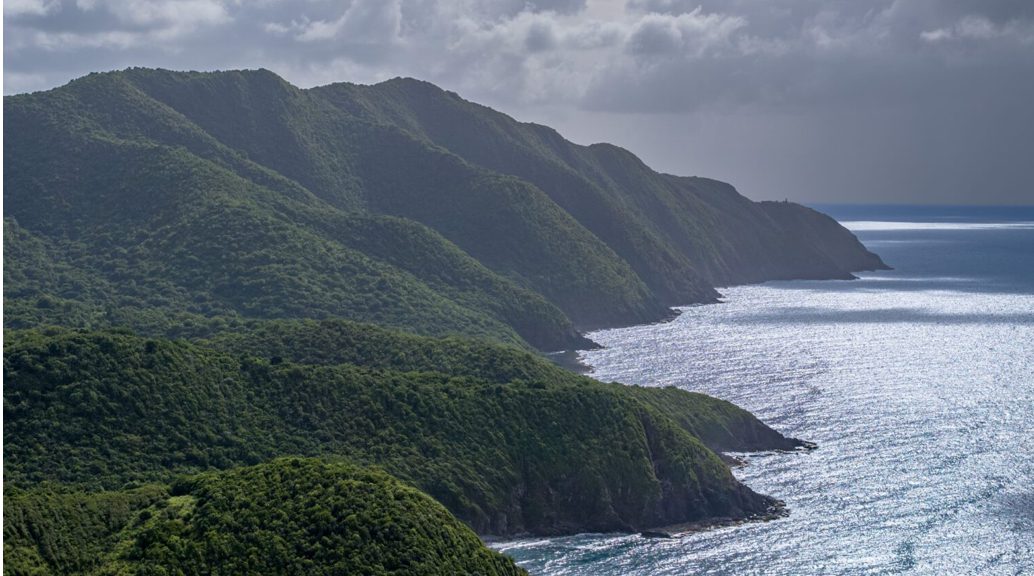
Editor’s Note: This is part 4 in the series Sacred Geography, Ancestral Memory & the Restoration of Meaning, which explores the natural and cultural history of the recently designated Maroon Sanctuary Territorial Park in northwest St. Croix. Previous articles in the series can be found here, here and here.In the northwest corner of St. Croix, the rugged coastline of Annaly Bay rises to the peaks of Maroon Ridge. This landscape once sheltered Maroons who escaped enslavement and built hidden communities amongst the steep cliffsides. Today, it stands as the island’s largest intact forest, home to several rare and endangered marine and terrestrial species (Photo by Dan Mele for DPNR)
“The people who made Maroon Country their sanctuary and stood for freedom and human dignity have names and identities. They are part of the ancestral history of St. Croix and are connected to the people alive on St. Croix today.”
—Olasee Davis
“They hid in the hills, sequestered in the unpredictable security of caves at craggy shores, scratching out a subsistence with stubborn dignity. A presence once, they were all but forgotten in the aftermath of colonial slavery.”
—Bernetia Akin
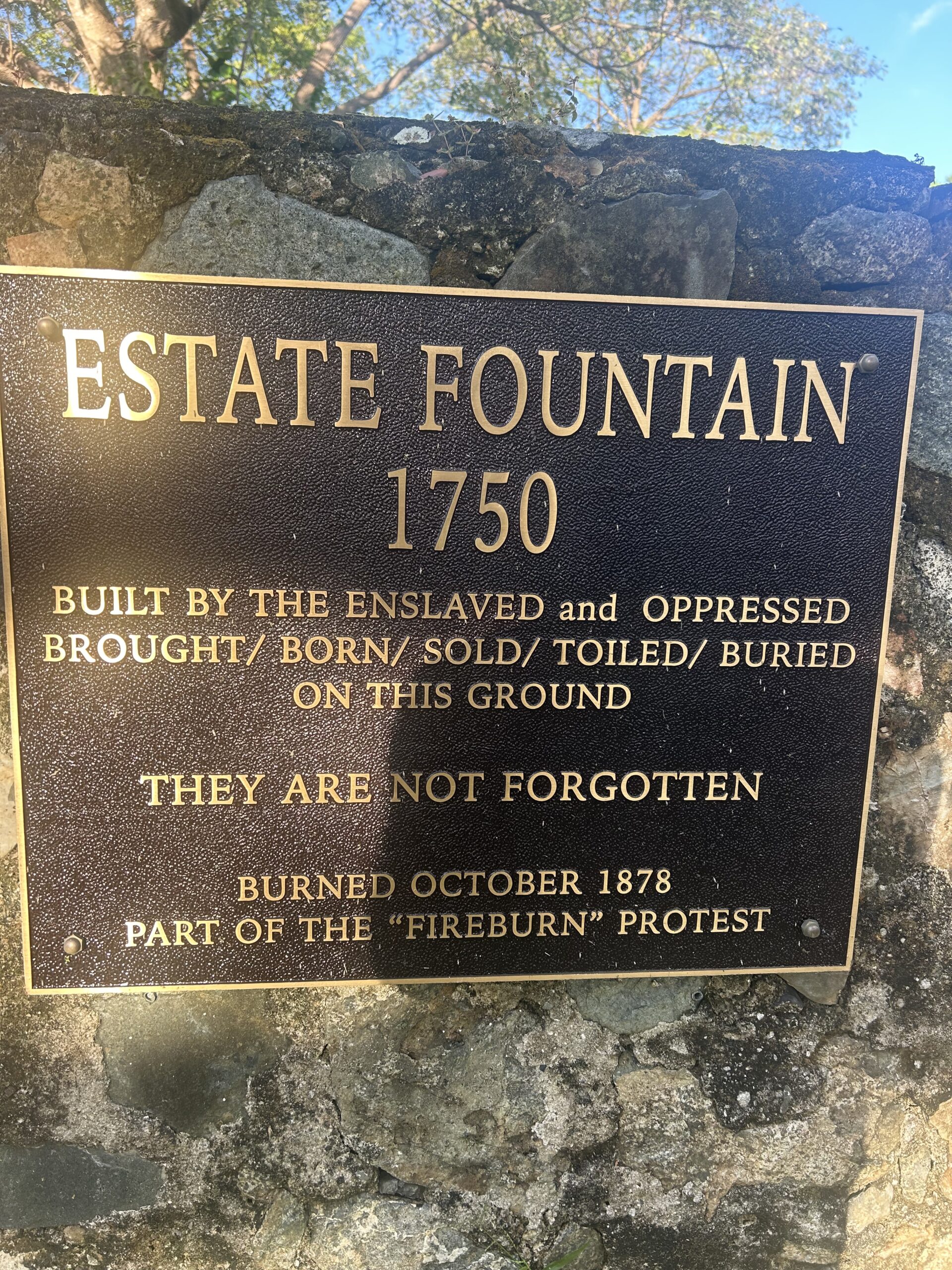
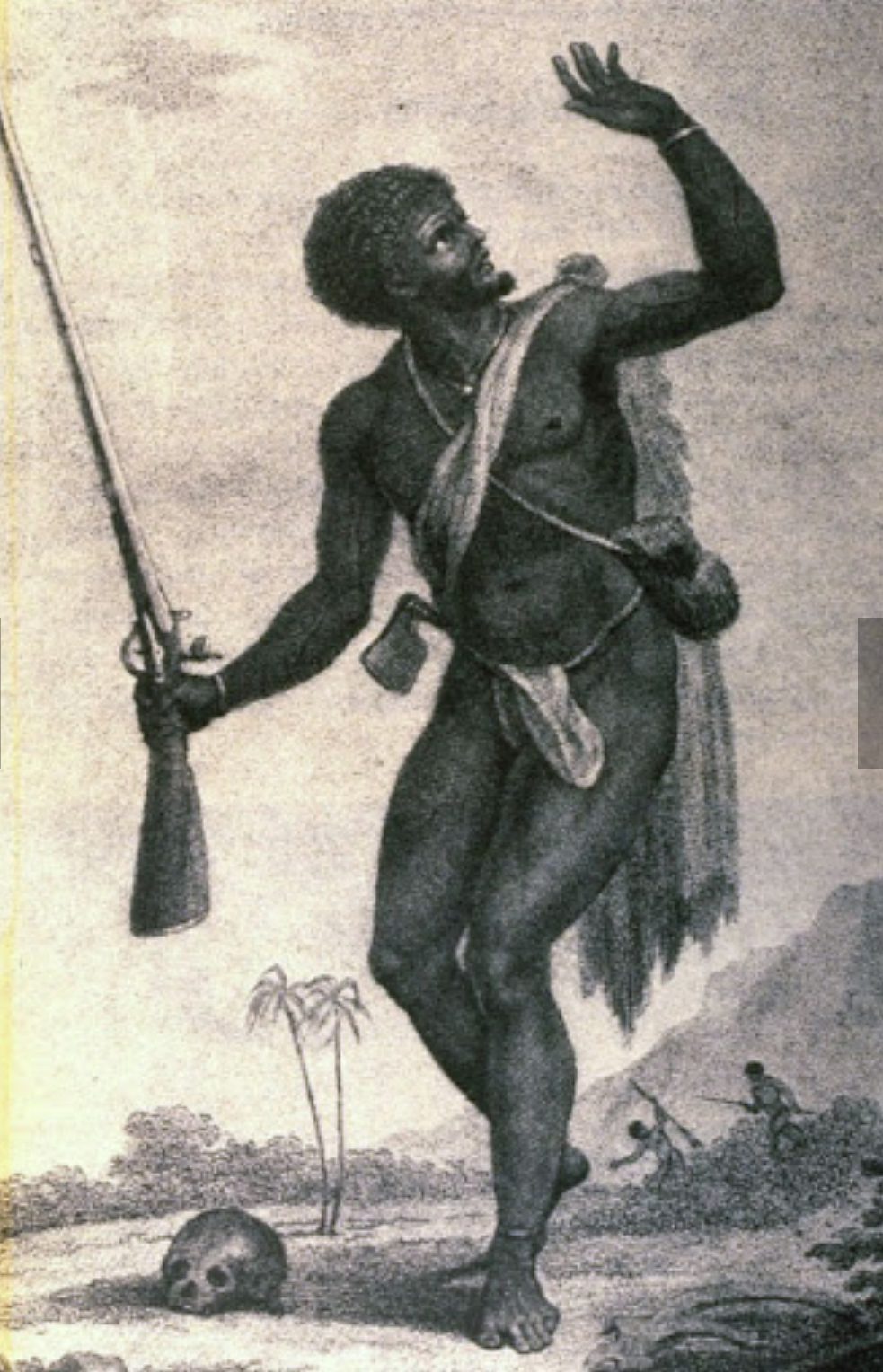
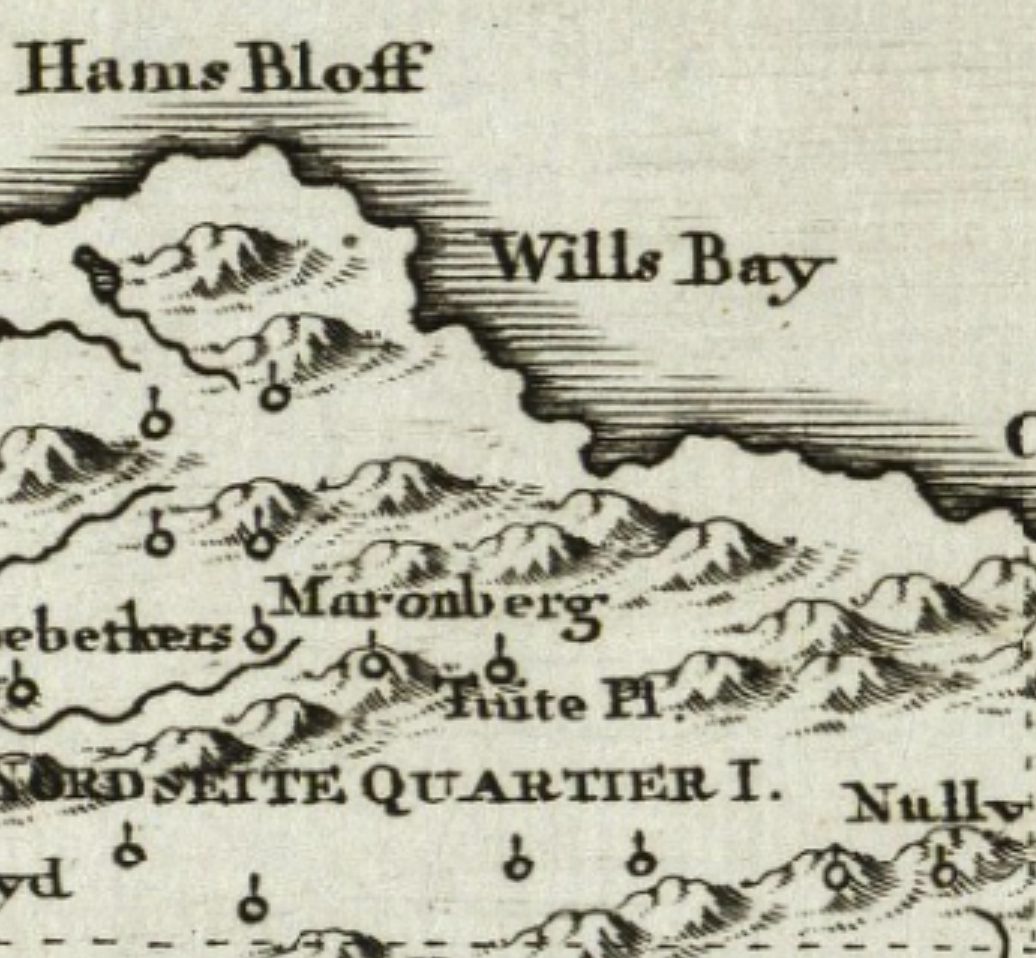
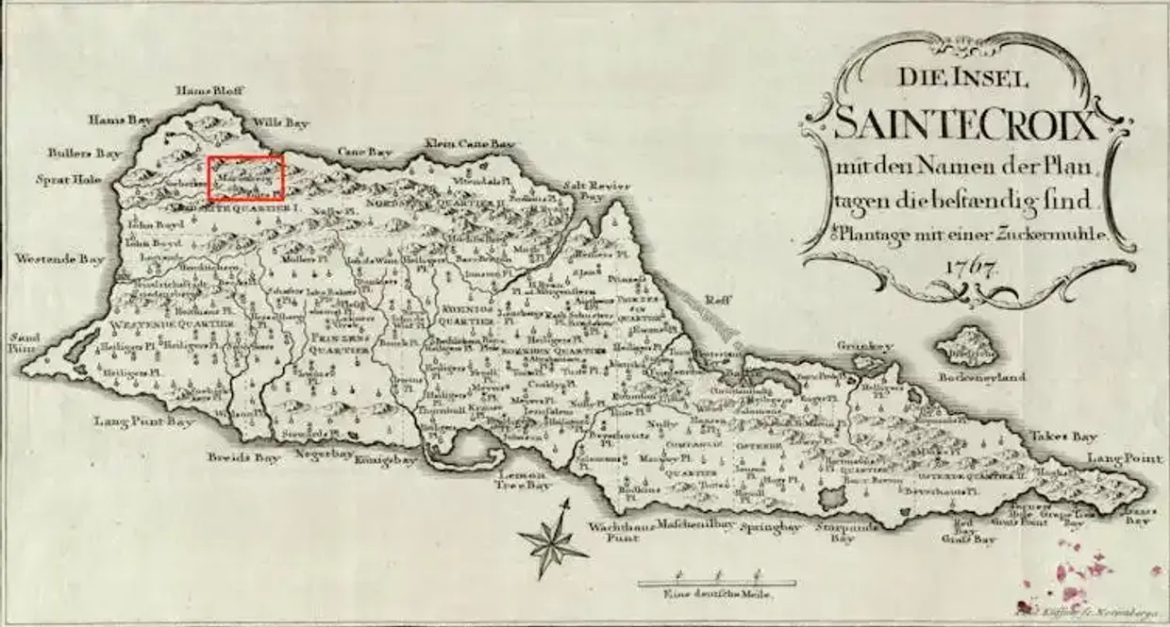
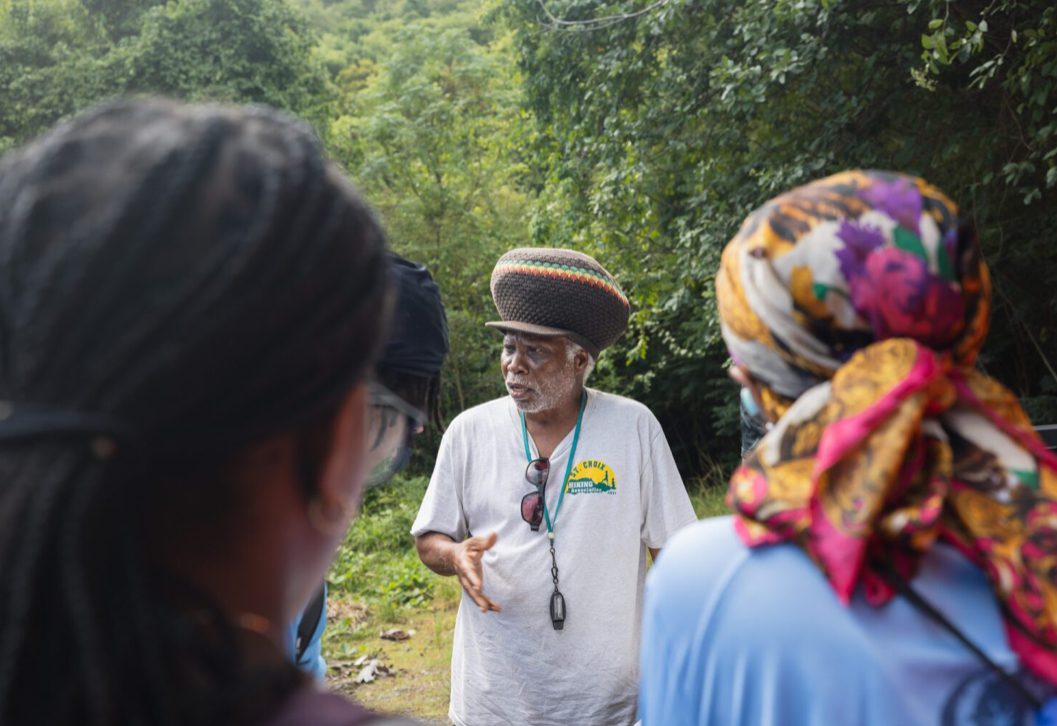
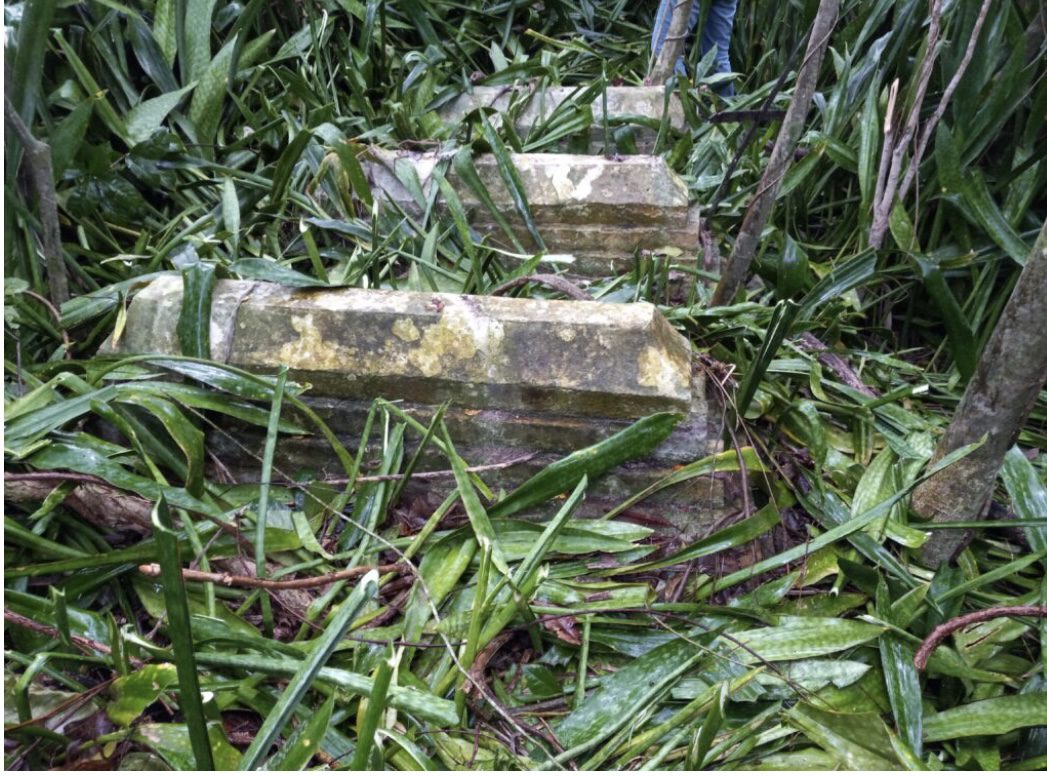
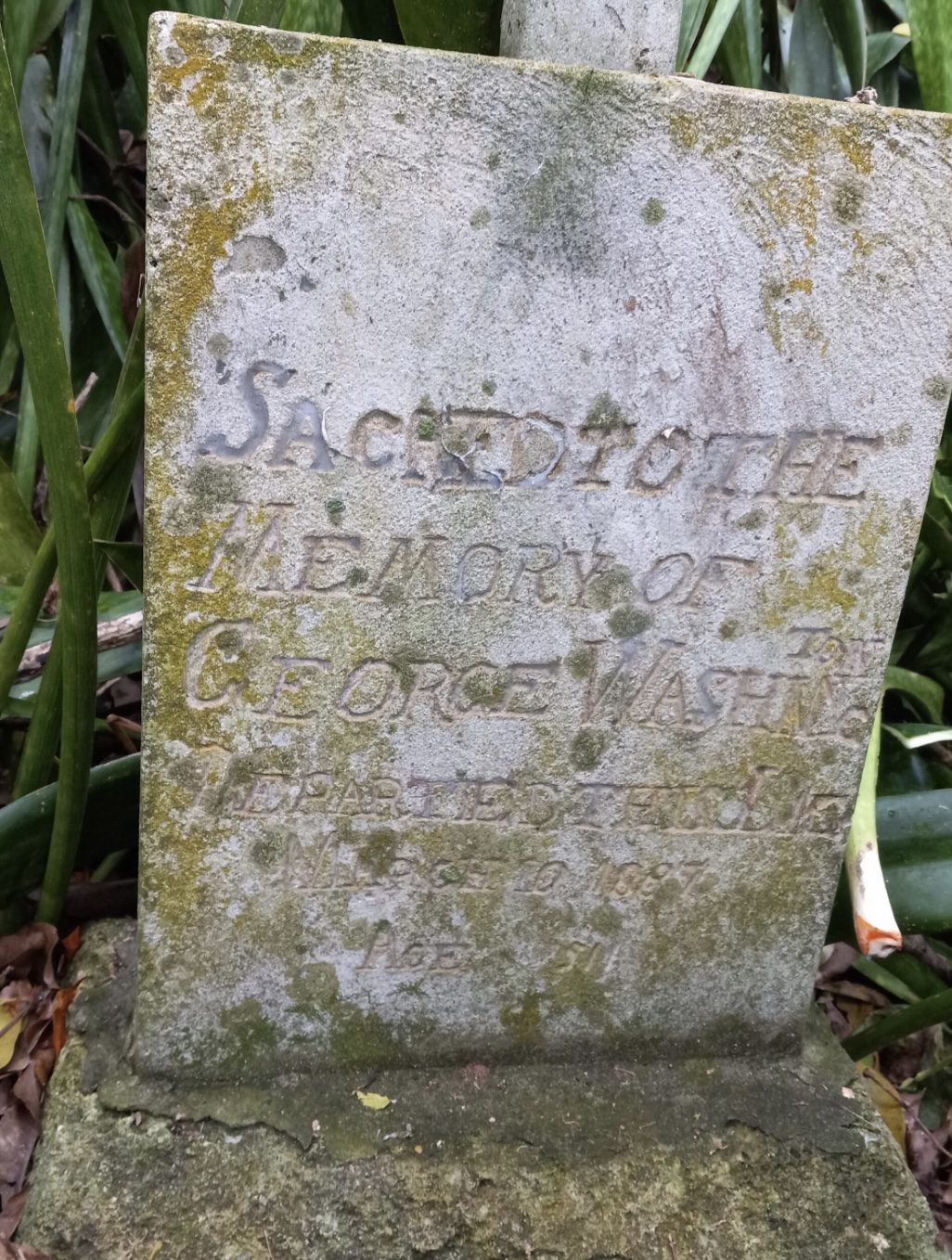
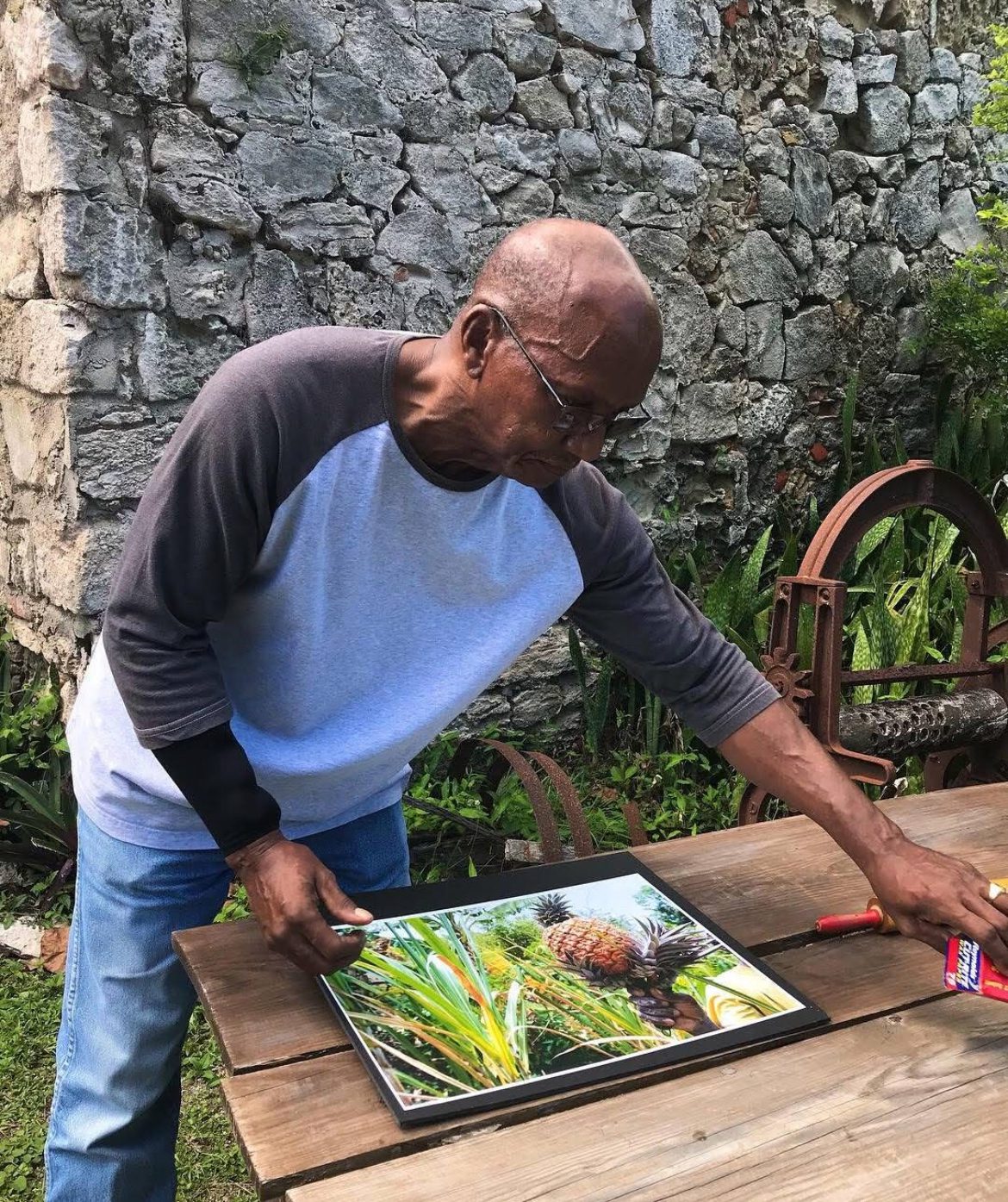
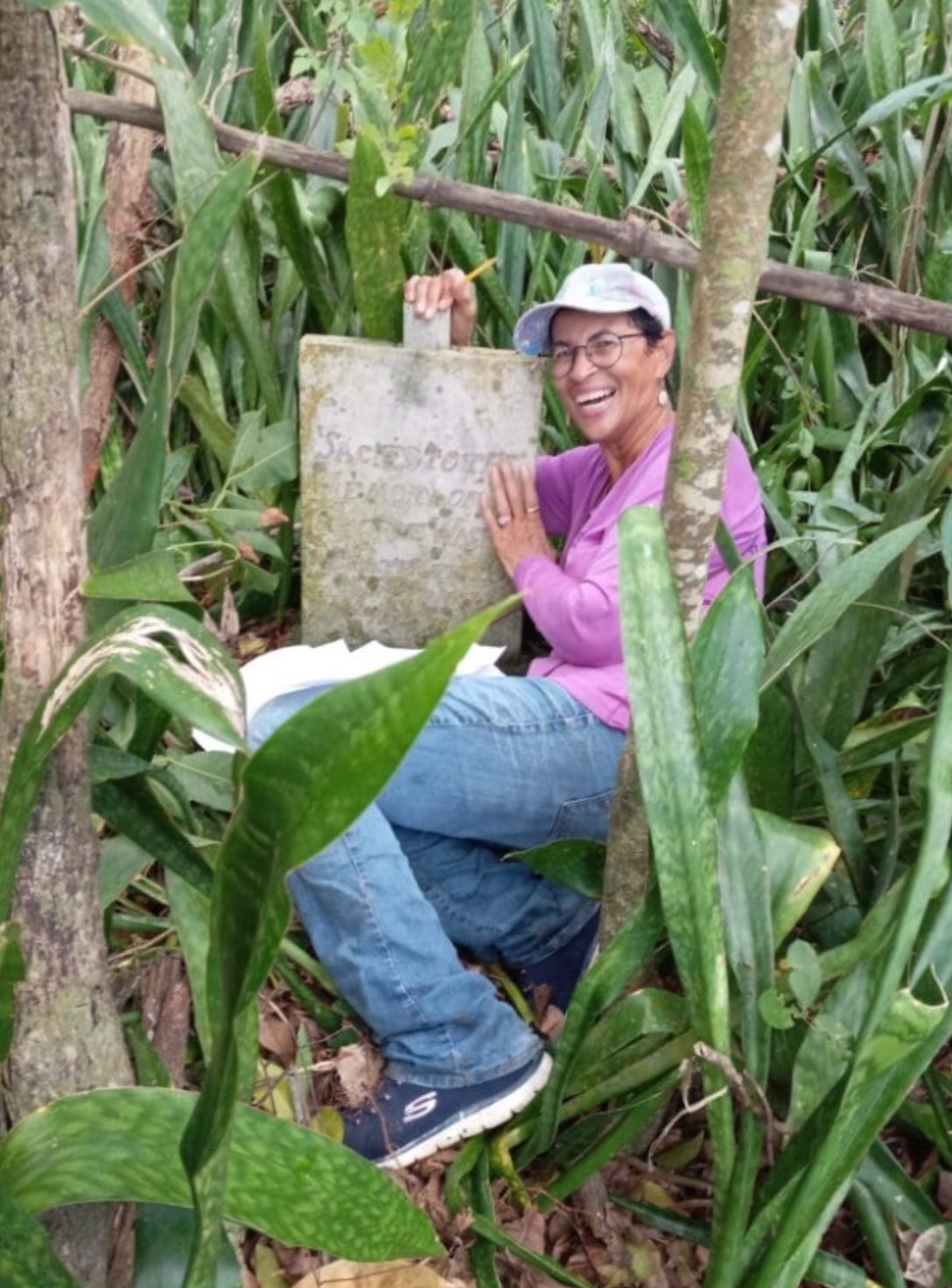
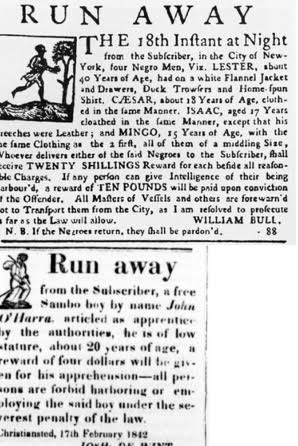
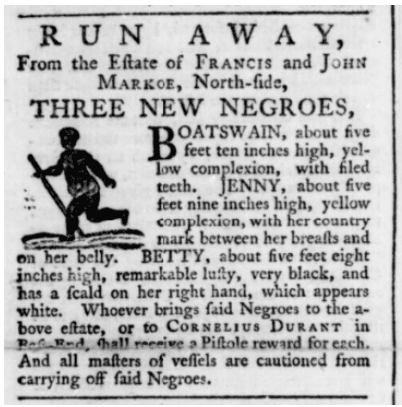
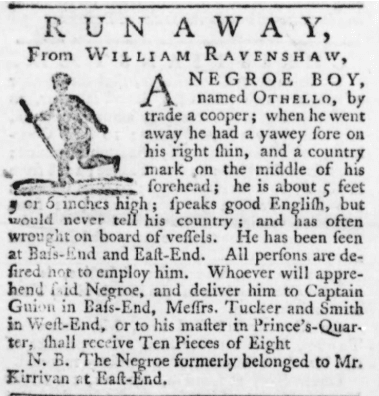
Tall, stately Royal Palms punctuate the grounds and tower imperiously over the crumbling, flower-strewn ruins of Estate Fountain in northwestern St. Croix. A ghostly silence settles over the sloping meadow where the eroding facades of several buildings, topped with muted red notes of bougainvillea, are gradually subsiding into the earth. The voracious limbs of a strangler fig have seized one of the south-facing walls of the former plantation in a slow-motion wrestling match in which vegetation has triumphed over stone. Amidst the colonial rubble and the twisted detrital machinery of Danish West Indian sugar production is a rusted-out boiler drum lying askew in the wet grass. It has been set upon and overtaken by hardy weeds and tangled bush and has become a feature of the landscape itself. The forest creeping back in, reasserting a prior claim to the territory. Nearby a recently erected bronze plaque affixed to a low wall of crumbling stone memorializes the slaves who built the plantation here in 1750: Built by the enslaved and oppressed, brought/born/sold/toiled/buried on this ground:THEY ARE NOT FORGOTTENThe plaque at the slave grave site at Estate Fountain memorializes those who once toiled here, including ancestors of the Doward family of St. Croix. (Photo by Joshua Canning)In October of 1878, nearly a century and a half after those enslaved Africans erected it, the estate was set ablaze during the legendary “Fireburn” labor riot, a conflagration of defiance that would sear itself into the fabric of island memory, becoming an enduring touchstone in the history and lore of Crucian culture. Standing here within the vestigial remains of the estate and looking about into the encircling hills at the periphery of the recently designated Maroon Sanctuary Territorial Park, I marvel at the dense wave of green vegetation that crests the ridgeline before spilling over onto the downhill slope, marking the forest’s edge. Beyond that edge the dense wall of forest abruptly swallows all traces of human agency and the forest rolls, largely intact, over the crumpled terrain of the island’s northwest quadrant and all the way to the distant west end: Maroon Country.Early depiction of a “Maroon” (Submitted photo)The palpable legacy of self-emancipated former slaves who once took refuge here hangs over the territory like a mist. It rings through the silent air, hangs from the branches of trees and broadcasts from the secret-keeping stones. The unanswered questions about who these people were and where, in this shadowed landscape, they might have lived, continues to impart upon them a pervasive sense of mystery which infuses the newly established park with historical gravitas and a shadowy mystique. Absence has a way of energizing an awareness of traces. Standing here at the park’s edge, peering into the encircling forest vastness, one can imagine an enslaved man or woman poised for flight, the temptation they must have felt, freedom and refuge seemingly so near at hand, to simply disappear into the thick encompassing sea of greenery, to dip into the shadows and be gone into a new life of refuge and fellowship among a gathering tribe of escapees who would become known as “Maroons.”The word “Maroon” refers broadly to descendants of enslaved Africans who escaped captivity in the Americas, forming independent, free communities in remote, rugged areas starting as early as 1512. Exploring the etymology of the word sheds meaningful light: “Maroon” is believed to be derived from the French word “marron,” which in turn is derived from the Spanish word “cimarrón” meaning “wild” or “untamed.” The word itself seems to convey the spirit of defiance and independence that characterized runaway slaves such as those who once took refuge in the steep hills and deep valleys, among the precipitous cliffs and within the sheltering caves of the rugged terrain that surrounds me as I stand here on a quiet March morning, my mind alert to the mystery. Perhaps because of the transient nature of their fugitive settlements or the desperation that fueled their stealthy passage through this landscape, the Maroons left few traces behind them; few dots to connect; few clues from which an accurate picture of their lives here might emerge. While the concerted efforts of teams of archaeologists, aided by complex, cutting edge geospatial mapping technology, have not yet produced much in the way of definitive material evidence of Maroon settlements in this remote and wild region, turning to the historical record and to written accounts does yield some provocative hints including numerous references to a legendary settlement known as “Maronberg” which was said to have been a well-populated haven and refuge for fleeing slaves. Maronberg (outlined in red) became sufficiently well known that it was marked as a place on the Küffner Map of 1767, which was included with the Oldendorp book published in 1777. (Submitted photo)“For a long time now, a large number of escaped slaves have established themselves on lofty Maroon Hill in the mountains toward the west end of the island,” wrote C.G.A. Oldendorp, a Moravian missionary who visited the Danish West Indies between 1767 and 1768. “They are there protected by the impenetrable bush and by their own wariness.” Oldendorp’s account of what became known as “Maronberg” is the most substantial one that exists amongst the historical records of the Danish West Indies. The existence of Maronberg among these rugged hills of northwestern St. Croix was corroborated by its inclusion on the Küffner Map of 1767. Its exact location, however, remained somewhat vague reflecting the vested interest that the Maroons had in remaining undetected. Earlier colonial maps had routinely labeled the region now known as “Maroon Country” as “Uoptagne Grunde” or “uncharted ground.” One imagines a kind cartographic hole in the map through which fugitive slaves disappeared.When the Danish West India-Guinea Company purchased St. Croix from France in 1733, it quickly expanded the island’s sugar and cotton production. As Dr. Justin Dunnavant, an archaeologist and Associate Professor of Anthropology at UCLA explains, “This also meant expanding the slave population to harvest lucrative plantations. But the Danes were never able to fully control the island – or the enslaved. By the end of the 1700s, nearly 1,400 people – more than 10% of the enslaved population – successfully escaped captivity. But where did they escape to? Only recently have researchers started to shed more light on this centuries-old mystery.”Few people have committed more time and energy to plumbing the depths of that centuries-old mystery than ecologist, activist and historian Olassee Davis. Olasee has also been more responsible than any other individual for successfully shepherding the Maroon Sanctuary Territorial park into existence. Certainly these two endeavors are inextricably interwoven and one senses in Olasee an abiding and deeply rooted spiritual commitment both to the legacy of the Maroons and to this landscape which enshrines that legacy in perpetuity. On a Saturday evening this past winter some friends and neighbors gathered at our home to hear Olasee present a talk entitled “The Hardships of the Maroons.” His talk provided a detailed overview of what is known about Maroon history on St. Croix, and as he projected his slides on the wall of our living room, those of us gathered here, on the outskirts of the newly established territorial park, felt that palpable mystery of the Maroon legacy pulse with life. Professor Olasee Davis leading a tour of Maroon Country (Photo by Dan Mele for DPNR)Olasee projects onto the wall of our living room clippings from early editions of the Royal Danish American Gazette from the early 1770s that include public announcements and detailed physical descriptions of escaped slaves and the threats of plantation owners to exact severe punishment on them in retaliation. Olasee’s vivid descriptions and anecdotal accounts of the kind of brutality meted out on those fugitive slaves who were apprehended casts a dark shadow over the entire Danish colonial project. In his book “Negro Slavery,” historian Eddie Donoghue poignantly refers to the history of slavery in the Danish West Indies as a “Rosary of Tears,” describing it as “brutal, harsh, violent and vicious.” He also provides a translation of the five articles of the infamous Slave Code issued by the Royal Council and Promulgated by Governor General Philip Gardelin on September 5th 1773. Article 1 reads “The leader of runaway slaves shall be pinched three times with red-hot iron tongs and then hanged.” Article 2 warns that “each runaway slave will lose one leg, or if the owner pardons him, shall lose an ear and receive one hundred and fifty lashes.” The subsequent articles retain this same sinister and barbarous tone. Those defiant individuals who took their lives into their own hands and fled into the shadowed forest knew full well what hung in the balance for them.Gravestones at the slave burial ground at Estate Annaly. (Photo by Olasee Davis)In a dense thicket of bush and tangled snake grass at Estate Anally is a weathered headstone, engraved and festooned with lichen. This is the final resting place of one such defiant individual whose irrepressible human spirit and refusal to be defined by the dictates of slavery fueled his flight from forced plantation labor and into the life of a proud Maroon. “Sacred to the Memory of George Washington” reads the tombstone. The common associations one likely has with the name – the powdered wig, the apocryphal wooden teeth, the mythical cherry tree, the Revolutionary War and the founding of a nation – however, are entirely misplaced here. If the man buried here can be said to have been a “Founding Father” it is perhaps because he helped blaze a trail to freedom and helped “found” a place of refuge for those who would break the chains of slavery. The revolutionthat he fought was in defiance of human enslavement. George Washington’s gravestone at Estate Annaly (Photo by Olasee Davis)Among the friends and neighbors who gathered at our home to hear Olasee speak about the Hardships of the Maroon was Gerard Doward. “Jerry,” as his friends call him, is a scholar, author, Crucian cultural historian and a volunteer Landmarks Society researcher. We met and talked one morning on the grounds of the Whim Plantation where we sat at a tree-shaded picnic table outside the building that houses the Landmark Society’s offices.Gerard Doward at the Whim Plantation (Photo by Olasee Davis) Jerry lived and worked in Denmark for several years and is fluent in Danish – a great asset for him since much of his research has entailed sifting through colonial records, navigating the linguistic divide and helping to piece together aspects of St. Croix’s storied past. His ancestral roots trace directly back to that weathered headstone at Estate Annaly. George Washington is his forebear. Like other current residents of St. Croix, Jerry Doward has traced his ancestry back to Maroons who are today buried in the newly established park and thus he represents a direct line of ancestral descent from the Maroons. “The people who made Maroon Country their sanctuary and stood for freedom and human dignity have names and identities” writes Olasee, “ They are part of the ancestral history of St. Croix and are connected to the people alive on St. Croix today.”Also there to hear Olassee speak was Mary Roebuck whose tireless work for the St. Croix African Roots Project, has included meticulously transcribing thousands of genealogical records from the colonial era of the Danish West Indies. A few days prior to Olasee’s talk, Mary and I met at Altoona Lagoon where we sat at a shaded table by the water’s edge. As gentle waves lapped at the shoreline, she told me her story, reflecting on her own ancestral connection to the institution of slavery in northwestern St. Croix.Mary Roebuck at the grave site of George Washington in Estate Annaly (Photo by Olasee Davis)Over many years Mary has helped transcribe tax records, slave lists, census reports, church, school and vaccination records. In the process she read and sifted through thousands of documents, many of which had sat for centuries unread on shelves in the Danish National Archive, the U.S. Archives, and on St. Croix. Thanks to Mary and others involved in the project, these records have been organized online in a way that can help bring the people of the past to life for the people of today and the future. “Most of the records are in Danish,” she says “and some in Latin. They were handwritten documents and often the writing was barely legible. Sometimes it would take two or three people poring over the document to decipher a name or place.”Runaway slave announcements in the Royal Danish American Gazette from the 1770s. (Submitted photo)The Roebuck family also has deep roots in and around Maroon Country. Mary had heard about the slave cemetery at Estate Annaly but was not sure where it was. Years ago Jerry took her to see it. “When we first went up there, we found the headstone but couldn’t read it” she tells me. At the time the stone was caked and encrusted with dirt, obscuring the engraved inscription. Years later, in the aftermath of Hurricane Maria, they returned to the site only to discover that the storm’s devastating maelstrom had ironically had a clarifying impact on the stone’s engraving. “It had been washed off! You could now clearly read it.” Mary decided that this was clearly a sign, an ancestral echo, a signal. “He wants to be found!” she said to herself. Addressing the headstone, she spoke directly to the spirit of the man himself: “George, you really want your story to be told, don’t you?” Joshua Grant Canning—Joshua Grant Canning holds a Master’s Degree in Environmental Journalism and in his writing he pursues projects that involve the intersection of nature and culture. On the basis of his writing about the ecological and cultural implications of the reintroduction of wolves to Yellowstone National Park, he was awarded a Middlebury College Graduate Fellowship in Environmental Journalism 2008-2009. The fellowship enabled him to travel widely in Japan (where he had lived previously for four years) to research and write about pressing environmental and cultural issues. He and his wife Wendy moved from Vermont to St. Croix in 2010 and he taught World Literature and AP English at Good Hope Country Day for over a decade. He is also a musician and jazz guitar enthusiast and performs regularly at events and venues around the island.
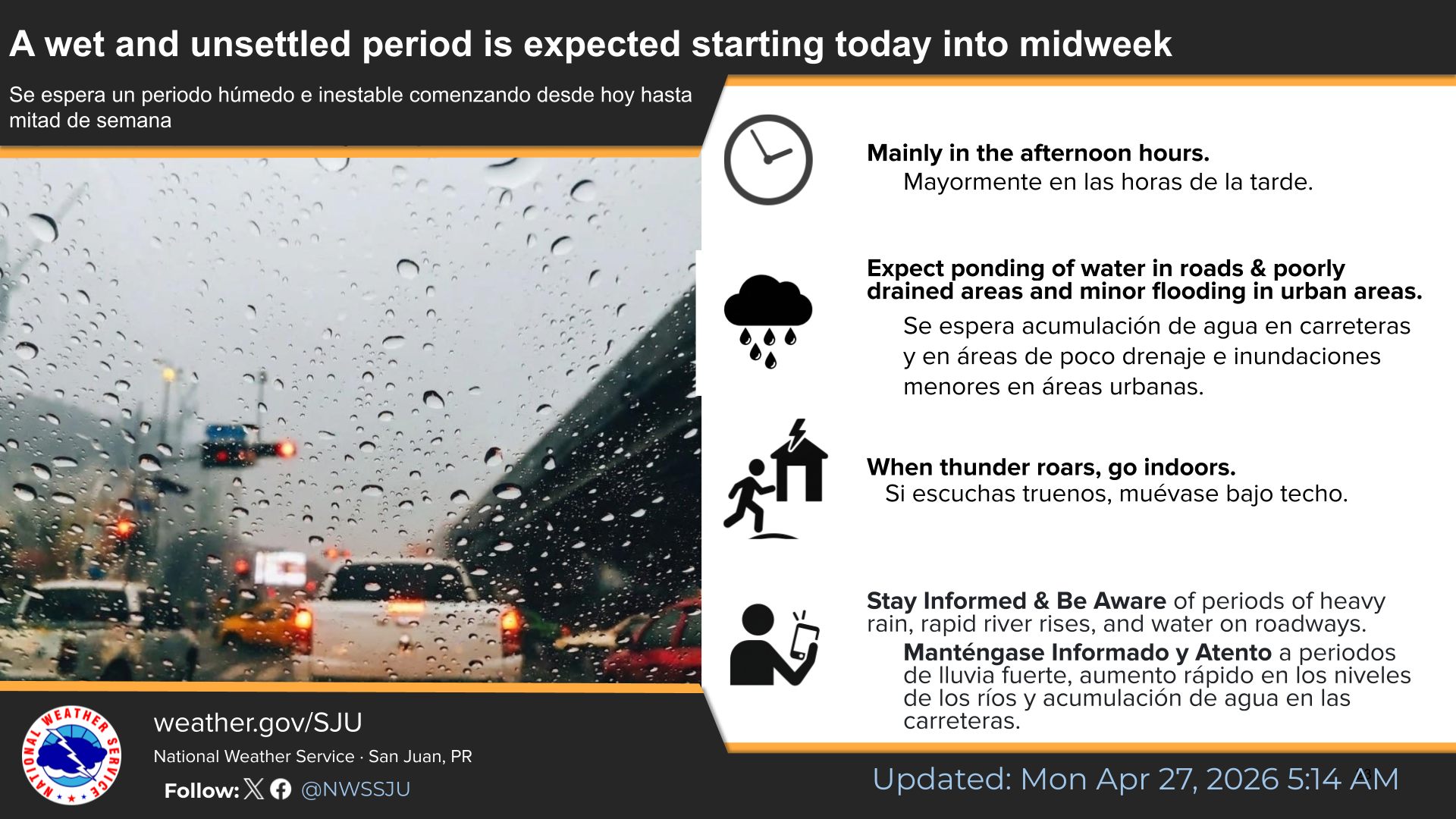
The National Weather Service in San Juan is forecasting a wet and unsettled pattern into midweek. (Photo courtesy NWS San Juan, Puerto Rico)
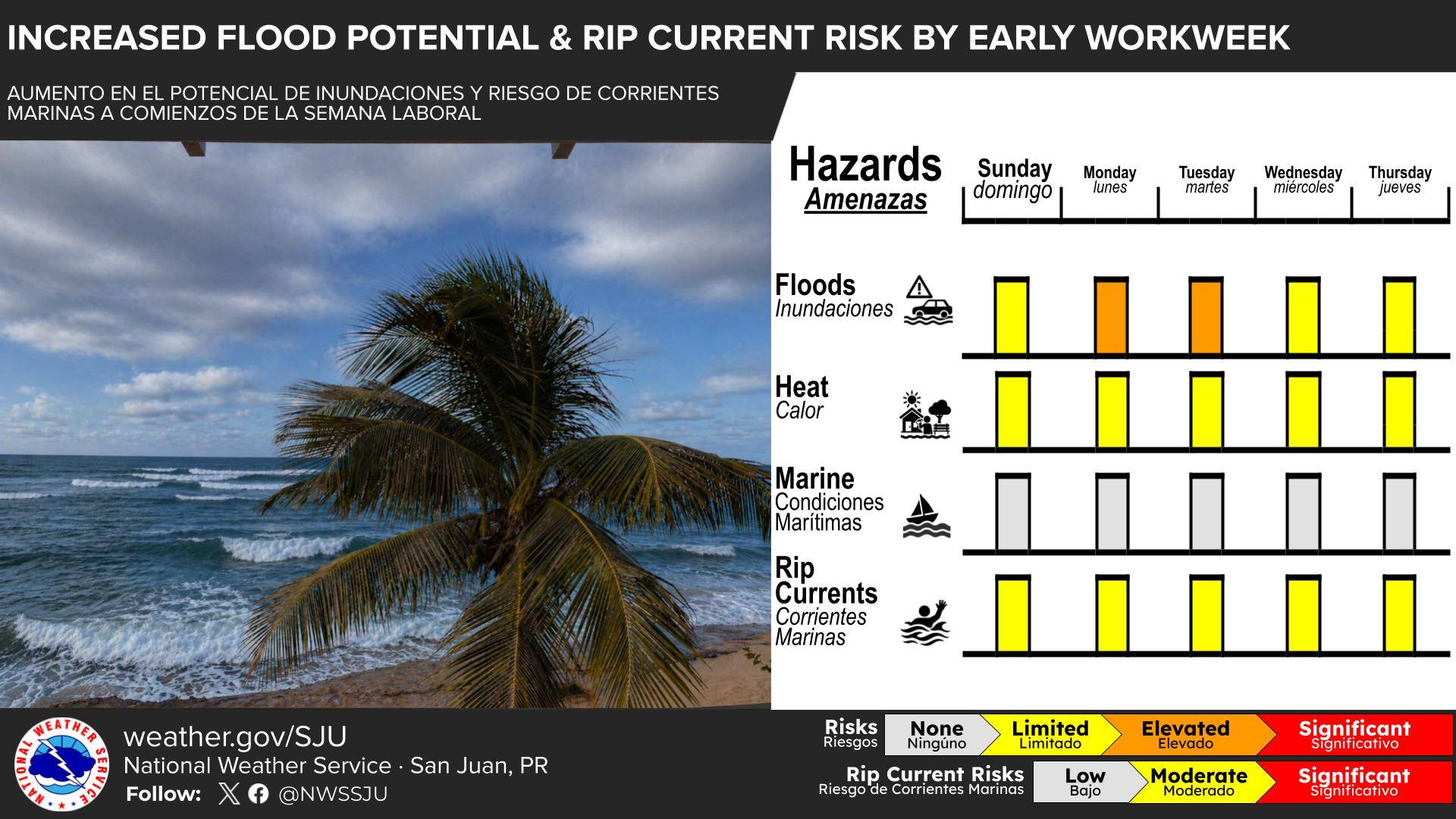
According to the National Weather Service in San Juan, Puerto Rico, warm and humid conditions, increasing showers, and isolated thunderstorms are forecast across Puerto Rico and the U.S. Virgin Islands this week.
Elevated Heat Risk Across the Region
The NWS reported that the anticipated warm conditions are due in part to a southerly wind flow across the islands.
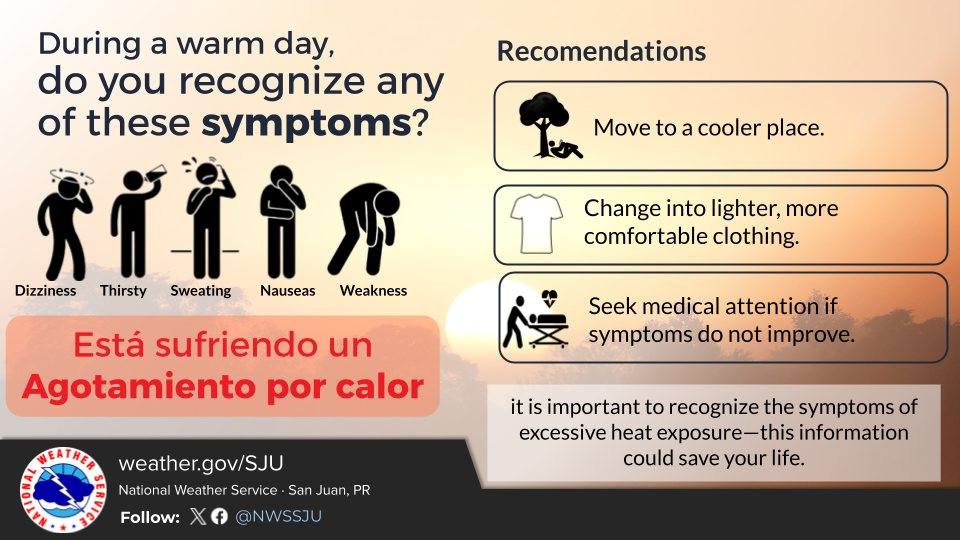
Heat safety guidance highlights precautions for staying safe during periods of excessive heat. (Photo courtesy NWS, San Juan, Puerto Rico)
“Warmer-than-normal conditions will continue across urban and coastal areas of the islands, with heat indices reaching or exceeding 100 degrees Fahrenheit, affecting the more vulnerable individuals,” the NWS said in an update on Monday afternoon.
According to the NWS, “The heat index, also known as the apparent temperature, is what the temperature feels like to the human body when relative humidity is combined with the air temperature.”
The hot weather is forecast to affect both U.S. territories through the end of the week.
“Maximum surface temperatures will range from the upper 80s to low 90s Fahrenheit across coastal and urban areas and from the low to mid 80s Fahrenheit in higher elevations,” the NWS stated. “Combined with high humidity, heat indices are expected to exceed 100 degrees Fahrenheit daily, especially through Friday with slight moderation by late weekend.”
Residents and visitors are encouraged to stay hydrated, take breaks from the heat, and limit prolonged sun exposure in order to remain safe during periods of excessive heat, especially during the warmest parts of the day.
Showers and Thunderstorms Expected This Week
In addition to the warmer weather, the NWS explained that a wetter and more unstable weather pattern is expected throughout the week as moisture continues to move across the region from the Caribbean Sea and northern South America.
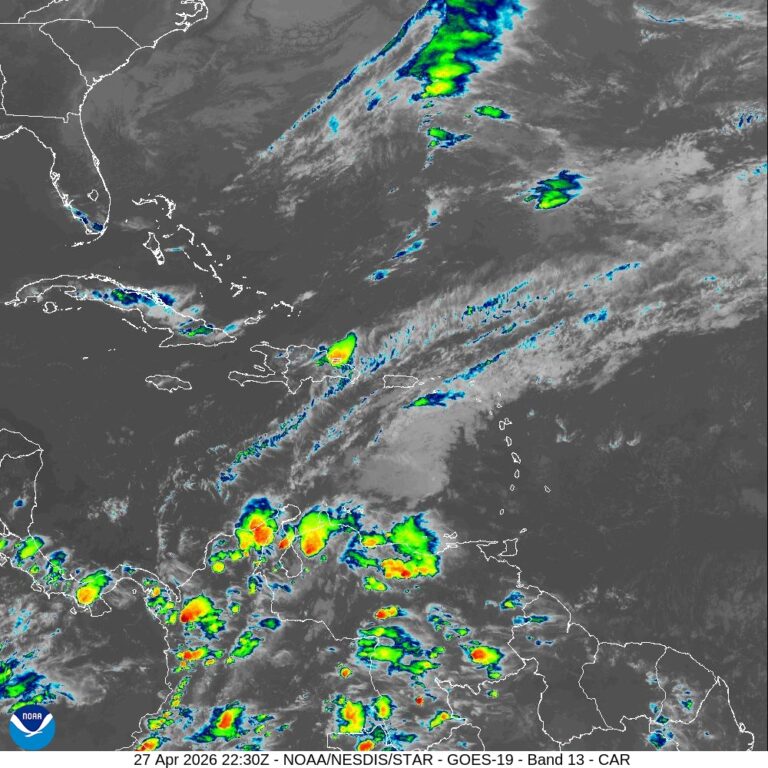
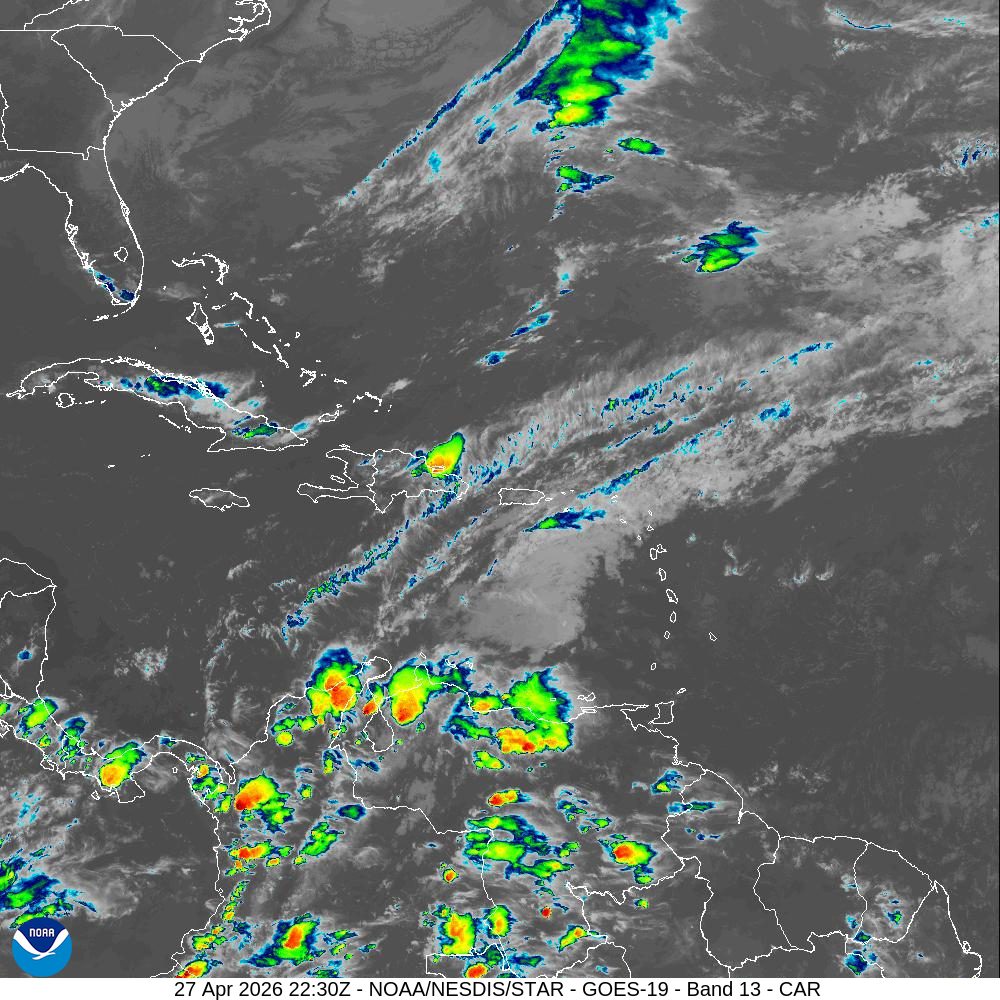
Infrared satellite imagery obtained at 6:30 p.m. AST shows moisture and cloud cover across the region. (Photo courtesy NOAA)
“The frequency of showers will increase late Monday night into early Tuesday across the U.S. Virgin Islands, with ponding of water over roadways and poorly drained areas,” the NWS said.
A limited to elevated flooding risk is expected to persist through much of the short-term forecast period. Rainfall across the U.S. Virgin Islands may be intermittent rather than constant. However, rainfall that does develop could be heavy at times, and decreasing winds may cause some showers and thunderstorms to move more slowly, leading to the increased chance of localized flooding.
Unsettled weather is possible through Friday, with the potential for daily showers and thunderstorms. The NWS reported that a gradual drying trend is expected by the upcoming weekend, with more stable conditions forecast from next Sunday into Monday.
Marine and Beach Conditions
Regarding the local marine conditions, the NWS said that pulses of a small, long-period northeasterly swell will affect the region over the coming days, leading to a low-to-moderate risk of rip currents, along northern and eastern coastlines of Puerto Rico and the USVI. Seas are forecast to remain between two and four feet.
NWS San Juan’s hazard outlook shows increased flood potential and warm weather throughout the week. (Photo courtesy NWS San Juan, Puerto Rico)
Forecasters also reiterated the threat of rainfall and thunderstorms throughout the week.
“In addition to rip currents, beachgoers should remain weather alert as afternoon showers and thunderstorms are expected near northern coastal areas of Puerto Rico, resulting in heavy rainfall, gusty winds, and lightning,” the NWS advised.
Local Weather ForecastWeather hazards can occur year-round, and it is crucial to be prepared. Information regarding the weather across the USVI, including marine forecasts, is available from the NWS and NOAA. With the Atlantic hurricane season set to begin June 1, individuals across the islands are also encouraged to begin preparing for hurricane season.
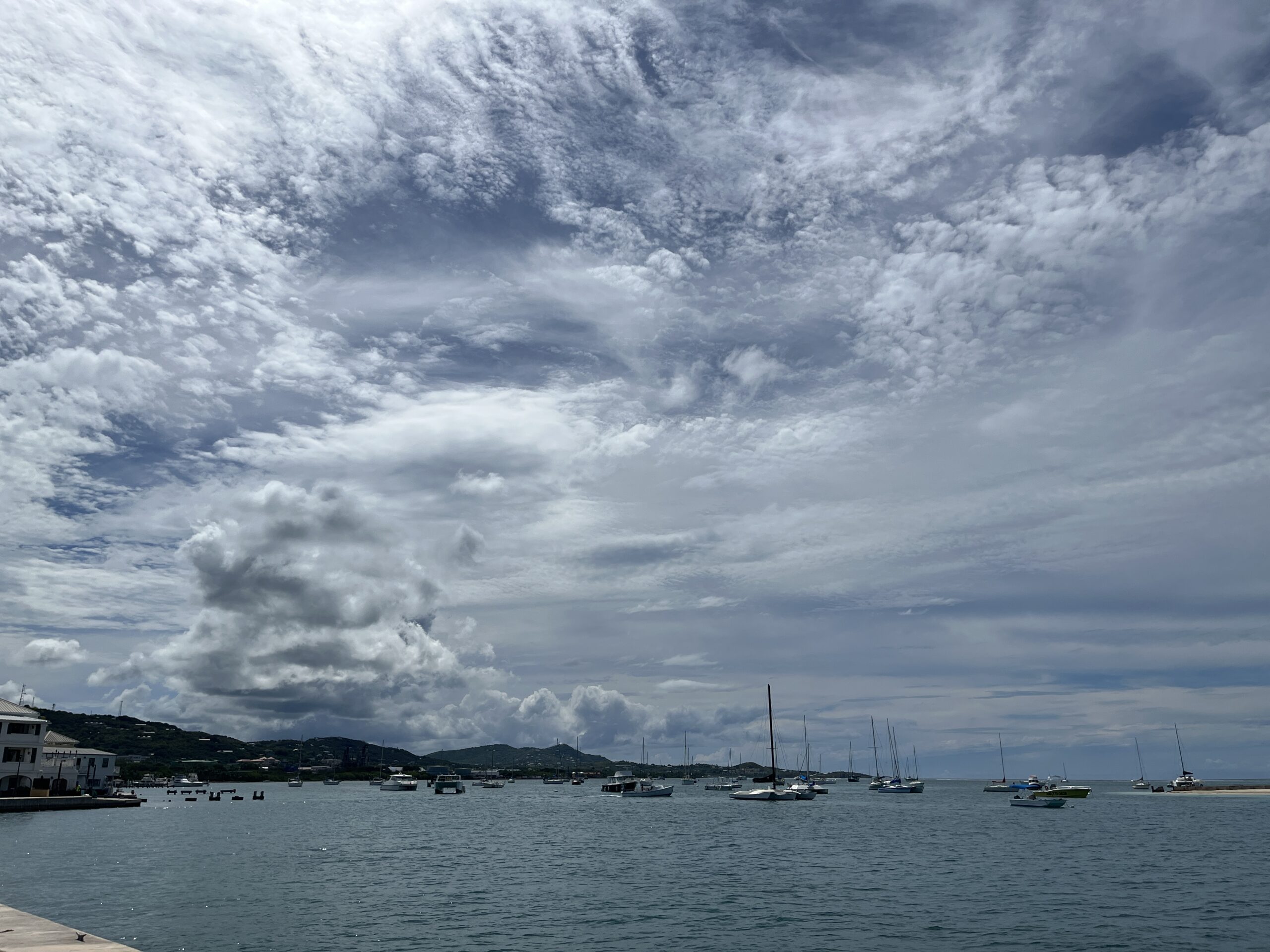
Increasing clouds were visible over Christiansted Harbor on St. Croix on Monday during warm and humid conditions. (Source photo by Jesse Daley)
The local forecast is regularly updated on the Source Weather Page, where a weekly video forecast is available. Additionally, residents and visitors can view weather alerts and disaster preparedness information from the Virgin Islands Territorial Emergency Management Agency.
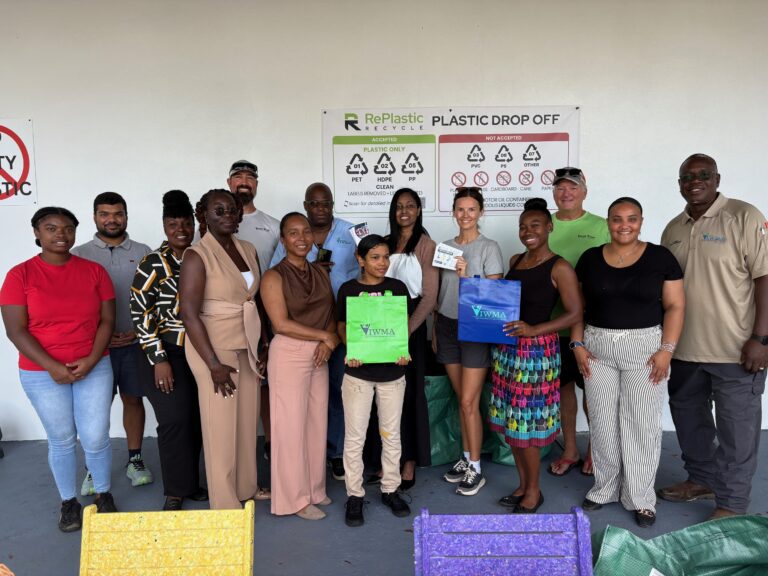
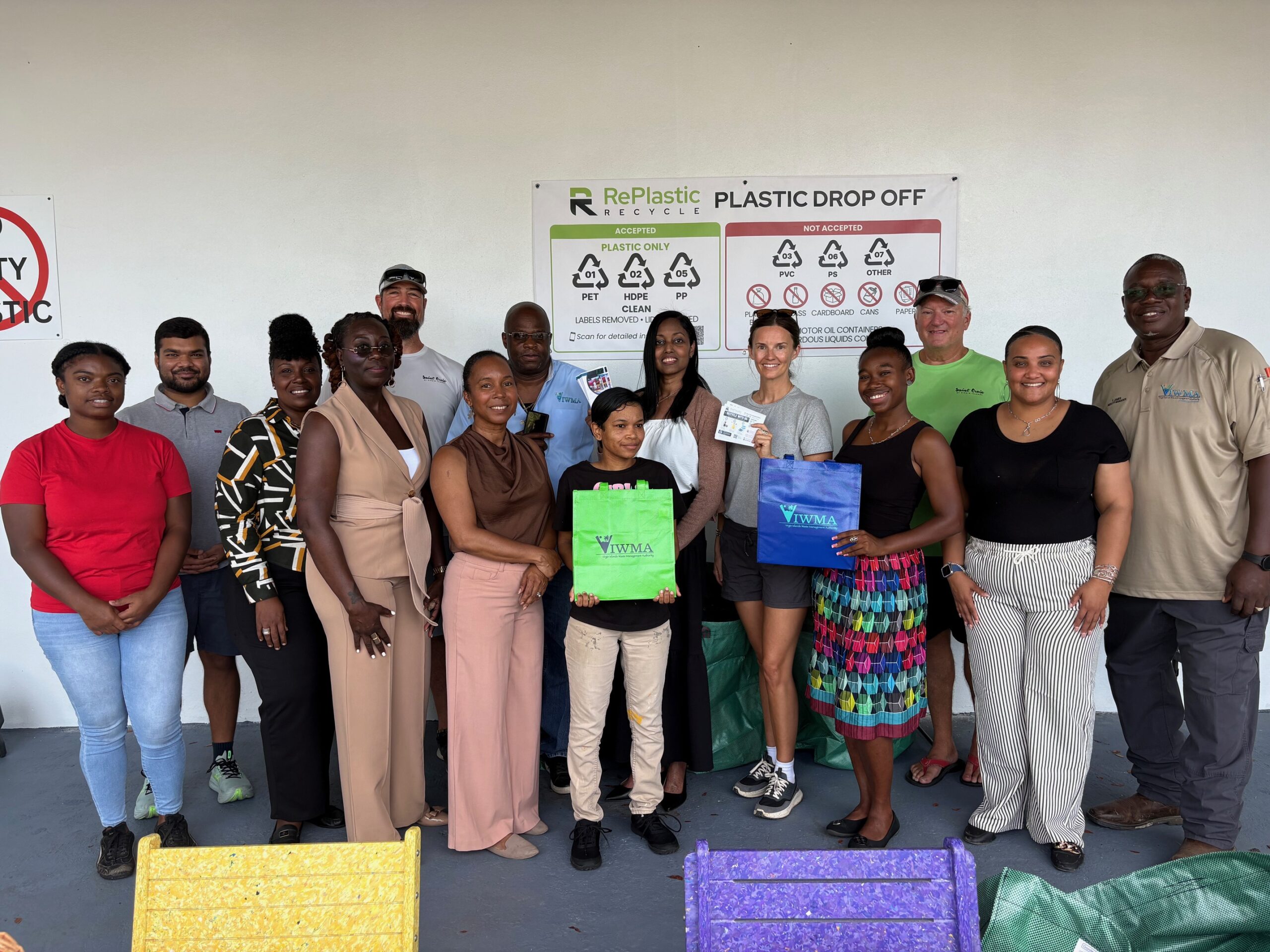
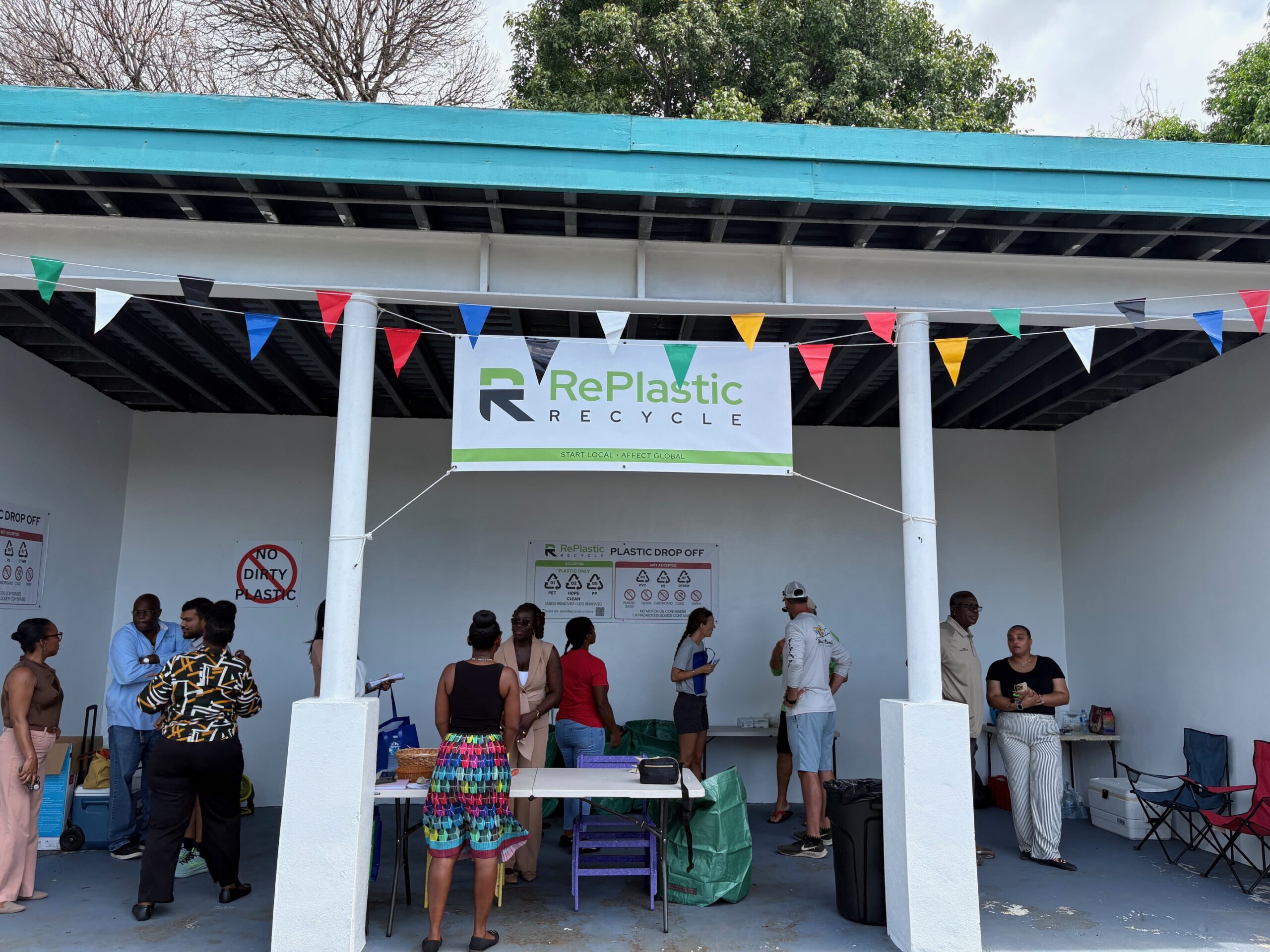
A new partnership aimed at reducing plastic waste and strengthening recycling efforts in the U.S. Virgin Islands officially launched on Monday at the Peter’s Rest Convenience Center on St. Croix. (Source photo by Diana Dias)
A new partnership aimed at reducing plastic waste and strengthening recycling efforts in the U.S. Virgin Islands officially launched on Monday at the Peter’s Rest Convenience Center on St. Croix, as one of the territory’s own companies gains international attention for its work.
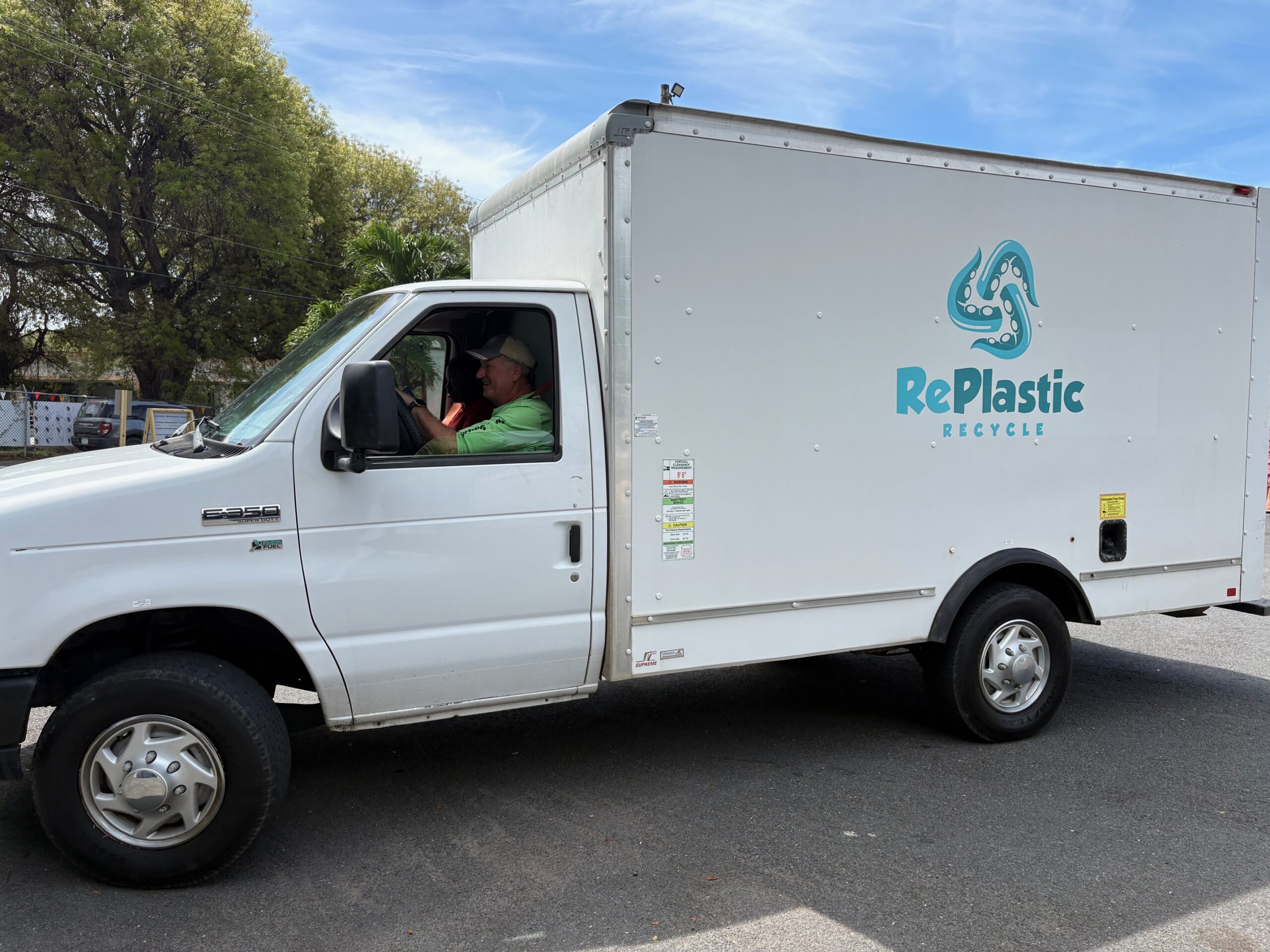
The initiative, a collaboration between RePlastic Recycle LLC — owned by Steve Chmura, Amy Bowler and Lacy Geddie — and the Virgin Islands Waste Management Authority, introduces a dedicated plastic collection station at the Peter’s Rest Convenience Center, where residents can now drop off recyclable plastics for local processing.
The launch comes just weeks after RePlastic was selected to present its model at a global sustainability summit, signaling growing recognition of a program that began as a small, community-driven effort on St. Croix.
“We’re super excited. This has been a long time coming,” said Lacy Geddie, a co-owner of RePlastic Recycle LLC, who was on site for the launch. “We’ve worked really hard on this partnership, and there’s just a lot of gratitude for everything Waste Management has done to help make this possible.”
The program accepts plastics labeled #1, #2 and #5 — commonly used for items such as water bottles, detergent containers and food packaging. Residents are encouraged to bring clean plastics with labels removed and lids taken off.
Unlike traditional recycling systems, visitors are not required to sort materials themselves.
“When people bring us their plastic, we won’t make them sort it,” Geddie explained. “Our staff will go through everything, separate what we can use, and return anything that doesn’t meet the guidelines.”
The collection site is staffed Monday through Saturday from 9 a.m. to 4 p.m., with team members available to guide residents through the process and answer questions. Educational materials are also available on site to help the public better understand recycling practices.
The recycling center is located at the Peter’s Rest Convenience Center on St. Croix. (Source photo by Diana Dias)
Organizers emphasized that the effort is designed to be accessible and community-focused.
“Don’t be nervous about bringing the wrong things,” Geddie said. “We’re here to teach, and we’re never going to shame anyone. Recycling is a learning process, and we want to make it as simple and welcoming as possible.”
All collected plastic will remain on St. Croix, where it will be processed into building materials such as plastic lumber, pavers and interlocking blocks — an approach that not only reduces landfill waste but also supports local manufacturing and job creation.
That model is now drawing international interest. RePlastic’s selection for a global summit highlights how locally developed solutions in the Virgin Islands are contributing to broader conversations about sustainability, particularly for island communities facing similar waste and environmental challenges.
RePlastic staff was on sight to greet and educate customers as they dropped off items. (Source photo by Diana Dias)
Officials with the Waste Management Authority say the partnership reflects broader goals to reduce landfill waste and improve environmental sustainability.
“Waste Management Authority is excited to partner with RePlastic Recycling,” said Berita Coggins-Saldana, chief of staff at the authority. “We encourage shared responsibility with the public. Today marks a significant step in strengthening recycling efforts in the territory. We are heading in the right direction in diverting plastic from our landfills.”
While there was some hint of plans to expand the types of materials accepted in the future, it was noted that those efforts are still in development.
For now, this partnership is built on the hope that the community embraces the new program and plays an active role in reshaping how waste is handled across the island.
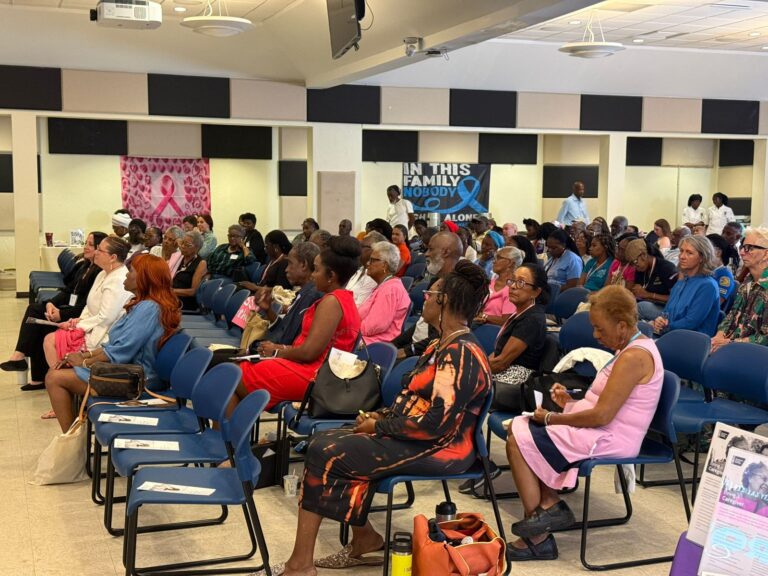
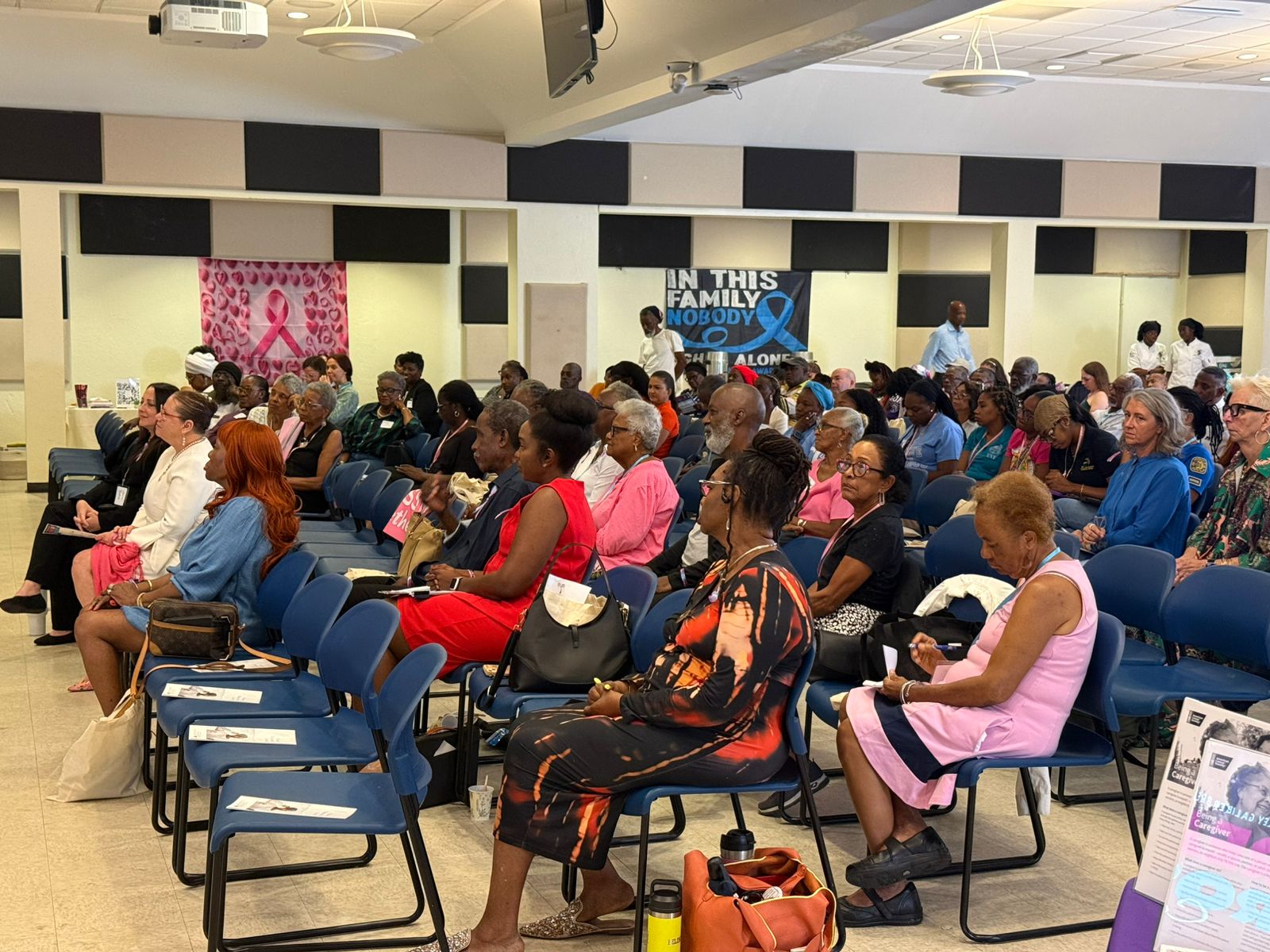
The Yvonne Ashley Galiber Breast Cancer Foundation brought together survivors, medical experts, advocates, and community members for a two-day Breast and Prostate Cancer Conference held Friday and Saturday at the University of the Virgin Islands Albert A. Sheen Campus Great Hall. (Photo from the Yvonne Ashley Galiber Breast Cancer Foundation Facebook page)
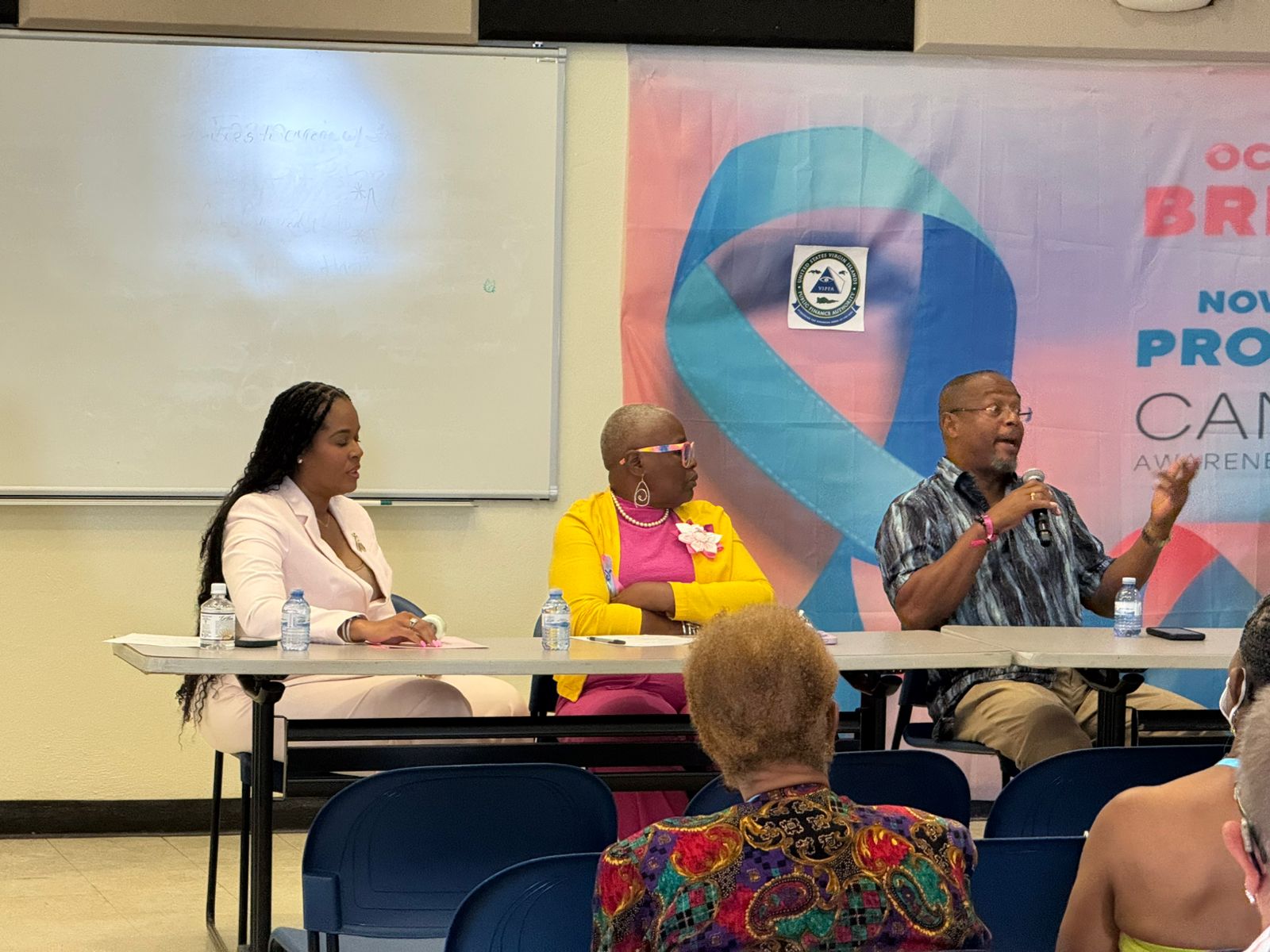
The Yvonne Ashley Galiber Breast Cancer Foundation brought together survivors, medical experts, advocates, and community members for a two-day Breast and Prostate Cancer Conference held Friday and Saturday at the University of the Virgin Islands Albert A. Sheen Campus Great Hall on St. Croix.
Centered on the theme “Linked by Genes. United by Hope,” the admission-free event expanded the foundation’s long-standing breast cancer programming to include prostate cancer, highlighting the growing need for open conversations about genetic risk, family history, and early detection in the Virgin Islands.
“We are finding more and more that if we don’t understand our genetic inheritance in our family line, we don’t always understand how cancer passes from generation to generation,” said YAGF President Cassandra Dunn. “Families have to talk about what is happening so the next generation understands their health legacy.”
Funded in part by the USVI Public Finance Authority, the conference featured 22 presenters and 33 sessions over two days, with experts traveling from the mainland United States and across the Caribbean, including Atlanta, Texas, Florida, Antigua, and Puerto Rico.
Gov. Albert Bryan, Jr. was also in attendance at the two-day seminar. (Photo from the Yvonne Ashley Galiber Breast Cancer Foundation Facebook page)
The conference was held in memory of the foundation’s founder, Yvonne Ashley Galiber, who died in May 2025 at age 62. A survivor of both breast and thyroid cancer, Galiber was remembered for her commitment to ensuring Virgin Islanders had access to lifesaving care and information.
“Yvonne believed in closing the gaps — between diagnosis and care, between fear and understanding, and between those with access to health resources and those without,” Dunn said. “Cancer touches all of us. We must talk about it.”
The conference opened with keynote speaker Dr. Lauren Bates of the University of South Florida, who addressed cancer research, environmental factors, and the importance of sustainable health practices. On the second day, Dr. Jade Jones of Emory University — a St. Croix native — delivered a keynote on breast cancer risk and clinical trials, emphasizing opportunities for Virgin Islanders to participate in research.
Sessions throughout the conference covered a wide range of topics, including the emotional toll of cancer, nutrition, exercise, caregiving, and emerging treatment approaches. Dr. Zina Peters addressed the psychological impact of diagnosis, while Dr. Simeon Jaggermauth highlighted the often-overlooked reality of male breast cancer. Other presentations explored alternative therapies, cancer care planning, and regional trends, with medical professionals, including Dr. Wilfred Labiosa and Dr. Dwayne Thwaites, sharing insights specific to Caribbean populations.
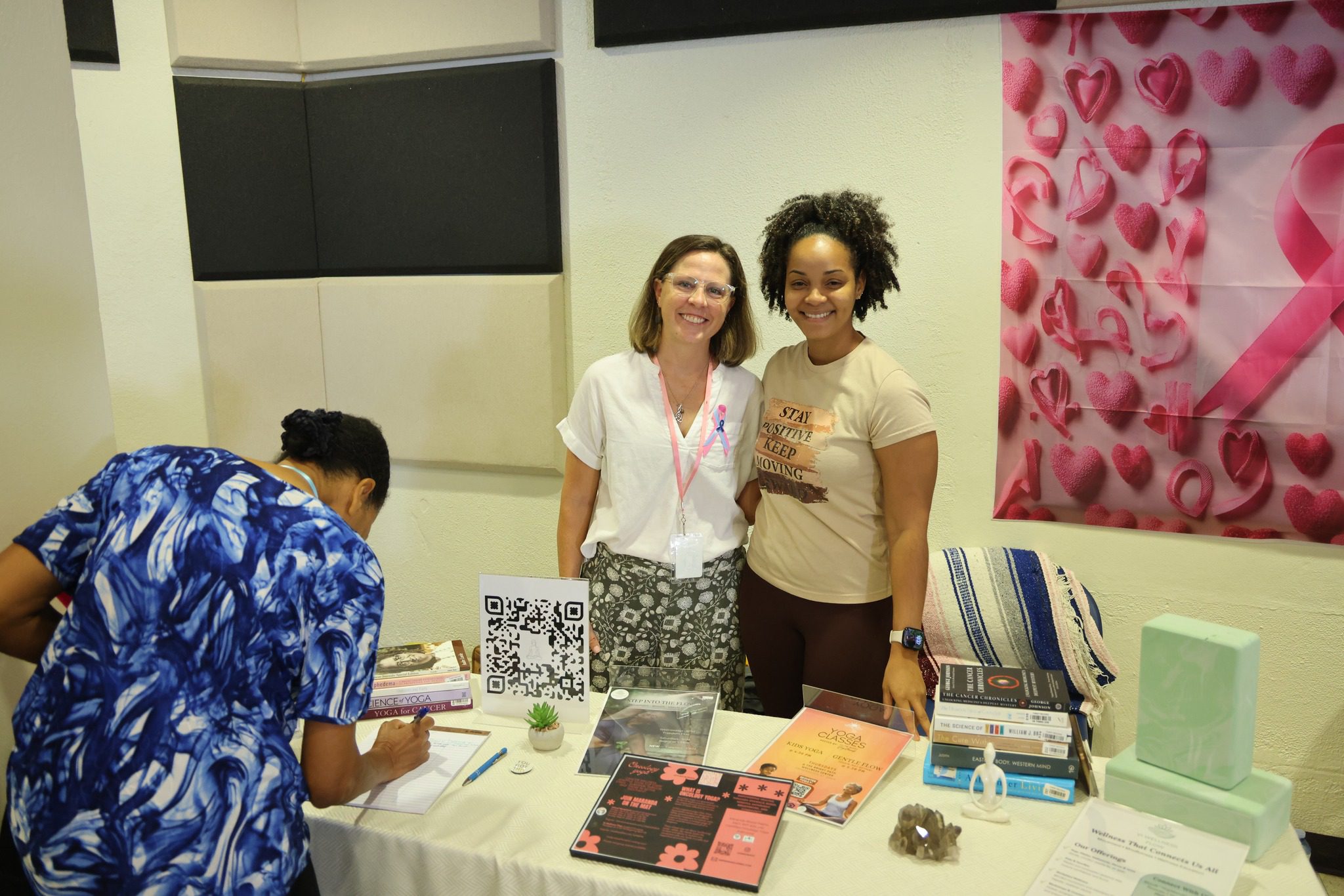
Interactive elements, including private “chat room” sessions and chair yoga led by an oncology-trained instructor, gave attendees opportunities to engage more personally with both experts and one another.
Interactive elements, including private “chat room” sessions and chair yoga led by an oncology-trained instructor, gave attendees opportunities to engage more personally with both experts and one another. (Photo from the Yvonne Ashley Galiber Breast Cancer Foundation Facebook page)
One of the most impactful moments came during a panel featuring survivors and advocates, including Sen. Franklin “Frankie” Johnson, who shared his prostate cancer journey in candid detail. Organizers said his presentation walked the audience through each stage of treatment and recovery, offering a deeply personal perspective on the disease.
Sen. Franklin “Frankie” Johnson, who shared his prostate cancer journey in candid detail. Organizers said his presentation walked the audience through each stage of treatment and recovery, offering a deeply personal perspective on the disease. (Photo from the Yvonne Ashley Galiber Breast Cancer Foundation Facebook page)
The audience also heard from a six-year-old participant who shared her experience losing her mother to breast cancer, as well as survivors speaking about early diagnoses and aggressive forms such as triple-negative breast cancer. Organizers said these stories helped break down stigma and encouraged more open dialogue, particularly among men.
“We wanted people to know it’s okay to speak about these things,” Dunn said. “If you’re a man, speak about prostate cancer. Speak about breast cancer. These conversations save lives.”
Beyond education, the conference aimed to strengthen collaboration among local organizations. Members of the Virgin Islands Cancer Coalition hosted informational tables, connecting attendees with resources and support services.
Organizers said feedback from participants was overwhelmingly positive, with many calling for the event to become a regular offering.
“We believe we raised awareness for both breast and prostate cancer and helped deepen community connections,” Dunn said. “If people understand the full continuum — prevention, early detection, treatment, and survivorship — then we can truly make a difference.”
The event concluded with a closing reception at the Caribbean Museum Center for the Arts.
YAGF continues its mission to support cancer patients and families across the territory through education, advocacy, and direct services, including funding for mammograms and biopsies for underserved and uninsured residents.
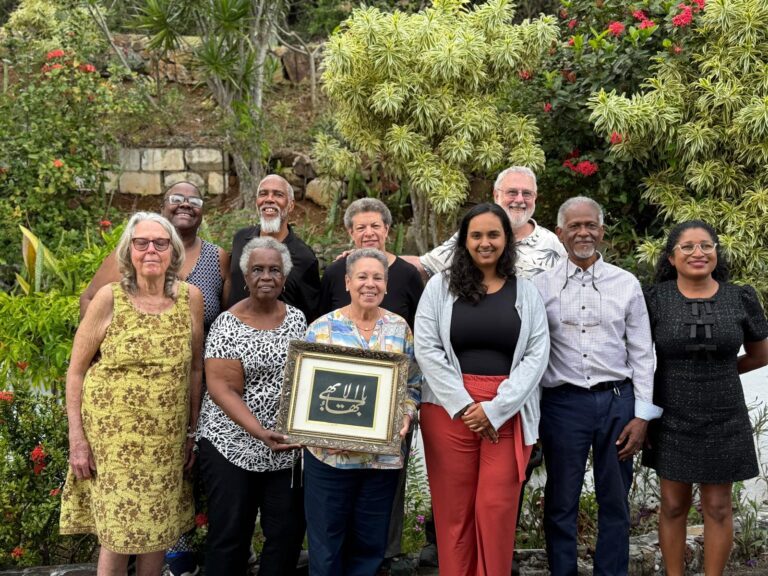
The Bahá’í community of the Virgin Islands gathered April 24–26 for its 58th Annual National Convention, a central event in the administrative life of the Bahá’í Faith.
The Bahá’í community of the Virgin Islands gathered April 24–26 for its 58th Annual National Convention, a central event in the administrative life of the Bahá’í Faith.
Eighteen delegates elected from communities across the Virgin Islands met at the Bahá’í National Center to consult on the progress of the Faith and elect the nine‑member National Spiritual Assembly, the governing body responsible for guiding and coordinating community progress, and explore opportunities to strengthen the spiritual and social life of the Virgin Islands.
Bahá’í elections are distinctive in that no nominations or campaigning are permitted, delegates vote by secret ballot in a reverent, prayerful atmosphere, and electors consider spiritual qualities such as integrity, humility, and a record of service.
The National Convention coincides with the Festival of Riḍván, a twelve‑day period commemorating Bahá’u’lláh’s declaration of His mission and celebrated worldwide as the “King of Festivals.” During this sacred season, Bahá’ís reflect on themes of peace, justice, and the oneness of humanity, values that guide the deliberations of the Convention.
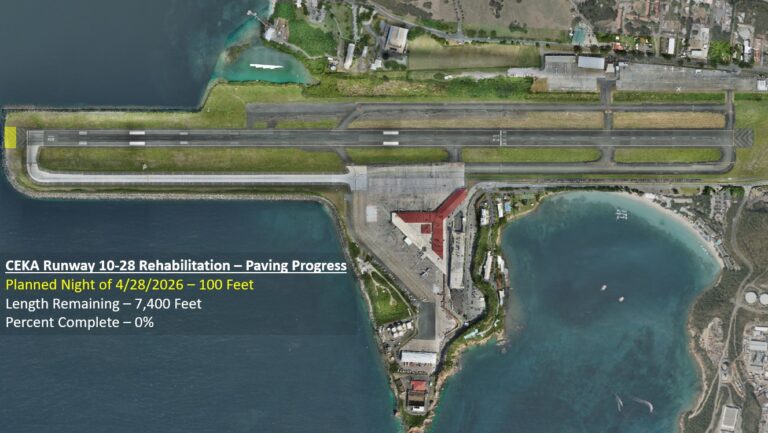
The paving and rehabilitation of the Cyril E. King Airport runway is set to begin on Tuesday, April 28.
The paving phase of the resurfacing of the airport’s 7,000-foot runway involves milling the top three inches of the existing asphalt pavement and then applying a new three-inch layer of asphalt surface. Additionally, the project will incorporate electrical upgrades, including new LED runway and navigational lighting.
The $27 million project is being executed with Island Roads Corporation and is primarily funded by a federal grant from the FAA and Passenger Facility Charges. VIPA aims to significantly reduce the likelihood of unexpected pavement failures, improve runway reliability, and ensure the safety and continuity of aviation services for travelers.
The last major rehabilitation of the CEKA runway took place in 2012. VIPA has been planning this current project in collaboration with airport users, the Federal Aviation Administration, and other stakeholders since 2018.
While VIPA does not expect any significant disruptions to air travel in St. Thomas, the agency apologizes for any inconvenience caused by the nightly closures as it works to complete these crucial improvements to the runway infrastructure. During the paving portion of the project, VIPA will provide progress updates to the public.
Gov. Albert Bryan Jr. has signed Executive Order No. 545-2026, implementing a new General Schedule pay plan for non-union classified employees in the Executive Branch of the Government of the Virgin Islands.
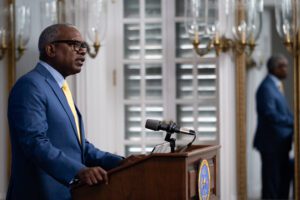
Gov. Albert Bryan Jr. at Government House on St. Croix. (Source photo by Kit MacAvoy)
The executive order is necessary to bring the government’s non-union classified pay structure into compliance with Act No. 8995, which increased the minimum annual salary for full-time employees of the Government of the Virgin Islands, its semi-autonomous agencies, and independent instrumentalities from $27,040 to $35,000.
Governor Bryan said the executive order reflects his administration’s responsibility to follow the law while implementing the mandate in a structured and fiscally responsible way.
“I have been clear from the beginning that Virgin Islands workers deserve better pay,” Governor Bryan said. “I have also been clear that we cannot govern by hope alone. A pay increase of this magnitude must be implemented with a plan, with accurate data, and with the discipline to make sure we do not weaken the very government services our people depend on. This executive order puts that structure in place for non-union classified employees and ensures that the law is carried out in an orderly and responsible manner.”
Under Executive Order No. 545-2026, all non-union classified employees covered by the order will be placed into the updated GS pay plan beginning October 1, 2026, for Fiscal Year 2027.
Employees will not be placed below their current salary and will receive a one-step increase within their assigned pay grade.
The executive order also provides for additional one-step increases in Fiscal Years 2029, 2031, 2033, 2035, and 2037, subject to the structure of the new GS pay plan. Once an employee reaches the final step in a grade, no additional step increase will be granted under that grade.
The Fiscal Year 2027 Budget Proposal submitted to the Legislature includes funding for the initial placement of employees into the new GS pay plan and the first one-step increase. The Office of Management and Budget will include the scheduled future step increases in the appropriate fiscal year budgets.
Governor Bryan said the action is part of the administration’s broader effort to balance fair compensation with the long-term financial stability of the Government of the Virgin Islands.
“Fair pay and fiscal responsibility are not competing goals,” Governor Bryan said. “The right way to support workers is to make sure compensation reform is sustainable, properly funded, and does not create new obligations the government cannot meet. We have spent years restoring financial discipline, paying down old obligations, issuing tax refunds, addressing retroactive wages, and rebuilding public trust. We are not going back to a time when government made promises without a plan to pay for them.”
The executive order applies only to non-union classified employees in the Executive Branch. It does not authorize pay increases for employees represented by a labor organization or employees in the exempt service of the Government of the Virgin Islands.
Executive Order No. 545-2026 takes effect October 1, 2026, and remains in effect unless amended or repealed by a subsequent executive order.
VITRAN St. Thomas is offering a Carnival Shuttle Run from Monday, April 27 to Friday, May 1.
The shuttle will include 2 buses: one incoming and one outgoing. The shuttle will run from 9 p.m. to 12 a.m. (midnight) from the Bus Depot (in the Contant area) to the Red Hook bus stop.
The stops will include Red Hook, the Tutu Park Mall, Fort Mylner and along the path between Lockhart Gardens and the Depot and then reverse back to Red Hook. The last trip from the Depot to Red Hook will leave at 12 a.m.
Please be reminded no drinking, eating, smoking, loud music, weapons, or yelling or arguing on the bus.
The bus ride is $2.00
Children under 12 – $1.00
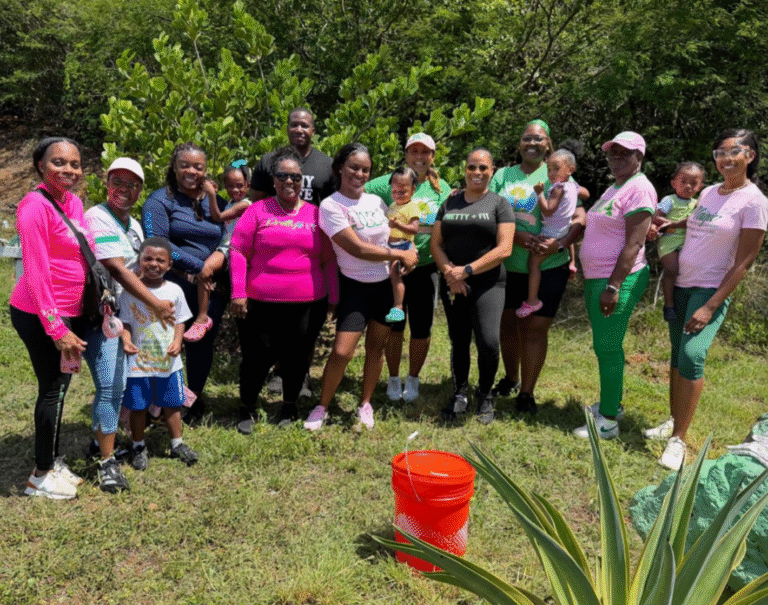
Alpha Kappa Alpha Sorority, Sigma Theta Omega and Rho Omicron Chapters, engaged in a Regional Tree Planting Day April 25. Sorority members and their families gather to plant Lignum Vitae trees at Bolongo Bay, St. Thomas on the sorority’s Regional Tree Planting Day. (Submitted photo)
“Rooted in Service, and Growing in Impact,” chapter members and their families promoted environmental awareness, beautification, and sustainability by weeding the area and planting trees at the Bolongo Bay Site, for the second time.
This initiative reflects Alpha Kappa Alpha’s long-standing commitment to service and improving the quality of life in our communities. Through projects like this, our organization continues to lead efforts that create meaningful and lasting change.
“Planting a tree is an investment in the future,” said Lineek Williams, president of Sigma Theta Omega Chapter. “Today we are planting more than trees – we are planting hope, legacy, and a greener tomorrow.”




 The paving phase of the resurfacing of the airport’s 7,000-foot runway involves milling the top three inches of the existing asphalt pavement and then applying a new three-inch layer of asphalt surface. Additionally, the project will incorporate electrical upgrades, including new LED runway and navigational lighting.
The $27 million project is being executed with Island Roads Corporation and is primarily funded by a federal grant from the FAA and Passenger Facility Charges. VIPA aims to significantly reduce the likelihood of unexpected pavement failures, improve runway reliability, and ensure the safety and continuity of aviation services for travelers.
The last major rehabilitation of the CEKA runway took place in 2012. VIPA has been planning this current project in collaboration with airport users, the Federal Aviation Administration, and other stakeholders since 2018.
While VIPA does not expect any significant disruptions to air travel in St. Thomas, the agency apologizes for any inconvenience caused by the nightly closures as it works to complete these crucial improvements to the runway infrastructure. During the paving portion of the project, VIPA will provide progress updates to the public.
The paving phase of the resurfacing of the airport’s 7,000-foot runway involves milling the top three inches of the existing asphalt pavement and then applying a new three-inch layer of asphalt surface. Additionally, the project will incorporate electrical upgrades, including new LED runway and navigational lighting.
The $27 million project is being executed with Island Roads Corporation and is primarily funded by a federal grant from the FAA and Passenger Facility Charges. VIPA aims to significantly reduce the likelihood of unexpected pavement failures, improve runway reliability, and ensure the safety and continuity of aviation services for travelers.
The last major rehabilitation of the CEKA runway took place in 2012. VIPA has been planning this current project in collaboration with airport users, the Federal Aviation Administration, and other stakeholders since 2018.
While VIPA does not expect any significant disruptions to air travel in St. Thomas, the agency apologizes for any inconvenience caused by the nightly closures as it works to complete these crucial improvements to the runway infrastructure. During the paving portion of the project, VIPA will provide progress updates to the public.