



First-Ever Coral Conservation Festival Brings Community, Science, and Hope Together on St. Croix

0
The Nature Conservancy hosted its first-ever Coral Conservation Festival on Sunday at the Coral Innovation Hub at Estate Little Princess on St. Croix, opening its doors to the community in an effort to raise awareness about coral reef restoration and the critical role reefs play in the U.S. Virgin Islands. “This is actually the first year for the Coral Conservation Festival,” said Semoya Phillips, educational outreach coordinator for the organization’s coral program. “One of the biggest pushes for this program is that we have this lovely facility … and lots of Virgin Islanders do not know it is here.”
CMCArts encourage young people to paint educational pieces on fish and their habitats. (Source photo by Diana Dias)
Held at Estate Little Princess, the event brought together government agencies, private partners, researchers, and families for a day of education, activities, and hands-on learning. Booths featured everything from coral restoration efforts to wastewater management systems and marine conservation initiatives. “We have activity partners from both our governmental partners as well as private agencies,” Phillips explained. “It’s a really nice amalgamation of regional and territorial partners … everybody has their own piece.”
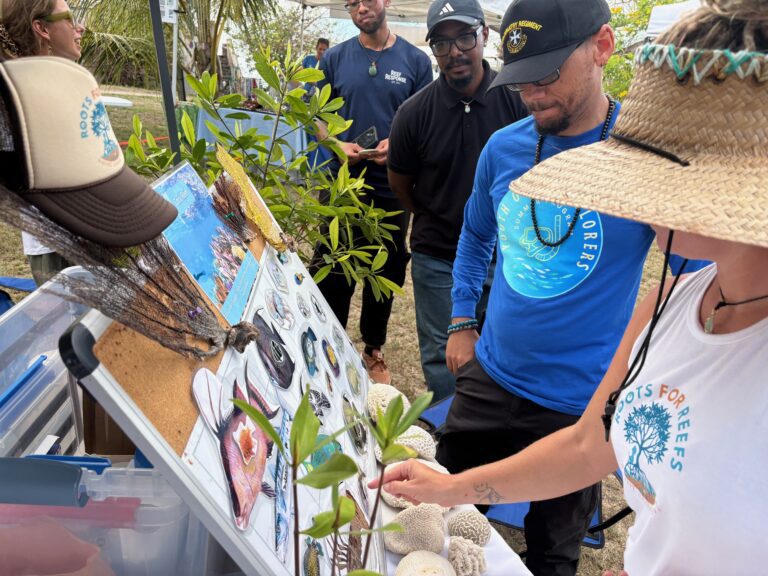
Roots for Reefs play an educational game with visitors, identifying baby fish with their habitats during the Coral Conservation Festival. (Source photo by Diana Dias)
A major goal of the festival was to make coral science more accessible to the public. “One of the amazing things about this facility is that you can see the coral close up,” Phillips said. “You don’t have to swim … you can learn and understand what’s happening without any barriers.” Organizers hope the event sparks curiosity, especially among young people, and encourages deeper community involvement in conservation efforts.
Booth “Eat more Lionfish” made a lionfish ceviche as a display of just how yummy lionfish can be once prepared correctly. (Source photo by Diana Dias)
“I want this to be a nucleus of knowledge about the reefs,” Phillips added, “and for it to flow into the community.” For Jessica Craft Ward, Virgin Islands program director for The Nature Conservancy, the festival represents a long-awaited step toward stronger community engagement. “We are one of the best kept secrets on St. Croix,” Ward said. “The more people we talk to, the more we understand how much people don’t know about us.”
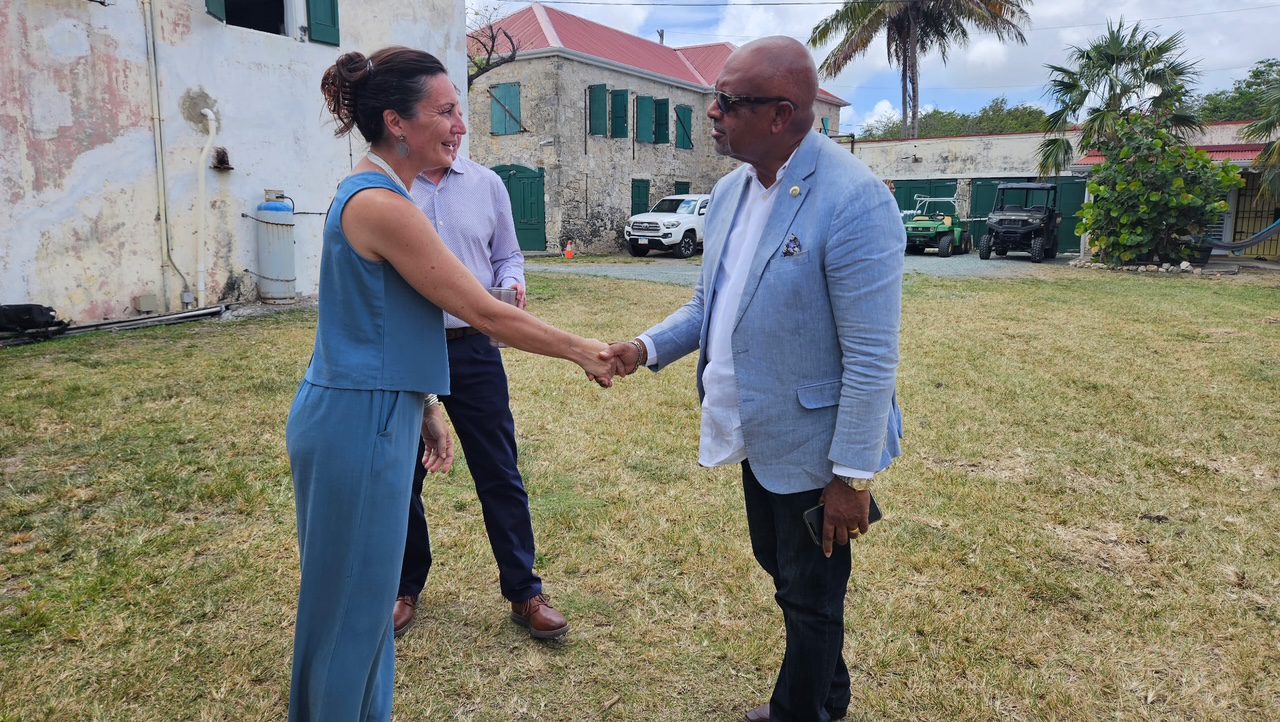
Jessica Ward, the Virgin Islands program director, with Lt. Gov Tregenza E. Roach at the opening ceremony for the Coral Conservation Festival on Sunday. (Photo by CSam/TNC)
Ward emphasized that outreach is now a key pillar of the organization’s work, alongside land management and coral restoration. “Without engaging the community — especially the youth — our work isn’t as effective,” she said. “We need the next generation to become champions for the environment.” The urgency behind the work was a central theme throughout the festival, as coral reefs across the region continue to face significant threats.
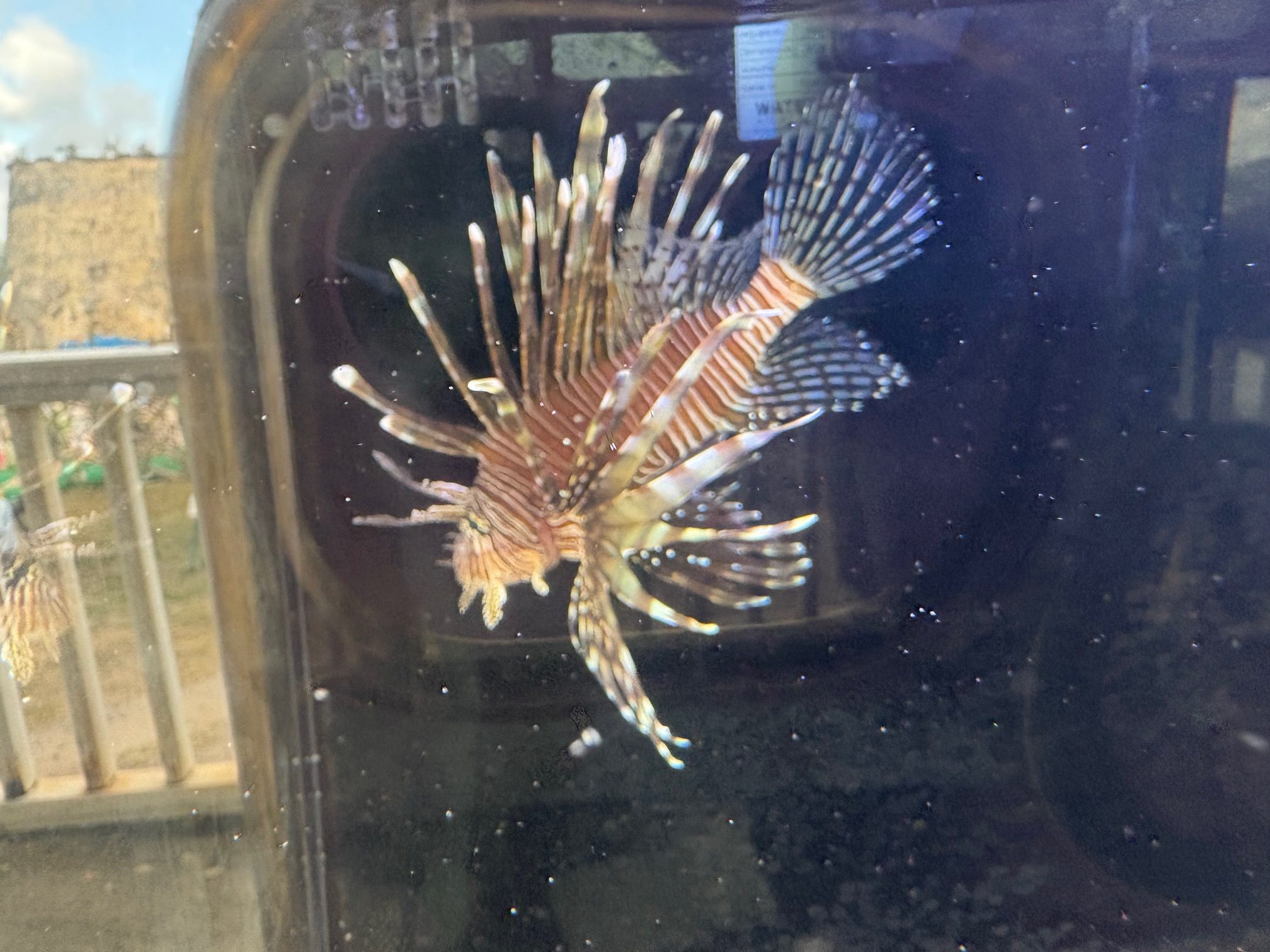
There were also educational booths discussing how lionfish affect the reefs and more about their venomous bodies and how to identify them in the water. (Source photo by Diana Dias)
“Coral reefs have been in decline for decades,” Ward said. “But the last couple of years brought severe bleaching.” Rising ocean temperatures have caused widespread coral bleaching across the Caribbean, with devastating consequences. According to Ward, more than 90% of remaining elk horn coral — a key reef-building species — was lost following recent bleaching events. “That’s a really devastating story,” she said. “We’re not just restoring reefs — we’re trying to save species from going extinct.”
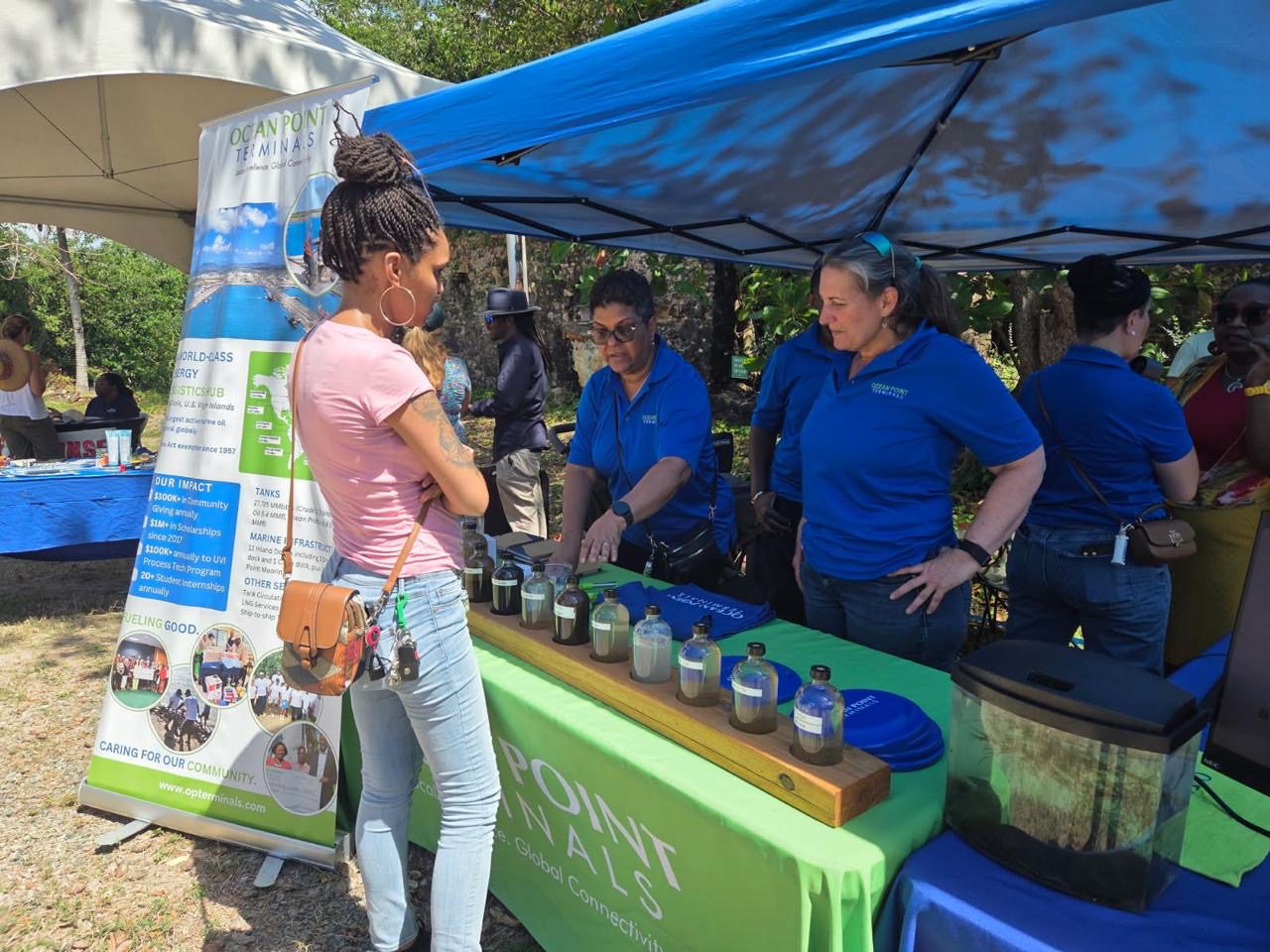
Ocean Point Terminals also participated in the festival with an exhibit. (Photo courtesy Ocean Point Terminals)
The work being done in St. Croix is part of a much larger regional and global effort led by The Nature Conservancy, which has been active in the Caribbean for decades. “The reefs of St. Croix are connected to Puerto Rico, the Dominican Republic, Haiti, the Bahamas — even Florida,” said Rob Brumbaugh, executive director for The Nature Conservancy in the Caribbean. “You can’t just fix one place. These ecosystems are interconnected.” The organization is currently working across multiple Caribbean countries, focusing on large-scale coral restoration and resilience-building to help reefs withstand warming ocean temperatures.
Local business, the Invasive Fire, uses lionfish bones in their jewelry, sold at the festival. (Source photo by Diana Dias)
The facility itself is also evolving to reflect environmental goals. Recently, 164 solar panels were installed as part of a broader shift toward renewable energy, reducing reliance on fossil fuels while supporting the energy-intensive demands of coral restoration work. “These facilities are energy intensive,” said Ward. “We’re trying to transition from fossil fuels to green energy — because we don’t want to contribute to the problem we’re trying to solve.” Beyond the science, organizers say the festival was about connection — bringing together generations of Virgin Islanders to learn, engage, and take pride in protecting their natural resources.
Children played and learned at the festival, an effort that was important for the event’s mission. (Source photo by Diana Dias)
“What gives me hope is seeing generations here,” Brumbaugh said. “Little kids learning about coral, families engaging together — this is how conservation becomes something we live.” With interactive exhibits, educational booths, and a festive atmosphere, the event blended learning with celebration, reinforcing a central message: coral conservation is not just the responsibility of scientists, but of the entire community. “We labeled it a festival for a reason,” Brumbaugh added. “This isn’t just about problems — it’s about joy, learning, and connection.”

VIBE Returns to St. Thomas With Yachts, Jobs Focus and Fundraising Gala

0
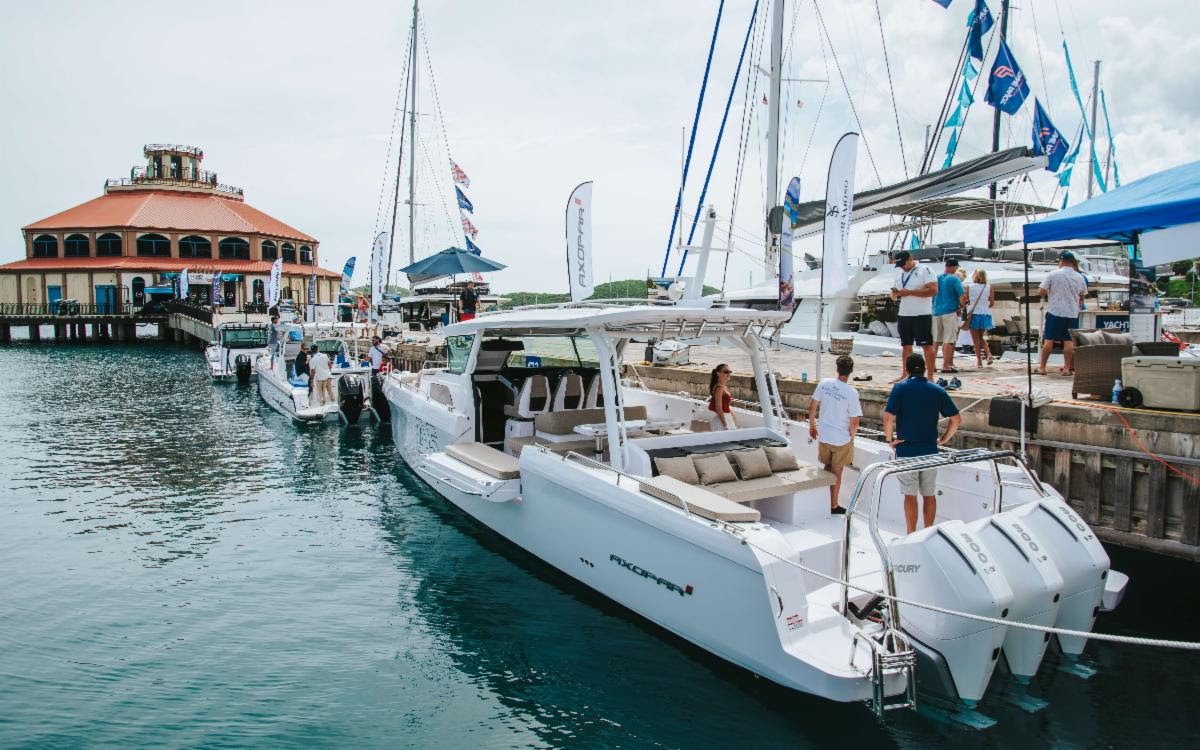
The beautiful VIBE venue at IGY’s Yacht Haven Grande Marina in St. Thomas, U.S. Virgin Islands. (Photo courtesy MediaBoostVI)
The third annual Virgin Islands Boating Expo will return to St. Thomas May 14-16, bringing luxury yachts, global brands and a focus on workforce development to IGY’s Yacht Haven Grande Marina, a press release announced. The event, known as VIBE, will feature yachts available for sale and charter, including power and sail vessels, monohulls and multihulls. Brands such as Axopar, Sunreef, Lagoon and Tiara are expected to participate, according to the press release. Organizers say the marine industry in the Virgin Islands continues to face a shortage of skilled workers, from diesel mechanics to marine electricians and fiberglass technicians. A new addition this year is the “Charting the Future” gala, set for May 16 at Muse in Charlotte Amalie. Proceeds will support the Marine Rebuild Fund, a nonprofit created by the Virgin Islands Professional Charter Association to fund its Marine Apprenticeship program, the release stated.
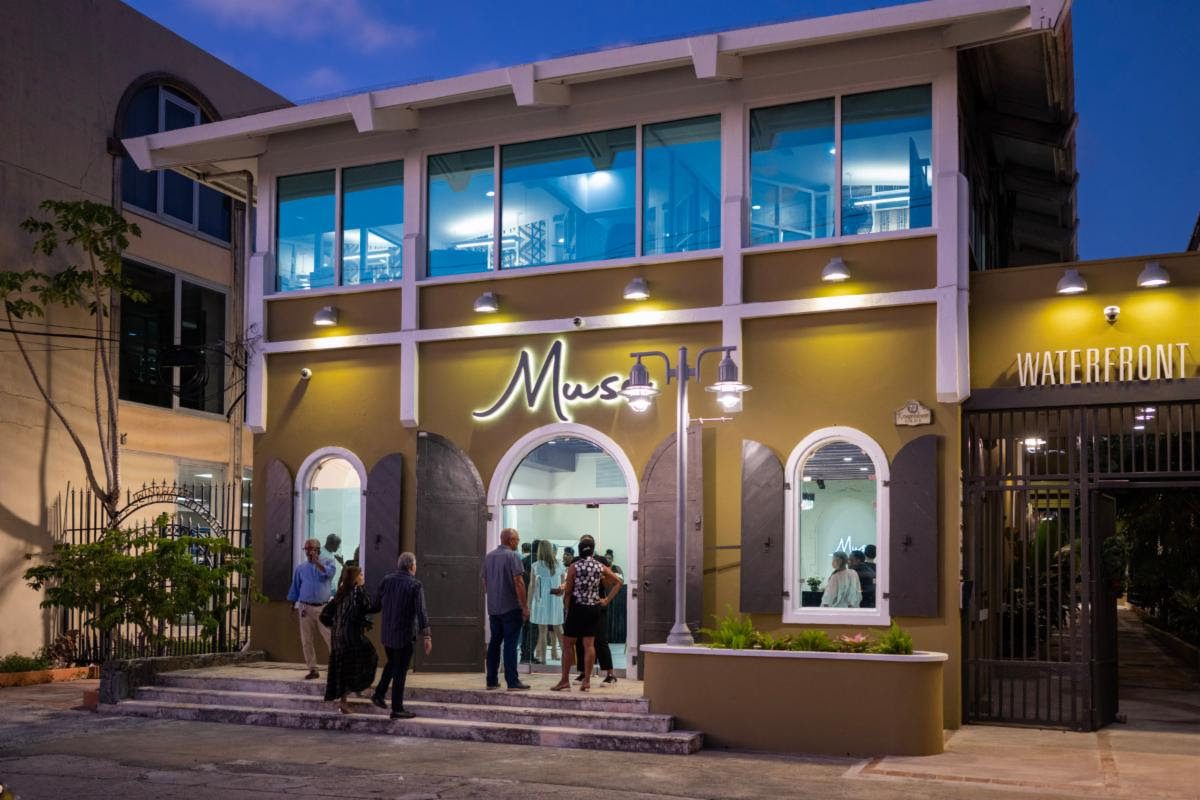
The beautiful venue at Muse, on the Charlotte Amalie Waterfront, will be the setting for the Charting the Future Gala. (Photo courtesy Muse)
“Our industry offers incredible opportunities, but there is a real and growing shortage of technical marine talent in the Virgin Islands,” said Kennon Jones, executive director of VIPCA. “We need to ensure Virgin Islanders are prepared to take advantage of these opportunities.” America’s Cup commentator Tucker Thompson will serve as keynote speaker. He said technical trades are critical to the future of the industry. “The America’s Cup is first and foremost a design and engineering competition,” Thompson said. “There are more opportunities in boatbuilding, systems, and mechanics than there are for sailors.”
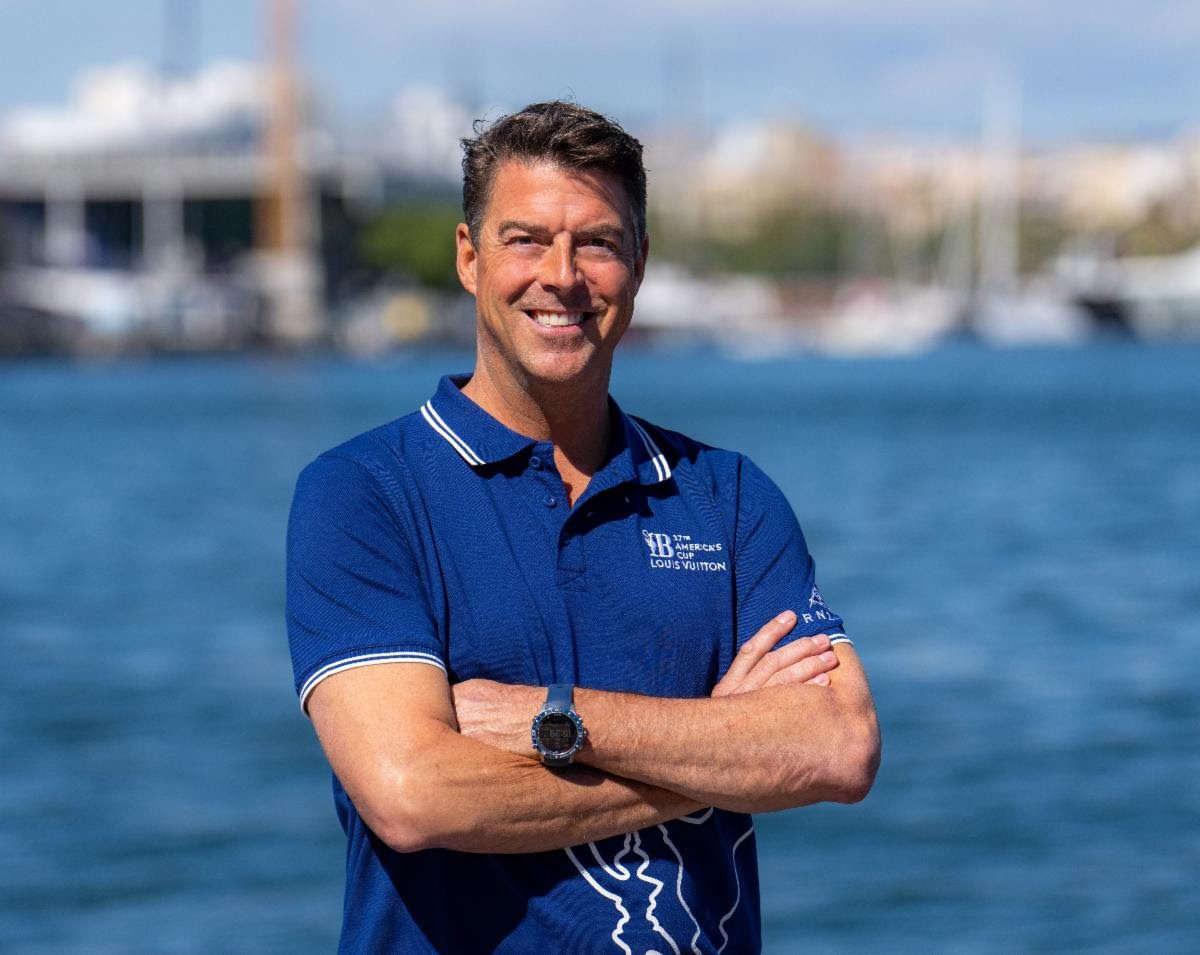
Tucker Thompson, America’s Cup commentator, will be the keynote speaker at the Charting the Future Gala. (Photo courtesy Tucker Thompson)
VIP tickets for the gala include a plated dinner curated by Chef Julius Jackson, open bar, music and a silent auction. General admission tickets will also be available with drinks and light bites from local vendors, the release stated. Since its launch, the Marine Apprenticeship Program has graduated 89 students. Organizers said participants have gone on to earn captain’s licenses, marine certifications and jobs across the territory, with some entering military service.
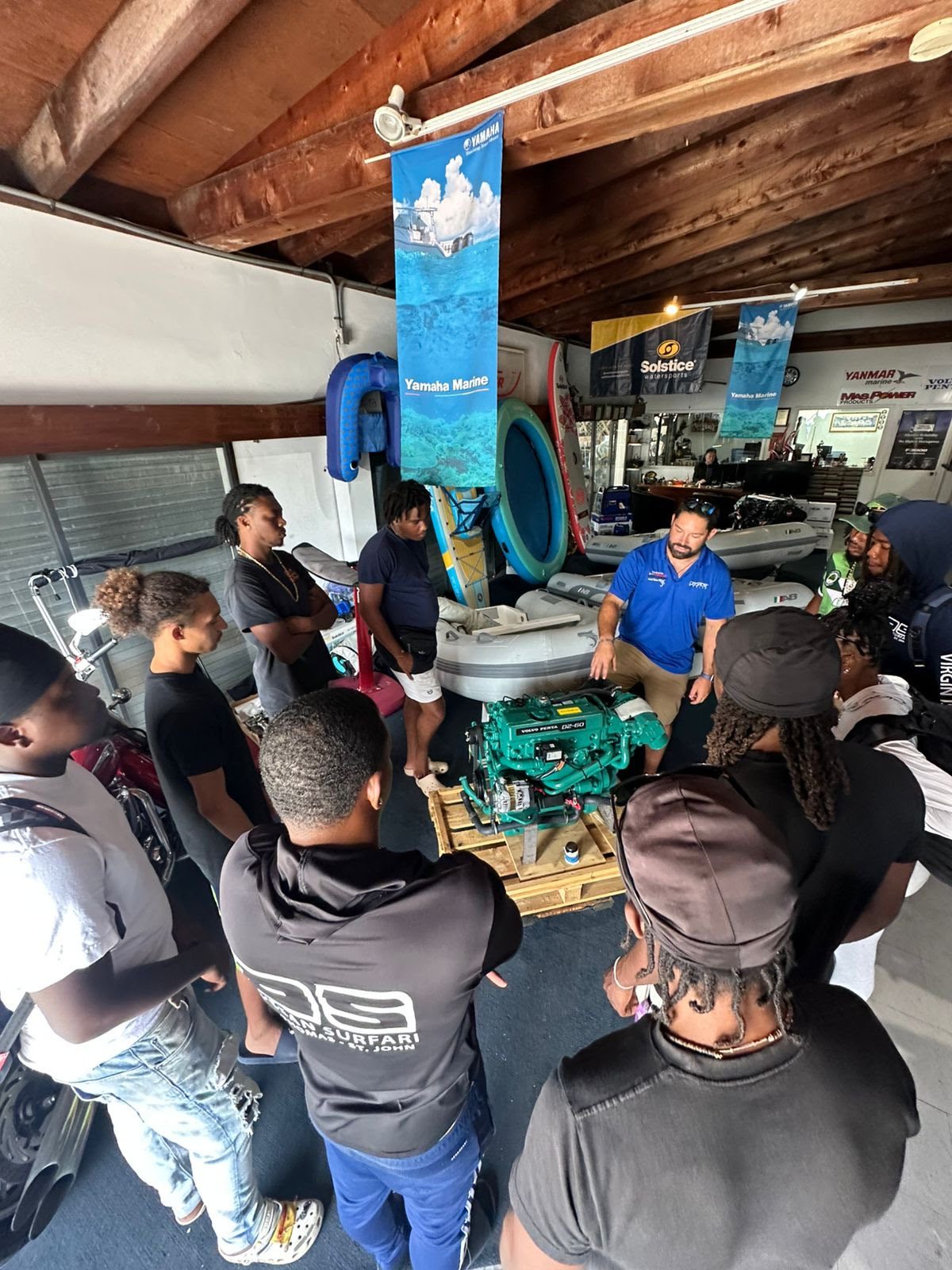
Marine Apprentices in 2025 learn about marine engines at Offshore Marine. (Photo courtesy VIPCA)
Kitty Edwards, director of the Department of Planning and Natural Resources and a founder of the Marine Rebuild Fund, said the program continues to grow. “Every year at the Marine Apprenticeship graduation, I am reinvigorated with pride,” Edwards said. Jamari Benjamin, a program graduate now working at the St. Thomas Sailing Center, said the experience helped build practical skills. “What I value and liked best about the program is that it gets young people out on the water and increases your knowledge, experience, and skills out there,” he said.
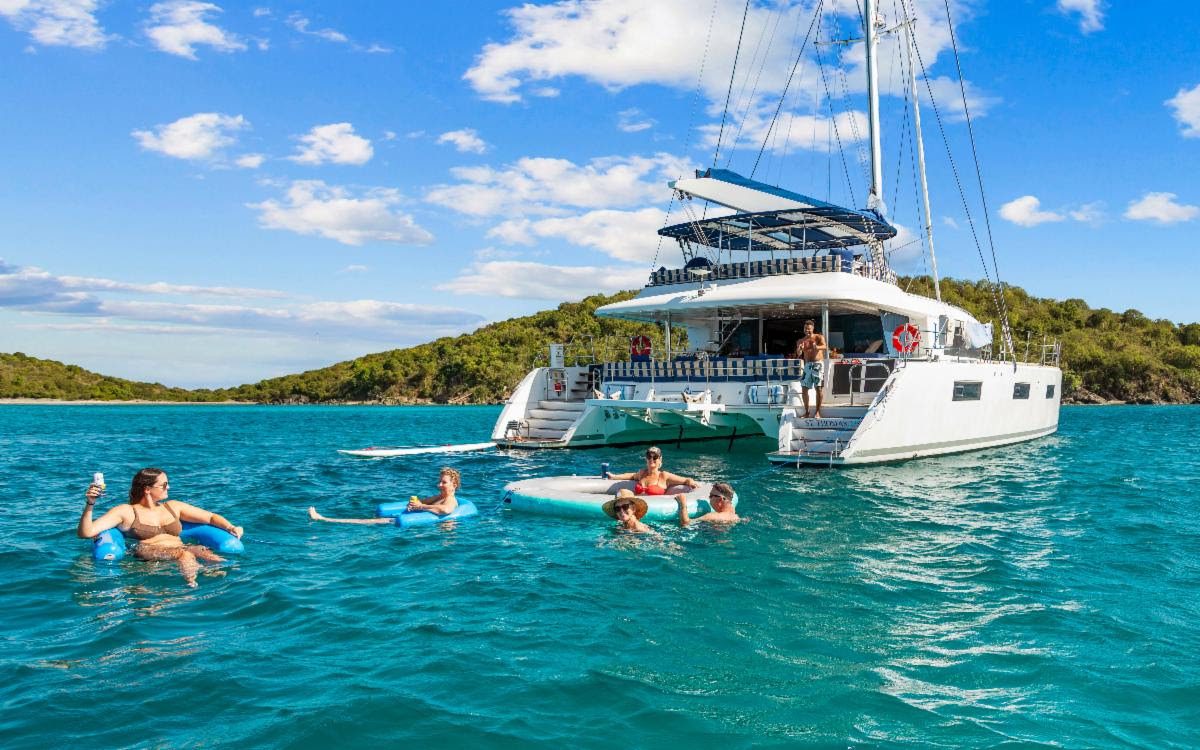
Learn about luxury charters from Charter Smarter at VIBE 2026. (Photo courtesy MediaBoostVI)
Applications for the 2026 apprenticeship are open through May 15. The four-week training is free for eligible Virgin Islands residents ages 18 to 29. Apply here. In addition to yacht tours, VIBE will host the Harbor 360 Vendor Expo, featuring companies in charter services, marine technology and conservation, including the University of the Virgin Islands. Tickets are available online at vibe.vi/tickets. For full VIBE event details, exhibitor information, and sponsorship opportunities, visit www.vibe.vi.

YAG Foundation to Host Breast and Prostate Cancer Conference on St. Croix

0
Community members are invited to attend a free two-day conference focused on cancer awareness, prevention, and support on April 24 and 25 on St. Croix. (Shutterstock image)
The Yvonne Ashley Galiber Breast Cancer Foundation will host a free two-day Breast and Prostate Cancer Conference April 24 and 25 at the University of the Virgin Islands Albert A. Sheen Campus Great Hall on St. Croix, a press release announced. The event, themed “Linked by Genes. United by Hope,” runs from 8 a.m. to 4:30 p.m. on Friday and 7:30 a.m. to 3:30 p.m. on Saturday. Breakfast and lunch will be provided at no cost both days, according to the press release. Organizers said the conference will focus on how genetic makeup, family history and shared heritage influence the risk of breast and prostate cancers, along with prevention, early detection and survivorship. Sponsored in part by the V.I. Public Finance Authority, the event is open to the public and designed to expand access to cancer education, care and support across the territory, the press release stated. The conference is held in memory of the foundation’s founder, Yvonne Ashley Galiber, who died in May 2025 at age 62, the release stated. Foundation President Cassandra Dunn said, “Yvonne believed in closing the gaps—between diagnosis and care, between fear and understanding, and between those with access to health resources and those without. Cancer touches all of us, as patients, as caregivers, as neighbors, as family. We must talk about it.” According to organizers, the agenda will include presentations from local, regional and national experts on cancer risk factors, emotional impacts, genetic inheritance, nutrition, exercise and caregiving. Survivors will also share their experiences. The event will feature separate sessions for men and women to allow for more private discussions, along with chair yoga activities for participants, the release stated. Organizers said the conference is open to attendees from teens to seniors and encouraged early registration at yagfoundation.org. A closing reception will be held at the Caribbean Museum Center for the Arts. The Yvonne Ashley Galiber Foundation is a nonprofit that supports individuals and families affected by cancer in the U.S. Virgin Islands through education, outreach and access to early detection services.

Weekly Weather Forecast With Jesse Daley

0
Check out our weekly weather forecast with Jesse Daley, covering Sunday, April 12, through Saturday, April 18. Please stay safe and follow the Source for more weather updates!

Photo Focus: Music, Sports, Creative Cooks Show Support for Young Sailors

A desire to give young sailors on St. John a chance to keep enjoying life on the water brought the community together for a weekend fundraiser in Coral Bay. Billed as a flotilla and chili cookoff, supporters took a path through the bush to reach a scene filled with fun, song and potfuls of delight.
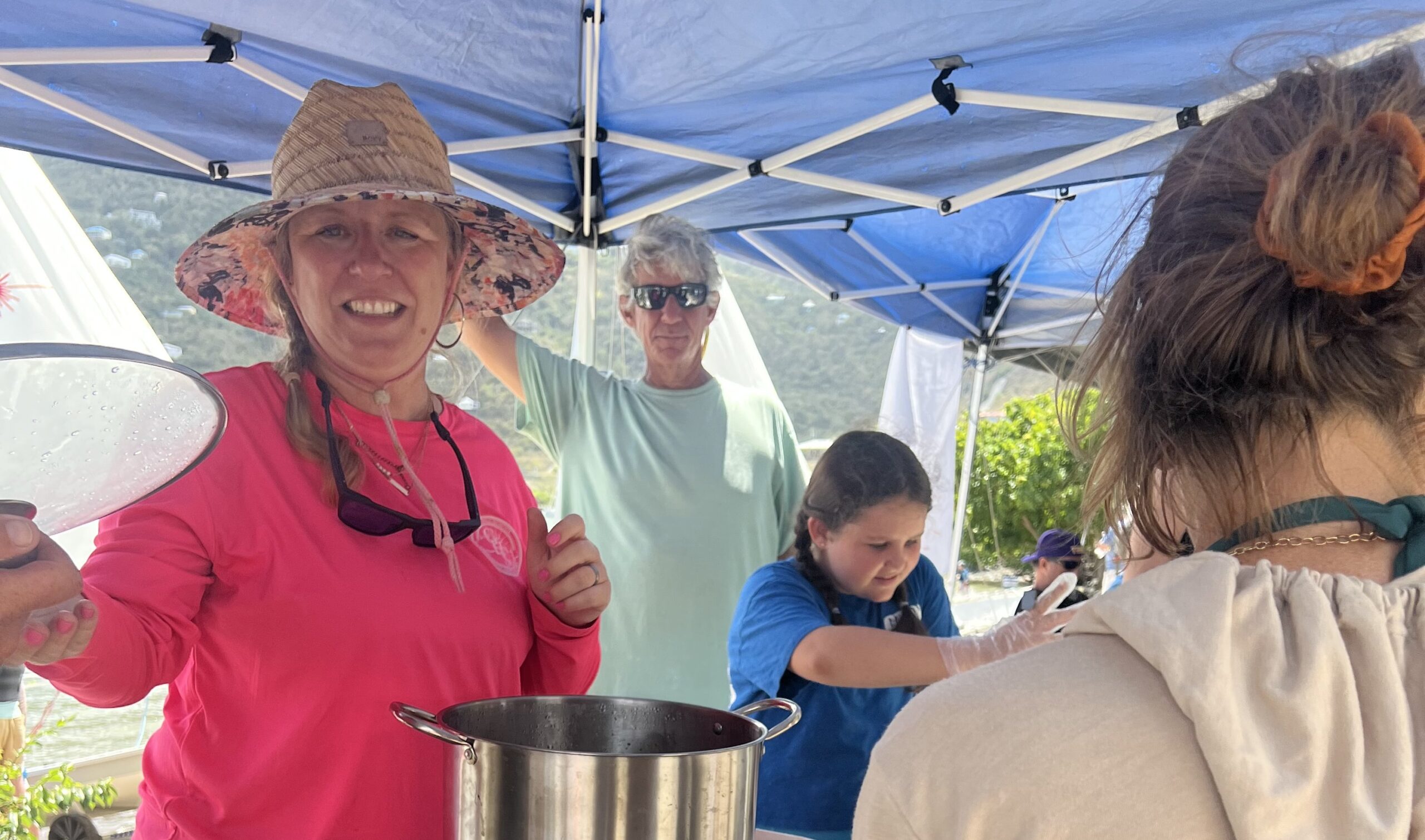
Heather McGuire from Gifft Hill School serves green chili with a smile. (Source photo by Judi Shimel)

Organizers said the Saturday event had become a tradition of sorts, harkening back close to 30 years when members of the Coral Bay Yacht Club teamed up with parishioners from Emmaus Moravian Church for trips to Norman Island.

Yacht Club secretary Mary Burks welcomed guests from a seat at the registration table. “The funds are going for youth sailing on St. John; any child is eligible. We have formed a unique collaboration — St. John Yacht Club, Coral Bay Yacht Club, KATS (Kids and the Sea), and Gifft Hill School are collaborating to put our resources together to make boats, and coaching and funds available for teens,” Burks said.

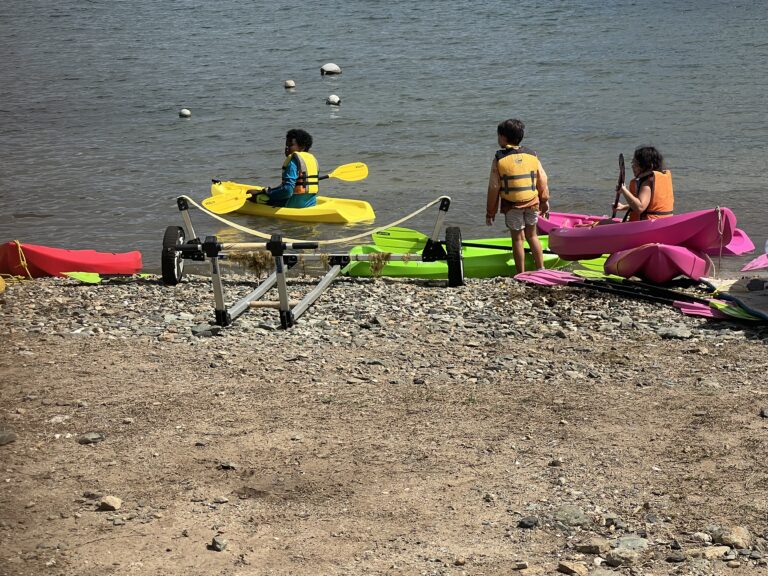
Behind the registration table along the shore, young sailors stood waist deep in the water, having already taken part in different water sports, and waiting for the next one to begin.

Young sailors waiting for the next race to begin. (Source photo by Judi Shimel)

Next to the table stood a series of tents where those who bought tickets could sample different chilis.

Hand lettered signs labelled one pot holding “Coral Bay Tropical Heat with corn and green olives,” another, invited tasters to sample green chili with pork. Matt Wilkerson filled tiny cups with “Southwest Chili – no beans.”
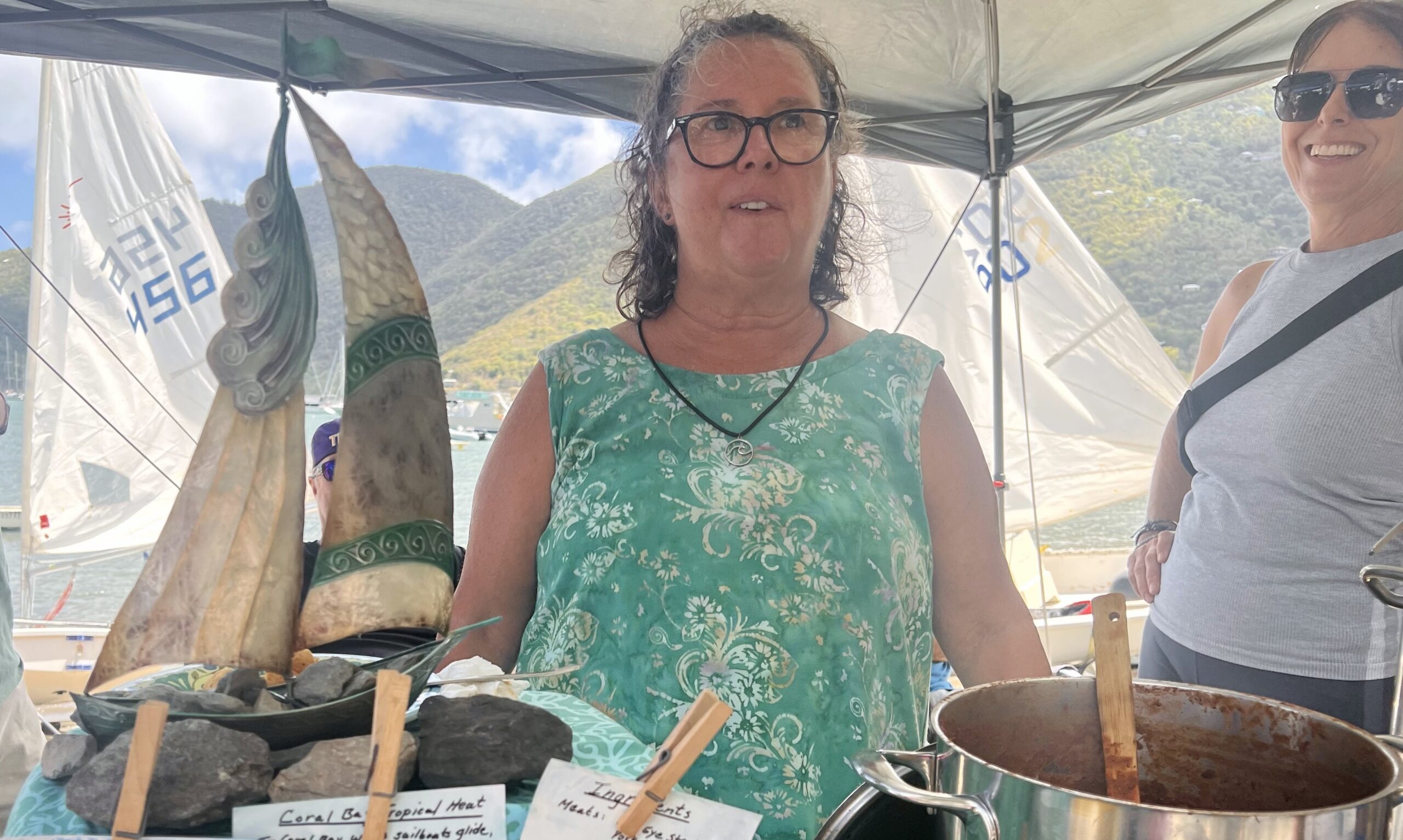
Dianna Serrano brings the tropical heat. (Source photo by Judi Shimel)

Then came the table with two pots — both prepared by Gifft Hill Students from the culinary arts class.
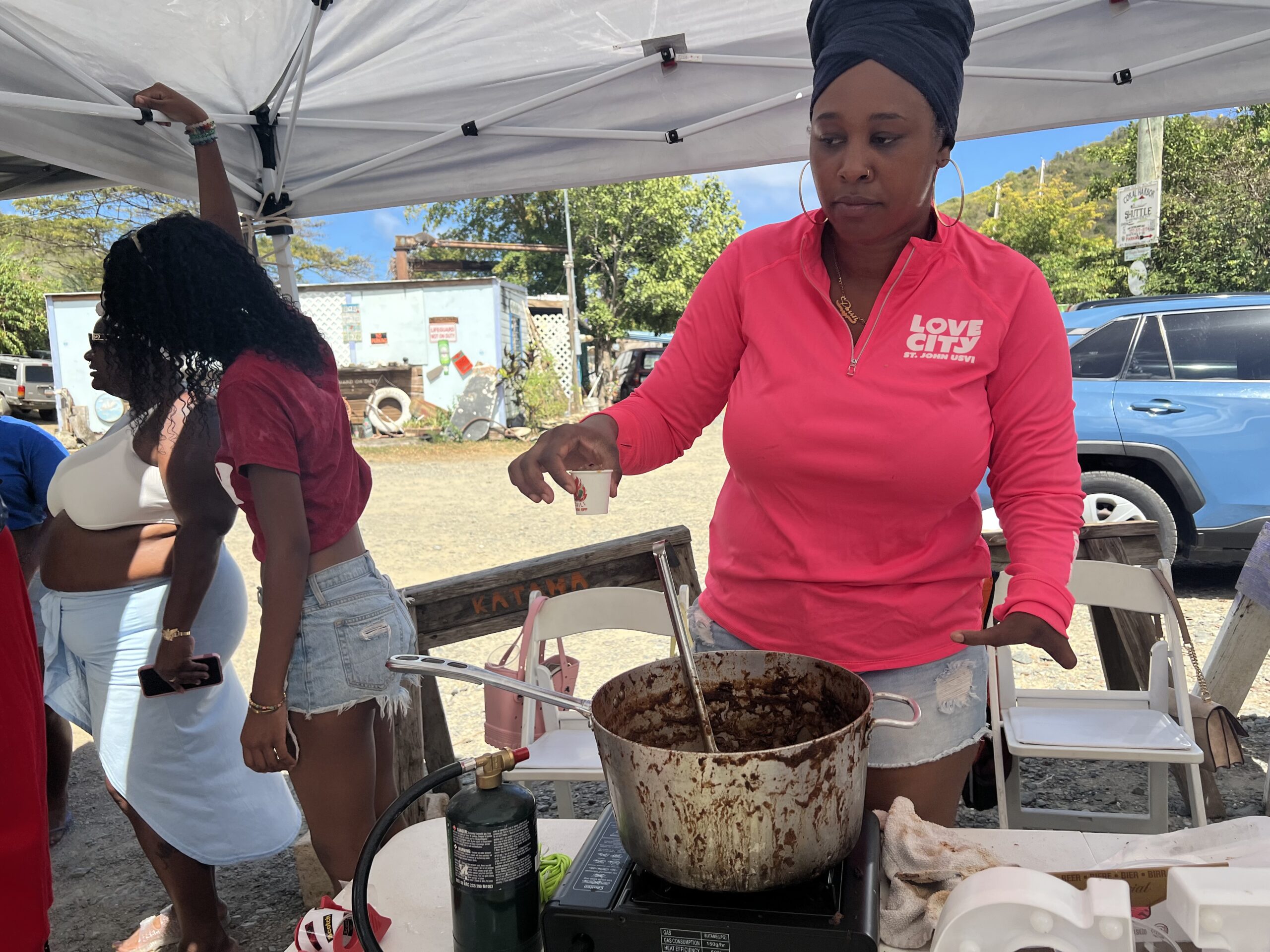
Chef Parris Ceasar prepares chili sample. (Source photo by Judi Shimel)

“… There’s one from my senior class which is short rib chili and then I have one made by my underclassmen which is oxtail chili,” said Chef Parris Ceasar.

The oxtail chili which featured rings of softened oxtail bones suspended in a seasoned sauce won praise from those who dug in. Others found favor among the others.

The taster’s task was to sample each offering and jot down their favorite on a paper ballot for the judges to pursue. “We bought 14 tickets and I shared half of every chili with my husband,” said taster Theresa Charow.

Even as the band ended a set to let organizer Dave Dostall make some remarks, a musician was seen scooping samples from a paper chili cup the size of a shot glass.
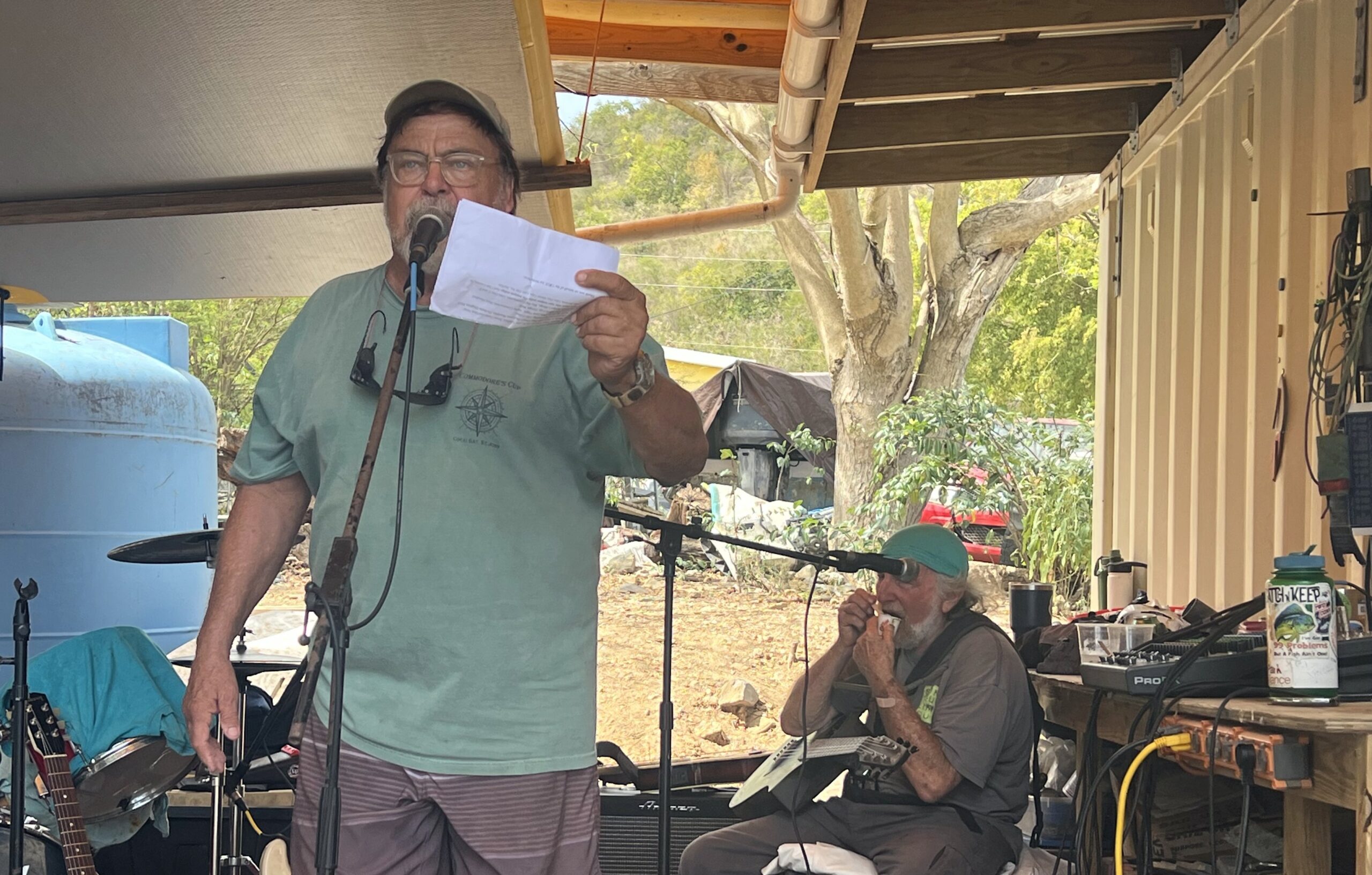
Dave Dostall thanks supporters while musician Bucky Buckholter digs in. (Source photo by Judi Shimel)

Support from the St. John business community brought in close to $20,000 before the Saturday event began, he said. Dostall urged the crowd to turn in their ballots for the judging to begin.

“We’ve been doing this particular fundraiser for over 30 years. We used to partner with folks from the Moravian Church who used to cook food, and we used to sail over to Norman Island to raise money for the church. We did that for 10 years, and then we did that for Guy Benjamin School, and now we’re doing it for the kids,” he said.
Savan Gut Sewer Paving Starts Monday

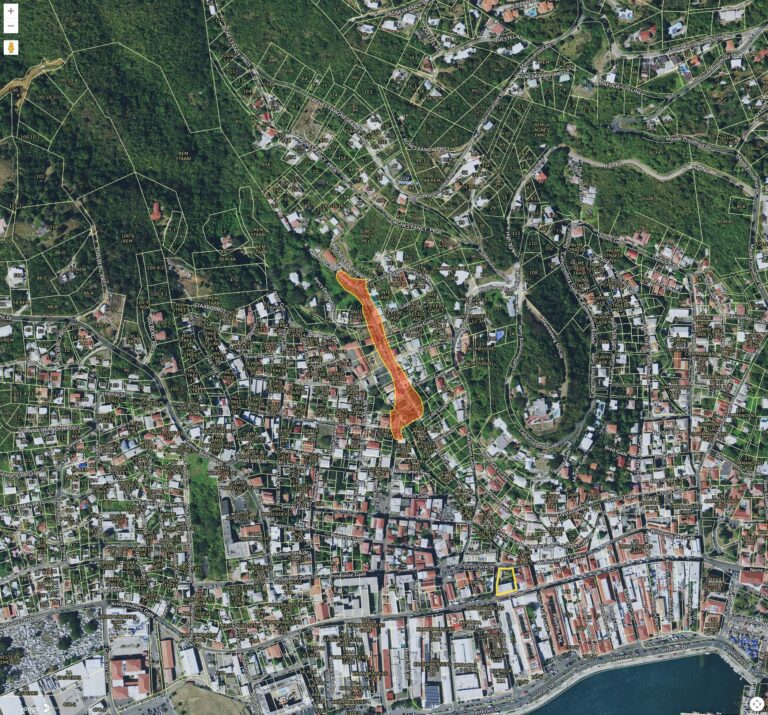
The Virgin Islands Waste Management Authority advises the public that the Savan neighborhood is scheduled to undergo pavement restoration as part of the final phase of the Savan Gut Sewer Line Replacement Project. Paving will be conducted by the Authority’s contractor, SD&C, Inc., during the week of April 13.
Savan paving map. (Submitted photo)
To ensure the successful completion of this work, all parked and abandoned vehicles must be removed from the roadway prior to the start of paving activities, effective immediately. Vehicles left in place will prevent crews from restoring the roadway surface. Paving will take place on Vester Gade between Irvin Brownie Brown Street and Percy DeJongh Drive.  VIWMA is working in coordination with the St. Thomas Administrator’s Office to tag and remove abandoned or non‑compliant vehicles from the area. The Authority appreciates the community’s cooperation as we complete this important infrastructure improvement for the residents of Savan and the wider St. Thomas community. For more information, please contact the Division of Education and Communications Management at 340-474-2811 or email communications@viwma.org. Stay connected with us on Facebook, X, and LinkedIn for updates.

New Rule May Add Surge of IRS Impostor Scams

IRS impostor scams tend to spike during tax season, and a new change in how refunds are issued could create added confusion and opportunities for scammers.
(Submitted photo)
Starting this year, the IRS will only issue tax refunds electronically as the federal government moves away from paper checks. Changes like this are often used by scammers to make their messages sound more believable. Scammers impersonating the IRS may contact you claiming they need your banking information to “update your refund details” because of the new rule. Know that the IRS generally will not call, text, or email you. Rather, the agency will send a letter to the taxpayer’s last known address explaining next steps or requesting additional information. If you’re unsure whether a message is legitimate, don’t engage. Instead, confirm your tax refund or payment status by contacting the IRS directly using a trusted phone number from an official IRS letter, or by logging in to your IRS Online Account if you have one. Learn how to spot and avoid scams with AARP Fraud Watch Network™. Suspect a scam? Call our free helpline at 877-908-3360 and talk to one of our fraud specialists about what to do next.

Lawmakers Discuss Sustainable Growth With Economic and Education Officials

0
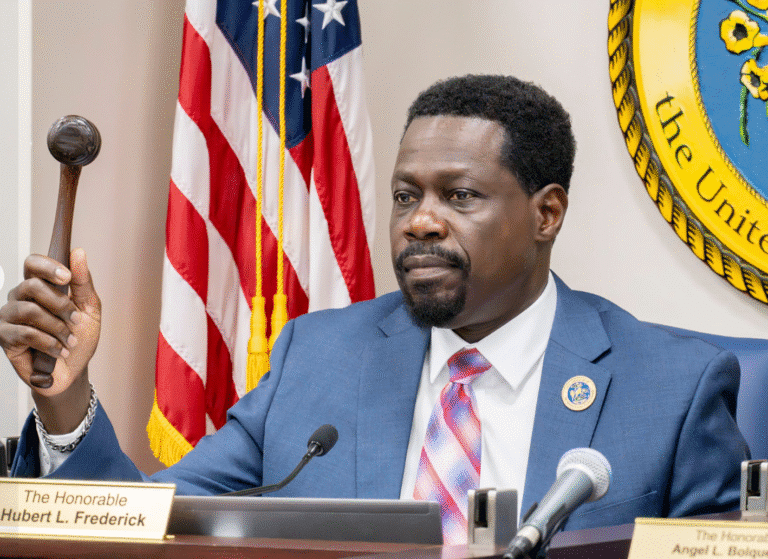
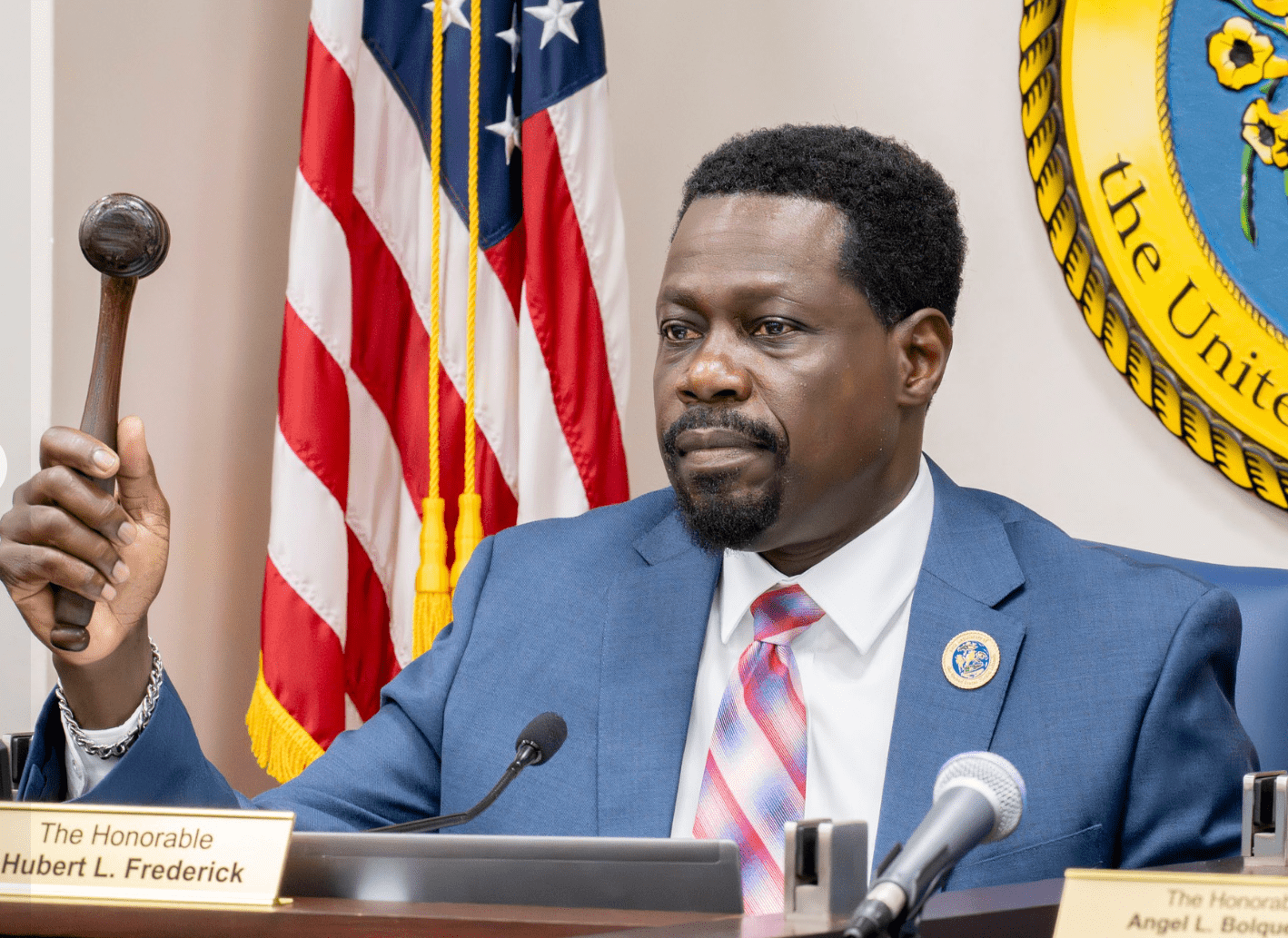
Sen. Hubert Frederick, chair of the Senate Economic Development and Agriculture Committee, leads a hearing Friday focused on how $25 billion in federal funding is being converted into sustainable economic development and long-term economic resilience. (Photo courtesy V.I. Legislature)

Top economic and education officials told senators Friday they are working to turn roughly $25 billion in federal funding into long-term growth, jobs and resilience for the territory, but acknowledged that inflation, housing costs and high energy prices remain major obstacles.

The testimony came during a hearing of the Senate Economic Development and Agriculture Committee, where lawmakers examined how disaster recovery and infrastructure dollars are being converted into sustainable economic development.

“This hearing is not simply about plans. It’s about performance,” said Committee Chair Sen. Hubert Frederick, calling the federal money an “unprecedented level of funding” that must result in “long, lasting sustainable development” across the territory and benefits for residents.

Wayne Biggs Jr., CEO of the Virgin Islands Economic Development Authority, said the agency is focused on balancing economic growth with environmental protection and social equity. He pointed to Vision 2040, the territory’s long-term strategic plan, and said recent efforts have expanded the Economic Development Commission portfolio.

“As a result of our sustainable economic development strategies, our EDC portfolio over the last four years has increased by about 47%, from 75 beneficiaries to 105,” Biggs said. “On the capital side, our Economic Development Bank has lent about $18.7 million under the first tranche of SSBCI funds.”

Haldane Davies, director of the Bureau of Economic Research, said the territory’s economy remains “stable and resilient,” with GDP rising to about $5.2 billion from $3.9 billion in 2018. However, he warned that inflation reached 7.6% in 2025, driven largely by a 22% increase in housing costs.

Davies also cautioned against “greedflation,” where businesses raise prices beyond actual cost increases, and emphasized that the territory must carefully manage its resources.

“In the USVI, we are blessed, albeit after unfortunate circumstances, to have approximately $25 billion in disaster recovery funds available to us as a territory,” he said. “This is a windfall we did not see coming, and we should ensure each dollar is effectively spent — not even one should be left on the table.”

Tourism Commissioner Jennifer Matarangas-King highlighted record visitor demand, noting that the territory welcomed 303,380 air arrivals in the first quarter of 2026, a 12% increase year over year.

But she stressed that tourism growth must extend beyond traditional hubs.

“Tourism must create opportunities for local entrepreneurs, small businesses and cultural practitioners,” she said, pointing to investments in workforce development and a shift toward higher-value travel such as ecotourism and cultural experiences.

At the University of the Virgin Islands Research and Technology Park, Executive Director Eric Sonnier pointed to a $1.1 million FEMA-funded solar project as an example of how targeted investments can deliver broader benefits.

“What began as a mitigation project ultimately grew into an opportunity to reduce our dependence on fossil fuel-based electricity, generate operational savings, and create a platform for education, workforce development and innovation,” Sonnier said.

He said the RTPark has already deployed about $1.3 million in loans and grants to small businesses and nonprofits and is preparing additional initiatives, including a mixed-use agriculture and innovation campus.

University of the Virgin Islands President Safiya George described the institution as central to building long-term capacity, emphasizing its role in workforce training, research and data development.

“With approximately $25 billion in federal investments flowing into our territory, we have a generational opportunity,” George said. “The critical question is how to ensure these investments translate into durable economic strength and improved quality of life.”

Several senators pressed testifiers on whether those promises are reaching ordinary residents. Sen. Franklin Johnson warned that late government payments and red tape can “kill an opportunity” for small contractors and vendors operating on thin margins. Sen. Marvin Blyden questioned how agencies are steering young people into high‑demand maritime and blue‑economy jobs, saying many students “do not know enough about the industry, and they are surrounded by it.”

Lawmakers also raised concerns about the cost of power and its impact on families and businesses. Sen. Carla Joseph called reliable and affordable energy “what’s going to fuel our economy” and urged officials to push harder on renewable projects already funded by federal money.

Beyond funding and growth, witnesses and senators also discussed broader structural issues, including possible changes to the tax system, concerns about lost revenue from unregulated short‑term rentals, and the need to improve the overall visitor experience, from airports to cruise ports. Several testifiers pointed to the maritime and “blue economy” sectors as major untapped sources of good jobs, and stressed that improving basic infrastructure and government processes will be critical to keeping local talent and attracting new investment.

Looking ahead, Frederick announced that the committee, in partnership with several testifying agencies, will host a 2026 Economic Development Summit at the University of the Virgin Islands on May 22 from 7:30 a.m. to 5 p.m. The event is designed to connect local entrepreneurs with agencies and companies managing hundreds of millions of dollars in projects. He urged residents to come prepared with business cards and a readiness to “step up to the plate” to grow their own enterprises and hire Virgin Islanders.
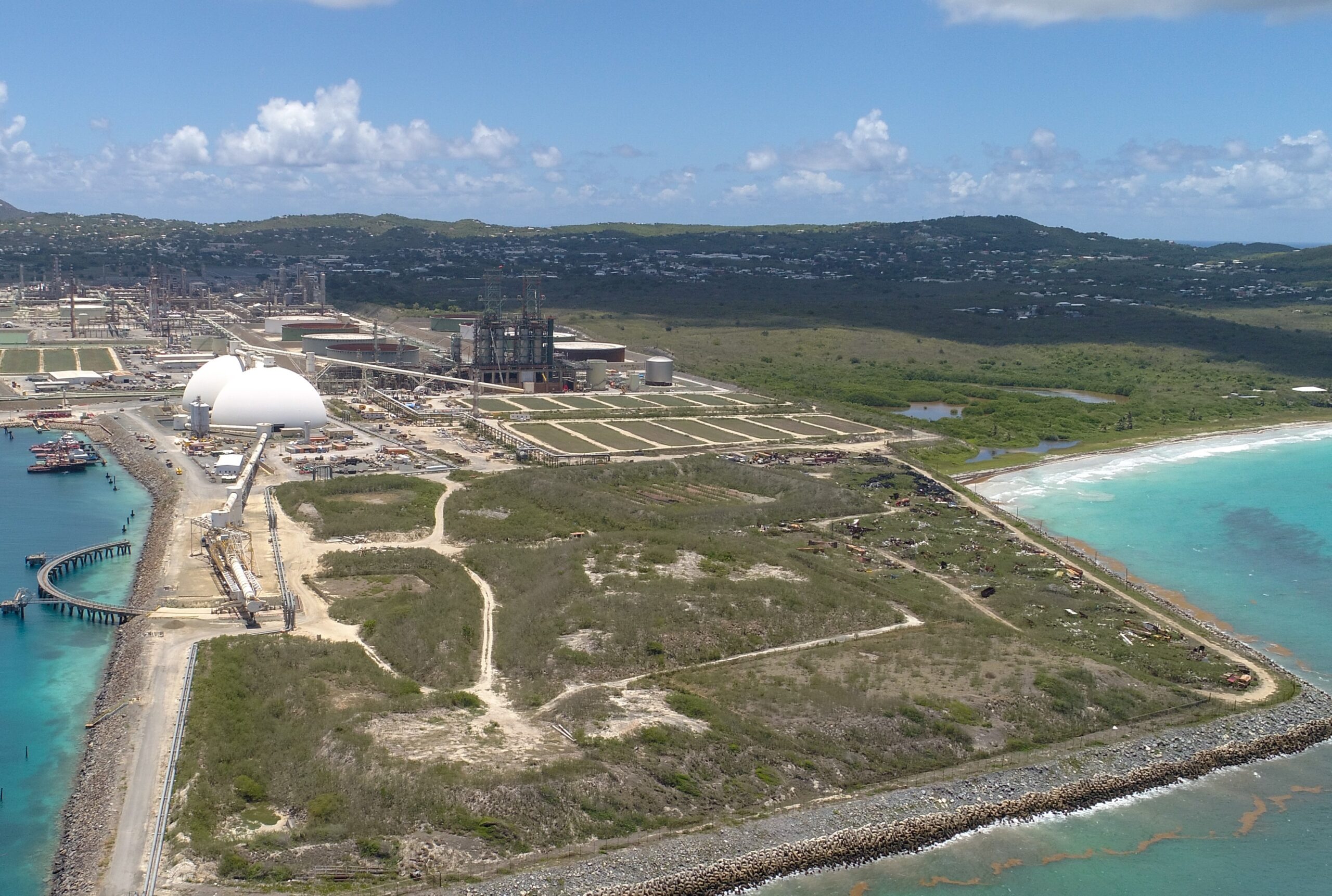
In a Twist, Oil Refinery Embraces Wind Turbines

0
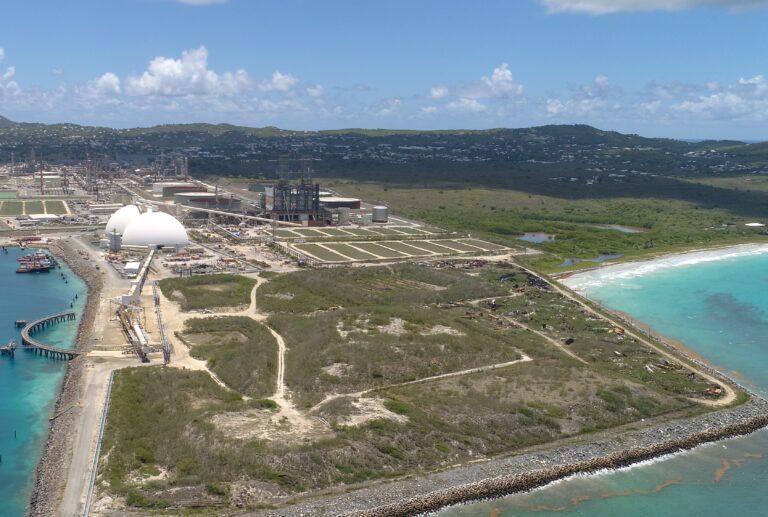
The oil refinery’s debris-strewn coke dock peninsula could soon be home to a wind and solar field. (Submitted photo)
The owners of one of the Western Hemisphere’s largest oil refineries have entered an agreement to build a wind turbine and solar power field along St. Croix’s south shore, refinery officials said Friday. Port Hamilton Refining and Transportation signed a letter of intent with Davis, California-based Wind Harvest to build a renewable-energy and battery-storage project on the refinery’s coke dock peninsula. The plan calls for Wind Harvest to develop a hybrid renewable-energy system with up to six megawatts of vertical-axis wind turbines, paired with six megawatts of solar generation and integrated battery energy storage. The system would provide reliable, on-site power to support refinery operations while reducing emissions and improving redundancy for critical systems, refinery officials said in a press release. Wind Harvest CEO Kevin Wolf cofounded the company 20 years ago and never dreamed he’d be partnering with an oil refinery. “Not expected. I know they are trying to do a variety of low-carbon fuels and things like that but the world needs our technology,” Wolf said. Developing the company’s eight patented technologies — including those that make the turbines hurricane resistant — required testing in Denmark, Texas, and elsewhere, and cost a lot of money. The more projects Wind Harvest can get up and running, the easier time it will have convincing banks that it’s a worthy investment, he said. “It’s damn expensive and it takes a long time,” Wolf said. Hybrid wind, solar, and battery storage projects are a growing trend in industrial energy systems, particularly in island and remote environments, where energy resilience, fuel cost reduction, and grid stability are key operational priorities, refinery officials said in a written statement “This project has the potential to deliver meaningful value to Port Hamilton,” Port Hamilton Director David Johnson said. “Accessing locally generated renewable energy at a lower cost than conventional fuel-based generation improves long-term operating economics while strengthening energy resilience. It is a practical solution aligned with our operational and infrastructure objectives.” The site itself is one of the windiest on St. Croix but has mounds of hosing, concrete and steel put there over nearly 70 years of oil refining, Wolf said. His company is also exploring adding a wind turbine at the island’s Leatherback Brewery. Wind Harvest’s vertical-axis wind turbines are engineered for complex wind conditions, designed to operate in high-wind and hurricane-prone environments. The turbines’ compact design — just 60 to 90 feet tall — support deployment in industrial and coastal settings where conventional turbine configurations may be less suitable, Wolf said. The turbines have a hexagonal base and the turbine blades connect at two points, not one. “Trade wind regions such as the Caribbean require durable and cost-effective renewable energy solutions,” he said. “Our technology is designed specifically for these conditions, offering a resilient approach to renewable power generation in challenging environments.” The turbines also operate at a lower 50-kilowatt level, which helps in windy regions, he said. The project was in the early development and data-gathering phase Friday. Near-term efforts were focused on advancing site development activities, resource assessment, and positioning the project to qualify for applicable federal investment tax incentives. Installation was projected for completion in 2028.
Although the plan was for power produced by the refinery’s solar and wind field to only be used by the refinery, Wolf said at some point it could be fed into St. Croix’s main electrical grid.

Plaskett and Democrat Candidates Urge Senate to Fund Primary Elections

The debate of who pays for primary elections is older than the VI Source and may not be resolved anytime soon. (Source file photo)
Delegate to Congress Stacey Plaskett and four other Democrats seeking territorial office have written to the Virgin Islands Legislature, calling on lawmakers to fully fund the upcoming 2026 primary election, according to a statement issued Thursday. The letter, sent Tuesday to Senate President Milton Potter and the 36th Legislature, asserts “the Virgin Islands Board of Elections is obligated by law to conduct primary elections, and the Legislature is obligated to fund them.” Not doing so, or extended debates against doing so, creates distrust detrimental to voters just months before the elections, Plaskett wrote. “Now is not the time to create obstacles that limit ballot access,” the letter states. “At every level of election throughout the United States, Democrats are fighting to protect the public’s access to the voting booth.” The letter was cosigned by Democratic congressional candidates Rashida Francis, Teri Helenese, Janelle Sarauw, and Delia Smith. Independent candidate Shelley Moorhead refuted Plaskett’s interpretation of the law, saying in social media posts that 2024 court rulings barred public elections officials from helping organize political parties’ internal structure, such as electing leaders and committee members. Conducting primary elections themselves, however, was covered under Title 18 of the V.I. Code, he said. Moorhead’s concern, he said, was whether it was appropriate to use tax money for primary elections that only party members could vote in — with only Democrats allowed to vote in the Democratic primary. The idea of opening primaries to all registered voters, regardless of party affiliation, has been around for more than two decades. “If public money funds this primary, it must comply with the 14th Amendment, the 15th Amendment, and the Voting Rights Act. That means it cannot be exclusionary. It cannot be a closed party event funded by taxpayers,” he said. “If a primary election is funded by taxpayer dollars, administered by the Elections System of the Virgin Islands, conducted using public infrastructure, then it is not a private party event. It is state action,” Moorhead said. Who should pay for the Virgin Islands’ primary election has long been a topic of heated conversation and occasional litigation. Inconsistencies in Virgin Islands Elections laws, practices, and funding have led to countless legislative and court hearings. In 1997, the St. Croix Elections Board interpreted the V.I. Code as requiring political parties to be responsible for primary elections. In March 2000, Gov. Charles Turnbull vetoed a bill that would have codified in law that political parties were responsible for holding their own primaries. A few months later, Elections officials reversed course and, in an effort not to disenfranchise voters, decided to pay for primaries. More disputes followed. In 2002, public funds were allocated to fund primaries. That was up for debate again by the Election System in 2014. In 2015 and 2016, the board that would later be rolled into a unified territorial Board of Elections would oversee primary elections, but the individual parties would need to pay for them. It was not a new idea. This led to a divided Board of Elections and a standoff with the Legislature about funding the primaries. A decade later, some of the same issues remain.