


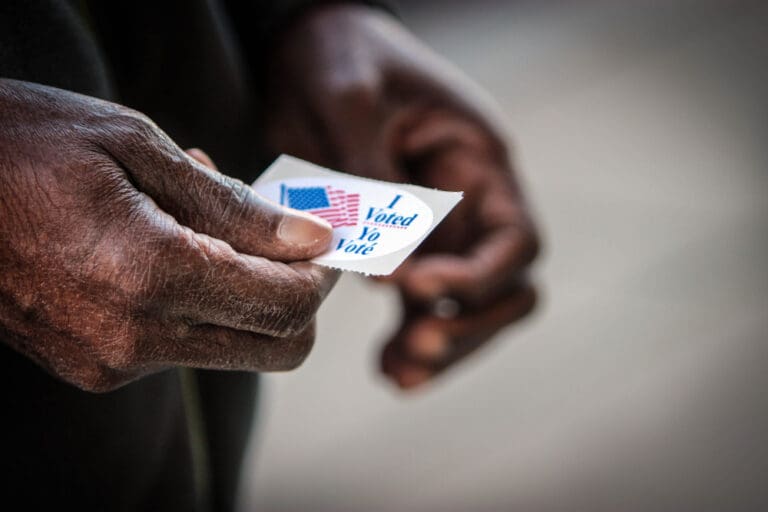
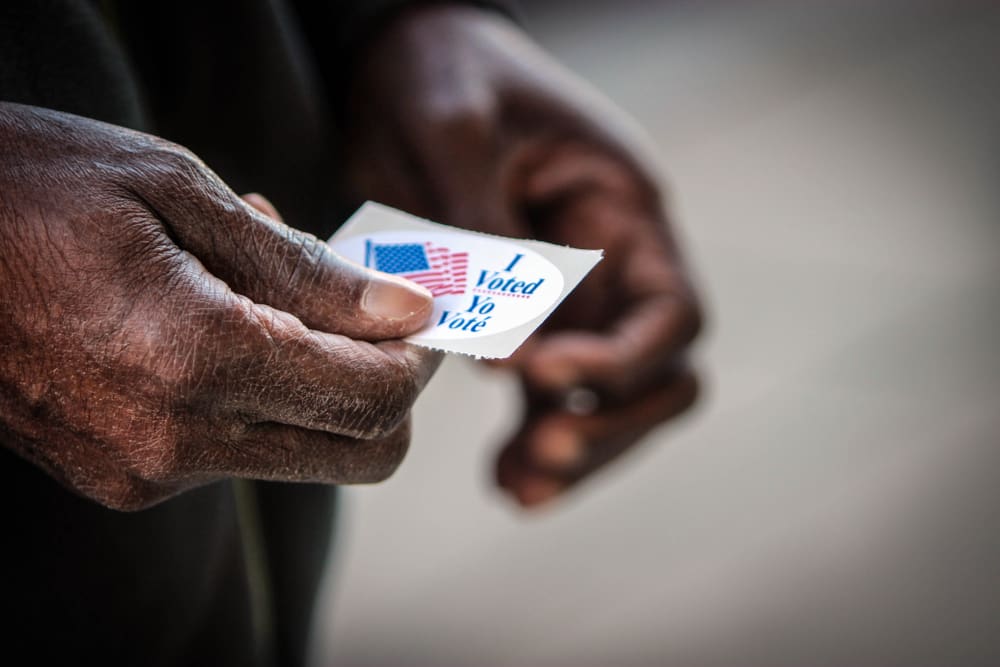
With election season fast approaching in 2026, the League of Women Voters of the Virgin Islands is inviting the public to consider the role of political parties in an election cycle. Organizers of the league’s annual meeting say the topic — “Are Political Parties Still Relevant in the USVI?” — will be examined from several perspectives, all designed to give voters food for thought as they make their way to the polls.
The annual meeting is scheduled to take place Saturday at 1 p.m. at the University of the Virgin Islands 13-D Innovation Center on the Orville E. Kean Campus on St. Thomas. Those who would like to join the discussion but cannot attend in person are encouraged to request a Zoom link at lwvusvi@gmail.com.
League President Gwen-Marie Moolenaar said the public portion of this year’s meeting was inspired by comments heard on a radio show. “The question is: If candidates think that parties aren’t relevant, does the public think so as well, and really what is the relevance of political parties?” Moolenaar said.
The question is posed during a four-year local election cycle where voters will choose a governor/lieutenant governor, delegate to Congress, lawmakers and members of the Boards of Elections and Education. Speakers chosen to help explore the topic include former Elections Supervisor John Abramson, representatives of the Democratic, Republican and Independent Citizens’ Movement parties; UVI Assistant Economics Professor Mark Wenner, and voters.
An unaffiliated candidate who ran and won a public office had been invited as well, the league president said. Their remarks will be followed by a question-and-answer session where meeting participants can weigh in.
“What does that mean for the way politics are run? What does it mean for the Legislature? Are we losing things by not having parties? Are we gaining things by not having parties?” Moolenaar said.
Organizers hope those who speak, listen and consider different views will leave the meeting ready to sort out the candidates and make the best choices.
Saturday’s session online and in person at UVI-St. Thomas comes at a time when the Pew Research Center — a prominent fact-finding group — points to national trends suggesting U.S. voters have split into three roughly equal voting blocks: Democratic, Republican, and Independent (although in the U.S., there is no recognized Independent political party).
The League of Women Voters has about 800 chapters nationwide. It was formed in the 1920s after U.S. women won the right to vote.





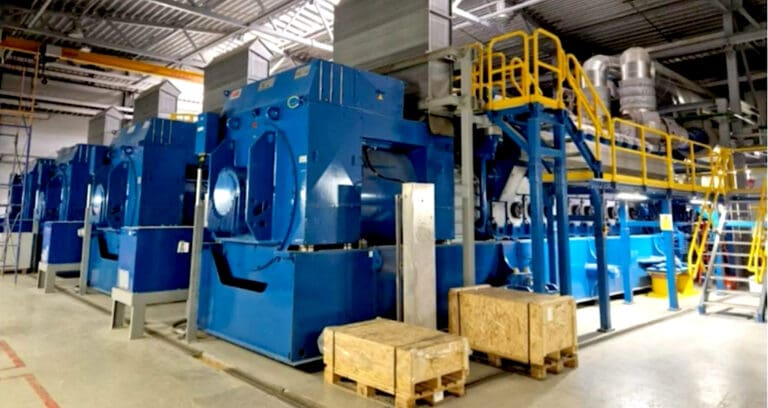

Attorneys for the U.S. Justice Department and V.I. Water and Power Authority heard Wednesday that a federal judge may order Finnish power company Wartsila to address emission control issues with seven generators at the Randolph Harley Power Plant on St. Thomas.
The suggestion came during a consent decree status conference held Wednesday morning virtually before U.S. District Court Judge Mark Kearney. The Justice Department launched a civil action against the utility for violating the federal Clean Air Act in 2014. The consent decree was approved in 2016 and amended in 2019. Though a federal judge agreed to terminate a similar settlement agreement for the St. Croix power plant two years ago, attorneys told Kearney Wednesday that maintenance problems at the Randolph Harley Power Plant continue to hinder the utility’s efforts to achieve and sustain compliance on St. Thomas.
“They’re doing their best to try to fix them,” said Myles Flint, of the U.S. Justice Department Environmental Enforcement Section, “and once they’re fixed and we can kind of get them on that glide path — where there’s a period of time if they’re in compliance, or substantially in compliance — then we would be able to proceed with termination.”
WAPA’s outside counsel, Robert Smith, said the plant’s lack of redundancy has prevented technicians from taking units offline to perform needed maintenance. The utility has also struggled to adapt the four newer Wartsila generators to run on liquefied propane following what WAPA Project Management Director Maxwell George described Wednesday as a “catastrophic failure” last year. Smith said all seven of the Wartsila generators are having issues with controls meant to limit the emission of nitrous oxides and carbon monoxide.
“So we’re put in this position repeatedly where we have to make the choice,” he said. “Do we continue to comply with that particular limitation, primarily related to the control of NOx emissions and the water injection … or do we turn out the lights?”
Unit 27, a legacy generator which was brought back online last month after Unit 15 failed amid repeated outages on St. Thomas and St. John, has no operational emission monitors, according to Smith.
“That’s something that’s required by the consent decree,” he said.
“Yeah, I can see that being important,” Kearney observed.
Kearney raised the subject of a court order after George and plant superintendent Kevin Harrigan said Wartsila hadn’t yet given them a timeline to fix the emission controls. When Kearney asked if it would be helpful to issue a court order directing Wartsila to be more responsive, Smith sounded skeptical.
“If it was directed to them, if we had jurisdiction over them, I think it would,” he said. “But we’ve been dealing with other vendors where we’ve told them we’re subject to EPA and DOJ requirements, and the lack of response has been just enormous.”
“Okay, well, we’re going to test that,” Kearney said. Later, Kearney said he’d give WAPA personnel time to “light a fire” under Wartsila and another contractor.
“Let’s give Mr. Harrigan a little chance to say, ‘a federal judge is looking at you now, Wartsila,’” Kearney said. “Let’s give him a chance to be a customer for a bit and start asking questions.”

Morris Anselmi and Kimberly McCollum — facing federal wire fraud charges stemming from the alleged theft of $500,000 in COVID-19 relief funds — have entered into pretrial diversion agreements with the U.S. Attorney’s Office, though the terms of those deals remain under seal.
Assistant U.S. Attorney Denise George said the government has agreed to defer prosecution of Anselmi and Morris “for a specified period, the stay of trial and all trial proceedings until after the completion of the diversion period for each Defendant” in a motion for approval of the agreements filed Wednesday in District Court on St. Croix.
The agreement with McCollum was executed March 5 and with Anselmi on March 27, according to the motion that U.S. District Court Judge Mark Kearney granted Wednesday along with another requesting that the agreements be filed under seal.
Anselmi and McCollum were first indicted two years ago, but proceedings have moved at a snail’s pace because of health issues that prevented Anselmi’s return to the territory. His initial appearance before Magistrate Judge Emile Henderson III on March 9, held virtually, came days after U.S. Marshals formally processed Anselmi’s arrest in Texas, where his attorney said he is living at a medical center and awaiting a heart transplant.
Anselmi and McCollum are charged with conspiracy to commit wire fraud, mail fraud and making false statements to the U.S. Small Business Administration and a financial institution in connection with an alleged scheme to defraud the COVID-era federal Paycheck Protection Program to the tune of $500,000.
In February, Kearney set deadlines for Anselmi’s attorneys to cement the terms of a plea agreement with the government for his testimony in the separate but related federal fraud trial of Davidson and Sasha Charlemagne, currently set to begin July 17. The former subcontractors are accused of bilking millions under a federally funded contract while allegedly mismanaging disaster recovery materials along with former V.I. Housing Finance Authority executive Darin Richardson.According to a grand jury indictment of the Charlemagnes and Richardson, Richardson awarded the warehousing contract to Anselmi and McCollum’s company, Island Services Group, while working as VIHFA’s chief operating officer. ISG subcontracted the work to the Charlemagnes’ company, D&S Trucking.
Richardson was found guilty of making material false statements to a federal agent, criminal conflict of interest, bank fraud, money laundering and making false statements on a loan application in March 2025 and was sentenced last month to three years in prison. He has since filed an appeal in the Third Circuit Court of Appeals.
Over the course of Richardson’s two-week trial, prosecutors showed that he received a $107,000 loan from Anselmi and that he continued signing off on checks to ISG despite notifying VIHFA of a conflict of interest. While Anselmi did not testify in Richardson’s trial, the case against the Charlemagnes stalled while attorneys sparred over the admissibility of his testimony in that case.
During the first part of a court-ordered deposition last April, Anselmi reportedly acknowledged that he was testifying in hopes of receiving immunity, leading to confusion over whether his immunity agreement pertained to the PPP case, his involvement in the Charlemagnes’ alleged scheme, or both.
Senior District Judge Wilma Lewis later concluded that the agreement only covered the woodpile case and that “in the absence of a change in Anselmi’s potential criminal exposure which would permit him to fully answer Defendant’s cross-examination questions … without a legitimate fear of self-incrimination,” his testimony would be excluded from trial.
Since then, attorneys repeatedly told the court that they were close to reaching a plea deal in the PPP case. During a status conference in the Charlemagnes’ case in February, Assistant U.S. Attorney Denise George said a new immunity agreement “should be completed shortly,” allowing them to resume Anselmi’s deposition.
Following a separate status conference, Anselmi and McCollum’s attorneys told the court that they had reached a resolution with the government and were in the process of having the documents signed by all parties.
“This matter does not need to be scheduled for trial,” they wrote in a Feb. 27 filing.
On April 9, Kearney signed an order granting the government’s motion to compel Anselmi’s witness testimony in the Charlemagne case, directing that “no testimony or other information compelled under this Order, or any information directly or indirectly derived from such testimony or other information, may be used against Morris Anselmi in any criminal case, except for a prosecution for perjury, giving false statement, or otherwise failing to comply with this Order.”


An audit by the Inspector General’s Office of the U.S. Housing and Urban Development Department found that the V.I. Housing Finance Authority, the semiautonomous agency tasked with managing $2 billion in federal disaster recovery and mitigation grants, “does not have fraud risk management processes to prevent and detect fraud risks.”
“We assessed VIHFA’s fraud risk management program maturity at or below the lowest desired goal state … because some anti-fraud activities were disorganized, uncontrolled, and reactive, while other anti-fraud activities expected in a fraud risk management program were absent altogether,” according to a summary in the report.
Five points highlighted by auditors included: the agency’s lack of an overall fraud management framework or entity dedicated to managing fraud risk; VIHFA’s failure to implement fraud-specific control activities; lack of monitoring or evaluation of the agency’s anti-fraud activities; lack of “setting an anti-fraud tone by management, even after” the indictment of former Chief Operating Officer Darin Richardson; and a lack of involvement from all levels in the organization in protecting disaster recovery and mitigation funds.
“Until VIHFA implements a fraud risk management framework, there remains a high risk that fraud may continue to occur or go undetected and jeopardize the integrity of its programs and compliance with federal requirements,” the report warned. “As a result, this will leave nearly $2 billion disaster recovery and mitigation funds at risk.”
VIHFA officials did not respond to emailed questions from the Source by Wednesday evening.
The audit zeroed in on several areas of concern, including a “culture” at the agency that “does not promote an anti-fraud environment.” The report cited a 2023 questionnaire conducted by VIHFA’s internal audit division, which found that employees had personal knowledge of fraud or suspected fraud, knew of instances where the agency’s management had overridden fraud controls, and were aware of “motives, pressures, and (or) incentives within the organization that would make someone susceptible to committing fraud.”
“Despite the gravity of the information received, these results were not acted upon to mitigate fraud risks when it was public knowledge fraud had potentially occurred at VIHFA,” according to the report. “Instead of conducting an investigation and sharing the alarming questionnaire results with VIHFA’s management team, especially the Executive Director, the Internal Audit Division shared the information exclusively with the Procurement Division and the Finance Unit directors, who are no longer employed by VIHFA and appear to have taken no action to elevate or address the matter.”
VIHFA officials who were interviewed by auditors said they had no knowledge of the questionnaire or its results, according to the report.
Since 1999 the Virgin Islands Source – the only online newspaper of general circulation in the U.S. Virgin Islands – has been providing the community with reliable, accurate and balanced local journalism.
Contact us: visource@gmail.com
© 1999-2025 Virgin Islands Source