















St. Thomas/St. John IAA All-Association Flag Football and Cross-Country Teams

In December 2023, the student-athletes who made the St. Thomas/St. John Interscholastic Athletic Association (IAA) All-Association team for volleyball were announced. Flag football and cross country were also being played during that time. Coaches, league officials and the league commissioner also cast their ballots for the IAA teams in those two sports. Here are the honorees for Varsity Flag Football: Chrislord Bernard is a sophomore linebacker and receiver for Ivanna Eudora Kean High School.
Chrislord Bernard of Ivanna Eudora Kean High School (Submitted Photo)
  Jeffrey Boschulte Jr. is a junior wide receiver for Antilles School.
Jeffrey Boschulte Jr. of Antilles School (Submitted photo)
Malakai Henley is a senior running back for Charlotte Amalie High School.
Malakai Henley of Charlotte Amalie High School (Submitted photo)
Jaden Pascal is a senior linebacker and receiver for Gifft Hill School.
Jaden Pascal of Gifft Hill School. (Submitted photo)
Averad Penn is a senior running back from Antilles School.
Averad Penn of Antilles School (Submitted photo)
 Guyma Phebe is a senior cornerback and receiver for Ivanna Eudora Kean High School.
Guyma Phebe of Ivanna Eudora Kean High School (Submitted photo)
Justin Richards is a junior linebacker and receiver for Gifft Hill School.
Justin Richards of Gifft Hill School (Submitted photo)
 Hunter Simpson is a senior wide receiver for Gifft Hill School.
Hunter Simpson of Gifft Hill School (Submitted photo)
Dillen Webbe is a sophomore quarterback for Antilles School.
Dillen Webbe of Antilles School. (Submitted photo)
Justin Richards was also selected as the League’s Most Valuable Player.
Justin Richards of Gifft Hill School (Submitted photo)
Here are the honorees for Varsity Cross Country: Zion Baptiste is a senior from Seventh Day Adventist School.
Zion Baptiste of Seventh Day Adventist School. (Submitted photo)
 Quemane Bell is a senior from Seventh Day Adventist School.
Quemane Bell of Seventh Day Adventist School. (Submitted photo)
Edward Foerstel is a senior from All Saints Cathedral School.
Edward Foerstel of All Saints Cathedral School. (Submitted Photo)
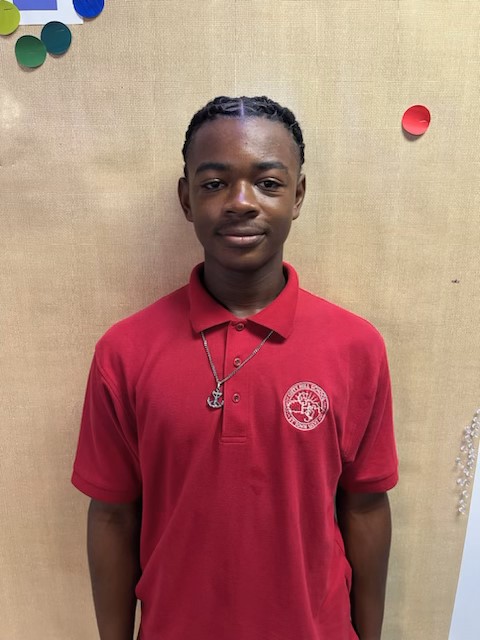
Judah Frett is a senior from Ivanna Eudora Kean High School.
Judah Frett of Ivanna Eudora Kean High School. (Submitted photo)
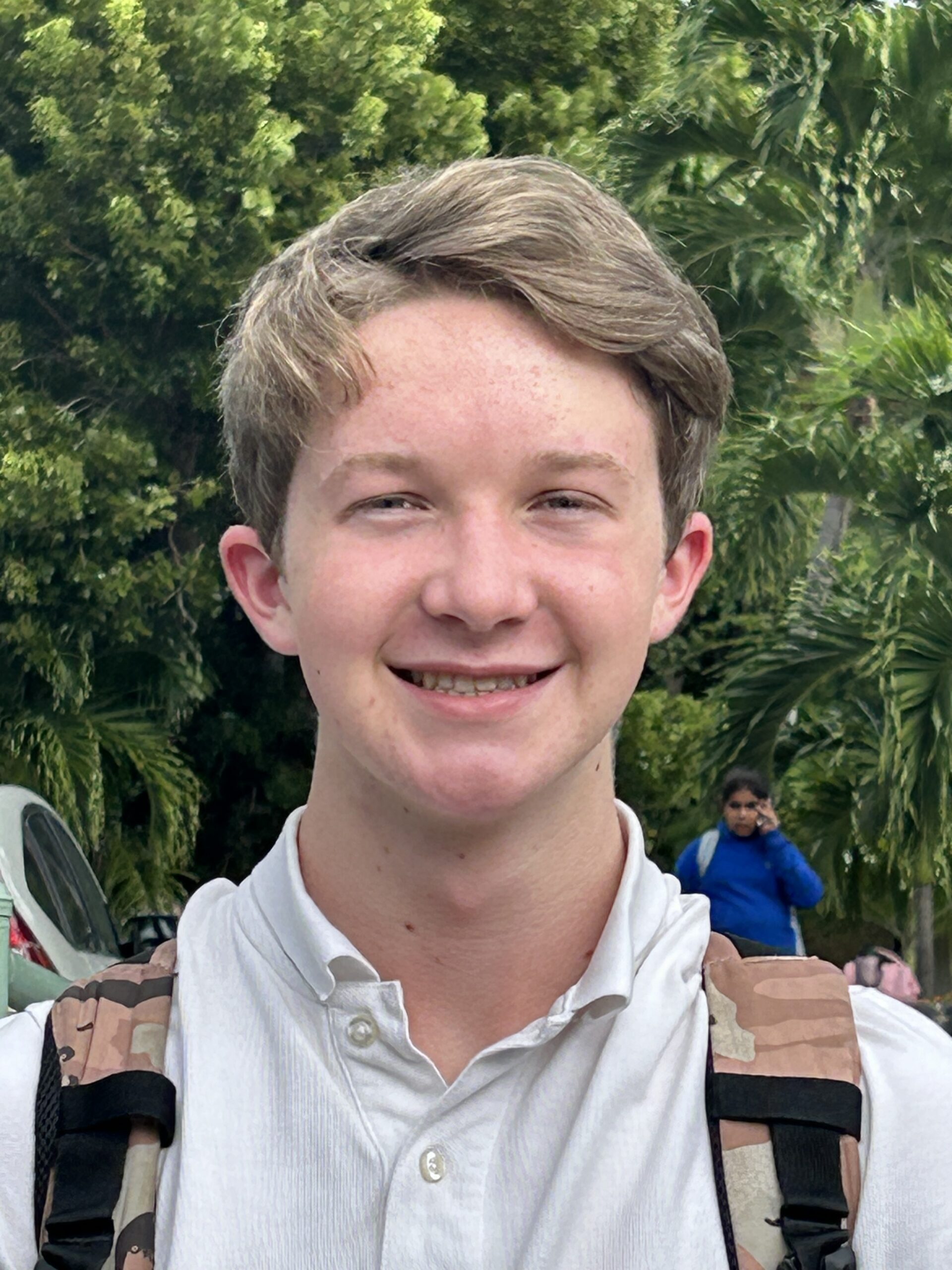
Ethann Hobdy is a senior from Antilles School.
Ethann Hobdy of Antilles School (Submitted photo)
Jack Oram is a senior from Antilles School. Oram was voted the League’s Most Valuable Runner.
Jack Oram of Antilles School. (Submitted photo)
Jaden Richardson is a senior from All Saints Cathedral School.
Jaden Richardson of All Saints Cathedral School (Submitted photo)
All-Association Teams for every varsity sport played in the St. Thomas/St. John IAA leagues will be selected for the 2023-2024 school year.  

St. John Recovery Choir Welcomes New Members for Concert Featuring Harry Belafonte Songs

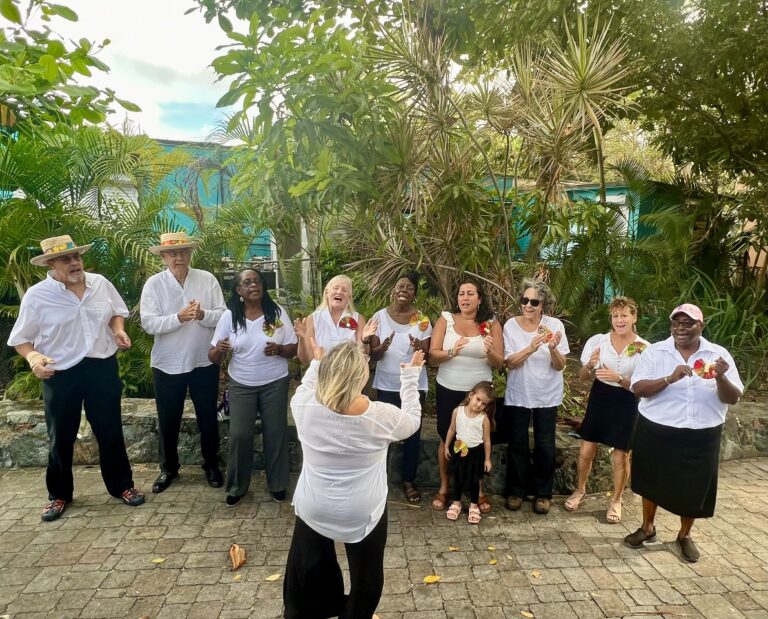
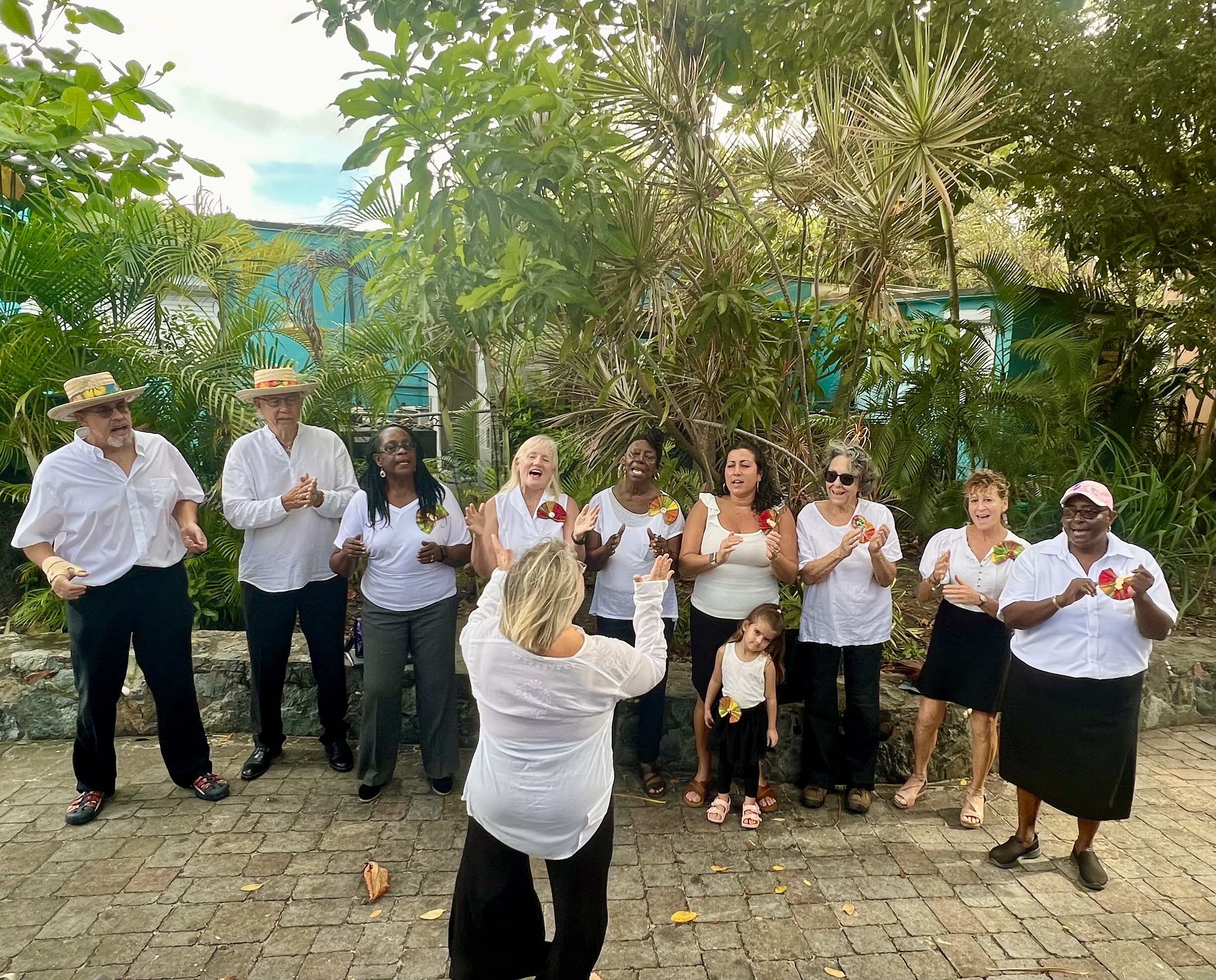
Members of the STJ Recovery and the Senior Sing Along practice a song for the Martin Luther King Day celebration in Cruz Bay. (Source photo by Amy H. Roberts)
The St. John Recovery Choir is inviting new and old members to join them to sing in a concert featuring the music of Harry Belafonte on April 20. Rehearsals, which begin on Feb. 6, are offered twice a week. Tuesday evening rehearsals are held at the Gifft Hill School Upper Campus from 5:30 to 7 p.m. Saturday morning rehearsals are held at a picnic table at Hawksnest Beach from 9 to 10:30 a.m. Additional sectional meetings are held by Zoom during the week. The choir– named in the wake of Hurricane Irma – is open to singers at all levels, including those who have no experience and can’t read music. “The music we’re doing is music that brings joy to most people,” says choir director Kristen Carmichael-Bowers. “The emphasis is on fun and community interaction as members develop their musicianship and vocal technique.” To register, go to www.singstjohn.org or call (802) 380-0761. Members who can afford to are asked to contribute an annual membership fee of $50, but the fee can be waived by checking a box upon registration. The Recovery Choir is one of five choirs under the umbrella organization Sing St John, whose programming is made possible through grants from the V.I. Council on the Arts and the National Endowment for the Arts, the V.I. Lottery, The Community Foundation of the Virgin Islands, Martha and Dana Robes, and donations from community organizations, businesses and individuals.    

Operation “Round Up Step By Step” Yields Six Arrests

0

Members of the Criminal Investigation Bureau and Special Operations Bureau executed Operation “Round Up Step By Step,” where arrest warrants were executed for six individuals on St. Croix, the V.I. Police Department reported Sunday.

Franklin Xavier On Thursday, at 9:05 a.m., Xavier, 55, was arrested and charged with second-degree for pepper spraying an adult male in the face. His bail was set at $10,000 and he was remanded to the John Bell Correctional Facility pending his advice of rights hearing. Angel Torres Sr. On Thursday, Torres, Sr., 54, was arrested and charged with first-degree reckless endangerment and discharging or aiming firearms for opening fire with a firearm causing damage to his neighbor’s property during a dispute on Nov. 1, 2022. The neighbor returned fire at Torres. Torres’ bail was set at $10,000.00. He was released on his own recognizance with instructions to be present for his advice of rights hearing. Angel Rosa On Friday, an arrest warrant was executed for Angel Rosa, 20, at the John Bell Correctional Facility for unauthorized use of a vehicle and grand larceny. An investigation revealed that Rosa stole a Ford Ranger truck and a flatbed trailer on April 12, 2023. His bail was set in the amount of 25,000. Rosa was unable to post bail and was remanded to the John Bell Correctional Facility pending his advice of rights hearing. Donna Emmanuel On Thursday, Donna Emmanuel, 34, was arrested for second-degree assault and disturbance of the peace. On Oct. 13, 2023, Emmanuel pepper-sprayed a man and woman while they were in the parking lot in the Sunny Isle Annex. Her bail was set in the amount of 10,000. Emmanuel was unable to post bail and was remanded to the John Bell Correctional Facility pending her advice of rights hearing. Dixon Martin

On Thursday, Martin, 18, was arrested for unauthorized use of a vehicle and his bail was set in the amount of 25,000. Martin was identified as the driver of a Jeep Cherokee that was reported stolen from the government parking lot on April 15, 2023. Martin was unable to post bail and was remanded to the John Bell Correctional Facility pending his advice of rights hearing.

Asha Felix

Felix, 33, was arrested for attempted murder, simple possession of narcotics, first-degree assault, unauthorized possession of a firearm during the commission of a crime of violence, unauthorized possession of ammunition, and third-degree assault. On Aug. 29, 2023, an adult male reported that he was shot. An investigation unveiled that Felix shot the victim unprovoked by the Water Gut Shanty. Felix’s bail was set at $750,000.

Additionally, upon executing the warrant, Felix was found to be in possession of crack cocaine and subsequently charged with that offense. His bail for this matter was set by chart at $1,500. Felix was unable to post bond and was remanded to the John Bell Correctional Facility pending his advice of rights hearing.

   

Weekly Weather Forecast with Jesse Daley

0
Check out our weekly weather forecast with Jesse Daley, covering Sunday, Jan. 28, through Saturday, Feb. 3. Our YouTube playlist is updated every week, AND check out Jesse’s daily weather updates here.

$6.5 Million in STX Urban Forestry Grants Hailed as Investment ‘Never Seen Before’

0
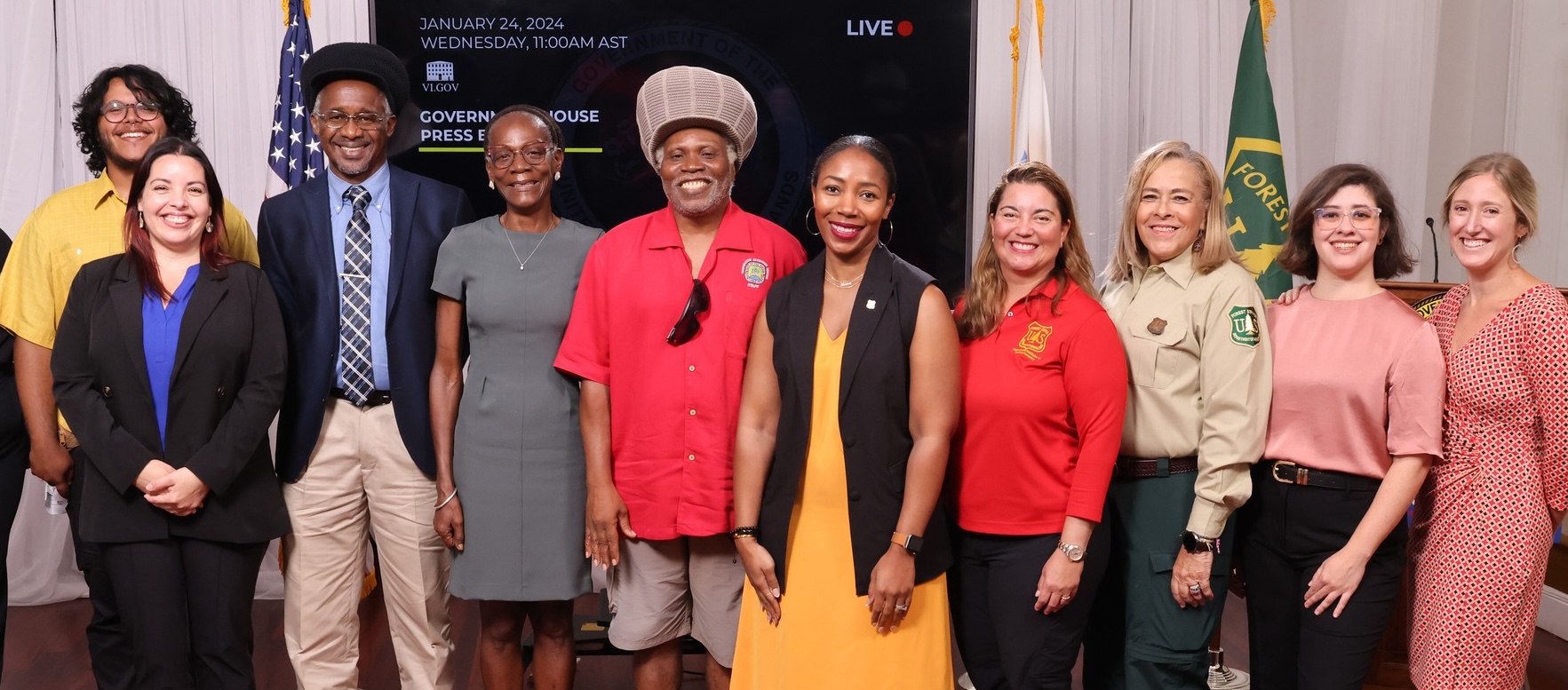
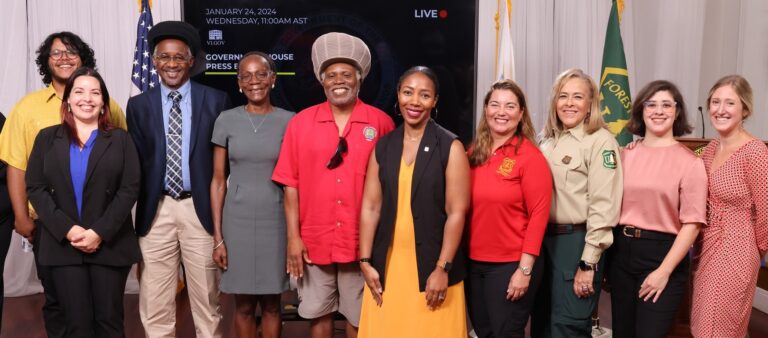
Celebrating the award of a record $6.5 million in federal urban forestry grants at a ceremony Wednesday at Government House on St. Croix are, from left, Andres Gonzalez and Maya Quinones of the International Institute of Tropical Forestry in Puerto Rico, V.I. Agriculture Commissioner Louis Petersen, Assistant Commissioner Diana Collingwood, Olasee Davis, representing the V.I. Trail Alliance, Beattra Wilson, assistant director of the Urban and Community Forestry Program of the U.S. Forest Service, Grizelle Gonzalez and Magaly Figueroa of the International Institute of Tropical Forestry, and Sarah Brady, executive director of the St. George Village Botanical Garden. (Government House photo)
Celebrating the award of a record $6.5 million in federal urban forestry grants at a ceremony Wednesday at Government House on St. Croix are, from left, Andres Gonzalez and Maya Quinones of the International Institute of Tropical Forestry in Puerto Rico, V.I. Agriculture Commissioner Louis Petersen, Assistant Commissioner Diana Collingwood, Olasee Davis, representing the V.I. Trail Alliance, Beattra Wilson, assistant director of the Urban and Community Forestry Program of the U.S. Forest Service, Grizelle Gonzalez, Magaly Figueroa and Jo Ann Santana of the International Institute of Tropical Forestry, and Sarah Brady, executive director of the St. George Village Botanical Garden. (Government House photo)

Jubilation filled the air at Government House on St. Croix as the V.I. Trail Alliance, St. George Village Botanical Garden and V.I. Agriculture Department celebrated the award of a record $6.5 million in federal urban forestry grants meant to improve the island’s climate resiliency and food security.

Beattra Wilson, assistant director of the Urban and Community Forestry Program of the U.S. Forest Service, said the grants — funded through President Joe Biden’s Inflation Reduction Act — are “an investment in urban forestry never seen before.”

She praised the grant applications of the St. Croix non-profits and the Agriculture Department, telling the Source in an interview after Wednesday’s press conference that their proposals “leaped from the pages,” compared to their more than 840 competitors from across the country, for their focus not just on climate but also food security.

Typically, when people think about urban forestry, they think about planting shade trees on city streets and medians, said Wilson. “But the way you all are using your trees here is to offset food insecurity. The preponderance of fruit and nut and spice trees [in the grant applications] was incredible, and I think it was an amazing example that leaped from the pages, that this isn’t just a shade tree. You are checking so many boxes around the benefits that not everybody is thinking of,” she said.

“We had $6.4 billion in asks for this grant program,” Wilson said of the initiative, which awarded $1 billion in total. “For the Virgin Islands to not just take the time to put in a proposal but put in a proposal that lifted off the pages,” and demonstrated the full benefits of urban forestry, was inspiring, she said. “This was a very specific ask, for the sustenance.”

Also striking was the focus on solutions, said Wilson, who has been with the U.S. Forest Service for 23 years and is based in Washington, D.C.

“They talked about educating youth and paid training for the workforce — opportunities for them to get trained while getting a stipend, while getting acclimated, but also building that camaraderie and ownership around the green spaces that are being planted. All of that is what makes this unique,” said Wilson.

Under the program, the V.I. Agriculture Department will receive $1.5 million, and the St. George Village Botanical Garden and Virgin Islands Trail Alliance $2.5 million each. The grants are for a period of five years.

Agriculture Commissioner Louis Petersen said the money will allow the department, which partners with the V.I. Trail Alliance, to plant a variety of trees to increase food production but also to train people to nurture and maintain the green spaces, creating job opportunities and economic benefits to the community.

“There is no doubt these projects will benefit the community in many ways and for a long time to come,” said Petersen who, along with others, had high praise for Assistant Commissioner Diana Collingwood, whom he thanked for her “relentless efforts” spearheading the grant initiative for the department.

Her passion for the environment evident, Collingwood discussed the importance of trees — for shade, food, a healthy environment, recreation, and for mental health — and the need to sustain the initiative the grant is funding.

“We need to start engaging our young people early, so they can develop the skills we need for success in the industry,” she said.

Sarah Brady, executive director of the St. George Village Botanical Garden, said that’s exactly what the grant will allow the garden to do, and thanked Collingwood for alerting them to the opportunity, and in helping with their application.

The money will allow the garden to hire a full-time arborist, grounds crew and education coordinator to facilitate projects geared to community education, workforce development in urban forestry, climate mitigation, forest conservation and food resilience, said Brady. The garden plans to partner with local schools on more forestry education, field trips, teacher leader training, and also will provide 800 trees for the public school system, she said.
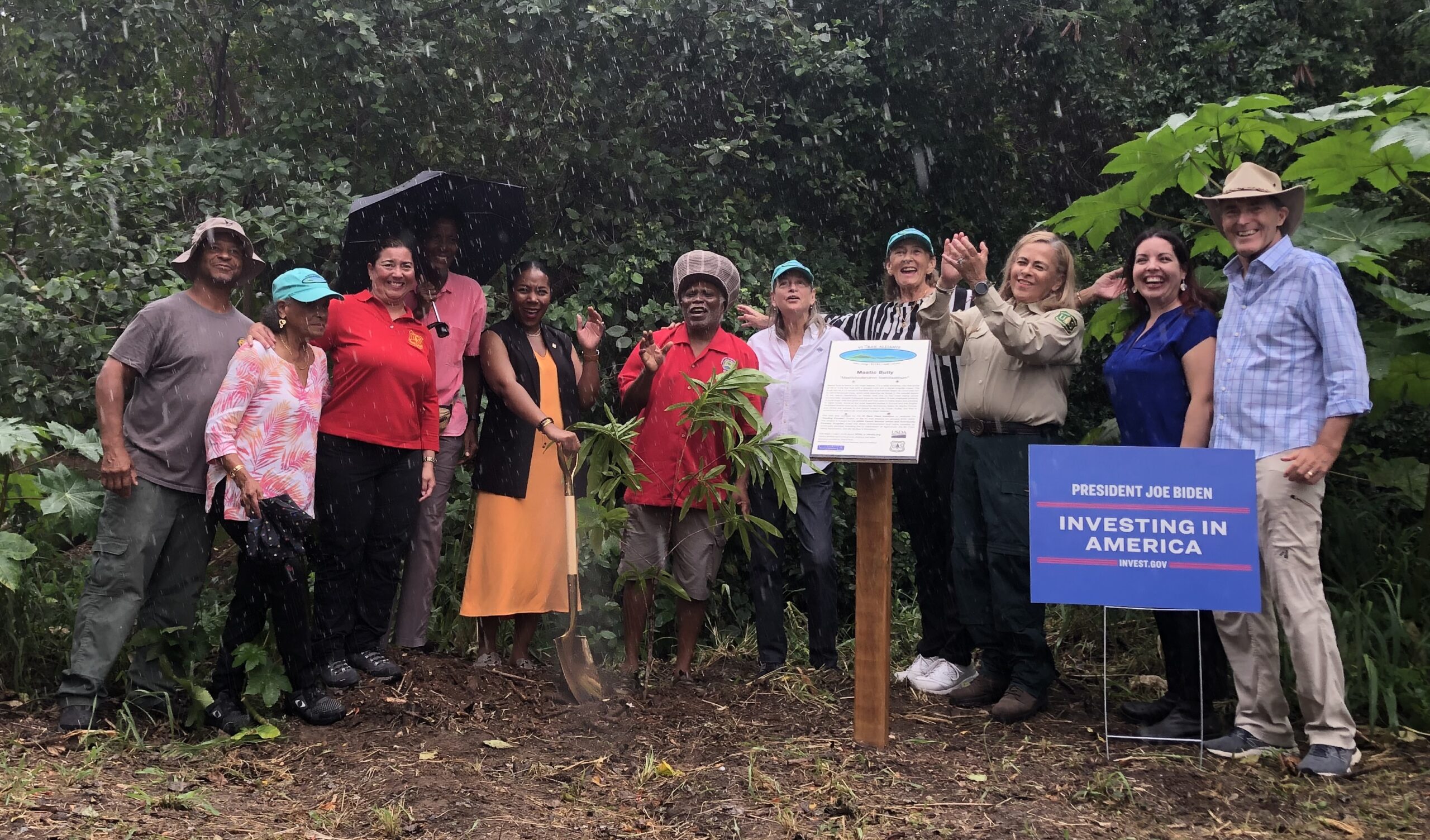
Rain could not dampen the enthusiasm of members of the V.I. Trail Alliance, My Brother’s Workshop, the International Institute of Tropical Forestry in Puerto Rico, and the Urban and Community Forestry Program of the U.S. Forest Service as they plant a mastic bully tree at the Estate Adventure Pavilion trail on Wednesday on St. Croix to commemorate the award of $6.5 million in urban forestry grants for the big island under President Joe Biden’s Inflation Reduction Act. (Source photo by Sian Cobb)
Rain could not dampen the enthusiasm of members of the V.I. Trail Alliance, My Brother’s Workshop, the International Institute of Tropical Forestry in Puerto Rico, and the Urban and Community Forestry Program of the U.S. Forest Service as they plant a mastic bully tree at the Estate Adventure Pavilion and Trail on Wednesday on St. Croix to commemorate the award of $6.5 million in urban forestry grants for the big island under President Joe Biden’s Inflation Reduction Act. (Source photo by Sian Cobb)

With Funding Comes Opportunities

Tree planting ceremonies were held after Wednesday’s press conference to commemorate the grant awards. A soapberry (Sapindus Saponaria) and mastic bully (Mastichodendron foetidissimum), donated by the V.I. Rare Plant Initiative, now grace the entrance to the trail at the Estate Adventure Pavilion, and a tamarind tree (Tamarindus indica) was planted near the entrance to the St. George Village Botanical Garden.
Olasee Davis and Susan Austin Kraeger, board chair of the St. George Village Botanical Garden, prepare to plant a tamarind tree Wednesday in celebration of the award of $6.5 million in urban forestry grants for the big island under President Joe Biden’s Inflation Reduction Act. (Source photo by Sian Cobb)

For Susan Austin Kraeger, board chair of the garden, the grant award was yet another sign from the village’s enslaved ancestors, whose presence she said is felt in every project undertaken at the historic 16-acre site. Once a massive 18th-century Danish colonial sugar plantation, today it boasts more than 1,000 Caribbean and pan-tropical plants and trees and is home to a museum, herbarium, and seed bank.

The site was once also home to Amerindians, who traveled up the Lesser Antilles island chain from Venezuela and settled in the area from about 100 to 900 A.D. Which is all to say, federal reviews are required before any projects are undertaken, said Austin Kraeger. As luck would have it, the St. George Village Botanical Garden has been working with the Society of Black Archaeologists for several years, including Alexandra Jones, Ph.D., who will be a consultant on the project, she said.

“We are hoping to have a dynamic display of what we are finding as we go along,” said Austin Kraeger. “It’s pretty exciting. It’s just a marvelous, exciting matrix. The key is finding people who are as passionate as we are to engage.”

The ultimate goal is to plant 1,100 fruit, nut and spice trees, said Austin Kraeger. “We thought it would be fun to be able to talk about ethno-botany and some of the ways the culture uses things we grow in cooking,” she said.

For example, a pilot program for all public school fifth graders to visit the garden, funded by a separate grant through the Community Foundation of the Virgin Islands, includes a lunch with macaroni and cheese that incorporates annatto, the food coloring derived from the seeds of the achiote tree that imparts a yellow or orange hue to the foods we eat.

The Urban Forestry grant will also enable the garden to hire paid student interns in the summertime, “which is going to be huge,” said Austin Kraeger. “I’m not sure there is any other botanical garden like this … with the combination of the historical and the botanical at the same time – it is pretty unique,” she said.
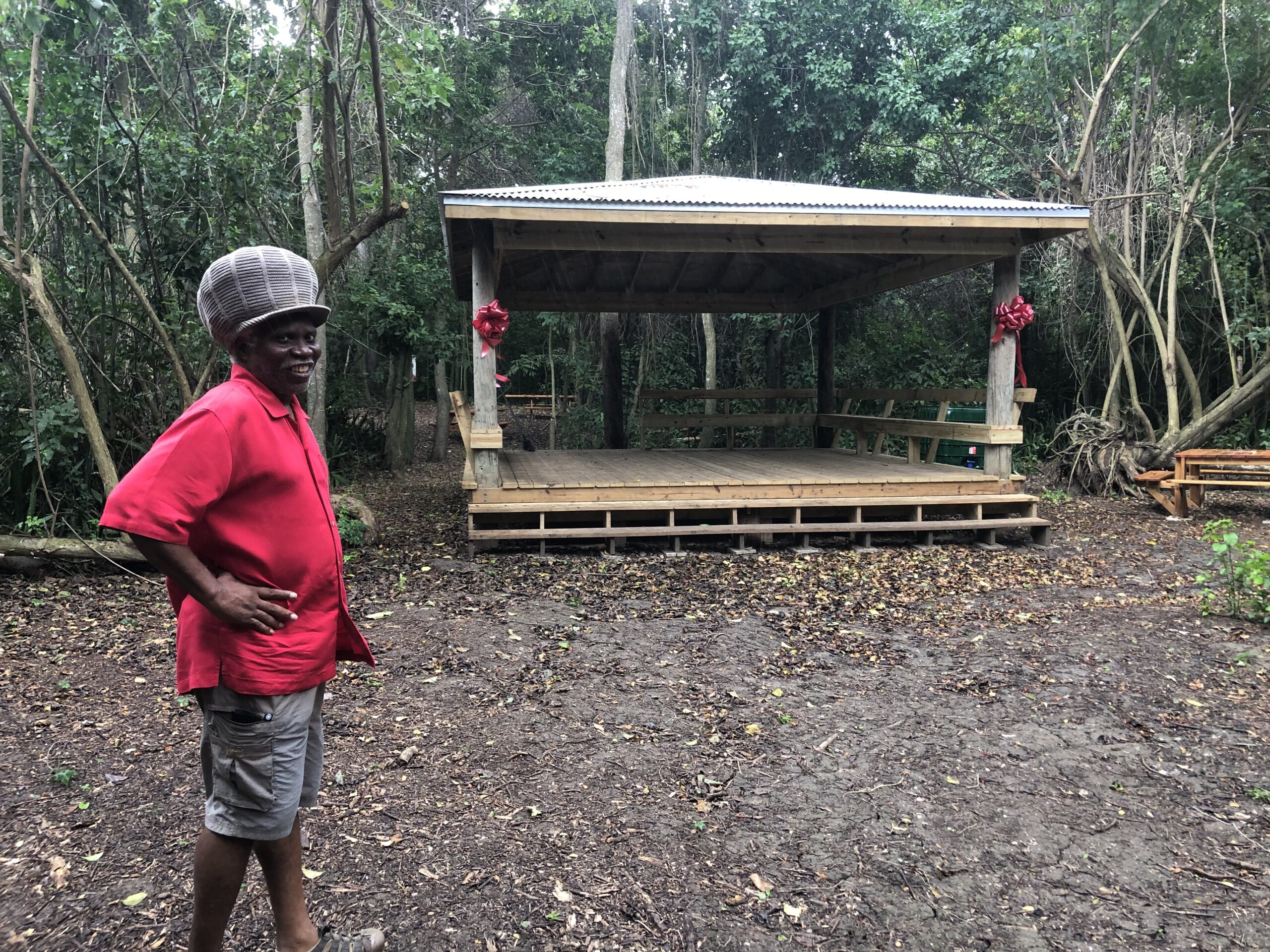
Olasee Davis at the Estate Adventure Pavilion and Trail on St. Croix, which was made possible thanks to the joint effort of AARP in the Virgin Islands, the V.I. Trail Alliance and community partners, including My Brother’s Workshop. (Source photo by Sian Cobb)
Olasee Davis at the Estate Adventure Pavilion and Trail on St. Croix, which was made possible thanks to the joint efforts of AARP in the Virgin Islands, which provided a grant, the V.I. Trail Alliance and community partners, including My Brother’s Workshop. (Source photo by Sian Cobb)

It Really Does Take a Village

Wednesday’s celebration featured the who’s who behind the effort to promote sustainability in the territory, from Petersen and Collingwood to members of the International Institute of Tropical Forestry in Puerto Rico, part of the USDA Forest Service, who all spoke at the Government House ceremony.

But to a person, all acknowledged the unstinting contributions of Olasee Davis, Ph.D. — who wrote letters in support of the grants, is on the board of the V.I. Trail Alliance, and a member of 20 other non-profit organizations locally, nationally and internationally — as central to the initiative.

At the press conference Davis, an assistant professor at the University of the Virgin Islands School of Agriculture on St. Croix and a passionate environmentalist and historian who shares his knowledge freely, including in the pages of this newspaper, took his turn at the podium to ask for a moment of silence to remember Larry Bough, who in 1974 became the director of the Division of Forestry and coordinator of the U.S. Forest Service and is hailed as the first native forester of the Virgin Islands.

Urban forestry has a “long, long, long history” on St. Croix, said Davis, noting the mahogany trees outside Government House that are more than 200 years old, and President Franklin D. Roosevelt’s Civilian Conservation Corps program that began in 1933, employing single men ages 18 to 25 during the Great Depression to work on programs to improve America’s public lands, including on the big island.

The V.I. Trail Alliance will plant food trees along the island’s streambeds, as was done by the ancestors, said Davis, and will also have programs to educate children about their importance, “so they can appreciate what we have here in the Virgin Islands,” he said.

“This is the first time in history that we have received so much money,” said Davis. “Whenever you see President Biden, tell him the bushman said thanks,” he told Wilson.

New Solar Power Plan Promises Cost Relief for Customers

0
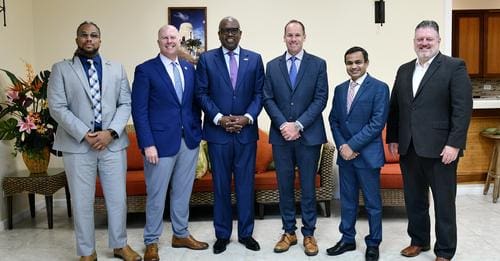
Partners in a new effort to cut local energy costs. (Photo courtesy of Government House)
Government House and the V.I. Water and Power Authority recently announced a venture designed to lower energy costs. The plan revolves around the creation of six solar parks, coupled with battery storage systems across the territory. Details of the plan were announced at a Jan. 22 press conference on St. Thomas. Energy Office Director and WAPA Governing Board Chairman Kyle Fleming introduced two alternative power executives who will partner with the utility to meet their goals.  It’s the latest attempt by the V.I. government to lower energy costs since then-Gov. John de Jongh reached a deal with Vitol America in 2013. The Vitol agreement was promoted as part of a tri-fuel energy plan that would reduce WAPA’s dependence on fossil fuel. “We’re looking at a significant shift in the way the territory uses energy,” said WAPA Chief Executive Officer Andrew Smith. He added that 70 percent of the utility’s operational costs are currently spent on buying either fossil fuel or propane gas.  The collaboration between V.I. Electron, Honeywell Industrial Automation and WAPA has already resulted in the creation of power purchase agreements expanding the use of solar energy, Smith said. Officials speaking at the Monday announcement also credited the Economic Development Authority for supporting the two entities. “We have long talked about renewables in the territory and I think what we are talking about — on the horizon — in 2024 is the actual realization and implementation of widespread deployment,” Fleming said. Under the terms of the agreement, WAPA will buy electricity generated through V.I. Electron’s solar farms. Honeywell will provide storage systems that will allow the sun-powered energy to last past its peak production hours. “This visionary partnership is set to transform the energy landscape of the US Virgin Islands through the deployment of cutting-edge Battery Energy Storage Solutions (BESS) across six strategically positioned solar parks,” according to a Jan. 25 statement from Government House.  WAPA opened its first solar farm on St. Croix in 2013, followed by a second one on St. Thomas a few months later. Utility officials pledged to restore and expand those facilities after they were damaged in 2017 by Hurricanes Irma and Maria.

Adopt a Forever Pet

0
The Source wants to help reduce the overpopulation of unwanted pets in the U.S. Virgin Islands. Every week we will feature a dog or cat from the hardworking rescue organizations and hope someone will find their fur-ever friend on this site. (All animals have been vaccinated, neutered and are healthy.)
This pretty gray female pup is 8-9 months old and available for adoption. (Photo courtesy of Cruzan Satos Rescue)
This is Sarena. She was found at the dump with her sisters in terrible condition. But all have been rehabilitated and Sarena is ready for her forever home. She is around 8-9 months old and is a Pit bull mix who is dog friendly and very playful.  She has met cats and gets along fine with a proper introduction. She is super loving and affectionate and would be happiest in a fenced yard with people who love her. She has been microchipped and is up to date with her vaccines, so take this sweet baby to your home. Call 340-513-7113 to meet this beauty and email to adopt Sarena. Pettie is about five and a half years old and has been at the St. Thomas shelter for two years. Pettie really needs a home. He weighs about 50 pounds and is one St. Thomas’s world-famous coconut retrievers. He is such a nice dog- he loves people and gets along with other dogs. He loves to play with his toys and loves to eat his food and treats. He also adores going on walks and is easy to handle on a leash. Call 340-775-0599 to meet Pettie.
This beautiful boy has been at the Humane Society of St. Thomas for way too long – 2 years. He deserves the best home? (Photo courtesy of Humane Society of St. Thomas)
 
Leo is less than a year old, but a gentle giant. (Photo courtesy of St. Croix Animal Welfare Center)
Do you love a squishy face dog? Meet Leo! This snuggly boy is under a year old and is already 51 pounds of love. He’s incredibly calm despite his age and seems to understand he’s a big dog, so he’s very careful not to bump into people or step on their feet. He gets along with other dogs and loves people. It might take a minute to warm up because shelter life can be stressful and confusing. Give Leo a chance – he’s ready to go to his new home. Come meet him at Pet Place next to FoodTown.

National Climate Assessment to the Virgin Islands: Wake Up

There’s very little warm and sunny in the near future for the Virgin Islands or Puerto Rico, as depicted in a recent climate change overview.

Rather, the two U.S. territories can look forward to more severe hurricanes, devasting droughts, increased flooding, and all the ripple effects that catastrophes can trigger, from plagues of disease-bearing insects to contaminated water sources to reduced crop yields and excessive strain on physical, emotional, and mental health.
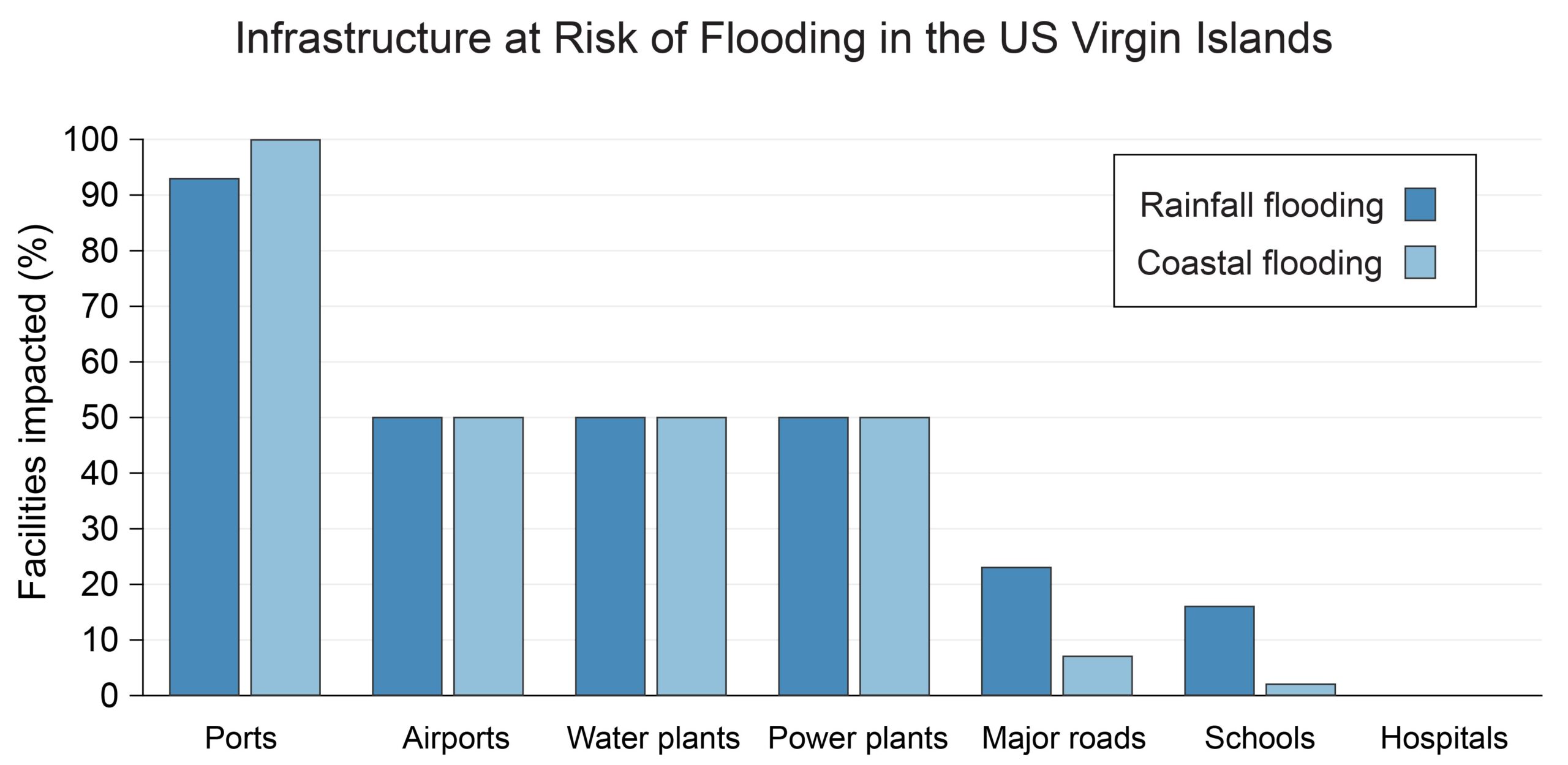
Per the graphic, 94 percent of V.I. ports are at risk from rainfall flooding, with half of the territory’s airports at risk both from rainfall and storm sea flooding. (Graphic by the University of the Virgin Islands, NOAA National Centers for Environmental Information, and the Cooperative Institute for Satellite Earth System Studies at the North Carolina Institute for Climate Studies)

The islands are described as especially vulnerable because of their exposed coastlines, their abundance of aged and neglected infrastructure and the general lack of collective will to address global warming and mitigate its effects.

The grim picture is contained in a chapter on the “U.S. Caribbean” in the latest National Climate Assessment. A collaborative effort by myriad scientists and researchers, the report has been produced approximately every four years since 2006.

The U.S. Global Change Research Program oversees the assessment. Originally, the analyses concentrated on regions in the lower 48 states, but the fourth edition contained a chapter about the two U.S. territories located in the Caribbean, Puerto Rico, with its 3,515 square miles (700 miles of which are coastline) and three million people and its much smaller neighbor, the 133-square-mile Virgin Islands, with 175 miles of shoreline and, according to the 2020 Census, a little more than 87,000 residents.

The fifth and most recent edition of the National Climate Assessment was released late in 2023.

The fourth report detailed such geophysical effects of climate change as the amount of current and anticipated sea level rise and consequent shore erosion. The latest edition builds on that information and also focuses on the consequences of these changes for the people living in the islands.

Not new is the idea that climate change is widening the swing from extreme dry conditions to extreme flooding events.

“Hurricanes, increasingly powerful storms and rising sea levels are already harming human health, ecosystems, water and food supplies and critical infrastructure in the U.S. Caribbean, with underserved communities suffering disproportionate impacts,” the report states. By the end of this century, the tropical cyclone rain rate is expected to increase by about 15 percent, and the wind is expected to be about three percent stronger.

“Climate change is also causing higher temperatures and drier conditions, thereby reducing water availability, increasing water demand, and intensifying saltwater intrusion into aquifers,” the report says. The daily average temperature in Puerto Rico has already increased by two degrees Fahrenheit since 1950. (Similar data is not available for the V.I.)

“In the Eye of the Storm,” a linocut print by Simona Clausnitzer, depicts how a hurricane’s effects can spin outward from the immediate damage to natural resources and buildings and other infrastructure to human impacts, including out-migration. (Illustration courtesy Fifth National Climate Assessment)

All of that is expected to increase what is already significant competition for water, which is needed for agriculture and electricity production, as well as direct human consumption.

Another water-related concern is the potential for groundwater contamination. Both territories have “superfund” sites, areas with toxic waste that the Environmental Protection Agency has declared hazardous.

There are two V.I. sites: the Tutu Wellfield in eastern St. Thomas and the former Island Chemical Corp./V.I. Chemical Corp. in southwestern St. Croix.

Problems surfaced in both areas in the 1980s and led to closures and decades-long EPA involvement. Benzene, toluene and trichloroethene were among the contaminants found at Tutu, and chloroform, benzyl acetate and benzyl salicylate were some of the chemicals found at the former manufacturing site on St. Croix.

The report warns that extreme flooding could possibly lead to the spread of “large amounts” of contaminants and carcinogens from a superfund site into the surrounding area.

In addressing the issue of increasing storm intensity, the researchers didn’t have to look hard for examples. The back-to-back Category 5 hurricanes of September 2017, Irma and Maria, damaged 12 percent of the region’s corals, caused beach loss of between 1.2 miles and 3.1 miles, and devastated one-third of the region’s mangroves.

The hurricanes also “demonstrated the vulnerability of critical infrastructure (e.g., energy, water, healthcare, transportation, telecommunications, wastewater, stormwater, and solid waste).”

Both short and long-term loss of infrastructure elements caused myriad ripple effects. Healthcare services, for instance, were stunted, and for varying periods of time, residents lost access to vaccinations, cervical cancer screenings, dialysis, oncological treatment and many other services.

At the same time, transportation interruptions caused some food scarcity since 90 percent of the food consumed in the Virgin Islands (and 80 percent of food consumed in Puerto Rico) is shipped into the islands.

Most obvious was the loss of electrical service, with consequences ranging from the inconvenient and uncomfortable to the life-altering and even life-threatening.

Much of that, the report suggests, might have been avoided or at least mitigated with proper planning.

Although “the recurrence of powerful tropical storms” is one reason for infrastructure vulnerability, it is also the result of “deferred maintenance” and of “a centralized mode of production and governance that limits redundancy, flexibility, and, therefore, the ability to anticipate and adapt to future scenarios that climate change will create,” according to the report.

While their geographic isolation and relatively small size make the islands especially susceptible to problems from climate change, those same factors could also help the “U.S. Caribbean” become the poster child for successful mitigation efforts.

“For Puerto Rico and the USVI, significant financial resources could be made accessible for climate adaptation and comprehensive disaster management,” the report says.

“However,” it continues, “effective adaptation planning is impeded by limited uptake of climate change information in decision-making, weak linkages between programs, and insufficient institutional capacity for prioritizing initiatives and designing linked operational systems across multiple organizations.”

The report notes there has been a rise in “sustainable development efforts” by community-based organizations in response to inaction by government. A 2016 “climate change initiative” for the Virgin Islands, sponsored by the U.S. Interior Department, garnered support from civil society organizations.

“However,” the report says, “there is currently no climate change adaptation program in the USVI, and the inadequate uptake of climate change information for decision-making identified in 2016 is still reflected in current public sector policies and programs in both the USVI and Puerto Rico.”

To access the U.S. Caribbean section of the report, click here.
Op-Ed: A Brief History of Magens Bay: Part 3

0
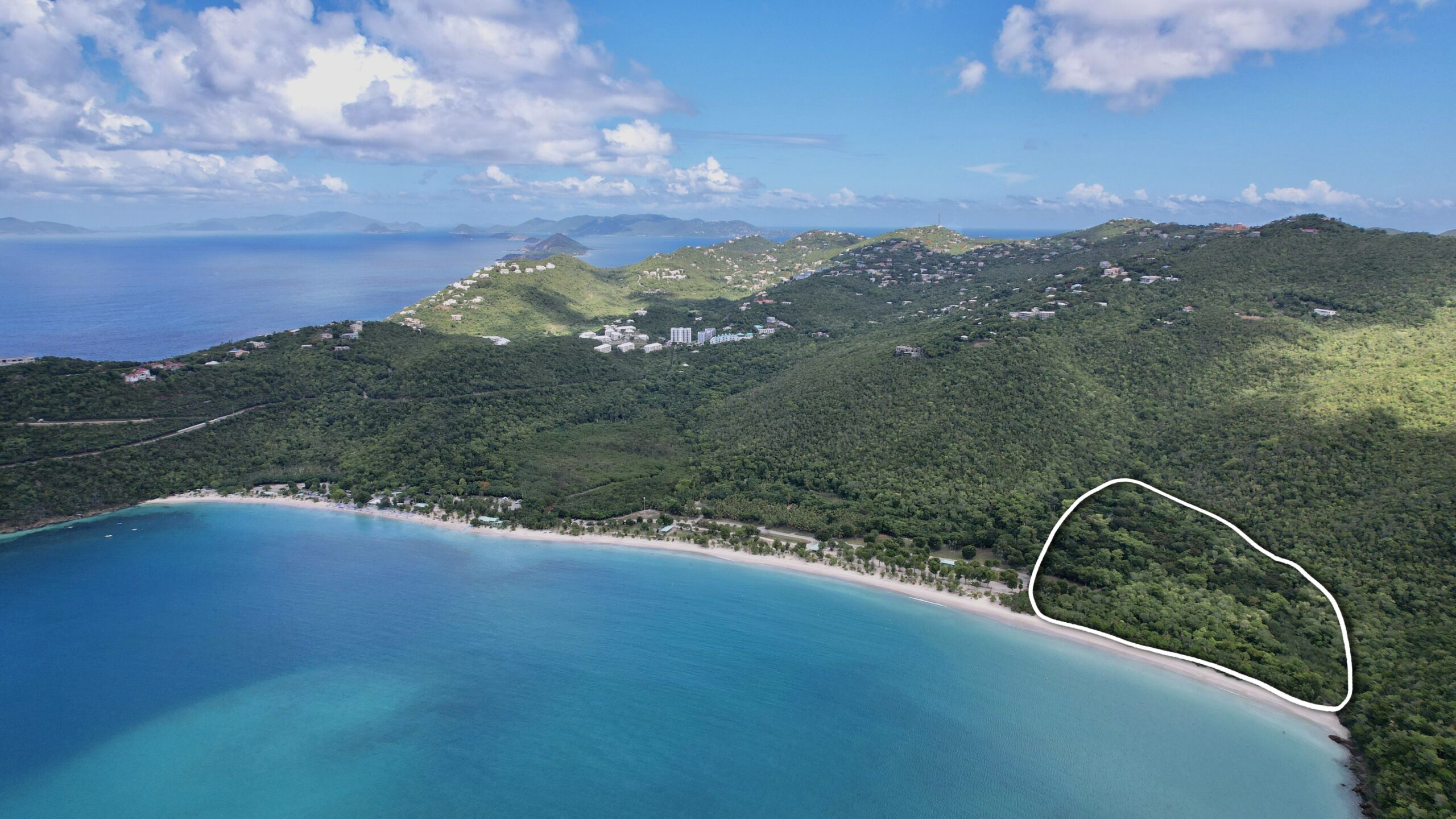
Conservation or Coney Island? When he resigned from the Magens Bay Authority Board in protest of some of his colleagues’ approval of the zoning change at the far southwest end of the park in order to accommodate a resort development in 1985, Guido Moron predicted were the resort to come to fruition, Magens Bay would become “a genteel Coney Island.”* There were other casualties of that ill-advised rezoning, including seven of the senators who voted in favor of changing the zoning from R1 (half-acre single-family dwelling) to commercial, who would not be re-elected. Three others did not seek re-election.
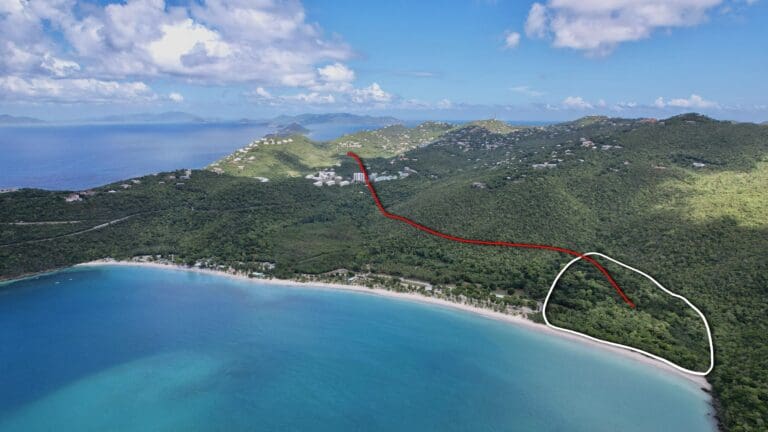
White line approximates the rezoned area intended for Magens Bay Resort. (Don Hebert photo, courtesy Bill Otto)
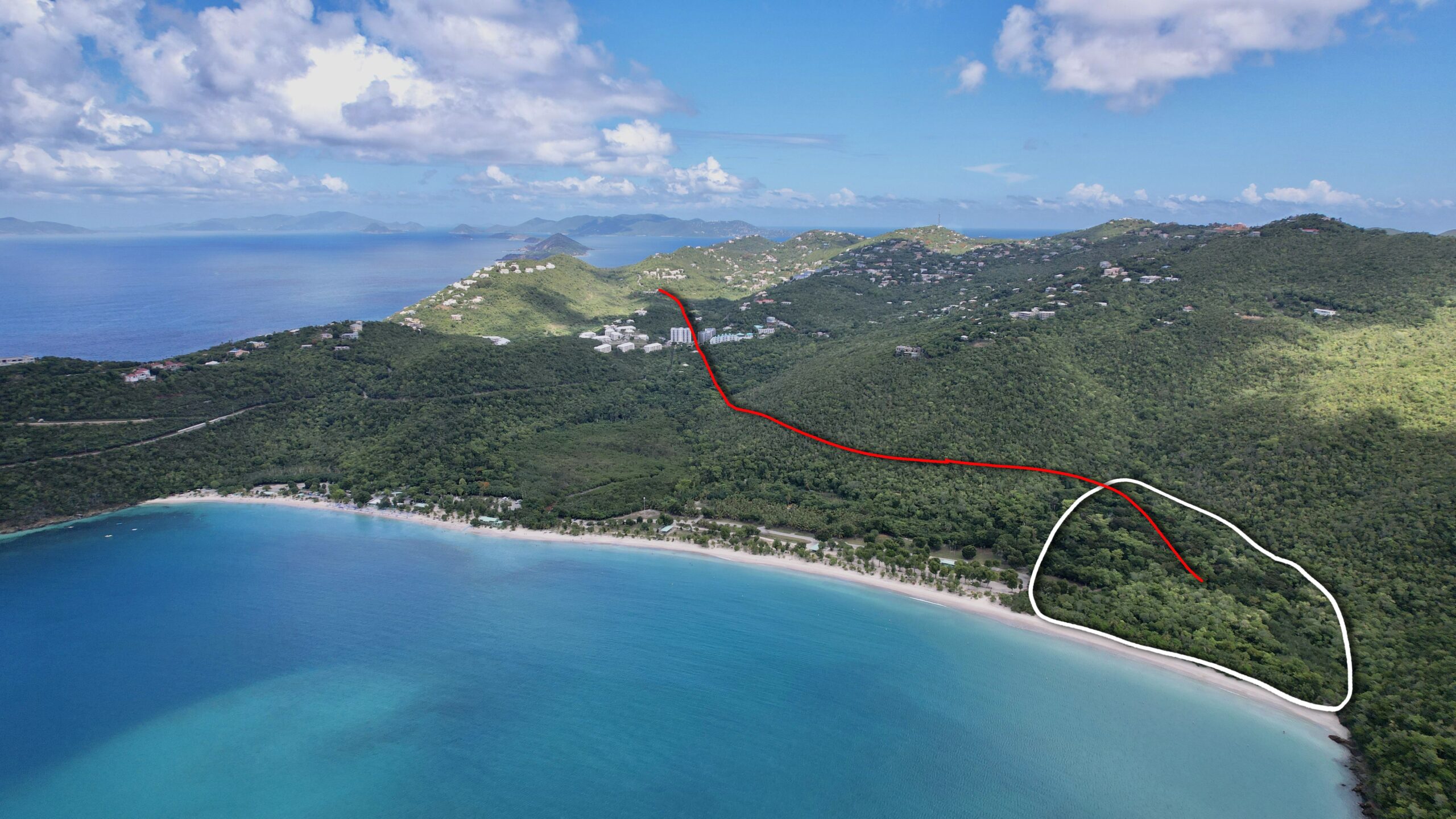
According to a New York Times article in October, a bill rezoning the heirs’ tract was attached to an omnibus bill that passed without debate on the day the Senate recessed for the upcoming November election. According to then-Sen. Iver Stridiron, who vehemently opposed the rezoning, the vote also took place at “3 o’clock in the morning.” The voice of the people at the voting booth notwithstanding, the same group, by now with nothing further to lose politically, voted at a lame-duck legislative session to let the rezoning stand, effectively kicking the can down the road for the newly elected senators to deal with the prickly issue, the New York Times reported. The senators and the Magens Bay Authority Board were not the only ones who went along with the re-zoning. Then director of the planning office Roy Adams recommended that the 56 acres behind Magens Bay Beach be rezoned to allow the planned resort, saying that Gov. Juan Luis had favored the hotel’s request and he was therefore obligated to support it.** Meetings were held between James Armour, the local developer who was the force behind the commercial development plan, which included Mahogany Run Resort, which later became the only golf course on St. Thomas, and the conservation and historic preservation activists. At one point, Armour walked out of a meeting saying that these groups, which included the V.I. Conservation Society, the League of Women Voters and the St. Thomas Historic Trust, among others, were not interested in a dialogue. Armour said they preferred a “combative role,” according to Marilyn Krigger in her seminal work.*** What was never made public at the time or since was the crucial connection between the proposed Mahogany Run and Magens Bay Resort. That connection was literal. Otto said in a conversation for this article that in order to secure more funding for the Mahogany Run project, Armour needed a resort near the beach. Otto confirmed that the road would have run approximately as shown by the red line in the photo dividing the environmentally crucial watershed in half.
Red line approximates the road from proposed Mahogany Run Resort to rezoned area intended for Magens Bay Resort.(Don Hebert photo, courtesy Bill Otto)
Even Darlan Brin, author of a 2018 Source article Op-ed: Management of Watershed to Protect Magens Bay and Related Ecosystems who was at the time of the proposed rezoning, the commissioner of Conservation and Cultural Affairs, which later became the Department of Planning and Natural Resources, was not aware of the planned roadway, he confirmed in a recent conversation. During the time of the protests, Brin testified against the rezoning “all alone” at the Legislature. “But let me tell you something,” he said, “That whole issue of watershed and nonpoint pollution remains a major problem on this island.” Armour’s argument against the protestations of these groups claim was that “Arthur Fairchild indicated before his death in 1951 that he approved of some resort development at Magens Bay. Existing zoning permitted residential development that could harm the area more than the plan for a resort,” according to a 1984 New York Times Article about the outrage the zoning change had stoked in many members of the community. It’s an odd claim considering the wording in Fairchild’s statement of intention, which clearly stated, “To allow these slopes to be deprived of their well wooded covering; to treat them otherwise that according to a general plan; or to utilize them for any commercial purpose would’ve resulted I believed, in the loss by our island of one of its greatest assets.” Otto, owner of David Jones Realty, who worked for years helping Homer Wheaton, Fairchild’s nephew and heir to his estate and after Homer’s death and his wife, Christine Wheaton, to dispose of the property in question in keeping with Fairchild’s wishes said this week that Homer had approved an easement that would allow people staying in the planned resort to walk from the 300 room hotel to the beach. Otto also affirmed Armour’s conviction that the hotel would be far less disruptive to the sensitive and crucial watershed than building 100 single residences on the R1 zoned 58 or so acres that the developers wanted rezoned for commerical use. Otto believes that the late firebrand environmentalist and lawyer Edith Bornn, who is quoted heavily in the New York Times article from 1984, would have stopped the development legally anyway because no public hearings had been held on the rezoning as is required by V.I. code. But, according to Krigger, Armour, realizing that he would not get the rezoning from the newly elected Legislature anyway, walked away from the Magens Bay resort idea. There was a “lull,” Otto says, between 1985 and 1995. But he says from 1995 until 2002 was a much more “dangerous” time for the pristine bay. When Homer Wheaton died in 1997, Christine – who was from Switzerland – was anxious to get rid of the remaining Fairchild property that she was left with, including the resort acreage, and cut her ties with the Virgin Islands. “She had a very low opinion of the Virgin Islands government,” Otto said. First, according to Otto, she was “disgusted with the condition of Fairchild Park, which had also been deeded to the people of the Virgin Islands and left full of debris and overgrown bush. Fairchild Park, after it was deeded to the Virgin Islands government, became the responsibility of the Department of Housing Parks and Recreation. Stanley Smith, assistant HPR commissioner for 12 years, said in a phone conversation, “Our department never had the means to maintain of all the facilities that fell to our care.” And it wasn’t a priority when stacked against the parks where Virgin Islands children played sports and enjoyed other recreational opportunities within easy reach via public transportation or walking distance from where they lived. The tiny little park in Estate Elizabeth overlooking Magens, with no public transportation or parking, was not a priority. Smith, who is retired, said the small crew of groundskeepers employed by his department “cut the grass and keep moving.” Smith believes that the only solution for Fairchild Park would be a public-private partnership. And, in fact, in 2012, efforts were made and an official partnership agreement was reached to form Rock Men Community Corp to that end. The impetus for forming Rock Men was the possibility that care of Fairchild Park could align with My Brother’s Workshop’s mission. The idea was to train young people in landscaping and gardening care – a lucrative business and employment opportunity in the jungly tropical community. But as with so many noble efforts and sincere intentions, Rock Men Community Corps died on the vine.
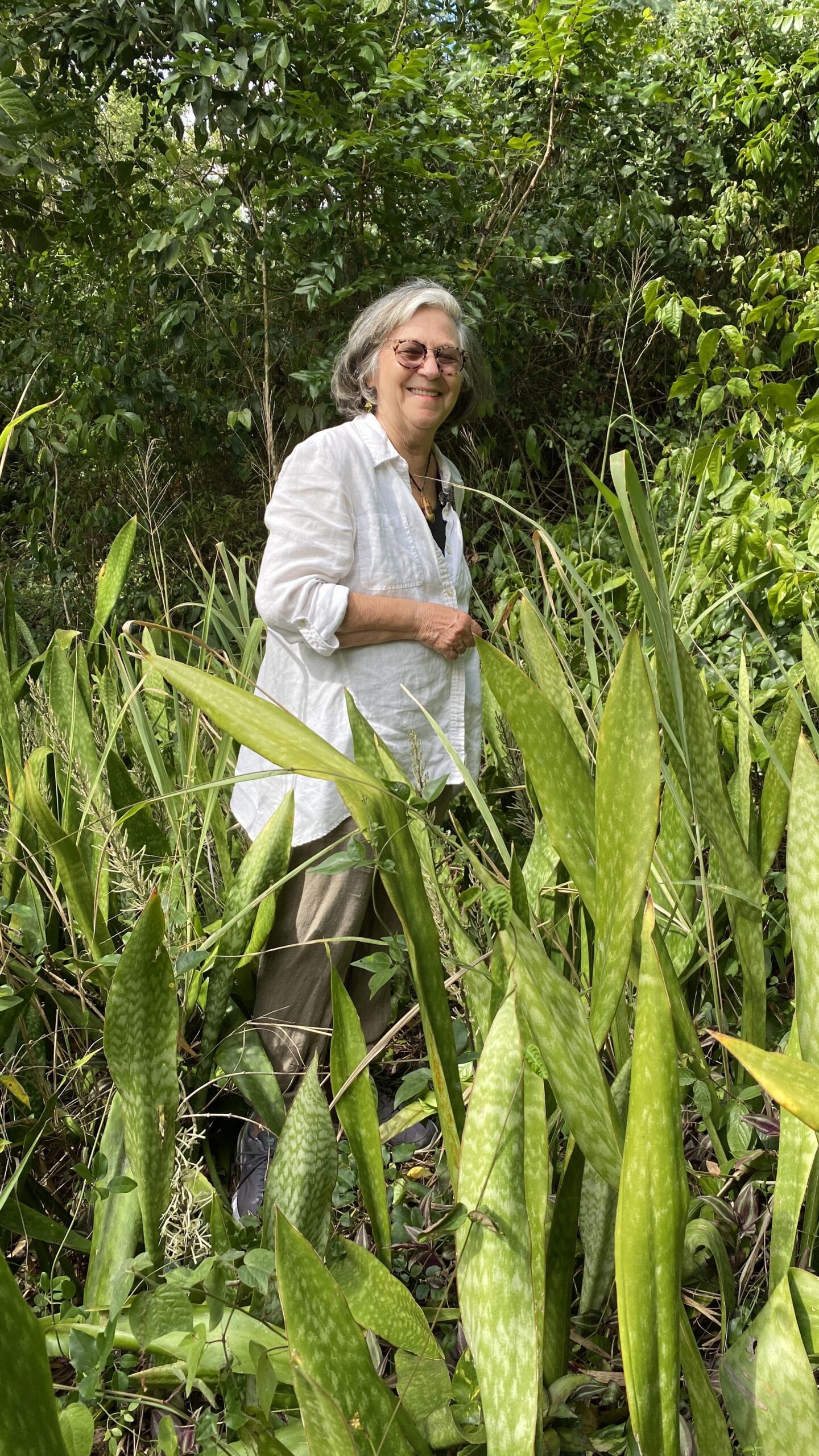
SAP Fairchild Park (Photo courtesy Jefferson McCarley)
The final straw for Christine Wheaton, whom Otto described as someone who was never afraid to speak her mind, was the use of Drake’s Seat for commercial purposes, which was explicitly forbidden in the deed of conveyance. It took two years for that matter to be settled to her satisfaction when the vendors were evicted. Meanwhile,  the remaining property upon which the resort would have rested had the zoning change taken place was zoned R1 and could easily have been developed for 500 or more half-acre residential lots. And Otto said there were developers sniffing around, but none made an offer that was acceptable to Christine Wheaton. That may well have been in part, Otto says, because “She was committed to perpetuating Fairchild’s vision for the bay, but she really just wanted to get out of the Virgin Islands.” Otto understood that that kind of building and the roads and the attendant runoff would’ve meant the end of the bay as we know it. So Otto spent the next seven years attempting to balance Wheaton’s need to be done with the Virgin Islands while keeping Fairchild’s vision in mind. The precarious balancing act ended in 2002 with an agreement brokered by Otto, which allowed the Nature Conservancy to purchase the land on behalf of the Virgin Islands government for $5.5 million. See From Drake’s Seat to Beach Now Protected Land. That is far from the end of the story, and subsequent attempts to commercialize Fairchild’s gift will be addressed in further articles. Meanwhile, a quote by another woman who was never afraid to speak her mind is much like a directive from our dear departed, fierce, relentless defender of sacred spaces. ”The very basic challenge to these islands is government’s lack of commitment to planning,” Edith Bornn told the New York Times reporter. ”We do have a master plan, but it is ignored more than it is observed.” And 40 years later, that land and water use plan first developed by the Virgin Islands League of Women Voters has never been codified in any form, leaving the island vulnerable to lucrative and never-ending spot zoning which does not serve the indigenous, native population that Fairchild loved enough to bequeath most of his holdings to them. * Race Relations in the U.S. Virgin Islands by Marilyn P. Krugger,  pg 242 ** Race Relations in the U.S. Virgin Islands by Marilyn P. Krugger,  pg 242 ***Race Relations in the U.S. Virgin Islands by Marilyn P. Krugger,  pg 242 Editor’s note: On Wednesday afternoon, the Magens Bay Authority issued the following statement via email: The Magens Bay Authority announces a Town Hall Meeting at Magens Bay Beach, Shed Two, scheduled for January 27, 2024, at 9:00 AM. This meeting aims to provide the public with updates on the latest developments at Magens Bay Park and Smith Bay Beach and to gather community feedback on upcoming initiatives. The authority invites all community members to join in this meeting to discuss the parks’ future and share their insights and opinions. This initiative is part of the authority’s commitment to keeping Magens Bay Park a cherished destination for both locals and visitors. For further details, please email info@magensbayauthority.org. Related Links: Op-Ed: A Brief History of Magens Bay, Part I: Fairchild’s Dream Op-Ed: A Brief History of Magens Bay: Part 2

Lions Club Boost Safety for Child Passenger on STX

0
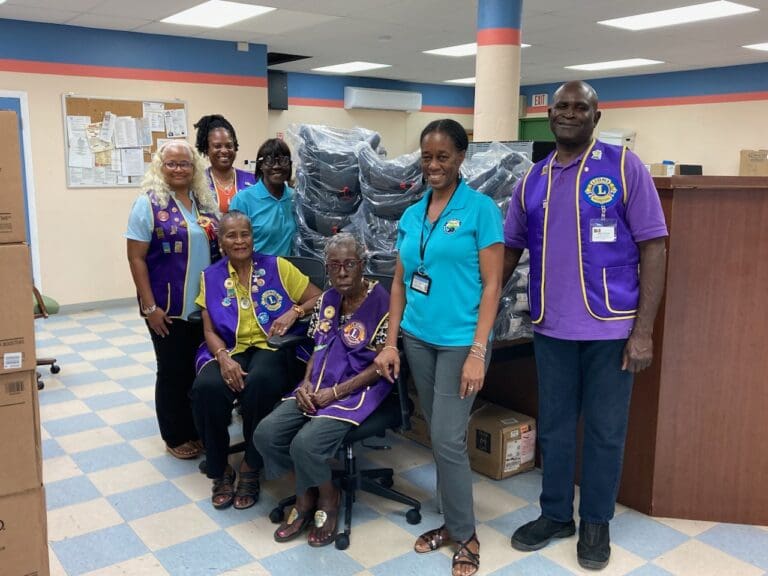
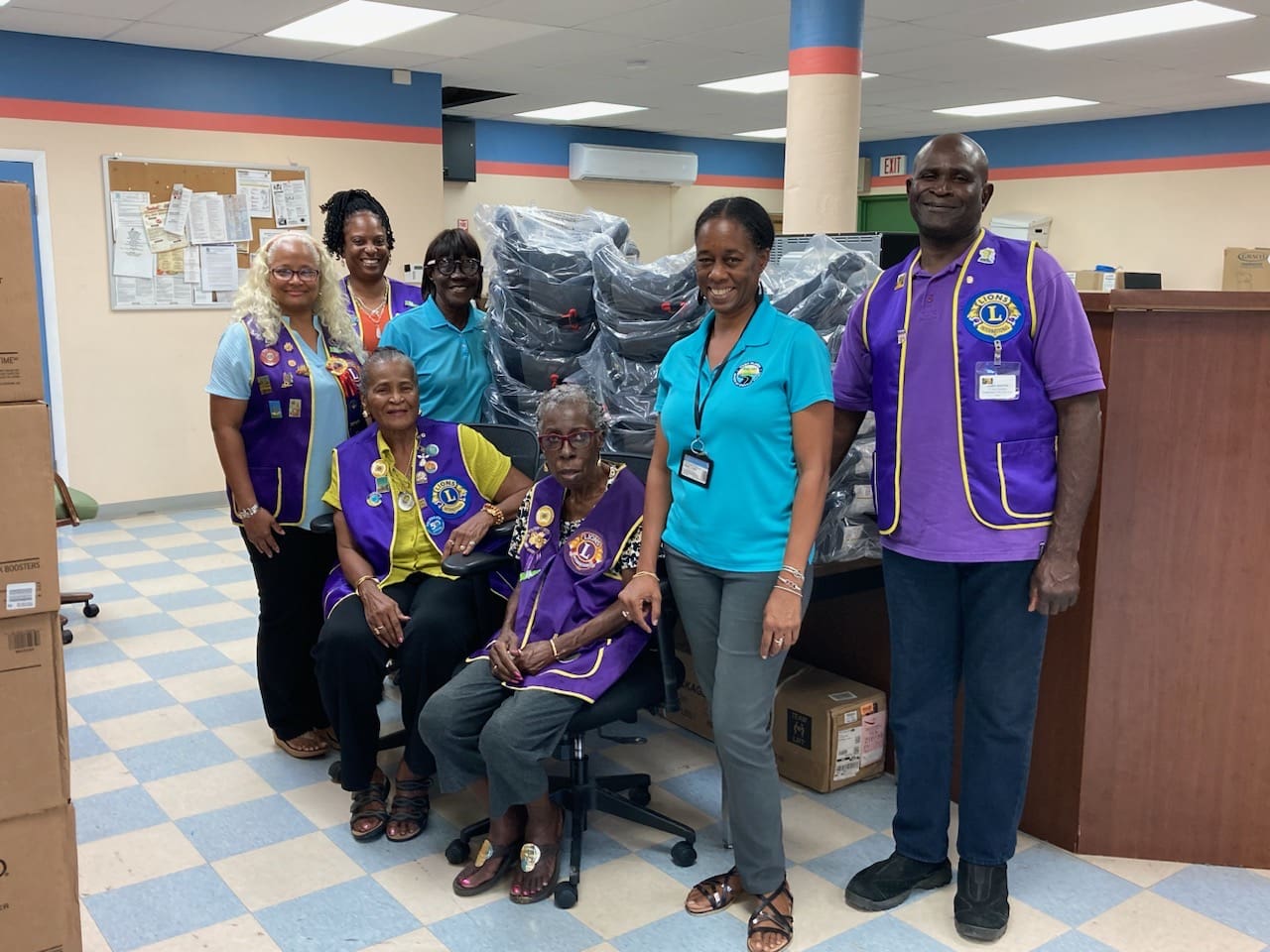
Frederiksted Twin City Lions Club donate 30 booster seats on St. Croix. (Photo courtesy VIPD)
Booster seats will be distributed to families without boosters due to the Frederstiked Twin City Lions Club’s generosity of donating 30 booster seats to the V.I. Police Department and the V.I. Office of Highway Safety’s Occupant Protection Program, the agencies announced.

Beverly E. Smith, the organization’s president, was compelled to participate in the booster drive. “When Ms. Gomes sent out her plea to the village for help in purchasing the seats, we had to respond,” expressed Smith. “We must work together to improve safety methods and knowledge in our community.”

Lion Club member Laverne Joseph and committee chair for Health and Youth, who initiated interest on the organization’s behalf, stated, “We felt that it was incumbent on us to step up and assist in the process of ensuring the safety of our children- our future generation.” To date, the drive has collected 395 seats, which are provided at no cost to caregivers with child passengers in need, according to the release

The booster seat drive was launched in December 2022 in response to local data, which revealed that approximately 73 percent of the territory’s children between ages four and seven were being transported without appropriate safety restraints. For this population, wearing a seatbelt without a booster may result in ejection, increasing injury risks for child crash victims, the press release stated.

Booster seats elevate the child so that the vehicle’s seat belt fits securely. In the territory, children are required to utilize a car or booster seat until age eight or up to 4’9” tall, the release stated.

For more information about child passenger safety in the territory or to contribute to the booster seat drive, contact the Virgin Islands Office of Highway Safety through Director O’Neal at daphne.oneal@vipd.vi.gov or Occupant Protection Planner/Coordinator Denise Gomes at denise.gomes@vipd.vi.gov. You may also contact the office via telephone at 340-772-3025 or 340-473-7383.