



Superior Court of the Virgin Islands Reappoints Ernest E. Morris Jr. as Magistrate Judge

Viya Donates $10,000 to Family Resource Center During Domestic Violence Awareness Month


FEMA Awards Security Grants to USVI Nonprofits and Houses of Worship
WAPA Spill Forces Switch to Diesel for Past Three Days, Cleanup Ongoing
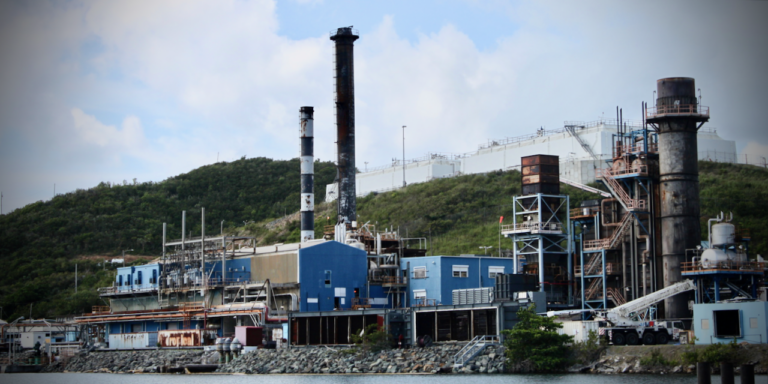
In the wake of a diesel spill at the Randolph Harley Power Plant on St. Thomas, V.I. Water and Power Authority officials said they worked quickly to follow the right response for cleanup, including adhering to the U.S. Coast Guard’s recommendation to use the remaining fuel so the situation doesn’t get any worse.
While offloading a shipment of diesel at the Harley plant late last week, one of the onshore storage tanks appears to have overflowed. About 30-40 percent of the spillage ended up outside the tank’s exterior secondary containment unit, which is meant to function like a dam to contain the liquid, according to WAPA Chief Executive Officer Andy Smith. The authority is working to figure out what caused the malfunction and if it can be fixed, but first has to mitigate what landed on shore, which was mixed in over the weekend and into Monday, with large amounts of rainwater and together is estimated at around 17,000 gallons.
Though full activation of the authority’s on-site oil response team didn’t appear to be needed over the weekend, Smith said in an interview with the Source Monday that any situation that could have a negative environmental impact is cause for concern, not to mention that oil onshore is flammable and could be harmful, if ignited, to WAPA’s personnel and the surrounding community. Diesel in water won’t explode, but it will cause a blaze, he said.
The first priority, after bringing the oil response team in to take a look, was coordinating response with Planning and Natural Resources, the Environmental Protection Agency and Coast Guard, which Smith said got involved because of the spill’s proximity to the water. It was upon the Coast Guard’s recommendation that WAPA use what was left in the tank, forcing the authority to switch to diesel for the past couple of days.
At this point, WAPA is still doing cleanup, which Smith said will continue, then expects to work with the EPA and Coast Guard afterward on compliance review, followed by inspecting the tank and understanding if repairs are needed.
Smith said the switch to diesel had nothing to do with Monday’s power outages, however, which were caused by issues with Feeder 13 on St. Thomas, which experienced a fault last month, pushing the authority into about a week of rotating power.
During that time, the feeder experienced multiple faults occurring on the cable and WAPA energized it several times, which, due to its old age, can weaken some of the connections on the line, Smith explained. The heavy rain over the weekend exacerbated the situation Monday, causing a fault that was identified late Sunday night, but couldn’t be fixed immediately because crews couldn’t get into the overflowing manholes, Smith said.
The feeder was fully restored by Monday evening.
Bryan Declares STX Water Crisis a Local State of Emergency, Setting Stage for National Designation
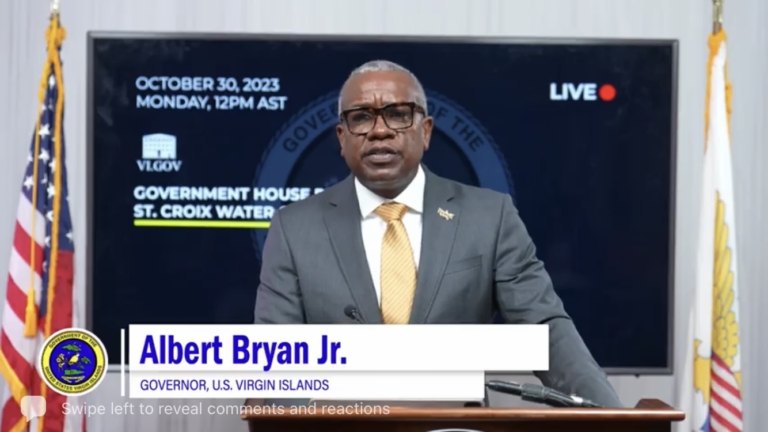
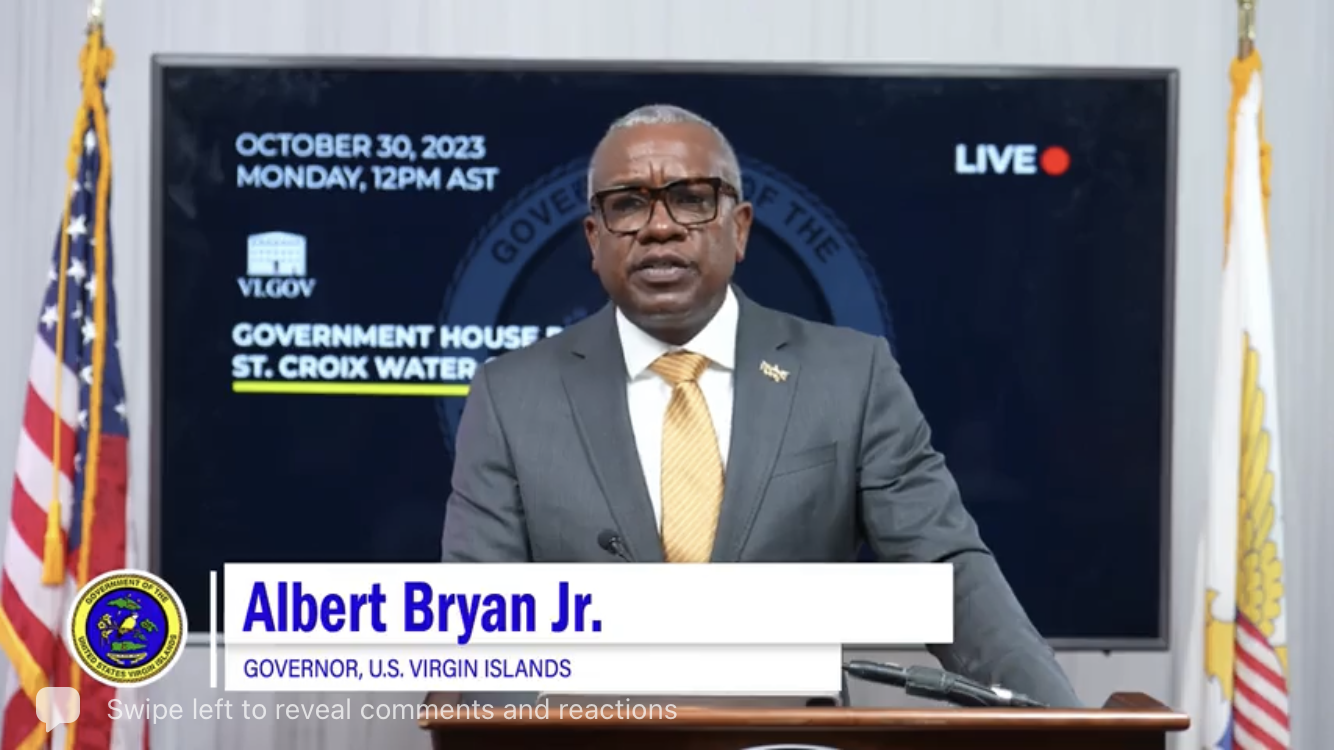
Gov. Albert Bryan Jr. on Monday declared a local State of Emergency for the potable water system on St. Croix as the first step in seeking a national emergency designation by President Joe Biden to address high levels of lead and copper first discovered in parts of the island’s water supply after testing in late September.
A territorial declaration of emergency gives the V.I. government access to local funding to help with the crisis and the ability to freeze prices on commodities such as bottled water, said Bryan, who has directed the Licensing and Consumer Affairs Department to do so for drinking water, water truck haulers, and water filtration products on St. Croix.
It also is a required step before he can seek federal help, said Bryan, who made the local declaration at noon on Monday at the start of the weekly Government House press briefing, which was held an hour earlier than the customary 1 p.m.
“A national declaration of emergency — which is what the most important thing is — is to get the resources of the federal government, where we will also be getting funding, more money for water, the ability to access funds for health testing and the like. Some of the things that are not within our grasp at this point,” he said.
Notably, it will bring financial and technical support from the Federal Emergency Management Agency, the Environmental Protection Agency, and Health and Human Services, which have already been lending their expertise to the problem, along with the Centers for Disease Control and Prevention, which is aiding the V.I. Health Department with its response to those who fear impacts from the lead and copper, said Bryan.
To date, the Health Department has found no evidence of residents harmed by the contaminants, according to Territorial Epidemiologist Dr. Esther Ellis. However, under the local emergency, it will be expanding its health survey of children from infants to six years old, including blood tests for lead and copper, the governor said.
Besides the local declaration, two other steps are required to trigger a national emergency, including proving that the V.I. Water and Power Authority’s efforts have been unsuccessful at preventing components in St. Croix’s water distribution system from leaching heavy materials into the system and that the local government has taken every prudent action to ensure residents have safe water for consumption, according to Bryan.
“Those heavy materials, particularly lead and copper, put us in violation of the Safe Drinking Water Act standards for certain parts of the system,” said Bryan, who expressed confidence that a federal declaration would get speedy approval.
St. Croix residents have long been dealing with discolored brown WAPA water coming from their taps, and tests conducted on Sept. 30 and returned to the territory on Oct. 13 revealed levels of lead and copper in 35 of 66 sites that in some cases were hundreds of times above what the EPA deems safe.
Lead levels in one pipe tested at more than 1,340 times the threshold set by the EPA. Another site had 601 times the lead considered an EPA “action level.” Another test site had water with more than 105 times the allowable copper levels. Exposure to either metal at those levels can cause severe, long-lasting health problems, federal officials warn, especially in children.
A Government House advisory against drinking WAPA water remains in place across all of St. Croix, and residents are advised to flush their taps for 10 to 13 minutes before using the water.
WAPA works closely with DPNR to monitor the territory’s water systems, and the Oct. 13 findings “were a surprise to all involved,” said the authority’s CEO, Andrew Smith.
The problem may rest with the chemicals used to treat the water post-production, said Bryan, who noted that tests have confirmed the issue is not at the reverse osmosis plant operated by Seven Seas, which provides the water used by WAPA as well as water haulers who deliver to homes that rely on cisterns.
According to Smith, recent testing performed at the standpipe at the Seven Seas plant found 0.021 parts per million of copper versus the EPA action level of 1.3 parts per million — or 98.4 percent less than the agency stipulates. It contained 0.00294 parts per million of lead versus the EPA action level of 0.015 parts per million, or 80 percent less, he said.
“Adjustments to WAPA’s post-production chemical water treatment can potentially help address this as a source of contamination. WAPA and DPNR continue to work with the EPA on a modified water treatment program, and WAPA is engaged with two outside advisers about guidance to modify its water treatment program,” said Smith.
“There are metal parts in the service lines, and preliminary indications are that the interaction of stagnant water in the service line with the metal parts in the service line may be the source of copper and lead,” said Smith.
“We think the lines going into the house are particularly suspect — the lines that come off the main line and run up to your meter before it gets into your house,” said Bryan. “We’re going out into the community and we’re pulling some of these lines in the affected areas to see if we can test to see if the leaching problem is occurring there,” he said.
“The way out of this will ultimately rest in the $1.2 billion prudent replacement of the water distribution system to ensure that we meet President Biden’s goals of eliminating all traces of lead nationwide,” said Bryan, referring to FEMA funding approved earlier this year for St. Croix. However, Smith has said that process could take 20 years.
As part of the local State of Emergency, Bryan has designated Health Commissioner Justa Encarnacion and Planning and Natural Resources Commissioner Jean-Pierre Oriol as the co-incident commanders to coordinate emergency response activities within the V.I. Territorial Emergency Management Agency, with VITEMA Director Daryl Jaschen as the territorial coordinating officer.
“WAPA is responsible for creating the path into permanent safety for all the water and water lines,” said Bryan, which includes finding a treatment system that will reduce the levels of lead and copper as well as the turbidity and brown water.
The authority also must implement a sustainable flushing protocol for its water system, “which means we will continue to flush the lines to make sure that we don’t have accumulation of lead, copper or any other materials in the system,” said Bryan.
WAPA also must assess the entire water distribution system for lead and copper, not just the 66 sites tested so far, said Bryan. “The good news about that, we already have been ahead of the ball game,” he said, referring to $32 million in federal funding that was allocated through Biden’s Bipartisan Infrastructure Investment and Jobs Act to assess all homes in the Virgin Islands for lead, copper and other particulates that may be contaminating the water.
“We’ve got to get the test kits together and we’ve got to send out a [Request for Proposal] because it is a massive undertaking and beyond the capabilities of WAPA direct,” said Bryan. He also is making available $36 million to expedite the process of replacing the authority’s service lines that have tested above EPA safe drinking water standards.
“We will address this crisis in a sustained and scientific manner,” said Bryan, who added that the problem is affecting a maximum of 3,800 households on St. Croix and that WAPA has begun excavation of service lines to identify and replace any lead and copper components.
The V.I. government also plans a public education campaign on ways to protect against contaminated water, he said.
While people have been calling for the government to distribute water to the affected homes, that is not in the budget, Bryan said, who said filters are a better long-term solution.
“We are going to be looking into buying some of this material and distributing them to those households so we can make sure that these people have options,” said Bryan. “As time goes by — because this is not going to be a one-month process or a two-month process, it is probably six months to several years to totally eradicate this problem — we’ll be looking at different ways” to help those affected, especially households with children or those on fixed incomes, he said, adding that could include giving people a credit on their WAPA bills.
“We’ll be looking into all of those things and bringing those online. This is why the federal declaration is so important because a lot of our money is tied to replacement of the system and replacements of parts, but we don’t have resources to give people free water and the like. Those resources we would have to use our local funds in order to do them. We have about $50 million right now dedicated to eradicating this problem in the Virgin Islands as an immediate address, and then $1.2 billion in terms of getting rid of all the unsafe drinking water,” he said.
“We understand that the challenges being faced are frustrating and for that, we apologize for the inconvenience this has caused our customers. As we navigate this ever-evolving landscape we continue to work to implement solutions alongside the Joint Information Center, or JIC, and Unified Command,” said Smith.
“Just like we tackled the hurricanes, just like we tackled COVID, we are doing this as a team, and as a team we will get through this,” said Bryan.
Two Health Department hotlines are available for residents to call from 8 a.m. to 5 p.m., Monday through Friday, with any concerns regarding health related to water quality. Individuals may call 340-712-6299 on St. Croix and 340-776-1519 on St Thomas-St. John. DPNR also operates a hotline number, 340-514-3666, Monday through Friday from 8 a.m. to 5 p.m.
The Health Department advises the community that testing for lead exposure is available at the Frederiksted Health Center on St. Croix and the East End Medical Center at Tutu Park Mall on St. Thomas.
WAPA Board Increases CEO’s Financial Authority to Deal with STX Water Crisis

Health Department Announces Initiative for Pediatric Lead Testing on STX

The V.I. Health Department is intensifying its efforts to raise awareness about lead exposure and its impact on health, particularly for the most vulnerable population — pregnant women and children ages 0 to 6 — after Gov. Albert Bryan Jr. declared a local State of Emergency on Monday to address high levels of lead and copper found in some of St. Croix’s drinking water.
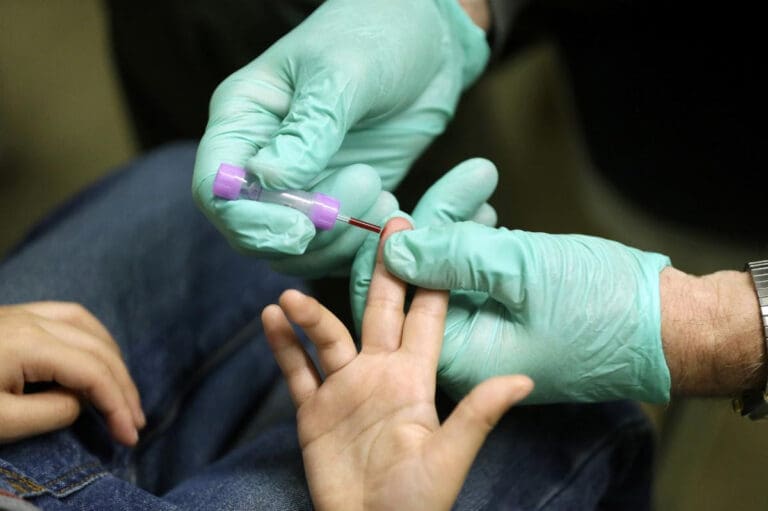
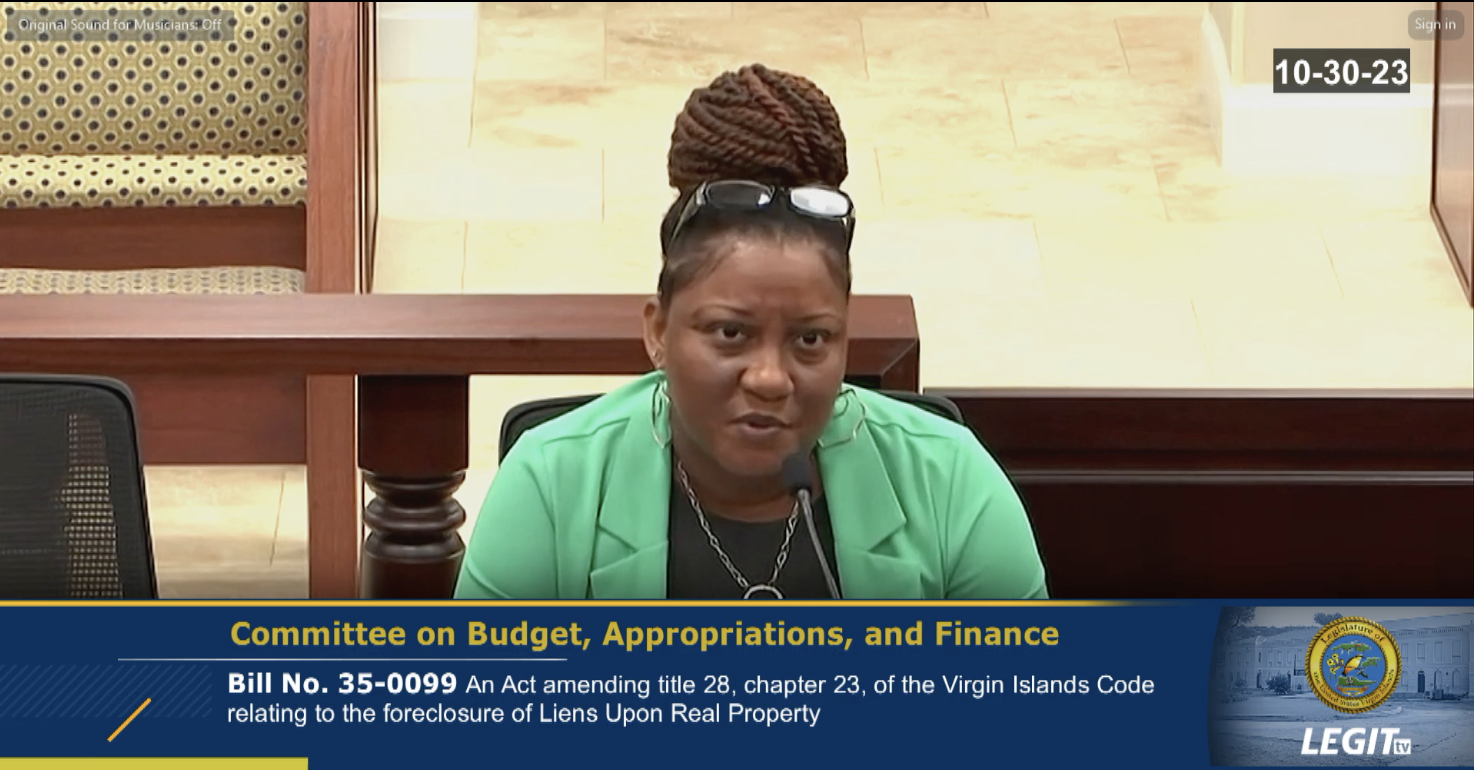
Bryan Jr. declared the emergency during the Government House press briefing on Monday as the precursor to seeking a national emergency designation to address the potable water system on St. Croix. As the Department of Planning and Natural Resources collaborates with its federal partners and the Water and Power Authority to rehabilitate the water system, the Health Department is intensifying its efforts around lead exposure, the department announced in a release shortly after the press briefing. “We are announcing the launch of a new project titled ‘Safe Haven: A Lead-Free Family Initiative,’ with the objectives of increasing awareness about lead exposure and conducting blood lead level pediatric testing for children ages 0 to 6 years old on the island of St. Croix,” said Nicole Craigwell-Syms, acting commissioner for the V.I. Health Department. Lead exposure can impact children’s development from the womb and early childhood, affecting attention spans, hyperactivity, and IQ levels. The risks of lead exposure are not limited to children; adults exposed to lead exhibit irritability and aggressive behavior, and it negatively impacts virtually every system of the body, the press release stated. “Testing the blood lead level will allow us to develop a baseline to determine the health impacts of lead in children as we work toward a lead-free future,” Craigwell-Syms stated. “Our goal is to test approximately 1,000 young children on the island of St. Croix.” Testing will be provided at no cost, the release stated. This week, Health’s Epidemiology Division, in collaboration with the Education Department, will pilot the program at Alfredo Andrews Elementary School for students in pre-K to first grade, according to the release. Parents of those students can register their children and provide parental permission for testing at the AAES public registration site. It is currently open for parents and guardians of Alfredo Andrews students only, it said. Starting Nov. 6, DOH will offer blood lead level testing to all children ages 0 to 6 on St. Croix. To have a child tested, a parent or guardian must register their child on the online portal and provide consent. On Wednesday, DOH will provide a new link to the registration site via local news outlets, online at www.doh.vi.gov, and on the Facebook page, the release stated. The Epidemiology team will conduct tests from 8 a.m. to 5 p.m., Monday to Friday, at the Community Health van located adjacent to the department’s modulars in Estate Richmond, Christiansted. DOH is also providing the blood lead level test to the general population of children ages 0 to 6 at no cost, it said. A child with lead poisoning may not exhibit visible signs or symptoms, and many children with lead poisoning appear healthy. A blood lead test is the best way to determine if a child has lead poisoning. The capillary blood lead test, a finger-prick sample, is the initial step to check for lead in a child’s blood, according to the release. During this test, a small amount of blood is taken from the finger and tested for lead, it said. If the capillary blood lead test shows positive results, the DOH will contact the parent or guardian and recommend follow-up testing. A venous blood draw is used to confirm the capillary blood test results, drawing blood from the child’s vein, which is less likely to be contaminated with lead. The venous blood draw will be sent to a laboratory for testing, and results may take a few days. If the venous blood draw indicates lead poisoning, follow-up services will be recommended, the release stated. Residents with health concerns related to lead testing can call the Health Department’s hotlines from 8 a.m. to 5 p.m., Monday through Friday. People can call 340-712-6299 or 340-776-1519. DOH strongly urges residents to also assess their home environment, it said. “Lead isn’t limited to water; it’s present in old plumbing, paint, soil, and consumer products,” emphasized Craigwell-Syms. “We encourage residents to assess their homes and to consider installing filters or water filtration systems,” she said.Senate Mulls ‘Ancient’ Mortgage and Beautification Bills
VIPD Implements Changes in the Firearms and Records Bureaus
Changes will be implemented in the Firearms and Records Bureaus effective Monday, the V.I. Police Department reported.
- The Records Bureau on St. John will be open to the public on Mondays and Fridays only between 8:30 a.m. and 3:00 p.m. Reports can also be obtained at the St. Thomas Records Bureau, which will continue its regular business hours from Monday through Friday, 8:30 a.m. to 3:00 p.m. The St. Croix Records Bureau will continue its regular business hours from Monday through Friday, 8:30 a.m. to 3:00 p.m.
- Business hours for fingerprinting have been extended territory-wide, from 8:30 a.m. to 2:00 p.m., Monday through Friday.
- The Firearms Bureau will increase their license fee to $75.00 and renewal fee to $150.00 per the V.I. Code listed below.
For more information, please call 340-778-2211 on St. Croix and 340-774-2211 on St. Thomas.
Wet Weather Pattern Forecast to Continue Until at Least Tuesday; Conditions Forecast to Gradually Improve
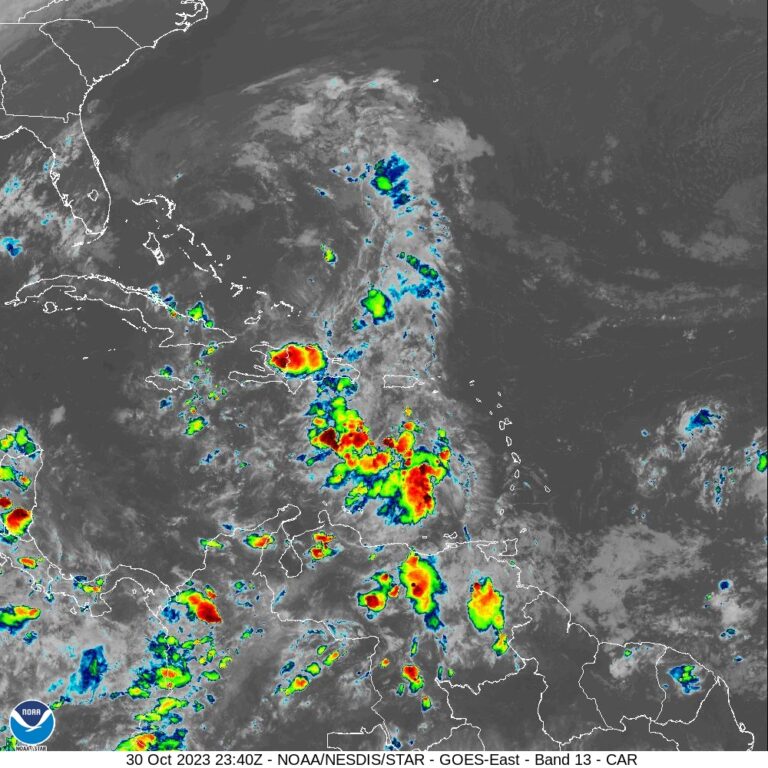
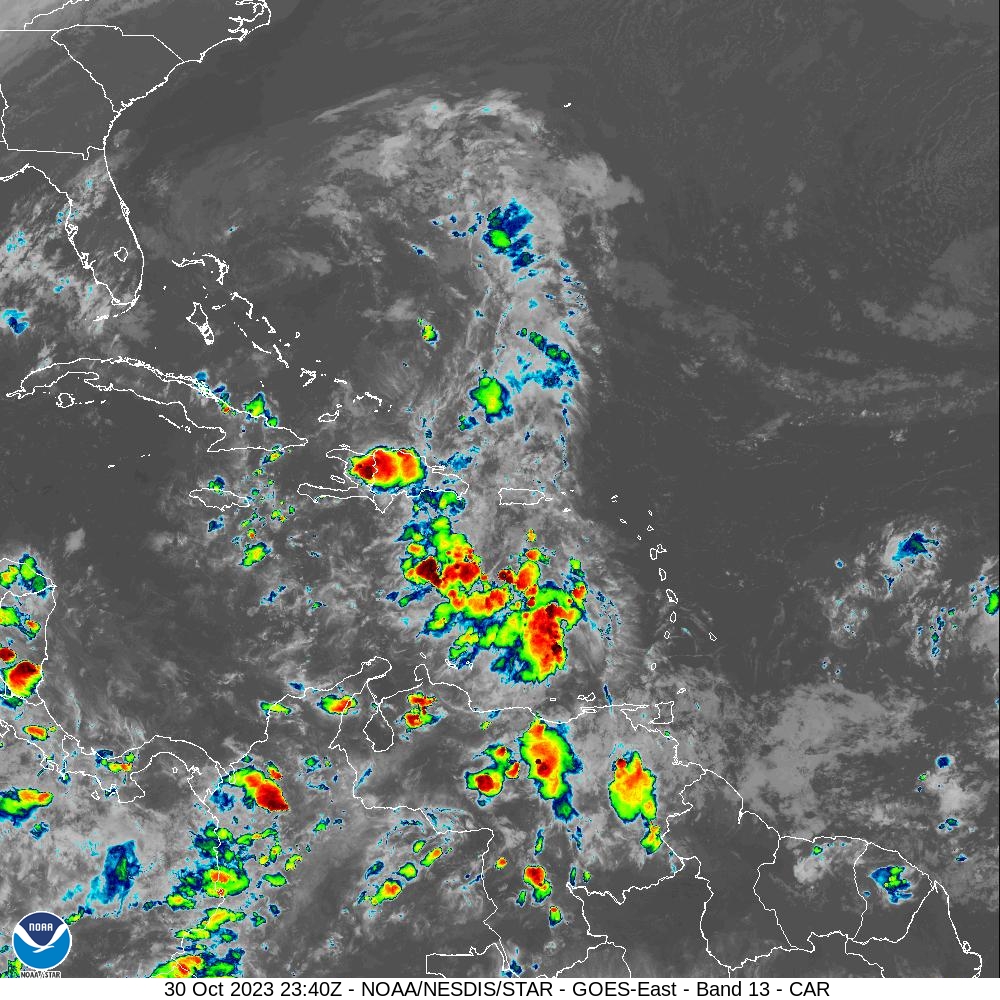
The National Weather Service has indicated that the current wet weather pattern across the region is likely to continue through at least Tuesday. Flash flooding and heavy rain are possible before conditions gradually improve.
“Periods of heavy rains from the showers and thunderstorm activity will continue to cause ponding of water over roadways and poorly drained areas and flash flooding across the islands,” according to an afternoon update from the NWS on Monday.
As of Monday afternoon, severe weather alerts, including flood watches, have been terminated across USVI and Puerto Rico. However, because the ground is saturated and rainfall is forecast to continue, the NWS cautions that flooding could still occur early this week. Additional alerts may be issued.
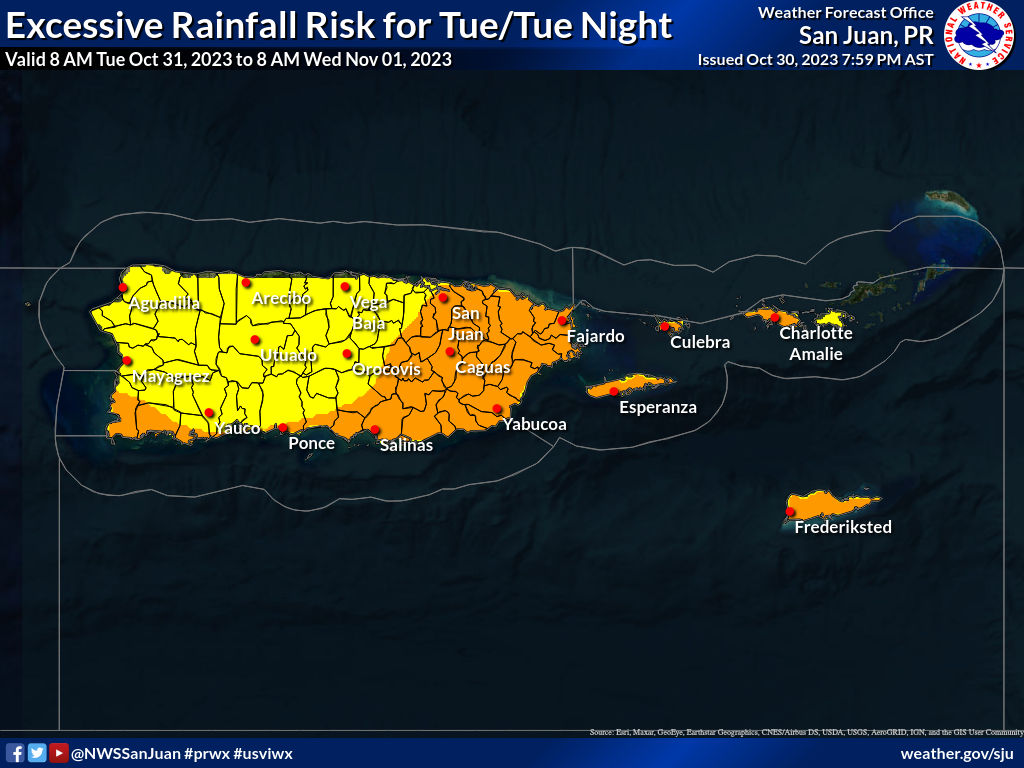
“The weather conditions will still be favorable for localized urban and flash flooding and therefore ‘flash flood’ warnings will remain likely for some areas at least through Tuesday,” the NWS noted. A drier air mass is forecast to arrive during the second half of the week and into next weekend.
Marine conditions, which have been hazardous, will also continue to improve. In the meantime, the NWS encourages swimmers and boaters to remain vigilant as choppy seas and the potential for strong rip currents continue to impact the islands for the next few days.
Abundant Tropical Moisture Across the Caribbean
The current weather pattern, along with an abundance of tropical moisture across the Caribbean, has resulted in the recent rainfall in the USVI and P.R.
The National Hurricane Center has been monitoring a couple of areas for potential tropical cyclone development, including “Invest 96L,” located to the north of the Caribbean, and another disturbance, currently dubbed “Disturbance #1,” located to the southwest of the local islands. While direct impacts from the systems are not expected, the weather features will continue to influence the forecast. And if either system strengthens into a tropical storm, with maximum sustained winds of at least 39 mph, it will acquire the name “Vince,” the next cyclone name of this year’s busy hurricane season.
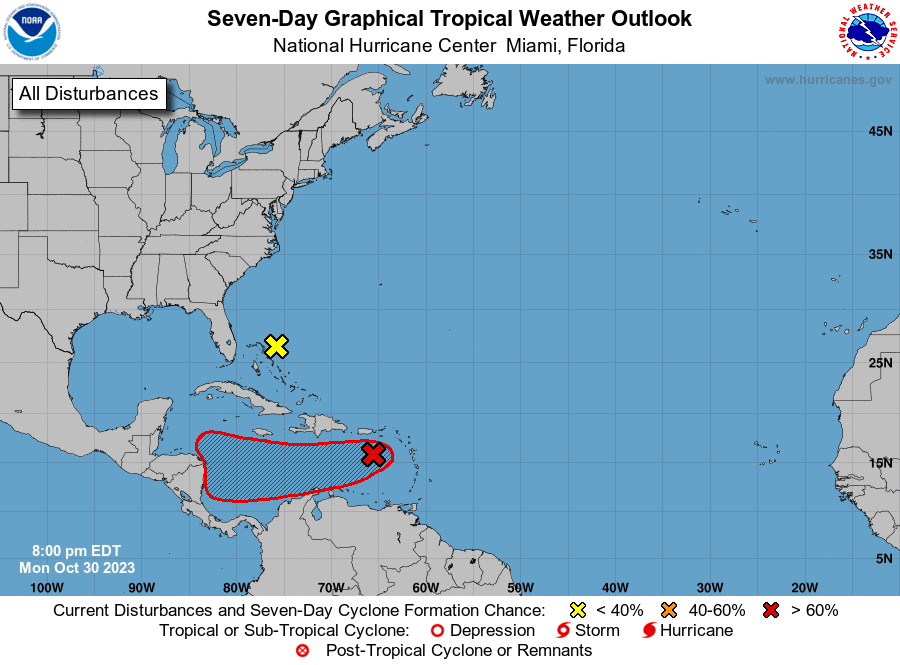
The 2023 Atlantic Hurricane Season will officially end in one month, on Nov. 30. Visitors and residents in the USVI and Puerto Rico are advised to stay updated regarding the latest weather alerts from the Virgin Islands Territorial Emergency Management Agency website and the National Weather Service.
Additionally, the weather forecast is published at least once per day on the Source Weather Page.

