 The Tektite Museum at the V.I. Environmental Resource Station (VIERS) on St. John is bringing day visitors to the remote facility at Lameshur Bay, instead of just researchers and youth groups, VIERS Administrator Randy Brown said.
"It’s changed how people think about VIERS," Brown said.
For those unfamiliar with the Tektite project, the Tektite habitat was an underwater laboratory, which was the home to divers during the Tektite I and II programs. Designed and built by General Electric, the Tektite habitat allowed scientists to live and study underwater for prolonged periods. The habitat capsule was placed in Great Lameshur Bay in 1969 and again in 1970. (For more information, see link at story’s end.)
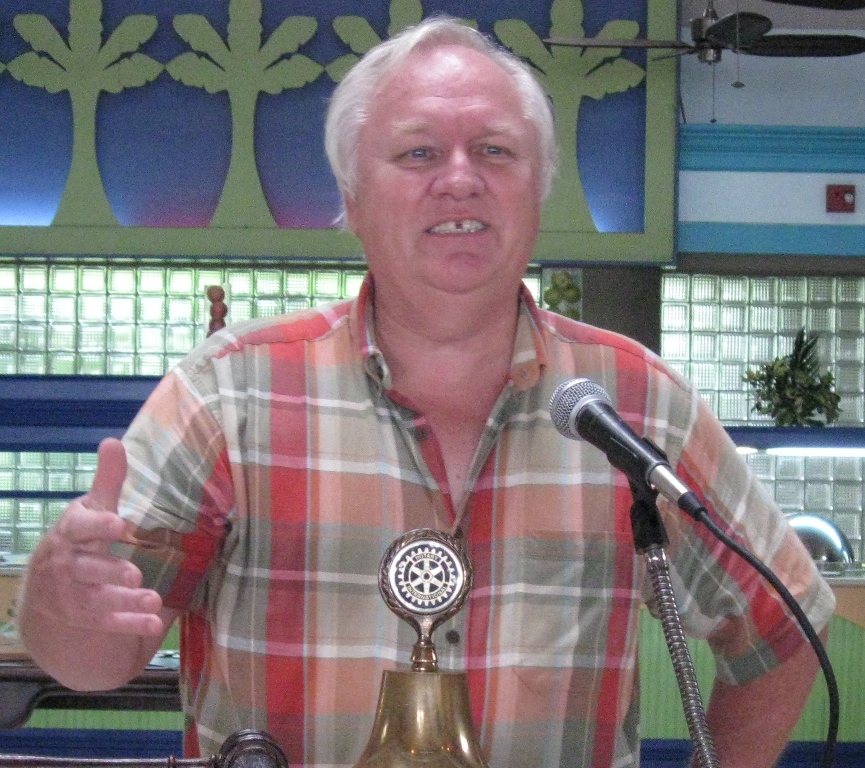
Brown was the featured speaker at Friday’s meeting of the Rotary Club of St. John, held at the Westin Resort and Villas Beach Café. About 20 people attended.
About 1,000 people a year typically spend several days to several weeks studying at VIERS, Brown said.
"Last year we had just as many day visitors," he said.
Some of the day visitors are school groups from St. John and St. Thomas, Brown said.
He expects the number of day visitors to further increase once V.I. National Park paves a very bad spot of the dirt road located close to where the main road ends. Brown said the repair involves moving a telephone pole and putting erosion controls in place.
Brown said that about 25 percent of VIERS visitors are researchers who have projects based at VIERS. He said that while previously, they all stayed in VIERS rustic accommodations, some are now opting to sleep elsewhere while conducting their research in VIERS’ seaside laboratory.
He announced that VIERS will hold a celebration Nov. 6 to honor the 40th anniversary of the end of the second Tektite project. While Tektite I was run mainly by the military, Brown said that the second project in 1970 was academic in nature. In that project, acclaimed oceanographer Sylvia Earle led a team of women in the underwater habitat. Hers was one of 10 missions over a six-month period. A total of 500 people were associated with the Tektite II missions.
Brown hopes that Brooks Tenney Jr., who designed the underwater habitat, will be on hand. Laughing, he said that the aquanauts had some complaints about Tektite.
"The habitat was too small. Their tanks hit the doors," he said, referring to the scuba tanks the divers wore when they worked in the ocean outside the habitat.
Last year, VIERS saw several groups cancel because of the poor economy, but Brown said that, so far, no groups have canceled for this year.
This year, VIERS will participate in the park’s junior ranger program for youths 13 to 16 years old. The participants will get to tag along with enforcement and interpretive rangers to introduce them to those career options.
Brown also announced several improvements at VIERS, including raising the roof of the dining room to improve ventilation and installing a concrete floor to replace the old wooden one that slanted.
"Cooking a cake was kind of hard," he said.