



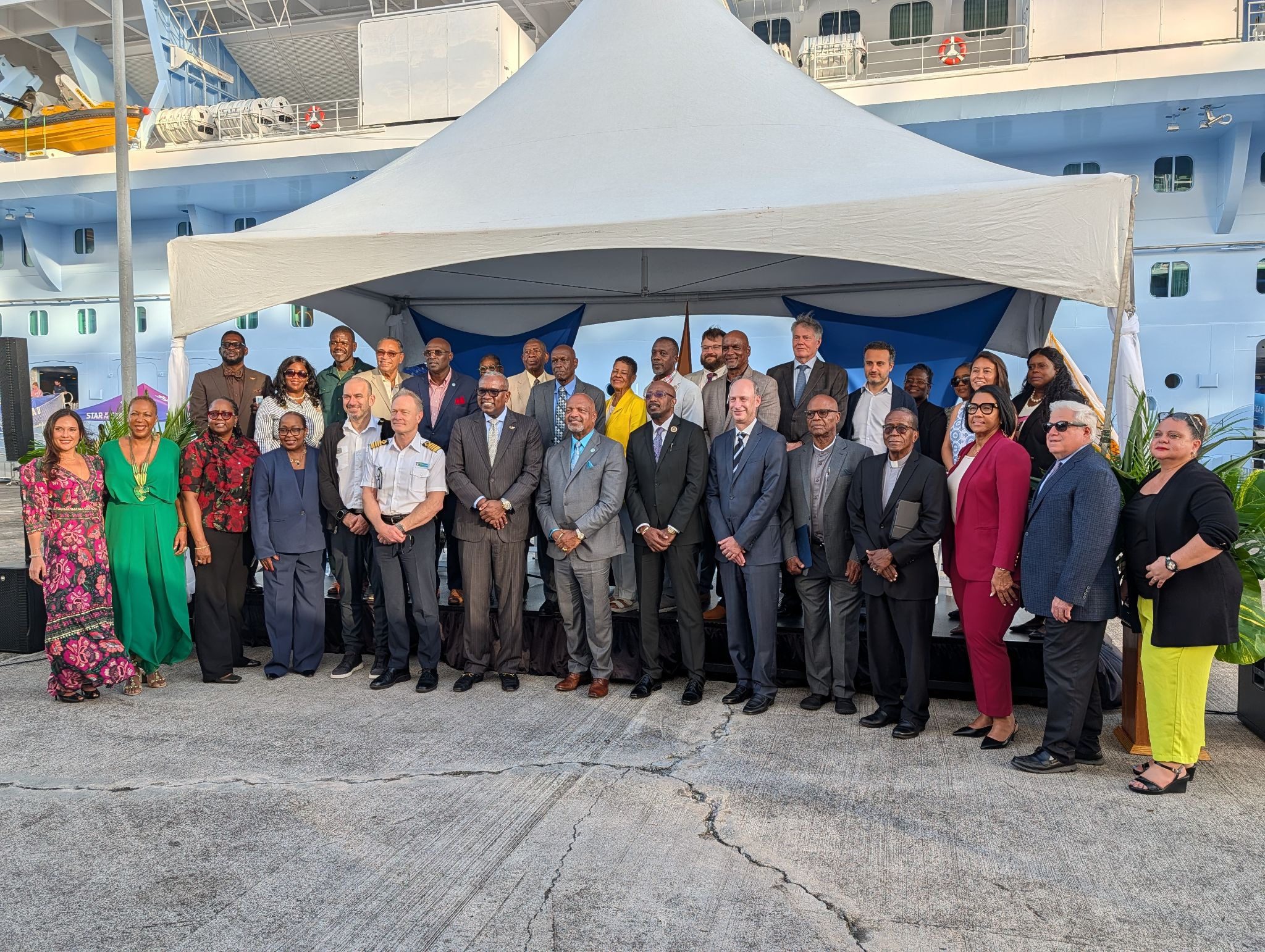
On Wednesday, the Virgin Islands Port Authority signed a long-anticipated public-private redevelopment agreement with Royal Caribbean Group and Cruise Terminals International for the Crown Bay cruise facility on St. Thomas.
Officials say the deal is intended to modernize the port, expand economic opportunity across the territory and preserve public ownership of a key waterfront district.
The agreement, signed at the Austin “Babe” Monsanto Marine Terminal, calls for construction of a new cruise pier, upgrades to village and transportation areas, environmental cleanup of surrounding lands and new amenities designed to serve residents as well as visitors.
“This development represents a strategic decision by the board to strengthen the foundation of our tourism economy while safeguarding public ownership and ensuring long‑term value for the people of the territory,” said Virgin Islands Port Authority Board Chair Willard A. John. “The property owned by the Port Authority is owned by the people of the Virgin Islands, and it will always be owned by the people of the Virgin Islands.”

Officials described the project as a response to changes in the global cruise industry, where larger ships and higher passenger expectations have increased competition among ports, and as an effort to design Crown Bay in a way that encourages greater use by local residents.
“We’ve been working very closely with VIPA over the past two years to devise an investment and a project that will enhance and expand Crown Bay into one of the top cruise ports of call in the entire Caribbean region,” said Kevin Goldstein, head of development for the Americas at Cruise Terminals International.
Goldstein said the plan includes a new pier capable of accommodating an additional large cruise ship, expanded parking and ground transportation areas, environmental remediation, and on‑site attractions intended to serve the broader community.
“This destination will be fully open for business to both the local community and to cruise guests,” Goldstein said. The project, he added, will “create over 100 construction jobs and over 100 operational jobs, as well as numerous entrepreneurial opportunities for local vendors,” with the goal of delivering “a project that will be embraced by the community for decades and decades to come.”
From the cruise industry’s perspective, Royal Caribbean executives said the redevelopment is essential to sustaining recent growth in the territory.
“Since 2017 we have nearly doubled guest volume to St. Thomas to over 800,000 passengers,” said Melissa Morales, senior director of destination development for Royal Caribbean Group. “We’ve increased our volume to St. Croix fivefold, from 40,000 passengers to over 200,000. That’s nearly one million passengers to the U.S. Virgin Islands, contributing $150 million to the territory in guest spend.”
“The Crown Bay redevelopment project is essential to keep this momentum,” Morales said, adding that the company wants the development to “serve the U.S. Virgin Islands residents who welcome our guests every year.”
Tourism and port officials stressed that the agreement is intended to support all three main islands.
“Today marks more than the signing of an agreement. It truly represents a shared commitment to the future of the U.S. Virgin Islands, one rooted in strategic growth, thoughtful development and opportunity for our people and our home,” said Tourism Commissioner Designee Jennifer Matarangas-King, who also sits on the Port Authority Board. She described the project as “transformational,” saying it will create space for “authentic Virgin Islands culture” and greater local business participation.
Virgin Islands Port Authority Executive Director Carlton Dowe said the agreement highlights how deeply tourism is woven into daily life across the territory, from port jobs to shipping to small businesses.
“Over 75 percent of what we spend in this territory is a result, directly or indirectly, of the tourism product,” Dowe said, noting that even shipping employees are connected to the cruise industry. “We need to be telling the story so everyone understands,” he added, pointing to cruise-driven business at beaches, restaurants and taxis.
Dowe also emphasized the human side of the Port Authority’s work, including plans to relocate mechanics and other tenants into new facilities rather than displacing them for construction.
Sen. Milton E. Potter, president of the 36th Legislature, called the agreement “far more than a contract.”
“It is a vote of confidence in the future of Crown Bay and in the people of these Virgin Islands,” Potter said. “Together we can reshape a district, reimagine an economy and renew a sense of possibility for the entire U.S. Virgin Islands.”
Speakers also placed the project in the context of Crown Bay’s military and industrial past. Lt. Gov. Tregenza Roach recalled the area’s history as a submarine base and industrial site.
“Where we stand really is sacred ground,” Roach said. “Virgin Islanders have reason to want to retain this space because it is such a vital one in our history.” He added that the territory’s legacy is part of its appeal to investors and visitors: “People want to come here … because we continue to be of global significance.”
Gov. Albert Bryan Jr. framed the Crown Bay agreement as part of a broader effort to modernize the territory’s tourism infrastructure, citing recent hotel acquisitions, waterfront upgrades and other ongoing projects.
Bryan said the Crown Bay project and related initiatives aim to secure long-term economic growth and keep the territory competitive in global tourism.
“With the perseverance of people like Mr. Dowe, the cooperation of our legislature, the faith in us from our private partners, the blessings of God and your support, we’ll make it happen for the Virgin Islands,” he said.