



Correction: A previous version of the article incorrectly identified Empire Gas as the V.I. Water and Power Authority’s long-term fuel supplier. The utility has a temporary agreement with Empire but selected Carib Gas to be its long-term supplier last month.
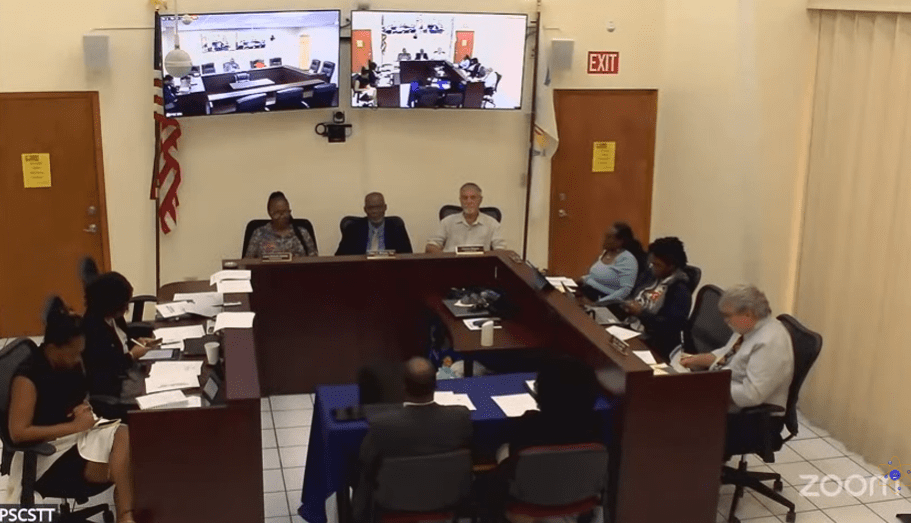
The V.I. Public Services Commission appeared satisfied Tuesday with the Water and Power Authority’s selection of Carib Gas as the utility’s long-term fuel supplier after several months of occasionally tense meetings about WAPA’s procurement practices.
The utility’s governing board approved the selection during a regular meeting in December, four months after rescinding a previously approved contract with Empire Gas amid questions about the utility’s due diligence. WAPA first issued a request for proposals in April but scrapped the process because the pricing proposals from four respondents “did not leave us any place differently than we had been, nor had the payment terms improved,” WAPA Chief Executive Karl Knight told the PSC in August. WAPA’s governing board narrowly approved the first contract with Empire in July after the utility engaged directly with the Puerto Rico-based supplier, alarming legislators, other bidders and at least one board member.
In September, PSC Vice Chair David Hughes grilled WAPA’s leadership for reissuing an RFP without making significant changes. Hughes noted that a number of respondents had taken issue with a provision requiring local storage.

“So you didn’t listen to the vendors that said that that was completely unnecessary — and that was exclusionary to all but one party,” he said at the time. “You kept that local storage requirement in the document.
Hughes was absent from a similarly tense meeting in November during which WAPA’s leadership bristled at a request to share the names of its evaluation committee members.
“We are in the midst of a procurement process,” Knight said at the time. “They’re trying to preserve the integrity of the procurement process. Your request is an unprecedented request of the authority in the midst of a procurement process. I do not reveal the identity of the evaluation committee until they submit their report, because I do not want individuals to compromise or attempt to compromise the folks who are doing the work.”
Knight went on to accuse Hughes of “advocating for” a particular vendor.
Tuesday’s meeting was more collegial. Knight walked commissioners through the utility’s evaluation criteria, which included scoring respondents by experience, financial stability, corporate social responsibility, technical capability, hurricane preparedness, pricing, and payment terms. Empire’s proposal came in at 47.49 cents per gallon — approximately 11.5 cents below the current rate.
“Ultimately, the one weakness in the proposal was an insistence on prepayment for fuel,” Knight said, which could strain the financially-challenged authority.
Carib offered the second-lowest price at 48.5 cents per gallon, and Knight reported that the utility was impressed by their responsiveness to other evaluation criteria. Commissioners were quick to congratulate Knight for the successful solicitation and for securing the market rate for liquid petroleum gas.
“That doesn’t always happen,” Hughes said, “and I’d particularly like to just throw a kudo out to his board that I know was a little more actively involved in this than they have typically been, which is a great indication that the board is involved in his management of the company. So in general, I think this is a great process — and my compliments all around.”