



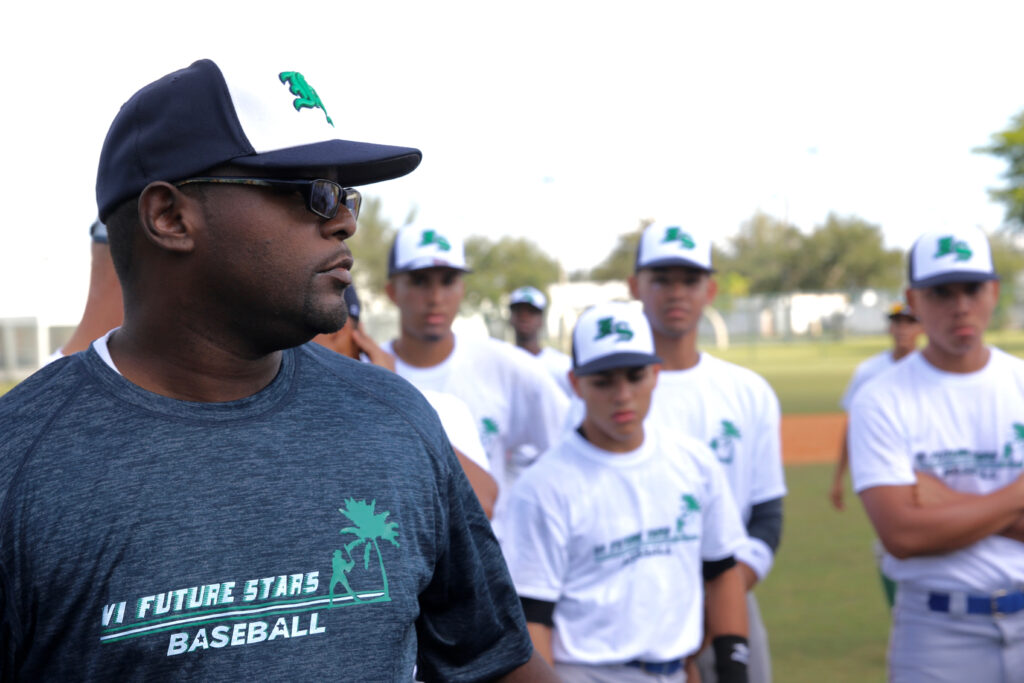
More than the date of when I first met him, what I remember most about Darren Canton is my immediate first impression — an enthusiasm for and belief in our local athletes that knew no bounds.
Darren was already deep into the work of building Future Stars Baseball, and what stood out wasn’t simply that he loved the game – it was that he was intent on building something durable. In a territory where talent has always been evident, sometimes in abundance, Darren understood that structure, exposure and mentorship were what separated potential from progress.
The idea for his program had taken root years earlier, after he watched territory players compete in Florida and realized how much ability was going unseen. A third-generation baseball player himself, Darren had once fielded Division I offers before an injury ended his own playing career. He often spoke about wanting the next generation to avoid some of the setbacks he had experienced — academically and otherwise — and to approach the game with discipline not just on the field, but in the classroom.
He didn’t try to do that alone.

Darren built a network around these young athletes. Alvis Christian became a steady presence in the organization, helping to manage operations and communication, while Darren reconnected with former coaches from his own Brooklyn’s Bonnie Youth Club, including Dharyl Russell, who, wear after year, came down to work with Virgin Islands players — not for spectacle, but for instruction, repetition, and accountability.
Years ago, practices ran three or four times a week during the summer, with freshman scouts brought in to evaluate talent. During Darren’s annual Future Stars showcases, meanwhile, major league scouts were invited to take a serious look at local players. The program traveled to South Florida at least twice a year, giving athletes the chance to compete against stateside talent and visit college campuses so they could see, firsthand, what continuing their education might look like.
Through Darren, our own family came to know many of the young men who would go on to represent the territory at higher levels — the Blashes, the Cottons, Akeel Morris, Joel Bellot. I remember going to film Jabari’s draft watch party at his mother’s home — a woman I had never met before — and watching Darren take it all in with a quiet pride, understanding what that moment meant, not only for one player, but for the broader idea he had been advancing for years.
He talked often about creating a system here — about building something that could, over time, resemble the development pipelines of Puerto Rico or the Dominican Republic, producing disciplined, college-ready, professionally visible players if the infrastructure existed. His tournaments in Florida and at home were not simply competitions; they were proof that the territory belonged in that conversation.
What Darren emphasized, especially to young men who were not yet standouts, was consistency. He was clear that raw talent was rarely enough. Dedication, academic focus, and resilience mattered just as much. He celebrated players who grew from an average high school athlete into a college scholarship recipient through steady work and strong grades and took pride in athletes who chose to complete four years of college before pursuing professional careers, because to him, the degree was as important as the draft.
Now, with such a committed and organizing force gone, the loss is deeply personal for many families — including ours — but it is also structural. Darren didn’t just encourage athletes; he assembled the professionals, built the schedule, made the calls, arranged the travel, and insisted that Virgin Islands players be evaluated alongside anyone else.
He believed that if given a fair look, they would measure up.
And, when someone who carried that belief so consistently is no longer here, the question is not only how he will be remembered, but what happens to the work itself. Darren was not simply a supporter of young athletes; he was an organizer, a connector, a bridge between this small territory and a much larger game. Much of what he built depended on his persistence, his relationships, and his willingness to keep pushing.
His belief changed trajectories. In the wake of his passing, honoring him now means continuing the work — and insisting, as he always did, that our athletes belong.
Our sincere condolences to his children and family, loved ones, friends, teammates, and the athletes — including my own son — he has inspired.