



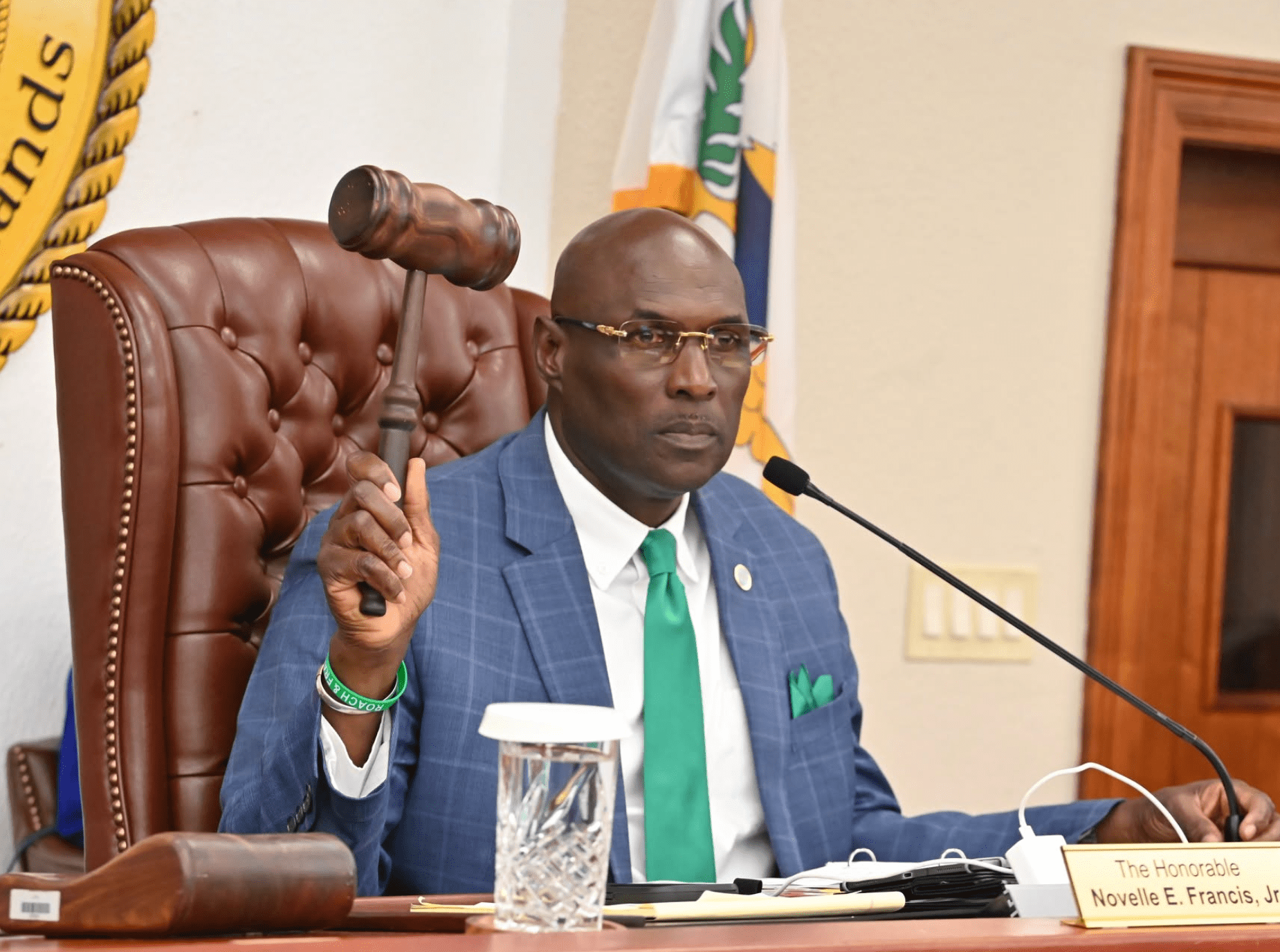
During a budget hearing before the Senate Budget, Appropriations and Finance Committee, senators pressed the Finance Department, the Virgin Islands Public Finance Authority and the Office of Disaster Recovery on the territory’s financial condition and long-term obligations.
Finance Commissioner Kevin McCurdy told lawmakers the government still has roughly $36 million in unpaid vendor invoices, including more than $16 million that is more than 90 days overdue. Senators questioned why businesses continue to face long waits for payment, while finance officials argued that many invoices arrive late from individual agencies before reaching the Treasury.
Lawmakers also focused on the government’s broader financial condition. McCurdy said the Treasury currently holds about $48 million in cash, equal to roughly 12 days of operating expenses, and noted that government spending has grown faster than revenues in recent years. “Expenditures … have increased by 15%,” he told senators, compared with about 6% growth in revenues.
He also estimated that the government still owes more than $100 million in retroactive wage payments tied to long-standing labor agreements, even after a previous appropriation intended to reduce the backlog.

Finance officials said the territory is making progress on long‑delayed audits and working to restore timely financial reporting. McCurdy told senators the governmentwide audit for fiscal year 2023 was completed in January, the 2024 audit is expected by the end of June, and officials are targeting completion of the 2025 audit by the end of 2026. However, officials acknowledged that many audit findings remain unresolved because agencies continue to struggle with documentation, reconciliations and other reporting requirements. “Paramount is the documentation … that has been plaguing us for a while,” McCurdy said.
Senators also raised concerns about internal financial controls after learning that some departments have gone extended periods without depositing collected funds and that the government continues to deal with bounced checks and other accounting issues. Several lawmakers called for tighter oversight and stronger accountability across agencies.
Attention then shifted to the Public Finance Authority, which manages much of the territory’s borrowing. PFA Director Nathan Simmons said the authority oversees approximately $1.47 billion in outstanding debt, including bonds backed by gross receipts taxes, federal highway revenues and federal rum-tax revenues.
Senators expressed concern about rum‑tax collections coming in below projections, which help support major government obligations, including financing connected to the Government Employees’ Retirement System. Simmons said a reassessment of expected federal rum-tax revenues reduced the Virgin Islands’ fiscal 2026 advance from $252.5 million to about $225.5 million, a decrease of roughly $27 million.
He also noted that because those rum-tax revenues are now pledged to the retirement-system financing, the authority now depends on annual support from the General Fund to pay for its own basic operating costs.
Lawmakers also questioned spending on lawyers, financial advisers and federal lobbyists, spending that Simmons linked to managing complex financial and legal matters and to working with legal and government relations consultants in Washington on issues such as rum taxes and federal policy.
The hearing also included testimony from the Office of Disaster Recovery on the territory’s ongoing disaster recovery and rebuilding effort.
ODR Director Adrienne Williams‑Octalien told senators that about $24.5 billion in federal disaster recovery funding has been obligated to the Virgin Islands, and about $4.5 billion has been spent so far, leaving roughly $20 billion in obligated funds still to be spent within an overall program covering about 1,600 projects.
Those projects include schools, hospitals, housing, public facilities and major infrastructure upgrades. Williams‑Octalien said the territory has secured favorable FEMA cost‑sharing terms that reduce the local share to 2% for critical facilities and 5 percent for most others, instead of the usual 10 percent. However, she noted that this benefit depends on completing projects by 2035; after that, the local cost share will revert to 5 percent for all projects.
To avoid missing that deadline, ODR is targeting completion by about 2032, providing a buffer for delays. Williams‑Octalien acknowledged that large projects, including the Roy Lester Schneider Hospital rebuild, remain the most difficult.
She pointed to visible progress, saying 34 of 38 Rebuild USVI school projects are under contract, including work at Charlotte Amalie High School, the reconstruction of St. Croix Central High School, and a new Arthur A. Richards K‑8 school expected to open for the 2026–27 school year. Other major projects include hospital and health facility upgrades, public libraries, Head Start centers, and power‑plant improvements with new backup generators. Williams‑Octalien said 1,120 of about 1,600 projects have already been completed, with dozens more shovel‑ready or under construction.
Lawmakers also raised concerns about reliance on outside contractors after learning ODR paid roughly $66 million to consultants over the past year. Williams‑Octalien said outside firms are needed to manage the scale and federal requirements of the work, while senators warned against long‑term dependence on contractors.
The testimony underscored how the government is trying to stabilize its finances, manage long‑term debt and push nearly $20 billion in recovery work to completion before federal cost‑sharing terms change in 2035.