



The final series of “dECOlonial Feelin’” opened this weekend with a current that pulled attendees into deep and necessary conversations on art, ancestry, intellect, education and activism at Crucian Heritage and Nature Tourism, Inc. in Frederiksted. Against the backdrop of St. Croix, where the sea is both history and horizon, the Virgin Islands Studies Collective invited participants to consider decolonial thought not just as theory but as lived practice.
Hadiya Sewer, VISCO member and an Africana philosopher hailing from St. John, set the tone early, honoring those who paved the way. “I’m grateful for generations of Black feminists,” she shared, a sentiment echoed in the audience’s nods and affirmations. They spoke of the privilege of continuing the work — of answering the call of the ancestors and their experiences, of letting spirit shape scholarship. “Our political status is in a possessionless state,” they noted, confronting the historical violences that have shaped the Virgin Islands and other colonized lands.
In a moment that felt sacred, Sewer read from her first short story, “Interment,” publicly shared for the first time. Set to be included in VI Noire, the piece centered Mary Magdalene – not the biblical figure, but a reimagined Crucian ancestor inspired by her great-grandmother, Mary Joseph. “That sounded like love or obeah or both,” Sewer shared, offering a meditation on how spirituality disrupts and reclaims power from the narrative that demonizes ancient practices.
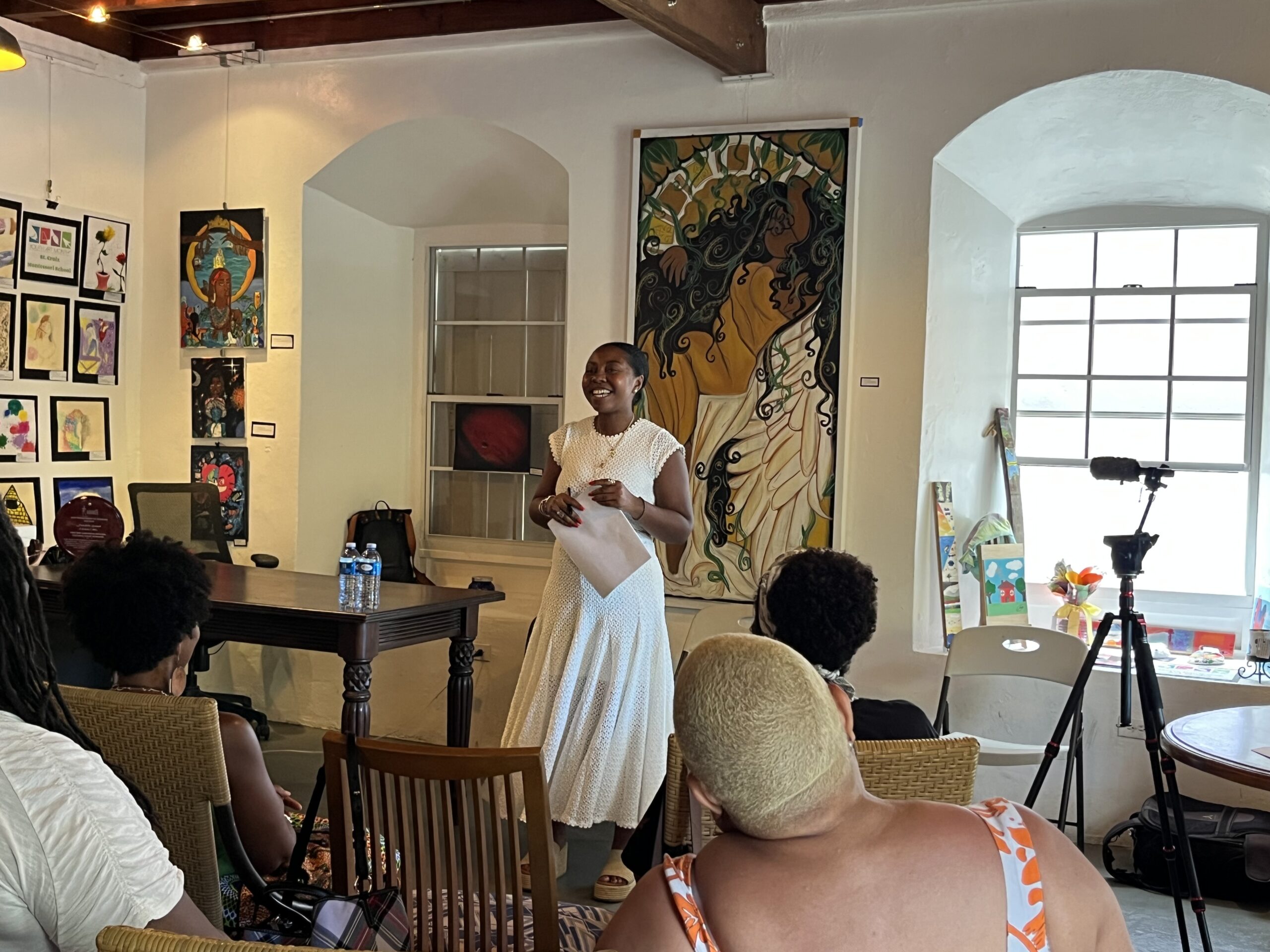
Tiphanie Yanique, a VISCO member, ancestral Virgin Islander, and award-winning author and poet, led a session filled with wordplay and vivid imagery of vertigo. During the session, she read from her new short story, “Looking House,” set on the island of St. John. She shared a passage where, at five years old, the main character feels “steady on the sand” and connects with sixth cousins across the Atlantic, collapsing the vastness of the ocean into something familiar — a “small puddle in comparison to the entire earth.” The main character also experiences vertigo, “feelin'” the coming of a tsunami, the first of its kind on St. John, which intensely builds to the internal struggle of following his father, a fisherman, out to sea or listening to the ocean urging him to run home to his mother high in the hills.

Magical Knowing: The Power of Being Multiple
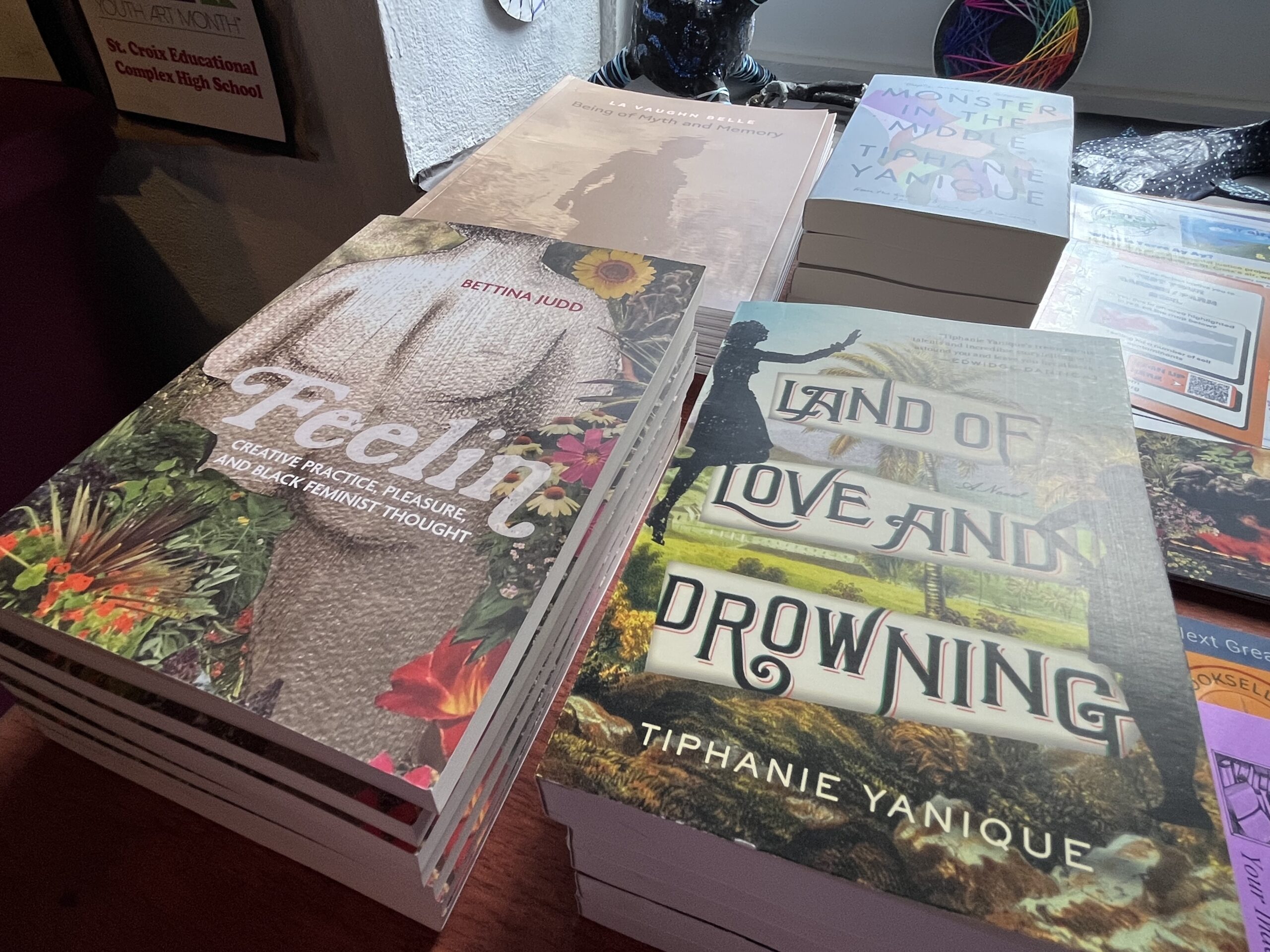
Bettina Judd, author of “Feelin,” guided a conversation with Sewer and Yanique that dug into what it means to be both grounded and fluid, bound yet boundless. “I am always multiple. That is our state of being. That moving-being thing is natural to us,” Yanique reflected, challenging static definitions of identity as a Virgin Islander.
“Our selfhood is magical,” she continued, “That knowing is a magical knowing.”
The discussion turned to the intersections of land, spirit, and resistance. Sewer spoke of the U.S. Virgin Islands as a site of ongoing struggle — two-thirds of St. John remains occupied by federal entities, a stark reminder of environmental colonialism. “Our Black bodies, our relationship to the land,” they emphasized, “the environment itself is a coconspirator in our liberation project.”
Yanique frequently wove water into the conversation, quoting the late Teresia Teaiwa, who coined the term “Big Ocean People.” “We know the sea. We are connected to the sea,” she reminded the audience, urging a reclamation of that relationship.
Attendees reflected on the inherited fear of water — the epigenetic trauma of ancestors thrown from ships, the trail of sharks that marked the trans-Atlantic slave trade routes. “It wasn’t the sea’s fault,” Yanique noted. “It took us in. It was our cemetery.” A new vision emerged: one of swimming as resistance, as spiritual practice, as a decolonial act. “The Caribbean is a continent,” an attendee observed. “We just have more water than land.”
Decolonizing Everyday Life
The conversation shifted toward tangible ways to integrate decolonial thought into daily life. Yanique offered a simple but profound directive: “Making art is decolonial work.” She also rejected institutional allegiance, stating, “Institutions are only there to serve the individual. Operate on a human level.” The collective provided free lesson plans for educators at all levels, from elementary to collegiate, interested in decolonizing the minds of young Virgin Islanders.

For Sewer, the foundation of decolonial practice is love. “Love is central,” they asserted, referencing a young St. Johnian’s film on colonial violence. “There is so much violence we have with each other. In order to organize, you need solidarity.” Love, Sewer explained, must be practiced with integrity and care, and a wanting of healing, transformation, survival and liberation.
An audience member, who moved to St. Croix — a witness of racial injustice — asked how to engage in difficult conversations. “What is the role of anger?” she asked. Sewer’s response was decisive: “I made a political stance to not respond.” She added that showing up to sovereign spaces is enough. And proposed to not ask for the answer to that question, but instead to “do the work for yourself … with love.” Because “we [Black women] tired” rippled through the audience resoundingly.
As the afternoon session closed, there was a collective sense of gratitude — not just for the speakers but for the space created by host Frandelle Gerard, executive director at CHANT.
The symposium offers opportunities to deepen conversations and consider how the land, the sea, and storytelling lead toward liberation. La Vaughn Belle, groundbreaking artist and a member of VISCO, will close this final series in downtown Christiansted with a performance art walk.
For more information to support VISCO, contact vistudiescollective@gmail.com or visit https://www.vistudiescollective.org.