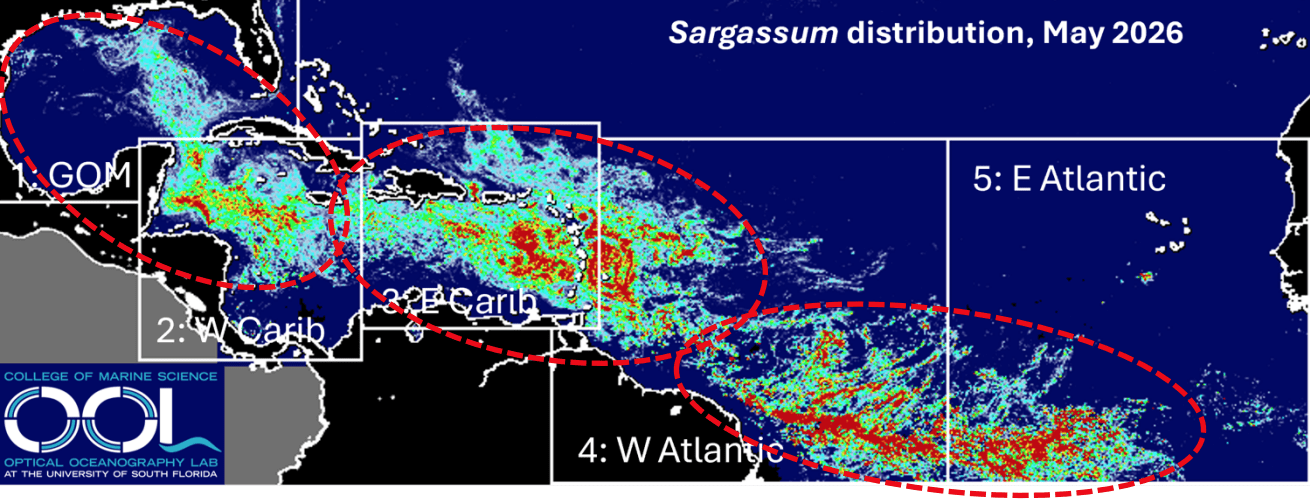
Sargassum continued to rise across much of the Atlantic basin during May, and the latest regional outlook from the University of South Florida’s Optical Oceanography Lab indicates that beaching events around the Caribbean and Florida may continue to increase in June.
The lab at USF monitors the presence of sargassum across the Atlantic, Caribbean, and Gulf regions using satellite imagery. In its May 31 bulletin, USF showed another active month for sargassum, with amounts continuing to rise across most monitored regions.
“As predicted in April, total sargassum amount in most regions continued to increase in May. Every area except the West Atlantic region continued to show record-high sargassum amount for the month of May,” according to the USF report.
The bulletin included a chart that depicts an estimated 28.9 million metric tons of sargassum across all monitored regions during May. USF also said that three separate, large masses of sargassum continued to expand across the Atlantic basin. Additionally, the USF lab reported that sargassum transport into the Gulf continued, and that seaweed beaching events have occurred.

“The transport of sargassum to the Gulf also continued, resulting in record-high amount at this time of year,” USF reported. “Major beaching events have been reported around the Caribbean and Lesser Antilles islands as well as along the Florida Keys and east coast of Florida.”
Local Sargassum Effects
For the U.S. Virgin Islands and Puerto Rico, impacts from the seaweed will continue to depend on winds, currents, tides, swell direction, and nearshore conditions. Even when the broader region is active, conditions can change quickly from one beach to another and from one day to the next.
Because both U.S. territories sit within the eastern Caribbean and Lesser Antilles region, additional sargassum arrivals remain likely in the weeks ahead. Residents and visitors are encouraged to monitor local beach conditions, particularly during periods of changing winds or currents.
“Sargassum amount in most regions is likely to increase in June,” USF said.
The USF lab added that shoreline inundation events are also predicted to continue.
“Beaching events around the Caribbean and southeast coast of Florida will continue and likely increase,” USF stated. “Some beaching events may also occur around Louisiana and Texas coasts. The year of 2026 is set to be another major sargassum year, meaning that sargassum amount exceeds 75% of the historical values, and possibly will be a record year by summer 2026,” USF added.
Sargassum Explained
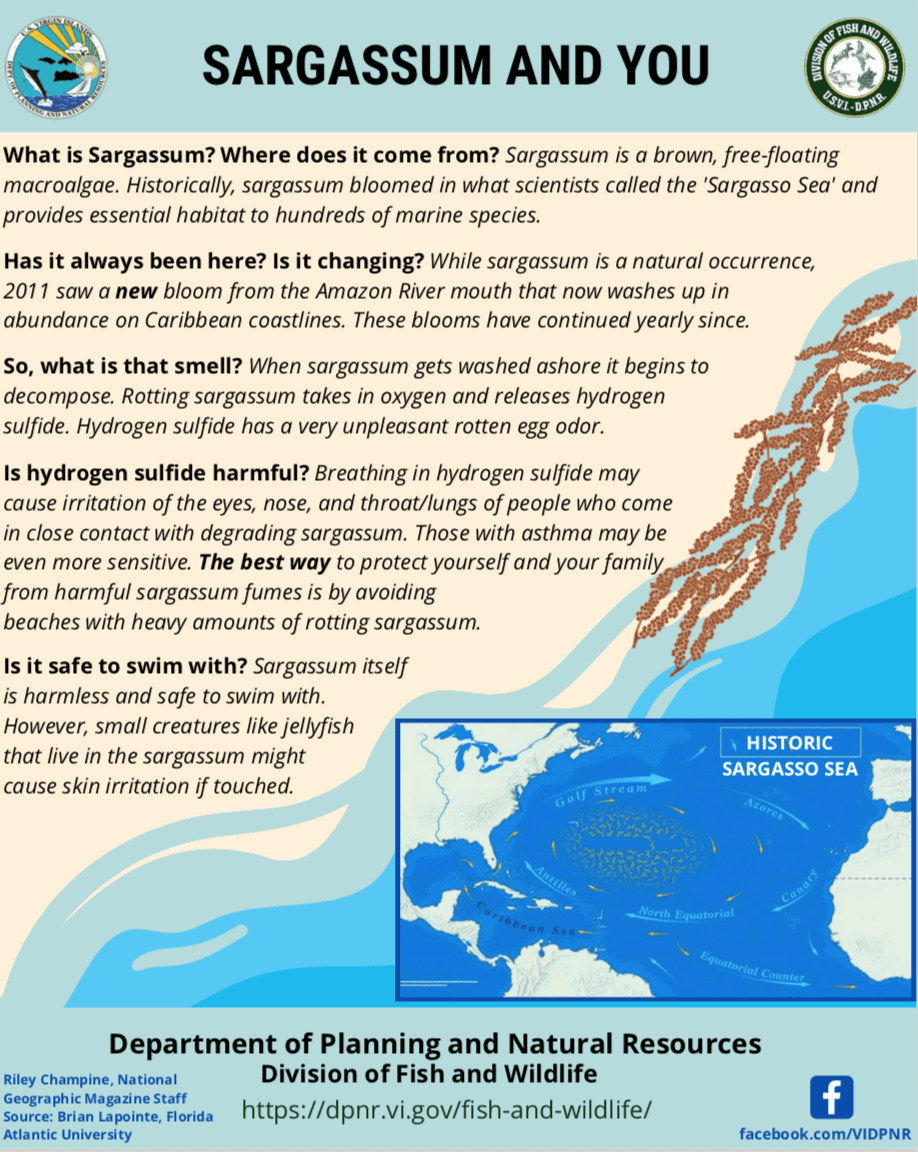
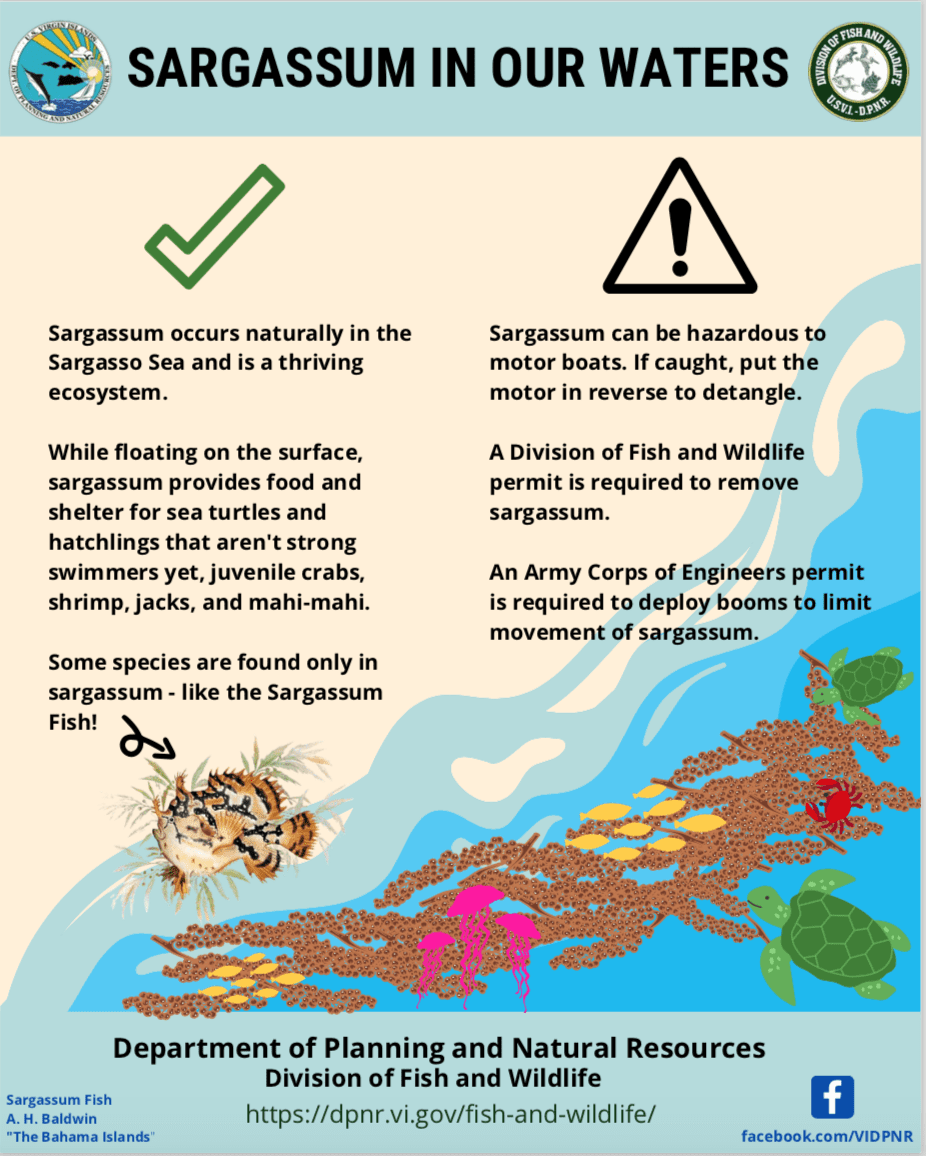
As the Source previously reported, sargassum seaweed plays an important role offshore as habitat for marine life, but it can also create problems when winds and currents carry large mats ashore, according to the National Oceanic and Atmospheric Administration.
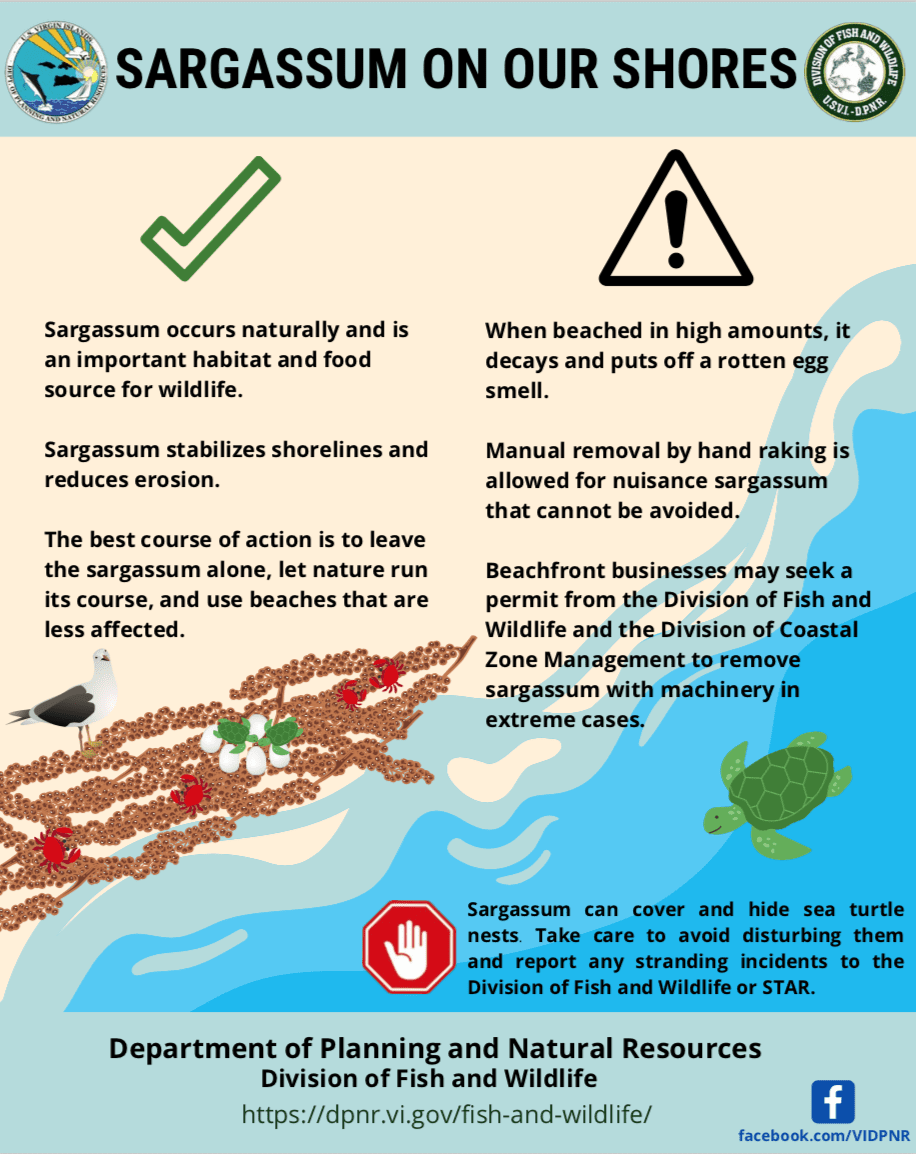
“Sargassum is a type of floating brown algae that provides food, protection, and habitat for many marine species. While sargassum plays an important role in the health and biodiversity of open ocean ecosystems, it can also be harmful in certain situations when rafts of this brown algae are carried to shore by winds and currents,” NOAA said.
Sargassum Research and Possible Uses
While sargassum remains a major challenge for Caribbean communities, researchers continue to study ways the seaweed may be used as a resource.
A recent Barbados TODAY report highlighted work by Bidyut Mohapatra, Ph.D., a University of the West Indies Cave Hill Campus scientist, who discovered three new species of microorganisms in decomposing sargassum. The report said the microbes may help break down the structural components of sargassum and could have potential uses involving enzymes, antibiotics, biofuels, and agricultural chemicals.
One of the newly identified microbes, “Streptomyces sargassi,” was described in the Barbados paper as especially significant because of its possible medical and industrial uses.
Additionally, a recent report from Earth.com, based on a Nature Communications study, noted that scientists are increasingly viewing the Great Atlantic Sargassum Belt as a persistent and self-sustaining feature of the ocean, rather than a short-term seasonal problem. The study found that nutrient recycling within older sargassum mats and the organisms living in them may now be helping to sustain the blooms.
“Floating mats now host communities of marine organisms that recycle nutrients such as nitrogen inside the seaweed itself,” the Earth.com report explained. “Decaying algae release those nutrients back into the surrounding water.”
“The system has learned, in a biological sense, to feed itself. Wind events still influence it, but they no longer drive it. The belt generates its own conditions for growth, season after season, regardless of what the weather does,” the article continued.
Monitoring Local Conditions
Individuals can follow the progression of the current sargassum bloom and stay up to date each month on where the algae may be headed.
Finally, in addition to monitoring sargassum, residents and visitors across the U.S. Virgin Islands are encouraged to follow the local weather forecast. Weather information is available from the NWS and NOAA. The local weather forecast for the U.S. Virgin Islands is regularly updated on the Source Weather Page, and individuals can also find helpful weather information and alerts from the Virgin Islands Territorial Emergency Management Agency.