Editor’s Note: A Source article published Aug. 31 explored the differences between the Legislature’s 2013 sexual harassment policy and how a recent internal review of Sen. Angel Bolques Jr. by the Committee on Ethical Conduct was handled. In the wake of this story, Sen. Marise James has issued this call to action.
As we celebrate and recognize Labor Day, a day dedicated to honoring the contributions of working people, we must also confront the conditions that still persist in our workplaces. Chief among them is the continued failure to provide a safe, respectful environment free from sexual harassment. While we champion the rights of workers, we cannot ignore the structural and cultural failures that allow harassment to go unreported, unaddressed, or unresolved.
True respect for labor must include a commitment to dignity, safety, and accountability in every workplace — including the Virgin Islands Legislature.
The National Women’s Defense League has spent the past decade tracking sexual harassment in state governments. Their findings are sobering: between 2013 and 2024, there were 400 allegations involving 145 sitting lawmakers. The true number is likely three times higher, due to underreporting. Harassment drives women out of political spaces, silences voices, and shapes policy through fear. But women are not the only ones harmed. Men are victims, too. Any credible policy must protect everyone.

Now consider this: our Legislature has just 15 members. Yet in the past five years, three senators have been accused of harassment or misconduct. That rate would be scandalous anywhere. Here, it has too often been treated as politics as usual.
This raises serious concerns about our workplace culture, our commitment to accountability, and the adequacy of our complaint and enforcement mechanisms. The public is asking important questions: Who investigated the complaints? Why was the accused senator allowed to vote on a matter involving himself? When was the Legislature’s sexual harassment policy last updated? Are digital forms of harassment, like sexting or cyberstalking, even addressed?
Unfortunately, the answers point to a system that is outdated and deeply flawed — a policy essentially left to gather dust. First adopted in 2005 under Senate President Lorraine Berry, it marked the Legislature’s first attempt to put such rules in writing. Eight years later, in 2013, Senate President Shawn Michael Malone issued an update. But in the 12 years since, nothing has changed.
Our current policy has not kept pace with the way harassment has evolved. Technology changes quickly, and with it, so do the tools people use to harm others. What began as policies meant to address in-person misconduct have not been updated to reflect online abuse — sexting, cyberstalking, image-based exploitation, or other technology-facilitated harassment. The result is a policy frozen in time.
Even worse, the investigative process is handled internally. Senators are asked to police themselves. That creates conflicts of interest, silences staff and employees who fear retaliation, and erodes trust among the very people we serve. It is no wonder that so many believe their complaints will be buried.
Other states have recognized these same problems and acted. Missouri brought in external investigators for complaints involving lawmakers. Maryland requires an independent investigator for all statehouse harassment cases. New Mexico overhauled its process to ensure outside review. North Carolina and California turned to bipartisan ethics commissions. These examples remind us that the problem is not unique — but also that solutions are within reach.
My colleague Sen. Kenneth Gittens has proposed extending the statute of limitations for filing complaints. That is an important step — but it is not enough. Real reform in the Virgin Islands must go further. We must update the definition of harassment to include digital abuse. We must establish an independent investigative process, free from political influence. We must align legislative rules with an updated policy, eliminating contradictions. We must guarantee confidentiality, prevent retaliation, and provide clear disciplinary steps— from censure to removal. And we must preserve legislative authority for final discipline, but only after a fair, outside review.
These are not abstract ideals. They are proven best practices, recommended by the National Conference of State Legislatures and already adopted in statehouses across the country.
But policy is words on paper. Culture is how people live those words. What we need is a Legislature where victims feel safe to speak, where staff and employees know they will be protected, where public trust is not eroded, and silence is no longer the norm.
This is not about public posturing. It is about whether the people of the Virgin Islands can believe in the integrity of their government. Good governance demands more than passing laws; it requires living by them, modeling fairness, and holding ourselves to the same standards we ask of others.
On this Labor Day, when we honor the value of work, let us also honor the dignity of workers. Safety. Respect. Accountability. These are not extras. They are the bedrock of labor, and they are the bedrock of good governance.
The people of the Virgin Islands deserve nothing less.
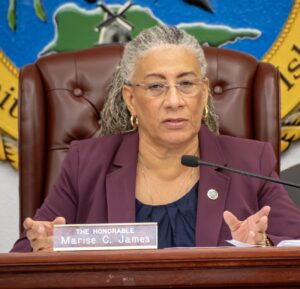
— Marise C. James is a Senator in the 36th Legislature of the Virgin Islands.
Editor’s Note: Opinion articles do not represent the views of the Virgin Islands Source newsroom and are the sole expressed opinion of the writer. Submissions can be made to visource@gmail.com.