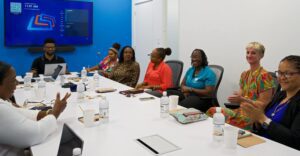
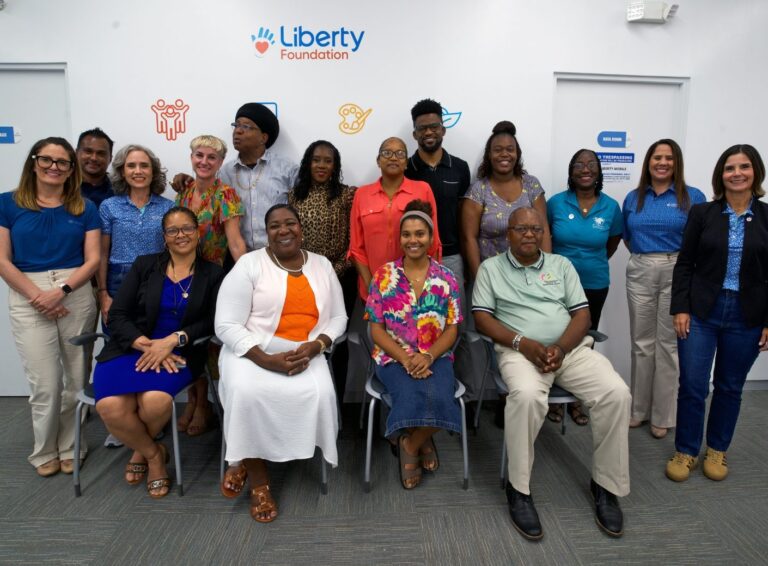
With a $30,000 donation to seven nonprofit organizations, Liberty Foundation continues to promote collaboration to maximize positive impact in the communities that need it most. The grants were presented during an event honoring organization representatives and highlighting their work serving underserved populations in the U.S. Virgin Islands.
Nonprofit representatives applaud Liberty Foundation’s donation. (Submitted photo)
The seven nonprofits in the USVI that received donations were Boys and Girls Clubs of St. Thomas/St. John, Elevate WI, Family Resource Center, Friends of the VI National Park, Future Jobs Skills of Tomorrow, Lutheran Social Services of the VI, and Y-TEENS VI.
“Collaboration made it possible for our communities to move forward in the face of the challenges of 2025,” stated Giovanna Ramírez de Arellano president of the Liberty Foundation. “At the Liberty Foundation, we join forces with nonprofit organizations so that children, youth, and adults can continue to receive the essential services they need to achieve their full development. The backing we receive from our partners and sponsors is the key for our continued support of the communities. In turn, the collaboration among the organizations is what further expands the impact on the communities.”
Liberty Foundation has maintained its social investment program in the USVI for the past six years. During 2025, challenges brought on by funding cuts in several government programs made that investment even more crucial for the community-based organizations, according to Yadira Valdivia, Liberty Foundation’s executive director. She added that, in addition to funding, the foundation provides other forms of support such as volunteers, equipment and access to telecom services.
“Our mission at Liberty Foundation goes beyond the monetary assistance we provide to nonprofit organizations delivering direct services,” Valdivia commented. “Each year, we continue expanding our reach to walk alongside them and offer a wide range of support that enables them to deliver more and better life-transforming services under our four pillars: education, social well-being and health, art and environmental protection.”
“This is much more than a donation, it’s about collaborating with nonprofits in the USVI to enable them to continue helping underserved communities in our islands,” said Ravindra Maywahlall, Liberty VI’s general manager. “We are committed to serving our communities in the territory by investing time and resources. We are honored to have this opportunity to support the important work that these organizations do every day.”
Since 2020, Liberty Foundation has awarded $450,100 in social investment to 30 nonprofit organizations in the USVI to help fund a variety of community initiatives that support childcare, education, and environmental protection in the territory.
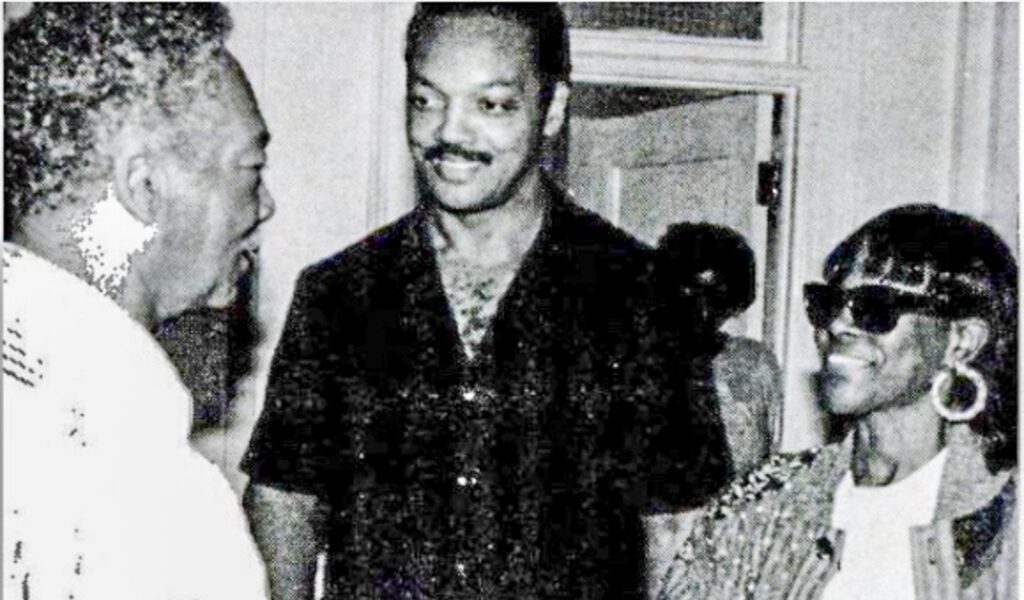
The Rev. Jesse Jackson Sr. and Cecily Tyson meet with former Gov. Alexander Farrelly during a visit to the territory after Hurricane Hugo (Photo submitted by Dr. Donna Christensen)
When Rev. Jesse L. Jackson Sr. ran for president in 1984, Donna Christensen was not watching from afar. She was in it.
“I chaired Jesse’s campaign in the Virgin Islands,” Christensen told the Source Tuesday. “I was a Jesse delegate to both conventions — 1984 and 1988.”
Jackson, the civil rights leader and two-time Democratic presidential candidate, died Tuesday at age 84, according to national reports and statements from his family. His death closes the chapter on one of the most consequential political and moral voices of the late 20th century — a man whose presidential campaigns reshaped the Democratic Party and whose work through Operation PUSH and the Rainbow/PUSH Coalition expanded the political imagination of what was possible in America.
For Christensen, Jackson was not simply a national figure. He was someone she worked alongside during a formative political moment.
As a member of the Democratic National Committee beginning in 1984, Christensen aligned herself with Jackson’s insurgent presidential campaign — a campaign that centered Black and brown communities, working families, and those long excluded from power. In 1984, Jackson became only the second African American to seek the Democratic nomination for president. Four years later, in 1988, he mounted an even stronger bid, winning 11 contests and earning more than 7 million votes nationwide.
“He opened the path for us to have a President Obama in our lifetime,” Christensen said. “It might have taken longer had we not had not only Jesse, but also Shirley Chisholm before him.”
Born in Greenville, South Carolina, in 1941, Jackson rose to prominence as a close associate of Dr. Martin Luther King Jr. and was present at the Lorraine Motel in Memphis the day before King’s assassination in 1968. In 1971, he founded Operation PUSH (People United to Save Humanity), aimed at economic empowerment and corporate accountability. In 1984, he established the National Rainbow Coalition, a multiracial political movement that emphasized voting rights, labor rights, and economic justice.
His message of coalition politics resonated in the Virgin Islands, where questions of political status and representation have long shaped public life, according to Christensen and local leaders.
Christensen recalled that during the 1984 Democratic National Convention, she was scheduled to speak on behalf of Jackson’s campaign. She and Puerto Rico’s delegation had crafted remarks centered on self-determination for the territories. She made it backstage, waiting to go on, before being told her speech would not be delivered.
“The word ‘self-determination’ was seen in the context of Israel and Palestine, and they did not want those two words uttered,” she said.
She never gave the speech.
Four years later, in 1988, she found herself again navigating internal party tensions as the territory’s delegate vote strength became a point of dispute in a convention largely aligned behind the eventual nominee.
Yet Jackson’s connection to the Virgin Islands extended beyond party politics.
After Hurricane Hugo devastated the territory in 1989, national media reports often portrayed chaos and disorder in its aftermath. Christensen, then serving within Democratic Party leadership circles, reached out and urged that Jackson come to the Virgin Islands.
“He went to St. Thomas first and then to St. Croix,” she said. “His presence was reassuring to a lot of people.”
At a moment when many residents felt mischaracterized and marginalized, she believed his presence would carry weight.
“He was a spokesperson for the Black community,” she said. “I felt that his presence would be acknowledged by the community and bring some comfort.”
Local leaders echoed that sentiment Tuesday.
Sen. Marvin A. Blyden said Jackson inspired him as a young man during the 1984 and 1988 presidential campaigns and credited him with centering Black and brown communities, women and working families in the national political vision. Blyden noted Jackson’s early work alongside Dr. King, his role in the Selma to Montgomery march, and his later leadership through Operation PUSH and the Rainbow Coalition, adding that Jackson’s inclusive vision “still speaks powerfully to us in the Virgin Islands.”
Senate President Milton E. Potter described Jackson as “a servant leader in the truest sense” and said his life carried special meaning in the Virgin Islands, where residents understand what it means to be marginalized within the nation they call home. Jackson’s Rainbow Coalition, Potter said in a press release, proved that a coalition of conscience could change the course of American history.
In a statement Tuesday, the Democratic Party of the Virgin Islands likewise described Jackson as “a towering figure in American history and a global symbol of civil rights, justice, and democratic participation,” crediting his leadership with strengthening democracy and expanding representation for communities long denied a voice.
Christensen last saw Jackson in 2019, when he was honored by the University of the District of Columbia. In recent years, as his health declined, many who followed his career understood that his public appearances were becoming fewer.
Still, she spoke of him without hesitation.
“Jesse is a legend,” she said. “And legends never die.”
Asked whether there is someone today who carries the same national moral authority Jackson once did, she paused.
“It may take more than one person,” she said. “Until that person emerges, each and every one of us in between has to carry on his work.”
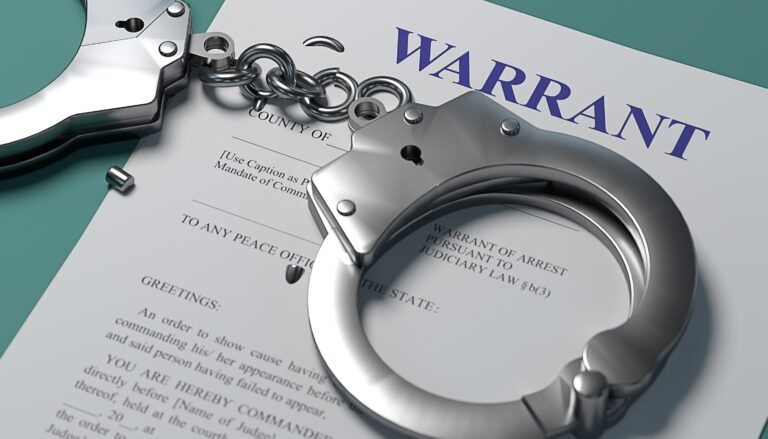
A man accused of stabbing an adult male multiple times in November 2024 has been extradited to St. Croix and charged in Superior Court, the Virgin Islands Police Department reported.
Juan Gabriel Cintron Rodriguez was arrested Tuesday after being returned to the island from Puerto Rico, where he had fled following the incident, according to the police report.
Police said that on Nov. 16, 2024, at approximately 8:47 p.m., the 911 Emergency Call Center dispatched officers to Juan F. Luis Hospital in reference to an assault. Officers made contact with the victim, who reported he had been stabbed several times by the suspect, the police report stated.
The case was assigned to a detective with the Major Crime Unit of the Criminal Investigation Bureau. Investigators identified Cintron Rodriguez as the suspect but said he had already left the island and his whereabouts were unknown, the report stated.
An arrest warrant was obtained Dec. 22, 2025, from Superior Court and entered into the National Crime Information Center system, police said.
On Jan. 18, 2026, Cintron Rodriguez was apprehended in Patillas, Puerto Rico, by the Puerto Rico Police Department. He waived extradition Jan. 22 and was returned to St. Croix on Feb. 17 with assistance from HIDTA personnel, the report stated.
Cintron Rodriguez was charged with attempted murder first degree, assault first degree, assault third degree and carrying a dangerous weapon during the commission of a violent crime. Bail was set at $100,000, and he was unable to post bail, police said.
He was remanded to the John Bell Adult Correctional Facility pending advice of rights scheduled for Wednesday in Superior Court.
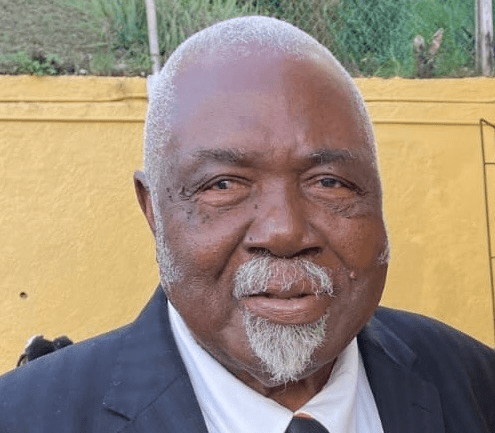
Relatives and friends are advised of the passing of Bertile Fleming on Jan. 27, 2026 at the age of 86.Bertile Fleming
Bertile Fleming is survived by his wife, Arlette Fleming,
His sons: Gifford Fleming (Angela), Allynford “Ali” Fleming.
His brothers: C. Walton Fleming of Anguilla, G. Royden Fleming, Ezekiel Fleming, Michael Fleming all of St Thomas
His sisters: Millicent Smith, Rosemary Fleming, and Louise Peterson all of St.Thomas
He also leaves sister-in-laws, brother-in-laws, grandchildren, great grandchildren, nieces, and nephews, and very close friends.
Relatives and friends are respectfully invited to attend first viewing on Saturday, Feb. 28, at Celestial Chapel of Dan Hurley Home for Funerals 4 p.m. – 6 p.m. Funeral service will be held on Sunday, March 1 at Shiloh Seventh Day Adventist Church. Viewing begins at 9 a.m. with service to follow at 10 a.m.
Interment: Eastern Cemetery
Funeral arrangements are under the care of Dan Hurley Home for Funerals and Cremation Centers of St. Thomas, ST. John, and St. Croix. For online condolences, or to share a special memory, visit www.hurleydavisfuneralhome.com
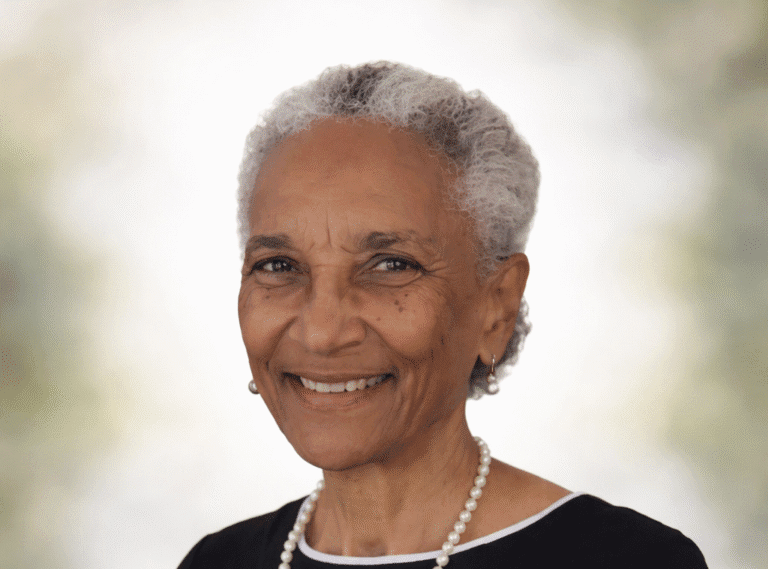
Relatives and friends are advised of the passing of Merle E. Smith-Matthias on Jan. 29, 2026, at the age of 67.Merle Smith-Matthias
She is preceded in death by: Father, Austin Smith Sr., Mother, Jewel Powell Stepfather, Winston Powell, Brother, Austin Smith Jr.
She is survived by her:
Brothers: Franklin Smith, Alston Smith, Charles Smith, Brian Smith, Wade N. Smith,Kafar Smith
Sisters: Beverly Hendricks, Marilyn Francis, Beverlie Smith-Baron, Brenda Smith-Grupee, Shakira Smith-Isom, Morvel Vanterpool, Winifred Powell, Jewel Powell II
Ex-Husband: Douglas Matthias
Adopted Children: Maxine David, Maximus David
Sisters-in-Law: Charmaine Burton-Smith, Marlita Hickson-Smith, Betty Smith, Luz Melendez-Smith, Lydia Smith
Brothers-in-Law: Edwin Hendricks Sr., Clyde Vanterpool Sr., Aaron Baron
Aunt: Beatrice Stephens-Dalmida
Nephews: Edwin Hendricks Jr., Franklin Smith Jr., Kenneth Francis Jr., Charles Smith Jr., Leon Smith, Kevin Smith, Caleel Smith, Jevon Brooks, Alberic Brooks, Jmoi Powell, Navarrone Paigai, Degupea Francis Grupee, William Smith, Christopher Smith
Nieces: Desiree Hendricks-Burghart, Sherece Smith-Severino, Nichelle Smith, Latoya Smith, Kenya Francis, Latisha Mosby, Latanya Smith, Jennifer Sustaire,Chanice Smith, Luz-Marie Smith, Amber Smith, GéLeah Browne, Nicole Dalmida, Natalie Dalmida, Cheyenne Vanterpool, Z’nea Turnbull, Nicole Walters, Danielle Cranston, Suri Isom
Great-Nephews: Kaheem Walters, Doug Walters Jr., Jalen Mosby, Marcus Norford Jr., Kevin Smith Jr., Ke’Tarri Smith, Charles Smith III, Ki’Andre Smith, Seiba Joseph Jr., Khoi Frett Kaylan George, Donte Smith, Dayen D. Smith-Webster, Ciario Vasquez, Shannon Barry Jr. Amari Brooks, J’Siah Brooks, Joel Brooks, Ziare Evans, Ky’Od Walters, Kylan DeCastro
Great-Nieces: Isabella Francis, Kalleigh Smith, Ariyah Brooks, Laniyah Brooks, Alexis Barry, A’janique Barry, Shaii Clendinen, Keilah Brooks, K’Ziah Brooks, T’soleah Powell Zemira Powell, Jeweliana Powell, Neveah Penn, Naiya Harris, Joia-Alexis Cranston
Godsister: Lorraine Sprauve
Godchild: Angelic Ramnarine
Adopted Grandchild: Chilah David
Special Pet Nephew: Kreed Powell
Special Cousins: Barbara Dalmida-Thompson, Justin Dalmida
Special Friends: Ms. Jane Johannes and Family, Jane and Sunnilal Ramnarine, Pastor Alva, Sharron, Sharona and Alvaughn Stevens, Muriel Callwood, the Kuffmans of North Carolina, Beth of North Carolina, the Gray Family, Geneva Paris
Special Families: the Smith Family, the Powell Family, the Stevens/Stephens Family, the Harley Family, the Christians Family … and many more relatives and friends too numerous to mention.
Relatives and friends are respectfully invited to attend first viewing on Thursday, Feb. 26, at Celestial Chapel of Dan Hurley Home for Funerals 4 p.m. – 6 p.m. Funeral service will be held on Friday, Feb. 27, at Calvary Baptist Church – St. John, USVI. Viewing begins at 9:30 a.m. with service to follow at 10:30am. Interment: Calabash Boom Cemetery, St. John, USVI.
Funeral arrangements are under the care of Dan Hurley Home for Funerals and Cremation Centers of St. Thomas, St. John, and St. Croix.
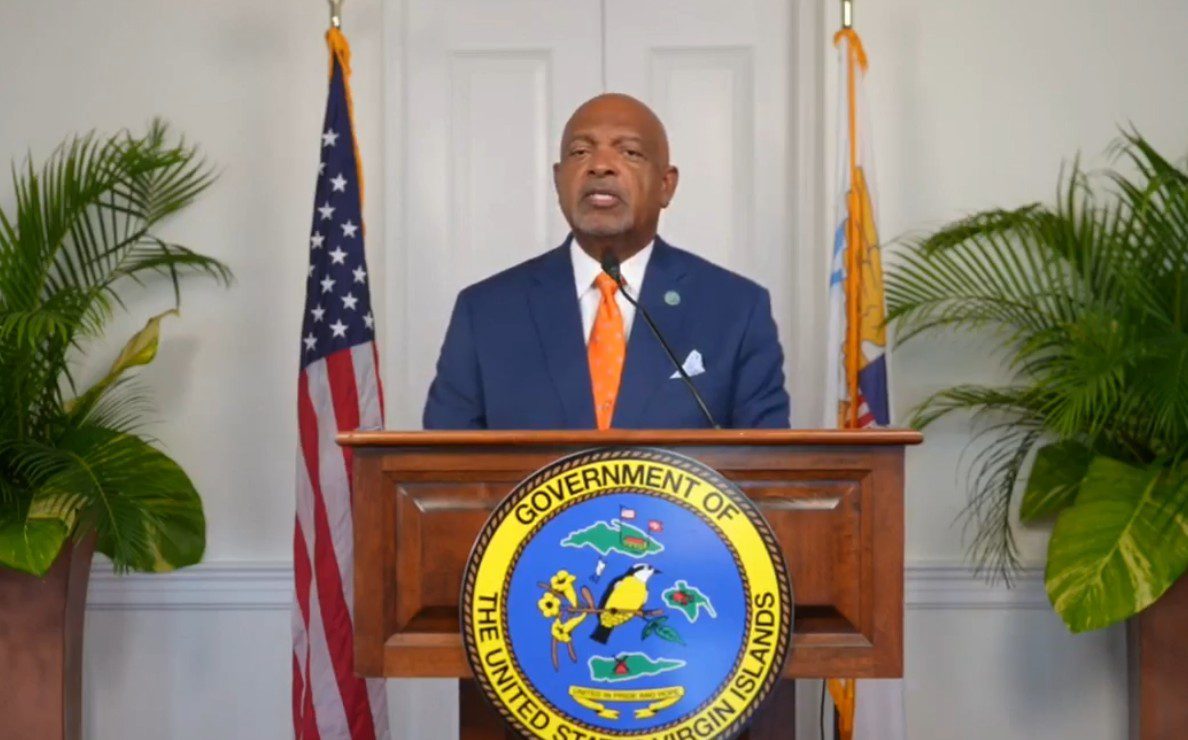
Lt. Gov. Tregenza Roach led a weekly Government House press briefing Tuesday from St. Thomas. (Screenshot from V.I. Legislature livestream)
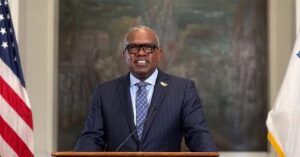
The U.S. Justice Department no longer considers the local agency responsible for administering federal grants related to criminal justice, juvenile delinquency and victim services to be a “high risk” entity, V.I. Law Enforcement Planning Commission Director Moleto Smith Jr. announced during a weekly Government House briefing Tuesday.
“LEPC has reached this significant milestone achievement on behalf of the Virgin Islands, and it is great to know that our federal granters have recognized us in this way,” Smith said.
During an August hearing before the Senate Budget, Appropriations and Finance Committee, Smith said the U.S. Justice Department designated the LEPC as being “high risk” because of “serious irregularities” involving oversight and use of federal grants and that Justice had mandated that the commission reimburse more than $1 million in unallowable costs. A 2012 report from the auditing arm of the U.S. Justice Department Inspector General’s Office looked at 40 grants awarded to the LEPC between 2005 and 2010. Thirty-four were awarded through the federal government’s Office of Justice Programs and six others through the Office of Violence Against Women.
The 2012 report found that the LEPC: lacked controls “to account for, manage, and report the use” of the funds; lacked staff to manage the funds; could not provide accounting records to show how it spent nearly $1 million in grant funds; commingled the Justice Department money with other funds; let more than $600,000 in grant funds expire; failed to allocate Violence Against Women Act grant funds in 2007, 2008 and 2009; and had multiple other deficiencies.
Smith said Tuesday that the redesignation will allow the LEPC to continue funding priority areas in law enforcement, corrections and juvenile justice.
The U.S. Justice Department has changed radically since President Donald Trump resumed office a year ago. Executive orders signed by Trump and pushed by Attorney General Pam Bondi encourage prosecutors to pursue immigration and death penalty cases, among others. The Public Integrity Section, charged with weeding out public corruption, has been hamstrung, according to national reporting. The changes could have long-term implications for oversight in the U.S. Virgin Islands, which handles more than $25 billion in federal disaster recovery dollars and has seen four former cabinet members and high-ranking officials convicted on public corruption charges in the past year.
Lt. Gov. Tregenza Roach led Tuesday’s briefing while Gov. Albert Bryan Jr. attends meetings in Washington, D.C. Roach announced that the territory’s Tax Amnesty Program will be extended to Feb. 23, and that work on the Street Addressing Initiative for St. John has been finalized. The information has been shared with the U.S. Transportation Department, Google Maps, the U.S. Postal Service and the U.S. Interior Department.
“Both St. Thomas and St. John are 87 percent complete,” he said before asking Virgin Islanders to assist with street-naming. “We still need you to contact our offices. Every lane, every street must be named, and this is an extremely collaborative effort where we have gotten residents involved and have been able to memorialize certain aspects of our history by having streets named to commemorate people and events.”
Governor Albert Bryan Jr. is in Washington, D.C., this week to represent the U.S. Virgin Islands at the National Governors Association’s annual Winter Meeting and the 2026 Interagency Group on Insular Areas Senior Plenary Session at the U.S. Department of the Interior.
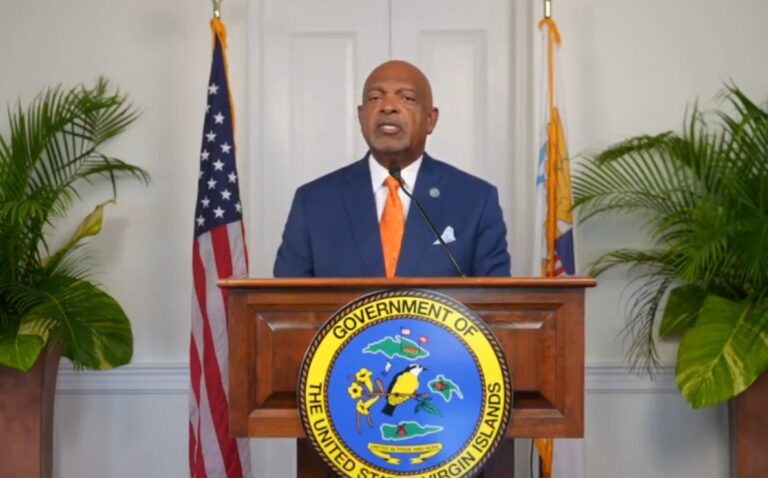
Gov. Albert Bryan Jr. (Screenshot from Government House Facebook livestream)
The trip is focused on strengthening federal partnerships and advancing priorities tied to the territory’s recovery, economic stability, and long-term growth.
“Washington is where decisions are made that shape how fast we rebuild and how fairly the Virgin Islands is treated under federal policy,” Governor Bryan said. “We are going to make our case clearly and directly, because our recovery and our residents cannot afford delays, uncertainty, or unequal treatment.”
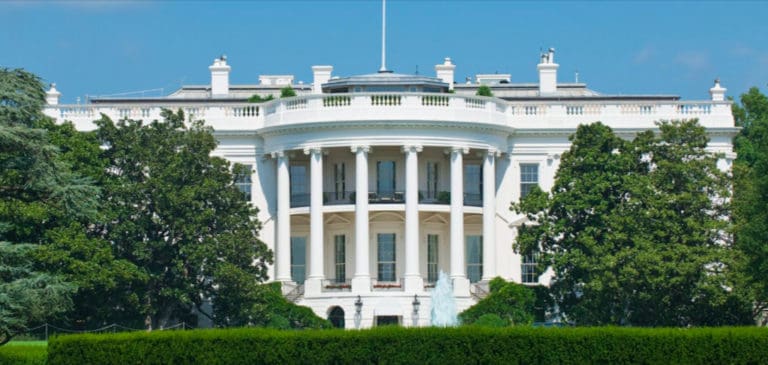
While in Washington, Governor Bryan will meet with White House Administration officials at the U.S. Department of State and the White House to press several key federal priorities, including H-2B visas for skilled construction workers to support recovery and rebuilding work and keep major projects moving, Medicaid equity to strengthen health care access and secure fair federal support, restoration of the de minimis exemption to avoid added costs tied to low-value shipments and routine imports that affect residents and local businesses, and the recent BVI charter yacht fee increases that threaten regional marine tourism and place new burdens on an industry that supports Virgin Islands jobs and small businesses.
Lieutenant Governor Tregenza A. Roach, Esq., will serve as Acting Governor while Governor Bryan is off island. Governor Bryan is scheduled to return to the territory on Feb. 28.
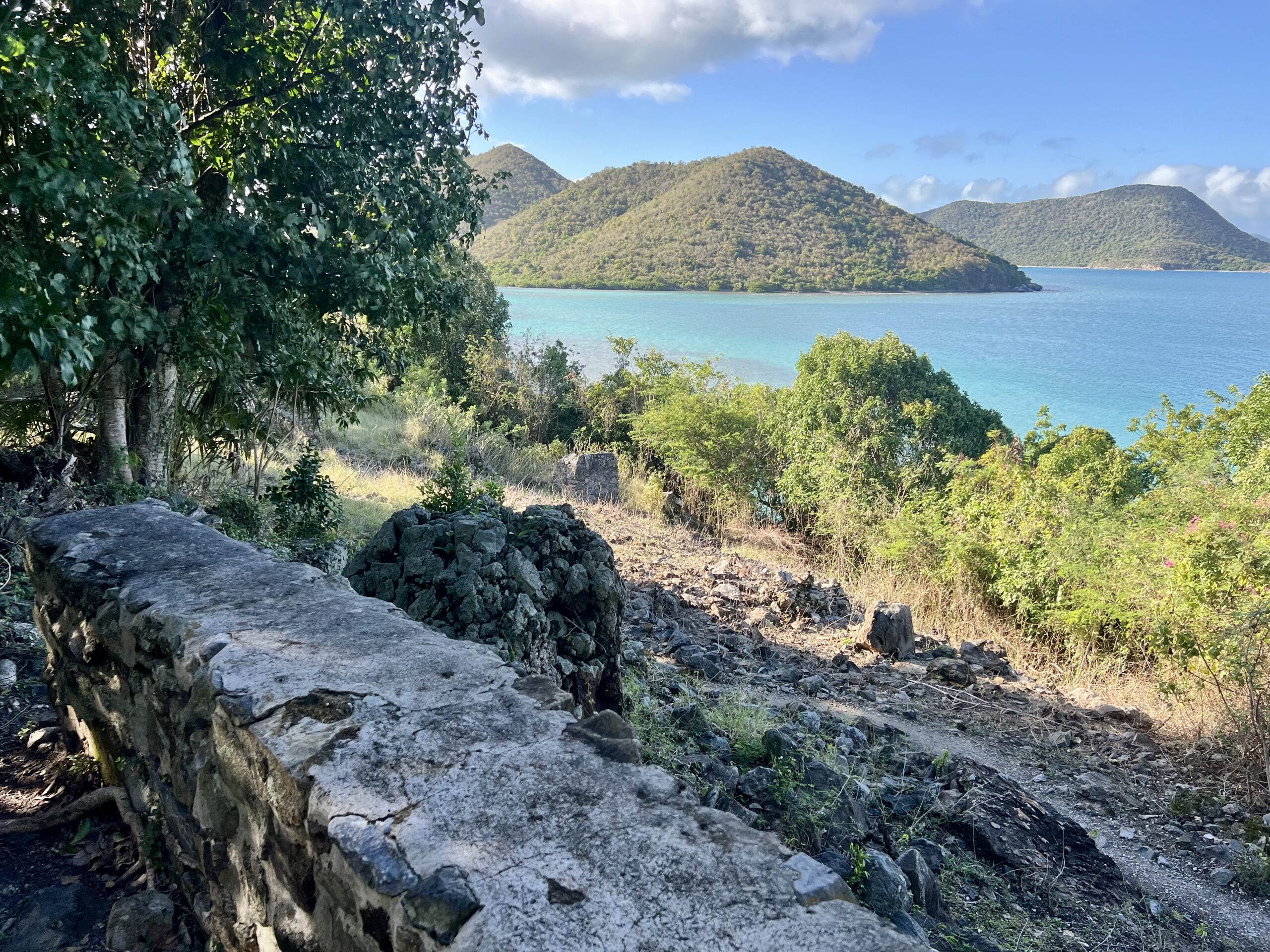
Explanatory signs are now missing from the enslaved people’s quarters at Annaberg. (Source photo by Amy H. Roberts)
On Feb. 4, visitors to the Virgin Islands National Park noticed that something was missing at Annaberg Plantation, a colonial sugar factory that is one of the most well-known sites within the park.
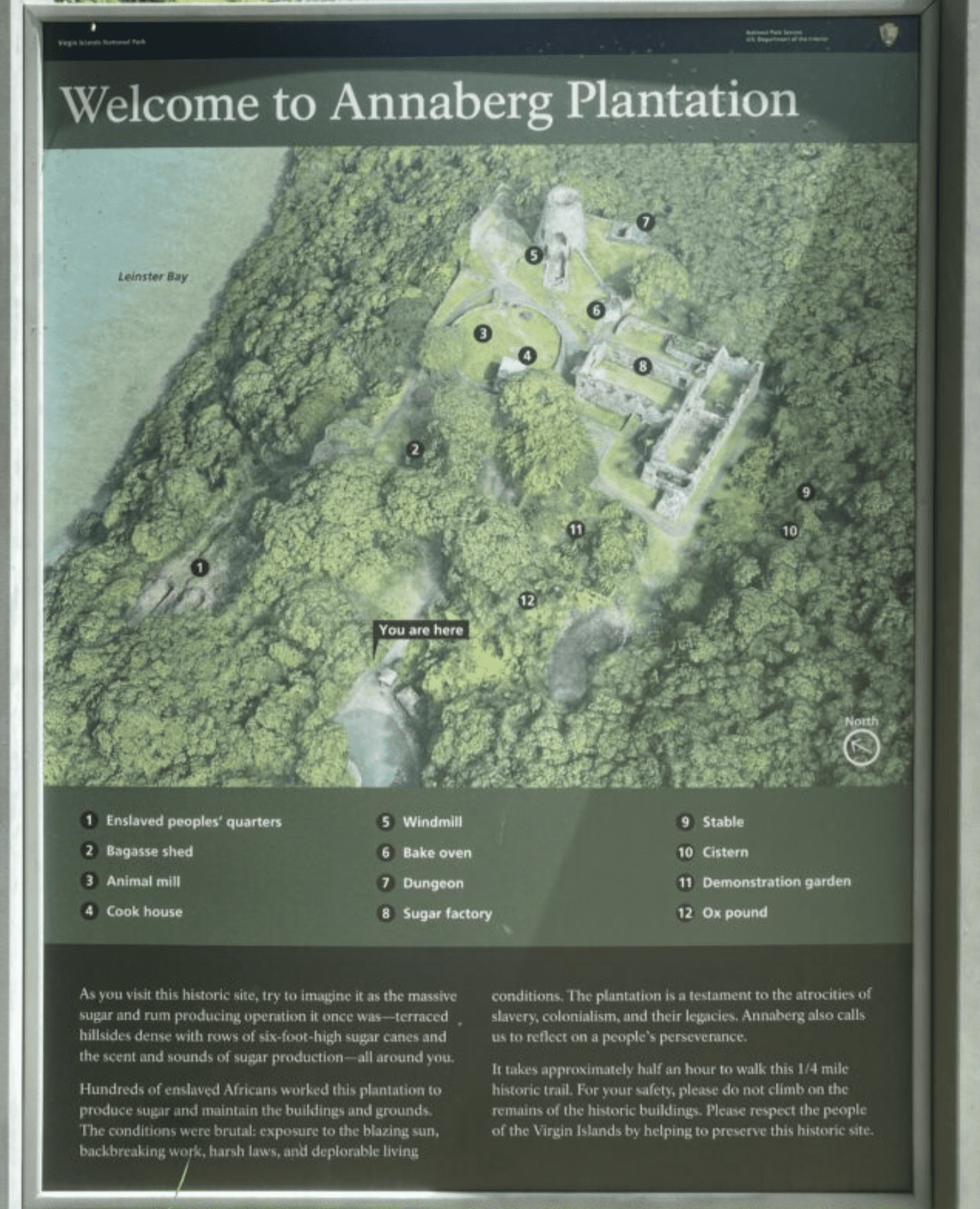
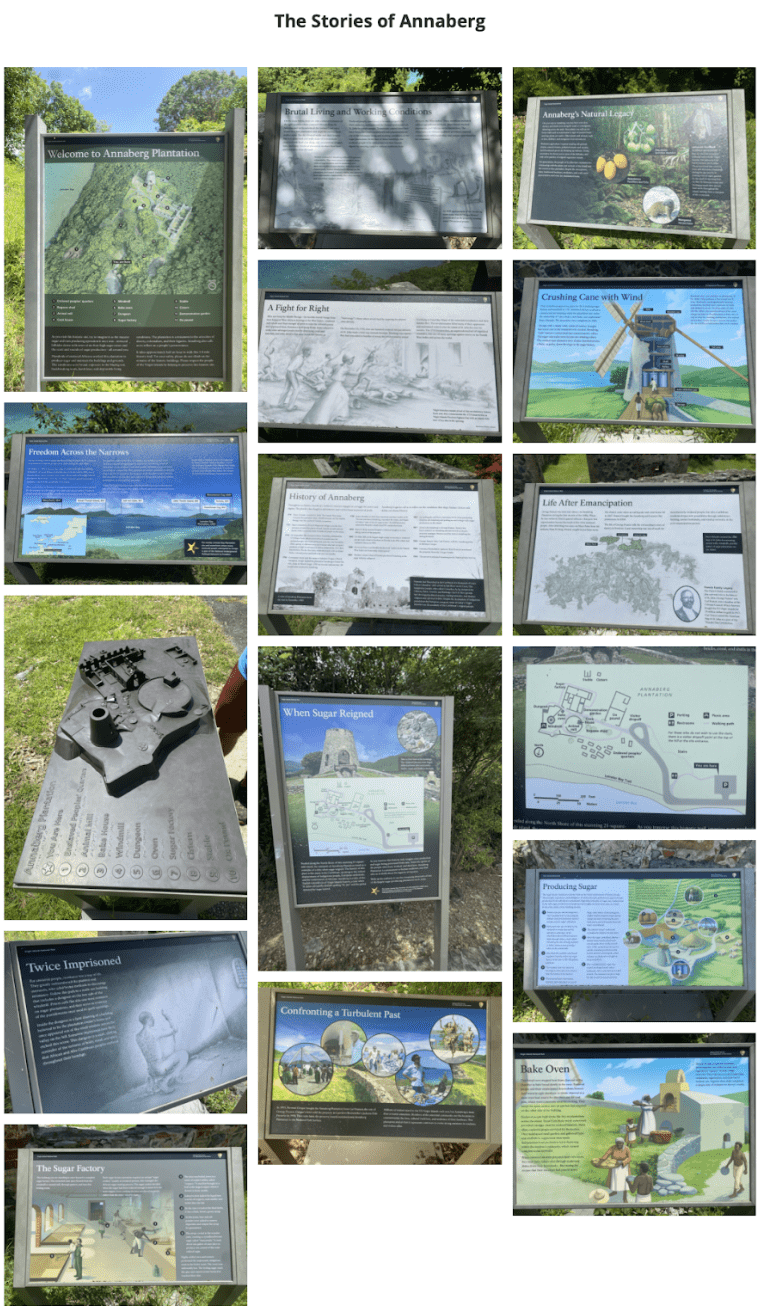
Upon arrival, the first thing visitors see is a “Welcome To Annaberg” sign with a map orienting them to the trail that winds throughout the ruins. Yet on Feb. 4, when visitors reached “Enslaved peoples’ quarters,” the first stop marked on the map, there was nothing there to indicate that they had arrived.
The sign had been removed.
A sign welcoming visitors to Annaberg provides a map. (Image from the Friends of the Virgin Islands National Park website)
Exactly when it had been removed is not clear. Virgin Islands National Park officials have referred all questions to the Southeast Region NewsMedia desk, and the Source is still awaiting answers to a series of questions emailed last week.
It seems apparent that this sign — as well as at least two others — were removed in response to a March 2025 executive order by the Trump Administration.
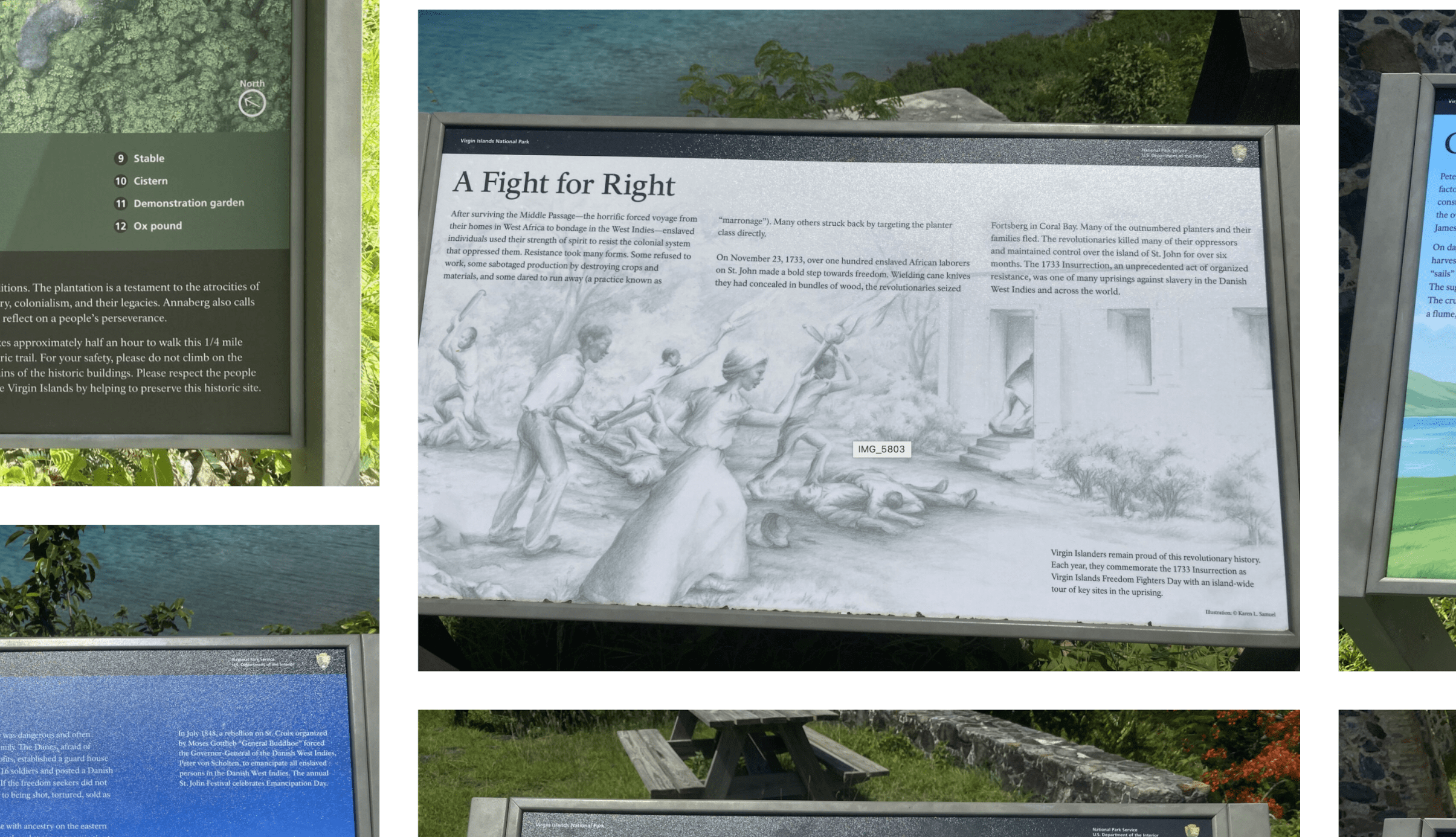
“A Fight for Right” tells of the Insurrection of 1733. (Image from the Friends of the Virgin Islands National Park website)
Known as “Restoring Truth and Sanity to American History,” President Donald Trump’s executive order directed the Department of Interior to remove any information which is “inappropriately disparaging to Americans past or living” and instead to “focus on the achievements and progress of the American people, or with respect to natural features, the beauty, abundance and grandeur of the American landscape.”
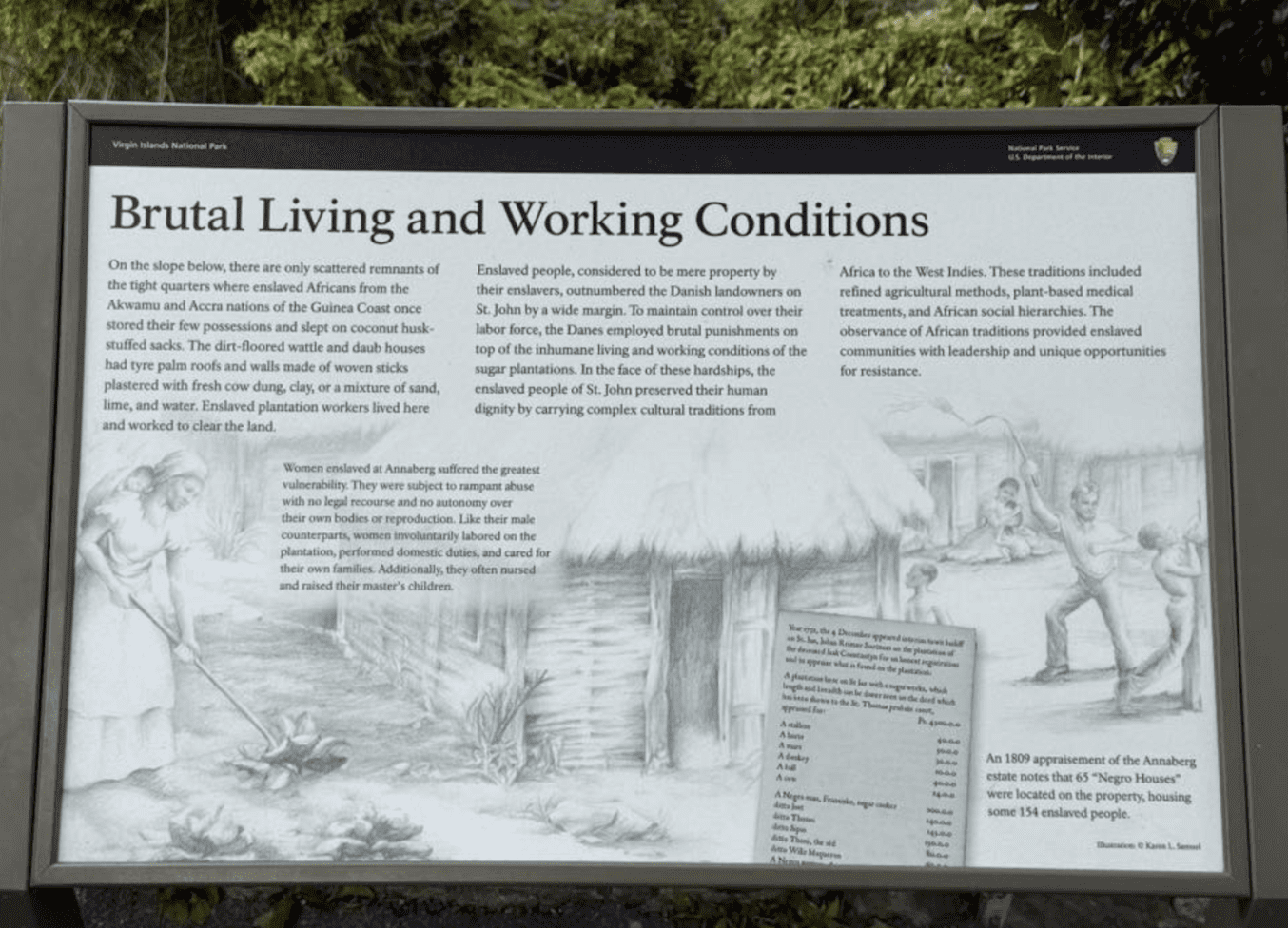
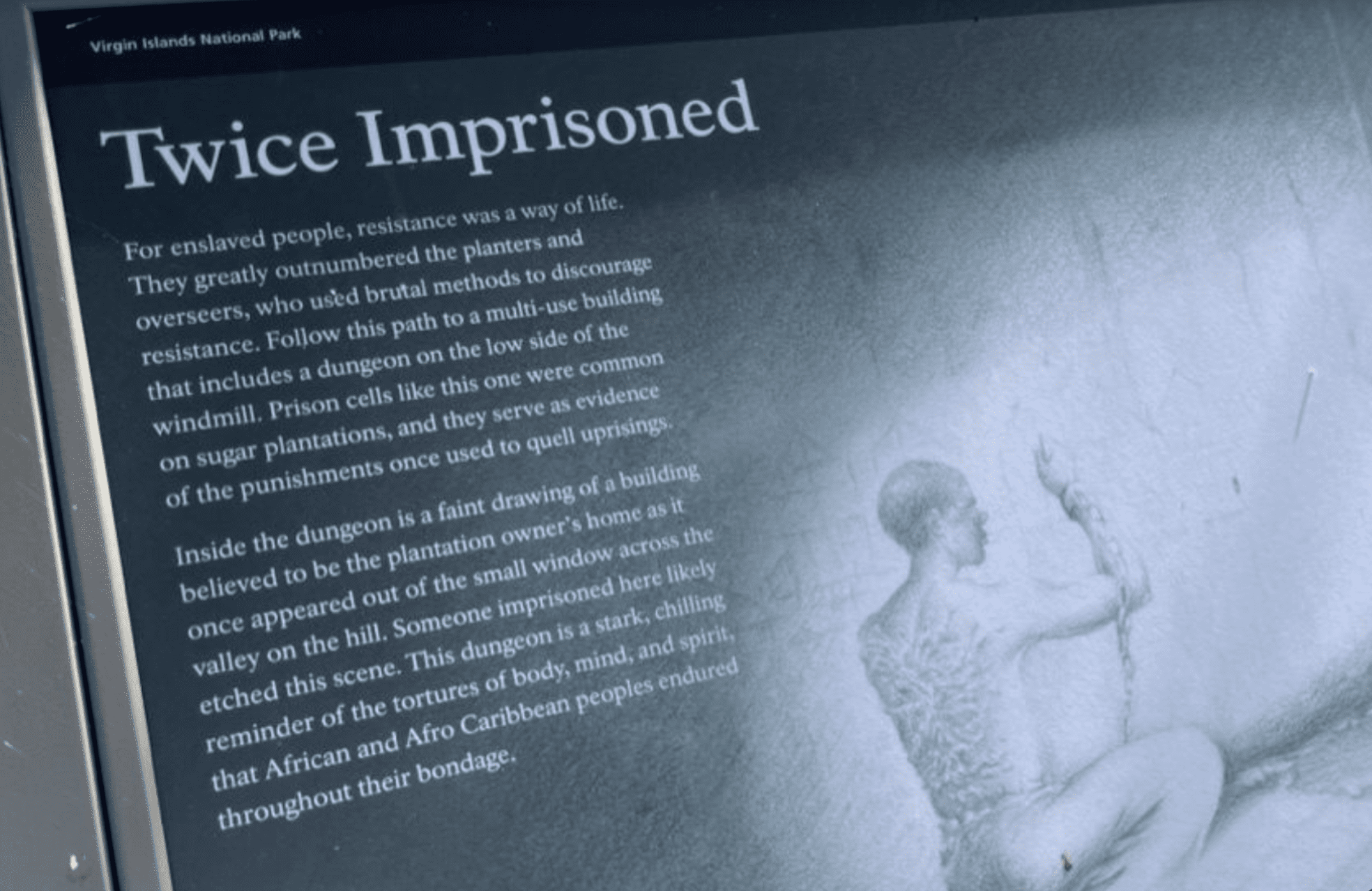
“Brutal Living and Working Conditions” describes the harsh realities faced by the enslaved. (Image from the Friends of the Virgin Islands National Park website)The Department of the Interior’s order, SO 3431, issued in May 2025, also specifically directed the National Park Service to review and remove any “disparaging” content from Independence National Historic Park in Philadelphia before July 4, when the country celebrates 250 years of independence.“Twice Imprisoned” depicts punishment suffered by the enslaved under Danish rule. (Image from the Friends of the Virgin Islands National Park website)
On Jan. 22, the National Park Service removed panels entitled “The Dirty Business of Slavery” from the President’s House at Independence National Historic Park. The panels provided details about nine people enslaved by George and Martha Washington when they lived in Philadelphia in the 1790s.
The city of Philadelphia sued, and on Monday, Presidents Day, U.S. District Judge Cynthia Rufe ruled that the panels had to be restored in their original condition “while a lawsuit challenging the removal’s legality plays out. She prohibited Trump officials from installing replacements that explain the history differently.”
V.I. Delegate to Congress Stacey Plaskett had issued a press release the previous Friday condemning the removal of the signs from the Virgin Islands National Park. “The erasure of history does not change history — it only ensures we are condemned to repeat it,” she wrote. “The Virgin Islands National Park preserves the history of our ancestors — from the Indigenous peoples who first called these islands home to those who endured enslavement and built our communities through unimaginable hardship.”
“These stories must be told accurately and completely so current and future generations understand where we come from and the lessons we must carry forward,” Plaskett continued. “The removal of these historical markers robs our children and all Americans of the truth they deserve.”
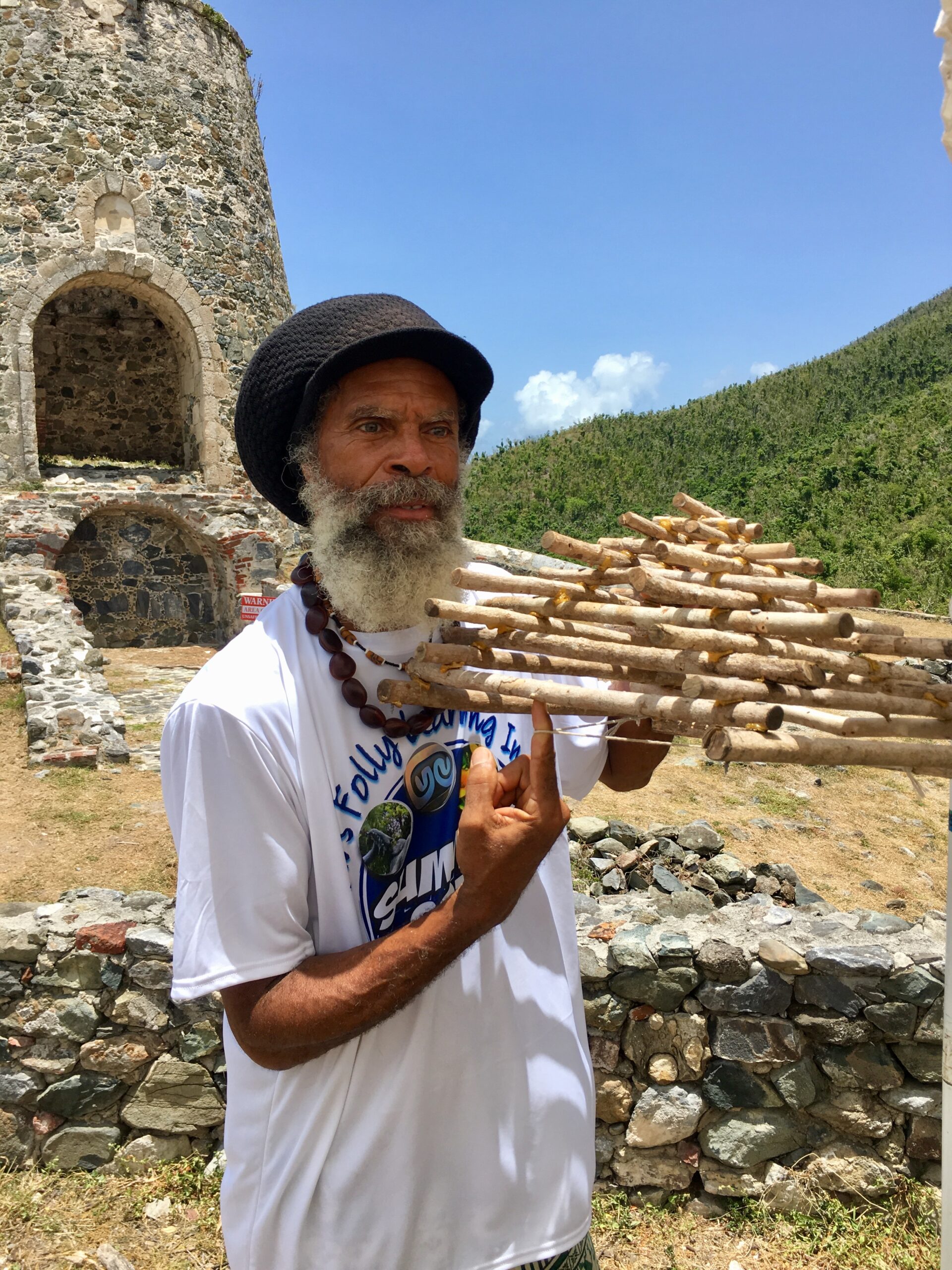
Delroy “Ital” Anthony displays a model of early construction methods during a cultural demonstration at Annaberg in 2018. (Source photo by Amy H. Roberts)
Observers have noticed that three signs are now missing from Annaberg. “Brutal Living” describes the harsh realities faced by the enslaved. “A Fight for Right” recounts the 1733 Insurrection as “an unprecedented act of organized resistance.” “Twice Imprisoned” tells of a drawing found on a prison wall.
The missing signs at Annaberg are the work of native St. Johnians, including artist Karen Samuel and cultural historian Hadiya Sewer, who collaborated with NPS sign makers to depict conditions of the Danish Colonial period as accurately as possible.
A compilation of signs at Annaberg can be seen at the Friends of the Virgin Islands National Park website. (Image from the Friends of the Virgin Islands National Park website)
Despite their efforts, Sewer said some of the signs contained explicit errors, and others included “clumsy wording.” Although she worked on several drafts, Sewer said she was not given an opportunity to review the final wording before the signs went into production and were posted.
Sewer wondered whether the removal of the signs was the result of “the federal government cracking down, or something the park was trying to correct.”
“What’s the rationale for taking down these signs?” she asked. “Who were the decision makers? Is there a plan in place to revise them?”
Community activist Lorelei Monsanto challenged the removal of the Annaberg signs in response to Trump’s order, since the period of enslavement “has nothing to do with American history. People do not understand that the Virgin Islands were the Danish West Indies until 1917, when we created a new history as we embarked on becoming American.”
“I believe the NPS has done us a disservice,” Monsanto said. “It is alarming, yet we’ve known it was coming.” She noticed in September 2025 that posters appeared in the park asking visitors to give feedback regarding “any areas that need repair … services that need improvement … or any signs or information that are negative about either past or living Americans.”
Tonia Lovejoy, executive director of the Friends of the Virgin Islands National Park, wrote, “Unfortunately the removal of the signs was not a surprise. We have seen and heard reports of similar actions in Parks across the U.S. as local park staff act on orders from the current Administration.”
She said a website has been created to document signs within parks throughout the nation.
Editor’s Note: This story has been corrected to reflect that the missing signs were first noticed Feb. 4, not Feb. 3.
Virgin Islands campaign finance laws look strong on paper. In practice, they appear weakly enforced — if enforced at all — creating fertile ground for cronyism, pay-to-play politics, and public cynicism.
Dr. Mark Wenner
Under Title 18, Sections 902–907 of the Virgin Islands Code, individual contributions to candidates or Political Action Committees (PACs) are capped at $1,000 per election cycle. The intent of the law is clear: to prevent wealthy donors from dominating the political process and to limit corruption or the appearance of corruption.
Yet repeated disclosures, investigative reporting, and court filings suggest that this legal framework has failed to deliver meaningful accountability.
A Pattern That Demands Scrutiny
Recent allegations emerging from the Epstein files claim that the Bryan–Roach campaign received as much as $380,000 during the 2018 election cycle from Jeffrey Epstein, and that former Gov. Kenneth Mapp personally solicited a $50,000 contribution from Epstein for his unsuccessful reelection bid. These claims warrant careful verification, but they align with a broader, long-standing concern: that campaign finance limits in the Territory are routinely circumvented with little consequence.
Earlier reporting tied to internal JPMorgan Chase investigations revealed that Delegate Stacey Plaskett received approximately $30,000 from Epstein and his associates over three election cycles. CBS News, citing Federal Election Commission (FEC) data, reported that Epstein and related donors made direct contributions of $5,400 in 2016 and $2,700 in 2018. After Epstein’s death and the public exposure of his criminal conduct, Plaskett donated an amount equivalent to those contributions to charity.
JPMorgan-related disclosures also included emails from a former first lady boasting that 10 of the 12 candidates financially supported by “us” won their races. That statement alone should alarm any citizen who believes elections ought to be competitive, transparent, and fair.
This raises an unavoidable question: Who in the Virgin Islands is responsible for verifying campaign finance disclosures and enforcing the law — and why does enforcement appear ineffective?
The True Cost of Power
As we enter a new election cycle, it is worth being honest about what it takes to win the governorship. Based on the size of the electorate (about 39,000 registered voters), historical turnout rates (roughly 52–55%), the need to campaign across three island districts, and prior spending patterns, a competitive gubernatorial campaign today costs between $1.3 million and $2 million, according to AI-assisted modeling.
Even a modest campaign requires a professional staff: a campaign manager, three district captains, finance and compliance staff, communications and digital media support, legal oversight, and a field operation capable of mobilizing volunteers locally and in the mainland diaspora. Campaigns that fail to raise at least $500,000 by summer typically cannot afford television ads, sustained radio placement, or the inter-island travel necessary during the critical final months.
These realities explain why candidates gravitate toward large donors — and why the system structurally favors those willing to court ambitious politicians without independent wealth.
Pay-to-Play as the Default
In the Virgin Islands, generous political donations are widely understood as a means of gaining access and influence, including expedited permits, regulatory forbearance, waivers, government leases, contracts, board appointments, or consulting arrangements. Whether explicit or implicit, the expectation of reciprocity undermines public trust, impartiality, and good governance.
A candidate who doesn’t want to be beholden to special interests would need to rely on small donors and small- to medium-sized local businesses, many of whom are frustrated by the Territory’s high energy costs, inadequate infrastructure, poor public services, elevated housing and food costs that make it hard to recruit and retain skilled workers and to simply survive, let alone prosper. But building such a coalition takes time, organization, and — most importantly — an engaged and informed electorate.
Here lies the deeper problem.
An Electorate That Rewards Short-Term Gains
Roughly 45% of eligible voters do not vote. Winning the governorship typically requires only 10,000–12,000 votes. About 29% of workers are government employees; roughly 19% of residents receive SNAP, and 37% receive medical assistance. These groups, along with contractors dependent on public spending, form a reliable voting bloc.
Meanwhile, younger voters, private-sector professionals, small entrepreneurs, and the self-employed are largely disengaged.
Politics in the Virgin Islands remains driven less by policy than by personalismo, handouts, and spectacle — flashy concerts, fish fries, and short-term giveaways. In 2024, the Bryan administration accelerated spending in the run-up to the election: direct payments to seniors and unemployed residents, grants to roughly 500 businesses with unclear criteria, and $1,000 payments to registered taxi drivers years after the worst of the pandemic had passed. The strategy worked electorally — but left the Territory fiscally strained afterward.
A more politically and discerning mature electorate might have recognized this as unsustainable political budgeting. Instead, many rewarded it. Gov. Bryan won reelection with a wide margin.
Same Players, Same Game in 2026
With no incumbent, the current field for governor is crowded. So far, 16 individuals and/or teams appear to be vying, as indicated by handshaking activities and the display of T-shirts at the Agricultural Fair on St. Croix, and as reported by long-term political observers. Most aspiring candidates are known politicians, and only a few are newcomers. Those candidates with large war chests, name recognition, and strong on-the-ground organizations will likely dominate, because the rules of the game have not changed.
This brings us to the central question facing Virgin Islanders: Are we prepared to demand a different system — or will we continue to expect better outcomes from the same practices and the same politicians?
If the public wants a different system, it means insisting on the effective enforcement of existing campaign finance laws, frequent and accessible disclosure of fundraising and spending, serious consideration of moving to public campaign financing, equal access to the media, and a better-informed electorate.
Democracy cannot function on paper alone. Without enforcement, transparency, and civic engagement, campaign finance laws become window dressing — and public trust becomes collateral damage. An electorate that does not research issues, assess candidates, and understand how government works, and that does not demand pragmatic policies, is bound to make choices that are not in its self-interest.
In this new election cycle, the Virgin Islands voting public should demand to know who the major contributors are to each of the dozen or more gubernatorial and senatorial candidates. The current aspirants for high office, such as Bernie Sanders, should periodically and voluntarily disclose the range of donations they have received. The V.I. electorate should demand candidates who are reformists, have credible policy platforms, have a record of achievement, and have demonstrated competence and managerial ability.
To get rid of the spoils-patronage that plagues V.I. politics and results in cronyism, corruption, and poor governance, campaign finance laws must be enforced, the electorate must demand a better quality of political candidate, and campaigns should be contested based on ideas, values, policy proposals, and competence, not spectacle and personal ties.
— Mark D. Wenner is an economics professor at UVI and a resident of St. Thomas, USVI.
Editor’s Note: Opinion articles do not represent the views of the Virgin Islands Source newsroom and are the sole expressed opinion of the writer. Submissions can be made to visource@gmail.com.
Ramadan is a time to dedicate oneself to spiritual reflection, self-discipline, and increased devotion to one’s faith. (Shutterstock image)
Ramadan is one of the most sacred and meaningful months in Islam. Observed during the ninth month of the Islamic lunar calendar, Ramadan is a time when Muslims around the world fast from dawn until sunset, dedicating themselves to spiritual reflection, self-discipline, and increased devotion to their faith.
In 2026, Ramadan is expected to begin around Feb. 18 and end around March 20, though the exact dates may vary. The Islamic calendar follows the lunar cycle, meaning the start of Ramadan is determined by the sighting of the crescent moon. Because of this, Muslims typically do not know the official start of Ramadan until the evening before it begins.
Fasting during Ramadan is one of the Five Pillars of Islam, which are the core acts of worship that guide a Muslim’s life. Muslims fast not as a form of punishment or hardship, but as a spiritual practice meant to cultivate mindfulness, gratitude, humility, and a deeper connection with Allah (God). “Ramadan is a month full of blessings for me, and it is time to reset my heart, clean my body, grow closer to Allah and his book, and focus on what truly matters in life,” said Shagufta Baig.
While fasting includes abstaining from food and drink during daylight hours, the purpose of Ramadan extends far beyond physical restraint. It is a time for reflection, personal growth, and intentional living. Muslims are encouraged to practice patience, self-control, kindness, and compassion, while being more mindful of their words, actions, and relationships. “Ramadan teaches us patience and helps us connect to our Deen, so every year I try to adopt a new spiritual habit or sunnah,” said Yaz Kubba. “I wish people knew it’s not just about not eating or drinking, it’s about patience, kindness, self-control, and spiritual growth,” said Baig.
Each day of Ramadan begins with a pre-dawn meal known as suhoor, which helps sustain individuals throughout the day. The fast is broken at sunset with iftar, traditionally starting with water and dates, followed by prayer and a shared meal. “Sunrise feels like waking up with a clear goal. Sunset feels like accomplishing something meaningful,” said Jerscillia Desiree.
In the U.S. Virgin Islands, Muslims begin fasting at approximately 5:50 a.m. and break their fast around 6:25 p.m., with times shifting by a few minutes throughout the month. “Fasting here on the island feels especially meaningful. As the sun rises over the ocean and sets into the horizon, I cannot help but think of my people in Palestine. This month reminds me to be grateful for what I have, to give more, to pray harder, and to never forget those who are breaking their fast with uncertainty, or not breaking it at all,” said Nadir Abdelgani.
A central aspect of Ramadan is its emphasis on charity and generosity. Muslims are encouraged to give to those in need, support their communities, and engage in acts of kindness. Fasting fosters empathy by helping individuals better understand hunger and hardship, reinforcing gratitude for everyday blessings.
Ramadan is also a time of increased prayer and spiritual reflection. Many Muslims dedicate more time to reading the Quran and strengthening their relationship with Allah. The month offers an opportunity for renewal, spiritually, emotionally, and mentally. “It actually started as something I did to support a friend, but it ended up becoming one of the best things I’ve ever tried. The mental clarity and discipline I experience during Ramadan are beyond explanation. It’s one of the best choices I’ve made, and now I genuinely look forward to it every year,” said Desiree.
Islam places great importance on health and well-being. Not everyone is required to fast. Children, the elderly, individuals who are ill, pregnant, menstruating, or traveling are exempt, and accommodations are encouraged when fasting may pose a risk to one’s health.
For Muslims, Ramadan is deeply cherished because it creates space to slow down, reconnect with faith, and refocus on what truly matters. It is a month of healing, gratitude, and growth, one that nurtures the heart, mind, and soul. “Prophet Muhammad (saw) once said, whoever fasts Ramadan with faith and seeking reward, his previous sins will be forgiven,” said Mohammad Suid.
Through greater understanding of Ramadan and its purpose, communities can foster respect, compassion, and cultural appreciation. For Muslims, this blessed month is not simply about abstaining from food and drink, but about strengthening faith, building character, and deepening connection. “It changes what’s important, what matters, how you experience your beliefs & religion,” said Jayda Bryan. “It also gave me a genuine respect for Muslim believers, that they’re closer to God than most Christians that I know because of their faith & commitment to Ramadan,” Bryan added.
As Ramadan begins, there are many ways to greet a Muslim practicing during this blessed month. A simple and thoughtful greeting such as “Ramadan Mubarak” (Blessed Ramadan) or “Ramadan Kareem” (Generous Ramadan) is commonly shared. You can also say “cul sana wa intee salma”- for a female, or “cul sana wa inta salam” for a male, translating to, may you be well/safe every year. These greetings serve as a meaningful way to express support, respect, and goodwill during this sacred time.
—Nour Z. Suid, PsyD, is a Licensed Professional Counselor who was born and raised in the Virgin Islands. She graduated with her doctorate in Clinical Psychology and Naturopathic Medicine. Dr. Suid is currently working as a mental health counselor at Serenity Wellness & Counseling.