

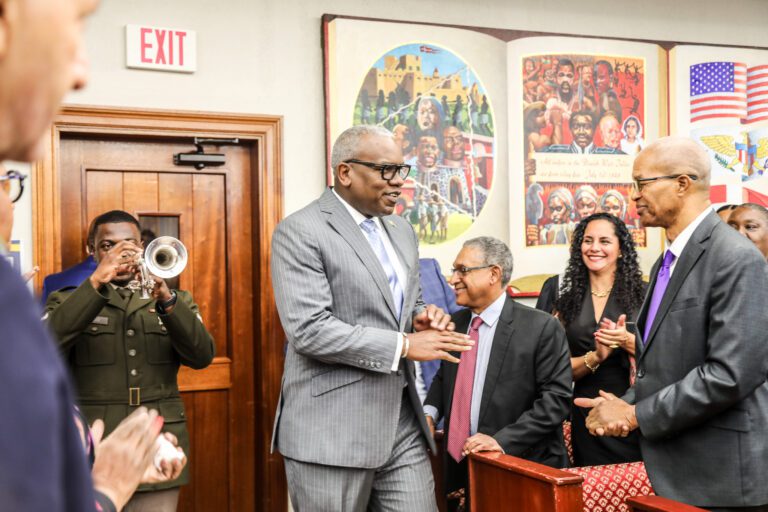
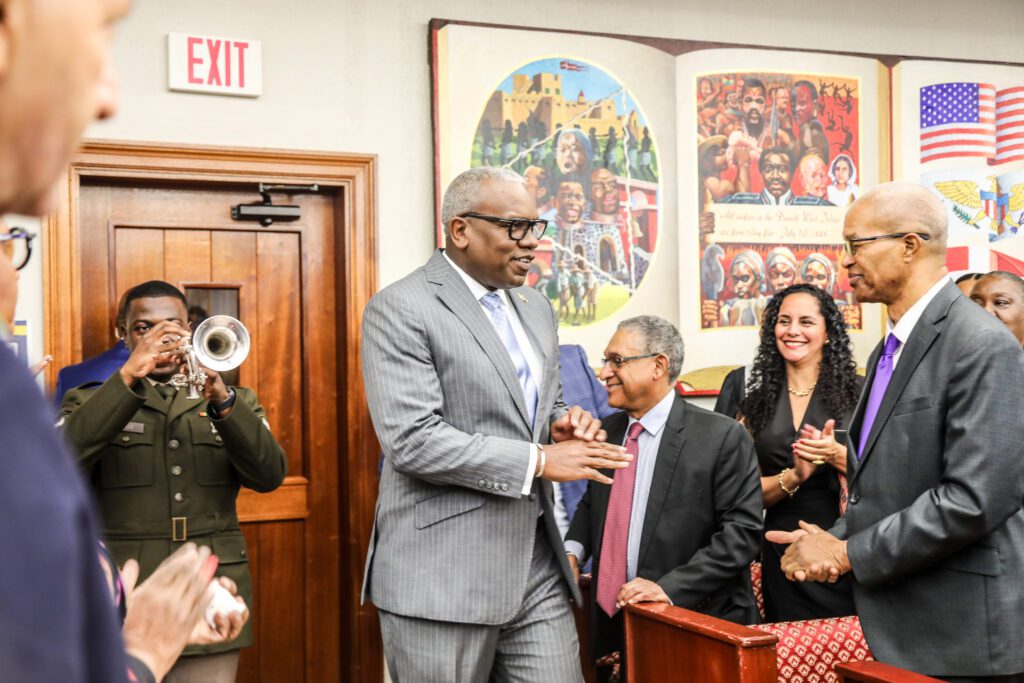
That arc — from inherited strain to guarded confidence — shaped nearly every section of Bryan’s address, as he reflected on an administration that navigated hurricanes Irma and Maria, the COVID-19 pandemic, fiscal instability and political scandal, while pressing forward on long-promised reforms in health care, education, infrastructure, public safety and economic development.
But woven through the speech’s emphasis on progress was a more sober acknowledgment of larger challenges— including public corruption cases that struck at the core of his cabinet, hospitals under federal scrutiny, fragile utilities, and an economy whose headline gains do not always reflect conditions on the ground.
Bryan opened by revisiting the condition of the territory when he and Lt. Gov. Tregenza Roach took office, describing a government so financially strained that meeting payroll was uncertain, vendor obligations exceeded $270 million, GERS faced multiple lawsuits, and the government had borrowed heavily just to operate. Infrastructure was deteriorating, streetlights were out, and there were no reserves waiting to fund recovery.
He framed his administration’s response as structural rather than cosmetic — focused on restoring credibility, stabilizing systems and rebuilding institutional capacity. In doing so, Bryan credited former Govs. John de Jongh Jr. and Kenneth Mapp for laying groundwork in areas such as renewable energy, early childhood education, pension reform and early hurricane recovery, underscoring his assertion that progress in the Virgin Islands is cumulative, not confined to a single administration.
The most direct and consequential portion of the address came when Bryan turned to public corruption. Last year’s State of the Territory Address was delivered just weeks after federal indictments were handed down against two former members of his cabinet and one sitting commissioner. Over the past year, each case resulted in convictions: former Management and Budget Director Jenifer O’Neal, former Police Commissioner Ray Martinez, and former Sports, Parks and Recreation Commissioner Calvert White. The cases were investigated and prosecuted by federal authorities, and Bryan described them Monday as “perhaps the most painful test of this term.”
Addressing Virgin Islanders directly, Bryan recommitted to “stamping out corruption, wherever it appears, and to protecting the trust you have placed in me and my cabinet.”
“I am asking you to walk with me in this work,” he said. “When you see something wrong, report it. When you see something that does not look right, say so. We will investigate it and act. Where the investigation leads, we will always cooperate and support the pursuit of justice, seeking the light to reveal the truth.”
Bryan said his administration responded by expanding mandatory ethics training for government employees, strengthening procurement oversight and implementing a comprehensive code of conduct across agencies. He said additional safeguards were put in place for employees involved in procurement, and that his administration committed to full cooperation with any investigation into wrongdoing. Bryan also urged the public to report suspected misconduct, saying complaints would be investigated and acted upon, and emphasized that accountability and transparency were essential to restoring trust in government.From accountability, Bryan pivoted to crisis response and institutional resilience, pointing to the territory’s experience navigating hurricanes, a pandemic and prolonged recovery efforts that stretched already fragile systems. He highlighted the accreditation of the Virgin Islands Territorial Emergency Management Agency, calling it a marker of progress in disaster preparedness and coordination.
Disaster recovery itself featured prominently, with Bryan citing billions of dollars obligated through FEMA and administered through the Office of Disaster Recovery to repair and rebuild homes, schools, roads and utilities damaged by the 2017 storms. He framed recovery not as a single phase but as a long-term process of rebuilding infrastructure to modern standards. That framing comes as the territory continues to wrestle with slow project delivery, contractor shortages and lingering complaints from homeowners still awaiting repairs years after the storms.
Housing and homeownership were woven throughout the address as both a recovery priority and an economic one. Bryan pointed to expanded programs through the Virgin Islands Housing Finance Authority and Economic Development Authority, including down-payment assistance, mortgage support and affordable housing development, describing homeownership as central to community stability and generational wealth. At the same time, rising construction costs, limited inventory and delayed recovery projects have continued to constrain housing access for many residents.
Health care emerged as one of the most consequential and detailed policy areas in the speech. Bryan said his administration is moving toward a single, unified territorial health care system, with Gov. Juan F. Luis Hospital on St. Croix and Roy L. Schneider Hospital on St. Thomas operating under one leadership structure rather than separate district boards.
The shift reflects long-standing concerns raised by health care officials that the current dual-board system leads to duplicated costs, inconsistent policies and weakened negotiating power. Shortly after becoming chair of the Government Hospitals and Health Facilities Corporation, Dr. Jerry Smith publicly called for abolishing the district boards altogether, arguing centralized leadership would improve efficiency, stabilize finances and standardize care.
On Monday, Bryan said he stands “fully with the Territorial Hospital Board,” signaling support for governance changes expected to unfold in the coming weeks.
“By pooling resources and negotiating together, our hospitals will stretch every dollar further and deliver more consistent care from the first visit to recovery across the territory,” Bryan said.
Those comments came amid mounting operational pressure. Lawmakers have redirected millions of dollars — including Epstein-related settlement funds and a line of credit — to address vendor arrears, staffing shortages and supply gaps. At the same time, the Centers for Medicare and Medicaid Services conducted both scheduled and unannounced surveys at Juan F. Luis Hospital tied to dialysis capacity and community complaints, underscoring the gap between long-term reform plans and immediate service challenges.
Bryan also said the government is “in the final stages of contracting” for the long-awaited rebuild of Juan F. Luis Hospital. The statement followed action by the V.I. Public Finance Authority last August approving preliminary preconstruction contracts for hospital rebuilds on both St. Croix and St. Thomas, though officials have since said negotiations remain ongoing — highlighting the complexity and long timeline of hospital reconstruction.
Beyond physical infrastructure, Bryan emphasized telehealth expansion as a way to improve access to specialty care across islands amid chronic staffing shortages.
Education was another focal point of Bryan’s assessment. He highlighted the permanent closure of the aging John H. Woodson Junior High School and the opening of Arthur Richards K-8, the first new public school campus to open in the Virgin Islands in more than 30 years. While Bryan framed the milestone as a turning point, he acknowledged the continued age and strain of many remaining school facilities, signaling that modernization remains incomplete.
On infrastructure, Bryan pointed to road projects on both major islands — including Williams Delight on St. Croix and the long-anticipated Nardo Trotman Drive corridor on St. Thomas — as well as investments in buses and transit systems.
“These are steady investments that keep people and goods moving,” he said.
He also acknowledged long-standing failures in wastewater systems, noting that many sewer lines are more than 60 years old and continue to fail. Bryan said FEMA has recognized the scope of the problem, with billions allocated for replacement — a generational project unlikely to be resolved quickly.
Utilities featured as both a point of progress and persistent frustration. Bryan referenced modernization efforts at the Water and Power Authority, including infrastructure upgrades and management reforms. But recent outages, particularly on St. Thomas, and years of leadership turnover at WAPA have continued to test public confidence, underscoring the gap between reform plans and daily reliability.
Public safety and justice also figured prominently. Bryan announced plans to expand the Virgin Islands Police Department’s use of drone technology to support emergency response and search operations. He also put forward judicial nominations, including Judge Denise François to the Supreme Court of the Virgin Islands — which would give the court a full complement of five justices for the first time — and Reneé M. André to the Superior Court, moves he framed as strengthening the judiciary and improving access to justice.
In sports and recreation, Bryan returned to the troubled issue of horse racing. He said his administration is pursuing a public-private partnership to revive racing on St. Croix, modeled on the Clinton E. Phipps Racetrack arrangement on St. Thomas with Southland Gaming but larger in scope, and announced plans to submit legislation consolidating gaming regulation by merging the Lottery and Casino Control Commissions into a single regulator.
The comments came as horse racing continues to face scrutiny. Earlier this year, racing at the Clinton E. Phipps Racetrack was halted after a single race day resulted in the euthanizing of three horses and injuries to others, prompting a Racing Commission investigation and widespread public concern. While racing later resumed following inspections and maintenance, questions about oversight and animal welfare remain.
Economically, Bryan reiterated themes from summer budget hearings, pointing to improved revenue collection, fiscal discipline and negotiated wage increases as markers of progress. Lawmakers approved a phased minimum wage increase earlier this year, framing it as a response to cost-of-living pressures, even as business owners raised concerns about implementation.
Bryan also addressed what he described as external pressures undermining key sectors of the Virgin Islands economy, pointing specifically to new charter and cruising fees imposed by the British Virgin Islands. He said his administration has been exploring “every available option” to respond, warning that the fees threaten marine tourism and regional commerce by diverting vessels and spending away from the territory. The issue has drawn sustained concern from local marine operators and business groups, who have argued that the BVI’s fee structure places Virgin Islands charters at a competitive disadvantage and could cost the territory millions in lost economic activity if left unaddressed.Bryan made only brief reference to St. Croix’s shuttered refinery — a notable shift from prior addresses in which a restart was framed as a major economic catalyst. A year ago, he cited the facility’s potential to generate hundreds of millions in economic activity and government revenue. This year, the refinery was mentioned largely in passing, reflecting a recalibration of expectations.
He also pointed to modernization across government, including procurement reforms such as the rollout of the GVIBUY electronic procurement platform, intended to centralize bidding and improve transparency in government purchasing.
As he looked ahead, Bryan suggested that the next phase of governance in the Virgin Islands may require a different kind of civic engagement. He floated the idea of giving taxpayers the option to direct a portion of their tax payments toward specific priority areas, such as health care, infrastructure, education or public safety — a concept he framed as a way to better align public investment with community needs and shared responsibility.
The proposal, Bryan said, reflects his view that the challenges facing the territory in the years ahead will be different from those he inherited, but no less complex, and will require both disciplined leadership and more intentional participation from residents in shaping how limited resources are applied.
Bryan closed by returning to the theme that framed the address.
“Tonight I’ve given you a replay,” he said. “We did not inherit ease.”
The territory’s anchor, he insisted, now holds — not because the work is finished, but because systems, standards and expectations have shifted. The challenges ahead, Bryan said, will demand the same focus on stability and purpose that defined his administration’s response to crisis.
“Our anchor holds,” he said, “because of the work we have done — together.”
 As the Governor prepares to deliver his State of the Territory Address, the people of the Virgin Islands deserve more than optimism, selective framing, or recycled talking points. They deserve the truth.
And the truth is this. The Government of the Virgin Islands is in a deeply precarious financial position, one that can no longer be obscured by messaging or managed away with hopeful projections. The numbers already tell the story, and they tell it plainly.
For years, the government’s finances have revolved around two primary accounts. Understanding the distinction between them is essential, because confusion, intentional or not, has helped mask the severity of the problem.
Bank One is the government’s operating account. It is the checkbook. This is where payroll and vendor payments are made, utilities are covered, and routine government expenses are handled. It is funded by recurring revenues such as taxes, fees, and collections. When officials say cash is tight, what they really mean is that Bank One is stressed or depleted.
Bank Two is not an operating account and was never intended to function as one. It is a clearing and holding account for restricted and pass through funds. This includes the Tourism Advertising Revolving Fund, which is largely funded by hotel room taxes and legally designated for tourism marketing, not general government spending. Bank Two also temporarily holds taxes and fees collected for agencies, fines and penalties, permits, refunds, and internal transfers awaiting reconciliation.
Here is the reality leadership has avoided stating clearly.
Bank One is empty.
Bank Two is empty.
Not low. Not strained. Empty.
This is not conjecture. The Department of Finance’s monthly revenue reports, publicly posted, show ongoing stress in operating cash balances and recurring revenues that consistently underperform projections. The Internal Revenue Bureau’s reports reinforce the same conclusion. Month after month, the data shows declining balances, weak collections, and no meaningful cushion left to absorb fiscal shocks.
These are government documents telling a glaring story.
With the unprecedented level of federal relief funds received by the territory in recent years, the Virgin Islands should not be in this position. There is no defensible explanation for being this financially depleted after historic federal support. None.
Yet instead of addressing the structural failures early, the government leaned on temporary money. Restricted funds were treated like flexible cash. Bank Two became a crutch rather than a clearing account. Now, there is nothing left to lean on.
Quiet signals suggest that borrowing may once again be floated as a solution. Bonds. Financing. Short term fixes. This playbook should look familiar. Borrowing to plug holes created by mismanagement is not a strategy. It is a warning sign that the fundamentals have collapsed.
Then there is the Epstein money.
Those funds were spent. They were never properly reported as spent. To this day, there is no comprehensive public accounting, no transparent breakdown, and no clear explanation to the people of this territory about where that money went. That alone should alarm everyone, regardless of political affiliation.
This is not a personal attack.
This is not partisan.
This is math.
This is governance.
The financial crisis facing the Virgin Islands did not happen overnight. It was created over time through poor fiscal discipline, weak internal controls, and a persistent refusal to confront reality early enough to correct course.
A State of the Territory Address that does not grapple honestly with this financial condition is not leadership. It is avoidance. The people deserve candor. They deserve to hear where things went wrong, what guardrails failed, and what will be done differently moving forward. They deserve transparency, not reassurance.
Markets do not respond to optimism. Creditors do not operate on vibes. Federal partners do not rely on talking points. They look at balance sheets.
At some point, the Governor must reckon with the truth. The numbers already have.
The Government of the Virgin Islands is broke.
Literally.
And the people of this territory did not deserve that.
As the Governor prepares to deliver his State of the Territory Address, the people of the Virgin Islands deserve more than optimism, selective framing, or recycled talking points. They deserve the truth.
And the truth is this. The Government of the Virgin Islands is in a deeply precarious financial position, one that can no longer be obscured by messaging or managed away with hopeful projections. The numbers already tell the story, and they tell it plainly.
For years, the government’s finances have revolved around two primary accounts. Understanding the distinction between them is essential, because confusion, intentional or not, has helped mask the severity of the problem.
Bank One is the government’s operating account. It is the checkbook. This is where payroll and vendor payments are made, utilities are covered, and routine government expenses are handled. It is funded by recurring revenues such as taxes, fees, and collections. When officials say cash is tight, what they really mean is that Bank One is stressed or depleted.
Bank Two is not an operating account and was never intended to function as one. It is a clearing and holding account for restricted and pass through funds. This includes the Tourism Advertising Revolving Fund, which is largely funded by hotel room taxes and legally designated for tourism marketing, not general government spending. Bank Two also temporarily holds taxes and fees collected for agencies, fines and penalties, permits, refunds, and internal transfers awaiting reconciliation.
Here is the reality leadership has avoided stating clearly.
Bank One is empty.
Bank Two is empty.
Not low. Not strained. Empty.
This is not conjecture. The Department of Finance’s monthly revenue reports, publicly posted, show ongoing stress in operating cash balances and recurring revenues that consistently underperform projections. The Internal Revenue Bureau’s reports reinforce the same conclusion. Month after month, the data shows declining balances, weak collections, and no meaningful cushion left to absorb fiscal shocks.
These are government documents telling a glaring story.
With the unprecedented level of federal relief funds received by the territory in recent years, the Virgin Islands should not be in this position. There is no defensible explanation for being this financially depleted after historic federal support. None.
Yet instead of addressing the structural failures early, the government leaned on temporary money. Restricted funds were treated like flexible cash. Bank Two became a crutch rather than a clearing account. Now, there is nothing left to lean on.
Quiet signals suggest that borrowing may once again be floated as a solution. Bonds. Financing. Short term fixes. This playbook should look familiar. Borrowing to plug holes created by mismanagement is not a strategy. It is a warning sign that the fundamentals have collapsed.
Then there is the Epstein money.
Those funds were spent. They were never properly reported as spent. To this day, there is no comprehensive public accounting, no transparent breakdown, and no clear explanation to the people of this territory about where that money went. That alone should alarm everyone, regardless of political affiliation.
This is not a personal attack.
This is not partisan.
This is math.
This is governance.
The financial crisis facing the Virgin Islands did not happen overnight. It was created over time through poor fiscal discipline, weak internal controls, and a persistent refusal to confront reality early enough to correct course.
A State of the Territory Address that does not grapple honestly with this financial condition is not leadership. It is avoidance. The people deserve candor. They deserve to hear where things went wrong, what guardrails failed, and what will be done differently moving forward. They deserve transparency, not reassurance.
Markets do not respond to optimism. Creditors do not operate on vibes. Federal partners do not rely on talking points. They look at balance sheets.
At some point, the Governor must reckon with the truth. The numbers already have.
The Government of the Virgin Islands is broke.
Literally.
And the people of this territory did not deserve that.