Plessen Healthcare, LLC, a participant in the Virgin Islands Economic Development Incentive Program of the US Virgin Islands, has a procurement requirement to purchase goods and services locally in the Virgin Islands to the maximum extent practicable and regularly purchases the following types of goods and/or services:
Advertising, Printing, and Publishing ServicesAir conditioner parts, sales and servicesAuditing & Accounting ServicesBiomedical Waste Services & Equipment RepairComputer Sales, Related ITConstruction Contractor ServicesDry cleaning, laundry pickup and delivery servicesElectronic Security (Burglar, Fire, CCTV, Access Control)Equipment and ServicesExterminator ServicesHospitality, High Speed InternetInsurance Services
Kitchen and Cleaning SuppliesLegal ServicesLife, health, and auto insurance servicesMedical SuppliesMedical EquipmentOffice SuppliesRunner/Delivery ServiceTrucking, Transportation and Delivery ServicesWater Supply ServicesUniforms
If you are an Eligible Virgin Islands Supplier as defined in the Virgin Islands Economic Development Commission’s (“VIEDC”) Rules and Regulations but are not on the VIEDC’s list of Eligible Suppliers, you are encouraged to request being added to the list by having your business certified by the Chief Executive Officer of the Virgin Islands Economic Development Commission. Applications for certification may be obtained online at www.usvieda.org or by contacting the VIEDC Office. Completed applications should be filed with the Virgin Islands
ST. CROIX OFFICEVirgin Islands Economic Development Commission16 King Street, FrederikstedSt. Croix, Virgin Islands 00840(340)773-6499
ST. THOMAS OFFICEVirgin Islands Economic Development CommissionP. O. Box 305038St. Thomas, VI 00803 (340)714-1700
ORVirgin Islands Economic Development Commission8000 Nisky Shopping CenterSuite 620St. Thomas, VI 00802
Historic Area Revitalization Project Joint Venture a participant in the Economic Development Program of the Virgin Islands has a procurement program to purchase goods and services locally in the Virgin Islands to the maximum extent practicable and regularly purchases the following types of goods and/or services:
Insurance Office Cleaning
Office Equipment/Furniture Landscaping
Accounting /Tax/ Payroll Construction Materials
Paper & Office Supplies Automobile Supplies
Pest Control Consulting Services
IT Support HVAC Repair & Maintenance
Repair & Maintenance Supplies Freight Clearance
Computer & Technology Services Trash Removal
Procurement Department may be contacted at
procurement@crystalblueusvi.com
If you are an Eligible Virgin Islands Supplier as defined in the Virgin Islands Economic Development Commission’s (“VIEDC”) Rules and Regulations but are not on the VIEDC’s list of Eligible Suppliers, you are encouraged to request being added to the list by having your business certified by the Chief Executive Officer of the Virgin Islands Economic Development Commission. Applications for certification may be obtained online at www.usvieda.org or by contacting the VIEDC Office. Completed applications should be filed with the Virgin Islands Economic Development Commission at:
ST. CROIX OFFICE
Virgin Islands Economic Development Commission 116 King Street, Frederiksted
St. Croix, Virgin Islands 00840
(340) 773-6499
OR
ST. THOMAS OFFICE
Virgin Islands Economic Development Commission 8000 Nisky Shopping Center
Suite 620
St. Thomas, VI 00802
(340) 714-1700
OR
Virgin Islands Economic Development Commission
P.O. Box 305038
St. Thomas, VI 00803
The Virgin Islands Board of Education issues this statement not as routine communication, but as a moral response to a wound still open in our community. A young life was lost a couple of weeks ago as a result of violence in our Territory, and the weight of that loss has not faded with time.
We name what must never be normalized. That young person was somebody’s child. Somebody carried that child. Somebody raised that child. Somebody prayed for that child. Somebody expected to see that child grow into adulthood. That is not abstract. That is real. That is permanent. And that absence now echoes through a family that will never be the same.
A child should not become a memory because of a moment of anger. A disagreement should not become a death sentence. A chain, a gesture, or a decision made in seconds should never erase a lifetime of potential. We are not only mourning a life lost. We are confronting what is being lost every time violence is chosen.
We are losing future graduates who will never cross a stage.
We are losing skilled workers who will never build businesses or serve communities.
We are losing artists, athletes, educators, caregivers, and leaders who never get the chance to become who they were meant to be.
We are losing entire futures before they have the chance to begin.
Violence does not only end life.
Violence interrupts destiny.
Violence fractures families.
Violence erodes schools.
Violence weakens entire communities.
As the Territory prepares for the opening of a new school year, we must be honest. Schools cannot carry this alone. Teachers cannot carry this alone. Administrators cannot carry this alone. Education begins in classrooms, but safety is shaped in homes, neighborhoods, peer groups, and community spaces.
The Virgin Islands Board of Education calls on every sector of our society to respond with urgency and accountability. We call on organizations, churches, sports programs, youth groups, and civic leaders to move beyond concern and into structured protection for our young people by:
Establishing clear curfews and accountability systems for youth participation in community activities
Creating clear expectations for relationships, conduct, and respect among young people
Teaching conflict resolution as a required life skill, not an optional message
Implementing active supervision and safety check systems at youth events and gatherings
Building intentional mentorship so no young person grows up without guidance and support
Strengthening partnerships between schools, families, mental health professionals, and public safety institutions
This is not about control. It is about care. It is about the structure that protects life. We must also speak directly to the moral reality of this moment. No disagreement is worth a grave. No pride is worth a parent’s suffering. No moment of anger is worth a lifetime of silence at a dinner table where a child should still be sitting.
Let us be clear. A safer Virgin Islands will not be created by statements alone. It will require sustained presence, consistent accountability, and collective courage to intervene before conflict becomes tragedy. Let every church become a place of refuge where young people are reminded they are valued. Let every sports court become a place where discipline and respect are taught alongside skill. Let every neighborhood become a space where protection is visible, not assumed. Let every adult accept responsibility for the safety of every child.
The Virgin Islands Board of Education believes something simple but profound: no child should ever have to survive the community they are growing up in. We therefore issue this central truth not as rhetoric, but as a warning and commitment: Violence steals talent before it is fully formed. Violence steals education before it is completed. Violence steals life before it has the chance to unfold.
To the family grieving this loss, we extend our deepest and most sincere condolences. We recognize that no public statement can restore what has been taken. We also recognize that your child’s life mattered and continues to matter beyond this tragedy.
To the community, we say this plainly. We cannot become accustomed to this. We cannot normalize this. We cannot accept this as the cost of living in our islands. Let this moment be a turning point, not another passing headline.
The Virgin Islands Board of Education commits to continuing this work not only in words, but in action, partnership, and sustained advocacy for the safety and future of every child in this Territory.
— Sandra Bess is the executive director of the Virgin Islands Board of Education.
Editor’s Note: Opinion articles do not represent the views of the Virgin Islands Source newsroom and are the sole expressed opinion of the writer. Submissions can be made to visource@gmail.com.
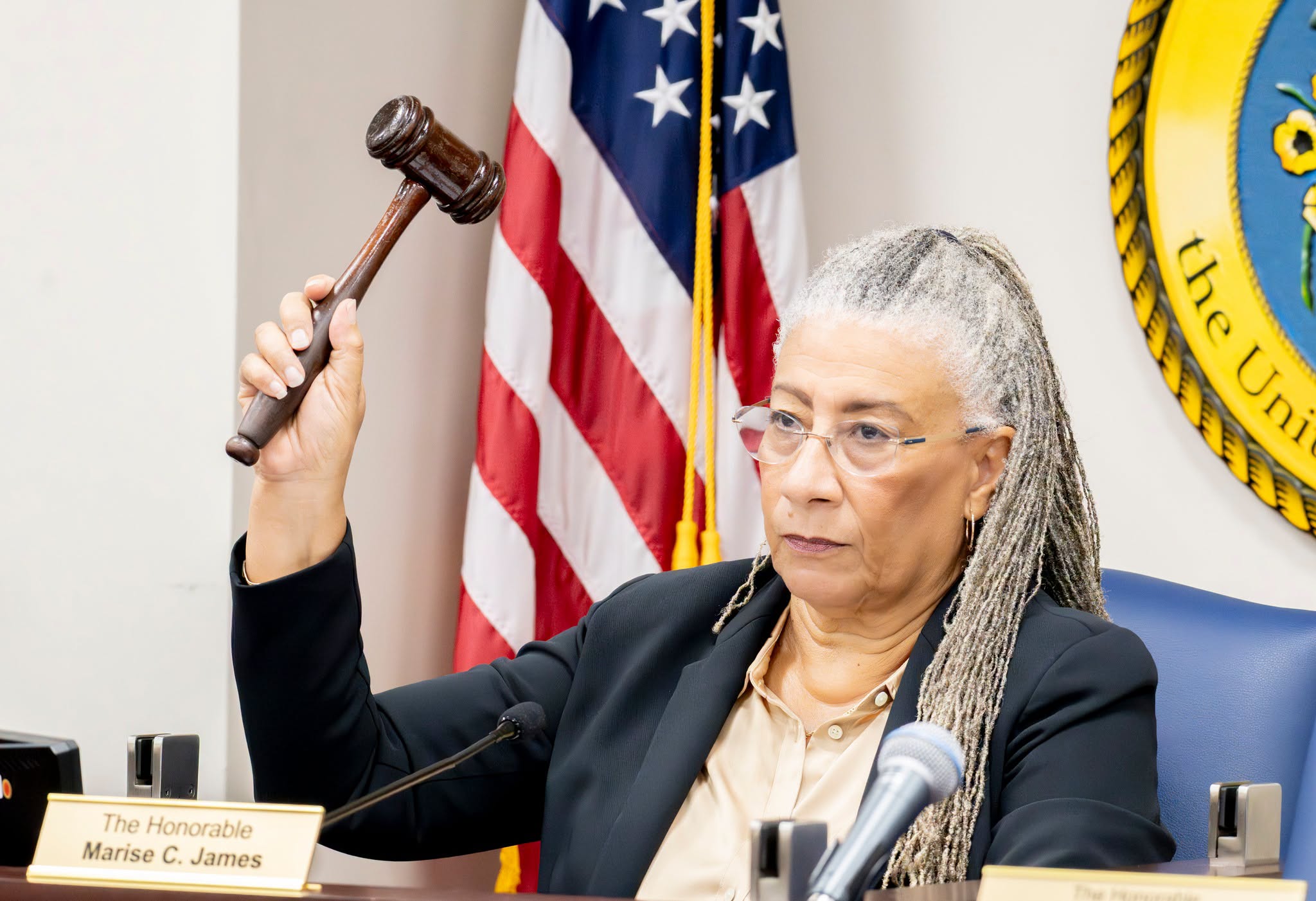
Sen. Marise C. James, chair of the Senate Disaster Recovery, Infrastructure, and Planning Committee, chaired Tuesday’s hearing, where the committee received updates from multiple agencies on the territory’s emergency preparedness. (Photo courtesy V.I. Legislature)
On Tuesday, the Senate Disaster Recovery, Infrastructure and Planning Committee reviewed territorial emergency preparedness, including emergency operations planning, agency coordination and hurricane readiness.
Emergency management, health, utility and law enforcement officials outlined improvements in hurricane planning and operations for the 2026 Atlantic season but also acknowledged continuing vulnerabilities in shelter staffing, hospital infrastructure and the electric grid.
Virgin Islands Territorial Emergency Management Agency Director Daryl Jaschen said the government recently completed a five-day hurricane exercise with federal partners, simulating a Category 3 storm striking St. John, with moderate damage on St. Thomas and minor damage on St. Croix.
A draft after-action report cited improvements in planning with federal partners and emergency operations coordination but also identified recurring issues, including underuse of the WebEOC incident management system, operational gaps on St. John, shelter staffing shortages, confusion at food and water distribution sites and communications problems.
“Before I saw my after-action review, I’d give us definitely a B-plus, but right now I’d give us a B-minus,” Jaschen said of the territory’s hurricane readiness entering the 2026 season. He said several findings in the draft after-action report “parallel gaps identified in past events, proving that priority recommendations from other reports have not yet been fully implemented.”
Jaschen said emergency operations centers are prepared, with contingency plans in place while the St. Thomas facility undergoes repairs. He urged residents to stock enough food, water and other basics to be self-sufficient for 10 days on St. John and about seven days on St. Thomas and St. Croix until supply chains recover after a hurricane.
Several senators questioned whether long-standing weaknesses identified after hurricanes Irma and Maria have been fully resolved, particularly involving shelter staffing, hospitals and emergency operations.
Assistant Human Services Commissioner Carla Benjamin said the territory can accommodate 2,209 people in shelters before a storm, but capacity drops to 1,136 after landfall because fire and health standards require about twice as much space per person for longer stays. She said about half as many people can be housed safely if shelters remain open for longer-term stays.
She also said shelter operations are coordinated through a 72-hour planning matrix with FEMA, the American Red Cross and the Education Department, and that water is pre-staged at shelter sites ahead of storms. Federal agencies have pre-positioned roughly 250,000 meals and about 500,000 liters of water in the territory, and pet sheltering options have been expanded at colocated shelters on St. Thomas and St. Croix.
Jaschen and Health Commissioner Justa Encarnacion said staffing remains a major constraint. Jaschen testified that a shortage of nurses could limit the government to opening only one shelter per island during a significant hurricane. Encarnacion said the Health Department has 23 nurses territorywide, with 18 available for medical special-needs shelters, and that officials are working with federal partners to secure additional clinical personnel if needed.
Benjamin also reported that 954 residents are enrolled in the territory’s elder and disabled disaster registry, a program created by law to track seniors and people with disabilities living alone. She said it is used to prioritize welfare checks and identify medically fragile residents who may need backup power if outages persist.
Hospital Chief Executive Officer Darlene Baptiste told lawmakers both Gov. Juan F. Luis Hospital on St. Croix and Schneider Regional Medical Center on St. Thomas continue operating from temporary hospital facilities established after the 2017 hurricanes.
She said JFL North was not designed as a permanent hospital and that, if a stronger storm threatens, inpatient care would be relocated into the Virgin Islands Cardiac Center, while outpatient dialysis currently provided in a temporary trailer remains a top clinical priority. Health officials also testified that the territory’s medical oxygen supply is one of its most significant vulnerabilities.
Encarnacion said SRMC can now generate medical oxygen on site, but JFL still depends on vendor deliveries that can be disrupted “when sea and airports close.” Baptiste added that an oxygen generator intended for St. Croix has not yet been installed and is still undergoing design and siting work.
Director of Water Distribution Don Gregoire told senators the utility has replaced 10,213 wooden poles with composite poles designed to withstand wind speeds up to 200 miles per hour and converted about 40% of critical portions of its electrical distribution system underground, reducing exposure to high winds and falling vegetation.
He said the authority’s financial position is its “most significant concern,” with limited cash reserves constraining WAPA’s ability to build emergency inventory to desired levels, purchase additional fuel reserves, accelerate fleet repairs, and maintain the financial flexibility needed to respond to multiple storms.
Adjutant General Maj. Gen. Kodjo S. Knox‑Limbacker told senators that a worst-case Category 4 or 5 hurricane would likely require about 989 additional Guard personnel from other states through the Emergency Management Assistance Compact.
He said deployment plans have been revised since 2017 to preposition Guard teams with vehicles and communications equipment at local police and fire stations across the islands rather than concentrating forces at armories, and that Guard personnel would work alongside the Virgin Islands Police Department on security, traffic control and support at distribution sites.
Several senators said the exercise findings underscored how much work remains since hurricanes Irma and Maria, pointing to recurring problems with shelter staffing, temporary hospital facilities, St. John logistics, communications, debris clearance and the power grid.
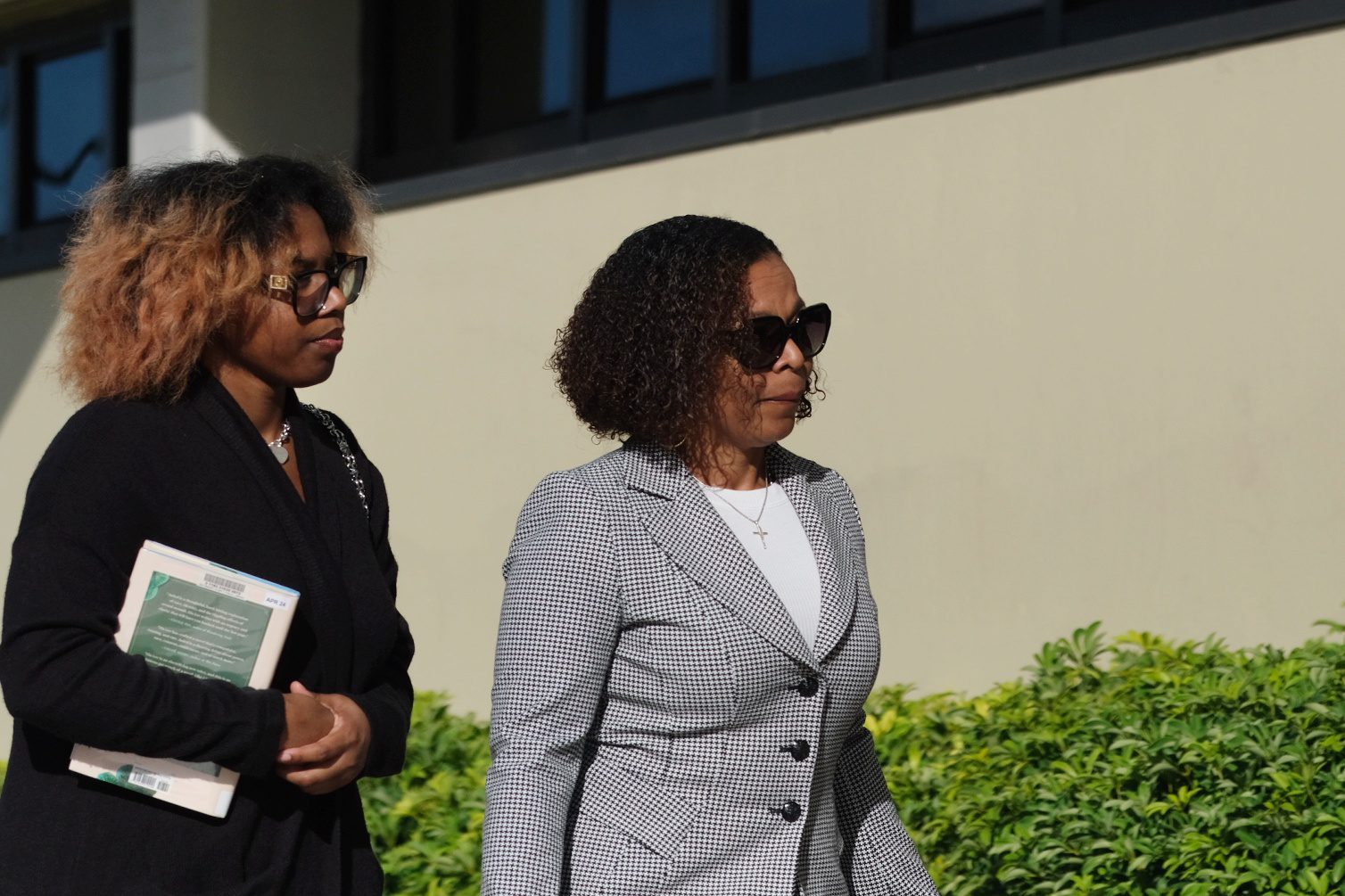
Jenifer O’Neal, the former V.I. Management and Budget director who was sentenced to seven years in prison this month, will be required to surrender herself into federal custody Wednesday. (Source photo by Kit MacAvoy)
After being sentenced to seven years in prison and multiple attempts to delay the day of her court-ordered surrender into federal custody, former V.I. Management and Budget Director Jenifer O’Neal was once again ordered to report to U.S. Bureau of Prisons custody on July 1.
A jury found O’Neal and her codefendant, former V.I. Police Commissioner Ray Martinez, guilty of honest services wire fraud, bribery concerning federally funded programs and money laundering conspiracy in December. Earlier this month, U.S. District Judge Mark Kearney sentenced O’Neal to seven years in prison for her role in a kickback scheme involving Martinez and David Whitaker, a former cybersecurity contractor, felon and cooperating witness. O’Neal’s June sentencing hearing was briefly paused after she told Kearney that she had some issues with her then-attorney, Dale Lionel Smith. After the court reconvened, she was sentenced and ordered to surrender on June 23.
O’Neal promptly fired Smith and asked Kearney for a two-month surrender date delay while she found a new attorney with whom to work on her appeal. She also referenced health problems and concerns about Smith’s representation, which Kearney rejected because she hadn’t previously raised the former issue and because, when asked, she agreed to move forward with her sentencing hearing earlier this month. Kearney gave her until July 1 to surrender.
Over the weekend, O’Neal tried to push that date again. Her current attorney, Carl Williams, argued that O’Neal is neither a flight risk nor a danger to her community and claimed that her appeal will “raise substantial questions of law and fact likely to result in reversal or a new trial.” Williams and Alexandre Dempsey, a trial attorney with the U.S. Justice Department’s Public Integrity Section, presented oral arguments in a virtual hearing Tuesday afternoon.
Kearney wrote in a subsequent order that O’Neal had “not demonstrated grounds to further delay Congress’s mandate of incarceration following conviction” and offered “no basis to question the jury’s finding of guilt on honest services wire fraud and money laundering with concurrent eighty-four month sentences.”
“The parties do not dispute Ms. O’Neal is not likely to flee or pose a danger to the safety of another person or the community,” Kearney wrote in a footnote appended to the order. “We focus on whether she has shown her appeal raises a substantial question of law or fact likely to result in reversal, a new trial, a sentence not including imprisonment, or a reduced sentence shorter than the time already served plus the expected duration of her appeal. She has not. And she largely concedes she cannot meet her burden during today’s oral argument.”
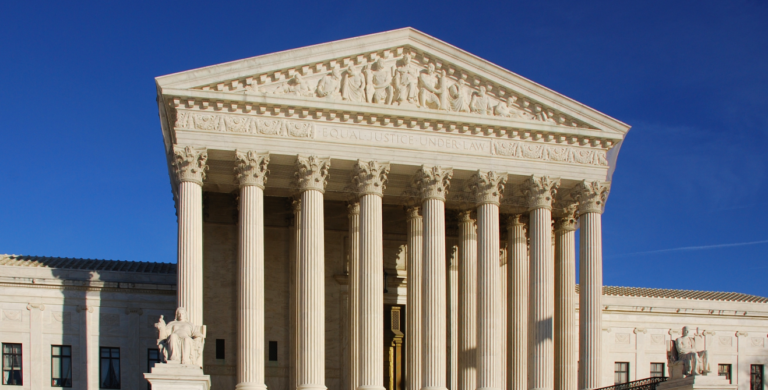
The nonprofit Right to Democracy reacted Tuesday to the U.S. Supreme Court’s majority opinion striking down President Donald Trump’s push to end birthright citizenship, calling it “significant” for people born in U.S. territories.
Neil Weare (Submitted photo)
In a 5-4 decision, the top court found that Trump’s attempt to redefine the long-settled understanding of the Citizenship Clause, with an executive order to exclude children born to parents who are temporary or unauthorized immigrants, violates the Fourteenth Amendment. Justice Brett Kavanaugh dissented but joined the 6-3 majority in finding the order must be struck down as inconsistent with federal statute, Right to Democracy noted in an analysis following the decision.
Writing for the court, Chief Justice John Roberts called citizenship “the right to have rights — to freely participate in our political community. The Framers of the Fourteenth Amendment extended that promise to every free-born person in this land. We keep that promise today.” In reaching this result, Roberts explained that because of the Citizenship Clause of the Fourteenth Amendment, “[a] child born on American soil and subject to American law was made an American citizen.”
The decision has important consequences for people born in U.S. territories, who the federal government continues to argue are not U.S. citizens based on the Fourteenth Amendment, according to Right for Democracy, which works to advance democracy, equity, and self-determination in U.S. territories.
Federal Government Has No Power to Deny Citizenship in U.S. Territories
Earlier this year, Right to Democracy filed an amicus brief on behalf of 21 current and former elected officials and judges from the U.S. Virgin Islands, Puerto Rico, Guam, the Northern Mariana Islands, and American Samoa who urged the court not to repeat the same mistakes it has made in U.S. territories.
“While today’s decision did not directly address the question of birthright citizenship in U.S. territories, the court is clear that anyone born on U.S. soil and subject to U.S. law has a constitutional right to U.S. citizenship.’ The court definitively ruled that the political branches of the federal government have no power to redefine the Citizenship Clause. This is significant for people born in U.S. territories, because the federal government continues to argue — contrary to the text and history of the Citizenship Clause — that it can turn citizenship on and off in U.S. territories,” said Neil Weare, co-director of Right to Democracy, who served as Counsel of Record for the amicus brief.
“It is also noteworthy that Justice Ketanji Brown Jackson, in a concurring opinion joined by Justice Sonia Sotomayor, also called out the Insular Cases as an example of when the Supreme Court has ‘denied Americans’ the ‘promise’ of ‘securing equal citizenship,’” said Weare.
Adi Martínez Román (Submitted photo)
“The court’s broad ruling today is a recognition that, absent very narrow exceptions, the U.S. must recognize fundamental citizenship rights to all of the people who are born under their rule. The language of the court is clear — that neither the president nor Congress has the power to unilaterally deny U.S. citizenship to someone born under the sovereignty and jurisdiction of the United States,” said Dr. Adi Martínez-Román, co-director of Right to Democracy.
“Regardless of one’s views on political status, this re-emphasizes the important constitutional limits placed on federal power when it comes to the fundamental right of citizenship. Understanding what basic rights are recognized to people born under U.S. sovereignty is critical to the conversation of self-determination,” said Martínez-Román.
Several current and former elected officials and judges who joined the brief spoke out on the decision, said Right to Democracy, including:
V.I. Delegate to Congress Stacey Plaskett: “The President and Congress have broad powers. But as the Supreme Court ruled today, absent from those powers is the ability to turn the Constitution’s guarantee of birthright citizenship on and off whenever they like. This is an important ruling for Virgin Islanders, because the federal government continues to claim our citizenship is a legislative privilege rather than a constitutional right. That’s not just contrary to the Constitution, but contrary to the 1917 Treaty of Transfer, which expressly recognized that Virgin Islanders would be recognized as U.S. citizens.”
Mary Camacho Torres, who served in the Guam Legislature from 2015 to 2023: “Today’s decision should serve as a roadmap for recognizing that people born in U.S. territories have a constitutional right to U.S. citizenship that neither Congress nor the president can take away. No elected official or legislative body should have a veto over whether someone born in Guam or anywhere else on U.S. soil is a U.S. citizen. Whatever the people of Guam decide regarding our future political status, so long as we are under the U.S. flag we should be entitled to equal citizenship and equal rights.”
Ana Irma Rivera Lassén, who served in the Senate of Puerto Rico from 2021 to 2025: “Today’s ruling confirms what we argued: the political branches do not have unilateral power to define who is and isn’t a citizen. Just as the court struck down the executive order as unconstitutional, it must eventually recognize that neither Congress nor the president have unilateral control over the question of citizenship in U.S. territories. This is also true of the colonial relationship between the United States and Puerto Rico — which is rooted in the same racist and colonial prejudices as the challenged executive order. It is time to end the federal government’s unilateral power over people in the territories and begin an informed process of self-determination and decolonization.”
Eduardo Bhatia, who served as President of the Senate of Puerto Rico from 2013 to 2017: “I applaud the Supreme Court’s powerful reaffirmation that birthright citizenship is a constitutional guarantee that no president can erase by executive order. The court’s sweeping principle — that a child born on American soil and subject to American law is a citizen — cannot logically be confined to the states. In my reading, that principle equally protects those born in the territories of the United States, including Puerto Rico.”
Zoe Laboy, who served in the Senate of Puerto Rico from 2017 to 2019: “As Puerto Ricans, we recognized firsthand what was at stake when the president sought to exclude the children of immigrants from the protections of citizenship, and the court was right to reject that exclusion today. But it should not stop there: birthright citizenship must also be recognized for those born in U.S. territories, who have historically been denied equal treatment.”
Andra Samoa, who served in American Samoa’s Fono from 2019-2022:” Federal officials cannot just redefine whether or not someone has a right to citizenship — that was the clear message from today’s decision. With so many of our American Samoan brothers and sisters facing criminal prosecution in Alaska because the federal government denies them recognition as U.S. citizens, this Supreme Court ruling is important for our community.”
Former V.I. Superior Court Judge Soraya Diase-Coffelt, who served from 1994-2000: “It is the role of a judge to say what the law is, and that is just what the U.S. Supreme Court did today. The justices were clear that no government official has the power to deny citizenship to anyone granted that right by the U.S. Constitution. This should be true not just for the Trump Executive Order, but for people born in U.S. territories.”
American Samoans in Alaska Face Possible Jail Time
Beyond calling into question whether Congress could unilaterally change the citizenship status of people born in U.S. territories, the federal government’s argument that citizenship is a congressional privilege rather than a constitutional right has led to people born in American Samoa continuing to be denied citizenship at all, Right to Democracy noted.
Right to Democracy represents Michael Pese and his wife, Tupe Smith, who — along with several family members — face felony perjury and voter misconduct charges carrying up to 5-10 years in prison, because the federal government denies them recognition as U.S. citizens despite being born on U.S. soil in American Samoa.
Unlike every other U.S. territory, where people are recognized as U.S. citizens at birth, American Samoa is the only U.S. territory whose residents are instead labeled “nationals, but not citizens” of the United States — a distinction that traces back to the same unresolved constitutional questions raised in the amicus brief filed by territorial officials in Trump v. Barbara, the nonprofit said. The day after oral argument in Trump v. Barbara, Pese filed a motion to dismiss his indictment, arguing that the Citizenship Clause already makes him a U.S. citizen.
“While we weren’t surprised the court did not address birthright citizenship in U.S. territories, its continuing failure to resolve this question leaves people born in U.S. territories vulnerable. This is especially true in Alaska, where state prosecutors are criminally targeting American Samoans because the federal government claims they are ‘U.S. nationals’ but not ‘U.S. citizens’ despite being born on U.S. soil,” said Charles Ala’ilima, an American Samoan attorney who serves on the board of Right to Democracy and as co-counsel in Alaska v. Pese and Alaska v. Smith.
“Citizenship establishes to whom the United States government is ultimately responsible. Today’s decision strengthens the argument of our clients, who face up to 5-10 years in jail, that all charges must be dropped because they are in fact U.S. citizens based on the Fourteenth Amendment,” said Ala’ilima.
“The federal government has no power to impose ‘non-citizen’ U.S. national status on people born in American Samoa or any territory, because citizenship is a fundamental individual right conferred at birth,” he said.
Additional Information
The Trump v. Barbara amicus brief is available here, an overview from SCOTUSblog here, and a two-page summary here in English and Spanish. Here is more information on the Alaska prosecution of American Samoans based on their status as “non-citizen” U.S. nationals. Right to Democracy hosted a virtual panel with legal experts discussing birthright citizenship, which is available here (transcript here).
New water and electricity meters will provide accurate readings where older ones had failed, WAPA CEO Karl Knight said. One possible meter failure has a St. Croix medical company in dire straits after potentially overpaying by more than $21,000. (Photo from WAPA webpage)
A St. Croix medical company may have overpaid the Virgin Islands Water and Power Authority $21,600 because of faulty meter readings, leaving bank accounts too dry to buy patients’ medication, an owner said Tuesday.
Joanna Garcia, the practice manager at the Family Wellness and Health Center, said she had utility payments for the business and other properties she controlled come out of her account automatically because they had remained steady for years. Then there was a sudden jump.
“I’m on autopay and I only noticed it when they sent me a bill for $7,000,” Garcia said. “We’re talking about water from $40 to $3,000, and now down to $1200.”
$3,000 worth of water would have flooded her small office, she said.
Fed up, Garcia sent an email to federal and local officials, as well as the Source, pleading for an investigation into “corruption and abuse” at WAPA. The email detailed attempts to resolve billing discrepancies with the utility going back to at least April.
In January 2025, the center providing health services to Medicaid patients received a water bill of $29. In October, it was $3,065. The electricity bill in January 2025 was about $363. A year later it was $868 and by March $7,970. All without substantial changes in use, according to the emails.
“This represents an increase of 30 to 100 times my normal usage, despite no changes in occupancy, usage patterns, or property conditions that would justify such a spike. As a matter of fact, we have closed the cafe in January 2026,” Garcia wrote in the email, copying Justice Department officials. “These amounts are grossly inconsistent with our historical consumption and cannot be reasonably explained by normal usage.”
Inoperable or otherwise faulty WAPA meters may be behind many such erratic billing issues, CEO Karl Knight acknowledged Monday. He cautioned that recognizing the issue didn’t mean it’s a quick fix.
WAPA crews plan to start installing 55,000 new, better meters in September, Knight said, but the equipment swap won’t correct roughly two years of billing discrepancies.
“Sometimes we overbill customers, sometimes we underbill customers,” Knight said Monday evening. “The erraticness in billing makes our cash management a little bit difficult. Imagine if I think you owe me thousands of dollars and it turns out that instead I owe you thousands of dollars, and that’s a big swing in our ability to forecast our revenues and to manage our cash.”
WAPA has a team going over billing errors but it’s slow going, he said. Part sleuthing in historical billing records and part estimated guessing, the back office team has a pile of bills to go through.
“Sometimes it does take a while because we do have quite a preponderance of cases that we work through as quickly as we can. Some cases are a little bit more complicated than others, and so some cases do require a little bit more investigation. Some are pretty straightforward, especially if we catch it early enough,” Knight said.
“I encourage customers in that situation to come in and sit with a customer service rep and have them walk through their billing history and see if there’s anomalies that are obvious. We can then turn it over to the customer accounts folks to investigate further and determine what level of adjustment should be made to the bill,” he said.
Even after a billing error is identified, resolving the issue can be difficult. If the customer had been under billed, WAPA could help set up a payment plan. If the customer had been overbilled, they may need to settle for an account credit with the long cash-strapped utility.
That won’t work for Garcia, who was left with $700 in the bank. She needs a refund.
“I’ve never been in that situation,” she said. “I have been a very successful business owner here because I hustle.”
Knight said the authority has issued refunds in the past but usually when an account is closed. To address cases like Garcia’s, Knight said WAPA was working with the Legislature to offer payments.
The slow process has Garcia exasperated.
“I have to shoulder all these bills on my own,” she said, saying she’s considered more than once shuttering her business but feels responsible for her clients’ well-being. I cannot let go of our mental health patients. We have patients here with major PTSD; patients with real trauma from gun violence on this island. I’m not going to shut down service to these people just because WAPA decided to bully me.”
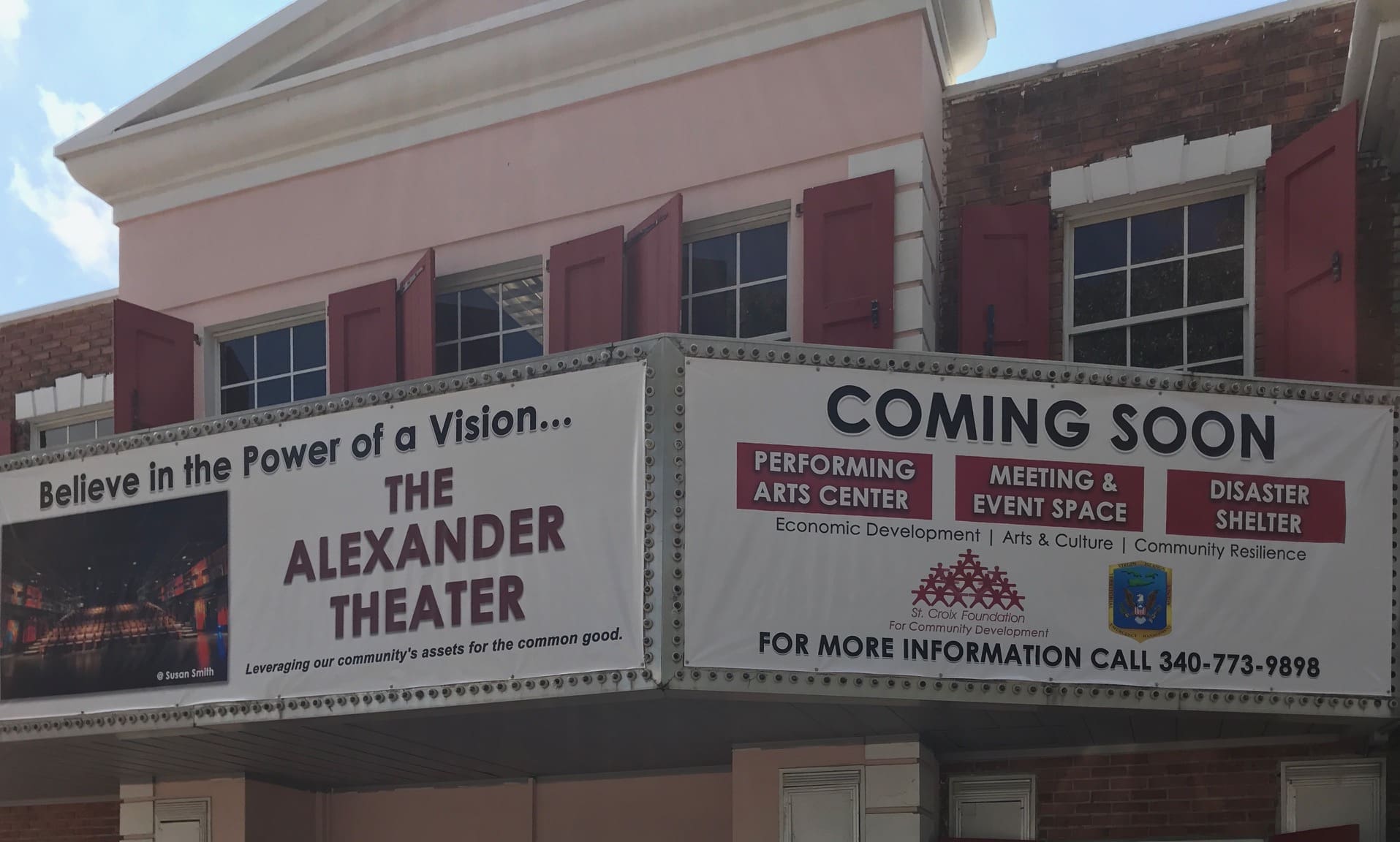
Christiansted’s Alexander Theater is slated to be restored and hardened to meet Federal Emergency Management Agency safe room standards. (Source file photo)
St. Croix Coastal Zone Management commissioners approved both a rebuild and hardening of Christiansted’s historic Alexander Theater and a reverse osmosis water purification unit in back-to-back decision meetings Tuesday evening.
The theater’s restoration will include a new, two-story addition that will house a lobby, classrooms, offices, two restaurants, a generator and pump room and storage spaces. A third-floor “utility penthouse” will house air conditioning equipment, and a reinforced cistern will also be built on the site. The facility will also meet Federal Emergency Management Agency safe room standards. After noting that the project was discussed in detail during a public hearing in October, committee chair Kai Nielsen asked representatives from the St. Croix Foundation for Community Development, which is spearheading the restoration, about its long-term maintenance plan.
“I’ve found this in every project that I’ve looked for, for the government of the Virgin Islands,” he said. “They want to build these grandiose facilities with state-of-the-art this and state-of-the-art that, but they have no maintenance at all. You cannot build these big facilities and cannot maintain them — it makes no sense.”
Foundation Vice President Haley Cutler said the maintenance budget will be “multipronged.”
“So when it is actually serving as a performing and cultural arts center — and we’re partnering with organizations who are hosting after-school programs, summer camps, as well as performances — there will be … performance rental income,” she said. “And then it’ll also be available for private events, so that’ll be part of the rental income.”
Cutler added that the foundation will also be seeking operating grants for the theater that can fund maintenance as well.
“And then during its ‘gray sky’ use as a safe room, all the costs for operating the safe room are … part of a contracted relationship with VITEMA,” she said. “And there is compensation for the use of the facility for that purpose, and there is a cost-share agreement that would go into place in terms of whose responsibilities maintaining the emergency functionalities of the shelter operations are — things like the generator and stuff like that.”
Commissioners later voted on a St. Croix Renaissance Group plan to install a reverse osmosis water purification system on the island’s southern shore. Environmental engineer Benjamin Keularts, from the consultant firm Tysam Tech, said the plan builds on an existing, damaged seawater intake system.
“The intake structure is there — with existing pumps that are damaged, they’re beyond repair — but the piping infrastructure is there,” he said. “And setup of a saltwater RO system that’s containerized should be very quick and not impact any sort of green space.”
The project’s first phase is expected to produce 200 gallons per minute of “double-pass” water meant for industrial use and 40 gallons per minute of “single pass” water that is “relatively equivalent to Safe Drinking Water Act potable water standards,” Keularts said. He added that the VI Water and Power Authority currently can’t meet the demand for “ultra-pure double-pass” water needed for industrial applications and food and beverage production.
An independent audit found the Virgin Islands Economic Development Authority remained in compliance with federal requirements while improving its overall financial position during fiscal year 2024, according to findings presented Tuesday to the authority’s governing board. (Shutterstock image)
The Virgin Islands Economic Development Authority governing board convened Tuesday morning to review the findings of an independent financial audit for fiscal year 2024, which concluded on Sept. 30, 2024.
The audit was conducted by Bert Smith and Company, a Washington, D.C. based professional services firm with deep ties to the Virgin Islands. Managing Partner George Willie and Senior Auditor Keisha Bridgewater joined the meeting on behalf of BSC to present their findings.
“We were engaged to perform an audit in accordance with auditing standards generally accepted in the United States, and in accordance with government auditing standards. We performed a federal compliance audit in accordance with uniform guidance for the year ended September 30, 2024, and this presentation is to inform those charged with governance of our findings, results, and observations,” Willie told the board.
Before revealing the audit’s quantitative findings, Willie painted a positive picture of the EDA and its compliance with relevant federal statutes that govern its operations.
“There are a number of areas of focus. Critical in these times is management’s ability to circumvent controls and override controls. We tested those. We did not find that that occurred. We also perform significant work over grant revenue in compliance with federal statutes, and we are happy to report that we found EDA to be in compliance,” he said.
Compared with fiscal year 2023, fiscal year 2024 saw an overall improvement in the EDA’s financial health.
“We have an actual decrease in the negative net position, $5.6 million in [fiscal year] 2023 versus $3.382 in [fiscal year] 2024, so we have about a $2.3 million change,” Bridgewater said.
In accounting, an organization’s net position is roughly defined as the difference between its assets and liabilities. While the EDA’s net position was negative in both 2023 and 2024, representing a financial deficit, this deficit shrank by $2.3 million year over year.
Bridgewater noted that, while the EDA’s assets decreased by roughly $13 million, this decrease was offset by a larger decrease in the authority’s liabilities.
“You can see that this larger decrease in liabilities is flowing down to your net position,” she said.
Bridgewater also pointed out the EDA’s move to convert many of its cash reserves to investments. From 2023 to 2024, the value of all EDA investments increased from $957,562 to $20,973,787 as a result of this choice.
Following the audit presentation, the board entered an executive session. No votes were taken, and the meeting was subsequently adjourned.
A St. Croix man has been sentenced to 10 years in federal prison for firing a gun inside a Christiansted restaurant during a confrontation with employees, the U.S. Attorney’s Office for the District of the Virgin Islands announced Tuesday.
Terrell E. Johnson was sentenced by Chief U.S. District Judge Robert A. Molloy after being convicted of discharging a firearm during a crime of violence inside Cruzian Bayou Bistro Restaurant in King’s Alley Walk, according to a press release from the U.S. Attorney’s Office.
According to court documents, Johnson entered the restaurant on Feb. 10, 2024, and sat at the bar. Employees told him smoking was prohibited after he began rolling a marijuana cigarette. When he refused to stop and was asked to leave, Johnson pulled a Glock .40-caliber handgun from a fanny pack and threatened to shoot one of the restaurant’s owners.
Court documents state that Johnson then fired one shot into the air inside the restaurant. As he walked away from the establishment, he fired three additional shots.