I love data. It can show us what is working and what is not working, pointing the way to effective solutions to some of our most intractable problems. Indeed, I love it so much I have spent most of my career engaged in applied research and teaching undergraduates the skills to do the same.Standardized tests are one tool the V.I. Education Department uses to assess student proficiency in math and language arts. (Shutterstock)
However, not all data are created equal. Every student of mine has heard the Jaeger saying, “Bad data in, bad data out”. In other words, poor measurement of the things we are trying to study leads to statistical results that are meaningless. If we have not measured things correctly (i.e. what is referred to a valid measures or assessments), we cannot draw meaningful conclusions from our results and when we do, they can not only be wrong but also dangerous.
Take last week’s reports in The Source and the VI Consortium on the results of the new Virgin Islands Students and Teachers Accountability System (VISTAS) as an example. The assessment of how well schools are doing is largely dependent upon student test scores. We assume these scores are telling the truth. But what if these test scores themselves are not accurate reflections of the knowledge and skills VI children demonstrate in the real world. Admittedly, this is a challenge with all tests – they are given in a contrived situation but are meant to reflect what a student can do outside of the testing situation. But it goes beyond this. Assessments can only truly begin to provide accurate results if they are given to the same type of students on whom the test was created.
To my knowledge, no tests of student learning have been created on or for students in the USVI. This alone should give everyone pause when interpreting the meaning of assessment results in the VI. Sometimes known assessments are adapted to better fit a particular culture or community which was not included in the test’s development. Unfortunately, even such adaptations fail to solve a much deeper problem with assessments developed on other populations: those who create the tests choose the standards against which a community’s students are judged. At best, it means children’s culturally relevant and valued strengths go undocumented. At worst, it means that the tests are working exactly as some are intended, labeling those who are not like the test creators (i.e. the “other”) as deficient.
The consequences of a mismatch between the test makers and test takers should never be minimized, especially given the VI’s political status as a territory. One of the processes by which colonizers maintain the status quo is by convincing the colonized that they are deficient compared to their colonizers. In the VI, it seems many do not question the characterization of our children as deficient. For example, as a commenter on the VI Consortium article mentioned above stated, “So barely over 1/2 of the students at the BEST school in the territory were proficient in English and math?No wonder nothing else works properly here.”
Such ideas even shape how we view VI children before they start school. Every few years the Kids Count Data Report, funded by the Annie E. Casey Foundation, comes out and repeats the narrative that many of our young children are not prepared for school, especially in the domain of language development. This is a particularly interesting given that the tool used by VIDE to assess kindergarten readiness was developed on monolingual children. However, most of our children come from homes where a Caribbean dialect, a creole, other language, or multiple languages and/or dialects are spoken. On such tests, young children from such early home environments often appear to be lagging behind children who come from homes where only academic English is spoken. However, a little later in development, they not only catch-up on such tests but demonstrate cognitive advantages over such peers if schools treat such experiences as assets, not liabilities.
Repeating narratives derived from suspect data is extremely dangerous. The notion that our children are deficient becomes embedded in the minds of parents, teachers, community members and, worst of all, in the minds of our children, sowing the seeds of self-fulfilling prophecies. For example, ample research confirms that teachers who have low expectations for a student’s success provide them with poorer learning opportunities than they do for a student for whom they have high expectations. Students for whom expectations are lower in turn demonstrate less motivation. Not surprisingly, parent expectations for academic achievement operate in a similar way.
None of what I write here should be taken as a negation of any efforts to ensure our children have first-rate educational opportunities in safe, clean learning environments. Often data are not needed to spot the obvious. But if we want to rate schools based on students’ test scores, use their scores as an overall barometer of what students are capable of, or use data to inform actions to assure they thrive, we better be 100% certain we are measuring what matters and that we are doing so accurately. Having no data would be so much better than relying on bad data that simply does the colonizer’s bidding.
Moving forward, community knowledge and expertise, including that from family members, teachers, elders, children, and other professionals from the VI who work with children, should be used to define the standards against which our children are judged and develop valid assessments that truly measure their accomplishment. Other minoritized communities are reclaiming their autonomy in this way. The VI must start doing the same. Our children’s lives and the future of our community depend on it.
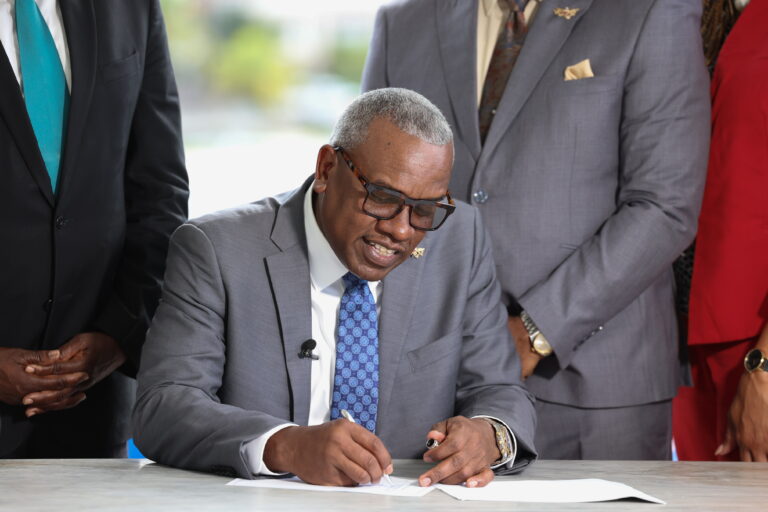
Gov. Albert Bryan Jr. has signed Act No. 9047, authorizing $2.77 million from the Budget Stabilization Fund to ensure Virgin Islanders receive half of their November Supplemental Nutrition Assistance Program benefits despite the ongoing federal government shutdown, according to a Government House press release.
“Washington may be stalled, but our responsibility to Virgin Islanders is not,” Bryan said in a press release statement. “This action makes sure families can put food on the table while Congress sorts itself out. We prepared the logistics in advance so help would move the moment the law allowed it.”
The 36th Legislature passed Bill No. 36-0202 Thursday. Anticipating approval, the departments of Finance and Human Services worked together to finalize operations before the measure reached the governor’s desk. Checks began going out by mail as Bryan signed the bill into law, the press release stated.
Bryan credited fiscal planning for making the funding possible. “Since taking office in 2019, we have budgeted deposits to the Budget Stabilization Fund, which for years was not prioritized or funded,” he said. “Responsible budgeting, and responsible use of those reserves, is for moments like this. The point is capacity to act when Virgin Islanders need us.”
Each SNAP household will receive a check equal to 50 percent of its normal November allotment, mailed to the address on file beginning Saturday. Standard postal delivery times apply, and households should verify mailing information with Human Services if their address has changed, the release stated.
For questions about November SNAP checks, residents can contact the Human Services Department hotlines at 340-772-7110 (St. Thomas/St. John) or 340-715-9090 (St. Croix), or email usvisnaprelief@dhs.vi.gov.
Bryan thanked the 36th Legislature for acting quickly and acknowledged Finance and Human Services teams for “executing an accelerated and accountable process.”
“This is what a Rainy Day Fund is for,” Bryan said. “We saved for tough moments so we could protect families when they need it most. Today, that promise is being kept.”
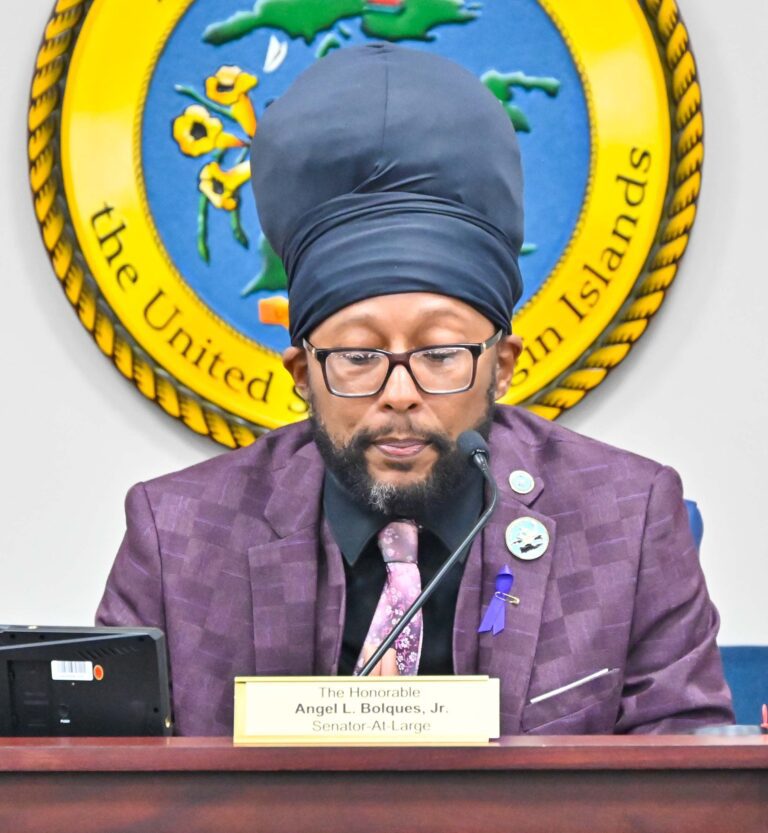
Sen. Angel L. Bolques chairs the Senate Culture, Youth, Aging, Sports, and Parks Committee Friday. (Photo courtesy V.I. Legislature)
The Senate Culture, Youth, Aging, Sports, and Parks Committee, chaired by Sen. Angel L. Bolques Jr., heard testimony Friday addressing the growing challenges affecting the territory’s youth. Testifiers discussed youth violence, education, and workforce readiness—issues linked to broader concerns of public health, inequality, and community well-being, the Virgin Islands Legislature announced in a press release.
Nicole Craigwell-Syms, assistant commissioner of the V.I. Health Department, testified on behalf of Commissioner Justa Encarnacion, calling youth violence a public health crisis rooted in poverty, trauma, and limited behavioral health resources. Nearly one-third of local children live below the federal poverty line, she said, contributing to chronic stress and aggression. Craigwell-Syms cited the lingering effects of hurricanes Irma and Maria, the COVID-19 pandemic, and community violence as major factors contributing to depression, anxiety, and suicidal behavior among young people. She highlighted several ongoing prevention efforts, including the Behavioral Health Division’s school outreach programs, the “Zen Van” counseling service, and the “Positive Vibes Alone” campaign, the press release stated.
Antonio Emanuel, executive director of the Office of Gun Violence Prevention, said the agency continues to treat gun violence as a public health issue through partnerships with law enforcement, schools, nonprofits, and faith-based organizations. The office has held more than 100 prevention events, including anti-bullying and conflict resolution programs. Sergeant Danisha Samuel-Santos, representing the V.I. Police Department’s Juvenile Bureau, said the department supports stronger interagency coordination, increased school-based behavioral health services, and expanded youth mentorship programs, the release stated.
Attorney General Gordon Rhea said youth firearm incidents and juvenile reoffending remain concerns, despite national declines in youth arrests. The Justice Department urged investment in youth engagement programs, safe spaces, and technical training, the release stated.
Chystie Payne, program and development director at My Brother’s Workshop, testified that workforce training should be viewed as violence prevention. She recommended greater investment in community-based initiatives and sustainable funding for intervention programs, the release stated.
The committee also examined broader structural issues shaping youth success, including disparities in education, employment, and vocational training, it stated.
Haldene Davis, director of the V.I. Bureau of Economic Research, reported a youth unemployment rate of 25.3 percent in 2024 and a 4.6 percent dropout rate among 16- to 19-year-olds in 2022. There were 263 youth arrests for violent crimes in 2023, he said. Davis urged targeted, sustainable programs that offer living wages and early intervention for at-risk youth, according to the release.
Davis noted that the 2020 Census recorded a population decline to 87,146 residents, though 2025 estimates show growth to 103,792. The population is aging, with 37 percent over age 55 and just 15 percent under 14. Public school enrollment has dropped by 3,000 since 2017, and while graduation rates have climbed to 83.9 percent, academic proficiency remains low, the release stated.
V.I. Education Department Assistant Commissioner Victor Somme III reported 10,263 public school students across both districts. The 2024–25 dropout rate was 3 percent, down from previous years, which he credited to early intervention strategies that allow students to retake failed courses immediately. Somme also highlighted Career and Technical Education pathways that prepare students with practical skills and industry certifications. However, he said many classrooms lack updated equipment and sufficient resources, it stated.
CTE Board Executive Director Genevieve Whitaker said programs in high-demand sectors such as health sciences, hospitality, IT, construction, and finance have expanded despite persistent instructor shortages and infrastructure challenges. She renewed the board’s request for a $600,000 appropriation to establish the “Ms. Lena Schulterbrandt CTE Fund” to support internships, equipment repairs, and instructor training, the release stated.
Labor Commissioner Gary Molloy said the Virgin Islands Workforce Development System is focused on building a “talent pipeline” aligned with key industries through the American Job Center and apprenticeship programs for ages 14–25, the release stated.
Renee Hansen, assistant commissioner of the Department of Sports, Parks, and Recreation, outlined initiatives to empower youth through safe spaces, mentorships, and recreation programs, including “Recreation-in-Motion” and the “Summer Cultural Arts Series.” She also cited challenges such as aging infrastructure, limited funding, and unequal access across islands, it stated.
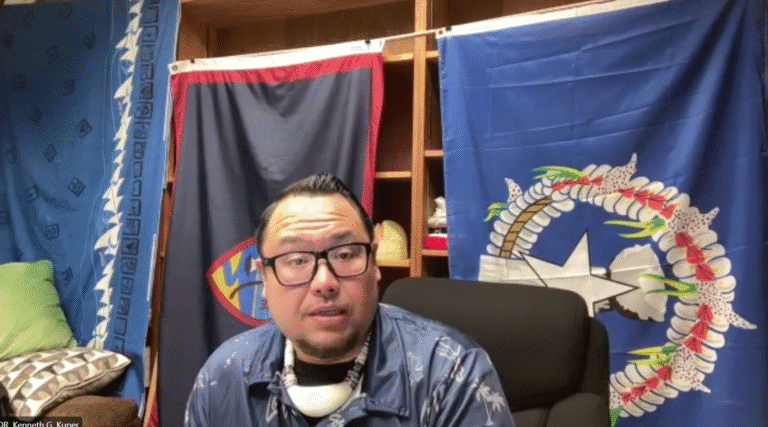
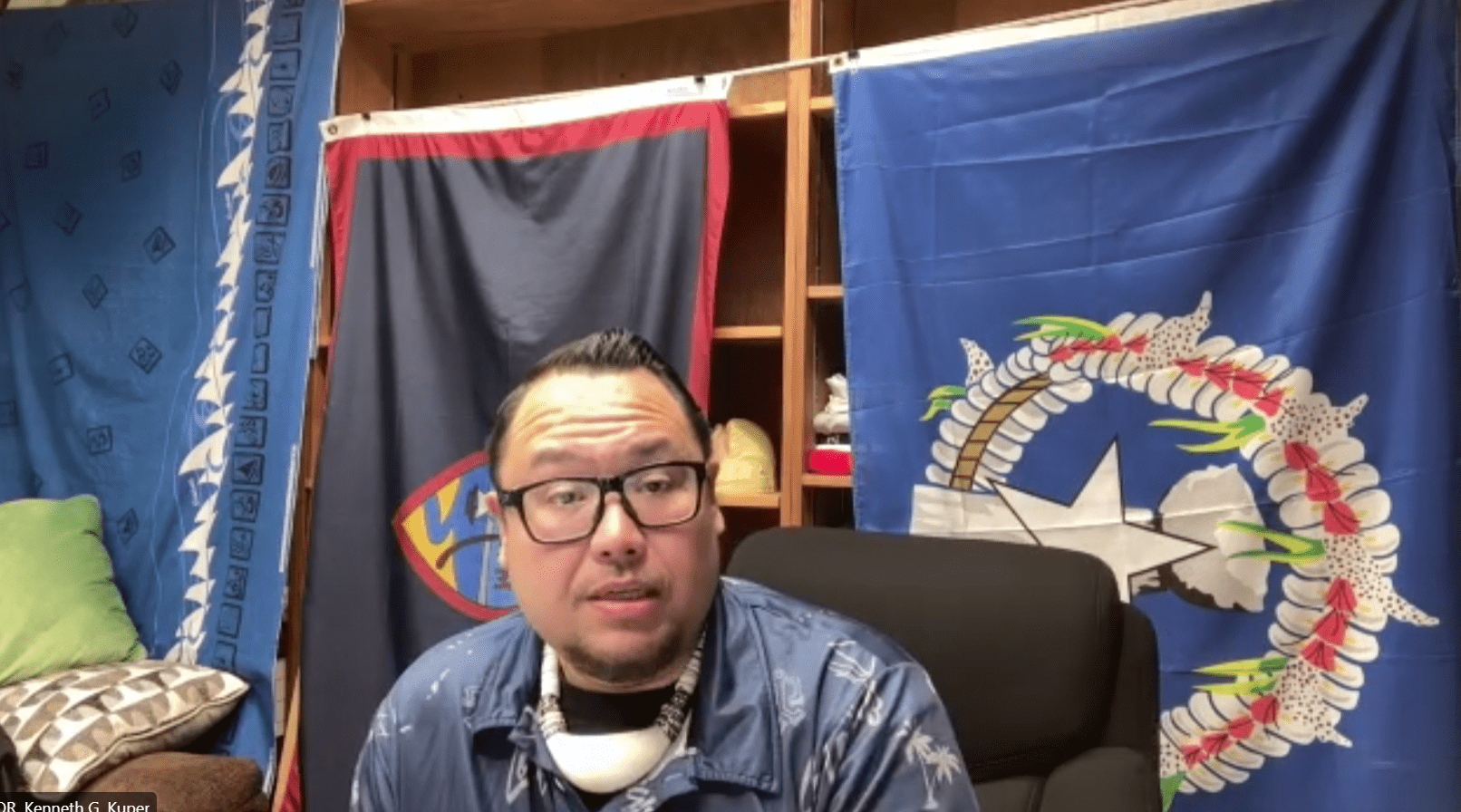
Kenneth Gofigan Kuper, associate professor of political science at the University of Guam’s Micronesian Area Research Center, speaking at Right to Democracy’s digital discussion on the history and effects of militarization in the U.S. Territories. (Screenshot from online meeting)
In a cross-territorial discussion hosted Wednesday by the advocacy group Right to Democracy, scholars and organizers from U.S. territories convened to examine both the history and contemporary impacts of militarization.
“Our focus as an organization, and the focus of this conversation, is on ensuring that people in the U.S. territories have power and agency over decisions that impact them,” said Adi Martínez Román, co-director of Right to Democracy and co-moderator of the event. “U.S. military activities are having profound impacts on the communities across the territories, and our belief is that these communities should have a say in these activities, whether as part of the U.S. political body or on their own.”
Panelists from Puerto Rico, Guam, and the Northern Mariana Islands, along with moderators from the U.S. Virgin Islands and Puerto Rico, discussed the wide-ranging impacts of militarization, from rising costs of goods to environmental and public health concerns. They also examined the historical roots of U.S. military presence in the territories.
“In our contemporary history, the change in colonial administration that occurred in 1898 created a new model of occupation and militarization,” said Melody Fonseca Santos, associate professor of political science at the University of Puerto Rico. “Puerto Ricans have a long history of engagement with the U.S. military, marked by moments of struggle, resistance, and even victories.”
That same year, Guam was ceded from Spain to the United States. “After the Spanish-American War, just as Puerto Rico and the Philippines were transferred to the United States, so was Guam, though Guam was much smaller,” said Kenneth Gofigan Kuper, associate professor of political science at the University of Guam’s Micronesian Area Research Center and director of the Pacific Center for Island Security, a think tank offering independent foreign policy analysis for the Asia-Pacific region.
“At that time, we were put under a naval government. So the highest ranking naval official pretty much ran Guam and these officers were not made for civilian government.” Kuper said.
The consequences, he explained, remain visible today. “Twenty-seven percent of our land is currently occupied by the U.S. military,” Kuper said. “A lot of times, what is good for Guam security and U.S. security will line up. But what do we do in the instances in which they don’t? … We need to exercise our agency.”
For the Northern Mariana Islands, the transition to U.S. association came through negotiation rather than conquest. “At that time, [we] negotiated our political status with the United States, which resulted in our current status as a U.S. Commonwealth,” said Theresa “Isa” Arriola, an assistant professor in the Department of Sociology and Anthropology at Concordia University.
Arriola also chairs Our Commonwealth 670 (OCW 670) on Saipan, a community advocacy group dedicated to research, education, and awareness about military planning in the Mariana Islands. “The arrangement gave us a level of political autonomy that we had not had before, yet the United States maintained complete authority, essentially over foreign affairs and defense,” she said.
Hadiya Sewer, a U.S. Virgin Islands native and co-moderator of the panel, discussed how the U.S. Virgin Islands, purchased from Denmark in 1917 for $25 million in gold, became a strategic outpost, a status whose effects can still be felt in many ways. “St. John is over two-thirds National Park, St. Croix had one of the largest oil refineries in the Western Hemisphere, and St. Thomas was a polling station during the naval administration,” Sewer said.
Panelists agreed that the effects of militarization are still felt across the territories, reshaping economies, housing markets, and local environments. “If the military is a 12-foot giant in your house, he’s bound to step on you sometimes,” said Kuper. “Our two pillars of our economy are military spending and tourism.” He noted that raising concerns can carry a social cost: “Sometimes to criticize even remotely the military, you get labeled as, like, anti-American … which is quite odd,”
Santos told the panel that U.S. military activities have left deep and lasting scars on Puerto Rico’s environment and public health, particularly in Vieques. She noted that in Vieques, “the prevalence of cancer …[is] 30% higher than in the rest of Puerto Rico,” with especially elevated rates among children and youth. She described these areas being treated as “sacrifice zones,” where residents have faced displacement, toxic exposure, and ongoing threats to water and land.
“To this day, they have not finished cleaning these territories, and there is no idea of when these territories will be transferred from the military to the communities,” she said, warning that the consequences of contamination remain unresolved, with no clear timeline for environmental restoration or the return of local control.
Santos also emphasized Puerto Rico’s ongoing strategic importance to U.S. military plans in the Caribbean. “After decades of active militarization, the strategic position of Puerto Rico has again become of high interest to the United States,” she said, citing recent troop deployments and increased use of local bases. She cautioned that these military activities carry tangible social and environmental costs.
The island’s central role in U.S. military strategy has also sparked long-standing local resistance. “In Puerto Rico, there are community groups and political organizations that have sustained a culture of anti-militarization and anti-imperial struggle,” said Santos.
She said she feels that the costs of militarization outweigh the economic benefits. “There’s no discourse of economic development that is worth it if we put into perspective that other cost. The health, the contamination, the loss of land.”
Panelists made clear that dissent is not about opposing individuals in uniform, but about standing for community agency. “To critique systems of power that are directly benefiting from violence, and war, and war preparation does not mean we’re in opposition to military personnel …” said Arriola. “It means privileging and centering self-determination, centering indigenous agency, and actually exercising the right to your political future.”
As the discussion closed, Román said, “It is very important that we have these conversations,” she continued. “It is important to recognize that the territories need to have agency, actual agency, in these decision making processes, because the decision making that is being done … is affecting our communities, it is affecting our economy, and it is subjugating our leaders and our local governments into acquiescence with models that might not be the best for the development of our people and our communities.”
A St. Thomas woman has been arrested following an investigation into the alleged non-consensual sharing of sexual images on social media, the Virgin Islands Police Department reported.
The VIPD said its Domestic Violence Unit began investigating after a male victim reported the incident to the Richard N. Callwood Command on Sept. 18. In a follow-up statement on Sept. 26, the victim said he learned from a family member that photos showing him engaged in sexual acts with a woman were circulating online. He told police he recognized both himself and the setting, identifying the location as the residence of Kalila Roberts.
According to the police report, the victim said he had questioned Roberts several times during their encounter about whether a camera in her living room was functional, and she allegedly assured him it was not. The images were later shared multiple times across various social media platforms.
On Thursday, Roberts turned herself in to detectives at the Domestic Violence Unit. Police said she declined to provide a statement under the advisement of her attorney. She was advised of her rights, detained, and charged with non-consensual dissemination of private sexual images (domestic violence), cyber harassment, cyber pornography, and disturbance of the peace.
The case remains under active investigation. Police urge anyone with information to contact 911, the Domestic Violence Unit at 340-715-5535, or the Office of the Police Chief. Anonymous tips can also be submitted to Crime Stoppers USVI at 800-222-TIPS (8477).
A woman has been arrested following a police investigation into a 2024 shooting in the Cane Bay area of St. Croix that damaged several vehicles, the Virgin Islands Police Department announced.
The VIPD said that on Sept. 15, 2024, around 7:39 p.m., the 911 Emergency Call Center received multiple reports of gunfire in Cane Bay. Patrol and Criminal Investigation Bureau officers responded and were informed that several vehicles had been struck by gunfire and that the suspects had fled the scene, according to the police report.
Investigators identified several suspects and vehicles involved. During the investigation, detectives made contact with 32-year-old Amber Stanley, who, according to police, gave false information in her statement. Detectives later obtained a warrant for Stanley’s arrest from a Superior Court magistrate judge, setting her bail at $5,500, the police report stated.
On Friday, Stanley was arrested without incident and booked. She posted bail and was released pending her Advice of Rights hearing scheduled for Monday at the Superior Court, the report stated.
Two men have been arrested in connection with a shooting that occurred earlier this month at Four Winds Plaza on St. Thomas, the Virgin Islands Police Department reported.
According to the VIPD, 21-year-old Shane Forbes and 23-year-old Elroy Brown III were taken into custody for their alleged roles in the Oct. 6 shooting incident. Both men face multiple felony charges, including illegal possession of a firearm, using a firearm during a crime of violence, and reckless endangerment. Bail was set at $100,000 for each, according to the police report.
Police said the incident occurred shortly after 1 a.m. when several men engaged in a shootout, damaging multiple vehicles in the area. No injuries were reported. “The VIPD recognizes the gravity of such incidents and is committed to ensuring public safety,” the police report stated.
The case remains under investigation as the Criminal Investigation Bureau continues efforts to locate additional suspects. The department urged anyone with information to contact 911 or Detective Y. Loblack at 340-774-2211, extension 5577. The public may also reach the Police Chief’s office at 340-774-2211 or submit anonymous tips to Crime Stoppers VI at 800-222-8477 (TIPS).
Surveillance video helped police identify and arrest a man accused of breaking a window and entering the McDonald’s restaurant at Lockhart Gardens on St. Thomas early Friday morning, the Virgin Islands Police Department reported.
Around 4:20 a.m. Friday, officers responded to a call from the 911 Emergency Call Center about property damage at the restaurant. When police arrived, they spoke with a Genesis Security guard who said he found a shattered glass window on the building’s northern side. The guard told officers the suspect, identified as Allen Springette, was not inside the restaurant but had been seen on surveillance footage breaking the window with a rock, entering the building, sweeping the floor with a broom, and then leaving through the same broken window, according to the police report.
Police later returned to Lockhart Garden after receiving another call and found Springette asleep on the ground in front of the Foot Locker store. He was arrested, advised of his rights, and taken to the Richard Callwood Command, Zone A, where he was charged with destruction of property and unlawful entry. Springette was booked and processed but unable to post $25,000 bail, police said. He was turned over to the Bureau of Corrections pending his advice of rights hearing, the police report stated.
A new public opinion survey, conducted by the University of Michigan and Island Analytics with support from UVI students, seeks to capture Virgin Islanders’ views on the territory’s political future and constitutional process. (Shutterstock image)
As the U.S. Virgin Islands moves forward with its Sixth Constitutional Convention, a new public opinion survey is underway to capture residents’ views on the territory’s political future.
The survey is being administered by the University of Michigan and will be fielded by Island Analytics, with support from students at the University of the Virgin Islands. It seeks to document how Virgin Islanders view the constitutional convention process, political status options, and broader issues of autonomy, equity, and community priorities.
The project was developed by Mara Cecilia Ostfeld, research associate professor of public policy at the University of Michigan’s Ford School of Public Policy, and Ignangeli Salinas-Muñiz, a political science doctoral candidate at the University of Michigan, in collaboration with Mayra Vélez Serrano of the University of Puerto Rico–Río Piedras.
“Your perspective is deeply valuable and it matters,” said Ostfeld. “We want to ensure that it is heard and represented and really reverberates across many institutions of power and politics.”
The effort is part of a broader comparative research project involving Puerto Rico and Guam, providing the opportunity to analyze the political attitudes of residents across U.S. territories.
“It’s about amplifying the voices of residents of the U.S. territories and ensuring that both public accounts and policy can center the priorities of territorial residents,” Ostfeld said.
The survey, which takes about 15 minutes to complete, includes both standardized and open-ended questions. Residents are asked about their awareness of the constitutional convention, political status preferences, likelihood to vote, and impressions of proposed changes.
“There are some open-ended questions about what would be important for you to see in a constitution,” said Salinas-Muñiz. “And some about what people want to see in their own spaces, even beyond this one political process.”
To ensure proportional representation, the survey uses what Richard Dorsey Jr., CEO of Island Analytics & Marketing, described as a “geographically stratified sampling approach.” Surveys are administered in person at University of the Virgin Islands campuses and key community locations, and by phone using local listings.
“We are not controlling for age or gender, but we are actively monitoring geographic balance throughout the data collection period,” Dorsey said.
Participation is voluntary and compensated with a $10 USPS money order, which is mailed to participants’ addresses after survey completion. While the survey is not publicly available online, residents who wish to participate can contact Island Analytics directly.
“If a resident hears about the project and would like to participate, they are welcome to contact me, directly at rdorsey@islandanalytics.com.” Dorsey said. “I’ll connect them with the appropriate data collector for their island if we’re still accepting responses.”
The three methods of survey administration — on-site at UVI, where student data collectors engage with participants on campus; community-based intercepts, where trained collectors connect with residents at key locations; and phone outreach, using local phone listings to reach participants directly — are designed to ensure broad, representative participation.
Organizers say the project’s success depends on trust and transparency, recognizing that some residents may hesitate to share their views due to privacy concerns.
Organizers stressed that privacy remains a top priority, all responses are anonymous and de-identified. “It’s all anonymous, all de-identified,” Ostfeld said. “We want to be super upfront and clear that this is just a tool to represent people’s opinions and preferences.”
Salinas-Muñiz believes that collaboration with local organizations will help build trust and overcome hesitation from residents. “Once you see they’re coming from Island Analytics and have a relationship to the University of the Virgin Islands, the public should take that as a signal,” said Salinas-Muñiz. “But it’s a very valid concern to be, at first, worried for your information and your safety.”
To ensure the project reflected local perspectives, organizers sought input from Sixth Constitutional Convention Delegate Imani Daniel.
“There are outside entities that come in and extract data for their benefit from the Virgin Islands. And this is not one of those instances. This is a partnership that is genuinely interested. Our partners are from Puerto Rico. They understand the colonial context,” Daniel said. “This is, in my opinion, a good-faith effort to do something benevolent and in good partnership that will move the needle for what we are trying to do here.”
Once data collection concludes, anonymized results will be released to the public, policymakers, and researchers. A second round of the survey is planned following the next constitutional vote to track shifts in community perspectives over time. To capture perspectives the survey might miss, organizers are also planning a series of focus groups in early 2026.
Daniel said that while she welcomes the survey, she is especially excited about the focus groups, which she believes will foster the kind of exchange that can lead to deeper understanding. “I think dialogue is where you find discovery,” she said. “The survey and the focus groups, from a thesis standpoint, are about political imagination … especially the focus groups, they are a place to imagine and to dream and to think big and to bounce ideas off of each other. And I don’t know many places in the Virgin Islands that allow for that right now.”
Daniel added that, unlike previous constitutional conventions, which sent drafts to the governor before seeking public input, the current effort prioritizes community engagement and feedback earlier, a shift she believes will be the reason this sixth convention is successful in its mission.
Highlighting the broader significance of the work, Salinas-Muñiz emphasized the importance of documenting residents’ perspectives: “If people’s opinions are not recorded, then others might go to political bodies or other areas and speak on behalf of residents. In these processes, their opinions might be reflected differently than they actually are. This survey is really important because it draws insights from different members of the community … it is important that their own preferences and beliefs are recorded, and others aren’t speaking for them.”
Building on that point, Ostfeld said, “There are over 4 million Americans living in U.S. territories whose voices and preferences are not being represented in our federal government. It is our responsibility to ensure that we listen to those voices, amplify them, respect them, and respond to them.”
BCB Middle School’s flag football team remained in good spirits despite a disappointing 31-12 loss against Antilles B. (Source photo by Amara Stokes Gilbert)
Antilles School’s B team celebrated back-to-back flag football wins this week against Bertha C. Boschulte Middle School (31-12) and Gifft Hill School (28-14), heading into Saturday’s Bull and Bread Bowl, where they will contend for the league championship.
On Tuesday afternoon at Fishman Family Field at Antilles School on St. Thomas, BCB’s coed squad fought hard but ultimately conceded the match 38-12 to Antilles B. The stands were packed with parents who shouted and cheered with every play.
BCB’s 8th-grade linewoman, Janica Rogers, said, “It’s tough to lose games after practicing so hard, but my favorite part of the experience is getting to compete and enjoy the game with my friends.”
Janica Rogers, 8th-grade linewoman at BCB, smiled through the tough loss and said she most enjoyed taking the field with her friends. (Source photo by Amara Stokes Gilbert)
Her teammate Jahniya Joseph added, “I’ve always wanted to play flag football, so this moment means everything to me.” Despite the tough loss, Joseph beamed with pride over BCB’s female presence on the field. When asked if she felt intimidated playing against boys, she laughed and responded, “Never!”
Antilles B seized a postgame opportunity to encourage their teammates and fellow students competing in Saturday’s bowl game. Eighth grader Braydon Richardson reminded the players, “Big games come around, and there are some big moments, but just have fun. Enjoy what you do.”
Parents lined the field as Antilles B secured a win, 31-12, against BCB at Fishman Family Field. (Source photo by Amara Stokes Gilbert)
Tre Richards chimed in with his own words of wisdom, “Never back down! Never give up! And don’t be afraid of the score!”
On Wednesday, Antilles B traveled to St. John, where they secured their second victory of the week, winning 28-14 against Gifft Hill School. Standout performances came from Tucker Edwards and sibling duo Max and Cameron Martinez. Edwards scored two touchdowns, and the Martinez brothers teamed up for another.
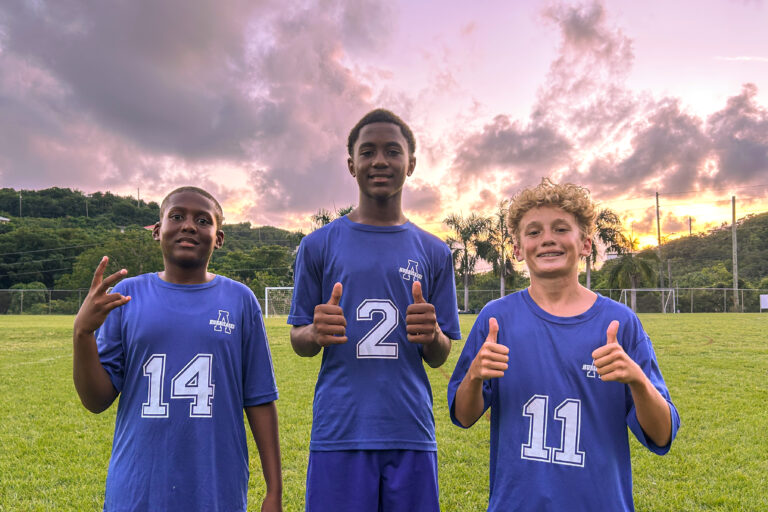
Tre Richards, Braydon Richardson, and Max Martinez celebrated an exciting victory for Antilles B on Tuesday afternoon, gaining momentum for Saturday’s Bull and Bread Bowl. (Source photo by Amara Stokes Gilbert)
The energetic squad anticipates facing off with Antilles A at the Bull and Bread Bowl to determine who will be crowned middle school flag football champions.
Quarterback Max Martinez expressed confidence in his team: “We’re looking forward to the final, and we’re ready to try and win!”
The young athletes are excited to see the stands filled with supporters at the Bull and Bread Bowl on Saturday at Lionel Roberts Stadium from 11 a.m. to 3 p.m.